
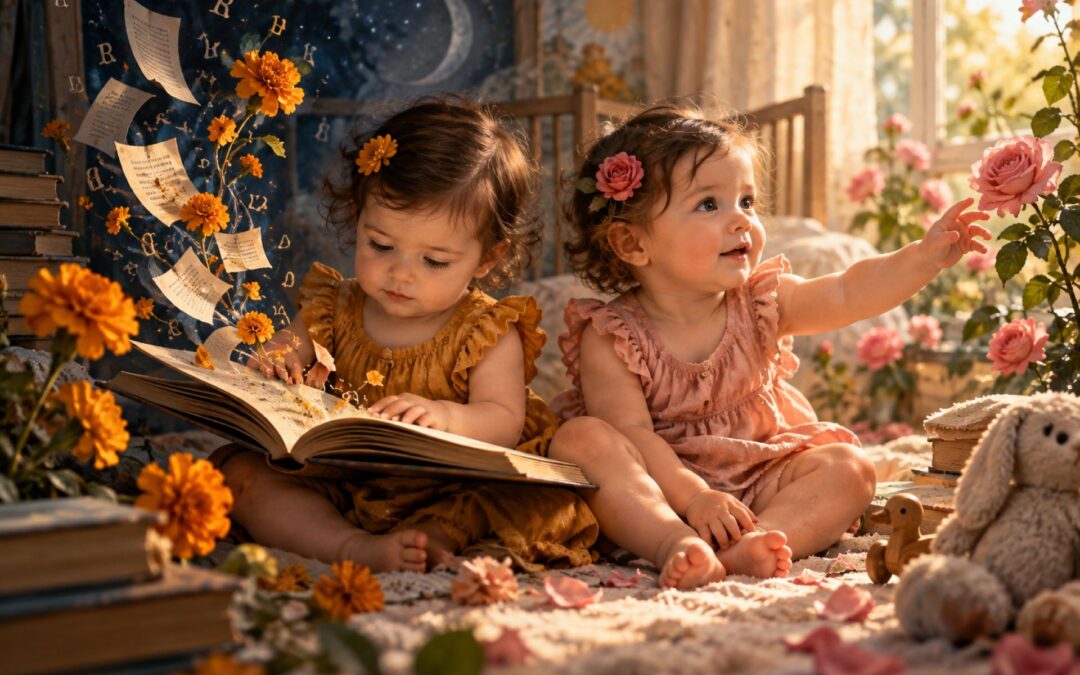
Louise Glück’s Marigold and Rose begins with an impossible idea and treats it as completely natural: two infant twin sisters who cannot yet read or properly speak possess elaborate inner lives, and one of them is already trying to write a book. Marigold is reflective, anxious, suspicious of easy explanations, and drawn toward words she does not yet possess. Rose is sociable, adaptable, physically confident, and fascinated by the people immediately around her. Between them, Glück constructs a miniature world in which learning to crawl, hearing an adult phrase, losing a grandmother, climbing a staircase, or turning one year old can become a problem of identity, time, mortality, language, and art.
Published by Farrar, Straus and Giroux in 2022 as Marigold and Rose: A Fiction, the book is extraordinarily short, but its small scale is deceptive. It follows the twins through roughly their first year of life while Marigold’s imagined book gradually takes shape alongside them. What first appears to be a charming fantasy about precocious babies becomes an origin story for consciousness and authorship: experience disappears almost as soon as it arrives, memory begins because things no longer remain present, and words offer Marigold a way to preserve what time will otherwise take away.
This article contains full spoilers, including Grandmother’s death and the complete ending.

Marigold and Rose: Detailed Summary
The book is arranged in ten short chapters rather than around a large conventional plot. Its movement comes from accumulation: the twins acquire mobility, memories, words, distinctions between people, and increasingly complicated ideas about time. At the same time, their domestic world becomes less secure as they discover that parents can leave, grandmothers can die, homes may change, and being older does not simply mean becoming more capable.
Marigold’s unwritten book runs through this development. She begins wanting to write before she can read, then acquires a subject, worries about truth, searches for an opening, and eventually confronts the problem of how a story can end. Her artistic development gives the episodic first year a second structure beneath the chronology of infancy.
Two Babies, Two Ways of Being
In the opening chapter, Marigold is absorbed in an alphabet-style book while Rose feels neglected. Neither twin can actually read, but the distinction between them already seems complete. Rose likes people, attention, baths, praise, and participation; Marigold is capable of disappearing into an interior activity even while sitting beside her sister in the playpen.
Marigold is also already writing a book in her head. The fact that she cannot read presents an obvious difficulty, but she treats it as temporary: the book exists conceptually before she has the language required to produce it. She believes books need animals as well as people, partly because animals seem less judgmental than humans. This matters because Marigold already measures herself against Rose and usually finds herself inferior.
Rose can drink neatly from a cup and appears to be the naturally “good” baby. Marigold makes messes and imagines that her name would be accompanied by a series of marks indicating that she needs improvement. Yet the comparison works in both directions. Rose sees Marigold’s absorption and resourcefulness and feels that she herself lacks something important. Each sister initially interprets the other’s strength as evidence of her own deficiency.
The chapter then expands abruptly from the playpen to time itself. Day and night accumulate into something the twins cannot yet fully understand. Marigold imagines adulthood and immediately realizes that having a life implies eventually dying. She imagines herself and Rose as grown women living apart, still communicating across distance. Separation, therefore, enters the book almost as soon as twinship does.
Rose answers the imagined problem differently. Her instinct is to trust, attach herself to people, and accept the possibility that closeness may eventually result in loss. Marigold looks forward far enough to see death; Rose remains more willing to inhabit relationship in the present. The book’s central contrast has been established, but already neither perspective is treated as complete.
The second chapter moves outside to Mother’s garden. The twins remain on a blanket because they cannot yet crawl, and that temporary physical limitation creates a state of safety they will only understand retrospectively. Crawling, walking, climbing, speaking, and outgrowing clothes will all feel like victories when they occur, but each victory will also remove something that cannot be recovered.
Mother’s garden introduces another pattern that will recur throughout the book: adult language creates as much confusion as clarity. She explains that nasturtiums can be eaten and describes their taste as magical, while other flowers are potentially dangerous. To the twins, this makes the garden difficult to categorize. They are being taught words and rules, but the world refuses to divide itself into simple categories.
Rabbits then eat much of the garden. Mother has taught the twins that sharing is good, yet she is visibly distressed when forced to “share” her flowers with the rabbits and protects what remains with wire cages. The twins notice the contradiction even if they do not yet possess a sophisticated language for hypocrisy. Glück repeatedly uses such moments to make ordinary adult speech appear strange when examined literally.
The chapter ends with the family returning indoors as Father comes home from work. His arrival produces intense excitement in the twins, who expect to be lifted into the air one after the other. Rose interprets the moment from inside the present and feels that they are thriving. Marigold agrees, but she characteristically sees even happiness from a longer temporal distance.
Dreams, Memory, and Mother’s Childhood
In “Marigold’s Dream,” Marigold imagines that she is a single baby and Rose was never born. The apparent fantasy of having Mother and Father to herself quickly turns frightening. Marigold cannot experience her sister’s absence as liberation; she worries instead that she has somehow caused Rose not to exist.
The dream exposes what her waking envy obscures. Marigold may regard Rose as more lovable, more competent, and more naturally successful, but her own identity has already formed around the existence of her twin. She remembers the difficulty of climbing the enormous stairs, the effort required to hoist herself onto each step, and the humiliation of eventually falling while Rose watches. Her sense of herself is inseparable from comparison, but comparison is also inseparable from attachment.
Rose’s view of Marigold is almost the reverse. Mother and Father recognize Marigold’s envy, but Rose reveres her sister. She experiences Marigold’s concentration and inwardness as a kind of superiority rather than deficiency. When Marigold sleeps restlessly after her dream, Rose wants to comfort her but cannot reach across the bars separating their cribs. The scene turns a piece of nursery furniture into a simple physical image of a larger problem: intimacy does not eliminate separateness.
The next chapter gives Marigold’s imaginary book a title: The Childhood of Mother. This is a crucial development because Mother’s existence before motherhood has become a mystery. The twins know that Mother was once a baby and that Grandmother was once responsible for her, but they have almost no information about that vanished period. Marigold’s first serious artistic subject is therefore something inaccessible to direct knowledge.
At the same time, the twins discover the implications of their flower names. Rose is perennial, which Marigold understands as continuity: a rose remains itself in one place and grows. Marigolds are annuals that reseed, producing multiplicity. Mother regards this as cheerful, but Marigold experiences it as an identity crisis. If a marigold returns as many marigolds, which one is she?
Her solution is connected to writing. Rose seems able simply to stand for Rose, while Marigold wants something outside herself that can establish continuity. Her imagined book can become that object. She proposes taking things that happened to the twins and changing their names to Mother, thereby inventing Mother’s childhood from available experience.
Rose objects that stories should be true. Marigold distinguishes between literal reality and a different kind of truth: the events may not have happened to Mother, but they can still express something true. In an extremely compressed form, Glück has turned the babies’ disagreement into a theory of fiction.
The chapter also introduces a second problem of knowledge. Marigold can hear her own thoughts but cannot hear Rose’s, even when their heads are physically close. She wonders why this is so and is surprised that Rose nevertheless speaks first. Thought cannot simply be inferred from visible behavior, and verbal fluency does not map neatly onto inward complexity.
Rose, meanwhile, worries about how the rest of the world will understand Marigold. Her response is not to distance herself from the strange sister but to identify with her more strongly. Twinship increasingly becomes a chosen solidarity as well as a biological fact.
“Forward Motion” broadens these questions from the sisters to the whole family. Mother wants to buy a house; Father tends to cooperate with new plans until his characteristic tendency to stop takes over. Mother represents motion, planning, and action, while Father is temperamentally inclined toward delay and hesitation.
The twins themselves appear to be evidence for forward motion. They began life as tiny premature babies and are now capable of crawling, climbing, drinking from cups, and producing increasingly varied sounds. Yet Marigold complicates the idea of progress. At the top of the stairs she sometimes stops and looks back at the distance she has traveled.
The staircase therefore becomes more than a physical achievement. It gives Marigold a position from which forward movement and memory can coexist. She crosses thresholds but also wants to retain where she has been.
Rose is becoming increasingly vocal, though her communication consists more of torrents of sound than recognizable language. She wants other people to understand her and becomes angry when they cannot. Marigold reacts differently to the frustration of communication and considers skipping speech entirely until she can write.
Memory begins to become possible at the same time. Marigold reasons that people remember things because things change. There is no need to remember what remains directly in front of you. Memory becomes necessary only when the present turns into the past, which means its emergence is already connected to loss.
At the end of the chapter, the book reaches farther backward than Marigold can. Rose, as the slightly older twin, imagines a first memory from birth: she must breathe first and then somehow teach Marigold. The moment is comic, but it also fits Rose’s deepest role. She may appear less contemplative, yet her attachment to her sister repeatedly takes the form of responsibility.
Loss, Language, and the Unwritten Book
The emotional center of the book arrives abruptly when Grandmother dies. Mother tells the twins that Grandmother has gone to Heaven, where she is happy, but the explanation fails almost immediately under the pressure of their literal reasoning. Grandmother loved the twins; why would she be happier somewhere that does not contain them?
The babies begin recognizing a special category of adult explanation designed for children. These explanations often postpone understanding into a future when they are supposedly old enough to grasp things. From the twins’ perspective, however, such explanations can sound suspiciously close to not telling the truth.
Mother grieves visibly. Father explains that she is sad because she has “lost” Grandmother, but that language creates another contradiction because Mother claims to know exactly where Grandmother has gone. She also says that remembering Grandmother keeps her present in another sense. The twins therefore confront multiple meanings of presence and absence before they can resolve any of them.
The loss coincides with Mother’s attempt to return to paid work. She says that she wants to contribute to the household, which strikes the twins as absurd because they already understand her work as Mother to be a contribution. Through their literal perspective, the adult distinction between paid labor and unpaid care appears arbitrary.
Mother eventually decides to postpone returning to work until the twins are older. This does not make growing older sound attractive. They have already been told that they will understand death when they are older, and now being older is also associated with Mother leaving for longer stretches of time.
The chapter joins these experiences into Marigold’s darkest realization. Grandmother is gone, the apartment may eventually be gone, diapers will disappear, childhood conditions will disappear, and the twins themselves will continue changing whether they want to or not. Rose can still play peacefully in the bathtub with a squirting elephant while Marigold looks at the same world and recognizes impermanence.
Yet Marigold discovers a counterforce. While everything disappears, she is acquiring words. Her vocabulary remains tiny, but she understands that the process can continue indefinitely. The world will vanish piece by piece, and she will accumulate the language required to write about it.
The next chapter, “Once Time,” concentrates this idea into the problem of beginning a book. Marigold first settles on a conventional opening equivalent to “long ago,” then stops. Her inability to continue makes her recognize Father’s hesitating temperament in herself.
Another familiar story opening troubles her more deeply: “once upon a time.” The phrase is ordinary to adults but nearly nonsensical to the twins. Father tries to explain “upon” by separating it into spatial concepts such as up and on, but the explanation never quite works.
“Once” makes more sense because Marigold hears the idea of one inside it. She also understands time through the repeated movement between waking and sleep. From these fragments she forms her own expression, “Once time,” accidentally producing a phrase that captures something central to the book: what occurs in time happens once and cannot be recreated in exactly the same form.
Marigold then stops trying to force the book. Its existence feels real to her, but its words are not yet available. She decides that she can wait until the book is ready to speak, just as she and Rose must wait until their own internal experience can become language.
“The Winged Soul” shifts attention toward Rose and makes the apparently simple opposition between the sisters much less stable. Everyone thinks Marigold lives in her head while Rose lives in the world. Rose herself sometimes envies the protected concentration of inwardness, especially because she experiences ordinary social life as exposure to the metaphorical wind and rain.
Rose’s sociability appears natural, whereas Father’s social competence has been acquired through effort. Although strangers might assume that Father resembles Rose, Rose recognizes a deeper similarity between Father and Marigold. Both are quiet, resistant, inclined to stop, and capable of surprising depths of tenderness.
This troubles Rose because she fears she is too simple. She is pleased to resemble Mother but worries that lacking Father’s temperament leaves her less complex. Her self-doubt mirrors Marigold’s envy from the opposite direction: Marigold thinks Rose does everything easily, while Rose suspects that ease might indicate shallowness.
Rose watches Marigold practice coloring inside the lines and understands that obedience is temporary. Marigold is learning control so that she can eventually violate it deliberately. Rose therefore understands her sister’s artistic temperament more clearly than Marigold understands Rose’s social one.
She imagines Marigold as possessing a winged soul and is pleased that the metaphor sounds like something Marigold might think. The supposedly less literary twin has produced a metaphor of her own. Glück quietly defeats the easiest interpretation of the sisters by giving each qualities supposedly belonging to the other.
“The Good Provider” continues dismantling rigid categories. Mother describes Father as a good provider, and the twins take the phrase literally: Father has somehow provided Mother, after which Mother provided them. Adult economic language becomes a family genealogy.
The household seems divided into pairings. Rose belongs especially to Mother, while Marigold appears closer to Father. Yet these alignments never supersede the twins’ own attachment. Rose has Marigold and Marigold has Rose, which the book treats as a more fundamental arrangement than either child’s preferred parent.
Mother and Father had expected twins to resemble two copies of the same baby, but difference was immediate. Now Rose is learning to talk while Marigold is learning to watch. Mother calls Marigold the thinking one, implicitly leaving Rose to occupy everything outside thought.
Both twins recognize why the distinction is inadequate. Rose fears that “everything else” somehow counts less than thought, while Marigold understands that everything outside invisible thinking is, in another sense, nearly everything. Their opposing insecurities again reveal the danger of classifying one sister through a quality the other supposedly lacks.
Marigold returns to her alphabet book. Each letter occupies its own page before joining the others to form an alphabet, after which the letters can break apart and recombine into words. Even a temporarily unused letter will eventually become necessary. For a child worried about usefulness, identity, and disappearance, this offers hope: separate units do not have to remain isolated, and meaning can arise through arrangement.
Rose ends the chapter delighted by something much more immediate. New shoes have altered the appearance of her feet so completely that they seem like different objects. Marigold dreams about systems of language while Rose marvels at the transformation directly in front of her.
The First Birthday and the Beginning
The final chapter opens when the twins suddenly “become” one. The phrase immediately creates problems for Marigold. If they are now one, what were they before? And how can two babies become one when, in another biological sense, they began as a single fertilized egg before becoming distinct individuals?
The birthday turns ordinary arithmetic into metaphysics. Completing twelve months somehow produces the number one, after which the twins can begin accumulating the months that will eventually make them two. Marigold understands the counting but not the deeper logic of identity implied by the language.
The party intensifies the sisters’ differences. Rose enjoys frosting, crumbs, visitors, improvisation, and sensory activity. Marigold sits amid what she perceives as disorder, disturbed by the imprecision of adults who call the twins animal names despite their obvious humanity.
After the guests leave, Rose tries to help Marigold with the ending of her imagined book. She suggests putting a party into it, partly because parties introduce people and therefore create more opportunities for events. Rose even thinks that a cheerful party might provide a bright ending.
Marigold rejects the idea. She is only one year old and cannot speak, yet she already holds herself to artistic standards that she cannot possibly satisfy. She envies Rose precisely because Rose seems able to participate without constantly measuring herself against an imagined future perfection.
Rose proposes a simpler ending: the characters could just go to bed because that is what the family normally does. The twins do go to bed, but Marigold still feels the story cannot end there. It is too early in every sense.
Unable to sleep, she returns to her possible openings and discovers that neither solves the problem. Then the structure becomes clear to her: what she has been treating as an ending is actually a beginning.
Marigold finally dreams that she is writing a real book that other people can read. Nothing obstructs her—not even words. She writes throughout the night, and morning becomes the end. The phrase resolves the book without closing the life it describes: morning ends the dream and the darkness, but it simultaneously begins another day.
Marigold and Rose: Character and Twinship
Marigold and Rose initially appear to have been designed as opposites. Marigold is inward, Rose outward; Marigold thinks, Rose participates; Marigold worries about the future, Rose adapts to the present. Glück needs that contrast because twinship allows her to divide different modes of being between two children who nevertheless share almost everything else.
Marigold experiences herself primarily through insufficiency. Rose drinks better, charms people more easily, adapts more gracefully, speaks first, and seems able to enjoy experience without interrogating it. Marigold responds by retreating into thought, but her inwardness is not simply compensation for social difficulty. It becomes a genuine imaginative vocation. She watches, remembers, categorizes, doubts explanations, and gradually discovers that writing might preserve what experience cannot keep.
Her anxiety is inseparable from that vocation. Marigold is the twin most sensitive to disappearance because she habitually extends the present into the future. A pleasant day becomes a day that will end; infancy implies adulthood; adulthood implies death. Even success creates the possibility of looking backward and seeing what has been left behind.
Rose initially seems freer because she does not carry this temporal burden with the same intensity. She likes strangers, praise, baths, shoes, parties, sounds, and the physical immediacy of the world. Her intelligence often expresses itself socially rather than analytically. She knows how to produce warmth and how to respond to other people before she understands the concepts Marigold is trying to solve.
Yet Rose is not the uncomplicated “heart” beside Marigold’s “brain.” She worries that her social fluency may make her shallow. She studies Father because his quiet tenderness reveals dimensions that other people might miss, and she fears she lacks similar hidden complexity. Her metaphor of Marigold’s winged soul proves that she possesses an imaginative life of her own.
The most important fact about the sisters is therefore not opposition but reciprocal misrecognition. Marigold looks at Rose and sees effortless completeness. Rose looks at Marigold and sees concentrated depth. Each uses the other as evidence of what she believes she herself lacks.
Their attachment is strongest precisely where their difference is greatest. Marigold’s dream of life without Rose turns into guilt and terror because she cannot imagine herself coherently as a solitary child. Rose, meanwhile, repeatedly takes responsibility for Marigold, from the imagined first breath after birth to her desire to protect a sister she believes the world may misunderstand.
This makes the line between two people and two possible selves deliberately unstable. Teju Cole’s reading of the twins as two personae within Glück is persuasive because the book repeatedly distributes contrary temperaments between them: withdrawal and sociability, stopping and motion, language and action, apprehension and trust. Fiona Sampson similarly reads their doubled consciousness as capable of suggesting two simultaneous versions of a female self.
But treating Marigold and Rose only as symbolic halves would flatten the fiction. Their relationship works because they are also distinct children with different pleasures, frustrations, loyalties, and misunderstandings. Rose does not exist merely to embody the world Marigold cannot inhabit, and Marigold does not exist merely to supply Rose with depth. Glück repeatedly gives each twin access to the qualities supposedly belonging to the other.
The title of the last chapter, in which Marigold and Rose “are one,” captures this double structure. They are one family unit, one pair, and once shared a biological origin, yet becoming individual people is the whole trajectory of the book. Their intimacy does not abolish difference. It makes difference survivable.
Mother, Father, and the Family World
The parents are named only through their roles, which makes them partly archetypal from the babies’ perspective. Mother initially represents energy, planning, explanation, and forward motion. She gardens, considers moving house, tries to teach moral rules, explains death, contemplates returning to work, and repeatedly attempts to convert the confusing world into language suitable for children.
Her authority is affectionate but not absolute. The twins notice contradictions that Mother herself may not resolve. She praises sharing but protects the garden from rabbits, explains Heaven in ways that do not survive literal scrutiny, and describes paid work as a contribution despite already doing the unpaid work around which the babies’ entire lives are organized.
Mother therefore becomes the twins’ first source of language and one of their first demonstrations that language cannot guarantee certainty. Her explanations matter, but they are provisional. The babies keep testing words against experience and discovering gaps between the two.
Father is less associated with motion. He cooperates with plans and then sometimes stops, a disposition Marigold recognizes in herself when her book refuses to progress. Yet his hesitation is not presented simply as weakness. He is patient, observant, soothing, and able to let other people find their way rather than constantly forcing movement.
The division between Rose/Mother and Marigold/Father gives the twins another system through which to understand themselves. Rose resembles Mother’s openness to people and movement; Marigold resembles Father’s reserve and tendency to pause. But the family repeatedly exceeds its own classifications. Rose wants qualities she associates with Father, and Marigold sometimes needs Mother desperately.
Grandmother’s death changes the emotional status of this family world. Before it, separation is imaginable or temporary: Father goes to work and returns to celebration; the twins may eventually live apart but can imagine writing letters. Grandmother introduces departure without return.
Other Grandmother occupies a different kind of distance. She lives far away and is less interested in baby life. The distinction between the two grandmothers helps the twins discover that family relationships are neither interchangeable nor guaranteed by titles alone.
The physical world surrounding them is deliberately small. There is the playpen, blanket, garden, cribs, bath, stairs, park, apartment, possible future house, and eventually the birthday party. Glück does not build a large setting because infancy does not require one; the limited domestic environment is effectively the twins’ cosmos.
Within that small space, almost every object can become conceptual. A crib becomes a barrier between loving sisters. Stairs become a measure of development and a vantage point for memory. A garden becomes a lesson in beauty, danger, appetite, morality, and contradiction. A front door becomes significant because people can pass through it and disappear.
The family is therefore not merely the background against which the twins think. It is the first system they are learning to interpret. Mother, Father, Rose, and Marigold form a structure in which everyone believes they know everyone else, yet the story repeatedly demonstrates how much remains invisible even between people who love one another.
Time, Memory, Mortality, and Growing Up
Time enters the book before the twins have a practical need to understand clocks or calendars. Day becomes night, weather changes, naps occur, adults leave and return. Marigold quickly senses that these repetitions add up to something larger, and once she recognizes time she immediately encounters mortality.
Her reasoning is simple and devastating: if she will become an adult, her life has a direction; if it has a direction, it must also have an end. The book never treats death as an isolated subject introduced by Grandmother’s later disappearance. Mortality is already embedded in the idea of development.
Growth therefore has a double meaning. The twins celebrate new capacities—crawling, climbing, speaking, drinking, eventually walking—but every capacity removes a previous condition. The safe blanket matters because they cannot crawl away from it. Once mobility arrives, that safety cannot be restored without also giving up the freedom they have acquired.
Marigold is particularly sensitive to this exchange. She pauses at the top of the stairs and looks downward, turning physical progress into retrospect. The gate in front of her prevents a fall, but the position itself allows her to perceive a distance between where she is and where she was.
Memory emerges from the same structure. Marigold concludes that people remember because things change. What remains immediately present does not need to be recalled; memory becomes necessary when experience has disappeared.
This makes remembering both consolation and evidence of loss. To possess a memory is to retain something, but it also confirms that the thing is no longer available in its original form. The book’s treatment of memory anticipates the function Marigold will eventually assign to writing.
Grandmother’s death transforms the twins’ theoretical understanding into experience. Adult euphemisms cannot remove the central fact that someone who used to be available is no longer present. Mother says Grandmother persists through memory, which gives the twins a model of symbolic continuity, but memory does not erase absence.
Mother’s attempt to return to work compounds the lesson because another person now walks out the door during the same period. Even though Mother comes back and later postpones working, the twins understand that their world is becoming less stable. Being older appears to mean accumulating knowledge partly by accumulating departures.
Marigold eventually generalizes the pattern: the apartment, diapers, current routines, and familiar versions of the people around her will disappear. The stuffed bear may survive by moving with them and even receiving new stuffing, but continuity increasingly requires maintenance rather than permanence.
The first birthday makes time measurable. Twelve months become one year, after which another accumulation begins. But the neatness of counting does not solve Marigold’s problem. Numbers can mark the passage of time without explaining what it means for a person to remain herself through change.
The birthday also exposes the strange grammar of becoming. To “become one” suggests that one is a new state, yet the twins have always existed as themselves and in another sense were once more literally united than they are now. Time makes them older, but age does not provide a simple answer to whether they are one, two, the same, or continuously becoming different.
Glück’s central insight is that growing up cannot be represented as pure acquisition. Every gain creates a new relation to loss. Mobility ends one kind of safety, language replaces a wordless state, memory begins because moments vanish, and the first completed year proves that an entire portion of life has already become the past.
Language, Truth, and the Making of a Writer
Marigold’s desire to write before she can read is the book’s most obvious impossibility, but it also provides its deepest structural logic. She experiences the book before she possesses its sentences. Form, subject, and necessity arrive first; vocabulary must catch up later.
The title The Childhood of Mother emerges from a gap in knowledge. Marigold understands Mother primarily as Mother, yet she learns that Mother once occupied the position the twins now inhabit. That missing life fascinates her precisely because it cannot be recovered directly.
When Marigold decides to use the twins’ experiences and rename them as Mother’s, Rose objects on the grounds of truth. Marigold’s answer distinguishes fictional truth from factual correspondence. A story can be invented at the level of events and still express something recognizable about experience.
That distinction makes Marigold and Rose itself easier to understand. The babies obviously do not possess Glück’s syntax and philosophical vocabulary in any realistic developmental sense. The fiction is “true” only if its artificial speech reveals something about dependence, learning, difference, loss, and consciousness that a literal transcription could not.
The twins repeatedly discover that words are unstable. “Magic” refers both to extraordinary forces and to the taste of flowers. “Sharing” seems morally required until rabbits eat Mother’s garden. “Lost” describes a dead person whose supposed location is known. “Contribution” suddenly appears to mean paid labor rather than care. “One” can refer to age, number, unity, or prior biological identity.
The comedy depends on literal interpretation, but the literalism also exposes how much adult speech relies on convention. Adults usually do not stop to examine the contradictions embedded in phrases because they already know how the phrases are meant to function. The babies have not yet acquired that habit and therefore keep reopening language.
Marigold’s difficulty with “once upon a time” is the purest example. “Upon” becomes nearly impossible because its storybook function cannot be reconstructed merely from physical demonstrations of “up” and “on.” “Once,” however, offers a concept she can understand: something happens one time and cannot happen identically again.
Her shortened phrase “Once time” is technically wrong and conceptually exact. It binds singularity to temporality. What occurs in time is unrepeatable, and that unrepeatability is exactly why memory and storytelling matter.
Marigold also learns that artistic control cannot be absolute. She wants to begin correctly but repeatedly stops. Eventually she decides to wait until the book is ready rather than treating writing as an act of pure will.
The parallel with infancy is explicit. Marigold and Rose possess internal experiences before they can express them in words. The book in Marigold’s mind likewise exists before it can speak. Authorship becomes another form of development: something is forming invisibly until language makes it communicable.
The alphabet book offers a further model. Individual letters appear separate and incomplete, but together they create a system capable of generating innumerable words. Even letters not presently in use retain future possibility. Marigold, who often fears being inadequate or misplaced, finds comfort in a structure where usefulness can remain temporarily hidden.
Learning to color inside the lines supplies another artistic lesson. Rose understands that Marigold’s discipline is not obedience for its own sake. One learns control so that breaking the rule can eventually become intentional rather than accidental.
Glück’s own account of the book’s origin gives this metafiction an additional resonance without reducing it to autobiography. In an Associated Press interview about the origins of Marigold and Rose, she explained that she became absorbed in videos of her twin granddaughters during the pandemic and that chapters of the fiction then arrived with unusual speed. The real writer and fictional baby writer are not the same figure, but both versions of composition involve watching experience until a form begins to announce itself.
Marigold’s final dream completes this development. Earlier, words are the obstacle between the imagined book and the readable book. In the dream, she writes so freely that even words cannot stop her. The fantasy is not merely about becoming fluent; it imagines a state in which intention, language, and form are no longer fighting one another.
Names, Flowers, Books, and Other Motifs
The twins’ flower names establish one of the book’s most important symbolic contrasts. Rose learns that roses are perennial, which appears to confirm a stable and singular identity. Marigold learns that marigolds are annuals that reseed themselves in multiplicity, which she interprets as evidence that her own identity is unstable.
The botanical facts do not determine their personalities, but Marigold turns them into a metaphysical problem because she is already looking for permanence. Rose can imagine herself as one continuing Rose. Marigold imagines herself as one among many possible marigolds and begins searching for another structure that might guarantee continuity.
Writing becomes that structure. A book can hold a version of the self across time even if the person changes. The Childhood of Mother is therefore not only a creative project but an answer to Marigold’s anxiety about being one temporary instance among many.
The garden broadens the flower motif. It contains beauty but also danger; flowers may be admired or eaten, protected or destroyed. Mother tries to impose order on it, yet rabbits ignore her moral vocabulary and consume what they want.
Stairs are the book’s clearest spatial representation of time. Moving upward signifies development, but Marigold repeatedly stops at the top to look backward. The threshold at the top of the stairs joins movement and recollection in a single image.
The bars of the cribs perform a related function. The twins are extremely close, yet they occupy separate bodies and separate sleeping spaces. Rose may want to reach Marigold after a frightening dream, but affection does not dissolve the physical boundary.
Books and alphabets repeatedly represent structures that turn difference into relation. A letter can retain its identity while combining with other letters. A book can contain animals and people, real experience and invented events, beginnings and endings.
The stuffed bear represents a quieter kind of continuity. The twins imagine that homes, diapers, and people may vanish, but the bear can move with them. Even damaged stuffing can be replaced, suggesting that persistence sometimes means surviving through alteration rather than remaining untouched.
Day, night, and morning provide the largest recurring temporal motif. From the first chapter, day and night are the repetitions from which Marigold begins constructing the concept of time. At the end, morning becomes both termination and renewal, allowing the book to close without pretending that life itself has reached a final state.
The birthday’s numbers compress all these ideas into one ordinary ritual. Marigold and Rose are two babies who become one year old after having once been biologically one. The numerical language is perfectly functional in everyday life and philosophically unstable when examined too closely, which is exactly the kind of problem Glück repeatedly gives to her twins.
Style and Structure: A Fiction Between Prose and Poetry
Marigold and Rose is prose, but it does not behave like a conventional plot-driven novella. Its ten chapters consist largely of compact episodes, observations, anticipations, remembered moments, jokes, and conceptual leaps. External events matter because of the thought they generate rather than because they create suspense about what will happen next.
The narration moves freely into both twins’ minds. There is no attempt to simulate developmentally realistic infant thought. Instead, Glück gives the babies a vocabulary sophisticated enough to discuss mortality, guilt, memory, art, and social behavior while preserving the literal misunderstandings of people encountering ordinary language for the first time.
The resulting mismatch is the book’s governing comic device. Rose and Marigold can think with startling sophistication and still misunderstand simple adult idioms. Because they have not internalized linguistic convention, they treat familiar phrases as problems requiring fresh interpretation.
That approach allows Glück to make clichés strange again. A “good provider,” a “lost” grandmother, “sharing,” “turning one,” or “once upon a time” can be reopened because the babies do not know what adults have agreed not to question.
The prose also carries qualities associated with Glück’s poetry: compression, exact tonal shifts, abrupt conceptual enlargement, and an ability to move from domestic detail to mortality without explanatory scaffolding. Fiona Sampson’s review describes the separated prose units in stanza-like terms, which helps explain why the book can feel spacious despite its extreme brevity. White space and short blocks allow each small incident to retain its own pressure.
The chronology is similarly compressed. The babies anticipate adulthood, revisit birth, imagine future separation, remember earlier stages of infancy, and move through the seasons without a conventional scene-by-scene account of twelve months. Psychological and conceptual time matter more than calendar completeness.
That makes the subtitle “A Fiction” especially apt. The work sits comfortably between several labels without being reducible to any of them: novella, fable, prose poem sequence, philosophical fiction, family comedy, and artist story. Its hybrid quality is not accidental decoration; it allows the twins’ first year to remain both extremely concrete and openly artificial.
The autobiographical origin should therefore be treated carefully. Glück said that the real twins in her family inspired the work and identified a version of herself with the distant “Other Grandmother,” but the narrative does not ask to be decoded as a family transcript. The exaggerated consciousness of Marigold and Rose makes the transformation from observation into fiction obvious.
That transformation is essential to the book’s late-style quality. Rather than speaking directly in an autobiographical first person, Glück distributes temperament, memory, anxiety, sociability, artistic compulsion, and family observation among invented figures. The fiction gains freedom by refusing to make any one character a transparent substitute for the author.
Ending Explained: Why the End Is the Morning
The ending begins with a false ending. A first birthday appears to complete a natural narrative unit: the twins have survived the year that began with premature infancy and reached an age adults recognize as a milestone. A party therefore looks like the obvious place to stop.
Rose instinctively understands conventional narrative satisfaction. More people create more activity, and a party can provide brightness, sociability, and celebration. For Rose, who lives comfortably among people and events, that ending feels plausible.
Marigold rejects it because a cheerful event cannot automatically supply meaning. The birthday does not resolve her deepest concerns about time, identity, words, or writing. If anything, it intensifies them by proving that the first year is already gone.
Rose’s next suggestion—simply having everyone go to bed—is closer to what literally happens but still does not solve the artistic problem. Sleep is a recurring endpoint to each day, but repetition is not the same as conclusion.
Marigold therefore returns mentally to beginnings. She tries her earlier formulations for opening the book, but neither gives her what she needs. The solution comes only when she recognizes that she has misunderstood the relationship between ending and beginning.
The first birthday is an end because the first year has been completed. It is a beginning because the second year now exists as possibility. Bedtime ends waking and begins sleep. Morning ends the night and begins another day. The structure is cyclical without pretending that time itself reverses.
This distinction matters because the book has repeatedly insisted on irreversibility. Grandmother does not return. The babies cannot become the newborn versions of themselves again. The exact Band-Aids, sweater tear, safe blanket, apartment, and stage of language disappear.
What returns is form rather than identical experience. Days continue to produce nights and mornings; letters can be recombined into new words; memory can bring the absent into consciousness without restoring the original moment. Art operates similarly. A story does not reverse disappearance, but it gives vanished experience another form.
Marigold’s final dream is therefore the completion of her first artistic education. Until now she has possessed a book without enough words. In the dream she can finally write without obstruction, and the act continues throughout the night.
“The end” becomes morning because the dream can finish without treating Marigold’s life or book as finally closed. The ending resolves the immediate narrative while preserving futurity. She is one year old; she has hardly begun.
The same logic applies to the twins’ identity. They were once literally joined, they now function as an intense pair, and they are becoming increasingly distinct people. Their unity is not the cancellation of individuality but the relationship within which individuality develops.
The morning ending therefore gathers almost every important thread in the book. Time takes things away, memory retains traces, language gives those traces form, and writing turns an ending into the material for another beginning.
Critical Review: What Marigold and Rose Achieves—and Where It Is Limited
The most remarkable achievement of Marigold and Rose is its compression. Glück uses a domestic world small enough to fit inside a baby’s first year and extracts from it questions about mortality, artistic creation, memory, family, identity, and language without making the book feel like a disguised philosophical treatise. The large ideas remain attached to cups, stairs, flowers, cribs, shoes, baths, words, and birthday cake.
The infant-consciousness device is crucial to that success. It is obviously artificial, yet psychological realism would have defeated the purpose. The twins need to be capable of reflecting on experiences they do not yet possess the conventional language to normalize. Their impossible eloquence makes the familiar available for examination.
The humor keeps this device from becoming unbearably solemn. Adult phrases are constantly dismantled by literal interpretation, and Marigold’s profound worries coexist with the ordinary indignities of being a baby. Rose’s delight in people, objects, and food continually interrupts the temptation to treat infancy as pure metaphysical allegory.
The twins are also more convincingly characterized than their initial opposition suggests. Marigold could easily have become the serious intellectual child beside a purely charming Rose. Instead, Rose develops insecurity, interpretive insight, loyalty, and imagination, while Marigold’s intelligence remains bound up with envy, fear, vanity, and need.
That reciprocity gives the emotional relationship depth. Both sisters believe the other possesses something essential. Their love is therefore not based on sameness but on an imperfect understanding of difference, which is a more interesting account of twinship than simple mystical unity.
The parents receive less development, although this limitation is partly formal. Mother and Father appear as the babies understand them: recurring presences, temperaments, sources of language, providers of care, and representatives of different approaches to motion. They are individuals, but they remain framed by parental roles.
The same compression limits the external world. Jobs, money, social structures, extended family, and the prospective new house are barely developed. Mother’s attempt to return to paid work briefly opens a larger question about the economic invisibility of caregiving, but the book does not pursue that social argument very far.
Readers seeking plot may consequently find the work slight. A contemporary Publishers Weekly review noted how little conventional plot the book contains, and that description is fair. The major events are a garden damaged by rabbits, developmental milestones, a grandmother’s death, a possible move, Mother’s brief attempt to work outside the home, and a birthday.
Whether that is a weakness depends on what the reader expects fiction to do. The book deliberately transfers narrative pressure from event to perception. Its question is not primarily what will happen to the twins but what happens to experience once consciousness begins organizing it.
The greatest stylistic risk is preciousness. Philosophical babies, flower names, stuffed animals, gardens, maternal tenderness, and reflections on mortality could easily become cloying. Some readers will inevitably find the premise too mannered to accept.
Glück largely avoids that result because the prose is dry, unsentimental, and willing to let the babies be irritated, competitive, self-important, confused, and funny. Marigold is not a miniature sage; she is often wrong, jealous, frightened, and absurdly demanding of herself. Rose’s sweetness is complicated by vanity, condescension, and insecurity.
The inward/outward division between them remains the book’s most obvious schematic feature. Marigold represents reflection and artistic concentration, while Rose represents sociability and immersion in the world. If the novel never complicated that binary, the twins would function more like an intellectual diagram than characters.
Fortunately, the later chapters repeatedly undermine it. Rose produces metaphor, understands Marigold’s artistic discipline, and reflects on her own identity. Marigold recognizes that the supposedly secondary realm of “everything else” may actually contain almost everything. Their difference remains useful without becoming absolute.
The treatment of writing is particularly strong because Glück avoids turning artistic vocation into easy inspiration. Marigold’s book exists as compulsion before it exists as accomplishment. She stops, doubts herself, cannot find the correct opening, lacks words, and cannot manufacture an ending merely because convention says a story needs one.
That makes the final dream satisfying without being a conventional success story. Marigold has not published anything, learned to read, or even reached ordinary speech. The book ends with possibility rather than achievement.
Its treatment of death is similarly restrained. Grandmother’s disappearance matters because it alters the twins’ understanding of time, not because the narrative stages an elaborate scene of grief. The babies’ skepticism toward explanations of Heaven allows the book to acknowledge the inadequacy of consoling language without replacing it with another certainty.
What has aged well about Marigold and Rose is precisely this refusal to over-explain. It does not turn childhood into a program of lessons, provide a sentimental doctrine of family, or resolve mortality through a neat spiritual claim. Its confidence lies in allowing contradictory interpretations to remain alive.
The book’s strongest contribution is its reanimation of basic concepts. Readers already know what birthdays, memory, parents, words, flowers, death, and stories are. Glück imagines minds encountering those categories before familiarity has made them invisible.
Its most important limitation is equally clear: readers who do not accept the central conceit may find there is too little else to hold onto. There is no larger plot mechanism waiting beneath the philosophical play. The babies’ consciousness is not one element of the book; it is the book.
For readers who respond to that conceit, however, the narrowness becomes a strength. The restricted setting and short length prevent the work from diluting its attention. Almost every object or phrase enters the same network of questions about continuity, difference, loss, and language.
Marigold and Rose is therefore best read not as a conventional novel compressed into miniature but as a deliberately small fiction whose scale allows ordinary beginnings to appear enormous. It is tender without being merely comforting, philosophical without constructing a system, and autobiographically suggestive without needing to become memoir.
The first year ends because the calendar says it must, but the book refuses to mistake a completed unit of time for a completed life. Marigold and Rose have learned enough to recognize disappearance, difference, memory, and language, yet they remain at the beginning of nearly everything those discoveries will make possible.
That is why morning is the right ending. Glück does not ask us to believe that actual babies secretly formulate polished reflections about mortality and fiction. She uses impossible infant eloquence to return adult readers to a stage at which familiar words and arrangements might still feel mysterious: why two people can belong together without being the same, why happiness becomes visible when it disappears, why memory begins after loss, and why stories are necessary when experience cannot remain present.
For readers of Glück, literary fiction, prose poetry, philosophical fables, or fiction about consciousness and artistic creation, Marigold and Rose is worth reading precisely because it does so much with so little. Readers looking primarily for suspense, external conflict, or a strongly event-driven story may find its miniature scale frustrating. On its own terms, however, the book’s brevity is not an absence of ambition. It is the form through which Glück turns a first birthday into a meditation on how a life—and a writer—begins.
Last Updated on October 7, 2026 by Aseem Gupta