
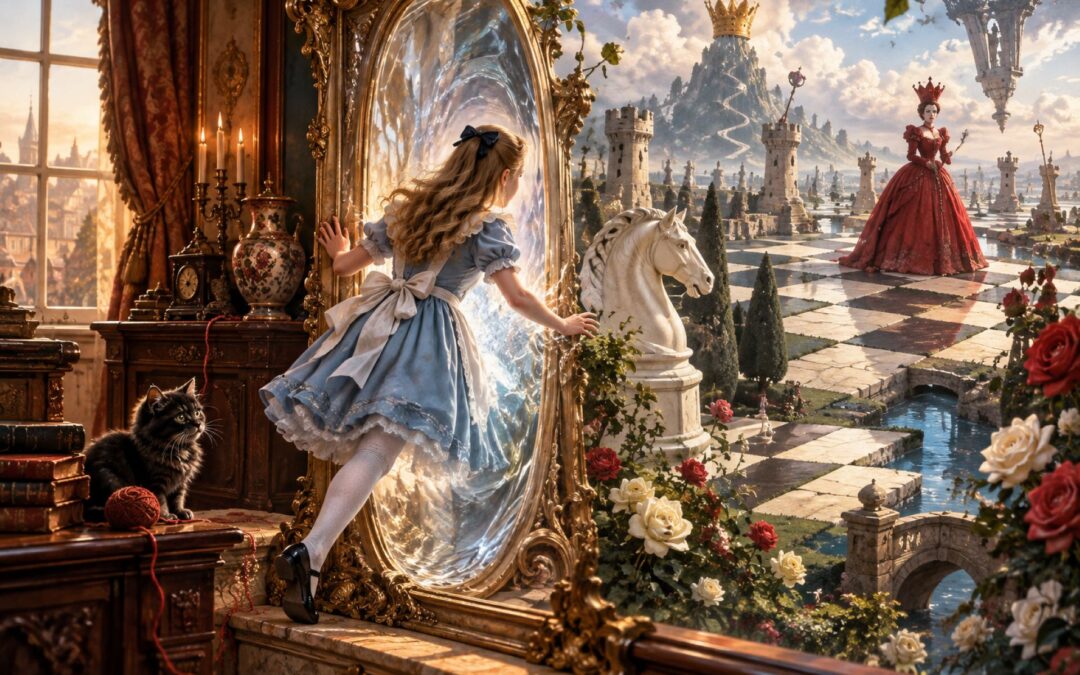
In Through the Looking-Glass, and What Alice Found There, Lewis Carroll sends Alice into another dream world, this time through the mirror above her drawing-room fireplace. On the other side, she discovers a country arranged like a gigantic chessboard, where flowers talk, animals lose their names, time sometimes runs backward, and familiar nursery-rhyme characters behave according to rules that make very little sense. Alice joins the game as a white pawn, hoping to cross the board and become a queen.
Published in December 1871, although its first edition was dated 1872, Through the Looking-Glass is the sequel to Alice’s Adventures in Wonderland. The two novels share a fascination with language, logic, childhood, and authority, but their structures differ. Wonderland is a wandering adventure driven by unpredictable encounters. Looking-Glass Land gives Alice a destination and a recognizable system of advancement, even though understanding that system proves almost as difficult as understanding its inhabitants.
The novel combines an entertaining children’s fantasy with challenging questions about identity, memory, reality, and the relationship between words and meaning. Its strangest episodes frequently begin with an ordinary assumption that one of Alice’s companions interprets in an unexpected way. The result is a story in which Alice can achieve her apparent objective without gaining much control over the world around her.
Spoiler Warning: This article covers the complete novel, including all twelve chapters, Alice’s coronation, her awakening, and the meaning of the ambiguous ending.

The Mirror and the Chessboard: Alice Joins the Game
The novel begins on a cold November afternoon, with Alice sitting beside the fire in her drawing room. Her cat Dinah is washing the white kitten, while the black kitten has been playing with a ball of worsted and tangling the wool Alice is trying to wind. Alice affectionately scolds the mischievous animal, imagining its excuses and threatening it with punishments that will be saved up for a future date.
Her conversation is an elaborate game of make-believe. She considers what would happen if punishments accumulated until someone had to endure them all at once, then turns to chess and wonders whether the kitten understands the game. During an earlier match, it had appeared to watch the pieces with considerable interest. Alice pretends that the black kitten is the Red Queen and begins describing the remarkable possibilities of the room reflected in the looking-glass.
She has noticed that the mirror shows a room resembling her own, but with everything reversed. Some objects are visible in the reflection, while others are hidden beyond its boundaries. She wonders whether looking-glass milk would be safe to drink and imagines that books in the other room must have their letters printed backward.
As she talks, the reflected glass begins to dissolve into something soft and misty. Alice climbs onto the mantelpiece and passes through it, discovering that the imagined room has become real.
The first surprise is that the fireplace in Looking-Glass House contains living chess pieces. The Red King and Red Queen are present, along with the White King and White Queen, whose little daughter Lily is crying upstairs. Alice is enormous compared with these figures, and although she can see and touch them, they appear unable to perceive her.
Hoping to help the White Queen reach her child, Alice lifts the tiny royal figure into the air and carries her toward Lily. The Queen experiences the journey as a terrifying supernatural event. Alice later helps the White King, who is struggling to climb the fireplace furniture, but he is equally bewildered by his unexplained movement.
The King tries to record his frightening experience in a memorandum book. Alice mischievously takes his pencil and writes a message of her own, which he cannot understand. The episode establishes an important feature of Looking-Glass Land: Alice may exercise tremendous power over some inhabitants without being visible to them, just as she will later find herself helpless before characters who insist on controlling her.
Her attention then turns to a book lying on a table. Its writing appears reversed, but she realizes that holding the pages against a mirror makes the text readable. The poem is “Jabberwocky,” beginning with strange words that seem almost familiar while resisting ordinary interpretation.
The poem tells of a young hero warned about dangerous creatures, including the Jabberwock. Armed with a vorpal sword, he searches for the monster, eventually kills it, and returns to his delighted father. Alice can follow this general sequence, but the invented vocabulary leaves much of the action mysterious. She finds the poem beautiful and confusing, with the disturbing suggestion that somebody or something has been killed.
Having explored the room, Alice decides to investigate the garden.
Outside, she discovers that reaching an apparently nearby hill is surprisingly difficult. Every path that seems to lead toward it bends unexpectedly and carries her back toward the house. Walking directly toward her destination produces the opposite of her intended result.
While trying to find a better route, Alice enters a garden filled with speaking flowers. A Tiger-lily addresses her, and the Rose, daisies, and other flowers join the conversation. They inspect Alice as though she were an unfamiliar specimen, criticizing her appearance and debating whether she is a flower herself.
Alice is accustomed to thinking of flowers as decorative objects, but the flowers have opinions and social prejudices of their own. The Tiger-lily seems particularly irritated by the noisy daisies, while the Rose makes judgments about Alice’s petals and shape. Their conversation is an early example of the novel’s reversal of perspective: creatures Alice normally observes now observe and classify her.
The flowers eventually draw Alice’s attention to the Red Queen, who is visible in the distance.
Alice wants to meet her, but walking toward the Queen only seems to increase the distance between them. After further frustration, Alice tries moving in the opposite direction and unexpectedly finds herself face to face with her intended companion.
The Red Queen immediately begins correcting Alice’s manners. She demands proper posture, precise answers, respectful speech, and obedience to rules that Alice has never heard before. She also declares that all the paths belong to her, turning Alice’s innocent reference to finding her own way into a question of royal ownership.
The Queen takes Alice to the top of the hill, where the landscape becomes intelligible for the first time. Fields are divided into large squares, with hedges and brooks marking their boundaries. Alice realizes that the entire country resembles a chessboard.
She wishes she could take part in the game, even if she must begin as a pawn. The Red Queen agrees, explaining that Lily, the White Queen’s daughter, is too young to play and that Alice can take her place.
Alice will move forward as a white pawn, crossing the successive squares until she reaches the eighth rank. If she succeeds, she will become a queen.
Before the journey begins, the Red Queen makes Alice run with her at extraordinary speed. They race so fast that the surrounding air seems to rush past them, but when they stop, Alice discovers that they have remained beneath the same tree.
She is astonished that such effort has produced no change of location. The Queen explains that in this country running as fast as possible is necessary merely to remain where one is; getting somewhere else would require considerably greater speed.
The Red Queen gives Alice instructions about the route, including the encounters she should expect in later squares. She also corrects her manners once more, recommending French when English fails and reminding her to remember who she is.
Then the Queen disappears, leaving Alice to begin her journey.
Alice has acquired something she lacked in Wonderland: a destination. Yet the rules of movement, language, and social behavior have already proved unreliable, and becoming a queen will demand much more than simply crossing a landscape.
The Train, the Nameless Wood, and Tweedledum and Tweedledee
Alice begins by surveying the chessboard country and considering how she will reach the next square. She soon crosses a brook and suddenly finds herself inside a railway carriage.
The train is crowded with remarkable passengers, including a Goat, a Beetle, a gentleman dressed in white paper, and other creatures whose identities are less obvious. A Guard demands tickets, and Alice admits that she has none. She has not purchased one because there was no ticket office where she began her journey.
The passengers repeatedly interrupt her with comments about money, knowledge, and what a properly equipped traveler ought to possess. Their criticisms operate according to their own peculiar calculations, and Alice struggles to answer them before another voice joins the discussion.
The Guard examines her through a variety of instruments before eventually leaving. Meanwhile, a small voice begins speaking near Alice’s ear, drawing her attention to an unseen companion.
As the train approaches another brook, the carriage rises unexpectedly into the air. Alice catches at the Goat’s beard in alarm. The sudden movement dissolves the railway scene, and she finds herself beneath a tree, speaking with a Gnat.
The Gnat asks what kinds of insects exist in Alice’s country. When she names a Horse-fly, he shows her a Rocking-horse-fly, a creature made of wood that swings from branch to branch.
A Dragon-fly becomes a Snap-dragon-fly, with a plum-pudding body, holly-leaf wings, and a burning raisin for a head. A Butterfly becomes a Bread-and-butter-fly, whose wings are made of slices of bread and butter, whose body resembles a crust, and whose head is a lump of sugar.
These insects turn familiar compound names into literal descriptions. Alice finds them fascinating but immediately begins worrying about practical problems, such as what the Bread-and-butter-fly will do if it cannot find its preferred food. The Gnat explains that it would die, a consequence Alice had not expected from the playful construction.
Their conversation shifts toward names. The Gnat wonders why creatures possess names if they do not respond when called by them. Alice replies that names are useful to the people who use them, an answer that exposes the difference between a person’s identity and the labels other people assign.
The Gnat then mentions a nearby wood where things have no names at all. Alice wonders whether entering such a place might allow her to escape unpleasant responsibilities, such as lessons, but she quickly realizes that losing her name could also mean losing a part of herself.
When she steps into the wood, she discovers that the effect is immediate. She can no longer remember her own name or even the names of ordinary things. She struggles to identify herself, trying to recover a word that seems to have slipped beyond her grasp.
A young Fawn approaches her.
The animal is not frightened, and Alice finds herself able to stroke it affectionately. The Fawn cannot remember its own name either, so neither recognizes the social distinction between them.
They walk through the forest together, with Alice’s arms around the creature’s neck. Their companionship is gentle and unusually uncomplicated, especially after the railway passengers’ aggressive judgments.
When they emerge into the open, however, the Fawn remembers what it is. Recognizing Alice as a human child, it becomes frightened and runs away.
Alice is saddened by the loss of their brief friendship. Remembering her own name does not provide the comfort she expected, because the return of identity has also restored a separation that neither companion felt inside the wood.
Continuing her journey, she notices signposts pointing toward the houses of Tweedledum and Tweedledee. Although the signs appear to indicate different destinations, they repeatedly point in the same direction.
Alice eventually concludes that the brothers probably live together.
She finds them standing beneath a tree with their arms around one another’s necks. Their clothing identifies them as Tweedledum and Tweedledee, making it possible to distinguish the otherwise similar figures.
Alice tries to treat them politely, but the twins immediately begin demanding that she follow their preferred conventions. When they insist on shaking hands, Alice worries that choosing one brother first will offend the other. She therefore takes both their hands, producing an awkward dance.
The brothers then offer to entertain her with poetry.
Tweedledee recites “The Walrus and the Carpenter,” a long narrative poem in which two figures walk along a beach and persuade a group of young oysters to accompany them.
The eldest Oyster refuses the invitation, but several younger oysters eagerly follow. The Walrus and Carpenter lead them away from the sea, settle them on a rock, and prepare to eat them.
The Walrus speaks sentimentally about the oysters and appears distressed by their fate. Nevertheless, his apparent compassion does nothing to prevent him from consuming them.
After the poem, Alice tries to decide whether the Walrus or the Carpenter behaved better. She initially prefers the Walrus because he expresses sorrow for the oysters. The twins complicate her judgment by pointing out that the Walrus may have eaten more than his companion.
Alice then considers the Carpenter, only to encounter another difficulty in assigning relative blame.
The poem has introduced a moral problem that cannot be settled by identifying which character expresses the most agreeable feelings. Alice must consider actions, motives, and consequences, all while the twins take pleasure in frustrating her reasoning.
Their conversation becomes more unsettling when they lead Alice toward the Red King, who is sleeping beneath a tree and snoring loudly.
Tweedledee tells Alice that the King is dreaming about her. Tweedledum insists that she exists only as a figure in his dream and that if he wakes, she will disappear.
Alice objects that she is real and cannot simply be imagined by somebody else. The brothers refuse to accept her objection. From their perspective, her certainty is itself part of the dream.
Their claim upsets Alice enough to bring her close to tears. She feels an immediate threat to the reality she has taken for granted throughout the journey.
The brothers then turn their attention to an approaching quarrel. Tweedledum discovers that his favorite rattle has been damaged and blames Tweedledee. Their dispute follows the nursery rhyme in which the two brothers agree to fight over a spoiled rattle.
They begin putting on extraordinary armor, including household objects that seem poorly suited to combat. Alice attempts to help them while encouraging them to recognize how trivial their disagreement is.
The preparations become increasingly ridiculous. One brother struggles with a saucepan, while the other becomes entangled in an umbrella. Their solemn concern for the rules of battle contrasts with the childishness of their grievance.
Before the fight can begin, a gigantic black crow arrives. Its wings produce a violent disturbance, and the brothers immediately abandon their conflict and flee.
Alice shelters beneath a tree while the crow passes overhead. She notices a white shawl caught nearby and retrieves it, setting up her encounter with the White Queen.
The journey has now taken Alice through several sharply different experiences: adults who judge her without listening, insects whose names become physical realities, a friendship briefly made possible by forgetting, and twins who challenge both her moral judgment and her very existence.
The White Queen, the Sheep, and Humpty Dumpty
The White Queen comes running through the wood with her arms stretched outward, searching for the shawl Alice has recovered. Her clothing is disordered, and she appears unable to manage the ordinary business of dressing herself.
Alice offers to help and discovers that the Queen has become hopelessly entangled in her own garments. The Queen complains about the difficulty of arranging her hair and clothing, but Alice patiently restores some order.
Grateful for the assistance, the Queen offers to employ Alice as a lady’s maid for a small wage and a supply of jam.
Alice has no wish to accept the position, but the discussion introduces an unusual rule: jam may be available yesterday or tomorrow, but never today.
The White Queen insists that this arrangement is perfectly reasonable, and Alice finds herself arguing against an explanation that is grammatically possible but practically absurd.
The Queen then reveals that she lives backward through time.
Alice explains that her own memory operates in only one direction. She remembers what has already happened, whereas the White Queen claims to remember events that have not yet occurred.
As an example, the Queen describes the King’s Messenger, who is already undergoing punishment even though his trial and the alleged crime lie in the future.
Alice objects that punishment ought to follow wrongdoing and that a person who has committed no offense should not be punished. The Queen treats the situation as an improvement because it leaves open the possibility that the Messenger might never commit the expected crime.
The exchange makes Alice confront a distorted relationship between justice and causality. Ordinary principles of responsibility become difficult to maintain when their chronological foundations are reversed.
The Queen then begins screaming before anything has injured her.
She explains that she is about to prick her finger while fastening her shawl. Shortly afterward, the pin slips and wounds her exactly as predicted. The Queen has already finished screaming, so she sees no reason to cry out again.
This provides Alice with a practical demonstration of backward experience, rather than merely another bizarre claim.
Their conversation also reveals differences in how they understand happiness and belief. Alice becomes upset by the loneliness of her journey, while the Queen tries to distract her through calculation and abstract consideration.
When Alice admits that she cannot believe impossible things, the Queen recommends practice. She claims that in her youth she could believe as many as six impossible things before breakfast.
The distinction matters because Alice’s imagination is lively and adventurous, but she continues to demand reasons for what other people tell her. The Queen, by contrast, treats belief as a skill that can be strengthened independently of evidence.
A gust of wind carries the Queen’s shawl across a brook. Alice follows her, and the world begins changing again.
The Queen’s voice turns into a bleat, and her clothing becomes woolly. Alice finds herself inside a shop where an elderly Sheep sits knitting with numerous needles.
The transformation occurs without a conventional explanation. The White Queen has become, or has been replaced by, the Sheep, and Alice is expected to adapt immediately.
The shop is full of objects that refuse to remain where she looks for them. When she turns her attention toward one shelf, its contents appear to shift to another. The highest shelves seem particularly well stocked, but their goods are impossible to inspect properly.
The Sheep repeatedly asks what Alice intends to buy, while Alice explains that she cannot choose something she has not been able to see.
The knitting needles suddenly become oars, and Alice finds herself in a small boat with the Sheep. The shop has transformed into a river, and the instructions for handling the oars become another opportunity for misunderstanding.
The Sheep tells Alice to feather, but Alice initially fails to understand the rowing term. The Sheep also calls her a goose, confusing Alice, who tries to interpret the word as a literal description.
As they travel along the water, Alice notices beautiful scented rushes growing nearby. She reaches for them and gathers some, delighted by their appearance and fragrance.
But the rushes do not remain beautiful once picked. They lose their scent and freshness, leaving Alice with an increasingly disappointing collection.
The river eventually becomes a shop once more, and the Sheep resumes her knitting.
Alice decides to buy an egg. The Sheep takes her money but refuses to hand the egg directly to her, insisting that Alice must fetch it herself.
The shop grows darker as Alice approaches the egg, and the furniture begins turning into trees. The object seems to move farther away as she advances.
Eventually, the egg becomes larger and more human in appearance. Alice recognizes it as Humpty Dumpty, seated precariously on a wall.
She remembers the familiar nursery rhyme about his great fall and the failure of the King’s horses and men to put him together again.
Humpty Dumpty is annoyed by Alice’s interest and treats her as intellectually inferior. He dislikes her description of his appearance, questions her name, and objects to the supposed lack of usefulness in the name Alice.
Their conversation moves toward age and birthdays. When Alice explains that she is seven years and six months old, Humpty Dumpty begins discussing unbirthday presents.
Since birthdays occur only once a year, he argues, there are far more opportunities to receive unbirthday presents. The distinction allows him to transform a familiar social practice through arithmetic and verbal invention.
Alice notices what appears to be a belt around Humpty Dumpty’s waist. He indignantly insists that it is a cravat, an unbirthday present from the White King and White Queen.
His frustration grows when Alice struggles to distinguish his neck from his waist. His egg-shaped body makes the ordinary terms difficult to apply.
The conversation then turns to language.
Humpty Dumpty maintains that he can make words mean precisely what he chooses. Alice doubts that speakers possess such unrestricted control, but Humpty Dumpty insists that the essential question concerns which party has authority.
His confidence appears especially unreasonable because he is physically vulnerable, sitting on a narrow wall from which everyone familiar with the rhyme expects him to fall.
Yet Alice remains interested in his knowledge and asks him to explain “Jabberwocky.”
Humpty Dumpty offers detailed interpretations of several invented words. He explains that “slithy” combines qualities associated with being lithe and slimy, and that “mimsy” combines flimsy and miserable. Such constructions, he explains, are portmanteau words, in which multiple meanings are packed together.
He also defines the mysterious creatures and places in the poem, offering elaborate descriptions of toves, borogoves, and other inventions.
Some explanations are ingenious, while others seem supported only by his confidence. Alice listens attentively, but their discussion never entirely settles whether his authority is earned or merely asserted.
Humpty Dumpty recites another poem concerning messages sent to fish, their refusal to obey, and the speaker’s escalating frustration. The narrative becomes increasingly circular and unhelpful.
As Alice prepares to leave, Humpty Dumpty remarks that he probably would not recognize her again because her face is too ordinary. He also makes unpleasant observations about the way human faces are arranged.
Alice finally says goodbye, but he refuses to respond.
She walks away, reflecting on his behavior and the uncomfortable sight of his enormous head and precarious position.
A tremendous crash follows, strongly implying that the fall anticipated by the nursery rhyme has occurred.
The Lion, the Unicorn, and the White Knight
After Humpty Dumpty’s apparent fall, soldiers begin running through the forest in enormous numbers. Their movements are disorderly, and Alice takes shelter to avoid being trampled.
Mounted troops follow the infantry, although their horses seem scarcely more capable of maintaining order. Alice soon encounters the White King, who explains that he has sent out his forces and is waiting for news.
The King appears more concerned with numbers, messages, and proper arrangements than with the practical situation. He tells Alice precisely how many soldiers he has dispatched, relying on his notebook for information.
When Alice says that she saw nobody on the road, he misunderstands her statement as a reference to a person named Nobody.
The King wonders why Alice can see Nobody at a great distance when he cannot see anybody at all. When a messenger later reports that nobody passed him, the misunderstanding becomes increasingly elaborate.
Alice tries to explain the ordinary meaning of her statement, but the King treats the word as a proper name. His reasoning remains internally consistent only because he refuses to accept the meaning Alice intended.
The King’s two messengers, Haigha and Hatta, contribute their own peculiar behavior. Haigha arrives exhausted and requires refreshments before speaking, eventually reporting that the Lion and the Unicorn are fighting.
The King explains that they are fighting for his crown, although neither possesses it.
Alice accompanies the royal party to watch the battle. The Lion and Unicorn appear as living embodiments of the familiar nursery rhyme about their competition for the crown.
Their fighting is energetic but interrupted by customary refreshments. The two opponents accept the situation with an absurd combination of rivalry and ceremony.
The Unicorn is astonished when he sees Alice. He considers her a fabulous monster, and Alice responds with equal surprise.
When the Unicorn learns that Alice has always regarded unicorns as imaginary, they agree to believe in one another. Their exchange turns the distinction between real and imaginary creatures into a matter of perspective.
The King gives Alice a plum cake to distribute. She tries to cut it into portions, but the pieces immediately reunite whenever she separates them.
The Unicorn explains that Looking-Glass cakes must be handed around before being cut. Alice follows the instruction, and the distribution produces the result that ordinary cutting could not achieve.
The scene concludes when enormous drums begin sounding. Their noise overwhelms the gathering, forcing everyone to scatter.
Alice jumps across another brook and finds herself alone once more.
She is soon approached by a Red Knight, who announces that he has captured her. He rides toward her with an aggressive display of martial authority, but another figure arrives to dispute the claim.
The newcomer is a White Knight, who declares that he has rescued Alice.
The two Knights agree to fight according to their rules of battle. Their combat resembles an elaborate exercise in falling off horses and striking one another with poorly managed equipment.
Alice watches in bewilderment, trying to determine the rules from their behavior. The Knights repeatedly fall on their heads and recover in time to continue the struggle.
The White Knight eventually claims victory. He tells Alice that he will escort her to the final brook, where she can enter the eighth square and become a queen.
Alice is relieved, especially because she has no wish to become anybody’s prisoner.
The White Knight is a remarkable contrast to the characters she has recently met. He is courteous and genuinely interested in helping her, but he is also extraordinarily impractical.
His horse carries an assortment of boxes, bags, tools, and other equipment. The Knight explains that he has invented various contrivances to solve problems, although many create complications of their own.
A box intended to store clothing has been carried upside down, causing its contents to fall out. He has provided arrangements for collecting useful objects and has thought about protecting his horse from dangers that are unlikely to arise.
His inventions reveal a mind capable of endless imaginative effort but poorly suited to ordinary physical reality.
The Knight continually falls from his horse. Sometimes he falls forward, sometimes backward, and sometimes sideways, yet he never appears to regard these accidents as convincing evidence that his methods need reconsideration.
Alice repeatedly helps him recover. She recognizes the absurdity of his equipment, but she also begins to appreciate his friendliness.
The Knight speaks about his ideas with complete seriousness. He describes inventions, methods of thinking, and peculiar explanations of things that interest him. His conversations are often as puzzling as those of other Looking-Glass inhabitants, but they lack the cruelty and condescension Alice has encountered elsewhere.
Eventually, they reach the hill overlooking the final brook.
The Knight tells Alice that he must leave her there. Before parting, he wishes to sing a song.
His explanation of the song’s name becomes another complicated discussion of language. He distinguishes between what the song is called, what its name is, and what the name itself is called, producing a chain of distinctions Alice struggles to follow.
The song concerns an old man encountered beside a gate and the strange ways he earns his living. Its verses are comic, filled with improbable occupations and peculiar explanations.
Yet the moment is more affecting than the song’s absurdity might suggest.
Alice listens while the Knight sings, and the narrative gives unusual attention to how she remembers him afterward. His gentle manner, his earnestness, and the image of him standing in the sunlight remain with her.
When the song ends, he asks Alice to wait and wave her handkerchief as he departs. He rides away, falling repeatedly, and Alice watches until he has gone.
She hopes that her farewell encourages him.
Then she turns toward the final brook and crosses it.
Alice has reached the eighth square. A golden crown appears on her head, and her ambition to become a queen has been fulfilled.
Alice Becomes Queen and Wakes from the Dream
Alice is delighted by her promotion. She sits down beneath a tree, examines the crown that has appeared so unexpectedly, and begins imagining how she should behave as a queen.
She also scolds herself for sitting awkwardly and failing to display the dignity appropriate to her new status. Her instinctive imitation of royal discipline suggests that she has already absorbed some of the attitudes of the people who have instructed her.
Her pleasure is interrupted when the Red Queen and White Queen appear beside her.
Rather than welcoming Alice as an equal, they begin examining her qualifications. The Red Queen insists on correct speech and obedience, while the White Queen contributes questions that are hardly more reasonable.
They test Alice’s arithmetic. A question about adding a series of ones becomes difficult because Alice is interrupted before she can calculate. Other questions transform elementary mathematics into verbal jokes.
When asked to subtract nine from eight, Alice protests that the operation cannot be performed in ordinary arithmetic without considering negative numbers. The Queens take her difficulty as proof of ignorance.
A question about dividing a loaf by a knife produces the answer bread and butter. Another about removing a dog’s bone becomes an argument over what would remain.
Alice is frustrated because the Queens are less interested in discovering what she knows than in declaring her wrong.
They also discuss education, conversation, and proper conduct. Their instructions contradict one another, leaving Alice with little chance of satisfying either of them.
The two Queens eventually decide that Alice should hold a dinner party. Strangely, they invite one another to the celebration as though Alice has no authority over her own event.
Alice tries to object, but the Queens continue making arrangements and issuing corrections.
As the conversation proceeds, the White Queen becomes increasingly sleepy. The Red Queen follows her example, and both settle down with their heads resting on Alice.
Alice is left holding the sleeping monarchs, unable to decide what to do with them.
Their snoring begins to resemble music. Suddenly, the Queens disappear, and Alice finds herself standing outside a doorway marked with her own royal title.
The entrance presents another puzzle. One bell is intended for visitors and another for servants, but Alice is neither. She cannot determine which bell a queen should use.
A creature with a long beak briefly opens the door and announces that nobody may enter until a future date. Alice then seeks help from an elderly Frog sitting nearby.
The Frog interprets the instruction to answer the door literally, asking what question the door has put to him. Alice’s irritation increases as another supposedly knowledgeable figure refuses to understand an ordinary phrase.
Music and singing begin inside the hall, celebrating her arrival in extravagant language. Alice hears verses about her crown, her subjects, and the preparations for a royal feast.
Unable to endure further delay, she finally enters.
The banquet hall contains a long table crowded with extraordinary guests. Birds, animals, and other inhabitants of Looking-Glass Land are present, while the Red and White Queens occupy positions at the head of the table.
Alice takes the remaining seat between them.
She has apparently become the honored guest at her own dinner, but she still cannot control what happens.
The Red Queen orders a leg of mutton to be brought to the table. When Alice offers to carve it, the Queen insists that she must first be introduced to the dish.
The leg of mutton rises and bows when the introduction is performed. Alice then discovers that cutting somebody to whom she has been introduced is considered unacceptable etiquette.
The mutton is removed before anyone can eat it.
A pudding appears next, but Alice attempts to avoid the same difficulty by asking not to be introduced. The Red Queen introduces her anyway, and the pudding is promptly taken away.
Alice finally orders the pudding returned, only to be scolded by the pudding itself when she tries to cut it.
The meal has become impossible because the ordinary purpose of food is defeated by the social conventions governing it.
Alice attempts to make conversation by mentioning the extraordinary amount of poetry she has heard during the day. The Queens respond by discussing fish, and the White Queen offers another song built around the difficulties of preparing a fish for dinner.
The guests then drink to Alice’s health, making a tremendous noise.
When Alice is told to deliver a speech, she tries to comply, but the two Queens press against her from either side. Their attempts to support her are physically oppressive rather than helpful.
At this point, the entire celebration begins to disintegrate.
The candles grow unnaturally tall, guests tumble into dishes, and objects move independently across the table. Alice finds herself surrounded by a disorder that makes the previous absurdities seem manageable.
The White Queen appears to transform into the leg of mutton, while the soup-ladle walks toward Alice as though it has business of its own.
Alice finally loses patience.
She seizes the tablecloth and pulls it away, sending the feast crashing to the floor. Plates, food, candles, and guests fall together in a great heap.
Turning on the Red Queen, whom she considers responsible for much of the disturbance, Alice discovers that the monarch has shrunk to the size of a doll.
Alice catches the tiny figure and begins shaking her.
The next two chapters, “Shaking” and “Waking,” are extraordinarily brief. The Red Queen becomes smaller, rounder, softer, and increasingly kitten-like as Alice continues shaking her. The transformation is completed when Alice wakes and discovers that she is holding the black kitten from the opening scene.
The royal adversary has returned to the domestic world from which the adventure began.
Alice is back beside the fire.
She addresses the kitten as though it had participated in the dream, reproaching it for behaving so badly as the Red Queen. She also wonders whether the white kitten might have been the White Queen and considers the possible roles of the other household animals.
Her reflections return to the chessboard and the Red King.
Tweedledum and Tweedledee had insisted that Alice existed only inside the sleeping King’s dream. Alice remains troubled by the possibility, because she cannot decide whether she dreamed the King or whether he dreamed her.
The narrative does not resolve the question.
The novel closes with a poem recalling the three children who once listened to Alice’s adventures on a summer boat trip. The initials of its lines spell Alice Pleasance Liddell, the name of the historical Alice associated with Carroll’s original storytelling.
The poem links imaginative adventure to passing time and remembered childhood. Its final question leaves the boundary between dreaming and living open.
Alice has completed her journey, achieved her promotion, and returned safely home. What she cannot determine is whose experience the journey truly was.
The Rules of Looking-Glass Land: Chess, Mirrors, and Reversal
Looking-Glass Land has more visible organization than Wonderland. The chessboard supplies both its geography and the basic direction of Alice’s journey, while mirrors establish a broader expectation that familiar relationships may be reversed.
The game begins with Alice as a white pawn occupying the position of Lily, the White Queen’s daughter. Her progress is represented by successive advances across the squares, with brooks acting as boundaries between ranks.
In ordinary chess, a pawn advances toward the opposite side of the board and may be promoted upon reaching the final rank. Carroll uses that rule to give Alice a clear ambition. The eighth square becomes a destination toward which she can measure her progress.
As the Lewis Carroll Society’s examination of chess in the novel explains, the fictional game does not strictly observe every rule of competitive chess. The sides are identified as Red and White, reflecting the colors of certain traditional chess sets, and the arrangement of turns and movements includes deliberate liberties.
Carroll acknowledged some irregularities in his later preface. He did not intend the entire novel to function as a perfectly legal game played by two ordinary competitors.
The chessboard provides an underlying framework, but the experiences within its squares follow the freer logic of dreams.
That distinction matters because readers can recognize Alice’s progress without needing to reconstruct every move. She advances because the narrative repeatedly returns to brooks, positions, and the promise of promotion.
The other chess pieces also influence her encounters. The Red Queen moves with an authority and mobility appropriate to her position, while the Knights become literal armored riders. The White King, frequently distracted and dependent on written information, offers a comic version of royal vulnerability.
The fictional world also changes the meaning of movement.
When Alice tries to reach the hill by taking the obvious path, she repeatedly returns to her starting point. When she walks away from the Red Queen, she unexpectedly approaches her. When the Queen makes her run, enormous effort leaves them beneath the same tree.
The last example is particularly memorable because it transforms ordinary assumptions about progress. Alice believes that speed should produce displacement; the Queen lives in a world where movement must first overcome the motion of the surroundings.
Other reversals concern time, procedure, and social relationships.
The White Queen remembers events before they occur. A cake must be distributed before being cut. Alice is introduced to food and then forbidden to eat it. The Unicorn regards a human child as an imaginary creature.
These are not random impossibilities. Most begin with a familiar practice and alter one of its underlying assumptions.
The mirror provides the governing image for this process. A reflection resembles the original while reversing its arrangement, just as Looking-Glass Land preserves recognizable ideas while changing their relationships.
Yet the world does not follow one universal rule of reversal. Some events proceed backward, some words acquire unexpected meanings, and some characters simply behave irrationally.
Carroll’s method depends on the reader recognizing enough ordinary logic to appreciate how it has been transformed.
The result is a setting with a clear formal design but considerable local unpredictability. Alice can learn the rules of pawn promotion, but she cannot assume that the rules governing a conversation, meal, or friendship will remain stable.
Alice, the Queens, and the White Knight: Character and Power
Alice is curious, imaginative, and unusually persistent. She wants explanations for unfamiliar events and often attempts to resolve confusion through observation or reasoning.
She is also capable of irritation, pride, impatience, and inconsistency. Her behavior is more interesting because Carroll allows these qualities to coexist with her intelligence and kindness.
At the beginning, Alice plays at disciplining her kitten. She invents offenses, imagines excuses, and threatens postponed punishments, echoing the methods of adults who correct children.
Once she enters Looking-Glass Land, however, she becomes the person being corrected.
The Red Queen repeatedly interrupts her speech, criticizes her posture, and assumes that her own instructions must be obeyed. Alice tries to remain polite but grows increasingly uncomfortable with the Queen’s arbitrary authority.
The tension becomes more complicated because Alice herself wants to become a queen.
She does not initially question whether the position is desirable. She imagines its privileges and works toward promotion with considerable determination.
When she finally receives her crown, she discovers that the title does not protect her from humiliation. The Queens continue examining her, while the banquet guests disregard her dignity and comfort.
Alice’s development therefore involves a gradual separation between possessing an official position and having real independence.
Her decisive action occurs when she refuses to tolerate the banquet any longer. By pulling away the tablecloth and seizing the Red Queen, she abandons the effort to satisfy everyone else’s rules.
The Red Queen’s character helps explain why that rebellion becomes necessary.
She is confident, commanding, and preoccupied with manners. Her instructions often sound authoritative because they imitate the language of education and social discipline.
But the rules she imposes are frequently contradictory. She uses her superior position to interrupt Alice, declare her wrong, and change the conditions of a discussion whenever convenient.
Her treatment of Alice resembles an examination in which the examiner has already decided that the student is incompetent.
The White Queen presents a different kind of difficulty.
She is helpless in practical matters, unable to dress herself properly, and frequently bewildered by ordinary circumstances. She depends on Alice’s assistance even while claiming knowledge unavailable to other people.
Her extraordinary memory complicates the apparent distinction between intelligence and foolishness. She can anticipate events that Alice cannot remember, yet she struggles to manage clothing, conversation, and common-sense reasoning.
Alice’s relationship with her is therefore less straightforwardly hostile than her relationship with the Red Queen.
She sometimes cares for the White Queen almost as though the monarch were a child. Nevertheless, the White Queen participates in the interrogation that follows Alice’s promotion, demonstrating that dependence and authority can coexist.
The White Knight introduces a more sympathetic possibility.
He is physically awkward and intellectually eccentric, but he offers Alice help without demanding that she surrender her judgment. His inventions are ridiculous, yet they reveal genuine enthusiasm and creativity.
His behavior contrasts with Humpty Dumpty’s arrogance and the Red Queen’s authoritarian discipline. The Knight speaks at length about his ideas, but he does not seem interested in humiliating Alice for failing to understand them.
He is also vulnerable in a way that encourages affection rather than contempt.
Alice repeatedly watches him fall from his horse, helps him recover, and listens to his explanations. Their companionship gradually becomes more important than the immediate purpose of reaching the final brook.
The farewell works because it interrupts the novel’s familiar pattern of meetings that end in irritation or confusion. Alice remembers the Knight with tenderness, making their parting one of the few emotionally sustained relationships in the narrative.
Some critics have interpreted the White Knight as an affectionate representation of Carroll himself, particularly because of his inventiveness and awkwardness. The resemblance is suggestive, but the character does not require a definitive autobiographical explanation to be effective.
Alice’s final position is consequently more complicated than a simple triumph over authority.
She has gained experience and become increasingly willing to resist absurd demands. Yet the reward promised by the chess game proves less satisfying than the kindness she receives from someone who has no interest in exercising power over her.
Her growth can be understood partly as a movement away from unquestioning respect for titles and toward a more independent assessment of how people behave.
Nursery-Rhyme Characters and the Social World of the Novel
Many inhabitants of Looking-Glass Land originate in nursery rhymes or familiar forms of children’s literature. Carroll takes figures who ordinarily occupy a few memorable lines and gives them personalities, conversations, and situations that extend their original material.
Tweedledum and Tweedledee are among the clearest examples.
Their nursery rhyme describes a quarrel over a damaged rattle, followed by preparations for battle and an interruption by a crow. Carroll preserves this basic sequence but expands it into a prolonged encounter with two argumentative brothers.
Their conversations reveal a shared tendency to manipulate Alice. They demand proper greetings, insist on their interpretations, and respond to objections by changing the subject or introducing further complications.
The brothers behave like children while claiming the authority to instruct another child. Their exaggerated solemnity makes the eventual flight from the crow especially comic.
Humpty Dumpty receives a different expansion.
The nursery rhyme already establishes the likelihood of his fall. Carroll places him on the wall before that event and gives him sufficient time to lecture Alice about names, birthdays, poetry, and language.
The character’s self-confidence is comically incompatible with his precarious situation.
His declaration that the King’s forces would help him if he fell becomes more ridiculous because readers know the conventional ending of the rhyme. His future is familiar, but he behaves as though his position is secure.
The Lion and Unicorn similarly enter the narrative through their established quarrel over a crown.
Carroll transforms the rivalry into an organized public event involving royal officials, spectators, refreshments, and procedural expectations. The competition becomes less a meaningful struggle for political power than an exercise in ceremonial repetition.
The White King contributes to this atmosphere through his dependence on messengers and records. His administration is busy but ineffective, filled with instructions, calculations, and misunderstandings that rarely produce useful knowledge.
The royal court seems to possess the external features of government without much practical capacity to govern.
Elsewhere, the Gnat, talking flowers, and Sheep belong to a social world in which every creature seems ready to correct Alice or question her assumptions.
The flowers judge her appearance according to standards appropriate to flowers. The Sheep insists that Alice follow shopping procedures that make purchasing almost impossible. The Unicorn assumes that Alice must be imaginary because her existence conflicts with his expectations.
Such reversals prevent the human child from occupying the unquestioned center of the world.
There is also a recurring distinction between politeness and kindness.
Many characters demand careful manners while behaving selfishly or rudely. The Red Queen’s concern for etiquette does not prevent her from humiliating Alice, while the banquet’s elaborate introductions make an ordinary meal impossible.
By contrast, the White Knight frequently violates the expectations of competent adult behavior but treats Alice with genuine consideration.
Carroll’s social comedy repeatedly exposes the limitations of conventions that are valued more highly than the people they are supposed to serve.
Humpty Dumpty and the Struggle Over Language
Language in Through the Looking-Glass frequently becomes a source of conflict rather than a reliable means of communication.
Alice usually assumes that words have meanings shared by speakers and listeners. Her companions often treat language as something they can reinterpret, manipulate, or control whenever it suits them.
Humpty Dumpty provides the clearest expression of this attitude.
His dispute with Alice concerns whether a person can make a word mean anything they choose. Alice questions the possibility, while Humpty Dumpty insists that authority determines the matter.
The argument is funny partly because his confidence exceeds his actual power. Humpty Dumpty cannot even guarantee that he will remain safely on his wall, yet he behaves as though he can dictate the behavior of language itself.
He also treats his vocabulary as a workforce under his command, discussing the amount of work words perform and the rewards they deserve.
This personification transforms language into an economic and social relationship, with Humpty Dumpty imagining himself as the employer.
His interpretations of “Jabberwocky” are more complicated than simple nonsense. Some demonstrate how unfamiliar words can acquire meaning through recognizable sounds, associations, and grammatical positions.
A word such as “slithy” can suggest several qualities at once. The technique of combining existing words into a new expression offers genuine possibilities for linguistic invention.
Yet there is an important difference between inventing a word and controlling its interpretation.
Humpty Dumpty may provide a definition, but the poem’s success does not depend entirely on readers accepting his explanation. Its narrative rhythm, grammatical structure, and imagery already communicate something before he speaks.
Other characters reveal different problems.
The Gnat’s inventions take compound nouns literally, producing insects whose bodies reflect their names. The White King’s interpretation of “Nobody” creates a complete misunderstanding because he treats a negative pronoun as a personal identity.
The Queens exploit language through questions that appear reasonable until their terms are changed. They then condemn Alice for failing to produce the answer they expect.
In each case, a speaker’s ordinary intention is obstructed by someone else’s preferred interpretation.
These jokes also have a historical dimension. James A. Williams’s study of Carroll’s relationship with Victorian theories of language places the Alice books within contemporary debates about the origins, development, and apparent autonomy of words.
Victorian philology often treated languages as systems with histories and patterns that exceeded the intentions of individual speakers. Carroll’s nonsense provides imaginative ways of testing the relationship between speakers and the words they use.
Humpty Dumpty’s certainty is therefore especially revealing. He imagines complete personal control over meanings at the very moment Carroll demonstrates how words can escape such control.
The novel does not claim that communication is impossible. Alice often succeeds in understanding enough to continue, and readers can follow many exchanges despite their unusual vocabulary.
Instead, it shows that language depends on conventions, context, cooperation, and shared expectations. When one speaker refuses to recognize those conditions, even a simple conversation can become an instrument of domination.
The Poems of Through the Looking-Glass and Their Meanings
Poetry occupies an unusually important position in Through the Looking-Glass. Carroll interrupts the main narrative with songs and recitations that sometimes contain their own stories, sometimes imitate familiar literary forms, and sometimes become opportunities for characters to display their peculiar habits of thought.
The poems are not merely decorative additions to the prose. They change the rhythm of Alice’s journey, provide situations for her to interpret, and repeatedly introduce differences between what a speaker intends and what a listener understands.
Several also create emotional effects that would be difficult to achieve through the surrounding dialogue alone.
Jabberwocky and the Possibility of Meaning
“Jabberwocky” is the novel’s most famous poem and one of the best-known examples of English literary nonsense.
Alice encounters it almost immediately after entering Looking-Glass House. Its mirrored printing makes reading itself into a physical puzzle, while its invented vocabulary creates a second difficulty after the text has been deciphered.
Despite the strange words, the poem has a recognizable narrative structure.
A father warns his son against dangerous creatures. The young hero takes up a sword, searches for his enemy, encounters the Jabberwock, and kills it. He returns with evidence of his victory and receives an enthusiastic welcome.
The poem’s basic events remain comprehensible because its sentences use familiar grammatical patterns. Readers can identify actions, creatures, warnings, and consequences even when individual nouns and adjectives are unfamiliar.
The sounds of the invented words also contribute to meaning. Some suggest movement, texture, danger, or animal behavior through their resemblance to recognizable English sounds.
When Humpty Dumpty later explains the vocabulary, his definitions add another layer to the poem without entirely exhausting its imaginative possibilities.
His account of portmanteau words is useful, but his self-appointed authority makes the explanation part of the novel’s broader argument about interpretation.
“Jabberwocky” demonstrates that understanding does not always require complete translation into ordinary language. Context, rhythm, grammar, and association can produce a coherent experience even when exact meanings remain uncertain.
The Walrus and the Carpenter as a Moral Problem
“The Walrus and the Carpenter” is more straightforward linguistically but more troubling in its moral content.
The poem begins with a seaside walk and a conversation between two apparently respectable figures. They invite young oysters to accompany them, promising an enjoyable excursion.
The eldest Oyster refuses, but the younger oysters follow.
After leading the creatures away from the water, the Walrus and Carpenter eat them.
The cruelty is concealed beneath cheerful conversation, polite invitations, and sentimental expressions. The Walrus appears particularly emotional about the oysters’ fate, but his sympathy has no practical effect on his behavior.
Alice’s response reveals the difficulty of judging character from appearances.
She initially favors the Walrus because he seems sorry for what he has done. When the twins suggest that he may have eaten more oysters, her preference becomes harder to defend.
The Carpenter also participates in the deception, even though he displays less sentimentality.
The poem therefore separates moral language from moral conduct. Expressions of pity are insufficient when they coexist with the deliberate exploitation of those supposedly being pitied.
Carroll avoids delivering a tidy conclusion. Alice’s uncertainty remains part of the encounter, allowing the poem to function as both a comic tale and a difficult exercise in ethical judgment.
The White Knight’s Song and Other Embedded Verses
The White Knight’s song occupies a very different emotional position.
He introduces it through a complicated series of distinctions between the name of the song, the song itself, and the name by which the name is known. Alice struggles to follow these distinctions, but the Knight delivers them with complete seriousness.
The song concerns an elderly man sitting beside a gate and describing improbable ways of earning a living. Its occupations and explanations are deliberately absurd, and its speaker repeatedly misunderstands or fails to remember what the old man has said.
The comic material contrasts with the circumstances in which Alice hears it.
The Knight is about to leave her. He has accompanied her with unusual kindness, and she understands that crossing the final brook will end their brief companionship.
The narrative gives special attention to Alice’s later memory of the scene. The song becomes associated with the Knight’s figure, his affection, and the moment of separation.
Other poems contribute to the novel’s sense that language is constantly being rearranged. Humpty Dumpty’s verses about fish present an increasingly unreasonable speaker frustrated by creatures that refuse his commands. The Queens’ banquet songs turn celebration into an exercise in exaggerated ceremony.
The opening and closing poems are especially important because they frame Alice’s adventure from a position outside its immediate events.
The opening dedication addresses a child across the distance created by passing time. Its imagery contrasts the innocence of childhood with the adult awareness that moments of shared imagination cannot be repeated indefinitely.
The closing acrostic returns to children listening to a story and transforms the memory of the original Alice tales into an image of vanished summers.
Together, these poems give the novel an emotional dimension that its individual comic episodes sometimes conceal. The nonsense belongs to a remembered world of childhood play, and the act of remembering it carries an awareness of change and loss.
Identity, Memory, Time, and Recurring Motifs
Questions of identity appear throughout the novel, although they are expressed through a variety of objects, places, and situations.
Alice begins in a familiar domestic setting where she knows who she is and where she belongs. Entering the mirror changes her surroundings, but it does not initially disturb her confidence in her own existence.
That certainty becomes increasingly difficult to maintain.
The Gnat questions the usefulness of names, and the nameless wood temporarily removes the distinction between Alice and the Fawn. Their friendship is possible precisely because neither recognizes the category separating human beings from animals.
When the names return, the relationship collapses.
The episode suggests that identity can provide continuity while also imposing boundaries. Names make creatures recognizable, but they can also restore expectations and prejudices that restrict their relationships.
The Red King’s dream presents a more radical problem.
If Alice exists only as part of somebody else’s imagination, her identity may have no independent foundation. Unlike the nameless wood, where she forgets a familiar label, the King’s dream threatens the reality of the person who possesses the label.
The chess game introduces another dimension.
Alice begins as a pawn and becomes a queen. The transformation gives her a new title and social position, but it does not necessarily change her underlying abilities or the attitudes of those around her.
The crown represents advancement, yet its practical value is uncertain.
The mirror itself is the book’s central symbol of altered identity and perception. It produces a world that resembles the familiar one while unsettling the relationships through which that familiarity is understood.
Books, words, and names repeat the same problem on a smaller scale. A written poem appears meaningless until Alice reverses its letters. A creature’s name becomes an anatomical description. A familiar pronoun is treated as an individual person.
Objects can therefore become strange without becoming entirely unrecognizable.
Time is equally unstable.
The White Queen’s memory moves toward the future, and she treats events that have not happened as though they already belong to experience. Her punishment of the Messenger reverses the ordinary relationship between wrongdoing and responsibility.
The Queen’s finger provides a physical example: she screams before being injured and considers the later wound already accounted for.
Such reversals complicate Alice’s assumption that time proceeds in a sequence of causes followed by effects.
The recurring presence of water adds a different kind of movement.
Brooks divide the chessboard and mark Alice’s advancement. Crossing them repeatedly changes her situation, often transporting her into a new scene with different rules.
The boat journey with the Sheep introduces water as something less orderly. Alice attempts to gather beautiful rushes, only to discover that they lose their freshness once removed from their surroundings.
The fading rushes can be read as an image of experiences that cannot be permanently possessed. Their beauty exists most fully in the moment of encounter, a possibility reinforced by the novel’s framing poems about remembered childhood.
Food also appears repeatedly, often through transformations that frustrate ordinary purposes.
The Bread-and-butter-fly is made from edible materials, yet its dependence on particular nourishment creates a fatal problem. The cake must be distributed before being cut. The mutton and pudding become social acquaintances who cannot be eaten without violating etiquette.
Food is recognizable, but the rules governing its consumption have been altered.
Flowers, meanwhile, repeatedly become observers rather than passive objects. The speaking garden flowers judge Alice, while the rushes change after she removes them from the water.
Across these motifs, Carroll explores the instability of familiar categories without insisting on one fixed symbolic interpretation.
Memory offers a partial form of continuity.
Alice can return home and remember the extraordinary events she has experienced. The White Knight’s farewell remains especially vivid, while the closing poem preserves the imaginative world through recollection.
Yet memory cannot settle every question.
Alice remembers dreaming the Red King, but that memory cannot prove that he did not dream her. The past may be recalled without the nature of the experience becoming certain.
Who Dreamed It? The Red King and the Meaning of the Ending
The ending of Through the Looking-Glass resolves Alice’s physical adventure while leaving its central philosophical question unanswered.
The literal events are clear.
Alice becomes a queen, attends a chaotic banquet, loses patience with the Red Queen, and begins shaking her. The tiny monarch transforms into the black kitten, and Alice wakes in her drawing room beside the fire.
The dream world disappears, but the objects and relationships of ordinary life return.
The transformation of the Red Queen into the kitten creates a connection with the novel’s opening, when Alice pretended that the black kitten was the Red Queen. What began as a game of make-believe has become the structure through which the dream is understood.
Alice’s other identifications are less certain. She wonders whether the white kitten represented the White Queen and considers the possible roles of Dinah and the other figures.
Her attempts to interpret the dream are playful, but they also show her desire to discover an orderly relationship between the fantastic adventure and the ordinary world.
The unresolved problem concerns the Red King.
Earlier, Tweedledum and Tweedledee insisted that Alice existed only within the King’s dream. Their claim frightened her because it undermined her certainty that she was a real person moving through a strange place.
After awakening, Alice remembers the claim and wonders whether it might somehow be true.
The novel does not offer a privileged perspective from which readers can settle the dispute.
From Alice’s viewpoint, she dreamed the chessboard country and its inhabitants. The transformation of the Red Queen into the kitten strongly supports that ordinary explanation.
Yet within the dream, the brothers claimed that Alice herself was imagined by the sleeping King.
Because the narrative leaves the question open, the final uncertainty cannot be eliminated simply by pointing to the fact that Alice wakes.
The problem concerns the status of experience and the limits of knowledge. Alice can describe what happened to her, but she cannot produce absolute proof that her apparent reality occupies the highest level of existence.
The ending also changes the significance of the chess quest.
Alice has reached the eighth square and received her crown, fulfilling the objective established near the beginning. But the achievement does not provide the final understanding she might have expected from successfully completing the game.
Instead, her journey ends with uncertainty about the conditions under which the game existed at all.
The closing poem broadens the question beyond Alice’s personal experience.
Its acrostic spells Alice Pleasance Liddell, linking the fiction to the historical child associated with Carroll’s original storytelling. The poem recalls the three children listening to stories during summer excursions and reflects on how time carries those experiences away.
The memory of childhood becomes inseparable from the world of dreams.
Carroll’s final question suggests that ordinary life itself may possess something of the same uncertain quality as Alice’s adventures. Experiences feel real while they occur, yet they pass into memory, where imagination and recollection become difficult to separate completely.
That possibility should not be reduced to the claim that the novel proves reality is an illusion.
The text does not establish such a conclusion. It invites readers to consider how confidently they can distinguish dreaming, remembering, imagining, and knowing.
The ending is therefore appropriately unresolved.
Alice returns home, but the story refuses to close every question opened by her journey. Its final achievement lies in preserving the uncertainty that has animated the novel’s strangest encounters.
Carroll’s Narrative Style and Tenniel’s Illustrations
Carroll tells Through the Looking-Glass through a third-person narrator who remains close to Alice’s experiences. Readers generally encounter the fictional world as she does, receiving its surprises before being offered explanations.
The narrator occasionally comments on Alice’s thoughts or behavior with gentle amusement, but the perspective remains anchored in her curiosity and bewilderment.
This closeness is essential to the comedy.
Alice usually approaches strange situations with ordinary expectations. She assumes that people should mean what they say, that movement should change location, and that familiar objects should retain recognizable properties.
The inhabitants of Looking-Glass Land challenge those expectations so consistently that her reactions become an important part of the narrative’s rhythm.
Carroll frequently builds scenes around conversations rather than physical action.
Humpty Dumpty’s discussion of words, the White Queen’s account of backward memory, and the Red Queen’s examination of Alice all depend on verbal exchanges in which familiar assumptions are gradually overturned.
The humor often emerges from precise logical distinctions. A phrase is interpreted literally, a category is treated as a person, or a rule is applied in circumstances where its consequences become absurd.
Carroll’s mathematical interests are visible in this fondness for definitions, sequences, and unusual applications of apparently reasonable principles.
The book’s structure is more directed than that of Alice’s Adventures in Wonderland. The chessboard gives Alice a clear route from pawn to queen, and the recurring brooks make her movement through the story identifiable.
Nevertheless, the individual episodes remain highly independent.
A conversation with insects may be followed by a forest of forgotten names, while a Queen may become a Sheep without any explanation resembling the transitions of conventional realism.
These changes are consistent with the logic of dreams, where one situation can transform into another through an association that becomes apparent only afterward.
The novel’s tone also shifts more noticeably than its playful reputation might suggest.
The Gnat’s melancholy, Alice’s distress in the nameless wood, the Red King’s disturbing dream, the White Knight’s farewell, and the closing acrostic all introduce emotional experiences that are less easily dismissed as jokes.
Carroll allows moments of vulnerability to appear within the nonsense without turning the novel into a conventional sentimental story.
John Tenniel’s illustrations contribute substantially to this balance.
The Victorian artist had already illustrated Alice’s Adventures in Wonderland, and his work on the sequel helped establish the recognizable appearance of its characters. The Victoria and Albert Museum’s account of Tenniel’s illustrations describes his background in caricature, his attention to visual detail, and his collaboration with Carroll.
Tenniel’s pictures frequently make extraordinary characters seem physically convincing.
Humpty Dumpty appears as an egg-shaped figure occupying a precarious wall. The Lion and Unicorn resemble heraldic creatures brought into active life. The White Knight’s equipment visually reinforces the comedy of his inventions.
The illustrations also provide continuity in a narrative where the environment changes abruptly.
Because the characters have recognizable appearances, readers can follow the increasingly strange situations without losing their sense of who is involved.
Tenniel’s visual imagination adds a further dimension to Carroll’s prose. The text often supplies relatively little physical description, leaving room for the artist to create distinctive figures from a few narrative details.
His imagery draws on caricature, natural history, heraldry, and familiar visual conventions, producing figures that are simultaneously absurd and recognizable.
This collaboration helped shape the book’s enduring identity. Readers may encounter later interpretations of Alice and her companions, but Tenniel’s illustrations remain among the most influential visual expressions of Carroll’s fictional world.
Critical Review: The Achievements and Limitations of Through the Looking-Glass
Through the Looking-Glass is one of the most inventive works of Victorian children’s literature, and its principal achievement lies in the relationship between imaginative freedom and formal control.
Carroll creates a world in which almost anything can happen, yet its strangeness is seldom arbitrary. The chessboard, mirror reversals, nursery-rhyme structures, and verbal games establish recognizable patterns that give the episodes coherence.
The result is a novel that rewards attention to its methods as well as enjoyment of its individual adventures.
The chess structure is particularly effective.
Alice has a clear goal, and readers can recognize that each new square brings her closer to promotion. This gives the book a stronger sense of forward movement than a purely wandering dream narrative might possess.
At the same time, the destination does not eliminate unpredictability. Alice’s encounters remain free to explore subjects that have little direct relationship with the practical business of chess.
The structure is therefore both a strength and a limitation.
It gives the novel a recognizable shape, but some episodes remain only loosely connected to one another. Readers expecting a tightly plotted adventure may find that the chessboard promises more narrative integration than the story consistently delivers.
The individual encounters are often memorable because Carroll allows a single joke to develop into a sustained exchange.
The White Queen’s backward memory, for example, begins with an implausible claim and becomes a demonstration involving punishment, anticipation, injury, and emotional response.
The sequence works because Carroll investigates the implications of his invention rather than abandoning it after the first surprise.
Humpty Dumpty’s conversation operates similarly. His confidence about the meanings of words produces several layers of comedy, from his personal arrogance to the more serious difficulty of separating intended meaning from interpretation.
Such passages demonstrate the novel’s intellectual sophistication.
Yet their density can also make the reading experience demanding.
Carroll often builds jokes through grammatical distinctions or extended chains of reasoning. Readers who do not enjoy verbal puzzles may find that some conversations continue well beyond the point at which their original comic premise has become clear.
The poetry introduces a different kind of pleasure.
“Jabberwocky” remains remarkable for its ability to create a coherent narrative through unfamiliar vocabulary. Its rhythm, sounds, and grammatical structure make the invented language feel strangely meaningful.
“The Walrus and the Carpenter” succeeds through an almost opposite method. Its vocabulary is readily understandable, but its moral implications become increasingly uncomfortable as Alice tries to judge the conduct of its characters.
The White Knight’s song is especially effective because of its placement within the narrative. The absurd verses become associated with one of Alice’s few genuinely affectionate relationships, allowing a comic performance to carry unexpected emotional weight.
Characterization is more uneven.
Alice is a convincing central presence because Carroll allows her to be intelligent without being infallible. She can show compassion, impatience, curiosity, and arrogance, often in the same encounter.
Her responses provide an emotional and intellectual continuity that the changing world itself cannot supply.
The supporting characters, however, are generally defined by one or two dominant traits.
Humpty Dumpty is arrogant about language. The Red Queen is authoritarian. The Sheep is irritatingly literal. Tweedledum and Tweedledee are argumentative and childish.
These qualities make the figures immediately recognizable and dramatically useful, but they rarely develop into the psychological complexity expected of characters in a realist novel.
That limitation does not necessarily damage Carroll’s purpose.
Many of the characters originate in nursery rhymes, where exaggerated traits and memorable situations matter more than inner development. Their function is often to challenge Alice with a particular way of thinking or behaving.
Nevertheless, readers seeking sustained relationships or complex secondary character arcs may find the novel comparatively thin.
The White Knight is a notable exception.
His combination of ridiculous inventiveness and genuine kindness gives him a more varied emotional presence than most other inhabitants of Looking-Glass Land.
The scene of his departure is effective precisely because the novel has so rarely allowed Alice to experience uncomplicated companionship. Its tenderness feels earned by the preceding absurdities rather than imposed on them.
The book’s treatment of authority is another major strength.
Carroll repeatedly presents characters who demand obedience while failing to justify their own assumptions. The Red Queen’s obsession with manners, Humpty Dumpty’s linguistic arrogance, and the White King’s administrative confusion all expose differences between possessing authority and exercising sound judgment.
The criticism is frequently playful, but it can also be sharp.
Alice’s promotion offers a particularly revealing culmination.
The chess game promises that reaching the final rank will transform her status. She achieves that goal, but her coronation leads to another round of examination and correction.
Her new title provides little protection against the authority of the established Queens.
One possible interpretation is that the story questions the restrictions placed on female independence within Victorian social life. Alice gains a powerful designation but remains subject to rules and judgments imposed by others.
The reading is persuasive in several scenes, though it should not be treated as the only possible explanation. The novel’s absurdity also works more broadly as a criticism of empty rank, arbitrary convention, and the difference between formal position and practical freedom.
The ending is among the book’s most successful artistic choices.
The transformation of the Red Queen into the black kitten returns readers to the opening situation, giving the dream a satisfying narrative frame.
At the same time, the question of whether Alice dreamed the Red King or the King dreamed Alice prevents the ending from becoming completely reassuring.
Carroll allows the adventure to close while leaving its implications unsettled.
This ambiguity suits a novel repeatedly concerned with interpretation and the limits of certainty. A fully explained ending would weaken the experience by imposing the kind of authoritative answer that so many of its characters mistakenly claim to possess.
The book has also aged remarkably well in its inventiveness.
Its language games remain engaging because the relationship between words and interpretation continues to matter. Its social comedy remains recognizable wherever manners, titles, and formal procedures become more important than fairness or common sense.
Some aspects of its Victorian context are less immediately accessible.
The nursery rhymes and literary conventions Carroll assumes may be unfamiliar to contemporary readers. Certain jokes depend on historical patterns of education, pronunciation, or social behavior that no longer possess the same everyday familiarity.
These difficulties can make annotated editions particularly useful, especially for readers who want to understand the background of specific references.
Yet the novel does not depend entirely on historical explanation.
The visual absurdity of an egg lecturing a child, a knight repeatedly falling from his horse, or a queen transforming into a kitten remains accessible without specialized knowledge.
Its broad imaginative appeal coexists with an intellectual depth that rewards returning to it as an adult.
The contrast between those levels helps explain the book’s lasting reputation.
Younger readers may enjoy the unusual creatures, strange incidents, and memorable poems, although some extended conversations are likely to be challenging. Adult readers may find additional satisfaction in the logical paradoxes, linguistic experimentation, social satire, and unresolved philosophical questions.
The novel is best approached without expecting every episode to carry a hidden moral or every symbol to possess one definite meaning.
Its nonsense works partly because it allows several forms of pleasure to exist together: the immediate comedy of an absurd scene, the satisfaction of recognizing a logical pattern, and the more reflective enjoyment of considering what that pattern might reveal.
The most substantial weakness is the episodic unevenness that accompanies this freedom.
Some encounters have greater emotional or intellectual force than others, and the book occasionally risks exhausting its own methods through prolonged verbal play.
Yet those limitations rarely undermine the larger achievement.
The chessboard gives shape to an astonishing variety of inventions, Alice provides a consistent human perspective, and the closing uncertainty preserves the imaginative openness that has sustained the story.
Through the Looking-Glass remains worth reading both as an exceptional children’s fantasy and as a work of literary nonsense whose questions about meaning, authority, identity, and reality are more enduring than its apparently playful surface might suggest.
Its greatest strength is the ease with which Carroll turns ordinary language and familiar conventions into sources of intellectual surprise. The novel invites readers to recognize how much of what they regard as obvious depends on rules they seldom examine.
Alice’s journey succeeds because those rules keep changing, forcing her to respond with curiosity, judgment, impatience, and occasional rebellion.
She becomes a queen, but the experience teaches her that titles alone do not provide understanding or freedom. Her most meaningful encounter is arguably the friendship she forms with the White Knight, while the most enduring question she carries home concerns the nature of the dream itself.
The book’s conclusion remains compelling because it refuses to settle that question on the reader’s behalf. Carroll completes the adventure without closing the imaginative possibilities it has created, leaving a story that can be enjoyed for its comedy and revisited for the uncertainty beneath it.
Last Updated on October 14, 2026 by Aseem Gupta