
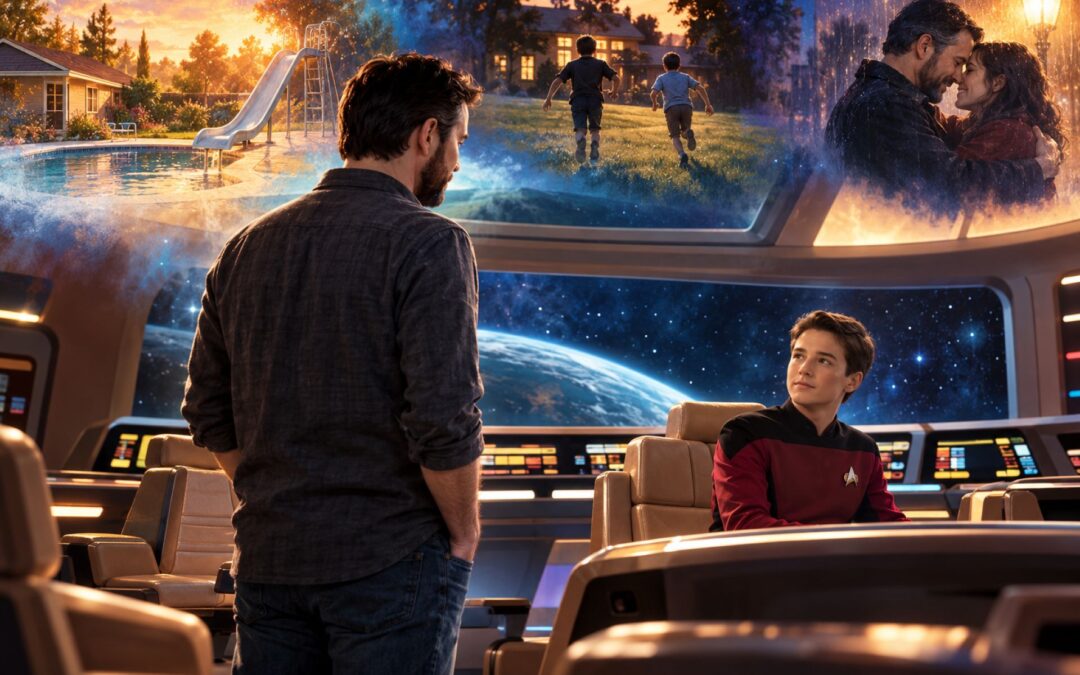
Dancing Barefoot by Wil Wheaton is a collection of five autobiographical stories about childhood, family, love, regret, and the complicated experience of becoming famous for playing Wesley Crusher on Star Trek: The Next Generation. Published in 2003, the book brings together personal narratives that Wheaton originally wrote for his website. Four are relatively short recollections of ordinary experiences, while the fifth is an extended account of a Star Trek convention that fundamentally changes how he understands his past.
The collection moves between two sides of Wheaton’s life. In one, he is a nephew grieving a beloved relative, a stepfather rediscovering childhood, an adult remembering an adolescent romantic opportunity, and a husband learning from his wife’s spontaneity. In the other, he is a former child actor struggling with the resentment and insecurity that have become attached to his most recognizable role. What connects these experiences is his uneasy relationship with memory: he remembers what he has lost, recognizes what he has neglected, and eventually recovers affection for something he spent years trying to escape.
Spoiler Warning: This article covers all five stories in detail, including their endings and the central revelation in the final narrative.

How Dancing Barefoot Became a Book
Wil Wheaton became widely known as a young actor through Stand by Me and his portrayal of Wesley Crusher on Star Trek: The Next Generation. By the early 2000s, however, he was developing another public identity as a writer whose website offered readers an unusually personal account of his experiences in entertainment, family life, and popular culture.
The five stories in Dancing Barefoot emerged from that writing. In the author’s note, dated April 2003, Wheaton explains that he wrote them around the time of his thirtieth birthday, when looking backward had become part of his attempt to understand the adult he was becoming. He had originally intended to include them in Just a Geek, a larger autobiographical project, but they did not fit the shape of that developing book.
Rather than discard them, he published the pieces separately. The collection first appeared through Monolith Press in April 2003, with a corrected printing following in June. O’Reilly subsequently brought it to a wider readership. The publisher’s publication record documents this history and identifies Ben Claassen III as the illustrator.
The origins of the collection explain its relatively informal construction. These are self-contained narratives written out of particular memories rather than chapters conceived for a continuous autobiography. Each begins with a recognizable situation and follows the emotional associations that situation produces. Their subjects range from visiting an emptied family house to performing before hundreds of science-fiction fans.
The final story is substantially longer than the others combined, giving the collection an unusual shape. The first four pieces establish the importance of childhood, affection, regret, and passing time; the last develops those concerns within the more difficult setting of Wheaton’s professional life.
In a 2013 reflection on the book’s audiobook release, Wheaton acknowledged that his writing had changed considerably since the collection appeared. He remembered its modest beginnings and admitted feeling tempted to revise the early work rather than simply record it. That retrospective perspective is useful because Dancing Barefoot captures a writer still developing his craft, often relying on the immediacy of spoken storytelling and emotional candor.
Saying Goodbye in “Houses in Motion”
The opening story begins almost a year after the death of Wheaton’s great-aunt Val. Her house, which relatives had expected to remain in the family, has been sold. Wheaton’s father asks him to help retrieve a china cabinet intended for his mother, turning what appears to be an ordinary moving errand into a painful farewell.
Wheaton enjoys spending time with his father, even when their conversations concern familiar subjects such as baseball, work, and family. During the drive, however, he realizes that this will probably be the last time he travels along the street he has known since infancy. The destination carries more emotional weight than the furniture they have come to collect.
When they arrive, Wheaton finds the house partly dismantled. Much of the furniture is gone, the walls are comparatively bare, and the warmth he associates with Aunt Val seems to have disappeared. Yet some objects remain untouched, producing a strange contrast between a home that has been emptied and one that still contains recognizable fragments of its former life.
The living room bookcase holds family photographs and children’s artwork, including pictures he made when he was young. Nearby are the recliners where his great-grandparents spent their later years. Wheaton remembers sitting in one of those chairs while Aunt Val watched television beside him, delighted that he had been allowed to stay awake beyond his ordinary bedtime.
His memories expand into the weekends he and his siblings spent with her. Aunt Val played with them, accompanied them to the corner store for snacks, let them stay up late, and made them feel unusually important. Her age never seemed to interfere with her willingness to participate in their childhood adventures.
Other parts of the house prompt equally precise recollections. The indentation left by a removed Christmas table allows Wheaton to imagine holiday decorations, family laughter, and gifts beneath the tree. The dining room table reminds him of family gatherings in which Aunt Val preferred to sit with the children. Although he eventually became old enough for the adults’ table, he requested permission to return to hers.
The kitchen contains another reminder of childhood. A cupboard that once seemed impossibly high held cereal for the visiting children, and Aunt Val was always willing to feed them regardless of when they arrived. Now the cupboard is empty and easily within his reach. The change measures his own passage into adulthood as clearly as the absence of its contents measures the disappearance of that household.
The refrigerator still displays handwritten notes and children’s schoolwork. Wheaton finds it disturbing that some personal traces have survived while other parts of the house have been stripped away. The apparent randomness makes the house feel caught between preservation and erasure.
Aunt Val’s dog, Missy, eventually leads him outside. Walking onto the patio, Wheaton looks across the swimming pool and recalls experiencing the same backyard at several different ages. He remembers riding a Big Wheel around the pool, playing with toys in the shallow water, and attempting increasingly ambitious dives as he grew older.
Then he sees the pool slide.
The sight reminds him of a visit the previous summer, when he brought his stepsons, Ryan and Nolan, to spend the day with Aunt Val. She had prepared food and drinks, listened enthusiastically as the boys described their plans, and encouraged their tricks in the swimming pool. Wheaton had been particularly pleased that the children were experiencing the same unconditional affection he remembered from his own youth.
During the visit, Ryan was stung by a wasp while sitting near the top of the slide. Wheaton treated the injury and expected the family to spend the rest of the afternoon indoors. Aunt Val, however, refused to let the wasps spoil the children’s day. Despite being eighty-four years old, she armed herself with a broom and insect spray and went outside to destroy the nest.
Watching her confront the wasps had frightened Wheaton because he feared she might be stung and suffer a serious reaction. The incident also prompted an unwelcome realization: Aunt Val would not always be there. At some future moment, he would stand beside the pool and discover that she was gone.
Now that moment has arrived.
The connection between the remembered afternoon and the deserted house overwhelms him. Wheaton begins crying beside the slide, unable to contain the grief that has been gathering since his arrival. He remembers Aunt Val’s voice, the children’s happiness, and his earlier recognition that her life was drawing toward its end.
After several minutes, he regains control, touches the slide, and says goodbye. He returns inside to help his father move the china cabinet, a heavy piece of furniture that makes the practical demands of the visit impossible to ignore.
He is angry with Aunt Val’s daughter for selling the house, which he experiences as the destruction of an important part of his childhood. Yet he does not confront her. He helps secure the cabinet, offers a restrained farewell, and leaves with his father.
During the journey home, Wheaton becomes unusually talkative. He asks about his childhood, discusses his children, and shows greater interest in the ordinary subjects that he and his father share. The experience has made him aware that his parents will not always be available either, and he wants to appreciate their company while he can.
After unloading the cabinet, his father embraces him and thanks him for helping. Wheaton tells his parents he loves them and drives home alone.
The story’s grief develops through an accumulation of ordinary objects rather than through a detailed account of Aunt Val’s death. Her generosity survives in the way she fed children, stayed awake with them, participated in their games, and fiercely protected their enjoyment of a summer afternoon. The sadness of the empty house comes from the contrast between these vivid experiences and the knowledge that they can never occur there again.
Returning to Childhood in “Ready or Not, Here I Come!”
The second story begins in Wheaton’s kitchen while his stepsons, Ryan and Nolan, play whiffle ball in the yard. He can hear them through an open window and is pleased that they are cooperating rather than allowing their usual competitiveness to spoil the game.
When Nolan comes inside for water, Wheaton promises to join them if they continue behaving well. The boy immediately becomes excited and runs outside to tell Ryan. Hearing both children welcome the prospect of his company is particularly meaningful to Wheaton because their growing independence has made his position as a stepfather less straightforward.
He has also been spending much of his time writing Just a Geek. The project has demanded enough attention that he has neglected opportunities to play with the boys. He recognizes that their childhoods are changing while he is occupied with adult responsibilities.
He quickly prepares a simple dinner, asks Anne to watch the food, and rushes outside. The reversal amuses him: at thirty years old, he is hurrying through his chores because he wants to go out and play.
Ryan’s friend, also named Ryan, has arrived. The group divides into teams, with Wheaton and Nolan playing against the two Ryans. Their baseball game includes imaginary runners, unreliable pitching, and the informal rules that children use to keep a backyard game moving.
As daylight fades, they can no longer see the ball well enough to continue. Rather than go indoors, Wheaton proposes hide-and-seek.
He begins counting while the boys run away to hide. The familiar sequence of numbers immediately sends him backward into memories of his own childhood. He remembers playing similar games at nine, ten, eleven, and twelve, with each remembered age bringing a different set of sensations and associations.
Those recollections include summer evenings, the sounds of his father cooking, familiar music, neighborhood games, and the nervous excitement of hiding beside a girl he liked. Counting becomes a bridge between the adult standing in his yard and the boy who once occupied similar evenings.
The game resumes in the present. Wheaton chases Ryan, pursues Nolan through the sprinklers, hides behind a tree, and participates with an enthusiasm that briefly overcomes the distinction between his age and theirs. The boys are not simply receiving entertainment from an adult; everyone is involved in the same spontaneous activity.
Eventually, Wheaton becomes too exhausted to continue. He returns indoors, where Anne asks him to drive Ryan’s friend home.
On the way to the car, the friend remarks that Ryan is fortunate to have a stepfather who plays with him. Ryan agrees but adds an important qualification: Wheaton has been so busy writing that an evening like this has become unusual.
Wheaton knows the observation is fair. He cannot pretend that he has been consistently available, however much he enjoys the boys’ company.
The friend’s judgment nevertheless misses something. Wheaton considers himself the fortunate person because playing with the children has allowed him to experience, for a little while, the pleasures of a childhood that otherwise exists only in memory.
Unlike the first story, where childhood can only be mourned, this one shows that certain aspects of it remain recoverable through action. Wheaton cannot become a child again, but he can participate in the same kind of game, feel its excitement, and share it with the next generation.
The Missed Connection in “Inferno”
“Inferno” opens against the unsettling atmosphere of a Southern California brushfire. Smoke hangs in the air, ash falls around Wheaton’s car, and the sun appears red through the haze. Despite the conditions, he drives to Studio City for an audition for the television series John Doe.
The casting office occupies a cramped converted apartment near the CBS studio. Other actors wait on the stairs, studying their lines and hoping the audition will lead to employment. Wheaton makes his way toward the sign-in sheet when a beautiful woman in a red dress passes him.
Her perfume triggers an unexpectedly powerful memory.
About fifteen years earlier, Wheaton and his best friend Darin were driving home after seeing a movie in Burbank. They had recently gained the freedom associated with driving and deliberately chose a longer route rather than the faster freeway. They wanted to extend their evening away from parental supervision.
The boys were talking about girls, comics, video games, and science fiction while listening to music. At a traffic light, Darin recognized a girl in another car and called out to her.
Her name was Misty.
They stopped their cars and began talking in the middle of the road, allowing other vehicles to pass around them. Wheaton was immediately attracted to Misty, who seemed friendly, funny, and comfortable speaking with them.
He was also acutely conscious of his own inexperience. Although he liked imagining romantic encounters, he had little confidence about how to behave when an actual opportunity appeared. He and Darin instinctively avoided some of their more obviously geeky conversational subjects, hoping to appear sophisticated.
Misty’s perfume made an especially strong impression. Wheaton found himself paying almost as much attention to its scent as to their conversation. The combination of attraction, freedom, and adolescent nervousness turned an accidental meeting into an unusually memorable event.
When the time came to say goodbye, he wanted to ask for her telephone number but repeatedly lost his nerve. He managed an awkward question about whether she often traveled that road, and Misty replied that she usually took the freeway.
Then she asked whether he would like to go out with her.
The sudden reversal astonished him. He agreed enthusiastically, but neither boy had a convenient piece of paper on which she could write her number.
Searching the car, Wheaton found his Car Wars Deluxe Edition Box Set, a tabletop game he enjoyed. Inside was a small card used to describe a vehicle. He handed it to Misty, embarrassed that a game accessory was the best he could provide.
She wrote her telephone number on the card and sprayed it with her perfume so that he would remember her. Wheaton placed the card back in the box for safekeeping.
The boys drove home in excited disbelief. He had received the telephone number of a girl he found extraordinarily attractive without even managing to ask for it.
But he never called.
In the adult present, Wheaton cannot offer a completely satisfactory explanation for his failure. He remembers being frightened by his own inexperience and uncertain about what would happen if Misty actually wanted a relationship. Imagining the possibility may have felt safer than risking embarrassment by pursuing it.
The perfume remained in the game box for years, preserving a sensory connection to an opportunity he allowed to disappear.
After the audition, Wheaton drives toward the smoke-covered mountains. Looking between the blue sky and the dark cloud, he wonders what became of Misty and whether she still remembers their meeting.
The story deliberately leaves these questions unanswered. Its emotional effect depends on a possibility that never became an actual relationship, and the adult narrator cannot recover the alternative life that a single telephone call might have created.
Love and Impermanence in “We Close Our Eyes”
Wheaton and Anne are visiting Santa Barbara to celebrate their anniversary. After a romantic dinner, they begin walking back to their hotel through a cold November rainstorm.
They have enjoyed an unusually peaceful day together after several weeks in which responsibilities left little time for their relationship. Wheaton values the evening, but the weather makes their return increasingly unpleasant. Their umbrella is too small to keep them dry, water seeps into their shoes, and the cold begins to numb his hands and feet.
Eventually, Wheaton suggests finding a taxi.
Anne stops and steps out from beneath the umbrella. Instead of trying to escape the weather, she announces that she wants to walk in the rain.
Wheaton protests that it is extremely cold. Anne understands the discomfort but sees the experience differently. She explains that someday she may want to feel rain on her face and discover that she is no longer able to do so. For now, she has the opportunity, and she intends to enjoy it.
She turns her face upward, allows the rain to fall on her, and splashes through a puddle. Her obvious happiness makes Wheaton reflect on the qualities that attracted him to her and continue to sustain their marriage.
He remains reluctant to abandon the umbrella. Although he recognizes the appeal of Anne’s spontaneity, he is still cold and would prefer to stay as dry as possible.
When he finally approaches her, Anne knocks the umbrella from his hand, pulls him close, and kisses him. They exchange declarations of love and remain together in the rain, soaked and freezing but entirely absorbed in each other.
The narrative ends without a further incident.
Its simplicity is important. Anne does not make the weather pleasant, solve a serious problem, or reveal information that changes their circumstances. She changes the meaning of an experience by choosing to participate in it fully.
Wheaton’s response also differs from his approach to the past in the preceding stories. Rather than remembering an experience that has disappeared, he recognizes an experience as valuable while it is happening. Anne’s attitude allows him to appreciate a moment that his desire for comfort might otherwise have ended prematurely.
A Star Trek Convention in “The Saga of SpongeBob Vegas Pants”
The final story, titled “The Saga of SpongeBob Vegas Pants, or ‘How I Learned to Stop Worrying and Love Star Trek,’” occupies most of the collection. Set during a major convention celebrating Star Trek’s thirty-fifth anniversary in Las Vegas in September 2001, it follows Wheaton through autograph sessions, awkward encounters, a difficult stage appearance, and a sketch comedy performance that offers him an opportunity to demonstrate his abilities beyond Wesley Crusher.
Yet his most important experience occurs after the public performances are over. A visit to an attraction recreating the Enterprise-D forces Wheaton to reconsider years of resentment toward the franchise, the people associated with it, and his own younger self.
A Hungover Morning and the Memory of William Shatner
The story begins with a telephone call at eight in the morning. Wheaton has slept for approximately five hours after a long night of drinking and gambling in Las Vegas. The caller, convention organizer Jackie Scott, reminds him that he is expected at an autograph session at ten.
Wheaton had mistakenly believed his obligations would not begin until late afternoon. He now faces the prospect of working through a significant hangover while remaining cheerful and attentive to hundreds of fans.
His immediate reaction becomes an elaborate comic argument among the voices in his head. One encourages him to remain in bed, while another reminds him of his professional obligations. A third warns him against waking Anne, who has also had very little sleep.
Responsibility eventually wins. He agrees to arrive at the convention, showers, and discovers that Anne has ordered breakfast to help him recover.
Wheaton explains that the convention is particularly important because he has planned something different from his usual appearances. He is a member of Hollywood’s ACME Comedy Theatre and has assembled a group of performers for a sketch show called Mind Meld Presents: Assimilate This!
The production has required months of preparation. For Wheaton, it represents an opportunity to demonstrate the comic abilities he has developed since leaving Star Trek: The Next Generation. His audience knows him primarily as Wesley Crusher, and he hopes to present them with a performance they cannot easily reconcile with their established image of him.
He arrives at the convention shortly before the autograph session and searches for the appropriate area. A staff member explains the signing arrangements, which involve moving large groups of fans past a series of tables occupied by actors.
As he passes fellow performers, Wheaton encounters familiar colleagues, including Michael Dorn, Marina Sirtis, and Armin Shimerman. The camaraderie reminds him of the professional community to which he once belonged.
Then he notices William Shatner speaking with Kate Mulgrew.
The sight produces an immediate physical reaction because Wheaton associates Shatner with one of his most humiliating experiences as a teenage actor. The narrative moves backward to 1988, when Wheaton was sixteen and working on The Next Generation.
The original Star Trek cast was filming Star Trek V nearby. Wheaton had admired those actors since childhood and was particularly excited about the possibility of meeting the performers who had brought the original series to life.
Gene Roddenberry, the creator of Star Trek, offered to introduce him. Wheaton declined because he wanted to find the courage to approach his heroes independently. Yet each opportunity seemed more intimidating than the last.
For weeks, he watched the neighboring production from a distance. His colleagues teased him affectionately about his reluctance, finding it amusing that a recognizable young actor could be frightened by the prospect of introducing himself to other actors.
One afternoon, Wheaton saw Shatner directing a scene on the neighboring set. Viewing him as a working director rather than as Captain Kirk briefly reduced the intimidation. Wheaton decided that the moment had finally arrived.
He asked his costumer, Mandy, to arrange his uncomfortable Starfleet uniform properly. Beneath it was padding intended to create a more muscular appearance, something that made the already self-conscious teenager particularly uncomfortable. Nevertheless, he wanted to look presentable when meeting the man he admired.
His confidence disappeared once he entered the neighboring set. Surrounded by uniforms, props, and performers associated with the original Enterprise, he suddenly felt like an ordinary fan rather than a fellow professional.
A still photographer who recognized him offered to make the introduction and called Shatner over.
According to Wheaton’s recollection, the meeting went badly almost immediately. Shatner appeared dismissive, did not accept his offered handshake, questioned his costume, and asked what his character did aboard the new Enterprise.
When Wheaton explained that Wesley Crusher was an acting ensign who sometimes piloted the ship, Shatner responded that he would never allow a child on his bridge. He then walked away.
Wheaton was devastated. He had spent weeks preparing to meet one of his childhood heroes and interpreted the encounter as a rejection of his role, his appearance, and his legitimacy as a member of the Star Trek family.
He returned to his own set, where Mandy noticed his distress. After describing what had happened, he withdrew to his trailer and cried.
Other colleagues soon learned about the encounter. His makeup artist, Jana, attempted to reassure him, while Brent Spiner, Jonathan Frakes, and Michael Dorn offered support and humor. Their responses helped him feel less isolated, but they could not immediately remove his humiliation.
Wheaton initially assumed that he must have done something wrong. The reaction reveals how readily he interpreted another person’s behavior as evidence of his own inadequacy.
Gene Roddenberry eventually learned about the incident. Rather than dismiss it as an insignificant disagreement between performers, he expressed support for Wheaton and made it clear that the young actor had a legitimate place on The Next Generation.
Roddenberry also intervened with Shatner.
A note subsequently arrived from Shatner’s office, containing an apology and an acknowledgment that Wheaton would be welcome on his bridge. Roddenberry telephoned to confirm that the note had been delivered.
For Wheaton, the intervention became one of his most treasured memories of Roddenberry. The creator of Star Trek had used his authority to protect a young performer who felt humiliated by someone he admired.
The story returns to the Las Vegas convention, where Wheaton must walk past Shatner to reach his table. He greets the surrounding group, but Shatner does not acknowledge him. Wheaton proceeds to his seat, interpreting the exchange as another example of their difficult relationship.
The memoir’s account is strongly shaped by Wheaton’s emotional perspective. His recollections establish how he experienced the encounter, but they do not independently verify Shatner’s motivations or every word spoken.
An important footnote further complicates the portrayal. Wheaton explains that he and Shatner appeared together on a special Star Trek edition of Weakest Link in 2002, where Shatner behaved warmly toward him. A subsequent online exchange was also friendly, suggesting that their relationship was not permanently defined by the earlier hostility.
The qualification does not diminish the significance of the 1988 experience for Wheaton. It does, however, prevent the reader from treating his teenage impression as a complete account of Shatner’s character or their entire relationship.
Autographs, Difficult Fans, and Unexpected Kindness
Wheaton begins the autograph session determined to give each attendee a pleasant experience. He understands that fans are paying for more than a handwritten signature. They want a brief encounter with someone associated with a fictional world that has mattered to them for years.
The convention’s signing system makes this difficult. Hundreds of fans move through a hallway, presenting photographs, posters, models, and other collectibles while actors sit at tables signing items as quickly as possible.
Wheaton recognizes the potential unfairness of this arrangement. The first attendees encounter performers who are relatively energetic, while those reaching the end of the line may receive less attention from exhausted actors. He tries to remember that the last person has paid as much as the first and may have waited considerably longer.
His first encounter illustrates how unpredictable the work can be.
An angry woman approaches his table and begins complaining loudly about the convention’s organization, its location, and the people responsible for running it. Wheaton attempts to explain that he is merely a guest and has little control over the event, but she continues protesting before leaving without an autograph.
The next attendee is friendly and straightforward. He asks Wheaton to sign a model of the Enterprise-D, thanks him, and moves along.
The contrast establishes the pattern of the session. Some people are excited and affectionate, while others are demanding, hostile, eccentric, or principally interested in obtaining a particular collectible.
Wheaton signs photographs of himself as Wesley Crusher, posters from his teenage celebrity years, action figures, and memorabilia displaying other cast members. He jokes with attendees and attempts to preserve a pleasant atmosphere despite the repetitive work.
A group of German women enthusiastically expresses affection for him, briefly feeding his comic fantasies of romantic celebrity. Another group has traveled from Tokyo, and their excitement makes him feel momentarily like a rock star.
One Japanese attendee, Hiroyuki, proudly explains that his friends believe he resembles Wheaton. Rather than challenge the comparison, Wheaton enthusiastically agrees and signs the young man’s action figure with a personalized message celebrating their supposed resemblance.
The encounter leaves Wheaton genuinely pleased. He recognizes that being friendly for a few seconds can give another person a memory that lasts much longer.
Another attendee produces a more confrontational experience. A conservatively dressed woman notices his rock-themed T-shirt, which features a provocative slogan and hand gesture. She accuses him of promoting Satan and repeatedly warns him that he is going to hell.
Wheaton responds with sarcastic humor, but the woman still wants his signature on a collectible plate. She also has detailed requirements about the color of ink he must use because other cast members have already signed it.
The contradiction between her moral outrage and the careful rules governing her collectible amuses him. It also illustrates how strongly some attendees connect their expectations of a public figure to the fictional character that figure once played.
After several hours, Wheaton realizes that approximately 150 people are still waiting. He is supposed to meet his comedy group for a rehearsal, and remaining until everyone has received a signature would compromise the preparation for that evening’s show.
The decision makes him anxious. He remembers years of criticism from fans and worries that leaving before the session is complete will confirm their worst assumptions about him.
He stands on a table and explains the problem to the people waiting. He promises to return the following day and sign their items when he can give them proper attention.
Wheaton expects anger, but the response is surprisingly understanding. A family wearing matching Data T-shirts reassures him that they can wait and expresses enthusiasm for the comedy show.
Other attendees respond similarly. Instead of confronting him, they offer encouragement as he makes his way along the line.
The experience challenges his expectation of hostility. He discovers that an audience he has learned to fear may be more willing to support him than he assumes.
After returning to his hotel for a short rest, Wheaton comes back to prepare for his appearance. Near the convention entrance, an enthusiastic attendee intercepts him and repeatedly insists that he is not really a Trekkie.
The man’s extensive knowledge contradicts his claim. He owns episodes on video, has studied technical manuals, knows obscure details of the franchise, and has corresponded about inconsistencies in its fictional technology. Nevertheless, he distances himself from the label associated with particularly devoted fans.
Wheaton finds the encounter exhausting, especially when the man begins testing him with obscure trivia questions. Yet he remains courteous until a staff member provides an opportunity to leave.
When the staff member asks how he tolerates such interactions, Wheaton explains that Star Trek’s continuing popularity depends on its fans. Their loyalty helped make later productions possible, and he regards treating them respectfully as part of his responsibility.
The statement is important because his feelings about fandom are contradictory. Some encounters irritate or embarrass him, and he occasionally mocks the people involved. At the same time, he understands their enthusiasm from personal experience and recognizes that his career owes something to their devotion.
A Convention Appearance That Nearly Falls Apart
Wheaton is scheduled to speak onstage for approximately fifty minutes. He usually prefers longer appearances because they allow him to tell stories, answer questions, and establish a comfortable relationship with an audience.
This event presents several difficulties.
He is the final speaker of the day, when attendees are likely to be tired. He follows Michael Dorn and Marina Sirtis, who have a successful convention routine and are warmly received by fans. His own reputation as Wesley Crusher adds another source of insecurity.
The presence of Anne, his parents, and members of his comedy group makes the stakes feel higher. He particularly dreads the possibility of being rejected in front of people whose opinions matter to him.
When the preceding performers finish, they offer encouragement. Convention organizer Dave Scott then introduces Wheaton with extravagant praise, promising an exceptionally entertaining appearance.
The audience responds enthusiastically. Wheaton walks onstage to applause and immediately attempts to establish a comic connection.
His first joke concerns bottles of convention-branded water distributed to attendees. He pretends to reveal that the water is ordinary bottled water rather than a product from the fictional world of Star Trek.
The audience does not respond as he expects. Someone points out that the water is free, undermining the premise of the joke.
Wheaton becomes nervous and tries to move quickly into a prepared sequence of humorous answers to familiar convention questions. This also fails.
He notices people leaving the room and begins to fear that the appearance is collapsing. His anxious internal commentary, presented through the same comic voices introduced earlier, grows increasingly hostile.
Searching for something that might recover the audience, he invites questions. When nobody immediately responds, he jokingly suggests that the session must already be over and begins walking away.
Unexpectedly, the audience laughs.
The reaction allows him to relax, and the question-and-answer period gradually becomes more successful.
A woman dressed as Beverly Crusher asks him to greet his mother. Wheaton turns toward Debbie, his actual mother, who is sitting in the audience, and humorously asks whether he is doing badly. She reassures him, creating a moment of affectionate comedy shared by the entire room.
Another attendee asks what it was like to kiss Ashley Judd. Wheaton responds with a flirtatious joke before acknowledging Anne’s presence. The audience enjoys the exchange, and his confidence continues to improve.
Then someone asks about his favorite episode of Star Trek: Voyager.
Wheaton answers candidly that he has watched relatively little of the series and does not particularly enjoy it. The response creates discomfort among attendees who expect him to share their enthusiasm.
A subsequent question about Deep Space Nine produces a similar admission. Wheaton explains that neither series appealed to him as much as the original Star Trek or The Next Generation.
He recognizes that his honesty is creating another problem. Many fans view the franchise as an interconnected world and expect its performers to express enthusiasm for all its branches. Wheaton, however, regards himself as entitled to individual preferences even though he once worked within that universe.
He eventually returns to familiar comic material.
One story concerns a limited-edition Star Trek Monopoly game whose supposed exclusivity becomes ridiculous when he describes the enormous number of copies produced. He jokes about its certificate of authenticity being signed by a fictional character and remembers Ryan eagerly claiming the Wesley Crusher playing piece during a family game.
The audience responds more warmly.
Wheaton then tells a story about contract renegotiations during The Next Generation. According to his account, the producers once suggested that a promotion for his fictional character might substitute for an increase in his actual salary.
He turns the idea into a joke about attempting to pay a mortgage with the rank of lieutenant aboard a fictional spaceship. The distinction between entertainment and employment produces substantial laughter.
Finally, he performs an elaborate routine about an online poll to determine the greatest Star Trek episode.
In the story, Wheaton supposedly spends days repeatedly voting for The Next Generation, neglecting food, sleep, and hygiene while concealing his activity from Anne. He builds the absurdity until admitting to downloading pornography appears, within the joke, less embarrassing than confessing to obsessively manipulating a Star Trek poll.
The routine produces enthusiastic laughter and applause. Wheaton finishes by celebrating The Next Generation and leaves the stage to a warm response.
The exaggerated details are part of a comic performance, not independently documented evidence that he literally spent days manipulating an online vote. Their importance lies in how they allow him to make fun of obsessive fandom while also declaring his affection for the franchise.
The convention appearance has moved from enthusiastic anticipation through humiliation and anxiety toward a qualified success. It is not the perfectly controlled performance Wheaton wanted, but he has recovered from failure and learned that his audience can respond to his personal style.
The Comedy Show and the Standing Ovation
Following the convention talk, Wheaton reunites with the performers from ACME Comedy Theatre. They have prepared a sketch comedy show intended to introduce the audience to a different side of him.
His fellow performers include writers and actors with whom he has worked in Hollywood. They are familiar with performing together but have not presented this particular arrangement of sketches before a Star Trek convention audience.
Some of them know relatively little about the franchise. Wheaton worries that they underestimate how critical devoted fans can become when entertainment fails to satisfy their expectations.
The group is hungry and has limited preparation time, so they stop for food before returning to the convention. Wheaton is too nervous to eat much. He is conscious that the show represents both a professional opportunity and a personal test of whether the audience will accept him as more than Wesley Crusher.
The schedule begins to deteriorate.
An earlier event runs late, preventing the performers from entering the room when expected. Their audience has already been waiting, and Wheaton fears that frustration will make the crowd harder to entertain.
The comedy group also needs to coordinate costumes, props, lighting changes, and the timing of individual sketches. Their technician, Jim, has not previously worked with this show and must quickly become familiar with its requirements.
The performers discover that they do not have the microphones they expected. Without microphones, the back of the large room may struggle to hear their dialogue.
The problem causes understandable anxiety. Rather than cancel or drastically change the production, the group decides to project their voices as strongly as possible and trust their theatrical experience.
They also work with Jim to coordinate the blackouts that end individual sketches. The timing matters because a joke’s effect can disappear if the lights remain on after its final line.
Wheaton eventually decides that further rehearsal will accomplish little. The audience has waited long enough, and the performers must rely on the preparation they have already completed.
Before opening the show, the actors gather together and encourage one another. Their joking conversation helps release some of the tension.
Dave Scott introduces Wheaton, who walks onto the stage to address the crowd.
He immediately notices something unexpected.
The audience is wearing Groucho glasses, creating a room full of exaggerated noses, eyebrows, and mustaches. The coordinated joke has transformed the audience into a playful group eager to participate in the evening.
Wheaton responds with a joke of his own, and the room erupts with laughter.
The opening gives him the reassurance he lacked during his earlier convention appearance. These people are not waiting for him to fail; they are prepared to enjoy themselves.
He introduces the performers and the show begins.
The sketches go remarkably well. The cast moves through its material confidently, and Jim handles the lighting cues with surprising precision despite his limited preparation. Even improvisations receive appropriate blackouts.
Most of the sketches generate strong laughter. Wheaton describes only one as comparatively unsuccessful, an excellent outcome for a ninety-minute comedy performance.
The performers encounter one unexpected practical problem: Wheaton and another cast member urgently need to use the bathroom, but the room’s makeshift backstage arrangement makes leaving without disrupting the show almost impossible. They endure the discomfort until the performance ends.
When the final sketch concludes, the audience cheers and demands more. The performers have exhausted their prepared material, so Wheaton comes forward to thank everyone and introduce the cast.
The audience rises to its feet.
The standing ovation overwhelms him.
For years, Wheaton has associated Star Trek conventions with ridicule, hostility, and the difficulty of being judged for a character he played as a teenager. He has worked hard to develop other abilities and wants people to recognize that he has grown.
Now hundreds of fans are applauding him for a performance that demonstrates those abilities.
The approval feels particularly significant because it comes from an audience he once feared. Wheaton has challenged their expectations and received an enthusiastic response.
He also recognizes that the achievement belongs to the entire group. The performers have worked together for months, and Jim’s technical contribution helped prevent a potentially disastrous show. Wheaton later regrets forgetting to acknowledge him during the public thanks.
After the audience departs, Anne embraces Wheaton and praises the performance. Her reaction matters to him at least as much as the standing ovation because she knows the work and anxiety that preceded it.
His parents also express their approval, and the cast celebrates the achievement.
Wheaton has accomplished the public objective that brought him to Las Vegas. He has demonstrated that he can entertain an audience through skills developed outside his most famous television role.
But the story has not yet reached its deepest resolution.
An Enterprise Bridge and a Changed Perspective
After the show, Wheaton spends time celebrating with the performers, Anne, and friends. Their weekend includes meals, gambling, swimming, and the ordinary pleasures of spending time together away from work.
These scenes provide a welcome contrast to the intense pressure surrounding the performance. Wheaton enjoys being part of a group whose relationships extend beyond the public identity associated with his television career.
On Sunday evening, he and Anne travel to Star Trek: The Experience at the Las Vegas Hilton. The convention organizers have arranged a special event where attendees and performers can socialize, see exhibits, and participate in an attraction recreating parts of the Star Trek universe.
They arrive late after a hurried taxi journey. Once inside, Wheaton sees a large model of the Enterprise-D suspended overhead.
The sight immediately recalls the first time he watched the ship appear on screen during an early presentation of The Next Generation. He remembers his excitement as a young actor who had become part of a fictional universe he already loved.
The attraction contains a restaurant modeled on Quark’s Bar, exhibits of Star Trek props and costumes, and a simulation that takes visitors aboard the Enterprise.
Wheaton encounters enthusiastic fans who praise the comedy show. Some describe sketches in considerable detail, and one woman tells him that she will no longer think of him exclusively as Wesley Crusher.
The reaction confirms that the performance achieved his intended effect.
He is also struck by the fact that the event was not recorded. The show that required months of preparation and produced such an extraordinary response now survives principally in the memories of the performers and audience.
Wheaton decides to experience the Enterprise attraction with Anne.
They begin by walking through exhibits displaying costumes, equipment, and props from Star Trek productions. Objects that other visitors regard as memorabilia evoke more immediate associations for him because he remembers using similar items, wearing comparable costumes, and working with the people connected to them.
Anne listens while he recalls individual production experiences. He recognizes that the stories may be far more interesting to him than to someone who did not share that history.
Their initial attempt to enter the attraction becomes uncomfortable when costumed fans begin arguing about Klingon honor and Starfleet principles. The participants try to draw Wheaton into their disagreement, and Anne becomes increasingly uneasy.
Wheaton decides to leave the queue with her rather than prolong the situation.
Later, he encounters Garrett Wang and Stephen Furst. They encourage him to try the attraction again, assuring him that he will enjoy it. The group returns and enters the simulation.
The ride begins in a conventional waiting area, with screens and safety instructions. Suddenly, the lights go out and special effects transform the visitors’ surroundings.
When the lights return, they appear to be standing in the transporter room of the Enterprise.
The experience shocks Wheaton.
The attraction is designed to make visitors feel as though they have entered the twenty-fourth century. For Wheaton, however, the room creates the sensation of returning to the television sets where he worked as a teenager.
The group moves through reconstructed corridors resembling those he once walked every day. Wheaton unconsciously anticipates the layout of the original production environment, remembering where familiar rooms and sets would have been.
They enter a simulated turbolift and eventually reach the Enterprise bridge.
The doors open, revealing a detailed reproduction of the space where Wheaton spent much of his adolescence.
He is overwhelmed.
The room contains familiar consoles, lighting, and the sounds of a functioning spaceship. A starfield fills the viewscreen, recalling the visual effects that once made the imaginary Enterprise feel real to him.
The recreation summons a sequence of memories.
He remembers being fourteen during the production of “Encounter at Farpoint,” excited by the scale of the fictional world. He recalls being fifteen in an awkward uniform with artificial muscle padding, trying desperately to appear mature.
At sixteen, he remembers feeling frustrated by episodes that gave him very little to do. At seventeen, he recalls the novelty of wearing a different uniform and performing different duties during “Yesterday’s Enterprise.”
Other memories arrive with equal force: the voices of crew members, the cold mornings near the trailers, lunches with fellow actors, the amusement of working beside Brent Spiner, and the opportunity to listen to Patrick Stewart and Gene Roddenberry discussing the fictional universe they were creating.
For years, Wheaton has primarily remembered the painful parts of his Star Trek experience.
He remembers hostile convention audiences, criticism of Wesley Crusher, dissatisfaction with the writing of his character, and his struggles to establish a career beyond the series. These memories had become so prominent that they obscured the pleasure he once took in the work.
Standing on the reconstructed bridge, he recognizes that the negative experiences never represented the whole of his time on Star Trek.
He had been excited to explore an imaginary spaceship, work with people he admired, become part of a professional family, and participate in a world that had fascinated him since childhood.
The realization fills him with regret.
Wheaton now believes that he spent years trying to escape an experience that he actually loved. His desire to move beyond Wesley Crusher had gradually become entangled with an effort to reject Star Trek itself.
He wishes he could recover the years he spent distancing himself from those memories, but the past cannot be reclaimed.
The attraction continues around him. He realizes that tears have formed on his cheeks and that other visitors are looking at him. Embarrassed, he jokes about being available if anyone needs help piloting the ship.
The group is instructed to leave the bridge and proceed toward the next part of the attraction.
Wheaton does not want to go.
The reconstructed bridge has briefly allowed him to inhabit a lost period of his life, and leaving feels like another separation from his younger self. Nevertheless, he follows the group into the shuttlecraft simulation and eventually returns to the ordinary surroundings of the attraction.
The experience has changed his perspective.
He realizes that Star Trek will probably remain an important part of his public identity, whether he welcomes it or not. Instead of treating that association as an obstacle, he can acknowledge what the work meant to him and remember the people and experiences that made it worthwhile.
The rest of the evening passes through familiar convention activities. Wheaton socializes, poses for pictures, signs autographs, and shares the company of colleagues and fans.
Before leaving, he thanks the organizers for the event. In a retrospective aside, he observes that an event two days later will profoundly alter his feelings about flying, an allusion to the September 11, 2001 attacks.
He and Anne then take a taxi back to their hotel.
Anne falls asleep against him while Wheaton looks through the window at the darkness beyond the bright lights of Las Vegas. His mind remains occupied with the Enterprise and the memories recovered during the attraction.
The driver notices him in the mirror and asks what brought him to the city.
Wheaton replies that he came because of Star Trek.
When the driver asks whether he is a fan, Wheaton answers that he is and says that he loves Star Trek.
The final exchange completes the emotional movement of the story. Wheaton no longer needs to separate his identity from the fictional universe that helped shape it.
The Collection’s Uneven Structure and Autobiographical Shape
Dancing Barefoot has a distinctive structural imbalance. Its first four stories are compact recollections built around individual incidents, while the fifth develops a much longer narrative with multiple settings, conflicts, flashbacks, performances, and moments of emotional change.
That difference is partly explained by the book’s origin as a selection of existing autobiographical writing. The stories were not originally designed as consecutive chapters in a single memoir, and their arrangements do not follow a continuous chronology of Wheaton’s life.
“Houses in Motion” begins after Aunt Val’s death and uses a house-clearing visit to reconstruct earlier family experiences. “Ready or Not, Here I Come!” begins with a routine domestic evening and moves repeatedly into childhood memory. “Inferno” interrupts an audition-day narrative with a teenage romantic encounter, while “We Close Our Eyes” remains almost entirely within one brief anniversary experience.
These four pieces are structured around moments of emotional recognition. Each begins in a recognizable present, introduces an incident or object that changes Wheaton’s perspective, and ends soon after that recognition becomes clear.
The Las Vegas story is different. It contains a practical professional problem, an extended childhood flashback, multiple encounters with fans, an unsuccessful stage opening, a successful comedy performance, and a final revelation that reorganizes the meaning of earlier memories.
The longer structure allows Wheaton to present the complexity of an attitude he cannot resolve through a single conversation. He fears fans while feeling obligated to respect them, resents his association with Wesley Crusher while still loving elements of Star Trek, and seeks approval for his newer creative work while struggling to appreciate the work that made him famous.
The preceding stories provide useful emotional preparation for this conclusion. They establish that Wheaton is especially responsive to the past, that his adult relationships matter deeply to him, and that ordinary physical experiences can suddenly restore forgotten feelings.
The Enterprise bridge becomes another such physical trigger. Its effect is much more complicated than Misty’s perfume or the swimming pool slide, but the mechanism is familiar.
Nevertheless, the relationship between the stories should not be overstated. Wheaton does not build a continuous argument across them, and several could be read independently without losing much of their meaning.
The book therefore has the character of a collection whose coherence emerges from recurring concerns rather than deliberate narrative progression. Its final story gives it a strong concluding effect, but the whole remains less integrated than a memoir planned from beginning to end.
A contemporary comparison of Dancing Barefoot and Just a Geek similarly identified the later work as having a more coherent narrative shape. That judgment is persuasive insofar as Dancing Barefoot often feels episodic, although its smaller domestic stories also possess a directness that might have been diluted within a larger autobiography.
The imbalance creates a practical consequence for readers. Someone expecting five equally developed essays will find that the book gradually becomes an extended Star Trek memoir. Readers more interested in Wheaton’s family life may prefer the opening pieces, while those drawn to his professional experiences will find most of the substantive narrative in the final section.
Memory, Lost Time, and the Triggers of Nostalgia
Memory is the most consistent organizing force in Dancing Barefoot. Wheaton repeatedly encounters ordinary objects or situations that produce intense recollections, often restoring feelings he had not deliberately sought.
In “Houses in Motion,” memory is tied to the physical arrangement of a home. The children’s artwork, television chairs, cereal cupboard, and swimming pool do not merely remind Wheaton that he once visited Aunt Val. They restore particular sensations of being welcomed, protected, and allowed to enjoy childhood.
The most important trigger is the pool slide because it connects multiple periods of his life. As a child, he enjoyed the pool himself. As a stepfather, he watched his children enjoy it. In the present, he confronts the absence of the woman who made both experiences possible.
The object remains physically recognizable while the relationships surrounding it have changed. That contrast produces the story’s grief.
In “Ready or Not, Here I Come!,” the mechanism is different. Wheaton does not need an old object or a return to a childhood location. The familiar action of counting during hide-and-seek recreates an experience he once performed repeatedly.
His memories move through different childhood ages because the present activity recalls the emotional world of earlier games. The association is pleasurable rather than devastating.
The distinction matters. Memory can make the distance between past and present painfully visible, but it can also preserve forms of enjoyment that remain available through repetition.
“Inferno” depends on another kind of trigger: smell. The perfume worn by a stranger evokes Misty before Wheaton has consciously chosen to remember her. The recollection is unusually specific, transporting him into a teenage evening filled with freedom, attraction, insecurity, and unfulfilled possibility.
The Car Wars card makes the remembered experience tangible. Wheaton preserved the object for years, but retaining the telephone number did not preserve the opportunity to use it. The keepsake becomes evidence of both the encounter and his failure to act.
The third story consequently presents memory as a source of unresolved speculation. Wheaton can remember the conversation, but he cannot discover what would have happened had he called Misty. Nostalgia preserves the possibility without providing an answer.
“We Close Our Eyes” offers a related but significantly different treatment of time.
Anne’s decision to walk in the rain arises from her awareness that ordinary abilities and experiences are temporary. She does not need to remember a lost opportunity to value the present. She recognizes in advance that the opportunity will eventually disappear.
Wheaton’s memories in the other stories often emerge after the decisive moment has passed. Anne’s response demonstrates a form of attention that may prevent an enjoyable experience from becoming another regret.
The Enterprise bridge brings these variations together. Like Aunt Val’s house, it is a recognizable physical environment associated with earlier life. Like the hide-and-seek game, it allows Wheaton to recover feelings that remain accessible despite the passage of time.
Like Misty’s perfume, it exposes opportunities he believes he has lost. The difference is that the bridge also forces him to correct an incomplete version of his past.
Until that moment, Wheaton has remembered his Star Trek years primarily through rejection and resentment. The reconstructed environment restores experiences of affection, excitement, achievement, and friendship that his later difficulties had obscured.
The resulting nostalgia is not entirely comforting. It brings joy and regret simultaneously because he realizes that he cannot return to those years with his new understanding.
This gives the collection a more complicated treatment of memory than simple idealization of childhood. The past is sometimes beautiful, sometimes embarrassing, sometimes painful, and frequently inaccessible. What changes is the adult narrator’s ability to recognize which parts of it he has neglected or misunderstood.
Family, Affection, and the Life Outside Hollywood
Family relationships provide much of the emotional stability in Dancing Barefoot. While Wheaton’s professional life is characterized by competition, uncertainty, criticism, and public expectations, his domestic life contains relationships in which affection does not depend principally on performance.
Aunt Val is the clearest example.
Her importance comes from the ordinary forms of attention she gave the children in her family. She listened to their conversations, prepared snacks, shared television programs, and allowed them to remain children even as they approached adulthood.
Her response to Ryan’s wasp sting extends that pattern. Despite the physical risk and her advanced age, she acts immediately to restore the children’s enjoyment of their visit.
Wheaton remembers her through generosity rather than through an idealized account of personal greatness. The small details explain why her absence has such power over him.
His father occupies a quieter position in the opening story. Their comfortable conversation during the drive suggests a longstanding relationship, but Wheaton also recognizes that ordinary opportunities for companionship are easy to take for granted.
After saying goodbye to the house, he becomes more attentive to their time together. His increased interest in childhood memories reflects a new desire to preserve the relationship while it remains possible.
Ryan and Nolan serve a related purpose in the opening two stories. Their presence allows Wheaton to experience family life from a different generational position.
At Aunt Val’s house, he watches them receive the same affection he once enjoyed. In the hide-and-seek story, he becomes the adult who provides opportunities for play.
Yet the second story also reveals a limitation in his self-presentation. Ryan’s observation that Wheaton has been spending most of his time writing prevents the episode from becoming an uncomplicated celebration of exemplary stepfatherhood.
Wheaton enjoys playing with the boys, but he has not always made himself available. Their happiness matters partly because it reminds him of a responsibility that ordinary adult commitments can easily displace.
Anne is the collection’s most consistently present adult relationship.
In “We Close Our Eyes,” she is spontaneous, playful, and determined to enjoy an uncomfortable experience. Wheaton admires her willingness to embrace the moment but initially resists following her example.
In the Las Vegas narrative, she is practical and supportive. She orders breakfast when his poor planning creates a difficult morning, shares the excitement of his theatrical success, and celebrates his achievement after the show.
She also retains preferences that differ from his. Her discomfort around the aggressive costumed fans at Star Trek: The Experience causes them to abandon their first attempt to enter the attraction.
That response is significant because Wheaton has become accustomed to behavior that she finds unsettling. Her perspective reminds him that the conventions and rituals of his professional world are not necessarily familiar or comfortable to everyone.
Their relationship provides a contrast to the uncertainty of public approval. Anne is pleased when Wheaton succeeds, but her importance to him does not depend on the fans’ judgment.
The same is true of his parents’ encouragement after the comedy performance. Their support matters because it connects his adult creative achievement to relationships that preceded his public struggles.
The professional colleagues in the final story also form a kind of extended family. Mandy comforts the teenage Wheaton after the Shatner encounter, Roddenberry intervenes on his behalf, and members of The Next Generation cast make him feel supported.
The comedy performers offer a comparable sense of solidarity. Their shared preparation, humor, and willingness to work through technical problems transform an intimidating event into a collaborative achievement.
The book does not suggest that familial or professional affection eliminates insecurity. Wheaton repeatedly experiences anxiety despite the presence of people who love or respect him. What these relationships provide is continuity: they allow him to recognize that his value cannot be measured entirely by the reactions of strangers.
Wesley Crusher and the Cost of Being Identified With a Role
Wesley Crusher dominates the final story because the character has become inseparable from Wheaton’s public identity.
As a teenager, Wheaton was proud to work on Star Trek: The Next Generation. The series placed him among established actors in a fictional universe he admired, but it also exposed him to criticism directed at Wesley, the young character he portrayed.
The distinction between actor and character became increasingly difficult to maintain.
Some fans disliked Wesley’s presence, personality, or the way the writers used him. Wheaton could recognize that such criticisms concerned a television production, yet repeated hostile encounters made them feel personal.
He came to expect rejection from an audience that had already formed opinions about him before meeting him.
The Shatner experience deepened this vulnerability because it connected professional insecurity with disappointed hero worship. Wheaton approached the older actor as a fan, hoping for recognition from someone central to the Star Trek universe. He interpreted Shatner’s dismissive behavior as proof that he did not belong.
That interpretation reveals the teenager’s fragile sense of legitimacy. Although he was a working actor on a successful television series, he did not feel secure enough to separate another person’s apparent contempt from his own worth.
The Las Vegas convention exposes the persistence of this problem.
Wheaton worries that leaving an autograph session early will confirm his critics’ assumptions. He fears that a failed comedy show will make him permanently unwelcome at conventions. He feels judged before his stage appearance even begins.
These anxieties often exceed the immediate evidence. Fans who might reasonably object to waiting longer for an autograph instead respond with encouragement, and an audience he fears will reject his comedy ultimately celebrates it.
The discrepancy suggests that Wheaton has carried earlier experiences of humiliation into situations where they do not always apply.
His desire to demonstrate other abilities is understandable. Playing Wesley Crusher did not exhaust his interests or skills, and he has worked to develop himself as a writer and comedian.
The problem arises when proving that he is more than Wesley becomes an attempt to deny the value of having played Wesley at all.
The standing ovation initially appears to solve that problem. The audience has seen him perform comedy and responded enthusiastically, demonstrating that fans can appreciate his work beyond the familiar television role.
But public recognition cannot completely resolve the conflict because the deeper issue concerns Wheaton’s attitude toward his own memories.
The Enterprise attraction forces him to recognize that he has allowed later criticism to determine the meaning of earlier experiences. He remembers the discomfort of his teenage uniform, the frustrating scripts, and the hostility of some audiences while neglecting the friendships, professional opportunities, and excitement that also defined those years.
The bridge restores his ability to value the experience without pretending that its difficulties never occurred.
This distinction makes the ending more convincing than a simple declaration that Wheaton has learned to ignore his critics. He does not need to deny their existence or abandon his ambitions outside Star Trek. He needs to stop allowing their judgments to dictate how he remembers an important part of his life.
There is also an unresolved practical reality. He recognizes that the franchise may remain the most recognizable aspect of his career, regardless of what he accomplishes elsewhere. The ending does not promise that this association will disappear.
Instead, Wheaton becomes willing to accept the connection without experiencing it only as a limitation.
The Ethics of Fandom, Celebrity, and Personal Encounters
The Las Vegas narrative provides an unusually detailed account of the relationship between performers and devoted audiences.
Convention attendees pay for access to people associated with characters and stories that have mattered to them. They may have followed the franchise for years, traveled considerable distances, or invested substantial money in collectible merchandise.
For the performers, however, the same event is also paid work. They repeat familiar stories, answer questions, sign objects, and attempt to remain personable through long and tiring sessions.
Wheaton recognizes that these unequal experiences can produce disappointment. An autograph that feels routine to the actor may represent an important personal memory for the fan.
His description of the signing line reveals an ethic of professional attention. He believes that attendees deserve courtesy, particularly when they have spent considerable time waiting to meet him.
The principle is influenced by his own experience as a fan. He remembers the humiliation of approaching Shatner with admiration and feeling dismissed. He does not want to inflict a similar experience on someone who has approached him in good faith.
The Shatner memory consequently functions as more than a personal grievance. It helps explain why Wheaton considers apparently small gestures of kindness meaningful.
His interaction with Hiroyuki demonstrates that principle in action. He could have responded dismissively to the young fan’s claim that they looked alike. Instead, he participates in the enthusiasm and gives him an affectionate personalized inscription.
The act costs very little but produces an obvious moment of happiness.
Yet Wheaton’s treatment of fans is not consistently generous.
He makes jokes about hygiene, costumes, excessive enthusiasm, social awkwardness, and obsessive knowledge. Some are recognizable examples of observational comedy, while others reduce unfamiliar people to stereotypes.
The contradiction is particularly visible in his encounter with the man who refuses to identify as a Trekkie despite possessing extensive knowledge of the franchise. Wheaton understands the man’s enthusiasm and remains outwardly courteous, but his private narration treats him as ridiculous.
This tension does not automatically invalidate Wheaton’s stated values. Respectful conduct and private irritation can coexist, particularly when someone is exhausted or dealing with unwanted demands.
It does, however, expose the difference between his ethical aspirations and his habitual comic reactions.
The convention also complicates any simple distinction between good fans and bad fans. The angry woman at the autograph table behaves unreasonably, but the family waiting farther down the line responds sympathetically when Wheaton explains his scheduling problem.
Some attendees expect him to endorse every Star Trek series, while others appreciate his independent opinions. The audience that initially resists his jokes later welcomes his comedy performance.
Fans are therefore more varied than Wheaton’s anxieties sometimes allow him to recognize.
His remark that committed viewers helped sustain the franchise also introduces a question about cultural participation. A television series depends on actors, writers, producers, and studios, but long-term fan enthusiasm can help preserve its public significance.
Wheaton acknowledges this relationship without denying the difficulties that conventions create for performers.
The most persuasive aspect of his position is that he treats the audience as people whose emotional investment deserves consideration. Its weakest aspect is his occasional tendency to mock the forms that investment takes.
The story gains complexity from leaving that contradiction visible. Wheaton is neither a consistently patient public figure nor someone indifferent to his fans. He is a tired, insecure, often funny performer attempting to meet obligations that are both commercial and personal.
Humor, Voice, and the Limits of Memoir as Evidence
Wheaton writes in a strongly conversational first person. His prose often resembles an animated personal anecdote delivered to friends, complete with digressions, jokes, exaggerated reactions, and informal references to films, television, music, and games.
That style suits the book’s origins in personal blogging.
The reader receives stories through the perspective of an individual who is willing to admit embarrassment, insecurity, affection, and foolish behavior without adopting a formal literary voice.
In “Houses in Motion,” the narration depends on concrete observation. Wheaton moves through the rooms of Aunt Val’s home and allows objects to prompt memories. The story becomes emotional because the reader gradually understands what those objects represent.
Its most effective passages do not require elaborate language. The position of a chair, the height of a cupboard, and the sight of a pool slide provide enough detail to make the loss intelligible.
“Ready or Not, Here I Come!” uses a different rhythm. The movement of the game creates opportunities for rapid transitions between present action and childhood recollection. Counting allows the narrative to move through time without lengthy explanations.
“Inferno” is built around a sudden sensory interruption. The smell of perfume displaces the present-day audition and allows an adolescent memory to take over the narrative.
“We Close Our Eyes” is more restrained. Its short duration and limited setting concentrate attention on a single disagreement and its affectionate resolution.
The final narrative is considerably more expansive and comic. Wheaton introduces named voices in his head to dramatize competing impulses, including laziness, caution, and self-preservation.
These voices make his anxiety entertaining while providing access to the exaggerated self-criticism that accompanies public performance. The technique is particularly effective when his confidence collapses during the convention talk.
He frequently moves between genuine vulnerability and comic exaggeration. A failed joke becomes a personal catastrophe, a difficult audience becomes an imagined mob, and a minor inconvenience can develop into an elaborate internal argument.
The exaggerations communicate how situations feel to him rather than claiming that every imagined disaster actually occurs.
Pop-cultural references are another important feature. Wheaton invokes science-fiction characters, video games, alternative music, television episodes, and geek subcultures with relatively little explanation.
These references establish his cultural identity. He is someone for whom imaginary spaceships, game boxes, and episode titles carry genuine personal associations.
They also make the writing strongly connected to its period. Some readers will immediately recognize the references, while others may find the narration interrupted by jokes whose cultural context they do not share.
The dialogue is generally lively, especially in family scenes and convention encounters. Wheaton has a good ear for the difference between a child’s spontaneous enthusiasm, a fan’s nervous excitement, and the practiced joking of professional performers.
Nevertheless, dialogue in autobiographical writing raises questions of reliability.
The publisher’s copyright statement acknowledges that some characters and dialogue have been dramatized. Readers should therefore understand the conversations as part of Wheaton’s literary reconstruction of experience rather than necessarily as exact transcripts.
This distinction matters most in the Shatner story. Wheaton recounts an encounter that occurred more than a decade before he wrote about it, including precise dialogue and interpretations of another person’s behavior.
His emotional response may be accurately remembered even if particular words, gestures, or motivations are less certain. The writing establishes the subjective significance of the event without independently confirming every detail.
The same principle applies more lightly to the comic stories. The elaborate online poll anecdote, for example, is presented as part of an onstage performance and is filled with obvious exaggerations.
Treating its contents as straightforward factual reporting would misunderstand the purpose of the routine.
Wheaton’s most distinctive stylistic quality is the ease with which he moves from mockery to sincerity. His willingness to look foolish makes the emotional material less guarded, although it can also produce abrupt changes of tone.
Sometimes a joke interrupts a moment that might have benefited from greater restraint. Elsewhere, explicit declarations of emotion repeat feelings that the preceding scene has already communicated.
The unevenness reflects an early author who has strong narrative instincts but does not always know when a passage has achieved its effect.
His later acknowledgment that he would have written portions of the collection differently is consistent with that impression, though the early prose also retains a spontaneity that extensive revision might have diminished.
The Ending’s Meaning and the Shadow of September 2001
The ending of Dancing Barefoot depends on two separate forms of acceptance.
The first comes from the audience’s standing ovation after the sketch comedy show. Wheaton has presented himself as a performer with abilities beyond his teenage television role, and the fans have responded enthusiastically.
That achievement resolves an important external conflict. He wanted recognition for his development as an actor and comedian, and the performance provided it.
The second form of acceptance occurs inside the reconstructed Enterprise.
There, Wheaton recognizes that much of his resentment has come from allowing painful experiences to dominate his memories. He has associated Star Trek with ridicule, professional frustration, and a public identity he cannot escape, while forgetting the friendships and excitement that originally made the work meaningful.
The simulated bridge restores those neglected memories.
The distinction is essential because the standing ovation alone could have reinforced the idea that Wheaton needed to prove he had moved beyond Star Trek before he could feel satisfied. The Enterprise experience instead allows him to recognize that moving forward does not require rejecting the past.
He can be proud of his newer work and still value the television series that made him famous.
The setting gives the revelation particular force. An attraction built to let fans imagine visiting a fictional spaceship unexpectedly allows one of the original performers to revisit his actual youth.
What others experience as an artificial reconstruction becomes, for Wheaton, a powerful reminder of a real place and period in his life.
The recreated corridors and bridge resemble the childhood spaces described earlier in the collection. Like Aunt Val’s house, they preserve associations with people and experiences that cannot be fully recovered.
There is, however, an important difference.
Aunt Val’s house has been sold, and its former life is permanently gone. The reconstructed Enterprise is also incapable of restoring the past, but it helps Wheaton reconsider what that past meant.
His sadness does not disappear. He regrets years spent distancing himself from people and experiences he loved. He cannot recover those years or undo every professional decision.
The ending is therefore a reconciliation rather than a complete restoration.
The final taxi conversation condenses that change into a simple exchange. When the driver asks whether he is a Star Trek fan, Wheaton identifies himself as one without qualification.
He no longer needs to insist that his relationship with Star Trek consists primarily of frustration or embarrassment.
The brief reference to air travel introduces a different kind of historical perspective. Wheaton notes that only two days after the convention he will feel profoundly differently about boarding an airplane, clearly referring to the September 11, 2001 attacks.
The attacks occurred outside the narrated events, and Wheaton does not describe his direct experience of them. The reference should therefore remain a historical allusion rather than become the basis for an invented account of his response.
Its presence nevertheless changes the emotional atmosphere of the final pages. The happiness and personal resolution of the convention take place immediately before a national catastrophe whose consequences the narrator understands only in retrospect.
The allusion also creates a slight structural awkwardness. It introduces an enormous historical event into a story concerned primarily with individual identity and then leaves that event largely unexplored.
A contemporary review of Dancing Barefoot noted the uncertain effect of this reference. The observation is reasonable because the reader may momentarily expect the larger historical event to become part of the narrative.
Wheaton instead closes with his changed relationship to Star Trek. That choice keeps the book focused on the personal transformation its final story has been developing.
The ending works because the emotional change follows a series of experiences that gradually challenge his established assumptions. The supportive autograph line, successful comic recovery, standing ovation, and physical return to the Enterprise all contribute to his new understanding.
His final statement is convincing because the story has shown how difficult it was for him to say it without resentment.
How Well the Five Stories Work Together
Dancing Barefoot is most successful when Wheaton trusts concrete experience to communicate emotion. Its strongest passages describe recognizable situations with enough precision that the reader can understand their significance before receiving the narrator’s interpretation.
“Houses in Motion” is particularly effective in this respect.
Aunt Val’s home is not presented through a generalized description of a beloved childhood place. Wheaton remembers individual pieces of furniture, familiar snacks, family rituals, and small acts of generosity. These details establish a persuasive emotional history, making the final goodbye painful without requiring extensive explanation of Aunt Val’s death.
The wasp incident is especially revealing. Aunt Val’s willingness to confront the nest for the children’s sake provides a memorable example of her personality and affection. The episode explains why the pool slide becomes the point at which Wheaton’s grief finally overwhelms him.
The ending of the story also avoids an artificially complete resolution. Wheaton cannot save the house or reverse Aunt Val’s death. He can only recognize the importance of his remaining relationships and behave differently toward his parents.
“Ready or Not, Here I Come!” succeeds through its physical immediacy.
The counting sequence provides a natural transition between present-day play and childhood memory. Wheaton’s exhaustion, the fading light, and the boys’ enthusiasm prevent the story from feeling like a purely abstract celebration of innocence.
The final exchange with Ryan’s friend adds useful complexity. It acknowledges that Wheaton’s work has often prevented him from joining the children, making his gratitude more credible than it would be if he presented himself as a consistently attentive parent.
“Inferno” is another efficiently constructed piece.
The perfume provides a plausible sensory trigger, while the Car Wars card gives the teenage encounter a distinctive personal detail. The card is simultaneously embarrassing, useful, and memorable, revealing Wheaton’s geeky interests without requiring a separate explanation of his identity.
The story also refuses to manufacture a romantic resolution. Wheaton never calls Misty, does not learn what became of her, and cannot explain his hesitation with complete confidence.
This uncertainty suits the subject. The missed opportunity matters because its possibilities remain unknown.
“We Close Our Eyes” is the simplest story in the collection. It succeeds through its concentration on a brief encounter between two people who know and love each other.
Anne’s desire to experience the rain gives the story its emotional movement. Wheaton’s reluctance makes her spontaneity more vivid, while the final embrace demonstrates intimacy without requiring an extended account of their marriage.
The piece is also vulnerable to sentimentality. Its emotional conclusion is directly stated, and readers less receptive to Wheaton’s romantic style may find the ending overly sweet.
Still, the story is short enough that the sentiment rarely overwhelms its central incident.
The final Las Vegas narrative is the collection’s most ambitious achievement.
Its strength comes from allowing Wheaton’s emotional position to remain unstable for an extended period. He is excited about the convention but fears the audience, feels indebted to fans while resenting some encounters, and seeks recognition for his newer work while remaining sensitive about his Star Trek past.
These tensions develop through actual incidents rather than through a succession of abstract reflections.
The autograph sessions are particularly useful because they provide contradictory evidence about the audience. Wheaton begins with expectations shaped by earlier hostility, yet repeatedly encounters kindness and enthusiasm.
The audience’s supportive reaction when he must leave the autograph line is especially important. It challenges an assumption that has influenced his behavior for years.
The stage appearance also benefits from its uneven trajectory.
Wheaton initially fails to entertain the crowd, becomes visibly anxious, recovers through improvised humor, alienates some attendees with his opinions, and eventually wins them back. The changing audience response prevents the sequence from becoming a simplistic story about a performer who succeeds immediately through talent.
The subsequent sketch show delivers the public triumph that the earlier appearance could not guarantee.
The missing microphones, limited rehearsal time, unfamiliar technician, and delayed schedule establish genuine practical obstacles. The performers overcome them through preparation, cooperation, and experience, making the standing ovation feel connected to work rather than luck alone.
The Groucho-glasses incident is especially effective because it transforms Wheaton’s understanding of the audience before the performance begins. Their willingness to participate in a collective joke demonstrates that they have arrived prepared to enjoy the show.
The Enterprise sequence then provides a deeper form of resolution.
Its emotional force depends on the difference between an attraction designed for visitors and a reconstructed workplace experienced by a former cast member. Wheaton is not simply impressed by the accuracy of the sets. He recognizes spaces connected to a formative period of his life.
The details of the uniforms, soundstage, bridge consoles, production routines, and fellow actors make the revelation persuasive.
At the same time, the final story contains considerable digression.
Wheaton pauses for jokes about gambling, food, sexual embarrassment, convention merchandise, obsessive fans, and the difficulties of live performance. Many are amusing and contribute to the narrator’s personality, but their cumulative effect sometimes weakens the narrative’s forward momentum.
The comedy occasionally becomes more elaborate than the underlying situation requires. The named internal voices, for example, provide an entertaining account of anxiety, although their repeated interventions can make the storytelling feel self-consciously performative.
The humor has also aged unevenly.
Some jokes depend on the casual stereotyping of convention attendees, while others use sexual or identity-based humor that may feel dated to contemporary readers. The issue is not that every joke must meet present-day expectations of politeness, but that some are less perceptive than Wheaton’s better observations about the people involved.
His descriptions of devoted fans illustrate this unevenness particularly well.
At his best, Wheaton understands their vulnerability. He remembers approaching someone he admired, being dismissed, and feeling humiliated. That experience informs his effort to make individual convention encounters pleasant.
At other moments, he reduces people to their appearance, hygiene, obsessive knowledge, or social awkwardness. Those caricatures can be funny in context, but they sit uneasily beside his insistence that fans deserve respect.
The contradiction makes the narrator human, although it also reveals a limitation in his powers of observation. He is often more perceptive about his own insecurity than about the inner lives of strangers.
The memoir’s reliance on remembered dialogue presents another limitation.
Wheaton has a strong talent for recreating conversations, but the precision of these scenes should not be confused with documentary certainty. The author presents his recollections as truthful personal narratives while acknowledging that some dialogue and characterization have been dramatized.
This matters especially in the Shatner episode, where the reader receives a detailed portrayal of another recognizable person through the recollections of someone who felt deeply hurt.
The later footnote describing friendly interactions makes the account more responsible, but the original scene remains shaped by a teenager’s remembered humiliation and an adult’s interpretation of it.
The collection is also uneven in how thoroughly it examines its own claims.
Wheaton is often willing to acknowledge regret, embarrassment, and error, as when he admits neglecting opportunities to play with his stepsons or failing to call Misty. These admissions make the personal stories appealing because the narrator does not always present himself favorably.
His larger judgments about public audiences can be less carefully qualified. He recognizes that some fans treat him unfairly, but his descriptions sometimes move from individual unpleasant encounters toward broader assumptions about what fans expect or how they behave.
The narrative itself provides reasons to question those assumptions, which gives it greater complexity than the narrator always explicitly acknowledges.
The book’s most substantial structural weakness remains its uneven construction.
The final story has enough material, dramatic movement, and emotional development to approach a short standalone memoir. The preceding pieces are comparatively slight, and the connection among them depends largely on recurring themes rather than a deliberately organized progression.
This imbalance does not make the shorter stories unsuccessful. Several are among the collection’s most economical and emotionally effective passages.
It does, however, make the volume feel less like five equal components of a carefully conceived literary whole and more like a set of strong autobiographical pieces gathered around one exceptionally long narrative.
The distinction is important when comparing Dancing Barefoot with a more fully developed memoir. A deliberately structured autobiography can build relationships, historical circumstances, and changes in personality across many chapters. Wheaton’s collection offers vivid episodes but leaves substantial spaces between them.
That approach has advantages. Readers are spared lengthy background explanations, and each incident begins quickly.
Its disadvantage is that certain emotional developments depend on information Wheaton assumes the audience already knows. Readers unfamiliar with his television career, the reception of Wesley Crusher, or convention culture may understand his anxiety without fully appreciating the history behind it.
The book’s original audience was especially likely to possess that context. Wheaton was writing for readers who already followed his website or were interested in Star Trek, and he often assumes familiarity with both.
For that audience, the colloquial references and personal disclosure create intimacy. For readers arriving without those associations, the same features can make portions of the work feel unusually specialized.
The book is therefore accessible in its basic emotional concerns but less universally accessible in its humor and cultural references.
One of its lasting points of interest is its relationship to early personal blogging.
Wheaton writes with the familiarity of someone who has already developed a direct relationship with an audience. He shares embarrassing memories, family scenes, professional frustrations, and moments of emotional vulnerability without presenting them as exceptional revelations.
The informality is central to the book’s appeal. Readers encounter an actor who is interested in being understood as an ordinary person with recognizable insecurities and responsibilities.
Yet it also means that the prose sometimes retains the looseness of weblog storytelling. Certain passages could benefit from tighter editing, while some emotional conclusions would be stronger if Wheaton allowed the scene to stand without an additional declaration of its significance.
The collection is consequently more impressive for its personal specificity and narrative warmth than for formal literary sophistication.
Its originality does not lie in discovering new ideas about memory, regret, childhood, or identity. These are familiar subjects in autobiographical writing.
What distinguishes the book is the particular life through which they appear: a former child star who can locate childhood memories in domestic cupboards, tabletop games, and the reconstructed bridge of a fictional spaceship.
That combination allows Wheaton to connect experiences that usually occupy very different kinds of writing. The intimate family stories and convention narrative both concern the difficulty of recognizing an experience’s value before time changes its meaning.
The strongest evidence of the collection’s achievement is that its final revelation remains intelligible beyond Star Trek fandom. Readers do not need to admire Wesley Crusher to understand the discomfort of being identified with an earlier version of themselves, or the regret of allowing painful memories to eclipse happier ones.
Even so, the collection does not provide a comprehensive account of Wheaton’s career or a complete explanation of his departure from The Next Generation. Its scope is narrower and more personal.
That limitation should be understood as a consequence of its form rather than evidence that the author failed to write a book he never intended to write.
Dancing Barefoot is a modest, uneven, frequently funny collection whose best moments are unusually candid and specific. Its short stories show Wheaton’s ability to make ordinary experiences emotionally meaningful, while the final narrative demonstrates greater ambition by tracing a complicated change in self-understanding through several connected events.
The book’s imperfections are visible, but they do not erase the effectiveness of its strongest scenes.
Who Should Read Dancing Barefoot?
Dancing Barefoot is particularly rewarding for readers interested in Wil Wheaton’s experiences during and after Star Trek: The Next Generation. The final story provides an extended look at convention culture, the work involved in meeting fans, the pressures of public recognition, and the personal history attached to Wesley Crusher.
Star Trek enthusiasts will recognize many performers, fictional references, and production details. They will also encounter a perspective that differs from a conventional celebration of the franchise: Wheaton is affectionate toward the fictional universe but frequently frustrated by the expectations surrounding it.
Readers interested in memoir and personal essays can appreciate the book for different reasons.
The stories about Aunt Val, Wheaton’s stepsons, Misty, and Anne are understandable without extensive knowledge of his career. Their subjects are ordinary but emotionally substantial: losing a family home, discovering that children still want an adult’s attention, remembering a missed romantic possibility, and recognizing the value of a shared moment.
Those readers may find the final story’s references more demanding, but its underlying conflict remains accessible.
The collection also offers a useful example of autobiographical writing shaped by the early culture of personal websites. Wheaton’s informal style, willingness to share embarrassment, and direct relationship with his audience reflect a period when publishing personal narratives online was becoming an important alternative to conventional celebrity publicity.
Readers seeking a tightly structured literary memoir may be less satisfied. The book does not offer a continuous account of Wheaton’s life, and the five stories vary considerably in length and complexity. Its prose can be digressive, its humor occasionally dated, and its emotional statements more explicit than some readers will prefer.
Anyone seeking a comprehensive career history should also understand that Dancing Barefoot concentrates on selected experiences rather than attempting to document Wheaton’s entire professional development.
Its greatest value lies in the combination of ordinary domestic memories and an unusually personal account of fame. The family stories establish the importance of affection and lost time, while the convention narrative shows how those same concerns can become complicated by public attention and professional resentment.
The collection concludes with Wheaton accepting that his experience of Star Trek was more valuable than years of hostility had allowed him to remember. He does not recover the past or resolve every difficulty associated with it. He simply becomes capable of recognizing the happiness that had existed alongside the pain.
That resolution is the book’s most convincing achievement. Dancing Barefoot remains worth reading for its intimate storytelling, humor, and account of a former child actor learning to regard his earlier life with greater generosity, even if the collection’s loose construction and uneven style reveal a writer who was still finding his form.