
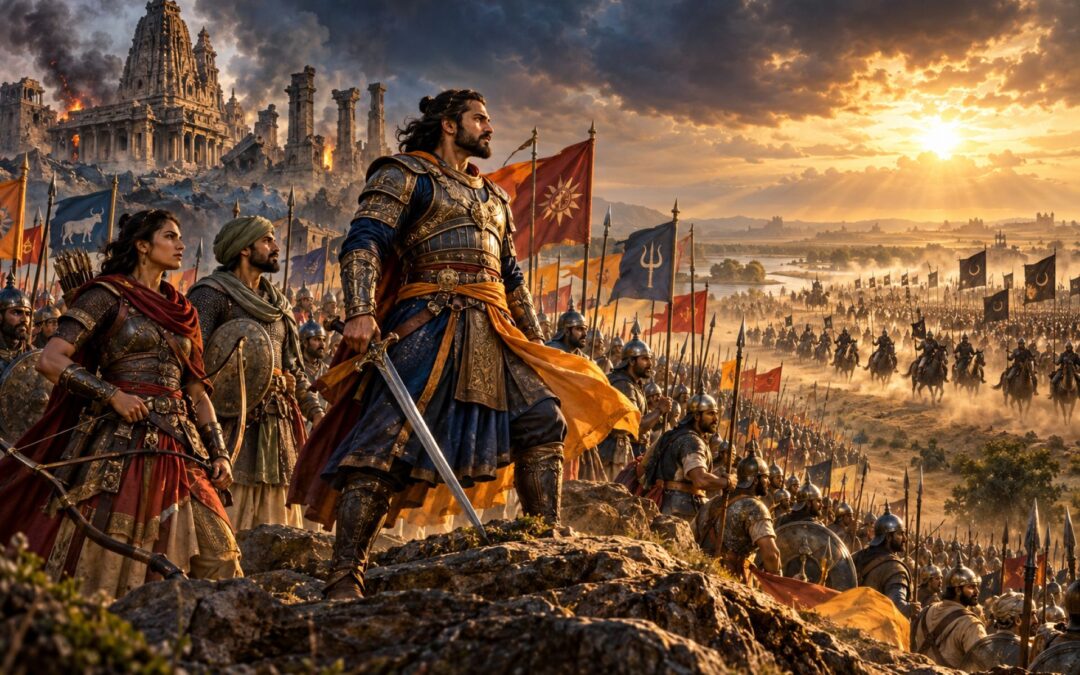
Legend of Suheldev: The King Who Saved India is a 2020 historical novel by Amish Tripathi, written in collaboration with the Immortal Writers’ Centre. Set in eleventh-century India, it follows a young prince whose brother is killed during Mahmud of Ghazni’s attack on the Somnath temple. What begins as a personal desire for vengeance develops into a campaign to unite divided Indian kingdoms against a powerful invading army.
The novel combines military adventure with questions about political leadership, religious identity, caste, loyalty, and the morality of warfare. Its central character, Suheldev, must learn that bravery alone cannot defeat a disciplined enemy. He needs allies whom traditional rulers underestimate, strategies that challenge accepted codes of honour, and the political judgment to place collective survival above personal ambition.
Amish presents this story as a fictional reconstruction of an Indian hero remembered in historical traditions surrounding the Battle of Bahraich. The novel draws on real places, dynasties, and religious communities, but its dialogue, relationships, military operations, and several consequential historical events belong to the author’s imaginative reconstruction.
Spoiler Warning: This article covers the complete novel, including its major character revelations, the Battle of Bahraich, and the ending.

Somnath’s Destruction and the Birth of a Rebel
The story begins in 1025 AD at Somnath, where Prince Malladev of Shravasti is fighting the invading army of Mahmud of Ghazni. The defenders are badly outnumbered, but Malladev refuses to abandon the sacred temple. His companions include Wasim, an Indian Muslim who fights alongside the Hindu warriors, establishing from the opening scene that the conflict cannot be understood simply as a struggle between two religious populations.
As the defenders fall, Malladev continues fighting with extraordinary determination. He understands that he is unlikely to survive, yet considers the defence of Somnath a responsibility greater than his own life. His death allows Mahmud and his nephew, Salar Maqsud, to advance towards the temple’s inner sanctum.
Inside, Mahmud encounters the Shiva Linga, an object of immense religious significance to the worshippers. He refuses to preserve it in exchange for wealth and destroys it with a hammer. The destruction is presented as an assault on the dignity and collective identity of India. Maqsud witnesses his uncle’s actions, absorbing the uncompromising ideology that will later make him the novel’s central antagonist.
The narrative then moves to Suheldev, Malladev’s younger brother. He is introduced during a wrestling contest against the powerful Ballala. Although physically smaller, Suheldev wins through agility, intelligence, and his ability to exploit an opponent’s weaknesses. These qualities foreshadow the methods he will eventually use against the Ghaznavid army.
News of Somnath transforms his triumph into grief. Suheldev struggles to accept Malladev’s death and directs some of his anger towards their father, King Mangaldhwaj, whom he considers insufficiently aggressive towards the invaders.
Memories of Malladev complicate this reaction. His elder brother had been a warrior and mentor who taught Suheldev to think beyond immediate circumstances. The Shiva pendant associated with Malladev becomes a personal reminder of his sacrifice and of the duty Suheldev believes he has inherited.
Mangaldhwaj attempts to address the greater political danger through diplomacy. He and Suheldev visit Ajitpal, the emperor of Kannauj, hoping to encourage cooperation against Ghazni. Ajitpal’s court instead reveals the weakness of India’s political order. The emperor is preoccupied with prestige and rivalry, while his more perceptive prime minister, Vrishabh, recognizes the danger of allowing personal ambition to obstruct collective security.
The diplomatic effort fails. On the return journey, the Shravasti party encounters Ghaznavid representatives whose activities suggest that the invaders are cultivating relationships with Indian rulers. Suheldev reacts violently to what he sees as humiliation and collaboration. His conduct demonstrates genuine courage but also the recklessness that makes him politically dangerous to his father.
Suheldev eventually recognizes that remaining within the royal establishment will restrict his ability to act. He decides to leave Shravasti and begin an independent campaign against Ghaznavid forces and their collaborators.
Mangaldhwaj accepts the decision, despite understanding the danger to his son. The parting marks Suheldev’s first major transformation: he abandons the protection of princely rank to become an outlaw dedicated to resistance.
Suheldev’s small group begins attacking enemy detachments and disrupting their operations. Unlike conventional royal armies, his force relies on reconnaissance, surprise, rapid movement, and intimate knowledge of the countryside.
The importance of these methods becomes clear when Abdul, one of his closest associates, is captured while attempting to prevent the desecration of a temple. The Turkic commander Salik tortures him, expecting religious conviction and physical suffering to break his resistance.
Suheldev organizes a nighttime rescue. Rather than challenge the enemy in open combat, he exploits darkness, confusion, and fire to overcome the detachment and recover Abdul. The mission succeeds because he chooses the conditions of the engagement instead of accepting those preferred by his opponents.
Afterwards, Suheldev challenges Abdul’s willingness to sacrifice himself for religious images. He does not dismiss their spiritual significance, but argues that defending the people and defeating those who threaten them are more important than dying to protect an object that can be replaced.
The discussion establishes a recurring distinction between honour and effectiveness. A warrior may display immense courage in a hopeless last stand, but such courage cannot by itself save a country. Suheldev begins developing the belief that survival and eventual victory must guide his decisions.
The Lives Drawn Into Suheldev’s Resistance
The novel gradually widens its geographical and social scope, showing how people from different religious communities and regions are being affected by Ghaznavid expansion.
In Peshawar in 1027, two young Buddhist monks, Ashvaghosh and Sanghamani, practise martial arts at their monastery. Ashvaghosh is talented but troubled by the apparent contradiction between Buddhist non-violence and learning to fight.
Their abbot, Chandrakirti, understands the tension. He recognizes the importance of compassion and restraint, but also knows that communities unable to protect themselves may face destruction. His conversations with Ashvaghosh establish a philosophical conflict that will follow the young monk throughout the novel.
Meanwhile, Suheldev continues his guerrilla campaign. In one encounter, his men intercept a party travelling with Hamida, the wife of the Ghaznavid representative Qasar Khan, and her children. Although he seizes wealth associated with the enemy, he refuses to harm the family.
This restraint is significant because the novel repeatedly distinguishes the legitimate use of force against combatants from violence directed at innocent people. Suheldev’s growing reputation depends partly on the fact that his military ruthlessness does not extend indiscriminately to everyone associated with Ghazni.
A separate narrative introduces a young man leaving Ghazni on a secret mission. He receives instructions from Ozgur and adopts a concealed identity. His destination and purpose remain uncertain, creating a mystery that will eventually converge with Suheldev’s rebellion.
The conflict at the Buddhist monastery becomes far more immediate when Turkic soldiers attack. Chandrakirti organizes the escape of Ashvaghosh and the other monks, prioritizing their survival over his own.
He remains behind as the invaders burn the building and kill him. Even while facing death, Chandrakirti refuses to surrender his compassion or spiritual discipline. His composure disturbs some of the attackers, particularly those whose own religious histories connect them to Buddhism.
Ashvaghosh survives, but the destruction of the monastery leaves him with an unresolved obligation. His teacher’s commitment to non-violence was extraordinary, yet the experience raises the question of whether compassion can survive without people willing to resist aggression.
By 1029, another important encounter takes place in Panchala.
Sheikh Nuruddin, a Sufi spiritual leader, presides over a gathering characterized by music and an inclusive understanding of religious devotion. His approach brings him into conflict with Zayan, a rigid preacher who condemns practices and beliefs that differ from his interpretation of Islam.
Their confrontation escalates into violence. A mysterious Turkic warrior named Aslan intervenes, displaying exceptional fighting ability. Suheldev also arrives and helps contain the situation.
Aslan impresses Suheldev with his courage and martial skill. He also appears sympathetic to a form of Islam compatible with peaceful coexistence among communities. Suheldev invites him to join his resistance.
Abdul, however, is suspicious. He knows that Aslan possesses unusual knowledge of Ghazni and its military establishment, and he is unconvinced by the stranger’s explanation of his background.
The reader receives reasons to share Abdul’s uncertainty. Aslan has private motives that he does not disclose, and his arrival in Suheldev’s orbit appears to fulfil an earlier plan.
The narrative then turns to Salar Maqsud at the Ghaznavid court.
In a disturbing episode, a merchant named Halil is accused of secretly maintaining the Yazidi faith of his ancestors. Maqsud forces him to demonstrate religious loyalty by desecrating an image associated with Melek Taus, a figure sacred in Yazidi tradition.
The test is deliberately cruel. Maqsud understands that the merchant’s attachment to his faith can be used against him. Halil eventually reacts violently, confirming in Maqsud’s mind the value of such coercive methods.
The episode establishes the antagonist’s understanding of psychological warfare. Maqsud sees religious devotion not as something deserving protection but as an instrument through which people can be controlled.
Connections between Maqsud’s actions and Aslan’s troubled memories deepen the mystery surrounding the latter.
The story moves forward to 1030, when the Ghaznavids confront the army of Delhi.
Govardhan, an experienced Indian warrior serving King Mahipal Tomar, realizes that the enemy’s military methods are more sophisticated than those of many Indian rulers. Ghaznavid commanders exploit mobility, deception, and tactical flexibility, while Mahipal remains attached to conventional ideas of royal courage.
The battle becomes a disaster. Mahipal is killed, the army collapses, and Govardhan must decide whether to continue fighting or retreat with the surviving soldiers.
He chooses retreat.
For Govardhan, the decision is painful because it conflicts with the values he has inherited. Yet he understands that the dead cannot participate in future resistance. Preserving experienced soldiers gives India another opportunity to fight.
His conclusion closely resembles Suheldev’s developing philosophy, preparing the ground for their eventual alliance.
Aslan’s separate activities continue to generate suspicion. Flashbacks reveal his journey from Ghazni and the deliberate construction of his assumed identity. In Suheldev’s company, he frequently undertakes intelligence missions and returns with useful information.
His effectiveness makes him valuable, but it also raises an uncomfortable question: how does he obtain intelligence about the Ghaznavid leadership so easily?
Govardhan eventually makes his way towards Suheldev. His journey involves political traps and dangerous encounters connected to rulers who have opposed the resistance. Suheldev’s intervention helps him survive.
The two men recognize common ground. Govardhan brings experience in conventional warfare, while Suheldev possesses the mobility and unconventional instincts of a guerrilla commander.
Suheldev also demonstrates that he is willing to recruit ordinary soldiers who have served hostile rulers. He distinguishes between leaders responsible for disastrous political choices and men whose loyalties may change when offered a more compelling cause.
Govardhan is initially surprised to learn that Abdul, one of Suheldev’s closest and most trusted companions, is Muslim. Abdul explains that his loyalty belongs to the country in which he lives and to the people whose suffering he witnesses.
This conversation is important because the novel refuses to identify all Muslims with the Ghaznavid invaders. Abdul’s presence also illustrates Suheldev’s conviction that cooperation must depend on shared responsibility rather than religious uniformity.
The resistance subsequently reaches a devastated settlement inhabited by families who work with leather. Vultures gather around the dead, and evidence of massacre confronts the warriors.
A young woman named Toshani survives. Skilled with a bow and hardened by the destruction she has witnessed, she initially attacks Suheldev’s party, believing them to be another group of enemies.
Once the misunderstanding is resolved, Suheldev recognizes her courage and abilities. Toshani explains the suffering of her community and becomes determined to punish those responsible.
She joins the resistance, bringing exceptional skill as an archer and a willingness to confront danger directly. Suheldev is immediately attracted to her, but their developing relationship begins under circumstances dominated by grief and war.
The warriors next attack a Ghaznavid detachment responsible for brutalizing captured villagers. The confrontation allows Toshani and Govardhan to demonstrate their skills alongside Suheldev’s established followers.
The rescued captives reveal that attacks on leather-working settlements are part of a wider pattern. These communities are being deliberately targeted rather than harmed solely by undisciplined soldiers.
The information changes the significance of the massacre. It points towards an enemy strategy designed to destroy groups capable of resisting Ghaznavid control.
Before Suheldev can fully secure the area, scouts report that another substantial enemy force is approaching. His fighters must withdraw quickly, leaving them vulnerable to pursuit.
Escapes, New Allies, and the Shadow of Aslan
Suheldev’s small force faces a dangerous problem after the rescue operation. It has defeated one group of Ghaznavid soldiers, but a larger pursuing force threatens to overwhelm it before everyone can escape.
A direct battle would be suicidal. Suheldev therefore uses the surrounding landscape to create a delay.
He exploits a sugarcane field and the enemy’s fear of being trapped in fire. The tactic interferes with the pursuit and forces the Ghaznavids to abandon their preferred rhythm of attack.
Suheldev’s men then race towards a bridge. Crossing the river is not enough; they must also prevent the pursuers from following.
The operation requires coordination under extreme pressure. Aslan helps ensure the bridge can be destroyed at the right moment, while Suheldev remains exposed to protect the evacuation of his companions.
The bridge is destroyed, denying the enemy an immediate crossing. Suheldev, however, is struck by an arrow and falls unconscious after reaching the riverbank.
His injury temporarily removes the central organizer of the resistance from active command.
Toshani reacts with desperation when she sees him fall. She and the others ensure that he is carried to safety, while Aslan applies medical knowledge to treat the wound.
The episode changes Suheldev’s relationship with both characters. Aslan’s conduct strengthens his reputation as a loyal friend, even though Abdul’s suspicions remain unresolved. Toshani’s anxiety and subsequent care make the emotional connection between her and Suheldev harder to ignore.
Their attraction develops during Suheldev’s recovery. Shared danger gradually gives way to moments of tenderness, but both remain conscious that their lives are governed by an unfinished struggle.
The narrative also returns to Maqsud, revealing the larger strategy behind the atrocities Suheldev has encountered.
Maqsud understands that Indian society is internally divided. He studies the differences between ruling elites, Buddhist communities, and people subjected to caste discrimination.
His campaign against leather-working settlements arises from this analysis. He regards the destruction of such communities as a means of weakening potential resistance and exploiting the fractures already present in Indian society.
This explanation makes his violence more disturbing because it is calculated rather than simply impulsive. Maqsud possesses considerable intelligence and understands that conquest requires attacking the social foundations of opposition.
His private life reveals another dimension through his relationship with Kerim.
Kerim is his lover and a military officer, but his religious beliefs are more tolerant than Maqsud’s. Influenced by Sufi ideas, he would prefer a world in which people of different faiths can live without constant religious conflict.
Kerim cares deeply for Maqsud and attempts to moderate his conduct. Maqsud, however, places his vision of conquest above these objections. Their relationship survives the disagreement, but its unresolved tensions will have catastrophic consequences.
The political situation changes when Sultan Mahmud dies.
Ozgur informs Aslan that the Ghaznavid dynasty is entering a struggle over succession. For Aslan, the development is personally significant, and he is urged to return to Ghazni.
He declines to abandon his activities in India because he considers his mission unfinished.
When Aslan shares news of the succession crisis with Suheldev, the resistance recognizes an opportunity. Internal conflict may temporarily divert Ghaznavid resources, providing time to recruit soldiers and strengthen alliances.
Suheldev nevertheless warns against confusing delay with safety. A stable and ambitious successor could eventually return to India with a larger army.
Aslan later announces that he wishes to pursue a peaceful life devoted to Sufi spirituality. His decision appears consistent with his previous expressions of religious tolerance, although his unusual history remains unexplained.
Around this period, Suheldev’s force encounters another group of Buddhist monks, including Ashvaghosh and Sanghamani.
The survivors of Chandrakirti’s monastery have continued travelling through a landscape threatened by military violence. They retain their spiritual commitments but cannot forget the destruction of their home and their teacher’s sacrifice.
Suheldev challenges them to distinguish aggressive violence from the defence of people who cannot protect themselves. His argument draws on the idea of dharma, presenting the protection of one’s homeland as a moral duty.
The monks eventually join his army. Their decision does not erase Buddhist compassion; instead, the narrative presents armed resistance as a painful obligation arising when other forms of protection have failed.
Their integration becomes more personal during later conversations and informal gatherings in Suheldev’s camp.
Military games provide relief from constant danger. Toshani shows her competitive spirit and martial skill, while Suheldev and Govardhan participate in moments of good-natured rivalry.
The scene allows the characters to exist briefly outside the demands of warfare. It also demonstrates why their relationships matter: they are people capable of friendship, affection, and amusement, even as the conflict increasingly consumes their lives.
A conversation between Abdul and Ashvaghosh develops the novel’s religious argument further.
Abdul explains why being Muslim does not weaken his attachment to India. He considers the country his home and sees its people as his own, irrespective of how the invaders describe themselves.
He also knows details about Ashvaghosh’s mother, whose sacrifice enabled the monk to survive as an infant. This revelation gives Ashvaghosh a new understanding of the protective love that shaped his life before he was old enough to remember it.
For Ashvaghosh, the defence of vulnerable people now becomes connected to his own survival. The duty Suheldev asks him to accept is no longer simply an abstract political proposition.
Suheldev Becomes King and Unites the Twenty-One Rulers
Suheldev’s growing resistance eventually forces him to reconsider his relationship with the kingdom he left behind.
Kashinath, a trusted elder and adviser, visits him with news that Mangaldhwaj is suffering from terminal cancer. Suheldev must return to Shravasti, where his father’s death will create responsibilities that cannot be fulfilled through guerrilla warfare alone.
Kashinath’s visit also provides one of the novel’s longest philosophical discussions.
He argues that India’s problems extend beyond military weakness. Political disunity and social exclusion have undermined the ability of its people to respond collectively to external threats.
Birth-based caste discrimination receives particular attention. Kashinath believes that a society which denies dignity and opportunity to large sections of its population weakens itself and creates divisions that enemies can exploit.
Suheldev comes to accept that defending his civilization cannot mean preserving every practice associated with its existing social order. Some traditions must change if the wider society is to survive.
When Suheldev returns to Shravasti, he encounters his dying father and his grieving mother, Queen Vijayalakshmi.
His reunion with Mangaldhwaj completes an important emotional development. The young prince who once saw his father’s caution as weakness now understands the burdens of kingship more fully.
Mangaldhwaj has also recognized his son’s potential. His final arrangements help prepare Suheldev to inherit the kingdom and build upon the political relationships necessary for resistance.
Vijayalakshmi offers different advice.
She worries that Suheldev’s growing willingness to employ ruthless methods may eventually damage his humanity. She believes personal love can help preserve the compassion that makes his struggle worth fighting.
Having observed his relationship with Toshani, Vijayalakshmi encourages him to marry her.
After Mangaldhwaj’s death, Suheldev becomes king of Shravasti.
His position gives him political authority unavailable during his years as an outlaw. He can now command an established army, negotiate with other rulers, and organize resistance on a much larger scale.
Suheldev assumes leadership of a confederacy involving twenty-one rulers. The arrangement is founded on collective defence rather than the abolition of their individual kingdoms.
This distinction matters. Suheldev understands that rulers jealous of their autonomy are unlikely to surrender their crowns, even when they recognize an external threat. He therefore offers a framework in which cooperation becomes possible without demanding complete submission.
The assembly also exposes the continuing dangers of treachery and ambition. Suheldev deals with a traitor and challenges the social assumptions that divide his prospective allies.
A symbolic shared meal becomes an important expression of his programme. By bringing people together across inherited boundaries, he demonstrates the social equality and cooperation that he wants the confederacy to practise.
The political message extends into his military arrangements. Toshani receives responsibility for organizing a regiment of women, reflecting Suheldev’s willingness to use talent without treating conventional gender expectations as absolute limits.
Yet his political success creates difficulties in his private life.
Suheldev asks Toshani to marry him, believing that their relationship can now become public and permanent. Toshani refuses, at least until the war has been won.
Her reasoning is political rather than emotional. She fears that marriage could encourage suspicion about dynastic advantage or personal favour at a moment when the confederacy needs unquestioned commitment to a common purpose.
Suheldev is disappointed, but he cannot dismiss her judgment. Toshani has become a political actor capable of placing the needs of the alliance above their personal happiness.
The choice leaves their relationship unresolved as the invasion approaches.
Maqsud’s Return and the March to Bahraich
The temporary weakening of Ghazni does not last.
By 1033, Maqsud has become an important participant in the dynastic struggle following Mahmud’s death. He uses his military abilities to support the victorious faction and secure a position of considerable authority.
The succession conflict gives Maqsud an opportunity to pursue the conquest he has long imagined. Unlike a commander interested only in raiding wealthy settlements, he wants to establish enduring Ghaznavid domination.
Kerim continues serving alongside him. Their relationship remains intimate, but the differences between their beliefs persist. Kerim hopes that military and political success may eventually allow them to live peacefully, while Maqsud interprets success as a reason to continue expanding.
In India, Suheldev’s advisers recognize the need for assistance beyond the northern confederacy.
Kashinath approaches Emperor Rajendra Chola, whose southern empire possesses military resources that could influence the coming struggle. He argues that the consequences of Ghaznavid domination will not remain confined to individual northern kingdoms.
Rajendra is initially confronted with a difficult calculation. Supporting Suheldev requires committing resources to a distant conflict without an obvious immediate reward.
The narrative reveals that Rajendra has already undertaken covert action against Ghazni. In the novel’s fictional history, he arranged Mahmud’s assassination in retaliation for the destruction of Somnath, helping create the succession crisis.
This revelation transforms what had appeared to be a fortunate interruption of Ghaznavid expansion into the result of another Indian ruler’s long-term planning.
Rajendra agrees to provide support, but the details remain secret while his commanders determine how assistance can reach Suheldev in time.
Maqsud meanwhile enters India with a substantial army.
Ajitpal of Kannauj welcomes him, demonstrating how far the emperor’s pursuit of advantage has carried him. His willingness to accommodate the invaders contrasts with the political courage shown by others within his kingdom.
The consequences become clear at Harsaran, where Ghaznavid forces massacre civilians. The destruction includes people whose religion does not protect them from the invaders’ brutality.
Resistance also comes from Indian Muslims, including Tarikh, reinforcing the distinction between the invading military establishment and the communities that live in India.
Vrishabh understands both the military importance and moral consequences of what is happening. Although he serves Ajitpal, he refuses to accept the emperor’s collaboration as an excuse for inaction.
He attempts to send crucial intelligence to Suheldev while concealing the messengers’ activities. When suspicion falls upon him, he accepts the danger rather than expose the wider resistance.
Captured and interrogated, Vrishabh refuses to betray those he has helped. He eventually takes poison, dying with the knowledge that he has done what he could for his country.
His sacrifice becomes one of the novel’s clearest demonstrations that loyalty to the homeland may require defying one’s own ruler.
Suheldev has spent the intervening years preparing his confederacy.
Its armies have trained to operate together, improving coordination among soldiers who previously served different political authorities. The preparation is necessary because the coming conflict will be fought on a scale far greater than Suheldev’s earlier guerrilla operations.
Aslan returns from his period of spiritual withdrawal, bringing approximately two hundred loyal followers. He offers them as a personal guard for Suheldev.
Suheldev welcomes the arrangement because he trusts his friend and values his military experience. Abdul remains deeply uneasy. A private guard personally loyal to a foreign-born warrior could become a fatal vulnerability if Aslan’s intentions are hostile.
The disagreement places Suheldev’s willingness to trust outsiders against Abdul’s instinct to protect him.
The war council must also decide where to confront Maqsud.
The Ghaznavid army possesses formidable cavalry, and its commanders are experienced in using rapid movement, deception, and concentrated attacks. Fighting on completely open ground would expose the Indian army to these strengths.
Suheldev therefore chooses the region around Bahraich. Its geographical features, including woodland, water, and constrained approaches, offer opportunities to control the movement of enemy cavalry.
The decision reflects lessons accumulated throughout the novel. Suheldev has repeatedly survived by changing the conditions of combat rather than accepting the enemy’s preferred form of battle.
Before the main confrontation, Maqsud attempts to exploit what appears to be a weakness in the Indian camp’s security.
He leads a night raid through a wooded approach, hoping to reach Suheldev and eliminate him before the armies engage.
But Suheldev has anticipated the possibility. Indian archers are concealed along the route, and the Ghaznavid raiders encounter an ambush.
The attack inflicts heavy casualties. During the fighting, Ashvaghosh and Sanghamani confront Maqsud.
Ashvaghosh sees the enemy commander’s face and is stunned by its resemblance to Aslan. The momentary hesitation gives Maqsud an opportunity to strike.
Ashvaghosh is mortally wounded. Before dying, he tries to warn Sanghamani that Aslan may be a traitor.
The warning creates an immediate crisis. Aslan’s followers are positioned near Suheldev, and their apparent leader seems to have been identified among the enemy.
Abdul reacts furiously and demands that Aslan and his men be arrested.
Suheldev insists on hearing an explanation.
Aslan finally reveals that his real name is Salar Masud. He is a nephew of Mahmud of Ghazni and the identical twin brother of Salar Maqsud.
The resemblance has made Ashvaghosh’s accusation understandable but mistaken.
Aslan recounts how he rejected his brother’s intolerance and his uncle’s political vision. His attraction to Sufi spirituality and his conviction that people should not be persecuted for their beliefs caused him to distance himself from Ghazni.
His concealed identity had allowed him to move through India without attracting the attention that a member of the Ghaznavid ruling family would otherwise receive.
The revelation also explains his knowledge of Maqsud and his emotional reactions to news from Ghazni. Kerim is an old friend, and Aslan knows that not everyone serving within the invaders’ army supports Maqsud’s ideology.
Suheldev believes him.
Nevertheless, he does not disregard Abdul’s concerns. Aslan and his followers are assigned to the front lines, where their courage can contribute directly to the battle and where their position is less dangerous to the king if the explanation proves false.
The decision combines trust with precaution, demonstrating how much Suheldev has learned since his early, impulsive confrontations with the enemy.
The Battle of Bahraich and the Brothers’ Tragedy
The Battle of Bahraich begins after years of preparation and several failed opportunities to prevent open warfare. Suheldev understands that a defeat could destroy the confederacy and expose its kingdoms to devastating retaliation.
Before the battle, he receives intelligence about a Ghaznavid plan to place cows in front of the invading army. The enemy hopes that Hindu soldiers will hesitate to attack for fear of harming animals they consider sacred.
Rather than permit this religious dilemma to paralyse his troops, Suheldev orders Govardhan to conduct a nighttime operation to free the animals. The mission succeeds, removing the obstacle before the armies confront each other.
The episode continues the novel’s emphasis on anticipation. Suheldev recognizes that the enemy will use his people’s beliefs against them, but his answer is to eliminate the manipulation rather than abandon those beliefs.
On the morning of battle, the Indian commanders prepare their separate responsibilities.
Abdul commands the left flank and Govardhan the right. Suheldev and his cavalry occupy the centre, while Toshani and Sanghamani remain active within the wider military arrangements.
The soldiers come from different regions and religious traditions. Their shared cause is expressed through invocations appropriate to their respective beliefs and through a collective commitment to defend the country.
Maqsud surveys the opposing formation and notices that the Indian flanks contain relatively few mounted soldiers. He concludes that his cavalry may be able to overwhelm these weaker positions and threaten Suheldev’s central force.
Jaichand, the ruler of Manohargarh, dismisses Suheldev as a commander whose experience is limited to small skirmishes.
Maqsud is less complacent. He knows that Suheldev has repeatedly defeated Ghaznavid detachments through unexpected tactics, and he is reluctant to assume that the apparent weaknesses of the Indian formation are accidental.
His caution proves justified when the Ghaznavid cavalry begins advancing.
Suheldev has ordered specially constructed iron spikes to be scattered across likely cavalry approaches. Their four-pointed design ensures that one sharp point will face upwards when they fall to the ground.
The charging horses encounter the spikes and stumble. As the front ranks collapse, riders behind them lose momentum and collide with fallen animals.
The interruption destroys the coordinated force of the initial charge. Indian archers and infantry can now attack soldiers who had expected to move rapidly through the battlefield.
The tactic produces an early advantage, but it cannot determine the battle by itself.
Maqsud adjusts his operations, redirecting pressure towards the Indian flanks. The Ghaznavid cavalry remains dangerous, and the confederacy’s soldiers must withstand repeated attacks.
Terrain helps Suheldev’s army, particularly where the nearby lake limits the space available for cavalry manoeuvres.
Maqsud studies the obstacle and realizes that the water may be shallower than it appears during the summer. He orders an investigation, hoping to find a route that will allow his soldiers to outflank positions protected by the lake.
This countermeasure is important because it prevents the battle from becoming an effortless demonstration of Suheldev’s ingenuity. Maqsud is capable of observing, adapting, and exploiting opportunities of his own.
As fighting intensifies, the Indian formation comes under substantial strain.
Toshani moves through the conflict with the aggression and precision that previously distinguished her as an archer and warrior. Govardhan and Abdul attempt to maintain discipline as their flanks face cavalry assaults.
Suheldev must decide when and where to commit his reserves. Sending soldiers to a threatened flank may prevent its collapse, but it can also expose the centre or leave the army without resources for a decisive counterattack.
The battle therefore becomes a contest of judgment as well as courage.
Aslan leads an important cavalry charge towards the Ghaznavid centre. His knowledge of the enemy’s methods and his personal fighting ability make him especially valuable in this phase.
He also faces a conflict more intimate than that of the other warriors: somewhere across the field is his twin brother, whose ambitions he has rejected but whose life he does not necessarily wish to end.
Meanwhile, the fighting places Suheldev in immediate physical danger.
Kerim, commanding part of the Ghaznavid forces, attacks him. Suheldev kills Kerim with a spear in self-defence, but the confrontation leaves him vulnerable, and he is knocked unconscious during the continuing battle.
The apparent fall of the king threatens Indian morale.
Suheldev has become the principal symbol and organizer of the resistance. Many soldiers believe that losing him could make the confederacy’s defeat inevitable, regardless of how much of its army remains intact.
Aslan sees the danger and acts to prevent the troops from losing confidence. His commitment to protecting Suheldev now becomes unmistakable.
News of Kerim’s death, however, makes Aslan’s relationship with Maqsud even more tragic.
Kerim had cared deeply for Maqsud despite opposing aspects of his ideology. Aslan also knew and valued him. Their shared connection complicates what might otherwise have been a straightforward confrontation between an honourable warrior and a villain.
The brothers eventually meet in battle.
Although they are physically identical, their decisions have carried them towards opposite ends of the conflict. Maqsud believes his military campaign serves a sacred purpose and treats those who resist him as obstacles to be destroyed. Aslan believes faith must coexist with compassion and that his loyalty cannot extend to atrocities committed by members of his own family.
Their duel is fierce and prolonged.
Aslan’s skill gives him opportunities to defeat his brother. Yet when he gains a decisive advantage, he hesitates to kill him, influenced by their familial bond and his commitment to Kerim.
The mercy is consistent with Aslan’s character. He has spent much of his adult life trying to escape the cruelty associated with his family, and he still hopes that his brother may be capable of a different choice.
Maqsud does not respond with similar restraint.
He exploits Aslan’s hesitation and kills him, ultimately severing his head. The act exposes the limits of brotherly affection when one party remains committed to victory at any cost.
Aslan’s death is emotionally devastating because the novel has already resolved the mystery surrounding him. The man who was repeatedly suspected of betrayal has proved his loyalty, only to be destroyed by someone who shares his face and blood.
The battle continues.
At the field hospital, Suheldev regains consciousness and learns of Aslan’s death. He also discovers that Toshani has suffered serious injuries.
The news confronts him with the personal cost of the war. People whose loyalty and love have sustained him are dying or enduring terrible suffering, and the army still faces defeat.
Suheldev nevertheless decides to return to the battlefield.
His appearance helps restore the confidence of Indian soldiers who believed their leader had fallen. He begins directing reserves and reinforcements towards threatened positions, attempting to stabilize the army without surrendering the possibility of victory.
The Ghaznavids continue pressing their advantage. The Indian flanks remain vulnerable, and enemy cavalry threaten to break through before the confederacy can recover its coordination.
Another confrontation brings Suheldev face to face with Jaichand.
The ruler of Manohargarh has allied himself with the invaders, placing political ambition above the collective defence that Suheldev has tried to organize.
Their encounter becomes a personal contest. Suheldev defeats and kills Jaichand, removing an important collaborator from the battlefield.
But this success does not settle the wider battle.
Even after Jaichand’s death, Suheldev’s army faces dangerous pressure. Its left flank is close to collapse, and the remaining reserves may be insufficient to hold every position.
The battle’s outcome still depends on whether the confederacy can survive long enough for an advantage to emerge.
Victory, Vengeance, and the Restoration of Somnath
At the beginning of the final phase, the Indian army is approaching its limit.
Suryavir, a Chandela commander serving alongside the confederacy, reports that the left flank has broken and that the army risks being surrounded. Govardhan has already committed troops to support the threatened positions, weakening his own ability to respond elsewhere.
For Suheldev, the situation is desperate. Years of political negotiation and military preparation may be destroyed in a matter of hours.
Then a new cavalry force appears on the battlefield.
The Indian commanders initially fear that the Ghaznavids have received reinforcements. As the riders approach, however, Suheldev realizes that they are not enemies.
They are soldiers of the Chola Empire.
The reinforcements have arrived through an operation organized by Rajendra Chola in response to Kashinath’s earlier mission. Under their commander, Narasimhan, approximately five thousand cavalrymen have made a rapid journey using a route that allows them to reach Bahraich in time.
Their arrival changes the military balance.
Suheldev orders his troops to open their formation and allow the new cavalry through. The Cholas attack at the moment when the Ghaznavid forces have committed heavily to breaking the Indian army.
Maqsud’s soldiers, already worn down by prolonged fighting, now face fresh mounted troops striking at a vulnerable point.
The reversal is decisive.
The Indian army regains momentum, and the Ghaznavid formation begins to disintegrate. Soldiers who had expected victory suddenly find themselves trapped between opposing forces without a viable means of organized retreat.
Suheldev’s confederacy destroys the invading army.
The victory is presented as the result of several interconnected achievements: years of training, alliances among independent rulers, the use of terrain, the resistance of exhausted soldiers, and Rajendra Chola’s decision to intervene.
It also comes at an immense human cost. Ashvaghosh, Aslan, and many ordinary warriors are dead. Toshani and Suheldev are injured, while other survivors must confront the suffering that victory cannot undo.
Maqsud survives the battle but is captured while hiding.
When he is brought before Suheldev, his face is an almost perfect replica of Aslan’s. The resemblance makes the confrontation deeply unsettling for those who knew and loved the fallen warrior.
Suheldev condemns Maqsud for the massacres, persecution, and destruction committed during his campaign. Maqsud continues to express contempt for his captors and appeals to his religious understanding of the afterlife.
Suheldev responds by threatening an act designed to strike at Maqsud’s deepest spiritual fears. He intends to execute him and then deny his body the funeral treatment he expects.
Maqsud asks for the protection of dharma and a fair judgment, but Suheldev rejects the appeal from a commander who systematically denied mercy to others.
He beheads Maqsud.
The execution completes Suheldev’s personal quest for vengeance. Holding the Shiva pendant associated with Malladev, he acknowledges that his brother’s death has finally been avenged.
Yet the novel does not end with this victory.
Govardhan approaches Suheldev to question his decision concerning the Ghaznavid dead. The king has ordered the bodies of the enemy soldiers, including Maqsud’s, to be burned.
Govardhan argues that the defenders should maintain their own moral standards even when their enemies have violated them. Proper treatment of the dead, he believes, is an obligation arising from the character of those who have won, rather than from the worthiness of those who have been defeated.
Abdul rejects the suggestion that Indian Muslims should accept responsibility for Maqsud’s burial. He explains that religious authorities have condemned the invader’s crimes and that their community does not regard him as representing them.
Govardhan clarifies that he is not asking Abdul’s community to perform the rites. He is offering to arrange respectful treatment because he believes the Indian army should behave according to its own principles.
Suheldev refuses.
He argues that the invasion has revealed the danger of allowing enemies to exploit a reputation for restraint. By making the defeat especially terrifying, he hopes to discourage future armies from attempting similar conquests.
He recognizes that the decision may carry a moral cost. In his reasoning, however, accepting that burden is preferable to exposing future generations to renewed massacres.
The contrast between the two men leaves an important ethical question unresolved. Govardhan believes that victory loses some of its meaning if the victors abandon their principles. Suheldev believes those principles must sometimes yield to the responsibility of preventing greater suffering.
The treatment of Aslan’s body provides a deliberate contrast.
Suheldev orders that his friend be buried with proper Islamic funeral rites beside the lake he loved. He begins visiting the grave, remembering the man who saved his life and fought against his own brother’s army.
Local people soon gather there to pray. Some begin treating Aslan, also known as Salar Masud, as a saintly figure.
When Suheldev discovers women bringing flowers to the grave, he permits their devotions. He accepts that the site can become meaningful to people of different faiths, reflecting Aslan’s own beliefs.
The story then moves forward one year.
India is rebuilding after the war, and the Somnath temple is being restored. Suheldev and his principal companions attend the rededication ceremony as honoured guests.
A new Shiva Linga, given by Rajendra Chola, stands ready to occupy the central place in the rebuilt temple.
Narasimhan also reveals that a fragment of the original Shiva Linga has survived and will return. He hints at the concealed circumstances of Mahmud’s death and promises to explain the complete story to Suheldev.
The revelation links the restoration of the temple with the Chola emperor’s earlier actions against Ghazni.
Toshani, Abdul, Govardhan, Sanghamani, Vijayalakshmi, and other surviving companions attend the ceremony. Their presence transforms what began as Suheldev’s personal grief into a collective achievement.
The ending also reveals the final message delivered to Ghazni.
Maqsud’s ashes are sent back, accompanied by his preserved, severed head bearing a warning: India will welcome peaceful visitors but respond mercilessly to future invaders.
The narrator claims that the defeat prevents another invasion for 150 years. This is a claim made within the novel and should not be mistaken for an independently established historical conclusion.
The final scene turns towards a young girl who witnesses Suheldev’s public recognition. Inspired by his example, she decides that she too wants to become a warrior for India.
The narrative closes with the suggestion that Suheldev’s greatest achievement is not confined to one victorious battle. His example has created a new generation willing to defend the country.
The Political and Social World of Eleventh-Century India
Amish’s India is a civilization with considerable wealth, military resources, and cultural sophistication, but without a political system capable of coordinating them consistently.
Shravasti, Kannauj, Delhi, the southern Chola Empire, and the smaller kingdoms of northern India possess their own rulers, interests, and armed forces. Their relationships are shaped by prestige, competing claims to authority, and the fear that cooperation may strengthen a rival.
Ajitpal represents the destructive consequences of these divisions. He possesses political standing but cannot recognize that the threat from Ghazni outweighs local calculations of status. His willingness to accommodate the invaders eventually exposes his own subjects to violence.
Mangaldhwaj offers a more sympathetic example of the limitations of conventional kingship. He understands diplomacy and responsibility but initially appears unable to translate concern into decisive collective action. His son’s rise requires a new political arrangement that extends beyond the habits of individual courts.
Ghazni operates differently within the novel. Its rulers can mobilize soldiers under a comparatively centralized command, and its military establishment has developed methods of rapid cavalry warfare that many Indian commanders struggle to counter.
The contrast is somewhat simplified, but it provides the main strategic problem of the narrative. The Indian kingdoms do not lack brave soldiers; they lack sustained cooperation and consistent tactical adaptation.
Social divisions make that weakness worse.
The leather-working communities targeted by Maqsud have been disadvantaged by birth-based hierarchy. Their treatment exposes a contradiction within a civilization whose leaders speak of collective greatness while denying dignity to sections of their own population.
Buddhist monasteries and Muslim communities also occupy complicated positions. The former seek to preserve spiritual traditions while confronting military threats, while the latter must distinguish their religious identity from the ambitions of foreign rulers.
The countryside matters as much as the courts. Villages supply people, labour, wealth, and the physical environment through which armies move. Forests, bridges, rivers, and cultivated land repeatedly determine whether Suheldev’s fighters survive.
Somnath and Bahraich become the setting’s principal symbolic locations. Somnath represents the humiliation that begins the story and the recovery that closes it. Bahraich is where the fractured political and social world is temporarily brought together through a shared military undertaking.
Suheldev’s Transformation From Prince to King
Suheldev begins the novel with qualities that make him a promising warrior but not necessarily a capable ruler.
His wrestling victory demonstrates intelligence and quickness, while his response to Malladev’s death reveals courage, loyalty, and intense emotional attachment. Yet his anger towards Mangaldhwaj and his confrontation with Ghaznavid representatives show a tendency to act before fully considering the political consequences.
Leaving Shravasti allows him to develop his abilities outside the expectations associated with royal conduct.
His early guerrilla operations teach him that the enemy can be defeated by understanding its habits and vulnerabilities. He learns to attack when conditions favour a small force and withdraw when survival serves a greater purpose.
The rescue of Abdul provides an early example. Suheldev refuses to accept an unnecessarily heroic death when stealth and fire can accomplish the objective more effectively.
The bridge operation develops the same philosophy at greater personal cost. He recognizes the importance of terrain and timing but also exposes himself to danger to ensure his companions escape.
As his followers increase, leadership becomes more complicated. His decisions affect people whose abilities, beliefs, and backgrounds differ substantially from his own.
Recruiting Abdul, Govardhan, Toshani, Aslan, and the Buddhist monks requires Suheldev to judge people according to their conduct rather than inherited social categories.
This openness is one of his most significant strengths. It makes possible a coalition larger and more adaptable than a conventional princely force.
Yet Suheldev’s trust is not always uncomplicated. His confidence in Aslan creates tension with Abdul, who sees dangers that the king’s affection may obscure.
The solution following Aslan’s revelation illustrates Suheldev’s growing judgment. He neither executes his friend on suspicion nor ignores the possibility of betrayal. Instead, he accepts Aslan’s explanation while making arrangements that protect the army.
His development also involves learning the political compromises required by kingship.
A guerrilla leader can choose his companions and conduct independent operations. A king responsible for twenty-one allied rulers must negotiate with competing interests, maintain discipline, and preserve confidence among people who may disagree with him.
Suheldev’s willingness to respect the autonomy of other kingdoms demonstrates his understanding that leadership need not require absolute control.
The central weakness in his characterization is the extent to which the narrative idealizes his judgments.
He receives criticism, particularly from Abdul and Govardhan, but his choices are frequently confirmed by subsequent events. His tactical plans repeatedly succeed, and those who question him often discover that he anticipated dangers they had overlooked.
This makes him satisfying as an adventure hero but sometimes limits the uncertainty of his psychological development.
The ending offers a more difficult test. Suheldev believes that burning the defeated soldiers’ bodies is necessary to deter future invasions. His willingness to accept moral blame suggests seriousness about the costs of power, but the narrative gives readers fewer opportunities to see him genuinely reconsider the decision.
His transformation is therefore both impressive and troubling. He grows from an angry young prince into a disciplined political and military leader, while acquiring the conviction that responsibility may authorize actions other people regard as morally unacceptable.
Toshani, Abdul, Govardhan, and the Coalition Around Suheldev
Suheldev’s achievements depend on companions who contribute forms of experience and judgment he does not possess alone.
Toshani enters the novel through violence inflicted upon her community. Her initial attack on Suheldev’s party is an understandable reaction from someone who has witnessed massacre and expects further brutality.
Once she joins the resistance, she refuses to remain defined by victimhood. Her skill with the bow, courage in combat, and eventual responsibility for a women’s regiment establish her as an important participant in the military struggle.
Her relationship with Suheldev adds emotional complexity without entirely displacing her independent choices.
Although attracted to him, Toshani refuses to marry before victory because she believes their relationship could weaken the political credibility of his leadership. Her decision demonstrates that she understands the demands of public responsibility as well as Suheldev does.
The romance is occasionally conventional in its presentation, particularly when battlefield danger gives way to scenes of teasing or physical attraction. Nevertheless, Toshani’s political judgment prevents her from functioning solely as a romantic reward for the hero.
Abdul plays a different role.
His Muslim identity is important because the novel deliberately contrasts him with Ghaznavid commanders who claim religious authority for their actions. Abdul sees no contradiction between practising Islam and defending his homeland against invaders.
His loyalty is active rather than rhetorical. He fights beside Suheldev, suffers torture, conducts intelligence operations, and repeatedly attempts to protect the king from danger.
His suspicion of Aslan becomes a defining feature of their relationship. Abdul recognizes that Suheldev’s personal warmth could expose him to betrayal, and he refuses to suppress his concerns merely because the king has reached a different conclusion.
Although Aslan ultimately proves trustworthy, Abdul’s objections are not irrational. They reflect a security problem that a responsible commander must consider.
Govardhan contributes experience acquired through defeat.
Having witnessed the destruction of Mahipal’s army, he understands the inadequacy of rigid military honour when confronting a more adaptive enemy. His decision to retreat preserves soldiers who would otherwise die without accomplishing anything.
When he joins Suheldev, his conventional military training complements the king’s guerrilla instincts. Govardhan understands formations, cavalry deployment, and the demands of large battles.
He also retains a moral independence that becomes especially important after Bahraich.
Unlike characters who primarily admire Suheldev’s decisions, Govardhan challenges the king when he believes victory is leading him away from dharma. His objection to the treatment of enemy bodies provides one of the clearest distinctions between loyal service and unquestioning obedience.
Kashinath, Mangaldhwaj, and Vijayalakshmi influence Suheldev without serving in identical capacities.
Kashinath supplies political and philosophical guidance, pressing Suheldev to recognize the connection between caste hierarchy, social weakness, and national survival. Mangaldhwaj represents the responsibilities and constraints of established rulership, which Suheldev initially rejects but eventually inherits.
Vijayalakshmi emphasizes the preservation of personal humanity. Her belief that love can restrain cruelty becomes particularly relevant when Suheldev confronts the moral consequences of his wartime decisions.
These relationships make the confederacy more than a military alliance. It becomes a network of people who contribute competing forms of intelligence, courage, affection, and ethical judgment.
The strongest moments occur when those qualities produce disagreement rather than automatic consensus.
Ashvaghosh, Sanghamani, and the Question of Religious Violence
The Buddhist storyline introduces a form of moral discipline different from Suheldev’s warrior tradition.
Chandrakirti teaches compassion even in circumstances where compassion offers no guarantee of physical survival. His refusal to abandon the monastery, despite knowing that the attackers will probably kill him, makes his death an extraordinary demonstration of spiritual conviction.
Ashvaghosh and Sanghamani inherit both his teachings and the trauma of his destruction.
Their dilemma concerns the distinction between protecting people and cultivating violence. A person committed to non-violence may refuse to harm others, but what should that person do when armed aggressors threaten the lives of innocents?
Suheldev argues that the duty to protect can justify fighting. His explanation of dharma emphasizes the responsibilities arising from particular circumstances rather than treating every moral rule as equally applicable in every situation.
For Ashvaghosh, Abdul’s account of his mother’s sacrifice makes this argument more personal. His own life depended on someone willing to accept suffering so that he could survive.
When the monks join Suheldev’s forces, the novel presents their decision as an extension of compassion rather than a repudiation of it. They fight because they believe protecting others has become necessary.
The tension remains significant, however, because Chandrakirti’s example is not simply disproved by their choice.
His courage under torture establishes a kind of moral victory that military success cannot fully replace. The novel tends to favour armed resistance as the practical answer to invasion, but the abbot’s death preserves a different understanding of spiritual courage.
Ashvaghosh’s final confrontation with Maqsud also exposes the costs of merging monastic and military obligations. His courage contributes to the defence of Suheldev, yet his death leaves Sanghamani to carry both their shared commitment and their grief.
Aslan, Maqsud, and Kerim: Two Brothers and Two Ways of Believing
Aslan and Maqsud are the novel’s most deliberate character contrast.
They possess the same appearance and share the same family history, but their convictions lead them into opposing armies. The device allows Amish to separate inherited identity from moral choice.
Maqsud regards conquest and religious supremacy as closely connected. He is convinced of his right to dominate people whose beliefs differ from his own and treats violence as a legitimate means of enforcing that authority.
His persecution of Halil reveals how well he understands sacred attachment. He knows that threatening a person’s religious symbols can create fear, humiliation, and desperate resistance.
The destruction of leather-working settlements demonstrates a similar intelligence directed towards political ends. Maqsud identifies internal divisions in Indian society and then deliberately attacks communities he regards as potential sources of opposition.
These acts distinguish him from a merely impulsive villain. He is calculating, observant, and capable of adapting his methods to different circumstances.
Aslan has witnessed the same political and religious environment but rejects its assumptions.
His interest in Sufi spirituality leads him towards a more inclusive understanding of faith. He believes that devotion need not justify domination and that people of different religious traditions can share a political home.
His decision to conceal his identity makes him initially difficult to trust. The narrative repeatedly uses his unexplained movements, intelligence about Ghazni, and reactions to Maqsud’s name to suggest that he may be working against Suheldev.
Once his identity as Salar Masud is revealed, these details acquire another meaning.
His secrecy is partly an attempt to escape a family history that would determine how others judge him. His assistance to Suheldev becomes an assertion that moral allegiance need not follow blood or political inheritance.
Kerim stands between these positions.
His love for Maqsud is genuine, but he disagrees with the cruelty and intolerance that drive the conquest. He hopes to preserve their relationship while encouraging a less destructive future.
The difficulty is that affection gives him little power over Maqsud’s decisions.
Kerim continues serving within the army whose campaign he questions. His involvement exposes the moral limitations of private disapproval when it is accompanied by continued participation in collective violence.
Aslan’s relationship with Kerim influences the final confrontation between the twins. His reluctance to kill Maqsud arises partly from an unwillingness to extinguish the possibility of reconciliation and from obligations associated with Kerim.
Maqsud exploits that hesitation.
The murder is an effective tragic conclusion because it follows from choices already established in the characters. Aslan’s mercy expresses his convictions, while Maqsud’s betrayal expresses his willingness to subordinate human relationships to victory.
The twin device is symbolically direct. Physically identical men demonstrate opposing possibilities within the same family, culture, and religion.
It can also feel overly schematic. Maqsud and Aslan sometimes represent ideological alternatives more strongly than psychologically complex individuals. Maqsud’s brutality leaves relatively little room for uncertainty, while Aslan’s moral position receives repeated confirmation.
Nevertheless, Aslan’s death complicates the novel’s optimistic vision. Good intentions and religious tolerance do not guarantee survival, particularly when confronted by an opponent who refuses reciprocal restraint.
Love and the Sacrifices Demanded by Leadership
Love appears in the novel as both a possible source of moral strength and a vulnerability created by emotional attachment.
Vijayalakshmi believes that Suheldev needs affection to protect him from becoming indifferent to human suffering. Having witnessed his increasing acceptance of military ruthlessness, she fears that political responsibility could gradually consume his personal humanity.
Her encouragement to marry Toshani follows from this concern.
Toshani, however, understands love through the language of sacrifice. She refuses marriage before victory because she does not want their relationship to become a source of political suspicion or distraction.
The choice demonstrates her loyalty to Suheldev’s cause, but it also places the future of their private happiness beyond their control.
Kerim’s relationship with Maqsud presents a darker possibility.
He loves someone whose conduct violates many of his own beliefs, and he continues hoping that affection will eventually change him. The hope proves insufficient because Maqsud’s ambitions are stronger than his willingness to listen.
Aslan’s response to Kerim’s death shows another danger of emotional loyalty. His mercy towards Maqsud is morally understandable, but it creates the opportunity through which his brother kills him.
These relationships complicate the idea that love automatically produces better judgment.
For Suheldev, love provides a reason to protect humanity within himself. For Toshani, it requires postponement. For Kerim, it becomes entangled with moral compromise, and for Aslan it contributes to a fatal act of restraint.
The novel treats affection as essential to human dignity while recognizing that it cannot always survive the demands and consequences of war.
Unity Beyond Caste and Religion
The novel’s vision of Indian unity is developed through characters whose inherited identities might otherwise place them on opposing sides.
The opening defence of Somnath includes an Indian Muslim warrior fighting alongside Hindus. Abdul later becomes one of Suheldev’s closest companions, while Sheikh Nuruddin represents an understanding of Islam compatible with respect for other faiths.
These characters challenge the assumption that religious affiliation determines political allegiance.
The Ghaznavid rulers claim religious legitimacy, but their conduct is repeatedly contrasted with the loyalty of Indian Muslims who resist them. Abdul’s attachment to his homeland is grounded in lived relationships and responsibilities rather than religious uniformity.
The Buddhist monks introduce another perspective. Ashvaghosh and Sanghamani do not abandon their tradition when they join the resistance. Their participation suggests that cooperation can accommodate differing understandings of spiritual obligation.
The treatment of caste gives the theme a more demanding political dimension.
Suheldev cannot plausibly claim to represent the entire country while accepting social arrangements that exclude large sections of its population. The massacre of leather-working communities demonstrates that people marginalized within Indian society remain vulnerable to external violence.
Maqsud exploits these divisions because he understands their strategic consequences.
Kashinath’s argument against birth-based caste hierarchy therefore serves a political as well as an ethical purpose. Exclusion weakens the sense of common belonging on which collective defence depends.
The shared meal organized by Suheldev gives this argument a visible form. It challenges social separation by requiring people accustomed to inherited distinctions to participate in a common civic undertaking.
Toshani’s military leadership extends the principle beyond caste and religion. Her ability to command a regiment of women suggests that practical competence should matter more than established restrictions on who may serve.
The twenty-one-ruler confederacy translates these social aspirations into political organization.
Its members retain separate kingdoms and traditions but agree to act together when their collective security is threatened. This is a vision of unity through cooperation rather than the complete elimination of difference.
The novel’s inclusive ideal is compelling, although its expression can be simplified by the way the characters are arranged.
Many allies articulate admirable versions of tolerance, while opposing figures embody unmistakable forms of bigotry or selfishness. Such contrasts clarify the message but sometimes reduce the uncertainty and disagreement that would accompany a transformation of this scale.
Its most persuasive demonstration of unity occurs when people must depend on one another in actual danger. Abdul’s protection of Suheldev, Toshani’s fighting, Govardhan’s military judgment, and Aslan’s final sacrifice make the principle consequential rather than purely rhetorical.
Dharma, Ruthless Warfare, and the Moral Cost of Survival
The novel repeatedly asks whether ethical principles can survive a war against enemies who deliberately exploit restraint.
Malladev’s death establishes the attraction of heroic sacrifice. He refuses to abandon Somnath, and his courage gives emotional meaning to the resistance that follows.
Suheldev eventually develops a different approach.
He argues that survival and successful defence may require retreat, deception, surprise attacks, and the refusal to fight according to rules established by an opponent.
Govardhan’s withdrawal from Delhi reinforces this position. By retreating, he preserves soldiers and experience that would otherwise be lost in a futile demonstration of honour.
The sugarcane fire, destroyed bridge, concealed archers, and iron spikes at Bahraich demonstrate how Suheldev translates the principle into military practice.
His understanding of dharma is closely tied to the consequences of action. A commander responsible for many lives cannot judge conduct solely by whether it conforms to inherited expectations of battlefield courage.
But the novel also presents forms of restraint that it clearly admires.
Chandrakirti’s death is portrayed with spiritual dignity. Aslan’s refusal to persecute those of different faiths establishes his moral superiority to Maqsud. Suheldev protects Hamida and her children rather than treating their association with Ghazni as grounds for punishment.
These choices suggest that military necessity is not intended to justify indiscriminate cruelty.
The difficulty arises when survival and revenge become difficult to distinguish.
Maqsud’s murder of Aslan offers a powerful argument against mercy towards an enemy who cannot be trusted. Aslan has the opportunity to kill his brother but refuses; Maqsud exploits the decision and kills him.
The reader is invited to recognize that restraint can have fatal consequences.
Yet this incident does not settle every ethical question raised by the ending.
Once Maqsud is captured and his army defeated, the immediate danger has changed. Executing a commander responsible for atrocities and using the bodies of defeated soldiers as a deterrent are different kinds of decisions from employing battlefield tactics to stop an attack.
Govardhan insists upon that distinction.
He accepts the need to fight ruthlessly when necessary but argues that treating the dead with dignity is a responsibility the victors owe to their own moral traditions.
Suheldev believes the consequences of restraint must be considered across generations. He fears that allowing future invaders to expect honourable treatment, even after committing atrocities, will encourage renewed violence.
His reasoning is consequentialist: he evaluates a troubling act primarily through its hoped-for effect on future suffering.
The novel presents him as willing to bear moral responsibility for the decision. That willingness gives his argument weight, but it does not establish that the policy is justified.
The proposed deterrent is speculative. Suheldev cannot know that the treatment of the dead will prevent future invasions, nor can he demonstrate that a less extreme response would fail.
His declaration that he accepts personal moral guilt also raises a deeper question. A ruler’s willingness to sacrifice his own moral peace does not necessarily authorize him to violate obligations owed to others.
Govardhan’s dissent prevents the final decision from passing entirely without challenge, although the narrative’s triumphant conclusion gives Suheldev’s reasoning considerable support.
The tension is one of the book’s most important features. A story that celebrates shared humanity ends by asking readers to accept a brutal policy justified by the protection of that same humanity.
Sacred Images, Fire, and the Meaning of Somnath
The Shiva Linga at Somnath provides the novel with its most important recurring image.
Its destruction begins the conflict and creates the emotional wound that drives Suheldev’s campaign. Mahmud’s attack is directed at a material object, but the narrative presents its significance as extending far beyond stone.
For Malladev and Suheldev, Somnath represents faith, continuity, and collective dignity.
The pendant associated with Malladev makes this vast symbolic injury personal. Suheldev carries a physical reminder of his brother’s sacrifice, linking the public destruction of the temple with the intimate experience of grief.
The novel also questions whether sacred reality can be reduced to its material representation.
Suheldev’s argument with Abdul after the latter’s capture distinguishes devotion to the divine from the willingness to sacrifice lives for objects. The destruction of a religious image is painful, but protecting people may be more important than preserving an individual representation.
This idea acquires additional complexity through the treatment of Buddhist and Yazidi sacred traditions.
Chandrakirti’s monastery is destroyed, while Maqsud uses Halil’s attachment to Melek Taus as a means of persecution. Religious images become instruments through which aggressors attempt to dominate others psychologically.
Fire is another recurring image with changing functions.
The invaders use it to destroy places and people. Suheldev uses it tactically to interrupt pursuit, while the final cremation order converts it into an instrument of intimidation.
Its movement through the narrative reflects the changing relationship between violence and protection.
The restoration of Somnath completes the principal symbolic sequence.
A new Shiva Linga replaces the destroyed image, while a surviving fragment of the original creates a tangible connection to the past. The temple’s return demonstrates that a community can rebuild after the destruction of something sacred.
At the same time, the renewed temple cannot restore Malladev, Ashvaghosh, Aslan, or the many others killed during the struggle.
The book’s closing image is therefore both restorative and incomplete. Material destruction can be repaired, but the human losses through which recovery was achieved remain permanent.
Battle Tactics, Suspense, and the Novel’s Narrative Style
Amish constructs much of the novel around the practical problems faced by soldiers and commanders.
Suheldev’s early operations are small enough for their mechanics to be understood clearly. A captive must be rescued, pursuers delayed, a bridge destroyed, or an enemy detachment attacked before reinforcements arrive.
The reader can follow the circumstances leading to each decision.
As the conflict expands, the military problems become more complicated. The confederacy must coordinate troops from different kingdoms, choose a battlefield, anticipate deception, and allocate reserves without knowing exactly where Maqsud will concentrate his attacks.
The transition from guerrilla operations to large-scale battle gives the plot a coherent military progression.
The iron spikes at Bahraich are an effective example of the book’s approach. Their construction, placement, and effect on cavalry are explained in sufficient detail that the tactical advantage feels earned rather than arbitrary.
The narrative also gives Maqsud opportunities to respond intelligently. His attempts to exploit the flanks and investigate the lake prevent Suheldev’s initial preparations from guaranteeing victory.
Suspense is sustained partly through shifting perspectives.
The story moves between Suheldev’s resistance, the Ghaznavid court, the Buddhist monks, and the mysterious traveller from Ghazni. Information available to one set of characters remains concealed from others.
The Aslan subplot benefits especially from this structure.
His unexplained journeys, emotional reactions, and knowledge of Ghazni create uncertainty. The revelation that he is Maqsud’s twin offers an explanation for his resemblance to the enemy commander while reorganizing the meaning of earlier incidents.
The reveal is deliberately sensational, but it has been prepared through recurring questions about Aslan’s identity and allegiance.
Amish’s prose favours speed and accessibility. Dialogue is generally direct, combat is described through immediate physical action, and many scenes end at moments designed to encourage continued reading.
This style suits a novel built around repeated danger and military escalation.
The limitations become clearer during ideological conversations. Characters frequently explain broad historical, philosophical, or political ideas in unusually explicit language, making some exchanges feel closer to arguments addressed to contemporary readers than spontaneous speech.
The emotional writing can also be emphatic. Characters repeatedly express extraordinary patriotism, courage, love, or outrage, and the narrative sometimes states feelings that their actions have already made apparent.
These tendencies do not eliminate the story’s momentum, but they reduce opportunities for quieter characterization and interpretive ambiguity.
The ending’s outcome is substantially anticipated by the book’s title. The central suspense therefore concerns how Suheldev achieves victory, which characters survive, and what the struggle requires of them.
The best battle sequences answer those questions through practical developments rather than relying solely on the expectation that the hero must triumph.
The Historical Suheldev and the Limits of the Legend
Legend of Suheldev draws on historical figures and traditions but should be understood primarily as imaginative historical fiction.
Mahmud of Ghazni was a historical ruler, and his campaign against Somnath belongs to the history of his Indian expeditions. The Ghaznavid dynasty, the Chola Empire, and Emperor Rajendra Chola also belong to the historical setting.
The specific story of Suheldev’s confrontation with Salar Masud, however, presents more complicated problems of evidence.
Later traditions associate Suheldev with resistance to Salar Masud near Bahraich. These accounts form part of a long and changing cultural history rather than an unambiguous contemporary record of everything described in the novel.
Historian Shahid Amin’s Conquest and Community: The Afterlife of Warrior Saint Ghazi Miyan examines the traditions surrounding Ghazi Miyan, another name associated with Salar Masud. His work is particularly important because it studies how memories of conquest, sainthood, community, and religious identity developed together.
The scholarly discussion of Amin’s research hosted by Columbia University also highlights the importance of later hagiographies and popular traditions. These sources cannot simply be treated as direct eyewitness accounts of an eleventh-century battle.
This distinction matters because Amish gives his characters detailed personal histories, motives, conversations, military plans, and relationships. Such details make the novel intelligible and entertaining, but they should not be confused with facts established by contemporary historical evidence.
The most striking invention is the division of Salar Masud and Salar Maqsud into identical twins.
Within the narrative, the device separates an intolerant military commander from a tolerant Sufi warrior. It also helps connect the story of a defeated invader with traditions in which Salar Masud is remembered and venerated as Ghazi Miyan.
The plot uses this separation to resolve an apparent contradiction: a man bearing a name associated with an invading army becomes an object of devotion among people of different religious backgrounds.
As historical reconstruction, however, the twin relationship belongs to the novel’s fictional architecture.
The Chola subplot also requires caution.
The book attributes Mahmud’s assassination to Rajendra Chola’s covert operations and places Chola cavalry at the decisive Battle of Bahraich. These episodes create an appealing image of cooperation between distant Indian powers, but the novel’s dramatic account does not establish them as historical events.
The treatment of religion is similarly shaped by the author’s interpretive intentions.
In his 2020 interview with Mint Lounge, Amish discusses his distinction between Turkic invaders and Indian Muslims. This distinction is central to the novel’s design, particularly through Abdul, Aslan, Sheikh Nuruddin, and the Indian communities that resist Maqsud.
It is a meaningful corrective to the assumption that people sharing a religion must possess identical political loyalties.
Nevertheless, historical populations and political relationships were more complicated than the opposing categories presented by the plot. The novelist’s desire to construct a compelling national story should not be confused with an exhaustive explanation of medieval society.
The book’s assertion that the victory prevented invasions for 150 years requires particular qualification.
The Ghaznavid dynasty’s history did not end with the narrative’s defeat at Bahraich. As documented in Encyclopaedia Iranica’s account of the Ghaznavids, the dynasty continued to exist and exercise power beyond the period of Mahmud’s death.
The broader history of medieval relations between Iran and India also records continuing Ghaznavid involvement in northwestern India.
The claim of a complete absence of invasions for the next century and a half is therefore not a reliable historical conclusion.
These qualifications do not make the novel worthless as historical fiction. Writers are free to invent conversations, combine traditions, and imagine relationships that illuminate the questions they wish to explore.
The important distinction is between historical material as the basis for storytelling and historical material as evidence.
Legend of Suheldev is best approached as a modern interpretation of a contested past. Its political and ethical arguments can be examined seriously without accepting its invented episodes as documented history.
What the Ending Resolves—and What It Leaves Uneasy
The ending resolves the personal and political conflicts that began with the destruction of Somnath.
Suheldev avenges Malladev, defeats Maqsud, preserves the confederacy, and witnesses the restoration of the temple. The young prince who once reacted to humiliation with uncontrolled anger has become the ruler credited with securing an entire region.
The return of a surviving fragment of the original Shiva Linga reinforces the connection between loss and recovery. It suggests that the past can be damaged without being entirely erased.
Aslan’s ending complicates the triumph.
Although killed by Maqsud, he is remembered with affection and receives Islamic funeral rites at the place he loved. The gathering of devotees at his grave suggests that religious identity can create forms of shared memory beyond the divisions that shaped the war.
The scene also gives the novel an unusual relationship with the historical traditions surrounding Ghazi Miyan. A figure connected with the invaders becomes, within Amish’s fictional account, a defender of India who is honoured by people of different faiths.
Yet the treatment of Aslan contrasts sharply with Suheldev’s decision concerning Maqsud and the other defeated soldiers.
Both decisions arise from the king’s beliefs about justice and collective survival. One expresses respect for religious difference; the other deliberately exploits religious fear.
The novel asks readers to accept both as parts of responsible leadership.
Its account of future security appears to vindicate Suheldev’s deterrence policy, but this asserted outcome cannot eliminate the ethical difficulty of the decision itself.
Govardhan’s objections remain relevant even after victory because they concern the character of the victors, not the military necessity of defeating the invaders.
The final image of the young girl inspired by Suheldev expresses hope that courage will survive beyond one generation. It also leaves open the question of which aspects of the hero’s example should be inherited: his inclusiveness, his intelligence and sacrifice, or his willingness to use extreme measures against defeated enemies.
The novel closes with confidence in Suheldev’s legacy, but its most substantial moral tension remains unresolved.
Where the Novel Succeeds as an Adventure
Legend of Suheldev is most effective when it transforms broad political ambitions into practical narrative problems.
Suheldev does not begin with the resources needed to defeat Ghazni. He must survive with a small force, win the confidence of strangers, recruit capable commanders, build political alliances, and eventually organize an army large enough to confront an experienced invader.
That progression gives the military story a convincing internal direction.
The best action sequences also have clear tactical logic. The rescue of Abdul, the sugarcane fire, the destruction of the bridge, the night ambush, and the iron spikes at Bahraich all depend on the characters identifying particular vulnerabilities and exploiting them.
These moments allow intelligence and preparation to matter as much as physical strength.
The ensemble contributes substantially to the adventure.
Toshani’s skill and determination, Govardhan’s experience, Abdul’s caution, the monks’ courage, and Aslan’s martial ability make Suheldev’s victories feel like collective achievements even when the narrative celebrates him as the central hero.
Aslan provides the strongest combination of suspense and emotional consequence.
The uncertainty surrounding his allegiance continues across much of the novel, while the revelation of his identity explains numerous earlier details. His death follows from a recognizable moral conflict and gives the climactic battle a personal tragedy that military triumph cannot erase.
The novel also benefits from its clear relationship between opening and ending.
The destruction of Somnath establishes both an immediate emotional motive and a larger symbolic problem. The restored temple eventually provides narrative closure, bringing Suheldev’s private memories and public achievements together.
Amish’s prose rarely demands slow interpretation. Its directness makes the story easy to follow despite a large cast, shifting locations, and complicated military arrangements.
For readers who enjoy action-driven historical adventure, these qualities produce an absorbing account of resistance, preparation, and eventual victory.
Where Its History and Characterisation Fall Short
The novel’s principal limitation is the tendency to simplify complex political and ethical questions through characters who represent sharply defined positions.
Suheldev is intelligent, compassionate, adaptable, courageous, and increasingly wise. His principal failings are visible, but the narrative frequently confirms that his decisions were correct or necessary.
This reduces the pressure under which his judgment is genuinely tested.
Maqsud is more interesting than an entirely mindless villain because he possesses strategic intelligence and understands Indian social weaknesses. His treatment of Halil, his assault on marginalized communities, and his military calculations establish him as a dangerous commander.
Nevertheless, his cruelty is so emphatic that he rarely becomes psychologically unpredictable. The story gives him convictions and ambitions but relatively little moral complexity.
The opposition between Maqsud and Aslan has similar strengths and weaknesses.
Their contrasting beliefs make the novel’s central distinction between religion and political conduct easy to understand. Yet the moral clarity of the device sometimes makes both characters feel designed to illustrate an argument.
Kerim offers a potentially richer contradiction because he loves Maqsud while opposing his intolerance. His failure to reconcile those commitments is tragic, but the novel gives less sustained attention to his responsibility for continuing to serve the campaign.
The philosophical conversations present another difficulty.
Kashinath’s discussion of caste, Abdul’s explanation of patriotism, and the monks’ debates about dharma address meaningful questions. They also sometimes express complex political ideas with a directness that makes the characters sound unusually close to contemporary commentators.
This reduces the sense that their beliefs emerge naturally from the particular social and political circumstances of the eleventh century.
The historical reconstruction further complicates the book’s claims.
Its depiction of a unified Indian national cause, the Chola intervention, the rivalry of the Ghaznavid twins, and the final claim about 150 years of security serves the narrative’s political vision more than a cautious reconstruction of the historical record.
The problem is not that a novelist has invented events. Fiction necessarily permits invention, and many of the book’s inventions make the story more coherent.
The limitation lies in the possibility that the confident presentation of invented history may encourage readers to mistake the novel’s ideological interpretation for an established account of the past.
The romantic subplot is also uneven.
Toshani is an effective character when her skills, political judgment, and personal experience influence the action. Scenes of romantic attraction occasionally interrupt the urgency of the military narrative without adding comparable psychological depth.
Her refusal to marry Suheldev restores much of her independence, but their relationship remains less developed than some of the more consequential friendships and rivalries.
The ending raises the most serious critical concern.
Govardhan’s objection to the treatment of the enemy dead is ethically substantial. It challenges whether the defenders’ moral identity can survive the deliberate denial of dignity to defeated opponents.
Suheldev’s justification depends on the belief that terrifying future enemies will prevent further invasions. The narrative then appears to endorse that calculation through its assertion of prolonged peace.
Because the historical assertion is unreliable, it cannot provide independent support for the ethical conclusion. Even within the fiction, the certainty of the promised deterrent limits the force of Govardhan’s dissent.
This does not negate the novel’s achievements. Its military scenes remain engaging, its inclusive ideals are often dramatized effectively, and its central story possesses emotional momentum.
It does mean that the book is more convincing when showing people cooperating against violence than when presenting its harshest response to violence as a necessary solution.
Who Should Read Legend of Suheldev?
Legend of Suheldev is well suited to readers who enjoy fast-moving historical adventures, large military confrontations, heroic characters, and stories organized around political and philosophical ideas.
Its accessible prose and clear chronology make it approachable even for readers unfamiliar with the historical traditions surrounding Suheldev. The emphasis on military ingenuity, loyalty, friendship, and collective resistance gives the story sustained momentum.
Readers attracted to Amish’s style in his other novels will recognize his interest in combining ancient or medieval settings with questions about social reform, leadership, and moral responsibility.
Those seeking complex psychological characterization, restrained dialogue, or historically cautious reconstruction may find the novel less satisfying. Its characters and historical inventions are often designed to serve a clearly expressed vision of national unity.
The book is most valuable when treated as a work of historical imagination rather than an authoritative account of eleventh-century India.
As an adventure, it delivers substantial action and an emotionally coherent progression from defeat to victory. As a political and ethical novel, it raises important questions about unity and survival, although its answers are sometimes more certain than the issues deserve.
The story begins with Malladev’s death and the destruction of Somnath, leaving Suheldev to confront a loss he cannot reverse. By the end, he has helped create a military alliance, defeated the invading army, and participated in the restoration of the temple whose destruction defined his early life.
What makes the narrative worth examining is the means by which that transformation occurs. Suheldev succeeds through alliances that challenge religious and social divisions, through military methods that reject inherited assumptions, and through decisions that demand considerable personal sacrifice.
The book’s greatest strength lies in showing how collective action can accomplish what isolated courage cannot. Its most important limitation is the confidence with which it sometimes resolves difficult historical and moral questions.
Legend of Suheldev remains an engaging work of historical adventure, especially when readers distinguish its imagined past from established history and recognize that the hero’s victory does not settle every question about the methods used to achieve it.
Last Updated on October 15, 2026 by Aseem Gupta