
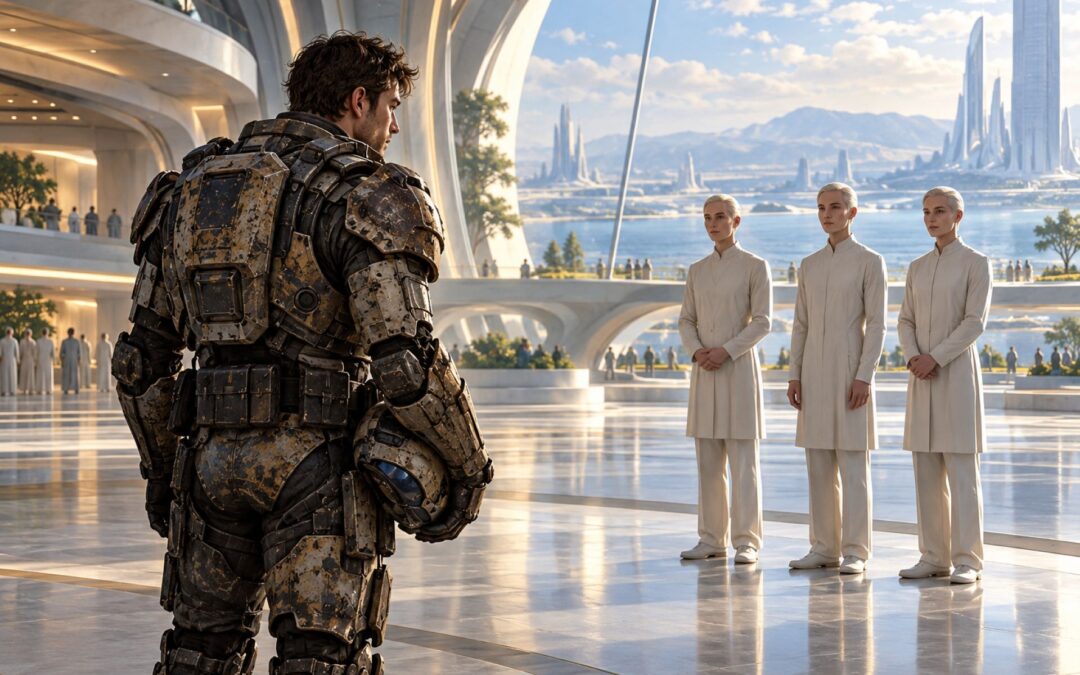
In Joe Haldeman’s The Forever War, a soldier can spend a few months fighting on a distant planet and return to discover that decades have passed on Earth. His friends have grown old, his country has changed, and the society he was sent to defend has become almost unrecognizable. The military, however, still expects him to fight. Each new assignment threatens to carry him further into a future where he has no family, no familiar culture, and increasingly little reason to believe in the war itself.
First published in 1974, The Forever War draws on Haldeman’s experience as a soldier in Vietnam while using the possibilities of interstellar travel to examine the estrangement of returning veterans. Its central character, William Mandella, is a reluctant infantryman whose scientific education cannot protect him from institutional incompetence, battlefield conditioning, or the consequences of surviving longer than his contemporaries. His relationship with fellow soldier Marygay Potter gradually becomes the one connection capable of surviving the centuries separating him from his original life.
The novel won the Nebula Award for Best Novel in 1975 and the Hugo Award in 1976, establishing itself as a landmark of military science fiction. Its unusual power comes from the combination of plausible military experience, speculative physics, bitter humor, changing social institutions, and an increasingly intimate concern with what remains of an individual after history has overtaken everything familiar. The version discussed here is the restored text preferred by Haldeman, including the substantial Earth-homecoming material that was absent from earlier versions.
Spoiler Warning: This article covers the complete novel, including its major battles, character deaths, revelations, and ending.

How William Mandella Is Drafted Into an Interstellar War
William Mandella enters military service in a future where humanity has developed a method of traveling between distant star systems through collapsars. These extraordinary astronomical objects provide access to interstellar routes, allowing ships to traverse distances that would otherwise make meaningful contact between stars nearly impossible. The system has opened opportunities for exploration and colonization, but it has also brought humanity into conflict with an extraterrestrial species called the Taurans.
The precise origins of that conflict are uncertain. Human exploration ships have disappeared, and military authorities believe the Taurans are responsible. The resulting tensions have developed into an organized interstellar war, although the soldiers being sent to fight possess remarkably little information about their enemy. They know almost nothing about Tauran biology, intentions, social organization, or methods of communication.
Humanity’s response is the United Nations Exploratory Force, or UNEF, which recruits exceptional individuals under the Elite Conscription Act of 1996. Its selection process emphasizes intelligence, education, and physical capacity. Mandella, a physics student with no particular enthusiasm for military life, finds himself surrounded by people who might otherwise have become scientists, engineers, mathematicians, and specialists in numerous demanding professions.
Their abilities do not spare them the ordinary absurdities of military training. The novel opens with an instructor announcing a lesson on silent killing, although Mandella doubts the young sergeant has any meaningful combat experience. Much of the instruction seems designed to enforce attention and obedience rather than develop abilities the recruits genuinely need.
Mandella approaches military life with skepticism and dry humor. He follows orders because refusing them would achieve little, but he maintains a considerable distance between his private judgment and the institution controlling him. The contrast becomes especially striking when highly educated recruits are required to perform exhausting manual tasks under conditions that make little practical sense.
The soldiers develop an informal culture of companionship, sarcasm, sexual relationships, and shared resentment. Regulations attempt to manage almost every aspect of their lives, but they retain considerable freedom in their private relationships. Mandella’s early encounters with Marygay Potter occur within this environment, where sexual intimacy is relatively casual and lasting emotional commitments have not yet become central to their lives.
Their training initially takes place in Missouri, where strenuous construction exercises establish the importance of discipline and coordination. The military insists that even small mistakes may endanger entire units. Although the recruits have reason to doubt their instructors’ judgment, they gradually learn that the environments awaiting them will make this warning disturbingly accurate.
The first major change occurs when the company is transferred to Charon, a remote and extremely hostile world where its final training will take place. The assignment brings the recruits closer to genuine combat, although none has yet encountered a living Tauran.
How Training on Charon Becomes a Deadly Test
Charon exposes the soldiers to physical conditions far beyond those of Earth. Its extreme cold, unfamiliar terrain, and lack of a breathable atmosphere make ordinary human movement impossible without specialized protection. The recruits must learn to work, travel, construct shelters, and fight while enclosed in powered combat suits.
These suits substantially increase the wearer’s strength while providing environmental protection, communications, weapons, and life support. Their advantages are immense, but their operation requires constant attention. Strength amplification can turn an ordinary movement into a destructive action, while a mechanical failure can kill someone almost instantaneously.
The armorer’s demonstrations make clear that the equipment is both essential and dangerous. A soldier who misunderstands a control or moves without accounting for the suit’s power may suffer injuries that would be impossible under ordinary circumstances. Training therefore involves learning to manage one’s own body through a complicated mechanical system.
Captain Stott and Sergeant Cortez oversee the recruits. Stott represents the formal authority of the command structure, while Cortez provides more immediate instruction and discipline. They warn that disobedience during maneuvers may be punished by death, although the environment itself is likely to kill anyone making a serious mistake.
The recruits discover that the warning is justified. Construction exercises, equipment failures, and environmental accidents begin claiming lives before the company has encountered an enemy. A landslide crushes Foster, Freeland dies after a suit malfunction, and other soldiers suffer catastrophic injuries that cannot be repaired in the field.
Dahlquist’s injuries are especially severe, leaving him permanently disabled and effectively stranded on Charon. The distinction between a soldier killed outright and one condemned to lifelong isolation becomes difficult for Mandella to maintain.
The casualties affect the survivors in ways that military instruction has not prepared them to manage. Rather than becoming uniformly more disciplined and efficient, they often grow frightened, exhausted, and uncertain. The experience exposes the limitations of an institution that can demand courage but cannot reliably control the conditions under which courage is required.
During a simulated attack on a defended position, Marygay plays an important role in Mandella’s survival. Their cooperation demonstrates that training can produce genuine trust even when the surrounding organization seems indifferent to individual lives. Their physical relationship also begins acquiring a more substantial emotional foundation.
The company eventually moves to Charon’s dark side, where the environmental hazards become more extreme. The soldiers must retrieve construction materials from pools of superfluid helium and establish facilities while protecting themselves from dangerous surfaces and unpredictable mechanical problems.
During one incident, Singer becomes trapped beneath a heavy structure. Mandella attempts to rescue him despite the risks, helping organize the effort that eventually gets him out. The episode shows that Mandella’s skepticism does not prevent him from accepting responsibility for another person’s survival.
Almost immediately afterward, an approaching black ship creates panic among the soldiers. They assume a Tauran attack has begun and prepare for combat, only to discover that the vessel belongs to their own side.
The officers criticize the recruits for failing to react aggressively enough to the apparent threat. The incident establishes a recurring military expectation: the soldiers are supposed to respond automatically with violence, even when they lack enough information to judge the situation.
Further simulated combat produces an even more devastating accident. The training facility is breached, causing explosive decompression and killing several soldiers, including Maejima, Garcia, and Friedman. Their deaths are sudden and grotesque, leaving the survivors to repair the damage and recover bodies under conditions where grief cannot interfere with necessary work.
Cortez personally handles part of the aftermath rather than ordering another soldier to perform the task. For Mandella, moments like this complicate an otherwise hostile assessment of military leadership. Cortez can be harsh and authoritarian, but he is also capable of confronting horrors from which others instinctively turn away.
By the time training concludes, the surviving recruits have already experienced substantial losses. They have learned to operate complicated weapons, endure alien environments, and function while exhausted or terrified. They have also discovered that the military can kill its own soldiers without the assistance of an enemy.
Their next destination is Stargate, the expanding military installation that serves as a gateway to the interstellar war. The soldiers see an infrastructure growing rapidly around a conflict whose ultimate purpose remains poorly understood.
The first collapsar jump introduces the mechanism that will determine the remainder of Mandella’s life. Although the jump allows enormous distances to be crossed, the journeys to and from collapsars still involve relativistic velocities. The resulting difference between time experienced aboard a ship and time passing elsewhere means that soldiers may return from a mission to find their civilization decades older.
Mandella understands the physics intellectually. He has not yet experienced what it means to lose an entire historical period while remaining personally young.
The First Tauran Campaign and the Violence of Conditioning
The soldiers approach their first enemy-controlled system aboard the Earth’s Hope. Before they reach the surface, the ship encounters and destroys a Tauran spacecraft with extraordinarily powerful missiles. The infantry experiences the engagement largely through announcements and the movement of the ship, making the destruction strangely remote.
This kind of combat differs sharply from the heroic imagery associated with conventional warfare. Ships move at enormous relative velocities, weapons are directed by computers, and the decisive actions may occur far beyond the crew’s direct perception. The people involved can understand the scale of the destruction without ever seeing their victims.
Mandella’s company then prepares to land on a planet orbiting the star Aleph. The environment contains unfamiliar vegetation, unusual atmospheric conditions, and living organisms whose behavior cannot easily be interpreted through terrestrial experience.
The infantry carries a wide range of expertise because commanders have no reliable way of predicting what knowledge might prove useful. Mandella is assigned to the command group because of his physics background, while Rogers contributes biological knowledge and other soldiers possess linguistic, chemical, psychological, or specialized observational abilities.
This arrangement briefly suggests that the mission might resemble scientific exploration. The soldiers are armed for combat, but understanding the environment is essential to their survival.
The ambiguity becomes especially important when the company encounters creatures that resemble small teddy bears. These animals appear harmless, following the soldiers and behaving with curiosity rather than aggression. Their unfamiliar biology makes them difficult to classify, but nothing immediately establishes that they are dangerous.
Cortez nevertheless orders the soldiers to fire on them.
The consequences are disturbing. Some soldiers experience intense psychological distress after participating in the killing, while others suffer unusual neurological effects. Ho dies from a catastrophic cerebral hemorrhage associated with the encounter, and several members of the company appear susceptible to an unexplained influence.
The surviving creatures continue following the soldiers, seemingly attempting some kind of mental contact. Lucky Hollister’s apparent extrasensory sensitivity contributes to the suspicion that they may be broadcasting thoughts or emotions.
The possibility of communication remains uncertain. The creatures may be intelligent, may possess abilities humans cannot understand, or may be interacting with the soldiers through mechanisms that resist ordinary scientific explanation.
Marygay is visibly distressed by the killing. Her reaction provides an early indication that the soldiers’ emotional responses to violence are more complicated than the military’s simple division between friendly and hostile organisms.
Mandella shares her discomfort, particularly because the creatures have not behaved like obvious enemies. The expedition has entered a world where the inability to understand another form of life may be mistaken for evidence that it deserves destruction.
As the soldiers advance, they eventually observe Tauran activity and locate an enemy installation. The planned attack becomes the first direct ground engagement between the two species.
The officers prepare the soldiers for combat while discussing the possibility that some Taurans may not resist. Cortez insists that restraint would be dangerous because the enemy has already attacked human vessels. He also argues that the Taurans are responsible for the deaths of human soldiers, including those who died during training.
The reasoning is questionable. The training casualties resulted from environmental hazards, equipment failures, and military decisions rather than direct Tauran action. Cortez nevertheless incorporates those deaths into the justification for attacking the enemy.
More disturbing is his revelation that the soldiers have been subjected to posthypnotic conditioning. At a predetermined signal, their restraints against killing will be suppressed and their aggression intensified.
The recruits have not freely chosen this psychological modification. Their behavior during the coming battle has already been manipulated by the institution commanding them.
The assault begins with an approach toward a complex of strange, largely featureless structures. The soldiers surround the installation and prepare their weapons while the Taurans appear poorly equipped to deal with conventional infantry tactics.
Once the conditioning is activated, the humans attack with devastating efficiency. What follows is closer to a massacre than a balanced engagement.
The Taurans are overwhelmed by weapons and methods of combat they seem scarcely prepared to understand. Some attempt to flee, and many are killed while offering little effective resistance. The human soldiers continue attacking with an intensity that extends beyond what Mandella might otherwise have considered necessary.
During the action, Mandella experiences the excitement and satisfaction that the conditioning has been designed to produce. The emotional response becomes horrifying when the effect subsides and he can examine his actions.
His guilt is not confined to the recognition that he killed. He has to confront the fact that he enjoyed killing while operating under psychological manipulation, and that human history provides abundant examples of similar violence committed without any technological conditioning.
He begins questioning whether his reactions were imposed entirely from outside or whether the military merely released capacities that already existed within him.
The distinction matters because it prevents him from completely separating himself from the violence. The institution bears responsibility for manipulating its soldiers, but Mandella still remembers the experience as something he participated in.
One Tauran escapes in a spacecraft, apparently carrying news of what happened. Mandella suspects that the next encounter will be different. If the Taurans learn from this disaster, humanity’s initial advantage in ground combat may disappear.
His prediction proves correct.
A Second Mission, Marygay’s Injuries, and the Journey Home
Mandella’s military career continues after the first campaign. He has acquired experience, increased responsibility, and a more precise understanding of how little control individual soldiers possess over their circumstances.
Aboard the Anniversary, he serves as a sergeant under Sub-major Stott. The company is again approaching enemy territory, and its commanders are concerned about morale. Fear has become more difficult to conceal because the veterans understand what can happen even when a mission appears carefully planned.
The troops also have more complicated personal relationships than they did during their first period of training. Mandella and Marygay remain important to each other, although both have other sexual relationships within the military’s permissive social arrangements. Their intimacy has not yet become exclusive, but it increasingly provides a degree of familiarity amid unpredictable deployments.
Military technology has advanced substantially during the time separating missions. New acceleration shells allow ships to maneuver under forces that would otherwise destroy their occupants.
A soldier enters a flexible protective enclosure that is flooded and pressurized before extreme acceleration begins. The system allows the ship to achieve maneuvers that conventional human physiology could never survive, but the experience is unpleasant, dangerous, and almost entirely passive.
The crew must trust equipment that they cannot meaningfully control once the process begins. Mandella’s earlier experience with fighting suits makes him acutely aware that a device designed to prevent death can produce it through mechanical failure.
Meanwhile, the Taurans have developed improved weapons and tactics. The humans can no longer assume that their enemies will remain behind technologically or continue making the mistakes observed during the first ground battle.
The approaching engagement requires the ship’s computers to calculate possibilities far beyond ordinary human reaction time. Mandella recognizes the irony of a war in which the decisive combatants may be machines, while soldiers remain necessary largely because military institutions insist on using them.
His anxiety intensifies when Marygay suffers a catastrophic accident involving her acceleration equipment. A malfunction compromises the protective shell around her body, causing serious internal injuries and leaving her in critical condition.
Mandella rushes to her, discovering the severity of the damage while medical personnel attempt to stabilize her. Her injuries are a reminder that the most immediate danger to the people he loves does not always come from the enemy.
The approaching combat creates an additional problem. Marygay may be too injured to withstand the acceleration required by the ship’s maneuvers, yet the vessel cannot stop operating because one soldier is critically wounded.
Mandella becomes consumed by the effort to keep her alive. Medical assistance and improvised technical arrangements offer some hope, but the outcome remains uncertain while the crew prepares for another period of extreme acceleration.
The commander eventually decides against pressing an attack that would almost certainly destroy the ship. This refusal to carry out a suicidal engagement provides a welcome exception to the repeated military assumption that orders and aggressive action must override practical judgment.
Mandella helps devise a way of protecting Marygay during the necessary maneuvers. He cannot eliminate the risks, but his scientific understanding and desperate attention to her condition contribute to her survival.
When the immediate danger passes, he initially fears the worst. Signs of hemorrhaging make the situation appear catastrophic, until the medical staff reassure him that the bleeding was anticipated and that Marygay will recover.
The relief changes the emotional weight of their relationship. Both have survived battles, but the possibility of losing Marygay has made Mandella recognize how much of his remaining personal life is concentrated in her.
Their return journey continues under military routines that appear increasingly meaningless. The veterans endure compulsory work, exercises, and administrative demands even after surviving experiences far beyond what their instructors could imagine.
Eventually they reach Stargate, where the expanding military presence reveals how much the conflict has grown during their absence. The installation now contains numerous warships and supports operations across multiple systems.
General Botsford meets the returning soldiers and encourages them to reenlist. He emphasizes the financial rewards accumulated through military pay and compound interest, as well as the continuing opportunities available to trained veterans.
His argument ignores the central difficulty: the money may belong to the soldiers, but the society in which they could spend it has changed.
Captain Siri provides a briefing on conditions back on Earth. Population growth, severe food shortages, unemployment, government rationing, and changing reproductive policies have transformed everyday life.
The soldiers learn that homosexuality has become increasingly common and that some governments encourage it as a means of controlling population growth. They also discover that their education and professional training may no longer qualify them for civilian employment.
Botsford warns that their relatives, friends, and former lovers will have aged considerably. Some will have died, while others may no longer recognize the people the soldiers have become.
Mandella and Marygay prepare to return home with substantial financial resources but very little understanding of how to resume ordinary lives. They have survived the enemy, yet the next challenge requires skills their military training has made increasingly irrelevant.
The Earth Mandella Cannot Return To
Mandella and the returning veterans initially receive an enthusiastic welcome. As some of the first soldiers to come home from the interstellar war, they become public celebrities, appearing at official ceremonies and attracting considerable media attention.
The honors produce money and brief excitement, but the experience gives them little insight into ordinary civilian conditions. Their receptions are carefully managed events, insulated from the difficulties facing the broader population.
Once the public attention fades, Mandella returns to Washington and discovers a society that no longer operates according to the assumptions of his youth.
Population pressure has transformed urban life. Many people are unemployed, public resources are limited, and the distribution of necessities depends on complicated systems of rationing and social classification.
Crime has become pervasive. Private bodyguards are common, and ordinary activities that Mandella once considered harmless now involve the possibility of armed violence.
His mother has adjusted to these conditions, although the changes are startling to him. She employs a bodyguard named Carl and has developed personal relationships that reflect the society’s new circumstances.
Mandella struggles with the language, technology, and everyday conventions around him. Even a telephone presents difficulties because its basic operation has changed during his absence.
These minor embarrassments accumulate into a more serious realization. He may be intelligent and highly trained, but the ordinary knowledge that once made him competent in civilian society has become obsolete.
He investigates employment opportunities and discovers that the abundance of people seeking work makes his prospects uncertain. His military accomplishments attract attention, but they do not automatically translate into a career he wants.
One possible occupation is private security, where his combat experience would be valuable. Yet the idea of risking his life to protect wealthy civilians is deeply unattractive after everything he has endured in uniform.
Marygay has returned to her family in South Dakota, where her parents live in an agricultural commune. She and Mandella reconnect and decide to spend time together exploring the changed world.
Their discussions reveal different reactions to the social transformation. Mandella is particularly unsettled by the new sexual norms, while Marygay is more willing to consider the pressures that produced them.
Both are disturbed by the widespread violence and the increasingly artificial organization of daily life. They want to discover whether their substantial financial resources can provide some escape from the society’s difficulties.
They decide to travel to London, using luxurious transportation and accommodations that temporarily separate them from ordinary conditions. The journey provides pleasure, but it also exposes the contrast between insulated wealth and general deprivation.
The cities they encounter remain technically sophisticated, yet their advanced infrastructure coexists with severe inequality and insecurity. Their money enables them to enjoy forms of comfort largely unavailable to the population around them.
The excursion turns violent during a civilian encounter, and Mandella uses his military experience to survive. His reaction to killing troubles Marygay, particularly because he can discuss the incident with a degree of detachment that would once have seemed impossible.
Mandella has learned to distinguish immediate danger from subsequent moral reflection. That ability may help him survive, but it also makes him aware that the military has changed how he responds to human death.
The couple eventually abandons the journey. They conclude that they need a more familiar environment before attempting further exploration of this radically different world.
Mandella returns to Washington, where his mother’s domestic life creates another reminder of the passage of time. She has adapted to circumstances and relationships that he finds difficult to understand.
His discomfort is not solely moral judgment. He is encountering people whose lives have continued normally while his own history was interrupted, and he cannot easily reconcile the two perspectives.
Marygay’s agricultural commune appears to offer a more promising alternative. Its residents grow food, share resources, and organize their lives around practical work rather than the insecurity of crowded cities.
Mandella travels there and meets Marygay’s parents, Richard and April Potter. They welcome his abilities and discuss the possibility of his joining their household.
For the first time since returning to Earth, he can imagine a useful civilian role. Physical work, family relationships, and the predictable demands of agriculture seem more substantial than public ceremonies or private security contracts.
The commune, however, has not escaped the violence surrounding it. Its members maintain defensive arrangements against armed raiders who threaten their property, supplies, and lives.
Mandella’s military experience makes him valuable in planning and operating these defenses. The irony is painful: even in the peaceful environment he hopes to join, the skill most immediately useful is his ability to kill.
The anticipated danger eventually becomes real when raiders attack the settlement.
Mandella participates in the defense, using his experience to respond to the assault. The violence is immediate and brutal, far removed from the clean abstractions of computerized interstellar warfare.
Richard Potter is killed, and April also dies. Their deaths destroy the domestic security that Mandella and Marygay hoped the commune might provide.
Afterward, Mandella helps confront the physical aftermath. He observes the bodies of the attackers and realizes how little their condition disturbs him compared with what he might once have felt.
The detail troubles him. He has become accustomed to death under technological conditions where bodies are often destroyed instantly, leaving little opportunity to examine what violence does to human flesh.
Here the dead remain visibly human, yet the emotional reaction he expects does not arrive.
Marygay’s grief is more direct. She has lost both parents in an attack on the place that was supposed to provide safety outside the cities.
The couple returns to Mandella’s mother, whose health has begun to deteriorate seriously. She suffers from an illness that should be treatable with adequate medical intervention.
The healthcare system, however, allocates access according to social and administrative criteria. Her priority is insufficient to secure the treatment she needs.
Mandella tries to navigate the bureaucracy, but his military status and accumulated wealth cannot overcome its restrictions. The institution is polite and impersonal while denying his mother a meaningful chance of survival.
She dies after several days.
Her death is one of the novel’s most important civilian episodes because it demonstrates how little protection the apparent achievements of civilization provide when institutions reduce individuals to categories.
Mandella has survived interstellar combat and mastered technologies almost unimaginable to earlier generations, yet he cannot save his mother from a medical system that has already decided she is not entitled to sufficient care.
He contacts his brother Mike, who lives on Luna. Mike offers a possible alternative to conditions on Earth, and the prospect of another civilian environment briefly reopens the question of what Mandella should do.
But Mandella and Marygay are exhausted by their encounters with the transformed world. Their families have been devastated, their employment prospects are uncertain, and the possibility of living peacefully seems increasingly remote.
They decide to reenlist, hoping to secure assignments that will keep them together and away from direct combat.
Their decision is neither an endorsement of the war nor an expression of renewed military enthusiasm. The military has become the only institution whose routines they understand, while its benefits seem more dependable than the alternatives available to civilians.
They negotiate assurances that they will be assigned to relatively safe training positions. Almost immediately afterward, new orders transfer them back toward active military operations.
The promises have technically been fulfilled for only a moment before the bureaucracy finds a way around them.
Mandella recognizes the deception, but he can do nothing effective to resist it. The military has once again taken possession of the future he thought he might control.
The Lieutenant’s Campaigns, Heaven, and the Separation From Marygay
Mandella returns to combat as an officer, responsible for the lives of soldiers who are often as frightened and reluctant as he was during his early service.
His additional experience does not give him confidence that the military understands its own objectives. The enemy has continued developing, the weapons are increasingly destructive, and the soldiers are repeatedly sent into situations where survival depends on factors beyond their control.
Before one operation, Mandella observes a pair of soldiers struggling with the prospect of separation. Their attachment reminds him of his relationship with Marygay, although he has little time to offer comfort.
Military procedure continues despite the emotional consequences. The troops take prescribed medication intended to reduce fear and maintain effectiveness, then prepare for another dangerous descent.
The operation unfolds rapidly. Soldiers attempt to secure positions while dealing with hostile terrain, complex equipment, and the possibility of overwhelming Tauran resistance.
Mandella suffers a catastrophic injury when a structural accident crushes his leg. His fighting suit automatically amputates and seals the damaged limb, preventing him from dying through decompression and blood loss.
The emergency system administers drugs and medical support, leaving him alive but severely injured. The experience demonstrates the extraordinary capabilities of the equipment, although those capabilities operate through a brutal form of mechanical intervention.
Marygay also suffers a devastating injury, losing an arm during subsequent fighting. Both survive, but their bodies have been altered by the war they never wanted to fight.
The company endures additional campaigns and considerable casualties before the survivors are withdrawn. The combination of battlefield losses, technological escalation, and repeated deployments leaves Mandella increasingly unable to view the war as a meaningful enterprise.
Eventually the wounded soldiers are sent to Heaven, a sophisticated colony serving as a hospital and rest-and-recreation center.
Heaven differs sharply from the Earth Mandella and Marygay recently visited. Its environment is carefully managed, medical facilities are advanced, and ordinary life appears far more comfortable.
The colony’s technology allows damaged or missing limbs to be regenerated. Mandella and Marygay undergo treatment, gradually recovering bodies that the fighting had mutilated.
The process is demanding and sometimes painful, but it offers a remarkable restoration of physical capacity. The medical contrast with Mandella’s mother’s death is difficult to ignore: the same civilization that could not provide adequate treatment for her can reconstruct parts of a wounded soldier.
Heaven’s recreational environment also gives Mandella and Marygay an opportunity to experience pleasures that have become almost inaccessible during military service. They spend time together away from immediate combat, exploring activities that have no military purpose.
Even here, however, technology cannot eliminate every danger. The planet contains enormous marine predators, and recreational areas require protective systems to prevent attacks.
During one excursion, a giant shark penetrates a protected area after a barrier is temporarily withdrawn. The creature’s size and ferocity make ordinary terrestrial sharks seem insignificant.
The incident introduces danger into an environment designed for leisure. It also exposes how difficult it has become for Mandella and Marygay to separate recreation from their habitual awareness of violence.
They have learned to live under conditions where catastrophe may arrive without warning. Their ability to respond effectively does not necessarily mean they can recover the psychological ease of ordinary civilian life.
For a time, Heaven nevertheless provides something approaching happiness. Mandella and Marygay can enjoy one another’s company without constantly preparing for the next attack.
Their relationship has changed considerably since the permissive and relatively casual sexual arrangements of their first training period. They now share memories of battles, injuries, losses, and historical displacement that few other surviving humans could understand in the same way.
The period of relief ends when their military assignments are announced.
Mandella receives a promotion to major and is ordered to take command of another force. Marygay receives a separate assignment.
Under ordinary circumstances, two soldiers assigned to different units might expect eventual reunion. Relativistic travel makes that expectation dangerously uncertain.
Their separate ships may travel at different velocities, pass through different collapsars, and emerge into civilizations separated by centuries. A relatively minor difference in subjective travel time could produce an enormous difference in historical time.
Neither can know whether the other will survive or when a reunion might become possible.
The separation devastates Mandella. He has already lost his family, the society of his childhood, and much of his confidence in the institutions controlling his life.
Marygay remains the person through whom he can remember who he was before the war. Losing her threatens to eliminate his last substantial connection to that identity.
His despair becomes severe enough that he contemplates suicide while standing above a great precipice.
The moment is an emotional turning point. Mandella does not refrain because he suddenly becomes optimistic about the future or reconciles himself to military service.
He realizes that allowing the army to determine even the end of his life would grant it a final victory over him.
His decision to survive becomes a limited act of resistance. He cannot control his assignment, the course of the war, or the centuries separating him from Marygay, but he can refuse to let the institution make his last decision for him.
Major Mandella and the Strangers Under His Command
Mandella arrives at Stargate to prepare for his new command. His accumulated military experience is substantial, but the time separating him from contemporary society has created another problem: much of what he knows is obsolete.
The military addresses this through accelerated education using advanced computer-assisted techniques. Information is impressed upon him with extraordinary speed, providing knowledge that would otherwise require years of training.
Mandella finds the process disturbing. He has repeatedly criticized the military for treating people as programmable instruments, yet his new rank requires him to undergo a system that changes his knowledge and responses with minimal opportunity for reflection.
He meets Colonel Kynock, who explains additional transformations in human society. The norms Mandella found strange during his first return to Earth have developed much further.
Heterosexuality has become uncommon and socially disapproved of in many communities. Reproduction is increasingly controlled through institutions that separate biological parenthood from conventional families.
Kynock himself has undergone extensive bodily modification following a medical problem, further illustrating the extraordinary distance between Mandella’s original understanding of humanity and the people now surrounding him.
The changes create practical difficulties for military leadership. Mandella is expected to command soldiers who do not share his upbringing, sexual assumptions, cultural references, or emotional habits.
Many have been raised in controlled institutions called creches, receiving standardized education in environments largely separated from ordinary family relationships. Their identities have developed within a system that Mandella finds unfamiliar and emotionally restrictive.
When he first assembles his new company, the troops appear physically normal but culturally distant. He struggles to interpret their expressions and expectations, just as they have difficulty understanding his behavior.
Mandella wants to establish a less authoritarian style of leadership than he experienced under Stott and Cortez. He explains his expectations, attempts to treat the soldiers as intelligent adults, and encourages a reasonable degree of personal independence.
Not everyone welcomes the approach.
Hilleboe, one of his subordinate officers, prefers stricter discipline and seems more comfortable with conventional military authority. Her attitude reflects an organization that has continued developing its methods long after Mandella’s original training.
Charlie Moore becomes one of Mandella’s more important colleagues. Although their social and sexual assumptions differ, Charlie is capable of direct conversation, practical judgment, and loyalty.
Diana Alsever, a medical officer, also provides important professional and personal support. Her competence becomes particularly valuable when command problems develop into injuries and ethical dilemmas.
The new expedition will travel aboard the Masaryk II, a large warship whose design reflects the changing priorities of military technology.
Earlier ships possessed a certain elegance, but the immense forces associated with modern maneuvers require heavier and more functional structures. The vessel is an instrument built almost entirely around the demands of warfare.
Its destination is Sade-138, a strategically important system where Mandella’s company will establish and defend a military installation.
The mission introduces a crucial technology: the stasis field.
Within the field, the physical rules governing electromagnetic activity and high-speed movement change radically. Sophisticated weapons and electronic systems cannot function normally, while objects entering the field are limited to extremely low velocities.
For soldiers trained in the most advanced forms of technological warfare, this creates an extraordinary tactical problem. Survival inside the field may depend on bows, spears, swords, shields, and other weapons that humanity abandoned centuries earlier.
Mandella studies these requirements alongside the more familiar problems of fortification, logistics, transport, and command.
The company travels toward Sade-138, adapting to the routines of life aboard ship. Mandella attempts to minimize pointless tasks while maintaining the training needed for their eventual deployment.
Some soldiers appreciate his approach, while others interpret his relative informality as weakness. Cultural distance makes even ordinary disciplinary decisions difficult.
The situation becomes more serious after the troops establish their base. Tensions involving a soldier named Graubard escalate into open violence.
Graubard proves unstable and increasingly hostile toward Mandella’s authority. His conflict with Schon and other personnel contributes to a wider atmosphere of discontent.
Eventually Graubard attacks Mandella directly. The incident leaves Mandella injured and Graubard facing severe disciplinary consequences.
The commander now confronts a problem for which neither his scientific education nor his humane intentions provide a satisfactory solution. Military law demands punishment, and his subordinates consider execution appropriate.
Mandella is reluctant to carry out the sentence. He recognizes that a commanding officer must maintain authority, but he is deeply uncomfortable with using that authority to kill a soldier who has become psychologically unstable.
The dilemma ends abruptly when Graubard apparently attempts suicide by hanging himself. Medical personnel try to revive him, but he dies.
His death removes the immediate problem without resolving every question surrounding it. The circumstances allow suspicion and uncertainty, and Mandella cannot entirely dismiss the possibility that the outcome was influenced by other people’s desire to avoid an execution.
The incident damages his confidence. He wanted to establish a form of command that would respect the individuality of his soldiers, but he has discovered that goodwill and reasonable intentions cannot automatically overcome psychological conflict or institutional expectations.
As the company waits for the Taurans, Mandella becomes increasingly isolated. He spends time with Charlie and Diana, but neither can replace Marygay.
A military psychiatrist attempts to challenge what he considers Mandella’s excessive attachment to a relationship separated from him by centuries. Mandella resists the suggestion that his love is merely a psychological fixation or an obsolete response to circumstances.
An unlikely companion is the company cat, which repeatedly seeks his attention. The animal’s ordinary behavior provides a small connection to familiar forms of life, although Mandella responds with characteristic irritation and reluctant affection.
By the time the enemy finally arrives, the company has endured a prolonged period of preparation, uncertainty, and internal tension. Mandella must now discover whether his unconventional approach to command can survive a genuine crisis.
The Last Siege and the End of the War
The Taurans arrive after the human installation has been established for more than a year. Their appearance ends a long period of waiting during which Mandella has attempted to prepare his soldiers for possibilities that remain largely unknown.
The enemy’s ships possess formidable capabilities. Both sides use advanced weapons, automated defenses, and reconnaissance systems while maneuvering around the planet and its collapsar.
Mandella must make decisions based on rapidly changing information. The technological systems designed to improve his awareness also confront him with more data than a human commander can easily interpret during battle.
Early enemy attacks test the defensive installation. Tauran drones and weapons progressively undermine the humans’ ability to control the surrounding terrain.
Their automated lasers prove effective against some incoming threats, but successive attacks reveal limitations. The enemy begins exploiting weaknesses in the system, and Mandella realizes that the defensive advantage on which his plans depend may disappear.
The Taurans eventually deploy ground troops, threatening to overrun the installation. Mandella organizes defensive positions, assigns personnel to trenches, and attempts to preserve reserves for a prolonged fight.
His decisions create tension among the soldiers. Some interpret their placement in dangerous positions as punishment rather than necessity, demonstrating how fragile trust has become within the company.
Mandella recalls his own resentment toward commanders who remained safe while infantry fought below them. He recognizes that his current position risks reproducing precisely the kind of leadership he once despised.
He therefore becomes increasingly willing to share the physical danger faced by his soldiers, even though his subordinates warn that exposing the commander unnecessarily may jeopardize the defense.
Meanwhile, an apparently ineffective human fighter undertakes an audacious maneuver. Rather than simply retreating from the enemy, it uses the gravitational and relativistic circumstances around the collapsar to approach at an extraordinary velocity.
The fighter launches drones toward a Tauran cruiser. At such speeds, even an object carrying no conventional explosive can release catastrophic energy upon impact.
The attack destroys the enemy vessel, but one drone continues toward the planet.
Mandella recognizes a terrible consequence that may not have been considered by the pilot. The collision will release enough energy to produce an enormous geological disturbance.
He attempts to warn the troops and order them toward safer positions.
The resulting earthquake devastates the battlefield. The carefully constructed base suffers catastrophic damage, defensive systems are buried or disabled, and soldiers are killed in the destruction.
The incident demonstrates the danger of tactical success achieved without adequate understanding of its wider physical consequences.
A human weapon has destroyed an enemy ship while simultaneously making the humans’ own position almost impossible to defend.
Mandella struggles to reorganize the surviving soldiers as Tauran ground forces continue approaching. He attempts an orderly withdrawal toward the stasis dome, where conventional weapons cannot operate effectively.
The movement becomes chaotic under fire. Some soldiers fail to reach safety, while others become separated from their units.
Mandella eventually enters the field, discovering that even the transition into its altered physical environment has killed personnel whose equipment was insufficiently protected.
Inside the dome, ordinary communications and advanced weapons become useless. Electrical systems cannot function normally, and the physical restrictions make familiar forms of movement and combat impossible.
The survivors must rely on gestures, writing, and primitive weapons.
They gather beneath a fighter positioned inside the field and distribute bows, spears, shields, swords, knives, axes, and other equipment prepared for this contingency.
Their numbers are desperately inadequate. The Taurans possess a much larger force and can choose whether to attack immediately or wait for the humans to exhaust their supplies.
Mandella organizes the survivors into a defensive formation, placing archers and other soldiers where their weapons can be used most effectively.
The stasis field imposes equally severe restrictions on both sides, but the Taurans initially demonstrate little understanding of how best to fight under its conditions.
Their first attacks include clouds of projectiles launched through the dome. The missiles fall toward the human position, killing soldiers who fail to notice the threat in time.
Because ordinary speech and electronic warnings are impossible, Mandella establishes a simple physical signaling system. Each soldier must touch the next person when danger appears, allowing a warning to pass around the formation.
The precaution helps during another barrage.
The Taurans then mount a large ground assault, entering the field with primitive weapons and shields. Their numerical superiority is overwhelming, but their tactics initially work badly against the human archers.
Human arrows penetrate their light defenses, killing large numbers before the attackers can reach close-combat range.
Mandella and the survivors use their limited ammunition and throwing weapons carefully. When the Taurans finally close the distance, the battle becomes a violent struggle with swords, staffs, and other hand weapons.
The enemy adapts through brutal methods, including sacrificing individual attackers to disable the humans’ weapons and create openings for others.
Casualties mount rapidly. Hilleboe and many other soldiers are killed, while Mandella survives partly through cooperation with those fighting beside him.
The Taurans eventually withdraw, leaving numerous dead. The human survivors have inflicted severe losses, but their own numbers have fallen so far that another comparable assault would almost certainly destroy them.
The enemy changes tactics again, using repeated projectile attacks to wear the humans down without committing another large ground force.
Mandella’s soldiers struggle with hunger, exhaustion, sensory deprivation, and the impossibility of maintaining constant vigilance. The stasis field provides protection from advanced weapons, but it has become a prison in which time passes slowly and death remains increasingly likely.
Eventually the projectile attacks stop. Mandella investigates and concludes that the Taurans are saturating the exterior with intense heat, hoping to force the survivors to deactivate the field.
He realizes that remaining inside indefinitely is impossible, while leaving under ordinary circumstances would be suicidal.
The solution comes from the physics of the stasis field itself.
The human fighter contains nova bombs, extraordinarily powerful weapons that cannot detonate while subjected to the field’s restrictive conditions.
Mandella devises a plan to remove the bombs from the ship and position them so that they will explode outside the protected region when the field is manipulated.
The operation requires careful manual work, because the electronic systems that would ordinarily control the bombs cannot function inside the dome.
The survivors move the weapons into position and alter the field to trigger the explosions while preserving their protective enclosure.
The plan works.
The resulting detonations devastate the surrounding landscape, destroying the Tauran forces and transforming the terrain into an enormous crater. The humans remain protected inside the field while the destruction occurs beyond it.
When Mandella finally deactivates the generator, the surviving soldiers emerge into a landscape fundamentally altered by their own weapons.
They have won the immediate engagement, although the victory has cost almost the entire company. Mandella suspends ordinary military routines while the survivors prepare to leave the devastated planet.
Eventually they escape aboard the remaining spacecraft and wait for further assistance.
During the return journey, the surviving officers and soldiers discuss the possibility of another assignment. They have endured one of the most destructive campaigns imaginable, yet they assume the military will eventually send them into combat again.
The expectation is reasonable based on everything they have experienced. The war has already lasted for centuries, and nothing they know suggests that its underlying causes have been resolved.
When they finally return to Stargate, however, they discover that the situation has changed beyond recognition.
The soldiers are received by apparently identical men and women who explain that the war ended more than two centuries earlier.
Humanity itself has undergone a profound transformation. Most of the population now consists of clones participating in a single collective consciousness called Man.
Man explains that the individual originally associated with this genetic pattern was named Kahn. The collective now encompasses billions of bodies sharing one consciousness rather than functioning as separate personalities.
The returning soldiers are among the last representatives of an earlier form of humanity. Their social assumptions, emotional identities, and experience of individuality belong to a world that has largely disappeared.
They also learn the truth about the war.
Human exploration ships had vanished during the early period of interstellar expansion. Military leaders assumed that the Taurans were responsible, despite possessing little convincing evidence.
Rather than investigate sufficiently, they armed exploration vessels and attacked the first Tauran ship they encountered.
The Taurans, who had long ceased practicing organized warfare, responded to humanity’s aggression. The conflict then escalated across centuries.
Human military institutions, political leaders, and economic interests helped perpetuate the war. Its immense expense was politically useful because it created a common external enemy while absorbing resources on a scale that might otherwise have destabilized human society.
The conflict continued because neither side understood the other adequately, and because their incompatible forms of consciousness prevented meaningful communication.
The Taurans had evolved as naturally collective beings, lacking humanity’s conventional distinction between individual minds.
Only after humanity developed Man did communication become possible between the species.
Once they could communicate, both sides discovered that the original reasons for fighting were profoundly mistaken.
The war’s conclusion exposes the terrible disproportion between its causes and consequences. Countless people had been killed, entire societies transformed, and immense resources consumed because military assumptions hardened into unquestionable historical facts.
Mandella finds the explanation both convincing and difficult to accept.
Man cannot fully explain the nature of its communication with the Taurans in concepts that Mandella can understand. The collective claims that his individual human consciousness lacks the necessary framework.
Mandella remains skeptical of this extraordinary assertion, but he is willing to accept a degree of uncertainty if the alternative is another continuation of the conflict.
The war has lasted 1,143 years. Its military machinery survived longer than the civilization whose interests it originally claimed to serve.
For Mandella, the announcement brings enormous relief, but it also creates a new problem. He is now free of the institution that has controlled his life, while almost everything that once gave that freedom meaning has disappeared.
How Marygay and Mandella Find a Future Together
Man offers the surviving soldiers considerable freedom. They may remain within its society or travel to planets where humans continue living as separate individuals and reproducing through conventional biological means.
Mandella is particularly interested in these alternative communities because he cannot imagine adapting comfortably to a civilization organized around collective consciousness.
He also believes Marygay is lost to him forever.
Their assignments separated them across vast distances and centuries. Even if she survived her own battles, there seemed no realistic reason to expect that she would still be alive when he returned.
Man eventually provides the soldiers with their old military records, preserved after the war ended. Mandella receives an unusually substantial file because his service has extended across almost the entire conflict.
Attached near the beginning is a handwritten note dated more than two centuries earlier.
He recognizes Marygay’s handwriting and initially assumes that he is receiving a message from someone long dead.
Instead, the note reveals that she survived.
Marygay had discovered his assignment and calculated when he might return. Knowing that ordinary waiting would cause her to age and die long before his arrival, she devised a way of exploiting the same relativistic effects that had repeatedly separated them.
With financial help from several other veterans, she purchased a spacecraft and arranged for it to make repeated journeys at velocities close to that of light.
The ship travels away from a planet called Middle Finger and returns, allowing enormous periods to pass elsewhere while Marygay experiences comparatively little time.
Her message explains that she intends to wait for him, regardless of how much he has aged or what physical condition he may be in when he returns.
Mandella realizes that Marygay has turned the war’s most destructive feature into a means of preserving their relationship.
Throughout his military service, relativistic travel repeatedly deprived him of family, home, and historical continuity. Marygay has deliberately used it to maintain the possibility of a shared future.
The novel’s epilogue takes the form of a brief newspaper announcement from Middle Finger in 3143.
It reports that Marygay Potter-Mandella has given birth to a son. The notice also records that she waited for her husband aboard the relativistic shuttle for 261 years.
The child is born with the assistance of Diana Alsever-Moore, linking the couple’s new life to one of the surviving friendships from Mandella’s military service.
The ending confirms that William and Marygay have reunited and established a family. Their survival does not reverse the destruction of the war, but it gives them a future that no longer depends on military orders.
How Relativity Turns Military Service Into Exile
Relativistic time dilation is the central mechanism through which The Forever War converts a familiar experience of military alienation into something extraordinary.
According to special relativity, time does not pass identically for observers moving at substantially different velocities. A traveler approaching the speed of light may experience a relatively short period while a much longer interval passes for people remaining elsewhere.
Haldeman combines this real scientific principle with his fictional collapsar travel system. Collapsars make interstellar journeys possible, while the acceleration and movement associated with those journeys create enormous differences in elapsed time.
The result is a war in which the distinction between military service and ordinary historical life becomes increasingly severe.
Mandella may spend months preparing for an operation, traveling to an enemy system, and fighting through a campaign, only to return to a civilization that has experienced decades or centuries of political, technological, and social development.
This creates a particular form of exile. Conventional exiles may hope to return to their homeland, even if it has changed during their absence. Mandella’s homeland repeatedly disappears into history while he remains comparatively young.
The first homecoming demonstrates the effect through everyday details. His mother’s aging, the transformation of employment, the altered language, and the necessity of carrying weapons in civilian environments all show how much he has missed.
The contrast becomes progressively more extreme. By the time he commands his final company, Mandella belongs to an almost incomprehensibly old cultural tradition.
His soldiers recognize him as an experienced officer, but their values and upbringing make him an outsider. He must lead people whose ordinary assumptions about sexuality, reproduction, discipline, and human relationships are unfamiliar to him.
The same mechanism affects military technology. Time passes differently for forces traveling along different routes, so the relative sophistication of opposing equipment may change dramatically between engagements.
A human force arriving to fight can encounter an enemy that has benefited from generations of technological development. Conversely, the humans may discover that the weapons and tactics they once regarded as advanced have become obsolete.
The novel therefore gives historical change a direct tactical consequence. The soldiers cannot count on shared technological experience or stable assumptions about their enemies.
For Mandella, however, the emotional consequences remain more important than the military ones.
His relationship with Marygay becomes precious because she shares the same original world and the same early military experiences. She can understand references, fears, and memories that later generations scarcely recognize.
When the military separates them, relativity threatens to destroy that connection as thoroughly as death. Their divergent journeys may make reunion impossible even if both survive.
Marygay’s final decision reverses this process. By voluntarily using high-speed travel to minimize her own aging, she preserves a relationship that the war’s travel system would otherwise have severed.
The device is effective because Haldeman allows it to determine the characters’ material circumstances. Time dilation affects their families, employment, military service, technological knowledge, emotional attachments, and chances of survival.
It makes the loss experienced by returning soldiers measurable without suggesting that ordinary veterans literally experience the same physical process.
The Political Order of Earth, Heaven, and the UNEF
The novel presents several different human societies, each demonstrating how political and technological development can produce arrangements that are rational from an institutional perspective while remaining destructive or alienating for particular individuals.
The UNEF is the most persistent institution in Mandella’s life. It possesses extraordinary resources, controls interstellar transportation, and can mobilize highly educated citizens through compulsory service.
Its formal purpose is to defend humanity, but its operations repeatedly demonstrate the difference between institutional continuity and individual welfare.
The original conscription program selects capable people without giving them meaningful control over their participation. Training exposes them to deadly risks, while military discipline treats obedience as the primary requirement of survival.
Later, bureaucratic promises allow Mandella and Marygay to believe they can escape combat assignments. Their almost immediate reassignment shows how institutions can satisfy the wording of an agreement while violating its apparent purpose.
Earth presents a different arrangement.
During Mandella’s first absence, overpopulation, unemployment, and food shortages produce increasingly extensive systems of economic and social management.
The government distributes food through rationing, regulates access to employment and benefits, and encourages demographic changes intended to reduce population pressure.
These policies respond to genuine problems within the fictional society. Haldeman does not portray the population crisis as imaginary, nor does he suggest that administrative intervention is automatically unnecessary.
The difficulty lies in how the resulting institutions distribute protection and opportunity.
Mandella encounters a world where money can purchase extraordinary comfort for a small minority while ordinary people struggle with scarcity and violence. Public resources are limited, and social classification can determine who receives basic necessities.
His mother’s death provides the clearest example. Medical knowledge has advanced, yet the system’s rules deny her treatment that could have extended her life.
The failure is political and institutional rather than technological.
The agricultural commune offers a partial alternative. Its residents cooperate in producing food and maintaining a local community, providing Mandella with the possibility of useful work and personal connection.
Yet the commune cannot protect itself from the broader society’s violence. It must organize armed defense, and the attack that kills Marygay’s parents destroys the hope that local cooperation can create an entirely separate refuge.
Heaven provides another contrast.
The colony has sophisticated environmental management, extraordinary medicine, and the capacity to offer pleasurable lives to wounded soldiers. It demonstrates what human technological achievement can provide when adequate resources are available.
Its regenerative medicine makes Mandella’s mother’s fate even more troubling. The civilization can restore an amputated limb but cannot guarantee ordinary medical care to everyone who needs it.
The discrepancy suggests that the distribution of technological benefits depends on political priorities, not simply scientific capability.
By the final part of the novel, human society has developed more intensive forms of reproductive and psychological organization. Creches standardize childhood experience, and governments influence sexuality and family formation according to demographic and administrative objectives.
These changes do not produce a single, uniform system. Different worlds retain different customs, while institutional control varies according to local circumstances.
Man represents the most radical social transformation.
The collective has eliminated many familiar economic and political problems by replacing separate individuals with bodies sharing one consciousness. It no longer depends on money in the conventional sense and can coordinate enormous populations without the conflicts associated with competing personal interests.
Its achievement also raises a profound question about what kind of society has survived.
Man offers peace, material security, and freedom to the returning veterans, but it no longer possesses individuality in the form familiar to Mandella.
The novel does not require readers to regard this transformation as simply desirable or horrifying. Man’s society has succeeded where earlier humanity failed, yet its success depends on a form of existence that Mandella cannot fully understand or personally embrace.
William Mandella’s Reluctance and Growth as a Commander
William Mandella’s development is shaped less by increasing enthusiasm for military service than by the responsibilities imposed on someone who continues surviving when others die.
He begins as an intelligent, skeptical young man whose scientific education encourages him to question explanations that do not make sense.
This skepticism initially takes the form of humor and private resistance. He follows orders, but he notices contradictions between military claims and observable reality.
His experience on Charon complicates that attitude. Some instructions are arbitrary or dangerous, but others exist because a mistake can kill an entire group.
Mandella learns that military authority cannot be rejected or accepted indiscriminately. He must distinguish legitimate practical necessity from the institution’s habitual demand for submission.
His first ground campaign creates a deeper crisis.
The posthypnotic conditioning allows him to kill with a degree of emotional involvement that horrifies him afterward. He recognizes that he participated in the massacre, even though his responses were deliberately altered.
The incident prevents him from developing a simple identity as a morally innocent victim of military institutions.
He is capable of violence, and his later civilian experiences show that the ability has become part of him.
During the attack on the agricultural commune, his combat training enables him to respond effectively. Yet afterward he recognizes that death no longer produces the emotional reaction he expects.
His military experience has helped him protect others while also distancing him from ordinary human responses.
As he rises through the ranks, Mandella becomes responsible for people experiencing conditions he once endured as a subordinate.
His memories of Stott and Cortez influence his leadership. He wants to avoid needless discipline, unnecessary work, and the use of fear as a substitute for competence.
His approach has genuine strengths. He understands the dangers faced by infantry soldiers and is reluctant to treat their lives as expendable.
But the Graubard crisis reveals its limitations.
Mandella’s preference for humane authority cannot eliminate severe psychological instability, personal hostility, or the necessity of enforcing military discipline.
He hesitates over the possibility of execution, yet the situation does not provide an easy alternative. His uncertainty reflects moral seriousness, but it also exposes the difficulties of command.
The final siege develops this conflict further.
Mandella initially coordinates the defense from relative safety, then recognizes that his soldiers may interpret his position as the same detached authority he once resented.
He remembers how he felt toward officers who remained away from combat while ordering infantry into danger.
His decision to expose himself to the fighting reflects an effort to align his command with his experience as a soldier. It is not necessarily the most tactically efficient choice, and his colleagues correctly identify the risks.
The episode shows the tension between personal solidarity and institutional responsibility.
Mandella’s effectiveness becomes most apparent when conventional plans collapse. During the final battle, he combines scientific reasoning with practical military judgment to exploit the stasis field and nova bombs.
His solution saves the remaining soldiers, but the victory offers little emotional satisfaction. Too many have died, and the larger war remains incomprehensible to those fighting it.
The character’s most important continuity is his refusal to surrender his private judgment completely.
He complies with military demands for most of his life, sometimes participates in terrible violence, and cannot prevent institutions from controlling his assignments. Nevertheless, he repeatedly questions their assumptions and refuses to convert survival into unquestioning loyalty.
His eventual release from military service therefore matters because it restores the possibility of a life defined by choices other than obedience.
Marygay Potter and the Relationship That Survives Time
Marygay Potter enters the novel as a capable soldier whose relationship with Mandella initially develops within the army’s relatively casual sexual culture.
She is not presented as a passive civilian waiting for a soldier to return. She shares his dangerous training, understands the military environment, and repeatedly demonstrates competence under pressure.
During the Charon exercises, her leadership and cooperation contribute to Mandella’s survival. Her abilities are practical rather than merely emotional, establishing the foundation for a relationship between people who can depend on one another.
Marygay also responds to violence in ways that sometimes differ from Mandella’s reactions.
Her distress after the killing of the teddy-bear-like creatures suggests a sensitivity to suffering that military conditioning attempts to suppress. She questions some of Mandella’s later statements about killing, especially when his detachment begins to resemble Cortez’s harsh pragmatism.
Their differences prevent the relationship from becoming an entirely sentimental refuge.
They share experiences but do not always interpret them identically. Marygay is often more adaptable to changes in social life, while Mandella remains particularly uncomfortable with the transformation of sexual customs.
The relationship becomes more substantial through their repeated exposure to danger.
Marygay’s near-fatal acceleration injury forces Mandella to confront the possibility of losing her. He uses his technical knowledge and personal determination to help keep her alive.
Later, both suffer amputations during combat and undergo rehabilitation on Heaven. Their shared physical injuries deepen the sense that they belong to a small group of people whose lives have been shaped by the same historical catastrophe.
Their time together on Heaven provides a glimpse of companionship outside immediate military necessity. They can enjoy one another’s company without the constant pressures of tactical survival.
The separation that follows is therefore especially painful.
The military assigns them to different commands with little apparent concern for the relativistic consequences. Their attachment has become central to their lives, but the institution treats it as administratively irrelevant.
Marygay then disappears from Mandella’s direct narrative for much of the final part.
Because the novel is told entirely through his perspective, readers initially share his uncertainty about her fate. Her independent experience remains largely inaccessible until the closing revelation.
This creates a limitation in the characterization. Marygay’s military competence and personal resilience are firmly established, but much of her later development is communicated indirectly through a message rather than dramatized in full.
Nevertheless, that message reveals an extraordinary act of agency.
Marygay does not simply remain in one place hoping Mandella will return. She identifies the consequences of his assignment, calculates the likely passage of time, and helps obtain a spacecraft capable of functioning as a relativistic waiting mechanism.
Her plan requires practical organization, considerable financial resources, patience, and a willingness to build her future around an uncertain possibility.
She also understands that Mandella may return physically changed, severely injured, or far older than she is.
Her decision is therefore about more than preserving a romantic ideal of youth. She commits herself to the person whose experiences and history she shares, whatever form their eventual reunion may take.
The birth of their son confirms that the relationship survives the war’s final separation.
Marygay’s importance to the novel lies in her ability to turn an apparently irreversible form of loss into a problem that human intelligence and personal commitment can overcome.
Commanders, Comrades, and the Human Cost of Obedience
The military characters surrounding Mandella provide contrasting examples of how individuals respond to authority, danger, and institutional expectations.
Captain Stott embodies a detached command structure that expects obedience while maintaining a considerable distance from the soldiers’ physical experience.
His authority is formal and unquestioned, but his decisions often reveal limited understanding of the people whose lives he controls.
Mandella’s resentment toward him becomes especially important during the final campaign, when he confronts the temptation to remain safely removed from combat while directing others into danger.
Sergeant Cortez is more complicated.
He is harsh, demanding, and capable of presenting questionable arguments as military necessity. His justification for killing Taurans includes blaming them for training deaths that resulted from human decisions and accidents.
He also reveals the conditioning used to produce aggressive behavior during the first ground assault.
Yet Cortez possesses genuine practical competence and occasionally demonstrates a willingness to face the physical consequences of combat alongside his soldiers.
After the decompression accident on Charon, he helps recover a mutilated body rather than delegating all the unpleasant work.
Mandella cannot simply dismiss him as a sadistic authoritarian. Cortez represents the troubling possibility that military experience can produce both necessary courage and an acceptance of institutional brutality.
General Botsford illustrates a different kind of authority.
His pressure on returning veterans emphasizes financial rewards, status, and the continued need for experienced personnel. He speaks as though military service offers attractive opportunities, even while acknowledging that the soldiers will find their former civilian lives almost impossible to recover.
Botsford’s position demonstrates how an institution can convert the hardship it produces into an argument for remaining within it.
Colonel Kynock belongs to a later historical period and reflects the profound changes in human society.
His conversation with Mandella exposes the distance between the older soldier’s assumptions and contemporary institutional norms. Kynock is not simply an antagonist; he helps explain a society whose organizational logic Mandella finds deeply unfamiliar.
Charlie Moore becomes one of the novel’s most sympathetic secondary characters.
His practical intelligence, willingness to challenge Mandella, and capacity for companionship help sustain the commander during his final assignment.
The differences in their sexual orientation and social upbringing do not prevent them from developing genuine friendship.
Diana Alsever similarly provides competence and stability during crises. As a medical officer, she confronts the physical consequences of violence without adopting Mandella’s increasingly bleak assumptions about the value of human life.
Her later presence in the epilogue connects the survivors’ military relationships to the civilian future they eventually establish.
Hilleboe offers a more rigid conception of command, emphasizing hierarchy and discipline. Her disagreements with Mandella reveal that reasonable officers can possess radically different assumptions about what troops require.
Graubard demonstrates the limits of command authority more painfully.
His instability, violence, and eventual death create a situation that Mandella cannot resolve through either compassion or conventional punishment.
The episode raises questions about the responsibility of an institution that selects, trains, and psychologically pressures soldiers before expecting commanders to manage the resulting damage.
The families left behind are equally important.
Mandella’s mother, brother Mike, and Marygay’s parents embody forms of ordinary life that military service has placed beyond the protagonists’ reach.
Their losses demonstrate that war injures soldiers through relationships as well as direct physical harm.
In Haldeman’s treatment, obedience is therefore never merely a question of following an order. It shapes who must bear danger, who can refuse responsibility, whose relationships are protected, and whose suffering is considered an acceptable institutional cost.
The Taurans, Man, and the Failure of Communication
The Taurans remain mysterious through most of the novel because readers encounter them almost entirely through humanity’s military experience.
The soldiers know that the enemy possesses advanced spacecraft and weapons, but they have little reliable information about Tauran motives, political organization, or understanding of the conflict.
Their ignorance makes ordinary military assumptions dangerous.
During the first ground encounter, the Taurans seem poorly prepared for conventional infantry tactics. Their behavior is interpreted through human expectations about combat, even though the two species may approach violence in fundamentally different ways.
The strange creatures following the soldiers complicate the question of alien intelligence further.
Their behavior suggests the possibility of communication through an unfamiliar mechanism, yet the humans respond largely with suspicion and violence.
The encounter does not establish that the creatures are Taurans or that they understand the war. Its importance lies in demonstrating how easily unfamiliarity becomes interpreted as threat.
The first massacre produces an immediate tactical consequence. A surviving Tauran escapes, apparently allowing the enemy to learn from the human attack.
Later engagements become more dangerous as the Taurans adopt or develop techniques suited to fighting humans.
This progression suggests that the species possesses formidable intelligence even when its initial battlefield behavior appears naive.
The final campaign further complicates the picture.
Inside the stasis dome, the Taurans initially use tactics that are ineffective against the humans’ primitive weapons. They suffer enormous losses because their shields and formations are poorly suited to the altered physical conditions.
Their subsequent attacks become more methodical, demonstrating an ability to learn and adapt.
The revelation at Stargate transforms the meaning of this long history.
The Taurans are collective beings who have evolved without the kind of separate individual consciousness familiar to Mandella.
Humanity’s original military institutions misunderstood them, and the resulting conflict persisted partly because neither species could communicate adequately with the other.
The development of Man creates a shared conceptual basis for communication.
Man is itself a collective consciousness distributed across billions of genetically identical bodies. Its existence allows humanity to communicate with the Taurans in ways unavailable to earlier generations.
The explanation is deliberately uncomfortable because Mandella cannot fully verify or comprehend it.
Man claims that the relevant form of communication cannot be translated into concepts accessible to an individual human consciousness.
Mandella has spent much of the novel questioning official explanations, and this final account is no exception. He recognizes its difficulties while accepting that the war has ended.
The revelation also challenges assumptions about individuality.
For Mandella, personal identity depends on separate consciousness, memories, relationships, and choices. Man operates through a profoundly different arrangement, yet demonstrates the capacity for peaceful cooperation that earlier humanity failed to achieve.
The novel does not establish that one form of consciousness is universally superior.
Instead, it presents the possibility that humanity’s familiar psychological organization contributed to its inability to understand another intelligent species.
The conflict ultimately exposes the danger of mistaking one’s own categories of thought for universal truths.
Violence, Conditioning, and the Manufacture of Consent
The novel’s account of violence repeatedly distinguishes what soldiers are told from what actually happens.
The UNEF claims to protect humanity against an aggressive extraterrestrial enemy. Yet its soldiers begin the war with little reliable information about the Taurans.
Their training encourages them to regard the enemy as dangerous, while military conditioning prepares them to kill without ordinary hesitation.
The first massacre demonstrates the consequences.
The Taurans appear unable to defend themselves effectively against the human assault, and many are killed while attempting to escape.
The conditioning makes the soldiers’ aggression seem automatic, transforming their behavior before they can exercise informed judgment.
Mandella’s subsequent guilt reveals that emotional programming does not eliminate moral consequences.
He remembers participating in the killing and cannot fully separate himself from the person he became during the battle.
The institution can manipulate his responses, but it cannot erase the memories or questions that follow.
Haldeman’s later discussions of military technology and psychological control reinforce the importance of this theme. In a 2014 interview with WIRED about future warfare and mind control, he considered the disturbing implications of technologies capable of influencing human behavior.
The novel also explores consent through less spectacular mechanisms.
Conscription deprives recruits of meaningful choice over military service. Training procedures require obedience under threats of severe punishment, and bureaucratic agreements can be manipulated to extend soldiers’ exposure to combat.
Mandella and Marygay’s reenlistment is particularly revealing.
They technically choose to return to military service, but their decision follows the destruction of their families, the failure of civilian institutions, and promises that prove almost immediately worthless.
Their consent exists within circumstances that severely restrict the alternatives available to them.
The war itself develops through a similar process.
The final historical explanation reveals that the original evidence against the Taurans was exceptionally weak. Military leaders nevertheless converted suspicion into armed aggression.
Once the fighting began, the existence of casualties provided additional justification for continuing it.
Each new death reinforced the demand that earlier deaths must have served a meaningful purpose.
The war became self-perpetuating because its institutions had accumulated political power, economic importance, and a history of sacrifice.
The extraordinary duration of the conflict makes this mechanism visible across centuries.
Haldeman’s criticism does not depend on portraying every officer as malicious or every soldier as morally innocent. Many characters act competently and courageously within a system whose larger justification is indefensible.
The resulting tragedy is that individual bravery can sustain an institution that should never have required such sacrifices.
Sexuality, Reproduction, and the Novel’s Changing Norms
The treatment of sexuality is among the most distinctive and controversial elements of The Forever War.
When Mandella begins military service, relationships among soldiers are relatively permissive. Casual sexual encounters are accepted within the company, and the institution regulates reproduction through medical procedures rather than conventional family arrangements.
Mandella and Marygay initially participate in this culture without treating their relationship as exclusive.
Their later attachment becomes increasingly significant because it develops from shared experience rather than formal social expectations.
During Mandella’s first return to Earth, he discovers that homosexuality has become much more common and is actively encouraged by some governments.
The fictional explanation concerns population management. In a world facing severe demographic pressure, same-sex relationships are promoted as a way to reduce reproduction.
Mandella finds the transformation unsettling. The norms through which he previously understood sexual identity no longer dominate society, and he discovers that his assumptions appear increasingly outdated.
Marygay responds with greater flexibility, recognizing that social arrangements may change under circumstances different from those they experienced before the war.
The transformation becomes more extreme during Mandella’s later service.
Many soldiers in his final company have been raised in creches and have little familiarity with conventional family structures. Heterosexuality is now unusual and may be treated as a psychological abnormality.
Mandella experiences what it means to belong to a minority whose preferences are regarded as strange or socially inappropriate.
Haldeman explicitly discussed this reversal in a 2004 interview with Strange Horizons. He explained that the portrayal was intended to explore isolation by placing a heterosexual protagonist in a society where his orientation was no longer normal.
That intention is relevant to understanding the novel, particularly its historical context.
Mandella’s experience parallels his broader alienation from future humanity. Sexual difference becomes another way of showing how a person’s identity depends on cultural assumptions that may disappear.
The novel’s treatment nevertheless raises legitimate problems.
Its future societies often connect sexual orientation to governmental manipulation or psychological conditioning in ways that can make homosexuality appear artificial rather than an ordinary dimension of human diversity.
The progression from population policy to widespread homosexuality is also scientifically and socially simplistic. Sexual orientation does not operate as a straightforward demographic instrument that governments can reliably produce through encouragement.
Some depictions use homosexuality primarily to intensify Mandella’s discomfort. As a result, characters belonging to the future majority are sometimes defined more by their difference from him than by independently developed psychological lives.
These limitations do not erase the novel’s attempt to imagine the experience of being treated as sexually abnormal.
But authorial intention and literary execution must be distinguished. Haldeman’s stated purpose helps explain the device without establishing that every aspect of its presentation succeeds.
The final society of Man complicates the issue further.
The collective no longer organizes reproduction around ordinary human relationships. It maintains biological continuity through cloning while preserving separate communities as genetic alternatives.
Some planets continue conventional sexual reproduction, allowing individuals like Mandella and Marygay to establish families outside the dominant collective system.
Man does not condemn those alternatives. It regards their continued existence as potentially valuable, partly because genetic diversity provides protection against unforeseen problems with its own reproductive arrangement.
Middle Finger, where Marygay waits, is one such community.
Its existence prevents the novel’s social transformation from becoming a complete elimination of earlier human forms of life.
The ending also gives individual preference a place within a society that has largely moved beyond individuality.
Marygay and Mandella choose to remain together and have a child, while Man permits their decision without requiring them to conform to its collective existence.
The novel’s sexual politics are therefore historically revealing as well as uneven. They reflect a serious effort to imagine cultural estrangement, but their underlying assumptions often remain tied to the period in which the book was written.
Fighting Suits, Stasis Fields, and the Limits of Technology
Haldeman’s military technology is persuasive partly because it creates practical problems rather than providing uncomplicated solutions.
The powered fighting suits allow soldiers to survive hostile atmospheres, withstand extreme temperatures, communicate across battlefields, and operate powerful weapons.
They also create new vulnerabilities.
A malfunction can freeze a soldier, rupture protective systems, or produce catastrophic injuries. Ordinary movements become dangerous when amplified by machinery capable of exerting extraordinary force.
The training deaths on Charon establish that technological sophistication does not remove the need for caution, judgment, and practical skill.
The acceleration shells provide another example.
They permit spacecraft to perform maneuvers that unprotected humans could never survive, but they also make soldiers dependent on complex systems they cannot repair or escape while operating.
Marygay’s injury turns that dependence into an immediate personal catastrophe.
Medical technology displays similar contradictions.
A fighting suit can amputate a damaged limb rapidly enough to prevent death, while later treatment can regenerate missing tissue.
Yet the same civilization may deny adequate healthcare to civilians because of administrative rules and social priorities.
The novel repeatedly separates what technology makes possible from what institutions choose to provide.
Its weapons also become increasingly abstract.
Spacecraft engage at enormous velocities, relying on computers to calculate trajectories and determine whether attacks can succeed. Human beings may be unable to observe the action directly or understand its outcome until after the decisive event.
The final campaign reverses this development through the stasis field.
Inside the dome, the physical restrictions prevent sophisticated weapons and electronic devices from operating normally. The soldiers must return to bows, spears, swords, and manual signaling.
The reversal is tactically important rather than merely picturesque.
Haldeman carefully explains why weapons behave differently within the field, how objects entering it are affected, and why its protective properties create unexpected vulnerabilities.
The result is a battle in which advanced science determines the conditions under which primitive weapons become necessary.
The nova-bomb solution extends this logic.
Mandella does not defeat the Taurans through superior aggression or some unexplained technological miracle. He applies his understanding of the field’s restrictions to create a situation where the bombs can detonate outside the protected area.
The victory depends on scientific reasoning under desperate circumstances.
The science fiction elements must nevertheless be distinguished from established physics.
Relativistic time dilation is a genuine scientific principle, while the novel’s collapsar travel system and stasis fields are speculative inventions.
Haldeman develops their consequences consistently enough to make the fictional world convincing, but their operation should not be confused with technologies that contemporary science has demonstrated to be possible.
The technical detail is effective because it remains connected to the characters’ lives.
Mandella’s knowledge occasionally saves him, but it cannot make him immune to institutional decisions, historical displacement, or grief.
The novel’s technological imagination therefore produces a world where scientific progress increases human capability without guaranteeing wisdom, freedom, or compassion.
Why the Novel’s Structure, Voice, and Humor Matter
The Forever War uses a first-person narrative that remains closely tied to Mandella’s experience.
Readers learn about the future through what he observes, remembers, and struggles to understand. This limited perspective is particularly effective because the world changes faster than his ability to interpret it.
Mandella’s narration is direct, technically informed, and frequently sarcastic.
He explains complicated equipment in practical language, notices absurdities in military procedure, and approaches danger with a mixture of fear, professional competence, and exhausted humor.
The opening lesson on killing establishes this voice immediately. Mandella describes the instructor’s youth and the apparent uselessness of the lesson without a formal declaration that the military is foolish.
The contradiction emerges through his observations.
This understated approach also shapes the novel’s treatment of death.
Haldeman often describes catastrophic injuries with clinical precision. The suddenness of the event contrasts with the narrator’s dry or practical response.
The effect can be more disturbing than extended emotional description because it demonstrates how soldiers adapt to circumstances in which horror becomes routine.
Mandella’s technical knowledge contributes to this distance.
He can explain the operation of a weapon or medical device while recognizing that the mechanism has killed or mutilated someone he knows.
The resulting prose frequently places intellectual understanding beside emotional helplessness.
The novel’s chronology is equally distinctive.
Its three named parts—Private Mandella, Lieutenant Mandella, and Major Mandella—organize the narrative around military rank, but the historical periods covered by each part expand dramatically.
Mandella’s progression through the hierarchy therefore contrasts with his increasingly limited connection to civilian civilization.
His promotion appears to represent professional advancement while simultaneously carrying him further away from the life he once expected to lead.
The substantial difference in chapter lengths reinforces this effect.
The early training and combat sequences unfold through relatively short episodes, emphasizing rapid changes in circumstances, immediate danger, and the episodic quality of military life.
The restored Earth-homecoming material allows the consequences of returning from war to develop through a more extended sequence of civilian experiences.
The Lieutenant section then compresses enormous military and historical developments into one long chapter, reflecting the acceleration of Mandella’s estrangement.
The final part concentrates on leadership, preparation, and the prolonged siege.
This changing narrative rhythm gives the later campaign additional weight. The battle feels exhausting partly because the reader has followed Mandella through the long period of waiting and the gradual collapse of his defensive arrangements.
Haldeman’s humor prevents the novel from becoming uniformly bleak.
Mandella’s irritation with regulations, colleagues, and obsolete assumptions provides comic relief while revealing his personality.
The humor often arises from the gap between official military language and the practical reality of what soldiers are experiencing.
Its effectiveness depends on restraint. Mandella rarely needs to announce that an institution is absurd; the procedures and consequences make the contradiction visible.
The same technique can create limitations.
Secondary characters sometimes appear briefly before disappearing through death, separation, or enormous historical jumps. Their function in the narrative may be clear even when their individual development remains limited.
The episodic structure also means that some potentially important experiences receive less attention than readers might expect.
Yet the form is closely connected to the novel’s subject.
Mandella’s life consists of interruptions, departures, lost relationships, and sudden transitions into unfamiliar historical periods.
The narrative repeatedly denies him the continuity that conventional character development might ordinarily require.
The Meaning of the Final Peace and the Epilogue
The ending of The Forever War contains two separate resolutions: the cessation of the interstellar conflict and the reunion of William Mandella and Marygay Potter.
The political resolution arrives when Mandella discovers that the war ended centuries before his return.
Humanity has become capable of communicating with the Taurans through the collective consciousness of Man, revealing that the conflict began through unfounded military assumptions and continued through institutional momentum.
This explanation changes the significance of every earlier campaign.
The first Tauran massacre, the dangerous technological contests, the civilian devastation, and the final siege were all components of a conflict whose original justification was profoundly defective.
The military victories that seemed meaningful to individual commanders did not produce the eventual peace.
Instead, peace became possible when the two species achieved a form of communication that made continued fighting unnecessary.
The revelation creates an uncomfortable relationship between technological and moral development.
Humanity’s extraordinary advances in weapons and transportation allowed the war to continue across centuries. Its later transformation into Man finally made peaceful communication possible.
But that transformation also meant the disappearance of most familiar forms of individual human identity.
The novel does not present this outcome as a simple restoration of an earlier peaceful world.
The society that began the war no longer exists in recognizable form, and the people who sacrificed their lives cannot be brought back.
Man’s explanation also leaves an important ambiguity.
Mandella cannot understand how collective consciousness creates the possibility of communication with the Taurans. He must decide whether to accept an account whose central mechanism remains beyond his conceptual reach.
His willingness to do so reflects the exhaustion of someone who has spent centuries confronting the consequences of institutional certainty.
The personal resolution is more intimate.
Marygay’s message reveals that she has preserved their possibility of reunion through deliberate use of relativistic travel.
The same physical phenomenon that made the war so destructive to Mandella’s relationships becomes the means of repairing one of them.
Their reunion does not undo the loss of his parents, comrades, or original civilization. Nor does it restore the social world into which they were born.
Instead, it provides a way of establishing continuity through deliberate personal commitment.
The epilogue’s newspaper announcement is unusually restrained for a story that has encompassed more than a millennium.
There is no elaborate celebration of the war’s end or extended description of the reunited couple’s happiness.
The announcement simply records the birth of their son and the extraordinary history of Marygay’s waiting.
Its ordinary domestic form gives the ending much of its force.
After centuries of military reports, casualty figures, strategic calculations, and administrative orders, the final document records a birth rather than a death.
It also establishes that Mandella and Marygay have entered a historical period where their future no longer depends on the next military assignment.
The child represents the possibility of personal continuity beyond the war, but the ending avoids claiming that such happiness compensates for the conflict’s enormous destruction.
The political resolution exposes the futility of the war, while the personal resolution shows that individual attachments can survive some of the damage it causes.
Where The Forever War Succeeds as Science Fiction and War Literature
The most impressive achievement of The Forever War is its integration of speculative science with the emotional experience of military service.
Haldeman’s Vietnam background is important to understanding the novel, but its value does not depend on treating every fictional event as a direct historical equivalent. The Science Fiction Encyclopedia’s account of Haldeman’s career places the novel within his wider engagement with warfare, science fiction, and the experience of soldiers returning to societies that no longer understand them.
Relativistic time dilation allows Haldeman to make that estrangement unusually concrete.
Mandella does not simply feel that the world has changed during his absence. Entire generations have lived and died, political systems have transformed, languages have evolved, and institutions have developed beyond his comprehension.
This device distinguishes the novel from more conventional stories about military veterans.
The early training episodes are particularly successful because they establish the military as an institution that produces both genuine competence and extraordinary waste.
Charon’s dangerous environment requires disciplined cooperation, but many casualties result from accidents, inadequate procedures, or the unnecessary risks imposed by training.
The distinction prevents the book from becoming an uncomplicated denunciation of every form of military organization.
Its criticism is more precise: institutions may perform necessary functions while simultaneously creating dangers through bureaucracy, bad judgment, and an exaggerated commitment to obedience.
The first Tauran massacre remains one of the novel’s strongest sequences.
The soldiers encounter an unknown enemy, prepare for battle through psychological conditioning, and participate in killing that subsequently horrifies them.
Mandella’s recognition that he enjoyed the violence while under conditioning creates an uncomfortable ambiguity about personal responsibility.
The narrative avoids allowing him to claim complete moral innocence simply because his behavior was manipulated.
The restored Earth-homecoming chapters substantially strengthen the novel.
Their importance was recognized by Haldeman himself, who discussed the restored material and the book’s publication history in a 2024 anniversary interview about The Forever War.
Without the extended civilian sequence, Mandella’s alienation risks remaining primarily an abstract consequence of time dilation.
The deaths of Marygay’s parents, the bureaucratic failure that contributes to his mother’s death, and the couple’s inability to find a secure civilian future make the problem immediate.
The reenlistment that follows becomes understandable as a desperate decision rather than a convenient means of returning the protagonist to combat.
The novel’s technological imagination is another major strength.
Haldeman develops equipment and weapons through their practical limitations, forcing characters to respond to the consequences of the inventions rather than merely admire them.
The powered suits, acceleration shells, and stasis field all create distinctive narrative situations.
The final siege is especially effective because the rules of the stasis field make conventional technological superiority temporarily irrelevant.
Soldiers who have spent centuries fighting with advanced weapons must suddenly engage in close combat with primitive equipment.
The sequence combines tactical reasoning, physical exhaustion, and the emotional consequences of catastrophic casualties.
Haldeman also handles military language convincingly.
Mandella’s narration contains the mixture of technical precision, irreverence, boredom, fear, and abrupt humor associated with people accustomed to dangerous institutional environments.
The prose rarely romanticizes the physical experience of combat.
Even when Mandella behaves courageously, the narrative remains attentive to discomfort, mechanical failure, uncertainty, and the possibility that his decisions may produce unintended consequences.
The relationship between Mandella and Marygay provides emotional continuity through the fragmented chronology.
Their attachment becomes more meaningful because the story repeatedly demonstrates how easily every other relationship can disappear.
The closing revelation is effective because it emerges from both their established commitment and the physics governing the novel’s world.
The war’s political resolution is similarly consistent with the earlier presentation of alien misunderstanding.
The first encounters repeatedly suggest that the conflict is being conducted with insufficient knowledge of the enemy.
The final explanation gives those uncertainties a coherent historical meaning, exposing how little the military institutions actually understood.
The novel remains significant because its criticism of war does not require its soldiers to be cowardly, incompetent, or morally contemptible.
Mandella and many of his companions behave with courage and intelligence.
Their achievements are genuine, even though the larger conflict is revealed to have been unnecessary.
That distinction gives the book greater emotional and political credibility than a narrative in which all military action is treated as uniformly absurd.
Where Its Future Societies and Plot Devices Fall Short
The novel’s most substantial limitations concern its social extrapolation and the uneven development of some secondary characters.
Haldeman imagines extraordinary changes in sexuality, reproduction, family organization, economic life, and collective identity. These transformations effectively create a sense of cultural distance, but their underlying explanations are not always as convincing as the book’s military technology.
The treatment of homosexuality is the clearest example.
The novel’s reversal of sexual norms provides a recognizable method of placing Mandella in the position of a socially marginalized individual.
However, the fictional connection between demographic policy and widespread changes in sexual orientation is reductive.
It often treats sexuality as something institutions can reshape through social pressure, while the narrative sometimes relies on Mandella’s discomfort rather than fully developing the lives of people whose orientations differ from his own.
The portrayal has consequently attracted criticism from later readers. A 2011 reassessment in The Guardian discusses the novel’s continuing strengths alongside elements of its social imagination that have aged less convincingly.
These criticisms are compatible with recognizing the author’s intention to depict alienation.
The issue is not that a science fiction novel must predict actual future social arrangements accurately. Its speculative societies must nevertheless operate through assumptions that support convincing human relationships and meaningful consequences.
Some of Haldeman’s social changes appear designed primarily to increase Mandella’s estrangement.
The recurring emphasis on sexuality sometimes becomes more schematic than psychologically complex, particularly when later generations are introduced as groups with sharply defined social characteristics.
This limitation also affects secondary characterization.
The narrative contains numerous memorable soldiers, officers, and civilians, but many appear only long enough to illustrate a command problem, cultural difference, or battlefield danger.
The first-person perspective and enormous historical jumps explain part of this compression.
Mandella experiences relationships that are repeatedly interrupted, so the narrative cannot provide every character with a conventional developmental arc.
Still, some deaths and separations would carry greater emotional weight if the people involved had received more independent characterization.
Marygay is more fully developed than most secondary figures, yet her experience during the long separation remains largely outside the novel.
Her final waiting strategy is emotionally persuasive, but its discovery through a note means that readers learn relatively little about the period in which she conceived and implemented the plan.
The conclusion succeeds through the clarity of her commitment, although a fuller account of her independent history might have produced additional psychological depth.
The restored Earth-homecoming material also contains elements that can feel convenient or exaggerated.
The concentration of civilian violence, institutional failure, and personal tragedy makes Mandella’s return to the army understandable, but the sequence sometimes seems arranged to eliminate almost every plausible alternative.
His mother dies after medical treatment is denied, Marygay’s parents are killed by raiders, and civilian security becomes extraordinarily difficult.
Each development fits the novel’s broader picture, yet their accumulation occasionally makes the machinery of the plot visible.
The military technology is generally more carefully developed, but it introduces another tension.
Haldeman’s detailed explanations of weapons and tactics are compelling, particularly during the final siege.
At times, however, their technical ingenuity competes with the novel’s condemnation of the war.
The narrative can become absorbed in the mechanics of destroying enemy forces even when the larger conflict has been established as morally dubious.
This contradiction is not necessarily a failure.
An antiwar novel may legitimately depict the skill, excitement, and practical fascination of combat while criticizing the institutions that produce it.
Nevertheless, the balance is occasionally uneven, particularly when extensive tactical explanation displaces the psychological consequences of casualties.
The final explanation of the war also requires a considerable suspension of disbelief.
The emergence of Man makes communication with the Taurans possible, but the central mechanism remains inaccessible to Mandella and is therefore largely inaccessible to readers.
The book deliberately acknowledges this problem rather than disguising it, allowing Mandella to question the explanation.
Yet the resolution depends on accepting that two collective consciousnesses can communicate in a way separate individuals cannot understand.
The idea is thematically appropriate, but it leaves some of the novel’s most important political and philosophical questions unresolved.
The revelation that economic interests helped sustain the war is also more persuasive as a critique of institutional incentives than as a fully developed historical explanation for every stage of a millennium-long conflict.
Haldeman establishes the existence of pressures that reward continued fighting, but the enormous social changes taking place over those centuries would presumably complicate the relationship between war, economic organization, and political authority.
The novel does not investigate all those transformations in detail.
Finally, the personal ending has an element of romantic convenience.
Marygay survives, secures a spacecraft, calculates the necessary relativistic journeys, and remains committed through centuries of waiting.
The plan follows the fictional physics and her established intelligence, but the extraordinary precision of the eventual reunion provides a degree of emotional resolution absent from most of the surrounding narrative.
Whether that conclusion feels fully satisfying depends partly on how readers interpret the novel’s relationship between tragedy and hope.
These limitations matter, but they do not undermine its central achievement.
The strongest parts of The Forever War remain its portrayal of military alienation, its practical imagination of future warfare, and its understanding that personal courage can exist within a profoundly unjustifiable conflict.
Is The Forever War Still Worth Reading?
The Forever War remains one of the most rewarding novels in military science fiction because it examines warfare through the experiences of someone who never acquires a convincing reason to admire the institution controlling his life.
Mandella’s progression from conscript to major gives him increasing responsibility without granting him meaningful authority over the war’s larger purpose.
He becomes more capable as a soldier while growing increasingly estranged from the civilization he is supposedly defending.
The use of relativity gives this experience a distinctive emotional and structural force. His losses accumulate across centuries, making the familiar problem of returning to a changed society increasingly severe.
Readers interested in scientifically grounded speculative fiction will find much to admire in the detailed treatment of weapons, spacecraft, acceleration, medical technology, and the stasis field.
Those interested in political fiction will encounter a sustained examination of how institutions justify violence, manipulate individuals, and perpetuate conflicts long after their original assumptions have become indefensible.
The novel is particularly valuable to readers interested in the relationship between war and historical memory. Mandella repeatedly discovers that the world continues developing while he is absent, and that survival may mean losing almost every connection to the life he once expected to have.
Its social predictions require more critical distance.
The portrayal of sexuality and reproduction reflects assumptions that now appear reductive, and some future societies are more effective as expressions of alienation than as fully convincing social systems.
Readers looking for extensive psychological development across a large supporting cast may also find the episodic structure limiting.
But these shortcomings should be considered alongside the novel’s historical achievement and its continuing literary effectiveness.
Haldeman’s most important insight is that the people who fight a war may become trapped within systems whose purposes they neither understand nor control. Their bravery can be genuine even when the conflict is based on mistakes, manipulation, or interests unrelated to their own lives.
The novel refuses to make Mandella a conventional military hero whose advancement confirms the righteousness of his cause.
His survival carries personal costs, his victories do not resolve the war’s underlying problems, and his eventual freedom arrives only after history has transformed humanity beyond recognition.
Marygay’s reunion with him gives the story a final source of hope without converting its enormous losses into necessary sacrifices.
Their child represents a future they have chosen rather than one imposed by military authority.
For readers willing to engage critically with its dated social assumptions, The Forever War remains exceptionally worthwhile. Its enduring achievement lies in making the distance between military experience and ordinary human life tangible, while showing how difficult it can be to preserve individuality, affection, and judgment when institutions demand obedience across generations.
Last Updated on October 16, 2026 by Aseem Gupta