
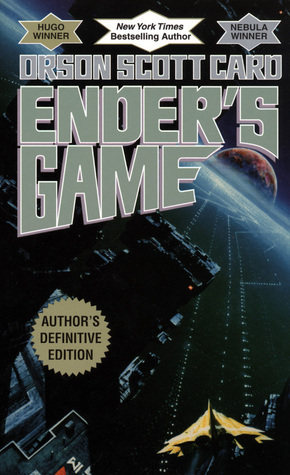
What happens when humanity places its survival in the hands of a child who understands his enemies better than anyone else? In Ender’s Game, Orson Scott Card follows Andrew “Ender” Wiggin, a brilliant young boy recruited into an elite military training programme designed to prepare humanity for another war against an alien civilisation. Ender appears to possess exactly the qualities the military needs: extraordinary intelligence, strategic imagination, emotional sensitivity, and the willingness to make difficult decisions. Yet the training intended to develop these abilities gradually destroys his childhood, isolates him from everyone he loves, and turns his greatest strength into a source of devastating moral conflict.
First published as a novel in 1985, Ender’s Game combines military science fiction with psychological drama, political intrigue, and questions about violence, responsibility, and the limits of empathy. Its famous Battle School sequences are exciting accounts of tactical innovation, but the story is equally concerned with the adults who manipulate Ender, the relationships that keep him emotionally alive, and the difference between winning a conflict and understanding its consequences. The novel won both the Nebula Award for Best Novel and the 1986 Hugo Award for Best Novel, establishing it as one of the most influential works of modern military science fiction.
Spoiler warning: This article contains a complete summary of Ender’s Game, including its major revelations, the outcome of the war, and the ending. It also examines the novel’s characters, fictional world, themes, symbolism, narrative construction, and literary strengths and limitations.
The Third Child: Ender’s Family, the Monitor, and Graff’s Recruitment
Andrew Wiggin is six years old when the military authorities decide to remove the monitoring device implanted in the back of his neck. For years, the monitor has allowed officials to observe his behaviour and evaluate his suitability for a programme intended to produce humanity’s next great military commander. Ender interprets its removal as rejection. He has spent his childhood knowing that his existence is part of an experiment, and he now believes that the experiment has failed.
Ender occupies an unusual position in his family and society. He is a Third, the third child of parents living under strict population controls. Most families are allowed only two children, but the government specifically authorised his conception because his older siblings demonstrated exceptional intelligence without possessing the psychological combination the military wanted. His brother Peter was considered too cruel, while his sister Valentine was judged too compassionate. Ender appears to combine their abilities, making him potentially more valuable than either.
The removal of his monitor immediately changes his position at school. Other children have resented him because he received special attention from the military, but they were reluctant to attack him while the authorities could observe everything he experienced. With that protection apparently gone, a bully named Stilson confronts him.
Ender understands that defeating Stilson in an ordinary fight will not solve the problem. A temporary victory would merely encourage Stilson to return with more friends or seek revenge later. He therefore attacks with unexpected ferocity, knocking Stilson down and continuing to strike him after the immediate danger has passed. His intention is to make the cost of attacking him so frightening that neither Stilson nor the other children will try again.
The strategy works in the short term, but Ender is horrified by his own behaviour. He has deliberately inflicted more violence than was necessary to escape the confrontation, and he recognises an uncomfortable resemblance between himself and Peter. Ender wants to be safe without becoming cruel, yet he increasingly discovers that the methods he considers necessary for self-preservation resemble the methods he despises.
At home, Peter makes that resemblance particularly frightening. Peter is extraordinarily intelligent, ambitious, and skilled at exploiting other people’s vulnerabilities. He resents Ender for apparently succeeding in the military selection process after his own rejection. During a game involving astronauts and alien enemies, Peter threatens to kill Ender, using the pretence of play to exercise real psychological power over his younger brother.
Valentine intervenes to protect Ender. Unlike Peter, she understands his sensitivity and recognises that his intelligence does not make him emotionally invulnerable. She provides the affection and reassurance largely missing from his relationship with his parents and brother. Peter’s behaviour is complicated by moments in which he expresses affection, but these gestures do not erase the genuine fear he creates.
The family establishes three contrasting expressions of exceptional intelligence. Peter understands people well enough to dominate them, Valentine understands them well enough to comfort and persuade them, and Ender possesses elements of both capacities. His central psychological struggle is already visible: he fears Peter’s cruelty, depends on Valentine’s love, and cannot escape the possibility that his own survival will require Peter’s methods.
Colonel Hyrum Graff soon arrives at the Wiggin household. He reveals that removing Ender’s monitor was not a declaration of failure but another experiment. The authorities wanted to see how Ender would behave when he believed they were no longer observing or protecting him.
Graff questions Ender about his confrontation with Stilson. Rather than treating the violence as proof of an uncontrollable temper, he focuses on Ender’s reasoning. Ender had recognised that ending one fight was insufficient; he wanted to prevent the entire series of future confrontations. For Graff, this willingness to think beyond the immediate encounter is evidence of exceptional military potential.
Graff offers Ender admission to Battle School, an orbital institution where gifted children are trained to command humanity’s military forces. He explains that Earth has already survived two conflicts with an alien species known to humans as the buggers, or Formics. Humanity believes another confrontation may be inevitable, and its survival depends on developing commanders capable of defeating an enemy whose intelligence and technology have previously threatened the species.
Ender does not accept because he desires glory. He is reluctant to abandon his home and especially Valentine, whose affection provides his strongest emotional security. Graff instead persuades him that leaving may be necessary to protect the people he loves. Ender agrees, beginning a pattern in which authority figures secure his cooperation by connecting personal sacrifice with the survival of others.
His departure marks the end of ordinary childhood. He enters an institution that considers his emotions, friendships, fears, and moral convictions important chiefly because they can be used to create an effective commander.
Battle School: Isolation, Friendships, and the Games That Shape Ender
Ender travels to Battle School with a group of other young recruits. Even before they arrive, Graff begins manipulating the social environment to isolate him. He publicly praises Ender’s intelligence and suggests that Ender is superior to the other children, knowing that such treatment will provoke jealousy.
The strategy succeeds. Ender becomes an immediate target for resentment, particularly from Bernard, another recruit whose hostility increases after Ender injures him during a confrontation on the journey. Ender is being encouraged to develop independence not by receiving support but by being placed in circumstances where support becomes difficult to obtain.
The journey also introduces an important feature of the novel’s imagined military environment: movement in the absence of ordinary gravity. Ender quickly recognises that assumptions about up, down, orientation, and physical positioning are less reliable in space. His ability to abandon familiar frames of reference eventually becomes one of his greatest tactical advantages.
At Battle School, students live under a highly competitive system of ranks, armies, scores, and supervised combat exercises. Although they are children, their daily lives are organised around military advancement. Success brings prestige, while weakness invites ridicule or exclusion. Adults maintain the institution but often allow students to resolve conflicts without intervention.
Bernard attempts to establish a hierarchy within the new group by mocking weaker children and rewarding those who support him. Shen becomes one of his targets, and Ender recognises that Bernard’s power depends on controlling the group’s social atmosphere.
Instead of fighting Bernard directly, Ender uses the school communication system to circulate messages that undermine his authority. His intervention turns Bernard into an object of ridicule and weakens the informal hierarchy he has built. Ender demonstrates that he can attack a social structure by understanding what makes it function.
Shen becomes an ally, and Ender gradually develops a friendship with Alai, another exceptionally capable student. These relationships matter because they provide evidence that Ender’s intelligence can attract cooperation rather than merely produce hostility. Although the institution wants him to become self-reliant, his most productive development often occurs through friendship.
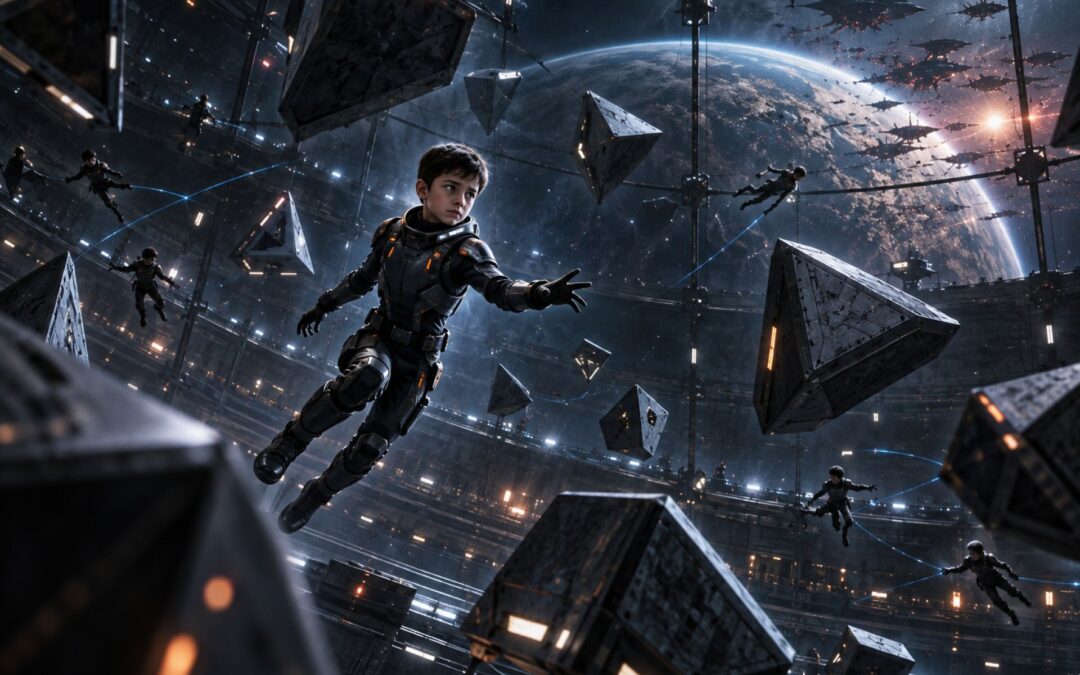
The Battle Room becomes the centre of Ender’s education. It is a large, enclosed environment in which gravity is absent and students fight simulated battles using specialised suits and handheld weapons. When a weapon strikes part of a suit, that section becomes rigid, limiting the wearer’s movement. Students can therefore be partially or completely immobilised without suffering the injuries associated with ordinary combat.
The room contains obstacles known as stars, which provide cover and can be used to redirect movement. Teams attempt to defeat opponents while manoeuvring toward a designated enemy gate. Students accustomed to ordinary gravity initially struggle because they approach the room as though it possesses a fixed floor and ceiling.
Ender begins questioning those assumptions. He learns to treat the enemy’s gate as a meaningful directional reference, changing the way he thinks about attacking, defending, and protecting his body. By altering his orientation, he can reduce his exposure to enemy fire and move in ways opponents may not anticipate.
This willingness to reconsider the rules distinguishes him from students who become highly skilled at conventional techniques. Ender is not merely learning to execute established tactics more effectively. He is beginning to recognise that the conceptual framework through which players understand a game may itself be the main obstacle to victory.
Outside the Battle Room, Ender spends considerable time with a computerised fantasy game known as the Mind Game. Unlike the structured combat exercises, it presents symbolic environments, strange characters, and apparently personal challenges. One of the most important encounters involves a Giant who offers Ender a choice between two drinks.
The Giant’s Drink appears to be a challenge Ender should solve through reasoning. He tries different approaches, but each choice leads to failure. The game offers the appearance of free choice while denying him a conventional path to success.
Ender becomes increasingly frustrated. Eventually, rather than choosing either drink, he attacks the Giant directly, killing him within the game and discovering that the story continues beyond the supposedly impossible obstacle.
The episode resembles his confrontation with Stilson. Ender faces a situation in which the available choices seem to guarantee defeat, so he escapes by attacking the structure of the problem itself. The solution is strategically inventive, but he feels disturbed by the violence it requires.
The Mind Game continues beyond the Giant, presenting increasingly unsettling environments. Ender becomes emotionally involved in the imaginary world despite recognising that it is artificial. The military authorities, who monitor the game’s responses, are fascinated because Ender is producing outcomes that do not fit their expectations.
The contrast between the Battle Room and the Mind Game establishes two forms of training. One teaches Ender to control external conflicts through tactics and cooperation, while the other confronts him with fears and impulses that he cannot fully understand. Both are presented as games, but neither is psychologically harmless.
Salamander and Rat: Ender Learns to Fight the System
Ender’s unusual abilities lead to his promotion into Salamander Army earlier than the ordinary training schedule would permit. This advancement appears to reward his success, but it also removes him from the friendships he has only recently established.
Salamander Army is commanded by Bonzo Madrid, an older student whose sense of authority depends on rigid discipline and personal prestige. Bonzo does not welcome Ender. He believes that being assigned a younger, inexperienced soldier threatens the army’s performance and undermines his control.
Bonzo orders Ender not to participate meaningfully in battles. He expects him to remain out of the fighting rather than risk damaging Salamander’s competitive standing. For Ender, the restriction creates a familiar problem: an authority figure demands obedience even when obedience prevents him from learning or contributing.
Petra Arkanian offers a different model of military competence. As one of the few girls in Battle School and the only girl in Salamander Army, she occupies a distinctive position among the students. She befriends Ender and teaches him shooting techniques, helping him refine his accuracy and understanding of combat in zero gravity.
Petra’s willingness to train him contrasts with Bonzo’s determination to keep him inactive. Ender discovers that useful knowledge often comes from peers who are willing to share their skills rather than commanders who rely on status.
He continues experimenting independently, developing a more effective relationship between movement, body position, and weapon use. In particular, he learns to exploit the fact that limbs immobilised by enemy fire can sometimes provide protection or tactical advantages. His understanding of the Battle Room becomes increasingly inventive because he treats its constraints as potential resources.
During a battle in which Bonzo has ordered him to remain passive, Ender eventually intervenes to prevent a worse outcome. His actions demonstrate competence, but they also expose the weakness of Bonzo’s command decisions. Bonzo resents the implication that a younger soldier can see possibilities he has overlooked.
The conflict grows beyond tactical disagreement. Bonzo interprets Ender’s independence as an attack on his dignity, while Ender finds it difficult to respect orders that serve a commander’s pride rather than the army’s objectives.
Bonzo’s hostility eventually becomes physical. Ender recognises that he must learn to defend himself outside the relatively controlled environment of the Battle Room, where immobilising an opponent does not ordinarily require inflicting lasting injury.
Ender is subsequently transferred to Rat Army, commanded by Rose de Nose. Rat Army possesses its own competitive culture, and Rose enjoys asserting his authority, but the arrangement gives Ender opportunities unavailable under Bonzo.
The most important new relationship is with Dink Meeker, an experienced toon leader who recognises Ender’s ability and helps him develop it. Dink possesses considerable strategic intelligence but distrusts Battle School’s hierarchy and the ambitions it creates.
Dink questions the institution’s entire educational purpose. He recognises that adults continually encourage children to compete, seek promotion, and become commanders without fully explaining the system they are serving. His scepticism gives Ender an alternative perspective on success.
For Ender, winning games initially seems to represent progress toward becoming capable enough to protect humanity. Dink suggests that winning may also mean becoming more deeply trapped within an institution whose purposes the students do not understand.
Ender nevertheless continues improving. He studies enemy formations, exploits the vulnerability of troops entering the Battle Room, and considers how the geometry of the environment can defeat opponents who rely on predictable formations.
He increasingly values flexibility over obedience. A good soldier, in his emerging philosophy, must understand the commander’s larger objective but remain capable of making independent decisions when circumstances change.
This distinction prepares Ender for eventual command. He is learning that an army cannot reach its full potential if every soldier waits for instructions, particularly in an environment where events unfold faster than a single leader can control.
The psychological cost becomes more apparent as the Mind Game grows increasingly disturbing. Ender encounters images associated with Peter, including a reflection that forces him to confront his fear of becoming like his brother.
The fantasy environment no longer seems merely an exercise in problem-solving. It begins drawing on Ender’s private memories and emotional vulnerabilities, suggesting that the boundary between the game and his identity has become dangerously unstable.
His development through Salamander and Rat therefore produces two conflicting outcomes. Ender becomes more capable of questioning authority, understanding complex environments, and guiding others, but he also becomes increasingly isolated from an ordinary sense of childhood security.
Locke and Demosthenes: Peter and Valentine’s Political Game
While Ender advances through Battle School, the novel follows an independent struggle for power on Earth. Humanity’s apparent unity against the Formics conceals political rivalries that may become dangerous once the alien threat no longer provides a common purpose.
Peter understands this possibility earlier than most people around him. Although excluded from the military programme, he remains extraordinarily intelligent and ambitious. He is convinced that global politics can be manipulated by people who understand public opinion, strategic interests, and the weaknesses of existing leaders.
Peter proposes that he and Valentine establish influential anonymous identities through the world’s computer communication networks. Their ages would prevent adults from treating them as serious political commentators, but anonymity allows their arguments to compete on intellectual and rhetorical terms.
They create two contrasting public personalities. Peter writes as Locke, presenting a relatively moderate and strategically restrained position, while Valentine writes as Demosthenes, adopting a more confrontational and inflammatory political voice.
The arrangement reverses their personal temperaments. Peter, whose private behaviour is often cruel and domineering, presents himself publicly as reasonable and measured. Valentine, naturally compassionate and more reluctant to use people, adopts a voice that encourages suspicion and confrontation.
Their political influence develops gradually through participation in public discussions. They respond to events, demonstrate knowledge of international affairs, and build reputations that make readers take their arguments seriously. Their apparent authority rests on their ability to influence people through words rather than reveal their true identities.
Peter hopes to direct humanity’s political future. He anticipates that international rivalries, particularly those involving powerful military blocs, will become more dangerous after the immediate Formic threat disappears. By positioning Locke as a credible voice in these debates, he hopes to gain influence that will eventually translate into direct political power.
Valentine initially participates partly because Peter persuades her that his ambitions can serve useful purposes. She also believes she may be able to restrain him. However, writing repeatedly as Demosthenes begins changing how she thinks, making the distinction between her authentic beliefs and the personality she performs increasingly difficult to maintain.
This development parallels Ender’s experience at Battle School. Both are being shaped by roles they did not entirely choose. Ender performs the part of a commander until strategic thinking becomes central to his identity, while Valentine performs a political character whose attitudes gradually influence her own.
Peter’s project also reveals that military intelligence is not the only form of power the novel considers. Ender’s exceptional ability operates through movement, prediction, and command. Peter and Valentine use language, political psychology, and information to influence large populations without possessing official authority.
The Earth subplot has direct consequences for Ender. The authorities recognise that his attachment to Valentine remains unusually important, and they use this relationship when his psychological development becomes difficult to manage.
Valentine is persuaded to communicate with Ender, but the resulting message fails to provide the reassurance the adults expect. Ender recognises that even contact with the person he loves most may have been arranged to influence his behaviour.
Meanwhile, the Mind Game continues incorporating elements of his family life. The appearance of Peter within its fantasy landscape suggests that the military can observe Ender’s psychological responses without fully understanding what they mean.
The political subplot also prepares the novel’s ending. Humanity may defeat the Formics, but a military victory will not remove the human desire for domination. Peter is preparing to shape a world in which the common external enemy no longer restrains international conflict.
Dragon Army: Ender Becomes the Commander He Was Trained to Be
Ender’s final and most important stage at Battle School begins when the authorities give him command of Dragon Army. The unit has a reputation for failure, and its name is associated with an organisation that previously performed so poorly it was removed from ordinary competition.
The army Ender receives is composed largely of inexperienced students. Unlike commanders who inherit established units containing veterans, he must develop an effective force from recruits who have not been trained into familiar habits.
Ender initially recognises the assignment as another attempt to make his position unnecessarily difficult. He is being asked to succeed with limited preparation, weak institutional support, and soldiers who may lack confidence in their abilities.
Yet these disadvantages offer an opportunity. Because Dragon Army has relatively few established traditions, Ender can organise it according to principles he has developed through observing the successes and failures of other commanders.
He divides the army into five toons and begins establishing a system in which the smaller groups can function independently. Instead of concentrating every tactical decision in his own hands, he trains subordinate leaders to adapt to changing circumstances while pursuing the same overall objective.
The system depends on trust as well as intelligence. Ender needs soldiers who understand what he wants to accomplish, but he also wants them to question methods that no longer work. He encourages experimentation, unconventional movement, and the willingness to exploit opportunities that commanders cannot anticipate.
This approach contrasts sharply with Bonzo’s leadership. Bonzo tried to preserve control by restricting initiative, whereas Ender discovers that distributing initiative can increase the entire army’s effectiveness.
One of the most important new recruits is Bean, a younger child whose intelligence and confidence immediately attract Ender’s attention. Bean challenges assumptions and asks questions that other soldiers might avoid, making him simultaneously valuable and difficult to manage.
Ender responds by treating Bean harshly. He publicly singles him out, creates pressure, and initially denies him the reassurance that might make integration easier.
The behaviour reflects Ender’s growing resemblance to Graff. Ender understands why adults isolate talented children to develop independence, but he also knows from experience how painful that isolation can become.
His treatment of Bean creates a moral problem. Ender wants to build the best possible army and recognises that Bean may become an exceptional leader, yet he is using precisely the kind of psychological manipulation that has made his own life miserable.
Over time, Ender gives Bean increasingly meaningful responsibilities. Bean proves capable of understanding both detailed tactics and the broader strategic environment, becoming an important contributor to Dragon Army’s success.
Ender’s training methods encourage soldiers to think of the Battle Room in unconventional ways. He experiments with orientation, formations, the use of partially disabled suits, unexpected movement, and the tactical opportunities created by stars and enemy positioning.
He teaches the toons to operate without becoming dependent on a single commander. This becomes especially important when battles unfold across a large three-dimensional environment in which Ender cannot personally supervise every soldier’s immediate choices.
The army’s rapid improvement is the result of an identifiable training philosophy rather than unexplained genius. Ender combines independent practice, shared tactical principles, delegated responsibility, and a willingness to change methods when evidence shows they are ineffective.
Dragon Army begins winning battles at an extraordinary rate. Its soldiers become increasingly confident because their success depends on competence rather than simply following orders.
The adults respond by making the competition more difficult. Dragon Army receives a relentless schedule, faces new tactical disadvantages, and is denied the recovery time ordinarily necessary between engagements.
What begins as an impressive demonstration of leadership increasingly resembles punishment. Ender can overcome the conditions, but every victory encourages the authorities to increase the pressure.
He also studies recordings of earlier battles against the Formics, attempting to identify strategic principles that can be applied beyond the Battle Room. His education is moving from simulated combat toward the actual problems of interstellar warfare.
The archived encounters reveal that the alien forces behave differently from ordinary human military organisations. Their extraordinary coordination suggests a command structure or communications system unlike anything Ender has experienced in competition.
Meanwhile, the students of Dragon Army are also paying a price. They are exhausted by the demanding schedule, and their devotion to Ender creates responsibilities he increasingly struggles to manage.
He must encourage them to withstand circumstances that he believes are unfair while recognising that his own expectations have become part of the pressure they face.
His leadership is effective because he understands individuals, distributes responsibility, and develops talent. Yet it is also troubling because he has begun sacrificing emotional well-being for competitive success.
By the end of this period, Dragon Army has become an outstanding military organisation. Ender has demonstrated that he can turn inexperienced children into a coordinated force capable of defeating established opponents, but the achievement leaves him physically exhausted and emotionally isolated.
Bonzo, the Final Battle Room Victory, and Ender’s Breaking Point
Dragon Army’s victories intensify the resentment directed toward Ender. His success threatens the status of older commanders, and Bonzo remains especially unwilling to accept the humiliation associated with their earlier confrontations.
The adults recognise that Bonzo poses a serious danger. Their discussions make clear that they understand the possibility of violence but continue prioritising Ender’s training and development over ordinary protection.
This decision exposes the contradiction within the institution’s treatment of its most valuable student. The military considers Ender essential to humanity’s survival, yet it repeatedly allows him to face physical danger because surviving such experiences may supposedly improve his strategic abilities.
The confrontation comes when Bonzo and several other boys corner Ender in the shower. Ender is naked, unarmed, and vulnerable, while Bonzo is physically stronger and supported by companions.
Ender attempts to manage the encounter psychologically, but Bonzo is determined to restore his dignity through violence. Ender recognises that he cannot rely on ordinary negotiation or expect the adults to intervene in time.
He responds with a calculated and devastating attack, exploiting Bonzo’s aggression and the physical circumstances of the confrontation. As with Stilson, Ender aims to end the danger permanently rather than secure a temporary escape.
The immediate result is that Ender survives and Bonzo is left seriously injured. Ender does not know that the injuries will prove fatal. The military’s decision to conceal the consequences becomes another example of how the institution controls his understanding of his own actions.
The incident reinforces Ender’s deepest fear. His ability to identify an opponent’s weakness and act decisively protects him, but it also makes him capable of violence that exceeds his intentions.
Soon afterwards, Dragon Army faces an unusually unfair Battle Room engagement involving overwhelming opposition. The teachers manipulate the conditions to create a situation that appears almost impossible to win through conventional tactics.
Ender recognises that attempting to defeat every enemy soldier is unnecessary if he can satisfy the formal conditions for victory. Instead, he coordinates a concentrated effort to reach the enemy gate.
By exploiting the rules that define the contest, Dragon Army secures victory despite being placed at an extraordinary disadvantage. Ender has once again escaped an apparently impossible situation by changing what counts as solving the problem.
The manoeuvre echoes his destruction of the Giant in the Mind Game. In both cases, he faces a challenge designed to defeat ordinary reasoning and responds by attacking the assumptions on which the challenge depends.
For the teachers, the victory demonstrates his exceptional adaptability. For Ender, it confirms that the institution will continue changing the conditions until winning becomes unbearable.
He understands that further success will not produce freedom. Each victory merely gives the adults another reason to demand more from him.
Ender openly rejects the system and reaches a psychological breaking point. He no longer wants to participate in games whose rules are controlled by adults who refuse to explain their ultimate intentions.
His refusal matters because it is one of the few moments in the novel when he attempts to exercise control over his own future. Until then, his independence has largely consisted of making tactical choices within situations designed by others.
Valentine’s Intervention and Ender’s Return to the War
Following his collapse at Battle School, Ender returns to Earth and refuses to continue training. The military’s long effort to build the perfect commander has produced someone who no longer wants to command.
He withdraws from the competitive environment that has defined his life and finds relative peace near a lake. The natural setting contrasts with the enclosed, artificial spaces of Battle School and gives him temporary distance from constant evaluation.
Graff and the other authorities recognise that ordinary appeals to duty will not be enough to recover Ender’s cooperation. They therefore turn to Valentine, the person whose affection has always mattered most to him.
Valentine is brought to meet her brother. Their reunion is emotionally complicated because the years of separation have changed them both. She remembers the child she loved, but Ender has endured experiences that she cannot fully understand.
Ender explains his exhaustion and reluctance to return. He has become exceptionally good at doing what others demand, but he no longer sees a clear purpose in continuing.
Valentine reminds him of the Formic threat and the possibility that humanity may not survive without the military preparations being made. Her argument reaches him because it connects the war to the protection of people rather than the satisfaction of his teachers.
Yet Ender recognises that Valentine’s visit has been arranged. He understands that the adults are using his love for her as an instrument of persuasion, transforming the one relationship he most trusts into another mechanism of control.
This recognition does not make her feelings false. Valentine genuinely loves Ender and wants him to survive, but she has become involved in an institutional strategy whose full consequences she cannot foresee.
Ender ultimately agrees to resume training. He does so with greater awareness of his manipulation but without escaping the moral burden that has made resistance difficult.
He understands that refusing may protect his own emotional well-being while leaving humanity vulnerable to the danger he has been trained to prevent. The adults have successfully placed him in a situation where his compassion can be used against his desire for freedom.
Graff takes him away from Earth toward Command School. During the journey, he provides more information about the Formics, the earlier invasions, and the difficulty of understanding an alien civilisation whose behaviour differs radically from humanity’s.
The conversations introduce the possibility that the conflict is not simply a conventional struggle between two hostile nations. Humans and Formics may misunderstand one another because their societies, communication systems, and assumptions about intelligent life are fundamentally different.
Nevertheless, humanity’s military strategy proceeds from the belief that another opportunity for peaceful coexistence may not exist. Ender is being prepared to confront an enemy whose true intentions remain uncertain.
The transfer marks the end of his conventional military education. At Command School, his training will become less concerned with personal combat and more focused on directing fleets across enormous distances.
Mazer Rackham, Command School, and the War Hidden Inside a Game
Ender arrives at Command School on Eros, an asteroid formerly associated with the Formics and transformed into a human military installation. Its unusual architecture and history make the alien presence more tangible than it was at Battle School.
He is introduced to an older man who initially behaves with hostility and physical aggression. The encounter becomes another test of Ender’s responses under pressure.
The man eventually reveals himself as Mazer Rackham, the legendary commander who defeated the Formics during the Second Invasion. Mazer’s survival into Ender’s generation is explained through relativistic travel, which allowed him to experience less elapsed time than those who remained on Earth.
Mazer is not merely another instructor. He possesses practical knowledge of fighting the Formics that cannot be obtained from conventional Battle School exercises.
He explains that Formic society is organised around queens whose relationship with individual workers differs fundamentally from the relationship between human commanders and soldiers. The workers act with a degree of coordination that initially appears almost impossible to explain through ordinary military communication.
This collective organisation offers both strengths and vulnerabilities. During the earlier war, Mazer recognised that destroying a critical central element of the alien force could disable a much larger military structure.
The discovery helped humanity survive the Second Invasion. It also encourages the belief that defeating the Formics requires understanding their collective organisation rather than merely matching individual ships against one another.
Ender begins training with increasingly sophisticated command simulations. He no longer personally moves through a battlefield. Instead, he directs formations of spacecraft and must interpret the changing tactical situation through information presented by the simulation.
The scale creates new difficulties. A decision that might involve a handful of soldiers in the Battle Room now concerns entire groups of ships, coordinated manoeuvres, and consequences across vast distances.
Ender’s earlier education proves valuable because he has learned to think beyond familiar physical orientations, identify an opponent’s weaknesses, and delegate responsibility. His understanding of warfare is increasingly based on systems rather than individual encounters.
He is eventually joined by former Battle School companions who become his subordinate commanders. These include trusted soldiers whose abilities he already understands, allowing him to distribute complex responsibilities rather than personally direct every movement.
The arrangement resembles Dragon Army on a much larger scale. Ender establishes a strategic purpose, assigns specific responsibilities, and relies on talented individuals to respond to local conditions.
Petra’s skill and reliability, Bean’s analytical intelligence, and the abilities of the other commanders help Ender coordinate a force that would overwhelm any individual attempting to control every detail.
The simulations become increasingly difficult. Ender faces unfamiliar formations, severe disadvantages, limited resources, and tactical situations designed to frustrate established methods.
Mazer also imposes psychological pressure. Ender is forced to endure exhausting schedules and has little opportunity to recover from failure or reconsider the purpose of his training.
Ender increasingly experiences the exercises as an endless series of demands. Victory does not provide closure because another, more difficult engagement always follows.
One of the most important technologies introduced during this stage is the Molecular Disruption Device, nicknamed the Little Doctor. Rather than functioning like an ordinary explosive, the weapon triggers a destructive reaction that can spread through nearby matter under suitable conditions.
Its properties make it extraordinarily dangerous when used against closely grouped enemy forces. It also creates possibilities for destruction far beyond those of conventional ship-mounted weapons.
Ender learns to incorporate the Little Doctor into his strategic thinking. The weapon offers opportunities to defeat apparently overwhelming concentrations of enemy forces, but successful use requires bringing it within effective range of an appropriate target.
His simulations continue escalating until he confronts what appears to be the final examination. The scenario involves a heavily defended Formic planet surrounded by an enormous military force.
Ender’s fleet is significantly disadvantaged. Conventional tactics offer little hope of defeating the defenders while preserving enough ships to continue the engagement.
By this point, Ender is exhausted and increasingly unwilling to continue participating in the adults’ programme. He decides that he will act in a way that should be unacceptable within an ordinary training exercise.
Instead of attempting to destroy the entire enemy fleet, he directs his forces toward the planet itself. The surrounding enemy forces become obstacles to reaching the true objective rather than the primary targets of his attack.
Ender accepts enormous losses among his simulated ships to create the opportunity. His strategy focuses on bringing the Little Doctor into position to attack the planet.
When the weapon is fired, the resulting reaction destroys the world and devastates the surrounding Formic forces. Within the supposed simulation, Ender has achieved a total and horrifying victory.
He believes he has finally performed an action so extreme that the adults can no longer pretend their games are ordinary tests of military competence. From his perspective, destroying an inhabited planet demonstrates the absurdity of the system.
The reaction of those around him is not what he expects. The adults celebrate, and Ender discovers that the exercises were never simply simulations.
He has been commanding real human fleets throughout the final phase of training. His orders were transmitted through the ansible, a communication technology allowing commands to reach spacecraft across interstellar distances without the ordinary delays associated with light-speed communication.
The images he interpreted as simulated battles represented actual engagements. His decisions caused real ships to move, real soldiers to die, and real Formic forces to be destroyed.
The final attack was not an imaginary act of defiance against the teachers. It destroyed the Formic homeworld and eliminated the surviving alien military power on an enormous scale.
Ender learns that humanity’s supposed preparation for a Third Invasion had concealed a human offensive. The military did not merely train him to defend Earth if the Formics returned; it used him to conduct a war intended to prevent the species from threatening humanity again.
The deception was deliberate. Graff, Mazer, and the military authorities believed Ender’s conscience would prevent him from making the necessary decisions if he understood that actual lives depended on his actions.
They therefore constructed an environment in which he could command with extraordinary strategic freedom while remaining ignorant of the reality of the conflict.
The revelation devastates Ender. He has been taught to understand his enemies as completely as possible, yet the institution has used that understanding to make him responsible for destruction he never knowingly agreed to commit.
His victory has preserved humanity from a perceived existential danger, but it has also destroyed almost the entirety of another intelligent civilisation.
Ender suffers a profound psychological collapse. The adults can celebrate the military outcome, but they cannot provide him with an explanation that removes the consequences of his actions.
The final campaign transforms the meaning of everything that preceded it. Battle School was not merely identifying a brilliant child. It was preparing someone capable of making decisive strategic choices while being denied essential information about the world in which those choices would operate.
After the Victory: Colonies, the Hive Queen, and the Speaker for the Dead
The destruction of the Formics ends the immediate external threat, but it does not bring lasting political harmony to humanity.
Without a common enemy, rival powers begin reconsidering their positions. The military forces and technologies developed for interstellar war become relevant to conflicts among human governments.
Peter’s earlier calculations prove perceptive. The political conditions created by victory provide opportunities for individuals who understand international ambition and public opinion.
His influence through Locke continues developing, and he eventually moves toward the position of Hegemon, a figure capable of exercising significant authority over Earth’s political future.
The consequences of Ender’s earlier actions also become subjects of public concern. Graff faces scrutiny over the deaths of Stilson and Bonzo, revealing that the military’s decisions during Ender’s training cannot be separated entirely from ordinary standards of responsibility.
Ender has become both a celebrated figure and a political problem. His role in humanity’s victory gives him extraordinary symbolic importance, but competing authorities may attempt to use that importance for their own purposes.
Valentine recognises the danger. She understands that returning Ender to Earth could place him under Peter’s influence or make him an instrument of further political conflict.
Rather than allowing him to become another prize in humanity’s struggle for power, she arranges for him to join the colonisation of formerly Formic worlds.
Ender leaves Earth with Valentine and becomes involved in establishing a human settlement. The move gives him an opportunity to create a life outside the military institution that controlled his childhood.
The colony also brings him into direct contact with remnants of Formic civilisation. Abandoned settlements, structures, and landscapes reveal that the destroyed species possessed a complex culture and history that humanity barely understood.
This knowledge changes the moral context of the war. The Formics were not simply an anonymous collection of enemy ships. They were intelligent beings with their own social organisation, physical environment, and relationship to the world.
Ender explores the alien landscape and eventually encounters an extraordinary discovery. He finds an arrangement resembling the fantasy environment he explored during the Mind Game, including features associated with the Giant and the strange world that followed his apparent victory.
The resemblance is too precise to be accidental. Ender realises that the Formics had somehow used the imagery of his computer game to establish a form of communication with him.
What had seemed a private psychological landscape now becomes a bridge between species. The Formics could not easily communicate with humans through ordinary means, but they discovered a way to interact with Ender’s imagination and memory.
The recreated landscape leads him to the cocoon of a surviving Formic queen. Through contact with her, Ender begins understanding the species’ history and the tragic misunderstanding underlying the war.
The Formics had initially approached humanity without recognising humans as independent intelligent individuals in the same way that humans recognise themselves. Their assumptions about consciousness were shaped by their own queen-centred social organisation.
The early conflict arose partly because the two species failed to understand how the other experienced intelligence, personhood, and death.
Once the Formics understood that humans possessed individual consciousness, they recognised the terrible consequences of their earlier actions. The surviving queen communicates that the species did not intend to continue the conflict after gaining that understanding.
Humanity’s subsequent destruction of the Formics was therefore not simply the inevitable defeat of an enemy preparing another invasion. It was the final outcome of a war prolonged by fear, incomplete knowledge, and the inability of the two civilisations to communicate before irreversible decisions were made.
Ender recognises the queen’s cocoon as a possibility of survival for the species he has almost destroyed. He promises to protect it and search for a suitable world where a new hive can be established.
The promise does not restore the countless lives lost during the war, but it gives Ender a concrete responsibility through which he can respond to the consequences of his actions.
He also writes an account of the Formics from their own perspective. Published anonymously as The Hive Queen, the work seeks to represent the destroyed species truthfully rather than preserve the image of an incomprehensible enemy.
Later, Ender receives information about Peter’s life and writes another account, The Hegemon. In treating his brother as a complicated human being rather than merely a monster, Ender extends the same principle of understanding to the person he feared throughout childhood.
The writings contribute to the practice of speaking for the dead: attempting to understand a deceased person’s life in its full complexity, including both its achievements and failures.
The role is distinct from conventional praise or condemnation. A Speaker seeks to communicate the truth about a life, allowing others to understand motives, actions, relationships, and consequences without erasing contradictions.
Ender adopts this purpose as part of his identity. The commander who destroyed an alien civilisation becomes someone devoted to representing lives that can no longer speak for themselves.
Valentine continues travelling with him and recording the history unfolding around them. Their companionship finally gives Ender a continuing connection to the affection that supported him before Battle School.
The novel ends with Ender carrying the surviving queen’s cocoon as he travels between worlds, searching for a place where the Formics can begin again.
He cannot undo the war or recover the childhood taken from him. His future is defined instead by the attempt to preserve what remains, communicate what was misunderstood, and prevent his greatest victory from becoming the final word about another civilisation.
The World of Ender’s Game: Earth, Battle School, and the Formics
The fictional world of Ender’s Game combines a relatively recognisable human society with military technologies and political institutions created by the experience of interstellar war. Although the narrative concentrates on a small group of exceptional children, the systems surrounding them determine the choices available to them.
Earth is neither a unified utopia nor a society in which national differences have disappeared. Governments cooperate against the Formic threat, but geopolitical rivalries remain important beneath the surface. The military alliance holding humanity together is therefore conditional rather than permanent.
Population restrictions illustrate the degree to which collective concerns shape private life. Ender’s identity as a Third is socially significant because his existence required exceptional permission. The state has already influenced his life before he can make any meaningful decision about participating in its institutions.
Battle School extends this power. The military identifies children with desirable characteristics, removes them from their families, and controls their environment during crucial developmental years.
The institution resembles a school only in the broad sense that it trains students. Its educational system is organised around competition, military rankings, psychological observation, and increasing responsibility under pressure.
Children are encouraged to behave like professional soldiers before they possess the emotional maturity ordinarily associated with adulthood. Their capacity to withstand stress becomes evidence of suitability, which can encourage instructors to increase suffering rather than question its value.
The Battle Room is the most convincing technological and imaginative achievement in the setting. Its rules are simple enough for readers to understand but flexible enough to support many different strategies. Zero gravity transforms movement into a problem involving orientation, momentum, geometry, and the ability to imagine space without a privileged direction.
Because the Battle Room functions according to consistent constraints, tactical ingenuity feels earned. Ender’s victories frequently arise from identifying possibilities already contained within the environment rather than discovering arbitrary new powers.
The Mind Game offers a less predictable form of technology. Its adaptive fantasy world responds to Ender’s psychological state in ways neither he nor his instructors entirely understand. This uncertainty is important because it creates a space where technological control appears to exceed the knowledge of those exercising it.
At Command School, the military technologies become more consequential. The ansible enables remote communication with fleets across enormous distances, while relativistic travel explains differences between the elapsed time experienced by certain characters and the time passing elsewhere.
The Little Doctor introduces a destructive capability whose consequences extend far beyond ordinary weapons. Together, these technologies make it possible for a commander to exercise enormous power without personally encountering the people or places affected by his decisions.
The Formics provide the novel’s most important example of genuinely alien social organisation. Human beings initially interpret their coordinated behaviour through familiar military categories, but their queen-centred society involves a different relationship between individuality, communication, and collective intelligence.
This difference is not merely a decorative feature of the setting. It explains both the military effectiveness of the Formics and the tragic difficulty of communication between the species.
Humanity interprets the early encounters through assumptions about hostility and individual intention. The Formics initially misunderstand human individuality, and the resulting violence creates fear that survives after the original misunderstanding could potentially have been resolved.
The setting is strongest when technological rules interact directly with the plot. The Battle Room, remote fleet control, and Formic organisation each generate specific kinds of decisions and consequences.
Its weaker elements arise when complex social and political systems seem unusually responsive to the actions of a few exceptional individuals. Peter’s rapid ascent through anonymous commentary and the military’s extraordinary concentration of responsibility in Ender require readers to accept a world in which rare intelligence can exert almost disproportionate influence.
Nevertheless, these features support the novel’s central examination of power. The institutions of Ender’s Game are designed to protect humanity, but their scale and urgency allow them to treat individuals as resources in pursuit of collective survival.
Ender Wiggin and the People Who Shape Him
The characters in Ender’s Game are connected by different kinds of intelligence and different attitudes toward power. Some understand people primarily as individuals deserving affection, while others perceive them as opponents, instruments, or resources. Ender’s development depends on navigating these competing perspectives without losing the ability to recognise other people as human beings.
The principal characters also reveal the novel’s moral contradictions. Its most successful leaders frequently rely on manipulation, and its most compassionate figures are not always free from the desire to control others. Their relationships become especially important because the central conflicts concern not only what people accomplish but how they persuade themselves that their actions are necessary.
Ender Wiggin: Empathy, Genius, Violence, and Conscience
Ender begins as a vulnerable child who wants security, affection, and freedom from intimidation. His intelligence gives him unusual advantages, but those advantages also attract hostility and cause adults to impose responsibilities he never sought.
His most important ability is strategic understanding. He can identify the assumptions guiding other people’s decisions, anticipate their likely responses, and adapt his own behaviour accordingly. This skill appears in his confrontation with Bernard, his Battle Room tactics, and his eventual coordination of interstellar fleets.
Unlike Peter, however, Ender is disturbed by the suffering he causes. He does not usually enjoy dominating an opponent, and his emotional sensitivity allows him to understand why enemies behave as they do.
This creates an unusual relationship between empathy and violence. Ender can defeat opponents decisively because he understands their motivations, fears, and habits. The same psychological insight that makes him compassionate also makes him dangerous.
His conflict with Peter illustrates the fear underlying his development. Ender worries that using cruelty for strategic purposes will eventually turn him into the brother he despises.
The military intensifies the problem by rewarding exactly those behaviours that trouble him. It recognises his ability to end conflicts through disproportionate force and repeatedly places him in circumstances where such actions appear rational.
Ender also possesses a strong desire for friendship. His relationships with Valentine, Alai, Petra, Dink, and Bean show that he is capable of loyalty and affection, even as his extraordinary abilities make ordinary social belonging increasingly difficult.
His growth as a commander is therefore not a simple movement from weakness to confidence. He gains authority and tactical mastery while becoming less certain that the person he is turning into deserves admiration.
The treatment of Bean demonstrates the conflict particularly clearly. Ender recognises Bean’s potential and wants to develop it, but he reproduces the methods through which Graff isolated and pressured him.
He becomes effective at guiding others while discovering how easily effective leadership can resemble coercion.
The final revelation breaks the relationship between Ender’s intentions and his accomplishments. He wanted to escape the military’s demands, but his attempted rejection of the system becomes the instrument of its greatest victory.
Ender’s response is genuine grief. He does not celebrate the destruction of the Formics simply because he did not know the battles were real.
His later commitment to preserving the surviving queen and recording the truth about the dead demonstrates that his conscience survives the training designed to make his decisions strategically uninhibited.
Yet the ending does not restore his childhood or remove the consequences of his actions. His development culminates in responsibility rather than ordinary personal fulfilment.
Peter and Valentine: Power, Compassion, and Contradiction
Peter and Valentine represent contrasting possibilities within Ender’s character, but they are also significant figures with ambitions and contradictions of their own.
Peter is intelligent, controlling, and deeply concerned with power. His threats against Ender reveal a willingness to exploit vulnerability for psychological dominance.
However, his political development complicates the image of a merely sadistic child. He possesses considerable discipline, strategic patience, and an ability to understand how reasonable public arguments can accumulate influence.
His identity as Locke demonstrates that he can use moderation even when his private temperament is aggressive. The contrast between performance and character creates uncertainty about how much of his political behaviour reflects genuine development and how much remains an instrument of ambition.
Peter’s eventual success also forces a difficult comparison with Ender. Both possess strategic intelligence, and both learn to influence large systems. The difference is partly one of motive and method, though neither remains entirely untouched by coercion.
Valentine’s compassion is more immediately visible. She protects Ender from Peter and provides the emotional connection he needs to maintain a sense of personal worth.
Yet Valentine is not simply incapable of manipulation. Her political partnership with Peter demonstrates her ability to adopt a deliberately inflammatory public identity, while her later intervention on behalf of the military reveals how genuine affection can become part of a coercive strategy.
Her role as Demosthenes changes her. Repeatedly arguing positions she initially treats as performances makes those positions increasingly psychologically meaningful.
Valentine therefore illustrates the instability of the distinction between authentic beliefs and strategic roles. She can remain fundamentally compassionate while participating in systems that influence or endanger others.
Her final decision to accompany Ender represents an important departure from those earlier forms of manipulation. She seeks to protect him from political exploitation and preserve a relationship based on affection rather than usefulness.
Graff and Mazer: The Adults Who Engineer Ender’s Success
Colonel Graff is among the novel’s most morally complicated characters. He recognises Ender’s extraordinary abilities and appears to understand the child’s emotional vulnerability, yet he deliberately creates situations that intensify his suffering.
Graff believes that humanity’s survival requires a commander capable of independent thought and decisive action. From this perspective, ordinary comfort and protection may prevent Ender from developing the qualities needed to defeat the Formics.
His methods include manipulating friendships, encouraging hostility, withholding information, and allowing dangerous conflicts to develop.
Graff’s justification is that the stakes are too high to permit ordinary moral constraints. He regards Ender’s well-being as important, but ultimately subordinate to the survival of the species.
The problem is that Graff’s apparent concern does not prevent him from treating Ender as an instrument. His affection, when visible, exists alongside decisions that deny the child meaningful control over his own life.
Mazer Rackham embodies a related but somewhat different kind of authority. As an experienced military commander, he provides knowledge of the Formics and the practical demands of interstellar warfare.
He understands that Ender must become capable of coordinating enormous military operations under conditions of uncertainty. His training is deliberately demanding because mistakes in actual war could have catastrophic consequences.
Mazer also participates in the deception that prevents Ender from recognising the reality of his command decisions. He believes this secrecy is necessary to preserve the child’s ability to act.
Graff and Mazer can therefore be interpreted as dedicated professionals confronting an existential danger, but dedication does not settle the ethical question of their methods.
The novel asks readers to recognise their fear and sense of responsibility while also observing the damage inflicted on the person they claim to protect.
Bean, Petra, Alai, Bonzo, and the Children of Battle School
Bean becomes one of Ender’s most important subordinates because his intelligence enables him to question assumptions that other soldiers accept. His confidence can appear insolent, but it is closely connected to his independence of thought.
Ender’s treatment of Bean reveals the difference between valuing another person’s abilities and respecting that person’s emotional needs. Their relationship develops as Ender recognises Bean’s tactical usefulness and grants him increasing responsibility.
Petra provides practical instruction and friendship when Ender is isolated within Salamander Army. She is competent, generous with her knowledge, and capable of contributing meaningfully to military success without depending entirely on formal status.
Her presence also exposes the relatively limited role given to girls in Battle School. Although Petra is an important and capable soldier, the institution remains overwhelmingly male in its leadership culture.
Alai represents the possibility of friendship across divisions of background and competition. His affection and loyalty matter because they show that Ender can experience connection without needing to defeat or dominate another child.
Dink offers a different kind of support. He recognises Ender’s abilities but questions the institution that rewards them, encouraging Ender to distinguish genuine competence from blind acceptance of military authority.
Bonzo represents the dangers of leadership organised around pride and status. His intelligence is limited by his inability to tolerate challenges to his authority, making him increasingly dangerous as Ender’s success exposes his weaknesses.
His death is especially important because Bonzo is both an aggressor and another child trapped within Battle School’s culture of competition. His actions threaten Ender, but the institution has also helped create the circumstances in which humiliation becomes intolerable.
Shen, Bernard, Rose de Nose, and Dragon Army’s toon leaders contribute to Ender’s social and tactical development in more focused ways. Shen shows how friendship can emerge through resistance to bullying, Bernard demonstrates how informal power can be undermined, Rose reveals another imperfect command style, and the toon leaders make Ender’s distributed leadership system possible.
Together, the children show that Battle School is not merely a place where Ender’s genius is displayed. It is a social environment in which affection, rivalry, fear, admiration, and authority continually shape the people being trained.
Family, Friendship, and Manufactured Isolation
Isolation is among the most persistent forces shaping Ender’s development. It begins within his family, where his exceptional status separates him from ordinary expectations, and continues through a military institution that deliberately weakens the relationships on which he depends.
Ender’s relationship with Peter teaches him that intelligence can become a tool of domination. Peter understands the emotional consequences of his threats and uses that understanding to exert power.
Valentine provides the opposite experience. She understands Ender’s feelings and uses that knowledge to protect him, giving him a model of intelligence associated with compassion rather than control.
These relationships are not merely background explanations for his personality. They become the emotional reference points through which Ender interprets his own actions.
When he injures Stilson and later Bonzo, he fears that he is behaving like Peter. When he seeks reassurance or emotional connection, he remembers Valentine.
Battle School systematically interferes with this foundation. Graff repeatedly removes Ender from social environments once he has begun developing friendships and confidence.
Ender initially makes allies among the launch group, only to be promoted into an army where he is isolated again. He eventually finds mentors and companions, but his advancement continually changes the conditions under which those relationships can continue.
The pattern forces independence, yet it also creates a dangerous confusion between independence and emotional deprivation. Ender becomes more capable of solving problems alone because he is repeatedly denied ordinary support.
His relationship with Alai demonstrates what the military risks destroying. Their friendship provides an experience of mutual recognition in an environment dominated by hierarchy and competition.
Petra and Dink offer forms of mentorship that are more humane than Graff’s methods. They teach Ender through shared knowledge and encouragement rather than calculated emotional suffering.
Bean eventually occupies a similar position in Ender’s life, though the relationship begins with Ender himself reproducing the institution’s isolating methods.
The manipulation becomes especially troubling when Graff uses Valentine to persuade Ender to return to training. Ender recognises the arrangement but remains emotionally affected because the affection between them is genuine.
This is one of the novel’s most effective portrayals of coercion. Manipulation does not require every statement or feeling involved to be false. It can operate by placing authentic relationships within circumstances where someone else controls their purpose.
Ender’s final relationship with Valentine offers a partial alternative. After the war, she accompanies him not simply to make him more useful to an institution but to help protect him from further exploitation.
The relationship between Ender and the surviving Formic queen develops that alternative further. Rather than seeking victory over an unfamiliar intelligence, Ender commits himself to understanding and preserving it.
His journey suggests that independence cannot be equated with isolation. Ender’s most meaningful freedom comes not from eliminating his need for others but from choosing relationships that are not organised around exploitation.
Childhood, Leadership, and the Ethics of Military Training
One of the novel’s central questions is whether extraordinary ability gives institutions the right to impose extraordinary burdens on a child. Ender is undeniably talented, and the military’s concerns about humanity’s survival are presented as serious. Nevertheless, his abilities do not make his need for emotional development, autonomy, or protection disappear.
Card developed the Battle Room concept from the problem of training soldiers to think in an environment without ordinary gravitational orientation. In his introduction to the revised novel, he also discusses the decision to portray children as capable of serious thought, ambition, fear, and moral reflection rather than treating them as simplified versions of adults.
This commitment gives Battle School much of its dramatic credibility. The students possess remarkable intelligence, but their arguments, friendships, humiliations, and desire for status remain deeply connected to childhood.
The problem is that the adults take advantage of precisely those vulnerabilities. They organise the students’ lives around competition and manipulate social conflict to accelerate development.
Graff’s approach assumes that a commander becomes capable of independent judgment by repeatedly experiencing situations where dependence is impossible. He therefore regards loneliness, fear, and pressure as educational tools.
The method produces measurable results. Ender becomes remarkably skilled at understanding tactical problems, organising teams, and adapting to apparently impossible circumstances.
Yet the story also demonstrates the costs. Ender becomes increasingly distrustful, exhausted, and frightened of his own capacity for violence. His success does not make him emotionally healthy or guarantee that he wants the responsibilities being imposed on him.
The difference between competence and consent is crucial. Ender can perform the tasks assigned to him, but he has little meaningful opportunity to decide whether he wishes to perform them.
The adults repeatedly present his choices as moral obligations. If Ender refuses, humanity may perish; if he cooperates, he must accept sacrifices that would ordinarily be considered intolerable.
This creates an ethical framework in which institutional necessity overwhelms individual autonomy. Ender is not simply persuaded to serve. He is placed in circumstances where rejecting service appears equivalent to abandoning everyone he loves.
The novel also complicates familiar ideas about good leadership. Bonzo exercises authority through rank, pride, and discipline, but his refusal to accept independent thinking makes him ineffective.
Ender succeeds by developing initiative among subordinates and recognising their distinct abilities. Dragon Army becomes stronger because its soldiers understand their objectives and can adapt when conditions change.
His leadership therefore appears more humane and intellectually sophisticated than Bonzo’s. However, his treatment of Bean reveals how easily even an effective leader can reproduce coercion.
Ender believes Bean will develop more quickly if placed under pressure and isolated from ordinary approval. The logic resembles Graff’s justification for Ender’s own suffering.
The parallel challenges the idea that effectiveness provides sufficient moral justification. A method can produce exceptional performance while still inflicting avoidable damage.
Tim Blackmore’s essay on the novel’s relationship to military authority offers an important interpretation of this conflict. The story can be read as exposing the destructive behaviour of military institutions that transform children into instruments of strategic necessity.
This interpretation is supported by Ender’s growing alienation, the manipulation of his relationships, and the concealment of the real war. The institution’s apparent success ultimately depends on denying him the information needed for informed moral choice.
At the same time, the novel repeatedly rewards the abilities produced by the system. Ender’s training works in the narrow sense that he achieves the military’s objective, and humanity celebrates the result.
The tension between these outcomes prevents the book from becoming an uncomplicated denunciation of militarism. It criticises the treatment of Ender while also asking readers to admire the extraordinary competence that emerges from that treatment.
The resulting ethical question is not merely whether harsh training can create effective commanders. It is whether an institution can legitimately claim ownership of a child’s abilities because those abilities might benefit society.
Empathy, Violence, and the Moral Problem of Xenocide
Ender’s greatest strategic advantage is his ability to understand opponents. He does not defeat them simply through speed, aggression, or superior resources. He studies their motivations, anticipates their choices, and identifies the vulnerabilities created by their habits of thought.
This form of empathy is more complicated than ordinary kindness. Understanding another person’s fears and desires can help someone protect that person, but it can also make exploitation more effective.
Ender’s confrontation with Stilson establishes the problem. He recognises that Stilson wants to dominate him and will probably continue attacking unless future confrontation becomes too costly.
Ender therefore uses more violence than the immediate encounter requires. His understanding of the bully’s motives helps him choose an effective response, but it does not automatically make that response proportionate.
The confrontation with Bonzo repeats the structure on a larger scale. Ender recognises that Bonzo’s pride will not permit him to accept humiliation, making ordinary compromise difficult.
He acts with devastating force to ensure his own survival, but the consequences exceed what he knows or intends.
These incidents prepare the reader for the final war. Ender repeatedly succeeds by anticipating the most dangerous outcome and acting to prevent an opponent from returning.
At Command School, that principle becomes catastrophic. The final attack is designed to end the conflict permanently by destroying the enemy’s capacity to continue fighting.
The ethical distinction between intention and consequence is essential. Ender does not knowingly order the destruction of the Formic civilisation because he believes the campaign is simulated.
Nevertheless, he deliberately chooses a strategy that, within the supposed simulation, destroys an inhabited planet. His decision reflects exhaustion, rebellion against the teachers, and the belief that such an extreme action will finally end the tests.
The adults bear direct responsibility for concealing the reality of the battle. They deliberately remove information Ender would need to understand the consequences of his decisions.
That deception makes it difficult to assign Ender the same responsibility as a commander knowingly authorising genocide. He was denied the opportunity to refuse the actual act or judge its necessity.
However, the circumstances do not settle every moral question raised by the narrative. The story has repeatedly associated Ender’s strategic excellence with his willingness to use overwhelming force, and the final campaign carries that pattern to its ultimate conclusion.
John Kessel explores this difficulty in his essay on intention and morality in Ender’s Game. He argues that the narrative constructs circumstances that allow Ender to commit extreme acts of violence while remaining unusually protected from moral blame.
The criticism concerns not simply whether Ender is legally or morally responsible for acts committed without full knowledge. It asks whether the narrative repeatedly arranges events so that his most destructive choices appear necessary, understandable, or excusable.
There is considerable evidence for this concern. Stilson and Bonzo initiate confrontations, Ender is physically vulnerable, and the adults fail to protect him. In each case, the reader is encouraged to view Ender’s aggression as a response to circumstances he did not create.
Yet the novel also gives serious emotional weight to his suffering. Ender does not enjoy discovering the consequences of his actions, and his later commitment to the Formic queen indicates that the narrative recognises violence as morally consequential rather than merely exciting.
The discovery that the Formics had not intended continued hostility fundamentally changes the apparent justification for the final war. Humanity believed it was preventing another existential attack, but the aliens had developed a greater understanding of humans than the human military realised.
The conflict therefore exposes a failure of communication as well as a failure of moral imagination. Each species initially interprets the other through assumptions drawn from its own social organisation.
The final tragedy arises because humanity possesses the means to destroy the Formics before establishing whether destruction remains necessary.
Ender’s remorse does not reverse the consequences, but his response matters because he refuses to treat military success as the final moral judgment.
The book leaves readers with a difficult distinction: understanding why violence occurs can help explain an action without establishing that the action was justified.
Identity, Political Power, and the Uses of Deception
Identity in Ender’s Game is repeatedly shaped by roles imposed or adopted for strategic purposes. Ender is treated as a potential commander long before he understands what the position entails, while Peter and Valentine deliberately construct public personalities that differ from their private selves.
Ender’s role begins before his birth. As a specially authorised Third child, he exists partly because the authorities hope he will possess a desirable combination of characteristics.
His family identity is therefore inseparable from institutional expectation. He is not simply a boy who later discovers a remarkable talent; he has been created and observed within a system designed to discover whether his talent can serve a military purpose.
At Battle School, the role becomes increasingly important. Ender is promoted, isolated, challenged, and praised until strategic competence dominates his sense of self.
The institution encourages him to identify with the responsibility of command while withholding information about what his command will ultimately accomplish.
Peter and Valentine’s online activities provide a parallel exploration of constructed identity. Their pseudonyms allow them to influence political debate without revealing their ages or personal histories.
Peter’s public identity as Locke is especially revealing because moderation becomes a means of pursuing enormous ambition. He understands that appearing trustworthy and reasonable can provide influence unavailable to someone openly expressing a desire for domination.
Valentine’s identity as Demosthenes produces a different consequence. By repeatedly presenting arguments more confrontational than her original beliefs, she gradually becomes affected by the persona she has created.
The political subplot thus suggests that performance can influence character. People may begin by adopting a role for instrumental reasons but eventually discover that the role has changed how they think.
The same process affects Ender. He learns to command because the adults repeatedly require him to act as a commander, and his increasing competence makes it harder to imagine an identity outside military achievement.
Deception operates throughout these developments. Graff manipulates social relationships, Battle School conceals the full purpose of its training, and Command School disguises actual warfare as simulation.
Peter and Valentine conceal their identities to influence political events, while Ender is denied crucial information about the war he is directing.
These examples involve different moral purposes. Peter deceives to acquire power, Valentine cooperates partly to restrain him, and Graff deceives because he believes humanity faces extinction.
Yet all demonstrate how information asymmetry allows one person or institution to shape another’s choices.
The novel is particularly interested in the relationship between knowledge and freedom. Ender can make extraordinary tactical decisions within a simulation, but he cannot make an informed moral decision about an actual war because the adults conceal the relevant facts.
His apparent independence therefore exists inside boundaries established by those who control his information.
Peter’s political ascent raises a related question about public consent. His arguments may persuade readers through reason, but the audience cannot evaluate the identity and ambitions of the person shaping the discussion.
The internet-based political campaign is sometimes strikingly suggestive of modern information environments. Its significance, however, lies less in predicting specific technological developments than in understanding how anonymous communication, persuasive performance, and access to public attention can create political power.
Ender’s final transformation into the Speaker for the Dead offers a contrasting use of narrative authority. Instead of creating a false identity to manipulate people, he attempts to tell difficult truths about lives that have ended.
The contrast is not absolute, since the Speaker’s identity also begins anonymously. The difference lies in the purpose of the communication: understanding and truthful representation rather than strategic concealment.
Symbols and Motifs: The Battle Room, the Giant, the Mirror, and the Hive Queen
The recurring games, objects, and environments in Ender’s Game develop meanings that become clearer as the narrative progresses. Their importance comes from their relationship to Ender’s decisions and psychological development rather than from a fixed system of symbolic equivalents.
The monitor represents the relationship between surveillance and apparent security. While Ender possesses it, he knows that adults can observe his behaviour, and other children understand that mistreating him may have consequences.
Its removal leaves him vulnerable to Stilson, but it also creates the illusion that he has escaped official observation. Graff later reveals that this supposed freedom was itself part of an experiment.
The monitor therefore introduces a recurring problem: Ender cannot reliably distinguish independence from circumstances deliberately arranged to test him.
The Battle Room develops the same problem on a larger scale. It appears to be a controlled environment in which children can experiment with warfare without suffering ordinary combat injuries.
Its clearly defined rules encourage innovative thinking, but the institution uses the competition to generate status, rivalry, and psychological pressure.
Ender’s ability to reinterpret the room’s geometry represents intellectual freedom within a controlled system. He discovers possibilities that others overlook because he questions their assumptions.
The recurring idea of the enemy’s gate is especially important. By using the opponent’s entrance as a directional reference, Ender frees his thinking from the assumption that conventional orientation remains meaningful in zero gravity.
The motif suggests that strategic advantage often depends on changing the framework through which a problem is understood. It also prepares the later emphasis on reaching a decisive objective rather than following the apparent logic of the surrounding battle.
The Giant’s Drink presents a darker version of the same principle. Ender is offered choices that appear legitimate but repeatedly lead to defeat.
By attacking the Giant rather than choosing between the drinks, he discovers a solution outside the permitted options. The achievement demonstrates creativity, but its violence troubles him.
The episode foreshadows the final planetary attack, when Ender again responds to an apparently impossible situation by choosing an option that breaks the expected structure of the contest.
The resemblance is significant because both decisions combine strategic ingenuity with consequences that challenge Ender’s moral self-understanding.
The mirror image associated with Peter in the Mind Game represents Ender’s fear of discovering cruelty within himself. Peter is not merely an external antagonist but a psychological reference point through which Ender judges his own capacity for violence.
As Ender becomes more successful, the image grows more disturbing because he cannot easily reconcile his compassion with the actions required to survive.
The fantasy landscape beyond the Giant initially appears to be a private psychological environment generated by the computer. Its later recreation on a Formic world changes its significance.
What seemed an expression of Ender’s inner conflict becomes evidence of communication from another intelligence. The transformation illustrates one of the book’s central ideas: experiences interpreted through a limited framework may acquire a very different meaning when additional information becomes available.
The hive queen’s cocoon provides the final and most hopeful recurring image. After a narrative organised around competition and destruction, Ender discovers a fragile possibility of life that requires protection rather than defeat.
The cocoon does not erase the genocide or guarantee a successful future. Its significance lies in preserving an opportunity for responsibility after irreversible harm.
Together, the symbols trace Ender’s movement from monitored child to military commander and finally to a person attempting to understand the lives affected by his actions.
How Ender’s Game Is Written: Perspective, Structure, Pacing, and Prose
Ender’s Game uses a relatively direct narrative style that places unusual emphasis on strategy, dialogue, and psychological motivation. Its prose is designed to make complex tactical situations understandable without requiring elaborate technical explanation.
The novel primarily follows Ender’s perspective through third-person narration. Readers observe his decisions, fears, and interpretations while often remaining unaware of information held by the adults.
This limited access is crucial to the final revelation. Because Ender believes that Command School’s engagements are simulations, readers are encouraged to interpret the events within the same framework.
The structure nevertheless provides hints that the adults know more than Ender does. Many chapters begin with conversations among Graff and other authority figures, allowing readers to observe the language of institutional planning without fully understanding its consequences.
These conversations create dramatic irony. Readers can recognise that Ender’s environment is being manipulated even when he does not understand the immediate strategy.
However, the adults themselves often discuss their actions through the language of tests, training, and preparation, preserving the larger deception until the climax.
The recurring games provide an effective narrative structure. Each new environment appears to introduce a more difficult challenge, and Ender repeatedly succeeds by recognising assumptions that other students accept without question.
This creates momentum because the tactical problems are usually specific enough to follow. The reader can understand why a conventional approach fails and how Ender’s alternative solves the immediate problem.
The repetition also serves a psychological purpose. Ender gradually discovers that victory does not provide security or freedom, because the institution continually responds by imposing greater demands.
The pacing accelerates through Dragon Army and Command School. Battles follow one another with increasing frequency, creating exhaustion that mirrors Ender’s own experience.
The Earth political subplot interrupts this progression with a different kind of strategic conflict. Peter and Valentine pursue influence through arguments and public identities rather than military formations.
Structurally, the subplot broadens the novel’s scope and prepares the consequences of the Formic war. It can also feel detached from the emotional intensity of Ender’s immediate experiences, especially when the political developments occur largely through discussion rather than dramatic confrontation.
Card’s prose generally favours clarity and momentum over elaborate imagery. Technical ideas are introduced through the problems characters must solve, making the fictional systems accessible even when they involve unfamiliar technologies.
The dialogue often treats children as exceptionally articulate and intellectually sophisticated. This supports the premise that Battle School selects unusual minds, but it can also make some exchanges sound more like debates among adults than spontaneous conversations between children.
The novel’s greatest structural achievement is the delayed revelation that its final simulations are real. The twist does more than surprise the reader; it changes the moral interpretation of the preceding narrative.
Every training exercise becomes part of a longer process of preparing Ender to act without knowing the full consequences of his actions.
The ending also redirects the novel’s emphasis. What appeared to be a story about winning an extraordinary war becomes a story about how victory can be achieved through ignorance and what responsibility remains once that ignorance ends.
The technique is effective because the earlier tactical and psychological details continue to matter after the revelation. The twist changes their meaning without making them irrelevant.
Ender’s Game Ending Explained: Victory, Guilt, and the Possibility of Redemption
The ending of Ender’s Game turns on the revelation that Ender has been commanding actual military forces while believing he was participating in simulations. His final attack destroys the Formic homeworld, allowing humanity to claim victory while leaving Ender devastated by the knowledge that he has unknowingly participated in the destruction of an intelligent civilisation.
The distinction between intention and consequence is central. Ender did not knowingly agree to conduct the real campaign, and the adults deliberately concealed the truth to preserve his strategic freedom.
Nevertheless, the destruction is real. The deaths cannot be reversed by explaining that Ender lacked full knowledge or that the military believed its strategy necessary.
The adults justify their deception through the threat of extinction. From their perspective, humanity could not risk placing its survival in the hands of a commander whose conscience might prevent him from making a decisive attack.
Their argument assumes that preserving humanity required removing moral hesitation from the actual decision-making process. The military thereby separates Ender’s strategic intelligence from the information that would allow him to exercise informed moral judgment.
This is one reason the ending is more complicated than a conventional military victory. Ender succeeds because he thinks the consequences are imaginary, but the success destroys his ability to experience victory as an achievement.
The revelation about the Formics deepens the tragedy. Through the surviving queen, Ender learns that the species had begun understanding humanity’s individuality and did not intend to continue the war once that understanding emerged.
The conflict therefore cannot be understood solely as the defeat of an enemy whose destruction was unquestionably necessary. It arose from incompatible assumptions about consciousness, communication, and the meaning of killing.
Humanity acted from fear of another invasion, but fear was not equivalent to complete knowledge.
The queen’s survival prevents the ending from becoming purely hopeless. Her cocoon contains the possibility that Formic life may continue, and Ender accepts responsibility for protecting that possibility.
However, the cocoon is not a simple symbol of forgiveness. The destroyed civilisation remains lost, and Ender cannot reverse the choices through which humanity achieved victory.
His promise to the queen is meaningful because it requires continuing action rather than merely expressing regret. He must travel, search, protect, and accept that his responsibility may extend far beyond the immediate aftermath of the war.
The creation of the Speaker for the Dead adds another dimension. By writing the Formics’ history from their perspective, Ender attempts to replace the language of enemies and victories with a fuller understanding of lives that humanity had failed to recognise.
His later account of Peter demonstrates that this principle is not limited to sympathetic victims. To understand someone truthfully, the Speaker must also acknowledge cruelty, ambition, and contradiction.
This does not mean that every action can be excused through understanding. The purpose is to resist the simplification that makes people easier to worship, condemn, or destroy.
The ending can therefore be interpreted as a movement from strategic empathy toward ethical empathy. During the war, Ender’s understanding of opponents helps him defeat them. Afterwards, understanding becomes valuable because it allows him to recognise and preserve the lives of others.
Yet an important tension remains. The novel gives Ender an opportunity for moral transformation while the overwhelming majority of the Formics receive no comparable opportunity to survive or explain themselves.
His subsequent remorse may be genuine, but the narrative also places considerable emotional attention on the suffering of the person whose actions caused the destruction.
Readers may therefore disagree about whether the ending fully confronts genocide or partly redirects attention toward the innocence and pain of its human protagonist.
The ending’s power comes from its refusal to let military victory conclude the story. Ender has achieved the objective for which he was trained, but that achievement leaves him with a responsibility that his training never prepared him to understand.
Critical Review: What Ender’s Game Does Brilliantly and Where It Falls Short
Ender’s Game is exceptionally effective when it combines clearly defined strategic problems with the emotional consequences of solving them. The Battle Room sequences are not merely decorative displays of futuristic technology. They create a structured environment in which readers can understand the limitations facing Ender and appreciate the originality of his responses.
The central tactical idea is particularly strong. Zero gravity changes the relationship between movement, orientation, protection, and coordinated action, allowing the novel to explore military strategy through problems unfamiliar to ordinary terrestrial combat.
Ender’s victories usually depend on identifiable reasoning. He learns to reinterpret orientation, exploit the rules of competition, train independent subordinate leaders, and concentrate resources on decisive objectives.
This makes his intelligence convincing at the level of problem-solving. Readers are not simply told that he is a genius; they observe how his methods differ from those of his opponents.
Dragon Army provides the strongest sustained demonstration of this approach. Ender’s transformation of inexperienced recruits into an effective organisation shows leadership as a system of education, trust, delegation, and adaptation.
The sequence is satisfying because it connects individual training decisions with larger military performance. Bean’s development, the independence of toon leaders, and the army’s evolving tactics all contribute to results that feel earned.
The psychological development of Ender is another major achievement. His intelligence does not protect him from fear, loneliness, or confusion about his own identity.
The novel repeatedly shows the difference between being capable of winning and wanting to participate in the competition. Ender becomes increasingly effective while growing less willing to accept the system that rewards him.
His fear of resembling Peter provides a powerful personal dimension to the military plot. It transforms violence from a merely tactical subject into a source of internal conflict.
The recurring pattern of overwhelming force, beginning with Stilson and culminating in the destruction of the Formic homeworld, gives the novel structural coherence. Each confrontation raises the scale of Ender’s decisions while preserving his desire to prevent future threats.
The final revelation is highly effective because it changes the meaning of this pattern. What initially appears to be an escalating series of games becomes the preparation and execution of a real war.
The ending also provides more than a twist. Ender’s discovery of the hive queen connects the earlier Mind Game imagery with the Formics’ attempt at communication, allowing material that initially seemed psychological to acquire a larger narrative purpose.
The subsequent Speaker tradition gives the novel an ethical conclusion distinct from its military climax. Rather than treating the destruction of the enemy as proof that the protagonist has fulfilled his purpose, the story asks what understanding and responsibility might mean after victory.
These achievements help explain the book’s lasting appeal and influence. Its combination of accessible prose, inventive military problems, gifted-child psychology, and moral conflict remains distinctive.
Nevertheless, the novel has substantial limitations.
One concerns the plausibility of its exceptional children. Ender’s intelligence is demonstrated through strategic reasoning, but the political sophistication of Peter and Valentine sometimes stretches credibility.
Their ability to influence major geopolitical developments through anonymous online identities depends on an extraordinary degree of intellectual and rhetorical competence being recognised without the ordinary obstacles associated with political organisation.
The premise is not impossible within the fictional world, but the speed and scale of their influence can make the subplot feel more convenient than fully developed.
The same issue affects some of the dialogue. Characters frequently express ideas with remarkable clarity and maturity, which supports the novel’s emphasis on exceptional intelligence but occasionally weakens the impression that they are children.
Card’s direct prose generally makes the narrative accessible, but it can become functional rather than expressive. The writing often prioritises delivering strategic information and psychological explanation over subtler characterisation or distinctive sensory detail.
This is not inherently a failure in a novel built around tactical thought, yet it contributes to the unevenness of its emotional and social world.
Several secondary characters are memorable primarily because of their relationship to Ender. Petra, Bean, Alai, and Dink possess distinct abilities and attitudes, but their independent emotional lives receive less development than their contributions to Ender’s growth.
Bonzo is effective as an antagonist because his pride makes the danger understandable, yet his character remains closely tied to the requirements of Ender’s moral and psychological trajectory.
The novel’s treatment of gender also deserves scrutiny. Petra is competent and important, but Battle School remains overwhelmingly male, and the explanation of that imbalance reflects assumptions that can feel restrictive or inadequately examined.
The book contains memorable children from varied cultural backgrounds, but their representation is not consistently developed beyond selected characteristics, relationships, and roles within the military system.
The Earth political subplot presents another mixed achievement. Its themes of anonymous influence, ideological performance, and postwar power struggles are intellectually important.
However, it lacks the immediate dramatic clarity of the Battle Room sequences. Political developments often occur through discussions of strategy rather than scenes that allow readers to experience the broader world directly.
The subplot is essential to the ending because it establishes Peter’s eventual influence and the danger Ender faces after the war. Even so, its execution is less consistently compelling than the central military narrative.
A contemporary Kirkus assessment of the novel likewise provides a useful contrast between the effectiveness of the central military story and limitations in the supporting material. The book’s greatest strengths lie in its focused development of Ender’s training and psychological burden rather than the equal richness of every narrative strand.
The most consequential criticism, however, concerns the novel’s moral construction.
The story repeatedly places Ender in situations where extreme violence appears necessary because opponents initiate conflicts, institutions fail to intervene, or the stakes seem impossibly high.
His actions are frequently followed by remorse, encouraging readers to distinguish his compassionate intentions from the harm caused by his decisions.
This is psychologically compelling, but it also raises the possibility that the narrative systematically protects Ender from full moral scrutiny.
Kessel’s criticism of Ender’s constructed innocence identifies this concern. If a protagonist repeatedly commits devastating acts under conditions designed to make him sympathetic, readers may be encouraged to admire his effectiveness while absolving him of responsibility for its consequences.
The final war intensifies the problem because Ender does not know the battles are real. His ignorance is morally important, but it also allows the narrative to give him the strategic achievement of destroying the enemy without requiring him to knowingly choose that destruction.
A different interpretation sees this arrangement as precisely the point of the novel’s criticism of military institutions. Graff and Mazer deliberately exploit a child’s abilities while denying him informed consent, revealing the moral corruption of a system that treats military necessity as superior to individual autonomy.
That reading has strong textual support. Ender’s psychological breakdown, the adults’ manipulation of his relationships, and the concealment of the real war all expose the human cost of the institution’s methods.
The two interpretations need not be entirely incompatible. The novel can criticise the adults’ treatment of Ender while also arranging its conflicts in ways that make Ender’s own violence unusually understandable.
The problem is whether the story maintains sufficient distance from the character’s self-justifications. Its emotional investment in Ender sometimes makes it difficult to determine how fully the narrative expects readers to question the recurring use of overwhelming force.
The ending partially addresses this concern by refusing to treat victory as moral closure. Ender learns that the Formics had attempted to communicate, and his subsequent commitment to the surviving queen acknowledges the enormity of what was lost.
Yet the surviving cocoon also provides a hopeful possibility that softens an otherwise devastating conclusion. The novel allows Ender to devote himself to restitution, but it cannot provide equivalent attention to the countless Formic lives already destroyed.
Whether this constitutes a powerful acknowledgement of irreversible guilt or a narrative mechanism for rescuing the protagonist from despair remains open to interpretation.
These tensions do not erase the novel’s accomplishments. They make its moral design more complicated than its reputation as a story about brilliant leadership sometimes suggests.
The book is strongest when it shows how intelligence can become an instrument of both cooperation and destruction. Ender’s ability to understand others enables him to create effective teams, but it also gives him the means to defeat people whose motivations he recognises.
Its most important insight is that understanding an opponent does not automatically produce mercy. Knowledge becomes morally valuable only when the person possessing it chooses how that knowledge should be used.
The novel is less convincing when exceptional intelligence appears sufficient to overcome nearly every tactical, institutional, or political obstacle. Its heroes sometimes succeed because the fictional world has been constructed around their extraordinary capabilities.
However, the pressure placed on Ender and the consequences of his final victory prevent the narrative from functioning as simple wish fulfilment. His brilliance does not deliver personal happiness, emotional security, or an uncomplicated sense of achievement.
The book’s accessibility is another reason it continues to attract readers. Its technical concepts are generally explained through action, while its moral dilemmas emerge from conflicts rather than extended philosophical lectures.
Readers interested in military strategy, leadership, psychological development, and ethically complicated science fiction will find substantial material to consider.
Those seeking scientifically rigorous world-building, consistently naturalistic child dialogue, deeper independent development of secondary characters, or an unequivocal condemnation of militarism may find its limitations more significant.
The novel’s historical importance also deserves recognition without allowing reputation to substitute for evaluation. Its awards, influence, and continued readership demonstrate its significance, but they do not resolve criticisms of its politics, representation, or treatment of responsibility.
Controversies surrounding Card’s later public statements have also influenced how some readers approach his work. Those debates are relevant to the broader reception of the author, but a literary assessment should still distinguish claims about the writer from arguments demonstrably supported by the novel.
As a work of science fiction, Ender’s Game remains highly effective. Its strategic imagination, clear narrative construction, emotional pressure, and transformative ending provide a compelling reading experience.
Its greatest limitation is not that it raises difficult moral questions without supplying simple answers. Rather, it sometimes arranges those questions in ways that make the protagonist’s suffering more visible than the experiences of those harmed by his victories.
Nevertheless, the book’s central conflict remains powerful. It follows a child whose intelligence makes him indispensable to a military system that denies him the knowledge and freedom necessary to use that intelligence responsibly.
The result is a novel that can be exhilarating and disturbing at the same time, inviting admiration for Ender’s abilities while demanding scrutiny of the circumstances in which those abilities are exercised.
Ender’s Game ultimately succeeds because its military triumph does not resolve its central human problem. Ender has been trained to understand enemies well enough to defeat them, but the destruction of the Formics forces him to recognise the difference between strategic understanding and moral responsibility.
The surviving queen and the Speaker tradition offer a fragile answer to that failure. Ender cannot reverse the war, but he can devote his future to preserving life and communicating truths that military necessity once concealed.
For readers interested in character-driven science fiction, inventive strategy, and morally complicated stories about power, Ender’s Game remains worth reading. Its uneven characterisation, improbable political developments, and unresolved ethical tensions are real limitations, but its strongest achievement endures: it transforms the fantasy of an exceptionally gifted child saving humanity into a difficult examination of what that victory costs and whether understanding an enemy should lead to destruction or compassion.
Last Updated on October 8, 2026 by Aseem Gupta