
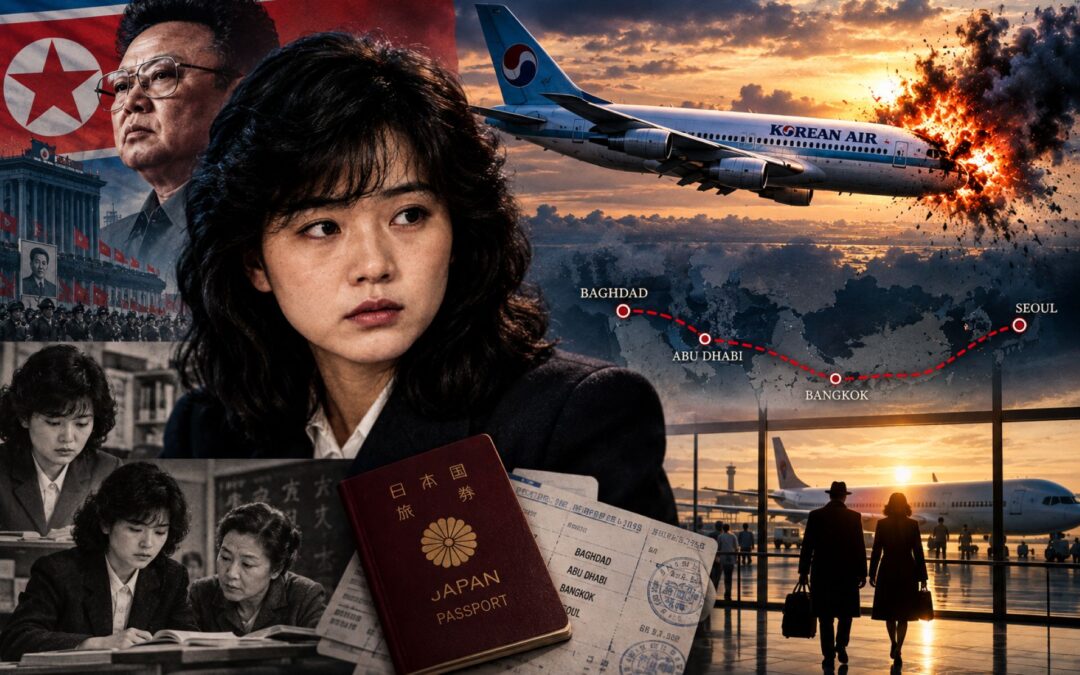
On November 29, 1987, Korean Air Flight 858 disappeared over the Andaman Sea while flying from Baghdad to Seoul. The Boeing 707 was carrying 104 passengers and 11 crew members when an explosive device detonated inside the aircraft. All 115 people aboard were killed, leaving families in South Korea waiting for loved ones who would never return.
The investigation soon focused on two people who had boarded the aircraft in Baghdad but disembarked during a stopover in Abu Dhabi. They had been travelling as a Japanese father and daughter, carrying passports that appeared genuine. Both were subsequently detained in Bahrain, where they attempted suicide by taking cyanide concealed in cigarettes.
The older man died, but his younger companion survived. She was Kim Hyon-hui, a 25-year-old North Korean intelligence operative who would eventually confess to planting the bomb.
Kim’s story became one of the most extraordinary espionage cases of the Cold War’s final years. She had grown up in a privileged North Korean family, been recruited into the country’s intelligence apparatus, and spent years preparing to operate abroad under false identities. Her mission, she later explained, had been intended to undermine South Korea’s international standing before the 1988 Seoul Olympics.
Yet the bombing was only the beginning of her public story. After being sentenced to death in South Korea, Kim received a presidential pardon and became a controversial witness to the regime that had trained her. Her life raises difficult questions about indoctrination, state terrorism, personal responsibility, and whether someone responsible for mass murder can also be considered a victim of the system that produced her.
From a Diplomat’s Daughter to a Recruited Operative
Kim Hyon-hui, also romanized as Kim Hyun-hee, was born on January 27, 1962. Biographical accounts generally identify her birthplace as Kaesong, a city near the border between North and South Korea. Her father worked in North Korea’s diplomatic service, and the family eventually settled in Pyongyang, spending part of Kim’s childhood abroad because of his assignments.
Her upbringing was relatively privileged by North Korean standards. Access to education, overseas experience, and opportunities within prestigious institutions depended heavily on family background and political standing. Kim performed well academically and participated in extracurricular activities, particularly acting and dancing. Accounts of her childhood describe her appearing in North Korean film productions and developing an interest in becoming an actress.
In November 1972, she was selected to present flowers to Chang Key-young, a senior South Korean delegate attending inter-Korean talks in Pyongyang. The occasion was significant because representatives of the two governments were attempting to establish limited contact after decades of confrontation. For the young Kim, however, it was primarily another instance of being selected to represent the state at a prestigious public event.
Her education subsequently took her into higher studies in Pyongyang, where she specialized in Japanese. In February 1980, while attending Pyongyang Foreign Language College, she was recruited by an intelligence department operating under the Central Committee of the Workers’ Party of Korea. Her academic ability, language skills, appearance, and politically acceptable family background reportedly made her an attractive candidate.
The recruitment was not an ordinary employment decision. North Korea’s intelligence services operated within a political system in which individuals had little practical freedom to reject assignments made by powerful party institutions. Kim later recalled that officials arrived at her school and informed her that she had been selected. She was given little opportunity to settle her affairs or say goodbye to friends before entering training.
In an Australian Broadcasting Corporation interview published in 2013, Kim described being allowed one final night with her family before her new life began. Her account presents recruitment as something imposed upon her rather than an ambition she had independently pursued. Although these recollections cannot establish every detail of her personal experience, they are consistent with the coercive authority exercised by North Korea’s ruling party.
The organization involved in her recruitment is important to identify accurately. Kim was not recruited by the Reconnaissance General Bureau, which was established in 2009 through the consolidation of earlier intelligence organizations. Her work belonged to the older Workers’ Party intelligence apparatus, commonly identified in contemporary reports as its Investigation Department.
From 1980 onward, Kim’s education was directed toward one purpose: preparing her to operate outside North Korea without revealing her nationality or political allegiance.
Seven Years of Training—and a Teacher Kidnapped from Japan
Kim’s training combined the physical demands of military preparation with the psychological and cultural requirements of clandestine intelligence work. She received instruction in weapons, martial arts, physical endurance, foreign languages, false identities, and methods of operating in unfamiliar environments. Political education reinforced the expectation that assignments from the party and leadership had to be carried out without question.
The curriculum was intended to produce an operative who could travel internationally, pass as a foreign national, and respond to unexpected situations without exposing her connection to North Korea. Students learned practical skills that were largely unfamiliar to ordinary North Koreans, including international travel procedures and the use of financial instruments such as credit cards. Training also involved exercises designed to test observation, memory, improvisation, and the ability to obtain information without attracting attention.
Japanese language and culture were central to Kim’s preparation. North Korean intelligence organizations frequently used Japanese identities because Japanese travellers could move through countries where North Korean passport holders faced greater scrutiny. Speaking Japanese convincingly was only part of the challenge; an operative also needed to understand everyday customs, behaviour, and social expectations.
One of Kim’s instructors was a Japanese woman whom she knew as Lee Un-hye. The woman’s real identity was Yaeko Taguchi, who had disappeared from Japan in 1978 at the age of 22, leaving behind two young children.
Taguchi had not voluntarily travelled to North Korea to teach intelligence recruits. She was one of several Japanese citizens abducted by North Korean operatives during the 1970s and 1980s. Some abductees were compelled to instruct North Korean agents in Japanese language and culture, while others were exploited for information useful in constructing false identities.
The Japanese Ministry of Foreign Affairs’ account of the abductions explains that the program served several intelligence purposes, including preparing operatives to impersonate Japanese nationals. The full scale and internal operation of the program remain incompletely documented because North Korea has not provided a comprehensive account.
Kim lived with Taguchi during part of her training in the early 1980s and learned Japanese language, customs, and everyday behaviour from her. Their relationship was fundamentally unequal: Kim was an intelligence recruit being prepared for foreign operations, while Taguchi was an abducted civilian who had no meaningful freedom to leave.
The connection later became important to the international campaign for Japan’s missing citizens. In September 2002, Kim Jong Il acknowledged that North Korea had abducted Japanese nationals and apologized during a summit with Japanese Prime Minister Junichiro Koizumi. Pyongyang claimed that Taguchi had died in a traffic accident in July 1986, but Kim disputed that account based on information she said she had received about Taguchi’s movements after that date.
Kim has expressed the belief that Taguchi may have survived, but her testimony does not establish the abductee’s ultimate fate. In March 2009, Kim met Taguchi’s son and elder brother in South Korea, helping renew attention to a disappearance that remained unresolved for her family.
While her language instruction continued, Kim also underwent extensive operational preparation. She learned how to maintain a cover identity, answer questions consistently, recognize situations that threatened exposure, and perform assignments without revealing her purpose. Such skills required repetition over several years because a momentary inconsistency could expose an agent travelling through foreign countries.
Eventually, she was paired with Kim Sung-il, an experienced North Korean operative much older than herself. Contemporary accounts describe him as a veteran intelligence agent with considerable overseas experience, knowledge of several languages, and technical expertise. He became her senior partner and operational guide, and Kim later described their relationship in almost paternal terms.
By 1987, the two had developed the working relationship that would underpin their final mission together. Kim had spent roughly seven years inside an intelligence system that treated obedience as an essential professional and political duty. The training had made her capable of carrying out a complex operation abroad, but it had also reinforced the belief that questioning the leadership’s instructions was unacceptable.
Why the 1988 Seoul Olympics Became a Target
The mission assigned to Kim Hyon-hui cannot be understood without the political rivalry between North and South Korea. Since the division of the peninsula after World War II and the Korean War of 1950–1953, both governments had claimed legitimacy over Korea as a whole. Each sought to demonstrate that its political and economic system represented the country’s rightful future.
By the 1980s, the competition was increasingly unfavorable to North Korea. South Korea had transformed itself into a major industrial economy, building export industries, international commercial relationships, and growing diplomatic influence. North Korea remained heavily militarized and politically isolated, while its centrally planned economy was struggling with structural weaknesses.
The decision to award Seoul the 1988 Summer Olympics represented a major diplomatic success for the South. The Games promised to bring athletes, journalists, tourists, and political attention from around the world, helping South Korea establish itself as a modern international power. For Pyongyang, the prospect of its rival receiving that recognition was politically threatening.
North Korea had already demonstrated its willingness to use clandestine violence against South Korean targets. In October 1983, North Korean agents bombed a mausoleum in Rangoon, Burma, during a visit by South Korean President Chun Doo-hwan. Chun survived, but senior South Korean officials and Burmese citizens were killed.
That operation belonged to a broader pattern of infiltration, abduction, political violence, and military provocation in North Korea’s history of covert operations and confrontation with the South. These methods offered Pyongyang ways to pressure its adversaries without necessarily initiating an open war.
On October 7, 1987, according to Kim’s subsequent testimony, she and Kim Sung-il received instructions to destroy a South Korean civilian aircraft. The mission was presented as an assignment of exceptional political importance, linked to the leadership’s ambitions for Korea and the approaching Olympics.
Kim later said she had been informed that the order originated with Kim Jong Il, the son and designated successor of North Korea’s founder, Kim Il Sung. Kim Jong Il had accumulated influence over party propaganda, cultural institutions, and intelligence activities during his gradual rise to power. His reported personal authorization of the bombing was therefore significant to the operatives entrusted with carrying it out.
The alleged strategic purpose was to frighten foreign governments and athletes away from the Seoul Olympics, undermine confidence in South Korea’s security, and damage the international prestige of the southern government. Kim’s testimony provides the clearest account of this intended effect, and later investigations found substantial evidence connecting the operation to North Korean intelligence. North Korea has consistently denied involvement.
The ideological environment in which Kim received the assignment also mattered. She had grown up within a system that portrayed Kim Il Sung as the indispensable protector of the Korean nation and obedience to the leadership as a patriotic responsibility. Juche, the state’s official ideology of self-reliance, operated alongside intensive leader worship and military mobilization. Although North Korea later elevated the formal doctrine of Songun, or military-first politics, under Kim Jong Il, Kim’s early indoctrination should not be described as the product of that later formal policy.
Within the worldview cultivated by her handlers, destroying a South Korean aircraft could be represented as serving national reunification rather than as an act of mass murder. That political framing helps explain how the mission was justified to Kim, but it does not alter what the operation involved: deliberately placing explosives aboard an aircraft carrying civilians.
False Japanese Passports and the Journey to Baghdad
Once the mission was assigned, Kim and her partner underwent further preparation, including instruction related to the explosives they would use. Their assignment required them to move through several countries, enter a commercial passenger aircraft, leave the explosives aboard, and escape before the device detonated.
On November 12, 1987, the two operatives departed Pyongyang for Moscow. Their route then took them to Budapest, Hungary, where they stayed in accommodation arranged through North Korean intelligence connections. The use of Eastern European locations reflected the access and diplomatic relationships North Korea maintained within the communist bloc.
The agents were supplied with forged Japanese passports and assumed the identities of Shinichi Hachiya and Mayumi Hachiya. Their cover story presented them as a Japanese father and daughter travelling abroad. Kim Sung-il’s age and experience suited the role of the older parent, while Kim Hyon-hui’s years of Japanese-language preparation helped her portray his daughter.
The cover depended on more than matching names in travel documents. The operatives needed to behave consistently with their assumed identities when purchasing tickets, passing through immigration, checking into hotels, and dealing with airline staff. A fluent language performance could still fail if their documents, travel history, or responses did not withstand scrutiny.
From Budapest, the pair travelled to Vienna and later to Belgrade, then part of Yugoslavia. These movements allowed them to pass through European airports and hotels while maintaining their Japanese identities. Kim subsequently recalled that she felt relatively confident in European environments because of her training and previous experience.
In Belgrade, North Korean intelligence contacts supplied the materials needed for the attack. The explosives were concealed in ordinary consumer objects, including a portable radio and a liquor container. The disguise was intended to allow the agents to carry the materials onto a commercial flight without drawing attention.
Their final destination before boarding Korean Air Flight 858 was Baghdad, Iraq. The aircraft was scheduled to depart Baghdad late on November 28 and travel toward Seoul through Abu Dhabi and Bangkok. This route served passengers travelling between the Middle East and South Korea, including Korean workers returning from overseas employment.
The mission relied on the agents leaving the aircraft at an intermediate stop while the concealed explosive remained aboard. The distinction mattered because the operatives intended to be elsewhere when the explosion occurred, protecting both their lives and the concealment of North Korean involvement.
Their original travel plans were complicated by onward visa arrangements after leaving the aircraft. They eventually travelled to Bahrain, hoping to continue through another international route and return safely to North Korea. That change would expose them to the scrutiny that ultimately ended their attempt to escape.
By the time they reached Baghdad, the operation had become a test of the very skills Kim had spent years learning. Her Japanese identity, her ability to travel through foreign countries, her cooperation with the older agent, and her willingness to follow orders were all being brought together in an assignment that would kill 115 people.
Korean Air Flight 858: The Bomb and the 115 Victims
Korean Air Flight 858 departed Baghdad late on November 28, 1987, with Kim Hyon-hui and Kim Sung-il aboard. The aircraft was a Boeing 707 operating a multi-stop international service to Seoul. Both operatives were travelling under their Japanese aliases, presenting themselves as ordinary passengers.
During the Baghdad-to-Abu Dhabi leg, the explosives were placed in luggage stored in an overhead compartment. The device concealed inside the portable radio was intended to detonate after the agents had disembarked. Kim later recalled feeling intensely nervous while carrying out the assignment, but she remained focused on completing what her handlers had ordered.
After several hours in flight, the Boeing 707 landed at Abu Dhabi International Airport in the United Arab Emirates. Kim and Sung-il left the aircraft during the stopover, but the explosive materials remained inside the cabin. The aircraft subsequently departed after its scheduled ground operations.
The failure to detect and remove the abandoned materials was critical to the attack’s success. Cabin and airport security procedures in 1987 were different from the controls that became more common after later aviation-terrorism incidents. Nevertheless, the essential vulnerability was straightforward: dangerous material placed aboard by passengers remained on an aircraft after those passengers had left.
Flight 858 continued toward Bangkok, where it was scheduled to make another stop before completing its journey to Seoul. On November 29, while the aircraft was travelling over the Andaman Sea near Burma, now Myanmar, the explosives detonated.
The Boeing 707 was destroyed in flight. All 104 passengers and 11 crew members were killed, and there were no survivors.
The passengers included South Koreans returning from work abroad. For their families, the journey represented the expected end of a period of separation and the prospect of returning to ordinary life. Instead, relatives received news that an aircraft carrying their loved ones had disappeared and that a catastrophic explosion was suspected.
The human cost extended beyond the individuals aboard the aircraft. Parents lost children, children lost parents, and spouses lost partners. Families were left without the opportunity to see their relatives return or, in many cases, to recover their remains. The absence of the main wreckage compounded the uncertainty surrounding the disaster.
The destruction of the aircraft initially posed serious investigative difficulties. The cockpit voice recorder and flight data recorder were not recovered, and investigators did not obtain the intact fuselage for a conventional forensic reconstruction. The disappearance occurred over a large maritime area, making recovery extremely challenging.
This absence of comprehensive physical evidence would later become central to disputes about the investigation. It did not mean investigators possessed no other evidence, but it limited their ability to reconstruct the aircraft’s final moments directly from its remains.
South Korean authorities rapidly suspected terrorism, particularly given North Korea’s history of violent covert operations. The fact that two passengers had disembarked at Abu Dhabi before the explosion became a crucial lead, directing attention toward the identities and movements of Kim Hyon-hui and Kim Sung-il.
Kim Jong Il’s alleged objective of damaging the Seoul Olympics ultimately failed. The Games went ahead in 1988 and attracted widespread international participation, while the bombing intensified international condemnation of North Korea. In January 1988, the United States designated North Korea a state sponsor of terrorism.
The attack nevertheless succeeded in its immediate destructive purpose. A civilian airliner had been deliberately destroyed, and 115 people who had no direct role in the political rivalry between the two Korean governments were dead.
Bahrain, the Cyanide Cigarettes, and Kim’s Confession
While Flight 858 continued toward its destruction, Kim Hyon-hui and Kim Sung-il travelled from Abu Dhabi to Bahrain. Their intention was to board onward flights and eventually return to North Korea. They did not immediately know whether the operation had succeeded, and the delay before their next departure increased the danger of discovery.
The agents’ forged Japanese passports eventually attracted attention from immigration officials and Japanese diplomatic personnel. Checks on their identities revealed inconsistencies, and suspicions intensified as authorities examined their travel arrangements. Their ability to speak Japanese and behave as Japanese travellers was no longer sufficient to protect their cover.
By early December, the two were under scrutiny in Bahrain. The timing was disastrous for them because investigators were already examining passengers who had disembarked from Flight 858 before its disappearance. The supposed father and daughter had become suspects in an international terrorism investigation.
The agents had been provided with cyanide concealed in cigarettes, intended to allow them to kill themselves if captured. Such precautions were designed to prevent detained operatives from revealing identities, handlers, training arrangements, or connections to North Korean intelligence. Suicide was presented as an expected final act of loyalty if an operation failed.
When they realized that their identities were under threat, Kim Sung-il and Kim Hyon-hui attempted to take the poison. The older operative died, while Kim survived after receiving medical attention. Her survival transformed the investigation because authorities now had a living suspect who could potentially identify the people and institutions behind the bombing.
Initially, Kim refused to acknowledge her real identity. She adopted another false account, claiming to be a Chinese woman who had travelled with an older Japanese man. Her story involved an upbringing in northeastern China and later movement through other Asian locations, but investigators found significant inconsistencies in the addresses, languages, and personal circumstances she described.
The dialect and vocabulary she used did not fit her claimed background, and details of her supposed life in Japan could not be corroborated. The investigation also found problems with the identity documents used by the two travellers. The combination of linguistic inconsistencies, forged passports, and suspicious travel movements undermined her explanations.
On December 15, 1987, Kim was transferred to South Korea for questioning. Investigators continued challenging her account while attempting to establish her origins and connections to North Korean intelligence.
Kim later claimed that two aspects of her detention profoundly unsettled her: the relatively humane treatment she received and her exposure to everyday life in South Korea. She had been raised to believe that the South was impoverished, corrupt, politically repressive, and dependent on the United States. The prosperity of Seoul and the comparatively open behaviour of the people around her contradicted what she had been taught.
According to her subsequent account, investigators drove her through the capital and showed her aspects of South Korean society that made it increasingly difficult to maintain her previous worldview. She described experiencing a psychological collapse as she began to question not only the information she had received about South Korea but also the moral legitimacy of the mission she had completed.
On December 23, she admitted that she was Kim Hyon-hui, a North Korean intelligence operative, and began providing information about the bombing. Her confession described the training program, her partnership with Kim Sung-il, the false Japanese identities, the journey through Europe, and the orders she said she had received to destroy the aircraft.
Her account became crucial to the subsequent prosecution, but confession alone was not the full basis of the case. Investigators also examined travel documents, the identities of her contacts, linguistic evidence, and intelligence information about North Korean operations. These additional findings became particularly important because the aircraft’s principal wreckage had not been recovered.
Kim’s later explanation of how South Korean life altered her beliefs offers an insight into her personal transformation, but it remains her retrospective account. It does not independently prove every claimed aspect of her psychological condition or explain away the decisions she made while carrying out the mission.
She had survived an operation in which 115 people had been killed. Her continued existence now placed her at the centre of a criminal investigation whose consequences reached far beyond her own fate.
A Death Sentence, a Presidential Pardon, and a Life in Hiding
Kim Hyon-hui’s prosecution became one of South Korea’s most prominent terrorism cases. She admitted participating in the destruction of Flight 858 and described the operation as an intelligence assignment originating in North Korea. The trial confronted the courts with the deliberate killing of civilians by a foreign operative acting under state instructions.
On April 25, 1989, a South Korean court sentenced Kim to death. She was convicted in connection with the murders, destruction of the aircraft, and violations of national-security and aviation laws. The court treated the gravity of the attack as requiring the most severe punishment available.
Her confession and stated remorse did not remove her criminal responsibility. She had knowingly boarded a passenger aircraft carrying explosives, participated in leaving them aboard, and escaped while the device was expected to detonate. Whatever pressure North Korean intelligence officials had exercised over her, the bombing had been carried out through her direct participation.
Kim later expressed the belief that she deserved the death penalty. She also began to present herself as someone who had been politically manipulated by an authoritarian state. The two elements of her account were not necessarily incompatible: she acknowledged responsibility for the deaths while arguing that her upbringing and training had shaped her understanding of the mission.
The case eventually reached South Korea’s Supreme Court, which upheld the death sentence on March 27, 1990. By then, however, the political question of whether Kim should actually be executed had become distinct from the judicial determination of guilt.
On April 12, 1990, President Roh Tae-woo granted her a special pardon. The government’s reasoning was that Kim had been subjected to extensive indoctrination and that keeping her alive could help expose North Korean intelligence operations.
The decision was reported contemporaneously in the Los Angeles Times account of the presidential pardon. Government representatives argued that Kim could serve as a living witness to North Korea’s actions and that her confession and cooperation justified clemency despite the seriousness of her crimes.
The pardon generated an enduring moral controversy. For supporters, Kim was a valuable intelligence witness and an example of how an authoritarian state could exploit a person from childhood and transform her into an instrument of political violence. Executing her would eliminate someone capable of providing firsthand knowledge about an exceptionally secretive regime.
Critics could reasonably ask why an operative responsible for 115 deaths should be allowed to live freely while the victims’ families received no comparable second chance. Her indoctrination might help explain her conduct, but it could not restore those lives. Nor did the pardon establish that she was innocent or that her participation in the attack had been involuntary in every meaningful sense.
After the pardon, Kim continued living in South Korea under government protection. She eventually married a former South Korean intelligence officer associated with her case, and the couple had two children. Security concerns limited her public appearances, although she occasionally gave interviews and became involved in efforts to clarify the fate of Japanese citizens abducted by North Korea.
Her public statements frequently returned to guilt. In a 1990 interview, she described feeling like a prisoner even after being spared execution, explaining that her sense of responsibility constrained her ability to enjoy ordinary life. Her later interviews continued to emphasize regret and the obligation to explain what had happened.
These expressions of remorse are part of the historical record, but remorse remains an internal experience that outsiders cannot definitively measure. Public statements can establish what Kim has said about the bombing; they cannot determine the sincerity or completeness of her repentance.
Her relationship with the family she left behind in North Korea is another source of uncertainty. Kim has said she heard reports suggesting that relatives may have been sent to a prison camp because of her survival and cooperation with South Korea. However, she has also acknowledged that she does not know their ultimate fate. Reports of imprisonment should therefore be treated as unconfirmed information, not as an independently established account of what happened to her family.
For Kim, survival created a future very different from the one her handlers had intended. She became a wife, mother, and public witness against North Korea while continuing to live with security restrictions and the consequences of her criminal past.
For the relatives of Flight 858’s victims, her survival remained inseparable from a much harder question: why had the person who helped destroy the aircraft been permitted to build another life when the people aboard it could not?
What the Investigations Proved—and Why Questions Remain
North Korea has consistently denied responsibility for the destruction of Korean Air Flight 858. Pyongyang rejected South Korea’s investigation and accused its adversaries of fabricating the case for political purposes. Those allegations became part of a wider dispute over the credibility of South Korean intelligence agencies during the country’s transition away from authoritarian rule.
The political circumstances made the bombing particularly controversial. South Korea was preparing for a presidential election on December 16, 1987, while President Chun Doo-hwan’s government faced intense public demands for democratic reform. National-security threats had frequently been used to justify political repression, and the ruling establishment had strong incentives to portray itself as the defender of the nation against North Korea.
Kim’s transfer to Seoul occurred on December 15, only one day before the election. Her arrival, the dramatic allegations surrounding the bombing, and the extensive publicity given to the case created questions about whether the government was exploiting the tragedy to influence voters.
Those suspicions required investigation, particularly because the aircraft’s principal wreckage and flight recorders were unavailable. Without the physical remains needed for a complete reconstruction, investigators could not rely on the usual combination of recovered aircraft components, recorder data, and forensic examination to establish precisely how the explosion occurred.
Nevertheless, an absence of recovered wreckage is not the same as an absence of corroborating evidence. Investigators examined the suspects’ travel histories, passport irregularities, false identities, and connections to North Korean intelligence personnel. Kim’s detailed account of her training and movements also supplied information that could be checked against independent intelligence holdings.
American authorities conducted their own assessment of the case and concluded that North Korean intelligence was responsible. According to declassified U.S. diplomatic documents reported by Yonhap in 2012, Kim correctly identified photographs of North Korean intelligence personnel connected with her movements through Budapest and Belgrade.
American officials compared her identifications with information independently available to them. They also examined her Korean speech and found linguistic features consistent with North Korean usage. These findings strengthened the case that she was not merely a person claiming a North Korean identity under pressure from South Korean investigators.
A declassified American intelligence assessment likewise identified the North Korean Workers’ Party intelligence apparatus as the probable organization behind the attack. It considered the operation consistent with earlier North Korean methods and found no persuasive evidence implicating another terrorist organization. Such assessments did not amount to an independent physical reconstruction of the explosion, but they provided corroboration beyond Kim’s confession.
North Korean responsibility remained the conclusion of subsequent South Korean investigations. At the same time, criticism of how the original inquiry had been conducted continued to warrant scrutiny.
In the mid-2000s, South Korea’s National Intelligence Service participated in a historical review of controversial intelligence cases, including the bombing of Flight 858. The inquiry examined allegations that South Korean intelligence had fabricated the incident, possessed advance knowledge of the plan, or manipulated the investigation for political advantage.
The historical investigation’s findings, reported by Yonhap in October 2007, reaffirmed that North Korean operatives had carried out the bombing. Investigators found no supporting evidence for claims that South Korean intelligence had staged the attack or knowingly allowed it to happen.
The inquiry also identified genuine problems with the government’s handling of the case. South Korean authorities had made efforts to bring Kim into the country before the presidential election, and government agencies had coordinated public responses that portrayed the bombing as an example of North Korean aggression. The investigation concluded that the incident had been politically exploited during the election period.
These findings need to be kept separate. The conclusion that South Korean officials used the bombing for political purposes does not establish that they planned the bombing. Equally, confirmation of North Korean responsibility does not mean every aspect of the original investigation, public presentation, or political response was beyond criticism.
The distinction matters because some uncertainties genuinely concern the management of evidence and the conduct of authorities, while other allegations challenge the perpetrators’ identities. A responsible historical account should not dismiss legitimate questions about the investigation merely because some alternative explanations lack credible support.
The continued concerns of victims’ families are particularly important. Relatives spent decades seeking recovered remains, personal belongings, and a more complete explanation of the aircraft’s destruction. The loss of the physical wreckage left an absence that official conclusions and court proceedings could not fully resolve for those grieving.
In January 2020, families renewed their demands for action after reports suggested that possible aircraft wreckage had been located in waters near Myanmar. As Yonhap reported on their calls for recovery and investigation, the families urged the South Korean government to investigate the reported discovery and recover any material that could shed further light on the disaster.
The reports did not establish that the objects belonged to Flight 858. Any purported wreckage would require proper identification and forensic examination before conclusions could be drawn. Nevertheless, the families’ demands reflected a reasonable interest in recovering physical evidence and the remains or belongings of their relatives.
The controversy also extends to Kim Hyon-hui’s position as a central witness. Her confession provided the original investigation with extraordinary detail, and subsequent intelligence findings supported essential elements of her account. Yet she has not always been willing or available to answer every question raised by later investigators and critics, contributing to continuing disagreements about aspects of the case.
Her testimony concerning Yaeko Taguchi illustrates another dimension of this responsibility. Information Kim provided about the abducted Japanese woman helped illuminate a separate North Korean crime and gave Taguchi’s family a potential source of knowledge. At the same time, Kim’s access to that information existed because she had benefited from a training program that exploited an abducted civilian.
The historical record therefore supports several conclusions simultaneously. North Korean intelligence was responsible for the destruction of Flight 858; Kim Hyon-hui and Kim Sung-il carried out the operation; the attack killed 115 people; South Korean authorities exploited the incident politically; and important questions about the recovery of physical evidence and the experiences of victims’ families continued long after the original investigation.
Recognizing these distinctions does not weaken the established account of the bombing. It makes that account more precise by separating the crime itself from the government’s response, the judicial process, the contested political environment, and the unresolved consequences for those who lost family members.
Kim Hyon-hui remains an unusual figure in the history of international terrorism because her life continued so publicly after the crime. Most of what is known about her training and experience came into public view because she survived an attempted suicide that was supposed to prevent her from revealing North Korean secrets. Her subsequent testimony helped establish details of the bombing and illuminate broader intelligence practices, including the abduction of Japanese civilians.
Understanding how Kim became an operative requires examining the coercive institutions, indoctrination, and state objectives that shaped her life. Understanding what she did requires recognizing that these influences culminated in the deliberate murder of 115 civilians who had no meaningful choice in the conflict being waged around them.
Her pardon remains controversial because both realities are true: Kim was shaped by an authoritarian system, and she was responsible for carrying out its deadly instructions. Her later remorse and cooperation became important parts of the historical record, but they did not erase the bombing or its consequences.
The lasting significance of Korean Air Flight 858 lies not only in the exposure of a North Korean intelligence operation but also in the lives it destroyed, the families who continued seeking answers, and the difficult distinction between explaining a perpetrator’s actions and excusing them.
Last Updated on October 28, 2026 by Aseem Gupta