
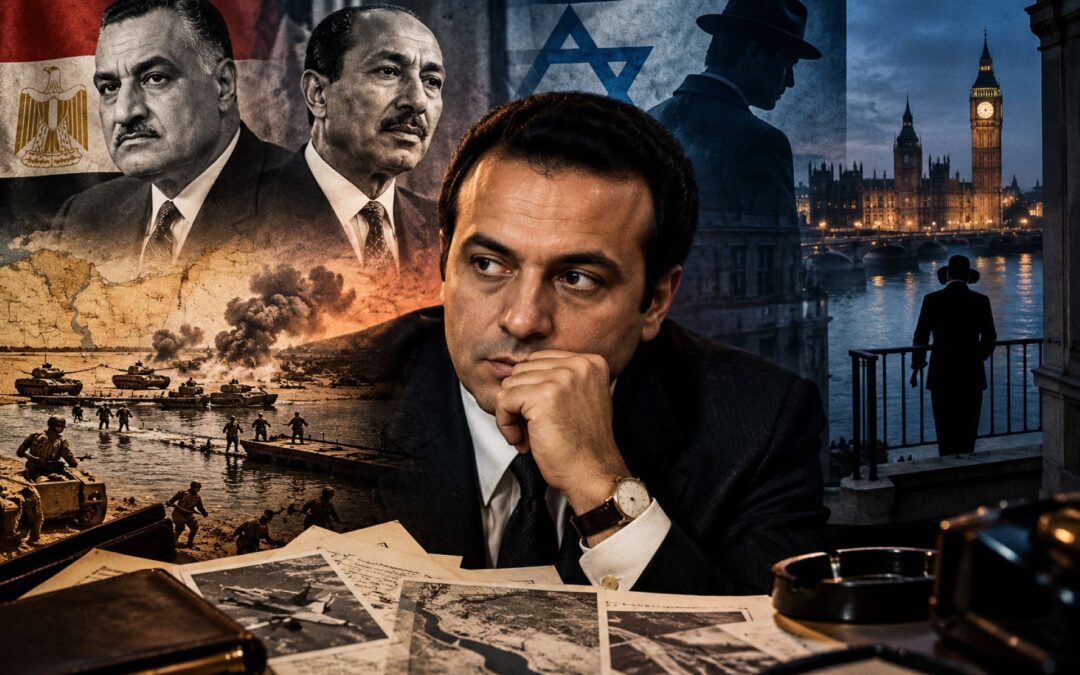
On 27 June 2007, Ashraf Marwan fell to his death from the balcony of his luxury apartment in central London. He was 63 years old, enormously wealthy, and connected to some of the most powerful figures in the Middle East. He had also been identified as one of the most important secret agents in the history of Israeli intelligence, despite spending much of his career at the heart of the Egyptian government.
Marwan was no ordinary intelligence operative. He was the son-in-law of Egyptian President Gamal Abdel Nasser, a trusted adviser to his successor Anwar Sadat, and a man with access to some of Egypt’s most closely guarded military secrets. Yet for years, he secretly supplied information to Mossad, Israel’s foreign intelligence agency. Shortly before the outbreak of the 1973 Arab–Israeli War, he warned Israel that Egypt and Syria were preparing to attack.
Israel’s intelligence establishment came to regard him as an extraordinary asset. In Egypt, however, he was honoured as a patriot, and some investigators have argued that his apparent betrayal was actually part of an elaborate deception operation. His mysterious death only deepened the disagreement, leaving historians and intelligence professionals debating whether he was Israel’s greatest spy, Egypt’s most successful double agent, or something more complicated.
From Nasser’s Family to Sadat’s Inner Circle
Mohamed Ashraf Abu El Wafa Marwan was born in Cairo on 2 February 1944 into a distinguished Egyptian family. His grandfather had served as a senior judge in the country’s religious courts, while his father became a high-ranking military officer associated with the Republican Guard. Marwan therefore grew up in an environment where public service, military authority, and political influence were familiar parts of life.
He studied chemical engineering at Cairo University, graduating in 1965, and began his professional life in Egypt’s military establishment. Around this period, he met Mona Nasser, the daughter of President Gamal Abdel Nasser. Their relationship progressed despite the president’s reservations, and the couple married in July 1966.
Nasser was one of the most influential Arab leaders of the twentieth century. Having emerged from the military movement that overthrew Egypt’s monarchy in 1952, he championed Arab nationalism, opposed Western domination, and placed Egypt at the centre of regional politics. Marriage into his family gave Marwan an exceptional position, but it did not automatically earn him the president’s confidence.
Accounts of their relationship suggest that Nasser questioned whether Marwan’s interest in Mona was entirely personal or partly motivated by political ambition. The president eventually accepted the marriage, but apparently remained wary of his son-in-law. Some later writers have suggested that this mistrust contributed to Marwan’s eventual willingness to cooperate with Israel, although the available evidence cannot establish his private motivations with certainty.
In 1968, Marwan began working within the presidential establishment under Sami Sharaf, one of Nasser’s closest associates and an important figure in Egyptian security. The position gave him a foothold inside the machinery of government, although his responsibilities were initially limited. He subsequently spent time in London with Mona and their young family, ostensibly pursuing further studies, before returning to Egypt at Nasser’s insistence.
The most important change in Marwan’s circumstances came after Nasser’s death in September 1970. His successor, Anwar Sadat, initially faced uncertainty about his authority and the loyalties of officials associated with the previous administration. Marwan’s connection to Nasser’s family made him politically useful, but his own abilities soon became important to his position.
Under Sadat, Marwan developed into a trusted presidential aide and special envoy, handling sensitive assignments and cultivating relationships with foreign leaders. He gained access to political discussions, military information, and international negotiations that would ordinarily remain far beyond the reach of a foreign intelligence service. By the early 1970s, he occupied an extraordinary position inside the Egyptian state, while secretly maintaining a relationship with Israel.
How Ashraf Marwan Became Mossad’s “Angel”
Marwan’s relationship with Israeli intelligence began with an approach to the Israeli embassy in London around 1969 or 1970. According to accounts reconstructed by intelligence historians, he contacted the embassy and offered to provide information to Israel. The proposition initially attracted skepticism, partly because an unsolicited approach from someone so closely connected to Egypt’s leadership was inherently suspicious.
In the intelligence world, an individual who voluntarily approaches a foreign service is known as a walk-in. Such people may be motivated by money, ideology, resentment, personal circumstances, or a desire to manipulate the agency they approach. The greatest danger for the receiving service is that an apparently willing source may actually be controlled by the opposing government’s intelligence organisation.
That possibility was particularly serious in Marwan’s case. Egypt and Israel had fought a devastating war in 1967, and their forces were still confronting one another along the Suez Canal. A member of Nasser’s family offering to betray Egyptian secrets seemed almost too valuable to be credible.
Marwan’s approach nevertheless reached senior Mossad officials, who recognised the significance of his identity. After preliminary contacts, the relationship developed into a clandestine operation. He was given the code name Angel, a name that later became inseparable from his reputation within Israeli intelligence.
The material he supplied reportedly included Egypt’s military order of battle, which described its formations, organisation, and capabilities. He also provided intelligence about Soviet weapons deliveries, strategic planning, confidential Egyptian discussions, and preparations for possible military action against Israel. Some of this information was delivered through original documents, making it considerably more valuable than uncorroborated conversations or second-hand rumours.
The significance of these reports was not simply their secrecy. Marwan could potentially explain what Egyptian leaders believed, what military capabilities they were attempting to acquire, and which political conditions might persuade Sadat to go to war. Understanding an adversary’s intentions can be as important as knowing the number of tanks or aircraft it possesses.
Mossad director Zvi Zamir became closely involved in handling Marwan and reportedly met him personally during visits to London. Such direct attention from the head of an intelligence agency reflected the value Israel placed on its Egyptian source. Israeli accounts also indicate that Marwan received substantial payments, making money one plausible explanation for his cooperation.
Other explanations have included personal resentment toward Nasser, frustration with his earlier position, ambition, and the attraction of playing a secret role in international affairs. Each is conceivable, but none conclusively explains why someone enjoying such privileged access would expose himself to the risk of discovery and potentially severe punishment.
The central problem was that intelligence agencies could assess the usefulness of Marwan’s information more readily than they could establish his ultimate intentions. Documents might be authentic, and specific reports might prove accurate, without necessarily resolving whether the person supplying them was acting independently or participating in a larger deception. That distinction would become crucial in the months before October 1973.
The Secrets Behind Egypt’s Plans for War
To understand why Marwan’s intelligence mattered so much, it is necessary to examine Egypt’s position after the Six-Day War of June 1967. Israel had defeated the armies of Egypt, Syria, and Jordan, capturing the Sinai Peninsula from Egypt, the Golan Heights from Syria, and other territories. The defeat transformed the regional balance of power and left Egypt determined to recover the Sinai.
For President Nasser, the loss represented a profound political and military humiliation. For Sadat, who inherited the problem in 1970, continuing Israeli occupation created an increasingly difficult strategic position. Diplomatic initiatives had failed to produce a satisfactory withdrawal, while Egypt lacked the capability to defeat Israel in a conventional campaign aimed at recovering the entire peninsula.
The confrontation was also connected to the wider Cold War competition in the Middle East. The Soviet Union supplied Egypt with weapons, military equipment, technical assistance, and air-defence systems, while the United States became Israel’s principal international supporter. Regional disputes consequently acquired implications for the relationship between the world’s two superpowers.
Sadat faced a military problem that appeared almost impossible to solve. Israel possessed a powerful air force, highly mobile armoured formations, and a formidable reputation following its victory in 1967. Egyptian troops attempting to cross the Suez Canal would be vulnerable to Israeli aircraft, while a prolonged advance into the Sinai would stretch Egypt’s ability to protect and supply its forces.
Israeli intelligence developed a strategic assumption that became known as the Concept. According to this interpretation, Egypt would not attack until it acquired sufficient long-range strike aircraft and surface-to-surface missiles to challenge Israel’s air superiority and threaten important targets inside Israel. Because Egypt had not satisfied these requirements, Israeli military intelligence repeatedly assessed the probability of war as low.
Marwan’s reports were important to the formation of this assessment. He had supplied information about the military capabilities and strategic conditions Egyptian leaders considered necessary for launching an offensive. Israeli analysts consequently believed they understood not only Egypt’s resources but also the circumstances under which Sadat would decide to use them.
The weakness in that reasoning was the assumption that Egypt’s military objective would remain unchanged. Sadat did not necessarily need to defeat Israel in a prolonged campaign or recapture the entire Sinai immediately. A limited offensive could demonstrate that the occupation was not sustainable, undermine Israeli confidence, and create pressure for diplomatic negotiations.
Egypt’s operational planning increasingly reflected this possibility. Rather than attempting to advance across the whole peninsula, Egyptian forces could cross the Suez Canal and establish positions within the protective range of their surface-to-air missile systems. Soviet-supplied air defences would make it more difficult for Israeli aircraft to destroy the crossing forces, even if Egypt could not match the Israeli Air Force throughout the wider battlefield.
Marwan also occupied an important position in Egypt’s regional diplomatic and military relationships. He developed connections with Saudi Arabia and Libya, whose financial resources and military cooperation were valuable to Sadat. Libya possessed French-built Mirage aircraft that could contribute to Arab air power, and regional efforts to secure aircraft and military assistance formed part of the preparations surrounding the conflict.
His Saudi connections were especially significant. According to Bruce Riedel’s reconstruction, Marwan accompanied Sadat to a meeting with King Faisal in August 1973, where the Egyptian president discussed the possibility of war and sought Saudi support for using oil exports as diplomatic pressure against the United States. Marwan subsequently reported the substance of these discussions to Mossad.
The significance of this information extended beyond the battlefield. It suggested that Sadat was preparing not merely a military operation but a broader campaign involving Arab political cooperation and economic pressure. When Arab oil producers subsequently imposed an embargo and production restrictions during the October war, they contributed to an international energy crisis.
That embargo was not simply a personal initiative by Marwan or a decision taken by all OPEC members. The collective production restrictions involved the Organization of Arab Petroleum Exporting Countries, while individual Arab producers imposed embargo measures against countries supporting Israel. The resulting disruption amplified existing instability in oil markets and had major consequences for inflation and economic growth.
Marwan’s intelligence therefore reached into several interconnected areas: Egyptian military preparations, Soviet weapons supplies, Arab diplomatic cooperation, and the possible economic consequences of war. The U.S. Office of the Historian’s account of the 1973 Arab–Israeli War places the conflict within the broader diplomatic confrontation that ultimately helped produce new negotiations between Egypt, Israel, and the United States.
The extraordinary feature of Marwan’s position was that he could report on preparations taking place inside Egypt’s ruling establishment while the Israeli leadership was trying to determine whether those preparations represented a genuine intention to fight. The information was valuable, but its interpretation remained vulnerable to the assumptions through which Israeli intelligence understood Egyptian strategy.
The Warning Before the Yom Kippur War
The first major warning in 1973 came several months before the war actually began. In April, Marwan contacted his Israeli handlers with information suggesting that Egypt was preparing to attack in mid-May. The warning was sufficiently serious for Mossad director Zvi Zamir to travel to London and meet him.
Marwan reportedly described preparations involving Egyptian forces and aircraft supplied or supported by other Arab countries. Israel responded by increasing military readiness, deploying additional units, and calling up some reservists. These measures created substantial expenses and disrupted the army’s normal activities.
The anticipated attack never occurred. Israeli military intelligence interpreted the absence of war as confirmation that its existing strategic assessment remained sound, although the episode did not necessarily establish that Marwan had deliberately supplied false information. Military plans can be postponed, exercises can be mistaken for attack preparations, and governments can change operational decisions without informing every official who previously knew about them.
For those already inclined to distrust Marwan, however, the failed warning became important. It appeared to demonstrate that even highly placed information could produce costly alerts without an actual attack. Later advocates of the double-agent interpretation would identify this episode as part of a possible effort to reduce Israeli confidence in future warnings.
Egyptian preparations continued through the summer. Sadat and Syrian President Hafez al-Assad moved toward a coordinated offensive, with Egypt planning to cross the Suez Canal and Syria preparing to attack Israeli positions on the Golan Heights. The Egyptian army was increasingly capable of conducting a limited operation under its air-defence umbrella, weakening the assumptions on which Israel’s earlier intelligence assessments had rested.
Marwan reportedly provided additional information about Egypt’s changing military thinking, the acquisition of new weapons, and Sadat’s discussions with Arab leaders. Yet Israeli military intelligence continued to place considerable weight on its existing interpretation of Egyptian intentions. Evidence that might have challenged the Concept was frequently assessed through the same framework that had produced it.
The approach of war generated warnings from other directions as well. Jordan’s King Hussein privately met Israeli Prime Minister Golda Meir in September and conveyed concerns about the possibility of conflict, particularly Syrian readiness. Israeli intelligence also observed substantial military deployments and preparations along both fronts, although Egyptian activity was presented as part of an exercise.
This accumulation of evidence complicated the situation. The Israeli leadership was not operating in complete ignorance of the dangers, nor did Marwan possess the only relevant information. The failure was partly analytical: several different indications of war were available, but they did not produce an adequately early decision to mobilise Israel’s forces.
The decisive warning arrived immediately before the attack. On 5 October 1973, Marwan urgently arranged to meet Zamir in London and informed him that Egypt and Syria would launch a coordinated offensive the following day. The information reached Israel in the early hours of 6 October, prompting urgent consultations and military preparations.
In September 2023, Mossad publicly released material concerning Marwan’s final warning. The declassified account reported by The Times of Israel described Marwan expressing near certainty that war would begin on 6 October. He identified both the Egyptian and Syrian fronts, warned of an Egyptian artillery bombardment and canal crossing, and described Syrian plans against the Golan Heights.
The warning nevertheless contained an important complication. According to published reconstructions of the meeting, Marwan anticipated that the attack would begin later in the day than it actually did. Egypt and Syria launched their offensive at approximately 2 p.m. Israeli time, leaving less preparation time than the information received overnight had suggested.
By then, Israeli commanders were responding to the danger, but mobilisation was incomplete. Israel relied heavily on reservists, who required time to assemble, receive equipment, and reach their assigned positions. Even a reliable warning delivered only hours before the attack could not provide the preparation time that military planners had expected from their intelligence services.
Egyptian forces crossed the Suez Canal and attacked Israeli positions along the Bar Lev Line, while Syrian formations advanced against Israeli defences on the Golan Heights. Both offensives achieved important early successes, and Israel suffered severe casualties and equipment losses. The attacks shattered the confidence established by Israel’s rapid victory in 1967.
Israel subsequently recovered militarily, halting the Syrian offensive, counterattacking on the Golan Heights, and eventually crossing the Suez Canal during the fighting against Egypt. American military resupply and wider international diplomacy also influenced the course of the war. By the time the fighting ended, the battlefield situation had changed substantially from the opening days.
Yet the conflict could not be understood simply as an Israeli victory that rendered Egypt’s offensive meaningless. Sadat had demonstrated that the military and diplomatic status quo could be challenged, while the war intensified international pressure for a negotiated settlement. The subsequent diplomatic process helped create the conditions for the Egyptian–Israeli peace treaty of 1979 and Israel’s eventual withdrawal from Sinai.
Marwan’s final warning became central to the argument over why Israel had been surprised. Bruce Riedel’s analysis of how Israel handled its most valuable intelligence source argues that the failure lay in the inability of Israeli military intelligence to recognise how Sadat’s objectives and capabilities had changed.
This interpretation does not mean every detail of Marwan’s warning was correct or that his information was the sole factor influencing Israel’s military response. It means that intelligence capable of identifying the danger existed, but the Israeli system did not translate the accumulated information into timely preparation. Whether that resulted from analytical complacency, deliberate deception, or some combination of the two became the central controversy surrounding Marwan’s career.
Was Ashraf Marwan an Israeli Spy or an Egyptian Double Agent?
The dispute over Marwan’s loyalty is not simply a disagreement about his personality. It is an argument about how intelligence should be evaluated when its sources, purposes, and operational effects remain partly concealed. The same sequence of events can be interpreted very differently depending on whether Marwan is assumed to have been a genuine Israeli agent or an Egyptian operative deliberately manipulating Israeli expectations.
The case for his genuine service to Israel begins with the scale and sensitivity of the information he supplied. His reports reportedly included authentic Egyptian military documents, details of weapons transactions, strategic plans, and intelligence about presidential meetings. These were not trivial disclosures, and providing them to an adversary could have exposed Egypt to substantial military and political risks.
Mossad officials consistently treated him as an exceptionally valuable source. Zvi Zamir defended Marwan’s credibility, while later Mossad leaders rejected the suggestion that the Egyptian government had controlled him. Their position was that Marwan had served Israel faithfully and that the failures surrounding October 1973 were principally the responsibility of the intelligence analysts who discounted his warnings.
Historian Uri Bar-Joseph developed one of the strongest scholarly defences of this view. In his study of Marwan’s loyalty and Israel’s intelligence failure, he challenges the double-agent interpretation and concludes that Marwan genuinely worked for Mossad. His argument emphasises the quality of the intelligence and the difficulty of reconciling such damaging disclosures with a controlled Egyptian deception operation.
Marwan’s final warning is especially important to this interpretation. He identified the correct date of the attack and the participation of both Egypt and Syria, giving Israel an opportunity to prepare for an imminent war. If the central objective of an Egyptian deception programme was to preserve strategic surprise, providing that warning seems, at first sight, to contradict the purpose of the operation.
Supporters of the genuine-agent explanation also point out that an intelligence source cannot be expected to predict every decision made by political and military leaders. A warning that proves premature may still reflect genuine preparations, and an incorrect estimate of an attack’s starting hour does not automatically establish deliberate misinformation. Egypt’s war planning changed over time, creating opportunities for accurate information to become outdated.
The competing interpretation begins with the extraordinary circumstances of Marwan’s recruitment. He was closely connected to the Egyptian president and operated in a political environment where foreign embassies were obvious intelligence targets. Critics have questioned how an Egyptian official with such sensitive access could approach Israel’s diplomatic establishment in London without attracting the attention of Egyptian security services.
This concern does not prove Egyptian involvement, but it forms part of the argument advanced by former Israeli military intelligence chief Eli Zeira and several subsequent researchers. They questioned whether Marwan had been deliberately positioned to gain Mossad’s confidence by supplying large quantities of genuine material before misleading Israel at critical moments.
The underlying technique is familiar in counterintelligence. An agent can provide accurate information repeatedly, allowing the receiving service to establish confidence in both the source and the apparent reliability of the information. At a decisive moment, the same agent may supply incorrect, incomplete, or carefully timed intelligence that influences the adversary’s decisions.
For advocates of this interpretation, Marwan’s earlier warning in spring 1973 becomes particularly significant. Israel raised its readiness in response to a predicted attack that never occurred, making future warnings easier to discount. His final message also arrived extremely late and reportedly gave an attack time later than the actual opening of hostilities.
Ahron Bregman, an Israeli historian associated with King’s College London, became one of the best-known proponents of the Egyptian double-agent interpretation. His investigations helped bring Marwan’s identity into public view, and his subsequent relationship with Marwan became the subject of a book and documentary. A King’s College London examination of The Spy Who Fell to Earth explains why Bregman questioned the conventional Israeli account of Marwan’s allegiance.
Other scholars, including Isabella Ginor and Gideon Remez, have raised doubts about the timing and strategic implications of Marwan’s warnings. Their arguments contribute to a broader interpretation in which Egypt’s preparations involved not only military secrecy but efforts to shape Israeli expectations about whether an offensive was likely.
The controversy has continued long after the principal participants left office. In January 2026, researcher Dany Shoham published a reconsideration of the case that argued the balance of evidence favoured the double-agent hypothesis. His discussion also acknowledged that alternative possibilities existed, including Marwan having genuinely begun working for Israel before becoming involved in Egyptian deception at a later stage.
These disagreements cannot be resolved merely by counting the number of accurate or inaccurate reports. If Marwan was operating under Egyptian direction, genuine documents could have been used to establish credibility. Conversely, if he was a genuine Israeli source, inaccurate or premature warnings could reflect changing Egyptian plans, imperfect access, or uncertainty within Egypt’s own leadership.
The institutional dispute inside Israel makes the evidence even harder to interpret. Mossad collected human intelligence through Marwan, but Israel’s Directorate of Military Intelligence held responsibility for assessing the likelihood of war. A failure to predict the attack therefore exposed senior figures in different organisations to sharply different accusations.
For Mossad, Marwan’s credibility demonstrated that it had obtained exceptional intelligence and that the military analysts failed to act on it. For Zeira and supporters of the double-agent hypothesis, the possibility of Egyptian deception challenged the assumption that the source had been reliable at decisive moments. The debate consequently became inseparable from the struggle over responsibility for Israel’s failure to anticipate the war.
The arguments also intersected with Egyptian national memory. Marwan had served two presidents and remained associated with important national achievements. A conclusion that he had willingly betrayed Egyptian secrets to Israel would be deeply damaging to his reputation, while the double-agent interpretation allowed him to be understood as someone who had participated in Egypt’s success.
Egyptian and Israeli officials did not present a unified historical account. Some Egyptian figures publicly praised Marwan as a patriot, while Israeli intelligence leaders maintained that he had served Mossad. Public declarations from either side are important evidence of institutional belief, but they do not independently establish the full truth of a covert operation.
Several conclusions can nevertheless be distinguished. Marwan had extraordinary access to Egyptian decision-making, supplied highly sensitive information to Israel, and provided a final warning about the October 1973 attack. Israel’s intelligence and military establishments failed to make adequate use of the warnings available to them, contributing to the severity of the initial surprise.
What remains unresolved is whether Marwan was acting independently, was deliberately misleading Israel throughout his relationship with Mossad, or occupied a position that changed over time. The historical record supports serious examination of the competing interpretations, but it does not justify treating either explanation as an incontrovertible solution.
Wealth, Exposure, and the End of His Double Life
Marwan’s life did not end with the 1973 war. He remained connected to political and commercial networks across the Middle East, using relationships developed during his years in Egyptian government to pursue international business opportunities. His contacts with influential figures in Saudi Arabia, Libya, and other countries gave him access to transactions far beyond the reach of most businessmen.
Over time, he became associated with international arms trading, investment activities, and substantial personal wealth. Some accounts describe lucrative arrangements involving influential Saudi intermediaries, particularly Kamal Adham, an important figure in Saudi intelligence. Such relationships made Marwan’s career unusually difficult to classify because his political, commercial, and intelligence connections frequently overlapped.
Following Sadat’s assassination in 1981, Marwan increasingly established his life in London. He operated within wealthy international business circles and developed associations with prominent businessmen, including Mohamed Al-Fayed. His public reputation was that of a successful Egyptian entrepreneur with an exceptional network of political and commercial contacts.
For years, his alleged activities for Mossad remained concealed from the wider public. Although Israel’s intelligence failure in 1973 had produced extensive official investigations and public argument, the identity of its highly placed Egyptian source was not widely known. That changed as former intelligence officials, historians, and journalists revisited the controversy.
The most consequential dispute involved Eli Zeira and Zvi Zamir, whose opposing interpretations of the intelligence failure gradually became entangled with allegations about the disclosure of Marwan’s identity. Zeira had questioned whether the source was genuinely serving Israel, while Zamir defended his reliability and condemned the exposure of an exceptionally important agent.
In 2002, Marwan became publicly identified in connection with Israel’s Egyptian intelligence source. Ahron Bregman’s work helped bring the allegation into the open, and subsequent reporting added details about Marwan’s relationship with Mossad. An Israeli arbitration ruling in 2007 also held Zeira responsible for leaking identifying information about the source.
The consequences extended beyond professional embarrassment. Revealing the identity of a clandestine agent could expose that person to threats, damage the reputation of the intelligence service that recruited him, and deter future sources from trusting its ability to maintain secrecy. For Marwan, exposure meant that a life built around political influence and discretion became inseparable from public accusations of espionage and betrayal.
Bregman eventually established personal contact with Marwan, and the two communicated over several years. Their unusual relationship would later become a central part of Bregman’s account of the affair. They were reportedly expected to meet in London on the day Marwan died, an unsettling coincidence that later attracted considerable attention.
By June 2007, Marwan was an internationally connected businessman whose intelligence past had become a matter of public controversy. He had wealth, status, and influential relationships, but his reputation now depended on a dispute that neither Egypt nor Israel had convincingly resolved.
The Unsolved Death of Ashraf Marwan
On the afternoon of 27 June 2007, Ashraf Marwan fell from the balcony of his apartment at 24 Carlton House Terrace, a prestigious address near central London’s government and diplomatic district. His body was found below the building, and emergency assistance could not save him. He was 63 years old.
The circumstances surrounding his final moments immediately raised questions. Four employees associated with one of Marwan’s companies were meeting in a nearby office with a view toward his apartment. Marwan was expected to join them, and when he had not arrived, they contacted him. According to later accounts, he indicated that he would be coming shortly.
The men subsequently witnessed the commotion surrounding his fall. Their recollections were not identical, and they did not all observe the same sequence of events. Some accounts described witnesses seeing Marwan apparently jump or fall, while others began observing only after someone in the room reacted to what was happening.
One witness also reported seeing two men standing on a nearby balcony after Marwan had fallen. Their presence later became a prominent feature of theories surrounding his death, particularly because the witness described them as watching events unfold without appearing to respond to the emergency.
However, the observation did not establish that the men had been inside Marwan’s apartment or that they had any connection to his fall. The precise balcony on which they stood was uncertain, and their identity and actions were not established by the testimony. Their reported presence therefore raised questions without proving that anyone had attacked Marwan.
Investigators faced other difficulties. Marwan’s family later alleged that a manuscript he had been preparing about his life and experiences had disappeared from his apartment. His widow also criticised the handling of physical evidence, including the reported loss of shoes that might have provided information relevant to the investigation.
These claims contributed to concerns that the circumstances of his death had not been adequately examined. Nevertheless, missing materials and investigative shortcomings do not establish the cause of death on their own. The contents of any unpublished manuscript cannot be confidently reconstructed, nor can its alleged disappearance be treated as proof that Marwan was murdered for what he intended to reveal.
His widow, Mona Nasser, stated that Marwan had become concerned about his safety before his death. She described him as increasingly attentive to household security and said he had expressed fears that someone might kill him. These reported concerns were particularly troubling because they emerged after his alleged intelligence activities had entered public discussion.
Mona publicly argued that her husband had been murdered and accused Mossad of responsibility. Her allegations reflected a deeply held conviction, but they were not established by the available investigation. No publicly demonstrated chain of evidence identified Mossad, Egyptian intelligence, or any other organisation as responsible for causing his fall.
The possibility of suicide was also examined. Some reports discussed potential psychological or medical factors, but these did not provide a conclusive explanation of what occurred. The distinction between a voluntary jump, an accidental fall, and someone being pushed remained unresolved.
In July 2010, a British coroner considered the available testimony and evidence. The proceedings ended with an open verdict, meaning that the evidence was insufficient to establish the circumstances of the death conclusively. As reported in The Guardian’s account of the coroner’s findings, the inquest did not establish suicide or unlawful killing.
Marwan’s death acquired additional significance because other prominent Egyptians with connections to political or security circles had died after falls from buildings in London. These similarities encouraged speculation about a wider pattern. However, the existence of superficially similar cases cannot establish that the deaths shared a perpetrator, motive, or mechanism.
The response to Marwan’s death also revealed the contradictory nature of his public reputation. In Egypt, he received an elaborate funeral attended by senior political and religious figures. Former President Hosni Mubarak praised him as a patriot and suggested that some of his contributions to Egypt could not yet be publicly explained.
In Israel, senior intelligence figures continued to commemorate him as an exceptionally valuable source whose information had helped the country prepare for the October 1973 attack. Mossad’s later disclosures, including material released around the war’s fiftieth anniversary in 2023, reinforced the organisation’s position that Marwan had been a genuine agent.
His life subsequently became the subject of books and screen adaptations, including the Netflix film The Angel and the documentary The Spy Who Fell to Earth. These works approached the same historical events from different perspectives, reflecting the enduring fascination with a man whose actions appeared capable of supporting sharply opposing interpretations.
The mystery surrounding Marwan’s death is therefore closely connected to the argument over his life, but the two questions should not be confused. Establishing that he supplied intelligence to Mossad does not establish who, if anyone, caused his death. Equally, uncertainty about his death cannot resolve whether his intelligence activities were conducted independently or under Egyptian direction.
Ashraf Marwan remains an unusual figure in modern intelligence history because the principal facts of his career coexist with unresolved questions about their meaning. His privileged position in Egypt, his dealings with Mossad, the information he supplied, and his warning before the October 1973 war are central parts of the historical record. They demonstrate how a single well-placed individual could influence what governments knew about an approaching conflict.
What those facts do not conclusively reveal is where his ultimate loyalty lay. Israeli intelligence viewed him as an invaluable agent, while the Egyptian double-agent interpretation offers a fundamentally different explanation for the same career. His unexplained death has ensured that neither narrative can be separated entirely from the suspicions that followed him.
The significance of his story is not dependent on an undiscovered confession or a final revelation. Marwan’s life illustrates a fundamental difficulty of intelligence work: possessing secret information is not the same as understanding the intentions behind it, and even an exceptionally valuable source cannot prevent disastrous decisions when evidence is interpreted through assumptions that governments are unwilling to question.
Last Updated on October 27, 2026 by Aseem Gupta