
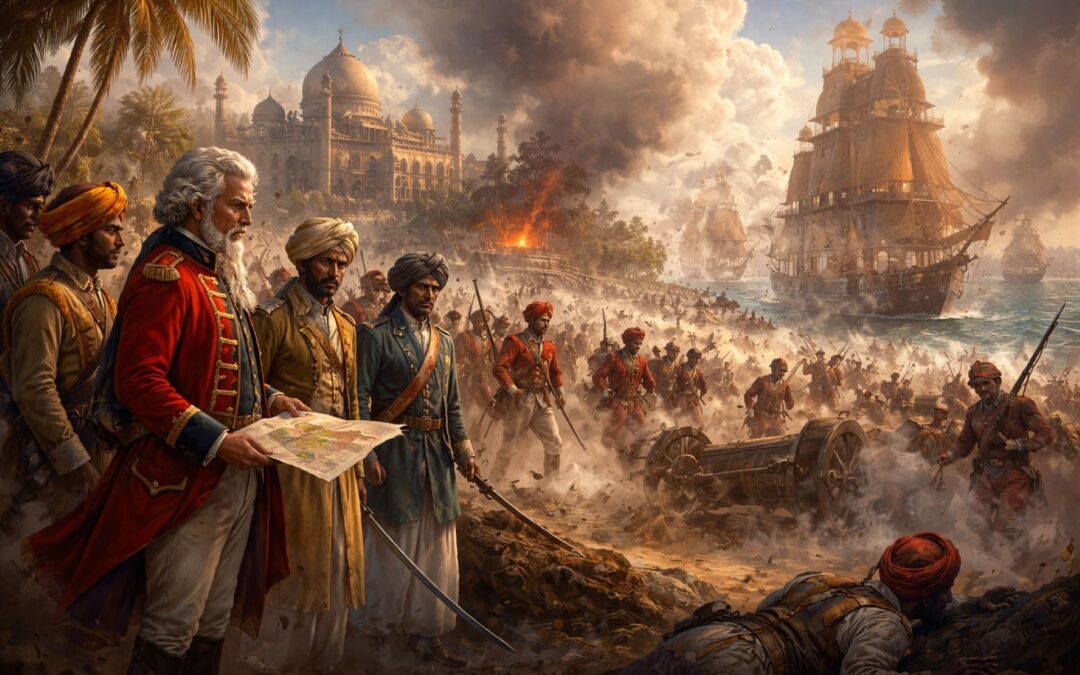
For centuries, India stood at the center of the global economy. Its textiles clothed the world, its spices fueled global trade, and its cities rivaled the richest urban centers anywhere on earth. European merchants did not arrive as conquerors—they arrived as supplicants, desperate to access the wealth of Asia. And yet, within a span of a few generations, the balance of power flipped dramatically. By the early 19th century, a private British corporation had transformed itself from a trading entity into the ruler of millions.
This reversal has long puzzled historians and observers alike. How did a civilization so rich, so sophisticated, and so deeply integrated into global trade networks fall under the control of distant European powers? Why didn’t Indian states repel these outsiders, as they had done with countless invaders before? And perhaps most intriguingly—was this outcome inevitable, or was it the result of a unique convergence of circumstances?
The answer lies not in simple narratives of strength and weakness, but in a complex interplay of systems, incentives, and historical timing. Europe did not begin this story as the dominant force—it became one through a series of structural transformations that reshaped the global order. At the same time, Indian polities operated within a very different set of constraints, optimized for a world that was rapidly changing beneath their feet.
To understand why India fell to the Europeans, we must move beyond surface-level explanations and examine the deeper forces at play. This is not a story of civilizational superiority, but of shifting systems—where trade became conquest, institutions outlasted empires, and a few critical turning points altered the trajectory of global history.
The Great Paradox: A Rich Civilization That Was Conquered
In the early 18th century, India was not a weak or declining land waiting to be conquered—it was one of the richest regions in the world. Estimates suggest that India accounted for a significant share of global GDP, driven largely by its thriving textile industry, advanced agricultural systems, and deeply entrenched trade networks that stretched from Southeast Asia to the Middle East and Europe. Indian cottons and silks were so prized that they reshaped consumer habits across continents, while its ports bustled with merchants from every corner of the known world.
This is what makes the events of 1757 so striking. When the British East India Company defeated the Nawab of Bengal at the Battle of Plassey, it was not just a military victory—it was the beginning of a profound political transformation. Bengal was among the wealthiest regions in the world at the time, known for its fertile lands and booming industries. And yet, it fell not to a vast imperial army, but to a private trading corporation with limited manpower.
The paradox deepens when we consider the broader context. Indian powers were not unfamiliar with warfare or statecraft. For centuries, they had navigated complex political landscapes, resisted invasions, and built powerful empires—from the Mauryas and Guptas to the Delhi Sultanate and the Mughals. There was no inherent lack of capability or sophistication.
So why did this time turn out differently?
The answer is not that India suddenly became weak, nor that Europe was always stronger. Instead, this moment represents a transition point—where older systems of power began to falter in the face of new kinds of organization, incentives, and global connections. The conquest of India was not the result of a single decisive advantage, but the culmination of multiple shifts that, taken together, created an imbalance that had never existed before.
To understand this shift, we must first confront an uncomfortable but crucial reality: at the beginning of this story, Europe was not the dominant player—it was the outsider looking in.
Europe Was Not the Stronger Civilization — At First
It is easy, in hindsight, to view European dominance as inevitable—to assume that the rise of the West was simply a matter of superior technology or institutions gradually overpowering the rest of the world. But this perspective collapses when we look at the world as it existed in the late 15th and early 16th centuries.
At that time, Europe was not the center of global wealth or power. It was, in many ways, a peripheral region—fragmented, resource-constrained, and economically dependent on the great civilizations of Asia. The true centers of prosperity lay elsewhere. The Mughal Empire in India commanded immense agricultural and industrial output. The Qing Empire in China presided over a vast and sophisticated economy. Even regional powers like Vijayanagara or the Tokugawa Shogunate operated at levels of organization and scale that dwarfed most European states.
From a global perspective, Europe was not the destination—it was the customer.
Asian economies produced the goods the world demanded: fine textiles, porcelain, spices, and luxury commodities that had no equal in Europe. Trade routes, particularly those passing through the Ottoman and Mamluk domains, connected these markets efficiently. European merchants had little leverage in this system. They lacked both the goods to offer and the political influence to demand better terms.
Crucially, this meant that Asian powers had no incentive to engage Europe directly. Why would a thriving and self-sufficient empire go out of its way to establish trade with distant, relatively underdeveloped regions? The flow of wealth already favored Asia. Europe needed Asia far more than Asia needed Europe.
This imbalance set the stage for everything that followed.
Because Europe could not compete within the existing system, it was forced to find ways around it. It had to innovate—not out of ambition alone, but out of necessity. The push to bypass traditional trade networks, to access Asian wealth directly, and to reshape the rules of engagement would become the first step in a much larger transformation.
In other words, Europe’s rise did not begin with dominance. It began with disadvantage—and the relentless drive to overcome it.
The Real Trigger: Europe’s Search for Direct Trade Routes
If Europe could not compete within the existing global system, it had only one option: change the system itself.
By the mid-15th century, the most lucrative trade routes linking Europe to Asia were controlled by powerful intermediaries. The Ottoman Empire dominated overland connections through Constantinople, while the Mamluks controlled access to the Red Sea. These “middlemen” extracted significant profits, driving up the cost of Asian goods by the time they reached European markets. Spices, textiles, and luxury items were still in demand—but they came at a premium Europe could not control.
For European powers, this was more than an economic inconvenience. It was a strategic bottleneck.
The solution they pursued was radical: bypass the intermediaries entirely. Instead of relying on established routes, European states—especially Portugal and Spain—began investing in long-distance maritime exploration. Their goal was simple but ambitious: find a direct sea route to Asia.
This pursuit triggered a wave of innovation. Portuguese shipbuilders, encouraged by royal incentives, began constructing larger, more durable ocean-going vessels. These ships incorporated techniques and knowledge drawn from Mediterranean and North African traditions, resulting in a new class of ships capable of surviving long voyages across open oceans. Crucially, they could also be armed with heavy cannons, turning them into floating fortresses.
This combination of endurance and firepower proved transformative.
In 1498, Vasco da Gama successfully rounded the Cape of Good Hope and reached the Indian coast, establishing the first direct maritime link between Europe and India. It was a breakthrough that fundamentally altered global trade dynamics. For the first time, Europeans could access Asian markets without relying on Ottoman or Mamluk intermediaries.
At roughly the same time, Spain’s westward expeditions led to an unexpected discovery—the Americas. What began as a search for Asia turned into something even more consequential: access to vast new sources of silver.
These developments were not the result of European superiority in the traditional sense. They were driven by constraint. Europe was pushed into innovation because it had no other choice. But in solving its immediate problem—how to reach Asia directly—it inadvertently laid the groundwork for a much larger shift in global power.
The world had not yet changed completely. But the first cracks in the old system had begun to appear.
Silver, Trade, and Europe’s Entry Into Asian Markets
Reaching Asia was only the first step. The real challenge for Europeans was far more fundamental: what did they have to offer in return?
For centuries, this had been Europe’s core weakness. Asian economies—particularly those of India and China—produced goods that were globally desired, from textiles and spices to porcelain and luxury crafts. Europe, by contrast, had little that Asian markets needed. This imbalance meant that trade, when it occurred, was heavily tilted in Asia’s favor. Europeans often found themselves paying in precious metals simply to participate.
Then, almost by accident, this limitation disappeared.
The discovery of the Americas flooded Europe with vast quantities of silver. Mines in regions like Potosí began producing unprecedented amounts of bullion, transforming Europe’s position in global trade almost overnight. What had once been scarce was now abundant—and suddenly, Europeans possessed something Asian markets desperately needed.
Because across Asia, there was a growing silver shortage.
Silver had long functioned as a crucial medium of exchange in many Asian economies, especially in China, where monetary systems were increasingly tied to silver flows. Shortages of the metal created economic strain, even contributing to political instability in certain regions. Into this environment arrived European merchants carrying exactly what was in short supply.
This changed everything.
For the first time, Europeans were not peripheral traders struggling for access—they were highly desirable partners. With abundant silver, they could purchase large quantities of goods without needing to offer equivalent products in return. Trade that had once been difficult to sustain now expanded rapidly.
In India, this shift is clearly visible. The establishment of early European trading posts was often not imposed through force, but welcomed by local authorities. Fort St. George, for instance, was set up with the encouragement—and even financial support—of local rulers who recognized the economic benefits of European trade. Tax privileges, protection, and incentives were extended not because Europeans were dominant, but because they were useful.
At this stage, the balance of power had not yet tilted in Europe’s favor. Asian empires remained far stronger, both politically and economically. But a new dynamic had emerged—one in which Europeans could integrate themselves into existing systems more effectively than ever before.
They had not conquered their way in.
They had bought their way in.
Cooperation, Not Conquest: The Early Phase of European Presence
The early phase of European expansion in Asia—and particularly in India—look nothing like the later era of colonial domination. There were no sweeping conquests, no large-scale territorial ambitions, and no direct challenges to the great empires of the region. Instead, the relationship was defined by caution, negotiation, and, above all, cooperation.
European traders understood their position clearly. They were outsiders operating in lands governed by powerful states with far greater resources and manpower. Direct confrontation was not just unwise—it was impossible. Early European records reflect this reality with surprising clarity. Officials of trading companies often expressed respect, even fear, of Asian powers such as the Mughals or the rulers of Japan. Their goal was not to dominate, but to survive and profit within the existing system.
As a result, Europeans willingly operated on the margins.
Their presence was largely confined to coastal enclaves—trading posts, fortified ports, and small settlements that functioned as nodes in a much larger commercial network. These enclaves were not seized outright in most cases; they were granted through negotiation or established with the consent of local authorities. European companies adapted themselves to local political realities, paying taxes, seeking protection, and abiding by the rules set by regional powers.
Even when violence occurred, it was selective and limited in scope.
European naval strength—particularly their cannon-armed ships—gave them an advantage at sea and against smaller coastal targets. They could blockade ports, disrupt maritime trade, and occasionally capture strategic locations. But these actions were typically directed at smaller city-states or rival trading hubs, not at the major inland empires that dominated the subcontinent.
In fact, there were moments when Indian powers actively supported European expansion—when it aligned with their own strategic interests.
The capture of Goa by the Portuguese in 1510 is a striking example. The Vijayanagara Empire, a major power in southern India, assisted the Portuguese in taking the city from the Bijapur Sultanate. For Vijayanagara, the goal was not to empower a foreign force, but to ensure that a critical trade hub—especially for horses, an essential military resource—did not fall into the hands of a rival. The Portuguese, as outsiders, were seen as a neutral intermediary, preferable to a competing regional power.
This kind of pragmatic alliance was not unusual.
From the 1500s to the mid-1700s, the relationship between European traders and Asian powers was largely symbiotic. Europeans gained access to lucrative markets, while local rulers benefited from increased trade, new revenue streams, and, in some cases, strategic partnerships.
Crucially, this means that for over two centuries after Vasco da Gama’s arrival, Europe did not dominate India.
It participated in it.
The shift from participation to control would come much later—and when it did, it would be driven not by a sudden surge of European strength, but by a profound transformation in the political landscape of India itself.
The Turning Point: Why the 18th Century Changed Everything
For over two centuries, the balance between European traders and Indian powers remained relatively stable. Europeans operated within limits, and Asian empires retained overwhelming dominance. But by the mid-18th century, this equilibrium began to unravel—and with it, the rules of engagement changed entirely.
The key shift did not originate in Europe.
It began within India.
The Mughal Empire, which had long served as the central pillar of political authority across much of the subcontinent, entered a period of steady decline after the early 1700s. What had once been a highly centralized and powerful state began to fragment into a mosaic of regional powers. The Marathas, the Nawabs of Bengal and Awadh, the Nizam of Hyderabad, the Sikhs, Mysore, Rajput states—all asserted varying degrees of autonomy.
On the surface, this did not necessarily signal weakness. India had always been politically diverse, and regional powers were often formidable in their own right. But the difference now lay in the absence of a unifying authority capable of maintaining long-term stability across the system.
Power was no longer concentrated—it was contested.
This fragmentation created a fundamentally different political environment—one that was far more fluid, unpredictable, and, crucially, exploitable. Regional rulers were locked in continuous competition, forming and breaking alliances as circumstances changed. In such a landscape, external actors could insert themselves not as conquerors, but as participants in existing rivalries.
This is where European trading companies found their opportunity.
No longer confined to coastal enclaves, they began to engage more directly in inland politics. At first, this involvement took the form of military support—providing troops, funding, or strategic assistance to one side in a regional conflict. But this support was never neutral. It came with conditions, concessions, and long-term implications.
The Battle of Plassey in 1757 is often seen as the defining moment of this shift—and for good reason. The British East India Company did not defeat Bengal through sheer military superiority. Instead, it leveraged internal divisions, forged strategic alliances, and capitalized on political instability. Key figures within the Nawab’s court switched sides, and the outcome was decided as much by intrigue as by combat.
Plassey was not an isolated incident. It was a blueprint.
From this point onward, European companies increasingly transitioned from traders to political actors. They inserted themselves into succession disputes, mediated conflicts, and gradually expanded their influence beyond commerce into governance. What began as participation evolved into control—not through overwhelming force, but through strategic positioning within a fragmented system.
This was the turning point.
Europeans did not suddenly become stronger in the 18th century. Rather, the environment in which they operated changed in ways that amplified their advantages and exposed the vulnerabilities of Indian polities. The shift from a unified imperial framework to a competitive regional order created openings that had never existed before.
And once those openings appeared, they were systematically exploited.
The Institutional Advantage: Stability vs Fragmentation
As the political landscape of India grew more fragmented in the 18th century, a quieter but far more decisive contrast began to emerge—one rooted not in battlefield strength, but in institutional structure.
European powers, particularly through their trading companies, operated with a level of continuity that Indian polities increasingly lacked.
Take the British East India Company as an example. It was not tied to the fate of a single ruler or dynasty. It functioned as an institution with its own administrative systems, chains of command, and long-term strategic goals. Individual officials could be replaced, policies could be adjusted, and operations could continue largely uninterrupted—even in the face of setbacks.
This gave European actors a kind of resilience that was difficult to match.
In contrast, political authority in much of India during this period was deeply personalized. Power was often concentrated in individual rulers or elite factions, and transitions—whether through death, succession disputes, or internal conflict—could quickly destabilize entire regions. When a strong ruler fell, the system did not always endure in the same form. It fractured, reorganized, or was contested.
Over time, this created a pattern of discontinuity.
While Indian states rose and fell, European institutions persisted. The British had been present in India for over a century before the Mughal Empire began its decline. This meant that when fragmentation occurred, they were not newcomers trying to establish a foothold—they were already embedded within the system, familiar with its dynamics, and positioned to take advantage of its shifts.
Fragmentation, in itself, is not necessarily a weakness. But in this context, it created a strategic asymmetry.
European entities operated as stable, long-lived institutions navigating a landscape of shorter-lived, competing powers. They could afford to think in decades rather than years, to build alliances gradually, and to recover from temporary losses without collapsing entirely.
Indian polities, on the other hand, were often forced into more immediate calculations. Survival, consolidation, and rivalry took precedence, leaving less room for coordinated long-term strategies against an external actor that was steadily increasing its influence.
This difference did not guarantee European success on its own.
But it meant that over time, as instability increased, one side remained structurally consistent—while the other became increasingly fluid. And in a contest shaped by shifting alliances and prolonged engagement, consistency became a powerful advantage.
The Loyalty Problem: Why European Systems Were Harder to Corrupt
In a fragmented political environment, loyalty becomes one of the most valuable—and fragile—assets. Alliances shift, incentives change, and individuals often act in their own interest rather than in service of a larger, stable system. In 18th-century India, this dynamic played a crucial role in shaping outcomes on the ground.
But not all systems handled loyalty in the same way.
European trading companies, particularly the British East India Company, operated with a structural advantage: their officials, while not immune to corruption, were fundamentally replaceable. Authority did not reside in the individual—it resided in the institution. If a company officer proved unreliable, compromised, or ineffective, they could be removed and substituted without destabilizing the broader system. The machinery of governance continued to function.
This created a built-in safeguard.
Even when European agents accepted bribes or engaged in private dealings—as many did—their ability to act against the long-term interests of their organization was limited. They did not command independent armies, nor did they possess autonomous political bases. Their power was delegated, not inherent.
In contrast, many Indian political systems were built around decentralized authority structures.
Regional lords, nobles, and military commanders often held independent power derived from land, lineage, and local influence. Their loyalty to a central authority—whether a Mughal emperor or a regional ruler—was not absolute. It was negotiated, conditional, and, at times, transactional. When incentives shifted, so could their allegiance.
And unlike European officials, these figures were not easily replaceable.
A powerful noble who defected or switched sides did not simply disappear from the equation. He took with him troops, resources, and regional influence. This could trigger a cascade effect, where other actors recalibrated their positions in response, leading to rapid and often unpredictable shifts in the balance of power.
This pattern is evident in events like the Battle of Plassey, where key figures within the Nawab of Bengal’s camp chose not to support him at critical moments. The outcome of the battle was shaped as much by these internal fractures as by any external military advantage.
Over time, this asymmetry in how loyalty was structured became increasingly significant.
European systems could absorb individual failures without collapsing. Indian systems, more dependent on personal allegiance, were more vulnerable to sudden breakdowns when those allegiances shifted. In a landscape defined by constant negotiation and competition, this difference created a subtle but persistent advantage.
It was not that one side was immune to corruption and the other was not.
It was that one system was designed to survive it—and the other was more easily undone by it.
War Without Risk: Why Europeans Could Afford to Lose
One of the least obvious—but most decisive—advantages Europeans possessed in India was not superior strength, but lower stakes.
For European powers, conflicts in India were distant ventures. They were fought thousands of miles away from their homelands, financed by trading companies or state-backed enterprises, and framed as opportunities rather than existential necessities. When European forces lost battles in India, the consequences were limited. They could regroup, send reinforcements, adjust their strategy, and try again.
Failure was a setback—not a catastrophe.
This created a unique kind of strategic flexibility. European actors could take risks, experiment with alliances, and engage in prolonged conflicts without the fear that a single defeat would destroy their entire system. Their core political structures remained intact back home, insulated from the outcomes of distant campaigns.
The situation for Indian powers was fundamentally different.
Wars were not fought on the periphery—they were fought at home. The same territories that generated revenue, sustained armies, and legitimized rulers were the battlegrounds themselves. A significant defeat could trigger immediate and far-reaching consequences: loss of territory, collapse of authority, rebellion among subordinates, or even the complete disintegration of a state.
This created a much higher level of vulnerability.
In many Indian polities, authority depended on a delicate balance of power between the central ruler and regional elites. When that balance was disrupted—especially by military defeat—it could set off a chain reaction. Local lords might defect, allies might withdraw support, and rivals could seize the opportunity to expand. What began as a single lost battle could escalate into systemic collapse.
This pattern had repeated itself throughout Indian history.
Empires rose to great heights, but they often fell rapidly when internal cohesion broke down. The Mauryas, the Guptas, the Chalukyas, Vijayanagara—each experienced periods of sudden fragmentation following critical defeats or internal crises. These collapses were not necessarily due to weakness, but to the interconnected nature of their political systems.
European actors, by contrast, were insulated from such cascading failures.
Their operations in India were extensions of a larger system, not the foundation of it. This meant they could sustain losses that would have been devastating for their Indian counterparts. They could afford to lose battles because the survival of their broader system was never at risk.
Over time, this difference in stakes translated into a difference in strategy.
European forces could persist, adapt, and re-engage. Indian powers, facing higher risks, were often forced into more immediate and defensive calculations. And in a prolonged contest, the ability to absorb losses without collapsing became a quiet but powerful advantage.
Discipline and Organization: The Military Gap
By the mid-18th century, another critical difference had begun to shape outcomes on the battlefield—one that went beyond numbers, bravery, or even technology. It was the difference in how armies were organized, trained, and deployed.
European military systems had undergone significant transformation in the preceding centuries. Warfare in Europe had become increasingly structured, emphasizing drill, coordination, and strict chains of command. Soldiers were trained to operate as cohesive units, executing maneuvers with precision and maintaining formation even under intense pressure. Discipline was not just encouraged—it was institutionalized.
At the heart of this system was the rise of the professional standing army.
European states, and by extension their trading companies, relied heavily on full-time soldiers—regulars who were trained, salaried, and continuously drilled. These troops were not tied to local land or seasonal obligations. Their primary identity was military, and their effectiveness depended on their ability to function as part of a larger, coordinated force.
This gave European armies a distinct edge in organization.
On the battlefield, this translated into predictable formations, synchronized movements, and the ability to execute complex tactics. Even when outnumbered, such forces could maintain cohesion and exploit weaknesses in less organized opponents.
In contrast, many Indian military systems still operated within a different framework.
While there were certainly highly capable and well-trained forces, a significant portion of armies were tied to feudal structures. Soldiers were often raised by local lords, bound through land grants or traditional obligations. Their level of training, equipment, and coordination could vary widely depending on the resources and priorities of their patron.
This created a degree of inconsistency.
In large-scale engagements, maintaining order across such forces could be challenging. Units might lack uniform training, and coordination between different contingents could break down under pressure. Attempts were made to adopt European-style formations and tactics, but without the underlying institutional framework—regular training, centralized command, and standardized discipline—these adaptations were often incomplete.
Contemporary observations reflect this gap. Some European accounts describe Indian forces as courageous but lacking the organizational cohesion necessary to sustain disciplined formations in battle. While such accounts should be approached critically, they do point to a broader structural difference in how military power was organized.
Importantly, this was not a question of capability or potential.
Indian states were fully capable of military innovation—as seen in various gunpowder empires and regional powers. But the transition to highly disciplined, standardized, and centrally controlled armies required deeper institutional changes. It was not just about adopting new tactics, but about restructuring how armies were raised, funded, and maintained.
And that transformation was uneven.
In a period where battlefield outcomes increasingly depended on coordination and discipline, this organizational gap began to matter more than ever. It did not guarantee European victory—but it made their forces more reliable, more adaptable, and ultimately more effective in sustained conflict.
The Sepoy System: How Europeans Solved the Numbers Problem
If European military success in India had depended solely on manpower from Europe, it would have failed almost immediately. The logistical challenges alone—distance, cost, and time—made it impossible to sustain large armies composed entirely of foreign troops. Yet by the mid-18th century, European forces in India were not outnumbered. In many cases, they commanded armies that rivaled or exceeded those of local powers.
The reason was simple, but transformative: they did not fight alone.
European trading companies began to recruit extensively from the local population, creating what would later be known as the sepoy system. These were Indian soldiers trained, organized, and commanded under European military structures. Over time, they came to form the backbone of European armies in the subcontinent.
This solved the most immediate constraint—numbers.
Instead of relying on reinforcements from Europe, companies like the British East India Company built armies on Indian soil, using Indian manpower. These forces could be expanded rapidly, sustained locally, and deployed across regions without the delays associated with transcontinental logistics.
But recruitment alone does not explain why this system worked so effectively.
The key lay in incentives.
European companies offered something that was often more attractive than traditional military arrangements: regular, reliable pay. Soldiers were compensated consistently, often with additional benefits such as pensions or provisions. In a landscape where many Indian forces operated under feudal systems—where payment could be delayed, uncertain, or tied to complex revenue arrangements—this predictability held significant appeal.
For many soldiers, the choice was practical rather than ideological.
Service under European command meant financial stability. It reduced dependence on local lords whose fortunes—and by extension, their ability to pay—could fluctuate with political circumstances. It also provided a clearer chain of command and, in some cases, better access to training and equipment.
This created a powerful feedback loop.
As more skilled soldiers joined European-led forces, their effectiveness increased. This, in turn, enhanced the reputation of these armies, attracting even more recruits. Over time, European companies were able to field disciplined, well-organized forces composed largely of local troops—combining the advantages of European military structure with the scale of Indian manpower.
For Indian rulers, this posed a difficult challenge.
They were not just facing foreign adversaries—they were facing armies built from within their own society, operating under a different system of organization and incentives. Matching this required not just raising more troops, but rethinking how those troops were recruited, trained, and paid.
That transformation, however, was slow and uneven.
In the meantime, European forces had effectively bridged the gap between limited foreign manpower and large-scale military operations. They had turned a structural weakness into a strategic advantage—one that would play a decisive role in their rise from traders to rulers.
The Deep Cause: Europe’s Military and State Revolution
Many of the advantages Europe displayed in India during the 18th century—discipline, organization, institutional continuity—did not emerge suddenly. They were the result of a much deeper transformation that had been unfolding within Europe for centuries.
At the heart of this transformation was what historians often call the military revolution.
Beginning in the late medieval period, new forms of artillery began to change the nature of warfare in Europe. Cannons capable of breaching traditional castle walls rendered older defensive systems obsolete. In response, European powers were forced to rethink how they built fortifications, fought wars, and organized their states.
The solution was not simple.
New defensive structures—such as star-shaped fortresses with angled bastions—were designed to withstand artillery fire. But these fortifications were enormously expensive to construct and required large, well-trained forces to defend or attack. Warfare itself became more complex, prolonged, and resource-intensive.
This created pressure on an unprecedented scale.
To sustain these new forms of warfare, European rulers had to raise more revenue, maintain larger standing armies, and develop more efficient systems of administration. Taxation expanded. Bureaucracies grew. Record-keeping, logistics, and financial management became central to statecraft. Smaller feudal lords who could not adapt to these demands were gradually absorbed or eliminated by those who could.
Over time, this process led to a profound shift.
Power became increasingly centralized. Authority moved away from fragmented feudal structures toward more unified state systems capable of mobilizing resources at scale. These emerging states were not just political entities—they were administrative machines, designed to sustain long-term competition and conflict.
This had far-reaching consequences.
The same systems that enabled European states to fight prolonged wars at home also enabled them to project power abroad. The ability to finance expeditions, maintain fleets, coordinate distant operations, and replace personnel without disrupting the whole—all of these were byproducts of this earlier transformation.
Even technologies that existed elsewhere became more impactful within this framework.
Indian and Asian powers were not unfamiliar with gunpowder, artillery, or naval construction. But in Europe, these technologies were embedded within a rapidly evolving system of centralized administration, fiscal capacity, and institutional continuity. It was this combination—not the technologies themselves—that proved decisive.
By the time European powers began to expand more aggressively in India, they were carrying with them the cumulative effects of centuries of internal evolution.
What appeared on the surface as a sudden advantage was, in reality, the outcome of a long process—one that had reshaped European societies in ways that made sustained expansion possible.
And this deeper transformation would prove difficult to replicate in a very different political and social context.
Why India Could Not Replicate This Transformation
If the advantages Europe brought to India were rooted in deep structural changes—centralized states, fiscal expansion, and institutional continuity—then a natural question follows: why didn’t Indian powers undergo a similar transformation?
The answer lies not in a lack of capability, but in a difference of context.
Indian polities operated within a political and strategic environment that imposed very different priorities. Unlike Europe, where constant interstate warfare forced rulers to centralize power and expand administrative control, Indian empires often functioned through layered systems of authority. Local rulers, nobles, and intermediaries governed vast territories, maintaining relative stability without requiring direct, intrusive control from the center.
This system was not inherently inefficient.
In fact, it was highly adaptive. It allowed large empires like the Mughals to manage diverse populations and regions without the administrative burden of micromanagement. But it also meant that power was distributed rather than consolidated. Attempts to centralize authority too aggressively risked disrupting this balance, provoking resistance from local elites whose cooperation was essential for governance.
This created a structural constraint.
To build the kind of centralized, resource-intensive states that emerged in Europe, Indian rulers would have had to fundamentally alter their political systems—reducing the autonomy of local elites, expanding taxation, and investing heavily in standing armies and infrastructure. Such changes were not impossible, but they were costly and potentially destabilizing.
At the same time, Indian powers faced a different set of immediate threats.
Much of the military focus remained on land-based conflicts—defending territory, managing rival states, and maintaining internal cohesion. Resources were directed toward these priorities. Naval expansion, while not absent, did not receive the same sustained investment. Building and maintaining a large, competitive ocean-going fleet—capable of matching European maritime power—would have required a reallocation of resources and a shift in strategic focus that many states could not afford.
This created a strategic trade-off.
Investing in naval power and centralized institutions might have strengthened long-term resilience against European expansion—but it could also have weakened a state’s position in ongoing regional conflicts. In a landscape of constant rivalry, few rulers were willing to make that trade.
There was also the question of timing.
By the time the need for such transformations became apparent, European powers were already deeply embedded in the subcontinent’s political and economic systems. Indian states were not adapting in isolation—they were adapting under pressure, while simultaneously dealing with internal fragmentation and external interference.
This made systemic reform far more difficult.
In essence, Indian polities were optimized for a different world—one in which power was negotiated locally, warfare was primarily terrestrial, and economic systems functioned without the need for heavy centralization. When the global environment began to shift, these systems did not immediately become obsolete—but they were less suited to the new kind of competition emerging.
The challenge was not that India could not change.
It was that change required dismantling and rebuilding deeply embedded structures—at a time when the window to do so was rapidly closing.
The Final Blow: The Industrial Revolution and the Great Divergence
By the mid-18th century, European powers had gained important advantages in organization, institutions, and military systems. But these alone do not fully explain the scale of what followed. The decisive break—the moment when the balance of power became overwhelmingly tilted—came with a transformation far beyond the battlefield.
Beginning in Britain in the late 18th century, this shift fundamentally altered how wealth was created, how goods were produced, and how power was projected. For the first time in human history, economic output was no longer constrained primarily by human or animal labor, or even by traditional energy sources like wood. Instead, it became tied to machines, fossil fuels, and scalable production.
This change was not planned in advance.
In many ways, it was the result of a fortunate convergence of circumstances. Britain faced a growing shortage of wood due to deforestation, which pushed it toward an alternative energy source—coal. Unlike wood, coal deposits were abundant and, crucially, located close to major industrial centers. This proximity made it viable to experiment with new forms of energy-intensive production.
What followed was a cascade of innovations.
The steam engine, mechanized looms, and new manufacturing techniques allowed British industries—especially textiles—to produce goods at an unprecedented scale and cost efficiency. Production that had once relied on skilled artisans could now be replicated in factories, dramatically increasing output while lowering prices.
The implications for global trade were enormous.
For centuries, India had been one of the world’s leading producers of textiles, known for both quality and variety. But now, British factories could produce similar goods in far greater quantities and at significantly lower costs. What had once been a competitive advantage for India was rapidly eroded.
This was not a gradual shift—it was a rupture.
Indian producers, operating within traditional systems of production, could not match the speed or scale of industrial manufacturing. At the same time, British control over trade policies and markets meant that Indian goods faced increasing disadvantages, while British products gained preferential access.
The gap widened quickly.
Each year, industrial Europe became more productive, more efficient, and more economically dominant. This, in turn, reinforced its military and political power. Resources generated through industrialization funded further expansion, creating a self-reinforcing cycle.
For Indian powers, the timing could not have been worse.
They were already dealing with political fragmentation and growing European influence. Now, they faced an economic transformation that undercut their strongest sectors. The ability to respond—to industrialize, to reorganize production, to protect domestic industries—was severely constrained.
What had once been a contest of systems became something else entirely.
A divergence.
From this point onward, the balance of power was no longer close. Europe did not just have advantages—it had momentum. And that momentum would carry it into a period of global dominance that would last for nearly two centuries.
From Producers to Subjects: The Deindustrialization of India
The Industrial Revolution did not just give Europe an advantage—it redefined India’s place in the global economy.
Before the 18th century, India was one of the world’s great manufacturing hubs. Its textile industry, in particular, was unmatched. Indian cottons and silks were exported across continents, valued for their quality, craftsmanship, and variety. Production was decentralized but highly efficient, supported by networks of skilled artisans, merchants, and regional markets.
This position was not simply eroded—it was systematically reversed.
As British industrial output surged, Indian goods found it increasingly difficult to compete on price. Machine-made textiles from British factories flooded markets that had once depended on Indian production. At the same time, colonial policies ensured that this competition was not occurring on equal terms.
Trade rules were reshaped.
Indian textiles faced restrictions and barriers in British markets, while British goods entered India with far fewer obstacles. Tariff structures, regulations, and administrative decisions were aligned to favor British industry. What had once been a two-way flow of trade became increasingly one-sided.
The effects were profound.
Local industries began to decline as artisans struggled to sustain their livelihoods in the face of cheaper imports. Traditional production systems, which had supported entire communities, started to unravel. Skills that had been passed down through generations lost their economic value in a rapidly changing market.
India’s role in the global economy shifted accordingly.
From being a major exporter of finished goods, it became a supplier of raw materials—cotton, indigo, and other resources that fed British industries. At the same time, it became a consumer market for British manufactured products. This dual transformation—producer to supplier, exporter to importer—was a defining feature of colonial economic integration.
It also reinforced political control.
An economy structured around extraction and consumption was easier to manage from the outside. Revenue could be generated through taxation and trade, while local industries, now weakened, posed less of a challenge to imported goods. Economic dependence deepened alongside political authority.
This was not an accidental byproduct.
It was the logical outcome of a system in which industrial power and political power reinforced each other. As Britain grew stronger economically, it gained the ability to shape markets. And as it shaped markets, it further strengthened its economic position.
For India, the consequences were long-lasting.
The decline of its industrial base did not just affect economic output—it altered the structure of society itself. Communities built around production were displaced, and the pathways to economic advancement narrowed. What had once been a dynamic and globally integrated manufacturing economy was gradually reoriented to serve the needs of an external power.
By the 19th century, the transformation was complete.
India was no longer one of the world’s leading producers. It had become part of a global system in which production, innovation, and control were concentrated elsewhere—and its role was to supply, to consume, and to sustain that system.
Conclusion: It Was Not Weakness — It Was Timing, Systems, and Luck
The fall of India to European powers is often framed as a story of failure—as if a once-great civilization simply declined while a superior one rose in its place. But as we have seen, this narrative does not hold up under closer scrutiny.
India did not fall because it was inherently weak. Nor did Europe succeed because it was always stronger.
At the beginning of this story, the balance of power favored Asia. Europe was the outsider—economically peripheral, politically fragmented, and dependent on Asian goods. Its rise was not inevitable. It was constructed over time through a series of shifts that reshaped the global system.
Some of these shifts were structural. Europe’s military and state transformation created institutions capable of sustained competition, coordination, and expansion. These systems proved more resilient in a fragmented political environment, allowing European actors to outlast, adapt, and gradually extend their influence.
Some were contextual. The fragmentation of power in 18th-century India created opportunities that had not previously existed. European companies did not conquer a unified empire—they inserted themselves into a landscape of competing states, leveraging alliances, divisions, and incentives to their advantage.
And some were contingent. The discovery of New World silver, the geographical proximity of coal in Britain, and the unintended consequences of industrialization all played decisive roles. These were not outcomes of long-term planning or civilizational superiority—they were, in many ways, fortunate alignments that accelerated Europe’s rise at a critical moment.
Timing mattered.
India’s systems were not inherently flawed—they were optimized for a different kind of world. A world where power was negotiated locally, where economies functioned without industrial scaling, and where global competition operated under different constraints. When that world began to change, adaptation required not just incremental reform, but deep structural transformation—something that is rarely easy to achieve under pressure.
By the time those pressures became undeniable, the balance had already begun to shift.
In this light, the story of India’s colonization is not one of simple decline. It is a story of systemic transition—where new forms of power emerged, old systems were outpaced, and a unique convergence of factors altered the course of history.
And as history continues to evolve, it serves as a reminder of something fundamental:
Global dominance is never permanent. It is shaped by systems, sustained by institutions, and, more often than we admit, influenced by timing and chance.