
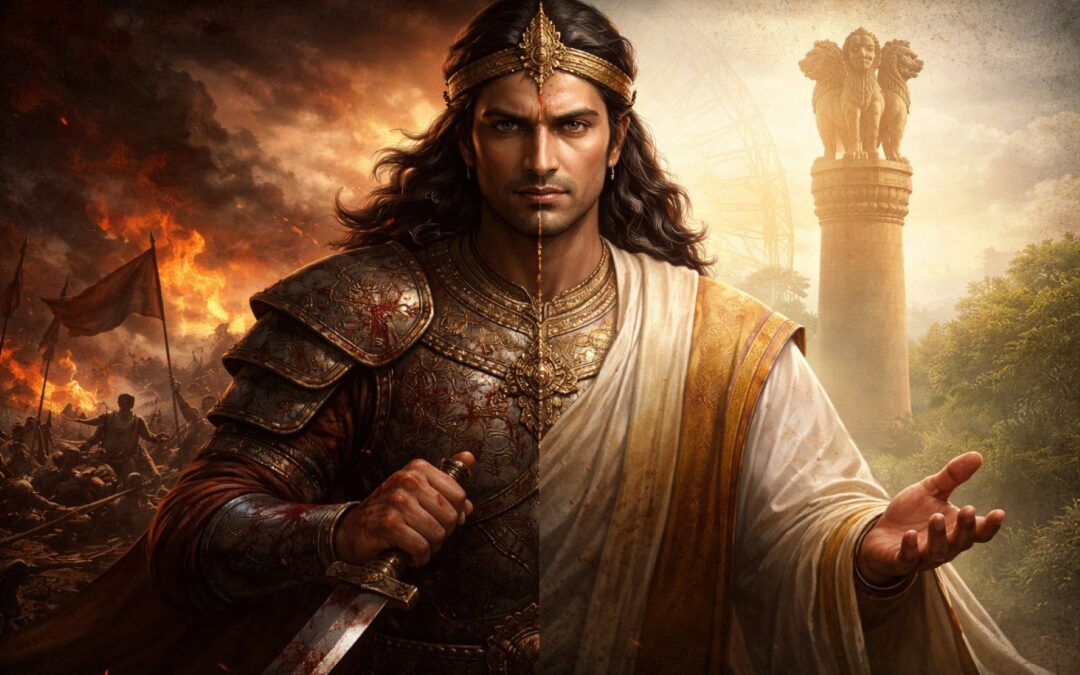
Introduction: The Emperor Who Became a Legend
Among the countless rulers who have risen and fallen across the vast landscape of history, very few have managed to transcend time itself. Names fade, empires crumble, and legacies are buried beneath the dust of centuries. But every once in a while, a figure emerges who refuses to disappear—whose story is retold, reshaped, and revered long after their empire has vanished. Ashoka is one such figure.
More than two thousand years after his death, Ashoka is not just remembered—he is institutionalized. His lion capital stands as the official emblem of modern India. The Ashoka Chakra, a symbol of law and motion, sits at the center of the Indian flag. In textbooks, political discourse, and public imagination, he is celebrated as one of the greatest rulers not just in Indian history, but in the history of the world.
The story we are told is powerful, almost cinematic in its moral clarity. A ruthless conqueror, drenched in blood, witnesses the horrors of his own making after the Kalinga War. Overcome with remorse, he renounces violence, embraces Buddhism, and dedicates his life to peace, compassion, and good governance. It is a story of redemption—of transformation so profound that it elevates Ashoka from a mere king to something close to a moral icon.
But history is rarely that simple.
When examined closely, the image of Ashoka begins to fracture. The clean arc of cruelty to compassion starts to blur. The sources that praise him also contradict him. The edicts that proclaim peace hint at coercion. The emperor who preached tolerance may not have always practiced it. And the transformation that defines his legend begins to look less like a moment of enlightenment and more like something far more calculated.
This raises an uncomfortable but necessary question:
Was Ashoka truly the enlightened ruler we believe him to be—or was he one of history’s most successful architects of his own image?
To answer that, we must move beyond the legend. We must strip away the layers of storytelling, political necessity, and historical simplification. And we must confront Ashoka not as a symbol, but as a man—ambitious, ruthless, reformist, contradictory.
Because only then can we begin to understand his true legacy.
The Popular Narrative: From Tyrant to Saint
If there is one version of Ashoka that has endured across centuries—repeated in textbooks, speeches, and popular history—it is the story of transformation. It is simple, powerful, and emotionally satisfying. And perhaps that is precisely why it has survived so unchallenged.
According to this widely accepted narrative, Ashoka began his reign as a man of extraordinary cruelty. Known as “Chandashoka”—Ashoka the Terrible—he is said to have ruled through fear, violence, and ruthless ambition. Tales describe an emperor who delighted in punishment, who crushed dissent without hesitation, and who saw conquest not as a necessity, but as a personal pursuit.
This phase of his life reaches its climax in the Kalinga War, one of the most significant military campaigns of his reign. Kalinga, a prosperous and strategically vital region on the eastern coast, resisted Mauryan expansion. Ashoka invaded—and won. But victory came at an unimaginable cost.
We are told that over 100,000 people were killed, and many more were displaced, enslaved, or left to suffer in the aftermath. The battlefield, according to the narrative, was a sea of corpses, grief, and devastation. And it was here, standing amidst the ruins of his own triumph, that Ashoka experienced a moment of profound awakening.
Overcome with remorse, he is said to have renounced violence entirely.
From that point onward, the story goes, Ashoka transformed into “Dharmashoka”—Ashoka the Righteous. He embraced Buddhism, rejected warfare, and committed himself to ruling through dhamma—a moral code centered on compassion, tolerance, and ethical governance. He promoted non-violence, supported religious harmony, built hospitals and roads, and worked tirelessly for the welfare of his people.
In this version of history, Ashoka becomes more than just a successful ruler. He becomes a symbol of what power should look like—restrained, moral, and guided by conscience. His story is not just about empire, but about redemption. It reassures us that even those capable of great destruction are also capable of profound change.
And that is precisely what makes this narrative so compelling.
It offers a rare kind of hope: that transformation is possible at any scale, even at the level of an emperor. That morality can emerge from violence. That history, often filled with conquest and cruelty, can still produce figures who rise above it.
But compelling stories are not always accurate ones.
Because as we begin to look closer—at timelines, at primary sources, at contradictions within Ashoka’s own inscriptions—the neat divide between Chandashoka and Dharmashoka starts to dissolve. The transformation begins to look less like a sudden moral awakening and more like something far more complex… and far more deliberate.
A Prince With Something to Prove
Long before he became an emperor—or a legend—Ashoka was a prince on the margins of power.
He was born around 304 BCE to Bindusara, the Mauryan emperor, and a woman named Subhadrangi. But even at the level of his birth, uncertainty creeps into the story. Some accounts claim that his mother was of Brahmin origin, while others suggest she was a low-caste woman—possibly even a royal hairdresser. The difference is not trivial. In a rigidly stratified society, lineage mattered. Legitimacy mattered. And stories about lineage were often rewritten to suit political needs.
If Ashoka’s maternal background was indeed humble, it would have placed him at a disadvantage from the very beginning. Even if it wasn’t, the existence of such conflicting narratives tells us something important: his origins were contested, and perhaps deliberately reshaped later.
Ashoka was not the natural heir to the throne. That position belonged to his half-brother Susima, the crown prince. In a royal court defined by hierarchy, alliances, and intrigue, this meant that Ashoka’s path to power was anything but straightforward. He was not groomed as the future emperor. He was, at best, an alternative.
Adding to this was his physical appearance. Historical descriptions portray Ashoka as short, stocky, and physically unattractive, with a disfigured face and rough skin. Whether exaggerated or not, such accounts suggest that he did not fit the traditional image of a king. In a world where rulers were expected to embody both physical and moral superiority, this would have mattered—not just politically, but psychologically.
It is not difficult to imagine the effect this combination might have had:
questionable maternal lineage, lack of succession rights, and perceived physical inadequacy.
These are not just biographical details. They are pressures. And pressures, over time, shape ambition.
What Ashoka may have lacked in conventional royal advantage, he compensated for in other ways. Sources consistently describe him as intelligent, assertive, and capable—a natural leader with a strong will. Bindusara himself, despite any reservations, recognized this. Instead of grooming him as heir, he used him where he was most valuable: as a problem-solver.
When the strategically crucial city of Taxila erupted in rebellion, it was Ashoka who was sent to restore order. The city was volatile, populated by diverse groups including Greeks and Persians, and sat at the edge of imperial control. Handling such a situation required more than brute force—it required authority, decisiveness, and adaptability.
Ashoka succeeded.
The details of how he suppressed the rebellion are unclear, but the outcome is not. He returned victorious, and in reward, he was appointed viceroy of Ujjain, one of the empire’s most important administrative centers. There, he continued to demonstrate competence in governance, earning the respect of key ministers in the royal court.
And this is where the dynamic begins to shift.
Ashoka was no longer just a sidelined prince. He was a proven administrator, a capable leader, and increasingly, a viable alternative to the designated heir. Whispers within the court began to reflect this possibility. Some ministers started to see in Ashoka not just potential—but preference.
For Ashoka himself, this would have been a turning point.
Because opportunity, once recognized, has a way of transforming ambition into action.
And in the Mauryan court, where power was rarely transferred peacefully, recognizing an opportunity often meant preparing to take it—by whatever means necessary.
Power Through Blood: The Violent Rise to the Throne
If Ashoka’s early life was defined by disadvantage and ambition, his ascent to power was defined by something far more brutal—decisive, calculated violence.
The turning point came in 272 BCE, when Emperor Bindusara fell gravely ill. In any monarchy, the death of a ruler creates uncertainty. But in the Mauryan Empire, where multiple princes had claims to power and the stakes were immense, it created something far more dangerous: a race for survival disguised as a succession.
Ashoka understood this.
While his half-brother Susima, the rightful heir, rushed back to the capital of Pataliputra, Ashoka moved faster. By the time Susima arrived, Ashoka had already taken control of the city. This alone suggests not just speed, but preparation—alliances secured, loyalties ensured, and a clear plan of action already in motion.
Susima did not surrender. He laid siege to the capital, attempting to reclaim what he saw as his rightful throne. But the conflict was short-lived. Accounts indicate that Susima was captured and killed—possibly by Greek mercenaries in Ashoka’s service. Some sources go further, describing a grim execution in which he was thrown into a burning pit of charcoal.
Whether embellished or not, the message is unmistakable:
Ashoka did not hesitate to eliminate his primary rival.
But securing the capital was only the beginning.
What followed was not a smooth transition of power, but a prolonged and violent consolidation. For nearly four years, Ashoka engaged in what can only be described as a civil war within the royal family. One by one, his brothers—anyone with a plausible claim to the throne—were hunted down and killed.
This was not incidental violence. It was systematic.
Ashoka reportedly spared only one sibling, his younger brother Tissa. Everyone else who stood between him and uncontested rule was removed. By the time the bloodshed ended, there were no serious challengers left.
Only then was Ashoka formally crowned emperor.
Even in his regnal identity, there is an interesting detail. He chose the name “Priyadarshi”, often translated as “He who is pleasant to behold” or “Beloved of the Gods.” Given the historical descriptions of his appearance—and the violence that marked his rise—the choice is almost ironic. But it is also revealing.
Because names, like narratives, can be tools.
By the time Ashoka ascended the throne, he had already demonstrated a clear pattern:
- He was willing to act decisively
- He was willing to use force
- And most importantly, he was willing to shape perception
The image of a righteous, compassionate ruler had not yet emerged. At this stage, Ashoka was something else entirely—a man who had fought his way to the top in a system where mercy was a liability.
And in doing so, he had established the foundation of his rule:
power, secured not by legitimacy alone, but by elimination.
Chandashoka: The Emperor of Fear
By the time Ashoka secured the throne, he was not just an emperor—he was a man whose reputation had already begun to precede him.
That reputation was not one of wisdom or compassion.
It was one of fear.
In the early years of his reign, Ashoka came to be known as “Chandashoka”—Ashoka the Terrible. The name itself is telling. It reflects not just isolated acts of cruelty, but a broader perception: that this was a ruler who governed through intimidation, punishment, and an almost theatrical display of power.
The stories that surround this phase of his rule are disturbing, even by the standards of ancient monarchies.
Some accounts describe incidents in which Ashoka reacted with extreme violence to personal slights. In one such tale, women in his harem allegedly mocked his appearance. His response, according to later texts, was to have them burned alive. Whether exaggerated or not, such stories persisted for a reason—they aligned with the image of a ruler who demanded absolute authority, not just in governance, but in perception.
But the most infamous symbol of his cruelty was something far more structured:
a place known as “Ashoka’s Hell.”
This was not metaphorical. It was, according to multiple historical sources, a purpose-built torture facility. Ashoka is said to have appointed a man named Girika, described as sadistic and ruthless, to oversee it. The facility was designed to inflict suffering—systematically, efficiently, and without restraint.
Prisoners brought into this space were subjected to extreme forms of torture and execution. The intention was not merely punishment, but deterrence. It sent a clear message to anyone who might consider dissent: this is what awaits you.
What makes this even more unsettling is the claim that Ashoka himself took an active interest in the place. Some accounts suggest that he would spend hours observing the proceedings, watching the suffering unfold.
Again, it is important to approach such descriptions with caution. Ancient sources often blend fact with moral storytelling. But even if we discount exaggeration, the consistency of these narratives across different traditions suggests that Ashoka’s early rule was indeed marked by severity, if not outright brutality.
And this raises a critical question.
If Ashoka was capable of creating and sustaining such a system—if he was comfortable with violence not just as a tool, but as an instrument of control—then what exactly changed after Kalinga?
Because the popular narrative asks us to believe that a man who oversaw institutionalized torture, who eliminated his own brothers, and who ruled through fear… suddenly transformed into a model of compassion after witnessing a single battlefield.
It is not impossible.
But it is worth questioning.
Because before Ashoka became a symbol of peace, he had already spent years cultivating something else entirely:
an empire built on fear, and a reputation that ensured it worked.
The Kalinga War: Turning Point or Political Theater?
If there is one moment that defines Ashoka’s legacy—one event that transforms him from a feared conqueror into a moral icon—it is the Kalinga War.
In the traditional narrative, this is the turning point. The moment where everything changes.
Kalinga was no ordinary territory. Located along the eastern coast, it was a prosperous and strategically vital region, controlling key trade routes and maintaining a strong sense of independence. Unlike many other regions that had fallen under Mauryan control, Kalinga resisted. And for Ashoka, that resistance was unacceptable.
The campaign that followed was devastating.
According to Ashoka’s own inscriptions, the war resulted in over 100,000 deaths, with another 150,000 people deported or forced into labor. Entire communities were uprooted. Families were shattered. The scale of destruction was immense, even by the standards of ancient warfare.
And it is here—amidst this devastation—that the story takes its most dramatic turn.
We are told that Ashoka, surveying the aftermath of his victory, was overcome with grief. The sight of the dead, the suffering of the survivors, and the realization of what he had done struck him with such force that it changed him fundamentally. In that moment, he is said to have renounced violence, embraced the teachings of Buddhism, and committed himself to a new way of ruling—one based on dhamma, or moral law.
It is a powerful image:
the conqueror brought to his knees not by defeat, but by conscience.
From this point onward, the narrative presents Ashoka as a transformed ruler. No more wars of expansion. No more unnecessary violence. Instead, a focus on welfare, ethics, and the spiritual well-being of his people. The Kalinga War becomes not just a military event, but a moral awakening—the defining pivot of his life.
But when we look more closely, the clarity of this turning point begins to blur.
Because while the scale of the war is not in doubt, the story of what followed is far less certain.
Ashoka’s own edicts—the primary sources from his reign—do mention regret. They speak of sorrow for the suffering caused, particularly to the families of those affected. But they do not describe a dramatic, immediate transformation. They do not depict a moment of sudden enlightenment on the battlefield.
Instead, they present something more measured. More restrained. Almost… curated.
And then there are the silences.
In the regions of Kalinga itself—the very land that bore the brunt of the war—there is a notable absence of explicit apology or repentance in the inscriptions. The language that speaks of remorse appears elsewhere, far from the people who suffered most.
This raises an uncomfortable possibility.
What if the Kalinga War was not the moment Ashoka changed—but the moment he needed to appear changed?
By this stage of his reign, Ashoka had already secured his empire. Further expansion was becoming increasingly difficult, especially with resistance from southern kingdoms. His reputation, meanwhile, had been shaped by years of violence. The name “Chandashoka” was not just a label—it was a problem.
In this context, the idea of transformation takes on a different dimension.
Not just as a moral shift—but as a strategic one.
Because a ruler who can no longer expand through conquest must find other ways to maintain control. And few tools are more powerful than moral authority.
So the question becomes:
Was the Kalinga War truly the moment Ashoka renounced violence… or was it the moment he began rewriting the story of who he was?
The Problem With the Transformation Story
The story of Ashoka’s transformation after the Kalinga War is elegant, powerful—and increasingly difficult to reconcile with the historical record.
At first glance, the narrative seems straightforward: a brutal conqueror witnesses the horrors of war, repents, and becomes a champion of peace. But when we begin to examine the timeline, inscriptions, and contradictions within Ashoka’s own edicts, the simplicity of that story begins to unravel.
The first and most significant issue lies in chronology.
Ashoka did not convert to Buddhism after the Kalinga War.
His own inscriptions indicate that he was already a lay follower of Buddhism several years before the war. In fact, he appears to have become more devout in the years leading up to the campaign. This immediately complicates the idea that Kalinga triggered his spiritual awakening. If he was already aligned with Buddhist teachings—teachings that emphasize non-violence—then why launch one of the bloodiest military campaigns of his reign afterward?
The transformation, in other words, was not as sudden or as clean as the narrative suggests.
Then there is the issue of what the edicts actually say—and where they say it.
Ashoka’s inscriptions do express a form of regret. They acknowledge the suffering caused by the war and the pain inflicted on families. But this expression is carefully framed. It is not a full admission of wrongdoing, nor does it resemble a personal confession. It reads more like a measured statement of concern, the kind a ruler might make to reassure his subjects.
More telling, however, is the geographical distribution of these messages.
In the regions far from Kalinga, Ashoka’s edicts emphasize remorse and moral reflection. But within Kalinga itself—the land that experienced the devastation—there is a conspicuous absence of such language. There is no direct apology to the people who suffered most. No explicit acknowledgment of responsibility.
If the transformation was genuine and profound, this silence is difficult to explain.
But if the message was intended for a broader imperial audience—for subjects whose loyalty needed to be maintained—it begins to make more sense.
There are other inconsistencies as well.
In some inscriptions, Ashoka expresses regret for the suffering caused by conquest. In others, he makes it clear that he remains fully capable of using force when necessary. There are even statements suggesting that rebellious or “problematic” groups—such as forest tribes—could face consequences similar to those inflicted upon Kalinga.
This is not the language of a ruler who has renounced violence entirely.
It is the language of a ruler who is reframing violence—not abandoning it.
And then there is perhaps the most revealing detail of all:
Ashoka himself acknowledges that his inscriptions are not always consistent. In one edict, he admits that differences in wording between similar messages are due to political considerations.
This is a remarkable admission.
It suggests that the edicts—often treated as direct reflections of Ashoka’s beliefs—were also tools of governance. They were crafted, adjusted, and deployed with intent. They were not just moral declarations; they were instruments of communication, designed to shape perception across a vast and diverse empire.
When viewed through this lens, the transformation story begins to look less like a spontaneous moral awakening and more like a carefully constructed narrative.
A narrative that served a purpose.
By the time of the Kalinga War, Ashoka had already established control over most of his empire. Further expansion was limited. His reputation for cruelty was well known. And maintaining stability across such a large territory required more than fear—it required legitimacy.
What better way to achieve that than by presenting himself as a ruler who had seen the error of his ways?
A ruler who now governed not through conquest, but through dhamma—a moral framework that encouraged obedience, harmony, and social order.
In this sense, the transformation was not necessarily false—but it may not have been what we think it was.
It was not a rejection of power.
It was a redefinition of it.
Managing an Empire: Stability at a Cost
Stripped of legend and moral storytelling, one fact about Ashoka’s reign remains undeniably impressive:
he ruled a vast and diverse empire for nearly four decades—and kept it largely stable.
This was no small achievement.
The Mauryan Empire at its height stretched across most of the Indian subcontinent, encompassing a mosaic of cultures, languages, religions, and local power structures. Governing such a territory required more than military strength. It required administrative control, coordination, and constant oversight.
Ashoka delivered that stability—but not without consequence.
At the heart of his governance model was an increasingly centralized bureaucracy. Authority flowed downward from the emperor, and the machinery of the state expanded significantly under his rule. Officials were appointed across regions to oversee administration, enforce policy, and ensure compliance with imperial directives.
Among the most distinctive elements of this system were the Dhamma Mahamatras.
These officials were tasked with a broad and somewhat ambiguous mission: to promote dhamma—Ashoka’s moral and social code—throughout the empire. On the surface, their role appears benevolent. They were meant to ensure the welfare of the people, encourage ethical behavior, and mediate conflicts.
But in practice, their reach was extensive—arguably intrusive.
The Dhamma Mahamatras operated across all levels of society. They interacted with soldiers, local chiefs, religious communities, households, and even the most vulnerable segments of the population. They inspected local institutions, monitored conduct, and were empowered to intervene where they deemed necessary.
This was not just governance.
It was moral administration.
And moral administration, by its nature, blurs the line between guidance and control.
These officials could reward behavior that aligned with dhamma, but they could also punish actions that violated it. The problem, however, was that dhamma itself was not always clearly defined. It was a flexible, evolving concept—shaped largely by the emperor’s own interpretation.
This gave the state a significant degree of discretionary power.
What constituted “proper conduct”?
What qualified as a transgression?
And who decided?
In a system where such questions are left open, enforcement tends to become uneven—and often arbitrary.
To sustain this structure, Ashoka expanded the imperial apparatus on a massive scale. Tens of thousands of officials were employed to manage the empire’s operations, enforce policies, and maintain order. This created a network of governance that extended deep into everyday life.
From one perspective, this was a sign of sophistication—a ruler attempting to create a cohesive and orderly society across vast distances.
From another, it was something else entirely:
a system that relied not just on authority, but on constant supervision.
Because stability, at this scale, rarely comes from trust alone.
It is maintained through systems that ensure compliance—systems that observe, regulate, and intervene.
Ashoka’s empire did not descend into chaos during his lifetime. That much is clear. But the stability he achieved was not organic. It was engineered—carefully, deliberately, and at considerable cost.
And as with any system built on extensive control, the real question is not how well it functions in the presence of a strong ruler… but how well it survives without one.
The Burden of Control: Corruption and Economic Strain
The system that allowed Ashoka to maintain stability across his vast empire was, in many ways, its greatest strength.
It was also its greatest weakness.
A heavily centralized state, supported by an expansive bureaucracy, can impose order with remarkable efficiency—but it comes at a cost. And in Ashoka’s case, that cost was both economic and structural.
To sustain the machinery of governance, the empire required resources—substantial ones. The growing network of officials, administrators, inspectors, and moral overseers had to be funded. Salaries had to be paid. Operations had to be maintained. And as the bureaucracy expanded, so too did its appetite.
The Dhamma Mahamatras alone are believed to have consumed a significant portion of state revenue, with some estimates suggesting that maintaining them accounted for nearly a quarter of total tax income.
This is not a minor expense.
It represents a system where a large share of economic output is diverted not toward production or trade, but toward administration. And while administration is necessary, excessive administrative overhead can become a burden—particularly when it begins to outpace the economic activity it is meant to regulate.
Compounding this issue was the nature of recruitment within the bureaucracy.
Ashoka’s system was not built on strict meritocracy. Many officials were drawn from existing noble families or selected through networks of influence, wealth, and connection. This was not unusual for the time—but it had predictable consequences.
When positions of authority are distributed based on status rather than competence, inefficiency tends to follow. And where there is inefficiency, there is often corruption.
Local officials, empowered with significant authority and operating far from the imperial center, had opportunities to exploit their positions. They could interpret dhamma as they saw fit, impose penalties selectively, and extract benefits under the guise of governance.
In theory, the system was designed to promote welfare and ethical conduct.
In practice, it risked becoming self-serving.
This creates a familiar pattern—one that has appeared in many centralized states throughout history:
- A growing bureaucracy requires increased revenue
- Increased revenue demands higher taxation or tighter control
- Higher pressure on local populations leads to dissatisfaction
- Officials, operating with broad discretion, begin to prioritize personal gain
Over time, the system becomes top-heavy—stable on the surface, but increasingly strained beneath it.
There are also indications that Ashoka’s economic policies may have contributed to this imbalance. The Mauryan focus appears to have leaned heavily toward agricultural development, with less emphasis on expanding trade networks or fostering commercial dynamism. While agriculture provides a stable foundation, an underdeveloped trade sector can limit overall economic growth—especially in a large and diverse empire.
And then there is the most telling piece of evidence:
What happened after Ashoka’s death.
Within a relatively short period, the Mauryan Empire began to fragment. Regions that had been held together under centralized authority declared independence. Kingdoms such as the Satavahanas in the south and the Kalingas in the east reasserted themselves.
This rapid disintegration suggests something important.
The stability of Ashoka’s empire may have depended less on the strength of its institutions—and more on the presence of the ruler himself.
In other words, it was a system that worked because he was there.
But systems built this way often struggle to outlive their architects.
Because when control is concentrated at the top, and when the machinery of governance is too heavy to sustain itself, the moment that central authority weakens… the entire structure begins to give way.
Religion and Power: The Spread of Buddhism
If Ashoka’s political legacy is debated—his administrative system questioned, his transformation scrutinized—there is one area where his impact is far clearer, far more enduring, and far more consequential:
religion.
Ashoka was not the founder of Buddhism. The teachings of the Buddha had already been spreading across parts of the subcontinent for generations. But what Ashoka did was something different.
He amplified Buddhism.
He took what had been a regional spiritual movement and helped propel it onto the global stage.
Under Ashoka, Buddhism received unprecedented state support. He sponsored the construction of stupas and monasteries, supported monastic communities, and integrated Buddhist ethical principles into his broader concept of dhamma. His inscriptions frequently reference moral conduct, compassion, restraint, and respect for all life—values that align closely with Buddhist teachings, even when they are presented in a more universal, non-sectarian form.
But Ashoka’s most significant contribution was not domestic.
It was missionary.
According to historical accounts, Ashoka actively sent Buddhist emissaries beyond the borders of his empire—to regions as far as Sri Lanka, Central Asia, the Hellenistic world, and possibly even Egypt and Greece. These were not casual exchanges. They were organized efforts to spread a set of ideas across cultural and political boundaries.
One of the most important of these missions was to Sri Lanka, traditionally attributed to Ashoka’s son Mahinda. This event is often seen as a turning point in Sri Lankan history, where Buddhism took root and eventually became a defining feature of the island’s identity. From there, Sri Lanka would later serve as a base for further dissemination into Southeast and East Asia.
In this sense, Ashoka’s influence extended far beyond his own lifetime—and far beyond his own empire.
Because while the Mauryan political structure eventually collapsed, the religious network he helped nurture continued to grow.
It is not unreasonable to suggest that without Ashoka’s patronage, Buddhism might have remained a relatively localized tradition—one among many competing schools of thought in ancient India. Instead, it evolved into one of the world’s major religions, shaping cultures, philosophies, and societies across continents.
There is also evidence that Ashoka, at least at the level of official policy, promoted religious tolerance.
His edicts encourage mutual respect between different sects and traditions. He speaks of honoring all religious paths, discouraging unnecessary conflict, and fostering harmony among diverse communities. In a period marked by frequent tensions between religious groups, this emphasis on coexistence stands out.
But as with many aspects of Ashoka’s reign, the picture is not entirely straightforward.
Because while his policies promote tolerance, his actions do not always seem to align perfectly with that ideal.
And that tension—between what was preached and what was practiced—is where the story becomes more complicated.
Contradictions in Tolerance: Violence in the Name of Faith
On the surface, Ashoka’s religious policy appears remarkably progressive.
His edicts speak of harmony between sects, mutual respect, and the importance of restraint in religious disputes. He advises his subjects not to glorify their own traditions at the expense of others, and instead to seek understanding across differences. In an era where religious disagreements could—and often did—escalate into conflict, this message stands out.
It is one of the key reasons Ashoka is often seen as a pioneer of religious tolerance.
But as with many aspects of his legacy, the reality is more complicated.
Because alongside these declarations of tolerance are accounts—drawn from various historical sources—that suggest a very different pattern of behavior.
One of the most striking examples involves the Ajivikas, a religious sect that coexisted with Buddhists, Jains, and other traditions in ancient India. According to certain records, Ashoka ordered the execution of 18,000 Ajivikas in response to what was considered an offensive depiction of the Buddha.
This was not a minor incident.
It was a large-scale act of violence directed at a religious group—carried out by a ruler who, at least in his own inscriptions, was advocating for tolerance and restraint.
There are similar accounts involving the Jains. In one case, a Jain is said to have created an image that offended Buddhist sensibilities. Ashoka’s response, according to these sources, was severe: the individual and his family were reportedly burned alive. In the aftermath, a bounty was allegedly placed on the heads of Jains—one silver coin for each head brought to the authorities.
The violence, it is said, continued until a tragic mistake was made—when Ashoka’s own brother, Tissa, was killed as a result of the policy.
Even if we approach these accounts with caution—recognizing that some may be exaggerated or shaped by later narratives—they point to a recurring theme:
Ashoka’s tolerance may not have been absolute.
There is also the question of how his policies affected other religious traditions, particularly Hindu practices of the time. Ashoka is known to have restricted or discouraged certain rituals, including forms of animal sacrifice that were integral to many communities. While these measures align with Buddhist principles of non-violence, they also represent a form of state intervention in religious life.
From one perspective, this can be seen as reform.
From another, it can be seen as imposition.
And this tension—between moral guidance and coercion—runs through much of Ashoka’s reign.
It suggests that his version of tolerance may have been conditional. That respect for other traditions existed within certain boundaries—but those boundaries were defined by the state, and ultimately, by the emperor himself.
This is not entirely surprising.
After all, Ashoka was not just a spiritual figure. He was a ruler. And rulers, regardless of their ideals, operate within the realities of power. They make decisions not only based on belief, but on control, stability, and authority.
In that context, promoting a dominant moral framework—whether labeled as dhamma or otherwise—can serve both ethical and political purposes.
So the contradiction is not necessarily that Ashoka preached tolerance but practiced intolerance.
It is that his tolerance appears to have been strategic.
Encouraged when it supported social harmony.
Enforced when it aligned with his vision.
And overridden when it threatened his authority or his preferred order.
Which brings us back to a recurring theme in Ashoka’s legacy:
Not a simple story of moral evolution—but a complex interplay between belief, power, and control.
Reform, Welfare, and Governance
For all the contradictions, there is another side to Ashoka’s rule—one that cannot be dismissed.
Beyond conquest, propaganda, and control, Ashoka also presents himself—and is often remembered—as a reformist ruler. A king who did not merely govern, but sought to improve the conditions of life within his empire.
In many ways, this is where his legacy becomes most recognizable in modern terms.
Ashoka introduced a number of legal and administrative reforms that, for their time, were notably progressive. One such reform involved the treatment of prisoners. Individuals sentenced to death were reportedly granted a period of time to appeal their cases or settle personal matters before execution. This may seem minimal by modern standards, but in the context of ancient justice systems, it reflects an attempt to temper punishment with consideration.
He also promoted animal welfare, an area rarely associated with ancient state policy. Ashoka’s edicts speak of restrictions on animal slaughter, the creation of wildlife preserves, and measures to reduce cruelty. These policies align closely with his broader emphasis on compassion—but they also suggest an effort to extend governance beyond human society, into the ethical treatment of living beings more broadly.
There are also indications that Ashoka supported women’s education.
His inscriptions suggest that women were encouraged to pursue learning, and provisions were made to facilitate this. While the scale and implementation of such initiatives are difficult to verify, the intent itself is significant. It reflects a ruler willing to challenge certain social norms—or at least expand opportunities within them.
Then there is infrastructure.
Ashoka describes himself as a builder. His edicts reference the construction of roads, hospitals, rest houses, water reservoirs, and irrigation systems. These projects would have had tangible benefits—improving mobility, supporting agriculture, and enhancing public welfare.
At first glance, this paints a picture of a ruler deeply invested in the well-being of his subjects.
But here, too, a more careful evaluation is necessary.
Because while these reforms and projects are often presented as evidence of exceptional governance, we must ask a simple question:
Were they truly exceptional—or were they expected?
Ashoka ruled for nearly 38 years. Over such a long period, it would be unusual for any emperor not to invest in infrastructure or introduce administrative measures. Roads, irrigation systems, and public works are not unique to Ashoka—they are fundamental to sustaining any large empire.
Without a clear point of comparison, it becomes difficult to determine whether his contributions were extraordinary… or simply part of the job.
This does not diminish the value of what he did.
But it does place it in context.
Because when evaluating a ruler’s legacy, it is not enough to list achievements. We must also consider the baseline expectations of their role—and whether they exceeded them in a meaningful way.
There is also the question of effectiveness.
Archaeological evidence from periods following Ashoka’s death suggests that material prosperity may have actually increased in the generations after his reign. This raises the possibility that despite his reforms and infrastructure projects, the Mauryan economy under Ashoka was not necessarily at its peak.
If true, it complicates the narrative further.
It suggests that a ruler can implement reforms, promote welfare, and still preside over a system that is economically strained or inefficient.
Which brings us back to the central challenge of evaluating Ashoka:
He was not a simple figure.
He was a ruler who could be both reform-minded and heavy-handed.
Both progressive in certain policies and restrictive in others.
Both concerned with welfare and reliant on control.
And understanding his legacy requires holding all of these truths at once.
The Empire After Ashoka: A Fragile Legacy
If the true strength of a ruler lies not just in how they govern, but in what they leave behind, then the most revealing chapter of Ashoka’s story begins after his death.
Because empires, unlike individuals, do not disappear overnight.
They weaken. They fragment. They unravel—often exposing the structural realities that were hidden during the lifetime of a powerful ruler.
In Ashoka’s case, that unraveling was remarkably swift.
Within just a few decades of his death, the Mauryan Empire began to disintegrate. Regions that had once been tightly held under centralized authority started to break away. Local powers reasserted themselves. The cohesion that had defined the empire during Ashoka’s reign gave way to fragmentation.
In the south, emerging kingdoms such as the Satavahanas began to establish independence. In the east, Kalinga—the very region whose conquest had defined Ashoka’s legacy—reclaimed its autonomy. Other areas followed suit, gradually eroding what had once been one of the largest political entities in the ancient world.
This was not a slow decline over centuries.
It was a relatively rapid collapse.
And that raises a critical question:
Why did an empire that appeared so stable under Ashoka fail to endure beyond him?
One possible explanation lies in the nature of the system he built.
As we have seen, Ashoka’s governance relied heavily on centralized control. Authority was concentrated at the top, and the machinery of administration extended deep into the lives of his subjects. The system functioned effectively while Ashoka was present—while there was a strong, active ruler to oversee, direct, and enforce it.
But such systems often face a fundamental challenge:
They are dependent on the ruler.
When the central figure is removed, the balance begins to shift. Local officials, once bound by strict oversight, gain more autonomy. Regional leaders test the limits of their independence. The bureaucracy, already heavy and resource-intensive, becomes harder to sustain without strong coordination.
In Ashoka’s case, there is little evidence of a robust succession plan or institutions capable of maintaining cohesion without him. His successors lacked his authority, his experience, and perhaps his ability to manage the complexities of such a vast empire.
The result was predictable.
What had been held together through a combination of control, administration, and personal leadership began to come apart.
This does not mean that Ashoka failed as a ruler.
During his lifetime, he achieved something significant: decades of stability across a massive and diverse territory. But the durability of that stability is another matter entirely.
Because lasting empires are not just built on control—they are built on resilient structures.
Structures that can function independently of any single individual. Structures that can adapt, evolve, and endure beyond the reign of their founders.
The Mauryan Empire, under Ashoka, appears to have lacked that kind of resilience.
And in that sense, his legacy reveals a paradox:
He was powerful enough to hold an empire together… but not to ensure that it stayed together after he was gone.
Ashoka’s Greatest Achievement: Religion Over Rule
If we step back from the political narrative—set aside questions of governance, bureaucracy, and imperial stability—and ask a simpler question:
What did Ashoka leave behind that actually lasted?
The answer becomes strikingly clear.
Not his empire.
Not his administrative system.
Not even his political model.
What endured was something else entirely.
Religion.
While the Mauryan Empire fragmented within decades of his death, the religious movement Ashoka supported continued to expand—crossing borders, shaping cultures, and influencing millions across centuries. In terms of long-term impact, his role in the spread of Buddhism stands above everything else.
This is not a minor achievement.
Through state patronage, missionary efforts, and ideological support, Ashoka helped transform Buddhism from a regional philosophy into a transnational force. His efforts in regions like Sri Lanka created footholds that would later become centers of Buddhist learning and dissemination. From there, the religion spread further—to Southeast Asia, East Asia, and beyond.
In time, Buddhism would influence entire civilizations—shaping art, philosophy, ethics, and governance across vast parts of the world.
And this is where Ashoka’s legacy takes on a different dimension.
Because while his political system struggled to survive him, his cultural and religious influence did not.
In fact, it grew stronger.
This contrast is important.
It suggests that Ashoka’s greatest strength may not have been in building institutions or sustaining an empire—but in recognizing the power of ideas. Ideas, unlike political structures, do not depend on centralized authority. They do not collapse when a ruler dies. They travel, adapt, and persist.
In promoting dhamma—whether as a sincere moral framework or as a tool of governance—Ashoka tapped into something far more durable than political control.
He aligned himself with a philosophical movement that could outlive him.
And in doing so, he ensured that his name would outlive his empire.
But this also reframes how we evaluate him.
If Ashoka is remembered primarily because of his role in spreading Buddhism, then his greatness may lie less in his success as a ruler and more in his impact as a cultural catalyst.
A figure who, intentionally or otherwise, helped shape the trajectory of a major world religion.
This does not diminish his political achievements—but it does put them into perspective.
Because in the long arc of history, empires rise and fall with remarkable regularity.
Ideas do not.
And Ashoka, more than perhaps any other ruler of his time, understood—or at least capitalized on—that difference.
Why Ashoka Was Chosen as India’s Symbol
Given the contradictions in his legacy—the violence, the propaganda, the fragile empire—it is worth asking:
Why is Ashoka the face of India today?
Why not another ruler?
Why not a more unambiguously successful emperor, or a figure with a longer-lasting political legacy?
The answer lies not just in history—but in modern necessity.
When India gained independence in 1947, its leaders faced an immense challenge. They were not simply inheriting a country—they were building a nation. A nation composed of extraordinary diversity: languages, religions, ethnicities, regional identities, and historical experiences that often diverged more than they converged.
What they needed was not just governance.
They needed a unifying symbol.
Ashoka fit this requirement almost perfectly.
First, he ruled over one of the largest territorial expanses in Indian history. His empire, at its peak, covered a vast portion of the subcontinent. This made him a convenient historical anchor for the idea of a geographically unified India—a concept that did not always exist in a political sense.
Second, his association with a dharmic tradition—Buddhism—aligned well with the cultural and philosophical heritage that modern India sought to emphasize. Buddhism, while no longer dominant within India, originated there and carried with it themes of compassion, non-violence, and ethical living—values that resonated strongly with the vision of a newly independent nation.
Third, and perhaps most importantly, Ashoka’s image—at least the popular version of it—was ideologically useful.
The story of a powerful ruler who renounced violence and embraced peace mirrors, in many ways, the ideals associated with India’s independence movement. Figures like Gandhi had already elevated non-violence to a central principle of political identity. Ashoka, reimagined as a ruler who underwent a similar transformation, became a historical precursor to that philosophy.
In this sense, Ashoka was not just a figure from the past.
He was a bridge—connecting ancient history to modern values.
The symbols associated with him reinforced this connection.
The Lion Capital of Ashoka, adopted as India’s national emblem, represents authority, power, and continuity. The Ashoka Chakra, placed at the center of the national flag, symbolizes law, motion, and moral order. These are not arbitrary choices. They reflect a deliberate effort to root modern identity in a carefully selected version of history.
But that is the key point:
a carefully selected version.
Because the Ashoka that serves as a national symbol is not the complex, contradictory figure we have been examining. He is a refined version—one that emphasizes tolerance, morality, and unity, while downplaying or omitting the more uncomfortable aspects of his reign.
This is not unique to India.
All nations engage in some degree of historical simplification. They highlight certain figures, reinterpret others, and construct narratives that serve present needs. History, in this sense, is not just about the past—it is also about how the present chooses to remember it.
Ashoka’s elevation, then, tells us as much about modern India as it does about ancient history.
It reflects a desire for unity in diversity.
For moral authority over mere power.
For a narrative that brings together a fragmented past into a coherent identity.
And in that role, Ashoka—regardless of his complexities—remains uniquely effective.
As long as we remember that the symbol is not the whole story.
Conclusion: Great Emperor or Master of Image?
So where does that leave us?
Was Ashoka truly one of history’s greatest rulers—a man who rose above violence to embrace a higher moral path? Or was he something else entirely: a calculating emperor who understood the power of narrative, and used it to reshape how he would be remembered?
The answer, perhaps unsurprisingly, lies somewhere in between.
Ashoka was not a simple figure, and any attempt to reduce him to one risks missing the very thing that makes his story so compelling. He was, at different points in his life, both ruthless and reformist, both pragmatic and ideological, both a conqueror and a communicator.
He rose to power through violence—eliminating rivals, consolidating authority, and ruling with a reputation that inspired fear. That part of his story is difficult to ignore, and even harder to reconcile with the image of the compassionate ruler he later projected.
At the same time, he was not merely a tyrant.
He governed a vast empire for decades with relative stability. He introduced reforms that, in many respects, were forward-thinking. He promoted ideas of welfare, restraint, and ethical conduct in a political environment where such concerns were often secondary. And most importantly, he played a decisive role in the spread of Buddhism—an impact that would echo across continents and centuries.
But it is in the space between these two realities that Ashoka becomes truly interesting.
Because the transformation that defines his legacy—whether genuine, exaggerated, or strategically framed—reveals something deeper about power itself.
Power is not only exercised through force.
It is also exercised through perception.
Ashoka appears to have understood this.
His edicts were not just expressions of belief; they were tools of communication. His emphasis on dhamma was not just a moral framework; it was also a means of governance. His narrative of repentance, whether fully sincere or partially constructed, helped redefine his image at a time when he no longer needed to expand through conquest.
In that sense, Ashoka may not have abandoned power.
He may have evolved it.
From physical domination to moral authority.
From fear to legitimacy.
From conquest to narrative.
And perhaps that is his greatest achievement—not that he became a different man, but that he became a different kind of ruler.
The Ashoka we remember today is not just the product of his actions, but of how those actions were interpreted, recorded, and ultimately selected by history.
Which brings us back to the question we began with.
Was Ashoka great?
If greatness is measured by moral purity, the answer is uncertain.
If it is measured by political durability, the answer is mixed.
But if it is measured by lasting influence—by the ability to shape ideas, identity, and memory across millennia—then the answer becomes much clearer.
Ashoka was not just a ruler of an empire.
He was a ruler of narrative.
And that may be why, more than two thousand years later, his legacy still stands—polished, debated, and very much alive.