
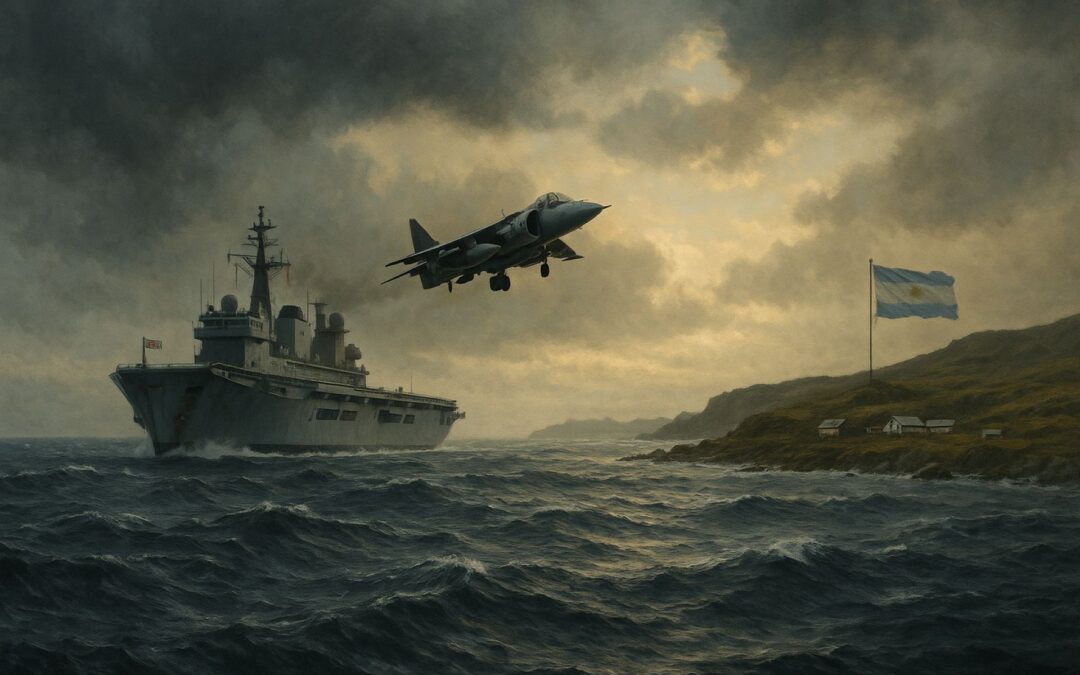
Introduction: A War at the Edge of the World
In the vast emptiness of the South Atlantic Ocean, nearly 500 kilometers east of Argentina’s coast, lie a group of windswept islands that few people outside the region had heard of for most of modern history. The Falkland Islands are cold, remote, and sparsely populated—home to more sheep than people and surrounded by stormy seas that make access difficult even today. Yet in 1982 these isolated islands became the center of one of the most dramatic military conflicts of the late twentieth century.
The Falklands War lasted only ten weeks, but it involved one of the world’s leading naval powers projecting military force across 8,000 miles of ocean to reclaim territory seized by a regional military dictatorship. The conflict brought Britain and Argentina into direct combat in a modern war fought with submarines, missile-equipped aircraft, naval task forces, and professional infantry units battling across rugged terrain.
At its core, however, the war was not simply about military strategy. It was the culmination of more than two centuries of competing claims, imperial rivalry, and national identity. Britain and Argentina each believed they possessed legitimate sovereignty over the islands—known as the Falklands in Britain and Las Malvinas in Argentina. These claims stretched back to the earliest days of European exploration in the South Atlantic.
The roots of the dispute can be traced to the eighteenth century, when several European powers began establishing settlements on the islands without realizing that others had already done the same. Britain, France, and Spain each asserted ownership at different times, creating a tangled web of colonial claims that would echo through history.
By the nineteenth century, Britain had secured lasting control over the islands, turning them into a small but stable colonial outpost. Argentina, however, never accepted this outcome. From its perspective, the islands had once belonged to Spain and therefore should have passed naturally to the newly independent Argentine state. For more than a century this disagreement simmered as a diplomatic dispute.
In 1982 the argument suddenly turned into war.
Argentina’s ruling military junta, struggling with economic collapse and rising public anger, believed reclaiming the islands would ignite patriotic unity and strengthen the regime. The Falklands were geographically close to Argentina and thousands of miles from Britain. Argentine leaders assumed that the British government would protest diplomatically but ultimately accept the loss.
They miscalculated.
The British prime minister at the time, Margaret Thatcher, saw the invasion not only as a violation of international law but also as a direct challenge to Britain’s credibility as a global power. Within days she ordered the formation of a massive naval task force to sail south and retake the islands.
What followed was a remarkable campaign fought across sea, air, and land. Submarines hunted warships in the cold Atlantic depths. Fighter jets and bombers clashed above the waves. Infantry units marched across muddy hills and freezing winds to capture enemy positions. Though brief, the conflict would claim hundreds of lives and reshape politics in both countries.
More than forty years later, the Falklands remain a point of contention in international diplomacy. Argentina continues to claim sovereignty over the islands, while the islanders themselves overwhelmingly support remaining under British rule.
To understand why such a small territory became the focus of such a dramatic conflict, one must look far beyond the war itself. The story begins centuries earlier, when European explorers first encountered these lonely islands in the South Atlantic.
The First Discoveries and Early European Claims
Long before the Falklands became the focus of a modern military conflict, they were simply a remote cluster of windswept islands drifting in the South Atlantic. Their isolation meant that for centuries they remained largely unnoticed by the great civilizations of the world. It was only during the Age of Exploration—when European powers began pushing their ships across the oceans in search of wealth, territory, and trade routes—that the islands entered the historical record.
Historians still debate exactly who first discovered the Falklands. Some scholars argue that Spanish sailors may have sighted the islands in the early sixteenth century during voyages around South America. Others suggest Portuguese navigators may have encountered them even earlier. But these early sightings were poorly documented and did not result in permanent settlements or widely circulated records.
The first clear written account came from the English.
The English Discovery and Naming of the Islands
In 1690 an English naval captain named John Strong sailed through the channel that separates the two main Falkland islands during an expedition around South America. Strong recorded the discovery in his ship’s log and named the channel “Falkland Sound” after Anthony Cary, the 5th Viscount Falkland, who was a senior official in the British Admiralty.
Over time, the name of the channel gradually came to be applied to the entire island group.
For British explorers and sailors, the Falklands were not exactly a paradise. The islands were cold, windy, and frequently drenched by rain. Treeless landscapes stretched across rocky hills, and the climate was harsh even by maritime standards. Yet despite these difficulties, the islands had one major advantage: location.
Positioned near the southern tip of South America, the Falklands sat close to one of the most important maritime routes in the world. Before the construction of the Panama Canal, ships traveling between the Atlantic and Pacific oceans had to sail around Cape Horn. The Falklands provided a potential base for ships to resupply, repair damage, or shelter from storms.
This strategic value ensured that European powers soon took an interest.
French Settlement and Spanish Intervention
By the mid-eighteenth century France had also begun exploring the South Atlantic. In 1764 a French expedition led by Louis Antoine de Bougainville established the first permanent European settlement on the Falkland Islands. The colony was built on East Falkland and named Port Louis.
The French referred to the islands as “Îles Malouines,” named after the French port of Saint-Malo from which many of the settlers had come. This name would later evolve into the Spanish term Malvinas, the name Argentina uses today.
At the time, however, another powerful player soon entered the picture: Spain.
Spain claimed that the islands fell within its sphere of influence based on earlier papal agreements that divided the newly discovered lands of the world between Spain and Portugal. These agreements, most famously the Treaty of Tordesillas, had attempted to prevent conflict between the two Iberian powers by drawing a line across the globe and assigning territories on each side.
Although the treaty had been signed centuries earlier, Spain still invoked it to assert authority over large portions of the Americas and surrounding regions.
Spain therefore pressured France to hand over its Falklands settlement. The two countries maintained close diplomatic relations, and Spain offered financial compensation in exchange for control of the colony. France agreed, transferring the settlement to Spanish administration.
At the same time, however, Spain discovered that another European power had already established a foothold on the islands.
The British had quietly created their own settlement on the opposite side of the Falklands.
What followed was one of the earliest international crises over the islands—a confrontation between two rival empires that nearly triggered war in Europe.
Britain, Spain, and the Colonial Power Struggle
By the late eighteenth century the Falkland Islands had become entangled in the rivalries of Europe’s great imperial powers. Britain, France, and Spain had each established a presence on the islands at different moments, often without realizing that others had done the same. What began as scattered settlements soon escalated into a diplomatic confrontation between two of the most powerful empires of the time.
Although the islands themselves were remote and sparsely populated, they held strategic significance. Control of the Falklands meant access to a naval outpost in the South Atlantic—an ideal location for resupplying ships and monitoring maritime routes around Cape Horn. For imperial powers competing for global influence, such positions were extremely valuable.
The first serious clash over the islands occurred between Britain and Spain.
The British Settlement and Spanish Expulsion
In 1765, the British established a settlement on West Falkland at a harbor they named Port Egmont. At the time, British officials believed the islands to be unclaimed territory. They were unaware that the French had already founded a colony on East Falkland the previous year.
When Spain later acquired the French settlement, Spanish authorities discovered that the British were also present on the islands. From Spain’s perspective, this was unacceptable. The Spanish crown believed that the Falklands fell within its colonial sphere based on earlier agreements that granted Spain authority over much of the New World.
Spanish officials therefore demanded that the British withdraw from Port Egmont.
Britain refused.
The dispute escalated quickly. In 1770, a Spanish naval force arrived at Port Egmont with overwhelming strength and expelled the British settlers by force. Spanish troops seized the settlement and raised their own flag over the harbor.
This sudden eviction triggered outrage in Britain.
At the time Britain and Spain were both major European powers with global empires. A military confrontation between them risked expanding into a large-scale war. The crisis became one of the most serious diplomatic incidents in Europe during that period.
Diplomatic Crisis Between Britain and Spain
As tensions rose, Spain turned to its ally France for support. Under the Bourbon Family Compact, the two nations had pledged to cooperate against common rivals, particularly Britain.
Some leaders within the French government initially supported Spain’s position and even considered launching an invasion of Britain if war broke out. However, France had only recently suffered defeat in the Seven Years’ War and was still recovering economically and militarily.
King Louis XV ultimately refused to support Spain in a new conflict.
Without French backing, Spain suddenly found itself in a vulnerable position. Britain possessed one of the most powerful navies in the world and was fully capable of retaliating militarily.
Facing the possibility of a major war it could not win alone, Spain backed down.
In 1771 the Spanish government agreed to restore the British settlement at Port Egmont, allowing Britain to return and reestablish its presence on the islands. The diplomatic compromise prevented open warfare but did not resolve the underlying question of sovereignty.
Both sides still insisted that the Falklands belonged to them.
A few years later Britain would abandon the settlement—not because Spain had defeated them, but because events elsewhere demanded Britain’s full attention.
Across the Atlantic, a rebellion was beginning to erupt in Britain’s North American colonies. As tensions with the American colonies escalated into the American Revolutionary War, Britain decided it could no longer maintain distant outposts that were not strategically essential.
In 1774 the British withdrew from Port Egmont.
Before leaving, however, they made sure to leave behind a plaque declaring that the Falkland Islands remained British territory.
Spain now controlled the islands in practice, but the sovereignty dispute had only been temporarily paused.
The next turning point would come not from Europe, but from revolution in South America.
From Spanish Control to Argentine Claim
For several decades after Britain withdrew from Port Egmont, the Falkland Islands remained under Spanish administration. Spain governed the islands from Buenos Aires as part of its vast colonial empire in South America. Spanish officials maintained a small settlement and military presence, ensuring that no other European power attempted to occupy the territory again.
Yet the islands were never a major priority for Spain. They were distant, sparsely populated, and offered limited economic value. The harsh climate and isolation made permanent settlement difficult, and the colony survived largely as a symbolic assertion of Spanish authority in the South Atlantic.
This fragile arrangement would collapse in the early nineteenth century as Spain’s empire in the Americas began to unravel.
Spanish Withdrawal During the Independence Wars
In 1808 Europe was thrown into chaos when Napoleon Bonaparte invaded Spain and forced the abdication of the Spanish king, Ferdinand VII. The French occupation triggered a wave of political turmoil throughout Spain’s colonies.
Across South America, colonial leaders began declaring independence from Spanish rule. The region known as the Viceroyalty of the Río de la Plata—covering modern Argentina, Uruguay, Paraguay, and Bolivia—became one of the centers of this revolutionary movement.
As Spain struggled to suppress these uprisings, it found itself overstretched. Maintaining remote outposts like the Falklands became increasingly difficult. Spanish forces gradually withdrew from the islands in the early 1810s as they redirected their attention to the larger wars raging across the continent.
By 1811 the Falklands were effectively abandoned.
For nearly two decades the islands had no permanent government. A handful of fishermen, seal hunters, and occasional traders visited the area, but no state exercised consistent authority over the territory.
During this period the islands were largely left to wildlife, roaming cattle, and a few temporary inhabitants. But as the new independent nations of South America emerged, interest in the Falklands returned.
The Vernet Settlement and Early Argentine Authority
One of the most ambitious attempts to develop the Falklands came from a merchant named Luis Vernet. Vernet was a businessman of German origin who had settled in Buenos Aires after the region gained independence from Spain.
In the early 1820s he learned that large numbers of feral cattle were roaming freely across the Falklands. These animals had originally been brought to the islands during the earlier European settlements, but with no permanent population they had multiplied unchecked.
To Vernet, the islands represented a commercial opportunity.
He obtained permission from the government of Buenos Aires—then part of the United Provinces of the Río de la Plata—to establish a private settlement on the islands and exploit their natural resources. At the same time, he also attempted to secure approval from British authorities in order to avoid provoking diplomatic conflict.
Vernet established a settlement at the former Spanish site of Port Louis and began organizing economic activity on the islands. His operations focused on cattle, fishing, and sealing, all of which had the potential to generate significant profit.
However, one of the biggest challenges Vernet faced was controlling foreign ships that were hunting seals and whales in the waters around the islands. American vessels in particular were heavily involved in these activities.
When Vernet attempted to regulate the industry by seizing several American ships and arresting their crews, the situation escalated dramatically.
The United States responded by sending a warship to the islands. In 1831 the American vessel USS Lexington arrived at the Falklands and destroyed much of Vernet’s settlement, declaring the islands free of government authority.
The fragile Argentine presence on the islands was left in disarray.
The Return of British Control
The events surrounding Vernet’s settlement alerted Britain to renewed political activity in the Falklands. British officials viewed the appointment of a governor by Buenos Aires as an attempt to formally assert Argentine sovereignty over territory that Britain still considered its own.
In 1833 Britain acted decisively.
A British naval vessel arrived at the islands and demanded that the remaining Argentine authorities leave. Facing a stronger naval force, the Argentine administration withdrew without significant resistance.
Britain then reestablished control over the islands.
From that point onward, the Falklands would remain under continuous British administration. Over time, British settlers arrived and began building a small but stable community. The islands gradually developed into a functioning colonial outpost with its own economy and local government.
Argentina, however, never accepted this outcome.
From the Argentine perspective, the Falklands—Las Malvinas—had once been governed from Buenos Aires during the final years of Spanish colonial rule. When Argentina gained independence, it believed those territories should have passed naturally to the new nation.
This disagreement would become one of the longest-running territorial disputes in the modern world.
The Falklands Under British Rule
After Britain reasserted control over the Falkland Islands in 1833, the territory gradually transformed from an abandoned outpost into a small but stable colonial settlement. British administration brought long-term governance, permanent inhabitants, and a functioning economy to the islands. Over the next century the Falklands developed a distinct identity shaped by British culture, maritime traditions, and the harsh environment of the South Atlantic.
Yet while Britain consolidated its control, Argentina never abandoned its claim. The sovereignty dispute that had simmered since the early nineteenth century remained unresolved and continued to influence relations between the two countries.
The Creation of a Crown Colony
In the decades following the British return, settlers from Britain began arriving to establish permanent communities. By 1840 the Falklands were formally declared a British Crown Colony, placing them directly under the authority of the British government.
A small administrative center soon developed at Port Stanley on East Falkland. Founded in 1845, Stanley became the capital and primary settlement of the islands. Its harbor provided a useful anchorage for ships traveling around Cape Horn, making the town an important stopover for maritime traffic during the age of sail.
Life on the islands was far from easy. The climate was cold and windy, and the terrain consisted largely of rocky hills and peat bogs. Agriculture was limited, and early settlers struggled to build a sustainable economy.
One of the most significant developments came in the mid-nineteenth century with the introduction of sheep farming. Sheep were imported from Britain in the 1850s, and the islands’ grassy terrain proved well suited for raising them. Over time wool production became the backbone of the Falklands’ economy.
Large sheep farms, known as “stations,” spread across the islands, and wool exports connected the territory to international markets. The population remained small—never more than a few thousand—but the community developed stable institutions, including schools, churches, and local governance.
The Falklands also played a modest role in global maritime history. Before the opening of the Panama Canal in 1914, ships traveling between the Atlantic and Pacific Oceans often sailed around Cape Horn. Stanley became a useful port for ships seeking repairs, supplies, or refuge from the dangerous southern seas.
Throughout the late nineteenth and early twentieth centuries, the islands functioned quietly as a remote but secure British territory.
Argentina’s Persistent Sovereignty Claim
Despite Britain’s long-term administration of the islands, Argentina consistently maintained that the Falklands rightfully belonged to it. Argentine leaders argued that the islands had been part of the Spanish colonial administration governed from Buenos Aires and therefore should have passed to Argentina after independence.
From Argentina’s perspective, Britain’s reoccupation of the islands in 1833 represented an illegitimate act of colonial expansion.
Throughout the nineteenth century Argentina periodically protested British control through diplomatic channels, though it lacked the military strength to challenge Britain directly. The issue remained largely symbolic during this period, overshadowed by Argentina’s own internal political struggles and nation-building efforts.
In the twentieth century, however, the dispute began to attract greater attention.
Argentina increasingly framed the Falklands issue as a matter of national sovereignty and anti-colonial justice. The islands’ proximity to the Argentine mainland—only a few hundred kilometers away—made the British presence seem particularly provocative from the Argentine perspective.
The dispute eventually reached the international stage.
In 1965 the United Nations passed Resolution 2065, recognizing the sovereignty dispute and encouraging Britain and Argentina to negotiate a peaceful solution. Diplomatic talks between the two countries continued for several years, exploring possible arrangements such as shared administration or eventual transfer of sovereignty.
But these negotiations produced little progress.
The islanders themselves strongly identified with Britain and consistently opposed any proposal that would place them under Argentine rule. Meanwhile, Argentina continued to view the islands as a national cause that symbolized unfinished independence from colonial powers.
For decades the disagreement remained confined to diplomacy.
Then, in the late 1970s and early 1980s, Argentina’s political situation changed dramatically. A new military government came to power, and its leaders began searching for ways to strengthen their authority.
In that environment, the Falklands dispute suddenly took on a far more dangerous significance.
Argentina’s Military Dictatorship and the Road to War
By the late twentieth century the Falklands dispute had existed for nearly 150 years without turning into open conflict. Britain controlled the islands, Argentina protested diplomatically, and occasional negotiations attempted to resolve the issue without success. For decades the disagreement remained largely symbolic.
That situation changed dramatically in the late 1970s when Argentina fell under the control of a military dictatorship.
The regime that emerged would soon face growing economic turmoil and public dissatisfaction. In this atmosphere of instability, the Falklands—known in Argentina as Las Malvinas—began to appear as an opportunity. For Argentina’s military leaders, reclaiming the islands could serve both national pride and political survival.
The Rise of the Military Junta
Argentina’s political landscape during the 1970s was marked by instability and violence. Following years of political conflict, a military coup in 1976 overthrew the civilian government and established a military junta that ruled the country with authoritarian control.
The new regime launched what became known as the “Dirty War,” a brutal campaign against political opponents, suspected dissidents, and left-wing activists. Thousands of people were arrested, tortured, or disappeared during this period as the military sought to eliminate perceived threats to its authority.
Although the dictatorship initially promised stability and economic reform, the results were deeply disappointing. By the early 1980s Argentina’s economy was struggling with inflation, rising debt, and declining living standards. Public frustration with the regime was growing, and protests against military rule were becoming increasingly common.
Within the junta, leadership also changed frequently as rival factions competed for power. In 1981 General Leopoldo Galtieri emerged as the country’s president and one of the most powerful figures in the military government.
Galtieri inherited a regime facing serious political pressure.
Leopoldo Galtieri’s Political Calculations
In times of domestic crisis, governments throughout history have sometimes turned to external conflicts to rally public support. A successful military operation abroad can generate national unity and distract citizens from economic or political problems at home.
For the Argentine junta, the Falkland Islands seemed like the perfect target.
The islands were located only about 500 kilometers from Argentina’s coast but more than 12,000 kilometers from Britain. Argentine leaders believed that the British government might not be willing—or able—to mount a major military operation to defend such a distant territory.
Several developments reinforced this assumption.
Britain had recently been debating reductions in military spending, and the Royal Navy was undergoing significant restructuring. One symbolic decision was the planned withdrawal of HMS Endurance, the small British ice patrol vessel stationed in the South Atlantic. To Argentine planners, this appeared to signal declining British commitment to the region.
At the same time, Argentine leaders believed that international diplomacy might favor them. Many countries in Latin America supported Argentina’s claim to the islands, and the United Nations had already acknowledged the sovereignty dispute.
If Argentina seized the islands quickly, the junta believed Britain might ultimately accept the situation rather than launch a costly war thousands of miles from home.
Galtieri and other military leaders concluded that an invasion could produce several benefits simultaneously. It would fulfil Argentina’s long-standing national claim, strengthen the legitimacy of the military government, and ignite patriotic enthusiasm among the population.
In early 1982, the Argentine leadership made its decision.
Plans were drawn up for a military operation to occupy the Falkland Islands and present the world with a new reality.
What the Argentine junta failed to anticipate was the determination of the British government—and the enormous military response that would soon follow.
The Argentine Invasion of 1982
In early April 1982, Argentina moved forward with its plan to seize the Falkland Islands. The operation was designed to be swift and decisive. Argentine military planners believed that if they captured the islands quickly and presented the world with a completed occupation, Britain would face immense logistical difficulties in attempting to retake them.
From Argentina’s perspective, the odds appeared favorable. The Falklands were geographically close to the Argentine mainland and thousands of miles from Britain. The small British garrison stationed on the islands consisted mainly of Royal Marines and a handful of local defense personnel. Argentine commanders expected that any resistance would be brief.
What followed was the beginning of a conflict that would quickly escalate into a full-scale war.
The Capture of South Georgia
Argentina’s campaign began with a move against South Georgia Island, a remote territory located east of the Falklands. Though sparsely populated, South Georgia was a British dependency and strategically significant in the region.
In March 1982 Argentine forces landed on the island under the pretense of dismantling an abandoned whaling station. The group raised the Argentine flag and asserted control over the territory. British personnel on the island protested but lacked the strength to remove them.
Soon afterward Argentine naval forces arrived with additional troops, securing the island and establishing an Argentine presence.
This early success encouraged the junta to proceed with the main objective: the Falkland Islands themselves.
The Occupation of the Falkland Islands
On April 2, 1982, Argentine forces launched their invasion of the Falklands.
Roughly 600 Argentine troops landed near the islands’ capital, Port Stanley. The small British garrison, consisting primarily of Royal Marines, attempted to resist the landing but was heavily outnumbered. Despite putting up a determined defense, the British forces soon realized that continued resistance would be futile and risk unnecessary casualties.
After brief fighting, the British governor and the remaining defenders surrendered.
Argentine forces quickly secured control of the islands, raising the Argentine flag and renaming Port Stanley as Puerto Argentino. News of the successful invasion triggered celebrations across Argentina. Large crowds gathered in Buenos Aires, cheering the military government and celebrating what many believed was the long-awaited return of Las Malvinas to Argentine sovereignty.
The junta had achieved its initial objective.
However, Argentine leaders had made a critical miscalculation.
They believed Britain would respond primarily through diplomacy and international pressure rather than military force. The enormous distance between Britain and the Falklands, combined with the cost and complexity of launching a major naval operation, seemed to make a British counterattack unlikely.
But the government in London saw the situation very differently.
Within days of the invasion, Britain began preparing one of the largest naval expeditions since the Second World War.
Britain Responds: Thatcher and the Task Force
The Argentine invasion of the Falkland Islands shocked the British government and the international community. For Britain, the occupation of the islands was not merely a distant territorial dispute—it was a direct challenge to national sovereignty and international law. If the invasion went unanswered, it would signal that Britain was unwilling or unable to defend its overseas territories.
Prime Minister Margaret Thatcher quickly made it clear that Britain would not accept the occupation.
Within days of the invasion, the British government began organizing a massive military response. The decision would set in motion one of the most ambitious naval operations undertaken by Britain since the Second World War.
Margaret Thatcher’s Decision to Fight
Margaret Thatcher had been Prime Minister since 1979 and was already known for her strong leadership style. Though her domestic policies were controversial, her response to the Falklands crisis demonstrated a firm resolve that would later become central to her political reputation.
To Thatcher and many members of the British government, the invasion represented a violation of international norms. Allowing Argentina to keep the islands would undermine Britain’s credibility and encourage similar actions elsewhere.
The British government therefore decided that the islands had to be retaken.
Diplomatic efforts were pursued alongside military preparations. The United Nations Security Council quickly passed Resolution 502, calling for Argentina to withdraw its forces and for both sides to seek a peaceful solution. Argentina refused to comply.
International reactions were mixed. Most Latin American countries supported Argentina’s claim, viewing the conflict through the lens of anti-colonialism. Chile was one notable exception, quietly providing intelligence assistance to Britain due to its own tensions with Argentina.
The United States initially attempted to mediate between the two countries. President Ronald Reagan hoped to avoid a conflict between two Western-aligned governments during the Cold War. However, when negotiations failed, the United States ultimately supported Britain by providing intelligence, equipment, and logistical assistance.
Meanwhile, Britain began preparing for war.
The Long Journey South
Retaking the Falklands presented an enormous logistical challenge.
The islands were located roughly 8,000 miles from Britain—far beyond the range of most British military bases. Any operation would require a naval task force capable of transporting troops, aircraft, and supplies across vast distances and sustaining combat operations far from home.
The British government assembled a fleet of more than 100 ships, including aircraft carriers, destroyers, frigates, submarines, and supply vessels. Civilian ships were also requisitioned and converted into troop transports, including cruise liners and container ships.
One of the most important logistical hubs was Ascension Island, a remote British territory in the Atlantic Ocean located roughly halfway between Britain and the Falklands. Ascension became the staging ground for aircraft, supplies, and reinforcements as the task force moved south.
British submarines were among the first assets deployed to the region, arriving ahead of the main fleet to monitor Argentine naval activity.
As the British task force sailed toward the South Atlantic, Argentine forces on the islands began strengthening their defenses. Thousands of Argentine troops were deployed, and defensive positions were established around key locations, particularly near Port Stanley.
Both sides now understood that a major confrontation was coming.
The first phase of the war would be fought at sea.
The Naval War in the South Atlantic
As the British task force approached the Falkland Islands in late April and early May 1982, the conflict entered its first major phase: control of the surrounding seas. In modern warfare, naval dominance often determines whether an army can safely land troops, supply them, and maintain long-term operations. Both Britain and Argentina understood that whoever controlled the waters around the islands would gain a decisive strategic advantage.
For Britain, naval superiority was essential. Without it, transporting thousands of troops across the South Atlantic and sustaining them in battle would be nearly impossible. Argentina, on the other hand, hoped that its navy and air force could disrupt the British fleet long enough to force a political settlement before British ground forces could retake the islands.
Within days of the British arrival in the region, the war produced two of its most dramatic and controversial incidents.
The Sinking of the General Belgrano
One of the most significant early actions of the war occurred beneath the waves.
On May 2, 1982, the British nuclear-powered submarine HMS Conqueror located the Argentine cruiser ARA General Belgrano southwest of the Falklands. The cruiser was part of a larger Argentine naval force operating in the region.
British commanders feared that the Argentine fleet might attempt a coordinated attack against the approaching task force. Acting on orders from London, HMS Conqueror fired three torpedoes at the cruiser.
Two of them struck their target.
The General Belgrano suffered catastrophic damage and began to sink rapidly in the cold waters of the South Atlantic. Of the more than 1,000 sailors on board, 323 lost their lives. It was the single deadliest incident of the entire war.
The sinking quickly became controversial. At the time of the attack, the cruiser was located outside the 200-mile exclusion zone that Britain had declared around the Falklands. Critics argued that the attack escalated the conflict unnecessarily.
The British government maintained that the Argentine vessel still posed a legitimate military threat and that naval forces anywhere in the region could engage British ships. From a strategic standpoint, the attack had a profound effect.
Following the loss of the General Belgrano, the Argentine navy largely withdrew from open operations for the remainder of the war.
This left the seas around the Falklands largely under British control.
The Exocet Missile and the Loss of HMS Sheffield
Argentina still possessed one powerful weapon capable of threatening the British fleet: its air force.
Argentine pilots flew daring missions from bases on the mainland, often operating at the very limits of their aircraft’s range. Flying low over the ocean to avoid radar detection, they launched surprise attacks against British ships supporting the task force.
One of the most devastating attacks occurred on May 4.
Two Argentine Super Étendard aircraft approached the British fleet and launched French-made Exocet anti-ship missiles. One of these missiles struck the British destroyer HMS Sheffield.
The missile caused severe damage and started fires that quickly spread through the ship. Despite efforts to save it, the vessel was eventually abandoned and later sank while under tow. Twenty members of the crew were killed.
The attack shocked the British navy. It demonstrated how vulnerable modern warships could be to advanced missile technology and highlighted the dangers posed by Argentina’s air force.
Over the following weeks Argentine aircraft carried out repeated bombing runs against the British fleet. Several ships were damaged or sunk during these attacks, and the Royal Navy suffered some of its heaviest losses since the Second World War.
Despite these dangers, Britain maintained control of the seas.
Securing naval dominance allowed the next stage of the operation to begin: gaining control of the skies above the islands.
The Battle for Air Superiority
With the Argentine navy largely withdrawn after the sinking of the General Belgrano, the focus of the war shifted to the skies above the South Atlantic. Control of the air became the next crucial objective. Aircraft had the ability to strike ships, disrupt troop movements, and influence every stage of the coming land campaign.
For Argentina, air power became the primary tool for resisting the British task force. Although Argentina’s aircraft were based on the mainland—hundreds of kilometers away—they were capable of launching dangerous attacks against British ships operating around the islands.
For Britain, defending the fleet from these attacks was essential. Without protection from the air, the ships carrying troops and supplies could be destroyed before ground operations even began.
The air war that followed became one of the most intense and dramatic aspects of the conflict.
Argentine Air Raids on the Fleet
Argentine pilots faced enormous challenges. Their aircraft had to fly from bases on the mainland, travel long distances across open ocean, conduct attacks against heavily defended ships, and then return safely before running out of fuel.
To overcome these limitations, Argentine pilots developed a tactic that relied on extremely low-altitude flight. By flying just meters above the water, they could avoid detection by British radar systems until the last possible moment.
When they reached the British fleet, they would rapidly climb, release bombs or missiles, and then attempt to escape before anti-aircraft defenses could destroy them.
These attacks were extraordinarily dangerous but often remarkably effective.
British ships anchored around the Falklands were repeatedly targeted by waves of Argentine aircraft. Several vessels—including destroyers, frigates, and supply ships—were damaged or sunk during these raids. The Royal Navy faced constant pressure as Argentine pilots launched surprise attacks against ships supporting the amphibious landing operations.
Many of the bombs dropped during these raids failed to explode because they had been released at such low altitude that their fuses did not activate properly. Had these bombs detonated as intended, British losses might have been significantly higher.
Even so, the attacks inflicted serious damage and demonstrated the courage and skill of Argentine pilots, who flew some of the most hazardous missions of the war.
The Sea Harriers Turn the Tide
Britain’s main defense against Argentine air attacks came from a small but highly effective aircraft: the Sea Harrier.
Operating from British aircraft carriers HMS Hermes and HMS Invincible, the Sea Harriers provided the fleet’s primary air defense. Unlike conventional fighter jets, the Harrier could take off and land vertically or on very short runways, making it ideal for use on smaller aircraft carriers.
Although Argentina possessed more aircraft overall, British pilots held several important advantages. The Sea Harrier was equipped with advanced radar systems and highly effective Sidewinder air-to-air missiles, which gave British pilots a technological edge in aerial combat.
British pilots used these capabilities to intercept incoming Argentine aircraft before they could reach the fleet.
Throughout the war, Sea Harrier pilots engaged Argentine aircraft in numerous dogfights above the islands. These encounters often ended in British victories, gradually reducing Argentina’s ability to launch large-scale air attacks.
By shooting down a significant number of Argentine aircraft, the Sea Harriers helped shift the balance of power in the air. While Argentine pilots continued to mount dangerous raids, their ability to control the skies steadily declined.
With naval dominance largely secured and air defenses holding, Britain could finally proceed to the most critical phase of the campaign: landing ground forces on the Falkland Islands.
The British Land Campaign
By late May 1982 the British navy had secured enough control of the surrounding seas to begin the next phase of the operation: landing ground forces on the Falkland Islands. Retaking the islands would ultimately require infantry to advance across the rugged terrain and defeat Argentine forces positioned around key defensive locations.
The challenge facing British commanders was significant. Argentine troops had several weeks to prepare defensive positions after the invasion. Thousands of soldiers were now stationed on the islands, and many of them had dug trenches, established strongpoints, and laid minefields to slow any British advance.
The Falklands themselves presented another obstacle. The landscape consisted of rocky hills, boggy ground, and open terrain exposed to harsh winds. Vehicles were difficult to use, forcing troops to move largely on foot across the muddy countryside.
Despite these difficulties, British forces began their assault.
The Landing at San Carlos
British commanders selected San Carlos Water on East Falkland as the primary landing site. The area provided a sheltered bay that could protect ships from rough seas and offer some protection from Argentine observation.
On May 21, 1982, British amphibious forces began landing troops at San Carlos. Royal Marines, Parachute Regiment soldiers, and other units came ashore with the goal of establishing a secure beachhead from which further operations could be launched.
The landings did not go unnoticed.
Argentine aircraft immediately launched heavy attacks against the ships supporting the operation. Waves of bombers and fighter aircraft flew in low over the water, targeting the British fleet with bombs and missiles.
Several British ships were damaged or sunk during these attacks, and the narrow waters of San Carlos soon earned the grim nickname “Bomb Alley” among British sailors.
Despite the intense air raids, the landings succeeded. British forces managed to unload thousands of troops, vehicles, and supplies onto the islands. Anti-aircraft defenses and Sea Harrier fighters shot down many of the attacking aircraft, gradually reducing the intensity of the Argentine assaults.
Within days, Britain had successfully established a secure beachhead.
The next step was to advance across the island toward the Argentine defensive positions.
The Battle of Goose Green
One of the first major ground battles of the war occurred at Goose Green, a small settlement located south of the main British landing area.
Argentine forces had established a strong defensive position there, controlling territory that could threaten the British advance toward Port Stanley. British commanders decided that the position had to be captured before moving further east.
On the night of May 28, British troops from the 2nd Battalion of the Parachute Regiment launched an assault against the Argentine positions.
The battle was long and intense.
British forces faced determined resistance from Argentine soldiers, many of whom were conscripts but fought with determination. The difficult terrain and strong defensive positions made progress slow and costly.
The battle lasted nearly 14 hours.
Eventually the superior training and leadership of the British troops began to shift the balance. British units gradually pushed through Argentine defensive lines and surrounded the remaining defenders.
By the end of the battle more than 900 Argentine soldiers had surrendered.
The victory at Goose Green was a major morale boost for British forces and demonstrated that they could defeat larger Argentine formations despite difficult conditions. It also removed a significant obstacle from the British advance across the island.
With reinforcements arriving and momentum building, British commanders began preparing for the final stage of the campaign.
Their ultimate objective was the Falklands’ capital: Port Stanley.
The Final Assault on Port Stanley
By early June 1982 the British advance across East Falkland was steadily tightening around Port Stanley, the islands’ capital and the center of Argentine military command. British troops had established a secure foothold at San Carlos, defeated Argentine forces at Goose Green, and continued pushing eastward across the island’s difficult terrain.
Reinforcements were also arriving. The British 5th Infantry Brigade landed additional troops, increasing the number of British soldiers available for the final phase of the campaign. With thousands of troops now assembled, British commanders began preparing for a coordinated assault on the defensive positions surrounding Stanley.
Argentine forces had fortified the hills and ridgelines around the town, creating a ring of defensive strongpoints designed to prevent any British advance.
Breaking through these defenses would determine the outcome of the war.
The Capture of the Surrounding Hills
The terrain around Port Stanley played a decisive role in the final battles. The town was surrounded by a series of hills and rocky ridges that provided natural defensive positions. Argentine forces had dug trenches and bunkers along these elevations, allowing them to observe and fire upon any approaching troops.
To capture Stanley, British forces first had to seize these high positions.
Beginning in the second week of June, British units launched a series of nighttime assaults against the Argentine defenses. Fighting in darkness reduced the effectiveness of Argentine artillery and air support, but it also made coordination difficult and required careful planning.
One by one, the surrounding hills fell into British hands.
Battles erupted across positions such as Mount Longdon, Two Sisters, Mount Harriet, and Mount Tumbledown. These engagements were some of the most intense fighting of the war. Argentine soldiers resisted fiercely, and the terrain made every advance slow and exhausting.
British troops often had to climb steep, rocky slopes while under enemy fire. Hand-to-hand combat and close-range firefights occurred in trenches and bunkers as the attackers pushed forward.
Despite these challenges, British forces gradually captured each defensive position.
The combination of disciplined infantry tactics, naval artillery support from ships offshore, and superior training allowed British units to break through the Argentine defenses.
Once the surrounding hills were secured, the situation for Argentine forces in Stanley became untenable.
Argentina’s Surrender
By mid-June the Argentine garrison in Port Stanley was effectively surrounded.
British artillery and naval guns were able to bombard Argentine positions, and British troops were now positioned on the high ground overlooking the town. Argentine forces faced the prospect of a final assault that could lead to heavy casualties on both sides.
On June 14, 1982, the Argentine commander in the Falklands, General Mario Menéndez, agreed to surrender.
The decision brought the conflict to an end after roughly ten weeks of fighting.
British forces entered Port Stanley and raised the British flag once again over the islands. Argentine troops laid down their weapons, and thousands of soldiers were taken prisoner before being repatriated to Argentina.
The Falklands War had lasted just over two months, but it had been costly. Hundreds of soldiers from both sides had been killed, along with several civilians. Ships had been sunk, aircraft destroyed, and large areas of the islands had been littered with mines and unexploded ordnance.
Despite the brevity of the conflict, its political consequences were enormous.
Aftermath and the Continuing Dispute
The Falklands War ended on June 14, 1982, but its political and historical consequences continued to shape both Britain and Argentina for decades afterward. The brief conflict had lasted just over two months, yet it had dramatically altered the political fortunes of both governments and permanently reinforced the strategic importance of the islands.
For the people living on the Falklands, the war confirmed the fragile nature of life in a disputed territory. For Britain and Argentina, it deepened a sovereignty dispute that had already endured for more than a century.
Political Consequences in Britain and Argentina
In Britain, the victory had a profound political impact. Prime Minister Margaret Thatcher’s government had been facing serious domestic criticism before the war, particularly over economic issues and rising unemployment. The successful military campaign dramatically strengthened her political standing.
The war demonstrated that Britain was still capable of projecting military power far beyond its borders, and many Britons saw the victory as a restoration of national confidence after years of economic and political difficulties. Thatcher’s leadership during the conflict earned her widespread support, and the victory contributed significantly to her landslide reelection in 1983.
In Argentina, however, the outcome had the opposite effect.
The military junta that had ordered the invasion quickly lost legitimacy after the defeat. Public anger erupted across the country as the scale of the military failure became clear. Protests against the dictatorship grew rapidly, and within a year the military government collapsed.
Argentina soon returned to civilian rule, marking the end of one of the most repressive periods in the nation’s modern history.
Although the war had ended Argentina’s military dictatorship, it did not resolve the sovereignty dispute itself.
The 2013 Falklands Referendum
In the decades following the war, the Falkland Islands remained firmly under British administration. Britain significantly strengthened its military presence in the region to deter any future attempts to seize the territory.
At the same time, Argentina continued to maintain its claim to the islands, arguing that they remained part of its national territory.
One of the most important developments in the modern history of the Falklands occurred in 2013, when the islanders themselves held a referendum on their political status.
The result was overwhelming.
An extraordinary 99.8 percent of voters chose to remain a British Overseas Territory. The referendum was intended to demonstrate clearly that the population of the islands strongly preferred British sovereignty rather than integration with Argentina.
Argentina rejected the referendum, arguing that the views of the islanders could not determine sovereignty because the population was largely descended from British settlers.
Despite ongoing diplomatic disagreement, the islands have remained under British control.
In recent years the discovery of potential oil reserves in waters surrounding the Falklands has added another dimension to the dispute. Natural resources could significantly increase the economic importance of the territory, making the question of sovereignty even more sensitive.
For now, however, the status of the islands remains unchanged.
The Falklands continue to be governed by Britain, while Argentina continues to assert its claim.
The conflict that erupted in 1982 ended long ago, but the historical argument over who truly owns the islands is far from over.
Conclusion
The Falklands War remains one of the most unusual conflicts of the modern era. Two nations fought a full-scale war over a small group of windswept islands in the South Atlantic—territory that, at first glance, seemed to hold little value. Yet the conflict demonstrated that geography alone does not determine the importance of land. History, national identity, strategic location, and political symbolism can transform even the most remote places into matters of immense national significance.
The roots of the conflict stretched back centuries to the era of European exploration and colonial rivalry. Britain, France, and Spain all played roles in shaping the early history of the islands, leaving behind competing claims that would later pass to modern states. When Britain reestablished control in 1833 and built a permanent settlement, the sovereignty dispute with Argentina became embedded in the political narratives of both nations.
For Argentina, the Falklands—Las Malvinas—came to symbolize unfinished independence and resistance to foreign control. For Britain, the islands represented a legitimate overseas territory whose inhabitants identified strongly with British governance and culture.
In 1982 these historical claims collided with the political ambitions of Argentina’s military dictatorship. Seeking to strengthen its domestic standing, the junta launched an invasion that it believed Britain would not challenge. Instead, the move triggered a dramatic military response.
Britain’s decision to send a naval task force across the world demonstrated both political determination and logistical capability. The campaign that followed involved naval warfare, intense air battles, and ground combat across harsh terrain. Despite the challenges, British forces eventually recaptured the islands, bringing the war to a close after just ten weeks.
The consequences were significant for both countries. In Britain the victory strengthened the government and restored a sense of national confidence. In Argentina the defeat accelerated the collapse of the military dictatorship and the return of democratic rule.
Yet while the war ended in 1982, the sovereignty dispute did not.
Argentina continues to assert its claim over the islands, while Britain maintains control and the islanders themselves overwhelmingly support remaining under British administration. Diplomatic tensions occasionally resurface, particularly as natural resources and strategic interests in the South Atlantic gain greater attention.
More than forty years later, the Falklands remain a reminder that history rarely ends cleanly. Even a brief conflict fought in one of the world’s most remote regions can leave a lasting legacy—shaping national memory, international politics, and the lives of those who call the islands home.