
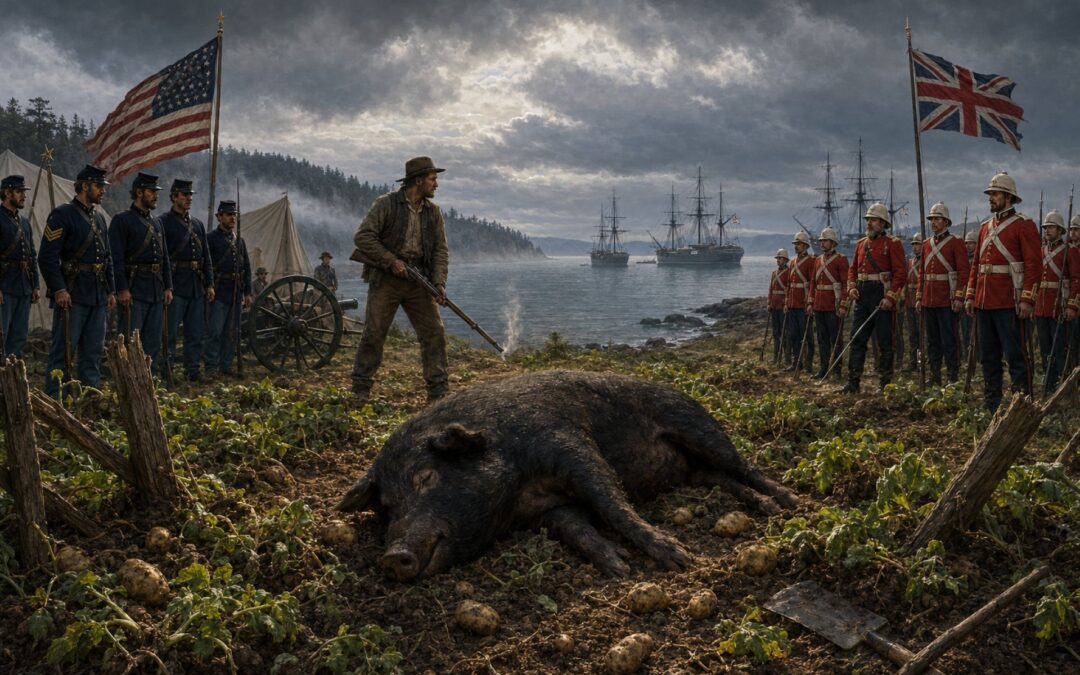
On June 15, 1859, Lyman Cutlar discovered a large black pig rooting through his potato patch on San Juan Island.
It was not the first time the animal had invaded his garden. Frustrated, Cutlar grabbed his rifle and shot it.
The pig belonged to the Hudson’s Bay Company, a powerful British commercial enterprise that operated a sheep farm on the island. When Cutlar informed the farm’s manager, Charles Griffin, the two men argued over compensation. British authorities threatened to arrest Cutlar. American settlers demanded military protection.
Within weeks, American soldiers occupied San Juan Island. British warships arrived offshore. Artillery was positioned, reinforcements were requested, and local commanders prepared for the possibility of battle.
The United States and Britain—two nations with a long and violent history—were suddenly on the brink of another war.
Over a dead pig.
But the pig did not create the conflict. It merely wandered into the middle of one.
Behind the potato patch was an unresolved border, an ambiguously written treaty, competing imperial ambitions, disputed land claims, and local officials who believed national honour depended on controlling a small group of islands in the Pacific Northwest.
The Pig War was never really about a pig.
It was about what can happen when an ordinary dispute enters a political landscape already primed for confrontation—and how a handful of people ultimately prevented that confrontation from becoming a catastrophe.
The Border Problem Began Long Before the Pig
The origins of the Pig War stretched back to the birth of the United States.
When Britain recognized American independence after the American Revolution, the two countries had to determine where the new nation ended and British North America began.
The 1783 Treaty of Paris attempted to define the boundary using rivers, lakes, and geographical coordinates. Unfortunately, the negotiators were working with imperfect maps. One section imagined a line extending west from the Lake of the Woods to the Mississippi River—even though the river did not extend far enough north for the proposed line to reach it.
The border existed in diplomatic language, but not always in geographical reality.
Further negotiations followed. After the War of 1812, Britain and the United States became increasingly interested in stabilizing their relationship. The Convention of 1818 extended the boundary along the 49th parallel from the Lake of the Woods to the Rocky Mountains.
West of the Rockies, however, neither country surrendered its claims.
Instead, Britain and the United States agreed to occupy the vast Oregon Country jointly. Citizens and companies from both nations could trade, travel, and settle there while the final question of sovereignty remained unresolved.
The arrangement postponed a conflict. It did not solve one.
Britain’s presence in the region depended heavily on the Hudson’s Bay Company. Although primarily a commercial enterprise, the company exercised enormous political influence. Its trading posts, supply routes, farms, ships, employees, and relationships with Indigenous communities made it one of the principal instruments of British power in the Pacific Northwest.
The company’s most valuable trade involved furs, particularly beaver pelts. British negotiators therefore wanted to protect access to the Columbia River and the commercial networks built around it.
The United States approached the region differently.
During the 1830s and 1840s, increasing numbers of American settlers travelled west along the Oregon Trail. Many believed the continent was destined to fall under American control. That belief eventually became known as Manifest Destiny: the idea that American expansion was not simply desirable but natural, inevitable, and even divinely sanctioned.
By 1843, mass migration had turned the Oregon boundary into a major political issue. Expansionists adopted the slogan “54°40′ or Fight,” demanding territory far north of the eventual border.
President James K. Polk supported American expansion, but he also understood the danger of fighting Britain while the United States was moving towards war with Mexico. According to the US State Department’s history of the Oregon negotiations, diplomats eventually settled on the 49th parallel as the basis for a compromise.
In 1846, Britain and the United States signed the Oregon Treaty.
It appeared to settle the Pacific Northwest boundary.
Instead, one imprecise sentence created the conditions for another crisis.
One Treaty, Two Channels, and an Unresolved Border
The Oregon Treaty extended the border west along the 49th parallel until it reached the water between the mainland and Vancouver Island.
From there, the treaty’s first article directed the boundary through “the middle of the channel” separating the continent from Vancouver Island and then south through the Strait of Juan de Fuca to the Pacific.
The problem was that there was no single, obvious channel.
The San Juan Islands sat between two major waterways. Haro Strait passed west of the islands, close to Vancouver Island. Rosario Strait passed east of them, closer to the American mainland.
If the border followed Haro Strait, the San Juan Islands would belong to the United States. If it followed Rosario Strait, they would belong to Britain.
Both countries insisted that the treaty supported their interpretation.
Britain argued that Rosario Strait was the more natural navigational channel and better matched the treaty’s direction. The Americans argued that Haro Strait more clearly separated Vancouver Island from the continent and provided the most direct passage towards the Strait of Juan de Fuca.
There was also a possible compromise. The boundary could run through San Juan Channel, dividing the archipelago between the two powers.
Neither side accepted it.
The disagreement was not caused solely by careless drafting. As research into the maps and navigation behind the boundary dispute demonstrates, negotiators were working with incomplete geographical knowledge and charts that did not always depict the waterways consistently.
The islands also mattered more than their size suggested.
They sat near the approaches to British-controlled Vancouver Island and the strategically important harbour at Victoria. Control of the waterways around them could affect trade, naval movement, and the defence of Britain’s colonies on the Pacific coast.
A joint boundary commission began investigating the disputed line in 1857. British commissioner James Prevost argued for Rosario Strait. American commissioner Archibald Campbell defended Haro Strait. Both assembled legal, geographical, and navigational arguments.
Neither persuaded the other.
The commission failed, leaving the islands suspended between two governments. Britain considered them British territory. The United States considered them American territory.
The people living there had to navigate the consequences.
San Juan Island Was Already Contested Ground
British and American accounts often described San Juan Island as territory waiting to be claimed.
It was not.
The island formed part of the ancestral homeland of Coast Salish peoples, who had lived, travelled, fished, harvested plants, maintained prairies, and built communities throughout the region for thousands of years. The modern National Park Service history of San Juan Island places the Pig War within this longer story of Indigenous life and imperial competition.
Britain and the United States were not arguing over empty land. They were arguing over which empire would control Indigenous land.
The first permanent non-Indigenous settlement on San Juan Island was established by the Hudson’s Bay Company. In 1853, the company created Belle Vue Sheep Farm on the island’s southern end, partly as a commercial venture and partly to reinforce Britain’s territorial claim.
Charles Griffin, an Irish employee of the company, managed the farm with workers who included Hawaiian shepherds. These men formed part of a much larger Pacific labour network. The Hudson’s Bay Company had recruited workers from Hawaii for decades, and their role complicates any simple picture of the island as a place inhabited only by British and American settlers.
Belle Vue became a substantial operation. Its sheep grazed across wide areas of the island, while its buildings and livestock gave the British claim a visible, permanent presence.
American officials refused to recognize that presence as proof of British sovereignty.
In 1854, an American customs official attempted to collect duties from the British farm. British authorities challenged his jurisdiction. Officials from Whatcom County later tried to collect property taxes from the company and seized valuable breeding sheep when Griffin refused to pay.
Both sides believed the other was trespassing.
The situation became more volatile after the Fraser Canyon Gold Rush began in 1858. Thousands of prospectors travelled north through the region. Many were Americans, and some who failed to find gold looked for land elsewhere.
By the spring of 1859, the National Park Service records that 18 American settlers had established claims on San Juan Island, often on land used by the Hudson’s Bay Company for grazing.
The Americans believed they were settling American territory. Griffin and the British authorities regarded them as squatters occupying company property.
Every fence, tax demand, grazing animal, and land claim now carried a political meaning.
That was the environment into which Griffin’s pig wandered.
Lyman Cutlar Shoots the Pig
Lyman Cutlar was an American settler who had built a cabin and planted potatoes on land claimed by the Hudson’s Bay Company.
The company’s animals roamed through the surrounding pastures. One large Berkshire pig developed a particular appetite for Cutlar’s potatoes and repeatedly entered his garden.
On June 15, 1859—exactly 13 years after the Oregon Treaty was signed—Cutlar found the pig in his potato patch again.
This time, he shot it.
Cutlar reportedly approached Griffin and accepted responsibility. Accounts differ over the precise offers and demands made during the argument that followed, but the disagreement over compensation quickly became secondary.
The more important question was jurisdiction.
Griffin believed Cutlar was an illegal settler who had killed British property on British land. Cutlar believed he was an American citizen defending his crops on American territory.
When British officials threatened to arrest Cutlar and remove American settlers from the island, the Americans interpreted the move as an attempt to establish British sovereignty through law enforcement.
A property dispute had become an international test.
The settlers appealed to Brigadier General William S. Harney, commander of the US Army’s Department of Oregon. They claimed British authorities were harassing American citizens and asked for military protection.
Harney was receptive.
Too receptive.
William Harney and George Pickett Militarize the Dispute
William Harney had a long military career and a reputation for aggression, insubordination, and hostility towards the British.
He also had considerable freedom of action. San Juan Island was thousands of kilometres from Washington, and communication with the federal government could take weeks. A commander who acted immediately could create facts on the ground long before political leaders had an opportunity to intervene.
Harney ordered Captain George E. Pickett to land on San Juan Island with Company D of the 9th US Infantry.
Pickett would later become famous as a Confederate general for his role in the disastrous charge that bears his name at Gettysburg. In 1859, however, he was an American Army officer stationed in the Pacific Northwest.
On July 27, Pickett landed on the island with 64 soldiers.
His official purpose was to protect American residents from British interference. In practice, the deployment placed US troops on territory whose ownership remained under negotiation.
Pickett established a camp near the Hudson’s Bay Company farm and asserted American jurisdiction. He refused requests to withdraw and warned that he would resist any attempt to remove his force.
The decision was extraordinarily provocative.
Harney had not received authorization from President James Buchanan or the War Department. By sending troops onto disputed territory, he transformed a local confrontation into a military occupation.
His motives remain contested.
Some later accounts suggested Harney and Pickett deliberately wanted to provoke a war with Britain. One theory held that a foreign conflict might unite an increasingly divided United States. Another claimed that Southern sympathizers wanted to distract the North while the South moved towards secession.
Other historians have rejected the idea of a coordinated conspiracy. Harney may simply have been impulsive, anti-British, and genuinely convinced that American citizens required protection.
The evidence does not justify presenting any secret plan as established fact.
What is certain is that Harney acted without sufficient authority and that Pickett’s landing forced Britain to respond.
Governor James Douglas of Vancouver Island viewed the American deployment as an invasion.
He turned to the Royal Navy.
British Warships Arrive at San Juan Island
James Douglas had spent much of his career defending British interests in the Pacific Northwest.
He had worked for the Hudson’s Bay Company, overseen its operations at Fort Vancouver, and watched American migration steadily weaken Britain’s position south of the 49th parallel. By 1859, he was governor of both Vancouver Island and the mainland colony of British Columbia.
To Douglas, San Juan Island represented a familiar pattern. American settlers arrived, claimed British-controlled land, demanded protection, and were followed by American institutions and soldiers.
If Britain did nothing, the United States might gain the island through occupation.
Douglas ordered Captain Geoffrey Hornby, commander of HMS Tribune, to prevent further American reinforcements and remove Pickett’s force if necessary. At the same time, Hornby was instructed to avoid starting a war.
Those orders contained an obvious contradiction.
Removing armed American soldiers against their will would almost certainly require force. Using force against American troops could produce the very war Hornby had been ordered to avoid.
British ships began gathering around the island. The Americans responded with reinforcements and artillery. By August, hundreds of US soldiers faced a British naval force of five warships carrying more than 2,000 sailors and marines.
The Royal Navy possessed overwhelming firepower. Pickett’s initial camp was exposed to naval guns, and his small command could have been destroyed quickly.
But an attack on American troops would not have ended the confrontation.
It would have started a larger war.
Britain had the world’s most powerful navy. The United States had a growing population, a large territory, and forces positioned close to British North America. Fighting could have spread to Vancouver Island, the Pacific coast, Canada, and the Atlantic.
All that was required was one nervous soldier, one misunderstood order, or one commander too proud to retreat.
The Officers Who Refused to Start a War
Douglas wanted British troops landed on San Juan Island to establish a military presence alongside the Americans.
Pickett warned that he would fire if they attempted to come ashore.
Captain Hornby now faced a direct choice. He could obey the governor, land his men, and risk an exchange of gunfire, or he could refuse to take the step most likely to begin a war.
He refused.
Hornby delayed action until Rear Admiral Robert Lambert Baynes, commander of Britain’s Pacific naval forces, arrived to assess the situation.
Baynes was appalled by what he found.
He outranked the naval officers already present and did not accept that Douglas’s political authority entitled the governor to initiate a conflict with the United States. He reportedly rejected the idea of involving two great nations in a war over a “squabble about a pig.”
The phrase was memorable because it exposed the absurdity of the situation.
Yet Hornby and Baynes were not dismissing Britain’s territorial claim. They were separating that claim from the immediate demand for military action.
Britain could defend its legal position without opening fire. The boundary could still be negotiated. The Americans could be contained without being attacked.
That distinction saved lives.
The Pig War is often celebrated as a bloodless conflict because both countries eventually chose peace. But countries do not choose anything by themselves. People make choices on their behalf.
In this case, British naval officers decided that following the most aggressive interpretation of their orders would be irresponsible.
Their restraint created the time needed for political leaders to intervene.
Winfield Scott Pulls the Crisis Back from the Brink
News travelled slowly from the Pacific Northwest to Washington and London.
By the time President Buchanan learned that Harney had placed troops on disputed territory, American and British forces had already been facing one another for weeks.
The administration was horrified.
The United States was moving towards a constitutional crisis over slavery and secession. Buchanan had no desire to begin an unnecessary war with Britain at the same moment.
He sent Lieutenant General Winfield Scott to resolve the situation.
Scott was the commanding general of the US Army and one of the most experienced soldiers in the country. He had fought in the War of 1812 and the Mexican-American War and had previously helped calm border disputes between the United States and Britain.
He also knew Harney.
Scott understood that the crisis had been driven as much by personalities and local decisions as by national policy. His task was to reduce the immediate military danger without forcing either government to surrender its territorial claim.
After travelling across the continent, Scott met Douglas and negotiated a temporary settlement.
Both countries would reduce their forces. Neither would attempt to remove the other. A small contingent from each side could remain on the island until the governments reached a final agreement.
The arrangement preserved the legal dispute while ending the immediate confrontation.
Harney continued to create difficulties. He objected to aspects of the settlement and later returned Pickett to the island despite instructions that the captain should be replaced. His behaviour reinforced Washington’s conclusion that local commanders could not be allowed to dictate foreign policy.
The large American force withdrew.
In March 1860, British Royal Marines landed peacefully on the northern end of the island, formalizing the joint occupation.
The shooting war had been avoided.
The sovereignty dispute remained.
Twelve Years of Joint Occupation
The Americans established their permanent camp on the island’s exposed southern end. The British constructed English Camp in a sheltered bay in the north.
For the next 12 years, both flags flew over San Juan Island.
This arrangement sounds inherently unstable. Two rival military forces occupied the same disputed territory, each representing a government that claimed the whole island.
In practice, relations became remarkably cordial.
The garrisons visited one another, shared meals, played games, and attended national celebrations. British marines participated in American Fourth of July festivities. Americans visited English Camp for events honouring Queen Victoria.
The men charged with defending rival claims often got along better than the officials who had created the dispute.
The island also remained connected to events far beyond its shores.
When the American Civil War began in 1861, George Pickett resigned from the US Army and joined the Confederacy. The United States suddenly faced a rebellion that threatened its survival, pushing the San Juan boundary far down the government’s list of priorities.
Anglo-American relations remained tense. The Trent Affair nearly brought Britain and the Union into conflict after a US naval officer seized Confederate diplomats from a British mail ship. British-built Confederate raiders later attacked American commerce, producing demands for compensation after the war.
These disputes made a San Juan settlement more difficult, but they also eventually created an opportunity.
Rather than resolve the island question by itself, Britain and the United States folded it into a much larger diplomatic effort to settle their outstanding differences.
Meanwhile, the joint occupation continued without combat.
The only creature killed in the Pig War remained the pig.
That did not mean the dispute was harmless. Rival imperial claims had displaced the question of Indigenous sovereignty, militarized the island, and left its residents under overlapping jurisdictions for more than a decade.
But the occupation demonstrated that unresolved sovereignty did not have to produce continuous violence.
Both governments had found a way to disagree without shooting.
The Treaty of Washington Sends the Border to Arbitration
After the Civil War, the United States demanded compensation for the damage caused by Confederate warships constructed in British shipyards. Britain and the United States also faced disagreements over fisheries, navigation, commercial claims, and their North American boundary.
In 1871, the two governments negotiated the Treaty of Washington, a broad agreement designed to settle these disputes peacefully.
The San Juan question appeared in Article XXXIV.
The official treaty text acknowledged that Britain claimed Rosario Strait while the United States claimed Haro Strait. It submitted both positions to Kaiser Wilhelm I of Germany, whose decision would be final and without appeal.
The arbitration was deliberately narrow.
The arbitrator was not asked to invent a compromise or divide the islands. He had to determine which proposed channel best matched the true meaning of the 1846 Oregon Treaty.
Britain and the United States submitted maps, historical records, diplomatic correspondence, navigational evidence, and legal arguments. The German emperor referred the material to a commission of experts.
On October 21, 1872, the decision was announced.
The American interpretation prevailed.
The boundary would follow Haro Strait, placing the San Juan Islands within the United States.
Britain disagreed with the judgment but accepted it. There was no attempt to overturn the award through military pressure.
On November 25, 1872, the Royal Marines departed English Camp. The Americans raised their flag over the former British position. The remaining US garrison stayed until 1874, when the military occupation of San Juan Island finally ended.
A dispute that had survived failed commissions, competing settlements, armed occupation, civil war, and diplomatic hostility was settled by arbitration.
The border created in 1872 remains the international boundary today.
Why the Pig War Still Matters
The Pig War survives in popular memory because its trigger was ridiculous.
A pig ate potatoes. A farmer shot it. Two countries nearly went to war.
But reducing the episode to that sequence makes it less useful.
Wars rarely begin because of one isolated event. They begin when an event collides with unresolved grievances, competing claims, political ambition, institutional confusion, and leaders who interpret compromise as weakness.
The pig mattered because the boundary was uncertain.
The boundary mattered because Britain and the United States were competing for territory.
The territory mattered because settlers, companies, officials, soldiers, and Indigenous peoples all had different relationships with the land.
Once those pressures converged, the difference between peace and war depended on individual decisions.
Harney chose escalation. Pickett accepted a dangerous assignment. Douglas demanded a stronger British response.
Hornby refused to land troops under conditions likely to produce bloodshed. Baynes prevented naval power from becoming a substitute for diplomacy. Scott gave both governments a way to retreat without formally abandoning their claims.
The eventual solution did not require either side to pretend the dispute was unimportant. It required them to recognize that the method used to settle it mattered more than the satisfaction of acting immediately.
That is what separates the Pig War from conflicts such as the Falklands War, where another disagreement over remote islands became an actual war with ships sunk, soldiers killed, and political consequences lasting for generations.
On San Juan Island, national pride came dangerously close to producing the same result.
It did not.
The border was settled. The troops went home. The two countries accepted an external judgment. Britain and the United States continued moving towards a more stable relationship.
One pig died.
No person had to follow it.
Last Updated on July 12, 2026 by Aseem Gupta