
Introduction: The Strangest War in Australian History
History is full of strange conflicts. Empires have fought over trade routes, religion, ideology, and territory. But in 1932, Australia found itself involved in one of the most unusual military operations ever recorded—a war against birds.
This strange episode, now known as the Great Emu War, began when thousands of large, flightless birds started invading farmland in Western Australia. These emus, capable of running at speeds over 40 miles per hour and standing nearly six feet tall, began trampling fences and devouring crops. For farmers already struggling through economic hardship, the birds were more than a nuisance—they were a serious threat to their livelihoods.
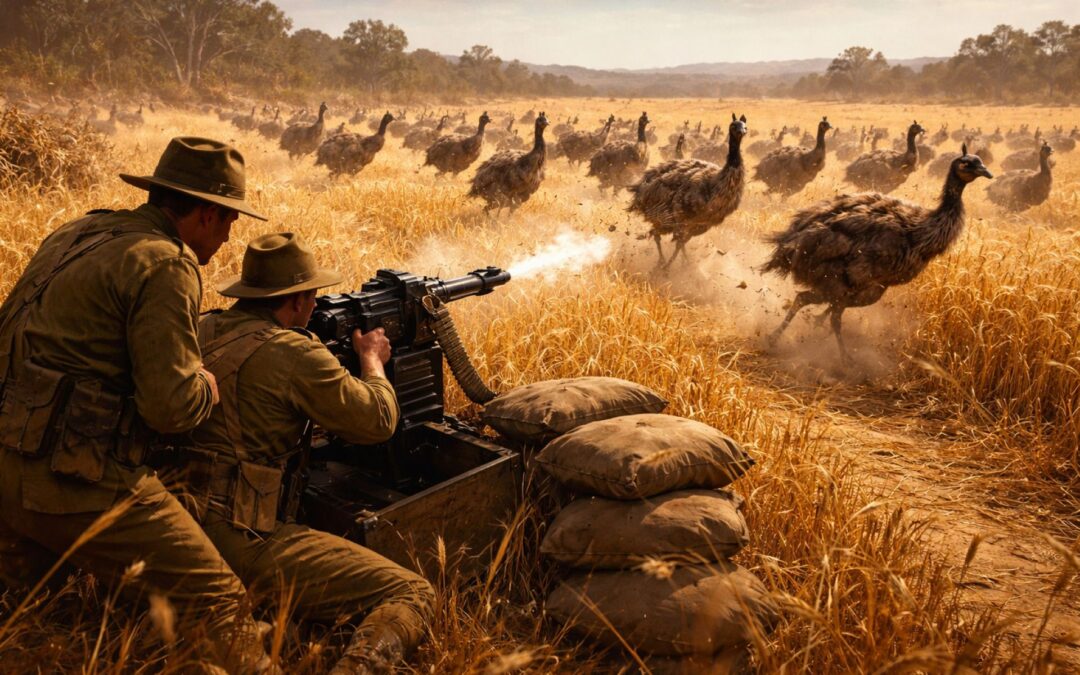
In response, desperate farmers appealed to the Australian government for help. Instead of relying solely on agricultural solutions, the government approved a military intervention. Soldiers armed with Lewis machine guns were deployed to Western Australia with the mission of eliminating the invading emu population.
What followed was not a decisive military victory, but a chaotic and deeply embarrassing campaign. Machine guns jammed, birds scattered, strategies failed, and the press quickly turned the operation into a national joke. Despite the firepower of a modern army, the emus repeatedly outmaneuvered their human opponents.
In the end, the Great Emu War became famous not for military success, but for its absurdity. The campaign revealed the limits of force when confronting nature and produced one of the most bizarre stories in Australian history—a conflict where, by most accounts, the emus won.
Australia’s Harsh Land and Early Settlement
Australia has long been known for its unforgiving environment. Vast deserts, extreme heat, unpredictable droughts, and unique wildlife make it one of the most challenging places in the world to build a stable agricultural society. For early European settlers, the continent was both an opportunity and a constant struggle against nature.
The British first established a permanent colony in Australia in 1788, when the First Fleet arrived at Port Jackson under the leadership of Governor Arthur Phillip. At the time, Britain viewed the continent as a distant frontier—part prison colony, part imperial experiment. Over the following decades, settlers gradually expanded inland, establishing farms, towns, and infrastructure across a landscape that was often hostile to traditional European farming methods.
Unlike the fertile farmlands of Europe, much of Australia’s soil was poor and rainfall patterns were unpredictable. Farmers had to adapt to long dry periods and the ever-present risk of drought. Yet despite these challenges, agriculture slowly expanded, particularly wheat farming in regions like Western Australia. By the early twentieth century, wheat had become one of the country’s most important export industries.
But farming in Australia meant constantly competing with the environment. Native animals frequently disrupted agricultural operations. Rabbits, introduced by European settlers in the nineteenth century, multiplied rapidly and devastated crops across huge areas of the country. Kangaroos, birds, and other wildlife also regularly wandered into farmland, eating crops and damaging fences.
Among these animals was the emu, a large flightless bird native to Australia. Emus were already a familiar part of the landscape long before European settlers arrived. Normally, they lived in open plains and coastal areas, moving seasonally in search of food and water. Most of the time, they posed little threat to human activity.
But under the right conditions, their migratory patterns could bring them directly into farmland. And when that happened in large numbers, the consequences could be devastating.
The stage was now set for an unusual confrontation between farmers struggling to survive and one of Australia’s most iconic native animals.
Economic Crisis and the Struggling Farmers
By the early twentieth century, Australia’s agricultural economy had become deeply tied to global markets. Wheat, wool, and other exports were vital to the country’s prosperity. But this dependence also meant that when the global economy faltered, Australia felt the effects almost immediately.
That is exactly what happened in the late 1920s and early 1930s.
The Impact of the Great Depression on Australia
The Great Depression, triggered by the 1929 stock market crash, quickly spread across the world and devastated international trade. Prices for agricultural products collapsed as demand fell sharply. Countries imposed tariffs to protect their own industries, which further restricted global commerce.
For Australia, this was particularly damaging. The nation relied heavily on exporting raw agricultural goods, especially wheat. When global prices dropped, farmers suddenly found themselves earning far less for the same amount of work.
At the same time, credit became difficult to obtain. Banks were reluctant to lend money, making it harder for farmers to maintain their operations, purchase equipment, or survive poor harvests. Many rural communities fell into severe economic hardship as farms struggled to remain profitable.
For many Australians, especially those working the land, the Depression was not just a financial crisis—it was a fight for survival.
Soldier Settlement Farms After World War I
Another factor made the situation even more fragile. After the First World War, the Australian government had introduced soldier settlement schemes designed to reward returning veterans. Large areas of land were divided into farms and distributed to former soldiers, giving them a chance to build new lives as farmers.
In theory, the policy honored veterans while expanding agricultural production. In practice, however, many of these farms were located in marginal areas with poor soil and unreliable rainfall. The new farmers often lacked experience in agriculture and struggled to make their land productive.
When the Great Depression struck, these veteran farmers were among the hardest hit. They were already working difficult land, and the collapse in wheat prices pushed many of them to the edge of financial ruin.
By the early 1930s, farmers in Western Australia were desperate. Crops were their only source of income, and every harvest mattered. Under normal circumstances, protecting those crops was already challenging.
But soon, an unexpected threat would arrive—one that no farmer had planned for, and that would push the situation from hardship into outright crisis.
The Unexpected Invasion of the Emus
Just as farmers in Western Australia were struggling to survive the economic crisis of the Great Depression, a new and unexpected problem emerged. Large numbers of emus began migrating into agricultural regions, turning already fragile farms into feeding grounds for thousands of hungry birds.
What might normally have been a minor nuisance quickly grew into a serious agricultural disaster.
Why Thousands of Emus Moved Inland
Emus are native to Australia and have long been part of the continent’s natural ecosystem. These large, flightless birds are highly mobile and often travel great distances in search of food and water. During certain seasons, especially after breeding periods, emus migrate inland from coastal regions.
In 1932, many emus began moving toward the wheat-growing areas of Western Australia, particularly around the Campion district. The reason was simple: the region’s farmland offered an abundant and easily accessible food supply.
Wheat crops, planted across wide open fields, were essentially a buffet for the birds. Compared to the harsher conditions of the Australian interior, farmland provided lush vegetation, water sources, and fewer natural obstacles. For thousands of migrating emus, the farms were the perfect feeding ground.
And they did not arrive in small numbers. Reports suggested that as many as 20,000 emus descended on the region.
How Emus Devastated Western Australian Farms
The problem was not just that emus ate the crops. Their sheer size and numbers caused widespread destruction.
An adult emu can grow nearly six feet tall and weigh over 100 pounds. When large groups moved through farmland, they trampled crops, destroyed fences, and consumed enormous quantities of wheat. Fields that farmers had carefully cultivated for months could be devastated in a matter of days.
Even worse, the emus often broke through fences that were meant to keep other pests out. Once those barriers were damaged, another major agricultural threat—rabbits—could enter the fields and cause even more damage.
For farmers already suffering from collapsing crop prices, the losses were devastating. Wheat harvests were being destroyed, fences were constantly breaking, and repairs required time and money that many farmers simply did not have.
Local farmers tried to deal with the birds themselves, but emus proved extremely difficult to control. They were fast, wary of humans, and capable of quickly scattering when threatened.
As the damage mounted and crops continued to disappear, the farmers realized they could not solve the problem alone.
Desperate for help, they turned to the government.
Farmers Demand Government Intervention
As the emu population continued to ravage farmland across Western Australia, the situation became increasingly desperate. Crops were being destroyed, fences were repeatedly broken, and farmers—many of whom were already struggling to survive the economic pressures of the Great Depression—felt they had no way to defend their livelihoods.
What began as frustration quickly turned into political pressure.
Why the Farmers Asked the Military for Help
Normally, agricultural problems such as pests or wildlife damage would fall under the responsibility of the Minister of Agriculture. Governments typically addressed these issues through pest control programs, hunting permits, or financial assistance.
But the farmers of Western Australia believed their situation required a more drastic solution.
The scale of the emu invasion made traditional methods seem ineffective. Thousands of birds were moving across large areas of farmland, and individual farmers armed with rifles could barely slow them down. The emus were fast, highly mobile, and capable of quickly scattering whenever they were threatened.
Many farmers were also former soldiers who had served in the First World War. They were familiar with military weapons and believed that modern firepower could solve the problem far more efficiently than hunting rifles.
So instead of appealing to agricultural authorities, the farmers made a surprising request: they asked the Australian military to intervene.
The Political Debate Over Killing the National Bird
The proposal immediately sparked debate. The emu was not just any animal—it was one of Australia’s most recognizable native species and appeared on the country’s coat of arms alongside the kangaroo.
For some politicians and members of the public, the idea of deploying soldiers and machine guns against a national symbol seemed excessive and even cruel. Critics argued that it was barbaric to slaughter thousands of native animals.
Others took a more practical view. Farmers were losing valuable crops during an economic crisis, and the government faced pressure to demonstrate that it was willing to act. Sending the military could show the public that officials were taking the problem seriously.
Eventually, the farmers’ appeals reached George Pearce, Australia’s Minister of Defence.
After reviewing the situation—and perhaps seeing an opportunity for the army to gain some target practice—Pearce approved an unusual military operation.
Australia was about to declare war on the emus.
Australia Declares War on the Emus
With farmers demanding action and political pressure mounting, the Australian government made a remarkable decision. Instead of treating the emu problem as an agricultural issue, it would be handled as a military operation.
In 1932, the government approved the deployment of soldiers to Western Australia to reduce the emu population using military weapons. What followed would become one of the most unusual campaigns in military history.
Defense Minister George Pearce Approves the Operation
The responsibility for the decision ultimately rested with George Pearce, Australia’s Minister of Defence. After receiving complaints from farmers about the damage caused by thousands of emus, Pearce agreed to send military personnel to deal with the situation.
However, the approval came with certain conditions. The farmers who had requested assistance were required to cover the costs of the operation, including providing transportation, food, and accommodation for the soldiers. Pearce also made it clear that the government would not take responsibility if the plan turned out poorly.
Despite these precautions, the decision was controversial. Deploying the military to fight animals was unusual, and critics questioned whether such an approach would actually solve the problem.
Nevertheless, the operation was authorized, and preparations began.
Major G.P.W. Meredith and the Machine Guns
To carry out the mission, the army assigned Major G.P.W. Meredith of the Royal Australian Artillery. Meredith and a small team of soldiers were sent to Western Australia equipped with two Lewis machine guns and several thousand rounds of ammunition.
The Lewis gun was a powerful automatic weapon widely used during the First World War. It was designed to fire rapid bursts of bullets and was capable of cutting down large numbers of targets quickly.
The plan seemed simple enough: locate large groups of emus and use machine guns to eliminate them before they could escape. Given the weaponry involved, officials assumed the birds would be easy targets.
To make the operation even more worthwhile from a political standpoint, a camera crew was sent along to document the mission. Government officials hoped the footage would demonstrate that the military was effectively solving the farmers’ problem.
But as the soldiers prepared for their first engagement with the birds, they were about to discover something unexpected.
The emus were far more difficult opponents than anyone had imagined.
The First Battle of the Emu War
In early November 1932, Major G.P.W. Meredith and his small military detachment began their operation in the farming districts of Western Australia. The plan was straightforward: locate large groups of emus and use the Lewis machine guns to eliminate as many birds as possible.
What followed, however, was not the decisive military success that officials had anticipated.
The Ambush at Campion
The first engagement took place near the town of Campion, where soldiers spotted a large group of emus gathered in the distance. Seeing an opportunity, the men positioned their machine guns and prepared to open fire.
When the guns finally began firing, the outcome was not what the soldiers expected.
Instead of remaining in a tight group, the emus immediately split into smaller clusters and scattered in every direction. Their speed and unpredictable movement made them extremely difficult targets. By the time the soldiers adjusted their aim, most of the birds had already escaped.
Only a small number of emus were killed during the encounter, while the vast majority disappeared into the surrounding landscape.
Why the Emus Easily Escaped
Several factors quickly became apparent to the soldiers. First, emus were much faster and more agile than expected. They could run at speeds exceeding 40 miles per hour and change direction quickly, making them difficult to track with heavy machine guns.
Second, the terrain worked in the birds’ favor. The open fields and scattered vegetation allowed emus to spread out and disappear quickly, preventing the soldiers from targeting large groups at once.
Even when bullets struck their targets, the results were surprising. Some emus appeared capable of absorbing multiple hits and still running away, prompting Major Meredith to later remark that the birds seemed almost like armored vehicles.
The first encounter revealed an uncomfortable truth: defeating the emus would not be nearly as easy as anyone had assumed.
Rather than an effortless victory, the military campaign was already beginning to look far more complicated—and far more embarrassing—than expected.
Machine Guns vs. Flightless Birds
After the disappointing results of the first encounter, Major Meredith and his men realized they would need to change their tactics. The original plan—simply opening fire on large groups of birds—had proven ineffective. The emus were too fast, too scattered, and far more resilient than anyone had expected.
Despite their superior firepower, the soldiers were beginning to discover that their unusual opponents were remarkably difficult to defeat.
Failed Strategies and Gun Malfunctions
Determined to improve their results, the soldiers attempted a new strategy. Instead of firing from a distance, they tried to approach the emus more closely before opening fire, hoping that shorter range would make the machine guns more effective.
At one point, the men located a large group of emus gathered near a local dam. The birds appeared to be in an ideal position for an ambush. The soldiers quietly set up their Lewis guns and waited for the right moment.
But once again, the plan fell apart.
When the guns opened fire, both weapons quickly jammed, allowing most of the birds to escape before significant damage could be done. Only a handful of emus were killed before the opportunity was lost.
Mechanical issues were not uncommon with early machine guns, particularly in dusty environments like the Australian outback. The harsh conditions made it difficult for the weapons to operate reliably, further complicating the operation.
For the soldiers, the repeated failures were humiliating. They had arrived expecting an easy mission, but instead they were struggling to eliminate even small numbers of birds.
The Emus’ Unexpected Resilience
Perhaps the most surprising discovery was how tough the emus seemed to be.
Reports from the soldiers suggested that some birds were able to continue running even after being hit by bullets. Their thick feathers and strong bodies may have helped absorb some of the impact, allowing wounded birds to escape before collapsing.
Major Meredith later described the birds with a mixture of frustration and admiration. In one famous remark, he compared the emus to military tanks, suggesting that if the Australian army possessed soldiers with the same ability to withstand gunfire, they would be nearly unstoppable.
While the comment was partly humorous, it captured the growing realization among the soldiers: they were facing an opponent that was far more formidable than expected.
And the most ambitious—and ill-fated—strategy of the campaign was still to come.
The Infamous Truck Chase
After repeated failures to effectively target large groups of emus from stationary positions, Major Meredith and his men attempted a more aggressive approach. If the birds were too fast and scattered for traditional ambushes, perhaps the soldiers could pursue them directly.
This idea led to one of the most memorable—and disastrous—moments of the entire campaign.
Mounting the Machine Gun on a Truck
The soldiers decided to mount one of their Lewis machine guns on the back of a truck. The concept was simple: the vehicle would chase the emus across open farmland while a gunner in the rear fired at the birds.
In theory, the truck would allow the soldiers to keep pace with the fast-moving emus and maintain sustained fire as the birds fled. It seemed like a practical solution to the problem of their elusive opponents.
Once the plan was ready, the soldiers set out across the fields in pursuit of a large group of emus.
Why the Plan Failed Spectacularly
The strategy quickly proved to be unrealistic.
The terrain of rural Western Australia was far from ideal for high-speed vehicle chases. The farmland was uneven, filled with bumps, holes, and rough patches that made it difficult for the truck to maintain stability.
As the vehicle bounced across the landscape, the gunner struggled to aim the machine gun accurately. The violent movement of the truck made sustained fire nearly impossible.
Meanwhile, the emus simply outran the vehicle or scattered in different directions, making it difficult to pursue them effectively. Rather than being cornered, the birds escaped once again.
The attempt to chase emus with a machine gun mounted on a truck became one of the most absurd episodes of the campaign. Instead of demonstrating military efficiency, it highlighted how poorly suited the army’s tactics were for dealing with fast-moving wildlife.
By this point, the operation was starting to attract unwanted attention—and the public reaction would soon make the situation even more embarrassing for the government.
Public Mockery and Political Embarrassment
As news of the failed operations spread, the campaign quickly became a source of national amusement. What had begun as a serious attempt to protect struggling farmers was now turning into a public relations disaster.
The idea of trained soldiers armed with machine guns repeatedly failing to defeat large birds was simply too absurd for the public and the press to ignore.
Media Reaction to the “War”
Newspapers eagerly reported on the strange conflict unfolding in Western Australia. Journalists highlighted the repeated failures of the military operation and emphasized the unusual nature of the campaign.
Stories about machine guns jamming, birds escaping, and soldiers chasing emus across farmland made for entertaining headlines. Rather than portraying the operation as a practical government response, the media increasingly framed it as a farcical “war.”
The image of a modern army struggling against flightless birds captured the public imagination. The situation quickly became a topic of jokes, cartoons, and satirical commentary.
Instead of demonstrating government competence, the operation was making officials look increasingly foolish.
Parliament’s Criticism of the Operation
The embarrassment was not limited to the press. Members of the Australian Parliament also began criticizing the decision to deploy the military.
Opposition politicians mocked the campaign and questioned whether the government had wasted public resources on a poorly planned operation. Some members sarcastically suggested that the emus deserved military medals for successfully defeating the army.
Under growing pressure and facing widespread ridicule, Defense Minister George Pearce eventually decided to suspend the operation. The soldiers were withdrawn, and the first phase of the campaign came to an end.
But the emu problem had not disappeared. The birds were still roaming across farmland and continuing to destroy crops.
And before long, farmers would once again ask the government for help.
Round Two: The Military Tries Again
Although the government had halted the initial operation, the fundamental problem remained unresolved. Emus were still roaming across Western Australian farmland, continuing to destroy crops and damage fences. For the farmers who depended on those harvests, the situation was still critical.
Not long after the army withdrew, farmers once again appealed to the government for assistance.
Faced with renewed pressure, Defense Minister George Pearce reluctantly agreed to resume the operation. The soldiers returned to the field for what would effectively become the second phase of the Emu War.
Adapting to Emu Tactics
By this point, Major Meredith and his men had learned several important lessons from their earlier failures. One of the most significant was that emus rarely moved in large, tightly packed groups once they sensed danger.
Instead, the birds tended to scatter into smaller units when threatened. Some observers even noted that groups of emus appeared to behave almost strategically, with one or two birds acting as lookouts while others continued feeding.
When danger approached, the lookout birds would alert the rest of the group, allowing the emus to quickly disperse and escape.
Understanding this behavior allowed the soldiers to adjust their tactics. Rather than attempting large ambushes, they began targeting smaller groups of birds and taking advantage of opportunities when the emus were concentrated in specific areas.
Increased Kill Rates but Limited Success
These new tactics produced somewhat better results. Reports from the operation suggested that the soldiers were able to eliminate around 300 emus per week during the renewed campaign.
Compared to the earlier failures, this represented a noticeable improvement. Over time, the soldiers managed to kill roughly 1,000 emus.
However, the scale of the problem remained enormous. Estimates suggested that around 20,000 emus had originally entered the farming areas.
Even after weeks of effort, the vast majority of the birds were still roaming the countryside.
The military operation had become more effective, but it was still far from solving the problem. And soon, the campaign would come to an end once again.
Declaring Victory Despite the Numbers
By late 1932, the renewed military campaign had achieved some measurable results. Soldiers had refined their tactics and were gradually improving their success rate when engaging the emus. Yet despite these improvements, the overall outcome of the operation remained questionable.
The numbers told a very different story from the idea of a decisive victory.
1,000 Emus Killed and 19,000 Remaining
Over the course of the operation, the military reported killing roughly 1,000 emus. While this might have sounded impressive at first, it represented only a small portion of the estimated 20,000 birds that had moved into the farming regions of Western Australia.
In other words, after weeks of effort, the overwhelming majority of the emu population remained untouched.
The cost of the campaign also raised concerns. Soldiers had reportedly fired around 10,000 rounds of ammunition during the operation. That meant roughly ten bullets were used for every confirmed kill.
For a military mission intended to solve a major agricultural problem, the results appeared inefficient at best.
Why the Operation Was Widely Seen as a Failure
Eventually, the government decided to end the military campaign and withdraw the soldiers. Defense Minister George Pearce later addressed Parliament and declared the operation a success, emphasizing the number of birds that had been eliminated.
However, many politicians and observers remained unconvinced.
Critics pointed out that thousands of emus were still roaming the countryside and continuing to damage crops. From their perspective, the campaign had consumed ammunition, time, and public attention without delivering a meaningful solution.
The press and opposition politicians continued to mock the operation, reinforcing the growing narrative that the Australian military had effectively lost a war against birds.
Although the government attempted to frame the operation as a victory, the reality was clear: the emu problem had not been solved.
And ultimately, the real solution would come from a much less dramatic source.
How the Emu Problem Was Actually Solved
Although the military campaign had failed to significantly reduce the emu population, the problem facing farmers could not simply be ignored. Emus were still entering farmland and damaging crops, and the government needed a more practical solution.
In the years that followed, officials shifted away from military action and toward more traditional methods of pest control.
The Bounty System
One of the first alternatives introduced was a bounty system. Instead of relying on soldiers, the government offered financial rewards to individuals who could prove they had killed emus.
Under this system, hunters and farmers could receive payment for each emu they eliminated, usually by presenting evidence such as the bird’s beak or feathers. The incentive encouraged widespread participation and turned emu control into a decentralized effort.
Unlike the military campaign, the bounty system allowed thousands of people across rural regions to target the birds simultaneously. Over time, this approach proved far more effective than a small group of soldiers attempting to hunt emus with machine guns.
Large numbers of emus were gradually removed through these bounty programs.
The Real Solution: Better Fencing
However, the most effective long-term solution turned out to be something far simpler than guns or government programs: improved fencing.
Farmers began installing stronger and more durable barriers designed specifically to keep large animals out of their fields. These fences prevented emus from entering farmland in the first place and helped protect crops from other pests such as rabbits.
As fencing technology improved, the scale of crop damage caused by emus declined significantly. Preventing access to farmland proved far more efficient than trying to eliminate the birds after they had already arrived.
In the end, the emu problem was solved not through military force, but through practical agricultural solutions—something that many critics of the original campaign had argued from the beginning.
Why the Emus “Won” the War
Although the Australian government officially declared success, the Great Emu War is widely remembered as a victory for the emus. The story has endured precisely because it illustrates how a modern military operation failed to achieve its objective against a group of wild animals.
Several factors contributed to the outcome.
First, emus were extremely difficult targets. Their speed and agility allowed them to outrun soldiers and vehicles with ease. When threatened, they quickly scattered into smaller groups, making it nearly impossible to eliminate large numbers at once. This natural behavior constantly undermined the soldiers’ attempts to use machine guns effectively.
Second, the terrain worked in the birds’ favor. The open landscapes of Western Australia provided countless escape routes. Unlike a conventional battlefield, there were no clear front lines or confined spaces where the emus could be cornered.
Third, the military tactics themselves were poorly suited to the problem. Machine guns were designed for combat against organized human forces, not highly mobile wildlife. The heavy weapons were difficult to position, prone to mechanical issues, and often ineffective against fast-moving targets spread across large areas.
Finally, the operation suffered from a mismatch between expectations and reality. Government officials assumed the birds would be easy to eliminate, but the campaign quickly revealed that controlling wildlife required different strategies than those used in military warfare.
For these reasons, historians and commentators often joke that the emus won the war. While thousands of birds survived and continued to roam the countryside, the Australian military withdrew after an embarrassing and ineffective campaign.
The story became a lasting example of how nature can frustrate even the most technologically equipped human efforts.
Conclusion: The Most Absurd Military Operation in History
The Great Emu War of 1932 remains one of the strangest episodes in modern history. What began as a genuine attempt to protect struggling farmers during an economic crisis turned into a bizarre military campaign that captured public attention and ridicule.
Faced with thousands of emus destroying crops in Western Australia, the Australian government chose an unconventional solution: deploying soldiers armed with machine guns. The plan seemed straightforward. With modern weapons and trained personnel, officials assumed the problem could be solved quickly.
Instead, the campaign exposed how poorly suited military force can be when confronting the natural world. The emus’ speed, resilience, and tendency to scatter made them incredibly difficult targets. Equipment failures, ineffective tactics, and challenging terrain further complicated the operation.
Despite weeks of effort and thousands of rounds of ammunition fired, the army managed to eliminate only a fraction of the emu population. Meanwhile, the press mocked the campaign, politicians criticized the decision, and the public increasingly viewed the conflict as an embarrassing spectacle.
Ultimately, the real solution to the emu problem came not from soldiers or machine guns but from practical measures such as bounty systems and improved fencing.
Today, the Great Emu War is remembered less as a serious military campaign and more as a historical curiosity. It stands as a reminder that sometimes the most powerful institutions can find themselves defeated by the most unexpected opponents—and that even a modern army can struggle when it declares war on nature.