
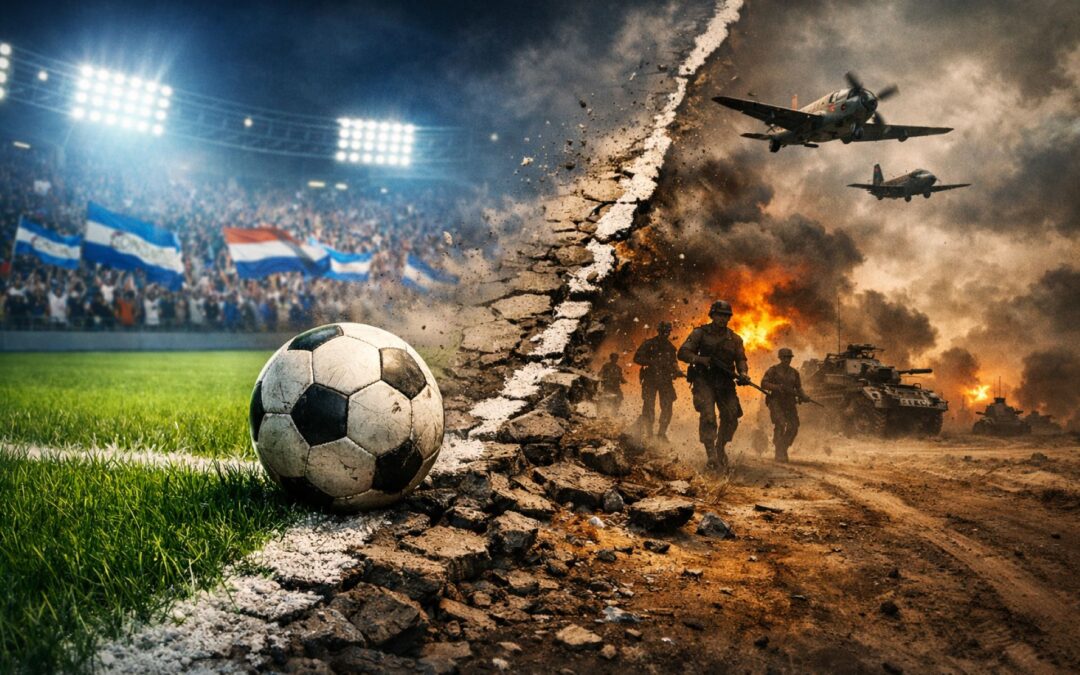
In 1969, two small Central American countries—Honduras and El Salvador—went to war in a conflict that lasted barely four days but left thousands dead and tens of thousands displaced. The war became known worldwide as the Football War, a name that suggests something almost ridiculous: that two nations went to war over a soccer match.
But the truth behind the conflict is far more serious.
Football was not the cause of the war. It was the spark. Beneath the stadium chants and World Cup excitement lay years of political tension, economic inequality, land disputes, migration crises, and nationalist resentment. By the late 1960s, relations between Honduras and El Salvador had become dangerously unstable, and the region was already primed for violence.
At the center of the crisis was land.
El Salvador was one of the most densely populated countries in the Americas, with a rural population dominated by landless farmers struggling to survive. Honduras, on the other hand, had far more land but much of it was controlled by powerful elites and foreign corporations. Over decades, hundreds of thousands of Salvadorans crossed the border into Honduras in search of farmland and opportunity.
For a time, the migration helped relieve pressure inside El Salvador. But in Honduras it created a growing backlash. Politicians, landowners, and nationalist groups began blaming Salvadoran immigrants for economic hardship, unemployment, and land shortages. Violence against these immigrants steadily increased.
By the late 1960s, thousands of Salvadorans were being expelled from Honduras and forced back across the border, creating a humanitarian crisis that the Salvadoran government struggled to manage.
Then came the 1970 FIFA World Cup qualifying matches.
When the national teams of Honduras and El Salvador met on the football field, the games quickly became something much bigger than sport. Fans rioted. Propaganda intensified. National pride and anger spilled out of stadiums and onto the streets.
Within weeks, diplomatic relations between the two countries collapsed.
Soon afterward, the armies began moving.
What followed was a short but brutal conflict known as the 100-Hour War—a war that demonstrated how sports rivalry can ignite violence when deeper political and social tensions are already at the breaking point.
The Unequal Neighbors: Honduras and El Salvador in the Mid-20th Century
To understand why tensions between Honduras and El Salvador escalated so quickly in the late 1960s, it is important to first understand how different the two countries were, despite sharing a border and a similar colonial history.
The most obvious difference was size.
Honduras is geographically much larger than El Salvador. Its territory is more than five times the size of its neighbor, with large stretches of countryside and mountainous regions spread across the country. In theory, this meant Honduras possessed far more land and natural resources.
El Salvador, by contrast, is the smallest country in Central America. Its land area is extremely limited, and by the mid-twentieth century its population density had become one of the highest in the Western Hemisphere. Millions of Salvadorans depended on agriculture for survival, but most of the fertile land was controlled by a small group of wealthy landowners.
This imbalance created a powerful economic pressure inside El Salvador.
The country’s economy was heavily dependent on coffee exports, and large plantations dominated the agricultural landscape. Rural peasants rarely owned land themselves and instead worked as seasonal laborers on estates owned by elites. Population growth throughout the early twentieth century only intensified the problem. With more families competing for the same limited farmland, opportunities for land ownership became increasingly scarce.
For many poor farmers, the solution seemed obvious: move.
Across the border in Honduras, land appeared more plentiful. Although much of Honduras was underdeveloped and infrastructure was limited, there were still large rural areas where farming communities could potentially expand. Beginning in the early twentieth century, Salvadoran migrants started crossing into Honduras in search of land and work.
At first, this migration occurred quietly and with little resistance.
Many Salvadorans settled in rural Honduran regions and began farming the land, sometimes legally and sometimes informally. Over time, entire communities of Salvadoran immigrants formed along the border and deeper inside Honduran territory. For struggling farmers, the move offered a chance at stability that was nearly impossible to achieve at home.
But as the decades passed, the number of migrants continued to grow.
By the 1960s, hundreds of thousands of Salvadorans were living in Honduras. What had once been a gradual migration had now become a major demographic shift—one that would soon become a source of deep political tension between the two nations.
The Land Crisis and the Migration Explosion
By the 1960s, the movement of Salvadoran farmers into Honduras had grown from a quiet migration into a massive demographic shift that neither government was fully prepared to handle.
The root of the problem lay in El Salvador’s land system.
For decades, the country’s economy had been dominated by large agricultural estates—particularly coffee plantations—controlled by a small group of wealthy landowners. These elites owned the vast majority of the country’s fertile land, leaving millions of rural Salvadorans with little or no property of their own. Most peasants survived as seasonal laborers, working during harvest periods and struggling to find income the rest of the year.
Meanwhile, El Salvador’s population continued to grow rapidly.
By the mid-twentieth century, the country had one of the highest population densities in the Americas. The amount of farmland available per person kept shrinking, and rural families increasingly found themselves trapped in a cycle of poverty with no realistic path to land ownership.
Crossing the border into Honduras began to look like the only option.
Honduras, although poorer in many ways, had far more territory and a lower population density. Large areas of rural land remained underdeveloped, and Salvadoran migrants believed they could build new farming communities there. Over time, entire villages of Salvadorans began appearing inside Honduran territory, especially near the border.
Many of these migrants farmed land informally. Some rented plots, others occupied unused land, and many simply settled in areas where government oversight was minimal. For years, the Honduran authorities largely tolerated this situation.
But the numbers kept rising.
By the late 1960s, estimates suggested that as many as 300,000 Salvadorans—roughly one tenth of El Salvador’s population at the time—were living in Honduras. In many rural areas, Salvadoran migrants had become a major part of the local population.
What had once been a gradual migration now began to feel, to many Hondurans, like a demographic takeover.
At the same time, Honduras was beginning to face its own land disputes. Large portions of the country’s best agricultural land were controlled not by small farmers, but by powerful elites and foreign corporations—especially American banana companies that dominated parts of the economy.
As Honduran peasants began demanding land reform, tensions rose over who had the right to farm the countryside.
For nationalist politicians and landowners, Salvadoran immigrants soon became an easy target. They were visible, vulnerable, and could be blamed for problems that had much deeper structural causes.
The stage was now set for a dangerous shift in Honduran politics. Instead of addressing inequality and land concentration, political leaders would soon begin redirecting public anger toward the immigrants themselves.
Honduras’ Political Instability and the Rise of Military Rule
While migration tensions were building along the border, Honduras itself was undergoing a period of political turmoil that would further inflame the situation.
In 1963, the Honduran political system was shaken by a military coup. General Oswaldo López Arellano, a conservative military officer, seized power and overthrew the existing government. The coup was justified as a necessary move to prevent the rise of communism, a common justification for military takeovers throughout Latin America during the Cold War.
But like many coups in the region, the takeover created a new problem: legitimacy.
Military governments often struggled to gain public acceptance, and López Arellano faced strong criticism from opposition groups, labor unions, and political rivals. In an attempt to strengthen his authority, he later held elections and officially assumed the presidency.
The election, however, did little to calm the political unrest.
Opposition parties accused the government of corruption and fraud. Critics argued that the regime was closely tied to wealthy landowners and powerful foreign corporations, particularly the large American banana companies that controlled significant portions of Honduras’s agricultural economy.
These corporations had enormous influence over the country’s politics and economy. For decades, companies like United Fruit had operated vast plantations across Central America, exporting bananas while paying minimal taxes and exercising considerable political leverage.
Many Hondurans believed their country’s resources were being exploited while ordinary citizens remained poor.
As public dissatisfaction grew, the government found itself under increasing pressure. Rural farmers were demanding land reform. Workers were organizing protests. Political opposition was gaining momentum.
For a leader whose authority rested on a fragile political foundation, this situation was dangerous.
Throughout history, leaders facing internal instability have often resorted to a familiar strategy: redirect public anger toward an external or vulnerable group. By shifting the blame for economic hardship onto someone else, governments can rally nationalist support and deflect criticism away from themselves.
In Honduras during the late 1960s, the target for that strategy soon became obvious.
Hundreds of thousands of Salvadoran immigrants were living inside the country, many of them farming land that Honduran peasants also wanted. Politicians and nationalist groups began portraying these immigrants as outsiders who were stealing jobs, taking land, and undermining the Honduran economy.
What had once been a social and economic issue was rapidly becoming a political weapon.
The Convenient Scapegoat: Blaming Salvadoran Immigrants
As political pressure mounted inside Honduras, the presence of hundreds of thousands of Salvadoran immigrants became a convenient target for nationalist rhetoric.
The Honduran government was facing criticism from multiple directions. Rural farmers were demanding land reform. Opposition parties were accusing the regime of corruption and illegitimacy. Many citizens believed that powerful elites and foreign corporations controlled too much of the country’s economy.
Addressing those problems directly would have required confronting wealthy landowners and multinational companies—something the government had little interest in doing.
Blaming immigrants, however, was far easier.
Political leaders and nationalist organizations began framing Salvadoran migrants as the cause of Honduras’s economic difficulties. They argued that immigrants were occupying land that rightfully belonged to Hondurans, taking jobs from local workers, and placing strain on the country’s already fragile economy.
The narrative spread quickly.
Newspapers and political speeches increasingly portrayed Salvadorans as outsiders who were undermining Honduran society. Anti-immigrant sentiment grew, particularly in rural areas where land disputes were most intense.
At the same time, Honduras began implementing land reform policies aimed at redistributing farmland to Honduran citizens. In theory, the reforms were meant to help poor farmers gain access to land. In practice, they often targeted Salvadoran settlers who had been farming in Honduras for years—sometimes for generations.
Entire communities suddenly found themselves vulnerable.
Salvadoran families were evicted from land they had worked for decades. Some were forced to abandon farms and homes with little warning. Others faced harassment and violence from hostile locals who believed they were reclaiming territory that belonged to Hondurans.
The situation quickly spiraled into widespread intimidation.
Reports emerged of homes being burned, farmers being driven from their land, and Salvadoran communities living in constant fear of attack. As the hostility intensified, thousands of Salvadorans began fleeing back across the border into El Salvador.
This created a new crisis.
El Salvador, already struggling with overpopulation and land scarcity, suddenly faced a wave of returning refugees who had nowhere to go. Housing, jobs, and farmland were already limited, and the influx of displaced families made the situation even more volatile.
Tensions between the two governments escalated rapidly.
El Salvador protested the treatment of its citizens, accusing Honduras of violating their rights and forcing them out unjustly. Honduran leaders, meanwhile, insisted they were simply reclaiming land for their own people.
By the late 1960s, relations between the two countries had deteriorated severely.
Then, in the middle of this already explosive situation, an unexpected catalyst appeared: the 1970 FIFA World Cup qualifiers.
Football Enters the Powder Keg: The 1970 World Cup Qualifiers
By 1969, relations between Honduras and El Salvador were already dangerously unstable. Salvadoran migrants were being expelled from Honduran territory, violence was spreading across rural communities, and both governments were trading accusations while nationalist anger intensified among their populations.
Then football entered the picture.
Both countries had successfully progressed through the early stages of qualification for the 1970 FIFA World Cup in Mexico, which meant they now had to face each other in a decisive playoff series. The format required a best-of-three contest: one match hosted by Honduras, one by El Salvador, and if necessary, a final deciding game on neutral ground.
Under ordinary circumstances, this would have been an exciting sporting rivalry between two football-obsessed nations. Football was deeply woven into everyday life across Central America, and international matches routinely attracted enormous public interest.
But the situation between these two countries was anything but ordinary.
The ongoing migrant crisis, the forced expulsions of Salvadoran farmers, and rising nationalist rhetoric had already created an atmosphere of hostility. Newspapers, radio stations, and political leaders on both sides were framing the neighboring country as an aggressor and an enemy.
As a result, the upcoming matches quickly became symbols of national pride and political grievance. Fans treated the games as more than sporting events; they became emotional confrontations between two societies already on the brink of conflict.
The three matches that followed would steadily inflame tensions, transforming an already volatile political dispute into a crisis that soon spiraled toward open war.
The First Match in Honduras
The first match was held in Tegucigalpa, Honduras, in June 1969. From the moment the Salvadoran team arrived, the atmosphere was hostile.
The night before the game, Honduran fans gathered outside the hotel where the Salvadoran players were staying. They spent the entire night shouting, honking car horns, and making as much noise as possible in an effort to prevent the visiting team from sleeping. The goal was simple: exhaust the Salvadoran players before they even stepped onto the field.
The tactic appeared to work.
When the match began the next day, the Salvadoran players looked visibly fatigued. Honduras controlled much of the game, while El Salvador struggled to maintain the same level of intensity. For most of the match the score remained close, but near the very end Honduras scored a dramatic 90th-minute goal, winning the game 1–0.
The victory sparked celebrations across Honduras.
In El Salvador, however, the defeat triggered shock and anger. The loss quickly took on symbolic meaning far beyond sport. The emotional reaction reached a tragic peak when a young Salvadoran fan reportedly took her own life after the defeat, unable to cope with the humiliation she felt over the loss.
Instead of quietly mourning the tragedy, the Salvadoran government and media transformed the incident into a national symbol. Her funeral became a widely publicized event attended by political leaders, military officials, and large crowds. Newspapers portrayed her as a patriotic figure who had died from grief over her country’s defeat.
Rather than easing tensions, the event intensified them.
By the time the two teams prepared for the second match, the football series had become entangled with nationalism, propaganda, and public outrage. The next game would take place in San Salvador, and the atmosphere there would prove even more explosive.
The Second Match in El Salvador
The second match took place a week later in San Salvador, and by this point tensions had reached an extraordinary level.
Just as Honduran fans had harassed the Salvadoran team before the first match, Salvadoran supporters now returned the favor. The Honduran players were subjected to a sleepless night as crowds gathered outside their hotel shouting insults, setting off fireworks, and making noise throughout the night.
When the Honduran team arrived at the stadium the following day, the hostility continued.
Before the match began, organizers raised a dirty rag in place of the Honduran national flag, an act widely interpreted as a deliberate insult. The atmosphere inside the stadium was furious, with thousands of spectators chanting and jeering the visiting team.
This time, the exhaustion affected Honduras.
El Salvador dominated the match and won decisively, leveling the playoff series. The result triggered wild celebrations among Salvadoran fans, but outside the stadium the situation quickly turned violent. Supporters clashed in the stands, and the Honduran team had to flee the stadium in a bulletproof bus while rocks were thrown at them.
The Honduran coach later remarked that his players were lucky they lost, suggesting that a victory might have provoked an even more dangerous reaction from the hostile crowd.
Back in Honduras, the defeat fueled further anger toward Salvadoran immigrants living inside the country. Attacks against these communities intensified. Salvadoran families were forced off their land, homes were burned, and thousands began fleeing back across the border.
The crisis between the two nations was now escalating rapidly.
With each side having won one match, a third and final game would be required to determine who advanced in World Cup qualification. The deciding match would be played on neutral ground in Mexico.
The Deciding Match in Mexico
The final match took place in Mexico City, chosen as neutral territory in an attempt to reduce tensions between the two nations.
But even outside their own countries, the atmosphere remained highly charged. Supporters from both Honduras and El Salvador traveled to Mexico to witness the decisive game, bringing the political tensions of Central America with them.
The match itself was fiercely contested.
Both teams knew that the result would determine who advanced in the World Cup qualifiers, and the pressure on the players was enormous. The game remained close throughout regular time, with both sides fighting intensely for control.
Eventually, El Salvador emerged victorious, winning the match and knocking Honduras out of the tournament.
The result triggered jubilant celebrations among Salvadoran fans and deep frustration among Hondurans. But the consequences of the match extended far beyond football.
Back in Honduras, violence against Salvadoran immigrants intensified dramatically. Reports spread of Salvadoran families being driven from their land, homes being burned, and entire communities fleeing toward the border.
For the Salvadoran government, the situation had become intolerable.
The refugee crisis was growing rapidly, public anger was rising, and relations with Honduras were collapsing. Within days of the final match, diplomatic ties between the two countries broke down completely.
The football series had ended.
But the conflict it had inflamed was only just beginning.
Violence Against Salvadoran Settlers and the Refugee Crisis
After the final World Cup qualifying match, tensions between Honduras and El Salvador moved rapidly from hostility to crisis. The football games had intensified nationalist emotions on both sides, and in Honduras that anger increasingly turned toward the large Salvadoran immigrant population living in the country.
Attacks against Salvadoran settlers escalated dramatically.
Across rural regions, Salvadoran families reported being forced off their land by hostile groups. Farms were seized, homes were burned, and communities that had existed for years were suddenly uprooted. Many Salvadoran migrants had lived in Honduras for decades, but in the heated nationalist atmosphere they were now treated as outsiders who had no right to remain.
Violence and intimidation became widespread.
Salvadoran families fled villages and farmland, often leaving behind homes, livestock, and crops they had spent years cultivating. In some cases, refugees reported physical assaults and threats that forced them to abandon their property immediately. Entire communities began moving toward the border in desperate attempts to escape the growing hostility.
The scale of the displacement quickly became enormous.
Tens of thousands of Salvadorans were driven out of Honduras in a short period of time. Many arrived back in El Salvador with little more than the clothes they were wearing. For a country already struggling with land shortages and overcrowding, the sudden arrival of so many displaced people created an immediate humanitarian emergency.
The Salvadoran government faced a difficult situation.
The country simply did not have enough land or economic resources to support such a large influx of returning migrants. Refugee camps and temporary settlements began forming as families searched for shelter and food. At the same time, public outrage grew as reports spread of the violence and expulsions taking place in Honduras.
For Salvadoran leaders, the crisis was becoming both a humanitarian and political problem.
The government began publicly condemning Honduras for failing to protect Salvadoran citizens living within its borders. Diplomatic tensions intensified as accusations and protests were exchanged between the two countries. Meanwhile, the refugee situation inside El Salvador continued to worsen.
By mid-1969, relations between Honduras and El Salvador had deteriorated to their lowest point.
The migrant crisis had transformed a political dispute into a national emergency. Public anger was rising, diplomatic channels were collapsing, and both governments were under pressure to respond.
Soon, the confrontation would move beyond diplomacy and turn into open conflict.
Diplomatic Breakdown and the Declaration of War
As the refugee crisis intensified, relations between Honduras and El Salvador deteriorated rapidly. What had begun as political tension and border disputes was now escalating into a full diplomatic confrontation.
El Salvador accused Honduras of failing to protect Salvadoran citizens living within its borders. Reports of violence against migrants, forced expulsions, and burned homes were spreading throughout Salvadoran media, fueling public outrage. The Salvadoran government demanded that Honduras guarantee the safety of Salvadoran settlers and halt the attacks against them.
Honduras rejected the accusations.
Honduran leaders insisted that the expulsions were part of legitimate land reforms and argued that the presence of large numbers of Salvadoran migrants had created economic and social problems within the country. Instead of easing tensions, both governments continued issuing hostile statements and diplomatic protests.
The situation quickly reached a breaking point.
In July 1969, El Salvador formally severed diplomatic relations with Honduras, declaring that the Honduran government had failed to protect Salvadoran citizens and had allowed systematic violence against them. The collapse of diplomatic ties removed one of the last remaining barriers preventing the conflict from turning into war.
Public opinion inside El Salvador was also becoming increasingly militant.
Thousands of refugees were arriving from Honduras, many with stories of attacks, land seizures, and forced expulsions. Their experiences circulated through newspapers, radio broadcasts, and political speeches, strengthening the perception that Salvadorans were being persecuted across the border.
Political leaders in El Salvador now faced immense pressure to act.
The government argued that Honduras had created a humanitarian crisis and that diplomatic protests had failed to resolve the situation. As anger and nationalism grew, calls for military action began to appear more frequently in public discourse.
Soon afterward, the Salvadoran government made its decision.
In July 1969, El Salvador launched military operations against Honduras, marking the beginning of the short but intense conflict that would become known as the Football War—or more accurately, the 100-Hour War.
Within hours, aircraft were in the air, armies were moving toward the border, and Central America had entered one of the briefest but most dramatic wars in modern history.
The 100-Hour War: Air Raids, Invasion, and Escalation
The war began on July 14, 1969, when El Salvador launched a coordinated military offensive against Honduras. The Salvadoran strategy relied on speed. Their military leadership believed that a rapid strike could overwhelm Honduran defenses before the conflict drew international intervention.
The opening phase of the war began in the air.
Salvadoran aircraft carried out air raids against key Honduran targets, including Toncontín International Airport near Tegucigalpa. The purpose of these attacks was to damage infrastructure and prevent the Honduran Air Force from launching an immediate response. By targeting airfields and other strategic locations, El Salvador hoped to gain temporary control of the skies.
At the same time, Salvadoran ground forces began advancing across the border.
Using infantry units supported by light armored vehicles and tanks, the Salvadoran army launched an invasion along several major roads leading into Honduran territory. The offensive moved quickly in its early stages. Honduran defenses were initially disorganized, and Salvadoran troops managed to push several kilometers into the country.
For a short time, the Salvadoran advance appeared successful.
Their forces captured a number of towns and strategic positions, and reports suggested that they were moving steadily toward deeper areas of Honduran territory. However, the rapid advance soon began to slow.
One of the key turning points came when the Honduran Air Force managed to recover from the initial surprise attacks.
With assistance from neighboring Nicaragua, Honduran aircraft began launching counterattacks against Salvadoran military positions. Honduran pilots targeted Salvadoran air bases, supply routes, and oil storage facilities—critical infrastructure that supported the invading army.
These air strikes had a significant impact.
By damaging fuel supplies and transportation networks, Honduras disrupted the logistics that were sustaining the Salvadoran offensive. Without reliable supply lines, Salvadoran ground forces found it increasingly difficult to maintain their advance.
The conflict soon settled into a military stalemate.
Salvadoran troops remained inside Honduran territory, but their momentum had slowed, while Honduran forces continued to resist and carry out air attacks. Meanwhile, the international community was growing alarmed by the rapidly escalating war between the two Central American nations.
What had begun as a sudden invasion was now drawing urgent diplomatic attention. International organizations began moving quickly to stop the fighting before the conflict expanded further.
International Intervention and the Ceasefire
As fighting continued between Honduras and El Salvador, international concern grew rapidly. The war had already caused significant casualties, and there was increasing fear that the conflict could destabilize the entire Central American region.
The Organization of American States (OAS) quickly stepped in to mediate.
Representatives from the OAS convened emergency meetings and agreed that the war needed to be stopped as soon as possible. The organization urged both countries to halt military operations and return to negotiations. Diplomatic pressure began mounting on El Salvador in particular, since its forces had initiated the invasion and were occupying Honduran territory.
At first, El Salvador resisted the pressure.
Salvadoran leaders argued that their military actions were justified because Honduras had failed to protect Salvadoran citizens and had allowed widespread violence against immigrants. They insisted that the safety of Salvadorans in Honduras had to be guaranteed before they would consider stopping the offensive.
Despite these objections, the OAS continued pushing for an immediate ceasefire.
As the fighting dragged on, the strategic situation also began to shift. Honduran air attacks had disrupted Salvadoran supply lines, slowing their advance and making a prolonged campaign increasingly difficult. The war was becoming less advantageous for El Salvador, while international diplomatic pressure was growing stronger.
Eventually, El Salvador agreed to halt military operations.
On July 18, 1969, a ceasefire was arranged under the supervision of the OAS, bringing the active fighting to an end. The conflict had lasted roughly 100 hours, which is why the war is often referred to as the 100-Hour War.
However, ending the fighting was only the first step.
The OAS also demanded that Salvadoran forces withdraw from Honduran territory. El Salvador initially resisted this demand, reluctant to pull back without stronger guarantees regarding the treatment of Salvadoran immigrants in Honduras.
Diplomatic negotiations continued for several weeks.
Finally, under the threat of international sanctions and mounting political pressure, El Salvador agreed to withdraw its troops. On August 2, 1969, Salvadoran forces began pulling back across the border, formally ending the military phase of the conflict.
Although the war had lasted only a few days, its consequences would be felt for years across both countries.
The Aftermath: Economic Damage and Political Consequences
Although the fighting ended after only four days, the consequences of the war were severe for both Honduras and El Salvador.
The human cost alone was significant. Thousands of people were killed during the conflict, and many more were injured. Entire communities along the border were disrupted, and infrastructure damage added further strain to two already fragile economies.
For Honduras, the war worsened an already difficult economic situation. Trade routes were disrupted, transportation networks suffered damage, and government resources were diverted toward military mobilization and reconstruction. The conflict also strained relations within the Central American Common Market, an economic cooperation system that had previously helped regional trade. After the war, economic cooperation between Honduras and El Salvador effectively collapsed.
El Salvador faced even deeper structural consequences.
The country was already struggling with severe land shortages and high population density. The return of tens of thousands of Salvadoran migrants expelled from Honduras intensified these pressures dramatically. Many of the returning refugees had nowhere to live and no land to cultivate.
This created a major social and economic crisis.
Unemployment rose, rural poverty deepened, and tensions between landowners, peasants, and political factions grew more intense. The sudden influx of displaced people made it even harder for the Salvadoran government to manage existing inequalities within the country.
Over the following decade, these pressures would contribute to an even larger conflict.
The refugee crisis, combined with long-standing land disputes and political repression, helped fuel the conditions that eventually led to the Salvadoran Civil War, which began in 1979 and lasted for more than a decade.
Meanwhile, the border dispute between Honduras and El Salvador remained unresolved.
Even after the ceasefire, disagreements over territory and migration policies continued to strain relations between the two countries. Diplomatic tensions lingered for years, and the border question was not fully settled until decades later through international arbitration.
In the end, the war left both nations weaker than before.
Neither country gained territory, solved its underlying problems, or achieved any meaningful strategic advantage. What remained instead was economic damage, political instability, and the long shadow of a conflict that had begun with tensions far deeper than football.
Why the “Football War” Is a Misleading Name
Despite its popular name, the Football War was never truly about football.
The World Cup qualifying matches between Honduras and El Salvador certainly played a dramatic role in the timing of the conflict. The games inflamed nationalist emotions, intensified media propaganda, and created public spectacles that amplified the hostility already spreading between the two countries. Riots, harassment of players, and the symbolic humiliation associated with victory and defeat pushed public anger to new heights.
But these events were only the spark.
The real causes of the war had been developing for years. At the center of the crisis were deep structural problems involving land ownership, population pressure, migration, and political instability. El Salvador’s overcrowded countryside had forced hundreds of thousands of farmers to migrate into Honduras in search of land. Over time, this migration created demographic tensions inside Honduras, where land reform debates and nationalist politics were already intensifying.
When Honduran authorities began expelling Salvadoran settlers, the situation escalated quickly. Violence against migrants triggered a massive refugee crisis in El Salvador, and diplomatic relations between the two governments collapsed under the strain.
By the time the World Cup qualifiers took place, the conflict was already approaching a breaking point.
Football simply provided a highly visible stage on which national pride, anger, and resentment could explode. The matches turned political tension into public spectacle, making the rivalry between the two countries impossible to ignore.
This is why historians often view the war as an example of how symbolic events can trigger real conflicts when deeper structural tensions already exist.
The football matches did not create the hostility between Honduras and El Salvador. They merely accelerated a crisis that had been building for years.
The name “Football War” survives largely because it captures the dramatic irony of the situation. It suggests that a sport caused a war, when in reality the sport only revealed how fragile the political and social relationship between the two nations had already become.
Conclusion
The Football War stands as one of the most unusual conflicts in modern history, not because football caused the war, but because a sporting rivalry became the visible trigger for a crisis that had been building for years.
Behind the stadium chants and World Cup drama were much deeper forces at work. El Salvador faced intense population pressure and land scarcity, pushing thousands of farmers to migrate across the border into Honduras. In Honduras, political instability, economic inequality, and rising nationalism turned those migrants into convenient scapegoats. When violence against Salvadoran settlers escalated and tens of thousands were expelled, the crisis between the two nations reached a breaking point.
The World Cup qualifiers simply concentrated all of that tension into three emotionally charged events.
Once diplomatic relations collapsed and refugees flooded back into El Salvador, war became increasingly likely. The resulting conflict—the 100-Hour War—was short but destructive, leaving thousands dead and damaging the economies and political stability of both countries.
In the end, neither Honduras nor El Salvador achieved any meaningful victory. The underlying problems that had fueled the conflict—land disputes, economic inequality, and political instability—remained unresolved. In fact, some of those pressures would later contribute to even larger conflicts in the region, including El Salvador’s devastating civil war in the following decade.
Today, the Football War is remembered as a cautionary story. It demonstrates how quickly sports, nationalism, and political tension can combine when societies are already under strain. What appeared to be a war about football was, in reality, a war about land, identity, and the fragile balance between neighboring nations.