
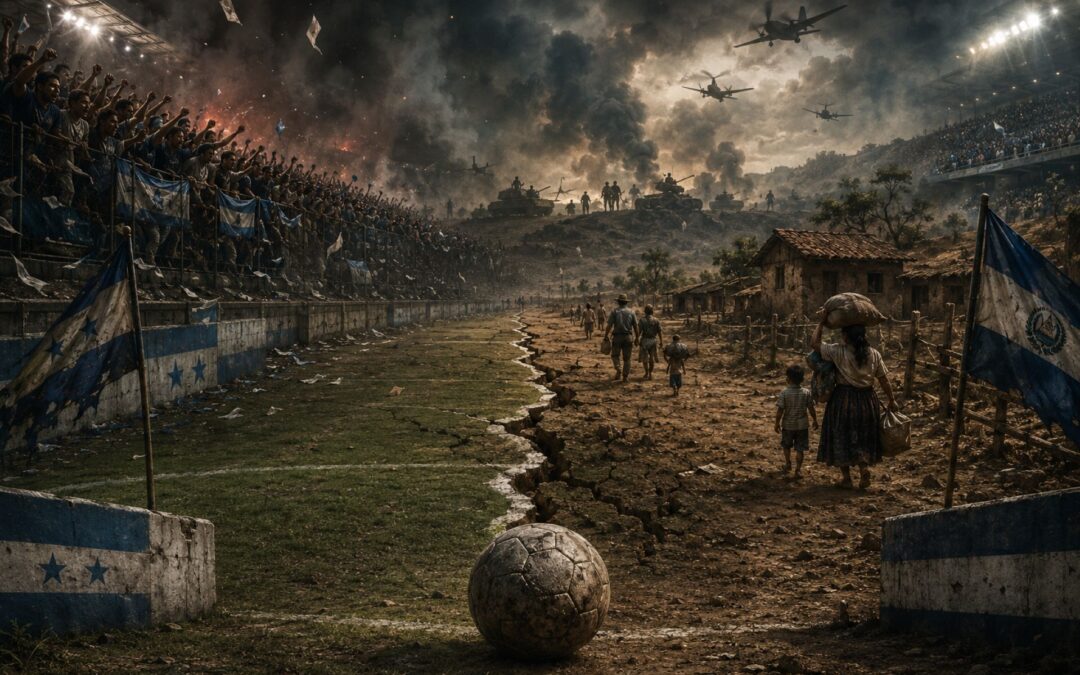
There is a version of this story that sounds almost too ridiculous to be true.
Two countries play a football match. The fans riot. National pride boils over. A few days later, the armies march.
That is how the 1969 war between Honduras and El Salvador is usually remembered: the Football War, or the Soccer War, a conflict supposedly caused by a World Cup qualifier.
It is a neat story. It is also misleading.
Football did not create the war. It gave the war its name. The real causes were older, harder, and far less amusing: land hunger, migration, weak governments, military rule, nationalist media, economic resentment, and the political usefulness of blaming outsiders for domestic failure.
The football matches mattered because they turned all of that pressure into humiliation.
They gave two angry societies a scoreboard.
The War Was Never Really About Football
In July 1969, El Salvador and Honduras fought a short but brutal war that lasted roughly 100 hours. Thousands were killed or wounded. Tens of thousands of Salvadorans fled or were expelled from Honduras. Diplomatic relations collapsed. Border disputes dragged on for years.
Yet the war is still remembered mostly because it followed a series of violent 1970 World Cup qualifying matches between the two countries.
That timing made the story irresistible.
The first match was played in Honduras. Honduran fans reportedly kept the Salvadoran team awake through the night, and Honduras won 1–0 with a late goal. The second match was played in El Salvador, where the Honduran team faced the same treatment, the Honduran flag was insulted, and El Salvador won 3–0. The deciding match was played in Mexico City. El Salvador won again, qualifying for the next stage.
Soon after, El Salvador severed diplomatic relations with Honduras. On July 14, 1969, it invaded.
On the surface, the link looked obvious: football match, nationalist rage, war.
But serious accounts of the conflict tell a different story. A University of Portsmouth analysis describes the conflict not as a war caused by football, but as a war rooted in land, migration, inequality, and political scapegoating. The football matches did not build the crisis. They exposed it.
The better question is not: “How did football cause a war?”
It is: “Why were two countries so unstable that a football rivalry could become the language of war?”
Two Countries, One Land Crisis
To understand the Football War, you have to start with geography and land.
Honduras was much larger than El Salvador. El Salvador was smaller, more densely populated, and dominated by a deeply unequal rural land system. Many Salvadoran peasants had little or no land of their own. For rural families, land was not just property. It was survival.
So Salvadorans moved.
For decades, hundreds of thousands crossed into Honduras, where land was more available and the population was thinner. Many settled as farmers. Some lived there for years. Some built lives across a border that, for poor rural communities, was often less meaningful on the ground than it appeared on a map.
This was not unusual in Central America. Borders were porous, economies were connected, and poor workers followed land and wages wherever they could find them.
But migration solved one country’s pressure by creating pressure inside another.
By the 1960s, Honduran peasants were also demanding land. Honduras had its own inequality, its own rural poverty, and its own angry campesino movements. The government faced pressure to redistribute land to Hondurans, while large estates and foreign companies continued to dominate valuable agricultural areas.
A World Bank rural development report on Honduras notes that Honduras had created the National Agrarian Institute after its 1962 agrarian reform law, but land reform remained limited and politically difficult. The competition for land was real, and Salvadoran settlers became an easy target inside that struggle.
This is where the conflict began to harden.
For El Salvador, migration to Honduras relieved pressure at home. For Honduras, Salvadoran migrants increasingly looked like competitors for land and jobs. For both governments, the issue became politically useful.
And dangerous.
Why Salvadoran Migrants Became the Enemy
Honduras in the 1960s was ruled by General Oswaldo López Arellano, who had come to power through a military coup in 1963. His regime faced questions of legitimacy, economic frustration, and pressure from peasants demanding land.
When governments are weak, scapegoats become tempting.
Salvadoran migrants were vulnerable. They were visible. They were poor. They could be blamed for problems that had deeper roots: land concentration, rural inequality, elite power, weak institutions, and economic dependence on export agriculture.
Honduran nationalism began to turn against them.
The issue was not simply that Salvadorans were present in Honduras. It was that Honduran political leaders could present them as the reason Honduran peasants lacked land. That framing shifted anger away from domestic elites and toward foreign settlers.
The role of foreign agricultural interests made the situation even more explosive. The region had long been shaped by powerful fruit companies, especially in Honduras, where “banana republic” was not just an insult but a description of how export agriculture, foreign capital, and domestic politics became entangled. The University of Portsmouth’s account emphasizes that land reform and foreign agrarian interests were central to the pressures behind the war, not merely background detail.
As tensions rose, Honduras moved against Salvadoran settlers. Many were evicted. Others faced harassment and violence. Homes were burned. Families fled back to El Salvador.
For El Salvador, this created a new crisis. The country already had too many landless people and too little land. Now thousands of returning migrants were coming back into a system that had no room for them.
The Salvadoran government publicly framed the issue as a defense of its people abroad.
That was partly true.
But it was also convenient.
El Salvador’s own elite had little interest in solving the land inequality that had pushed so many Salvadorans into Honduras in the first place. Defending migrants across the border was politically easier than confronting the land system at home.
Both countries were now trapped in a cycle of grievance.
Honduras blamed Salvadorans for land pressure. El Salvador blamed Honduras for abusing Salvadorans. Neither government wanted to fully confront its own failures.
Then came the football matches.
The World Cup Qualifiers Turned Politics Into Humiliation
Football did not need to create nationalism in Honduras or El Salvador. It only needed to give nationalism a stage.
The 1970 World Cup qualifiers arrived at the worst possible moment. Both countries were already primed for confrontation. The press on both sides was inflaming tensions. Migrants were being attacked and expelled. Governments were posturing. Public anger was building.
Then the national teams met.
The first match, in Tegucigalpa, became more than a game. Honduran fans reportedly surrounded the Salvadoran team’s hotel the night before the match, making noise to keep the players awake. Honduras won 1–0 with a late goal.
In El Salvador, the defeat became a national humiliation. The suicide of a young Salvadoran fan after the match was turned into a symbol of patriotic grief. Her funeral was reportedly treated almost like a state event. Football had become a vessel for national emotion.
The second match, in San Salvador, reversed the hostility. Honduran players endured their own sleepless night. The Honduran flag was reportedly dishonored before the match. El Salvador won 3–0. Violence erupted around the game, and the Honduran team had to leave under protection.
The deciding match in Mexico City became the final symbolic confrontation. El Salvador won 3–2 after extra time.
For football, that meant El Salvador advanced.
For politics, it meant something darker.
The academic article National Identity and Sports in Latin America: The Hundred-Hour Football War between El Salvador and Honduras argues that sport helped transform existing political and social tensions into a sharper national identity conflict. In other words, the matches mattered not because football was the root cause, but because football gave both publics a simple emotional script.
Us against them.
Honor against insult.
Victory against humiliation.
Once the conflict reached that emotional register, compromise became harder. A border dispute became a national insult. A migration crisis became an attack on the nation. A football loss became evidence of enemy hatred.
This is why the phrase “Football War” is both useful and misleading.
It captures the spark.
It hides the fuel.
Why El Salvador Chose War
After the final qualifier, the crisis moved quickly.
El Salvador accused Honduras of persecuting Salvadoran migrants. Honduras accused El Salvador of aggression and interference. Diplomatic ties broke down. Public anger in both countries hardened.
El Salvador faced a serious refugee crisis. Thousands of Salvadorans were returning from Honduras, many with stories of violence, eviction, and dispossession. The Salvadoran state did not have an easy way to absorb them. The country’s land problem, already severe, became even more urgent.
War offered the Salvadoran government a way to reframe the crisis.
Instead of asking why so many Salvadorans had been forced to seek land abroad, the government could present itself as the defender of Salvadorans against Honduran aggression. Instead of confronting domestic inequality, it could channel public anger outward.
That does not mean the suffering of Salvadoran migrants was invented. It was real. But states often use real suffering in politically convenient ways.
Honduras had used Salvadorans as scapegoats.
El Salvador used Salvadorans as a cause.
On July 14, 1969, El Salvador launched military action against Honduras.
The war was now official.
The Hundred Hours of Fighting
The conflict moved fast.
El Salvador began with air attacks on strategic Honduran targets, including airfields. Its ground forces then crossed into Honduras along major roads. At first, the Salvadoran advance was effective. El Salvador had the stronger army, and its troops pushed quickly into Honduran territory.
For a brief moment, it looked as if El Salvador might achieve a rapid victory.
But the war did not stay one-sided.
The Honduran Air Force recovered and struck back. Honduran planes attacked Salvadoran air bases and oil facilities, damaging the supply lines that El Salvador needed to keep its invasion moving. As the Salvadoran advance slowed, the conflict began to turn into a stalemate.
This was not a large war by global standards, but it was devastating for the people caught inside it. Civilians fled. Border communities were uprooted. Both countries suffered economic damage. The fighting was short, but the shock was deep.
The conflict also became historically unusual for another reason: it involved some of the last combat between piston-engine fighter aircraft, a detail that makes the war a niche subject in aviation history. But that military curiosity should not distract from the larger point.
This was not a comic-opera war caused by a bad football match.
It was a real war fought by real states, with real casualties, over a crisis neither side had managed to solve politically.
How the OAS Stopped the War But Not the Crisis
The Organization of American States moved quickly to stop the fighting.
A war between Honduras and El Salvador threatened regional stability, and the OAS pushed for a ceasefire, withdrawal, and guarantees for civilians. U.S. diplomatic records in the Foreign Relations of the United States collection show how intensely the crisis was handled through regional diplomacy, including calls for a ceasefire, troop withdrawal, grounding of air forces, protection of nationals, and an end to inflammatory propaganda.
A ceasefire was arranged on July 18, 1969.
But stopping the shooting was easier than solving the dispute.
El Salvador did not immediately withdraw its troops. It wanted guarantees for Salvadorans in Honduras. The OAS increased pressure, including the threat of sanctions. Eventually, El Salvador pulled its forces out in early August.
The war had lasted around 100 hours.
The crisis had not.
Diplomatic relations remained broken for years. Migration and border issues remained unresolved. The damage to regional cooperation was severe. The Central American Common Market, which had been one of the region’s major economic integration projects, was weakened by the conflict and the bitterness that followed.
The OAS could stop the armies.
It could not undo the fear, expulsions, land pressure, or nationalist resentment that had produced the war in the first place.
What the Football War Really Changed
The Football War did not solve anything.
El Salvador qualified for the 1970 World Cup, where it lost all three group-stage matches without scoring a goal. Honduras did not recover some grand national victory. The migrants who had been at the center of the crisis remained vulnerable. The land problems in both countries remained.
In that sense, the war produced no winner.
But it did leave consequences.
Many Salvadorans who had lived in Honduras returned to El Salvador, worsening the country’s existing land and social pressures. Those pressures later fed into the broader instability that helped produce the Salvadoran Civil War. The Football War was not the sole cause of that later conflict, but it was part of the chain of displacement, inequality, repression, and political radicalization that made El Salvador increasingly unstable.
The border dispute also continued long after the guns fell silent. Honduras and El Salvador did not sign a formal peace treaty until 1980. The General Peace Treaty registered with the United Nations dealt with diplomatic relations, border questions, and mechanisms for settling disputes that the short war had failed to resolve.
That is one of the darkest ironies of the Football War.
The fighting lasted less than a week.
The causes and consequences lasted for decades.
The war damaged economies, hardened borders, displaced people, weakened regional integration, and left both countries with the same structural problems they had before.
The football matches gave the conflict its name.
They did not give it meaning.
Conclusion: Football Was the Spark, Not the Cause
The Football War is remembered because the story sounds absurd.
A World Cup qualifier. A riotous rivalry. A war.
But the truth is more serious than the myth. Honduras and El Salvador did not go to war because football made them irrational. They went to war because land was scarce, migrants were vulnerable, governments were weak, elites avoided reform, and nationalism made compromise feel like surrender.
Football mattered because it turned slow-burning problems into public spectacle.
It gave people a way to feel the crisis instantly. A lost match could become a national insult. A hostile crowd could become proof of enemy hatred. A team’s humiliation could become a country’s humiliation.
That is why the Football War still matters.
Not because football is uniquely dangerous.
But because any symbol can become dangerous when a society is already looking for someone to blame.
Last Updated on July 3, 2026 by Aseem Gupta