
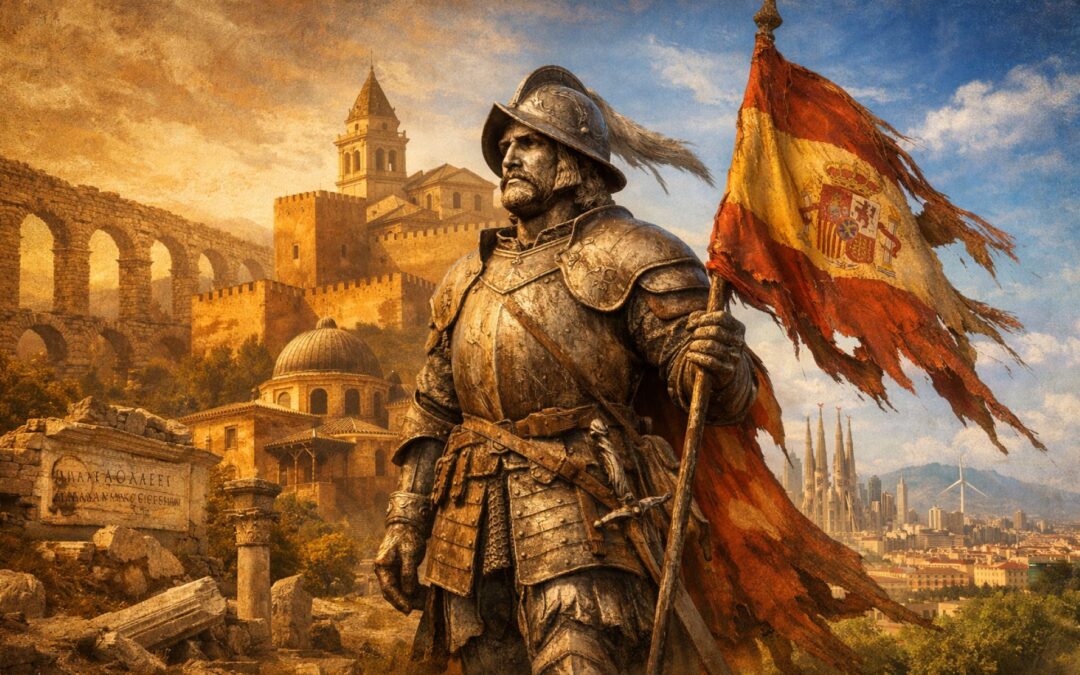
Spain’s history is one of the most dramatic and complex in Europe. Few countries have experienced such a sweeping sequence of civilizations, religions, empires, and political transformations. Over thousands of years, the Iberian Peninsula has been shaped by prehistoric tribes, Roman administrators, Germanic kings, Muslim scholars, Christian monarchs, imperial conquistadors, revolutionary republicans, authoritarian rulers, and modern democratic reformers. Each era left behind institutions, traditions, and tensions that continue to shape the country today.
Situated at the crossroads of the Mediterranean and the Atlantic, and only a narrow strait away from North Africa, the Iberian Peninsula has long served as a meeting point between worlds. Civilizations from Europe, Africa, and the Middle East converged there, bringing with them trade, conquest, ideas, religions, and cultures. As a result, Spain developed a uniquely layered identity in which Roman law, Islamic learning, Christian kingdoms, and regional traditions all became part of its historical fabric.
At different moments in history, Spain has stood at the very center of global power. During the 16th century, the Spanish Empire stretched across Europe, the Americas, Africa, and Asia, becoming one of the largest empires the world had ever seen. Spanish explorers reshaped global geography, Spanish armies dominated European battlefields, and Spanish artists and writers helped define the cultural spirit of an entire age. Yet this extraordinary power was followed by centuries of decline, political upheaval, civil war, and dictatorship before Spain finally emerged as a modern democratic nation in the late 20th century.
The story of Spain is therefore not a simple tale of rise and fall, but rather one of constant transformation. Empires rose and collapsed, religions competed and coexisted, and regional identities persisted even as rulers attempted to unify the country under a single crown. From ancient Iberian tribes to the modern European state, Spain’s past reveals a civilization repeatedly reinventing itself in response to conquest, crisis, and opportunity.
To understand Spain today—its language, culture, politics, and enduring regional diversity—it is necessary to trace the long and turbulent path that brought it into existence. That journey begins thousands of years ago, when the Iberian Peninsula was home to a patchwork of indigenous peoples and trading colonies that would eventually draw the attention of the greatest empires of the ancient world.
Ancient Iberia: The Foundations Of The Peninsula
Long before the emergence of Spain as a unified kingdom, the Iberian Peninsula was home to a diverse patchwork of peoples, cultures, and early civilizations. Its strategic location between the Mediterranean Sea and the Atlantic Ocean made it a natural crossroads for migration, trade, and cultural exchange. Over thousands of years, waves of indigenous communities and foreign traders shaped the early foundations of Iberian society, setting the stage for the dramatic transformations that would follow.
Indigenous Cultures Of Iberia
Human habitation in the Iberian Peninsula stretches back hundreds of thousands of years, with archaeological discoveries revealing evidence of early human settlements across the region. By the Neolithic period, communities had begun transitioning from nomadic hunting and gathering to settled agricultural life. Farming villages spread throughout the peninsula, cultivating crops and domesticating animals while developing distinct regional cultures.
By the beginning of the first millennium BC, Iberia had become a mosaic of tribal societies. Along the Mediterranean coast lived the Iberians, a collection of culturally related peoples who developed relatively advanced urban settlements, metalworking industries, and trading networks. In the interior and northwestern regions, Celtic tribes dominated the landscape. These groups, often referred to collectively as the Celtiberians, combined elements of Celtic and local Iberian culture and were known for their warrior traditions and fortified hilltop settlements.
Other groups also inhabited different regions of the peninsula. The Lusitanians occupied the western territories corresponding roughly to modern Portugal and parts of western Spain, while the Tartessians flourished in the fertile southwestern region. Tartessian society appears to have been among the most sophisticated of early Iberia, enriched by trade and natural resources such as silver and copper.
Despite their cultural diversity, these societies shared certain common characteristics. Most lived in tribal confederations rather than centralized states, and political authority tended to revolve around local leaders and warrior elites. Warfare between tribes was common, yet trade and cultural exchange also connected different regions of the peninsula.
Phoenician, Greek, And Carthaginian Influence
Beginning in the first millennium BC, Iberia’s coastal regions attracted the attention of powerful seafaring civilizations from the eastern Mediterranean. The first of these were the Phoenicians, master traders from the Levant who established a network of trading posts along the southern coast of the peninsula. Among the earliest and most important of these settlements was Gadir, modern Cádiz, founded around the 9th century BC.
The Phoenicians were primarily interested in Iberia’s rich natural resources, particularly silver and other metals. Through trade, they introduced new technologies, writing systems, and cultural influences to the indigenous populations. Over time, these coastal settlements became thriving commercial hubs connecting Iberia to the wider Mediterranean world.
Greek colonists followed in later centuries, establishing their own trading enclaves along the northeastern coast. One of the most prominent was Emporion, located in present-day Catalonia. Like the Phoenicians, the Greeks sought commercial opportunities, exchanging goods such as pottery, wine, and olive oil for Iberian metals and agricultural products.
By the 5th and 4th centuries BC, however, the dominant foreign power in southern Iberia had become Carthage. Founded by Phoenician settlers in North Africa, Carthage inherited much of the Phoenician trading network and gradually expanded its influence across the western Mediterranean. Carthaginian forces established military and commercial strongholds throughout southern Iberia, including the important city of Carthago Nova, modern Cartagena.
Under Carthaginian influence, Iberia became an increasingly important strategic and economic asset. The peninsula supplied soldiers, metals, and resources that helped sustain Carthage’s growing power. But this rising influence would soon draw Iberia into one of the most famous conflicts of the ancient world.
The Punic Wars And Rome’s Arrival
In the 3rd century BC, Iberia became a crucial battleground in the rivalry between two Mediterranean superpowers: Carthage and Rome. The conflict between these states erupted into a series of wars known as the Punic Wars, which would determine the balance of power across the Mediterranean world.
Carthage viewed Iberia as a vital source of manpower and wealth for its military campaigns against Rome. One of its most famous commanders, Hannibal Barca, used Iberia as the launching point for his daring invasion of Italy during the Second Punic War. In 218 BC, Hannibal famously marched his army—including war elephants—across the Pyrenees and the Alps in an attempt to strike directly at the Roman heartland.
Although Hannibal achieved several stunning victories against Roman forces in Italy, Rome ultimately prevailed in the long struggle. Roman armies invaded Iberia to undermine Carthaginian power there, gradually seizing control of key territories and cutting off Hannibal’s supply base.
By 206 BC, the Romans had successfully expelled Carthaginian forces from the peninsula. Iberia now came under Roman control, marking the beginning of a new chapter in its history. Over the next two centuries, Rome would slowly conquer the entire peninsula, transforming it into one of the most important regions of the Roman Empire.
The Roman conquest would reshape Iberia more profoundly than any previous influence, laying the foundations for language, culture, infrastructure, and institutions that would endure long after the fall of Rome itself.
Roman Hispania: The Birth Of A Romanized Spain
The arrival of Rome in the Iberian Peninsula marked one of the most transformative periods in its history. What had once been a fragmented landscape of tribal societies and foreign trading enclaves gradually became integrated into the vast political, economic, and cultural system of the Roman Empire. Over the course of two centuries, Roman rule reshaped Iberia’s cities, languages, infrastructure, and institutions, leaving behind a legacy that would endure long after the empire itself had collapsed.
The Roman Conquest Of Iberia
Rome’s initial presence in Iberia began as part of its broader conflict with Carthage during the Second Punic War. After successfully driving Carthaginian forces from the peninsula by 206 BC, the Romans established a foothold along the eastern and southern coasts. However, consolidating control over the entire region proved far more difficult.
The interior of Iberia was inhabited by fiercely independent tribes who resisted Roman authority for generations. Among the most formidable were the Celtiberians, whose fortified hilltop settlements and skilled warriors posed a constant challenge to Roman expansion. One of the most famous episodes of resistance occurred during the siege of Numantia in the 2nd century BC, when Celtiberian defenders held out against Roman forces for years before ultimately choosing mass suicide rather than surrender.
Further west, the Lusitanians waged a prolonged guerrilla war against Roman rule under the leadership of the legendary chieftain Viriathus. His campaigns inflicted several humiliating defeats on Roman armies before he was eventually assassinated in 139 BC.
Despite these setbacks, Roman military power and persistence gradually prevailed. By the late 1st century BC, Emperor Augustus launched the final campaigns against the Cantabrian and Asturian tribes in the rugged northern mountains. With their defeat in 19 BC, the Roman conquest of Iberia was finally complete after nearly two centuries of conflict.
Urbanization, Trade, And Cultural Integration
Once pacified, the Iberian Peninsula became one of the most prosperous and stable regions of the Roman Empire. Known to the Romans as Hispania, the territory was organized into several provinces governed by Roman administrators and integrated into the empire’s vast network of trade and communication.
Roman authorities undertook extensive infrastructure projects throughout the peninsula. Roads connected distant settlements and facilitated commerce, while aqueducts, bridges, and public buildings transformed urban landscapes. Cities such as Tarraco (modern Tarragona), Emerita Augusta (Mérida), and Caesaraugusta (Zaragoza) flourished as centers of administration, trade, and culture.
Economic activity expanded significantly under Roman rule. Iberia became a major exporter of agricultural products including grain, olive oil, and wine, as well as valuable metals such as silver, gold, and copper extracted from its rich mines. These goods were shipped across the Mediterranean to supply Rome and other parts of the empire.
Urban life followed the familiar Roman pattern. Cities featured forums, temples, amphitheaters, baths, and marketplaces where public life revolved around civic institutions and social gatherings. Roman law and governance introduced new forms of political organization, while local elites were gradually incorporated into the imperial system through citizenship and administrative roles.
Roman Legacy In Language, Religion, And Governance
Perhaps the most enduring transformation brought by Roman rule was cultural integration. Over time, much of the indigenous population adopted the Latin language, Roman customs, and imperial institutions in a process known as Romanization. This gradual assimilation blurred the distinctions between conquerors and conquered, creating a shared cultural identity across Hispania.
The spread of Latin would prove especially significant for the future. Over centuries, the spoken Latin of the peninsula evolved into the Romance languages that later emerged in medieval Spain, including Castilian Spanish, Catalan, and Galician.
Roman Hispania also produced several influential figures who left their mark on the wider empire. The philosopher Seneca, the poet Martial, and the historian Lucan all hailed from the peninsula. Perhaps even more remarkably, two Roman emperors—Trajan and Hadrian—were born in Hispania, reflecting the region’s growing integration into imperial life.
Christianity also began to spread across the peninsula during the later centuries of Roman rule. By the 4th century AD, the new religion had become firmly established in Hispania, laying the foundations for the dominant religious traditions of medieval Spain.
When the Western Roman Empire began to weaken during the 4th and 5th centuries, Hispania remained one of its most deeply Romanized provinces. Roman law, language, urban life, and Christianity had all taken firm root across the peninsula. Even after imperial authority collapsed, these institutions would continue to shape Iberian society under the new rulers who soon arrived from the north.
The Visigothic Kingdom: Rome’s Successor In Iberia
As the Western Roman Empire began to unravel in the 5th century, the Iberian Peninsula entered a new and uncertain era. Waves of migrating Germanic peoples crossed into the region, taking advantage of Rome’s weakening authority. Among these groups, the Visigoths eventually emerged as the dominant power, establishing a kingdom that preserved many aspects of Roman civilization while also reshaping Iberian society in new ways.
The Germanic Migrations
The collapse of Roman authority across Western Europe triggered a series of large-scale migrations that transformed the political landscape of the continent. In the early 5th century, several Germanic tribes crossed the Pyrenees into Hispania, including the Vandals, the Suebi, and the Alans.
Each group established control over different parts of the peninsula. The Suebi formed a kingdom in the northwestern region of Galicia, while the Vandals settled in the south before eventually moving onward to North Africa. The Alans occupied territories in central and southern Iberia but were eventually defeated and absorbed by rival groups.
At first, the Roman administration attempted to manage these migrations by granting land to some of the newcomers as federated allies. However, the imperial government was increasingly unable to maintain real control. As Roman power faded, these Germanic kingdoms gradually took on greater autonomy.
Among these groups, the Visigoths soon rose to prominence. Originally settled in southern Gaul as allies of Rome, the Visigoths were called upon by the Roman authorities to restore order in Hispania. Over time, they expanded their influence and began consolidating control across the peninsula.
The Kingdom Of Toledo
By the late 6th century, the Visigoths had succeeded in unifying most of the Iberian Peninsula under their rule. Their kingdom initially centered in southern France but later shifted its political heart to the city of Toledo in central Iberia. From this new capital, Visigothic rulers governed a realm that extended across nearly the entire peninsula.
Unlike many other Germanic conquerors, the Visigoths adopted much of the existing Roman administrative framework. Roman law, taxation systems, and urban institutions largely remained in place, while Latin continued to function as the language of governance and culture. In many respects, the Visigothic kingdom operated as a successor state to the Roman Empire rather than a complete break from it.
Religion, however, initially created divisions within society. The Visigoths practiced Arian Christianity, a theological doctrine considered heretical by the Roman Catholic Church followed by the majority of the Hispano-Roman population. This religious difference created tensions between the ruling elite and the broader population.
In 589 AD, a significant turning point occurred when King Reccared I converted to Catholic Christianity. His conversion brought the Visigothic rulers into alignment with the religious beliefs of their subjects and helped strengthen the unity of the kingdom. Catholicism would thereafter become a central pillar of Visigothic identity and governance.
Over time, the distinction between the Visigothic ruling class and the Hispano-Roman population gradually diminished. Intermarriage, shared religion, and common legal institutions blended the two communities into a more unified society. The Visigothic law codes that emerged during this period combined elements of Roman law with Germanic traditions and would influence Iberian legal systems for centuries.
The Collapse Of Visigothic Rule
Despite these efforts at integration, the Visigothic kingdom remained politically unstable. Unlike many hereditary monarchies, Visigothic kings were often chosen by the nobility, which led to frequent power struggles and rival claims to the throne. Assassinations, coups, and internal rebellions were common features of Visigothic politics.
These internal divisions weakened the kingdom at a critical moment. In the early 8th century, a succession crisis erupted following the death of King Wittiza. Rival factions supported competing candidates for the throne, plunging the kingdom into civil war.
It was during this moment of instability that a new force arrived from across the Mediterranean. In 711 AD, Muslim armies composed primarily of Arab and Berber soldiers crossed the Strait of Gibraltar under the leadership of the general Tariq ibn Ziyad. Taking advantage of the Visigothic kingdom’s internal divisions, the invading forces achieved a decisive victory over King Roderic at the Battle of Guadalete.
Following this defeat, Visigothic resistance collapsed with surprising speed. Within only a few years, Muslim armies had conquered most of the Iberian Peninsula. The fall of the Visigothic kingdom marked the end of the post-Roman order in Iberia and ushered in a new chapter in the peninsula’s history—one that would profoundly reshape Spain for centuries to come.
Al-Andalus: Islamic Spain And The Medieval Golden Age
The Muslim conquest of the Iberian Peninsula in the early 8th century marked one of the most transformative turning points in Spanish history. Within just a few years, the old Visigothic kingdom collapsed and a new Islamic civilization emerged across much of Iberia. For centuries, the region known as Al-Andalus would become one of the most prosperous and culturally vibrant societies in medieval Europe, blending influences from the Islamic world, the Mediterranean, and the surviving Christian communities of the peninsula.
The Muslim Conquest Of 711
In the year 711 AD, an army composed largely of Berber soldiers from North Africa, led by the general Tariq ibn Ziyad, crossed the narrow strait separating Africa and Europe. Landing near what is now Gibraltar—a name derived from Jabal Tariq, meaning “Mountain of Tariq”—the Muslim forces advanced rapidly into Visigothic territory.
At the time, the Visigothic kingdom was deeply divided by internal conflicts over succession. The Muslim army soon confronted King Roderic, the Visigothic ruler, at the Battle of Guadalete. The battle ended in a decisive defeat for the Visigoths, and with the collapse of centralized resistance, the Muslim forces moved swiftly across the peninsula.
Within a few years, most major cities—including Toledo, Córdoba, and Zaragoza—had fallen under Muslim control. By 718 AD, nearly the entire Iberian Peninsula was incorporated into the expanding Islamic world. Only a small mountainous region in the far north remained beyond Muslim rule, where Christian resistance would slowly begin to take shape.
The Emirate And Caliphate Of Córdoba
Initially, Al-Andalus functioned as a province of the powerful Umayyad Caliphate, which ruled from Damascus and controlled a vast empire stretching from the Middle East to North Africa. However, political upheaval soon reshaped the structure of Islamic Spain.
In 750 AD, the Abbasid Revolution overthrew the Umayyad dynasty in the eastern Islamic world. One surviving member of the Umayyad family, Abd al-Rahman I, escaped to Iberia, where he established an independent Emirate of Córdoba in 756. Though he did not claim the title of caliph, Abd al-Rahman effectively ruled Al-Andalus as an autonomous state separate from Abbasid authority.
Under the Umayyad emirs, Córdoba grew into one of the most important cities in the Mediterranean world. In 929, Abd al-Rahman III formally proclaimed himself caliph, elevating the emirate into the Caliphate of Córdoba and placing Islamic Spain among the leading political powers of the era.
At its height during the 10th century, the caliphate presided over a flourishing society characterized by economic prosperity, advanced scholarship, and architectural achievement. Córdoba itself became one of the largest and most sophisticated cities in Europe, boasting paved streets, public lighting, baths, libraries, and centers of learning that rivaled those of the Islamic East.
Cultural Flourishing And Religious Coexistence
One of the defining characteristics of Al-Andalus was its remarkable cultural vitality. As part of the broader Islamic Golden Age, the region became a hub of intellectual and artistic activity. Scholars made significant contributions to fields such as medicine, mathematics, philosophy, astronomy, and agriculture.
The society of Al-Andalus was also notable for its religious diversity. Although Islam was the dominant faith and Muslims held political authority, Christians and Jews were generally allowed to practice their religions under a system that granted protected status to non-Muslim communities. In return, these communities paid special taxes and accepted certain legal restrictions.
This arrangement created a multi-religious society in which Muslims, Christians, and Jews often lived alongside one another in cities and towns. While tensions and inequalities certainly existed, the period witnessed significant cultural exchange between these communities.
Several of the most celebrated intellectual figures of the medieval world emerged from Al-Andalus. The philosopher Averroes played a crucial role in preserving and interpreting the works of Aristotle, influencing both Islamic and European thought. The Jewish scholar Maimonides also flourished in this environment, contributing important works in philosophy and medicine.
Architectural achievements further reflected the wealth and sophistication of the era. The Great Mosque of Córdoba, with its iconic forest of arches, became one of the most magnificent religious buildings in the Islamic world. Later, the Alhambra palace complex in Granada would stand as another masterpiece of Andalusian art and design.
Fragmentation Into Taifa Kingdoms
Despite its cultural brilliance, the political unity of Al-Andalus proved fragile. In the early 11th century, internal rivalries and power struggles caused the Caliphate of Córdoba to collapse. The once-unified state fragmented into numerous smaller Muslim principalities known as taifa kingdoms.
These rival states often competed with one another for power and territory, weakening their collective ability to resist external threats. At times, some taifa rulers even allied with Christian kingdoms in the north against their Muslim rivals.
This political fragmentation gradually shifted the balance of power on the Iberian Peninsula. The Christian kingdoms that had survived in the northern mountains began expanding southward, launching a centuries-long struggle to reclaim territory from Muslim rule.
This long conflict, later known as the Reconquista, would reshape the political and religious landscape of Iberia and ultimately lead to the emergence of a new Christian Spain.
The Reconquista: The Christian Reclamation Of Iberia
While Muslim rulers governed most of the Iberian Peninsula during the early centuries of Al-Andalus, small Christian strongholds survived in the mountainous regions of the north. Over time, these kingdoms gradually expanded their territory southward, beginning a long and complex struggle that later generations would call the Reconquista—the reconquest of Iberia from Muslim rule. Lasting nearly eight centuries, this conflict reshaped the political, cultural, and religious identity of the peninsula.
The Rise Of Northern Christian Kingdoms
The earliest Christian resistance emerged in the rugged northern mountains, where Muslim control was weakest. According to later tradition, the Kingdom of Asturias was founded after a small Christian force led by Pelayo defeated Muslim troops at the Battle of Covadonga in the early 8th century. Though modest in scale, this victory became an important symbol of Christian resistance.
From Asturias, Christian authority gradually expanded across the northern regions of Iberia. Over the centuries, new kingdoms emerged as territories were divided and reorganized. León, Castile, Navarre, and Aragon all developed into independent centers of Christian power, each pursuing its own political ambitions while also competing with one another.
These kingdoms slowly pushed their frontiers southward through a combination of military campaigns, settlement, and diplomacy. Newly conquered lands were often repopulated by Christian settlers from the north in a process known as repoblación, which helped consolidate Christian control over frontier regions.
Despite their shared religious identity, the Christian kingdoms were not always united. Rivalries between them frequently led to wars and shifting alliances, sometimes even involving cooperation with Muslim rulers against fellow Christians.
Muslim Dynasties And Renewed Conflict
The fragmentation of Al-Andalus into taifa kingdoms during the 11th century initially accelerated Christian expansion. However, Muslim rulers soon sought help from powerful North African dynasties to defend their territories.
The first of these were the Almoravids, a Berber empire from Morocco that crossed into Iberia in the late 11th century. Known for their strict interpretation of Islam and strong military organization, the Almoravids temporarily halted Christian advances and reasserted Muslim control over many of the taifa states.
In the 12th century, another North African power—the Almohads—replaced the Almoravids as the dominant Muslim force in Iberia. Like their predecessors, the Almohads attempted to reunify Al-Andalus and resist the growing strength of the Christian kingdoms.
These interventions prolonged Muslim rule in the peninsula but also intensified the religious and political character of the conflict. The struggle between Christian and Muslim powers increasingly came to be framed as part of a broader confrontation between two civilizations.
The Turning Point: Las Navas De Tolosa
The decisive turning point in the Reconquista came in 1212 at the Battle of Las Navas de Tolosa. In this pivotal confrontation, a coalition of Christian forces from Castile, Aragon, and Navarre faced the armies of the Almohad Caliphate.
The Christian coalition achieved a crushing victory, breaking the military power of the Almohads in Iberia. In the years that followed, Christian armies rapidly advanced into territories that had been under Muslim control for centuries.
Major cities including Córdoba and Seville fell to Christian forces during the 13th century. As Muslim power collapsed across much of the peninsula, the Christian kingdoms consolidated their gains and expanded their authority over newly conquered lands.
The Survival Of Granada
By the mid-13th century, almost the entire Iberian Peninsula had come under Christian rule. Only one Muslim state remained: the Emirate of Granada in the far south.
Granada managed to survive for over two centuries by adopting a pragmatic strategy. Its rulers paid tribute to the powerful Kingdom of Castile and skillfully navigated the complex politics of the peninsula. Protected by the mountainous terrain of southern Iberia and the impressive fortifications of the Alhambra palace complex, the emirate endured as the final remnant of Islamic Spain.
During this period, Granada continued to serve as a center of Andalusian culture, preserving many artistic and architectural traditions developed during the earlier centuries of Al-Andalus.
Meanwhile, the Christian kingdoms of Castile and Aragon grew steadily stronger. Their eventual political union in the late 15th century would create the conditions necessary to bring the Reconquista to its final conclusion—and to lay the foundations for the emergence of a unified Spanish state.
The Birth Of Spain: Ferdinand, Isabella, And 1492
By the late 15th century, the centuries-long Reconquista was approaching its final chapter. The Christian kingdoms that had gradually expanded across the Iberian Peninsula were becoming more politically consolidated, and a dynastic union between two of the most powerful realms—Castile and Aragon—would fundamentally reshape the future of the region. Under the rule of Ferdinand II of Aragon and Isabella I of Castile, often known as the Catholic Monarchs, the foundations of a unified Spain began to take shape.
The Union Of Castile And Aragon
In 1469, the marriage of Isabella of Castile and Ferdinand of Aragon united the crowns of the two most powerful Christian kingdoms on the peninsula. Although each kingdom retained its own institutions, laws, and administrative systems, the royal couple ruled in partnership and coordinated their policies closely.
This dynastic union did not immediately create a single centralized Spanish state, but it did establish a powerful political alliance capable of dominating the Iberian Peninsula. Castile was the larger and more populous kingdom, while Aragon possessed an influential network of Mediterranean territories that included parts of Italy and several strategic islands.
Together, Ferdinand and Isabella strengthened royal authority within their realms. They curtailed the power of rebellious nobles, reformed administrative institutions, and established mechanisms such as the royal councils and the Santa Hermandad—an armed league used to enforce law and order across Castile.
Through these reforms, the Catholic Monarchs gradually centralized power and created a more stable political foundation than had existed in Iberia for centuries.
The Fall Of Granada
The final stage of the Reconquista focused on the last remaining Muslim state in Iberia: the Emirate of Granada. Though Granada had survived for centuries by paying tribute to Castile and navigating shifting alliances, its position became increasingly precarious as the power of the Christian kingdoms grew.
In 1482, Ferdinand and Isabella launched a sustained military campaign against the emirate. The war lasted for a decade and involved a series of sieges and battles across southern Iberia. Granada’s internal divisions weakened its ability to resist, while the Catholic Monarchs brought considerable military and financial resources to bear.
In January 1492, the city of Granada finally surrendered. Its ruler, Muhammad XII—known in Spanish sources as Boabdil—formally handed the keys of the city to Ferdinand and Isabella. With this event, nearly eight centuries of Muslim political rule in Iberia came to an end.
The fall of Granada marked a symbolic culmination of the Reconquista and helped solidify the authority of the Catholic Monarchs over most of the peninsula.
The Spanish Inquisition And Religious Unity
Following the conquest of Granada, Ferdinand and Isabella sought to strengthen religious unity within their expanding realms. Although Muslim and Jewish communities had long existed in Iberia, the Catholic Monarchs believed that religious uniformity would reinforce political stability and royal authority.
The Spanish Inquisition, established earlier in 1478 with papal approval, became an important instrument of this policy. Unlike earlier inquisitions directed by the Church, the Spanish Inquisition operated largely under royal control and focused on investigating individuals suspected of secretly practicing non-Christian faiths.
Many Jews had converted to Christianity—becoming known as conversos—but were often suspected of continuing Jewish religious practices in secret. Similarly, converted Muslims, called moriscos, later faced similar scrutiny.
In 1492, the same year Granada fell, Ferdinand and Isabella issued the Alhambra Decree ordering the expulsion of Jews who refused to convert to Christianity. Thousands left Spain for North Africa, the Ottoman Empire, and other regions of Europe. While these policies strengthened the religious identity of the kingdom as firmly Catholic, they also removed communities that had played important roles in Iberian economic and intellectual life.
Columbus And The Opening Of The Atlantic World
The year 1492 proved to be even more consequential for Spain’s future. That same year, Ferdinand and Isabella agreed to sponsor the voyage of the Genoese navigator Christopher Columbus, who proposed reaching Asia by sailing west across the Atlantic Ocean.
In October 1492, Columbus landed in the Bahamas, believing he had reached islands near Asia. Although he had in fact encountered lands previously unknown to Europeans, his voyages opened the door to an era of exploration, conquest, and colonization that would dramatically transform global history.
Within a few decades, Spanish explorers and conquistadors established control over vast territories in the Americas. Powerful indigenous civilizations such as the Aztec and Inca empires were conquered, and enormous quantities of wealth—particularly silver and gold—began flowing into Spanish coffers.
These developments propelled Spain into the ranks of the world’s greatest powers. The union of Castile and Aragon, the completion of the Reconquista, the enforcement of religious uniformity, and the discovery of new lands across the Atlantic together marked the birth of a new political entity that would soon emerge as the first truly global empire.
The Spanish Empire: The First Global Superpower
In the decades following 1492, Spain rapidly transformed from a powerful European kingdom into the center of a vast global empire. Through conquest, exploration, and dynastic inheritance, Spanish rulers came to control territories stretching across Europe, the Americas, Asia, and Africa. During the 16th century, Spain emerged as the dominant political and military power of the Western world, presiding over an empire so extensive that contemporaries famously claimed the sun never set upon it.
Conquest Of The Americas
Spain’s imperial expansion began in the newly encountered lands of the Americas. Following Columbus’s voyages, Spanish expeditions spread across the Caribbean and mainland America, driven by a mixture of ambition, religious zeal, and the search for wealth.
Among the most dramatic conquests were those carried out by the conquistadors in the early 16th century. In 1519, Hernán Cortés launched an expedition into Mexico that ultimately brought down the powerful Aztec Empire. Exploiting internal rivalries among indigenous groups and aided by superior weaponry and devastating diseases introduced from Europe, Cortés captured the Aztec capital of Tenochtitlán in 1521.
A little more than a decade later, another Spanish conquistador, Francisco Pizarro, conquered the Inca Empire in South America. In 1532, Pizarro captured the Inca ruler Atahualpa during a surprise attack, eventually leading to the collapse of the vast Andean empire.
These conquests brought enormous territories under Spanish control. Over time, Spain established a complex system of colonial administration across the Americas, organized into large viceroyalties governed on behalf of the Spanish crown. These territories supplied immense quantities of silver, gold, and agricultural products that flowed back to Spain and helped finance its global ambitions.
The Habsburg Empire Of Charles V
Spain’s imperial power expanded even further through dynastic inheritance. In 1516, the Spanish throne passed to Charles I, the grandson of Ferdinand and Isabella. Through his family connections, Charles inherited not only the Spanish kingdoms and their overseas territories but also extensive lands in central Europe.
In 1519, Charles was elected Holy Roman Emperor, becoming Charles V. As a result, he ruled a sprawling empire that stretched across Spain, the Low Countries, parts of Italy, central Europe, and the newly conquered territories in the Americas. Few rulers in European history have commanded such a vast collection of lands.
Charles V’s reign placed Spain at the center of European politics. His empire faced constant challenges from rival powers, including France, the Ottoman Empire, and various Protestant states that had emerged during the Reformation. Managing these conflicts required immense financial and military resources, drawing heavily upon Spain’s growing wealth from its colonial possessions.
Despite the scale of his empire, Charles eventually chose to divide his territories. In 1556, he abdicated the Spanish crown to his son Philip II while transferring the Holy Roman Empire to his brother Ferdinand. Even so, Spain remained the dominant power in Europe under the Habsburg dynasty.
Philip II And Spain’s Global Reach
Under Philip II, Spain reached the height of its political influence. Philip centralized royal administration and established Madrid as the permanent capital of Spain in 1561. From this new center of power, the Spanish monarchy governed a global empire spanning multiple continents.
Spain emerged as the leading defender of Catholicism during the era of the Protestant Reformation. Philip II committed considerable resources to suppressing Protestant revolts in the Low Countries and defending Catholic interests across Europe. His reign also saw continuing conflict with the Ottoman Empire in the Mediterranean.
One of the most significant naval battles of the period occurred in 1571 at the Battle of Lepanto, where a coalition of Christian forces led by Spain defeated the Ottoman fleet. This victory helped curb Ottoman naval dominance in the western Mediterranean.
Philip also briefly united the Iberian Peninsula under a single crown when he inherited the Portuguese throne in 1580. This Iberian Union brought together the overseas empires of both Spain and Portugal, temporarily creating one of the largest imperial domains in history.
However, not all of Philip’s ventures were successful. His attempt to invade England with the Spanish Armada in 1588 ended in disaster, marking a symbolic setback for Spanish naval power.
The Cultural Golden Age
Even as Spain exercised immense political power, the 16th and early 17th centuries also witnessed a remarkable flowering of cultural life. This period, often referred to as Spain’s Golden Age, produced some of the most influential works of art, literature, and architecture in European history.
Spanish painters such as El Greco and Diego Velázquez created masterpieces that would shape the development of European art. Writers including Miguel de Cervantes produced enduring literary works, most famously Don Quixote, often regarded as one of the first modern novels.
Spanish architecture also flourished during this time, exemplified by monumental structures such as the royal complex of El Escorial, built under Philip II as both a palace and monastery.
Yet beneath the grandeur of empire and cultural achievement, structural weaknesses were beginning to emerge. The costs of constant warfare, administrative overextension, and economic imbalances would gradually erode Spain’s dominance in the centuries to come.
Imperial Overstretch And Decline
Despite its extraordinary power during the 16th century, Spain’s global dominance proved difficult to sustain. The immense responsibilities of governing a vast empire, combined with constant military conflicts and structural economic weaknesses, gradually began to erode Spain’s position. Over the course of the 17th century, the Spanish monarchy faced mounting financial crises, territorial losses, and political instability that signaled the slow decline of one of Europe’s greatest empires.
European Wars And Economic Strain
Spain’s leadership of the Catholic cause in Europe placed it at the center of nearly every major conflict of the era. The Spanish monarchy spent enormous resources attempting to suppress the Protestant revolt in the Netherlands, maintain influence in Italy, defend its Mediterranean territories, and counter the growing power of rival states such as France and England.
These prolonged wars placed a severe strain on Spain’s finances. Although the empire received large shipments of silver and gold from its American colonies, this wealth often flowed quickly back out of the country to pay for armies, mercenaries, and foreign debts. Much of the silver also fueled inflation across Europe, reducing its long-term economic value.
Spain’s domestic economy struggled to keep pace with the demands of empire. Heavy taxation fell disproportionately on Castile, the wealthiest region of the kingdom, while other territories retained older privileges that limited royal taxation. Agriculture remained relatively underdeveloped, and much of Spain’s manufacturing sector failed to compete with more dynamic economies in northern Europe.
As a result, the Spanish crown repeatedly declared bankruptcy during the 16th and 17th centuries, undermining its financial credibility and weakening its ability to sustain prolonged military campaigns.
Revolts And Territorial Losses
Spain’s political authority was also challenged by a series of revolts and territorial losses. The Dutch Revolt, which began in the late 16th century, proved particularly damaging. After decades of conflict, the northern provinces of the Low Countries eventually secured independence as the Dutch Republic, dealing a major blow to Spanish prestige and influence in northern Europe.
Meanwhile, tensions within Spain’s own territories erupted into rebellion. In 1640, both Catalonia and Portugal rose up against Spanish rule. The Catalan revolt was eventually suppressed, but Portugal successfully restored its independence, ending the Iberian Union that had brought the Portuguese empire under Spanish control.
France also emerged as Spain’s most formidable rival on the European continent. Prolonged conflicts between the two powers culminated in the Treaty of the Pyrenees in 1659, which forced Spain to cede several territories to France and confirmed the shifting balance of power in Europe.
These developments revealed that Spain’s empire, once seemingly invincible, had become increasingly vulnerable to both internal and external pressures.
The End Of The Spanish Habsburgs
By the late 17th century, Spain’s decline was further compounded by dynastic problems within the ruling Habsburg family. Generations of intermarriage among European royal families had produced a line of monarchs plagued by physical and political weaknesses.
The last Spanish Habsburg king, Charles II, embodied this crisis. Frail and chronically ill, Charles struggled to govern effectively and left no heir when he died in 1700. His death triggered a major international conflict known as the War of the Spanish Succession.
Rival European powers feared that control of the Spanish Empire by either the French Bourbon dynasty or the Austrian Habsburgs would upset the balance of power. As a result, a coalition of states entered into war over who would inherit the Spanish throne.
The conflict lasted more than a decade and involved battles across Europe and in Spanish territories overseas. When peace was finally reached in 1714 through the Treaty of Utrecht, Philip V of the Bourbon dynasty was recognized as king of Spain. However, Spain was forced to surrender several European territories, including possessions in Italy and the Low Countries.
Although Spain remained a significant power, the end of the Habsburg dynasty marked the close of an era. The once-dominant empire had been reshaped by defeat, and the new Bourbon rulers would now attempt to reform and modernize the kingdom in order to restore its fortunes.
Bourbon Spain And Enlightenment Reform
The arrival of the Bourbon dynasty in the early 18th century marked the beginning of a new chapter in Spanish history. Although the War of the Spanish Succession had weakened Spain’s position in Europe, the new rulers sought to rebuild the country’s strength through administrative reform, economic modernization, and the adoption of Enlightenment ideas. While Spain would never fully regain the dominance it once enjoyed during the Habsburg era, the Bourbon monarchs introduced changes that reshaped the Spanish state and laid the groundwork for modernization.
The War Of The Spanish Succession
The death of the last Habsburg king, Charles II, in 1700 without an heir plunged Europe into a major diplomatic and military crisis. In his will, Charles had named Philip of Anjou, a grandson of the French king Louis XIV, as his successor to the Spanish throne. This decision alarmed other European powers, who feared that Spain and France might unite under a single Bourbon dynasty, creating an overwhelming concentration of power.
As a result, several European states—including Britain, Austria, and the Dutch Republic—formed a coalition to oppose Philip’s claim. The conflict that followed, known as the War of the Spanish Succession, lasted from 1701 to 1714 and involved battles across much of Europe as well as in Spain itself.
Within Spain, the war also took on the character of a civil conflict. Different regions supported different claimants to the throne, reflecting longstanding political divisions within the country. The kingdoms of Castile largely backed Philip, while territories within the Crown of Aragon—including Catalonia and Valencia—often supported the Austrian candidate.
The war finally concluded with the Treaty of Utrecht in 1713 and subsequent agreements in 1714. Philip V was recognized as king of Spain, establishing the Bourbon dynasty. However, he was required to renounce any claim to the French throne, ensuring that the crowns of France and Spain would remain separate.
Spain also lost several important European territories as part of the settlement. The Spanish Netherlands and various Italian possessions were transferred to other powers, while Britain gained control of Gibraltar and the island of Minorca. Although these losses reduced Spain’s influence in Europe, they also allowed the new monarchy to focus more directly on governing the Iberian Peninsula and its overseas empire.
Bourbon Centralization
One of the Bourbon dynasty’s primary goals was to strengthen royal authority and create a more centralized and efficient state. Inspired in part by the administrative practices of France under Louis XIV, the Bourbon monarchs sought to reduce the autonomy of regional institutions and standardize governance across the kingdom.
Philip V introduced a series of measures known as the Nueva Planta decrees, which abolished many of the traditional privileges and political institutions of the former Crown of Aragon territories. In their place, a more uniform administrative structure modeled on Castilian institutions was implemented.
These reforms significantly strengthened the power of the central monarchy while diminishing regional autonomy. Although Castile had long been the dominant political force within Spain, the Bourbon reforms further consolidated Madrid’s authority over the entire country.
At the same time, the government worked to modernize taxation, improve the efficiency of state administration, and strengthen the military. These efforts aimed to rebuild Spain’s capacity to function as a major European power.
Enlightenment And The Bourbon Reforms
During the mid-18th century, Spain experienced the influence of the Enlightenment, a broader intellectual movement sweeping across Europe that emphasized reason, scientific inquiry, and social reform. Several Bourbon monarchs, most notably Charles III, embraced elements of these ideas while maintaining strong royal authority.
Charles III’s reign from 1759 to 1788 is often regarded as one of the most effective periods of Bourbon rule. Under his leadership, the government promoted a series of reforms designed to stimulate economic development and improve public administration.
Infrastructure projects expanded road networks and canals to facilitate trade and communication. Agricultural reforms sought to increase productivity and make better use of land, while commercial policies encouraged greater economic activity both within Spain and across its overseas territories.
Education and scientific research also received increased attention. Academies, scientific societies, and educational institutions were established or expanded in an effort to modernize Spanish intellectual life. These initiatives helped Spain participate more actively in the broader intellectual currents of Enlightenment Europe.
The Bourbon reforms also extended to Spain’s colonial empire. Efforts were made to strengthen imperial administration, improve tax collection, and stimulate economic activity in Spanish America. These changes, however, sometimes generated resentment among colonial elites who felt increasingly constrained by royal authority.
By the end of the 18th century, Spain had achieved some degree of recovery from the decline of the previous century. The state was more centralized, its administration more efficient, and its economy somewhat revitalized. Nevertheless, Spain still faced serious challenges, and the revolutionary upheavals that soon swept across Europe would once again plunge the country into crisis.
Napoleon And The Collapse Of Empire
At the beginning of the 19th century, Spain was once again drawn into the sweeping upheavals transforming Europe. The rise of Napoleon Bonaparte and the revolutionary wars that followed shattered the fragile stability the Bourbon monarchy had tried to rebuild. Within a few years, Spain found itself invaded, occupied, and plunged into a brutal conflict that would permanently weaken the country. At the same time, Spain’s vast empire in the Americas began to unravel, ending centuries of global dominance.
The Peninsular War
Initially, Spain was allied with Napoleonic France during the early years of the French Revolutionary Wars. However, the relationship quickly deteriorated as Napoleon sought to expand his control across Europe. In 1808, under the pretext of invading Portugal, French troops entered Spain and soon began occupying key cities.
Napoleon then forced the Spanish king Charles IV and his son Ferdinand VII to abdicate and installed his own brother, Joseph Bonaparte, on the Spanish throne. This act provoked outrage across the country and ignited widespread resistance.
On May 2, 1808, the people of Madrid rose up against the French occupation in a spontaneous revolt that was brutally suppressed. The uprising soon spread across the country, triggering the Peninsular War. Spanish forces, joined by local militias and irregular guerrilla fighters, launched a determined campaign against the French army.
The war quickly became one of the most brutal conflicts of the Napoleonic era. Guerrilla warfare—so named after the Spanish term guerra meaning “little war”—became a defining feature of the struggle. Spanish fighters harassed French troops with ambushes, sabotage, and hit-and-run attacks, making it difficult for Napoleon’s forces to maintain control over the countryside.
Spain also received crucial assistance from Britain and Portugal. British troops led by General Arthur Wellesley, later known as the Duke of Wellington, joined the fight against the French. After several years of intense warfare, the combined Allied forces gradually pushed the French armies out of the peninsula. By 1814, Napoleon’s troops had been expelled from Spain.
Although the war restored the Bourbon monarchy under Ferdinand VII, the country emerged devastated. Cities had been destroyed, the economy was shattered, and political divisions had deepened.
The Independence Of Spanish America
While Spain was fighting to expel the French, its colonies in the Americas seized the opportunity to pursue their own independence. The absence of effective royal authority during the Peninsular War encouraged colonial leaders to challenge Spanish rule.
Inspired by the ideals of the American and French Revolutions, independence movements spread rapidly across Spanish America during the 1810s. Revolutionary leaders such as Simón Bolívar and José de San Martín led campaigns that gradually dismantled Spanish control over vast territories.
Over the course of little more than a decade, Spain lost most of its colonial empire in the Americas. By the mid-1820s, newly independent states had emerged across the continent, including Mexico, Colombia, Peru, Argentina, Chile, and others.
These losses represented one of the most dramatic imperial collapses in modern history. For centuries, Spain had drawn enormous wealth and prestige from its overseas possessions. Now, with most of its empire gone, the country faced a profound economic and political crisis.
Spain’s Loss Of Global Power
The combined impact of the Peninsular War and the independence of Spanish America transformed Spain’s place in the world. Once the dominant imperial power of the early modern era, Spain was now reduced to a secondary European state.
The loss of colonial revenue severely weakened the Spanish economy, while political instability continued to plague the country. The restored Bourbon monarchy struggled to navigate the competing demands of conservative forces that supported absolute monarchy and liberal groups advocating constitutional reforms.
Spain retained only a handful of overseas territories, including Cuba, Puerto Rico, and the Philippines. These remaining colonies would persist for several decades longer, but the era of Spain as a global imperial superpower had effectively come to an end.
The country now entered a long and turbulent period of internal conflict, ideological struggle, and political experimentation. Throughout the 19th century, Spain would grapple with repeated revolutions, civil wars, and unstable governments as it searched for a stable political order in the aftermath of imperial collapse.
Crisis And Instability In The 19th Century
The collapse of Spain’s American empire left the country politically fractured and economically weakened. Throughout the 19th century, Spain struggled to establish a stable political system as competing visions of monarchy, constitutionalism, liberal reform, and traditional authority clashed repeatedly. Revolutions, civil wars, and rapid changes of government became common, turning the century into one of the most turbulent periods in Spanish history.
The Carlist Wars
One of the most destructive sources of instability emerged after the death of King Ferdinand VII in 1833. Ferdinand had abolished the traditional Salic law that prevented women from inheriting the throne, allowing his young daughter Isabella II to succeed him as queen. However, this decision was fiercely contested by Ferdinand’s brother, Don Carlos, who claimed the throne for himself.
The dispute sparked the First Carlist War, a brutal civil conflict between two rival factions. The Carlists, who supported Don Carlos, represented conservative and traditionalist elements of Spanish society. They favored a strong monarchy, close ties with the Catholic Church, and the preservation of regional privileges and traditions. Their strongest support came from rural regions such as the Basque Country and Navarre.
Opposing them were the Liberals, who backed Queen Isabella II. This faction favored constitutional government, administrative reform, and a more centralized state. The war lasted several years and ended with a victory for the liberal forces, securing Isabella’s position on the throne.
However, the Carlist movement did not disappear. Additional Carlist uprisings erupted later in the century, reflecting the deep ideological divisions that continued to shape Spanish politics.
Revolutions, Monarchies, And Republics
Even after the Carlist conflict subsided, political instability remained a constant feature of Spanish life. The reign of Isabella II was marked by frequent changes of government, military coups, and factional struggles between competing political groups.
Spain experienced some signs of modernization during this period. Railways expanded across the country, industrial development began in regions such as Catalonia and the Basque Country, and liberal reforms attempted to modernize Spain’s legal and administrative institutions. Yet these developments were often overshadowed by political turmoil.
In 1868, a revolution known as La Gloriosa forced Queen Isabella II into exile. The monarchy collapsed, and Spain entered a period of political experimentation in search of a new system of government.
In 1870, the Spanish parliament selected Amadeo I, an Italian prince from the House of Savoy, as king. However, his reign proved short-lived. Facing constant political opposition and instability, Amadeo abdicated after only three years.
In 1873, Spain proclaimed the First Spanish Republic. The republic, however, quickly descended into chaos, plagued by internal divisions, regional revolts, and renewed Carlist uprisings. Within less than two years, the republican experiment collapsed.
The Disaster Of 1898
In 1875, the Bourbon monarchy was restored with the accession of King Alfonso XII, the son of Isabella II. A new constitution was introduced, and a political system based on alternating conservative and liberal governments—known as the Restoration system—was designed to provide stability.
For several decades, this arrangement brought a degree of political calm to Spain. Yet beneath the surface, many structural problems remained unresolved. Economic inequality persisted, regional tensions continued to simmer, and the country struggled to adapt to the rapidly changing industrial world.
The final shock of the century came in 1898 with the Spanish–American War. What began as a conflict between Spain and Cuban independence movements escalated when the United States intervened on behalf of the rebels.
The war proved disastrous for Spain. Within a few months, Spanish forces were defeated both in the Caribbean and in the Pacific. As a result of the conflict, Spain lost its last major overseas colonies, including Cuba, Puerto Rico, and the Philippines.
The defeat—often referred to as the “Disaster of 1898”—marked the definitive end of Spain’s imperial era. It triggered widespread national introspection, prompting intellectuals and political leaders to question why the once-great empire had fallen so far behind other European powers.
As the 20th century began, Spain remained a deeply divided society struggling to reconcile tradition and modernization. These unresolved tensions would soon erupt into one of the most devastating conflicts in the country’s history.
The Road To Civil War
As the 20th century began, Spain was still struggling to resolve the political and social tensions that had defined the previous century. The monarchy remained fragile, economic inequality persisted, and ideological divisions between conservatives, liberals, socialists, anarchists, and regional nationalists continued to deepen. These unresolved conflicts gradually pushed the country toward a profound crisis that would ultimately erupt into civil war.
Early 20th Century Instability
Following the humiliation of 1898, Spain entered a period of intense political debate about the country’s future. Intellectuals, reformers, and politicians began questioning the institutions that had governed Spain during the Restoration era. While the monarchy of Alfonso XIII remained formally intact, the political system that supported it was increasingly seen as ineffective and corrupt.
At the same time, social tensions were rising rapidly. Industrialization was transforming parts of Spain, particularly in Catalonia and the Basque Country, where factories and urban growth produced a growing working class. Labor movements gained strength, and anarchist and socialist organizations began organizing strikes and protests demanding better working conditions and political reform.
Rural Spain faced its own crises. In many regions, especially in the south, vast estates were controlled by wealthy landowners while large numbers of peasants lived in poverty. Calls for land reform became increasingly prominent, fueling political agitation among rural workers.
Spain also faced difficulties in its remaining colonial ambitions. In the early 20th century, the country attempted to expand its influence in North Africa, establishing a protectorate in parts of Morocco. However, these efforts proved costly and controversial.
The Dictatorship Of Primo De Rivera
The growing instability reached a breaking point in 1923 when General Miguel Primo de Rivera launched a military coup with the support of King Alfonso XIII. Primo de Rivera justified his takeover as a necessary measure to restore order, suppress political corruption, and stabilize the country.
The new regime suspended the constitution, dissolved parliament, and ruled through military authority. Although the dictatorship began as an attempt to impose discipline and order, it initially achieved some success. The regime ended Spain’s costly war in Morocco, implemented infrastructure projects, and attempted to modernize certain aspects of the economy.
For a time, these measures brought a degree of stability to the country. However, the dictatorship also suppressed political freedoms and relied heavily on the support of the military and the monarchy. As economic conditions deteriorated during the late 1920s and opposition grew, the regime began to lose support.
By 1930, Primo de Rivera was forced to resign, and the political system that had sustained the monarchy quickly unraveled.
The Second Spanish Republic
The collapse of the dictatorship severely damaged the reputation of the monarchy. In municipal elections held in April 1931, republican candidates won overwhelming victories in many major cities. Recognizing the shift in public opinion, King Alfonso XIII chose to leave the country rather than risk a violent confrontation.
Soon afterward, the Second Spanish Republic was proclaimed. The new government introduced an ambitious program of reforms aimed at modernizing Spain and addressing many of its longstanding social problems.
The republic enacted a secular constitution, expanded civil liberties, and granted women the right to vote. It also attempted to implement land reform, reduce the influence of the Catholic Church, and grant greater autonomy to regions such as Catalonia.
While these reforms were welcomed by liberals and left-wing groups, they provoked fierce opposition from conservatives, monarchists, large landowners, and elements of the military. Political polarization intensified as both left-wing and right-wing factions mobilized in defense of their competing visions for Spain.
Throughout the early 1930s, elections repeatedly shifted power between rival political coalitions, deepening instability. Violence between political groups became increasingly common, and faith in democratic institutions began to erode.
In July 1936, a group of military officers led by General Francisco Franco launched a coup against the republican government. The uprising failed to secure immediate control of the entire country, but it ignited a brutal and devastating conflict that would reshape Spain for generations to come.
The Spanish Civil War And Franco’s Dictatorship
The outbreak of the Spanish Civil War in 1936 marked one of the darkest and most defining chapters in Spain’s history. What began as a military rebellion against the republican government quickly escalated into a brutal national conflict that drew international attention and ideological divisions from across the world. When the war ended in 1939, Spain emerged devastated and politically transformed under the authoritarian rule of General Francisco Franco.
The Civil War, 1936–1939
The Spanish Civil War began in July 1936 when a group of military officers launched a coordinated uprising against the Second Spanish Republic. The conspirators believed they could quickly overthrow the government and restore order under conservative leadership. However, the coup only succeeded in taking control of parts of the country, leaving Spain divided between two opposing camps.
The rebels became known as the Nationalists. Their coalition included monarchists, conservative Catholics, fascists, and much of the military leadership. On the other side were the Republicans, who defended the existing republic and were supported by liberals, socialists, communists, anarchists, and various regional nationalist groups.
The conflict soon became deeply ideological, reflecting the broader political struggles that were unfolding across Europe during the 1930s. Nazi Germany and Fascist Italy provided significant military assistance to the Nationalists, supplying aircraft, weapons, and troops. Meanwhile, the Soviet Union offered support to the Republican side, and thousands of international volunteers joined the fight through the International Brigades.
The war was marked by extreme brutality on both sides. Cities were bombed, civilians were targeted, and political reprisals became widespread. One of the most infamous events occurred in 1937 when the Basque town of Guernica was bombed by German aircraft supporting Franco’s forces, an attack that shocked the world and later inspired Pablo Picasso’s famous painting.
After nearly three years of intense fighting, the Nationalists gradually gained the upper hand. With stronger military organization and sustained foreign support, Franco’s forces captured key territories and eventually seized Madrid in early 1939. Shortly afterward, Franco declared victory, bringing the civil war to an end.
The conflict left the country devastated. Approximately 350,000 people had died, and hundreds of thousands more fled into exile. Spain’s economy, infrastructure, and social fabric were shattered by the violence.
Franco’s Authoritarian State
Following his victory, Francisco Franco established a highly centralized authoritarian regime that would govern Spain for nearly four decades. Franco abolished the democratic institutions of the republic and consolidated power under a one-party system dominated by the Falange, the regime’s official political movement.
Political opposition was harshly suppressed. Thousands of Republicans and suspected opponents were imprisoned, executed, or forced into exile. Censorship was imposed across the media, and political dissent was tightly controlled.
Franco’s regime promoted a conservative vision of Spanish identity rooted in Catholicism, nationalism, and traditional social values. The government emphasized a unified Spanish culture centered on the Castilian language and suppressed regional identities. Languages such as Catalan, Basque, and Galician were restricted in public life, and movements advocating regional autonomy were banned.
During the early years of the dictatorship, Spain remained politically isolated from much of the international community due to Franco’s authoritarian rule and his earlier sympathies toward the Axis powers during the Second World War.
Spain During The Cold War
Although Franco had been ideologically sympathetic to Nazi Germany and Fascist Italy, he kept Spain officially neutral during World War II. This decision spared the country from the devastation experienced elsewhere in Europe, but it also left Spain diplomatically isolated in the postwar years.
The situation began to change with the onset of the Cold War. Western powers, particularly the United States, increasingly viewed Franco’s anti-communist regime as a strategic ally. In the 1950s, Spain reached agreements with the United States that allowed the establishment of American military bases in exchange for economic and military aid.
During the following decades, Spain experienced significant economic transformation. Beginning in the late 1950s and continuing through the 1960s, a series of economic reforms encouraged industrial growth, tourism, and foreign investment. This period became known as the “Spanish Miracle,” during which living standards rose and the country modernized rapidly.
Despite this economic progress, political freedoms remained severely restricted. Opposition movements continued to operate largely underground, and the regime maintained tight control over political life.
By the early 1970s, however, Franco was aging and increasingly frail. Many Spaniards began to question what would happen after his death. When Franco died in 1975, the country stood at a crossroads between the continuation of authoritarian rule and the possibility of democratic reform. The path Spain ultimately chose would reshape its political future and transform the nation once again.
Democratic Spain And The Modern Era
The death of Francisco Franco in 1975 marked the end of nearly four decades of authoritarian rule and opened the door to one of the most remarkable political transformations in modern European history. Instead of descending into renewed conflict, Spain undertook a largely peaceful transition from dictatorship to democracy. Over the following decades, the country reintegrated into the international community, modernized its economy, and became a stable democratic state—though not without continuing challenges.
The Transition To Democracy
Before his death, Franco had designated Prince Juan Carlos, the grandson of the former king Alfonso XIII, as his successor. Many expected that the monarchy would simply preserve the existing authoritarian system. However, once he became king in 1975, Juan Carlos surprised both supporters and critics by initiating a transition toward democratic government.
Working alongside reform-minded political leaders, particularly Prime Minister Adolfo Suárez, the new monarchy began dismantling the structures of the Francoist state. Political parties were legalized, including those that had previously been banned such as the Socialist and Communist parties.
In 1977, Spain held its first democratic elections in more than four decades. These elections produced a parliament tasked with drafting a new constitution. The result was the Spanish Constitution of 1978, which established Spain as a parliamentary monarchy with democratic institutions and a system of checks and balances.
One of the most important features of the new constitution was the recognition of Spain’s regional diversity. The country was reorganized into autonomous communities, granting significant self-government to regions such as Catalonia, the Basque Country, and Galicia. This arrangement helped address longstanding tensions between regional identities and the central state.
The democratic transition was not entirely smooth. In 1981, a group of military officers attempted a coup by seizing the Spanish parliament. The attempt failed in large part due to the firm opposition of King Juan Carlos, whose televised defense of democracy helped secure public support for the constitutional system.
Integration Into Europe
During the following decades, Spain rapidly reestablished itself as a major participant in European political and economic life. In 1982, Spain joined NATO, strengthening its ties with Western defense institutions. Four years later, in 1986, Spain became a member of the European Economic Community, the predecessor to the European Union.
Membership in the European economic system helped accelerate Spain’s modernization. Infrastructure expanded, industries diversified, and international investment flowed into the country. Tourism also grew dramatically, making Spain one of the most visited countries in the world.
Spain’s economic and cultural resurgence became especially visible in 1992, when the country hosted two major international events: the Summer Olympics in Barcelona and the World Expo in Seville. These events symbolized Spain’s transformation from an isolated dictatorship into a confident and modern European nation.
Economic Crisis And Contemporary Challenges
Despite these successes, Spain has continued to face significant challenges in the 21st century. The global financial crisis of 2008 struck the Spanish economy particularly hard. A collapse in the housing market and rising unemployment triggered a severe recession, forcing the government to implement austerity measures and economic reforms.
Although Spain has gradually recovered from the worst effects of the crisis, economic inequality and youth unemployment remain ongoing concerns.
Political tensions have also persisted, particularly surrounding regional autonomy. The Catalan independence movement has become one of the most significant political issues in recent years, with large demonstrations and a controversial independence referendum in 2017 leading to clashes between regional authorities and the central government.
Debates about the role of the monarchy have also intensified in contemporary Spanish politics, especially following the abdication of King Juan Carlos in 2014 and the accession of his son, King Felipe VI.
Despite these tensions, modern Spain remains a stable democratic state and an influential member of the European Union. Its society reflects the long historical journey that shaped it—one marked by conquest, empire, division, reform, and renewal.
Conclusion: The Many Lives Of Spain
The history of Spain is not the story of a single continuous state gradually unfolding over time. Instead, it is the story of a land repeatedly transformed by conquest, cultural exchange, political experimentation, and social upheaval. From the early tribal societies of ancient Iberia to the Roman province of Hispania, from the Islamic civilization of Al-Andalus to the Christian kingdoms of the Reconquista, the Iberian Peninsula has been shaped by layers of civilizations that each left lasting marks on its identity.
Few countries in Europe have experienced such dramatic swings between power and crisis. Spain rose to become the center of one of the largest empires in world history, dominating global trade, exploration, and culture during the 16th century. Yet the same empire that brought immense wealth and prestige also created financial strain and political overextension, contributing to centuries of decline and instability.
The modern Spanish state emerged only after a long and often painful process. The collapse of empire, the turmoil of the 19th century, the devastation of the Spanish Civil War, and the long years of dictatorship under Franco all deeply shaped the nation’s political culture. Spain’s peaceful transition to democracy in the late 20th century therefore represents one of the most remarkable transformations in its history.
Today’s Spain reflects the legacy of this complex past. Its regional diversity, linguistic variety, and cultural richness are the result of centuries of interaction between different peoples and traditions. At the same time, debates about identity, autonomy, and political authority continue to echo themes that have shaped Spanish history for generations.
Understanding Spain’s past reveals a country that has continually reinvented itself in response to crisis and change. Across thousands of years, the Iberian Peninsula has witnessed the rise and fall of empires, the clash of religions, and the evolution of political systems. Through all of these transformations, Spain has remained a land defined by resilience, adaptation, and the enduring influence of its many historical layers.