
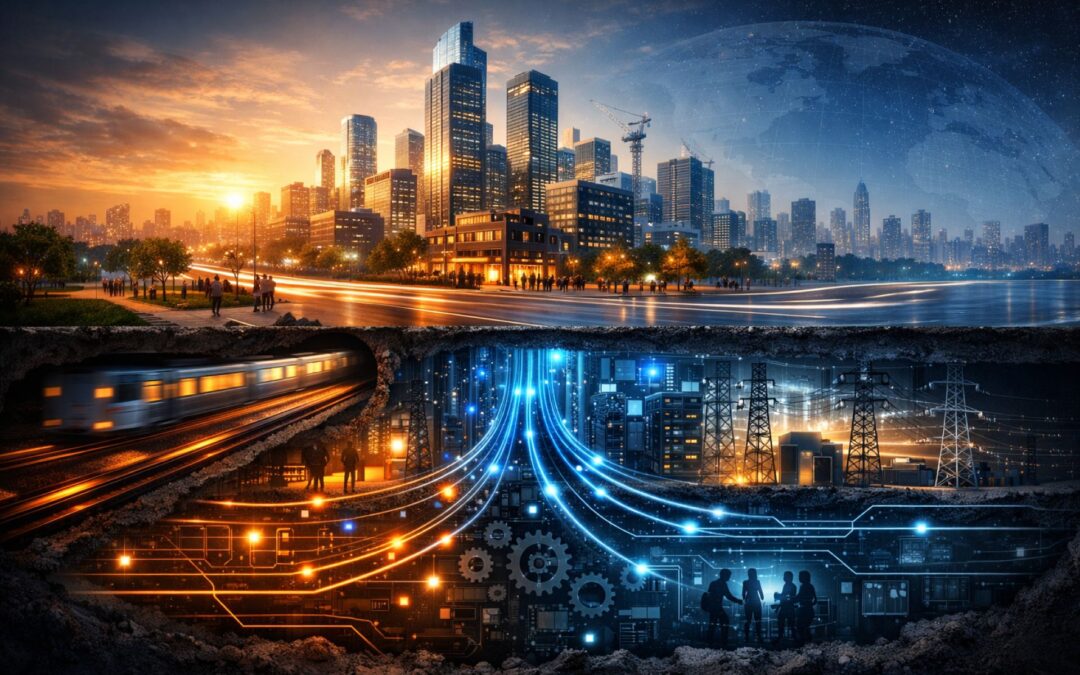
Every city wants to be rich.
Not just functional. Not just livable. Rich—dynamic, influential, overflowing with opportunity. The kind of place where talent gathers, businesses scale, and ambition turns into reality at an almost predictable pace.
But here’s the uncomfortable truth: most cities never get there. And among those that do, very few manage to stay there.
Because building a prosperous city is not a single achievement—it’s an ongoing process. A fragile equilibrium. One that depends on getting a handful of fundamental principles right, over and over again, across decades or even centuries.
When you zoom out and study the world’s wealthiest cities—past and present—a pattern begins to emerge. From Silicon Valley to Singapore, from New York to Shenzhen, the specifics may differ, but the underlying mechanics remain remarkably consistent. These cities didn’t stumble into wealth. They engineered it.
And just as importantly, the ones that fell—from Venice to Detroit to Athens—didn’t collapse overnight. They slowly drifted away from those same principles, until the systems that once created wealth could no longer sustain it.
This article breaks down exactly how cities get rich, the strategic decisions that separate thriving hubs from declining ones, and the critical mistakes that quietly erode prosperity over time.
Because in the end, wealth isn’t just about resources or geography.
It’s about systems.
And the cities that understand this are the ones that don’t just rise—but endure.
Attract Talent: The Foundation of Every Wealthy City
Every wealthy city, without exception, begins with the same raw material: people.
Not just population, but a very specific kind of population—skilled, ambitious, and forward-looking individuals who are willing to take risks, build things, and push boundaries. Talent is the seed from which everything else grows. Capital follows it. Innovation amplifies it. Influence emerges from it.
Without talent, a city has no future. With it, almost anything becomes possible.
History makes this painfully clear. Take Detroit during the early 20th century. At its peak, it wasn’t just an industrial hub—it was a magnet. Engineers, designers, machinists, and entrepreneurs flooded into the city, drawn by the explosive growth of the automotive industry. The presence of companies like Ford didn’t just create jobs; it created momentum. A sense that this was the place to be if you wanted to build something meaningful.
But when that industry declined, Detroit struggled to replace it. The inflow of talent slowed, then reversed. And once that happened, the city’s economic engine began to stall. Because when the people leave, everything else eventually follows.
Now contrast that with Silicon Valley.
Before it became synonymous with global innovation, it was largely agricultural land—orchards, farms, and scattered infrastructure. What changed wasn’t the geography. It was the people.
The turning point came when Stanford University made a deliberate decision to encourage its students and faculty to stay local and build companies instead of migrating east. That single strategic shift created the conditions for something much bigger. Early success stories attracted more engineers, more investors, and more ambitious minds. Over time, a powerful network effect took hold.
Once enough talent concentrates in one place, it becomes self-reinforcing. People move there not just for opportunities, but because everyone else who matters is already there.
This is why world-class universities are such critical anchors for wealthy cities. Institutions like Stanford, MIT, and Harvard don’t just educate—they act as talent pipelines, research engines, and startup incubators all at once. They continuously inject fresh energy into the local ecosystem.
But attracting talent isn’t about building a single institution or launching a few initiatives. It’s about positioning the entire city as a destination—somewhere ambitious people actively choose to move to.
That requires opportunity, yes. But it also requires reputation.
Talented individuals are highly mobile. They compare cities. They evaluate ecosystems. They go where they believe their potential will be maximized. And once a city earns that perception, it gains a powerful advantage: it stops chasing talent, and talent starts coming to it.
At that point, the game changes.
Because when a city becomes a magnet for the best minds, it doesn’t just grow—it compounds.
Retain Talent: Why Livability Determines Long-Term Growth
Attracting talent is only half the equation.
Keeping it is where most cities fail.
Because while opportunity brings people in, quality of life determines whether they stay. And if enough people decide to leave, even the most powerful economic engine can begin to stall.
Talent is not static. It moves. It responds. It evaluates constantly.
If a city becomes too expensive, too chaotic, too unsafe, or simply too exhausting to live in, people will look elsewhere—no matter how strong the job market is. And once that outflow begins, it can quietly undermine everything the city has built.
San Francisco is a perfect illustration of this tension.
For decades, it has been at the center of global innovation. The opportunities are still there. The companies are still there. The capital is still there. But increasingly, the experience of living in the city has started to deteriorate. Sky-high housing costs, rising concerns around crime and homelessness, and a general decline in day-to-day livability have pushed many skilled professionals to reconsider.
Not because they lack opportunity—but because they no longer see a future there.
And when enough people reach that conclusion, the city begins to bleed its most valuable resource.
Now look at the other side of that equation.
Austin, Texas wasn’t always on the global map. For years, it was just another mid-sized American city. But over the past decade, it has become one of the fastest-growing talent hubs in the world.
Why?
Because it didn’t just offer jobs—it offered a lifestyle.
Compared to traditional tech hubs, Austin felt more affordable. It had space to grow. A strong cultural identity. A sense of balance between work and life that many people found increasingly rare. When companies started expanding there, talent followed. And once the talent arrived, the ecosystem began to deepen.
But the key insight here is simple: people stayed.
They didn’t treat Austin as a temporary stop. They built lives there. And that’s what transformed it from a rising city into a compounding one.
Retention is what allows wealth to accumulate.
When talented individuals stay in a city, they build companies, form networks, invest locally, and contribute to long-term stability. Their presence compounds over time, creating layers of value that cannot be easily replicated elsewhere.
But if they leave, that compounding effect breaks.
A city becomes transient. Opportunities feel short-lived. And instead of building momentum, it starts losing it.
This is why livability is not a luxury—it’s a strategic necessity.
Safe streets, affordable housing, reliable services, cultural vibrancy, and a sense of belonging—these are not soft factors. They are the conditions that determine whether a city can hold onto the very people it depends on.
Because in the end, a wealthy city isn’t just a place where people come to work.
It’s a place where they choose to stay.
Eliminate Crime and Corruption: The Invisible Engine of Trust
If talent is the fuel of a wealthy city, then trust is the infrastructure that allows it to function.
And nothing erodes trust faster than crime and corruption.
You can build world-class universities, attract brilliant people, and create massive economic opportunities—but if people don’t feel safe, and if institutions can’t be relied upon, the entire system begins to break down. Quietly at first, then all at once.
Because at its core, every economic decision is a bet on stability.
Entrepreneurs invest time and capital with the expectation that the rules will hold. Businesses expand assuming contracts will be enforced. Families settle down believing their environment is secure. When those assumptions are violated, the rational response is simple: leave.
Look at Caracas.
On paper, it should be one of the wealthiest cities in the Americas, backed by Venezuela’s vast oil reserves. The natural resources are there. The geographic advantages are there. But persistent crime, systemic corruption, and political instability have turned it into an environment where both people and capital are constantly looking for the exit.
The result isn’t just stagnation—it’s erosion. Businesses hesitate to invest. Talent emigrates. Informal systems replace formal ones. And over time, the city loses its ability to generate sustainable wealth, despite having all the raw ingredients.
Now compare that to Singapore.
In the 1960s, it was the opposite of what you’d expect from a future global powerhouse. Limited resources, a struggling economy, and widespread corruption. But instead of accepting that as inevitable, the leadership made a deliberate and uncompromising decision to eliminate it.
They professionalized the civil service, paid competitive wages to reduce incentives for bribery, and enforced laws consistently. Not selectively. Not symbolically. Systematically.
The outcome was transformational.
Businesses could operate with confidence. Contracts were honored. Disputes were resolved predictably. Investors knew that the system would protect their interests. And that single shift—from uncertainty to reliability—turned Singapore into one of the most trusted business environments in the world.
This is the part most cities underestimate.
Wealth doesn’t just flow toward opportunity—it flows toward predictability.
Money prefers environments where risks can be calculated, where outcomes follow rules, and where institutions function as expected. When those conditions exist, capital moves in. When they don’t, it moves out—often permanently.
The same applies to people.
Highly skilled individuals have options. They won’t build their lives in places where safety is uncertain or where success depends on navigating corruption. Even if they arrive initially, they won’t stay long enough to create lasting value.
That’s why controlling crime and corruption isn’t just about governance—it’s about signaling.
It tells the world: this is a place where the system works.
And when that signal is strong, everything else becomes easier. Investment increases. Talent stays. Growth accelerates.
Because once trust is established, wealth doesn’t need to be forced.
It arrives on its own.
Build Infrastructure: The Backbone of Economic Expansion
If talent is the engine and trust is the operating system, then infrastructure is what allows everything to move.
Without it, even the most promising cities stall.
Infrastructure is not glamorous. It’s not what people post about or celebrate. But it is the silent enabler behind every functioning economy—roads that connect, ports that move goods, power grids that sustain activity, and increasingly, digital networks that carry information at scale.
When infrastructure works, growth feels natural. When it doesn’t, everything becomes friction.
Take Lagos.
On paper, it has all the ingredients of a booming city. A massive population, strong entrepreneurial energy, access to global markets. But in practice, inefficiencies choke its potential. Traffic congestion can consume hours of productive time every day. Power outages disrupt businesses. Ports struggle to handle the volume of goods efficiently.
Each of these issues may seem isolated, but together they compound into a systemic drag. They increase costs, reduce productivity, and discourage investment. Not because opportunity doesn’t exist—but because accessing it becomes too difficult.
Now contrast that with Shenzhen.
Just a few decades ago, it was a small fishing town with limited economic significance. But when China designated it as a special economic zone in 1980, the transformation began with infrastructure.
Massive investments were made into highways, ports, industrial zones, and later, digital connectivity. These weren’t incremental upgrades—they were foundational shifts. The goal wasn’t to support existing activity, but to enable entirely new forms of it.
And it worked.
Manufacturing scaled rapidly. Supply chains became efficient. Businesses could move goods, access labor, and operate at speed. Over time, Shenzhen evolved from producing low-cost goods to becoming a global hub for high-tech innovation, home to some of the largest technology companies in the world.
What changed wasn’t just the economy—it was the city’s capacity.
That’s the real function of infrastructure. It expands what a city is capable of.
It reduces friction across every layer of activity. It allows ideas to move faster, goods to travel farther, and systems to operate more reliably. And when that happens, growth accelerates—not because of a single breakthrough, but because everything becomes easier to execute.
Modern infrastructure goes beyond physical systems.
Digital networks now play an equally critical role. High-speed internet, data centers, and communication systems are the backbone of the modern economy. Cities that invest in these layers position themselves to participate in industries that didn’t even exist a generation ago.
Those that don’t, fall behind.
Because in the absence of infrastructure, potential remains theoretical.
You can have talent. You can have ideas. You can even have capital. But without the systems to connect and support them, none of it scales.
And in the race to become a wealthy city, scale is everything.
Embrace Technology: The Ultimate Force Multiplier
Infrastructure creates capacity.
Technology determines how far that capacity can go.
Because at a certain point, growth is no longer just about doing more—it’s about doing things better, faster, and at a completely different scale. And that shift is almost always driven by technology.
Cities that understand this don’t just participate in economic change—they lead it.
Those that don’t gradually fall behind, even if everything else is working.
You can see this divide clearly across parts of Europe.
Cities like Milan, Madrid, or Vienna remain culturally rich, historically significant, and highly livable. But when the global economy began shifting toward digital industries, many of these cities didn’t adapt aggressively enough. The result isn’t collapse—it’s relative stagnation.
They remain good places to live.
But they’re no longer the places where the future is being built.
And that distinction matters.
Because talent—especially young, highly skilled talent—wants to be at the frontier. Where innovation is happening. Where new industries are forming. Where the pace of change creates opportunity.
When cities fail to embrace technology, they don’t just lose industries—they lose relevance.
Now compare that to Seoul.
In the 1960s, South Korea was one of the poorest countries in the world. There was no natural advantage, no obvious path to prosperity. But instead of trying to compete on traditional industries alone, the country made a deliberate bet on technology.
It invested heavily in education, research, and industrial development tied to electronics, telecommunications, and manufacturing. Over time, this created the foundation for companies like Samsung, Hyundai, and LG to emerge and dominate globally.
Seoul became the center of that transformation.
For years, it had some of the fastest internet speeds in the world. Digital infrastructure wasn’t an afterthought—it was a priority. And that decision compounded over time, positioning the city at the forefront of innovation.
Today, it’s not just keeping up with technological change—it’s helping define it.
That’s what technology does for a city.
It acts as a force multiplier.
It increases productivity. It lowers costs. It creates entirely new industries. And most importantly, it compresses time. What used to take decades can now happen in years—or even months.
But this only works if cities are willing to embrace it fully.
Because technology doesn’t reward hesitation.
It favors environments that are open to experimentation, that invest in research, and that allow new ideas to scale quickly. Cities that resist this shift—whether due to regulation, cultural inertia, or lack of vision—don’t just slow down. They get bypassed.
And once that happens, catching up becomes exponentially harder.
In the 21st century, technology is not optional.
It is the layer that sits on top of everything else—amplifying the effects of talent, infrastructure, and capital.
Cities that integrate it into their core strategy don’t just grow.
They accelerate.
Diversify the Economy: Avoiding Fragility and Decline
Growth is powerful.
But concentration is dangerous.
A city can do everything right—attract talent, build infrastructure, embrace technology—and still collapse if all of its success depends on a single industry. Because industries change. Markets shift. And when they do, cities that are overly dependent don’t just slow down—they unravel.
Diversification is what separates durable wealth from temporary success.
History offers a clear warning.
Take Venice.
For centuries, it was one of the richest cities in the world. Its entire economic engine was built around controlling trade routes between Europe and Asia. Goods flowed through its ports. Wealth accumulated rapidly. Influence expanded across continents.
But that dominance was tied to a very specific advantage.
When new trade routes opened across the Atlantic, Venice didn’t adapt quickly enough. Its economic foundation—once its greatest strength—became its biggest vulnerability. As global trade patterns shifted, the city’s relevance declined. Over time, it transformed from a commercial powerhouse into a cultural and historical landmark.
Still admired.
But no longer dominant.
Now contrast that with New York City.
In the 19th century, it thrived as a port and industrial hub, much like Venice. But when those industries began to evolve, New York didn’t resist the shift—it leaned into it. It repositioned itself as the financial capital of the world, building a new layer of economic strength on top of the old one.
And it didn’t stop there.
Media, fashion, entertainment, and eventually technology all became part of its economic fabric. Each new industry added resilience. Each layer reduced dependence on any single source of growth.
The result is a city that doesn’t just survive change—it absorbs it.
Dubai offers another modern example.
For decades, its wealth was driven primarily by oil. But its leadership recognized early that this was not a sustainable long-term strategy. Instead of waiting for decline, they proactively diversified—investing heavily in tourism, aviation, real estate, and finance.
Today, oil accounts for only a tiny fraction of its economy.
What replaced it is a multi-layered system that can adapt as global conditions shift. And that adaptability is what protects its wealth.
Because the real risk isn’t failure—it’s rigidity.
Cities that become too reliant on a single industry often optimize everything around it. Infrastructure, talent pipelines, policy decisions—they all align with that one source of growth. And while that can create rapid expansion in the short term, it also creates blind spots.
When disruption comes, there’s no buffer.
Diversification solves that problem.
It spreads risk. It creates optionality. It allows a city to pivot when necessary without starting from scratch. And most importantly, it ensures that no single shock can take down the entire system.
A truly wealthy city is not defined by what it does today.
It’s defined by how many different ways it can create value tomorrow.
Invest in Quality of Life: The Glue That Holds Wealth Together
By the time a city reaches a certain level of success, the challenge changes.
It’s no longer just about growth.
It’s about sustainability.
Because once wealth is created, the real question becomes: can people actually enjoy living there?
This is where quality of life comes in—and it’s far more important than most cities realize.
You can have a powerful economy, thriving industries, and global relevance, but if daily life feels stressful, unsafe, or exhausting, the very people who built that success will begin to leave. Not immediately, not dramatically—but steadily.
And over time, that steady outflow becomes a structural problem.
São Paulo illustrates this tension.
It’s one of the largest economic engines in Latin America, generating enormous wealth and opportunity. But extreme inequality, persistent crime, and underdeveloped infrastructure create a daily experience that many residents describe as survival rather than living.
In environments like this, success becomes compartmentalized.
Wealth exists, but it doesn’t translate into a broadly livable city. And when that happens, talent begins to fragment—those who can leave, do. Those who stay often operate within isolated pockets, disconnected from the broader urban experience.
That kind of imbalance weakens the system over time.
Now look at Copenhagen.
It’s not the largest city. It doesn’t dominate global finance or tech. But what it has built is something equally powerful—a city that works exceptionally well for the people who live there.
Bike-friendly infrastructure, accessible green spaces, reliable public transportation, and a strong emphasis on urban design all contribute to a lifestyle that feels balanced and sustainable. The result is consistently high levels of happiness and retention.
People don’t just move there.
They stay.
Zurich offers a similar model.
Clean, safe, highly efficient, with world-class healthcare and education—every element of the city is designed to support long-term living. And because of that, it attracts both talent and capital, not through hype, but through reliability.
This is the key insight: quality of life is not a luxury layer added after growth.
It is what allows growth to endure.
When people feel comfortable, secure, and fulfilled in a city, they invest more of themselves into it. They build families, start businesses, form communities, and contribute to the long-term stability of the environment.
That creates a feedback loop.
Better living conditions lead to stronger retention. Stronger retention leads to deeper economic activity. And deeper economic activity supports further improvements in quality of life.
But when that loop breaks—when a city becomes too expensive, too unequal, or too difficult to navigate—the opposite happens.
People disengage.
And once that starts, even the strongest economies begin to lose their edge.
Because in the end, cities are not just systems of production.
They are places where people live.
And if living there stops making sense, everything else eventually follows.
Build a Global Brand: Turning Cities Into Aspirational Identities
At a certain level of development, something interesting happens.
A city stops being just a place—and becomes an idea.
This is where the most successful cities separate themselves from the rest. Because while many cities can generate wealth, only a few manage to turn that wealth into identity. And once they do, they unlock an entirely new layer of value.
A global brand.
This is not about logos or slogans. It’s about perception.
What a city represents in the minds of people who may have never even been there. What it signals about lifestyle, status, culture, and opportunity. And most importantly, whether people aspire to be associated with it.
Because aspiration drives demand.
Take Johannesburg.
It is, by many measures, one of the wealthiest cities in Africa. It plays a critical role in the continent’s economy. But globally, it lacks a strong, clearly defined identity. Ask people what it represents, and the answers tend to be vague or limited.
As a result, its economic strength doesn’t fully translate into global influence.
Now compare that to Paris.
Paris is not just a city—it is a symbol.
For centuries, it has cultivated an image tied to art, fashion, cuisine, romance, and luxury. That identity has been reinforced across generations through culture, media, and deliberate positioning. The result is something far more powerful than economic output alone.
Paris generates desire.
People don’t just visit it—they dream about it. They associate themselves with it. They pay a premium to live there, to do business there, or even to be connected to its image in some way.
That premium is real.
It shows up in tourism, real estate, global investment, and cultural influence. And it compounds over time, because once a city becomes iconic, its reputation begins to work on its behalf.
New York operates on a similar principle.
It represents ambition, energy, and scale. It signals that things happen there—that if you want to be at the center of finance, media, or culture, this is where you go. That perception alone attracts a constant flow of talent, capital, and opportunity.
Dubai has engineered this effect more recently.
It positioned itself as a symbol of modern luxury, global connectivity, and bold ambition. Even people who have never visited understand what it stands for. And that clarity of identity has turned it into a magnet for business, tourism, and high-net-worth individuals.
This is the power of a global brand.
It transforms a city from a functional environment into an aspirational one.
And when that happens, value expands beyond the physical.
People are no longer just paying for space, services, or infrastructure. They are paying to be part of something—to belong to a narrative, an identity, a perception that carries meaning.
Cities that fail to build this layer can still become wealthy.
But they remain transactional.
They attract people for what they offer, not for what they represent. And in a world where attention and perception shape decisions as much as economics, that limitation matters.
Because in the long run, the cities that are remembered—and the ones that continue to command influence—are not just the richest.
They are the most meaningful.
Resilience: The Ultimate Principle That Determines Longevity
Everything we’ve covered so far explains how cities get rich.
But none of it guarantees they stay that way.
Because history is full of cities that once dominated the world—only to fade into irrelevance. Not because they lacked resources or intelligence, but because they failed to adapt when the conditions that made them successful began to change.
This is where the final principle comes in.
Resilience.
Not as a slogan, but as a system.
The ability of a city to absorb shocks, evolve its identity, and rebuild its economic foundation without collapsing. The capacity to reinvent itself—not once, but repeatedly, across generations.
Because no advantage lasts forever.
Trade routes shift. Technologies evolve. Industries rise and fall. Political systems change. And cities that tie their identity too tightly to a specific moment in time eventually get left behind.
Athens is a powerful example.
With thousands of years of history, it once stood at the center of the world—politically, intellectually, and culturally. It was the birthplace of democracy, philosophy, and architectural ideas that still shape modern civilization.
At its peak, it was unmatched.
But over time, it failed to maintain the systems that sustained that dominance. Economic instability, underinvestment, and structural inefficiencies gradually eroded its position. Today, Athens remains culturally significant and historically revered—but its influence is largely anchored in the past.
Its legacy endures.
Its economic power does not.
Now compare that to London.
Nearly two thousand years old, it has faced plagues, fires, wars, the collapse of empire, and multiple financial crises. And yet, it continues to rank among the most powerful cities in the world.
Not because it avoided disruption—but because it adapted to it.
When it lost its position as the center of a global empire, it leaned into finance. When industries evolved, it diversified. It invested in education, culture, infrastructure, and innovation. It continuously redefined what it meant to be relevant.
London didn’t protect a single identity.
It built a system that could generate new ones.
That’s the essence of resilience.
It’s not about stability in the traditional sense. It’s about flexibility. The ability to shift direction without losing momentum. To replace declining industries with emerging ones. To retain talent even during periods of uncertainty.
And most importantly, to maintain trust in the system—even when conditions are difficult.
Because resilience is cumulative.
It is built by consistently applying all the principles we’ve discussed—attracting and retaining talent, maintaining trust, investing in infrastructure, embracing technology, diversifying the economy, improving quality of life, and reinforcing a global identity.
Not once.
But continuously.
Cities that do this don’t just grow.
They endure.
They survive shocks that would cripple others. They evolve faster than their competitors. And over time, they build something far more valuable than short-term wealth.
They build continuity.
And in a world defined by constant change, that may be the rarest asset of all.
Conclusion
Rich cities are not accidents.
They are systems—deliberately built, carefully maintained, and constantly refined over time.
What makes them powerful is not any single advantage, but the way multiple principles come together and reinforce each other. Talent attracts opportunity. Opportunity draws capital. Infrastructure enables scale. Technology accelerates progress. Diversification protects against shocks. Quality of life retains the very people who sustain growth. And a strong global identity amplifies everything outward.
But none of it works in isolation.
Remove one piece, and the system weakens. Ignore several, and it begins to collapse.
That’s why so many cities rise quickly and fall just as fast. They optimize for growth, but not for durability. They chase expansion, but neglect the underlying conditions that make expansion sustainable.
And over time, that imbalance catches up.
The cities that endure take a different approach.
They think in layers. They build for the long term. They adapt when the world changes instead of resisting it. And most importantly, they understand that wealth is not something you reach—it’s something you maintain.
Again and again.
The same logic applies at an individual level.
You don’t build wealth through a single breakthrough. You build it by stacking the right elements—skills, habits, relationships, and systems that compound over time. You invest in yourself, diversify your capabilities, and stay adaptable as conditions evolve.
Because whether you’re building a city or a life, the principle is the same.
Sustainable wealth is not created by chance.
It’s engineered—and then protected through continuous reinvention.