
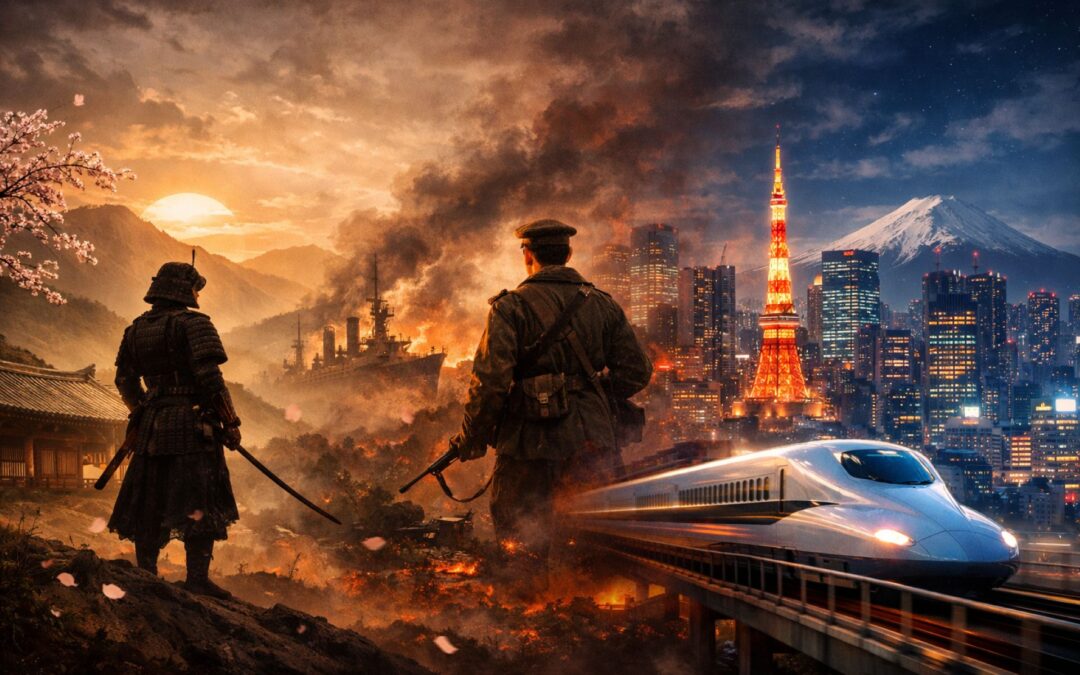
Introduction: From Isolation to Global Power
Japan is a country of striking contrasts.
It is a land where ancient wooden temples stand in quiet harmony beside neon-lit skyscrapers, where centuries-old traditions coexist with some of the most advanced technology in the world. Today, Japan is one of the most developed and globally connected nations on Earth—an economic powerhouse, a cultural exporter, and a symbol of modern efficiency.
But this openness to the world is a relatively recent phenomenon.
For much of its history, Japan evolved in relative isolation. Most notably, between the 17th and 19th centuries, the country deliberately closed itself off from almost all foreign contact in a policy known as sakoku. During this time, Japan turned inward, developing a unique and highly refined culture, a stable social order, and a self-contained economy. While the rest of the world was undergoing rapid global expansion, Japan was quietly perfecting its own civilization behind closed borders.
And yet, when Japan finally reopened to the world in the mid-19th century, it did something extraordinary.
In just a few decades, it transformed itself from a feudal society ruled by samurai into a modern industrial nation capable of competing with—and even defeating—Western powers. Within a century, it would rise as an empire, suffer devastating defeat in World War II, and then rebuild itself into one of the most successful economies in modern history.
This is not just a story of continuity—it is a story of reinvention.
Japan’s history is defined by cycles of transformation: from tribal societies to imperial rule, from imperial courts to samurai governments, from isolation to expansion, and from destruction to rebirth. At each turning point, Japan absorbed external influences, reshaped them to fit its own identity, and emerged stronger and more unified.
To understand Japan is to understand how a civilization can remain deeply rooted in tradition while repeatedly redefining itself in the face of change.
This is the story of how Japan became Japan.
The First Settlers and Early Foundations (Prehistory to 3rd Century CE)
Long before Japan became a unified nation or even a recognizable civilization, it was a scattered archipelago inhabited by small, isolated communities shaped by geography as much as by culture.
Human presence in Japan dates back roughly 40,000 years, when early migrants arrived from mainland Asia. These groups likely traveled via land bridges that connected the Japanese islands to the continent during periods of lower sea levels. Over time, these early inhabitants adapted to the islands’ diverse landscapes—dense forests, mountainous terrain, and rich coastal waters—developing ways of life that were both resilient and localized.
One of the earliest identifiable cultures in Japan was the Jōmon civilization, which emerged around 14,000 BCE. The Jōmon people were primarily hunter-gatherers, but unlike many such societies, they established relatively stable, long-term settlements. They are especially known for their distinctive pottery—some of the oldest in the world—characterized by intricate cord-marked designs. This suggests not only technical skill but also a growing sense of artistic and cultural identity.
For thousands of years, the Jōmon way of life remained dominant. But around 300 BCE, a major transformation began with the arrival of a new wave of migrants from the Asian mainland. This period, known as the Yayoi era, introduced revolutionary changes.
These new settlers brought with them wet-rice agriculture, metalworking (including bronze and iron tools), and more advanced forms of social organization. Unlike the relatively egalitarian Jōmon communities, Yayoi society was more hierarchical. Control over agricultural land and resources led to the emergence of social classes and, eventually, early forms of political authority.
Rice cultivation, in particular, reshaped Japanese society. It required coordinated labor, irrigation systems, and long-term planning—factors that naturally encouraged cooperation, governance, and centralized control. Villages grew larger, populations increased, and competition over fertile land intensified.
By the 3rd century CE, these developments had begun to coalesce into more organized political entities. Various clans and regional powers emerged, each vying for influence and dominance. Among them, one region in particular—the Yamato area in central Japan—began to distinguish itself as a center of growing authority.
While Japan was still far from unified, the foundations had been laid.
The transition from small, scattered communities to structured societies marked the beginning of Japan’s long journey toward state formation. Agriculture, technology, and migration had fundamentally altered the trajectory of the islands, setting the stage for the rise of kingship, imperial rule, and a more cohesive national identity in the centuries to come.
The Rise of the Yamato State and Imperial Japan (3rd–8th Century)
By the 3rd century CE, Japan was no longer a loose collection of isolated communities. The gradual consolidation of power among regional clans had begun to produce something more structured—an emerging state centered in the Yamato region of central Japan.
The Yamato clan would become the single most important political force in early Japanese history.
Through a combination of military strength, strategic alliances, and religious legitimacy, the Yamato rulers gradually extended their influence over neighboring clans. Rather than eliminating rivals entirely, they often integrated them into a broader hierarchy, creating a network of loyalty that reinforced their authority. At the center of this system stood a monarch—what would later be recognized as the emperor—who was not only a political leader but also a sacred figure.
This idea of divine rulership became one of the defining features of Japanese civilization.
The Yamato rulers claimed descent from the sun goddess Amaterasu, a belief rooted in Shinto, Japan’s indigenous spiritual tradition. This divine lineage elevated the emperor above ordinary rulers and provided a powerful ideological foundation for centralized authority. Even when political power later shifted away from the emperor, this symbolic status would endure for centuries.
While the Yamato state was consolidating internally, it was also being profoundly shaped by influences from the Asian mainland—particularly from China and Korea.
One of the most transformative imports was Buddhism, officially introduced to Japan in 552 CE through the Korean kingdom of Baekje. Initially, Buddhism faced resistance from conservative factions who feared foreign influence. But over time, it gained acceptance, especially among the ruling elite, who saw in it both spiritual value and political utility.
Buddhism brought with it more than just religious ideas. It introduced new forms of art, architecture, writing, and philosophy. It also helped connect Japan to a broader East Asian cultural sphere dominated by Chinese civilization.
This connection deepened during the Taika Reforms of 645 CE, a series of sweeping political changes aimed at restructuring Japan along Chinese lines. Inspired by the Tang dynasty’s centralized bureaucracy, the reforms sought to strengthen imperial authority by:
- nationalizing land under the emperor
- creating a formal system of taxation
- establishing a centralized administrative structure
In theory, all land belonged to the emperor, and local elites were redefined as officials serving the state rather than independent power holders.
Although the reforms were not fully implemented in practice, they marked a critical shift in political thinking. Japan was no longer just a collection of clans—it was becoming an imperial state with ambitions of centralized governance.
Another major step toward this transformation came in 794 CE, when Emperor Kanmu established a permanent capital at Heian-kyō (modern-day Kyoto). Until this point, the imperial court had been somewhat nomadic, relocating with each new emperor. Fixing the capital in one place provided stability and allowed for the development of a sophisticated court culture.
This decision marked the beginning of the Heian period, an era that would see the flowering of aristocratic life, literature, and artistic refinement.
But beneath this cultural brilliance, deeper structural weaknesses were already beginning to form.
The imperial system, modeled after China, depended heavily on centralized control and effective administration. Yet Japan’s geography and entrenched clan loyalties made this difficult to sustain. Over time, power would begin to slip away from the court and into the hands of regional elites—setting the stage for a dramatic shift in Japan’s political order.
The foundations of the empire had been laid.
But the age of emperors ruling in practice—not just in name—was already beginning to fade.
The Heian Period and the Decline of Central Authority (794–1185)
With the establishment of Heian-kyō (modern Kyoto) as a permanent capital in 794, Japan entered one of the most refined and culturally rich periods in its history—the Heian period.
At first glance, this era appeared to fulfill the promise of the earlier imperial vision.
The court in Kyoto became the center of political authority, aristocratic life, and artistic achievement. The emperor remained the symbolic head of state, and governance was conducted through a complex bureaucracy influenced by Chinese models. But in reality, power within the capital increasingly came to be dominated not by the emperor himself, but by a small number of elite aristocratic families—most notably the Fujiwara clan.
The Fujiwara perfected a subtle but highly effective strategy for controlling the state.
Rather than seizing power through force, they embedded themselves within the imperial system by marrying their daughters into the imperial family. Over generations, this allowed them to produce heirs to the throne and act as regents for young emperors. In doing so, they exercised real political control while preserving the outward structure of imperial rule.
This arrangement created an illusion of centralized authority.
In practice, however, the imperial court became increasingly inward-looking. Court life grew more elaborate, ceremonial, and focused on aesthetics—poetry, literature, calligraphy, and refined social rituals. Works like The Tale of Genji, often considered the world’s first novel, emerged from this environment, reflecting the sophistication and emotional depth of Heian aristocratic culture.
But this cultural brilliance came at a cost.
As the court became absorbed in its own world, it neglected the practical governance of the provinces. The system of centralized land control envisioned during the Taika Reforms began to erode. Large estates known as shōen emerged, owned by aristocrats, temples, and powerful families. These estates were often tax-exempt and operated independently of the central government.
This had two major consequences.
First, it weakened the financial and administrative power of the imperial state. Second, it allowed local elites to build their own bases of authority, often backed by private armed forces.
Out of this environment emerged a new class of warriors—the samurai.
Initially, these warriors were employed by landowners to protect their estates and enforce their authority. But as central control continued to weaken, they grew in power and importance. Loyalty shifted away from the emperor and toward local lords, creating a decentralized system of military governance that would come to define the next phase of Japanese history.
Two major warrior clans rose to prominence during this time: the Taira and the Minamoto.
Both clans had close ties to the imperial court but also commanded significant military strength. As competition for influence intensified, tensions between them escalated into open conflict. What began as political maneuvering within the court eventually spilled over into full-scale warfare.
This culminated in the Genpei War (1180–1185), a decisive struggle that would reshape Japan’s political landscape.
The Minamoto clan, led by Minamoto no Yoritomo, ultimately emerged victorious. But more importantly, their victory signaled the end of effective imperial rule as it had existed during the Heian period.
Power was no longer centered in the court.
It had shifted to the battlefield.
The elegant world of Heian aristocracy—with its poetry, rituals, and refined culture—had created one of the most sophisticated court societies in history. But it had also, unintentionally, hollowed out the foundations of centralized authority.
In its place, a new order was rising—one defined not by nobles and courtiers, but by warriors and military rule.
The age of the samurai had begun.
The Age of the Samurai and the Birth of the Shogunate (1185–1333)
The victory of the Minamoto clan in the Genpei War did more than end a rivalry—it fundamentally transformed the structure of power in Japan.
For the first time, military authority openly eclipsed imperial rule.
At the center of this transformation was Minamoto no Yoritomo, a leader who understood that winning a war was only the beginning. The real challenge was consolidating power in a way that could endure. Rather than overthrowing the emperor outright, Yoritomo adopted a more strategic approach—he ruled through the existing system while quietly redefining it.
In 1192, he was granted the title of Shogun, meaning “Great General.” While the emperor remained the formal sovereign in Kyoto, Yoritomo established his own military government, or bakufu, in the city of Kamakura—far removed from the imperial court.
This marked the beginning of the Kamakura shogunate and a new political order.
Japan now operated under a dual system: the emperor as a symbolic figurehead, and the shogun as the true wielder of power. In practice, it was the shogunate that governed the country, relying on a network of loyal samurai bound by personal allegiance and land-based rewards.
The rise of the samurai was not just political—it was cultural.
The samurai developed their own code of conduct, later known as bushidō, which emphasized loyalty, discipline, honor, and martial skill. Their identity was shaped by constant readiness for conflict and a deep commitment to their lords. This warrior ethos would come to define Japanese society for centuries.
To maintain control, the Kamakura shogunate created a decentralized but effective system of governance.
Local military governors, known as shugo, and estate stewards, called jitō, were appointed across the provinces. These officials were responsible for maintaining order, collecting taxes, and ensuring loyalty to the shogunate. While this system allowed for greater stability than the late Heian period, it also reinforced the decentralization of power, as regional leaders retained significant autonomy.
The strength of this new order would soon be tested by an external threat unlike anything Japan had faced before.
In the late 13th century, the Mongol Empire, under Kublai Khan, turned its attention toward Japan. After demanding that Japan submit as a vassal state and receiving no response, the Mongols launched an invasion in 1274.
The invading force was formidable—larger, better organized, and equipped with advanced weaponry unfamiliar to the Japanese. Samurai warriors, accustomed to more ritualized forms of combat, initially struggled against the Mongols’ coordinated tactics.
And yet, the invasion ended not in conquest, but in catastrophe—for the invaders.
A powerful typhoon swept through the region, devastating the Mongol fleet and forcing a retreat. When the Mongols returned in 1281 with an even larger force, they met a similar fate. Another massive storm destroyed much of their fleet.
These events became legendary in Japanese history as the kamikaze, or “divine wind,” believed to be a manifestation of divine protection.
While the invasions were successfully repelled, they exposed a critical weakness in the shogunate.
Unlike internal conflicts, where land could be redistributed as rewards, the defense against the Mongols produced no tangible spoils. Many samurai who had fought bravely received little to no compensation. This led to growing dissatisfaction and strained the relationship between the shogunate and its warrior base.
At the same time, the financial burden of maintaining defenses had nearly exhausted the government’s resources.
These pressures gradually eroded the stability of the Kamakura system. Discontent simmered among the samurai, and the authority of the shogunate began to weaken.
Sensing an opportunity, Emperor Go-Daigo attempted to restore direct imperial rule. In 1333, his forces, supported by disaffected samurai, succeeded in overthrowing the Kamakura shogunate.
For a brief moment, it seemed as though imperial power had been restored.
But the underlying dynamics had not changed.
The real power in Japan still lay with the warrior class. And within just a few years, another military leader would rise, overthrow the emperor’s restored authority, and reestablish the dominance of the samurai.
The age of the shogunate was far from over.
It had only just begun.
Fragmentation and Civil War — The Warring States Period (1333–1600)
The fall of the Kamakura shogunate in 1333 briefly revived the hope of imperial rule under Emperor Go-Daigo. But this restoration proved short-lived.
The deeper reality of Japan’s political structure had already shifted beyond recovery.
Military power—not imperial legitimacy—was now the true foundation of authority. And it did not take long for this reality to reassert itself. In 1338, Ashikaga Takauji, a former ally of Go-Daigo, turned against him, seized Kyoto, and established a new military government—the Ashikaga shogunate.
On paper, the shogunate had been restored.
In practice, however, it was far weaker than its Kamakura predecessor.
The Ashikaga rulers lacked the same level of centralized control and relied heavily on the cooperation of regional warlords, known as daimyō. These feudal lords governed their territories with considerable independence, commanding their own armies of samurai and managing local resources as they saw fit.
Japan was no longer a unified state—it was a fragile network of competing power centers.
This instability reached a breaking point in 1467 with the outbreak of the Ōnin War, a conflict sparked by a succession dispute within the Ashikaga shogunate. What began as a political struggle in Kyoto quickly escalated into a nationwide crisis.
Daimyō across the country took sides, forming alliances and mobilizing armies. The fighting devastated Kyoto and shattered what little remained of central authority. By the time the war ended in 1477, there was no clear victor—only a deeply fractured nation.
This marked the beginning of the Sengoku period, or the “Warring States” era.
For over a century, Japan descended into near-constant warfare. Regional lords competed relentlessly for land, power, and influence. Alliances were temporary, betrayals were common, and the balance of power shifted constantly.
Each daimyō sought to expand their domain, often at the expense of their neighbors.
In this environment, warfare evolved rapidly.
The traditional samurai, once bound by codes of honor and ritualized combat, adapted to the brutal realities of large-scale conflict. Armies grew in size, tactics became more sophisticated, and new forms of warfare emerged. Ninjas—specialists in espionage, sabotage, and assassination—played a crucial role in covert operations. Meanwhile, warrior monks (sōhei) from powerful Buddhist institutions took up arms, sometimes acting as independent military forces.
Religion, politics, and warfare became deeply intertwined.
The constant conflict also drove innovation and meritocracy. Leaders who could not adapt were quickly eliminated. Those who succeeded did so not merely through noble birth, but through strategic brilliance, military skill, and the ability to command loyalty.
Out of this chaos emerged a new type of leader—one who sought not just survival, but unification.
The turning point came in 1543, when a Portuguese ship, blown off course, arrived on the shores of Japan. This seemingly accidental encounter would have profound consequences.
The Portuguese introduced firearms—specifically matchlock muskets—which quickly revolutionized Japanese warfare. Daimyō who adopted these weapons gained a decisive advantage over their rivals. Within decades, Japan had become one of the largest producers and users of firearms in the world.
Alongside guns came Christianity and expanded trade networks, further complicating the political landscape.
Amid this transformation rose one of the most formidable figures in Japanese history: Oda Nobunaga.
Nobunaga was ruthless, innovative, and strategically brilliant. He embraced firearms, broke the power of militant Buddhist institutions, and systematically defeated rival daimyō. His campaigns brought large parts of central Japan under his control, marking the first serious attempt at national unification since the fall of the imperial system.
But just as he neared complete dominance, Nobunaga was betrayed and killed in 1582.
His death could have plunged Japan back into chaos.
Instead, his work was carried forward by his successor, Toyotomi Hideyoshi, a man of humble origins who rose through the ranks to become the most powerful figure in the country. Hideyoshi completed the process of unification, bringing an end to more than a century of civil war.
Yet even in unity, stability remained fragile.
Hideyoshi’s rule depended heavily on his personal authority, and upon his death in 1598, the question of succession reignited tensions among the daimyō. Rival factions quickly formed, setting the stage for one final निर्णायक conflict.
The long era of fragmentation was coming to an end.
But it would take one more decisive battle—and one more powerful leader—to finally bring lasting order to Japan.
European Contact and the Introduction of Gunpowder (1543–1600)
Even as Japan was being torn apart by internal conflict during the Sengoku period, forces from beyond its shores were beginning to reshape its trajectory in unexpected ways.
In 1543, a Portuguese trading vessel, blown off course, landed on the small island of Tanegashima. What might have seemed like a minor, accidental encounter would prove to be one of the most consequential moments in Japanese history.
Because the Portuguese did not arrive empty-handed.
They brought with them firearms—specifically matchlock muskets—technology that was entirely new to Japan. Unlike traditional samurai weapons such as swords and bows, firearms required less training and could be deployed in coordinated volleys, dramatically changing the nature of warfare.
Japanese warlords immediately recognized their potential.
Within a remarkably short period, Japanese craftsmen had reverse-engineered and mass-produced these weapons. By the mid-16th century, firearms were being used extensively across battlefields, and Japan had become one of the largest producers of guns in the world. Warfare shifted from individual combat toward organized, large-scale engagements where discipline and tactics mattered more than personal valor.
No one understood this shift better than Oda Nobunaga.
Nobunaga was among the first to fully integrate firearms into his military strategy. He used them not just as supplementary weapons, but as central tools of warfare—deploying them in coordinated formations that could devastate traditional cavalry and infantry. His victory at the Battle of Nagashino in 1575, where disciplined gunfire played a decisive role, demonstrated the transformative power of this new technology.
But firearms were only one part of the foreign influence entering Japan.
The Portuguese also brought Christianity, introduced by Jesuit missionaries such as Francis Xavier. The new religion spread rapidly in certain regions, particularly among daimyō who saw strategic advantages in aligning with European traders. Conversion often came with access to trade networks, firearms, and even military support.
This created a complex dynamic.
Some warlords embraced Christianity and foreign trade, while others viewed them with suspicion. Religion became intertwined with politics, and in some areas, Christian communities grew strong enough to influence local power structures.
Amid this shifting landscape, Nobunaga continued his campaign to unify Japan.
He broke the power of entrenched religious institutions, particularly militant Buddhist sects that had long acted as independent military forces. By weakening these centers of resistance and leveraging superior military tactics, Nobunaga brought much of central Japan under his control.
Yet his rise was cut short.
In 1582, Nobunaga was betrayed by one of his own generals, Akechi Mitsuhide, and forced to commit suicide. His death threatened to undo years of progress toward unification.
But the momentum he had created did not vanish.
It was carried forward by Toyotomi Hideyoshi, a man whose rise was as extraordinary as it was unlikely. Born into a peasant family, Hideyoshi rose through the ranks of Nobunaga’s army through sheer ability and ambition. After Nobunaga’s death, he quickly consolidated power, defeated rival factions, and completed the unification of Japan.
Hideyoshi’s rule brought an end to the chaos of the Sengoku period.
However, he also recognized the potential dangers of foreign influence. While he initially tolerated Christianity and trade, he later grew wary of their political implications. Fearing external interference and internal instability, he began to restrict Christian activities and limit foreign presence.
This tension between openness and control would become a defining theme in the next phase of Japanese history.
When Hideyoshi died in 1598, he left behind a unified but fragile state, held together largely by his personal authority. His heir was too young to rule, and competing factions among the daimyō quickly reemerged.
The stage was set for one final struggle.
A decisive battle that would determine not just who ruled Japan—but how it would be governed for the next two and a half centuries.
The Tokugawa Shogunate and the Age of Isolation (1600–1853)
The death of Toyotomi Hideyoshi in 1598 left Japan unified, but politically unstable.
Without a strong central figure to hold the system together, tensions among the powerful daimyō quickly resurfaced. Two rival factions emerged—one supporting Hideyoshi’s young heir, and the other backing a seasoned and calculating leader who had been quietly consolidating his influence: Tokugawa Ieyasu.
The decisive moment came in the year 1600 at the Battle of Sekigahara.
It was one of the most important battles in Japanese history. Ieyasu’s forces decisively defeated their rivals, effectively ending any meaningful resistance to his authority. Three years later, in 1603, he was formally granted the title of Shogun, establishing the Tokugawa shogunate—a regime that would rule Japan for over 250 years.
Unlike the fragmented rule of the Sengoku period, the Tokugawa system brought unprecedented stability.
The new government was based in Edo (modern Tokyo), which rapidly grew into one of the largest cities in the world. While the emperor remained in Kyoto as a symbolic figure, real political power resided firmly with the shogun and his administration.
But this stability did not come naturally—it was carefully engineered.
The Tokugawa shogunate implemented a series of strict policies designed to maintain control and prevent rebellion. The most important of these was the bakuhan system, a dual structure in which the central government (bakufu) coexisted with semi-autonomous domains (han) ruled by daimyō.
To keep these powerful lords in check, the shogunate introduced the policy of sankin-kōtai, or “alternate attendance.”
Under this system, daimyō were required to spend every other year in Edo, while their families were kept there permanently. This served two purposes: it ensured loyalty by effectively holding their families as hostages, and it drained the financial resources of the daimyō, limiting their ability to fund rebellions.
The result was a delicate balance—local autonomy under tight central supervision.
At the same time, society was rigidly structured into a formal hierarchy:
- samurai (warrior class)
- peasants (farmers)
- artisans
- merchants
Each class had defined roles and restrictions, reinforcing social order and minimizing mobility. While this system provided stability, it also limited individual freedom and innovation in certain areas.
Perhaps the most defining feature of the Tokugawa era, however, was its approach to the outside world.
By the early 17th century, the shogunate had grown increasingly wary of foreign influence—particularly Christianity, which it viewed as both a religious and political threat. European powers, especially Spain and Portugal, were seen as potential colonizers, and the spread of Christianity raised fears of internal division and foreign interference.
In response, the Tokugawa government enacted a series of isolationist policies.
By 1639, these policies culminated in sakoku, or “closed country.” Under this system:
- Foreigners were largely barred from entering Japan
- Japanese citizens were forbidden from leaving or returning from abroad
- Shipbuilding for long-distance travel was restricted
- Christianity was banned and harshly suppressed
Limited trade was still permitted, but only under tightly controlled conditions. The Dutch, who showed little interest in religious conversion, were allowed to trade from the small artificial island of Dejima in Nagasaki. Trade with China and Korea also continued in a restricted form.
For over two centuries, Japan remained largely isolated from the rest of the world.
And yet, this was not a period of stagnation.
On the contrary, the Tokugawa era witnessed remarkable internal development. Peace allowed agriculture to expand, leading to population growth and increased productivity. Infrastructure improved, with roads connecting major cities and facilitating commerce. Urban centers like Edo, Osaka, and Kyoto flourished as hubs of economic and cultural activity.
A vibrant urban culture emerged.
The arts—kabuki theater, ukiyo-e woodblock prints, literature, and poetry—thrived. Education became more widespread, and literacy rates rose significantly compared to other parts of the world at the time.
But beneath this prosperity, tensions were slowly building.
By the late 18th and early 19th centuries, economic growth had begun to stagnate. Famines exposed weaknesses in the government’s ability to respond to crises. Social unrest grew as rigid class structures clashed with changing economic realities—particularly the rise of wealthy merchants who lacked corresponding social status.
At the same time, the outside world was changing rapidly.
Western powers, armed with industrial technology and expanding global ambitions, were increasingly looking toward Japan. Despite its isolation, Japan could not remain untouched forever.
The system that had preserved stability for over 250 years was about to face its greatest challenge.
And when that challenge arrived, it would come not gradually—but suddenly, and with overwhelming force.
Crisis and the End of Isolation (1800–1868)
By the early 19th century, the Tokugawa system—once a model of stability—was beginning to show clear signs of strain.
For over two centuries, Japan had maintained peace through strict control, rigid social hierarchy, and isolation from the outside world. But the very structures that had preserved order were now becoming sources of weakness.
Economically, growth had slowed.
Agriculture, which had expanded rapidly during the early Tokugawa period, began to reach its limits. Crop yields stagnated, while the population continued to rise, placing increasing pressure on resources. This imbalance became painfully evident during a series of devastating famines in the 1830s, particularly the Tenpō famine, which exposed the government’s inability to respond effectively to widespread suffering.
At the same time, social tensions were intensifying.
The rigid class system no longer reflected economic reality. Merchants—officially at the bottom of the social hierarchy—had grown wealthy through trade and urban commerce, while many samurai, bound by fixed stipends, found themselves in financial decline. This inversion of wealth and status created deep frustration within the social order.
Politically, the shogunate struggled to adapt.
Reforms were attempted, but they were often inconsistent and insufficient. The government remained cautious, conservative, and resistant to fundamental change. Meanwhile, new ideas were quietly entering Japan through limited contact with the outside world.
This was particularly evident in the spread of rangaku, or “Dutch learning.”
Through the Dutch trading post at Dejima, Japanese scholars gained access to Western books on science, medicine, and technology. These works were translated and circulated among intellectual circles, introducing new ways of thinking that contrasted sharply with traditional frameworks.
Japan was still isolated—but no longer entirely insulated.
Then, in 1853, everything changed.
A fleet of American warships, led by Commodore Matthew Perry, entered Edo Bay. Unlike earlier, more tentative contacts, Perry arrived with a clear objective: to force Japan to open its ports to American trade.
And he brought the means to enforce it.
The ships—modern, steam-powered, and heavily armed—were unlike anything Japan had seen. Their presence was a direct demonstration of Western industrial and military superiority. Perry delivered a message from the United States government demanding that Japan open itself to foreign relations.
The shogunate faced an impossible choice.
Resist, and risk military confrontation it was unlikely to win. Or comply, and undermine the very foundations of its authority.
In 1854, Japan signed the Treaty of Kanagawa, opening select ports to American ships. Similar agreements with other Western powers soon followed.
The policy of isolation—sakoku—was effectively over.
But the consequences went far beyond foreign trade.
These treaties were widely seen within Japan as unequal and humiliating. Many believed the shogunate had failed to protect the nation’s sovereignty. Discontent spread rapidly, particularly among powerful domains in the south, such as Satsuma and Chōshū.
A powerful political movement began to take shape, centered around the slogan “sonnō jōi”—“revere the emperor, expel the barbarians.”
At its core, this movement was not just anti-foreign—it was anti-shogunate.
Opponents of the Tokugawa regime argued that the emperor, not the shogun, should hold true authority. They saw the restoration of imperial power as a way to unify the country and resist external pressure.
Tensions escalated into open conflict.
By the late 1860s, alliances between reformist domains had grown strong enough to challenge the shogunate directly. In 1868, forces loyal to the emperor marched on Edo, initiating the Boshin War.
The Tokugawa shogunate, weakened and divided, could not withstand the pressure.
Within a year, it collapsed.
Power was formally returned to the emperor, marking the end of over 700 years of shogunal rule and the beginning of a new era in Japanese history—the Meiji Restoration.
But this was not simply a restoration of the past.
It was the beginning of something entirely new.
Japan now faced a critical question: how to survive—and compete—in a world dominated by industrialized Western powers.
The answer would reshape the nation more rapidly and more radically than ever before.
The Meiji Restoration and Rapid Modernization (1868–1912)
The collapse of the Tokugawa shogunate in 1868 marked one of the most dramatic turning points in Japanese history.
Power was formally restored to the emperor—now known as Emperor Meiji—but this was not a simple return to the old imperial system. Instead, it marked the beginning of a deliberate and far-reaching transformation.
Japan would no longer remain a feudal society.
It would become a modern nation-state.
The leaders behind the Meiji Restoration—many of them former samurai from domains like Satsuma and Chōshū—understood the stakes with remarkable clarity. The fate of other Asian nations, which had been colonized or dominated by Western powers, served as a warning.
If Japan did not modernize, it would be subjugated.
If it did, it might stand as an equal.
This urgency drove a program of reform that was both rapid and comprehensive.
One of the first steps was the abolition of the feudal system.
The domains controlled by daimyō were dismantled and replaced with a centralized system of prefectures governed by the state. Land was reorganized, and taxation was standardized, creating a more stable and predictable revenue system for the government.
At the same time, the social hierarchy that had defined the Tokugawa era was dismantled.
The samurai class—once the backbone of Japanese society—lost its privileged status. Their stipends were abolished, and their exclusive right to bear arms was revoked. In their place, Japan introduced universal conscription, creating a modern national army based on Western models.
This was a profound shift.
For centuries, warfare had been the domain of a specialized warrior class. Now, it became the responsibility of the nation as a whole.
Modernization extended far beyond the military.
The Meiji government invested heavily in infrastructure—building railways, telegraph lines, and modern ports to connect the country internally and to the wider world. Industrialization was actively promoted, with the state initially funding factories and later transferring them to private ownership, laying the foundations for powerful industrial conglomerates known as zaibatsu.
Education was also transformed.
A national system of universal education was established, emphasizing literacy, technical skills, and civic responsibility. This created a more informed and capable population, essential for supporting industrial and economic growth.
At the same time, Japan actively sought knowledge from abroad.
Hundreds of foreign experts were invited to Japan to share expertise in fields such as engineering, law, medicine, and finance. Japanese students were sent overseas to study Western systems and bring back what they learned.
This process was not passive imitation.
Japan selectively adopted Western ideas, adapting them to fit its own context. Traditional institutions, such as the emperor, were preserved and redefined to serve the new state. In 1889, Japan introduced a constitution, establishing a constitutional monarchy that combined Western political structures with Japanese traditions.
But modernization came with resistance.
Many former samurai, displaced by the new order, were dissatisfied with the loss of their status and identity. This discontent culminated in the Satsuma Rebellion of 1877, led by Saigō Takamori, one of the very figures who had helped bring about the Meiji Restoration.
The rebellion was ultimately crushed by the modernized imperial army.
It was a symbolic moment—the old samurai order being defeated by the very system that had replaced it.
By the end of the 19th century, the results of these reforms were unmistakable.
Japan had transformed itself into an industrialized, centralized, and militarily capable nation. It was no longer vulnerable in the way it had been when Commodore Perry arrived just decades earlier.
Instead, it had become something entirely new.
A rising power—one that would soon begin to assert itself beyond its own borders.
The next phase of Japan’s history would not be defined by internal transformation, but by outward expansion.
And the consequences of that expansion would be felt across all of Asia.
Imperial Expansion and Rise as a Global Power (1895–1937)
By the late 19th century, Japan had achieved something unprecedented.
In the span of just a few decades, it had transformed itself from a feudal society into a modern industrial nation. But modernization alone was not the end goal. Like the Western powers it had studied so closely, Japan now sought influence, security, and prestige beyond its own borders.
It sought an empire.
The first major test of Japan’s new strength came in the First Sino-Japanese War (1894–1895).
At the heart of the conflict was control over Korea, a strategically vital region that both China and Japan sought to influence. Despite China’s larger size and long-standing regional dominance, Japan’s modernized military proved far superior. Its forces were better organized, better equipped, and more effectively led.
The result was a decisive Japanese victory.
China was forced to recognize Korea’s independence (which in practice meant falling under Japanese influence) and cede Taiwan to Japan. This marked Japan’s emergence as a serious regional power—and signaled the decline of China’s traditional dominance in East Asia.
But Japan’s ambitions did not stop there.
Its rapid rise soon brought it into conflict with another major power: Russia.
Tensions between the two nations centered on influence in Manchuria and Korea. Unlike China, Russia was a European great power with a formidable military. The prospect of war was seen internationally as a test of whether Japan could truly compete on the global stage.
The Russo-Japanese War (1904–1905) would provide the answer.
In a stunning turn of events, Japan defeated Russia in a series of land and naval battles. The most dramatic of these was the Battle of Tsushima, where Japan’s navy annihilated the Russian Baltic Fleet after it had traveled halfway around the world.
This victory sent shockwaves across the globe.
For the first time in modern history, an Asian nation had defeated a European power in a major war. Japan was no longer just a regional player—it was now recognized as a global power.
This newfound status was further reinforced through diplomacy.
In 1902, Japan had already signed an alliance with Britain, one of the world’s leading powers. Following its victories, Japan gained greater influence in international affairs and secured its position among the major nations of the time.
With power came expansion.
In 1910, Japan formally annexed Korea, bringing it under direct colonial rule. This marked a significant step in its transformation into an imperial state, mirroring the colonial empires of Europe.
Japan’s ambitions continued during World War I.
Joining the Allies in 1914, Japan seized German-held territories in the Pacific and in China. Unlike the brutal conflicts in Europe, Japan’s involvement was relatively limited in terms of casualties, but it allowed the country to expand its territorial holdings and strengthen its international standing.
By the end of the war, Japan was on the winning side.
It became a founding member of the League of Nations and enjoyed a period of relatively favorable relations with Western powers. Economically, it benefited from wartime demand, further boosting its industrial growth.
But beneath this success, new forces were emerging.
Nationalism was on the rise, particularly within the military. Many in Japan believed that the country deserved even greater recognition and influence, and they grew frustrated with what they perceived as unequal treatment by Western nations.
At the same time, economic pressures and global instability in the interwar period created fertile ground for more aggressive policies.
These tensions would soon find expression in renewed expansion.
In 1937, Japan launched a full-scale invasion of China, marking the beginning of the Second Sino-Japanese War. What had once been a calculated rise to power was now becoming something more dangerous—an expansion driven by militarism, nationalism, and the pursuit of dominance in Asia.
Japan had risen rapidly.
But the path it was now taking would lead not to stability or prosperity—but to one of the most devastating conflicts in human history.
War, Expansion, and Catastrophe (1937–1945)
By the late 1930s, Japan’s trajectory had shifted decisively from strategic expansion to full-scale militarism.
What began as a bid for regional influence had evolved into an aggressive campaign to dominate East Asia and the Pacific. In 1937, Japan launched a massive invasion of China, marking the beginning of the Second Sino-Japanese War.
The conflict was brutal and prolonged.
Japanese forces captured major cities, including Nanjing, where widespread atrocities were committed against civilians and prisoners of war. Despite early successes, the war in China became a draining and unresolved struggle, tying down large portions of Japan’s military and resources.
At the same time, Japan’s ambitions continued to grow.
Military leaders increasingly believed that control over Southeast Asia was essential—not only for strategic dominance but also for access to critical resources such as oil, rubber, and raw materials. These resources were necessary to sustain Japan’s war effort and industrial economy.
But this expansion brought Japan into direct conflict with Western powers.
The United States, along with Britain and the Netherlands, viewed Japan’s actions as a threat to their interests in the region. In response, they imposed economic sanctions, including an embargo on oil—one of the most critical resources for Japan’s military operations.
This created a crisis.
Japan now faced a stark choice: withdraw from its expansionist policies or secure resources by force. The leadership chose the latter.
In 1940, Japan formally aligned itself with Germany and Italy, forming the Axis Powers. This alliance further deteriorated its relationship with the United States and other Western nations.
Tensions escalated rapidly.
Japanese leaders concluded that if war with the United States was inevitable, it would be better to strike first—to cripple American naval power in the Pacific and secure time to consolidate their territorial gains.
On December 7, 1941, Japan launched a surprise attack on the U.S. naval base at Pearl Harbor in Hawaii.
The attack was tactically successful.
It damaged or destroyed a significant portion of the American Pacific Fleet and temporarily weakened the United States’ ability to respond. But strategically, it had the opposite effect of what Japan intended.
It unified American public opinion and brought the United States fully into World War II.
In the months that followed, Japan expanded rapidly.
Its forces captured vast territories across Asia and the Pacific, including the Philippines, Malaya, Singapore, Burma, and the Dutch East Indies. At its peak, the Japanese Empire stretched across a massive area, appearing to fulfill its vision of regional dominance.
But this expansion was unsustainable.
The United States, with its immense industrial capacity, began to mobilize on an unprecedented scale. Allied forces adopted a strategy of “island hopping,” capturing key positions in the Pacific and gradually moving closer to the Japanese mainland.
The tide of war began to turn.
Major battles such as Midway and Guadalcanal dealt severe blows to Japan’s military capabilities. As the conflict progressed, Japan found itself increasingly on the defensive, struggling to replace losses in ships, aircraft, and experienced personnel.
By 1945, the situation had become desperate.
Allied forces were approaching Japan itself, and bombing campaigns were devastating its cities. Yet Japan’s leadership remained unwilling to surrender, preparing instead for a final defense of the homeland.
Faced with the prospect of a costly invasion, the United States made a controversial and unprecedented decision.
On August 6 and 9, 1945, atomic bombs were dropped on the cities of Hiroshima and Nagasaki.
The destruction was catastrophic.
Hundreds of thousands of people were killed, and entire cities were reduced to ruins. Combined with the Soviet Union’s entry into the war against Japan, these events forced a decisive conclusion.
On August 15, 1945, Emperor Hirohito announced Japan’s surrender.
For the first time in its history, Japan had been defeated by a foreign power.
The empire that had risen so rapidly now lay in ruins.
Cities were destroyed, the economy was shattered, and the military—once a source of national pride—was disbanded. The war had brought immense suffering, not only to Japan but to millions across Asia.
Yet even in this moment of devastation, the seeds of transformation were already being planted.
Japan’s next chapter would not be written through conquest or expansion—but through reconstruction, reform, and an entirely new vision of its place in the world.
Occupation, Reconstruction, and Economic Miracle (1945–1980s)
Japan’s surrender in August 1945 marked not just the end of a war, but the collapse of an entire النظام.
The empire was gone. The military was discredited. The economy was in ruins.
For the first time in its history, Japan came under foreign occupation—led primarily by the United States under General Douglas MacArthur. But unlike many occupations in history, this one was not designed to punish and extract.
It was designed to transform.
The immediate priority was demilitarization.
Japan’s armed forces were dismantled, its weapons destroyed, and its ability to wage war effectively eliminated. This was followed by a process of democratization, aimed at reshaping Japan’s political system along more liberal lines.
At the heart of this transformation was a new constitution, enacted in 1947.
It introduced a parliamentary system of government, guaranteed civil liberties, and—most significantly—renounced war altogether. Article 9 of the constitution declared that Japan would never again maintain military forces for the purpose of warfare, redefining the nation’s identity in fundamentally peaceful terms.
The role of the emperor was also redefined.
Emperor Hirohito, who had once been regarded as divine, was required to renounce his divine status. He remained as a symbolic figurehead, but real political power now resided in elected institutions.
Beyond politics, sweeping reforms reshaped Japanese society.
Land reforms redistributed property from large landowners to tenant farmers, weakening traditional hierarchies and promoting economic equality in rural areas. Labor rights were expanded, education was restructured, and efforts were made to decentralize economic power.
But reconstruction was not easy.
In the immediate postwar years, Japan faced severe shortages, inflation, and social dislocation. Cities had to be rebuilt almost from scratch, and industries had to be restarted under new conditions.
Then came an unexpected turning point.
The outbreak of the Korean War (1950–1953) provided a massive economic boost to Japan. As a key logistical base for U.S. forces, Japan experienced a surge in demand for goods and services, jumpstarting its industrial recovery.
From that point onward, Japan’s growth accelerated rapidly.
Under leaders such as Prime Minister Shigeru Yoshida, Japan adopted a strategy that prioritized economic development over military expansion. Resources were directed toward rebuilding industry, improving infrastructure, and fostering technological innovation.
This approach proved remarkably successful.
By the mid-1950s, Japan’s economy had surpassed its prewar levels. By the late 1960s, it had become the second-largest economy in the world, behind only the United States.
This period is often referred to as the Japanese economic miracle.
Several factors contributed to this extraordinary growth:
- strong government-industry coordination
- a highly educated and disciplined workforce
- emphasis on exports and manufacturing
- adoption and refinement of foreign technologies
- long-term corporate planning
Japan became a global leader in industries such as automobile manufacturing and consumer electronics. Companies like Toyota, Sony, and Panasonic became internationally recognized symbols of quality and innovation.
At the same time, living standards improved dramatically.
Urbanization increased, incomes rose, and a growing middle class emerged. Japan transformed into a modern, prosperous society with one of the highest standards of living in the world.
Yet this success was not without its challenges.
Rapid industrialization brought environmental issues, and the intense work culture placed significant pressure on individuals. Still, compared to the devastation of 1945, the transformation was nothing short of remarkable.
Within a single generation, Japan had rebuilt itself from the ruins of war into an economic powerhouse.
It had done so not through military strength, but through discipline, innovation, and a relentless focus on growth.
The nation had once again reinvented itself.
But as the 20th century drew to a close, new challenges would emerge—ones that could not be solved by rapid growth alone.
Modern Japan — Stability, Challenges, and Global Influence (1990s–Present)
By the late 20th century, Japan stood at the peak of its economic success.
It was a global leader in manufacturing, technology, and exports. Its companies dominated industries, its cities symbolized modernity, and its economic model was admired around the world.
But this momentum would not last indefinitely.
In the early 1990s, Japan’s economic bubble—fueled by soaring real estate and stock market prices—collapsed. What followed was a prolonged period of stagnation often referred to as the “Lost Decades.”
Growth slowed dramatically.
Asset prices plummeted, banks struggled with bad loans, and consumer confidence weakened. Despite various government efforts to stimulate the economy, recovery proved slow and uneven. Japan remained wealthy and stable, but the era of rapid expansion had come to an end.
At the same time, deeper structural challenges began to emerge.
One of the most significant was demographic decline.
Japan’s population began to age rapidly, with low birth rates and increasing life expectancy leading to a shrinking workforce. This created long-term economic pressures—rising healthcare costs, labor shortages, and concerns about sustaining growth in the future.
Social dynamics also began to shift.
Younger generations faced different realities compared to their predecessors. Lifetime employment, once a hallmark of Japanese corporate culture, became less common. Economic uncertainty led to changes in attitudes toward work, family, and lifestyle.
And yet, despite these challenges, Japan remained highly influential.
It continued to be a major player in the global economy, known for its technological innovation, precision engineering, and high-quality manufacturing. Japanese companies remained competitive in key industries, while the country’s infrastructure, public services, and overall quality of life ranked among the best in the world.
Culturally, Japan’s global reach expanded even further.
From anime and manga to cuisine, fashion, and design, Japanese culture became deeply embedded in global popular culture. Cities like Tokyo emerged as hubs of creativity and innovation, blending tradition with cutting-edge trends.
At the same time, Japan maintained a careful balance in its international role.
Bound by its postwar constitution, it continued to emphasize diplomacy, economic cooperation, and regional stability rather than military power. However, changing geopolitical dynamics—particularly in East Asia—have led to gradual shifts in defense policy and strategic positioning.
Throughout all of this, one defining characteristic has remained constant.
Japan’s ability to adapt.
From isolation to modernization, from empire to economic powerhouse, and from rapid growth to stable maturity, Japan has repeatedly demonstrated a capacity for reinvention without losing its cultural identity.
Today, it stands as a nation that embodies both continuity and change.
A country deeply rooted in its past, yet constantly evolving to meet the demands of the present.
Its journey is not one of uninterrupted progress, but of resilience—of navigating challenges, absorbing shocks, and emerging with a renewed sense of direction.
And in that sense, Japan’s story is still being written.
Conclusion — The Reinvention of a Civilization
Japan’s history is not a straight line—it is a series of reinventions.
From its earliest settlements to the rise of the Yamato state, from the elegance of the Heian court to the dominance of the samurai, from centuries of isolation to rapid modernization, and from imperial ambition to postwar reconstruction—each phase represents a fundamental redefinition of what Japan was and what it could become.
Few civilizations have undergone such dramatic transformations in such a relatively compressed span of time.
And yet, what makes Japan unique is not just the scale of these changes, but the way they were managed.
At every turning point, Japan demonstrated an ability to absorb external influences without losing its core identity. Chinese political systems, Buddhist philosophy, Western technology, and industrial practices were all adopted—but never passively. They were reshaped, refined, and integrated into a distinctly Japanese framework.
This balance between adaptation and continuity is the key to understanding Japan.
Even during its most radical transitions, certain elements endured: a strong sense of cultural cohesion, respect for hierarchy and order, and a deep appreciation for tradition. These constants provided stability in times of upheaval, allowing Japan to evolve without fragmenting.
But Japan’s history also carries important lessons.
Its rapid rise as an imperial power shows how modernization can lead not only to prosperity, but also to overreach. Its defeat in World War II serves as a reminder of the costs of unchecked ambition. And its postwar recovery demonstrates the power of discipline, resilience, and long-term vision.
In many ways, Japan’s modern success is built not in spite of its past, but because of it.
The hardships, disruptions, and transformations it experienced forced the nation to rethink its priorities and redefine its path. What emerged was a society that chose stability over expansion, innovation over aggression, and cooperation over conflict.
Today, Japan stands as one of the most advanced and stable countries in the world.
It is a nation where ancient traditions continue to shape daily life, even as it leads in technology and global culture. It is a country that has learned to navigate change without losing itself.
And perhaps that is Japan’s greatest achievement.
Not that it transformed—but that it transformed again and again, each time finding a way to endure, adapt, and move forward.