
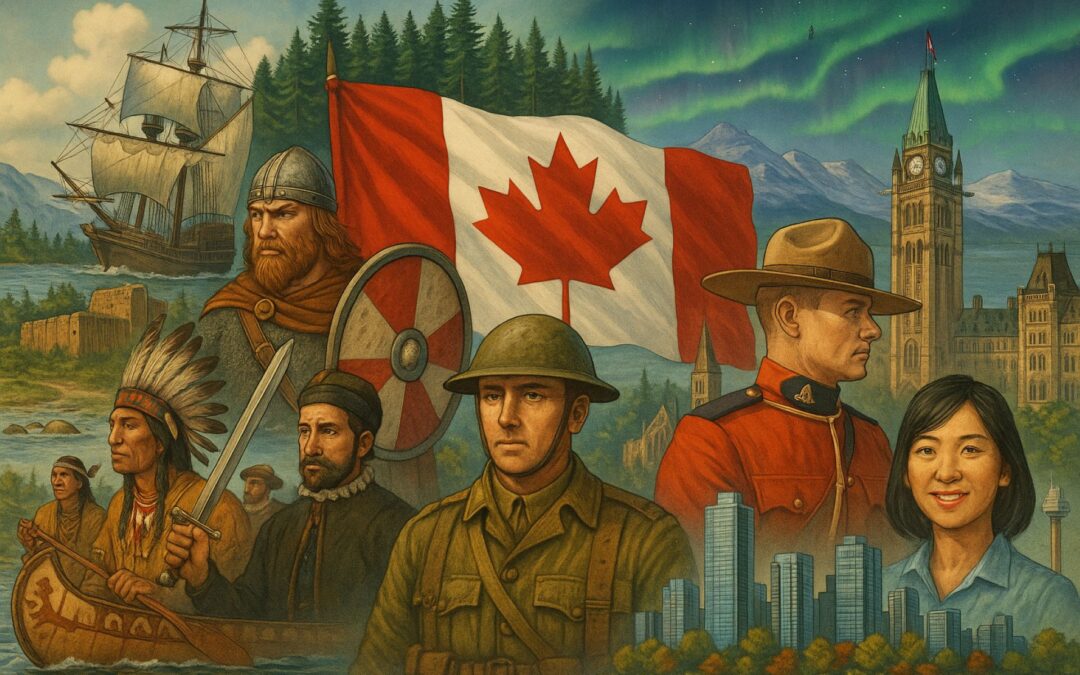
Canada’s history is a vast tapestry—woven from ice-age migrations, Viking landings, colonial rivalries, and the forging of a modern nation. It stretches across millennia and landscapes as varied as the tundra, the Rockies, the prairies, and the Pacific coast.
From the first peoples who adapted ingeniously to this land, to the French and British settlers who fought bitterly for dominance, to the waves of immigrants who later carried their languages, customs, and dreams to Canadian soil, each era added another thread to the story.
What emerged was not just a country, but an identity: resilient, diverse, and continually evolving. To trace Canada’s past is to see how geography, conflict, and compromise shaped one of the most multicultural societies in the world today.
A Land of Vastness and Diversity
To understand Canada, one must first confront its immensity. Stretching from the Atlantic Ocean in the east to the Pacific in the west, and reaching into the Arctic Circle in the north, Canada encompasses more land than nearly any other country on earth. It covers an area so large that one could fit the entire European Union within its borders and still have room to spare. Within this staggering breadth lie six distinct time zones and an environment that resists simplification.
The land is a patchwork of extremes. The jagged spine of the Rocky Mountains towers over the western horizon, snow-draped and formidable. The prairies, flat and seemingly infinite, shimmer with golden wheat under summer skies and become desolate expanses in winter’s grip. Dense boreal forests stretch like an emerald belt across the nation’s midsection, while the Great Lakes glitter as inland seas that have shaped trade and settlement for centuries. To the far north lies the tundra—an austere land of permafrost, caribou migrations, and the aurora borealis painting the heavens in shifting curtains of green.
But Canada’s diversity is not confined to geography alone. Its people, layered by millennia of settlement and centuries of migration, reflect the same breadth. Indigenous nations developed unique cultures finely attuned to their regions. Later waves of Europeans brought new languages, faiths, and laws. Over time, arrivals from Asia, Africa, the Caribbean, and the Middle East expanded this mosaic into one of the most multicultural societies on earth. Where once difference was a source of tension, today it is often celebrated as Canada’s defining strength, with cities like Toronto and Vancouver ranked among the most diverse globally.
This vastness and multiplicity have shaped a national identity rooted less in uniformity than in coexistence. Canada is a country where contradictions—French and English, wilderness and city, tradition and modernity—do not cancel one another out but instead coexist in a fragile, evolving balance.
First Peoples and Ancient Pathways
Long before the concept of “Canada” existed, the land was inhabited by peoples who had crossed from Asia during the waning days of the Ice Age. Around 16,000 years ago, as glaciers retreated, a corridor of land known as Beringia connected Siberia to North America. Families and clans traversed this frozen expanse, following herds of mammoth, caribou, and bison into uncharted territory. By the time rising seas swallowed Beringia around 11,000 years ago, these early migrants had already spread across the continent, laying the foundations of the first civilizations in what is now Canada.
Over thousands of years, these peoples adapted ingeniously to an unforgiving landscape. Along the eastern woodlands, Algonquian speakers such as the Mi’kmaq and Maliseet fished rivers and hunted game, while Iroquoian nations like the Huron and Mohawk built palisaded villages, practiced agriculture, and forged powerful confederacies. The Great Plains saw the rise of the Cree and Blackfoot, whose nomadic lives revolved around the bison—an animal that provided food, clothing, tools, and spiritual meaning.
On the Pacific coast, abundance shaped culture in extraordinary ways. The Haida, Coast Salish, and other groups thrived on salmon runs and cedar forests, building plank houses, canoes capable of navigating turbulent seas, and towering totem poles that told stories of lineage and myth. Further north, the Inuit mastered survival in one of the harshest environments on Earth, crafting kayaks, igloos, and an intricate knowledge system of ice, weather, and wildlife that allowed them to thrive where outsiders would quickly perish.
Each nation spoke its own language, carried unique cosmologies, and developed governance structures that rivaled European sophistication. The Iroquois Confederacy, for example, created a system of collective decision-making that later influenced the democratic principles of the United States and Canada. Trade networks stretched across the continent, linking copper from Lake Superior with shells from the Pacific and obsidian from the Rockies. Far from isolated, these societies were dynamic, innovative, and interconnected.
This was the world that awaited the first Europeans who set foot on Canadian soil: a land already filled with nations, histories, and voices, each rooted deeply in place.
The Norse Before Columbus
Centuries before Columbus unfurled his sails in the Caribbean, Norse seafarers were already pushing westward into the unknown waters of the North Atlantic. Hardened by the harsh landscapes of Scandinavia and Iceland, the Vikings possessed both the craftsmanship and the daring to venture across storm-lashed seas. Around the year 1000 CE, Leif Erikson, son of Erik the Red, landed on the northeastern coast of North America. The sagas tell of places he named Helluland (likely Baffin Island), Markland (probably Labrador), and Vinland, a fertile region that scholars now associate with Newfoundland.
At L’Anse aux Meadows, evidence of this bold journey remains. Archaeologists have uncovered the remnants of sod longhouses, workshops, and even forged iron nails—clear proof of Norse settlement. These ruins speak of a community intent on permanence, not mere passing exploration. The Vikings used the site as a base for expeditions further south, where they encountered Indigenous peoples. The sagas refer to these inhabitants as skrælings, describing encounters that swung between wary exchanges and violent clashes.
Despite their formidable skills, the Norse were too far from their Scandinavian homelands to sustain such ventures. Greenland’s colonies struggled with isolation and climate shifts, and the Vinland settlement was abandoned within decades. By the 12th century, their North American presence had faded into obscurity, swallowed by time and forgotten by most Europeans. Yet the Norse left behind a legacy: they were the first Europeans to set foot in the Americas, establishing an early, if fleeting, bridge between the Old World and the New. Their story reveals that the so-called “discovery” of North America was not a singular moment in 1492, but part of a longer, layered human encounter with this vast land.
European Rediscovery
Five hundred years after the Norse withdrawal, Europe once again turned its gaze westward. The year 1497 marked a pivotal moment when the Venetian explorer Giovanni Caboto—known in English as John Cabot—sailed under the flag of King Henry VII of England. Reaching the fog-bound coasts of Newfoundland, Cabot’s reports of seas teeming with cod ignited centuries of European interest. Soon, fleets from England, France, Spain, and Portugal plied Canadian waters, harvesting fish and claiming lands, though permanent colonies remained elusive.
The French took the lead in establishing a foothold. In 1534, Jacques Cartier entered the Gulf of St. Lawrence, raising a cross and claiming the land for France. He borrowed the term kanata—an Iroquoian word meaning village or settlement—to describe the region, inadvertently giving the future nation its name. Cartier’s expeditions probed deeper into the St. Lawrence River, reaching as far as present-day Montreal. Attempts to settle, however, ended in hardship and abandonment, with settlers succumbing to disease, famine, and bitter winters.
A century later, Samuel de Champlain transformed aspiration into reality. Known as the “Father of New France,” Champlain founded Quebec in 1608, creating a durable French settlement on the banks of the St. Lawrence. Unlike Cartier, Champlain understood the necessity of alliances. He cultivated partnerships with the Huron and Algonquin peoples, linking the fur trade to a network of Indigenous allies. His explorations took him deep into the interior, where he became the first European to map the Great Lakes.
From these early foundations, New France began to take shape. The French presence remained small—by the mid-17th century, its colonial population numbered only a few thousand—but it was strategic, anchored in trade, fortified settlements, and cultural exchange. In naming, mapping, and allying, these explorers inscribed Canada onto Europe’s imagination, planting seeds that would grow into centuries of rivalry, colonization, and cultural mingling.
Rival Empires and the British Conquest
By the 17th century, North America had become the theater of Europe’s grand imperial contest. France, through its settlement of New France, sought to dominate the fur trade by controlling the St. Lawrence River and forging powerful alliances with Indigenous nations. The French presence stretched deep into the interior, reaching the Great Lakes and even extending southward along the Mississippi River toward the Gulf of Mexico. To the French, Canada was not merely a distant outpost—it was the lynchpin of a sprawling continental vision.
The British, meanwhile, carved their power base along the Atlantic seaboard and around Hudson Bay. Their colonies, more populous and economically diverse, grew rapidly, drawing settlers from Britain and beyond. The establishment of the Hudson’s Bay Company in 1670 gave Britain a commercial stronghold in northern Canada. With its vast trading posts scattered across Rupert’s Land, the company became a formidable rival to French traders, linking the fur trade to global markets.
These competing ambitions inevitably collided. From the late 1600s to the mid-1700s, the French and British fought a series of wars in North America, often extensions of European conflicts. Boundaries shifted repeatedly, forts changed hands, and Indigenous nations were drawn into the struggles, sometimes as allies, sometimes as pawns. But the decisive chapter came with the Seven Years’ War, known in North America as the French and Indian War.
In 1759, on the windswept Plains of Abraham outside Quebec City, British forces under General James Wolfe clashed with French troops commanded by the Marquis de Montcalm. The battle was brief but transformative: both commanders were killed, but the British emerged victorious, sealing the fate of New France. Within a year, Montreal and other key settlements had surrendered, and in 1763 the Treaty of Paris formally transferred nearly all of France’s North American possessions to Britain.
Yet conquest did not mean erasure. To secure stability, the British allowed French Canadians to retain their language, religion, and civil law—a remarkable act of pragmatism that ensured French culture endured within an English empire. This accommodation laid the groundwork for Canada’s enduring bilingual and bicultural identity, one of its most distinctive national features today.
Revolution Next Door
Barely two decades after Britain secured Canada, its American colonies erupted in revolution. The grievances that led to the War of Independence—taxation without representation, restrictions on trade, and a desire for self-rule—were shared by some in Canada, particularly among French Canadians wary of British dominance. Yet the majority of Canadians, whether French or Loyalist settlers, remained aligned with Britain. Their loyalty was pragmatic: protection, trade, and stability were tied to imperial rule.
The American Continental Army attempted to draw Canada into the revolution. In 1775, they launched an invasion, capturing Montreal but failing spectacularly at Quebec City, where British forces and Canadian defenders repelled the attack. This solidified Canada’s role as a loyal outpost, a base from which Britain launched operations against the rebellious colonies.
When the Treaty of Paris ended the war in 1783, the newly independent United States established its borders with what remained of British North America. Tens of thousands of Loyalists—those who had sided with Britain during the conflict—fled the United States. Many resettled in Nova Scotia, swelling its population, while others founded the new colony of New Brunswick. Still more migrated to Quebec, bolstering its English-speaking minority. These migrations permanently altered the demographic and cultural landscape, embedding English institutions more deeply alongside French traditions.
Meanwhile, far to the west, another theater of imperial rivalry was unfolding. British explorers like Captain James Cook mapped the Pacific coast, establishing early trade in furs and building connections with First Nations communities. These ventures laid the foundation for British influence in what would later become British Columbia, even as Spain briefly contested the region.
Thus, while the American Revolution created a republic to the south, it also reinforced Canada’s loyalty to the Crown and reshaped its population. The influx of Loyalists, combined with Britain’s accommodation of French Canadians, created a dual identity that distinguished Canada from both its imperial rulers and its revolutionary neighbor.
The War of 1812 and Aftermath
The uneasy peace between Britain and the United States did not hold for long. By the early 19th century, tensions simmered on multiple fronts: Britain’s interference with American trade during its war with Napoleonic France, the Royal Navy’s practice of impressing American sailors into service, and disputes over the western frontier. In June 1812, the United States declared war on Britain, and the conflict immediately spilled across the border into Canada, then a British colony.
For Canadians, the war was both a trial and a crucible of identity. American forces invaded repeatedly, expecting local populations to welcome them as liberators. Instead, Canadians—both English and French—largely resisted. The defense of Upper and Lower Canada became a collective endeavor, bolstered by Indigenous allies who saw the British as a bulwark against American expansion. Figures such as Tecumseh, the Shawnee leader, played a crucial role, forging alliances with British commanders and rallying Indigenous nations in defense of their homelands.
Battles erupted along the Great Lakes, the Niagara frontier, and the St. Lawrence River. Some, like the capture of Detroit by British and Indigenous forces, were celebrated Canadian triumphs. Others, such as the burning of York (modern Toronto) by American troops in 1813, were searing losses. Yet even amid destruction, the resilience of Canadian defenders became a point of pride.
The war ended inconclusively with the Treaty of Ghent in 1814, restoring prewar boundaries and resolving little of the animosity that had fueled the conflict. Still, its legacy was profound. For Canadians, the successful defense against repeated American invasions forged a distinct sense of separateness from their southern neighbors. For Britain and the United States, the demilitarization of the border in subsequent years transformed the world’s longest international boundary into one of its most peaceful. To this day, the War of 1812 is remembered in Canada less for what it changed territorially and more for how it shaped a nascent collective identity rooted in defense, resilience, and loyalty.
Rebellion and Reform
Despite the unity forged in wartime, domestic unrest soon resurfaced. By the 1830s, many in Canada had grown disillusioned with colonial governance. Political power remained concentrated in the hands of a small elite—the Château Clique in Lower Canada (Quebec), largely Anglophone, and the Family Compact in Upper Canada (Ontario), descendants of Loyalist settlers. These oligarchies controlled land, commerce, and politics, leaving reformers and ordinary citizens frustrated by a lack of representation and accountability.
In 1837, anger boiled over into open rebellion. In Lower Canada, tensions were sharpened by cultural divides: French-speaking Canadiens, led by Louis-Joseph Papineau and the Patriotes, resisted what they saw as systematic suppression of their language, religion, and rights. In Upper Canada, reformers led by William Lyon Mackenzie railed against corruption and demanded responsible government. Both uprisings were poorly organized and quickly crushed by British forces, but the violence sent shockwaves through the colony.
The British response was not merely punitive. Recognizing that repression alone would not quell discontent, the Crown dispatched Lord Durham to investigate the causes of the unrest. His report, issued in 1839, became a landmark in Canadian history. Durham diagnosed the rebellions as the product of governance without accountability, and he recommended sweeping reforms: responsible government, in which executive councils would be answerable to elected assemblies, and the union of Upper and Lower Canada into a single colony to diminish French influence.
Though controversial, Durham’s report laid the foundation for Canada’s democratic evolution. In 1840, the Act of Union merged the two Canadas into the United Province of Canada. Over the following decades, the principle of responsible government gradually took root, empowering elected representatives and loosening Britain’s grip.
The rebellions of 1837–38 were short-lived and unsuccessful militarily, but they marked a turning point. They exposed the fragility of colonial rule, catalyzed democratic reforms, and set Canada on a path toward self-governance. In the ashes of failed uprisings, seeds of modern democracy were sown.
Confederation and Expansion
By the mid-19th century, the patchwork of British colonies in North America faced a pivotal question: remain as scattered, vulnerable outposts or unite into something larger and stronger? The 1860s brought both pressure and opportunity. To the south, the United States had emerged from the Civil War with renewed vigor, and many Canadians feared that American expansionism would soon target their lands. Economic instability and the need for infrastructure also pushed the colonies toward collaboration. Politicians began to see unification not only as protection but as a path to prosperity.
On July 1, 1867, the British North America Act was passed, creating the Dominion of Canada. It bound together four founding provinces—Ontario, Quebec, New Brunswick, and Nova Scotia—under a federal system with Ottawa as the capital. While Canada remained under the British Crown, it gained significant autonomy over internal affairs. Confederation marked the birth of a nation, though it was one still tethered to empire and not yet fully independent.
The project of expansion soon followed. Other colonies and territories, from Manitoba to British Columbia, joined in the years that followed. The promise of connection across vast distances led to the most ambitious infrastructure undertaking of the young dominion: the Canadian Pacific Railway. Construction began in the 1870s, requiring immense labor, engineering brilliance, and often brutal working conditions, especially for Chinese laborers who were paid little and endured dangerous environments.
The railway was more than steel tracks; it was a lifeline binding east to west, enabling settlers, goods, and ideas to traverse the continent. When the last spike was driven at Craigellachie, British Columbia, in 1885, Canada had, for the first time, the means to truly function as a unified country. Yet the story of expansion was also one of dispossession. Indigenous peoples were displaced, confined to reserves through treaties often signed under duress, and subjected to assimilationist policies such as the residential school system. The Métis, led by Louis Riel, resisted through the Red River and Northwest Rebellions, but were ultimately subdued. Expansion brought power and unity to Canada’s settlers, but at a devastating cost to those who had called the land home for millennia.
Prosperity, War, and Identity
As the 20th century dawned, Canada was a country of promise. Immigration surged, fueled by the hope of farmland, jobs, and opportunity. Settlers from Eastern Europe, Scandinavia, and Asia joined established communities, transforming Canada into an increasingly diverse society. Wheat fields blanketed the prairies, industry flourished in Ontario and Quebec, and cities grew rapidly. Canada’s wealth was on the rise, but its political fate remained linked to Britain.
That link would draw Canada into global conflict in 1914 when the First World War broke out. Though Canada had not declared war itself—Britain’s declaration automatically extended to its dominions—the country committed with fervor. Hundreds of thousands enlisted, and Canadian troops fought with distinction on the Western Front. The Battle of Vimy Ridge in 1917, where Canadian divisions fought together under Canadian command for the first time, became a defining moment. It symbolized the country’s emergence from colonial shadow into national maturity, earned through blood and sacrifice.
The interwar years, however, tested Canada’s resilience. The Great Depression of the 1930s struck hard, with unemployment, drought, and economic collapse shaking the nation. Yet progress still flickered: women gained the right to vote in federal elections, and ice hockey, through the formation of the NHL, cemented itself as a cultural cornerstone.
World War II once again summoned Canada to arms. This time, the nation entered the war by its own decision, a reflection of its growing sovereignty. Canadian troops fought bravely in Europe, most famously during the D-Day landings at Juno Beach. At home, the economy surged under wartime production, lifting Canada from the Depression. The country also faced darker moments, including the internment of Japanese Canadians and tensions over conscription, particularly in Quebec.
By war’s end, Canada had not only secured its reputation as a dependable ally but had also built a foundation for modern prosperity. The creation of social programs, including universal healthcare and old-age pensions, marked the rise of a welfare state. At the same time, Canada’s role on the world stage shifted—from colony to partner, from peripheral player to middle power. It was a transformation that gave Canadians new confidence in their identity, both at home and abroad.
From Dominion to Nation
Canada’s journey from dominion to fully sovereign nation was gradual, marked not by a single rupture but by a sequence of decisive steps. In 1931, the Statute of Westminster granted legislative independence to Britain’s dominions, including Canada, affirming that no British law would apply unless adopted by the Canadian Parliament. This was a monumental stride, but Canada still lacked full control over its own constitution, which remained housed in Westminster. The young country was independent in practice yet bound by legal threads to its imperial mother.
Symbolism mattered in this era of transition. In 1965, Canada adopted its own flag, replacing the British Red Ensign with the bold red-and-white maple leaf that now defines its identity. The decision was not without controversy. Many English Canadians, deeply attached to British traditions, opposed the change, while others saw it as a long-overdue declaration of uniqueness. Ultimately, the flag became a unifying emblem, a symbol that Canada was no longer content to live in the shadow of empire.
The true severance came in 1982 with the patriation of the constitution. Under Prime Minister Pierre Elliott Trudeau, the Constitution Act was passed, bringing Canada’s supreme law under Canadian control. Central to this was the Charter of Rights and Freedoms, which enshrined fundamental liberties such as freedom of expression, equality rights, and multicultural protections. The act was a declaration of maturity: Canada was no longer a dominion—it was a nation, self-determining and legally sovereign.
Yet, in a gesture of continuity, Canada retained the monarchy. The reigning British monarch remained head of state, but only ceremonially, represented domestically by the Governor General. This duality—independence alongside tradition—captured Canada’s distinctive path: evolution rather than revolution, continuity alongside change.
A Multicultural Identity
Postwar Canada witnessed demographic transformation on a scale unmatched in its earlier history. Waves of immigrants arrived, not just from Europe but increasingly from Asia, Africa, the Middle East, and the Caribbean. Toronto, once an Anglo-Protestant stronghold, became a city where over half the population was born outside of Canada. Vancouver developed thriving Chinese, South Asian, and Filipino communities, while Montreal welcomed newcomers who contributed to its cultural vibrancy.
In 1971, under Prime Minister Pierre Trudeau, Canada became the first country in the world to officially adopt multiculturalism as government policy. This was more than a political slogan—it was a recognition that Canada’s strength lay in diversity, in the coexistence of multiple languages, faiths, and traditions. The policy encouraged cultural preservation alongside integration, allowing communities to retain heritage while participating fully in Canadian society.
But multiculturalism did not come without challenges. The rise of Quebec nationalism in the 1960s and 70s posed questions about unity. The Quiet Revolution transformed Quebec society, fueling demands for sovereignty and culminating in two referenda on independence, in 1980 and 1995. Both were defeated, but the close result of the latter—just over 50% voting to remain in Canada—revealed deep fissures.
Indigenous peoples, too, fought for recognition. The legacy of residential schools, forced assimilation, and broken treaties cast a long shadow. From the 1960s onward, Indigenous activism gained strength, demanding land rights, political representation, and cultural renewal. Landmark moments, such as the 2015 Truth and Reconciliation Commission, brought national attention to these struggles, though reconciliation remains an unfinished journey.
Despite its complexities, Canada’s multicultural experiment has become a defining feature of its national identity. It is less a “melting pot” than a “mosaic,” where differences are not dissolved but displayed as integral pieces of a larger whole. Festivals of every heritage, religious diversity, and multilingual neighborhoods have become the norm in Canadian cities. The result is a nation that, while imperfect and evolving, stands globally as a model of pluralism.
Canada Today
The Canada of the present day is the culmination of centuries of migration, struggle, negotiation, and reinvention. It is one of the world’s largest democracies, governed through a parliamentary system that balances federal authority with provincial autonomy. Ottawa may be the nation’s capital, but real power and cultural influence flow from many centers—Toronto with its financial might, Montreal with its Francophone heritage, Vancouver as a Pacific gateway, and Calgary as a hub of energy and enterprise.
Geography still defines much of the Canadian experience. The north remains sparsely populated yet symbolically important, embodying both resilience and responsibility in the face of climate change and sovereignty disputes over Arctic waters. Meanwhile, cities in the south pulse with multicultural vibrancy. More than 20% of Canada’s population is foreign-born, making it one of the most ethnically diverse nations on Earth. Walk through Toronto’s neighborhoods and you’ll hear over 160 languages spoken, taste cuisines from every continent, and see cultural festivals that celebrate traditions from around the globe.
Yet Canada today is not simply a portrait of harmony. It is also a nation confronting its past and its present contradictions. The legacy of colonialism and the treatment of Indigenous peoples remain urgent challenges. The residential school system, with its decades of forced assimilation, has left deep wounds. Truth and reconciliation efforts, land claims, and the defense of Indigenous sovereignty are at the forefront of Canada’s moral and political discourse.
Internationally, Canada positions itself as a middle power—a country that prefers diplomacy to force, partnership to domination. As a founding member of NATO, a co-creator of NORAD, and a consistent voice at the United Nations, Canada embraces multilateralism. Its global image often rests on the ideals of peacekeeping, human rights, and humanitarian aid.
Domestically, Canada continues to navigate the delicate balance between unity and diversity. Quebec remains proudly distinct, Indigenous nations demand justice and recognition, and new immigrant communities reshape the cultural and political landscape. Yet despite its fractures, Canada’s national identity is grounded in coexistence. It is a society that seeks balance—between English and French, Indigenous traditions and settler institutions, rugged wilderness and cosmopolitan cities.
In the modern era, Canada’s story is one of endurance and reinvention. It is the story of a people who have made peace with vast distances, extreme climates, and cultural differences, weaving them into a national identity that is both fragile and resilient. Canada today is not a finished product but an ongoing project—defined by its ability to adapt, to reconcile, and to embrace diversity as its greatest strength.
Conclusion
The story of Canada is not a straight line—it is a mosaic of encounters, struggles, and reinventions. From the ancient footsteps across Beringia to the raising of the maple leaf flag, the nation has been defined by its ability to endure, to adapt, and to find unity amid difference. Wars tested its resilience, migrations reshaped its character, and reconciliation continues to challenge its conscience.
Yet through it all, Canada forged an identity grounded in coexistence, compromise, and diversity. Today, it stands not only as a vast land of natural wonders but as a democratic society that reflects the hopes, histories, and voices of many peoples. Canada’s past is long, layered, and complex—but its future remains an open canvas, still being written.