
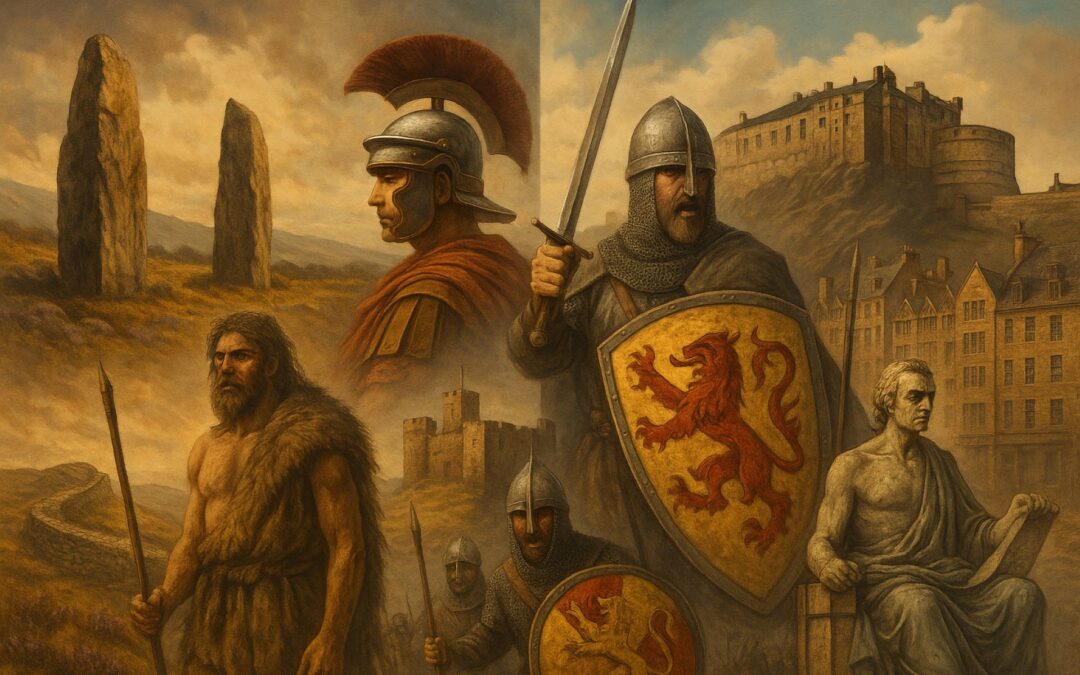
Scotland’s history is a tapestry woven from resilience, rebellion, and reinvention. From the earliest hunter-gatherers who raised stone circles on windswept isles to the fierce tribes that defied Rome’s legions, the story begins with a people unwilling to yield.
Over centuries, kingdoms rose and fell—Picts, Gaels, and Britons merging under one crown—while Norse raiders, Norman feudal lords, and English monarchs sought to bend the land to their will. Each attempt met with defiance, from Wallace’s victory at Stirling Bridge to Bruce’s triumph at Bannockburn, and later in the romantic but tragic Jacobite risings.
Yet Scotland’s tale is not only one of conflict. It is also a story of ideas and imagination: the Enlightenment that reshaped the modern world, the industries that powered an empire, and the culture that carried Scottish identity across oceans. To follow Scotland’s past is to walk the line between loss and endurance, between conquest and creativity—a journey through centuries that forged a nation both proud of its roots and restless in its search for self-determination.
Ancient Beginnings
The first footprints on Scottish soil appeared more than ten millennia ago, soon after the glaciers of the Ice Age melted away. What those early people saw was a rugged wilderness—mountains newly carved, valleys filled with rivers and lochs, and thick forests teeming with red deer, wild boar, and aurochs. They lived as nomadic hunter-gatherers, their existence tethered to the seasons. They fashioned tools of flint, tracked animals across heather-covered hills, and gathered shellfish along the windswept coasts. Life was harsh, survival precarious, yet their persistence stitched humanity into a landscape long left untouched.
Around 4000 BC, the rhythms of life began to change. The Neolithic revolution reached Scotland, and with it came farming. People cleared forests to plant barley and wheat, raised cattle and sheep, and built permanent dwellings. Farming meant stability. Villages formed, families stayed rooted, and society took on a new shape. With this permanence came imagination: megalithic monuments rose against the skyline. At Stenness in Orkney, enormous stones were set in circles, aligning with celestial patterns. On the Isle of Lewis, the Callanish stones stood like sentinels beneath the moon, marking solstices and rituals whose meanings are still partly hidden. These structures, older than both the pyramids of Egypt and Stonehenge, revealed a people deeply connected to time, space, and the unseen forces of the world.
Though these early inhabitants left no written language, their works of stone and earth speak loudly. Chambered cairns, burial mounds, and ceremonial sites suggest a belief in continuity beyond death, a reverence for ancestors, and a sense of belonging to the land itself. This was the dawn of Scotland—not yet a nation, but already a place where human resilience and imagination left lasting marks on the landscape.
The Roman Challenge
By the 1st century AD, Scotland’s rugged northern lands attracted the gaze of Rome. The empire, having conquered the fertile plains of southern Britain, sought to extend its dominion to the very edge of the known world. In 71 AD, Roman legions under Quintus Petillius Cerialis marched north into what is now southern Scotland. Over the following decade, Governor Agricola pushed deeper, determined to bring the last untamed tribes of Britannia to heel.
The Caledonians, descendants of earlier Celtic tribes, refused submission. In 84 AD, on the slopes of Mons Graupius, they met Agricola’s disciplined army. Tacitus, Rome’s historian and Agricola’s son-in-law, described the scene vividly: the Caledonians under Calgacus, “the most distinguished of their leaders,” fighting not for conquest but for freedom itself. Rome claimed victory, but the battle did not break the will of the tribes. They melted into forests and mountains, harassing supply lines, making every Roman mile costly.
To contain this restless frontier, Rome built walls. Hadrian’s Wall, begun in 122 AD, stretched 73 miles from coast to coast, a physical and psychological barrier marking where empire ended and wildness began. Later, the Antonine Wall was raised further north, between the Firth of Forth and the Firth of Clyde. Yet even this bold effort was abandoned after just two decades. The costs of holding Scotland were too steep—economically, militarily, and emotionally.
The legions withdrew, forts dismantled, towers left to weather. Scotland remained unconquered. Rome could dominate the south of Britain with cities, roads, and trade, but beyond the walls stretched a land too rugged, too stubborn, and too proud to bend. The Roman challenge revealed what would become a hallmark of Scotland’s history: defiance against larger powers, a refusal to surrender identity, and a capacity to endure where others faltered.
From Tribes to Kingdoms
When Rome finally abandoned Britain in the early 5th century, it left behind not peace but power vacuums. The north, which had never fully yielded to Roman authority, became a patchwork of peoples struggling to secure dominion. Out of this mosaic emerged four principal kingdoms, each carrying its own language, culture, and sense of destiny.
To the northeast lived the Picts, enigmatic and formidable. They carved mysterious symbols on standing stones, fought fiercely in battle, and earned a reputation as “painted people” for their habit of decorating their skin before combat. Their kingdom of Fortriu became a dominant force, rich with Celtic traditions and renowned for resisting outside domination.
In the west, across the sea from Ireland, came the Gaelic-speaking Scotii, who established the kingdom of Dalriada. They brought with them not only their language but also a spiritual and cultural identity that would eventually lend Scotland its very name. Their ties to Ireland remained strong, shaping the flow of ideas, warriors, and faith across the Irish Sea.
To the south and east, the Anglo-Saxons, pushing northward from their heartlands in England, carved out the kingdom of Bernicia, which would later merge into the powerful realm of Northumbria. Their Old English tongue and customs added yet another layer to Scotland’s cultural tapestry.
Finally, the Brittonic Celts of the southwest held sway in the kingdom of Strathclyde, a land rooted in older Celtic traditions but caught between the influences of its neighbors.
These four realms were far from harmonious. Rivalries and skirmishes were constant, alliances shifting as often as the weather. Yet amid this fragmentation came a unifying thread: Christianity. In 563 AD, the Irish monk St. Columba crossed the waters and established a monastery on the island of Iona. From this remote sanctuary, the new faith radiated outward, gradually supplanting pagan rituals and uniting disparate peoples under a shared spiritual order. Monks carried illuminated manuscripts, taught literacy, and spread new ideas of law and morality.
Still, faith could not erase politics. These kingdoms jostled endlessly for supremacy, none strong enough to dominate the others for long. It was a land of shifting borders, warlords, and fragile alliances—a crucible of conflict that would eventually forge the idea of a single Scotland.
Viking Storms and the Birth of Alba
The fragile balance was shattered in 793 AD when dragon-prowed ships appeared on the horizon. The Vikings had arrived, their first assault falling upon the monastery at Lindisfarne and soon after on the sacred isle of Iona. For centuries, Norse raiders swept the coasts of Scotland, burning monasteries, plundering treasures, and enslaving captives. Their longships, swift and shallow-keeled, could strike anywhere—remote villages, wealthy abbeys, even inland river valleys.
But these were not just raiders; they were settlers. By the 9th century, Norse communities were firmly planted in Orkney, Shetland, and the Hebrides, creating a cultural fusion of Norse and Gaelic traditions. The western seaboard became home to the Kingdom of the Isles, where Viking jarls ruled with both sword and sail. These colonies brought new words, new gods, and new bloodlines into the Scottish story.
It was in this crucible of crisis that unity began to take root. The kingdom of Dalriada, weakened by Viking incursions, and the kingdom of Fortriu, battered by constant threats, found strength in alliance. Around 843 AD, under Kenneth MacAlpin, Gael and Pict were united into the Kingdom of Alba. Historians debate whether this was a conquest or a merger, but the result was undeniable: a new political entity had emerged, one resilient enough to withstand external pressure.
Alba grew steadily, expanding its influence and consolidating its identity. Over time it absorbed Strathclyde and reached its contested frontier with England, solidifying its borders. The Norse presence lingered in the Isles, but Alba held firm on the mainland.
The creation of Alba was more than political—it was symbolic. It represented the first true fusion of Scotland’s diverse peoples: Picts, Gaels, and Brittonic Celts united under a single crown. It was the seed of the Scotland we know today, born not in peace but in resistance to storms from without and discord within.
Norman Shadows and Norse Rivalries
The 11th century opened with a Scotland still forging its sense of permanence, but new powers pressed on its borders. The Norman conquest of England in 1066 did not stop at the River Tweed. William the Conqueror, his eye set on dominance beyond England, forced Malcolm III of Scotland into submission. It was not conquest in the Roman sense, but it was influence: Norman knights began appearing in Scottish courts, bringing with them unfamiliar customs, codes of chivalry, and a system of feudal landholding that would transform the political fabric of the kingdom. Castles of stone replaced wooden fortresses, heralding a new age of fortified nobility. Lords held lands not as ancestral rights but as grants of loyalty, binding Scotland’s fate ever more tightly to that of its southern neighbor.
Yet while Norman culture seeped into Scottish soil, another foreign presence remained obstinate—the Norse. The Orkneys, Shetlands, and Hebrides were ruled by Norse jarls, their allegiance firmly tied to the kingdom of Norway. From these islands, Norse raiders and traders sailed the seas, linking Scotland not just with Scandinavia but with the broader North Atlantic world. Their cultural imprint was indelible: place names, dialects, and bloodlines wove Norse identity into the tapestry of Scotland.
The contest over these western territories came to a head in the 13th century. King Alexander II and later Alexander III sought to wrest control from Norway. This culminated in the Battle of Largs in 1263, a clash fought amid storm and surf. Though inconclusive militarily, the battle weakened Norwegian resolve. Three years later, the Treaty of Perth (1266) formally transferred the Hebrides and Isle of Man to Scotland. With this, the Norse grip was loosened, and Scotland’s western seaboard was firmly integrated into the kingdom.
By the close of the century, Scotland’s boundaries had largely crystallized. Yet the price of territorial unity was vulnerability. England loomed larger than ever, its Norman kings casting long shadows northward, waiting for weakness to pounce.
Wars of Independence
That moment of weakness arrived in 1286 with the sudden death of Alexander III, leaving no clear heir. The throne became a prize for rival claimants, and the Scottish nobles, unable to settle the matter, turned to England’s Edward I as mediator. Edward seized the opportunity, installing John Balliol as king while simultaneously demanding recognition of his overlordship. Scotland’s sovereignty had been compromised, and resentment festered.
In 1297, defiance erupted. William Wallace, a minor noble, rallied men under the banner of freedom. At the Battle of Stirling Bridge, his forces used cunning and terrain to annihilate a much larger English army. The victory resounded like thunder across Europe—Scotland had struck down the most powerful monarchy of the age. But triumph was short-lived. The next year, at Falkirk, Edward’s superior cavalry crushed Wallace’s army. Wallace fled, only to be betrayed, captured, and executed in London in 1305. His death was gruesome, his body quartered, but his martyrdom became immortal.
Into this struggle stepped Robert the Bruce, who, despite a bloody rivalry with other Scottish nobles, claimed the throne in 1306. His early reign was marked by setbacks, but perseverance became his weapon. In 1314, at the Battle of Bannockburn, Bruce’s army achieved a stunning victory over Edward II’s forces, securing Scotland’s independence in practice if not yet in law. Fourteen years later, the Declaration of Arbroath (1320) was sent to the Pope, asserting in unforgettable words that Scotland would never be subjugated, for “it is not for glory, nor riches, nor honors that we fight, but for freedom alone.”
Finally, in 1328, the Treaty of Edinburgh-Northampton formally recognized Scotland’s independence. Yet independence was never permanent. By the mid-14th century, succession crises and renewed English invasions reopened wounds. Still, the Wars of Independence carved something indestructible into Scotland’s identity: the conviction that freedom was worth endless struggle, that sovereignty was a treasure more precious than life itself.
The Stewart Dynasty and Rising Tensions
When Robert II, grandson of Robert the Bruce, ascended the throne in 1371, he inaugurated the Stewart dynasty, a line that would dominate Scottish politics for three centuries. His reign and those of his descendants brought continuity, but also turbulence, as Scotland grappled with dynastic rivalries, foreign wars, and religious upheavals.
Under the Stewarts, Scotland expanded its reach. The marriage of James III to Margaret of Denmark in 1469 secured the Orkney and Shetland Islands, finalizing the realm’s territorial map much as we recognize it today. Meanwhile, Edinburgh, with its commanding castle perched upon volcanic rock, became the nation’s capital in 1437, replacing Scone as the ceremonial heart. The city soon developed into a vibrant hub of culture and governance, its narrow wynds and rising spires symbolizing both strength and ambition.
Education and learning flourished as well. The founding of St Andrews University in 1413, followed by Glasgow (1451) and Aberdeen (1495), created intellectual centers that would later feed the Scottish Enlightenment. For the first time, Scotland had institutions where theology, philosophy, and law could be debated systematically, raising the nation’s stature across Europe.
Yet the shadow of England lingered. The two kingdoms, locked in rivalry, clashed repeatedly. At Flodden in 1513, Scotland suffered one of its darkest defeats. King James IV, bold and charismatic, led his army into Northumberland but was slain alongside much of the Scottish nobility. His death left the throne to his infant son, James V, marking the beginning of a fragile century. The calamity at Flodden haunted Scotland’s memory, a stark reminder of the dangers of challenging its more populous southern neighbor.
Religious upheaval added further strain. The Protestant Reformation of the 16th century shook Christendom, and Scotland was no exception. The old alliance with Catholic France clashed with the rising tide of Protestantism, aligning Scotland with new political realities. At the heart of this storm stood Mary, Queen of Scots, whose life became a tragic emblem of divided loyalties. Crowned in 1542 as an infant, she was betrothed into French royalty, briefly becoming Queen of France. On her return to Scotland, she found a nation transformed, its nobility leaning toward Protestantism. Though she remained Catholic, Mary sought compromise—yet in trying to balance both sides, she alienated all.
Her turbulent rule unraveled through scandal, rebellion, and conspiracy. Forced to abdicate in 1567, she fled to England, only to be imprisoned by her cousin Elizabeth I. After years of confinement, Mary was executed in 1587 for treason. Her death symbolized the collision of dynastic ambition, religious division, and the relentless pressure of England. Ironically, it was her son, James VI of Scotland, who inherited Elizabeth’s throne in 1603, uniting the crowns of England and Scotland in his person.
Civil Wars and Jacobite Dreams
The accession of James VI of Scotland as James I of England brought both promise and estrangement. Though the crowns were joined, the kingdoms remained distinct, each with its own laws and parliament. James moved his royal court to London, leaving Scotland politically distant from its monarch. This physical and symbolic relocation sowed discontent, a sense of neglect that would grow in the centuries to come.
The true crisis erupted under his son, Charles I. In 1637, Charles attempted to impose an English-style prayer book on Presbyterian Scotland. The reaction was swift and furious: ministers, nobles, and common folk alike signed the National Covenant, vowing to defend their faith. This resistance ignited the Bishops’ Wars, drawing Scotland into the broader Wars of the Three Kingdoms, which also engulfed England and Ireland. Scotland allied with the English Parliamentarians against Charles, yet not all clans shared this loyalty. The Highlands, in particular, remained staunchly royalist, tearing the land into factions.
The execution of Charles I in 1649 horrified many Scots. They declared his son, Charles II, their rightful king, but this defiance invited invasion. In 1650, Oliver Cromwell’s New Model Army crushed Scottish forces at Dunbar, and within two years Scotland was annexed into the Commonwealth of England, Scotland, and Ireland. Though Cromwell’s republic collapsed after his death, leaving room for the monarchy’s restoration in 1660, the episode scarred Scottish pride.
The next blow came with the reign of James VII of Scotland (James II of England), a devout Catholic ruling over a predominantly Protestant population. His open favoritism toward Catholics rekindled old religious anxieties. In 1688, the Glorious Revolution ousted him, replacing him with his Protestant daughter Mary and her husband, William of Orange. But not all of Scotland accepted this outcome.
Thus began the era of Jacobitism, named for James (Latin: Jacobus). Many Highland clans, loyal to the Stuart cause, rose in rebellion. The Jacobite Rising of 1689 was crushed at Dunkeld, but the movement endured, smoldering beneath the surface. Its embers flared repeatedly—in 1715, when James’s son, the “Old Pretender,” attempted to reclaim the throne, and in 1745, when his grandson, **Charles Edward Stuart—Bonnie Prince Charlie—**landed in the Highlands.
The ’45 was the Jacobite dream at its brightest and most tragic. Marching south, Bonnie Prince Charlie captured Edinburgh and threatened England itself. Yet the rebellion unraveled. At Culloden in 1746, the Jacobite army was annihilated in a brutal clash that ended not only the Stuart cause but also the Highland way of life. The British government enacted severe reprisals: clan chiefs were stripped of power, tartans and bagpipes outlawed, and Gaelic culture suppressed. The centuries-old clan system collapsed, replaced by commercial landlords who began the infamous Highland Clearances.
Still, Jacobitism left an indelible mark on Scottish identity. Though defeated militarily, its romantic memory—of loyalty, of defiance, of lost causes—echoed down through poetry, song, and legend, becoming part of the soul of Scotland itself.
Union and Enlightenment
The dawn of the 18th century found Scotland battered by failure and searching for survival. The Darien scheme—an audacious attempt to establish a Scottish colony on the Isthmus of Panama—had collapsed disastrously. Disease, poor planning, and Spanish hostility doomed the project, wiping out nearly a fifth of Scotland’s national wealth. The humiliation was profound. Families ruined by the scheme demanded restitution, and the kingdom’s economic weakness left it dangerously exposed to English pressure.
Thus came the Treaty of Union of 1707. In exchange for assuming Scotland’s debts and opening access to England’s colonial markets, the Scottish Parliament voted to merge with England, forming the Kingdom of Great Britain. To some, this was pragmatic—an economic lifeline. To many others, it was betrayal. Protests broke out across Scottish towns, where cries of “bought and sold for English gold” captured the bitterness of those who felt sovereignty had been surrendered for coin.
And yet, from this contested union emerged a paradox: while political independence was lost, intellectual and cultural independence flourished. The 18th century witnessed the Scottish Enlightenment, a dazzling period of creativity that transformed not only Scotland but the modern world.
Philosophers like David Hume probed the nature of human reason and skepticism, questioning the very foundations of certainty. Adam Smith, with his monumental Wealth of Nations (1776), laid down the principles of free-market economics that would guide global trade for centuries. Engineers and inventors, from James Watt with his perfected steam engine to James Hutton, the “father of modern geology,” pushed the boundaries of science. In literature, Robert Burns gave voice to Scottish identity in the everyday rhythms of the Scots tongue, while Sir Walter Scott wove history into romantic national myth.
Edinburgh, with its grand Enlightenment architecture and buzzing salons, became known as the “Athens of the North.” Coffeehouses brimmed with debates, and universities in Glasgow, Aberdeen, and St Andrews produced thinkers whose ideas reverberated across Europe and America. Ironically, at the very moment when Scotland was politically subsumed into Britain, it carved for itself a reputation as a crucible of modern thought, a nation of ideas whose reach far outstripped its borders.
Industrial Power and Migration
By the turn of the 19th century, Scotland stood at the forefront of the Industrial Revolution. The Clyde River, once a modest waterway, was transformed into a powerhouse of global shipbuilding. Glasgow became synonymous with steel and engineering, launching leviathans that carried empire, commerce, and migrants across the seas. Coal mines in Lanarkshire and Fife, iron foundries in the Central Belt, and textile mills in Dundee and Paisley roared with productivity.
Industrialization brought wealth and urban growth, but also upheaval. Populations surged: from 1.6 million in 1801 to over 4.4 million by century’s end. Rural Highlanders displaced by the Highland Clearances poured into industrial towns, while Irish immigrants fleeing famine swelled the workforce further. Overcrowded tenements, poor sanitation, and hazardous working conditions defined life for many. Disease spread quickly, and child labor became common. While Scotland’s industries helped power the British Empire, its workers paid the price in sweat, poverty, and shortened lives.
For many, the solution was emigration. Nearly two million Scots left in the 19th century, settling in Canada, the United States, Australia, and New Zealand. They carried with them skills, songs, and stubborn resilience, leaving an outsized Scottish imprint across the globe. Scottish engineers built railways in India, Scottish missionaries spread education and religion in Africa, and Scottish entrepreneurs planted businesses in every corner of the empire.
Yet even amid hardship, Scotland produced cultural flowering. The works of Robert Louis Stevenson, the poetry of Burns (revered ever more), and the novels of Sir Walter Scott kept alive a sense of identity and pride. In science, Alexander Graham Bell pioneered the telephone, and James Clerk Maxwell revolutionized physics with his electromagnetic theories.
The 20th century, however, dimmed this industrial might. The First World War saw Scottish regiments suffer immense losses, their bravery immortalized but their communities scarred. Between the wars, industries declined, and unemployment soared, leading to unrest like the “Red Clydeside” strikes of 1919. The Second World War revived production briefly, but by the late 1940s, traditional heavy industry was in inexorable decline. Shipyards closed, mines shuttered, and Scotland entered a period of economic malaise.
And yet, even in decline, Scotland endured. Its diaspora remained connected, its intellectual contributions continued, and its people turned increasingly to questions of autonomy, seeking once more to steer their destiny rather than be carried by the currents of empire and industry.
Devolution and the Question of Independence
The decline of heavy industry in the mid-20th century left scars on Scotland’s social and economic fabric. Communities that had thrived on shipbuilding along the Clyde or coal mining in the Central Belt now faced mass unemployment and depopulation. Entire neighborhoods withered, and with them, confidence in Westminster’s ability to address Scotland’s unique struggles. The sense that decisions made in London were distant, even indifferent, began to harden into political discontent.
By the 1970s, a new current of nationalism was rising. The discovery of North Sea oil off Scotland’s coast sharpened the debate. The slogan “It’s Scotland’s oil” became a rallying cry for those who believed that the nation’s resources were being siphoned away to fund the wider UK, rather than directly benefiting Scottish communities. Although a 1979 referendum on devolution failed due to voter turnout requirements, the seed had been planted.
The political tide shifted in the 1990s. Disillusionment with Westminster politics, combined with pressure from the Scottish National Party (SNP) and other pro-devolution voices, led to a second referendum in 1997. This time, the result was decisive: a majority of Scots voted in favor of their own parliament. In 1999, after nearly three centuries, the Scottish Parliament reconvened in Edinburgh, wielding authority over health, education, transport, and justice. It was a historic moment—Scotland had reclaimed a measure of self-governance within the framework of the United Kingdom.
Devolution did not silence the deeper question, however. If Scotland could govern parts of its affairs, why not all? This question came to a head in the 2014 independence referendum, one of the most momentous votes in Scottish history. The campaign electrified the nation. The “Yes” side promised sovereignty, control over resources, and a voice unfiltered by Westminster. The “No” side warned of economic risks, the uncertainty of currency, and the loss of the UK’s security umbrella. In the end, 55% voted to remain in the Union, while 45% supported independence—a narrow defeat that underscored how deeply divided the nation remained.
The debate did not end there. The Brexit referendum of 2016, in which a majority of Scots voted to remain in the European Union while England and Wales voted to leave, reignited calls for another independence vote. Many argued that Scotland was being dragged out of Europe against its will, proof of the structural imbalance in the Union. The SNP, buoyed by growing support, pressed the case for a second referendum, framing independence as not just a question of sovereignty, but of Scotland’s place in Europe and the world.
Today, the question of independence is no longer a matter for poets or rebels but for ballots and parliaments. Yet the echoes of history resound. From the Picts resisting Rome, to Wallace and Bruce defying England, to Jacobites rallying under Stuart banners, Scotland’s story has always been one of grappling with external authority. Devolution has restored a measure of dignity and voice, but the debate over full independence remains unresolved.
The nation stands at a crossroads familiar to its past: should it chart its own destiny, fully sovereign once again, or remain within a larger union that has shaped its fortunes for over three centuries? The answer, as ever in Scotland’s history, lies not in submission but in choice—hard-won, passionately debated, and deeply tied to the enduring spirit of its people.
Conclusion
The history of Scotland is not a straight path but a circle—its struggles for sovereignty echoing across ages, from Roman walls to referendums in Edinburgh. Time and again, outsiders have tried to dictate its destiny, yet the land and its people have persisted, adapting, resisting, and reimagining themselves. The Enlightenment proved that Scotland could shape the world through ideas as powerfully as through arms, while the diaspora spread its spirit far beyond its borders.
Today, questions of independence remain as urgent as ever, reflecting a deep continuity with the past. Scotland’s story is unfinished, its next chapter still unwritten. What endures is the same force that animated the Caledonians, the Stewarts, and the thinkers of the Enlightenment—the conviction that the right to choose one’s own future is the truest measure of freedom.