
Introduction: The Civil War That Became a Legend
China’s Three Kingdoms period is remembered as one of the most dramatic eras in world history.
It had everything: collapsing empires, child emperors, corrupt court factions, peasant uprisings, military geniuses, betrayed alliances, impossible battles, and warlords who dreamed of ruling everything under Heaven.
But the Three Kingdoms did not begin as three cleanly divided states. It began with the slow decay of the Han dynasty, one of China’s great imperial golden ages. For more than four centuries, the Han had given China political unity, administrative structure, trade routes, cultural confidence, and a model of government that later dynasties would look back to with admiration.
Then the center weakened.
The court turned inward. Eunuchs, imperial relatives, ministers, generals, and palace factions fought for influence while ordinary people struggled with floods, droughts, taxation, disease, and local violence. When rebellion finally erupted, the Han court survived only by calling on regional commanders to save it.
That decision kept the dynasty alive for a moment.
It also destroyed it.
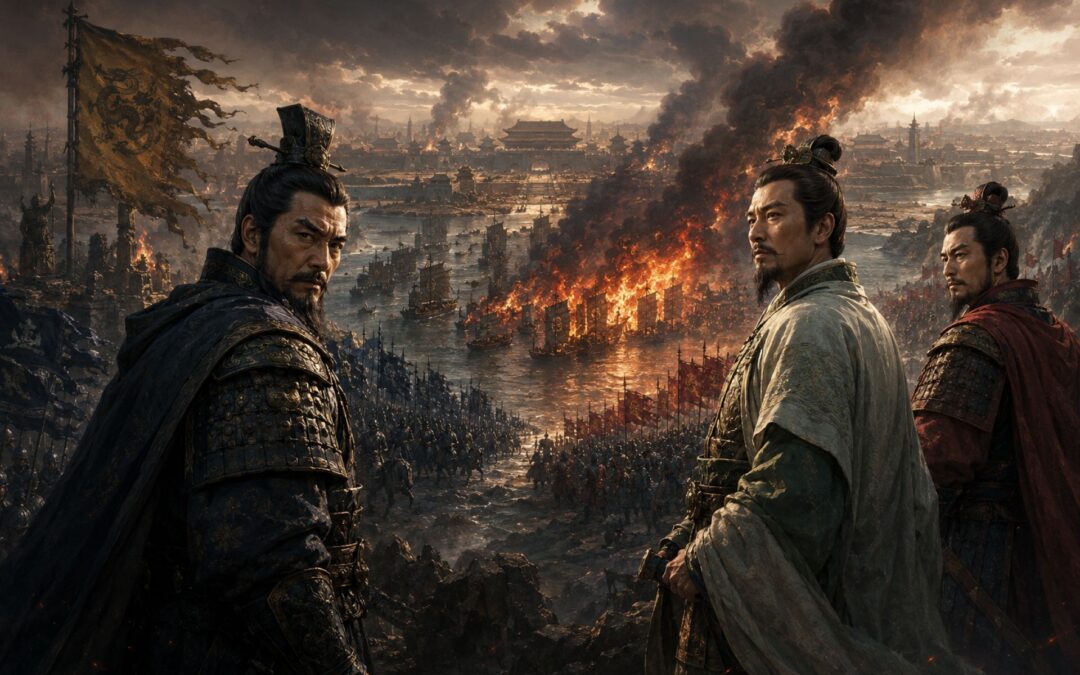
The warlords who crushed the rebellion realized that real power no longer belonged to the emperor in the capital. It belonged to the men with armies in the provinces. From there, China slid into a brutal contest for survival and supremacy. Dong Zhuo seized the emperor. Cao Cao built a state in the north. Liu Bei wandered, lost, regrouped, and survived. Sun Quan held the southeast. At the Battle of Red Cliffs, Cao Cao’s dream of quickly reunifying China went up in flames.
By 220, the Han dynasty was gone. In its place stood three rival regimes: Wei, Shu-Han, and Wu.
Yet even they were not the end of the story.
The Three Kingdoms period became legendary because it was not only a civil war. It was a political breakdown, a legitimacy crisis, a military stalemate, and a story about how empires collapse from the inside before anyone officially admits they are dead.
The Han Dynasty Looked Permanent Until It Didn’t
The Han dynasty was not a minor kingdom that happened to fall apart. It was one of the defining dynasties of Chinese history.
Founded in 202 BC after the short-lived Qin dynasty, the Han created a durable imperial system that shaped China’s government, culture, and identity for centuries. It expanded Chinese influence, developed administrative institutions, promoted Confucian political ideals, and helped open the trade networks later known as the Silk Roads. To many later generations, the Han became a model of imperial greatness.
That is what makes its collapse so important.
The Han did not fall because one unlucky emperor made one bad decision. It weakened through a pattern that appeared again and again in Chinese history: a dynasty began with energy and legitimacy, built order, expanded power, and then gradually became vulnerable to factionalism, corruption, court intrigue, military pressure, and social unrest.
Chinese political thought often explained this pattern through the idea of the Mandate of Heaven. A dynasty ruled because Heaven had granted it legitimacy. But if rulers became corrupt, disasters multiplied, and the people suffered, rebellion could be interpreted as a sign that Heaven had withdrawn its favor. The concept did not make rebellion easy, but it gave political language to collapse.
By the late Han, that language became dangerous.
The empire still looked impressive on paper. There was still an emperor. There was still a capital. There were still officials, rituals, taxes, commands, and laws.
But the machinery was wearing down.
Local elites grew stronger. Court politics became more poisonous. The imperial government struggled to respond to crises beyond the palace. On the frontiers, military pressure remained a constant concern. Inside the empire, floods, droughts, epidemics, and poverty made life harder for peasants who were already carrying the weight of taxation and labor obligations.
The Han still had prestige.
It no longer had enough control.
That gap between prestige and power is where the Three Kingdoms story begins.
The Court Became a Battlefield Before China Did
Before China became a battlefield of warlords, the Han court became a battlefield of factions.
A major weakness of the late Han system was the recurring problem of young emperors. When an emperor died and a child inherited the throne, real authority had to be exercised by someone else. That usually meant empress dowagers, imperial relatives, regents, senior officials, or palace insiders.
In theory, these people were supposed to protect the throne until the emperor could rule.
In practice, they fought to control him.
Two factions became especially important: the relatives of empresses and the eunuchs who served inside the palace. Eunuchs had direct access to the emperor and imperial household. Because they lived inside the palace world, they could become trusted attendants, messengers, advisers, and gatekeepers. Imperial relatives, meanwhile, often claimed authority through family connection to the ruling house.
The result was a court culture in which access mattered as much as office.
Who could speak to the emperor? Who controlled appointments? Who could block a rival? Who could influence a child ruler? Who could accuse someone of disloyalty before being accused first?
By the second century AD, these struggles had become deeply destructive. The Cambridge History of China’s account of the fall of Han emphasizes how factional conflict, court intrigue, and the weakness of imperial authority corroded the dynasty from within. The issue was not merely that individual officials were greedy or immoral. It was that the structure of power encouraged rival groups to capture the emperor rather than govern the empire.
This created a deadly imbalance.
While officials in the capital competed for influence, the empire’s real problems grew worse. Rural communities faced natural disasters, local exploitation, and heavy taxation. The government needed coordination, legitimacy, and practical relief.
Instead, the court became consumed by suspicion.
The more the palace factions fought, the less credible the dynasty looked. The less credible the dynasty looked, the easier it became for rebels and warlords to claim that the Han no longer deserved to rule.
The first great explosion came from below.
The Yellow Turban Rebellion Exposed the Empire’s Weakness
In 184 AD, the Yellow Turban Rebellion erupted across China.
It was not just another local disturbance. It was a massive uprising that revealed how badly the Han dynasty had lost touch with the suffering of ordinary people.
The rebellion was led by Zhang Jue, a religious healer and teacher associated with a Daoist-inspired movement known as the Way of Great Peace. His followers believed that the Han had lost the Mandate of Heaven and that a new age was coming. They wore yellow headscarves or turbans, a color associated with their vision of renewal, and rose against the imperial order.
The slogan traditionally linked to the movement captured the cosmic scale of its ambition: the blue heaven was dead, the yellow heaven would rise.
That was more than rebellion. It was replacement.
The World History Encyclopedia’s explanation of the Mandate of Heaven and the Yellow Turban Rebellion shows why the uprising was so politically dangerous. In Chinese imperial ideology, natural disasters, corruption, and mass suffering could be read as evidence that a dynasty had lost Heaven’s approval. The Yellow Turbans took that idea and turned it into a revolutionary movement.
Millions were drawn into the revolt or affected by the fighting. The Han court, weakened by factionalism and unprepared for a crisis of that scale, could not easily suppress the rebellion with central forces alone.
So it called on regional commanders and local military leaders.
That solved the immediate problem. The rebellion was crushed after devastating violence and enormous casualties. The Han dynasty survived.
But the survival was deceptive.
To defeat the rebels, the court had empowered the very men who would soon make the emperor irrelevant. Warlords and provincial commanders raised armies, controlled territory, built local power bases, and gained military prestige. Once they had done that, there was no simple way to force them back into obedient civilian life.
The Yellow Turban Rebellion did not single-handedly end the Han.
It exposed that the Han could no longer defend itself without giving away the power that made it an empire.
Warlords Saved the Han and Then Replaced It
The late Han state faced a paradox.
It needed military strongmen to survive. But every military strongman who helped save it made the central government weaker.
This is one of the most important points in the entire Three Kingdoms story. The warlords did not emerge after the Han collapsed. They emerged while the Han was trying not to collapse.
At first, these commanders could present themselves as loyal servants of the dynasty. They were suppressing rebels, restoring order, protecting provinces, and defending imperial authority. But once they controlled armies and territories, their loyalty became conditional. The emperor could issue commands, but those commands mattered only if powerful men chose to obey.
The empire was no longer a unified machine. It was becoming a map of armed regions.
Some commanders were ambitious from the beginning. Others were dragged into the logic of survival. In a world where rivals had armies, anyone without an army was vulnerable. Trust became dangerous. Alliances shifted quickly. A warlord who failed to expand could be swallowed by one who did.
This is why the Han collapse was so difficult to reverse.
Even if a court faction won in the capital, it could not magically restore control over the provinces. Even if a rebel army was defeated, the generals who defeated it remained. Even if everyone claimed to respect the emperor, they increasingly treated him as a symbol to possess, not a ruler to obey.
The dynasty’s name still carried legitimacy.
That made the emperor valuable.
Not because he could govern.
Because whoever controlled him could claim to govern in his name.
The first man to prove how powerful that arrangement could be was Dong Zhuo.
Dong Zhuo Turned the Emperor Into a Prize
The crisis in the capital reached a breaking point after the death of Emperor Ling in 189 AD.
His death triggered another succession struggle involving court eunuchs, imperial relatives, and military figures. He Jin, the brother of the empress dowager and a powerful general, wanted to eliminate the eunuch faction. The eunuchs struck first. They lured He Jin into the palace and killed him.
The response was catastrophic.
Yuan Shao and other forces attacked the palace and massacred the eunuchs. The capital descended into violence. The young emperor and his brother fled. Luoyang, the imperial center, became chaotic and vulnerable.
Into this chaos marched Dong Zhuo, a powerful frontier general from the northwest.
Dong Zhuo found the emperor, brought him under his control, entered the capital with his army, and effectively seized the Han government. He deposed the young emperor and replaced him with the emperor’s younger brother, who became Emperor Xian.
From that moment, the emperor was no longer even pretending to be independent.
Dong Zhuo ruled through intimidation. He killed opponents, ignored court norms, controlled appointments, and treated the imperial household as something he had captured. According to the OER Project’s account of the fall of the Han dynasty, the destruction of court order after He Jin’s assassination and Dong Zhuo’s seizure of power marked a decisive stage in the dynasty’s breakdown.
The symbolism mattered.
The emperor was supposed to stand above the political world as the Son of Heaven. Dong Zhuo made him look like a hostage. Once that happened, the remaining warlords could claim they were not rebelling against the Han. They were rescuing it from Dong Zhuo.
That claim gave them a shared cause.
Briefly.
The Anti-Dong Zhuo Coalition Failed Because Everyone Wanted Power
Dong Zhuo’s rule horrified other regional leaders. In response, a coalition of warlords formed against him, led nominally by Yuan Shao and including figures such as Cao Cao and Sun Jian.
On paper, the coalition had a noble mission: remove Dong Zhuo and restore proper imperial government.
In reality, it was an alliance of ambitious men who distrusted one another almost as much as they hated Dong Zhuo.
The coalition did put pressure on Dong Zhuo. Sun Jian’s forces scored important successes, and Dong Zhuo eventually abandoned Luoyang and moved the emperor west to Chang’an. Before leaving, his forces devastated the old capital, further damaging the symbolic heart of Han authority.
But the coalition did not become a new national government.
It stalled.
The warlords had different interests, different territories, different rivalries, and different ambitions. Once Dong Zhuo withdrew and the immediate campaign lost momentum, unity collapsed. The coalition members returned to their own regions and resumed the larger struggle for power.
Dong Zhuo himself was later assassinated in 192 by Lu Bu and court conspirators. Lu Bu, one of the most famous warriors of the era, had served Dong Zhuo as an adopted son and military asset before turning against him. Later literature would turn Lu Bu into a larger-than-life figure of strength and betrayal, but historically his role shows something colder: loyalty had become fragile because power had become personal.
Dong Zhuo’s death did not restore the Han.
It removed one tyrant from a system that had already broken.
The emperor remained a prize. The provinces remained militarized. The warlords remained armed. And the question was no longer whether the Han could return to its old strength.
The question was which warlord would inherit China.
Cao Cao Built the Strongest Warlord State in the North
Among the many contenders who emerged from the ruins of Han authority, Cao Cao became the most formidable.
He was not the strongest at the beginning. He did not inherit the largest domain. He faced rivals with older prestige, larger armies, and better family connections. But Cao Cao had a rare combination of military ability, political intelligence, administrative discipline, and ruthlessness.
He understood something crucial: legitimacy still mattered, even when the emperor had little real power.
In 196, Cao Cao took control of Emperor Xian and moved him to his own base at Xu. This allowed Cao Cao to issue commands in the emperor’s name. His enemies could portray him as a usurper, but Cao Cao could claim he was protecting the Han and restoring order.
This was not just propaganda. It was a political weapon.
As the historian Rafe de Crespigny explains in his study Man from the Margin: Cao Cao and the Three Kingdoms, Cao Cao’s strength came not only from battlefield success but from his ability to build a functioning regime amid collapse. He organized agricultural colonies, absorbed defeated groups, rebuilt military capacity, and created institutions that could support long campaigns.
Cao Cao also proved willing to be brutal. His campaigns could be devastating, and some episodes, including violence against civilian populations, left a dark mark on his record. This is part of why his later image became so contested. In some traditions, he appears as a villain. In others, he appears as a brilliant realist who understood what the times demanded.
His great northern rival was Yuan Shao, a powerful aristocrat with a strong base and impressive resources. The conflict between them culminated in the Battle of Guandu in 200 AD. Cao Cao was outnumbered, but he defeated Yuan Shao through superior strategy, discipline, and opportunism. That victory transformed the balance of power.
After Guandu, Cao Cao gradually consolidated northern China.
For a moment, it looked as if he might do what no one else had managed to do: end the civil war and reunify the empire under his control.
But China was not only the north.
To rule everything, Cao Cao would have to move south.
And there he met the two men who would stop him.
Liu Bei and Sun Quan Survived by Refusing to Disappear
Liu Bei and Sun Quan were very different kinds of leaders, but both mattered because they survived.
Liu Bei’s career was almost absurdly unstable. He lost territory, fled from stronger rivals, served under other warlords, changed alliances, and repeatedly seemed finished. Yet he kept reappearing. His power came partly from his personal reputation, partly from his claimed connection to the Han imperial family, and partly from his ability to attract loyal followers.
Later tradition would romanticize Liu Bei as the humane, legitimate, Confucian alternative to Cao Cao’s ruthless ambition. That image should be handled carefully. Liu Bei was a warlord too. He made hard choices, pursued power, and fought for territory. But his political identity mattered. By presenting himself as a defender of Han legitimacy, he offered a different moral claim from Cao Cao’s control of the emperor.
Sun Quan inherited a more stable regional base in the southeast. His father, Sun Jian, and older brother, Sun Ce, had laid the foundations of Sun family power. After Sun Ce’s assassination, Sun Quan took over and proved capable of holding together a difficult frontier regime.
His position was geographically important. The lower Yangtze region gave him a defensible base, river access, and room to develop a state outside Cao Cao’s northern heartland. Sun Quan did not need to conquer all of China immediately. He needed to survive long enough to make Cao Cao’s reunification impossible.
That gave Liu Bei and Sun Quan a shared interest.
Neither could defeat Cao Cao alone. Together, they had a chance to stop him.
Their alliance was not born from trust. It was born from necessity.
And necessity brought them to Red Cliffs.
Red Cliffs Stopped Cao Cao From Reunifying China
The Battle of Red Cliffs in 208 AD was the hinge of the Three Kingdoms story.
Before Red Cliffs, Cao Cao had momentum. He had consolidated the north, controlled the emperor, defeated major rivals, and advanced toward the south with a huge army. Liu Bei was on the run. Sun Quan faced pressure from advisers who feared resistance would be suicidal.
The numbers are debated, and later accounts likely exaggerated the size of Cao Cao’s forces. But the strategic imbalance was real. Cao Cao had the resources of the north behind him. The southern alliance had to fight defensively, using geography, timing, and Cao Cao’s weaknesses against him.
Those weaknesses were serious.
Cao Cao’s army had marched far from its northern base. His soldiers were tired. Disease spread through the ranks. Many of his men were not comfortable fighting on rivers and ships. The Yangtze was not just a line on a map; it was a military environment that favored those who understood southern waters.
The allied forces of Sun Quan and Liu Bei exploited that environment.
The most famous story of Red Cliffs involves a fire attack. According to traditional accounts, a Sun commander feigned defection and sent ships packed with flammable material toward Cao Cao’s fleet. Once close, the ships were set ablaze, spreading fire through Cao Cao’s naval camp. Whether every detail of this story happened exactly as later tradition tells it is debated, but the broad result is clear: Cao Cao’s southern campaign failed.
He retreated north.
He would never again have such a strong chance to conquer the south.
That is why Red Cliffs matters so much. It did not create the Three Kingdoms immediately, but it made them likely. Without Cao Cao’s defeat, China may have been reunified under his regime or his successors much sooner. With his defeat, the south remained outside his control, and the political map hardened into rival zones.
Modern readers should also remember that Red Cliffs is both history and legend. The battle’s later fame owes much to literary and cultural retellings, especially the Romance of the Three Kingdoms tradition. As The China Project notes in its discussion of Red Cliffs and the blurring of fact and fiction, the event became one of the great examples of how Chinese historical memory mixes record, strategy, drama, and myth.
But even stripped of legend, Red Cliffs remains decisive.
It stopped the strongest warlord of the age from ending the civil war on his terms.
Three States Emerged From One Broken Empire
After Red Cliffs, China did not immediately become the Three Kingdoms in a formal sense. The Han dynasty still existed, at least officially. Emperor Xian remained on the throne. Cao Cao continued to rule in the emperor’s name. Liu Bei and Sun Quan continued building their own positions.
But the direction was clear.
Cao Cao controlled the north. Sun Quan held the southeast. Liu Bei eventually established himself in the southwest, especially after taking Yi Province, roughly corresponding to the Sichuan basin. These regions became the foundations of the three states that followed.
In 220, Cao Cao died. His son Cao Pi inherited his position and took the final step his father had avoided. He forced Emperor Xian to abdicate and proclaimed the state of Wei.
The Han dynasty was officially over.
Liu Bei responded by declaring himself emperor of Shu-Han, presenting his regime as the legitimate continuation of the Han line. Sun Quan later declared himself emperor of Wu.
This is why the term “Three Kingdoms” can be slightly misleading. These were not kingdoms in the casual fairy-tale sense. They were rival imperial regimes, each claiming its own form of legitimacy. Wei claimed succession through control of the north and the abdication of the Han emperor. Shu-Han claimed dynastic continuity through Liu Bei’s asserted Han lineage. Wu claimed independent imperial authority in the southeast.
Each state had its own court, armies, bureaucracy, ambitions, and historical memory.
The empire had not simply shattered into chaos anymore.
It had hardened into three competing orders.
The Three Kingdoms Became a Stalemate
Once Wei, Shu-Han, and Wu had formed, the story became less about sudden collapse and more about exhausted balance.
Wei was the strongest of the three. It controlled the north, had the largest population base, and inherited much of Cao Cao’s administrative and military structure. If any state seemed positioned to reunify China, it was Wei.
But strength did not automatically translate into conquest.
China’s geography made the southern and western states difficult to absorb. River systems, mountains, supply lines, fortified passes, and regional defenses all mattered. Shu-Han, based in the Sichuan basin, was protected by difficult terrain. Wu, built around the lower Yangtze and southeastern regions, was protected by rivers and naval experience.
Shu-Han and Wu also understood that Wei was the main threat. Their alliance was unstable and sometimes hostile, but the logic of survival remained. Neither wanted Wei to dominate the whole realm.
The result was decades of campaigns that often produced movement, drama, and loss, but not final victory.
This is where popular imagination sometimes differs from political reality. The Three Kingdoms period is famous for brilliant strategists, daring generals, and heroic episodes. But from a state-level view, much of the era was a grinding stalemate. The great leaders aged and died. Their successors inherited the ambitions but not always the same ability. Court politics returned. Corruption grew. Military campaigns consumed resources without resolving the larger balance.
The same forces that had weakened the Han began appearing inside the rival states.
In Shu-Han, factionalism and court weakness undermined resilience. In Wu, succession problems and poor later leadership damaged the state. In Wei, the Cao family’s own authority weakened as another powerful clan rose inside the regime.
The Three Kingdoms had been born from the collapse of imperial central authority.
Eventually, they became vulnerable to the same disease.
The Sima Clan Won What Cao Cao Could Not
The final winner of the Three Kingdoms struggle was not Cao Cao, Liu Bei, or Sun Quan.
It was the Sima clan.
The Sima family rose within Wei, gradually taking control of its government in much the same way that earlier powerful factions had taken control of weak emperors. The pattern was familiar: a ruling house remained in place formally, but real authority moved into the hands of ministers and military power brokers.
Sima Yi, one of Wei’s most important strategists and officials, laid the foundation. His descendants expanded the family’s control. By the mid-third century, the Cao rulers of Wei had become increasingly dependent on, and then dominated by, the Sima clan.
Meanwhile, Shu-Han and Wu had weakened.
Shu-Han fell first. In 263, Wei forces invaded, and Shu-Han collapsed. It was a major step toward reunification, but the conquest still occurred under the Wei name, even though Sima power stood behind the regime.
In 266, Sima Yan forced the Wei ruler to abdicate and founded the Jin dynasty.
The pattern repeated: the family that controlled the state replaced the dynasty it claimed to serve.
Wu survived for a while longer in the southeast, but its position deteriorated. In 279, Jin launched a major campaign against Wu. By 280, Wu had fallen, and China was reunified under Jin.
This ending is deeply ironic.
Cao Cao had spent his life building the northern power that made reunification possible. Cao Pi had ended the Han and founded Wei. Wei had the strongest claim to eventual victory. Yet the dynasty that actually unified China was not Wei, but Jin, founded by the Sima clan that displaced Wei from within.
The Three Kingdoms began with men using the Han emperor as a political instrument.
It ended with the same logic inside Wei itself.
Power first hid behind legitimacy.
Then it replaced it.
Why the Three Kingdoms Still Matters
The Three Kingdoms period still matters because it is more than a dramatic chapter of Chinese history.
It shows how a great empire can collapse before its official institutions disappear. The Han still had an emperor, a court, rituals, and a name long after real power had slipped away. The dynasty’s authority did not vanish in one moment. It hollowed out, piece by piece, until warlords could claim to defend it while carving it apart.
It also shows why legitimacy matters in politics. Cao Cao did not ignore the emperor. He controlled him. Liu Bei did not simply call himself another warlord. He claimed to continue the Han. Sun Quan did not merely defend a region. He eventually declared imperial authority. Even in civil war, power needed a story.
That is one reason the Three Kingdoms became so legendary. It was not only a fight over land. It was a fight over who had the right to rule China.
The period also reveals the recurring Chinese tension between division and reunification. The Han collapsed. The realm split. Rival states fought for decades. But the idea of unity never disappeared. Every major contender wanted not merely survival, but recognition as the rightful ruler of the whole.
In the end, the Three Kingdoms did not produce a heroic reunifier from the famous trio of Cao Cao, Liu Bei, and Sun Quan. It produced exhaustion, institutional decay, and an opening for a new dynasty.
The Jin reunified China in 280.
But the deeper pattern continued: dynasties rose, claimed Heaven’s favor, built order, weakened from within, and faced the possibility that someone else would claim the mandate next.
That is why the Three Kingdoms remains so powerful. It is a story of ambition and strategy, but also of political fragility. It reminds us that empires do not fall only when enemies breach the gates.
Sometimes they fall when everyone inside the palace is fighting to control the throne, while the people outside have already stopped believing in it.
Last Updated on July 9, 2026 by Aseem Gupta