
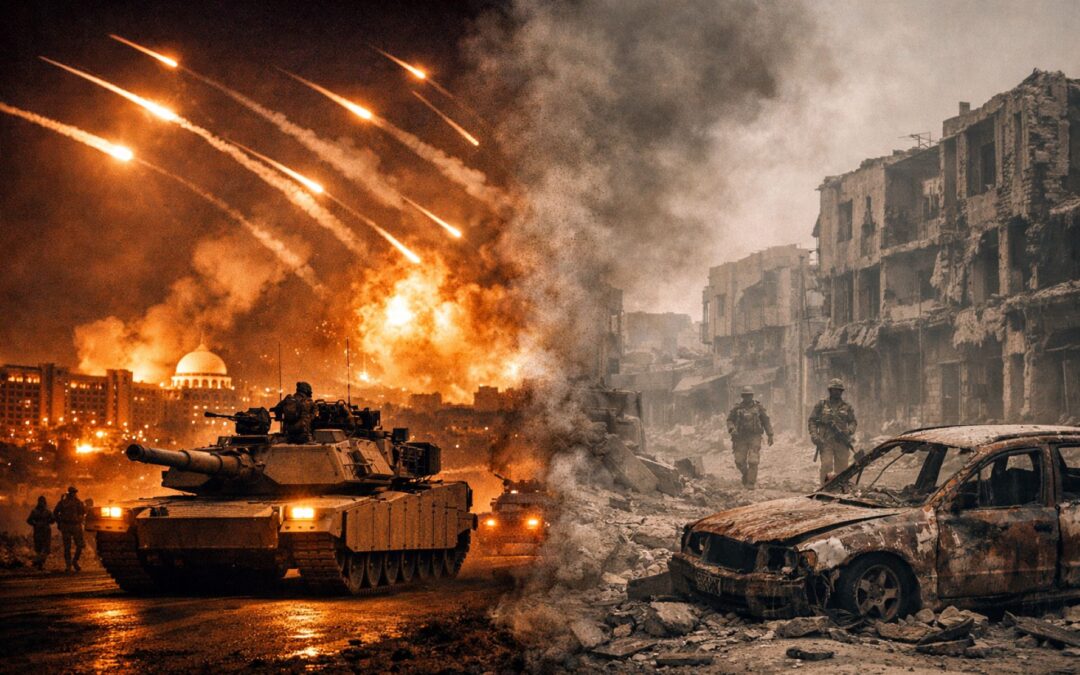
The Iraq War did not begin in Baghdad. It began in fear, in anger, and in the aftermath of a single morning that reshaped global politics overnight. In the shadow of September 11, 2001, the United States abandoned the cautious logic of containment and stepped into a far more aggressive doctrine—one built on preemption, certainty, and the belief that threats had to be eliminated before they could fully materialize.
What followed was one of the most consequential decisions in modern history.
At first glance, the war seemed almost effortless. A rapid invasion. A dictator toppled in weeks. Images of a statue collapsing in Baghdad broadcast across the world. For a brief moment, it looked like a clean, decisive victory—proof of unmatched military dominance and strategic clarity.
But wars are rarely defined by how they begin.
What came next was not a continuation of that victory, but a slow unraveling. A series of decisions—some rushed, others deeply flawed—transformed a controlled military campaign into a prolonged, chaotic conflict. Insurgencies emerged where none were expected. Alliances shifted. A nation fractured along internal fault lines that had long been suppressed. And gradually, the purpose of the war itself became harder to justify, even to those who had once supported it.
The Iraq War forces a difficult question: how does a war that is won so quickly become one that cannot be finished?
To answer that, you have to look beyond the battlefield. You have to examine the assumptions that led to the invasion, the choices made in its aftermath, and the consequences that no one fully anticipated—but that reshaped an entire region.
Because this was never just a story about removing a dictator. It was a case study in how power, intelligence, and strategy can collide—and how even the most dominant force in the world can find itself trapped in a war it doesn’t know how to end.
The Catalyst: How 9/11 Reshaped American Foreign Policy
On September 11, 2001, the United States experienced more than a terrorist attack—it experienced a rupture in its strategic worldview.
For decades, American foreign policy had been shaped by deterrence. The logic was simple: maintain overwhelming power, contain adversaries, and respond decisively when attacked. But 9/11 exposed a vulnerability that deterrence couldn’t address. Nineteen hijackers, armed with little more than box cutters and coordination, had inflicted catastrophic damage on the world’s most powerful nation. Nearly 3,000 people were killed in a matter of hours. And more importantly, the attack demonstrated that threats no longer needed to be state-based, visible, or predictable.
The old rules no longer applied.
In the immediate aftermath, the United States entered a state of strategic urgency. President George W. Bush made it clear that the response would not be limited to retaliation—it would be transformative. The doctrine that emerged from this moment would come to define the next decade: preemptive action against perceived threats, even if those threats had not yet fully materialized.
Afghanistan was the first and obvious target. The Taliban regime had provided safe haven to Al-Qaeda, the group responsible for the attacks. Within weeks, the United States launched a military campaign to dismantle both. It was swift, focused, and broadly supported—both domestically and internationally.
But while Afghanistan was the immediate battlefield, it was not the only one being considered.
Inside the Bush administration, a broader strategic shift was already taking shape. The question was no longer just how to respond to 9/11, but how to prevent the next one. And in that search for potential threats, attention began to drift toward regimes that were seen as hostile, unpredictable, and potentially dangerous in a post-9/11 world.
Iraq stood out.
Saddam Hussein had long been viewed as a destabilizing force in the Middle East. His history—invading Kuwait, defying international sanctions, and maintaining an authoritarian grip on power—made him a familiar adversary. But familiarity alone was not enough to justify war. What changed after 9/11 was the perception of risk.
The fear was no longer just what Saddam had done. It was what he might do—especially if he possessed weapons capable of mass destruction, or worse, if those weapons could find their way into the hands of non-state actors like terrorist organizations.
In a pre-9/11 world, that possibility might have been monitored, contained, or negotiated. In a post-9/11 world, it was seen as unacceptable.
This shift—from managing threats to eliminating them—set the stage for everything that followed. Iraq was no longer just a regional problem. It was reframed as a potential trigger for the next catastrophe.
And once that framing took hold, the path toward war became far easier to justify.
Why Iraq? The Case Against Saddam Hussein
The decision to invade Iraq was not made in a vacuum. It was built on a narrative—one that combined Saddam Hussein’s past behavior with a set of claims about present and future threats. On the surface, the case seemed compelling. But like many arguments constructed in moments of urgency, it relied as much on interpretation as it did on verified fact.
Saddam Hussein was not an unknown quantity. He had ruled Iraq with an iron grip for decades, using repression, surveillance, and violence to maintain control. His regime had carried out chemical attacks against Kurdish civilians, resulting in thousands of deaths. In 1990, he invaded Kuwait, triggering the Gulf War and establishing himself as a direct adversary of the United States and its allies.
In the years that followed, Iraq was subjected to strict international sanctions, no-fly zones, and weapons inspections. Saddam remained in power, but his regime was contained—economically weakened, militarily constrained, and constantly monitored.
That containment, however, began to look insufficient after 9/11.
The Bush administration’s case for war rested on three central claims.
First, that Saddam Hussein possessed weapons of mass destruction—chemical, biological, and potentially nuclear. The concern was not theoretical. Saddam had previously used chemical weapons, and intelligence reports suggested that he had continued to develop or conceal such capabilities despite international oversight.
Second, that Saddam had links to terrorist organizations, including Al-Qaeda. The argument here was not that Iraq had orchestrated 9/11, but that a regime hostile to the United States could collaborate with extremist groups. In a post-9/11 environment, even a small probability of such cooperation was treated as a major strategic risk.
Third, Saddam represented a broader threat to regional and global stability. His regime was framed not just as a localized problem, but as part of a larger pattern of hostile states that could challenge international order. This framing was formalized in 2002 when President Bush labeled Iraq part of an “Axis of Evil,” alongside Iran and North Korea.
Individually, each of these arguments carried weight. Together, they created a sense of urgency.
But the strength of the case depended heavily on one factor: the accuracy of the intelligence behind it.
At the time, much of the information presented to policymakers and the public suggested that Iraq was actively pursuing or hiding prohibited weapons. Satellite imagery, defectors’ testimonies, and intelligence assessments were used to build a picture of an ongoing threat. The conclusion seemed clear—waiting was riskier than acting.
What was less clear, and would only become evident later, was how much of that intelligence was incomplete, misinterpreted, or simply wrong.
And yet, in the atmosphere of fear that followed 9/11, uncertainty did not slow momentum. It accelerated it.
Because once a threat is framed as imminent—even if it isn’t—the space for hesitation disappears.
Selling the War: Intelligence, Politics, and Public Support
Making the case for war required more than internal conviction. It needed to be sold—to Congress, to allies, and to the public. And in the months leading up to the invasion, that effort became a coordinated campaign built on urgency, authority, and carefully presented intelligence.
At the center of this push were some of the most influential figures in the Bush administration. Vice President Dick Cheney, Secretary of Defense Donald Rumsfeld, and Deputy Secretary Paul Wolfowitz were among the strongest advocates for removing Saddam Hussein. Their argument was consistent: the risk of inaction was too great. If Iraq possessed weapons of mass destruction, waiting could lead to consequences far worse than war itself.
But political momentum alone wasn’t enough. The case needed credibility on the global stage.
That responsibility fell largely to Secretary of State Colin Powell.
In February 2003, Powell addressed the United Nations Security Council in what would become one of the most consequential presentations in modern diplomatic history. He presented satellite images of suspected weapons facilities, intercepted communications, and intelligence reports suggesting that Iraq was actively concealing prohibited programs. At one point, he held up a small vial as a visual representation of how little material would be needed to cause massive harm.
The message was clear: Iraq was hiding dangerous capabilities, and the world could not afford to ignore it.
For many, Powell’s credibility made the argument persuasive. He was widely respected, both domestically and internationally, and his presentation carried a weight that political rhetoric alone could not. In the United States, public support for the war strengthened. The idea that action was necessary—and justified—began to take hold.
But outside the United States, skepticism remained.
Countries like France and Germany urged caution, arguing that United Nations weapons inspectors should be given more time to complete their work. Inspectors on the ground had not found conclusive evidence of active weapons programs, and many believed that containment, not invasion, was still a viable strategy.
At the same time, public opposition to the war grew on an unprecedented scale. In February 2003, millions of people across hundreds of cities participated in coordinated anti-war protests—the largest such demonstrations in history. It was a rare moment of global consensus, not in support of action, but in opposition to it.
Despite this, the trajectory toward war did not change.
For the Bush administration, the decision had moved beyond debate. Intelligence—however flawed—had been interpreted as confirmation. The political case had been made. And the window for preventive action, as they saw it, was closing.
In March 2003, President Bush issued a final ultimatum: Saddam Hussein had 48 hours to leave Iraq or face military intervention.
He did not leave.
And with that, the argument ended—and the war began.
Shock and Awe: The Invasion of Iraq
On March 20, 2003, the United States launched Operation Iraqi Freedom. What followed was not a slow buildup or a prolonged opening phase—it was an overwhelming display of force designed to dismantle an entire regime in a matter of weeks.
The strategy was called “shock and awe.”
Its premise was straightforward: apply such intense and rapid military pressure that the enemy collapses psychologically as much as physically. Instead of grinding down Iraqi forces over time, the objective was to paralyze command structures, disrupt communication, and create the perception that resistance was futile from the very beginning.
Baghdad became the focal point of this approach.
In the opening days, precision-guided munitions and cruise missiles targeted government buildings, military installations, and infrastructure tied to Saddam Hussein’s control. The night sky over the العاصمة lit up with sustained bombardment, signaling not just the start of a war, but the scale at which it would be fought.
On the ground, coalition forces moved with remarkable speed.
Approximately 177,000 American and British troops advanced rapidly from Kuwait, pushing north through southern Iraq toward the capital. Iraqi resistance was inconsistent—some units engaged, others disintegrated, and many simply disappeared. Years of sanctions and isolation had weakened the Iraqi military, leaving it ill-prepared to confront a technologically superior force.
One of the most defining moments of the invasion came with the “thunder runs.”
Armored columns from the U.S. 3rd Infantry Division drove directly into Baghdad, penetrating deep into the city to demonstrate that the capital could not be defended. It was a calculated risk, but it worked. The psychological impact was immediate. The regime’s control began to unravel.
By early April, Baghdad had effectively fallen.
In a scene that would come to symbolize the invasion, a large statue of Saddam Hussein was pulled down in the city center, assisted by American forces and surrounded by Iraqi civilians. The image was broadcast globally, reinforcing the perception that the war had been not only swift, but decisive.
From a purely military standpoint, the campaign was a success.
Within three weeks, the Iraqi government had collapsed. Saddam Hussein was in hiding. Organized resistance had largely ceased. Compared to the expectations of a prolonged conflict, the speed of the victory seemed to validate both the strategy and the decision to invade.
That perception was cemented in May 2003.
President George W. Bush landed aboard the aircraft carrier USS Abraham Lincoln and delivered a speech beneath a banner that read “Mission Accomplished,” declaring that major combat operations in Iraq had ended.
At that moment, it appeared that the hardest part of the war was over.
In reality, it had just begun.
The Fatal Mistake: Winning the War but Losing the Peace
The invasion of Iraq was executed with precision. The aftermath was not.
Within weeks of Baghdad’s fall, the United States found itself in control of a country it had not fully planned to govern. The assumption had been that removing Saddam Hussein would be the hardest part—that once the regime collapsed, a stable transition would follow. Instead, the absence of a coherent post-war strategy created a vacuum that quickly filled with chaos.
Looting spread across major cities. Government buildings were stripped bare. Infrastructure began to fail. And with no functioning authority in place, basic order started to collapse.
Responsibility for rebuilding Iraq fell to the Coalition Provisional Authority (CPA), led by Paul Bremer. His role was to oversee the transition from dictatorship to a new political system. It was a critical moment—one that would shape everything that followed.
Within his first weeks in Iraq, Bremer issued two orders that would prove deeply consequential.
The first was de-Ba’athification.
This policy barred members of Saddam Hussein’s Ba’ath Party from holding positions in the new government. On paper, it was intended to remove loyalists of the old regime from power. In practice, it removed a large portion of Iraq’s administrative backbone. The Ba’ath Party had been woven into nearly every level of governance. Teachers, engineers, civil servants—many had joined not out of ideology, but necessity.
Overnight, tens of thousands of experienced professionals were excluded from public life.
The second decision was even more destabilizing: the dissolution of the Iraqi military.
Hundreds of thousands of soldiers were dismissed, stripped of income, status, and structure. Many returned home armed, trained, and uncertain about their future. There was no clear plan for reintegration, no immediate alternative employment, and no framework to absorb them into the new Iraq.
The combined effect of these decisions was profound.
A government without administrators. A country without a security force. And a growing population of unemployed, disillusioned men with military experience.
The assumption had been that removing the old system would make space for a new one to emerge. Instead, it dismantled the only structures that had been holding the country together—however imperfectly.
What followed was not a transition. It was fragmentation.
Power shifted from institutions to individuals, from centralized authority to local and often competing groups. In many areas, the absence of order became more dangerous than the presence of the regime that had just been removed.
And in that environment, resistance began to take shape.
Not as a single organized movement, but as a collection of grievances—former soldiers, displaced officials, ideological opponents, and opportunistic actors—all reacting to the same reality: a foreign military presence in a country that no longer had the means to govern itself.
The war had been won.
But the peace had not just been mishandled—it had been fundamentally misunderstood.
The Rise of the Insurgency
The collapse of Saddam Hussein’s regime did not end the conflict. It changed its nature.
What had begun as a conventional war between armies quickly transformed into an asymmetric struggle—one without clear frontlines, defined enemies, or predictable patterns. The United States was no longer fighting a government. It was confronting a growing and increasingly complex insurgency.
At first, the resistance appeared fragmented.
Former members of the Iraqi military, Ba’ath Party loyalists, and nationalist groups began organizing attacks against coalition forces. Their motivations varied—some were driven by ideology, others by anger, humiliation, or the sudden loss of status and livelihood. But they shared a common objective: to force the United States out of Iraq.
Over time, these scattered efforts began to coalesce.
Insurgent tactics evolved rapidly. Instead of direct confrontation, they relied on methods designed to exploit vulnerability. Roadside bombs—improvised explosive devices, or IEDs—became the defining weapon of the conflict. They were inexpensive, easy to conceal, and devastatingly effective. A routine patrol could turn deadly in seconds, with no warning and no visible enemy.
The battlefield had become unpredictable.
Alongside local insurgents, foreign fighters began entering Iraq, drawn by the opportunity to engage U.S. forces. Among them was Abu Musab al-Zarqawi, a Jordanian militant who would soon become one of the most influential and dangerous figures in the conflict.
Zarqawi did not just fight a war—he reshaped it.
As the leader of Al-Qaeda in Iraq, he introduced a level of brutality designed not only to inflict damage, but to provoke chaos. Suicide bombings, kidnappings, and public executions became tools of both violence and propaganda. His actions were deliberately extreme, intended to destabilize the country and draw attention from across the world.
The insurgency was no longer just local. It had become part of a broader ideological conflict.
By 2003 and into 2004, attacks increased in frequency and coordination. Military convoys were targeted. Supply routes became dangerous. Urban centers turned into contested spaces where control could shift block by block.
Even organizations that had initially operated with some degree of neutrality were no longer safe.
In August 2003, a truck bomb struck the United Nations headquarters in Baghdad, killing 22 people, including the UN’s top envoy in Iraq. The attack sent a clear signal: the conflict would not be limited to military targets. Anyone involved in rebuilding or stabilizing the country could become a target.
This escalation had a compounding effect.
As violence increased, so did mistrust. As mistrust grew, cooperation declined. And without cooperation, efforts to restore stability became increasingly difficult.
The United States had entered Iraq expecting to remove a regime and oversee a transition. Instead, it found itself in the middle of an expanding insurgency—one that was adapting faster than the strategies designed to contain it.
And as the insurgency grew stronger, the line between war and disorder began to blur.
Abu Ghraib and the Collapse of Moral Authority
Wars are fought on multiple fronts. There is the physical battlefield—territory, strategy, force. And then there is the moral one—legitimacy, perception, and the ability to claim the higher ground.
In Iraq, that second front suffered a severe and lasting blow in 2004.
In April of that year, photographs began to circulate showing American soldiers abusing detainees at Abu Ghraib prison. The images were stark and disturbing—prisoners humiliated, threatened, and subjected to treatment that violated both military protocol and international law.
The reaction was immediate.
What had previously been a complex and contested war was suddenly distilled into something far simpler in the eyes of many observers. The images became a symbol—not just of misconduct by individuals, but of a broader failure in oversight, discipline, and accountability.
For Iraqis, the impact was particularly severe.
The United States had entered the country presenting itself as a force for liberation and stability. Abu Ghraib undermined that narrative. It reinforced suspicions, intensified resentment, and made it easier for insurgent groups to frame the American presence as one of occupation rather than support.
In conflicts like this, perception is not secondary—it is central.
Insurgent groups quickly recognized the value of the scandal. The images were used as recruitment tools, circulated to demonstrate hypocrisy and to justify continued resistance. What had been a fragmented insurgency gained a unifying narrative: that the occupying force could not be trusted.
Internationally, the consequences were just as damaging.
Allies faced increased pressure at home. Critics of the war found their arguments strengthened. And for many who had remained undecided, the scandal shifted the balance. The war was no longer just controversial—it was morally compromised.
Within the United States, investigations were launched, and several individuals were held accountable. But the broader damage could not be easily contained. Trust, once lost at that scale, is difficult to restore.
Abu Ghraib did not change the military balance of the war.
But it altered something just as important—the perception of why the war was being fought, and whether it could still be justified.
And in a conflict already struggling with legitimacy, that loss of moral authority made an already difficult situation significantly harder to manage.
Fallujah: Urban Warfare at Its Brutal Peak
If the insurgency defined the new phase of the war, Fallujah became its most intense expression.
Located west of Baghdad, the city quickly emerged as a stronghold for insurgent activity. It was densely populated, strategically positioned, and increasingly resistant to coalition control. But it wasn’t just geography that made Fallujah significant—it was symbolism. By 2004, the city had become a focal point of resistance, a place where authority was contested openly and violently.
The turning point came in March 2004.
Four American private military contractors were ambushed, killed, and their bodies publicly desecrated. The images circulated rapidly, provoking outrage in the United States and placing immense pressure on military leadership to respond decisively.
The result was the first battle of Fallujah.
U.S. forces moved into the city with the objective of dismantling insurgent networks. But the operation quickly encountered complications. Urban warfare is inherently complex—narrow streets, dense civilian populations, and limited visibility reduce the advantages of conventional military power. As the fighting intensified, civilian casualties rose, and political pressure mounted. Eventually, the operation was halted before its objectives were fully achieved.
In an attempt to stabilize the situation, control of the city was handed over to a locally formed Iraqi force known as the Fallujah Brigade.
It was a short-lived solution.
The brigade lacked cohesion, authority, and long-term viability. Within months, it dissolved, and many of its members either abandoned their posts or joined the insurgency. Fallujah, instead of stabilizing, became even more entrenched as a center of resistance.
By late 2004, the situation had reached a point where a second, more decisive operation was considered unavoidable.
In November, U.S. and coalition forces launched Operation Phantom Fury—the second battle of Fallujah.
This time, the approach was different.
Civilians were encouraged to leave the city in advance, reducing the risk of mass casualties. What remained was a heavily fortified urban battlefield. Insurgents had prepared extensively—booby traps rigged into buildings, sniper positions established across rooftops, and defensive networks embedded throughout the city.
The fighting was methodical and relentless.
Progress was measured not in miles, but in blocks. Soldiers moved house to house, often breaching walls rather than using doors to avoid traps. Every structure was a potential threat. Every street required clearing and securing before advancing further.
The cost was significant.
American forces suffered substantial casualties, and large portions of the city were heavily damaged or destroyed. Insurgent forces were dealt a major blow, but not eliminated. Many fighters dispersed, relocating to other areas rather than being fully neutralized.
And that was the underlying pattern.
Fallujah demonstrated that even the most intense and concentrated military operations could not fully resolve the conflict. Tactical victories did not translate into strategic closure. Clearing one city did not end the insurgency—it shifted it.
In many ways, Fallujah marked the peak of conventional urban combat in the Iraq War.
But it also underscored a deeper reality: this was no longer a war that could be won by controlling territory alone.
Civil War: When Iraq Turned on Itself
By 2005, the Iraq War had evolved into something far more dangerous than an insurgency. It had become a conflict within a conflict.
What had initially been framed as a struggle between coalition forces and insurgents began to fracture along internal lines. Iraq was not a uniform society—it was a complex mosaic of identities, shaped by history, religion, and power. Under Saddam Hussein, those divisions had been suppressed through force. With his regime gone, they resurfaced rapidly—and violently.
At the center of this fragmentation were three primary groups.
The Shia majority, long marginalized under Saddam’s Sunni-led government, now found themselves in a position to assert political power. The Sunni minority, which had previously held influence, faced a sudden and destabilizing loss of status. In the north, Kurdish groups maintained a degree of autonomy, largely separate from the escalating tensions elsewhere.
This imbalance created a volatile environment.
What had been political differences quickly hardened into sectarian identities. Trust eroded. Communities began to view each other not as fellow citizens, but as rivals—or threats.
Into this environment stepped Abu Musab al-Zarqawi.
His strategy was not just to fight coalition forces, but to ignite a broader sectarian conflict. By targeting Shia civilians and religious sites, he aimed to provoke retaliation, escalate tensions, and push Iraq toward full-scale civil war.
In 2006, that strategy reached a critical point.
A bombing destroyed the Al-Askari mosque in Samarra, one of the most important Shia religious sites in the country. The attack was not just an act of violence—it was a trigger. Within days, retaliatory attacks began to spread. Militias mobilized. Neighborhoods became battlegrounds.
The conflict intensified rapidly.
Death squads emerged, carrying out targeted killings based on sectarian identity. Civilians were abducted, executed, and left in public spaces as warnings. Entire neighborhoods in Baghdad and other cities were effectively segregated through violence. In some areas, populations shifted almost overnight as families fled to avoid persecution.
The scale of the violence was staggering.
By 2006, tens of thousands of Iraqi civilians were being killed each year. The capital itself became one of the most dangerous cities in the world. And in the middle of it all were American forces—attempting to stabilize a country that was now fighting itself as much as it was resisting external presence.
This was the scenario few had anticipated.
The initial objective had been to remove a regime and establish a new political order. Instead, the removal of centralized authority had exposed underlying tensions that quickly escalated beyond control.
Even the death of Zarqawi in 2006, while symbolically significant, did little to halt the momentum of the conflict. The structures he had helped destabilize were already in motion.
What emerged was not just instability, but fragmentation at a national scale.
Iraq was no longer a single battlefield.
It was multiple, overlapping conflicts—sectarian, political, and insurgent—all unfolding at once.
The Turning Point: The Surge and a New Strategy
By the end of 2006, the Iraq War had reached a breaking point.
Violence was spiraling. Civilian deaths were mounting at an alarming rate. Baghdad had become a patchwork of sectarian enclaves, divided by fear and enforced by militias. And in the United States, public support for the war was collapsing under the weight of rising casualties and the growing realization that the original justification—weapons of mass destruction—had been fundamentally flawed.
The strategy in place was not working.
Faced with this reality, the Bush administration had three options: withdraw and risk total collapse, continue with the same approach and hope for gradual improvement, or attempt a fundamental shift in how the war was being fought.
In January 2007, President George W. Bush chose the third option.
He announced what would become known as “the surge”—the deployment of more than 20,000 additional American troops into Iraq, with a primary focus on securing Baghdad and its surrounding regions. But the increase in troop numbers was only part of the change. The more significant shift was strategic.
At the center of this new approach was General David Petraeus.
Unlike previous commanders, Petraeus brought with him a framework that challenged the existing model of engagement. His approach was rooted in counterinsurgency doctrine—a concept that prioritized protecting civilian populations, building local trust, and addressing the underlying conditions that allowed insurgencies to thrive.
The difference was immediate and visible.
Instead of operating primarily from large, heavily fortified bases, American troops were moved into smaller outposts embedded within Iraqi neighborhoods. The goal was not just to hunt insurgents, but to maintain a continuous presence—one that could provide security, gather intelligence, and establish relationships with local communities.
This shift was often summarized in three phases: clear, hold, build.
First, clear areas of insurgent presence. Then, hold those areas to prevent their return. And finally, build—restore services, support local governance, and create conditions for long-term stability.
It was a more comprehensive strategy.
But it was also riskier.
Embedding troops within urban environments increased exposure. The distance between soldiers and the conflict narrowed. As a result, casualties initially rose. In fact, 2007 became one of the deadliest years for American forces during the entire war.
The cost of proximity was immediate.
But over time, the effects began to emerge.
With a sustained presence in neighborhoods, patterns of violence became easier to track. Intelligence improved. Local cooperation, while limited at first, began to increase in certain areas. And most importantly, the ability of insurgent groups to operate freely started to decline.
The surge did not eliminate violence overnight.
But it altered the trajectory.
What had been a steadily deteriorating situation began, slowly and unevenly, to stabilize. The war did not end—but for the first time in years, it appeared that the direction of the conflict might be shifting.
And yet, the success of the surge was not solely the result of increased troops or refined strategy.
It was also shaped by a development that few had anticipated—and that would prove just as decisive as any military operation.
The Anbar Awakening: When Enemies Became Allies
One of the most decisive shifts in the Iraq War did not come from Washington. It came from within Iraq itself—specifically, from a group that had once been at the heart of the insurgency.
Anbar province had long been one of the most volatile regions in the country. Predominantly Sunni, it was a stronghold of resistance against American forces. Insurgent activity was widespread, and for years, the area had been considered nearly unmanageable.
But by late 2006, something began to change.
The very groups that had been fighting the United States started turning against a new adversary: Al-Qaeda in Iraq.
Under the leadership of Abu Musab al-Zarqawi and his successors, Al-Qaeda had imposed an increasingly brutal form of control over local communities. Their tactics—public executions, intimidation, and rigid enforcement of their ideology—began to alienate the very population they depended on for support.
Tribal leaders, in particular, reached a breaking point.
For them, the conflict was no longer just about opposing foreign forces. It had become about reclaiming control of their own communities from an organization that was undermining their authority and threatening their survival.
This shift gave rise to what became known as the Anbar Awakening.
Sunni tribal leaders began forming alliances with American forces, offering intelligence, manpower, and local knowledge in exchange for support. These groups, often referred to as the “Sons of Iraq,” played a critical role in identifying insurgent networks, securing neighborhoods, and pushing back against Al-Qaeda’s influence.
The transformation was significant.
Individuals who had once been actively engaged in attacks against coalition forces were now working alongside them. The dynamic of the conflict shifted from confrontation to cooperation—at least in certain regions.
For U.S. commanders, this presented both an opportunity and a challenge.
The opportunity was clear: local allies who understood the terrain, the culture, and the networks of insurgency could achieve results that external forces alone could not. The challenge, however, was trust. These alliances were built not on shared ideology, but on shared interests—and those interests could change.
Despite this, the impact was immediate.
In Anbar province, levels of violence dropped sharply. Attacks decreased, stability improved, and areas that had once been considered lost began to return to a degree of normalcy. When combined with the broader surge strategy, the Awakening created a reinforcing effect—military pressure from one side, local resistance from the other.
Together, they disrupted the operational space of insurgent groups.
But the significance of the Anbar Awakening extended beyond tactical success.
It demonstrated a fundamental truth about the conflict: that long-term stability in Iraq could not be imposed solely from the outside. It required internal shifts—changes in allegiance, perception, and priorities within Iraqi society itself.
At the same time, it also highlighted the fragility of those gains.
These alliances were situational. They depended on continued support, integration, and political accommodation. Without those, the same groups that had turned against insurgents could just as easily turn away from the coalition.
For the moment, however, the Awakening marked a turning point.
Not because it ended the war, but because it showed that the trajectory of the conflict was not fixed—that even in a deeply fragmented environment, unexpected alignments could reshape the outcome.
The Fall of Saddam Hussein
While Iraq was descending into insurgency and sectarian conflict, one central figure from the original invasion remained unresolved.
Saddam Hussein was gone—but he had not yet been accounted for.
After the fall of Baghdad in April 2003, the former dictator vanished. For months, his whereabouts were unknown. Despite the collapse of his regime, his absence carried symbolic weight. As long as he remained at large, he represented both a lingering threat and an unfinished chapter of the war.
That uncertainty ended in December 2003.
U.S. forces, acting on intelligence, located Saddam near his hometown of Tikrit. He was found hiding in a concealed underground space—small, confined, and designed to avoid detection. The contrast was stark. A man who had ruled Iraq for decades, projecting power and control, was now isolated and in hiding.
His capture was immediate and without resistance.
For the United States, it was a significant moment. It reinforced the narrative that the regime had been dismantled and that its leader had been brought to justice. Images of Saddam in custody were circulated widely, serving both as confirmation and as a message: the era of his rule was definitively over.
But symbolically powerful as it was, the capture did not alter the broader trajectory of the war.
By late 2003, the insurgency was already gaining momentum. The conflict had moved beyond the question of Saddam’s leadership. It was no longer about removing a dictator—it was about managing the consequences of what came after.
Still, the process of accountability continued.
Saddam Hussein was transferred to Iraqi custody and placed on trial before an Iraqi court. He faced charges related to crimes committed during his rule, including the killing of civilians. The trial itself was complex and closely watched, both within Iraq and internationally, as it raised questions about justice, legitimacy, and political influence.
In 2006, he was found guilty and sentenced to death.
His execution marked the formal end of his personal role in Iraq’s history. For some, it represented justice. For others, it underscored the divisions within the country, reflecting differing perspectives on both his rule and his removal.
What it did not do was resolve the conflict.
By the time Saddam was executed, Iraq was already deeply fractured. The forces shaping the war—insurgency, sectarian violence, and political instability—had taken on a life of their own.
Saddam Hussein had been the reason for the invasion.
But by this point, he was no longer the reason the war continued.
The Withdrawal: Ending the War Without Victory
By the late 2000s, the Iraq War had entered a different phase.
The surge had reduced violence. The Anbar Awakening had weakened insurgent networks. Sectarian conflict, while not eliminated, had receded from its peak. On paper, the situation looked more stable than it had in years.
But stability is not the same as resolution.
The United States was now faced with a different challenge—not how to win the war, but how to end it.
In 2008, the Bush administration signed a Status of Forces Agreement with the Iraqi government. This agreement established a timeline for the withdrawal of American troops and signaled a shift in responsibility from coalition forces to Iraqi institutions. It was an acknowledgment that the long-term future of Iraq could not be managed indefinitely by external forces.
When President Barack Obama took office in 2009, he inherited a war that had been contained, but not concluded.
The objective became clear: reduce the American military presence while avoiding a rapid collapse of the fragile stability that had been achieved. It required a careful balance—withdraw too quickly, and the gains of the surge could unravel; stay too long, and the costs, both political and human, would continue to mount.
In 2010, the United States formally ended its combat operations in Iraq.
This did not mean the conflict had disappeared. Violence persisted, political tensions remained unresolved, and Iraqi security forces were still developing their capacity. But the nature of American involvement had changed. The focus shifted from direct combat to support and advisory roles.
Then, in 2011, the withdrawal was completed.
The final American convoy crossed into Kuwait, marking the official end of U.S. military presence in Iraq after nearly nine years. There was no decisive battlefield victory, no formal surrender, no clear moment of closure.
Instead, the war ended quietly.
A ceremony in Baghdad. A lowering of flags. And a departure that felt less like a conclusion and more like an exit.
That absence of a clear endpoint was telling.
The Iraq War had begun with a defined objective—remove Saddam Hussein and eliminate a perceived threat. But over time, its purpose had expanded, shifted, and at times become uncertain. By the end, the measure of success was no longer victory, but the ability to leave without immediate collapse.
And even that outcome carried uncertainty.
Because while American forces had withdrawn, the underlying challenges—political fragmentation, sectarian divisions, and institutional weakness—remained unresolved.
The war was over for the United States.
But for Iraq, the consequences were still unfolding.
The Aftermath: Costs, Consequences, and Global Impact
The Iraq War did not end in 2011. It simply changed form.
The withdrawal of American troops marked the conclusion of direct involvement, but the consequences of the war—human, political, and strategic—continued to ripple outward. Some were immediate and measurable. Others unfolded slowly, reshaping the region and influencing global dynamics for years to come.
The human cost alone was staggering.
More than 4,400 American service members lost their lives. Tens of thousands returned home wounded—many with injuries that would last a lifetime. For Iraq, the toll was even more severe. Civilian deaths are estimated in the hundreds of thousands, with entire communities displaced, fractured, or permanently altered.
Beyond the numbers was the lived reality of the conflict.
Cities damaged or destroyed. Infrastructure weakened. Families divided or forced to flee. A generation that grew up in the shadow of constant instability.
The financial cost was equally significant.
The war is estimated to have cost the United States around two trillion dollars. That figure includes not only direct military spending, but also long-term care for veterans, reconstruction efforts, and the broader economic impact of sustained conflict. It was one of the most expensive wars in modern history—an investment whose returns remain deeply contested.
But perhaps the most enduring consequences were strategic.
The removal of Saddam Hussein altered the balance of power in the Middle East. Without a strong central authority in Iraq, regional dynamics shifted. Iran’s influence expanded. Internal divisions within Iraq deepened. And the fragile political system that emerged struggled to maintain cohesion.
Out of this instability, new threats emerged.
One of the most significant was the rise of ISIS.
Building on the remnants of Al-Qaeda in Iraq and fueled by ongoing political and sectarian tensions, ISIS capitalized on the vacuum left behind. Within a few years, it would seize large portions of territory in both Iraq and Syria, drawing the region—and once again, the international community—back into conflict.
At the same time, the war had a profound impact on the United States itself.
The failure to find weapons of mass destruction—the central justification for the invasion—undermined public trust in government institutions and intelligence agencies. The gap between the reasons presented for the war and the reality that followed became a point of lasting skepticism.
Foreign policy, too, was affected.
Future military interventions were approached with greater caution. Public appetite for prolonged conflict diminished. And the Iraq War became a reference point—a case study in how quickly a strategic objective can evolve into something far more complex and difficult to control.
In the end, the Iraq War did not produce a clear victory or a definitive outcome.
It produced consequences.
Some visible, others still unfolding. All interconnected.
And together, they form the true legacy of the conflict—not just what happened during the war, but what continues to happen because of it.
Conclusion
The Iraq War began with certainty.
Certainty that a threat existed. Certainly, that action was necessary. Certainty that overwhelming military power could resolve the problem quickly and decisively. And for a brief moment, those assumptions appeared to hold. The invasion succeeded. The regime fell. The objective, at least on paper, was achieved.
But wars are not defined by their opening moves.
What followed exposed a far more complicated reality—one where intelligence was flawed, planning was incomplete, and the consequences of initial decisions unfolded in ways that were neither anticipated nor easily controlled. A fast military victory gave way to a prolonged struggle, not because the battlefield was lost, but because the conditions for stability had not been fully understood.
The central question—why was this war fought, and was it worth it—does not have a simple answer.
The rationale for the invasion, built heavily on the presence of weapons of mass destruction, ultimately proved incorrect. That alone reshaped how the war would be judged. But beyond that, the conflict revealed something deeper: that removing a regime is not the same as rebuilding a nation, and that power, no matter how overwhelming, cannot substitute for strategy when it comes to long-term outcomes.
At the same time, the war was not defined solely by its failures.
It was also shaped by the individuals who operated within it—soldiers navigating uncertain conditions, civilians caught in the middle of shifting alliances, and communities attempting to rebuild in the aftermath of repeated disruption. Their experiences form a parallel narrative, one that exists alongside the broader strategic analysis.
In the end, the Iraq War stands as a case study in unintended consequences.
A reminder that decisions made under pressure can carry effects far beyond their original intent. That the line between action and overreach is often clearer in hindsight than it is in the moment. And that the true cost of a war is rarely confined to the years in which it is fought.
Because even after the final convoy leaves and the formal operations end, the impact remains—embedded in institutions, in regions, and in the collective memory of those who lived through it.