
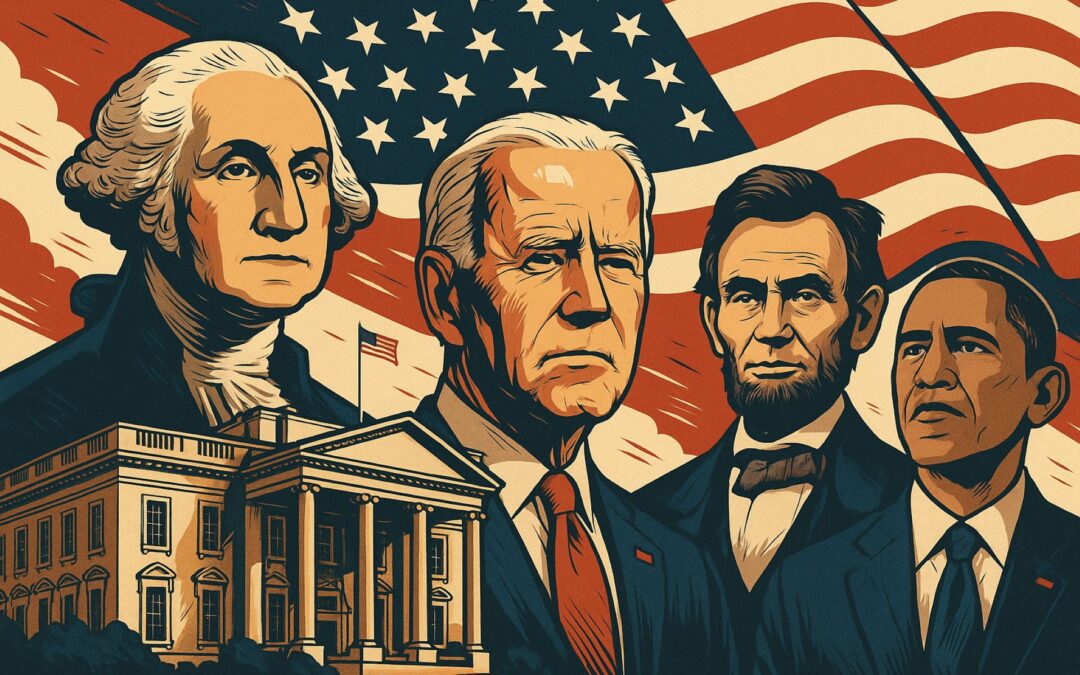
Every presidency marks a turning point in America’s story. Each man who has occupied the Oval Office has carried a “first” — a moment, decision, or distinction that reshaped how power, identity, and leadership are understood.
From George Washington’s refusal to become king to Joe Biden’s partnership with the nation’s first female vice president, these milestones reveal more than political trivia. They tell the story of a nation constantly redefining itself — from revolution to reconstruction, from isolation to globalization, from parchment promises to digital realities.
History isn’t built on grand speeches alone; it’s built on firsts — on risks taken, rules broken, and precedents set. To trace these presidential milestones is to watch the evolution of America itself: flawed, courageous, ambitious, and endlessly in motion.
George Washington: The Reluctant King
When George Washington took the oath of office in 1789, there was no blueprint, no manual for the presidency—just the weight of an entire republic on his shoulders. He wasn’t merely the first president; he was the model against which all future leaders would be judged. Washington’s unanimous election wasn’t a coincidence. It was a reflection of trust so deep that every elector voted for him twice.
Having led a ragtag army to victory against the British Empire, he could have easily turned his fame into monarchy. Many even offered to crown him king. But Washington’s refusal to seize absolute power became the defining act of his life. By stepping down after two terms, he established a sacred tradition: that leadership in a democracy must end willingly, not be clung to. His restraint gave birth to a precedent that would shape the moral backbone of the presidency itself.
John Adams: The First to Call the White House Home
When John Adams moved into the White House in November 1800, he entered not a palace but a construction site. The walls were damp, the floors unfinished, and dust clung to the furniture. Washington, D.C., was still a marshy frontier of ambition and mud. Yet, amid the hammering of carpenters and the echo of empty halls, the Adams family created history.
Abigail Adams turned adversity into routine. She famously hung laundry in the East Room because it was the only large space available. The symbolism was striking—humility and practicality at the heart of power. For all its imperfections, the unfinished White House became a tangible expression of America itself: young, unrefined, and brimming with potential.
Thomas Jefferson: The First Inauguration in Washington, D.C.
When Thomas Jefferson took his oath in 1801, Washington, D.C. was a swampy experiment more than a capital. The city smelled of wet soil and fresh lumber, the streets still unpaved. Yet Jefferson’s inauguration there transformed it from a muddy outpost into the beating heart of the republic.
He arrived on horseback, unescorted, choosing simplicity over ceremony. The act was deliberate—a message that the presidency belonged to the people, not an elite ruling class. By anchoring his inauguration in D.C., Jefferson solidified its role as the permanent seat of government, a place where power would reside not in marble palaces but among the marshes that symbolized rebirth and resilience.
James Madison: The First to Ask Congress for War
In June 1812, James Madison faced a dilemma. British ships were harassing American vessels, seizing sailors, and challenging the young nation’s sovereignty. Madison could have unilaterally declared war, as monarchs often did. But instead, he became the first president to formally ask Congress for permission.
His request led to the War of 1812—a conflict that tested America’s survival once again. The British would eventually march into Washington, setting fire to the Capitol and the White House. Yet Madison’s decision to follow the Constitution’s mandate underscored a critical principle: even in moments of crisis, power must be governed by process. He proved that in America, the rule of law stands taller than the passions of war.
James Monroe: The First to Ride a Steamboat
In 1817, James Monroe climbed aboard a steamboat, unknowingly symbolizing a nation on the verge of transformation. The journey was short, but the moment monumental. Steam technology represented innovation, mobility, and progress—the very spirit of the “Era of Good Feelings.”
Monroe’s presidency radiated optimism. Factories were humming, cities expanding, and westward expansion was redefining the American dream. His steamboat voyage became a floating metaphor for a country charging full steam into industrialization, propelled by invention and unity.
John Quincy Adams: The First to Be Photographed
By 1843, John Quincy Adams had long left the White House, but he entered a different kind of immortality. As he sat still for a daguerreotype—a primitive photographic technique—he became the first president ever captured on camera. The result was a hauntingly sharp portrait of age, intellect, and resolve.
The photo froze a moment that no painting could replicate. In it, Adams looks stern, his eyes carrying the fatigue of a man who had seen the republic’s birth and its growing pains. Photography, still an experiment, gave history a new kind of permanence—and Adams, the son of the second president, became its first preserved face.
Andrew Jackson: The First Assassination Attempt
In 1835, Andrew Jackson walked out of a funeral into chaos. A man named Richard Lawrence aimed a pistol at him and pulled the trigger—it misfired. He pulled a second—another misfire. Jackson, seventy years old and furious, lunged forward and beat the would-be assassin with his cane until bystanders restrained him.
It was the first assassination attempt on a U.S. president, and Jackson’s reaction cemented his image as “Old Hickory”—unyielding and unafraid. The episode captured his essence: a man of brute strength and willpower who faced danger the same way he faced politics—head-on and unflinching.
Martin Van Buren: The First to Speak English as a Second Language
Martin Van Buren’s story began not in the polished corridors of Washington but in a Dutch-speaking village in Kinderhook, New York. English was his second language, and that linguistic duality made him the first bilingual president. It was a quiet first, yet it reflected something profound—the American experiment’s cultural diversity.
Though Van Buren’s presidency was marked by economic hardship, his Dutch roots symbolized the growing reality that America was no longer purely English—it was already becoming a mosaic of cultures and voices.
William Henry Harrison: The First to Die in Office
William Henry Harrison gave a two-hour inaugural address without a coat in the freezing rain. Thirty-one days later, he was dead. His death—the first of a sitting president—plunged the nation into uncharted territory. Who takes over? What happens next?
The Constitution was vague, and uncertainty loomed. Harrison’s passing transformed a tragedy into a constitutional test. The answer would come through the next man in line—John Tyler.
John Tyler: The First Vice President to Succeed the Presidency
When Harrison died, John Tyler declared himself president, not “acting president.” The move was bold, controversial, and revolutionary. Some members of Congress scoffed, claiming he was overstepping. But Tyler stood firm, refusing to yield his authority. His declaration set a precedent that every future succession would follow: the vice president becomes president, not a placeholder.
It was a simple sentence—“I am the president now”—that solidified the line of continuity in the world’s most powerful office.
James K. Polk: The First Dark Horse Winner
James K. Polk wasn’t the favorite. He wasn’t even the second choice. Yet in 1844, this relatively unknown politician emerged from the shadows to win the presidency, earning him the title of America’s first “dark horse” candidate.
Polk’s campaign rode on one electrifying idea—Manifest Destiny. He promised to expand America’s borders from coast to coast. By the end of his single term, he delivered: Texas, Oregon, California—all added. His improbable rise proved that in American politics, obscurity could transform into destiny overnight.
Zachary Taylor: The First President Without Political Experience
Zachary Taylor was a soldier through and through. He’d never held public office, never debated in Congress, and never crafted a law. Yet, his battlefield heroics during the Mexican-American War made him a national icon.
Voters saw in him a man of grit, not rhetoric—a leader who acted, not talked. But his presidency was short-lived; Taylor died just sixteen months after taking office, reportedly from eating contaminated fruit. His sudden death underscored the fragility of power and the unpredictability of fate.
Millard Fillmore: The First to Open Trade with Japan
When Fillmore dispatched Commodore Matthew Perry across the Pacific in 1852, the mission seemed audacious. Japan had closed itself off from the world for over two centuries. Yet Perry’s black ships anchored in Tokyo Bay and opened the door to commerce.
Fillmore’s initiative marked America’s entry onto the global stage. Trade with Japan not only revolutionized international relations but also symbolized a nation beginning to think beyond its borders—a precursor to America’s future role as a global superpower.
Franklin Pierce: The First to Affirm the Oath of Office
Franklin Pierce took office in 1853 with an unusual decision: he would “affirm,” not “swear,” his oath. A devout Episcopalian, he believed swearing was contrary to his faith. Standing tall, he delivered his entire inaugural address from memory, a feat no president has replicated.
His meticulous preparation mirrored his belief in conviction over conformity. Though his presidency would later falter, Pierce’s quiet defiance during his inauguration reflected the enduring tension between personal conscience and public duty.
James Buchanan: The First Bachelor President
James Buchanan’s presidency is often remembered for its solitude. A lifelong bachelor, he entered the White House alone, without a first lady or family. His unmarried status became both a curiosity and a metaphor—an isolated leader presiding over a nation slowly breaking apart.
Buchanan’s indecision during the secession crisis would tarnish his legacy, but his bachelorhood remains an enduring historical oddity, the image of a man wedded only to indecision.
Abraham Lincoln: The First Assassinated President
Abraham Lincoln’s presidency was a symphony of contradictions—war and unity, sorrow and triumph. Encouraged by an eleven-year-old girl to grow a beard, he adopted a look that would become iconic: the thoughtful, bearded statesman who bore the nation’s suffering.
But victory was followed by tragedy. In 1865, as he watched a play at Ford’s Theatre, Lincoln was shot by John Wilkes Booth. His assassination made him the first president to die by violence, turning him from a leader into a legend. The unfinished play became a symbol of his unfinished work—healed only by memory and myth.
Andrew Johnson: The First Impeached President
Andrew Johnson inherited a country in chaos and immediately made it worse. His lenient approach to Reconstruction infuriated Congress, especially his defiance of the Tenure of Office Act. When he fired Secretary of War Edwin Stanton without approval, lawmakers struck back—impeaching him for “high crimes and misdemeanors.”
Johnson escaped removal by a single vote, but the stain remained. He became a cautionary tale: that defying checks and balances carries consequences, even for the man at the top.
Ulysses S. Grant: The First to Create a National Park
Grant, the stoic general who won the Civil War, found peace not on the battlefield but in preservation. In 1872, he established Yellowstone National Park—the first in the world. Amid a nation obsessed with expansion, Grant saw the value of protection.
His signature saved millions of acres of wilderness from destruction, giving birth to the conservation movement. In an age of steel and smoke, Grant’s decision was a rare act of foresight—a reminder that progress should coexist with preservation.
Rutherford B. Hayes: The First to Take the Oath in Private
The election of 1876 was one of America’s most disputed. With both sides claiming victory, tensions flared, and violence seemed imminent. To prevent unrest, Rutherford B. Hayes quietly took the presidential oath in the Red Room of the White House, a day before his public ceremony.
The secrecy reflected the fragility of democracy at that moment—how close the republic had come to unraveling. But Hayes’ quiet oath restored calm and affirmed that legitimacy sometimes requires humility, not spectacle.
James Garfield: The Ambidextrous Genius
James Garfield’s intellect was legendary, bordering on mythic. The story goes that he could write Greek with one hand while simultaneously writing Latin with the other. Whether perfectly true or slightly exaggerated, it symbolized his extraordinary mind. He rose from abject poverty—born in a log cabin, working as a canal boy—to become a scholar, Civil War general, congressman, and eventually president.
Garfield’s presidency, however, was tragically brief. Within months of taking office, he was shot by a disgruntled office seeker. What followed was a long, painful decline worsened by primitive medical treatment. His death in 1881 marked yet another early loss for the young republic, but his brilliance and humility left a mark far deeper than his short tenure.
Chester A. Arthur: The First to Restrict Immigration
Chester Arthur entered the presidency as an accidental leader, elevated by Garfield’s assassination. Once seen as a product of machine politics, he surprised everyone by acting with dignity and independence. His defining first came in 1882, when he signed the Chinese Exclusion Act, America’s first major immigration restriction.
It barred Chinese laborers for ten years, setting a precedent for future immigration controls. The act reflected both the economic anxieties and racial prejudices of the era, symbolizing a country struggling to define who could share in its promise. Arthur’s decision remains controversial—a moment when the “land of opportunity” began to erect its first barriers.
Grover Cleveland: The First to Serve Non-Consecutive Terms
Grover Cleveland occupies two separate numbers on the presidential list—22nd and 24th—because he’s the only man to win, lose, and win again. After losing reelection to Benjamin Harrison, Cleveland refused to fade into history. Four years later, he came roaring back, defeating the very man who had replaced him.
His comeback spoke volumes about resilience in politics. Cleveland’s reputation as a reformer—honest, austere, and allergic to corruption—won him admiration across party lines. He reminded Americans that defeat is not final; sometimes, the second act is the stronger one.
Benjamin Harrison: The First with Electricity in the White House
Under Benjamin Harrison’s presidency, modernity arrived at the White House in the form of electric light. Installed in 1891, it represented progress—but also fear. The Harrisons were reportedly so terrified of being shocked that they refused to touch the switches. At night, lights burned until servants turned them off.
This small anecdote captures a pivotal moment in American history—the uneasy transition between eras. The flicker of electric light illuminated not just the White House halls but also a society standing at the threshold of the technological age, both thrilled and terrified by its own inventions.
William McKinley: The First to Ride in a Car
William McKinley’s presidency was marked by industrial growth and imperial ambition, but one of his quieter firsts symbolized the changing times: he was the first president to ride in an automobile. It wasn’t sleek or elegant—it puffed steam, clattered loudly, and looked like a rolling teapot—but it represented the future on wheels.
McKinley embraced progress, championing innovation and modernization. Ironically, his forward-looking presidency ended abruptly when he was assassinated in 1901, another tragic first in the march of American history.
Theodore Roosevelt: The First to Travel Abroad
Teddy Roosevelt was not a man to sit still. In 1906, he became the first sitting U.S. president to travel outside the country, sailing to Panama to inspect the canal project firsthand. Clad in his signature white suit and Panama hat, Roosevelt waded through the muck, conversing with engineers and laborers as equals.
The trip wasn’t just a photo opportunity—it was a declaration. Roosevelt’s presence signified America’s emergence as a global power, one capable of reshaping geography and asserting its will on the world stage. His vigor embodied the nation’s restless energy, its desire to build, conquer, and connect.
William Howard Taft: The First to Lead the Supreme Court
Taft’s heart always belonged to the law more than to politics. After serving as president from 1909 to 1913, he achieved his true dream in 1921—becoming Chief Justice of the United States. He remains the only person to have led both the executive and judicial branches.
In the Court, Taft found the serenity that eluded him in politics. He modernized the judiciary, streamlined case procedures, and strengthened the institution’s independence. His journey proved that ambition isn’t always about power—it can be about purpose, fulfillment, and returning to where one truly belongs.
Woodrow Wilson: The First with a Ph.D.
Before entering politics, Woodrow Wilson was an academic—a professor, author, and president of Princeton University. With a Ph.D. in political science from Johns Hopkins, he became the first and only U.S. president to hold a doctorate. His scholarly mindset shaped his presidency: analytical, idealistic, and often inflexible.
Wilson saw the world in systems and theories. His belief in moral diplomacy and the League of Nations reflected his conviction that intellect could guide global peace. Yet, the same rigidity that made him visionary also made him divisive. Wilson’s presidency illustrated how intellect, when untempered by empathy, can both elevate and alienate leadership.
Warren G. Harding: The First Voice on Radio
In 1922, a new invention transformed communication—the radio. Warren G. Harding became the first president to have his voice broadcast to the nation. Millions of Americans heard him dedicate the Lincoln Memorial, his words crackling through the static into living rooms across the country.
For the first time, the presidency wasn’t confined to print—it could be heard. Harding’s broadcast marked the birth of mass media politics, connecting presidents directly to the people in real time. The era of invisible leadership was over; from then on, presidents would speak not just to rooms, but to the world.
Calvin Coolidge: The First Sworn In by His Father
When Harding died suddenly in 1923, Vice President Calvin Coolidge was visiting his family home in Vermont. News arrived late that night. With no judge available, his father—John Coolidge, a local notary—administered the presidential oath by lamplight in their parlor.
It was a moment of pure Americana: a son taking the highest office in the land, sworn in by his own father’s hand. That humble farmhouse ceremony, devoid of grandeur, became one of the most intimate inaugurations in U.S. history—a reminder that power, at its best, is rooted in family, faith, and quiet duty.
Herbert Hoover: The First Born West of the Mississippi
Herbert Hoover’s birth in Iowa in 1874 made him the first president born west of the Mississippi River—a subtle but significant milestone in America’s expansion. His life was the embodiment of self-made success. Orphaned young, Hoover studied engineering, worked in mines, and built a global fortune long before entering politics.
By the time he reached the presidency, he was admired as a humanitarian who had fed millions in Europe after World War I. Yet, fate had other plans. The Great Depression struck months after he took office, turning prosperity into despair. Still, Hoover’s story represented the boundless optimism of a country that had finally conquered its own frontier.
Franklin D. Roosevelt: The First to Serve Four Terms
Franklin D. Roosevelt was elected not twice, not thrice, but four times—an achievement that will never be repeated. From 1932 to 1944, he steered America through the Great Depression and World War II. His fireside chats soothed a nation, his policies reshaped the economy, and his leadership redefined resilience.
Before FDR, no president had dared break Washington’s two-term precedent. But extraordinary times demanded extraordinary continuity. His long presidency brought stability in chaos but also led to reform—the 22nd Amendment, limiting presidents to two terms. Roosevelt’s era became the benchmark for crisis leadership, unmatched in scope or endurance.
Harry S. Truman: The First to Use Atomic Weapons
Few decisions in history carry the gravity of Truman’s. In August 1945, faced with the brutal cost of continuing World War II, he authorized the use of atomic bombs on Hiroshima and Nagasaki. The devastation ended the war—and ushered humanity into the nuclear age.
It was a decision both condemned and justified, a moment that changed warfare, ethics, and diplomacy forever. Truman’s hand on that order symbolized the impossible burden of modern power—the realization that one signature could alter the fate of civilizations.
Dwight D. Eisenhower: The First to Serve in Two World Wars
Dwight Eisenhower’s résumé was forged in fire. He trained tank divisions in World War I and commanded Allied forces in World War II, orchestrating D-Day and Germany’s surrender. When he became president, Americans trusted him implicitly—a man who had seen the worst of humanity and sought peace through strength.
Eisenhower’s dual service gave him a unique perspective on leadership and restraint. His farewell warning about the “military-industrial complex” wasn’t cynicism—it was wisdom born of experience. He knew the cost of unchecked power because he’d wielded it himself.
John F. Kennedy: The First Televised Debate
In 1960, the world witnessed the power of television during the Kennedy–Nixon debate. On radio, Nixon’s arguments seemed persuasive. On screen, Kennedy’s composure, charisma, and poise won the nation. The camera had become a new political battlefield, and appearance was now inseparable from authority.
Kennedy’s mastery of media wasn’t vanity—it was adaptation. His understanding of optics and emotion made him the archetype of the modern politician: articulate, youthful, and image-aware. Politics had forever entered the age of performance.
Lyndon B. Johnson: The First Sworn In on an Airplane
The assassination of John F. Kennedy in November 1963 was a national trauma, but for Lyndon B. Johnson, it was also an urgent constitutional moment. Within hours of Kennedy’s death, Johnson stood aboard Air Force One, his hand raised, taking the oath of office beside a grief-stricken Jacqueline Kennedy still wearing her bloodstained pink suit.
It was the first time in history a president had been sworn in aboard an airplane—a surreal image of power, pain, and continuity. The cramped cabin fell silent as Johnson repeated the words that would make him president. The photograph, stark and unforgettable, captured more than succession—it captured a wounded nation demanding stability. Johnson’s presidency began mid-flight, a symbol of both crisis and resilience, and he would go on to pass landmark civil rights legislation that reshaped America’s moral landscape.
Richard Nixon: The First to Resign
Richard Nixon’s career began in triumph and ended in disgrace. A brilliant strategist and tireless campaigner, Nixon rose through the ranks with a reputation for cunning and control. But the Watergate scandal—an attempted cover-up of a political break-in—unraveled it all. By 1974, Congress had prepared articles of impeachment, and the nation’s faith in government had collapsed.
Rather than face removal, Nixon became the first president to resign from office. In his final televised address, his voice trembled as he announced his departure, his composure cracking beneath the weight of history. “You must always remember,” he said, “others may hate you, but those who hate you don’t win unless you hate them.” The words were poetic, but hollow. His resignation marked not just the fall of a man, but the corrosion of public trust that would haunt American politics for decades.
Gerald Ford: The First Unelected President
When Nixon resigned, Gerald Ford took the oath of office with humility and disbelief. He hadn’t been elected president—or vice president. He had been appointed VP after Spiro Agnew’s resignation, and suddenly found himself leading the nation. “Our long national nightmare is over,” he declared, becoming the first and only person in U.S. history to assume the presidency without ever winning an election.
Ford’s decency was his defining trait. He tried to heal a divided nation, famously pardoning Nixon to help the country move on—though it cost him politically. His presidency served as a reminder that sometimes history doesn’t choose the most ambitious man, but the most stable one.
Jimmy Carter: The First Born in a Hospital
Jimmy Carter’s first came long before his presidency. Born in 1924 in a small Georgia hospital, he was the first president not born at home. That detail, simple as it seems, marked a new era of modernity—America was moving from frontier births to the age of medical progress.
Carter’s life mirrored that same transformation. A peanut farmer, naval officer, and humanitarian, he carried a quiet moral authority that transcended politics. Though his presidency faced economic struggles, his post-presidential legacy—fighting disease, building homes, and advocating for peace—became legendary. Living past 100, Carter not only outlasted every other president but proved that legacy isn’t measured by years in power, but by decades of service.
Ronald Reagan: The First to Appoint a Woman to the Supreme Court
When Ronald Reagan appointed Sandra Day O’Connor in 1981, he didn’t just fill a vacancy—he shattered a barrier. O’Connor’s appointment made her the first woman ever to serve on the U.S. Supreme Court, an institution that had been exclusively male for nearly two centuries.
Reagan’s decision reflected a blend of pragmatism and progressivism. He recognized that symbolic acts can echo louder than speeches. O’Connor’s sharp intellect and balanced judgments went on to influence the Court for decades, her appointment becoming one of Reagan’s most enduring legacies. In that moment, the marble walls of the Supreme Court cracked open just enough for history to enter.
George H. W. Bush: The First CIA Director to Become President
George Herbert Walker Bush carried a résumé few could rival—decorated World War II pilot, U.N. ambassador, Congressman, envoy to China, and Director of the Central Intelligence Agency. When he entered the presidency in 1989, he brought with him the perspective of a man who had seen the world from behind every curtain, including the secret ones.
As the first former CIA director to become president, Bush navigated an era of seismic geopolitical change. The Berlin Wall fell, the Soviet Union dissolved, and the Cold War quietly ended—not through victory parades, but through diplomacy and poise. His steady hand guided America through uncertainty, proving that sometimes the most decisive victories are the ones achieved without firing a shot.
Bill Clinton: The First Inauguration Live-Streamed
In 1993, Bill Clinton’s inauguration made history as the first to be broadcast live on the Internet. The technology was clunky, the connection painfully slow, but it marked the dawn of a digital presidency. America was stepping into the information age, and Clinton’s youthful charisma made him its perfect herald.
Clinton’s presidency thrived on communication—televised town halls, talk-show appearances, and the first White House website. The live-streamed inauguration symbolized a new kind of accessibility: politics meeting pixels. For better or worse, from that moment on, presidents would govern not just through policy, but through screens.
George W. Bush: The First with an MBA
Before entering politics, George W. Bush earned a Master of Business Administration from Harvard—a credential that made him the first president with an MBA. The degree shaped his worldview: management, delegation, and decisiveness were his watchwords. He viewed the Oval Office not just as a seat of power, but as the CEO’s chair of a global enterprise.
Yet, the world he inherited tested more than managerial skill. The September 11 attacks, the wars in Afghanistan and Iraq, and the global financial crisis demanded more than business sense—they demanded moral endurance. Bush’s presidency demonstrated that leadership can’t be reduced to spreadsheets or strategy memos; it lives in the fog between calculation and conviction.
Barack Obama: The First African-American President
In 2008, Barack Obama’s election didn’t just make history—it redefined it. The son of a Kenyan father and a white American mother, he became the first African-American president, breaking a barrier that had stood since the nation’s founding. His campaign’s rallying cry, “Yes We Can,” echoed through streets, screens, and generations, uniting millions under a shared sense of possibility.
Obama was also the first president born in Hawaii, a man whose roots stretched across oceans. His rise embodied the evolving face of America—diverse, hopeful, and globally connected. His presidency symbolized more than progress; it embodied the idea that identity, once a boundary, could become a bridge.
Donald Trump: The First with No Political or Military Experience
Donald Trump’s election in 2016 upended every political rule. A billionaire businessman and television personality, he became the first president in history with zero political or military experience. To his supporters, that made him refreshing—an outsider uncorrupted by Washington. To his critics, it made him reckless and unfit.
Trump’s presidency was a spectacle of disruption. He wielded social media like a weapon, governed by instinct rather than convention, and redefined what it meant to communicate with the public. His rise revealed a country deeply divided, but also desperate for authenticity—even if it came wrapped in controversy. He was both a symptom and a catalyst of an era where politics had become entertainment, and outrage the new currency.
Joe Biden: The First with Over 35 Years in the Senate
Joe Biden’s career is the story of endurance. Having entered the Senate at just 30, he spent more than three decades shaping policy, forging relationships, and weathering personal loss before reaching the presidency. When he took office in 2021, he did so as the most experienced lawmaker ever to hold the role—a man whose political lifespan stretched across generations.
His presidency carried another historic milestone: Kamala Harris, the first female, first Black, and first South Asian vice president in American history. Together, they represented not just experience and diversity, but the culmination of centuries of struggle and evolution. Biden’s rise was less about ambition and more about perseverance—the long arc of service finally bending toward its reward.
Conclusion
The presidency has never been a static institution. It has evolved through centuries of conflict, progress, and reinvention — each leader leaving behind an imprint that reshaped the office for the next. Some firsts were acts of courage, others of tragedy, and a few born purely from circumstance. Together, they chart the nation’s transformation from fragile experiment to global power.
Every “first” in this lineage — whether Washington’s restraint, Lincoln’s sacrifice, or Obama’s breakthrough — carries a lesson about ambition, humanity, and time. America’s presidents didn’t just lead; they mirrored the world they inherited and the one they helped create. And in that long chain of firsts, the story of the United States continues — still unfinished, still unfolding, still reaching for the next defining moment.