
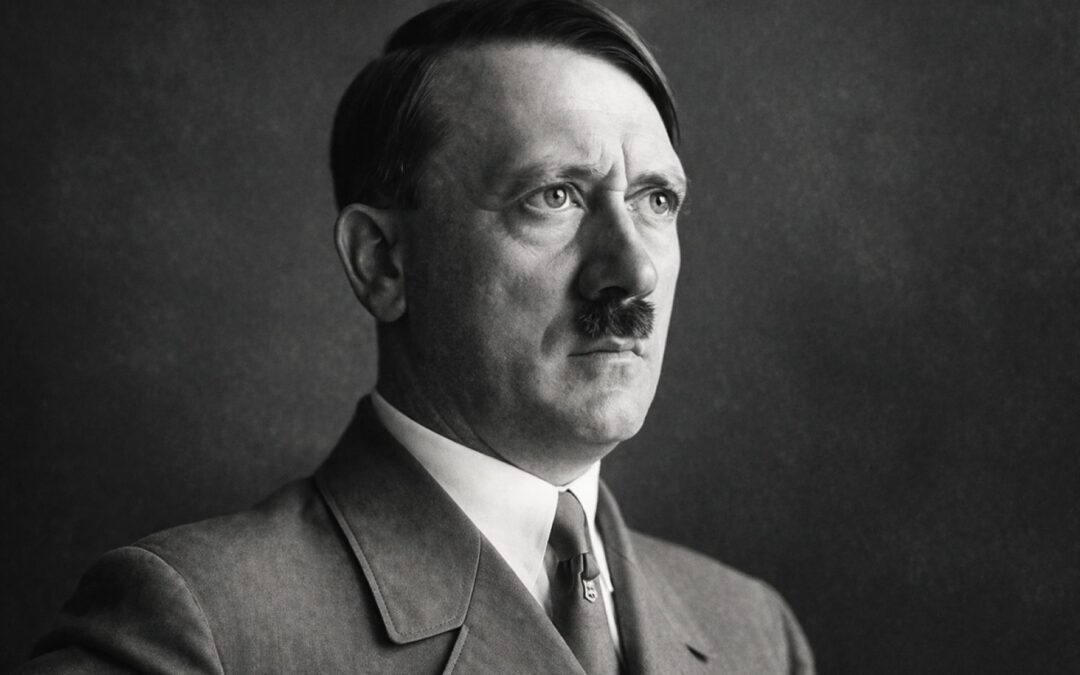
Adolf Hitler remains one of the most consequential—and catastrophic—figures in modern history. His life traces a trajectory that is both improbable and deeply revealing: from a struggling, directionless youth in Austria to the absolute ruler of Germany, and ultimately to the architect of a war and genocide that reshaped the world.
Understanding Hitler is not simply a matter of recounting events. It requires examining how personal ambition, ideological extremism, and historical circumstance converged at a precise moment in time. His rise was not inevitable, nor was it purely accidental. It was enabled—by political instability, economic collapse, and a society searching for direction after defeat.
The story that follows is a comprehensive account of that rise and fall. It begins in a fractured household in late nineteenth-century Austria, moves through the upheaval of World War I and the chaos of post-war Germany, and culminates in the establishment of a regime that would plunge Europe into devastation. Along the way, it reveals how power was seized, consolidated, and ultimately misused on a scale rarely seen before or since.
To understand Hitler is to confront uncomfortable realities about leadership, mass persuasion, and the conditions under which extreme ideologies can take hold. This is not merely a biography—it is a case study in how history can be shaped, and distorted, by a single individual operating within a vulnerable system.
Early Life and Family Background
Adolf Hitler was born on April 20, 1889, in the small border town of Braunau am Inn in Upper Austria, a place that sat uncomfortably between identities—Austrian by administration, yet culturally tied to the broader German world. This tension between national belonging and identity would later become a defining feature of Hitler’s worldview, but his early life was shaped less by ideology and more by the instability within his own home.
His father, Alois Hitler, was a customs official—rigid, authoritarian, and often volatile. Having risen from illegitimate birth to a respectable position in the Austro-Hungarian bureaucracy, Alois carried himself with a sense of hard-earned authority. That authority extended into his household, where discipline was enforced not through guidance, but through intimidation and physical punishment. He was known to be a heavy drinker, frequently absent, and when present, prone to outbursts that created a tense and often hostile domestic environment.
In stark contrast stood Hitler’s mother, Klara Pölzl. She was gentle, deeply religious, and emotionally devoted to her son. Hitler’s early years were marked by this imbalance—harsh paternal control offset by maternal affection. Klara’s attachment to Adolf was particularly strong, especially after the death of several of her children in infancy. Adolf became the center of her emotional world, and she, in turn, became a stabilizing force in his otherwise turbulent upbringing.
Loss, however, was a recurring theme in the household. Before Hitler reached adolescence, several of his siblings had died, and this constant proximity to death shaped the emotional atmosphere of his early years. It reinforced Klara’s protectiveness and may have contributed to a sense of exceptionalism in Adolf as the surviving child. At the same time, it deepened the emotional divide between him and his father, who remained distant and often hostile.
The family moved frequently due to Alois’s career, creating a sense of instability in Hitler’s formative years. Settling eventually near Linz, Hitler spent much of his childhood there, a city he would later romanticize and associate with his earliest ambitions. Yet even in these more settled years, the household remained defined by conflict. Alois expected his son to follow in his bureaucratic footsteps, while Adolf showed little interest in structured education or conventional career paths.
This clash between expectation and aspiration became a central tension. Hitler performed poorly in school, particularly in subjects that required discipline and consistency. However, he showed an early interest in art, architecture, and drawing—interests that his father dismissed outright. The result was not just disagreement, but deep resentment. Hitler resisted authority not in subtle ways, but through disengagement and defiance.
The death of Alois in 1903 brought an end to the immediate source of conflict, but it did not resolve the underlying instability. Instead, it removed structure altogether. Without his father’s presence, Hitler’s life lost direction, even as he grew closer to his mother. This period marked a transition—away from enforced discipline and toward an unstructured pursuit of personal ambition.
By the time he entered his late teens, the foundation of his personality had already been shaped: a deep aversion to authority, a tendency toward isolation, an inflated sense of personal destiny, and an emotional dependence on selective attachments. These traits would not yet find political expression, but they would persist—waiting for the conditions that would later transform them into something far more consequential.
Youth, Education, and the Vienna Years
With his father gone, Adolf Hitler’s life drifted further away from structure. What remained was not discipline, but possibility—at least in his own mind. He had little interest in formal education, and without the pressure to conform to his father’s expectations, he abandoned any serious attempt at academic success. Instead, he fixated on a vague but consuming ambition: to become an artist.
This ambition led him to Vienna in 1907, the cultural heart of the Austro-Hungarian Empire. For a young man with artistic aspirations, there were few places more appealing. Vienna at the time was alive with intellectual and artistic energy—home to movements like Impressionism, Expressionism, and a broader cultural shift that was redefining European art. Hitler arrived believing he would be part of it.
The reality was far less accommodating.
He applied to the Academy of Fine Arts in Vienna, one of the most prestigious institutions of its kind. His application was rejected. He tried again. Rejected again. The academy’s assessment was blunt—his work lacked depth and creativity. While he showed some technical ability, particularly in architectural sketches, he failed to demonstrate the artistic imagination required for formal training.
This was more than a setback. It was a rupture.
Around the same time, Hitler’s mother, Klara, fell seriously ill. She died of breast cancer in December 1907, shortly after his first failed application. Her death removed the last stabilizing influence in his life. What followed was not resilience, but decline.
By 1909, Hitler had exhausted what little financial support remained from his parents’ estate. Without formal education, without admission to the academy, and without stable employment, he slipped into poverty. For a period, he lived in homeless shelters and men’s hostels, moving between temporary accommodations and surviving on odd jobs. He sold small watercolor paintings—mostly depictions of buildings and cityscapes—not as artistic expressions, but as decorative items for modest buyers.
These years in Vienna were formative in ways that extended far beyond his failed artistic career.
Vienna was not just a cultural center—it was also a city marked by deep political and social tensions. It was a multi-ethnic empire capital, where Germans, Slavs, Jews, and other groups lived in close proximity, often uneasily. Nationalism, anti-Semitism, and populist politics were not fringe ideas; they were part of the public discourse.
It was here that Hitler was exposed to—and increasingly absorbed—radical ideological currents. He developed a growing hostility toward what he perceived as the fragmentation of society, particularly in a city where different ethnic and cultural groups coexisted under a single imperial system. Over time, this resentment sharpened into something more defined.
Historians have long debated the extent to which Hitler’s anti-Semitism took root during these Vienna years. What is clear is that this period marked a shift—from personal frustration to ideological framing. His failures were no longer simply his own; they began to be interpreted through a broader lens of cultural and societal decline.
At the same time, his lifestyle reinforced isolation. He did not form meaningful personal relationships. He did not integrate into any professional or social circles. Instead, he spent long periods alone, reading, observing, and developing a worldview that increasingly separated him from the society around him.
There is a tendency to view this phase of Hitler’s life as a prelude—a period of obscurity before his later rise. But that understates its importance. Vienna was not just where he failed; it was where he began to construct a framework for understanding the world, however distorted that framework would later become.
By 1913, Hitler left Vienna and moved to Munich. He carried with him no formal qualifications, no career, and no clear direction. But he did carry something else—an emerging set of beliefs shaped by failure, resentment, and exposure to radical ideas. Those beliefs had not yet found a platform.
They would soon find one in war.
World War I and Its Lasting Impact
When Adolf Hitler arrived in Munich in 1913, he was still an unremarkable figure—an aimless young man carrying the residue of failure from Vienna, but with no clear path forward. That changed dramatically with the outbreak of World War I in August 1914.
For Hitler, the war was not an interruption. It was an opportunity.
Despite being an Austrian citizen, he volunteered for service in the German army and was accepted into a Bavarian regiment. This decision was not accidental. By this point, he had already begun to identify more strongly with Germany than with the Austro-Hungarian Empire, which he viewed as fragmented and weakened by its multi-ethnic composition. Germany, in contrast, represented unity, strength, and purpose—qualities he believed were absent elsewhere.
The war gave him exactly what had been missing from his life: structure, belonging, and identity.
He served primarily on the Western Front in France and Belgium, where the war quickly descended into the brutal stalemate of trench warfare. Hitler’s role was that of a dispatch runner, tasked with carrying messages between units—often under dangerous conditions. It was a position that required mobility, reliability, and a willingness to operate under constant threat.
Over the course of the war, he distinguished himself in ways that were recognized by his superiors. He was wounded more than once and received several commendations, including both the Iron Cross Second Class and the more prestigious Iron Cross First Class—an award not commonly given to soldiers of his rank. These recognitions reinforced his sense of purpose and personal validation.
Yet the war was not just a formative experience—it was a transformative one.
Hitler did not experience the war as a tragedy. He experienced it as a defining moment. While millions of soldiers across Europe emerged disillusioned by the scale of destruction and loss, Hitler remained committed to the cause. He embraced the discipline, the hierarchy, and the collective identity that the military provided. In the chaos of the trenches, he found clarity.
That clarity would later become rigidity.
The end of the war in November 1918 was, for Hitler, not just a defeat—it was a shock. While recovering in a hospital after being temporarily blinded in a gas attack, he learned of Germany’s surrender. The news was devastating to him, not only because of the loss, but because of how he interpreted it.
He did not see the defeat as a military failure. He saw it as a betrayal.
This belief—commonly referred to as the “stab-in-the-back” narrative—held that Germany had not been defeated on the battlefield, but had been undermined from within by political actors, revolutionaries, and various internal enemies. It was a powerful and dangerous idea, one that gained traction among segments of the German population in the post-war years.
For Hitler, it became foundational.
The war had given him a sense of belonging. Its end took that away and replaced it with resentment. The structured world of the military dissolved into the instability of post-war Germany—a country now grappling with revolution, economic hardship, and political fragmentation.
At the same time, the psychological impact of the war cannot be ignored. Like many soldiers of the time, Hitler may have suffered from what was then called “shell shock,” now understood as post-traumatic stress disorder. While definitive conclusions are difficult, the intensity of his wartime experiences—and his reaction to Germany’s defeat—suggest a profound psychological imprint.
When he returned to Munich after the war, he was no longer the same individual who had left in 1914. He was not just a failed artist looking for direction. He was a man shaped by conflict, carrying a hardened worldview and a growing sense of grievance.
The conditions of post-war Germany would provide him with something even more significant than identity.
They would provide him with an opening.
Post-War Germany and Entry into Politics
When Adolf Hitler returned to Munich after World War I, he stepped into a country in upheaval. The German Empire had collapsed. The Kaiser had abdicated. In its place stood the fragile Weimar Republic—a new democratic system born not out of stability, but out of defeat, revolution, and compromise.
Germany in 1918–1919 was not merely rebuilding. It was unraveling.
Political factions across the spectrum were competing for control. Socialist and communist groups, inspired by the recent Russian Revolution, attempted to seize power in cities like Berlin and Munich. In response, right-wing militias and paramilitary groups formed to resist them. Violence was not incidental—it was routine. Street clashes, assassinations, and failed uprisings became part of daily political life.
Munich, where Hitler returned, was one of the most volatile centers of this unrest.
In 1919, the Bavarian Soviet Republic briefly took control of the region before being violently suppressed. The aftermath left a deep imprint on the political climate. Anti-communist sentiment surged, and nationalist groups began to organize more aggressively. It was in this environment—chaotic, polarized, and charged with resentment—that Hitler began his political journey.
Initially, it was not a deliberate pursuit.
After the war, Hitler remained in the German army, which had been retained in a reduced capacity under the terms of the Treaty of Versailles. The army, wary of political instability, began using soldiers as informants to monitor emerging political groups. Hitler was assigned one such role—to observe and report on small political organizations in Munich.
One of those organizations was the German Workers’ Party.
At the time, it was insignificant—small in size, limited in influence, and largely unknown beyond local circles. But during one of its meetings in 1919, Hitler attended as an observer and found himself unexpectedly engaged. The party’s nationalist and anti-Marxist positions resonated with him. More importantly, he discovered something he had not previously possessed: the ability to speak persuasively.
During the meeting, he intervened in a discussion and delivered an impromptu argument that caught the attention of the party’s founder, Anton Drexler. It was a turning point. What began as observation quickly turned into participation.
Hitler joined the German Workers’ Party soon after.
At first, his role was modest. But it did not remain so for long. He demonstrated a natural aptitude for public speaking—particularly in the emotionally charged atmosphere of post-war Germany. His speeches were not measured or academic. They were forceful, often aggressive, and tailored to the frustrations of his audience. He spoke to a population that felt humiliated by defeat, burdened by economic hardship, and uncertain about the future.
This ability to channel collective anger into a coherent message made him valuable.
At the same time, his ideological position began to solidify. Influenced by figures within the party, including Drexler and Dietrich Eckart, Hitler embraced a worldview that combined extreme nationalism, opposition to Marxism, and a growing emphasis on racial identity. These ideas were not unique to him—they were already circulating in various forms—but he adopted and amplified them with increasing intensity.
The German Workers’ Party soon underwent a transformation.
In 1920, it was renamed the National Socialist German Workers’ Party—better known as the Nazi Party. The rebranding was strategic. It aimed to appeal to a broader audience by combining nationalist rhetoric with elements that could attract working-class support. Around this time, the party also adopted the swastika as its emblem, aligning itself with symbols associated with Aryan identity and nationalist movements.
Hitler’s influence within the party grew rapidly.
By 1921, he had maneuvered his way into its leadership, effectively sidelining earlier figures like Drexler. His rise was not purely ideological—it was also tactical. He understood the importance of control, organization, and messaging. Under his leadership, the party began to take on a more structured form, with clearer hierarchy and a stronger public presence.
Yet despite this growth, the Nazi Party remained a fringe movement.
Its influence was largely confined to Munich and parts of Bavaria. It had visibility, but not power. Hitler, however, was not content with gradual expansion. The political instability of the early 1920s presented what he saw as an opportunity—one that he would soon attempt to seize.
That attempt would come in 1923.
And it would fail.
Rise Within the Nazi Party
Adolf Hitler’s ascent within the Nazi Party was neither accidental nor purely ideological—it was driven by a combination of timing, personal ability, and an instinct for control. When he joined the German Workers’ Party in 1919, it was a marginal group with little structure and even less influence. Within two years, it had been reshaped around him.
The most immediate factor behind his rise was his ability as a speaker.
Post-war Germany was a society saturated with frustration. Economic instability, national humiliation, and political fragmentation had created a population receptive to strong, emotionally charged messaging. Hitler did not speak in abstract terms. His speeches were direct, confrontational, and designed to provoke reaction. He identified enemies—both internal and external—and framed Germany’s problems in simple, absolute terms.
This clarity, however distorted, gave him an advantage.
Crowds responded. Meetings grew larger. The party, once obscure, began to attract attention—not necessarily respect, but visibility. And in the volatile political environment of early 1920s Munich, visibility translated into influence.
But speaking alone was not enough.
Hitler also understood the importance of organization. Under his influence, the party developed a more defined structure. Membership expanded. Propaganda efforts became more coordinated. Symbols, slogans, and visual identity—particularly the swastika—were used deliberately to create a sense of unity and recognition.
Equally important was the creation of a paramilitary presence.
The Nazi Party established the Sturmabteilung (SA), a group tasked with protecting party meetings, disrupting opponents, and asserting dominance in public spaces. In practice, this meant organized intimidation. Political meetings in Munich were often chaotic, with clashes between rival groups. The SA allowed the Nazis to not only defend themselves, but to project strength in an environment where strength was often equated with legitimacy.
Hitler’s leadership style began to take shape during this period.
He did not operate as a consensus builder. He centralized authority. Decisions flowed from him, not through a collective process. This approach created internal tensions, but it also eliminated ambiguity. Within a relatively short period, he positioned himself not just as a prominent member of the party, but as its defining figure.
The turning point came in 1921.
A dispute within the party leadership over a proposed merger with another nationalist group gave Hitler the opportunity to assert control. He threatened to resign, knowing that his departure would significantly weaken the party. Faced with that possibility, the leadership conceded. Hitler was granted near-complete authority, effectively making him the party’s leader.
From that point onward, the Nazi Party became inseparable from him.
Its identity, messaging, and direction were all shaped by his decisions. The earlier founders receded into the background, and Hitler emerged as the central figure—not just organizationally, but symbolically.
Yet despite these developments, the party’s reach remained limited.
It had a growing presence in Munich and surrounding areas, but it was still far from a national force. Its support base was narrow, and its political relevance uncertain. For Hitler, this incremental growth was insufficient. The instability of the Weimar Republic suggested that more direct action might yield faster results.
He began to consider a different path to power—one that bypassed elections entirely.
That decision would lead directly to the events of November 1923.
The Beer Hall Putsch and Imprisonment
By 1923, Germany was once again in crisis. Hyperinflation had devastated the economy. Savings were wiped out. Currency had become almost meaningless. At the same time, political instability persisted, and confidence in the Weimar Republic remained fragile. For Adolf Hitler, this moment appeared to present an opportunity.
He believed the system was weak enough to be overthrown.
Inspired in part by Benito Mussolini’s successful March on Rome in 1922, Hitler and other Nazi leaders began planning a similar seizure of power—starting in Bavaria and then extending to the rest of Germany. The idea was simple in theory: take control of Munich, rally support from key political and military figures, and march on Berlin.
In practice, it was anything but.
On the evening of November 8, 1923, Hitler and approximately 600 members of the Nazi Party’s paramilitary wing, the SA, entered a large beer hall in Munich where Bavarian officials were addressing a crowd. Hitler interrupted the meeting, declared that a revolution had begun, and attempted to force the support of regional leaders at gunpoint.
The situation was chaotic from the outset.
Although some initial concessions were made under pressure, the plan quickly began to unravel. Key figures who had been detained were allowed to leave—and once free, they alerted authorities. By the next morning, government forces were prepared.
On November 9, Hitler and his followers attempted to march through Munich.
They were met by police.
A brief confrontation followed. Shots were fired. Several people were killed. The march collapsed almost immediately. The attempted coup—later known as the Beer Hall Putsch—had failed.
Hitler fled the scene but was arrested shortly afterward.
At face value, the outcome was decisive. The Nazi Party was banned. Its leaders were detained. The attempt to seize power had not only failed, but exposed the movement’s lack of coordination and strategic planning.
Yet the aftermath was more complex than the event itself.
Hitler’s trial in early 1924 became a platform rather than a setback. Charged with treason, he used the proceedings to present his views publicly. The court, sympathetic to nationalist sentiments, allowed him considerable freedom to speak. What could have been a quiet legal process became a highly visible event.
He was found guilty.
But the sentence—five years in prison—was lenient. Even more significantly, he would serve less than one year of it, in relatively comfortable conditions at Landsberg Prison.
This period of imprisonment proved to be pivotal.
It was during his time in Landsberg that Hitler began dictating what would become Mein Kampf, a book outlining his ideological beliefs and political ambitions. While often remembered primarily for its racial doctrines, the work also contained broader strategic ideas—particularly the shift away from violent revolution toward achieving power through legal and political means.
The failure of the Beer Hall Putsch forced a recalibration.
Hitler recognized that attempting to seize power through force, at least under existing conditions, was not viable. The state was stronger than he had assumed. But the system itself—democratic, fragmented, and dependent on public support—offered a different pathway.
He would use the system to destroy the system.
When he was released from prison in late 1924, the Nazi Party was still banned, and its future uncertain. But Hitler emerged from imprisonment with something he had not fully possessed before: a clearer strategy.
The next phase of his rise would not be built on immediate confrontation.
It would be built on patience, organization, and control.
Rebuilding the Nazi Party and Ideological Consolidation
When Adolf Hitler was released from Landsberg Prison in December 1924, he returned to a very different political environment from the one he had tried to overthrow just over a year earlier. The immediate crises of hyperinflation and revolutionary unrest had subsided. The Weimar Republic, while still fragile, had stabilized enough to function. For the Nazi Party, this presented a problem.
Crisis had been its fuel. Stability deprived it of momentum.
At the time of his release, the party itself was effectively dormant. It had been banned following the Beer Hall Putsch, its organizational structure dismantled, and its influence reduced to a fraction of what it had been in Munich during the early 1920s. Hitler’s first task was not expansion—it was reconstruction.
He moved quickly to re-establish control.
By early 1925, the ban on the Nazi Party had been lifted under the condition that it would operate within the legal framework of the Weimar state. Hitler accepted this, but not as a concession. It was now part of his strategy. The failed coup had demonstrated the limits of force. The new approach would be systematic—using legal political participation as a means to gain power from within.
The party was formally re-founded in February 1925.
From the outset, Hitler ensured that its internal structure reflected his authority. Unlike conventional political parties, which often relied on committees and internal voting processes, the Nazi Party became highly centralized. Leadership flowed downward. Loyalty to Hitler was not just expected—it was foundational. This structure reduced internal dissent and allowed for rapid decision-making.
At the same time, the party’s ideological framework became more clearly defined.
Mein Kampf, written during Hitler’s imprisonment, now served as a reference point. It outlined a worldview built on extreme nationalism, racial hierarchy, opposition to Marxism, and the expansionist concept of Lebensraum—the idea that Germany required additional territory, particularly in Eastern Europe, to sustain its future. These ideas were not newly invented, but Hitler consolidated them into a coherent, if deeply distorted, ideological system.
The challenge was not just to define these ideas, but to spread them.
The Nazi Party invested heavily in propaganda and organization. Regional branches were established across Germany, not just in Bavaria. Membership drives expanded. Public rallies were organized with increasing precision. Messaging was tailored to different audiences—workers, veterans, the middle class—each addressed through language that aligned with their specific grievances.
Despite these efforts, progress was slow.
The period between 1925 and 1929 was one of relative economic stability in Germany, often referred to as the “Golden Years” of the Weimar Republic. Industrial production recovered. International relations improved. For many Germans, life became more manageable. In such an environment, the Nazi Party’s message of crisis and resentment struggled to gain traction.
Electoral results reflected this limitation.
In the 1928 Reichstag elections, the Nazi Party received just over 2% of the national vote. It remained a marginal political force, overshadowed by more established parties. Even within its own ranks, there were tensions. Figures like the Strasser brothers represented alternative directions for the party, advocating for a more socially oriented approach that differed from Hitler’s emphasis on centralized authority and ideological rigidity.
Hitler responded not by compromising, but by consolidating.
He moved to marginalize internal rivals and reinforce his control over the party’s direction. Key moments, such as the Bamberg Conference in 1926, allowed him to assert his leadership and unify the party under his vision. By the end of the decade, the Nazi Party was more cohesive, more disciplined, and more clearly aligned around a single figure.
Yet it was still not powerful.
What Hitler had built during these years was not a dominant political movement, but an infrastructure—an organization capable of scaling rapidly under the right conditions. It had structure, messaging, and leadership. What it lacked was widespread support.
That would change.
Not because the party fundamentally altered its message, but because the conditions around it would soon shift dramatically.
The Great Depression and the Path to Power
The turning point for Adolf Hitler and the Nazi Party did not come from internal evolution alone. It came from external collapse.
In 1929, the Wall Street Crash triggered a global economic crisis that quickly spread to Germany. The country, already burdened by reparations and dependent on foreign loans, was hit particularly hard. Banks failed. Businesses collapsed. Unemployment surged into the millions. Within a short period, the relative stability of the late 1920s gave way to widespread desperation.
This was the environment the Nazi Party had been waiting for.
For years, its message had struggled to resonate in a stable society. Now, that same message—centered on anger, betrayal, and national revival—suddenly aligned with the lived reality of millions of Germans. Economic hardship did not just create suffering; it created political opportunity.
The existing political system proved unable to respond effectively.
The Weimar Republic was built on coalition governments, which required compromise between multiple parties. In a time of crisis, this structure became a liability. Governments formed and collapsed in rapid succession. Policies were inconsistent. Public confidence eroded further with each failure to address unemployment and economic decline.
Into this vacuum stepped the Nazi Party.
Its appeal was not based on detailed policy solutions. Instead, it offered clarity and direction. Hitler’s speeches emphasized national unity, economic recovery, and the rejection of the post-war settlement that many Germans viewed as unjust. He presented himself not as a politician within the system, but as a figure capable of restoring order beyond it.
The results were immediate and dramatic.
In the 1930 Reichstag elections, the Nazi Party’s vote surged from just over 800,000 in 1928 to more than 6 million. It became the second-largest party in Germany. Two years later, in July 1932, it secured over 37% of the vote, making it the largest party in the Reichstag.
This was not a gradual rise. It was an acceleration.
Several factors contributed to this expansion. The party’s propaganda machinery, led by figures like Joseph Goebbels, was highly effective. It used modern techniques—mass rallies, posters, radio—to create a sense of momentum and inevitability. At the same time, paramilitary groups like the SA maintained a visible presence on the streets, reinforcing the image of strength and discipline.
Equally important was Hitler’s personal role.
His speeches during this period drew large crowds. His delivery—intense, repetitive, and emotionally charged—was designed to build momentum within the audience. To modern observers, it may appear exaggerated. At the time, it was compelling. Many who attended these rallies described a sense of collective energy, even conviction, that extended beyond the content of the speech itself.
Yet despite this popularity, Hitler did not immediately gain power.
Germany’s political system was fragmented. No single party could govern alone, and other parties were reluctant to form coalitions with the Nazis. Hitler himself refused to accept a subordinate role. He insisted on becoming Chancellor, not a participant in a broader coalition.
This stalemate created a different kind of opening.
By late 1932, political instability had reached a point where traditional mechanisms were no longer functioning. Conservative elites—politicians, industrialists, and advisors to President Paul von Hindenburg—began to consider an alternative approach. They believed that Hitler could be brought into government and controlled, using his popular support while limiting his actual power.
It was a calculated decision.
On January 30, 1933, Adolf Hitler was appointed Chancellor of Germany.
He did not seize power through revolution. He was invited into it.
The assumption among those who enabled his rise was that the system would contain him. That his influence could be managed. That the structures of government would remain intact.
They were wrong.
Hitler Becomes Chancellor and Dismantles Democracy
Adolf Hitler’s appointment as Chancellor on January 30, 1933, did not immediately transform Germany into a dictatorship. On paper, the Weimar Republic still existed. Its constitution remained in place. Political parties were still legal. The machinery of democracy had not yet been dismantled.
But the process of dismantling it began almost immediately.
Hitler did not attempt to overthrow the system from the outside. He used the authority granted to him within it. His position as Chancellor gave him access to the state apparatus—police, administration, and the ability to influence legislation. What followed was a rapid and calculated consolidation of power.
The first major turning point came within weeks.
On February 27, 1933, the Reichstag building—the seat of the German parliament—was set on fire. The cause of the fire remains debated, but the political consequences were immediate. The Nazi leadership framed the event as part of a broader communist uprising. Whether or not this was accurate was less important than how it was used.
The following day, President Hindenburg signed the Reichstag Fire Decree.
This decree suspended key civil liberties. Freedom of speech, freedom of assembly, and the right to privacy were effectively removed. It allowed the government to arrest political opponents without due process. The decree did not abolish democracy outright, but it stripped away the protections that made it functional.
The Nazis moved quickly to take advantage of this.
Communist leaders were arrested. Their party was effectively neutralized. Other political opponents faced intimidation, detention, or violence. The environment leading into the next election was no longer competitive—it was controlled.
In March 1933, new elections were held.
The Nazi Party did not achieve an outright majority, but it secured enough support, combined with allied parties, to push through the next critical step: the Enabling Act.
Passed on March 23, 1933, the Enabling Act fundamentally altered the structure of the German state.
It allowed the government—effectively Hitler and his cabinet—to pass laws without the involvement of the Reichstag. Even more significantly, these laws could deviate from the constitution. In practical terms, it transferred legislative power from parliament to the executive.
This was the legal foundation of dictatorship.
The passage of the Enabling Act was not inevitable. It required a two-thirds majority in the Reichstag. To secure it, the Nazis used a combination of pressure and absence. Communist deputies had already been removed. Other parties faced intimidation. Some were persuaded, others coerced. The result was a vote that appeared constitutional, but occurred under conditions that undermined its legitimacy.
With the Enabling Act in place, the transformation accelerated.
Political parties were systematically eliminated. By mid-1933, Germany had become a one-party state. Trade unions were dissolved and replaced with state-controlled organizations. Regional governments were brought under central control. The federal structure of Germany was effectively dismantled in favor of a centralized system aligned with Nazi authority.
This process became known as Gleichschaltung—the coordination of all aspects of society under a unified ideological framework.
It extended beyond politics.
Media, culture, education, and public institutions were all brought into alignment. Independent voices were removed or silenced. The goal was not just political control, but total integration of society into the new system.
By the end of 1933, the Weimar Republic no longer functioned as a democracy.
Yet one final step remained.
In August 1934, President Hindenburg died. Rather than allow a new presidential election, Hitler merged the offices of President and Chancellor. He assumed the combined title of Führer—leader—and required the military to swear an oath of personal loyalty to him, not to the state.
At that point, the transformation was complete.
What had begun as a constitutional appointment had evolved, within less than two years, into absolute rule. The mechanisms of democracy had not been destroyed in a single moment. They had been dismantled piece by piece, often through legal means, until nothing remained.
Hitler had not broken the system.
He had used it—and then replaced it.
Consolidation of Power and the Creation of the Nazi State
By 1934, Adolf Hitler had secured control over the German state in both legal and practical terms. But holding power was only the first step. The next challenge was to stabilize that power—to eliminate internal threats, enforce loyalty, and ensure that no competing centers of authority could emerge.
This phase was not about gaining power. It was about securing it permanently.
One of the most immediate threats came from within the Nazi movement itself.
The Sturmabteilung (SA), the party’s paramilitary wing, had played a crucial role in Hitler’s rise. Its members had intimidated opponents, dominated the streets, and projected strength during the unstable years of the Weimar Republic. By the early 1930s, however, the SA had grown to over three million members—far larger than the official German army.
Its leader, Ernst Röhm, envisioned the SA as a revolutionary force that would replace or absorb the traditional military.
This posed a direct problem for Hitler.
The German army, though limited in size by the Treaty of Versailles, remained a key institution. Its support—or at least its neutrality—was essential for maintaining stability. Röhm’s ambitions threatened that relationship. At the same time, the SA’s continued emphasis on radical street-level violence conflicted with Hitler’s need to present a more controlled image of governance.
The situation required a decisive response.
In late June 1934, Hitler ordered a coordinated series of arrests and executions targeting Röhm and other perceived rivals. Over several days, known as the Night of the Long Knives, members of the SA leadership were eliminated. The purge extended beyond the SA, encompassing other political opponents and individuals who had fallen out of favor.
It was a clear message.
Power within the Nazi state would not be shared. Loyalty would be enforced not just through ideology, but through fear.
The consequences were immediate.
The army, reassured that the SA would not replace it, pledged its support. Conservative elites, previously wary of the Nazi movement’s more radical elements, viewed the purge as a stabilizing action. Internally, the balance of power shifted. The SA was diminished, while other organizations—particularly the Schutzstaffel (SS)—gained prominence.
The SS, under Heinrich Himmler, would go on to become one of the most powerful institutions in the Nazi state.
Unlike the SA, which had been a mass organization, the SS was more selective and disciplined. It evolved into a complex structure encompassing intelligence, policing, and enforcement. Through organizations like the Gestapo (secret police), the SS played a central role in monitoring the population, suppressing dissent, and implementing state policies.
This expansion of control extended into everyday life.
The Nazi state did not rely solely on overt violence. It built a system in which surveillance and conformity became normalized. Citizens were encouraged to report suspicious behavior. Opposition was not just dangerous—it became increasingly rare, as the cost of dissent rose and the space for it disappeared.
At the same time, Hitler’s leadership style shaped how the state functioned.
Rather than operating through a traditional bureaucratic system with clearly defined responsibilities, the Nazi government became a network of overlapping authorities. Different agencies and officials competed for influence, often interpreting Hitler’s intentions without explicit directives. This created a dynamic in which subordinates sought to anticipate and fulfill his perceived wishes.
Historians have described this as “working towards the Führer.”
It allowed Hitler to maintain control without direct involvement in every decision. Power flowed through personal relationships and loyalty rather than formal structures. The result was a system that was both centralized in authority and chaotic in execution.
Public perception, meanwhile, was carefully managed.
Through propaganda, the regime projected an image of unity, strength, and renewal. Economic recovery programs, public works projects, and a reduction in visible unemployment contributed to a sense of progress. Whether these improvements were sustainable or evenly distributed was less important than the perception they created.
By the mid-1930s, Germany had been transformed.
Political opposition had been eliminated. State institutions had been aligned with Nazi ideology. Internal rivals had been removed. And a system of control—both visible and invisible—had been established.
What emerged was not just a dictatorship, but a state in which power was concentrated, enforced, and continuously reinforced.
The foundations were now in place.
What followed would be shaped not just by control, but by ideology.
Ideology, Propaganda, and Control of Society
With political power secured and internal threats neutralized, the Nazi regime turned its attention to something more expansive: shaping how people thought, behaved, and understood the world around them. Control was no longer just institutional. It became cultural, social, and psychological.
At the center of this effort was ideology.
Hitler’s worldview—articulated in Mein Kampf and reinforced through speeches—was built on several core principles: extreme nationalism, the idea of racial hierarchy, opposition to Marxism, and the belief that Germany required expansion to secure its future. These ideas were not presented as abstract theories. They were simplified, repeated, and embedded into everyday life.
The goal was not just agreement. It was internalization.
Propaganda played a central role in achieving this.
Under the direction of Joseph Goebbels, the Nazi regime developed one of the most sophisticated propaganda systems of its time. It operated across multiple channels—newspapers, radio broadcasts, films, posters, and public events. Messaging was consistent, emotionally charged, and carefully targeted.
Radio, in particular, became a powerful tool.
Cheap receivers were produced and distributed widely, allowing the regime to reach into homes across Germany. Hitler’s speeches, along with curated programming, created a direct line between the leadership and the population. Information was not just controlled—it was orchestrated.
Public events reinforced this messaging.
Mass rallies, especially those held in Nuremberg, were designed to project unity and strength. They were highly choreographed, with visual symbolism, coordinated movement, and carefully structured speeches. The experience was immersive. Individuals were not just observers—they were participants in a collective identity.
At the same time, alternative sources of information were systematically removed.
Independent media outlets were shut down or brought under state control. Books deemed undesirable were banned and, in some cases, publicly burned. Journalists, writers, and intellectuals who opposed the regime were silenced, forced into exile, or arrested. The range of acceptable discourse narrowed until it aligned almost entirely with state ideology.
Education was also transformed.
Schools and universities were restructured to reflect Nazi principles. Curricula emphasized racial theory, nationalism, and loyalty to the state. Teachers were expected to conform, and those who did not were removed. Youth organizations, such as the Hitler Youth, played a significant role in shaping younger generations, providing not just education, but a sense of belonging tied directly to the regime.
This influence extended into personal and social life.
Cultural institutions—art, music, theater—were aligned with ideological standards. Certain forms of expression were promoted, while others were labeled as degenerate and suppressed. Even leisure activities were organized through state-sponsored programs, ensuring that free time remained within the boundaries of acceptable behavior.
Yet control was not achieved through persuasion alone.
Behind the visible structures of propaganda and education was a system of enforcement. The Gestapo monitored dissent. The SS expanded its reach. Individuals who deviated from accepted norms faced consequences that ranged from social exclusion to imprisonment.
The effect was cumulative.
Over time, the distinction between public compliance and private belief became increasingly blurred. Some supported the regime actively. Others adapted out of necessity. Many simply operated within the boundaries that had been set, adjusting their behavior to avoid risk.
By the late 1930s, the Nazi state had established a level of control that extended far beyond traditional governance.
It was not just a political system. It was an environment—one in which ideology, information, and authority were tightly interwoven. The result was a society that, at least on the surface, appeared unified.
But beneath that surface, the consequences of this system were already unfolding.
And they would soon become far more visible.
Anti-Semitism, Racial Policy, and the Road to Genocide
Anti-Semitism was not a peripheral element of Adolf Hitler’s ideology—it was central to it. From the early days of his political development, he framed history, politics, and society through a lens that placed race at the core of human organization. Within that framework, Jews were not viewed as a religious group or cultural minority, but as a racial enemy.
Once in power, these ideas were no longer rhetorical. They became policy.
The process began gradually, but deliberately.
In April 1933, just weeks after Hitler became Chancellor, the regime organized a nationwide boycott of Jewish businesses. It was a symbolic action, but it signaled intent. Soon after, laws were introduced to remove Jews from positions in the civil service, education, and other public sectors. These measures did not yet amount to total exclusion, but they marked the beginning of a systematic effort to isolate Jewish people from German society.
This isolation was formalized in 1935 with the Nuremberg Laws.
These laws redefined citizenship in racial terms. Jews were stripped of their status as full citizens and prohibited from marrying or having relationships with non-Jewish Germans. Legal definitions of who was considered Jewish were established, not based on religious practice, but on ancestry. Identity was reduced to classification.
The implications were far-reaching.
Jewish businesses faced increasing restrictions. Economic participation became more difficult. Social separation intensified. What had begun as discrimination evolved into structured exclusion. The state was not merely tolerating anti-Semitism—it was organizing it.
Violence followed.
In November 1938, a coordinated series of attacks took place across Germany and Austria. Known as Kristallnacht, or the “Night of the Broken Glass,” synagogues were burned, Jewish-owned businesses were destroyed, and thousands of Jewish individuals were arrested. It was not a spontaneous outbreak. It was state-directed.
By the end of the 1930s, Jewish life in Germany had become increasingly untenable.
Many sought to leave, but emigration was difficult. Other countries imposed restrictions. Assets were often seized or heavily taxed upon departure. For those who remained, the situation continued to deteriorate.
The outbreak of World War II in 1939 marked a significant escalation.
As Germany expanded into Poland and later into other parts of Eastern Europe, millions of Jews came under Nazi control. The regime now faced what it framed as a “problem” on a much larger scale. Initial measures involved forced relocation. Jewish populations were concentrated into ghettos in cities such as Warsaw and Kraków, where living conditions were harsh and resources severely limited.
These ghettos were not intended as permanent solutions.
They were transitional spaces—marked by overcrowding, disease, and starvation—where populations were controlled and contained. At the same time, Nazi policy was evolving. Ideas that had once been framed in terms of exclusion and removal began to shift toward something more extreme.
This shift became more pronounced after the invasion of the Soviet Union in 1941.
Special units known as Einsatzgruppen followed the German army into Eastern territories. Their task was not conventional military engagement. It was mass execution. Jewish communities, along with other targeted groups, were systematically killed in large numbers. These actions marked a transition from persecution to organized mass murder.
The next phase would formalize this process.
In January 1942, senior Nazi officials met at the Wannsee Conference to coordinate what was referred to as the “Final Solution.” The term was bureaucratic. The reality was not. It referred to the systematic extermination of Europe’s Jewish population.
This policy was implemented through a network of concentration and extermination camps, primarily located in occupied Poland.
Individuals were transported by rail, often under the pretense of relocation. Upon arrival, many were sent directly to gas chambers. Others were subjected to forced labor under conditions that led to death through exhaustion, starvation, or disease. The system was designed for efficiency. It combined administrative planning with industrial-scale execution.
Approximately six million Jews were killed during the Holocaust.
Other groups, including the Roma and Sinti, political prisoners, disabled individuals, and others deemed undesirable by the regime, were also targeted. The scale and organization of the genocide were unprecedented.
Hitler’s role in this process has been extensively examined.
While he did not oversee every operational detail, the ideological foundation, authorization, and direction originated with him. Decisions were often delegated, but they were made within a system that operated in alignment with his stated goals.
What began as discrimination evolved into exclusion. Exclusion became persecution. Persecution became genocide.
It was not a sudden shift.
It was a progression—one that unfolded over years, through policy, enforcement, and escalation. And it occurred within a system that had already secured control over society, making resistance increasingly difficult and, in many cases, impossible.
Rearmament, Expansion, and the Road to War
While the Nazi regime was reshaping German society internally, it was also preparing for something far larger. From the outset, Adolf Hitler’s ambitions extended beyond Germany’s borders. His vision was not limited to restoring national pride or reversing the Treaty of Versailles—it was centered on expansion.
War was not a possibility. It was an objective.
The first steps toward that objective were taken cautiously.
In the early years of his rule, Hitler focused on rebuilding Germany’s military capacity. The Treaty of Versailles had imposed strict limitations on the size and capabilities of the German armed forces. For a time, these restrictions were publicly acknowledged, even as they were quietly undermined. Rearmament began gradually, often concealed or framed as defensive measures.
By 1935, this caution gave way to open defiance.
Germany reintroduced conscription, expanding its army far beyond the limits set by the treaty. The Luftwaffe, an air force prohibited under Versailles, was openly established. Military production increased. These actions were clear violations, but the international response was limited.
This pattern would repeat.
In 1936, German forces remilitarized the Rhineland, a region that had been designated as a demilitarized buffer zone. The move was risky. The German military at the time was not yet prepared for a full-scale conflict, and a strong response from France or Britain could have forced a withdrawal. But no such response came.
The lack of resistance reinforced Hitler’s confidence.
Each successful move, unchallenged, validated the strategy. Expansion could proceed incrementally, testing the limits of international tolerance. At the same time, these actions strengthened Germany’s strategic position, making future confrontations less uncertain.
The next phase involved territorial expansion beyond Germany’s pre-war borders.
In March 1938, Germany annexed Austria in what became known as the Anschluss. The process combined political pressure with the presence of military force. Once again, there was no significant intervention from other European powers. The annexation was presented as a unification of German-speaking peoples, aligning with Hitler’s broader narrative of national consolidation.
Later that year, attention turned to Czechoslovakia.
Specifically, the Sudetenland—a region with a significant German-speaking population. Hitler framed the issue as one of self-determination, arguing that Germans in the region were being denied their rights. Tensions escalated throughout 1938, raising the possibility of war.
This led to the Munich Agreement in September.
Leaders from Britain, France, Italy, and Germany met to negotiate a resolution. The outcome allowed Germany to annex the Sudetenland in exchange for assurances that no further territorial claims would be made. British Prime Minister Neville Chamberlain famously presented the agreement as securing “peace for our time.”
It did not.
Within months, Germany occupied the rest of Czechoslovakia, violating the agreement. The pattern had become clear. Diplomatic concessions were not endpoints—they were steps.
By this stage, Hitler’s objectives were no longer limited to revision of past treaties.
They had evolved into a broader strategy of domination. Central and Eastern Europe were viewed as areas for expansion, consistent with the concept of Lebensraum. The question was no longer whether conflict would occur, but when.
The answer came in September 1939.
Germany invaded Poland.
The justification was manufactured, involving staged incidents designed to present the invasion as a defensive action. In reality, it was the culmination of years of preparation. This time, the response was different.
Britain and France declared war on Germany.
The Second World War had begun.
What followed would extend far beyond the initial objectives. The conflict would expand across continents, drawing in multiple powers and reshaping the global order. For Hitler, the war was both an opportunity and a test—the realization of his ambitions, and the beginning of their ultimate consequences.
Early World War II Successes and European Domination
When Germany invaded Poland in September 1939, the campaign was swift and decisive. Within weeks, Polish defenses collapsed under a coordinated assault that combined rapid ground movement with concentrated air power. This approach—later described as Blitzkrieg, or “lightning war”—prioritized speed, coordination, and disruption. It avoided the prolonged stalemate that had defined the First World War.
Poland was defeated in just over a month.
Yet for several months after this initial victory, the broader conflict appeared strangely subdued. Britain and France had declared war, but large-scale fighting in Western Europe did not immediately follow. This period, often referred to as the “Phoney War,” was marked by preparation rather than confrontation.
That changed in the spring of 1940.
In April, German forces invaded Denmark and Norway. The operations were executed quickly, securing strategic positions and access to resources. Within weeks, both countries were under German control. The focus then shifted westward.
In May 1940, Germany launched a coordinated offensive against Belgium, the Netherlands, and Luxembourg.
These countries were neutral, but they stood between Germany and France. The attack moved rapidly through their territories, bypassing heavily fortified defensive lines and exploiting areas that had been considered less vulnerable. The speed of the advance created confusion among Allied forces, disrupting their ability to respond effectively.
The campaign in France followed immediately.
Rather than repeating the slow, attritional warfare of the previous conflict, German forces pushed forward with momentum. By June 1940, Paris had fallen. The French government surrendered shortly afterward. What had taken years during World War I had been achieved in weeks.
Germany now dominated Western Europe.
The scale of these victories was significant. Poland, Denmark, Norway, Belgium, the Netherlands, Luxembourg, and France had all been defeated or occupied within a relatively short period. The perception of German military effectiveness grew rapidly, both domestically and internationally.
One major opponent remained.
Britain.
Following the fall of France, Germany turned its attention to the British Isles. The objective was to force Britain into submission, either through invasion or by weakening its capacity to continue the war. This phase began with the Battle of Britain in the summer of 1940.
The strategy relied heavily on air power.
German forces sought to gain control of the skies by targeting the Royal Air Force and later by bombing industrial centers and cities. The campaign extended over several months. Despite sustained attacks, Britain did not collapse. Its air defenses held, and the German objective of air superiority was not achieved.
This marked a shift.
For the first time in the war, German expansion encountered a significant limitation. Britain remained in the conflict, and the possibility of a quick resolution diminished. However, the broader strategic picture still favored Germany.
By late 1940, much of continental Europe was either under German control or aligned with it.
Italy, under Benito Mussolini, had entered the war on Germany’s side. Other countries, through alliance or occupation, became part of a wider Axis sphere. The extent of German influence across Europe was unprecedented.
At this stage, Hitler’s position appeared strong.
Military victories had reinforced his authority. The perception of inevitability—of continued success—became more pronounced. Yet beneath this success were emerging complexities. Occupied territories required administration. Resources had to be managed. Resistance movements began to form.
More importantly, the strategic direction of the war was about to change.
Germany had not yet faced its most formidable challenges.
Those challenges would come from the east.
The Invasion of the Soviet Union and Strategic Turning Points
By mid-1940, Adolf Hitler had achieved a level of dominance in Europe that few could have anticipated just a year earlier. Yet for him, these victories were not the culmination of his ambitions—they were preparatory steps. His long-term objective lay further east.
In June 1941, Germany launched Operation Barbarossa—the invasion of the Soviet Union.
It was one of the largest military operations in history. Millions of German troops advanced across a vast фронт stretching from the Baltic to the Black Sea. The initial phase of the campaign followed the same principles that had brought success in Western Europe: speed, coordination, and overwhelming force.
At first, the results were consistent with earlier victories.
Soviet forces were caught off guard. Large numbers of troops were encircled and captured. Cities fell. Territory was gained rapidly. For several months, it appeared that the German strategy might succeed in the same decisive manner as previous campaigns.
But the Soviet Union was not France.
The scale of the territory, the depth of its resources, and the capacity to absorb losses altered the nature of the conflict. Even as German forces advanced, the Soviet military continued to mobilize. Resistance intensified. Supply lines stretched. What had been a rapid offensive began to slow.
By late 1941, German forces approached key objectives such as Moscow and Leningrad.
They did not take them.
As the campaign extended into the autumn, logistical challenges became more severe. Equipment wore down. Fuel and supplies became harder to maintain across long distances. Then winter arrived—earlier and harsher than anticipated. German troops, unprepared for extreme cold, faced conditions that affected both mobility and survival.
The offensive stalled.
This was the first major turning point of the war.
Germany had not been decisively defeated, but it had failed to achieve a quick victory. The assumption that the Soviet Union would collapse under initial pressure proved incorrect. Instead, the conflict shifted into a prolonged war of attrition—one that required sustained resources, manpower, and coordination.
At the same time, another development reshaped the broader conflict.
In December 1941, the United States entered the war following the attack on Pearl Harbor by Japan, an ally of Germany. This expanded the war beyond Europe, bringing a major industrial and military power into the conflict against the Axis.
Germany now faced a multi-front war.
Hitler’s strategic decisions during this period became increasingly consequential.
The choice to invade the Soviet Union while Britain remained unconquered divided German resources. The expectation of a rapid victory in the east led to insufficient preparation for a prolonged campaign. Decisions at critical moments—such as prioritizing certain objectives over others or delaying strategic withdrawals—had lasting effects.
One of the most significant of these moments came in 1942–1943 with the Battle of Stalingrad.
German forces advanced into the city with the goal of securing control over key regions and resources. Initial progress was made, but Soviet resistance intensified. Eventually, German troops were encircled. Rather than allowing a retreat, Hitler ordered them to hold their position.
The result was catastrophic.
Large numbers of German soldiers were killed or captured. The loss was not just tactical—it was symbolic. It marked a clear shift in momentum. From this point onward, the Soviet Union began pushing German forces back westward.
Other fronts reflected similar changes.
In North Africa, Axis forces faced setbacks against Allied troops. In Western Europe, preparations for future Allied offensives intensified. The cumulative effect was a gradual erosion of Germany’s earlier advantages.
By 1943, the trajectory of the war had changed.
Germany was no longer advancing. It was defending.
Hitler, however, did not adjust his approach accordingly. Strategic decisions became more rigid. Expectations remained aligned with earlier successes, even as conditions had fundamentally shifted.
The invasion of the Soviet Union, intended to secure long-term dominance, instead became a defining factor in Germany’s eventual defeat.
It transformed the war from a series of rapid victories into a prolonged struggle—one that the German state was not equipped to sustain indefinitely.
And as the military situation deteriorated, the consequences extended far beyond the battlefield.
The Holocaust and the Implementation of the Final Solution
As the war expanded across Europe, Nazi policy toward Jewish populations moved from persecution and containment to systematic extermination. This transition did not occur in isolation from the conflict—it was intertwined with it. The conditions created by war, particularly in Eastern Europe, enabled policies that had previously been implemented in more limited forms to escalate dramatically.
By 1941, the shift was already underway.
Following the invasion of the Soviet Union, special units known as Einsatzgruppen operated behind the advancing German army. Their role was not conventional military engagement, but targeted killing. Jewish communities, along with political officials and other groups, were systematically executed. These actions marked a clear departure from earlier policies of exclusion and relocation.
However, mass shootings were not the final form this policy would take.
They were logistically demanding and, from the perspective of those carrying them out, difficult to sustain on the scale envisioned. The Nazi leadership began to seek methods that would allow for more centralized and controlled implementation.
This led to the development of what became known as the “Final Solution.”
In January 1942, senior officials met at the Wannsee Conference near Berlin to coordinate this policy. The language used was administrative and indirect, but the objective was explicit: the systematic extermination of Europe’s Jewish population. The conference focused on logistics—transportation, categorization, and execution—rather than on whether the policy would be carried out.
The infrastructure for this system was already emerging.
Concentration camps, which had existed since the early years of the Nazi regime, were expanded and repurposed. New facilities were established, particularly in occupied Poland, designed specifically for mass killing. These included camps such as Auschwitz-Birkenau, Treblinka, Sobibor, and others.
The process was organized and methodical.
Individuals were transported by rail from across Europe. Upon arrival, selections were made. Many were sent directly to gas chambers. Others were assigned to forced labor under conditions that led to death through exhaustion, disease, or starvation. The system operated continuously, integrating administrative planning with industrial-scale execution.
The scale of the operation was unprecedented.
Approximately six million Jews were killed during the Holocaust. Other groups—Roma and Sinti, disabled individuals, political prisoners, and others—were also targeted. The methods varied, but the underlying objective remained consistent: the removal of those deemed incompatible with the regime’s racial ideology.
Hitler’s role in this process was central.
While he did not manage day-to-day operations, the ideological foundation, authorization, and direction of policy originated with him. Decisions were often communicated indirectly or delegated, but they were carried out within a system that functioned in alignment with his stated objectives.
This system relied on more than a single organization.
The SS, under Heinrich Himmler, played a leading role in overseeing the camps and coordinating operations. Other agencies, including the Gestapo and various administrative bodies, contributed to the process. The implementation of the Final Solution was not the result of isolated actions, but of coordinated activity across multiple levels of the state.
As the war progressed, the scale and intensity of these actions increased.
The expansion of German-controlled territory brought more populations under Nazi authority. At the same time, the regime’s confidence—particularly during the early years of the war—reduced concern about external consequences. Policies that might once have been constrained became more extreme.
By the time the tide of the war began to turn against Germany, the system of extermination was already deeply established.
The Holocaust stands as one of the most significant and devastating outcomes of Nazi rule. It was not an unintended consequence of war, nor a spontaneous development. It was the result of a progression—ideological, administrative, and operational—that unfolded over time.
Understanding this progression is essential.
It illustrates how policies, once normalized and embedded within a controlled system, can escalate beyond initial boundaries—especially when combined with unchecked authority and the absence of opposition.
Total War, Internal Struggles, and Growing Instability
By 1942, the character of the war had changed fundamentally. What had once been a series of rapid, decisive victories for Germany had evolved into a prolonged and increasingly difficult conflict. As setbacks mounted, Adolf Hitler and the Nazi leadership shifted toward a strategy of total mobilization—what became known as “Total War.”
This was not just a military adjustment. It was a transformation of the entire state.
Under Total War, every available resource—industrial, economic, and human—was directed toward sustaining the conflict. Civilian industries were repurposed for military production. Labor demands intensified. As German manpower declined, millions of foreign workers from occupied territories were brought in, often forcibly, to maintain output.
The burden of the war was no longer confined to the front lines.
Joseph Goebbels, the regime’s propaganda minister, became a central figure in this phase. His speeches and campaigns emphasized sacrifice, endurance, and absolute commitment. The message was clear: victory required total participation. Long working hours, reduced consumption, and increased control over daily life became part of the war effort.
Yet even as the state intensified its control, signs of strain began to emerge.
The Nazi system, built on centralized authority but overlapping responsibilities, became increasingly unstable under pressure. Rivalries between key figures—within the military, the party, and the SS—grew more pronounced. Decision-making became less coordinated. Competing interests led to inefficiencies at a time when efficiency was critical.
Hitler’s leadership during this period reflected these tensions.
He became more rigid in his strategic outlook, less willing to adapt to changing conditions. Orders were issued with little tolerance for deviation. Retreats, even when tactically necessary, were often prohibited. The expectation was not flexibility, but absolute adherence.
This approach had consequences.
Military commanders found themselves constrained, unable to respond effectively to shifting situations on the battlefield. Failures were increasingly attributed to individuals rather than to broader strategic miscalculations. Dismissals became more frequent. Experienced officers were replaced, sometimes only to be reinstated later when alternatives proved inadequate.
At the same time, Hitler’s personal condition began to deteriorate.
He exhibited signs of physical decline and increasing reliance on medication. Reports from those around him describe erratic behavior, mood swings, and a growing tendency toward isolation. His daily routines shifted. He worked late into the night, avoided public appearances, and limited his interactions to a smaller circle of trusted associates.
This isolation had a feedback effect.
As Hitler withdrew, the system around him adapted. Officials and subordinates began to anticipate his expectations rather than seek direct guidance. This intensified the dynamic of “working towards the Führer,” where decisions were made in alignment with perceived intentions rather than explicit orders.
The result was a system that became more extreme over time.
Policies were implemented not just to maintain control, but to demonstrate loyalty. Radical measures were pursued as a way of aligning with the leadership’s perceived direction. This dynamic contributed to both internal instability and the continuation of policies that might otherwise have been reconsidered.
Externally, the situation continued to worsen.
Allied forces advanced on multiple fronts. Bombing campaigns targeted German cities and infrastructure. Supply lines were disrupted. The cumulative effect of sustained conflict began to erode the state’s capacity to function effectively.
Despite these developments, there was no shift in overall direction.
Hitler did not pursue negotiations or consider alternatives to continued conflict. The emphasis remained on persistence—on maintaining the war effort regardless of cost. This approach increasingly resembled not just determination, but refusal to acknowledge the changing reality.
By the mid-1940s, the gap between perception and reality had widened.
The regime continued to project strength, but internally, it was under strain. The structures that had once enabled rapid expansion were now being tested by sustained pressure. The combination of external setbacks and internal instability marked a critical phase.
Germany was still fighting.
But it was no longer in control of the outcome.
Strategic Failures and the Collapse of the Third Reich
By 1943, the momentum of the war had decisively shifted away from Germany. What followed was not a sudden collapse, but a sustained unraveling—driven in large part by strategic failures at the highest level of leadership.
At the center of those failures was Adolf Hitler himself.
Earlier in the war, Hitler had been closely associated with Germany’s rapid successes. Whether deserved or not, he had claimed credit for bold decisions that appeared to outmaneuver his opponents. As conditions worsened, however, his approach did not evolve. Instead, it hardened.
Flexibility gave way to rigidity.
One of the most damaging aspects of Hitler’s leadership during this period was his refusal to allow tactical withdrawals. Military strategy often requires adaptation—retreating from unfavorable positions to preserve forces and regroup. Hitler rejected this logic. Orders were issued for units to hold their ground at all costs, even when encirclement or destruction was likely.
The consequences were severe.
The Battle of Stalingrad had already demonstrated the risks of this approach. Similar patterns emerged elsewhere. German forces became trapped in untenable positions, leading to large-scale losses that could not be replaced. What had once been a highly mobile and effective military began to suffer from depletion.
At the same time, Hitler’s relationship with his generals deteriorated.
As setbacks increased, he became more distrustful of military leadership. Commanders were dismissed for perceived failures. Decisions that had once been delegated were now increasingly centralized. In some cases, Hitler involved himself in operational details, overriding professional military judgment.
This shift did not improve outcomes.
Instead, it introduced further inefficiencies. Command structures became less coherent. Decision-making slowed or became disconnected from conditions on the ground. The gap between strategic intent and practical execution widened.
Other strategic decisions compounded the problem.
Germany was fighting on multiple fronts—against the Soviet Union in the east, Allied forces in North Africa and later Italy, and increasingly against Western Allied advances following the opening of a front in France in 1944. Managing these simultaneous conflicts required coordination and resource allocation on a scale that Germany struggled to sustain.
Resources became stretched.
Industrial production faced disruption from Allied bombing campaigns. Infrastructure was damaged. Supply lines were increasingly vulnerable. The capacity to replace lost equipment and personnel declined over time, while opposing forces—particularly the United States and the Soviet Union—were able to mobilize at a greater scale.
Even defensive strategies reflected limitations.
The construction of extensive fortifications along the western coast of Europe—known as the Atlantic Wall—was intended to prevent Allied invasion. While it posed challenges for the Allies, it could not compensate for broader strategic weaknesses. When the invasion of Normandy occurred in June 1944, the defenses were ultimately overcome.
At this stage, the collapse was not immediate, but it had become inevitable.
Internally, the situation was also deteriorating.
There were increasing signs of dissent within the German military and government. The most significant manifestation of this came in July 1944, when a group of German officers attempted to assassinate Hitler and seize control of the government. The plot failed, and those involved were executed, but the attempt itself reflected growing recognition among some within the system that the war could not be won.
Hitler’s response was uncompromising.
He intensified purges, expanded surveillance, and reinforced his authority. Rather than addressing the underlying issues, he focused on eliminating perceived disloyalty. This further narrowed the space for independent decision-making and reinforced the cycle of rigid, centralized control.
By late 1944, Germany was on the defensive across all fronts.
Allied forces advanced from the west. Soviet forces pushed from the east. Territories that had once been occupied were being reclaimed. The strategic position continued to deteriorate, and the ability to reverse it diminished.
Yet even at this stage, there was no shift toward negotiation or surrender.
Hitler remained committed to continuing the war, despite the mounting evidence of defeat. Strategic failures had accumulated to the point where recovery was no longer possible. The system he had built—centralized, inflexible, and dependent on his authority—was now collapsing under the weight of those same characteristics.
The final phase would not be one of recovery.
It would be one of endgame.
The Final Days in the Berlin Bunker
By early 1945, the Third Reich existed largely in name. German forces were retreating on all fronts. The Soviet Red Army was advancing rapidly from the east, while Allied forces moved in from the west. Cities were under sustained bombardment. Infrastructure had collapsed. What remained of the state was fragmented, strained, and nearing exhaustion.
At the center of it all, Adolf Hitler withdrew from public view.
In January 1945, he relocated to the Führerbunker beneath the Reich Chancellery in Berlin. This underground complex became the final command center of the Nazi regime. From there, he attempted to direct a war that was, by this point, no longer winnable.
The contrast with earlier years was stark.
Hitler, once a highly visible figure who addressed massive crowds, now operated in isolation. His physical condition had deteriorated. Observers described him as frail, with noticeable tremors and declining energy. His daily routine became increasingly detached from the realities outside the bunker.
Despite the situation, his expectations did not adjust.
He continued to issue orders for counteroffensives and defensive actions, often based on forces that no longer existed or were incapable of executing them. Military briefings became exercises in contradiction, as commanders attempted to reconcile directives with the actual state of the battlefield.
Blame became a recurring theme.
As conditions worsened, Hitler attributed failures to betrayal, incompetence, or lack of will among his subordinates. The pattern that had emerged earlier in the war intensified—successes were claimed as his own, while defeats were assigned to others. This further strained relationships within the remaining leadership.
Outside the bunker, the situation deteriorated rapidly.
By April 1945, Soviet forces had reached Berlin. Fighting moved into the city itself. Streets became battle zones. Civilian casualties mounted. The remaining German defenders—many of them elderly men or young boys—were ordered to resist despite the overwhelming odds.
Inside the bunker, the atmosphere shifted.
There was a growing recognition among those present that the end was imminent. Some attempted to leave. Others remained out of loyalty or lack of options. Discussions focused less on strategy and more on what would follow the inevitable defeat.
On April 29, 1945, Hitler took a final series of actions.
He dictated his political testament, outlining his views and assigning positions for a government that would succeed him—though such a government would have little time to function. On the same day, he married Eva Braun, his long-time companion, in a brief ceremony within the bunker.
These actions were symbolic.
They marked a transition from leadership to conclusion. The focus shifted from attempting to influence events to determining how they would end.
On April 30, 1945, Adolf Hitler died.
He took his own life in the bunker. Eva Braun also ended her life. Their bodies were taken outside, burned, and buried amid the ongoing battle for Berlin.
The decision was consistent with the trajectory of his final months.
There would be no surrender, no negotiation, and no public accountability. The end was controlled, but it was not redemptive. It reflected the same refusal to concede that had defined his leadership during the final phase of the war.
Within days, Berlin fell.
The German government that followed existed only briefly before surrendering to Allied forces. The war in Europe ended shortly afterward.
The bunker, once the center of command, became the setting for the final collapse.
What remained was not a functioning state, but the aftermath of one.
Death, Aftermath, and the End of Nazi Germany
Adolf Hitler’s death on April 30, 1945, did not immediately end the war—but it removed the central figure around whom the Nazi state had been built. What followed was a rapid unraveling of what remained of the regime.
Inside the bunker, the immediate aftermath was chaotic.
Those still present faced a stark reality. The Soviet forces were closing in. The command structure that had existed just days earlier was no longer functional. Some attempted to escape Berlin. Others remained, either out of loyalty or because there was no viable path out.
Hitler had already outlined a succession plan in his final political testament.
Joseph Goebbels was designated as Chancellor, while Karl Dönitz, the head of the German navy, was named President. This division of roles effectively dissolved the position of Führer, returning to a structure that had existed before 1934.
In practice, this arrangement had little time to take effect.
Goebbels remained in Berlin and, within a day of Hitler’s death, also took his own life after killing his children. The functioning center of authority shifted north, where Dönitz established a short-lived government in the town of Flensburg near the Danish border.
This government faced an unavoidable conclusion.
Germany’s military position had collapsed. The eastern front had been overrun by Soviet forces. Western Allied troops had advanced deep into German territory. There were no remaining strategic options. The question was no longer how to continue the war, but how to end it.
Over the following days, German forces began to surrender.
On May 7, 1945, Germany signed an unconditional surrender to the Allied forces. The following day, May 8, became known as Victory in Europe (VE) Day. The war in Europe was officially over.
The scale of what had occurred was immense.
The Second World War in Europe resulted in tens of millions of deaths—soldiers and civilians alike. Cities had been destroyed. Entire regions were left in ruins. The Holocaust had claimed the lives of approximately six million Jews, along with millions of others targeted by the Nazi regime.
The collapse of Nazi Germany also marked the beginning of a new phase.
Allied forces occupied the country, dividing it into zones of control. Efforts began to dismantle the structures of the Nazi state. Leaders who had survived were arrested and later tried for war crimes. The Nuremberg Trials sought to establish accountability, not just for individual actions, but for the broader system that had enabled them.
At the same time, Germany itself underwent a process of reconstruction—political, economic, and social.
The ideology that had shaped the regime was discredited, but its impact remained. The consequences of Nazi rule extended beyond the duration of the war, influencing the geopolitical structure of Europe and the broader global order in the decades that followed.
Hitler’s death did not bring closure in a conventional sense.
It marked the end of his direct influence, but not the end of the effects of his actions. The system he had built collapsed quickly once he was gone, revealing how dependent it had been on his authority.
What remained was not just the memory of a leader, but the legacy of a regime—and the consequences of the choices that had defined it.
Legacy and Historical Significance
Adolf Hitler’s legacy is defined not just by his actions, but by their scale, consequences, and the conditions that made them possible. He is widely regarded as one of the most consequential and destructive figures in modern history—not because he acted alone, but because he was able to operate within a system that enabled, amplified, and executed his vision.
His impact reshaped the twentieth century.
The Second World War, initiated under his leadership, resulted in tens of millions of deaths and fundamentally altered the political structure of Europe. The aftermath led to the division of Germany, the emergence of the United States and the Soviet Union as dominant global powers, and the beginning of the Cold War. Entire regions were redrawn, both physically and politically.
The Holocaust remains central to his historical significance.
The systematic extermination of six million Jews, along with millions of other victims, represents one of the most extreme manifestations of state-directed violence in history. It was not only a human catastrophe, but also a defining event that reshaped how genocide, human rights, and international law are understood.
Beyond the immediate consequences, Hitler’s rise has been studied as a case of how power can be acquired and consolidated under specific conditions.
His ascent was not inevitable. It was facilitated by a combination of factors: economic crisis, political instability, institutional weakness, and widespread public dissatisfaction. These conditions created an environment in which radical ideas could gain traction and where democratic systems could be dismantled from within.
This has made his rise particularly significant in historical analysis.
It serves as an example of how fragile political systems can become under pressure, and how leadership that operates outside conventional constraints can exploit those weaknesses. The mechanisms used—propaganda, legal manipulation, suppression of opposition—have been examined not only as historical events, but as patterns that can recur under certain circumstances.
At the same time, Hitler’s leadership style has been a subject of ongoing study.
His reliance on centralized authority combined with loosely structured governance created a system that was both highly controlled and internally unstable. The dynamic of subordinates interpreting and acting on perceived intentions contributed to the escalation of policies, particularly in areas such as racial persecution and war strategy.
There has also been sustained interest in the psychological aspects of his leadership.
Various interpretations have been proposed, ranging from personality disorders to the influence of external factors such as war experience and early life conditions. While no single explanation fully accounts for his behavior, these analyses contribute to a broader understanding of how individual traits can interact with historical circumstances.
Importantly, Hitler’s legacy is not limited to the past.
The events associated with his rule have influenced international frameworks, including the development of institutions and legal standards aimed at preventing similar occurrences. Concepts such as crimes against humanity and genocide have become central to international law, shaped in part by the need to address the actions of the Nazi regime.
At the same time, his legacy serves as a point of reference in discussions about extremism, authoritarianism, and political responsibility.
It underscores the importance of institutional resilience, informed public discourse, and the capacity to recognize and respond to emerging threats within a political system.
Adolf Hitler’s life, in its trajectory from obscurity to power and eventual collapse, is often examined for what it reveals about individuals and systems alike.
It is a history defined not only by what happened, but by how it happened—and by the lasting implications of both.