
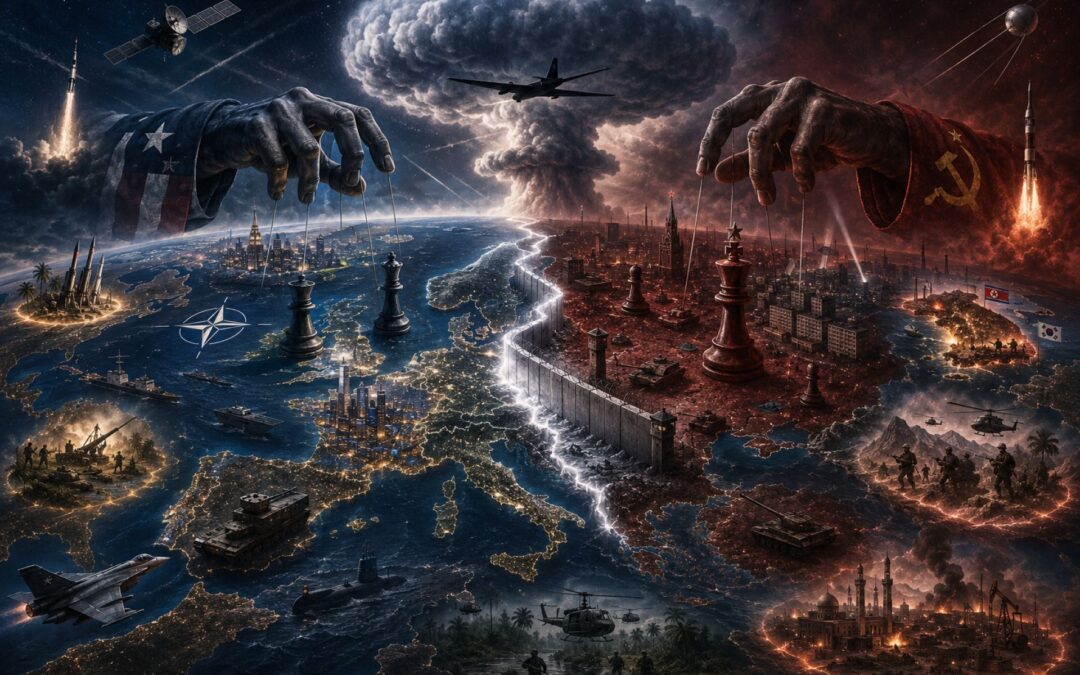
For almost half a century, the world lived with a strange contradiction.
The United States and the Soviet Union never fought each other in a direct, declared war. No American army marched on Moscow. No Soviet army invaded Washington. Yet the fear of war was everywhere: in school drills, spy stories, political speeches, nuclear bunkers, propaganda posters, divided cities, military alliances, space rockets, and battlefields thousands of miles away from either superpower’s capital.
This was the Cold War.
It was “cold” only in the narrowest sense. The two main rivals avoided direct combat because both understood what nuclear war could mean. But across Korea, Vietnam, Afghanistan, Latin America, Africa, the Middle East, and Eastern Europe, the Cold War was anything but cold. It toppled governments, divided countries, armed dictators, inspired revolutions, crushed uprisings, and left scars that still shape world politics today.
At its heart, the Cold War was a struggle over power, ideology, security, and fear. The United States believed the Soviet Union wanted to spread communism across the world. The Soviet Union believed the capitalist West wanted to encircle, weaken, and destroy it. Both sides thought they were defending civilization from the other.
That is what made the conflict so dangerous.
Each side saw itself as defensive.
Each side saw the other as aggressive.
And each side built enough weapons to end the world.
What Was the Cold War?
The Cold War was the long global rivalry between the United States and the Soviet Union after World War II. It lasted roughly from the late 1940s until the collapse of the Soviet Union in 1991.
It was not one single war. It was a system of confrontation.
On one side was the United States and its allies, broadly committed to capitalism, liberal democracy, and a world economy open to American influence. On the other side was the Soviet Union and its allies, committed to one-party communist rule, state control of the economy, and the spread of socialism against Western capitalism.
But the Cold War was never only about ideology. It was also about security.
The Soviet Union had been invaded repeatedly from the west, most devastatingly by Nazi Germany in 1941. Soviet leaders wanted friendly governments in Eastern Europe as a buffer against future invasion. The United States and Britain saw that same buffer zone as Soviet expansion. What Moscow called security, Washington and London called domination.
This tension created a new kind of global conflict.
The two superpowers competed through military alliances, economic aid, propaganda, espionage, nuclear weapons, scientific prestige, and proxy wars. They supported rival governments, funded friendly movements, trained armies, and backed coups and insurgencies.
The strange thing is that both sides feared the same outcome: another world war.
After the United States used atomic bombs on Hiroshima and Nagasaki in 1945, and after the Soviet Union successfully tested its own atomic bomb in 1949, direct war between the superpowers became almost unthinkable. A traditional great-power war could now become nuclear annihilation.
So the Cold War became a contest where both sides fought everywhere except directly against each other.
That made it more stable than World War III.
It also made it more permanent.
The Russian Revolution and the Birth of the Soviet Threat
To understand the Cold War, we have to go back before World War II.
In 1917, Russia was collapsing under the pressure of the First World War. The Russian Empire was poor, unequal, badly governed, and exhausted by war. In February 1917, Tsar Nicholas II was overthrown. Later that year, Vladimir Lenin and the Bolsheviks seized power in the October Revolution.
Lenin’s party promised peace, land, bread, and workers’ rule. In practice, the new regime became a one-party communist state that crushed rivals, pulled Russia out of World War I, and fought a brutal civil war to survive.
The Bolsheviks believed capitalism was exploitative and doomed. They expected communist revolution to spread beyond Russia. To many Western governments, that made the new Soviet regime dangerous from the beginning. It was not just another state. It was a revolutionary state openly hostile to the political and economic order that Western powers defended.
In 1922, the Union of Soviet Socialist Republics was created. The Soviet Union presented itself as the future of humanity: a society without capitalist exploitation, ruled in the name of workers and peasants.
But from the start, it was also a dictatorship.
Political opposition was eliminated. Private property was attacked. The secret police became central to the state. The dream of equality was tied to coercion, surveillance, and violence.
This mattered later because the Cold War was not born suddenly in 1945. Western suspicion of Soviet communism and Soviet suspicion of capitalist encirclement had been building for decades.
The alliance against Hitler temporarily buried that hostility.
It did not erase it.
Stalin, Terror, and the Soviet Transformation
After Lenin’s death in 1924, Joseph Stalin gradually outmaneuvered his rivals and became the dominant figure in the Soviet Union.
Stalin transformed the country with extraordinary speed and extraordinary brutality. His Five-Year Plans pushed rapid industrialization. The Soviet Union moved from a largely agrarian society toward a major industrial power capable of producing steel, weapons, machinery, and eventually the military strength needed to defeat Nazi Germany.
But the human cost was immense.
Forced collectivization devastated the countryside. Millions suffered from famine, including the catastrophic famine in Ukraine known as the Holodomor. The Gulag system expanded into a vast network of forced labor camps. During the Great Purge of the 1930s, Stalin eliminated real and imagined enemies inside the Communist Party, the army, the bureaucracy, and society at large.
By the time World War II began, the Soviet Union was powerful, paranoid, and deeply shaped by Stalin’s worldview.
Stalin believed weakness invited invasion. He believed enemies were everywhere. He believed political control had to be absolute. Those beliefs influenced Soviet behavior after the war. When Eastern Europe came under Soviet occupation, Stalin did not see free elections and pluralist politics as harmless democratic procedures. He saw them as openings through which hostile powers could return.
This did not justify Soviet domination of Eastern Europe. But it helps explain why Moscow treated control of the region as non-negotiable.
Stalin had built a state that survived through fear.
After 1945, he extended that logic outward.
World War II Turned Enemies Into Temporary Allies
When Nazi Germany invaded the Soviet Union in June 1941, the global balance changed. The Soviet Union joined Britain and later the United States in the Grand Alliance against Hitler.
It was one of history’s strangest partnerships.
The United States was capitalist and democratic. Britain was an imperial power fighting for survival. The Soviet Union was a communist dictatorship that had signed a non-aggression pact with Hitler in 1939 before becoming his victim two years later.
They were united by necessity, not trust.
The Soviet Union did most of the fighting against Nazi Germany on the Eastern Front and suffered staggering losses. Tens of millions of Soviet citizens died. Cities were destroyed. Villages were burned. The war left a deep wound in Soviet memory.
The Western Allies also made enormous sacrifices, but they did not experience the war in the same way. No American city was occupied by Nazi armies. Britain was bombed but not invaded. The Soviet Union was almost destroyed.
That difference mattered.
When the Red Army pushed westward and occupied Eastern Europe, Stalin saw a historic victory and a security necessity. The West saw the beginning of a new domination.
Near the end of the war, Allied leaders met at conferences such as Yalta and Potsdam to discuss the postwar world. They agreed on broad principles, but many questions were left vague. What did “free elections” mean in countries occupied by the Red Army? How much influence should the Soviet Union have in Poland, Romania, Hungary, Bulgaria, and East Germany? Could Germany be rebuilt without becoming a threat again?
The war ended with Nazi Germany defeated.
But the peace created a new argument almost immediately.
The Postwar World Begins to Split
After World War II, Europe was shattered. Cities lay in ruins. Economies were broken. Millions of refugees moved across the continent. Germany was divided into occupation zones controlled by the United States, Britain, France, and the Soviet Union.
The central question became: who would shape the future of Europe?
In Eastern Europe, the Soviet Union installed or supported communist-dominated governments. These governments often began as coalitions but gradually eliminated opposition parties, controlled the press, took over police institutions, and aligned themselves with Moscow.
From Stalin’s perspective, this created a buffer zone.
From the Western perspective, it looked like conquest by political means.
In 1946, Winston Churchill gave his famous Iron Curtain speech, declaring that “an iron curtain” had descended across Europe. The phrase captured the new division. Europe was no longer simply recovering from World War II. It was being split into rival spheres.
The United States slowly abandoned its hope that cooperation with Stalin could continue. American policymakers concluded that Soviet power had to be contained. The Soviet Union concluded that the West was organizing an anti-Soviet bloc.
This is one of the great tragedies of the early Cold War: both sides could point to real reasons for fear.
The Soviets had suffered invasion and wanted security.
The West saw Soviet-backed regimes destroying political freedom.
Neither side trusted the other enough to compromise.
That mistrust hardened into policy.
The Truman Doctrine, Marshall Plan, and the Battle for Europe
The Cold War became official not through one declaration of war, but through a series of decisions.
In 1947, President Harry Truman announced what became known as the Truman Doctrine. The immediate context was Greece and Turkey, where the United States feared Soviet pressure and communist expansion. Truman argued that the United States should support free peoples resisting subjugation by armed minorities or outside pressure.
In practice, this became a foundation of containment: the policy of preventing communism from spreading further.
That same year, the United States announced the Marshall Plan, a massive program of economic aid to rebuild Europe. According to the U.S. Office of the Historian’s overview of the Marshall Plan, the United States provided more than $12 billion to help Western European recovery.
This was generous, strategic, and ideological all at once.
Western Europe needed food, fuel, factories, trade, and stability. The United States understood that economic desperation could make communist parties more attractive. Rebuilding Europe was therefore not just humanitarian policy. It was Cold War strategy.
The Soviet Union rejected the Marshall Plan and pressured Eastern European countries to do the same. Moscow saw the plan as American economic imperialism. In response, the Soviet bloc developed its own mechanisms of coordination and control, including Cominform and later COMECON.
This created one of the Cold War’s defining patterns.
The United States used money, markets, and aid to bind Western Europe to its side.
The Soviet Union used party control, military pressure, and centralized planning to hold Eastern Europe to its side.
The battle for Europe was not only military.
It was economic.
It was psychological.
And it was visible in everyday life.
If Western Europe recovered faster and became more prosperous, that would make capitalism look strong. If Eastern Europe struggled under Soviet control, that would make communism look weak. Both sides understood the symbolic stakes.
Nowhere were those stakes clearer than Berlin.
Berlin Becomes the Front Line of the Cold War
Berlin was deep inside the Soviet occupation zone of Germany, but the city itself was divided among the four victorious powers. The western sectors were controlled by the United States, Britain, and France. The eastern sector was controlled by the Soviet Union.
This made West Berlin an island of Western influence inside Soviet-controlled territory.
For Stalin, that was intolerable. For the West, abandoning Berlin would signal weakness.
In 1948, the Soviet Union blockaded land and water routes into West Berlin, hoping to force the Western Allies out. Instead of withdrawing, the United States and Britain organized the Berlin Airlift. For months, aircraft flew food, fuel, and supplies into the city.
The airlift was a logistical triumph and a propaganda victory. It showed Western commitment without firing directly on Soviet forces. Stalin eventually lifted the blockade in 1949.
The crisis deepened the division of Germany. In 1949, West Germany became the Federal Republic of Germany. East Germany became the German Democratic Republic, a Soviet-backed communist state.
Berlin had become more than a city.
It was the Cold War in miniature: divided, tense, symbolic, and dangerous.
The crisis also convinced Western leaders that Soviet pressure could not be handled casually. Europe needed a permanent military alliance.
NATO, the Warsaw Pact, and the Creation of Rival Blocs
In 1949, the United States, Canada, and several Western European countries created NATO, the North Atlantic Treaty Organization. Its core principle was collective defense: an attack on one member would be treated as an attack on all.
The U.S. Office of the Historian’s summary of the formation of NATO explains how the alliance emerged from Western fears of Soviet expansion and the need to tie American power permanently to European security.
To the West, NATO was defensive.
To the Soviet Union, NATO looked like encirclement.
In 1955, after West Germany joined NATO, the Soviet Union responded by creating the Warsaw Pact with its Eastern European satellite states. NATO’s own history notes how West Germany’s entry into NATO helped trigger the formation of the Warsaw Pact.
Europe was now divided into rival military blocs.
This made the Cold War more organized and more dangerous. A crisis in Germany, Poland, Turkey, or elsewhere could trigger alliance commitments and pull the superpowers toward confrontation.
The blocs also created two political worlds. Western Europe increasingly rebuilt under American protection and economic influence. Eastern Europe remained under Soviet control, with local communist parties backed by Moscow and, when necessary, Soviet tanks.
The Cold War was no longer just a disagreement between leaders.
It had become a map.
Nuclear Weapons Changed the Rules of War
Nuclear weapons made the Cold War unlike any earlier rivalry in history.
At first, the United States had a nuclear monopoly. That ended in 1949, when the Soviet Union tested its first atomic bomb. The arms race then escalated from atomic bombs to hydrogen bombs, from bombers to missiles, from basic nuclear retaliation to complex systems of deterrence.
The logic was terrifying.
If one side attacked, the other side could respond with devastating force. If both sides had enough weapons to destroy each other even after being attacked first, then starting a nuclear war would be suicidal. This became known as mutually assured destruction, often shortened to MAD.
It sounds absurd because it was absurd.
But it also worked, in a grim way.
Nuclear weapons made direct superpower war too dangerous. Leaders could threaten, pressure, blockade, spy, and arm allies, but they had to avoid crossing the line into direct war. The price could be civilization itself.
That did not make the world safe. It made the world permanently anxious.
Every crisis carried the fear of escalation. Every new missile system raised questions of advantage. Every technological breakthrough threatened the balance. Every false alarm could become catastrophe.
The Cold War became a long argument conducted under the shadow of a mushroom cloud.
China Turns Communist and the Cold War Goes Global
For the first few years after World War II, the Cold War’s center was Europe. That changed dramatically in 1949.
After decades of civil war, Mao Zedong’s Communist Party defeated Chiang Kai-shek’s Nationalist government in China. The Nationalists fled to Taiwan, while Mao proclaimed the People’s Republic of China.
To the United States, this was a geopolitical earthquake.
The world’s most populous country had become communist. The Soviet Union now appeared to have a massive communist partner in Asia. American fears of a spreading communist bloc intensified.
In 1950, the Soviet Union and China signed a treaty of alliance. The alliance would later fracture, but at the time it made the communist world look larger, stronger, and more coordinated than before.
The Cold War was no longer a European standoff.
It was now global.
This shift changed American strategy. U.S. leaders began to see conflicts in Asia, the Middle East, Africa, and Latin America through the lens of containment. Local struggles over land, independence, corruption, dictatorship, colonialism, or nationalism were often interpreted as part of the larger battle between communism and capitalism.
That Cold War lens could simplify reality dangerously.
Not every left-wing movement was controlled by Moscow. Not every anti-communist regime was democratic. Not every revolution was a Soviet plot. But once the world was divided into rival camps, local conflicts were constantly pulled into global competition.
The next major test came in Korea.
The Korean War Shows How the Cold War Could Turn Hot
After World War II, Korea was divided along the 38th parallel. The Soviet Union supported a communist regime in the North. The United States supported an anti-communist regime in the South.
Both Korean governments claimed to represent the whole peninsula. Both wanted reunification on their own terms.
In June 1950, North Korea invaded South Korea. The attack quickly turned a divided country into one of the first major hot wars of the Cold War.
The United Nations, led mainly by the United States, intervened to defend South Korea. After early North Korean success, U.S. and allied forces landed at Incheon, recaptured Seoul, and pushed northward. But when they approached the Chinese border, China entered the war with massive force.
The war became a brutal stalemate. The front eventually settled near where it had begun.
The Korean War showed several things that would define the Cold War for decades.
First, the Cold War could turn hot very quickly.
Second, the superpowers could fight indirectly through allies and clients.
Third, nuclear weapons limited choices. General Douglas MacArthur pushed for a more aggressive approach, including widening the war against China. President Truman rejected that path and fired him. The United States wanted to contain communism, but it did not want a general war with China and the Soviet Union.
Fourth, the war left behind an unresolved division that still exists today.
Korea became one of the clearest examples of the Cold War’s legacy: a temporary military line hardened into a permanent political reality.
Khrushchev, De-Stalinization, and the Limits of Reform
Stalin died in 1953. His death created a power struggle inside the Soviet leadership and eventually brought Nikita Khrushchev to the top.
Khrushchev did something shocking. In 1956, he denounced Stalin’s crimes in a secret speech to the Communist Party. He criticized the cult of personality, mass repression, and the terror that had defined Stalin’s rule.
This began a process known as de-Stalinization.
Some prisoners were released. Some censorship loosened. Stalin’s image was reduced. The Soviet Union seemed, for a moment, as if it might become less repressive.
But there were strict limits.
The Communist Party would remain in power. The Soviet bloc would remain under Moscow’s control. Reform was allowed only as long as it did not threaten the system itself.
That became clear in Eastern Europe.
In East Germany in 1953, workers’ protests were suppressed. In Hungary in 1956, a revolution demanded political freedom and withdrawal from Soviet domination. Soviet tanks crushed it. In Poland, unrest led to limited reforms, but only within boundaries Moscow could accept.
Khrushchev wanted to move beyond Stalin’s worst terror.
He did not want to give up Soviet control.
This contradiction became a recurring problem for communist regimes. They promised reform, but feared freedom. They wanted legitimacy, but relied on coercion. They wanted citizens to believe in socialism, but often needed police power to keep them from leaving it.
That tension would eventually break the system.
But not yet.
Spies, Fear, and the Red Scare
The Cold War was not only fought with armies and missiles. It was fought in shadows.
The United States had the CIA. The Soviet Union had the KGB. Both sides recruited agents, stole secrets, intercepted communications, ran covert operations, funded political groups, and tried to influence events inside other countries.
Espionage mattered because information could change the balance of power. Soviet spies gained access to Western nuclear secrets, helping Moscow close the atomic gap faster than the United States expected. Western intelligence tried to understand Soviet military capabilities, political intentions, and internal weaknesses.
But spying also fed paranoia.
In the United States, fear of communism became a domestic political force. During the Red Scare, government employees, artists, writers, teachers, union organizers, and ordinary citizens could be accused of communist sympathies. Senator Joseph McCarthy became the most famous face of this era, claiming that communists had infiltrated American institutions.
Some espionage fears were real. Soviet intelligence did operate inside the West.
But McCarthyism went far beyond legitimate security concerns. It damaged careers, encouraged informants, narrowed political debate, and turned accusation into a weapon. The fear of communism collided with the freedoms the United States claimed to defend.
The Soviet Union had its own culture of suspicion, but with far harsher consequences. Dissent could mean surveillance, imprisonment, exile, psychiatric abuse, or worse. Citizens lived with censorship and the knowledge that the state could punish political disobedience severely.
Both sides said they were protecting freedom and security.
Both sides built systems of secrecy.
And both sides taught their citizens to fear invisible enemies.
The Space Race and the Technological Cold War
In 1957, the Soviet Union launched Sputnik, the first artificial satellite to orbit Earth. It was a small object, but its psychological impact was enormous.
If the Soviet Union could launch a satellite into orbit, Americans wondered, could it also deliver nuclear missiles across continents?
Sputnik made the Cold War feel technological, scientific, and existential. The rivalry was no longer only about territory or ideology. It was about which system could master the future.
The Soviet Union followed Sputnik with another stunning achievement in 1961, when Yuri Gagarin became the first human in space. For a time, Moscow seemed ahead in the Space Race.
The United States responded with urgency. Science education, missile technology, aerospace funding, and national prestige became linked. President John F. Kennedy committed the United States to landing a man on the Moon before the end of the decade.
The Space Race had peaceful language, but military logic was never far away. Rockets that could carry astronauts could also carry warheads. Satellites could support communication, surveillance, targeting, and intelligence.
Still, space also gave the Cold War a strange beauty. It produced achievements that belonged to all humanity, even though they were driven by rivalry. The first satellite, the first human in space, the Moon landing — all were born from competition, but they expanded the human imagination.
The Cold War made the sky a battlefield.
It also made it a dream.
The Berlin Wall and the Prison of East Germany
Berlin remained the Cold War’s most visible wound.
By the late 1950s and early 1960s, East Germany faced a serious problem. Millions of people were leaving for the West, many through Berlin. The open border between East and West Berlin allowed East Germans to see the contrast between the two systems and, if they chose, escape.
This was embarrassing and economically damaging for the East German regime. It was also a propaganda disaster for communism. If socialism was the future, why were so many people fleeing it?
On August 13, 1961, East German authorities began sealing the border. Barbed wire appeared first. Concrete followed. Over time, the Berlin Wall became a heavily fortified barrier with guard towers, patrols, floodlights, alarms, and a deadly no-man’s-land.
The Imperial War Museums’ history of the Berlin Wall explains how it surrounded West Berlin and became one of the most powerful symbols of the Cold War division of Europe.
The Wall was officially presented as an anti-fascist protective barrier. In reality, it was built to keep people in.
Families were separated overnight. Workers lost jobs across the border. Friends and relatives found themselves divided by concrete and guns. Thousands tried to escape. Some succeeded through tunnels, forged papers, hidden compartments, balloons, and daring improvisation. Others were captured or killed.
The Wall exposed the central weakness of the East German state. It could claim legitimacy, but it needed a wall to stop its citizens from leaving.
In 1963, Kennedy visited West Berlin and declared solidarity with the city. His speech turned Berlin into a moral symbol for the West. Democracy was imperfect, he argued, but it did not need walls to keep people from escaping.
That was the point Berlin made better than any speech.
The Cold War was not abstract there.
It was concrete.
The Cuban Missile Crisis Brings the World to the Edge
The most dangerous moment of the Cold War came in October 1962.
Cuba had become communist after Fidel Castro’s revolution overthrew the Batista dictatorship in 1959. For the United States, this was alarming. A communist government now existed just 90 miles from Florida.
The United States tried to remove Castro through covert action and the failed Bay of Pigs invasion in 1961. The failure humiliated the Kennedy administration and convinced Castro that another American attack might come.
The Soviet Union saw an opportunity. By secretly placing nuclear missiles in Cuba, Khrushchev could protect Castro, strengthen Soviet bargaining power, and offset American missiles stationed near the Soviet Union, including in Turkey.
In October 1962, American U-2 spy planes discovered Soviet missile sites under construction in Cuba. Kennedy faced a terrifying choice. An invasion or airstrike could trigger war with the Soviet Union. Doing nothing would allow Soviet nuclear missiles to become operational near American territory.
Kennedy chose a naval blockade, officially called a quarantine, to stop further Soviet military shipments to Cuba.
For thirteen days, the world moved toward nuclear war.
The U.S. Office of the Historian’s account of the Cuban Missile Crisis describes the confrontation as one of the most dangerous moments in Cold War diplomacy. The United States moved to DEFCON 2, the highest level ever reached below nuclear war. A U-2 spy plane was shot down over Cuba. Soviet ships approached the blockade line. At sea, a Soviet submarine came close to launching a nuclear torpedo, but officer Vasili Arkhipov refused to approve the launch.
Eventually, Kennedy and Khrushchev reached a deal. The Soviet Union would remove its missiles from Cuba. The United States would publicly promise not to invade Cuba and secretly agree to remove its Jupiter missiles from Turkey.
The crisis frightened both sides.
It showed that nuclear war could happen not because leaders wanted it, but because events could outrun control. Miscommunication, military pressure, domestic politics, and fear could push the world toward disaster.
Afterward, the superpowers created a direct hotline and pursued limited arms-control measures. The 1963 Limited Test Ban Treaty banned nuclear tests in the atmosphere, outer space, and underwater.
The Cuban Missile Crisis did not end the Cold War.
But it taught both sides that winning a nuclear showdown might mean losing everything.
Vietnam and the Rise of Proxy Wars
Vietnam became one of the Cold War’s most painful and consequential conflicts.
After World War II, Vietnamese nationalists fought to end French colonial rule. The struggle was led in the North by Ho Chi Minh and the communist Viet Minh. After the French defeat at Dien Bien Phu in 1954, Vietnam was temporarily divided into North and South.
The North became communist. The South became anti-communist and backed by the United States.
American leaders saw Vietnam through the domino theory: if South Vietnam fell to communism, they feared Laos, Cambodia, Thailand, and other countries might follow. This turned a Vietnamese struggle over colonialism, nationalism, dictatorship, and reunification into a Cold War test of credibility.
The United States first sent advisors. Then it sent troops. From 1965 onward, the war escalated massively.
The problem was that Vietnam was not the kind of war the United States was built to fight. The Viet Cong and North Vietnamese forces used guerrilla tactics, local networks, tunnels, jungle cover, and political organization. American firepower was immense, but it could not easily distinguish enemy fighters from civilians or solve the political weakness of the South Vietnamese government.
The war became brutal. Bombing campaigns devastated large areas. Civilians were killed. Soldiers faced a confusing and demoralizing conflict. The Ho Chi Minh Trail kept supplies moving through Laos and Cambodia. At home, television brought the war into American living rooms.
Public opinion shifted. The antiwar movement grew. The Tet Offensive in 1968 shocked Americans, even though it was a military setback for communist forces, because it contradicted official claims that victory was near.
President Lyndon Johnson chose not to seek reelection. Richard Nixon later pursued Vietnamization, withdrawing American troops while expanding bombing in parts of Indochina. The United States ended direct military involvement in 1973. In 1975, Saigon fell and Vietnam was unified under communist rule.
Vietnam changed the Cold War.
It showed the limits of American power. It weakened trust in government. It made the public more skeptical of intervention. It also demonstrated that proxy wars were not minor side conflicts. They could consume presidencies, kill millions, and reshape societies.
For the superpowers, Vietnam was one battlefield in a global contest.
For the Vietnamese, it was their country.
That difference mattered.
The Cold War Spreads Through the Third World
The Cold War is often told as a story of Washington, Moscow, Berlin, and nuclear missiles.
But much of its violence happened elsewhere.
As empires collapsed after World War II, newly independent countries in Asia, Africa, and the Middle East faced enormous questions. What kind of government should they build? How should land be distributed? Who should control resources? Should they align with the United States, the Soviet Union, China, or neither?
The superpowers saw these questions through Cold War logic. Local conflicts became opportunities. A revolution, civil war, election, labor movement, or military coup could be interpreted as a gain or loss in the global balance.
The Council on Foreign Relations’ overview of Cold War conflicts notes that although the United States and Soviet Union avoided direct war against each other, proxy conflicts tied to their rivalry killed millions.
In the Middle East, the United States often backed Israel and conservative anti-communist governments, while the Soviet Union supported several Arab nationalist regimes and movements at different times. In Africa, Cold War rivalry intensified conflicts in Angola, Ethiopia, Somalia, Mozambique, and elsewhere. In Latin America, the United States supported coups, dictatorships, and counterinsurgencies in the name of anti-communism, while Cuba and the Soviet Union supported revolutionary movements.
Afghanistan became one of the late Cold War’s defining disasters. In 1979, the Soviet Union invaded to support a communist government facing rebellion. The United States, Pakistan, Saudi Arabia, and others supported Afghan mujahideen fighters. The war drained Soviet resources, brutalized Afghanistan, and helped create forces that would shape global politics long after the Cold War ended.
The phrase “Third World” originally referred not simply to poverty, but to countries outside the First World capitalist bloc and the Second World communist bloc. Many leaders tried to avoid becoming pawns through the Non-Aligned Movement.
But non-alignment was difficult in a world where both superpowers saw neutrality as suspicious.
For many countries, the Cold War was not a chess match.
It was foreign money, weapons, coups, civil wars, secret police, insurgencies, sanctions, and ruined lives.
Détente: Why the Superpowers Tried to Cool Things Down
By the late 1960s and 1970s, both superpowers had reasons to reduce tension.
The United States was exhausted by Vietnam. The Soviet Union was spending heavily on the military while its economy struggled to provide the consumer goods and living standards its people wanted. Nuclear weapons had become so numerous and destructive that endless escalation seemed increasingly irrational.
This period of reduced tension became known as détente.
Détente did not mean friendship. It meant managed rivalry.
President Richard Nixon and his national security adviser Henry Kissinger pursued a more flexible strategy. Nixon visited China in 1972, exploiting the growing split between China and the Soviet Union. He also visited Moscow, where the United States and Soviet Union signed the first Strategic Arms Limitation Treaty, known as SALT I.
The goal was not to end the Cold War. It was to make it less likely to spiral into nuclear war.
Arms-control agreements tried to place limits on certain weapons and stabilize deterrence. Diplomatic contact increased. Trade and cultural exchanges expanded. Both sides accepted that the other was not going to disappear soon.
But détente had limits.
The ideological rivalry continued. Proxy wars continued. The Soviet Union still repressed dissent in Eastern Europe. The United States still supported anti-communist regimes abroad. Each side still distrusted the other.
Détente was a pause in escalation, not a solution.
And by the end of the 1970s, it was falling apart.
The Cold War Heats Up Again
Several crises revived Cold War tension.
The Soviet invasion of Afghanistan in 1979 shocked the West and damaged détente. The United States saw it as evidence that Moscow was still willing to expand by force. President Jimmy Carter responded with sanctions, support for Afghan resistance, and a boycott of the 1980 Moscow Olympics.
In Europe, the Euromissile crisis raised fears of nuclear war on the continent. Both sides deployed or planned new intermediate-range missiles. Europeans found themselves once again at the center of a potential nuclear battlefield.
Then came Ronald Reagan.
Reagan entered office in 1981 with a much harder line against the Soviet Union. He called it an “evil empire” and argued that the United States had become too passive. His administration increased military spending, supported anti-communist movements, and promoted the Strategic Defense Initiative, often called Star Wars, a proposed missile defense system based on advanced technology.
The Soviet leadership saw this as threatening. From Moscow’s perspective, the United States appeared to be seeking military superiority, not just defense.
Tensions became especially dangerous in 1983. The Soviet Union shot down Korean Air Lines Flight 007 after it entered Soviet airspace, killing all aboard. That same year, NATO conducted Able Archer, a military exercise that some Soviet officials feared might be cover for a real attack.
The early 1980s felt like a return to the darkest Cold War years.
But underneath the renewed confrontation, the Soviet system was weakening.
Its economy was stagnant. Its leadership was aging. Its military commitments were expensive. Its citizens were cynical. Its ideology no longer inspired the confidence it once had.
The Cold War heated up again just as one side was becoming less able to sustain it.
Gorbachev Tries to Save the Soviet System
Mikhail Gorbachev became leader of the Soviet Union in 1985. He was younger, more energetic, and more willing to admit that the system was in trouble.
Gorbachev did not initially set out to destroy the Soviet Union.
He wanted to save it.
He believed the Soviet system had become stagnant because it was too rigid, too secretive, too bureaucratic, and too afraid of honest criticism. To revive it, he introduced two major reforms: glasnost and perestroika.
Glasnost meant openness. It allowed more public discussion, more criticism, and more honesty about Soviet history and present problems.
Perestroika meant restructuring. It aimed to reform the Soviet economy and political system to make them more flexible and effective.
These reforms changed everything.
Once people were allowed to criticize the system, they criticized it more deeply than the leadership expected. Once information became freer, old lies became harder to maintain. Once fear loosened, nationalist movements, democratic activists, workers, intellectuals, and ordinary citizens began demanding more than controlled reform.
Gorbachev also changed Soviet foreign policy. He knew the arms race was draining the Soviet economy. He wanted better relations with the West. His meetings with Reagan helped reduce tensions and led to major arms-control progress.
The 1987 Intermediate-Range Nuclear Forces Treaty was especially important. The Arms Control Association’s summary of the INF Treaty notes that it eliminated an entire class of U.S. and Soviet ground-launched missiles with ranges between 500 and 5,500 kilometers.
That was a major breakthrough.
But Gorbachev’s most consequential decision may have been what he refused to do.
He refused to keep the Eastern Bloc under control by force.
That decision changed history.
The Eastern Bloc Breaks Free
For decades, Soviet control over Eastern Europe had ultimately rested on the threat of intervention. If a communist government was seriously threatened, Moscow could send tanks.
Gorbachev changed that.
He signaled that Eastern European countries would have to find their own way. The Soviet Union would no longer automatically crush reform movements to preserve hardline communist rule.
This was a revolution in itself.
In Poland, the Solidarity movement, rooted in independent trade union activism, challenged communist authority and eventually won a stunning victory in partially free elections in 1989. In Hungary, reformers opened political space and began dismantling the border barrier with Austria.
That opening mattered enormously.
East Germans had long been trapped by the Berlin Wall. But if they could travel to Hungary, and Hungary’s border with Austria was opening, then a route to the West suddenly existed. Thousands of East Germans fled.
Pressure built inside East Germany. Protests grew. The hardline leadership could not control the situation as it once had. On November 9, 1989, after a confused announcement about travel rules, crowds gathered at Berlin Wall crossing points. Border guards, overwhelmed and uncertain, opened the gates.
The Berlin Wall fell not through a planned demolition, but through accumulated pressure, public courage, bureaucratic confusion, and a regime that had lost the will and ability to shoot its way out of crisis.
The Berlin Wall Foundation’s account of the fall of the Berlin Wall explains how the events of November 9, 1989 opened the border and transformed the political future of Germany and Europe.
The images were unforgettable: people climbing the Wall, embracing strangers, crossing freely, hammering at concrete that had divided families for 28 years.
The Iron Curtain was unraveling.
In Czechoslovakia, the Velvet Revolution peacefully ended communist rule. In Bulgaria, the communist leadership collapsed. In Romania, the revolution turned violent and ended with the execution of Nicolae Ceaușescu. In 1990, Germany reunified.
The Cold War order in Europe disintegrated with astonishing speed.
What had seemed permanent was suddenly gone.
The Soviet Union Collapses
The fall of the Eastern Bloc weakened the Soviet Union’s authority, but the deeper crisis was inside the USSR itself.
The Soviet Union was a union of republics, including Russia, Ukraine, Belarus, the Baltic states, the Caucasus republics, and Central Asian republics. Under strong central control, this structure had held together. Under glasnost and political reform, national grievances resurfaced.
The Baltic states demanded independence. Other republics asserted sovereignty. Economic problems worsened. Political authority fragmented.
Boris Yeltsin emerged as a rival to Gorbachev. He positioned himself as a democratic reformer and became president of the Russian republic, the largest and most powerful republic within the Soviet Union.
In August 1991, communist hardliners attempted a coup against Gorbachev. They wanted to stop the reforms and preserve the Soviet system. The coup failed, partly because Yeltsin and his supporters resisted publicly in Moscow.
The failure destroyed what remained of the Communist Party’s authority.
The U.S. Office of the Historian’s overview of the collapse of the Soviet Union describes how the failed coup accelerated the breakup of Soviet power and the movement of republics toward independence.
By December 1991, the Soviet Union was finished. Russia, Ukraine, and Belarus announced that the USSR no longer existed and formed the Commonwealth of Independent States. Gorbachev resigned on December 25, 1991.
The red flag came down over the Kremlin.
The Cold War was over.
But it did not end like World War II, with armies conquering a capital and a surrender ceremony on a battleship. It ended through exhaustion, reform, nationalism, political miscalculation, economic stagnation, and the loss of belief.
The Soviet Union did not lose a final battle.
It lost the ability to continue.
What the Cold War Left Behind
The Cold War ended, but it did not disappear.
Its legacy is everywhere.
NATO survived and expanded. Russia’s relationship with the West remained haunted by arguments over security, influence, and humiliation. Nuclear weapons remained central to global politics. Arms-control agreements reduced some dangers, but the possibility of nuclear war never vanished.
Korea remained divided. The Korean War never ended with a full peace treaty, and North Korea eventually built its own nuclear weapons.
Vietnam was unified under communist rule, but only after decades of war and enormous human suffering.
Afghanistan was devastated by invasion, resistance, civil war, and the long afterlife of Cold War intervention.
Across Latin America, Africa, the Middle East, and Asia, countries lived with the consequences of coups, proxy wars, armed movements, dictatorships, and external interference.
The Cold War also shaped how people think. It encouraged the habit of dividing the world into camps: free world versus tyranny, capitalism versus communism, West versus East, us versus them. Even after the Soviet Union collapsed, that mental map did not fully disappear.
It shaped intelligence agencies, military budgets, diplomatic institutions, technology, space exploration, universities, culture, film, literature, and public fear.
It gave the world the internet’s military ancestors, satellite systems, nuclear submarines, spy planes, space programs, and enough weapons to destroy civilization many times over.
It also gave the world cautionary lessons.
Ideology can make compromise feel like betrayal.
Security can become indistinguishable from domination.
Fear can justify almost anything.
And a war does not need to be formally declared to shape an entire century.
Conclusion: The War That Never Officially Happened
The Cold War was the war that never officially happened between the two countries powerful enough to end the world.
That was its central paradox.
The United States and the Soviet Union avoided direct war because nuclear weapons made victory impossible. But that same fear pushed their rivalry into every other available space: divided cities, military alliances, propaganda, espionage, economies, elections, revolutions, and proxy wars.
For Americans and Soviets, the Cold War was often remembered as tension, competition, and fear.
For Koreans, Vietnamese, Afghans, Angolans, Nicaraguans, Cubans, Hungarians, Czechs, Germans, and many others, it was not cold at all. It was invasion, occupation, dictatorship, bombing, exile, censorship, resistance, and loss.
The Cold War divided the world into rival systems.
It nearly destroyed it through nuclear crisis.
And then, almost unbelievably, it ended not with global fire, but with people crossing borders, tearing down walls, demanding elections, rejecting fear, and proving that even the most permanent-looking systems can collapse.
For 45 years, the world lived under the shadow of a war that could not be fought.
The miracle is not that the Cold War ended.
The miracle is that it did not end everything else with it.
Last Updated on July 4, 2026 by Aseem Gupta