
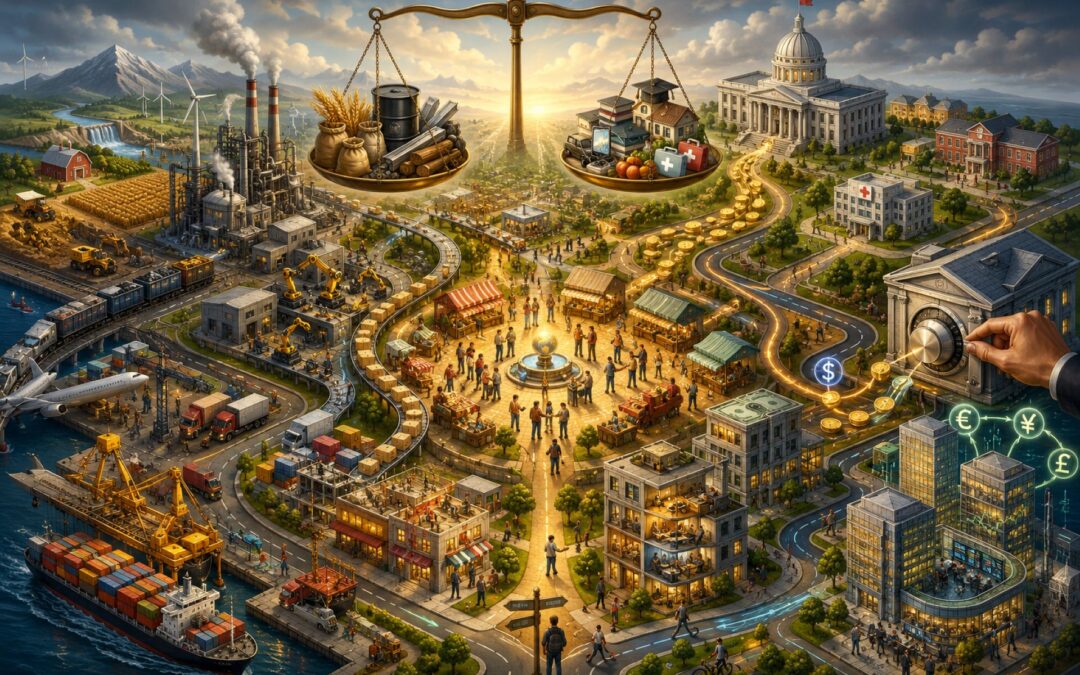
You wake up, check your phone, buy breakfast, pay rent, complain about prices, think about your salary, avoid your bank balance, wonder why houses cost so much, and hear someone on the news say the economy is “strong” even though everything feels expensive.
That is economics.
Not just money. Not just stock markets. Not just inflation charts or politicians arguing about taxes.
Economics is the study of how people make choices when they cannot have everything. It is about scarcity, trade-offs, incentives, markets, work, governments, money, power, and human behavior. It explains why rent rises, why jobs disappear, why countries trade, why banks matter, why prices change, why governments borrow, and why people often make terrible financial decisions even when they know better.
The American Economic Association describes economics as a field that studies how people use scarce resources, respond to incentives, and make decisions. That may sound abstract, but it is deeply practical.
Economics begins with a simple problem.
We want more than the world can give us at once.
Economics Begins With Scarcity
Scarcity is the foundation of economics.
There is only so much land, food, oil, housing, time, labor, money, attention, and patience to go around. People want homes, healthcare, education, vacations, better phones, safer streets, cleaner air, and a slightly nicer life than the one they currently have.
But resources are limited.
That gap between unlimited wants and limited resources is why economics exists. If everyone could have everything they wanted without cost, delay, labor, conflict, or consequence, there would be no need to study markets, money, wages, taxes, trade, or policy.
But we do not live in that world.
We live in a world where a city has limited land. A household has limited income. A government has limited tax revenue. A company has limited workers. A student has limited time. A country has limited natural resources.
So choices must be made.
A family choosing between rent and savings is making an economic decision. A government choosing between defense spending and healthcare is making an economic decision. A business choosing whether to hire workers or buy software is making an economic decision. A person choosing whether to study, work, rest, or scroll for another hour is making an economic decision too.
This is why economics is not just about money.
Money is one way we measure trade-offs. But the real subject is choice under constraint.
Scarcity forces the question every economy must answer:
What should we do with what we have?
Every Choice Has An Opportunity Cost
Every choice costs more than the money you spend.
It also costs the next best thing you gave up.
That is opportunity cost.
If you spend money on a new phone, the opportunity cost is whatever else that money could have done: rent, savings, travel, debt repayment, a course, or simply peace of mind. If you spend three hours watching videos, the opportunity cost is the work, sleep, exercise, reading, or conversation you did not have.
Opportunity cost is one of the most useful ideas in economics because it makes hidden costs visible.
A “free” event is not free if it takes four hours of your day. A cheap apartment is not cheap if it adds two exhausting hours to your commute. A high-paying job may not be as valuable as it looks if it consumes your health, relationships, and energy.
This is where economics becomes less about spreadsheets and more about judgment.
People, businesses, and governments constantly face trade-offs. A country that spends more on highways may spend less on public transport. A company that keeps prices low may cut product quality. A worker who chooses security may give up flexibility. A student who chooses a prestigious degree may take on years of debt.
Economics does not tell us that one choice is always right.
It teaches us to ask what we are giving up.
That one question changes everything.
Trade Makes People Better Off
Scarcity creates trade-offs.
Trade creates possibilities.
If one person grows rice and another makes shoes, both are better off when they exchange. The rice farmer does not have to learn shoemaking. The shoemaker does not have to grow rice. Each can specialize, produce more efficiently, and trade for the rest.
This is the basic logic of markets, jobs, companies, cities, and global commerce.
The deeper idea is comparative advantage.
Comparative advantage does not mean being the best at something. It means being relatively better at producing one thing compared with another. Even if one person or country is more efficient at everything, trade can still make sense if each side specializes where its relative advantage is strongest.
That idea helps explain why people do different jobs, why companies outsource certain tasks, and why countries export some goods while importing others.
A lawyer may be faster than an assistant at preparing documents, but it may still make sense for the assistant to do it because the lawyer’s time is more valuable elsewhere. A country may be able to grow food and manufacture electronics, but if electronics create more value and food can be imported cheaply, specialization may still make sense.
Trade is not magic. It does not make everyone equally rich. It does not protect every worker. It does not prevent exploitation by itself.
But when trade works well, it allows people to do more with less.
It turns individual specialization into collective abundance.
Markets Use Prices To Coordinate Choices
A market is not just a physical place.
It is any system where buyers and sellers exchange goods, services, labor, assets, or information.
A vegetable market is a market. A stock exchange is a market. A job portal is a market. A housing app is a market. A freelance platform is a market. Even informal bargaining between two people is a market.
Markets work through prices.
Prices are signals. They tell buyers how scarce or desirable something is. They tell sellers whether producing more is worth it.
If the price of coffee rises, some consumers buy less. Some producers try to grow or sell more. If the price of laptops falls, more people may buy them, while some producers may reduce output if profits shrink. This push and pull is the basic logic of supply and demand.
Demand is how much people are willing and able to buy at different prices. Supply is how much producers are willing and able to sell at different prices. Where the two meet, a market price emerges.
The OpenStax introduction to demand and supply explains this as one of the core tools economists use to understand how markets allocate resources.
But prices do more than move goods.
They shape behavior.
Higher wages can attract more workers. Higher rent can push people out of neighborhoods. Higher interest rates can reduce borrowing. Higher taxes on cigarettes can reduce smoking. Subsidies for solar energy can encourage investment. Discounts can make people buy things they did not know they wanted five minutes ago.
That is the power of incentives.
People respond to rewards and penalties, even when they do not consciously think of them that way.
Markets are powerful because they coordinate millions of decisions without one person directing everything. No single person has to plan how much bread, coffee, petrol, toothpaste, or phone storage a city needs each day. Prices, profits, losses, and competition do much of that coordination.
But markets have limits.
They do not automatically care about fairness. They do not protect people who have no purchasing power. They do not price clean air properly unless rules force them to. They may reward manipulation, monopoly, or speculation. They can produce abundance and still leave many people insecure.
Markets are useful.
They are not sacred.
Money Makes Trade Easier
Imagine trying to buy a laptop with sacks of rice.
The seller may not want rice. They may want rent money. The landlord may not want rice either. The entire transaction collapses unless everyone wants exactly what the other person has.
That is the problem of barter.
Money solves it.
Money works because people trust that others will accept it. It acts as a medium of exchange, which means we can use it to buy and sell things. It acts as a unit of account, which means we can compare prices. It acts as a store of value, which means we can save purchasing power for later.
Money has taken many forms across history: shells, metal coins, gold, paper notes, bank deposits, digital balances, and now cryptocurrencies. The form changes. The basic requirement remains the same.
People must believe it has value.
Trust is the hidden engine of money.
A currency works when people believe they can use it tomorrow. When that belief collapses, money stops behaving like money. In hyperinflation, prices rise so rapidly that people rush to spend currency before it loses more value. Savings are destroyed. Wages become meaningless. Ordinary life becomes chaotic.
This is why money is not just a convenience.
It is a social agreement backed by institutions, law, habit, and confidence.
When money works, trade becomes easier, saving becomes possible, and complex economies can grow. When money fails, the economy can fall apart very quickly.
Banks, Credit, And Interest Move Money Through The Economy
Banks sit at the center of modern economic life because they connect savers and borrowers.
People deposit money. Banks lend money. Borrowers use that money to buy homes, start businesses, expand factories, pay for education, or cover short-term needs. In return, they pay interest.
Interest is the price of borrowing money.
When interest rates are low, borrowing becomes cheaper. People and businesses are more likely to take loans, spend, invest, and expand. When interest rates are high, borrowing becomes expensive. Spending slows. Investment becomes more cautious. The economy cools.
This is why central banks matter.
In the United States, the Federal Reserve explains that monetary policy works partly by influencing interest rates and financial conditions to support price stability and employment. The Federal Reserve’s guide to monetary policy is a useful starting point for understanding this role.
Commercial banks also help create money through lending. When a bank gives a loan, it adds money to the borrower’s account. That money enters the economy. As loans are repaid, money is reduced. This is one reason credit booms can make economies feel rich, and credit crashes can cause severe pain.
But banking depends on confidence.
Banks do not keep every depositor’s money sitting untouched in a vault. They keep enough reserves to meet normal withdrawals and lend out the rest. That usually works.
Until everyone panics at once.
A bank run happens when too many depositors try to withdraw their money at the same time. Even a bank with valuable assets can collapse if it cannot meet sudden demands for cash. This is why deposit insurance exists. In the United States, the FDIC explains deposit insurance as a way to protect depositors and reduce panic.
Banks make modern growth possible.
They also make modern crises possible.
That is the bargain.
GDP Measures Economic Activity, But Not Everything That Matters
Gross domestic product, or GDP, is one of the most quoted economic numbers in the world.
It measures the total value of final goods and services produced within a country over a specific period. The U.S. Bureau of Economic Analysis defines GDP as a broad measure of economic activity.
The word “final” matters.
If a farmer sells wheat to a mill, the mill sells flour to a bakery, and the bakery sells bread to a customer, GDP should not count the wheat, flour, and bread as separate final products. That would double-count the same value chain. GDP counts the final bread.
There are three common ways to think about GDP.
You can add up production. You can add up income. Or you can add up spending.
The spending version is often written as:
GDP = Consumption + Investment + Government Spending + Exports − Imports
In plain English, that means an economy’s output includes what households buy, what businesses invest in, what governments spend, and what the country sells abroad, minus what it imports from elsewhere.
GDP is useful because it gives us a rough measure of economic size and activity. GDP per capita, which divides GDP by population, is often used to compare average living standards across countries. The World Bank’s GDP per capita data is commonly used for this kind of comparison.
But GDP has serious limits.
It does not count unpaid care work properly. It does not tell us whether income is fairly distributed. It can rise after natural disasters because rebuilding creates spending. It can rise when pollution increases, forests are destroyed, or people work longer hours under worse conditions.
GDP can tell us that an economy is producing more.
It cannot tell us whether life is becoming better.
That distinction matters.
A country can become richer on paper while many people feel more stressed, insecure, lonely, or excluded. A city can show economic growth while housing becomes unaffordable. A company can increase output while exhausting its workers.
GDP is a useful instrument.
It is not a moral verdict.
Inflation Is What Happens When Prices Keep Rising
Inflation is not when one thing becomes expensive.
It is when prices across the economy rise more broadly over time.
If mangoes become expensive because of a bad harvest, that is a price increase. If rent, food, fuel, electricity, transport, school fees, and household goods all keep rising, that is inflation.
Inflation reduces purchasing power. Your money still has the same number printed on it, but it buys less.
The Consumer Price Index, or CPI, is one common way to measure inflation. The U.S. Bureau of Labor Statistics describes CPI as a measure of average change over time in the prices paid by consumers for a basket of goods and services.
Inflation can happen for different reasons.
Sometimes demand rises faster than supply. People have more money to spend, but the economy cannot produce enough goods and services quickly enough. Prices rise.
Sometimes supply is disrupted. A war raises energy prices. A drought reduces food supply. A pandemic closes factories. A shipping crisis delays goods. Prices rise because things become harder or more expensive to produce and move.
Sometimes inflation is connected to money and credit. If too much money chases the same amount of goods, prices can rise.
Central banks usually respond to high inflation by raising interest rates. Higher rates make borrowing more expensive, which tends to reduce spending and investment. That can slow price increases, but it can also slow the economy and increase unemployment.
This is one of the most difficult trade-offs in macroeconomics.
Fight inflation too slowly, and people suffer through rising prices. Fight it too aggressively, and people may suffer through job losses, business failures, and recession.
The Cleveland Fed’s inflation explainer explains why central banks care so much about keeping inflation stable: when inflation is unpredictable, it becomes harder for households, businesses, and governments to plan.
Inflation is not just an economic statistic.
It is a daily experience.
It changes what people can afford, how safe they feel, and how much they trust the future.
Governments Tax, Spend, Borrow, And Shape The Economy
Governments are economic actors.
They collect taxes. They spend money. They borrow. They regulate. They build infrastructure. They provide public services. They rescue banks. They subsidize industries. They set minimum wages. They fund schools, hospitals, roads, courts, police, welfare systems, and militaries.
Even people who say they believe in “free markets” usually live inside economies shaped heavily by the state.
Taxes are how governments fund much of what they do. Income taxes, corporate taxes, sales taxes, value-added taxes, property taxes, capital gains taxes, customs duties, and excise taxes all shift money from private hands to public budgets.
Government spending then sends money back into the economy through salaries, contracts, welfare payments, infrastructure, subsidies, pensions, interest payments, and public services.
This combination of taxation and spending is called fiscal policy. The International Monetary Fund describes fiscal policy as the use of government spending and taxation to influence the economy.
When a government spends more than it collects in taxes, it runs a deficit. To cover that deficit, it usually borrows by issuing bonds. Over time, accumulated borrowing becomes public debt.
Debt is not automatically bad.
If a government borrows to build useful infrastructure, improve education, strengthen healthcare, or respond to a crisis, debt can support long-term prosperity. If the economy grows faster than the debt burden, borrowing may remain manageable.
But debt can become dangerous.
If borrowing funds wasteful spending, if interest costs rise sharply, if investors lose confidence, or if debt grows much faster than national income, the government can face a crisis. In extreme cases, countries default or need rescue packages.
The real issue is not simply whether debt exists.
It is whether the debt is sustainable, productive, and trusted.
Government policy is full of trade-offs. More welfare may reduce hardship but require higher taxes or borrowing. Lower taxes may encourage investment but reduce public revenue. More military spending may increase security but crowd out social spending. Subsidies may protect jobs but distort markets.
The state is not outside the economy.
It is one of the economy’s most powerful designers.
Countries Trade Because No Country Can Make Everything Efficiently
No country produces everything it wants at the lowest cost.
Some countries have oil. Some have fertile land. Some have advanced factories. Some have deep ports. Some have young labor forces. Some have strong universities. Some have rare minerals. Some have financial networks, legal systems, or technological ecosystems that took decades to build.
International trade allows countries to specialize and exchange.
A country may export software and import oil. Another may export coffee and import cars. Another may export manufactured goods and import food. Through trade, consumers get more variety, businesses access larger markets, and countries can benefit from each other’s strengths.
The World Trade Organization’s World Trade Report is useful for understanding how trade affects development, opportunity, and global economic patterns.
But trade creates winners and losers.
Consumers may benefit from cheaper goods. Export industries may grow. But workers in industries exposed to foreign competition may lose jobs. Local firms may collapse. Entire regions can decline if they depend on industries that move abroad.
This is why trade is politically explosive.
Economists may talk about efficiency. Workers experience layoffs.
Governments often respond with tariffs, quotas, subsidies, and trade restrictions. A tariff is a tax on imports. A quota limits how much of a good can be imported. A subsidy supports domestic producers. These policies may protect certain industries, but they often raise prices for consumers and reduce overall efficiency.
Trade also depends on currencies.
When countries buy and sell across borders, they exchange money. Exchange rates determine how much one currency is worth compared with another. If a country’s currency weakens, its exports may become cheaper for foreigners, but imports become more expensive for its own citizens. If its currency strengthens, imports become cheaper, but exports may become less competitive.
Global trade also depends on supply chains.
Modern products are rarely made in one place from start to finish. A phone may include design from one country, chips from another, assembly in another, minerals from several others, and shipping through ports across the world. This makes production efficient, but fragile.
A pandemic, war, canal blockage, chip shortage, port strike, or fuel shock can disrupt goods everywhere.
Globalization lowered costs and expanded choice.
It also tied everyone’s problems together.
Work Is Also A Market
Labor is not just something people do.
It is something economies buy, sell, organize, reward, underpay, replace, protect, and exploit.
A labor market is where workers supply time, skill, effort, and judgment, while employers demand labor to produce goods and services. Wages are the price of labor.
In simple theory, if demand for workers rises, wages should rise. If too many workers compete for too few jobs, wages may stagnate or fall. But real labor markets are more complicated because workers are not machines.
People need dignity, safety, meaning, stability, rest, and bargaining power. They cannot always move cities, change careers, or wait months for better offers. Employers may have more information, more money, and more power than individual workers.
This is why wages are shaped by more than productivity. They are also shaped by education, skills, experience, discrimination, unions, immigration, outsourcing, regulation, technology, and corporate power.
Unemployment is another key labor-market concept. The Bureau of Labor Statistics explains how unemployment is measured by counting people who are jobless, available for work, and actively looking for work.
But statistics can hide pain.
A person who has stopped looking for work may no longer count as unemployed. A person working part-time but wanting full-time work may be underemployed. A person with a degree driving a cab may be technically employed but economically frustrated.
There are different kinds of unemployment.
Frictional unemployment happens when people are between jobs. Structural unemployment happens when workers’ skills no longer match available jobs. Cyclical unemployment happens when recessions reduce demand. Seasonal unemployment happens when work depends on the time of year.
Automation adds another layer.
If machines or software can do a task more cheaply than humans, firms may replace workers. That can increase productivity and lower prices, but it can also disrupt lives and widen inequality if workers cannot transition into new roles.
Labor economics reminds us that “the economy” is not an abstraction.
It is people spending their lives trying to earn enough to live.
Finance Connects Today’s Money To Tomorrow’s Possibilities
Finance is about moving money across time and risk.
Someone has money now. Someone else needs money now. Finance connects them.
A company sells stock to raise funds for growth. An investor buys that stock hoping the company becomes more valuable. A government sells bonds to borrow money. A pension fund buys those bonds for stable returns. A startup raises capital from investors. A household takes a mortgage to buy a home.
Finance allows savings to become investment.
That can be incredibly productive. It can fund factories, homes, infrastructure, research, technology, and new businesses. Without finance, many useful projects would never happen because the people with ideas would not have the money to build them.
But finance also creates risk.
Stocks are ownership claims on companies. Their prices can rise or fall based on profits, expectations, interest rates, panic, hype, or speculation. Bonds are loans. They are usually safer than stocks, but not risk-free. Derivatives are financial contracts based on other assets. They can be used to manage risk, but also to magnify it.
Then there is crypto.
Some people see cryptocurrencies and blockchain systems as innovations in decentralization and digital ownership. Others see them as speculative assets with unclear real-world value. In practice, much of the crypto market has behaved less like a replacement for money and more like a high-volatility casino.
The basic rule of finance is simple:
Higher potential return usually comes with higher risk.
Safe assets tend to offer lower returns. Risky assets may offer higher returns, but they can also collapse. Diversification exists because no one can predict the future reliably.
Finance is useful when it supports real economic activity.
It becomes dangerous when it turns into leverage, opacity, speculation, and collective delusion.
The same system that funds growth can also fuel bubbles.
Development Economics Asks Why Some Countries Become Rich And Others Stay Poor
One of the biggest questions in economics is also one of the most morally urgent:
Why are some countries rich while others remain poor?
The simple answer is that richer countries produce more value per person. They tend to have higher productivity, better infrastructure, stronger institutions, more education, deeper financial systems, better technology, and more stable governments.
But the real answer is complicated.
History matters. Colonialism shaped institutions, borders, trade patterns, land ownership, and extraction. Geography matters. Landlocked countries face higher trade costs. Disease environments affect health and productivity. Natural resources can help, but they can also create corruption, conflict, and dependence.
Institutions matter enormously.
If property rights are insecure, courts are corrupt, contracts are unreliable, and political power is arbitrary, people are less likely to invest for the long term. Why build a factory, improve land, or start a business if someone powerful can simply take the rewards?
Education matters too. So do roads, ports, electricity, clean water, internet access, public health, and peace.
Poverty can become a trap. If people are poor, they struggle to save. If they cannot save, they cannot invest. If they cannot invest, productivity remains low. If productivity remains low, incomes remain low.
The cycle repeats.
Foreign aid, microfinance, trade access, infrastructure investment, education, and institutional reform can all help in some contexts. None is a magic button.
Development economics is humbling because it shows that prosperity is not created by one factor. It is an ecosystem.
Countries become rich when many things work together for a long time.
They stay poor when too many things break at once.
Behavioral Economics Explains Why Humans Do Not Always Act Rationally
Traditional economics often assumes that people are rational decision-makers.
Real people are not.
We procrastinate. We panic. We follow crowds. We hate losses more than we enjoy equivalent gains. We buy things because they are discounted, not because we need them. We stay in bad investments because we already put money in. We overvalue the present and undervalue the future.
Behavioral economics studies these patterns.
It brings psychology into economics and asks what humans actually do, not what perfectly rational models say they should do.
Loss aversion means losing ₹1,000 hurts more than gaining ₹1,000 feels good. Present bias means we prefer smaller rewards now over bigger rewards later. Anchoring means the first number we see can distort our judgment. Herd behavior means we copy others, especially under uncertainty. The sunk cost fallacy means we keep investing in bad decisions because we do not want to admit the earlier cost was wasted.
These ideas help explain why people fail to save, panic during market crashes, buy at the top, sell at the bottom, overborrow, underinsure, and make choices their future selves regret.
Behavioral economics also explains why design matters.
Default options can increase retirement savings. Automatic enrollment can change behavior. Simple reminders can improve repayment. Clear labels can affect consumption. Small “nudges” can help people make better choices without forcing them.
This field became especially influential through thinkers such as Daniel Kahneman, Amos Tversky, and Richard Thaler. Thaler’s work on behavioral economics was recognized by the Nobel Prize committee for showing how limited rationality, social preferences, and self-control problems affect economic decisions.
The big lesson is uncomfortable.
People are not calculators.
Any economic system that assumes they are will misunderstand them.
Economic Systems Are Different Ways Of Answering The Same Three Questions
Every society must answer three basic economic questions:
What should be produced?
How should it be produced?
Who should get what is produced?
Different economic systems answer those questions differently.
Capitalism relies heavily on private ownership, markets, prices, competition, and profit. It can be extremely good at innovation, efficiency, entrepreneurship, and growth. But it can also produce inequality, monopolies, exploitation, environmental damage, and insecurity.
Socialism emphasizes collective ownership, redistribution, public provision, and social welfare. It aims to reduce inequality and protect people from market outcomes. But depending on how it is designed, it can struggle with incentives, efficiency, innovation, bureaucracy, or excessive state control.
Communism, in its command-economy form, attempts to replace private ownership and markets with state planning. In theory, it promises equality and collective control. In practice, historical command economies have often suffered from shortages, repression, inefficiency, and political concentration of power.
Most real economies are mixed economies.
They combine markets and government intervention.
The United States has private companies, stock markets, public schools, subsidies, central banking, social security, military spending, and regulation. India has private enterprise, welfare schemes, public infrastructure, state-owned enterprises, subsidies, and market reforms. China has one-party political control, state-owned firms, private billionaires, industrial policy, exports, and stock markets. Scandinavian countries combine capitalism with high taxes, strong welfare states, and labor protections.
No modern economy is purely free market or purely planned.
The real debate is about balance.
How much should markets decide? How much should governments correct? How much inequality is acceptable? Which goods should be public? Which industries should be regulated? When does intervention help, and when does it distort?
Economic systems are not just technical arrangements.
They reflect values.
Freedom. Equality. Security. Efficiency. Innovation. Stability. Dignity. Power.
No system maximizes all of them at once.
Every system makes trade-offs.
Economics Is Really The Study Of Trade-Offs
Economics can look intimidating from the outside.
It has graphs, formulas, jargon, forecasts, policy debates, and people on television confidently predicting things that do not happen.
But underneath all of that, economics is built on a few human questions.
What do we want?
What do we have?
What must we give up?
Who decides?
Who benefits?
Who pays?
Scarcity forces choices. Opportunity cost reveals hidden trade-offs. Prices coordinate behavior. Money makes exchange easier. Banks move purchasing power through time. GDP measures production but not meaning. Inflation changes the value of money. Governments tax, spend, borrow, and regulate. Countries trade because they cannot make everything alone. Labor markets shape people’s lives. Finance connects risk and possibility. Development economics asks why prosperity is so uneven. Behavioral economics reminds us that humans are emotional, biased, impatient, and social.
Economics is not just about becoming rich.
It is about understanding the systems that decide what kind of life people can build.
A house price is economics. A salary is economics. A tax bill is economics. A traffic jam is economics. A polluted river is economics. A school lunch program is economics. A supply chain crisis is economics. A job lost to automation is economics. A government budget is economics. A family deciding what to cut from monthly spending is economics.
Once you see economics clearly, the world looks different.
Not simpler.
Clearer.
You start noticing the trade-offs behind every promise, the incentives behind every system, and the hidden costs behind every “free” choice.
That is the real value of economics.
It does not give you everything.
It helps you understand why no one can.
Last Updated on June 7, 2026 by Aseem Gupta