
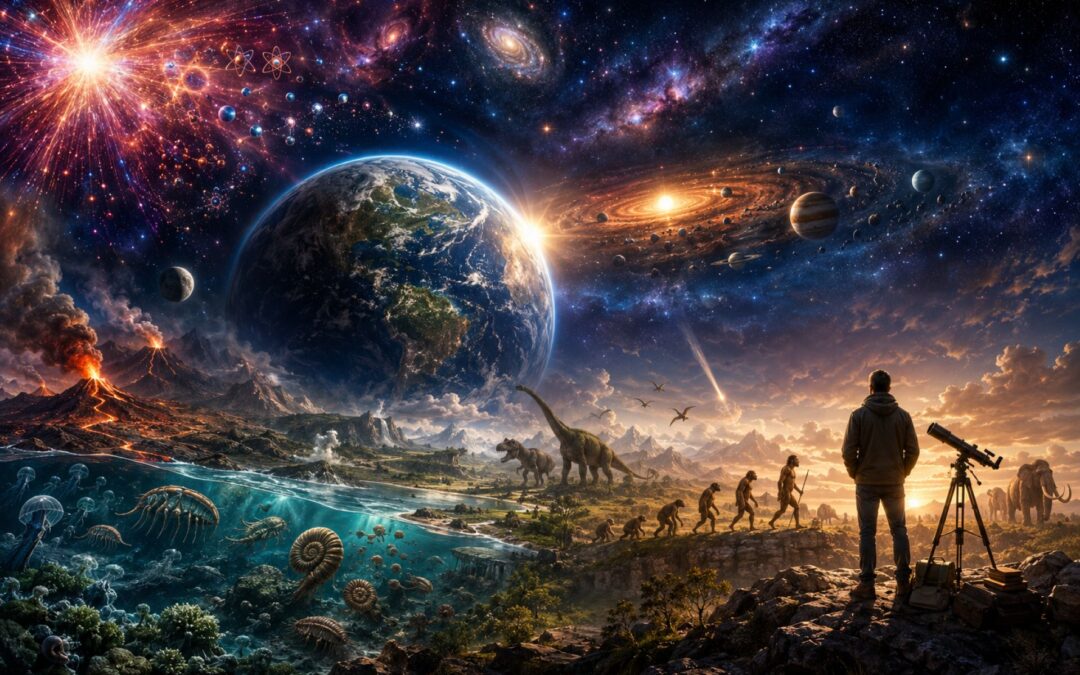
Bill Bryson begins A Short History of Nearly Everything with a fact so familiar that its strangeness is easy to miss: you exist. The atoms making up your body are unimaginably old, most of them were forged long before Earth existed, and none of them is alive by itself. Yet for a short interval they have assembled into a creature capable of asking where those atoms came from, how the universe began, why Earth is habitable, how life developed, and how human beings learned enough science to answer even part of those questions.
That combination of wonder and ignorance gives the book its shape. Bryson is not a scientist trying to introduce readers to his specialist field. He is a curious nonspecialist who became dissatisfied with the way science had been presented to him: textbooks supplied conclusions but often concealed the drama of discovering them. He wanted to know not merely that Earth is billions of years old, for example, but how anyone could possibly have measured the age of a planet on which nobody had been present at the beginning.
The result is a book with two histories running alongside each other. The first is the history of the universe itself, moving from the Big Bang through stars, planets, geological change, life, evolution, and eventually humanity. The second is the history of people trying to reconstruct that first history through observation, argument, experiment, error, rivalry, persistence, accident, and occasional flashes of extraordinary insight.
This article covers the original text of A Short History of Nearly Everything, represented by the 2004 trade paperback edition published after the book’s 2003 debut. Bryson later returned to the project with a fully revised 2025 edition, A Short History of Nearly Everything 2.0, because science had moved substantially in the intervening two decades. That distinction matters: the original remains a remarkable work of popular science, but some of its once-current scientific details are now historical snapshots.
The book’s deeper achievement is therefore not simply the accumulation of knowledge. Bryson repeatedly shows that knowledge is provisional, that confident experts can be wrong, that evidence can remain invisible until somebody learns how to recognize it, and that enormous discoveries sometimes begin with trivial anomalies. By the end, this scientific humility becomes an ethical one. Humanity is presented as an extraordinarily unlikely outcome of cosmic and biological history, but also as a species powerful enough to destroy forms of life whose history it has only recently learned to understand.

From the Big Bang to Humanity: A Complete Summary
Bryson organizes the book into six large movements. The first three take readers from the universe’s origin through the creation of modern physics and geology; the fourth emphasizes the catastrophes capable of reshaping Earth; the fifth asks how life became possible and diversified; and the sixth follows climate and evolution toward modern humanity. Within that sequence, stories about individual scientists are never merely biographical detours. They show how the picture of nature itself was assembled.
The progression is deliberately cumulative. Stars must exist before heavy elements can exist; heavy elements must exist before rocky planets can form; Earth must acquire suitable physical conditions before life can emerge; life must survive repeated catastrophe before complex organisms can diversify; evolution must produce primates before humans can appear; and human beings must develop scientific traditions before they can reconstruct any part of that story. Bryson’s “nearly everything” is therefore not a random collection of facts but an attempt to reveal the dependencies connecting one stage of existence to the next.
Part I: Lost in the Cosmos
Chapter 1, “How to Build a Universe,” begins with the Big Bang and immediately confronts the problem of scale. Bryson asks readers to imagine all the material that would become the observable universe compressed into a condition smaller and stranger than ordinary intuition can manage. He then moves through the extraordinary expansion of the early universe, stressing how difficult it is to translate modern cosmological models into pictures that make sense at a human scale.
As the universe expands and cools, basic matter becomes possible. Hydrogen and helium dominate, with only small amounts of a few other light elements. That creates an important problem for everything that follows: human beings contain carbon, oxygen, nitrogen, calcium, iron, and many other elements that the early universe did not initially possess in abundance. If those elements were not created at the beginning, some later process must have made them.
The chapter also introduces one of Bryson’s favourite forms of scientific history: discoveries that look obvious only in retrospect. Cosmologists such as George Gamow and his collaborators helped predict traces of the universe’s hot beginning, but the decisive observational evidence arrived through Arno Penzias and Robert Wilson, who were investigating persistent microwave noise. What at first looked like interference became evidence of cosmic microwave background radiation, a remnant of the early universe.
That story establishes a pattern Bryson will repeat throughout the book. Scientists do not always move cleanly from hypothesis to experiment to confirmation. Sometimes theory exists before technology can test it; sometimes the data appear before their significance is understood; and sometimes an inconvenient nuisance turns out to be the most important thing in the room.
Chapter 2, “Welcome to the Solar System,” narrows the scale from the universe to our immediate cosmic neighbourhood, but Bryson’s purpose is to show that “immediate” is misleading. The solar system is overwhelmingly empty. Illustrations in books inevitably compress distances so drastically that readers can retain a false mental picture in which the planets seem like nearby beads arranged around the Sun.
Bryson uses imagined journeys and comparisons to restore some sense of the actual distances involved. Even the region controlled by the Sun extends farther than ordinary representations suggest, while the nearest other stars remain fantastically remote. This enormous separation becomes important when Bryson considers the possibility of extraterrestrial intelligence: a universe may contain many inhabited worlds while still leaving those worlds effectively isolated from one another.
Pluto becomes a case study in the incompleteness of astronomical knowledge as it stood when the book was written. Bryson recounts Percival Lowell’s hunt for a hypothetical Planet X, Clyde Tombaugh’s discovery of Pluto, the later discovery of Charon, and growing awareness that the outer solar system contains many small bodies. The discussion reflects the early-2000s debate about Pluto’s status and captures a solar system whose classification was already becoming less tidy than the traditional nine-planet model suggested.
Bryson then pushes outward toward the Kuiper Belt, Oort Cloud, and the immense regions from which comets may originate. The effect is not simply to make space seem large. It makes humanity’s astronomical knowledge seem geographically provincial: even after centuries of observation, scientists remain uncertain about many objects in the very system humans inhabit.
Chapter 3, “The Reverend Evans’s Universe,” uses the Australian amateur astronomer Robert Evans to explain how stars die. Evans became exceptionally skilled at finding supernovae by visually recognizing small changes in familiar fields of stars. His story delights Bryson because it combines obsessive human attention with events occurring at an almost absurd cosmic scale.
Supernovae solve the elemental problem left open in Chapter 1. Stars build increasingly heavy elements through nuclear processes, and massive stellar explosions scatter those elements into space. Researchers such as Fritz Zwicky, Walter Baade, and Fred Hoyle helped transform stellar death from a spectacular astronomical curiosity into a key part of cosmic chemistry.
The implication is intimate despite the scale. The carbon in living tissue, calcium in bones, iron in blood, and many other ingredients of life depend on generations of stars that lived and died before the solar system formed. Human beings are not merely situated in the universe; the material of their bodies carries the history of stars.
Bryson then follows dispersed stellar material into the formation of the solar system. A cloud of gas and dust collapses, the Sun develops at its centre, and smaller bodies collide and accrete into planets. Early Earth is not a serene blue sphere but a violent construction site repeatedly struck by debris, heated by collisions and radioactive processes, and gradually transformed into something capable of holding oceans and supporting chemistry complex enough for life.
Part I therefore moves from an almost incomprehensible beginning to the formation of a habitable planet. It establishes several ideas that will govern the rest of the book: matter has a history, scale defeats intuition, apparently stable conditions emerge from violence, and human existence depends on a chain of processes that began billions of years before humans appeared.
Part II: The Size of the Earth
Having reached Earth, Bryson turns from asking where the planet came from to asking how anyone learned what kind of object it is. Chapter 4, “The Measure of Things,” is largely a history of measurement, beginning with efforts to determine Earth’s shape and dimensions. The story reveals how physically difficult seemingly straightforward scientific questions once were.
A French expedition to South America illustrates the point. Researchers undertook difficult surveying work in what is now Ecuador in order to help determine whether Earth bulges at the equator or is elongated toward the poles. Such expeditions required years of travel, triangulation, equipment management, physical endurance, and cooperation among people who often did not cooperate especially well.
The chapter brings in Isaac Newton and Edmond Halley as part of the broader transformation of astronomy and geophysics into quantitative sciences. It also demonstrates that establishing one planetary fact tends to create another problem. Knowing the size of Earth does not immediately tell scientists its mass, density, internal composition, or age.
Henry Cavendish becomes central because of the famous experiment usually described as “weighing the Earth.” Through an extraordinarily sensitive torsion balance, Cavendish measured tiny gravitational attractions between known masses. The result allowed scientists to infer Earth’s density and therefore estimate its mass without digging into the planet or placing it on any literal scale.
Bryson admires both the ingenuity and the strangeness of such achievements. Science repeatedly manages to measure inaccessible objects indirectly. Researchers cannot handle Earth as an experimental specimen, travel to the beginning of time, or look inside the planet in any ordinary sense, so they learn to exploit effects that the inaccessible thing produces.
Chapter 5, “The Stone-Breakers,” turns to Earth’s age and introduces geology’s discovery of deep time. James Hutton recognized that landscapes preserve evidence of enormously slow processes. Erosion, deposition, uplift, and the transformation of rock imply spans of time vastly longer than ordinary human history.
Hutton possessed a revolutionary insight but expressed it in prose that was difficult for many readers to follow. John Playfair became important partly because he could explain Hutton’s ideas more clearly. Bryson uses the episode to show that scientific influence depends not only on having an idea but on making that idea intelligible to other people.
Charles Lyell later systematized geological gradualism, arguing that processes visible in the present could explain much of Earth’s past if given enough time. This approach encouraged scientists to interpret dramatic geological structures as the cumulative result of ordinary mechanisms operating across immense durations. Deep time became indispensable, but quantifying it remained difficult.
Lord Kelvin seemed capable of supplying the answer. Using thermodynamics, he estimated how long a molten Earth could have been cooling and produced an age much younger than geologists and evolutionary thinkers required. Kelvin’s mathematics could be sophisticated while his conclusion was nevertheless wrong because an important source of internal heat—radioactivity—was still unknown.
That episode embodies one of Bryson’s central lessons about scientific error. A mistaken result does not necessarily come from stupidity or bad mathematics. Sometimes an investigator reasons correctly from an incomplete model of reality, and no amount of care within that model can compensate for the missing phenomenon.
Chapter 6, “Science Red in Tooth and Claw,” moves from rocks to fossils and the growing recognition that Earth had once contained creatures unlike anything alive in the present. Georges Cuvier helped establish extinction as a scientific fact. That idea was itself once radical because it required naturalists to accept that entire types of organisms had vanished permanently.
Dinosaur discoveries then unleash one of Bryson’s most memorable histories of scientific rivalry. Gideon Mantell’s work on fossils helped open the world of dinosaurs, but Richard Owen became a dominant and often ruthless figure in British palaeontology. Bryson emphasizes not only the intellectual importance of their work but also the jealousy, status competition, appropriation, and personal hostility surrounding it.
The American “Bone Wars” between Edward Drinker Cope and Othniel Charles Marsh intensify the same pattern. The two men collected and named remarkable numbers of fossil animals while damaging each other’s reputations, rushing publications, making mistakes, and turning palaeontology into something resembling a personal feud. Scientific progress and scientific behaviour are not identical; significant knowledge can emerge from deeply imperfect motives.
The chapter eventually returns to the age of Earth through radioactivity. Ernest Rutherford and other researchers investigating radioactive decay discovered a process that both generated heat inside Earth and provided a potential clock. Radioactivity therefore addresses the flaw in Kelvin’s cooling model while opening a new pathway for dating geological materials.
Chapter 7, “Elemental Matters,” broadens into the development of chemistry. Bryson moves from alchemy and confused early notions of matter toward increasingly systematic identification of gases, substances, and elements. Robert Boyle and Antoine Lavoisier represent stages in the transition from inherited speculation to experimental chemical science.
The process is not tidy. Substances are sometimes produced before anyone understands what they are, names vary across countries and researchers, and discoveries overlap. Chemistry gradually becomes a discipline by imposing order on a world in which materials can be combined, decomposed, weighed, classified, and related to one another with increasing precision.
Dmitri Mendeleev’s periodic table represents an extraordinary triumph of classification. Elements cease to be a mere list and become members of a structured system whose gaps can imply substances not yet discovered. The table does not simply organize existing knowledge; it makes the structure of knowledge predictive.
Radioactive elements complicate the older picture of atoms as permanent and indivisible. Marie Curie, Rutherford, and others show that matter can transform, emit energy, and possess internal structure. By the end of Part II, the attempt to measure Earth has led naturally into a deeper question: what is matter itself made of?
Part III: A New Age Dawns
Part III enters the scientific revolutions of the late nineteenth and twentieth centuries. Chapter 8, “Einstein’s Universe,” begins at a moment when some physicists believed the great theoretical work of their field was nearly complete. Classical mechanics and electromagnetism had achieved astonishing predictive success, and remaining problems could appear like details rather than signs of an impending transformation.
The Michelson-Morley experiment was one of the awkward details. It failed to detect the expected effect of Earth’s motion through the hypothetical luminiferous ether, creating a problem for established ideas about light and space. Albert Einstein’s special theory of relativity removed the need for the ether and radically altered assumptions about time, distance, simultaneity, and motion.
Mass and energy become connected through Einstein’s famous relation, while general relativity later reconceives gravity not simply as a force acting across space but as a consequence of the geometry of spacetime. Bryson’s challenge is not to turn readers into relativistic physicists but to communicate how profoundly these ideas changed the physical universe scientists thought they inhabited.
Astronomy undergoes a parallel enlargement. Edwin Hubble’s observations helped establish that fuzzy objects once treated as local nebulae were galaxies far beyond the Milky Way. Measurements of galactic recession then provided evidence that the universe itself is expanding.
The combination changes both scale and history. The universe is much larger than previously imagined, and it is not static. An expanding universe implies a different past, linking twentieth-century observation back to the cosmological origin with which Bryson began the book.
Chapter 9, “The Mighty Atom,” moves from cosmic scale to matter’s interior. John Dalton had helped revive atomic theory in chemistry, but atoms remained hypothetical enough that some major scientists resisted treating them as physical realities. Einstein’s explanation of Brownian motion helped provide evidence that molecular motion had observable effects, strengthening the case for atoms.
Rutherford’s experiments then reveal an atomic structure that defies ordinary expectation. Most of an atom is empty space, with a tiny nucleus holding much of its mass. Niels Bohr and later quantum physicists complicate the picture further by showing that the microscopic world does not behave according to the intuitive rules developed from everyday objects.
Heisenberg’s uncertainty principle becomes emblematic of the strangeness. At subatomic scales, certain properties cannot be simultaneously specified with arbitrary precision. Bryson stresses not only the technical challenge but the philosophical shock of discovering that nature at its foundation resists the simple mechanical picture inherited from classical physics.
The new understanding of atomic nuclei eventually acquires destructive consequences. Nuclear fission demonstrates that immense energy can be released from matter, and twentieth-century physics helps make the atomic bomb possible. Bryson does not argue that science naturally leads to catastrophe, but the history forces a distinction between understanding nature and deciding how knowledge should be used.
Chapter 10, “Getting the Lead Out,” returns to Earth’s age through the work of Clair Patterson. Patterson was attempting to use lead isotopes to determine when Earth formed, but his measurements were repeatedly compromised by contamination. The problem eventually revealed that lead had become pervasive throughout the modern environment.
That contamination leads Bryson to Thomas Midgley Jr., one of the book’s most consequential examples of technological unintended effects. Tetraethyl lead had been added to gasoline to reduce engine knocking, despite serious knowledge of lead’s toxicity. Industrial use spread the metal widely through air, soil, dust, and bodies.
Patterson’s work thus becomes two stories at once. His isotopic measurements provide a reliable estimate of Earth’s age at roughly 4.55 billion years, resolving a problem that had occupied geologists and physicists for generations. At the same time, his recognition of widespread lead contamination pushes him into conflict with powerful commercial interests reluctant to abandon a profitable technology.
Midgley also became associated with chlorofluorocarbons, compounds that appeared useful and safe in their intended applications but were later recognized as damaging to the ozone layer. Bryson uses the history to expose an uncomfortable aspect of technological progress: ingenuity can solve an immediate engineering problem while creating environmental consequences that become visible only much later.
Chapter 11, “Muster Mark’s Quarks,” pushes into the increasingly abstract world of particle physics. As experimental techniques improve, the supposedly simple components of matter multiply into a bewildering collection of particles and interactions. Quarks and other entities become part of a theoretical framework far removed from anything humans experience directly.
Bryson emphasizes the Standard Model’s success while refusing to turn that success into a claim of completion. Physics possesses remarkably accurate theories and yet still confronts major questions about the nature and distribution of matter and energy in the universe. Dark matter and dark energy illustrate the gap between being able to observe effects and fully understanding what produces them.
The Higgs particle occupies a particularly interesting position in the original edition. Bryson describes it as an important but still unobserved part of the theoretical picture. In that sense, Chapter 11 preserves a genuine historical moment: readers encounter particle physics just before one of its most famous predictions would receive strong experimental confirmation.
The chapter also reinforces Bryson’s fascination with the mismatch between public ideas of scientific certainty and the reality of research. Physics may be humanity’s most mathematically developed science, yet some of its biggest questions remain open. Progress does not eliminate mystery; it often identifies mystery more precisely.
Chapter 12, “The Earth Moves,” returns to geology and Alfred Wegener’s proposal of continental drift. Wegener noticed that continents appeared capable of fitting together and marshalled geological, fossil, and climatic evidence suggesting that landmasses had once been joined. His central claim was powerful, but he could not supply a convincing mechanism capable of moving continents.
Without that mechanism, continental drift remained easy to dismiss. Bryson portrays Wegener as a classic example of a scientist whose idea was rejected before later evidence made its essential correctness difficult to deny. The story is more complicated than a simple morality tale, however, because sceptics were not unreasonable to demand an explanation of the physical process.
Mid-twentieth-century mapping of the ocean floor transformed the problem. Researchers discovered mountain chains, trenches, and patterns that showed the seafloor was geologically active rather than a passive basin beneath the oceans. Harry Hess’s work on seafloor spreading helped connect new crust at mid-ocean ridges with the movement of larger plates.
Paleomagnetic evidence and other observations eventually produced plate tectonics, a unifying theory capable of explaining continental movement, earthquakes, mountain building, volcanic activity, and much of Earth’s large-scale geology. A once-ridiculed notion was absorbed into a broader framework far stronger than Wegener himself had been able to construct.
Bryson does not let the triumph create false closure. Humans still possess limited direct access to Earth’s deep interior, and many aspects of geological behaviour remain difficult to predict. Even a unifying theory can leave an enormous amount unknown.
Part IV: Dangerous Planet
Part IV shifts emphasis from understanding Earth to recognizing how dangerous it is. Chapter 13, “Bang!,” begins with evidence of ancient impact structures and the development of impact geology. Features that once seemed mysterious become interpretable as scars produced when extraterrestrial objects collide with the planet.
Eugene Shoemaker helps establish that impacts are not merely lunar or ancient curiosities. The same processes responsible for craters elsewhere in the solar system have affected Earth, even though erosion, tectonics, vegetation, and sediment often erase or disguise the evidence. The planet’s apparently smooth surface can therefore hide a violent history.
Walter and Luis Alvarez enter through their investigation of the boundary separating the Cretaceous and Paleogene periods. An unusual concentration of iridium supported the hypothesis that a massive asteroid impact played a decisive role in the extinction that eliminated the non-avian dinosaurs and many other organisms. The later identification of the Chicxulub structure helped transform a controversial proposal into a central explanation of the extinction event.
The larger point is not merely that dinosaurs died because of an asteroid. Catastrophic events can abruptly alter the evolutionary opportunities available to survivors. The disappearance of dominant groups opens ecological space for others, meaning that later evolutionary history depends partly on disasters that earlier organisms failed to survive.
Bryson brings that history uncomfortably close to the present by considering near-Earth objects. Astronomers have improved their ability to identify potentially hazardous bodies, but the fundamental vulnerability remains: Earth’s place in the solar system exposes it to objects whose trajectories may eventually intersect the planet.
Chapter 14, “The Fire Below,” turns from extraterrestrial danger to forces originating inside Earth. A fossil bed in Nebraska preserved animals killed by ash from an enormous volcanic eruption, reminding readers that catastrophic effects can spread far from the volcanic source itself. Geological violence does not respect human intuitions about safe distance.
Bryson then examines the difficulty of knowing Earth’s interior. Humans have penetrated only a tiny fraction of the planet directly, so knowledge of its deep structure depends largely on indirect evidence, especially seismic waves produced by earthquakes. Changes in wave behaviour allow geologists to infer boundaries and properties of material they cannot reach.
Earthquakes demonstrate the practical consequences of those hidden forces. Tectonic plates accumulate and release stress, but predicting the exact timing of destructive earthquakes remains extraordinarily difficult. Modern scientific understanding can identify hazardous regions and mechanisms without producing a reliable schedule of future events.
Volcanoes create a similar gap between explanation and prediction. The 1980 eruption of Mount St. Helens shows how even a relatively localized eruption can transform landscapes and disrupt human activity. Larger eruptions raise consequences that become continental or global.
Chapter 15, “Dangerous Beauty,” centres on Yellowstone. The familiar image of a volcano as a mountain with a crater does not fit Yellowstone’s enormous volcanic system. The area is associated with a vast caldera formed through previous eruptions of a scale far beyond ordinary historical experience.
Bryson explores evidence of enormous past eruptions and considers what another major event might mean. The danger is magnified by uncertainty: scientists can monitor seismic activity, ground deformation, hydrothermal behaviour, and other signs, but monitoring is not the same as exact prediction.
Yellowstone then provides Bryson with a transition rather than simply another source of fear. The hot, chemically extreme environments around volcanic systems support organisms capable of surviving under conditions once thought hostile to life. Extremophiles expand the biological possibilities scientists must consider.
The dangerous planet is therefore also a life-supporting planet. The same geological energy capable of producing earthquakes, eruptions, and mass destruction contributes to the dynamic conditions on which Earth’s long-term habitability depends. Bryson repeatedly resists a simple division between benign and hostile nature because many of the systems that threaten life also help make complex life possible.
Part V: Life Itself
Chapter 16, “Lonely Planet,” asks why Earth supports complex life at all. Bryson does not present a single miraculous cause. Instead, he assembles a collection of conditions whose combined presence makes Earth’s habitability appear unusually fortunate.
Distance from the Sun matters because Earth occupies a region where liquid water can persist under the right atmospheric conditions. The planet also contains the chemical ingredients necessary for complex organisms, maintains an active interior, possesses an atmosphere that moderates and protects its surface, and has remained stable enough for life to survive long evolutionary periods.
The Moon receives attention because its relationship with Earth influences tides and may contribute to long-term stability of Earth’s orientation. The architecture of the solar system also matters, though Bryson is careful to present habitability as a complex interaction rather than a simple checklist guaranteeing life.
The deeper theme is contingency. Looking backward from human existence, every necessary condition can appear as though it were arranged to produce us. Bryson instead encourages the opposite interpretation: humans exist because our ancestors happened to arise on a planet where a remarkable combination of conditions persisted long enough.
Chapter 17, “Into the Troposphere,” examines the thin atmosphere on which terrestrial life depends. Humans live at the bottom of an ocean of air, largely unaware of its weight because bodies are adapted to the pressure. Small changes in altitude quickly reveal how narrow the comfortable portion of the atmosphere really is.
Bryson moves through atmospheric layers, temperature, pressure, wind, clouds, and the history of meteorological classification. The naming of clouds becomes characteristic Bryson material: even something as ordinary as the sky above us required people to devise systems for recognizing recurring forms.
Weather reveals the complexity of interacting systems. Temperature differences, planetary rotation, moisture, land, oceans, and atmospheric circulation combine to produce patterns that can be described statistically but not perfectly predicted in local detail. Familiarity with weather should not be confused with scientific simplicity.
The chapter extends from weather into climate and the carbon cycle. Atmospheric composition participates in long-term feedback systems connecting oceans, rocks, biological activity, and temperature. Human additions of greenhouse gases therefore matter not because the atmosphere is large and invulnerable, but because its life-supporting properties depend on a relatively delicate composition.
Chapter 18, “The Bounding Main,” turns to water. Water’s properties are unusual in ways that make it indispensable to life, from its effectiveness as a solvent to the behaviour that causes ice to float rather than sink. Oceans also dominate Earth’s surface while remaining less directly explored than their physical importance might suggest.
Bryson recounts the history of deep-sea exploration through figures such as William Beebe and Otis Barton. Descents into deep water required technology capable of resisting extraordinary pressure, and early observers entered an environment almost entirely separated from ordinary human experience.
The oceans are not empty expanses between continents. Currents redistribute heat, marine microorganisms participate in global chemical cycles, and biological productivity depends on complex patterns of nutrients, light, and circulation. The largest habitat on the planet remains partly inaccessible because direct observation is difficult and expensive.
The chapter helps prepare for the origin-of-life discussion because early life was inseparable from water. It also reinforces the recurring epistemological point: humans can know broad principles about a planetary system while still having directly observed only a small portion of it.
Chapter 19, “The Rise of Life,” confronts one of the largest unresolved problems in the book: how nonliving chemistry became life. The Miller-Urey experiment appears at first to offer a dramatic breakthrough. By exposing a mixture of gases to electrical energy, researchers produced organic compounds including amino acids, demonstrating that molecules associated with life could arise through nonbiological processes.
Bryson immediately complicates the triumph. Amino acids are not living systems, and producing them is vastly easier than producing a self-replicating cell. Scientists also became less confident that the experiment’s assumed atmospheric conditions accurately represented early Earth, making the pathway from chemistry to biology even less straightforward.
The real challenge lies in integration. Proteins are extraordinarily complex, DNA stores information but depends on cellular machinery, membranes separate organisms from their environment, and replication requires processes that seem mutually dependent. Explaining how these pieces emerged in a sequence capable of natural selection remains difficult.
Bryson considers possible environments in which early life might have developed, while emphasizing the fragmentary evidence available from Earth’s earliest history. Once simple life does appear in the geological record, however, microorganisms remain the planet’s dominant inhabitants for immense spans of time.
Photosynthetic organisms eventually alter the planet itself. Cyanobacteria release oxygen as a by-product, transforming an atmosphere in which free oxygen had previously been scarce. Oxygen is toxic to many existing organisms but creates possibilities for much more energy-intensive forms of metabolism.
The emergence of eukaryotic cells marks another immense transition. Complex cells contain internal structures and appear to have arisen partly through ancient symbiotic relationships among simpler organisms. Multicellular life later builds upon this cellular complexity, making possible bodies composed of specialized cells working together.
Chapter 20, “Small World,” asks readers to abandon the human tendency to equate importance with visibility. Microorganisms are not marginal forms waiting below more interesting animals. They constitute much of life’s diversity, occupy almost every available environment, and have shaped the planet for billions of years.
The human body itself depends on enormous microbial communities. Bacteria live on and within people, assisting digestion and participating in ecological relationships that blur any simplistic boundary between an organism and its microbial environment. Most bacteria are not human enemies, even though infectious diseases make pathogenic species especially memorable.
Louis Pasteur and the development of germ theory helped establish the biological causes of many diseases. Later antibiotics seemed to provide extraordinarily powerful weapons against bacterial infection, but microbial evolution makes permanent victory impossible. Selection favours resistant organisms when antibiotics kill susceptible competitors, creating continuing pressure for medical adaptation.
Bryson also emphasizes microbial mobility. Modern transport allows pathogens to travel rapidly between regions that were once separated by long journeys. An interconnected human world increases economic and cultural exchange while also creating efficient pathways for biological exchange.
Carl Woese’s work provides another example of hidden biological worlds. Through molecular evidence, Woese helped reveal that organisms once casually grouped together as bacteria actually contain fundamentally different lineages, including archaea. Classification changes not because the organisms have changed, but because humans have learned to see relationships previously invisible.
Chapter 21, “Life Goes On,” turns to the fossil record and explains why reconstructing the history of life is intrinsically difficult. Fossilization is exceptional. Most organisms die, decay, are eaten, dissolve, or disappear without leaving material that can survive millions of years and later be exposed where a human happens to find it.
That bias means the history of life is reconstructed from an archive missing almost everything that once existed. Soft-bodied organisms are especially underrepresented, environments differ dramatically in preservation potential, and geological processes can destroy deposits that once contained evidence.
The Burgess Shale becomes one of the great exceptions. Its remarkable fossils preserve bizarre Cambrian organisms in enough detail to inspire major arguments about evolutionary history. Charles Doolittle Walcott discovered and collected huge quantities of material, but later researchers interpreted many specimens in radically different ways.
Stephen Jay Gould popularized one influential reading of the Burgess Shale, emphasizing the apparent diversity of Cambrian body plans and the importance of contingency in determining which lineages survived. Later palaeontologists revised parts of this picture, showing again that fossils do not speak independently of interpretation.
Bryson also discusses the still earlier Ediacaran organisms and Reginald Sprigg’s discoveries. Strange fossils can sit physically available yet conceptually invisible when scientists lack a framework for understanding what they represent. Recognition requires both evidence and the willingness to consider unfamiliar possibilities.
Chapter 22, “Good-bye to All That,” expands from fossil interpretation to the enormous role extinction has played in evolution. Life is persistent on a planetary scale, but individual species and lineages are temporary. Most forms that have ever lived are gone.
Moving onto land demanded profound adaptations. Organisms had to cope with gravity without water’s support, prevent desiccation, breathe differently, reproduce under new conditions, and move through an environment with different physical challenges. Evolution does not plan these solutions in advance; successful adaptations accumulate through selection.
Mass extinction repeatedly interrupts diversification. The Permian extinction eliminates an extraordinary proportion of existing life, leaving survivors to repopulate ecological systems. Other extinction events similarly reorganize which groups dominate.
Dinosaurs eventually become one of Earth’s most successful groups, persisting for vastly longer than recorded human civilization. Their disappearance therefore should not be interpreted as evidence of evolutionary failure. A catastrophic event changed ecological opportunity, and mammals subsequently expanded into niches that had previously been constrained.
The human lineage thus depends on events unrelated to any tendency toward humans. If different organisms had survived particular catastrophes, later ecosystems might have developed differently. Contingency is embedded not only in the origin of life but in every major transition that follows.
Chapter 23, “The Richness of Being,” focuses on the problem of discovering and naming the life that exists now. Natural-history museums contain enormous collections, much of which never appears in public galleries. Behind the exhibits lie cabinets, jars, drawers, and archives representing centuries of collecting.
Carl Linnaeus gave biology a durable system of binomial classification, helping impose order on proliferating species names. Yet taxonomy remains intellectually difficult because nature does not always divide itself into clean categories that perfectly fit human classification systems.
The very definition of a species can become troublesome, particularly for organisms that do not reproduce sexually or populations separated geographically while remaining genetically similar. Classification is a tool for organizing biological diversity, not proof that every biological boundary is naturally sharp.
Bryson is especially fascinated by the amount that remains undescribed. Some groups contain huge numbers of poorly known species, while charismatic vertebrates receive disproportionate attention. A tiny community of specialists may carry most of humanity’s knowledge about an obscure group of organisms.
This dependence on specialists gives biodiversity science an unexpectedly fragile quality. When an expert retires, dies, or leaves a field without successors, knowledge can become difficult to access or advance. Humanity may be losing species before anyone has formally described them, making extinction partly a crisis of ignorance.
Chapter 24, “Cells,” moves inward again. A human being begins as a single fertilized cell and develops into a body containing immense numbers of specialized cells. Those cells share a common genetic inheritance but behave differently because different genes are activated, suppressed, and regulated in different tissues.
Bryson describes cellular membranes, organelles, proteins, mitochondria, energy use, signalling, repair, and programmed death. The apparent unity of a body depends on staggering numbers of microscopic processes occurring continuously without conscious supervision.
The cell is both autonomous and social. It must maintain itself while participating in tissues whose survival may require individual cells to stop dividing or destroy themselves. Cancer can be understood partly as a breakdown in this cooperative regulation, when cells begin behaving in ways advantageous to their own proliferation but disastrous for the organism.
Historical figures such as Robert Hooke and Antonie van Leeuwenhoek appear because the cellular world had to be technologically revealed. Humans spent nearly their entire existence without knowing that their bodies were constructed from cells or surrounded by microorganisms.
The chapter naturally leads toward heredity. Cells reproduce, organisms develop according to inherited instructions, and biological continuity requires some mechanism through which information survives reproduction. That mechanism becomes the subject of the next two chapters.
Chapter 25, “Darwin’s Singular Notion,” reconstructs the development of natural selection. Charles Darwin’s voyage on the Beagle exposes him to geographical patterns, fossils, and variation among organisms that gradually contribute to his evolutionary thinking. The finished theory does not emerge as a sudden revelation but through years of observation, reading, comparison, and reflection.
Darwin recognizes that populations contain heritable variation, that organisms produce more offspring than can survive, and that individuals possessing characteristics advantageous under particular conditions may leave more descendants. Over long periods, selection can transform populations without any need for organisms to consciously adapt.
Darwin delays publication for years, partly because of the intellectual and social consequences of the theory and partly because he continues gathering evidence. Alfred Russel Wallace independently arrives at a closely related idea while working in Southeast Asia and sends Darwin an essay outlining it.
Wallace’s intervention forces the issue. Their ideas are jointly presented, and Darwin publishes On the Origin of Species. The book transforms biology even though Darwin cannot explain heredity correctly.
Gregor Mendel had already discovered regularities in inheritance through experiments with pea plants, but his work attracted little immediate attention. Mendelian genetics and Darwinian evolution therefore develop separately before later biology combines them.
Bryson uses the episode to show that possessing important evidence does not guarantee historical impact. Timing, communication, disciplinary networks, reputation, and the readiness of other scientists to recognize a result all influence whether a discovery changes a field.
Chapter 26, “The Stuff of Life,” follows the missing mechanism of inheritance into genetics and molecular biology. Chromosomes become associated with heredity, while experiments involving organisms such as fruit flies help researchers understand how traits relate to genetic material.
Evidence gradually establishes DNA as the central hereditary molecule. The question then becomes structural: how can DNA store information, replicate, and produce the extraordinary variety of living forms?
James Watson and Francis Crick build the famous double-helix model, but Bryson emphasizes the larger network of work on which their success depended. Rosalind Franklin’s X-ray diffraction research was especially important to understanding DNA’s structure, and the history of how her data were used has become inseparable from discussions of scientific recognition.
The structure of DNA helps explain replication because complementary strands can serve as templates. Yet discovering the molecule’s shape does not make genetics simple. Genes operate through complex systems of regulation, interaction, transcription, translation, and cellular context.
The Human Genome Project brings Bryson’s story almost to the moment of publication. Early expectations that humans might possess enormous numbers of genes give way to a more complicated realization: organismal complexity cannot be read directly from gene count. Much of biology depends on how genetic information is regulated and combined rather than on possessing a separate gene for every characteristic.
Bryson closes the biological arc by emphasizing common ancestry. Humans share enormous amounts of genetic machinery not only with other primates but across the living world. The apparent diversity of life rests on ancient biochemical foundations inherited from common ancestors.
Part VI: The Road to Us
Chapter 27, “Ice Time,” shifts from biological mechanisms to the climatic world in which human evolution unfolded. Bryson begins with the 1815 eruption of Tambora, whose atmospheric effects contributed to the following year’s severe climatic anomalies. A distant geological event could disrupt weather and agriculture thousands of kilometres away.
Recognition of earlier ice ages required another conceptual revolution. Researchers studying erratic boulders, scratched rocks, and landscape forms gradually concluded that enormous glaciers had once covered regions now free of permanent ice. Jean de Charpentier and Louis Agassiz became central figures in the acceptance of widespread past glaciation.
The idea initially seemed extreme because it required scientists to imagine climates dramatically different from the present. Once the evidence was accepted, another question followed: what could cause ice sheets to advance and retreat on such enormous scales?
James Croll and later Milutin Milanković explored the role of changes in Earth’s orbital geometry. Variations in eccentricity, axial tilt, and precession alter the distribution of solar energy, providing mechanisms capable of influencing glacial cycles.
Those astronomical changes do not operate alone. Ice, oceans, atmosphere, vegetation, and greenhouse gases participate in feedback systems capable of amplifying comparatively modest initial forcing. Climate therefore becomes another example of a system whose behaviour emerges from interacting processes rather than a single simple cause.
The chapter’s implication for humanity is important. Civilization has developed during a relatively stable climatic interval, but Earth’s climate has never been permanently fixed. Human beings occupy one moment in a long and dynamic environmental history.
Chapter 28, “The Mysterious Biped,” enters paleoanthropology, a field where tiny amounts of fossil material carry enormous interpretive weight. Eugène Dubois deliberately sought evidence of human ancestry in Southeast Asia and discovered remains that became associated with Java Man. His work helped establish that important stages of human evolution had occurred far outside Europe.
Bryson then moves through discoveries such as the Taung Child, whose interpretation by Raymond Dart initially met substantial resistance. Australopithecine fossils gradually reveal upright-walking primates with combinations of traits that complicate any simple distinction between ape and human.
The discovery of “Lucy” adds an unusually significant skeleton to this fragmentary archive. Her anatomy strengthens the case that bipedalism preceded the large brains associated with later members of the human lineage. Walking upright was therefore not merely a by-product of becoming intellectually human.
The larger fossil record becomes increasingly difficult to arrange into a clean line. Different specimens receive different species names, classifications are revised, and researchers disagree over whether anatomical variations represent separate lineages or diversity within broader populations.
Bryson emphasizes the scarcity underlying these disputes. Entire species can be known from fragments representing only a handful of individuals. Strong narratives about human origins may therefore rest on an evidential base far thinner than the confidence of public reconstructions suggests.
Chapter 29, “The Restless Ape,” follows hominins as increasingly mobile and technologically capable animals. Stone tools provide evidence of behaviour that can survive where bodies do not, giving archaeologists another archive through which to reconstruct prehistoric lives.
Homo erectus becomes central to the story of early human dispersal. Populations leave Africa long before modern Homo sapiens, demonstrating that migration across continents is not a uniquely recent human behaviour. The geographical spread of earlier humans creates the background against which later questions of ancestry and interaction arise.
Neanderthals occupy a particularly important place because older popular images had portrayed them as crude failures waiting to be replaced by superior modern humans. Bryson presents a more capable and enigmatic population whose relationship with modern humans remained uncertain in the science available when he wrote.
Sites such as Lake Mungo in Australia complicate migration timelines and reveal how sparse evidence can force revisions of assumed routes and dates. Olorgesailie and other archaeological landscapes similarly show that tool-making traditions can persist across astonishing spans of time.
The original edition discusses competing models for modern-human origins, including questions about whether modern populations largely replaced earlier groups or incorporated some of them. Bryson does not have access to the ancient-genomic evidence that would later transform this debate, so uncertainty appropriately remains central.
By the end of the chapter, one lineage has nevertheless acquired an unparalleled position. Homo sapiens has spread across nearly the entire planet, developed complex symbolic cultures, altered ecosystems, and accumulated technologies capable of reshaping environments on a global scale.
Chapter 30, “Good-bye,” refuses to end the story at the triumphant arrival of modern humans. Bryson instead places human intellectual achievement beside human destructiveness. While scientists were learning to explain planetary motion, other humans were helping eliminate the dodo.
The dodo becomes emblematic because its extinction seems almost absurdly unnecessary. A species that had evolved in isolation from major predators was poorly equipped for the arrival of humans and the animals humans brought with them. Once its environment changed rapidly, it disappeared.
Bryson expands the pattern through Steller’s sea cow, the passenger pigeon, the Carolina parakeet, the thylacine, and many other species. Some were hunted for food or commercial value, some were treated as pests, and some vanished through combinations of habitat destruction, introduced species, and direct killing.
Natural historians are not always outside this destruction. Collectors sometimes killed rare animals precisely because they wanted specimens for scientific collections. Bryson finds an especially dark irony in the possibility that institutions devoted to understanding biodiversity could contribute to eliminating the organisms they wished to preserve.
The chapter reaches farther back into debates over prehistoric extinctions of large animals following human arrival in new regions. Climate certainly changed during these periods, but human hunting and ecological disruption may also have contributed. The exact balance can be disputed without removing the larger pattern: humans have repeatedly transformed ecosystems after entering them.
The ending changes the emotional meaning of the entire book. For hundreds of pages, Bryson has emphasized how difficult it was for complex life to become possible, how often extinction nearly redirected evolutionary history, how many conditions must remain within tolerable limits, and how recently humans emerged.
Humanity’s intelligence therefore creates responsibility rather than entitlement. The species capable of understanding supernovae, atoms, plate tectonics, DNA, and deep time is also capable of erasing living products of that history before they have even been scientifically described. Bryson ends not with confidence that humans will become wise custodians, but with the unsettling recognition that extraordinary knowledge has not automatically produced restraint.
How Bryson Explains Science Through Ignorance, Error, and Discovery
The scientific facts in A Short History of Nearly Everything are only half of Bryson’s subject. The other half is epistemology in everyday language: how people can know things they cannot directly see, touch, revisit, or observe from the beginning. Random House’s teaching guide for the book explicitly emphasizes this dimension, treating Bryson’s work not simply as a catalogue of findings but as an exploration of how scientific knowledge is constructed.
The book repeatedly begins with questions that appear impossible. Nobody watched Earth form, descended to its core, witnessed the Big Bang, observed the first living cell, or followed the complete evolutionary line from ancient primates to modern humans. Scientists nevertheless infer these histories from surviving effects: radioactive ratios, fossil distributions, spectral lines, geological structures, genetic similarities, seismic waves, background radiation, and countless other traces.
Bryson’s most important corrective to naive ideas of science is that the process is rarely linear. James Hutton perceived deep time before geology possessed the vocabulary and social structure necessary to make his ideas widely influential. Kelvin could produce mathematically sophisticated estimates of Earth’s age that failed because radioactivity had not yet been discovered. Wegener could be substantially right about moving continents while lacking the mechanism required to make his theory persuasive.
These cases show why “science was wrong” is usually an inadequate description of scientific change. The relevant question is what evidence existed, what mechanisms had been identified, which assumptions were reasonable, and what new observation forced a model to change. Scientific knowledge advances not by becoming immune to error but by building procedures through which error can eventually be exposed.
Bryson is equally interested in delayed recognition. Mendel’s experiments existed before genetics knew what to do with them. Continental patterns existed before plate tectonics. Cosmic background radiation reached Earth long before anyone understood what it represented. Strange fossils could be collected before their evolutionary importance was appreciated.
Discovery therefore has at least two stages: something must become observable, and someone must recognize what the observation means. Technology often governs the first stage. Microscopes reveal cells and microbes; telescopes enlarge the universe; particle accelerators produce events that expose subatomic behaviour; DNA sequencing opens evidence about ancestry that bones alone cannot supply.
Conceptual frameworks govern the second stage. An observation that does not fit any accepted theory may be dismissed as noise, misclassified, or left unexplained. Once a better framework arrives, previously obscure details can become decisive.
This is why Bryson often frames knowledge through ignorance. His scientists frequently know enough to identify the shape of a mystery without being able to solve it. Astronomers can infer dark matter through gravitational effects without knowing what it consists of. Geologists can understand tectonic mechanisms while remaining unable to predict the exact moment of most earthquakes. Biologists can trace deep common ancestry while lacking a complete explanation of life’s origin.
Ignorance in this sense is not a defect that discredits science. It is often a productive achievement. To know exactly what remains unexplained is more scientifically valuable than to fill the gap with confidence unsupported by evidence.
The history of the Burgess Shale makes interpretation itself visible. Fossils remain physically fixed while their intellectual significance changes as researchers reconsider relationships among organisms. The evidence is real, but evidence does not eliminate judgment; researchers must decide how anatomical features should be compared, which classifications are plausible, and how much evolutionary history can be reconstructed from incomplete remains.
Paleoanthropology intensifies the problem. A fragment of jaw or skull can be asked to carry an enormous narrative burden because the human fossil record is sparse. Researchers inevitably debate how many species existed, which fossils belong together, and how lineages relate.
Bryson’s history can occasionally overdramatize this process. Because he prefers memorable stories, his examples disproportionately feature wrong experts, neglected geniuses, bitter rivalries, unexpected accidents, and revolutionary reversals. Ordinary science—careful replication, incremental measurement, large collaborations, technical maintenance, negative results—generates less narrative excitement and therefore receives less attention.
The result may leave readers with the impression that progress is driven primarily by eccentric individuals battling foolish establishments. Bryson is usually more nuanced than that, but his storytelling preferences naturally favour conflict. Wegener’s critics, for example, were not irrational merely because plate tectonics eventually vindicated continental movement; a proposed phenomenon without an adequate mechanism legitimately invites scepticism.
The book is strongest when it preserves both sides of this tension. Scientists can behave badly without science becoming arbitrary. Institutions can resist new ideas without scepticism itself being a mistake. An accepted theory can be overturned without implying that all scientific conclusions are equally unstable.
Bryson’s deepest lesson about science is therefore compatible with both trust and humility. Reliable knowledge is possible precisely because claims remain answerable to evidence, even when correction is slow. The fact that the scientific picture changes is not evidence that nothing can be known; it is evidence that knowledge can improve.
The Big Ideas Behind A Short History of Nearly Everything
Bryson does not present his book as a philosophical treatise, and its major themes emerge through accumulated examples rather than formal argument. Yet several ideas recur so consistently that they give the enormous range of material a coherent intellectual shape. Cosmology, geology, evolutionary biology, and human history become different scales at which Bryson examines the same problems of perspective, contingency, survival, and responsibility.
The most important themes also evolve as the book progresses. Enormous scale initially makes humanity appear insignificant, but the ending complicates that humility by showing that humans can exert disproportionate ecological power. Contingency initially makes existence seem miraculous, but later makes extinction morally serious because every lost lineage represents a history that cannot simply be recreated.
Scale and the Limits of Human Intuition
The book constantly confronts realities human senses did not evolve to comprehend. The diameter of the solar system, the age of geological formations, the size of an atom, the number of microorganisms in ordinary environments, and the distance between galaxies all lie far outside everyday experience. A person can repeat the numbers without possessing any intuitive sense of what those numbers mean.
Bryson’s solution is translation. He uses imagined journeys, familiar objects, time comparisons, and changes of scale to make remote quantities temporarily graspable. The technique is not mathematically exact in the sense of replacing formal calculation, but it is educationally powerful because it reveals the inadequacy of the reader’s default mental model.
Scale also undermines human centrality. Earth is a tiny object within a large solar system, the Sun is an ordinary star among enormous numbers of others, and the Milky Way is one galaxy among many. Human recorded history occupies an almost invisible fraction of geological time.
The microscopic direction produces a similar humiliation. Humans feel like discrete organisms but depend on countless cells and microbial partners. Those cells contain molecular machines inherited from biological history so ancient that humans share many fundamental processes with organisms that look nothing like them.
Yet Bryson uses scale to generate wonder rather than nihilism. Insignificance in size does not make existence meaningless. The same tiny organism that occupies almost no cosmic space can reconstruct the age of the universe, discover the structure of DNA, and calculate properties of objects it can never physically reach.
Chance, Contingency, and the Improbability of Being Here
The introduction presents individual existence as the outcome of an immense chain of successful reproduction, but contingency quickly expands beyond family ancestry. The elements necessary for bodies depend on earlier stars. Earth depends on the formation of a suitable solar system. Complex life depends on planetary conditions that remained within survivable ranges for billions of years.
Evolution deepens the argument. Life does not move along a predetermined staircase toward humans. Mass extinctions eliminate some lineages and leave others alive; environmental changes alter which characteristics become advantageous; geographical isolation sends related populations in different directions.
The asteroid associated with the end-Cretaceous extinction is therefore not merely an interesting disaster. Without the ecological transformation that followed, mammalian history might have unfolded very differently. Modern humans cannot be treated as an inevitable endpoint hidden inside the first living cell.
Bryson’s treatment of contingency never requires readers to conclude that every event was completely random. Natural selection is not random in the sense that differential survival has no relationship to traits and environments. Planetary processes obey physical laws. What remains contingent is the historical sequence: which mutations occur, which asteroid hits, which climate shifts, which populations survive, and which combinations of circumstances happen to coexist.
This distinction matters because retrospective storytelling naturally creates an illusion of inevitability. Once humans exist, every previous event can look like a necessary step toward us. Bryson repeatedly works against that temptation by emphasizing the lineages that vanished and the accidents through which other lineages survived.
The resulting emotional effect is unusual for popular science. Humanity is simultaneously demoted and made precious. We are not the universe’s obvious goal, but the sheer improbability of the route leading to conscious life makes its existence astonishing.
Extinction, Survival, and the Fragility of Life
Life in Bryson’s account is extraordinarily difficult to eliminate completely. Microorganisms inhabit extreme heat, deep environments, chemically hostile settings, and other places once considered biologically impossible. Catastrophes that destroy immense portions of Earth’s biodiversity still leave survivors from which ecosystems eventually recover.
At the level of species, however, life is brutally impermanent. Extinction is not an anomaly at the edge of evolutionary history; it is one of its defining processes. Nearly all species that have existed are gone, and mass extinctions periodically transform the structure of life on Earth.
Bryson’s discussion of the Permian extinction, dinosaur extinction, fossil record, and geological catastrophe makes survival look less like proof of superiority than continued passage through environmental filters. A lineage successful under one set of conditions can disappear rapidly when those conditions change.
The same history complicates simple notions of progress. Evolution produces complexity in some lineages, simplification in others, and extinction in most. The organisms alive today are not necessarily the “best” creatures Earth has produced; they are descendants of populations that happened to survive every relevant crisis between their ancestors and the present.
This makes the final chapter’s human-caused extinctions particularly disturbing. Geological history shows that nature can destroy species without moral agency, but humans introduce intention, knowledge, commerce, negligence, and preventable ecological pressure. A species capable of understanding extinction becomes capable of accelerating it.
Human Insignificance and Human Responsibility
For much of the book, Bryson seems to be teaching cosmic humility. Earth is not central. Humans arrived very late. Our species occupies only a tiny interval compared with bacteria, dinosaurs, or geological processes.
If the book ended with paleoanthropology, that might be its final philosophical position. Humanity would be an improbable but intellectually gifted newcomer looking backward at a universe much larger and older than itself.
Chapter 30 changes the argument because power does not track cosmic size. Humans may be physically negligible relative to planets and stars, yet they can transform atmosphere, landscapes, oceans, and biological communities. A late-arriving primate can become a geological and ecological force.
Bryson therefore refuses a comforting choice between human exceptionalism and human insignificance. Humanity is not exceptional because nature was designed to culminate in us, but human capacities are exceptional in practical consequences. No other known organism has built instruments capable of measuring the age of Earth while simultaneously developing technologies capable of altering planetary systems.
Responsibility emerges from that combination of knowledge and power. The dodo could not understand the forces destroying it, but humans could. Passenger pigeons could not establish conservation law, manage habitats, or reconstruct extinction history, but humans can.
The environmental ending is more compressed than the immense scientific journey leading to it, and some readers may find the moral shift sudden. Yet structurally it is earned. Bryson has spent the entire book showing how contingent, ancient, interconnected, and incompletely understood life is; ending with human destruction converts those facts from objects of curiosity into reasons for care.
Scientists as People: Rivalry, Ego, Luck, and Recognition
One reason A Short History of Nearly Everything remains memorable is that its science is populated by people rather than presented as a sequence of anonymous discoveries. Bryson rarely allows a theory to enter the book without asking who developed it, what that person was like, who disagreed, who received credit, and who was forgotten. Scientific knowledge becomes inseparable from the human institutions through which it emerges.
Newton exemplifies the difficulty of separating genius from personality. His contribution to physics is monumental, but Bryson is interested in the eccentric, combative, obsessive person behind the achievement. The reader is encouraged to admire intellectual power without assuming that great scientists must also be pleasant, generous, or emotionally balanced.
The history of early palaeontology makes the point more aggressively. Gideon Mantell’s work mattered greatly, yet Richard Owen’s institutional power and personal hostility affected reputations and recognition. Cope and Marsh turned fossil hunting into a competition so intense that scientific standards could suffer alongside personal fortunes.
These stories puncture the heroic model in which great discoveries are made by serenely rational individuals interested only in truth. Scientists care about priority, status, funding, reputation, employment, rivalry, and institutional influence because scientists remain human beings.
Bryson is equally attentive to neglect. Mendel’s work existed for decades before later genetics recognized its significance. Wegener died before the basic idea of continental mobility became accepted within the plate-tectonic framework. Rosalind Franklin’s role in determining DNA’s structure became far more widely appreciated after the most famous version of the discovery story had already centred Watson and Crick.
Clair Patterson offers a different model. His research into Earth’s age leads him into environmental advocacy because contamination becomes impossible to ignore. Scientific evidence places him in conflict with commercial interests, showing that producing knowledge and getting societies to act on knowledge are separate problems.
Thomas Midgley Jr. becomes almost an antihero of technological modernity. The products associated with him solved immediate industrial problems, yet later produced enormous environmental consequences. Bryson uses his story not to argue that invention is inherently dangerous but to show how expertise can remain narrow: a technology may be optimized for one desired effect without its wider systemic consequences being adequately understood.
Darwin and Wallace complicate the question of scientific priority. Wallace’s independent formulation of natural selection threatened to overtake work Darwin had been developing privately for years. The eventual handling of their overlapping discoveries illustrates a scientific culture in which credit can be negotiated rather than simply assigned to whoever possesses the most famous later name.
Luck appears repeatedly, but never as a substitute for ability. Penzias and Wilson encountered unwanted microwave noise, yet the discovery became scientifically meaningful only because a broader cosmological framework existed. Fossils can be found accidentally, but identifying what they reveal requires specialized knowledge.
This is one reason Bryson’s history is so accessible. Readers can remember continental drift through Wegener, environmental lead through Patterson, dinosaur fossil conflict through Mantell and Owen, and heredity through Darwin and Mendel. Personal narrative provides cognitive hooks for abstract science.
The tradeoff is selectivity. Large scientific advances often depend on laboratories, engineering teams, instrument makers, technicians, data processors, institutions, previous literature, and slow accumulations of work that do not fit easily into a vivid anecdote. By concentrating on remarkable personalities, Bryson sometimes gives scientific history a stronger “great individual” flavour than the real process warrants.
A contemporary Nature review by Walter Gratzer captured something important about Bryson’s position as an outsider moving through unfamiliar scientific territory. His lack of disciplinary identity allows him to approach scientists as characters in a landscape rather than as canonical names in a syllabus. That outsider’s curiosity is a strength because he notices the human strangeness specialists may take for granted.
It also creates a risk. Entertaining anecdotes can become easier to remember than the underlying scientific contribution, and colourful personality judgments can encourage readers to interpret theoretical disputes through moral categories. The scientist who turns out to be right can look heroic; the sceptic can look foolish.
Bryson is at his best when he avoids that simplification. The rejection of Wegener makes sense in context because he lacked a convincing mechanism. Kelvin’s incorrect age of Earth does not make thermodynamics worthless. Scientific progress does not require earlier scientists to have been stupid; it requires later scientists to gain access to evidence and concepts earlier investigators lacked.
The enduring value of Bryson’s human history is therefore not that it provides an exhaustive sociology of science. It reminds readers that “science says” is shorthand for a complicated process involving people, tools, institutions, disagreements, incentives, evidence, revision, and time.
Why the Book Reads Like a Journey Rather Than a Textbook
Bryson came to A Short History of Nearly Everything with the instincts of a travel writer, and that background shapes the book even when he is describing quarks or glaciation rather than countries and cities. He approaches scientific fields as unfamiliar territories. Specialists become local guides, strange historical episodes become landmarks, and each chapter moves toward a new intellectual destination.
This explains the book’s preference for questions over definitions. A textbook may begin a section by defining plate tectonics. Bryson begins with the puzzle of how anyone realized continents move, follows Wegener through rejection, travels into seafloor evidence, and only gradually arrives at the theory that explains the observations.
That narrative order transforms information into discovery. Readers encounter uncertainty before resolution and therefore experience some approximation of the intellectual problem that scientists faced. The answer becomes memorable because the book has created a reason to want it.
Bryson also excels at transitions. One chapter rarely ends as an isolated box of knowledge. Understanding the Big Bang raises the question of where heavy elements came from; stellar nucleosynthesis leads toward planets; measuring Earth’s dimensions raises the question of its age; geology leads into radioactivity; atomic physics leads into particle physics; geological catastrophe prepares the way for extinction; habitability leads naturally toward life’s origin.
The structure therefore resembles a long chain of curiosity. Each answer produces another question, which prevents the breadth from feeling entirely arbitrary. The book can move from French surveyors to dinosaur bones to relativity because the reader understands why each subject has become relevant.
Humour is one of Bryson’s most important tools. Scientists behave absurdly, historical disputes become comic, and the reader’s intuitive assumptions are frequently punctured. This makes difficult material less intimidating without requiring the book to pretend that difficult concepts are actually simple.
His comparisons perform similar work. Cosmic and microscopic scales are meaningless when presented only as enormous numbers, so Bryson translates them into imaginative situations. The analogies sometimes sacrifice technical precision for intuition, but they give general readers mental footholds from which more formal explanations can later grow.
Direct address reinforces the effect. Bryson often reminds readers that the atoms, bacteria, cells, environmental hazards, and evolutionary histories under discussion are not remote abstractions. They are part of the reader’s body and environment.
The style moves constantly between awe and deflation. A passage may describe an almost incomprehensible scientific achievement and then reveal that the scientist responsible was quarrelsome, neglected, eccentric, or confused about something apparently basic. This prevents reverence for science from becoming reverence for scientists.
The first-person episodes with contemporary specialists also retain the travel-writing sensibility. Bryson goes to places, talks to researchers, looks at landscapes and collections, and asks the kind of questions a curious nonspecialist might ask. The reader is placed beside him rather than beneath an expert lectern.
The price of this method is digression. A personality may receive space disproportionate to the importance of the associated science because the story is irresistible. An amusing historical detail may interrupt conceptual momentum.
Bryson’s prose can also make scientific history appear smoother after the fact than it actually was. Narrative naturally seeks beginnings, turning points, protagonists, revelations, and endings, while research often advances through overlapping groups working on problems whose boundaries are not obvious at the time.
Contemporary reactions reflected that tension. A review in The Guardian noted the conspicuous joking style while ultimately recognizing the strength of Bryson’s engagement with science. His humour is not incidental decoration; it is part of the method through which a very long book about difficult subjects becomes readable.
The larger achievement is that Bryson does not merely simplify science. He dramatizes the experience of trying to understand it. Readers are allowed to be confused before being enlightened, surprised by things specialists already know, and amused by the human story surrounding intimidating concepts.
That is why the book often works better as an intellectual journey than as a reference manual. A reference book is optimized for retrieving isolated information. A Short History of Nearly Everything is optimized for making the reader want to continue from one question to the next.
What Has Changed Since the Book Was Published?
The original A Short History of Nearly Everything appeared in 2003, which means its scientific content now occupies an unusual position. Much of the foundational material remains sound: stars still create heavy elements, Earth remains about 4.5 billion years old, plate tectonics still organizes modern geology, natural selection remains fundamental to evolutionary biology, and DNA remains the core hereditary molecule. Yet several subjects in which Bryson deliberately emphasized uncertainty have changed dramatically.
The most visible example is Pluto. In the original Chapter 2, Bryson writes within the era when schoolchildren still learned a nine-planet solar system and Pluto’s ambiguous status was an active controversy. The International Astronomical Union’s 2006 planetary definition subsequently classified Pluto as a dwarf planet rather than one of the Solar System’s major planets.
This change is almost perfectly Brysonian. The physical object did not change in 2006; the classification did. Astronomers discovered enough about Pluto-like bodies in the outer solar system that the existing category became difficult to maintain, and scientific terminology was revised in response.
The Higgs boson provides a more substantial change. Chapter 11 describes the Higgs as an important predicted particle that had not yet been experimentally found. That uncertainty was historically accurate when Bryson wrote.
In 2012, experiments at CERN’s Large Hadron Collider detected a new particle with properties consistent with the Higgs boson, turning one of Bryson’s open questions into one of the major experimental successes of modern particle physics. CERN’s account of how the Higgs boson was discovered shows how a theoretical prediction can remain unconfirmed for decades before instruments become capable of testing it.
The contrast illustrates why the original edition remains historically interesting. Readers see the Standard Model at a moment when one of its most famous components was still waiting for confirmation. The later discovery does not make the chapter useless; it changes the tense in which parts of it should be read.
Genomics has moved even more dramatically. Bryson wrote just as the Human Genome Project was creating a new sense that humanity had acquired the basic genetic “book” of the species. He correctly emphasizes that having a genome sequence is not equivalent to understanding how organisms work, but the reference genome itself remained incomplete in ways that later technology would expose.
In 2022, the Telomere-to-Telomere Consortium reported a substantially complete end-to-end sequence of a human genome, adding regions that had been absent from earlier reference assemblies. The development reinforces Bryson’s larger point: finishing one scientific project frequently reveals that the word “finished” concealed additional layers of complexity.
Human evolution has changed even more radically because of ancient DNA. Bryson’s final chapters were written when bones, tools, comparative anatomy, and limited molecular evidence carried much of the debate about Neanderthals, modern humans, and earlier migrations. Denisovans had not yet entered the standard account of human ancestry.
Genome research on remains from Denisova Cave later revealed an archaic human population previously unknown in the original framework. Ancient-DNA research also transformed understanding of interactions among modern humans, Neanderthals, Denisovans, and other populations, replacing overly simple replacement models with a more reticulate picture involving migration and interbreeding.
This matters especially for Chapters 28 and 29 because Bryson’s emphasis on uncertainty was justified, but some uncertainties have since been answered in ways he could not anticipate. The human family tree has become less like a tidy branching diagram and more like a network whose populations separated and later exchanged genes.
Other fields in the book have also changed in detail. Astronomers have discovered many more exoplanets, surveys of the outer solar system have expanded, cosmological measurements have become more precise, biodiversity estimates continue to change, climate science has accumulated two additional decades of observations and modelling, and methods for studying life’s molecular history have improved enormously.
That does not mean every older number should be hunted down and labelled “wrong.” Bryson frequently states estimates precisely because the quantities are uncertain. Updating a twenty-year-old popular-science book requires distinguishing between a factual error, a once-reasonable estimate later refined, and an open problem on which additional evidence has accumulated.
Bryson himself effectively acknowledged the scale of the change by producing A Short History of Nearly Everything 2.0 in 2025. The publisher highlights Pluto, newly discovered moons, advances in ancient-human genetics, the Higgs boson, and continuing mysteries about the composition of the universe among the areas transformed since the original.
The existence of the revision creates an interesting critical paradox. Scientific ageing is undeniably a weakness if someone approaches the 2003 edition as a current primer. A reader who memorizes every astronomical count or unresolved question without checking when the book was written will absorb some outdated material.
Yet the ageing also vindicates Bryson’s central conception of science. His book repeatedly insists that knowledge is provisional, theories change when evidence improves, classifications are revisable, and today’s unanswered question may become tomorrow’s established result. A version of A Short History of Nearly Everything that never needed revision would contradict the scientific world it describes.
The fairest way to read the original now is therefore historically and scientifically at once. It remains valuable for foundational explanations, scientific history, narrative method, and the experience of confronting enormous questions. For rapidly developing fields, its claims should be understood as a portrait of knowledge around the turn of the millennium rather than the last word available in 2026.
Critical Review: How Well Does A Short History of Nearly Everything Work?
The most impressive achievement of A Short History of Nearly Everything is not its quantity of information. Plenty of encyclopedias contain more facts, and specialist books explain every major field with greater precision. Bryson’s achievement is making subjects that usually live in separate textbooks feel like parts of one continuous story.
Cosmology leads to stellar chemistry, stellar chemistry to planetary formation, geology to deep time, radioactivity to Earth’s age, catastrophe to extinction, extinction to evolutionary opportunity, genetics to common ancestry, climate to human evolution, and human evolution to ecological responsibility. The architecture gives the reader a sense that scientific disciplines are different windows onto the same physical history.
This coherence is difficult to achieve because the book’s scope is dangerously large. Any attempt to explain “nearly everything” risks becoming either a shallow catalogue or an incoherent sequence of trivia. Bryson avoids the first problem by telling stories and the second by using unanswered questions as bridges.
His explanations of scale are particularly effective. General readers often struggle less with technical vocabulary than with quantities outside human experience. Saying that something is billions of years old or trillions of kilometres away is mathematically informative but psychologically weak.
Bryson repeatedly finds ways to make such figures imaginable. The reader may not emerge capable of doing the underlying calculations, but abstract quantities acquire shape. Popular science succeeds partly when it changes a person’s mental picture, and Bryson does this exceptionally well.
The history of discovery is another major strength. Textbook facts can appear inevitable because the failed theories and unresolved anomalies have disappeared from the final presentation. Bryson restores those lost possibilities.
Kelvin’s age of Earth, Wegener’s continents, Mendel’s neglected experiments, Patterson’s contamination problem, the Burgess Shale’s changing interpretation, and the debates of paleoanthropology all show science as an active process rather than a finished body of answers. This can improve scientific literacy more effectively than simply providing additional facts.
His scientists are memorable because they are not cleaned up into moral exemplars. Vanity, obsession, hostility, luck, prejudice, institutional power, and generosity coexist with intellectual brilliance. The demythologizing gives science a recognizable human environment.
The humour is similarly important. A book dealing with relativity, quarks, isotopes, plate tectonics, molecular biology, and hominin taxonomy could easily become exhausting. Bryson uses comedy as a pressure-release mechanism, allowing readers to move through difficult stretches without feeling trapped in a lecture.
There is also genuine emotional range beneath the jokes. Cosmic scale produces awe, mass extinction produces unease, the cellular world produces wonder, and the final ecological section produces anger and sadness. Bryson wants science to recover the emotional force that school instruction often drains from it.
The book’s central limitation is inseparable from its strength: breadth requires simplification. Every subject Bryson covers has specialists who could spend an entire career qualifying what fits into a few pages. A general reader receives the shape of an argument rather than its full disciplinary complexity.
Simplification is not automatically a flaw in popular science. The relevant question is whether simplification distorts more than it clarifies. Bryson often succeeds because he openly marks uncertainty and emphasizes that many areas remain disputed.
Problems arise when narrative efficiency makes scientific history too clean. Stories organized around one memorable individual can understate the collective nature of research. The breakthrough scientist, neglected precursor, hostile rival, and eventual vindication form an irresistible dramatic pattern, but real scientific change is often distributed across institutions and generations.
The emphasis on eccentric personalities also creates an uneven history. Scientists who behaved spectacularly are naturally better material than competent researchers who collaborated well and incrementally improved measurement. Readers may therefore remember science as more quarrelsome and idiosyncratic than the everyday practice of research actually is.
Anecdotes introduce another evidential issue. Bryson’s comic portraits are part of the pleasure of reading him, but colourful stories can carry disproportionate authority simply because they are vivid. A statement about a scientist’s personality is easier to remember than a technical qualification about the discovery.
The book is also uneven across disciplines. Geology, evolutionary biology, cosmology, and the history of physics receive large narrative arcs, while other areas necessarily appear only indirectly or not at all. This is inevitable given the project’s scale, but the title encourages expectations no finite book can satisfy.
Bryson knows this, of course. “Nearly everything” is playful rather than literal. The book is better understood as a guided route through major questions about existence than as an attempt at disciplinary completeness.
Its scientific ageing is now the most obvious practical limitation. The original edition contains open questions that have since moved significantly, classifications that have changed, and quantitative descriptions tied to early-2000s knowledge. This matters because Bryson writes so confidently and entertainingly that readers may forget to distinguish timeless principles from time-sensitive details.
The 2025 revision reduces that problem for readers seeking the Bryson experience with updated science. It also changes the role of the original. The 2003 text can now be read partly as a historical object showing what an exceptionally informed general-science synthesis looked like at the beginning of the twenty-first century.
The book’s final chapter deserves particular praise because it prevents the work from becoming mere intellectual tourism. After travelling through the universe, readers could easily finish with a pleasant sense of cosmic awe. Bryson instead returns attention to the consequences of human behaviour.
This shift gives the preceding chapters moral weight without forcing them into a simplistic environmental sermon. If living diversity is the product of billions of years of contingency, extinction is not merely a change in an inventory. It is the irreversible termination of a lineage whose history may reach farther into the past than anything human civilization has created.
The ending also complicates Bryson’s celebration of scientific intelligence. Knowledge does not automatically produce wisdom. Humans can understand ecosystems while destroying them, document extinct species after killing the last individuals, and discover global environmental processes while continuing activities known to damage them.
That tension may be the book’s most durable philosophical achievement. Humanity is impressive enough to comprehend nature but not necessarily mature enough to manage its influence on nature.
As a work of strict scientific reference, the original A Short History of Nearly Everything is now inevitably compromised by age. As a work of science communication, however, its central methods remain exceptionally strong.
It teaches readers how to be interested. That sounds less substantial than teaching facts, but curiosity is the engine that makes the enormous factual load sustainable. Bryson makes the reader want to know why Earth has an atmosphere, how anyone measured its mass, what killed the dinosaurs, why bacteria matter, how a cell works, and what fossils can actually prove.
He also teaches an appropriate form of scepticism. The book does not encourage suspicion of expertise simply because experts disagree. It shows why disagreement, revision, and incomplete knowledge are normal features of disciplines investigating difficult problems.
The fairest overall judgment is therefore strongly positive but qualified. A Short History of Nearly Everything is one of the most successful general-audience narratives of modern science because it unifies astonishing breadth with humour, character, and intellectual humility. Its weaknesses—simplification, anecdotal selectivity, uneven coverage, and scientific ageing—are real, but they do not destroy the project because the book’s deepest subject was always the evolving process of understanding rather than a frozen catalogue of eternal facts.
Is A Short History of Nearly Everything Still Worth Reading?
Yes, but the reason to read the original edition in 2026 is slightly different from the reason to read it in 2003. At publication, it could function simultaneously as an unusually entertaining survey of major scientific knowledge and a history of how that knowledge emerged. More than two decades later, its second function has aged better than every detail of the first.
A reader approaching the book primarily for the latest astronomical classifications, genomic discoveries, particle-physics results, or paleoanthropological models should not treat the original edition as a current reference. The existence of Bryson’s revised 2.0 edition makes that especially easy to acknowledge rather than excuse.
Readers interested in understanding science as a human intellectual adventure, however, will find that surprisingly little of the book’s appeal depends on every number being current. Hutton’s struggle with deep time, Cavendish’s measurement of Earth’s density, Patterson’s work on lead, Wegener’s continental drift, Darwin and Wallace’s natural selection, and the emergence of plate tectonics remain extraordinary stories because they explain changes in how humans learned to see the world.
The book is especially valuable for readers who have spent years believing they are “not science people.” Bryson assumes curiosity rather than technical preparation. Difficult concepts are approached through questions, analogies, historical episodes, and consequences before technical detail is allowed to overwhelm the reader.
Specialists may find particular explanations simplified and particular historical portraits overly neat. Readers who want a systematic textbook will also be frustrated by the digressions, because Bryson cares as much about the peculiar person behind a discovery as about arranging definitions in curricular order.
For the general reader, that apparent inefficiency is usually the source of the book’s effectiveness. Information becomes attached to narrative memory. Plate tectonics is no longer merely a diagram of crustal plates; it becomes the culmination of Wegener’s rejected continental movement, ocean-floor mapping, magnetic evidence, and a transformed picture of Earth.
The original edition also gains a new kind of value from its age. Reading its unresolved Higgs discussion now, or its pre-ancient-DNA account of human origins, allows readers to see scientific change occurring across a period short enough to fit within one adult lifetime. The book itself becomes evidence for its proposition that science is always unfinished.
The strongest reason it remains worth reading is therefore not that Bryson succeeded in recording everything humanity knew. He could not have done that in 2003, and nobody could do it now. His success lies in communicating what it feels like to confront the scale of what humanity has managed to discover while recognizing how much remains uncertain.
The journey begins with ancient atoms temporarily arranged into a human being and ends with that human species confronting the consequences of its own power. Between those points, Bryson shows a universe built from violent beginnings, stars that manufacture the ingredients of life, a planet repeatedly transformed by geological upheaval, organisms surviving disasters that eliminate entire worlds of diversity, and scientists gradually reconstructing events they never witnessed.
That complete arc gives A Short History of Nearly Everything its lasting force. The scientific details will continue to change, and any edition pretending otherwise will eventually age. The larger lesson survives precisely because change is part of it: human knowledge is astonishing, incomplete, revisable, and powerful enough to alter the way we understand our place in nature.
Bryson’s final achievement is to make that place feel simultaneously smaller and more consequential. Humanity is not the centre of the universe, not the inevitable destination of evolution, and not the owner of a stable planet designed for its convenience. We are one extraordinarily recent branch of an ancient living history, unusual mainly because we have become capable of understanding some of that history and deciding, at least partly, what survives alongside us.
That is why the book remains worth reading. Its best gift is not a collection of scientific facts but a durable way of looking at them: with curiosity about how we know, humility about what we do not know, wonder at the improbable history that produced us, and unease about what a species possessing so much knowledge chooses to do with it.
Last Updated on August 15, 2026 by Aseem Gupta