
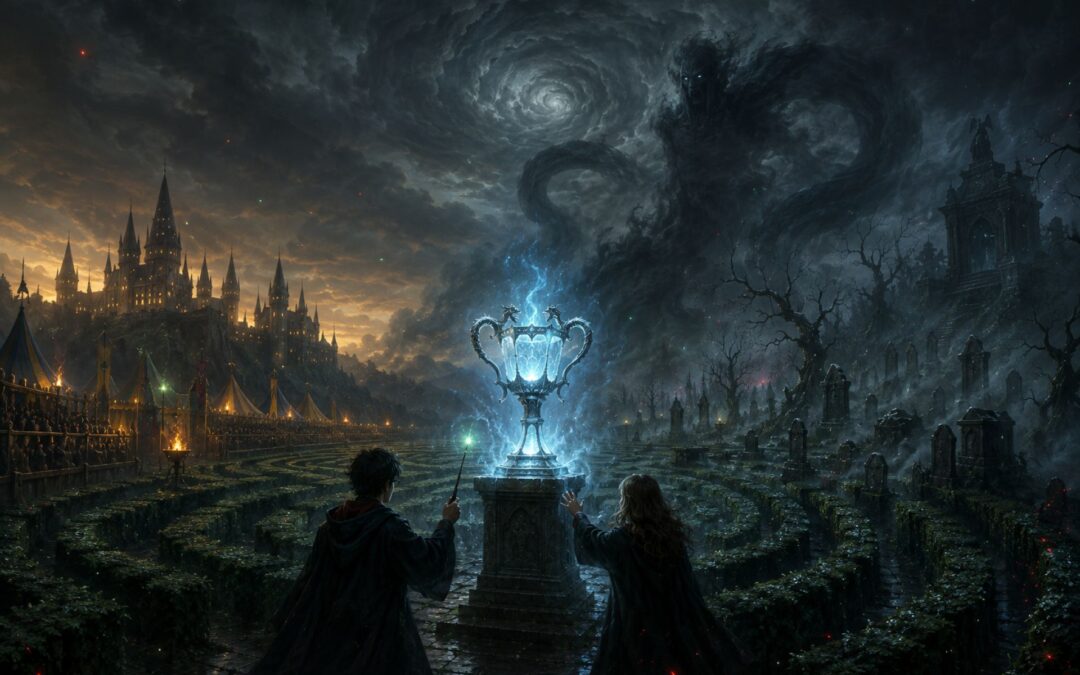
Harry Potter and the Goblet of Fire is the fourth novel in J.K. Rowling’s seven-book Harry Potter series, but it is also the point at which the series changes its scale, emotional register, and understanding of danger. The first three novels repeatedly bring Harry into contact with the unfinished consequences of Voldemort’s first rise, yet their climaxes still allow Hogwarts to recover something resembling normality. Goblet of Fire deliberately breaks that pattern. By the end of the novel, a student is dead, Voldemort has regained a body, the government has refused to acknowledge the truth, and Dumbledore has begun preparing for a conflict that can no longer be contained within one school year.
The scale of the book reflected the scale of the phenomenon surrounding the series. Scholastic’s publication history records a July 8, 2000 U.S. publication date, 37 chapters, and an initial American printing of 3.8 million copies. Rowling herself explained shortly after publication that Harry’s world needed to become larger as he grew older, and that the fourth book represented the culmination of one phase of his life before the later books moved into a different era. That makes Goblet of Fire more than a sequel to Harry Potter and the Prisoner of Azkaban. It is the bridge between the relatively self-contained mysteries of Harry’s childhood and the political conflict that will define the second half of the series.
The novel achieves that transition by disguising it as expansion. Harry encounters international Quidditch, professional athletes, foreign magical schools, older students, romantic attraction, government officials, unfamiliar forms of magic, and the revived Triwizard Tournament. The wizarding world appears larger, richer, and more exciting than it has ever seemed. Yet almost every new institution or spectacle also exposes a weakness: the World Cup becomes the site of racist violence, the Tournament’s protections are manipulated, the press distorts private lives, the Ministry values reputation over truth, and the teacher who appears best prepared to protect Harry from dark magic is actually the servant preparing him for Voldemort.
Spoiler warning: This article covers the complete novel, including Cedric Diggory’s death, Barty Crouch Jr.’s identity, Voldemort’s return, and the ending.
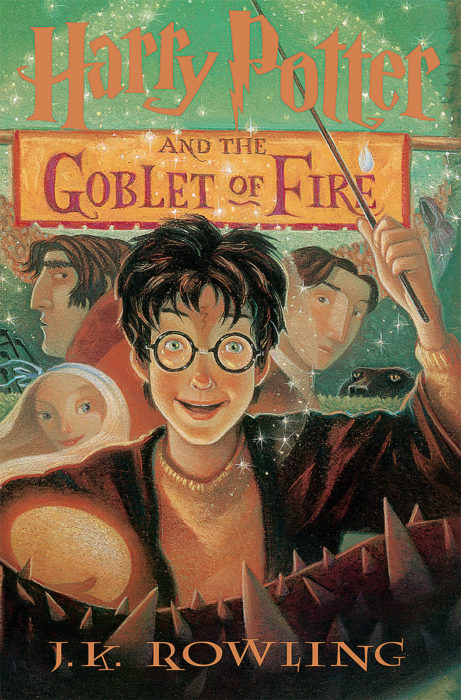
Harry Potter and the Goblet of Fire: Complete Plot Summary
The novel contains 37 chapters, but its plot works more clearly when understood as a series of connected movements rather than as 37 isolated episodes. The apparent story concerns Harry’s unwilling participation in the Triwizard Tournament. Beneath that story, however, a second narrative is unfolding in which Voldemort and Barty Crouch Jr. patiently manipulate the entire school year so that Harry will reach one particular object at one particular moment.
The Riddle House, the World Cup and the Dark Mark
The novel begins far from Harry and Hogwarts, in the village of Little Hangleton. Decades earlier, the wealthy Riddle family had been found dead in their house under mysterious circumstances. Their gardener, Frank Bryce, was suspected because there was no obvious killer and because villagers already regarded him as an isolated, unpleasant man. Yet the bodies showed no conventional cause of death, and Frank was eventually released.
Years later, the abandoned Riddle House is believed to be empty, but Frank notices a light inside and goes to investigate. He overhears Peter Pettigrew, or Wormtail, speaking to a physically ruined Voldemort. Their conversation establishes that Voldemort has captured Bertha Jorkins, learned information that will help him reach Harry Potter, and developed a plan involving someone inside Hogwarts. Nagini, Voldemort’s snake, detects Frank’s presence. Voldemort calls him into the room and murders him.
Harry experiences part of this scene in his sleep at Privet Drive. He wakes with his scar hurting sharply, which frightens him because the scar has historically reacted to Voldemort. Harry considers telling Ron, Hermione, or Dumbledore, but eventually writes to Sirius Black. Sirius is now more than the fugitive introduced in the previous novel; he is Harry’s godfather and the adult Harry instinctively trusts with fears connected to Voldemort.
Life at the Dursleys has also changed slightly because Harry now possesses something he never had before: leverage. When Molly Weasley invites him to attend the Quidditch World Cup, Vernon initially resists, but Harry casually reminds him that Sirius is his godfather. The Dursleys believe Sirius to be a violent criminal, so the implication that he may take an interest in Harry’s treatment is enough to make Vernon reconsider.
The Weasleys collect Harry through the Floo Network, only to discover that the Dursleys have blocked their fireplace. Arthur Weasley eventually blasts the fireplace open, producing the kind of chaotic comedy familiar from the earlier books. Fred and George leave behind one of their experimental Ton-Tongue Toffees, which Dudley eats, causing his tongue to swell enormously. Arthur is embarrassed by the prank because his fascination with Muggles does not prevent him from recognising that abusing them for entertainment is wrong.
At the Burrow, Harry meets Bill and Charlie Weasley and sees Fred and George’s joke-making becoming a genuine business ambition. Percy, meanwhile, is preoccupied with his Ministry work and speaks constantly about his superior, Barty Crouch. Crouch is still only a name to Harry, but the reverence Percy has for him establishes the older man as a powerful, serious, highly respected official.
The journey to the Quidditch World Cup expands Harry’s understanding of magical society. To reach the campsite, the Weasleys use a Portkey: an apparently worthless object enchanted to transport people to a predetermined destination. They travel with Cedric Diggory and his father, Amos. Cedric had previously appeared as a capable Hogwarts student and Quidditch player, but here Rowling begins developing him as an individual with family ties, social standing, and a reputation for decency.
The campsite is filled with wizards from many countries. Some struggle comically to dress like Muggles, forcing Ministry officials to manage the risk of exposure. Harry meets Ludo Bagman, a cheerful former Quidditch star who now works at the Ministry and seems far more informal than Crouch. He also sees Barty Crouch himself and meets Crouch’s house-elf, Winky, who is terrified of heights and unusually anxious about her master’s reputation.
Fred and George place a strange bet with Bagman: Ireland will win the match, but Bulgarian Seeker Viktor Krum will catch the Golden Snitch. The wager appears reckless because catching the Snitch normally decides a match, but the twins have calculated that Ireland’s overall team is so much stronger that Krum may be unable to overcome the points deficit even if he catches it.
The World Cup itself reveals a level of Quidditch far beyond school competition. The Irish team dominates collectively, while Krum demonstrates why he is internationally famous. Bulgaria falls far enough behind that Krum eventually catches the Snitch even though doing so confirms Ireland’s victory, 170–160. Fred and George’s prediction is exactly correct.
The celebratory atmosphere collapses later that night. A group of masked wizards begins levitating the Muggle family that manages the campsite, twisting and displaying them above the crowd. The attackers behave like Death Eaters, though Voldemort has been gone for years. Their actions reveal that his ideology has survived his disappearance even among people who have returned to respectable public lives.
Harry, Ron, and Hermione flee into the woods. Harry realises that his wand is missing. Soon afterward, someone fires the Dark Mark into the sky, producing the skull-and-snake symbol Voldemort’s followers used during the first war. Ministry officials rush toward the spell and fire at the location before discovering Winky nearby with Harry’s wand.
A magical test shows that Harry’s wand cast the Dark Mark. Winky insists that she did not do it, and Harry knows he did not. Crouch reacts less like a man determined to discover the truth than like a man horrified by the scandal. He dismisses Winky despite her desperate loyalty.
When the Weasleys return home, the Ministry faces intense criticism for failing to control the World Cup and protect the Muggle family. The Daily Prophet begins playing an increasingly important role in shaping public interpretation of events. Percy automatically defends Crouch and Ministry procedure, but the reader has already seen something Percy has not: the institutions responsible for maintaining order do not necessarily understand what has happened.
Return to Hogwarts and the Triwizard Tournament
Before Harry returns to school, Sirius tells him that the combination of the painful scar, the World Cup attack, and unexplained events is serious enough that he intends to return to Britain despite the danger of capture. Sirius cannot yet identify the conspiracy, but his reaction establishes that the adults who understand Voldemort’s history are becoming alarmed.
On the Hogwarts Express, Draco Malfoy hints that an important event is going to take place at the school. His father’s connections have given the Malfoys information before most students receive it, reinforcing a recurring pattern in the series: social and political privilege often means access to knowledge.
At Hogwarts, Hermione learns that house-elves perform much of the school’s cooking and domestic labour. The discovery disturbs her because the students enjoy the benefits of their work without seeing them. She begins treating house-elf servitude as a moral problem and eventually creates S.P.E.W., the Society for the Promotion of Elfish Welfare.
Dumbledore soon announces the main event of the year. Hogwarts will host a revived Triwizard Tournament with Beauxbatons Academy and Durmstrang Institute. Historically, the Tournament tested champions from the three schools through dangerous magical tasks, but it had been discontinued because contestants were repeatedly injured or killed. Its revival comes with stricter precautions, including a rule that no student under seventeen may enter.
The new Defence Against the Dark Arts teacher is Alastor “Mad-Eye” Moody, a legendary retired Auror. He appears scarred and damaged from years of fighting dark wizards, with a magical eye that can see in unusual directions and through many forms of concealment. Students quickly accept his paranoia and severity as the natural behaviour of a man who has spent his life expecting attacks.
When Draco attempts to hex Harry from behind, Moody transforms him into a ferret and bounces him around the corridor until McGonagall intervenes. The scene is funny to many of the students because Draco is being humiliated, but it also establishes the teacher’s alarming willingness to punish children through magical violence.
Moody’s most memorable class concerns the three Unforgivable Curses. The Imperius Curse controls another person’s actions, the Cruciatus Curse inflicts unbearable pain, and Avada Kedavra kills. Neville Longbottom reacts especially badly to the Cruciatus Curse, although Harry does not yet know that Neville’s parents were tortured into permanent mental incapacity by Voldemort’s followers. Harry, meanwhile, sees the curse that killed his parents demonstrated before him.
The visiting schools soon arrive. Madame Maxime brings the Beauxbatons delegation in a gigantic flying carriage, while Igor Karkaroff and the Durmstrang students arrive aboard a ship that emerges from the lake. Viktor Krum is among them, transforming Ron’s distant admiration for an international Quidditch star into astonishment that the celebrity is now living at Hogwarts.
Students who want to enter the Tournament place their names into the Goblet of Fire. Dumbledore surrounds it with an Age Line, which Fred and George unsuccessfully attempt to defeat with an Ageing Potion. Their failure reinforces the impression that the selection process is secure.
The Goblet chooses Fleur Delacour for Beauxbatons, Viktor Krum for Durmstrang, and Cedric Diggory for Hogwarts. Then, after everyone expects the selection to be over, another piece of parchment emerges.
It contains Harry Potter’s name.
The Fourth Champion and the First Task
Harry immediately denies entering himself. In the champions’ chamber, the adults debate whether the selection can be reversed. Dumbledore asks Harry directly whether he entered or asked anyone else to enter him, and Harry answers no.
Moody proposes a disturbing explanation. A highly skilled wizard could have Confunded the Goblet into believing that four schools were competing, then entered Harry under the name of an invented fourth school so that he would be the only possible champion from it. The theory turns out to be essentially correct, although neither Harry nor Dumbledore yet knows that Moody is describing his own crime.
The Goblet’s decision constitutes a binding magical contract, so Harry must compete. The supposedly protective rules of the Tournament therefore become the mechanism that traps him.
School opinion quickly turns against Harry. Many Hufflepuffs resent him because Cedric was finally giving their house a chance to receive attention, while Slytherins enjoy treating Harry as an arrogant celebrity who entered for more fame. Draco distributes “Potter Stinks” badges.
The most painful reaction comes from Ron. He believes Harry may have discovered some secret way to enter and failed to tell him. Ron’s anger is not only about the Tournament. It reflects years of living beside Harry’s fame, wealth, extraordinary experiences, and involuntary centrality. Ron loves Harry, but in this moment his insecurity becomes stronger than his trust.
Hermione believes Harry and supports him consistently. She also becomes more than a neutral friend in the conflict, pushing Harry to recognise that Ron’s behaviour is connected to feelings he has trouble expressing.
Rita Skeeter, a journalist covering the Tournament, interviews Harry and almost immediately demonstrates that factual accuracy is less important to her than a compelling story. Harry’s reluctance, orphanhood, friendships, and private emotions are rearranged into a sentimental celebrity profile. His actual fear of being forced into a deadly competition is less useful to her than a marketable version of “Harry Potter.”
During the traditional weighing of the champions’ wands, Ollivander verifies that the competitors’ wands are in working order. The ceremony reminds the reader of Harry’s unusual wand core, although its significance will not become clear until the graveyard.
Hagrid secretly shows Harry the creatures prepared for the first task: dragons. Because Madame Maxime also sees them and Karkaroff is likely to tell Krum, the ideal of a perfectly fair contest is already compromised by informal networks of assistance.
Harry responds by warning Cedric. He could preserve an advantage over the official Hogwarts champion, but he decides that Cedric should know what the others know. Cedric’s later help with the second task will grow directly from this choice.
Sirius contacts Harry and warns him that Karkaroff was once a Death Eater. He also points out that Barty Crouch has a complicated history from the first war. Harry still lacks enough information to understand the Crouch mystery, but Sirius encourages him to stop assuming that respectable institutional positions make people uncomplicated or safe.
Moody subtly guides Harry toward thinking about what he does exceptionally well. Harry eventually realises that he does not need to overpower a dragon directly if he can turn the task into a flying challenge.
Hermione helps him practise the Summoning Charm until he can reliably call an object from a distance. During the task, Harry uses it to summon his Firebolt, mounts the broom, and draws the Hungarian Horntail into the air. His success depends on his flying ability, but the apparently individual triumph is the product of several people’s help: Hagrid showed him the dragons, Hermione trained him, and Moody manipulated him toward the solution.
Ron watches Harry confront the dragon and finally accepts that Harry could not possibly have chosen this situation for himself. Their reconciliation is awkward but sincere. Harry does not demand a perfect apology because he understands what Ron is trying to say, and the friendship resumes.
House-Elves, the Yule Ball and the Second Task
After the first task, Hermione takes Harry and Ron to the Hogwarts kitchens. The visit reveals that the school’s comfort depends upon a large workforce of house-elves who cook, clean, and maintain the castle while remaining almost invisible to students.
Two particular elves complicate Hermione’s campaign. Dobby, whom Harry freed in Harry Potter and the Chamber of Secrets, has actively sought paid employment and negotiated wages and time off at Hogwarts. Winky, by contrast, has also been employed there after her dismissal by Crouch, but she regards losing her old position as catastrophic and remains devoted to the family that expelled her.
The contrast prevents the subplot from becoming simple. Dobby demonstrates that an elf can desire independence, wages, and self-direction, while Winky shows how thoroughly servitude can shape identity and belonging. Hermione is morally right to see a coercive institution where others see tradition, but her tendency to decide what elves ought to want sometimes prevents her from listening to the individuals she is trying to help.
The champions soon receive another unexpected obligation: they must open the Yule Ball with partners. Harry and Ron discover that facing a dragon does not make ordinary adolescent embarrassment easier. Harry eventually asks Cho Chang, but she has already agreed to attend with Cedric. Ron impulsively asks Fleur and immediately regrets it.
Hermione reveals that she already has a partner but refuses to tell them who it is. Harry and Ron have become so accustomed to her availability that the possibility of someone else seeing her romantically surprises them.
At the Yule Ball, Hermione arrives with Viktor Krum. Ron’s reaction exposes feelings he has not admitted. Rather than acknowledging jealousy, he becomes rude and accusatory, suggesting that Hermione should not have gone with a Durmstrang student. Hermione correctly points out that Ron had plenty of time to ask her himself.
Harry spends much of the evening watching Cho and Cedric. The Tournament’s rivalries have therefore become entangled with adolescent relationships. Cedric is not merely the other Hogwarts champion; he is also the boy dating the person Harry likes.
Outside the ball, Harry overhears Hagrid talking privately with Madame Maxime. Hagrid reveals that his mother was a giantess. Maxime refuses to acknowledge comparable ancestry, which demonstrates the shame and prejudice attached to giant blood in wizarding society.
Harry also overhears Karkaroff speaking anxiously with Snape about something on their arms becoming stronger. They are referring to the Dark Marks they received as Death Eaters. Voldemort has not yet publicly returned, but the signs connecting his former followers to him are becoming active.
Rita Skeeter soon publishes a story exposing Hagrid’s giant ancestry. The article turns a private fact into a public scandal by relying on existing prejudice. Hagrid withdraws from teaching and briefly tries to hide from the students.
Harry, Ron, and Hermione eventually persuade him to return. Their defence of Hagrid is not based on denying his ancestry but on rejecting the assumption that ancestry determines character. Hagrid tells them more about his parents and his childhood, making his identity a personal history rather than merely a category that Rita can weaponise.
Harry still needs to solve the clue contained in the golden egg from the first task. Cedric repays Harry for warning him about the dragons by telling him to take the egg into the prefects’ bathroom and listen to it underwater.
With help from Moaning Myrtle, Harry discovers that the apparently unbearable shrieking becomes a merpeople song underwater. The message tells him that something precious will be taken from him beneath the lake, and he will have an hour to recover it.
On his way back from the bathroom, Harry encounters another clue to the larger mystery. Hidden beneath the Invisibility Cloak, he becomes trapped in a trick step. The Marauder’s Map shows someone named Barty Crouch moving through Snape’s office.
Harry assumes this must be Crouch Sr. The map, however, does not distinguish between father and son by title. It is actually revealing that Barty Crouch Jr. is inside Hogwarts.
Fake Moody arrives, helps Harry avoid discovery, and takes possession of the Marauder’s Map. On a first reading, his interest seems connected to the paranoia of an Auror. In retrospect, Crouch Jr. is removing an object capable of exposing him.
Harry now understands the second task but cannot solve its practical problem: he has no reliable method of breathing underwater for an hour. His preparation becomes increasingly desperate.
On the morning of the task, Dobby gives him gillyweed. Harry eats it and develops temporary aquatic adaptations that allow him to breathe underwater.
At the bottom of the lake, Harry discovers the hostages: Ron has been taken for him, Hermione for Krum, Cho for Cedric, and Fleur’s young sister Gabrielle for Fleur. The “treasures” are tied together while merpeople guard them.
Harry frees Ron but becomes worried because Fleur has not arrived. He does not trust the assumption that the Tournament organisers will automatically protect Gabrielle once time runs out. He stays behind until he can free her as well.
The judges explain that the hostages were never genuinely going to die, so Harry’s delay was unnecessary in purely competitive terms. Yet his concern earns him credit. The episode captures a recurring tension in the book: the scoring system rewards efficient victory, but Harry repeatedly makes decisions based on responsibility for other people rather than on what maximises his chance of winning.
The Crouch Mystery and the Road to the Maze
Rita Skeeter now redirects her attention toward Harry’s personal life. She creates a romantic triangle involving Harry, Hermione, and Krum, presenting Hermione as someone manipulating famous boys. The article leads strangers to send Hermione abusive mail, showing how quickly invented narratives acquire real consequences once the public accepts them.
Sirius returns to Britain and secretly meets Harry, Ron, and Hermione in a cave near Hogsmeade. He provides the political history that Harry lacks.
Barty Crouch Sr., Sirius explains, built his reputation during Voldemort’s first rise as a hard-line Ministry official. He authorised increasingly severe measures against suspected dark wizards and seemed positioned to become Minister for Magic. Then his own son was arrested.
Sirius also explains that Igor Karkaroff gained leniency by identifying other Death Eaters, and that Ludo Bagman once faced accusations connected to information he had passed to Voldemort’s supporters. Bagman was not convicted as a conscious Death Eater, but the story makes the adult world surrounding the Tournament far more ambiguous than Harry initially understood.
Bertha Jorkins, the Ministry employee Voldemort mentioned in the opening chapter, also belonged to this network of old institutional connections. She has disappeared while travelling abroad.
The mystery deepens when Harry and Krum encounter Barty Crouch Sr. near the Forbidden Forest. Crouch appears physically exhausted and mentally unstable. He switches between bureaucratic speech from his working life and broken references to his family. Yet amid the confusion, he repeatedly makes one request: he needs to see Dumbledore.
Harry leaves Krum with him and runs for help. When he returns, Krum has been stunned and Crouch has disappeared.
Harry does not know that Crouch Sr. has spent months under the Imperius Curse. He has managed to resist it enough to escape and reach Hogwarts, but Crouch Jr. intercepts and kills him before he can reveal the conspiracy.
Harry’s scar dreams also become more intense. During Divination he experiences another vision connected to Voldemort in the Riddle House. Voldemort is furious with Wormtail and discusses setbacks to their plan. The connection between Harry and Voldemort is becoming more active as Voldemort approaches physical restoration.
The Pensieve finally supplies the historical information needed to understand why Barty Crouch’s name matters. While waiting in Dumbledore’s office, Harry discovers the magical device used to store and revisit memories.
He witnesses Igor Karkaroff’s hearing, where Karkaroff attempts to reduce his sentence by naming other Death Eaters. He sees Ludo Bagman’s hearing, in which Bagman is accused of passing information to a Voldemort supporter but is treated as a naïve sportsman rather than a committed conspirator.
Most importantly, Harry witnesses the trial of Barty Crouch Jr. The younger Crouch is accused alongside Bellatrix Lestrange, her husband, his brother, and another Death Eater of torturing Frank and Alice Longbottom with the Cruciatus Curse in an attempt to discover Voldemort’s location after his disappearance.
Neville’s reaction during Moody’s class now becomes comprehensible. The people whose torture Harry watches in Dumbledore’s memory are Neville’s parents.
Crouch Jr. protests that he is innocent and begs his father to save him. Crouch Sr., determined to demonstrate that public duty matters more than family, condemns his own son and sends him to Azkaban. The memory does not tell Harry whether the younger Crouch’s denials are genuine, but it establishes the catastrophe that destroyed the elder Crouch’s political career.
Dumbledore also confirms that Snape was once a Death Eater but later became his spy. Harry’s world is therefore filling with people whose public identities do not reveal their entire pasts. Yet the important distinction is not between people with and without dark histories. Snape, Karkaroff, and Crouch Jr. all have connections to Voldemort, but their choices after those connections diverge radically.
The Third Task, Cedric’s Death and Voldemort’s Return
Before the third task, the champions’ families are invited to Hogwarts. Because Harry has no conventional wizarding family to attend, Molly and Bill Weasley come for him. Their presence quietly confirms the role the Weasleys have acquired in Harry’s life: they are not legally his guardians, but they function as family in ways the Dursleys never have.
The final task is a maze grown over the Quidditch pitch. The champions enter according to their Tournament standings and must find the Triwizard Cup at the centre.
Harry encounters a series of magical obstacles, including a boggart, a Blast-Ended Skrewt, strange enchanted mist, a sphinx, and a giant spider. The danger appears to be the official challenge, but the real manipulation comes from outside the maze.
Fake Moody is watching the competitors and interfering with events. Fleur is removed from contention. Krum is placed under the Imperius Curse and made to attack Cedric.
Harry helps Cedric rather than taking advantage of his trouble. Cedric later has a chance to leave Harry behind but also refuses. By the time they reach the Cup, both have legitimate claims to victory and both have repeatedly helped the other.
Cedric argues that Harry deserves the Cup because Harry saved him in the maze. Harry argues that Cedric deserves it because Cedric would have reached it first without the interference. They eventually decide to take the Cup together, creating an ending to the competition based on shared victory rather than exclusive triumph.
The Cup is a Portkey.
It transports them to a graveyard in Little Hangleton. Harry recognises the setting from his dreams.
Before either boy understands what is happening, Voldemort orders Wormtail to kill Cedric. Cedric dies almost instantly.
The abruptness matters. Cedric does not die after making a tragic mistake, discovering a secret, or sacrificing himself for Harry. He is murdered because he happens to be present. A school competition that has spent hundreds of pages establishing rules, scores, spectators, judges, and prestige suddenly becomes irrelevant in a place where Voldemort regards another human life as disposable.
Wormtail ties Harry to the grave of Tom Riddle Sr. and begins a ritual to restore Voldemort’s body. He takes a bone from Voldemort’s father’s grave, cuts off his own hand as the “flesh of the servant,” and takes Harry’s blood as the blood of an enemy.
Voldemort emerges with a fully restored body.
He summons the Death Eaters using the Dark Mark. Figures who had returned to normal wizarding society arrive and form a circle around him. Voldemort criticises those who failed to search for him, praises or punishes according to his own logic, and reasserts dominance over the group.
His relationship with his followers is not built on reciprocal loyalty. They fear him, flatter him, hide from him when he is weak, and return when his power becomes undeniable. Voldemort interprets obedience as loyalty because he cannot imagine a meaningful relationship that is not hierarchical.
He explains parts of what happened after his curse rebounded from baby Harry. Voldemort survived without an ordinary body and spent years in diminished forms. His temporary possession of Professor Quirrell failed because Harry’s body carried the protection created by Lily Potter’s sacrifice.
Voldemort believes he has now overcome that protection by using Harry’s blood in his resurrection. If Lily’s protection exists in Harry’s blood, Voldemort reasons, taking that blood into his own body will allow him to touch and kill Harry.
He decides to prove his superiority publicly by duelling Harry in front of the Death Eaters.
Harry knows he is almost certainly going to die, but he refuses to submit passively. He chooses to face Voldemort and cast a spell.
Their wands connect.
Ollivander had explained years earlier that Harry’s wand and Voldemort’s share feathers from the same phoenix. When forced directly against one another, the twin cores produce a rare effect later identified as Priori Incantatem. Voldemort’s wand begins producing echoes of its recent victims in reverse order.
Cedric appears. Frank Bryce appears. Bertha Jorkins appears. Eventually Lily and James Potter appear.
These figures are not resurrected in the ordinary sense. They are temporary echoes produced by Voldemort’s wand. Yet they give Harry the emotional and tactical support he needs. His parents encourage him, and the dead surround Voldemort long enough for Harry to break the connection.
Cedric’s echo asks Harry to take his body back to his parents.
Harry reaches the Cup, summons it, and returns to Hogwarts carrying Cedric.
The spectators initially think the champions have returned together in triumph. Then the reality of the body becomes clear.
Barty Crouch Jr.’s Confession and the Ministry’s Denial
Harry is exhausted, injured, and traumatised, but Moody immediately removes him from the crowd. Instead of taking Harry to Dumbledore, he brings him to his office and begins asking detailed questions about the graveyard.
His interest becomes suspiciously intense. He reveals that he guided Harry through the Tournament so that Harry would reach the Cup first. Before he can kill Harry, Dumbledore, McGonagall, and Snape intervene.
The effects of Polyjuice Potion begin to fade.
The man who has spent the entire school year pretending to be Alastor Moody is Barty Crouch Jr.
The real Moody is discovered imprisoned in a magical trunk. Crouch Jr. has kept him alive because he needed hair for Polyjuice Potion and information with which to maintain a convincing impersonation.
Under Veritaserum, Crouch Jr. reconstructs the conspiracy, and nearly every mystery in the book suddenly connects.
Crouch Jr. had been sentenced to Azkaban after the trial Harry saw in the Pensieve. His mother, dying and desperate to save him, persuaded Crouch Sr. to help her exchange places with their son using Polyjuice Potion. Because Dementors sense human emotion more readily than visual identity, the exchange succeeded. Crouch’s mother died in Azkaban while appearing to be her son, and the public believed Barty Crouch Jr. had died there.
Crouch Sr. secretly kept his son at home under the Imperius Curse. Winky helped care for him and became one of the few people who knew he was alive. Her apparently excessive anxiety about the family’s reputation was therefore connected to an enormous hidden crime.
At the Quidditch World Cup, Crouch Jr. attended under an Invisibility Cloak. Winky had persuaded his father to let him experience the event, believing some controlled freedom might help him. Surrounded by the excitement and by former Death Eaters who had escaped punishment, he began resisting his father’s Imperius Curse.
He stole Harry’s wand and later used it to cast the Dark Mark. Winky was found with the wand because she had been trying to control him and prevent him from exposing the family secret. Crouch Sr. responded by dismissing her.
Meanwhile, Voldemort had captured Bertha Jorkins. Through her, he learned that Barty Crouch Jr. was alive and hidden at his father’s house. Voldemort and Wormtail freed Crouch Jr. and placed Crouch Sr. under the Imperius Curse.
Crouch Jr. then helped capture the real Alastor Moody before the school year began. Using Moody’s appearance, mannerisms, knowledge, and hair, he entered Hogwarts as the new Defence Against the Dark Arts teacher.
He placed Harry’s name in the Goblet under a false fourth school, ensuring that Harry would be chosen. The Tournament then gave him a year-long structure within which he could guide Harry without openly abducting him.
For the first task, Crouch Jr. pushed Harry toward using his broom. For the second, he originally attempted to steer Harry toward information about gillyweed through Neville, then ensured Dobby supplied it. During the year he behaved like a remarkably effective Defence teacher because teaching Harry useful defensive skills made Harry more likely to survive long enough to reach Voldemort.
When Crouch Sr. began resisting the Imperius Curse completely, he escaped and reached Hogwarts. Crouch Jr. intercepted him before he could speak to Dumbledore, killed him, and concealed the body.
During the third task, Crouch Jr. used Moody’s magical eye to watch the maze. He removed obstacles, attacked Fleur, controlled Krum through Imperius, and tried to clear Harry’s path to the Cup.
He had turned the Cup into a Portkey that would deliver Harry to Voldemort.
The entire Tournament was therefore a mechanism for creating an apparently accidental disappearance inside a dangerous competition. Voldemort intended to kill Harry, restore his body, and keep his return hidden.
The conspiracy is solved, but the political problem is only beginning.
Dumbledore makes Harry recount what happened in the graveyard while the memories are still clear. He later explains the twin-wand connection that saved Harry.
Cornelius Fudge arrives, but one of the Dementors accompanying him enters the room with Crouch Jr. and performs the Dementor’s Kiss. Crouch Jr.’s soul is removed, making a normal confession or trial impossible.
Fudge refuses to believe that Voldemort has returned. The implications are too enormous, and the surviving evidence can be interpreted in ways that allow him to preserve the existing political order. He suggests that Harry is traumatised and unreliable and treats Dumbledore’s conclusions as alarmist.
Snape displays the Dark Mark on his arm and explains that it has been growing stronger. Fudge remains unwilling to act.
Dumbledore proposes immediate preparations, including removing Dementors from Azkaban and seeking alliances with groups such as the giants before Voldemort can recruit them. Fudge rejects the measures and leaves.
The disagreement becomes a political split. Dumbledore does not wait for official approval. He begins contacting old allies, sends Sirius on a mission, and gives Snape a dangerous assignment that clearly involves returning to his old connections among Voldemort’s followers.
In the hospital wing, Harry finally begins emotionally processing what happened. Molly Weasley embraces him, and the experience nearly overwhelms him because it resembles the kind of unconditional parental comfort he barely remembers receiving.
Harry later meets Cedric’s parents. He tries to give them the Tournament prize money, but they refuse. For them, the competition has ceased to matter.
At the final feast, Dumbledore refuses to allow Cedric’s death to be sanitised as an unfortunate Tournament accident. He tells the students that Voldemort killed Cedric and asks them to remember what actually happened. Truthful memory becomes an ethical responsibility precisely because powerful people will soon attempt to deny the truth.
The foreign students depart. Karkaroff has fled after feeling Voldemort’s return through the Dark Mark. Hermione reveals that she has finally discovered Rita Skeeter’s secret: Rita is an unregistered Animagus who transforms into a beetle, allowing her to spy on private conversations. Hermione captures her and forces her to stop publishing for a period.
On the train home, Harry gives the thousand-Galleon Tournament winnings to Fred and George to finance their joke shop. He asks them to use some of the money to buy Ron better dress robes.
The gesture resolves a subplot that began at the Burrow, but it also shows how thoroughly Harry rejects the meaning attached to the prize. The money is connected to a Tournament that led Cedric to his death. Harry would rather transform it into something that creates laughter and possibility.
He returns to Privet Drive knowing that Voldemort is back. The chapter is titled “The Beginning” because the conventional ending of the school year no longer marks the restoration of safety. The contest has ended, but the larger conflict has begun.
Setting and World-Building: A Wizarding World That Becomes Larger—and Less Safe
The first three novels gradually reveal Hogwarts and the immediate British magical world to Harry. Goblet of Fire makes a much more dramatic expansion. Rowling said shortly after publication that Harry’s horizons had to widen as he grew older, and her contemporary discussion of the novel helps explain why the World Cup, international schools, Ministry politics, and social hierarchies occupy so much more space than comparable institutions did earlier in the series.
The important effect is not simply that the world becomes bigger. The expansion allows Harry to discover that magical society contains many of the same structural problems as ordinary societies: prejudice, labour exploitation, bureaucratic self-protection, celebrity journalism, class privilege, political fear, and unequal access to institutional power. The wonder that defines Harry Potter and the Philosopher’s Stone remains, but wonder is no longer enough to make the magical world morally uncomplicated.
An International Wizarding World
The Quidditch World Cup is the novel’s first great act of expansion. Harry has known Quidditch as a school sport, but the World Cup reveals a professional culture with international stars, national loyalties, specialised spectators, elaborate mascots, and global travel. Viktor Krum ceases to be merely Ron’s sports idol and becomes a person Harry will later know directly.
The gathering also reveals the practical difficulties of keeping an international magical community hidden from Muggles. Wizards camp in one location while repeatedly violating ordinary dress conventions, performing magic carelessly, and forcing Ministry officials to modify the campground manager’s memory. Secrecy is presented not as a perfectly functioning magical shield but as an immense bureaucratic maintenance problem.
Beauxbatons and Durmstrang expand this international dimension inside Hogwarts. Their arrival introduces different educational traditions, cultural expectations, and reputations. Durmstrang is associated with a greater tolerance for teaching the Dark Arts, while Beauxbatons carries its own social rituals and institutional pride.
The Tournament is supposed to turn these different communities toward peaceful competition. Dumbledore’s final speech makes clear that international solidarity is also a political necessity. Voldemort benefits when communities remain divided by national identity, old prejudice, or institutional rivalry.
Hogwarts, the Ministry and Social Hierarchy
Hogwarts remains Harry’s emotional home, but this novel complicates the institution itself. Hermione’s discovery of the kitchens reveals that students experience warmth, food, cleanliness, and comfort without seeing the workers who provide them. The house-elves’ invisibility is structural rather than accidental.
Dobby and Winky show two different responses to that institution. Dobby values wages and independence, while Winky experiences service to the Crouch family as the basis of her identity. Her loyalty does not prove that the system is just; it demonstrates how deeply a social system can shape what people believe they are supposed to want.
The novel also widens the treatment of prejudice. Hagrid’s giant ancestry becomes a scandal not because he has behaved differently but because Rita Skeeter provides the public with a category they already distrust. Madame Maxime’s refusal to acknowledge her own likely giant ancestry shows how prejudice can produce concealment as well as persecution.
Blood ideology remains important even before Voldemort publicly returns. The World Cup attackers humiliate a Muggle family for entertainment. Draco and the Malfoys continue treating ancestry as a marker of worth. The social prejudices that Voldemort exploits therefore exist independently of Voldemort himself.
The Ministry becomes more visible than ever before. Bagman represents its informal, celebrity-friendly side, Crouch its severe bureaucratic side, and Fudge its political leadership. None of them is simply incompetent in the same way, but the institution repeatedly shows how vulnerable public administration becomes when officials value reputation, procedure, or personal ambition more than uncomfortable evidence.
Magic, Rules and the Failure of Safeguards
The novel contains an extraordinary number of magical rules and security systems. The Goblet has an Age Line around it. The Tournament has judges. Hogwarts supposedly has protections. Moody is recruited because of his experience fighting dark wizards. The third task occurs inside a controlled maze in front of an enormous audience.
Almost every safeguard works technically while failing strategically.
The Age Line prevents underage students from entering their own names, but it cannot stop a skilled adult from manipulating the Goblet. The Tournament rules protect the contract once Harry is selected, which means the rule designed to govern fair competition helps imprison an unwilling child inside the scheme. Moody’s magical eye is a powerful security instrument, but because the person using it is an impostor, the same surveillance advantage helps the conspiracy.
Portkeys are another example. Harry first encounters one as mundane transportation to the World Cup. The final task turns the same technology into an abduction device. Polyjuice Potion, already familiar from an earlier book, becomes powerful enough to sustain a year-long infiltration when combined with access to the victim.
The Unforgivable Curses make the book’s political ideas physically concrete. Imperius can remove free choice, Cruciatus can make pain itself a weapon, and Avada Kedavra can erase life instantly. Voldemort’s followers do not merely hold authoritarian ideas; their magic gives them literal tools for domination.
The result is a world where complexity does not automatically produce security. Sophisticated magical institutions can still fail if the people operating them misunderstand the threat.
Character Analysis
Goblet of Fire contains one of the largest casts in the series, but its character work is not simply additive. The expanded cast allows Rowling to place different kinds of courage, loyalty, ambition, insecurity, authority, and prejudice beside one another.
The novel is also structured around misreading. Harry misreads Crouch Jr. as Moody, Ron misreads Harry’s participation as ambition, the public misreads Harry through Rita, and Fudge misreads Harry’s trauma as evidence against his testimony. Characterisation therefore often depends on the gap between how a person appears socially and what their choices reveal.
Harry Potter: Courage Without Control
Harry begins the novel older and more independent than the boy who first entered Hogwarts, but the defining fact of his year is his lack of control. He does not choose the Tournament. He cannot persuade most people that he did not enter. He cannot withdraw. He cannot stop Rita from reinventing him publicly. He cannot prevent Voldemort’s plan from progressing around him.
His growth therefore does not take the form of gaining control over his circumstances. It lies in how he chooses to act inside circumstances other people have created.
Harry’s most important Tournament decisions are rarely the most competitively efficient. He warns Cedric about the dragons. He remains underwater because he fears Gabrielle may be abandoned. He helps Cedric in the maze. He agrees to share the Cup.
These choices could look like weaknesses inside a pure winner-takes-all contest. In the moral architecture of the novel, they are the point. Harry’s value does not come from defeating everyone else.
His first task also shows his practical intelligence. Harry is not a scholar in Hermione’s sense, but he is good at adapting under pressure. He learns the Summoning Charm, recognises that flying is his best ability, and transforms a problem he cannot solve through brute magical force into one he can solve through movement.
The second task reveals a related tendency: Harry has difficulty believing that institutions will guarantee someone else’s safety simply because the rules say they will. His instinct is partly irrational in context—the hostages were protected—but it becomes increasingly understandable in a novel where official assurances repeatedly fail.
Harry’s adolescent life also becomes more complicated. He notices Cho differently, experiences romantic disappointment, resents Cedric for reasons unrelated to the Tournament, and becomes more aware of how other people perceive him. Rowling does not allow the growing political darkness to replace ordinary adolescence.
The graveyard transforms all these developments. Harry has faced death before, but Cedric’s murder is different because Harry witnesses an innocent peer being killed casually and immediately understands that he was the intended target. His survival is not triumphant.
His decision to bring Cedric’s body back is crucial. Voldemort treats the dead as discarded obstacles. Harry treats the dead as people whose relationships continue to matter. Returning Cedric does nothing strategically useful, but it preserves a human obligation.
By the end of the novel, Harry is not stronger because trauma has somehow improved him. He is more burdened, more knowledgeable, and less protected by the assumption that adults will recognise reality once they see enough evidence.
Ron Weasley and Hermione Granger: Friendship, Jealousy and Moral Growth
Ron’s temporary break with Harry is one of the most important developments in their friendship because it gives shape to an insecurity that has existed for years. Ron grows up in a loving family but is surrounded by accomplished older siblings. His best friend is famous, wealthy, unusually talented in high-pressure situations, and continually placed at the centre of events.
Harry experiences fame as a burden. Ron can understand that intellectually while still occasionally envying the attention attached to it.
When Harry becomes the fourth champion, Ron imagines that Harry found a way to enter and excluded him. The accusation is unfair, but it is emotionally coherent. Ron’s resentment becomes strong enough that he temporarily prefers a story consistent with his insecurity over Harry’s actual explanation.
The first task corrects him because seeing Harry confront a dragon makes the danger undeniable. Their reconciliation works because both boys understand the emotional truth without having the language for a sophisticated conversation about jealousy.
The Yule Ball gives Ron another lesson in emotional immaturity. He is jealous of Hermione and Krum but expresses the jealousy as criticism of Hermione’s decision. Hermione refuses to accept the implication that she should have remained available until Ron decided he wanted her.
Hermione’s development is different. She is the friend who consistently believes Harry about the Goblet and helps him prepare for the Tournament. She provides research, practice, emotional steadiness, and practical criticism.
Her house-elf campaign, however, reveals the limits of intelligence when it becomes paternalism. Hermione notices a moral problem almost everyone else ignores, but she often assumes that identifying injustice gives her full understanding of the people inside it. Dobby supports much of her moral intuition; Winky complicates her methods.
Hermione also learns to fight Rita Skeeter on Rita’s own terrain. Rather than simply complaining about dishonest journalism, she works out how Rita is obtaining supposedly private information. Discovering the illegal beetle Animagus form demonstrates Hermione’s investigative patience and willingness to use leverage when ordinary appeals fail.
Cedric Diggory, Viktor Krum and Fleur Delacour: The Other Champions
Cedric matters because Rowling makes him decent without making him idealised. He is handsome, popular, talented, and socially secure, which initially gives Harry several reasons to resent him. Cedric defeated Harry at Quidditch in the previous year and is now dating Cho. He is also the official Hogwarts champion when Harry’s selection appears to steal attention from him.
Yet Cedric repeatedly behaves fairly. Once Harry warns him about the dragons, Cedric finds a way to repay the favour with the second-task clue. In the maze, he refuses to treat Harry’s vulnerability as an opportunity to win dishonestly.
The decision to share the Cup is the culmination of their relationship. They enter the final stage as rivals and reach the trophy unwilling to define victory through the other person’s defeat.
That is what makes Cedric’s death especially brutal. He is not killed because he represents an opposing ideology or because Voldemort has a personal grievance against him. He is killed because Voldemort has no reason to let him live.
Viktor Krum is initially introduced as a celebrity, which encourages Ron and the reader to see him as an image rather than a person. At Hogwarts, he turns out to be reserved, observant, and capable of forming an independent relationship with Hermione. His interest in her challenges the assumption that she exists only inside Harry and Ron’s social world.
Fleur is treated more superficially at first, partly because Harry and Ron respond to her Veela heritage and appearance. Her failure in the second task could make her seem like the weakest champion, but her reaction to Harry rescuing Gabrielle reveals intense loyalty to her sister.
Together, the three champions prevent the Tournament from becoming a simple story about Harry competing against antagonists. None of them is fundamentally Harry’s enemy.
Barty Crouch Jr and Barty Crouch Sr: The Family Inside the Mystery
Barty Crouch Jr. is the hidden architect of the school-year plot. His success depends on one of the novel’s most effective structural tricks: the reader spends almost the entire book getting to know him while believing he is someone else.
Crouch Jr. is committed to Voldemort with a fanaticism many of the older Death Eaters lack. They built respectable lives after Voldemort disappeared. Crouch Jr. endured imprisonment, magical control, concealment, and years of obsession while waiting for his master’s return.
His impersonation of Moody is successful because it contains more than surface mimicry. He studies Moody closely enough to reproduce habits, knowledge, professional paranoia, and speech. He also performs the role of an effective teacher so convincingly that students respond positively to him.
That creates one of the novel’s most unsettling retrospective effects. Harry learns useful lessons from a person whose ultimate intention is to murder him. Crouch Jr. teaches him about resisting Imperius and helps him survive the Tournament because those actions serve the larger plan.
Crouch Sr.’s tragedy is different. He defines himself through control, reputation, and public duty. During the first war, his severity helped make him politically powerful. When his son was accused of being a Death Eater, he condemned him publicly.
Yet the private decision to help his wife rescue their son from Azkaban destroys the clean distinction between the stern official and the compromised father. Crouch then attempts to control the consequences through secrecy and Imperius.
His failure is both political and personal. He cannot eliminate his son’s agency through magical control, cannot preserve the family secret indefinitely, and cannot protect his public identity from the private reality he has suppressed.
Winky becomes one of the clearest casualties of this household. Her loyalty is genuine, but the family structure turns that loyalty into a mechanism for concealing coercion.
Voldemort, Wormtail and the Death Eaters: Power Built on Fear
Voldemort spends much of the novel physically absent, yet the entire plot moves toward him. His influence appears first through Harry’s scar, then through former followers, the Dark Mark, dreams, Bertha’s disappearance, Karkaroff’s fear, and eventually the graveyard.
His return reveals what kind of leader he is. Voldemort wants more than obedience; he wants public acknowledgement of his superiority. That is why Harry’s death must become a demonstration before the Death Eaters.
Voldemort is intensely dependent on other people while despising dependency. Wormtail keeps him alive, helps him recover, sacrifices a hand, and performs the resurrection. Crouch Jr. manages the Hogwarts conspiracy. Bertha supplies information under torture.
Voldemort converts every dependency into hierarchy. Wormtail’s sacrifice becomes something Voldemort rewards as a master. Crouch Jr.’s devotion becomes useful because it serves Voldemort’s return. The Death Eaters are valued according to usefulness and obedience rather than mutual attachment.
Wormtail embodies the uglier side of loyalty. His allegiance does not arise from conviction so much as fear and opportunism. He attaches himself to whoever seems most powerful.
The Death Eaters behave similarly. Many spent years pretending they had been bewitched or had never supported Voldemort. They return when summoned because the power they thought gone is suddenly present again.
Dumbledore, Sirius, Hagrid, Winky, Dobby, Rita Skeeter and the Supporting Cast
Dumbledore’s role changes sharply at the end. For most of the year, he functions as headmaster, Tournament organiser, and investigator. Once Fudge refuses to act, Dumbledore becomes a political organiser working outside the government’s approval.
Sirius has his most important function as Harry’s chosen adult confidant. He risks capture because Harry’s scar pain worries him, gives Harry historical information about Crouch and Karkaroff, and takes Harry’s concerns seriously before the Ministry does.
Hagrid remains emotionally generous but socially vulnerable. The Rita Skeeter episode demonstrates how quickly private identity can become a weapon when prejudice already exists.
Winky and Dobby make the house-elf issue personal. Dobby embodies chosen independence; Winky embodies internalised duty, grief, and the destructive effects of a system in which service becomes indistinguishable from identity.
Rita Skeeter is not a Death Eater and does not need magical coercion to distort reality. Her power comes from transforming ambiguity into narrative. She decides what kind of story the public wants and then rearranges people to fit it.
Ludo Bagman serves a different purpose. His gambling debts, charm, and apparent interest in Harry provide a plausible source of suspicion without making him part of Voldemort’s conspiracy. Karkaroff is a genuine former Death Eater, yet he is not the person attacking Harry. Both help the mystery by demonstrating that a suspicious past and actual present guilt are not the same thing.
The real Alastor Moody deserves a final distinction. Almost everything readers admire, fear, or criticise about “Moody” during the school year belongs to Crouch Jr.’s performance. The real Moody spends the novel imprisoned. Later books may develop him, but this novel deliberately gives readers an imitation before the person himself.
Relationships, Rivalry and Loyalty
The Triwizard Tournament appears to organise the novel around competition, but the relationships that matter most repeatedly undermine the assumption that achievement is purely individual. Harry survives because other people help him, and his best moral decisions often involve helping people he is supposed to defeat.
Harry and Ron provide the clearest example of friendship strained by inequality. Their relationship is genuine, but genuine friendship does not erase envy. Ron’s resentment becomes dangerous when he stops trusting Harry’s account of his own experience, yet the rupture also allows the friendship to mature by exposing a problem that usually remains unspoken.
Harry and Hermione have a different bond. Hermione believes him immediately and becomes his most consistent practical support during the Tournament. Their relationship demonstrates intimacy without romance, which is particularly important in a novel where Rita Skeeter repeatedly assumes that emotional closeness must be converted into a romantic story.
Ron and Hermione, meanwhile, begin moving toward a form of attraction neither can manage maturely. The Yule Ball exposes Ron’s jealousy and Hermione’s refusal to accept his assumption that she should simply wait for him.
Harry and Cedric start from institutional rivalry but develop reciprocal respect. Harry gives Cedric information because fairness matters more to him than advantage; Cedric later repays the favour. Their decision to share the Cup is therefore not sentimental convenience but the logical result of the relationship they have built.
Harry and Sirius show what chosen family looks like under pressure. Sirius cannot solve Harry’s problems or protect him physically inside Hogwarts, but he listens, believes him, travels closer despite the danger, and provides adult historical knowledge without dismissing Harry’s fear.
The Crouch family offers an opposite model. Crouch Sr. responds to family crisis through control, secrecy, and reputation management. His wife’s love leads her to sacrifice herself for their son, but the rescue returns Crouch Jr. not to freedom but to magical imprisonment inside his father’s home.
Voldemort’s relationships are more distorted still. He interprets loyalty almost entirely through fear. His followers kneel, plead, flatter, and obey, but their years of abandonment reveal how little genuine attachment he inspires.
The contrast matters because Harry repeatedly relies on relationships Voldemort would regard as weaknesses. Hermione’s preparation, Hagrid’s warning, Cedric’s reciprocity, Sirius’s guidance, Dobby’s help, and the echoes of Harry’s parents all contribute to his survival.
Major Themes
The novel’s darker turn is not the result of Cedric’s death alone. Rowling develops several interconnected themes that make the death meaningful: adolescence, rivalry, prejudice, coercion, truth, political denial, and different responses to mortality.
In a contemporary interview, Rowling explicitly discussed bigotry as one of the ideas operating in the fourth book, particularly as Harry encounters a wider wizarding society. The novel’s themes therefore extend well beyond the Tournament itself.
Coming of Age and the End of Safety
Harry’s adolescence is visible before the graveyard. He thinks differently about Cho, notices social embarrassment more sharply, experiences conflict with Ron on a deeper level, and becomes more aware that adults have histories he does not understand.
The Yule Ball matters because it prevents “growing up” from becoming synonymous with encountering evil. Harry and Ron are awkward about partners, Hermione demands to be seen differently, jealousy enters friendships, and students begin creating identities beyond their childhood social roles.
Yet the end of the novel introduces another kind of growing up: learning that knowledge does not guarantee protection. Harry can tell the truth and still be disbelieved. Dumbledore can understand the threat and still lack the authority to force the government to respond.
Cedric’s death destroys the assumption that good behaviour or innocence produces narrative immunity. He is capable, decent, and fair, but none of those qualities matter to Voldemort.
The novel does not suggest that childhood ends in one neat psychological moment. Harry will continue being a teenager. What changes is the world’s capacity to be restored around him.
Competition, Fairness and Cooperation
Competition structures almost the entire visible plot. The World Cup establishes professional sport, the Triwizard Tournament turns students into champions, judges assign points, spectators cheer, and school identities become attached to individual competitors.
Yet the novel consistently asks whether winning is the same thing as succeeding morally.
Krum catches the Snitch even though Bulgaria loses, immediately separating individual brilliance from collective victory. Harry enters a contest he never wanted, making the idea of ambition itself unstable.
During the first task, Harry tells Cedric about the dragons. Cedric later helps Harry solve the egg. In the second task, Harry risks points because he is worried about Gabrielle. In the maze, Harry and Cedric save each other.
Their final decision to share the Cup rejects the basic winner-takes-all logic of the Tournament.
That choice leads them into the trap, but the tragedy does not invalidate the moral decision. Voldemort exploits their cooperation because he has manipulated the physical object they reach. Cedric does not die because sharing was morally foolish; he dies because another person has corrupted the entire framework around them.
The Tournament therefore becomes a useful model for the novel’s larger politics. Institutions can define success through scores and rules, but moral value may require choices that those systems do not measure well.
Prejudice, Servitude and Inherited Hierarchy
The novel presents several forms of hierarchy that exist before Voldemort publicly returns. That matters because Voldemort is not the creator of every prejudice he exploits.
The World Cup attackers treat Muggles as objects. Draco’s family associates ancestry with superiority. Hagrid’s giant blood becomes scandalous because wizarding society already carries assumptions about giants.
House-elves deepen the issue because the moral structure is more complicated than open hatred. Wizards often describe elves with affection while also accepting a system in which elves belong to households, perform unpaid labour, and can be punished or dismissed according to their masters’ wishes.
Dobby shows that an elf can desire freedom and wages. Winky shows that someone raised inside servitude may experience independence as abandonment rather than liberation.
The narrative is strongest when it allows this contradiction to remain uncomfortable. Winky’s devotion does not make the Crouch household humane, and Dobby’s independence prevents claims that elves universally prefer enslavement from being treated as neutral fact.
Hermione correctly notices something others refuse to see. Her weakness is not moral concern but strategy. She sometimes treats disagreement from the elves as evidence that they do not understand their own condition, which allows the narrative to critique paternalism without making the underlying institution harmless.
The subplot remains ethically uneasy because the book sometimes uses elf attitudes toward servitude as comedy. That tension becomes important in evaluating the novel later.
Truth, Propaganda and Institutional Denial
One of the novel’s strongest thematic developments is the difference between truth and public narrative.
Rita Skeeter works by recognising that readers prefer stories with clear emotional roles. Harry can become a tragic orphan, Hermione a manipulative girl, Hagrid a dangerous half-giant. Accuracy is less useful than recognisability.
Crouch Sr. also manages reality through public narrative. His political identity depends on appearing uncompromising toward Voldemort’s followers, which makes his private decision to rescue and conceal his son particularly destructive.
Fudge becomes the most consequential version of the same impulse. He is not presented as secretly working for Voldemort. His failure comes from the opposite direction: he cannot tolerate a truth that would destabilise the order he governs.
Harry’s testimony threatens Fudge with the return of war, the failure of Ministry security, and the need for politically dangerous decisions. Crouch Jr.’s loss to the Dementor removes the easiest source of corroboration, making denial psychologically and institutionally easier.
Dumbledore’s final speech to the students therefore makes memory political. Cedric must be remembered as Voldemort’s victim because allowing his death to become a vague Tournament tragedy would help the lie.
Truth in Goblet of Fire does not automatically defeat propaganda. It has to be preserved by people willing to accept its consequences.
Control, Free Will and the Uses of Loyalty
The Imperius Curse gives the novel a literal representation of controlled will. Crouch Sr. uses it on his son, Voldemort uses it on Crouch Sr., and Crouch Jr. uses it on Krum. A person can appear to act normally while another will operates through them.
That magical mechanism echoes less literal forms of control. Harry is bound to the Tournament by a contract he did not knowingly enter. Winky’s sense of duty has been shaped by generations of house-elf expectations. Rita controls public perception by deciding which facts people see.
Polyjuice Potion adds another dimension by separating identity from appearance. Crouch Jr. does not merely hide; he acquires the social authority attached to Moody’s face and reputation.
Harry’s resistance to Imperius during class becomes symbolically important because his strength lies in preserving a core sense that another person’s command is not identical with his own desire.
The Death Eaters provide the political version of the theme. Voldemort demands obedience and calls it loyalty. Harry’s relationships operate differently because other people help him without erasing his agency.
Death, Resurrection and the Limits of Power
Voldemort’s defining obsession is the refusal to accept ordinary human mortality. His return requires bone, flesh, blood, manipulation, and sacrifice, and the result is a body restored through domination.
Cedric’s death provides the opposite image. It is sudden, irreversible, and impossible to explain away through moral logic. Harry cannot save him.
Priori Incantatem briefly brings back echoes of Voldemort’s victims, but the scene carefully stops short of resurrection. Harry’s parents can help him, but they cannot return to ordinary life.
The distinction is central. Voldemort treats death as something to conquer technologically and magically because he cannot tolerate limitation. Harry’s relationship to death develops through memory, obligation, and grief.
Returning Cedric’s body is therefore more significant than defeating Voldemort would have been in a conventional duel. Harry cannot reverse what happened. He can refuse to let Voldemort determine what happens to the dead afterward.
Symbols and Motifs
Rowling’s symbolism in Goblet of Fire is usually embedded in functional objects rather than detached literary imagery. The most important recurring objects already matter to the plot before they acquire larger significance.
That makes the symbols effective because their meanings change through use. A cup can represent competition, a scar can represent injury, and a mark can identify allegiance, but the novel repeatedly complicates those meanings.
The Goblet and the Triwizard Cup
The Goblet of Fire appears to be an impartial selector. Students place their names into it and accept its judgment as authoritative.
Harry’s selection exposes the danger of confusing an apparently neutral system with a trustworthy one. The Goblet follows its magical rules perfectly after being deceived. Its authority becomes part of the trap because adults conclude that its decision must be obeyed.
Rowling said she liked “Goblet of Fire” partly for its suggestion of a cup connected with destiny. That association suits the novel because the Goblet seems to pronounce Harry’s fate while actually being manipulated by another person.
The Triwizard Cup repeats the pattern. For most of the novel, it represents victory. Harry and Cedric’s decision to share it transforms the trophy into a symbol of cooperative achievement.
Then it becomes a Portkey.
The object that should confirm the success of the Tournament delivers the champions outside the Tournament’s protection. Victory and danger occupy the same physical object.
Scars, the Dark Mark and Blood
Harry’s scar is an injury that also functions as an unwanted connection. It hurts when Voldemort’s presence becomes stronger and carries information Harry cannot fully control.
The Dark Mark is also a bodily sign of connection, but its history is different. Death Eaters received the mark through allegiance to Voldemort. When it strengthens, their past affiliation becomes physically present again.
Blood becomes even more important in the resurrection ritual. Voldemort takes Harry’s blood because he believes doing so will defeat Lily’s protection.
The act reveals Voldemort’s characteristic mistake: he understands magic as something he can appropriate technically without necessarily understanding the relationships that gave it meaning. Lily’s protection came from self-sacrificing love, but Voldemort treats the blood carrying that protection as material to be incorporated.
Masks, Disguises and Acts of Seeing
The World Cup attackers wear masks, physically hiding respectable social identities behind Death Eater behaviour. Crouch Jr. goes much further by becoming Moody through Polyjuice.
Rita Skeeter becomes a beetle to gain access to private conversations. Harry uses the Invisibility Cloak. Moody’s magical eye supposedly sees through concealment. The Marauder’s Map identifies people regardless of appearance.
The Pensieve offers another form of seeing by allowing Harry to enter preserved memories. Yet even memories require interpretation. Seeing Crouch Jr.’s trial does not tell Harry whether his protests of innocence were sincere.
The motif therefore develops a consistent question: what does it mean to see someone accurately?
Appearance can be manipulated, public reputation can be false, and even correct information can be misunderstood. The challenge is not merely gaining access to hidden facts but interpreting them responsibly.
Games, Spectacle and Hidden Danger
The novel repeatedly places danger inside organised spectacle. The World Cup is an international celebration before masked attackers turn it into terror. The Tournament transforms potentially lethal magic into school entertainment with judges and scores.
Rita Skeeter also converts people into spectacle. Harry’s emotions, Hermione’s friendships, and Hagrid’s ancestry become material for public consumption.
Voldemort stages the duel in the graveyard for a similar reason. He does not merely want Harry dead; he wants the Death Eaters to witness his superiority.
The difference is that the sporting spectacles pretend their structures make danger manageable, while Voldemort openly celebrates domination. By the climax, the distance between entertainment and violence has collapsed.
Style and Narrative Structure
Goblet of Fire is structurally more ambitious than the first three Harry Potter novels. It combines the familiar Hogwarts calendar with an international sports story, a tournament narrative, an adolescent social comedy, a political mystery, and finally a horror-inflected resurrection story.
That ambition gives the book some of its greatest strengths and some of its most obvious strains. Joan Acocella’s contemporary review in The New Yorker recognised the fourth book as a transitional volume with broader political concerns and a darker tone, while also noting that its greater scale could make its energy feel more dispersed than in the earlier novels.
The opening is an important structural departure. Instead of beginning directly with Harry at Privet Drive, Rowling enters the perspective of Frank Bryce. Harry later experiences part of the scene through his dream, but the reader has already received information Harry cannot fully understand.
This creates a double mystery. Harry must discover what is happening, while the reader must understand how the Voldemort plot seen in Chapter 1 connects to the Tournament narrative.
The school-year structure remains familiar. Summer moves into September, autumn becomes winter, the Christmas period contains the Yule Ball, spring intensifies the mystery, and the final task arrives near the end of the academic year.
The Triwizard Tournament gives this calendar a second framework. The first, second, and third tasks divide the year into escalating challenges and preparation periods. Each task also develops a different part of Harry’s character: adaptability in the first, responsibility for others in the second, and cooperative fairness in the third.
The mystery operates through clues that often look like secondary subplots. Winky appears to be part of the World Cup aftermath. Bertha Jorkins seems like a missing Ministry employee. Crouch Sr.’s behaviour looks like political collapse. Moody’s interest in Harry resembles professional vigilance. The Marauder’s Map displays the correct name, but Harry interprets it incorrectly.
This is one reason the Crouch Jr. reveal works so well on rereading. The novel does not simply conceal the culprit; it repeatedly places him in front of Harry.
Moody’s characterisation becomes a large-scale act of dramatic irony after the reveal. His knowledge of dark magic, interest in Harry, magical eye, willingness to break rules, and constant vigilance all appear to confirm his identity. In retrospect, those same qualities explain how Crouch Jr. manipulates the school.
Rowling also uses false suspects without making them irrelevant. Karkaroff really was a Death Eater. Snape really has a Dark Mark. Bagman really has secret problems. Crouch Sr. really is hiding something. Each suspicious figure carries genuine guilt or secrecy, just not the crime Harry is trying to solve.
The prose continues the series’ accessible third-person style, normally staying close to Harry’s perception. That focalisation is crucial because Harry knows less than many adults around him. The reader therefore experiences institutions first through surfaces and only later through hidden histories.
Tonally, the novel covers an unusually broad range. The Dursley fireplace disaster, twins’ joke products, awkward Yule Ball conversations, and Ron’s jealousy coexist with torture, murder, political denial, and Voldemort’s physical resurrection.
The tonal shift works because it is gradual rather than absolute. Darkness repeatedly interrupts ordinary life instead of replacing it. That makes the graveyard more disturbing because the reader has spent most of the novel believing the central danger is a controlled competition.
The book’s increased length also creates problems. Rowling acknowledged in her contemporary interview that the complicated ending required a substantial run-up and that the plot was unusually difficult to construct. The finished novel shows both the payoff and the cost of that complexity.
The greatest structural weakness is the amount of explanation required after Harry escapes the graveyard. Crouch Jr.’s confession must account for his survival, his mother’s sacrifice, Winky, the World Cup, Bertha Jorkins, Moody, the Goblet, each Tournament task, Crouch Sr.’s death, and the Portkey.
The confession is satisfying because so many clues align, but it is also a substantial block of retrospective exposition. Instead of the mystery resolving primarily through Harry’s active deduction, the villain explains much of the architecture after the plan has already succeeded.
The plot also depends on Voldemort choosing an extremely complicated method of getting Harry to the graveyard. The Tournament provides concealment and an explanation for Harry disappearing inside a dangerous event, but readers can reasonably wonder whether Crouch Jr., who had extraordinary access to Harry all year, needed three elaborate tasks merely to create an opportunity for abduction.
That weakness does not destroy the construction because the Tournament does more narrative work than the villain strictly needs. It produces the relationships, themes, spectacle, and moral decisions that make the novel meaningful. The plot mechanism may be overengineered from Voldemort’s perspective while remaining highly productive from the novel’s.
Ending Explained: Why “The Beginning” Is Really the Start of the War
The ending of Goblet of Fire differs fundamentally from the endings of the first three books because solving the mystery does not solve the larger problem. Harry discovers who manipulated the Tournament, but that knowledge cannot restore Cedric, remove Voldemort, or force the Ministry to respond.
Literally, Voldemort’s plan is both successful and unsuccessful. He succeeds in regaining a body, summoning the Death Eaters, and killing Cedric. He fails to kill Harry and fails to keep his return entirely secret.
Harry survives because several forms of protection converge: his own refusal to submit, the twin wand cores, the echoes produced through Priori Incantatem, and his ability to reach the Portkey. His survival is an escape rather than a victory.
Cedric’s body changes the meaning of the return to Hogwarts. Harry and Cedric appear together at the Cup, which should signify a shared sporting triumph. Instead, Harry arrives holding a corpse.
The Barty Crouch Jr. revelation answers the detective mystery, but the Dementor’s Kiss immediately damages the political usefulness of that answer. The Ministry loses the possibility of publicly interrogating the person who could corroborate the conspiracy.
Fudge’s refusal is therefore more complicated than simply ignoring perfect evidence. The strongest living conspirator can no longer testify. Voldemort has disappeared again. Harry is traumatised. Many of the Death Eaters are respected people who will deny involvement.
Yet Fudge goes beyond reasonable caution. He begins from the conclusion that Voldemort cannot have returned because accepting that conclusion would require enormous political and institutional changes. Evidence becomes something to explain away.
Dumbledore responds in the opposite direction. He recognises uncertainty but treats the cost of inaction as greater than the cost of preparation. He proposes policies, reactivates relationships, sends Sirius away to contact people, and gives Snape a dangerous mission.
The disagreement creates the political world that Harry Potter and the Order of the Phoenix will inherit. Voldemort’s return is no longer only a conflict between Harry and an enemy. It becomes a conflict over whether society is willing to recognise what has happened.
Cedric’s memorial is therefore one of the most important scenes in the ending. Dumbledore tells the students that Voldemort killed him. He refuses the safer language of accident.
Remembering accurately becomes a form of resistance. If Cedric is reduced to someone who died during a dangerous tournament, the political meaning of his death disappears.
Harry’s final actions are quieter but equally important. He tries to give the prize money to Cedric’s parents because the idea of profiting from the Tournament has become intolerable. When they refuse, he gives the money to Fred and George.
That gesture transforms the reward attached to the year. The thousand Galleons no longer signify Harry’s status as Tournament winner. They become the foundation of something creative, comic, and future-oriented.
The final chapter title, “The Beginning,” captures the novel’s structural role perfectly. The academic year ends, but narrative restoration does not occur.
Harry returns to Privet Drive carrying knowledge most of the wizarding government refuses to accept. Dumbledore has begun organising resistance. Voldemort has begun rebuilding power.
The earlier books end by sending Harry away from Hogwarts after a threat has been contained. Goblet of Fire sends him away knowing containment has failed.
Critical Review: How Well Does Goblet of Fire Hold Up?
Harry Potter and the Goblet of Fire is one of the series’ most ambitious novels because it attempts two transformations at once. It expands the pleasures of the wizarding world while dismantling the assumption that those pleasures exist inside a fundamentally secure order.
That ambition explains both its extraordinary strengths and its imperfections. The novel is not as tightly economical as the earlier books, but the additional scale allows Rowling to develop political institutions, international society, adolescent relationships, prejudice, public narratives, and Voldemort’s return without reducing any of them to a single plot device.
What the Novel Does Exceptionally Well
The mystery construction is the novel’s most obvious technical achievement. Barty Crouch Jr. is not hidden outside the narrative waiting for a surprise entrance. He occupies one of its most visible roles.
The clues are frequently fair. Winky’s behaviour is genuinely connected to the Crouches. Harry’s missing wand matters. Bertha Jorkins matters. The Marauder’s Map correctly displays Barty Crouch. Crouch Sr.’s disappearance matters. Moody’s access to Harry matters.
Even more impressively, many clues serve two functions. Moody’s teaching develops Harry’s knowledge and the villain’s plan. The World Cup expands the world and provides the first direct appearance of Crouch Jr. The house-elf subplot develops a social theme and preserves the Crouch family secret.
Cedric is another major success. Rowling gives him enough characterisation to make his death emotionally meaningful without turning the whole novel into his story. His fairness develops through repeated choices rather than through declarations about his goodness.
The graveyard sequence remains powerful because it destroys the Tournament’s governing assumptions quickly. Scores, houses, judges, school pride, and magical contracts cease to matter once Cedric is killed.
Voldemort’s return also succeeds because the novel has delayed his full physical presence while making his influence increasingly tangible. The reader feels him approaching through the scar, Dark Marks, dreams, former followers, and missing people before seeing the restored body.
Harry’s character development is equally strong. His moral centre is shown through decisions that repeatedly cost him competitive advantages. The book makes generosity active rather than sentimental.
The world-building is among the best in the series. The World Cup and visiting schools enlarge the magical world without turning the novel into an encyclopedia. Readers learn about institutions because Harry encounters them.
The expansion also makes Hogwarts more interesting. The school remains beloved without being perfect. House-elf labour, Tournament danger, infiltration by Crouch Jr., and Dumbledore’s limited political authority make the institution feel embedded in a larger society rather than sealed away from it.
The shift into political fantasy is especially successful because the Ministry does not suddenly become evil. Fudge’s denial grows from recognisable motives: fear of instability, concern for reputation, distrust of extraordinary claims, and reluctance to admit failure.
Contemporary readers recognised the novel’s importance quickly. It ultimately won the 2001 Hugo Award for Best Novel, an unusually prominent science-fiction and fantasy honour for a book marketed primarily to younger readers.
Where the Plot and Pacing Strain
The same complexity that makes the mystery rewarding also makes the novel less economical.
The first three Harry Potter novels generally maintain strong momentum by organising their school-year mysteries around comparatively compact sets of clues. Goblet of Fire has to carry the World Cup, house-elves, Bagman’s gambling, Rita Skeeter, adolescent romance, international schools, the Crouch mystery, three Tournament tasks, Voldemort dreams, Snape and Karkaroff’s histories, and the graveyard conspiracy.
Most of these elements eventually matter, but the density can make the middle feel less focused. Bagman is the clearest example. His gambling debts explain his odd behaviour and create a plausible false trail, yet the subplot occupies significant space without becoming central to the climax.
The villain’s plan also strains plausibility. Crouch Jr. possesses sustained access to Harry and considerable freedom inside Hogwarts. Voldemort nevertheless chooses to manipulate an entire international Tournament so that Harry will eventually touch a Portkey disguised as the Cup.
There are reasons for the complexity. The Tournament provides a context in which Harry can disappear during a dangerous task without immediately exposing Voldemort’s return. Voldemort also wants Harry’s death to appear explainable within the competition.
Even so, the plan remains overengineered. Readers who ask why Crouch Jr. could not simply create another Portkey and arrange for Harry to touch it earlier are identifying a genuine mechanical weakness.
The third-task manipulation is particularly elaborate because Crouch Jr. cannot guarantee exactly how Harry will behave. Harry repeatedly helps Cedric, which nearly prevents the intended single-person arrival at the graveyard.
The confession scene then has to explain almost everything retrospectively. It is satisfying as a solution but unusually exposition-heavy.
That trade-off is worth making for many readers because the Tournament generates so much of the book’s character and thematic material. The plot may be unnecessarily complicated as a kidnapping method, but it is extremely productive as a novel.
The House-Elf Subplot and the Limits of the Social Critique
The house-elf material is one of the book’s most interesting and least fully resolved elements.
Hermione’s discovery is important because Hogwarts’ apparent comfort depends on labour students rarely acknowledge. She sees a moral contradiction that her friends and teachers mostly treat as normal.
Dobby provides strong support for her basic intuition. He values freedom, payment, choice, and negotiated working conditions. His life improves after leaving the Malfoys despite the social assumptions of other elves.
Winky complicates the issue. She is emotionally devastated by dismissal and continues defining herself through loyalty to the Crouch family.
The strongest interpretation is not that Winky proves elves naturally prefer slavery. Her behaviour shows how identity can be shaped by a system so thoroughly that separation from it feels like personal collapse.
Hermione’s activism is also deliberately imperfect. She creates an organisation before understanding the people she wants to organise. She sometimes dismisses their stated wishes because they conflict with her theory of what liberation should look like.
That is a potentially sophisticated critique of reform conducted without listening. The problem is that the narrative sometimes uses the elves’ rejection of Hermione’s efforts primarily for humour, which can blur the difference between criticising Hermione’s method and trivialising the underlying institution.
The book never resolves that tension satisfactorily. It deserves credit for making invisible labour and inherited servitude visible, but its treatment does not always match the seriousness of the moral problem it identifies.
Lasting Value and Who Should Read It
Goblet of Fire remains one of the most rewarding books in the series to reread because knowledge of the ending changes the meaning of earlier scenes. Fake Moody’s behaviour becomes almost an entirely different performance once readers know who he is.
The book also has unusual value as a transition between modes of fantasy. Younger readers can still respond to the school setting, magical tasks, friendship, romance, and spectacle, while older readers can see the emerging political structures beneath them.
Its length can be a barrier for someone seeking the compact plotting of the earliest novels. The book is deliberately more expansive, and not every subplot carries equal weight.
For readers moving sequentially through Harry Potter, however, the novel is indispensable. Skipping it would mean missing not only Voldemort’s return but the transformation of the series’ understanding of authority, prejudice, friendship, death, and political responsibility.
It also works particularly well for readers who enjoy mystery construction. The pleasure is not merely discovering that Moody is Crouch Jr. but realising how many apparently unrelated details were components of the same design.
Its most important limitation is that Rowling sometimes creates more social complexity than the novel is prepared to resolve, especially around house-elves. Its most important structural weakness is the extraordinary complexity of the villain’s plan.
Neither flaw destroys the central project.
The novel’s great achievement is that the wizarding world becomes more impressive and less reassuring at the same time. The World Cup, international schools, elaborate magic, and Tournament demonstrate how much larger Harry’s life can become; the Death Eaters, Crouch conspiracy, Ministry response, and Cedric’s death demonstrate that a larger world also contains larger systems of danger.
That is why Harry Potter and the Goblet of Fire remains one of the defining books of the series. Its climax is not simply Voldemort’s resurrection. It is the collapse of the idea that recognising evil will automatically produce a united response to it.
Cedric dies. Harry survives. Dumbledore believes him. Fudge does not. Those facts create a world in which the truth is known but not yet socially accepted, and the difference between those two conditions becomes the central problem Harry must carry forward.
For readers approaching the series for the first time, Goblet of Fire is best read in sequence because so much of its emotional weight depends on relationships and histories established earlier. For returning readers, it may be even richer on rereading, when the Crouch conspiracy and the performance of “Mad-Eye Moody” can be seen in full.
The first three books repeatedly ask whether Harry can discover the hidden danger before the school year ends. The fourth gives him the answer—and then asks a harder question: what happens when discovering the truth is only the beginning?
Last Updated on August 15, 2026 by Aseem Gupta