
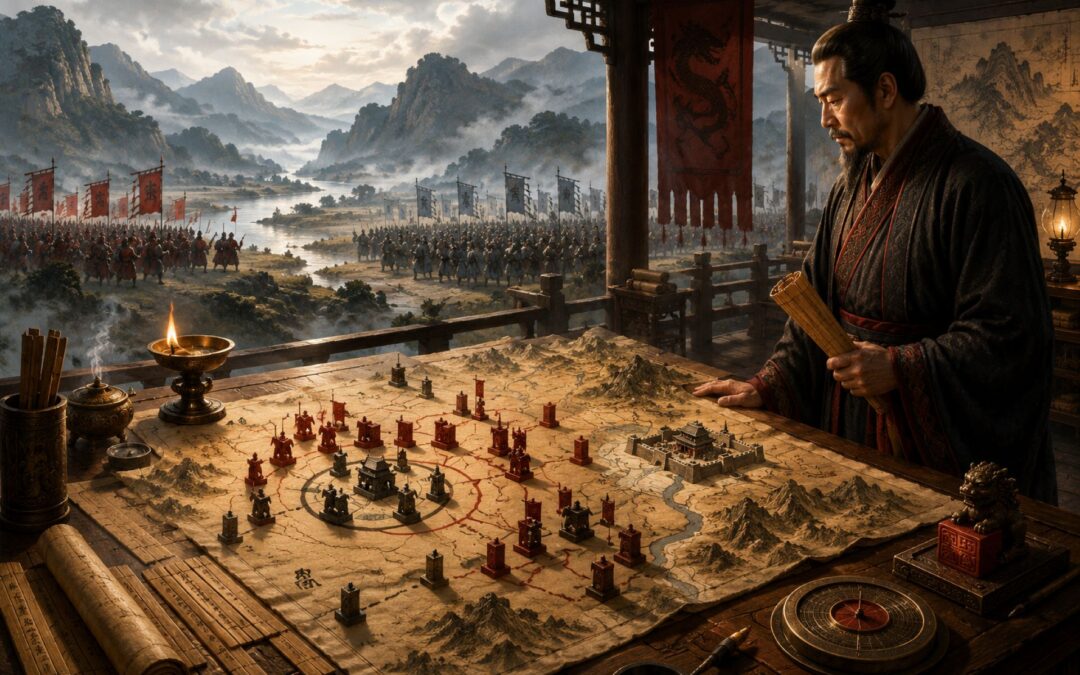
The Art of War is one of those books that many people know without having really read. Its most famous lines circulate through military histories, business presentations, sports coaching, political commentary, negotiation advice, and collections of motivational quotations. That familiarity can be misleading. Detached from their chapters, sayings about knowing the enemy, winning without fighting, deception, flexibility, or attacking weakness begin to sound like independent rules rather than parts of a larger strategic argument.
Read as a complete work, The Art of War is far more systematic than its quotation culture suggests. Across thirteen compact chapters, it asks how rulers and commanders can pursue political and military objectives while reducing uncertainty, avoiding unnecessary cost, shaping the enemy’s choices, preserving their own strength, exploiting favourable conditions, and refusing battles that offer no sufficient advantage. Its ideal commander does not prove greatness by rescuing hopeless situations through courage. He prevents hopeless situations from arising.
That is the central logic connecting the book. Information leads to comparison; comparison informs planning; planning determines whether conflict is worth undertaking; logistics constrain what can be sustained; positioning reduces exposure; deception makes the enemy misallocate effort; concentration creates local superiority; adaptability prevents doctrine from hardening into predictability; terrain changes what actions are possible; leadership shapes morale and cohesion; and intelligence makes the entire process of calculation possible in the first place.
This strategic sophistication is also what makes the book difficult to evaluate. Sun Tzu is often praised for restraint because he prefers preservation to destruction, short wars to prolonged ones, and strategic success to costly battle. Yet strategic restraint is not the same thing as a moral theory of peace. The text accepts deception, coercion, conquest, manipulation of soldiers, expendable spies, and the deliberate creation of desperate situations when they serve the objective. The Art of War is exceptionally good at asking how power can be used intelligently. It is much less concerned with whether the ends for which that power is used are just.

What The Art of War Is—and Which Text We Are Reading
The Art of War, conventionally attributed to Sun Tzu or Sunzi, is an ancient Chinese military treatise arranged in thirteen chapters. Rather than offering a campaign narrative or a sequence of historical battles, it consists largely of compressed propositions, comparisons, taxonomies, practical instructions, strategic metaphors, and observations about how people behave under pressure. Its subject is war, but its method is broader: it studies decision-making when information is incomplete, opponents are active, resources are limited, and mistakes can become irreversible.
The familiar historical tradition identifies Sun Tzu with Sun Wu, a strategist supposedly active around the late sixth or early fifth century BCE. That attribution should not be treated as settled biography. Modern scholarship on the formation of the Sunzi is more cautious, and Scott Boorman’s study of the text’s historical and textual background presents an accretionist picture in which the work developed over time rather than necessarily emerging as the single composition of one identifiable historical author. The military, political, and intellectual world reflected in the text fits the long transition toward the large-scale warfare associated with the Warring States period better than a simple author-and-date formula would suggest.
That uncertainty does not make the text less real. It means that “Sun Tzu argues” is best understood as convenient shorthand for the strategic voice of the received work rather than an unquestionable statement about one historical individual. The thirteen-chapter structure itself became canonical through a long process of transmission and commentary, and modern readers encounter that tradition through editions that already embody interpretive choices.
The version discussed here is anchored to Lionel Giles’s 1910 English translation because the supplied text closely follows his wording and chapter titles. Lionel Giles’s complete 1910 translation and commentary remains historically important, but its familiar English terminology should not be mistaken for transparent equivalents of the ancient Chinese. Expressions such as “Moral Law,” “Energy,” “Weak Points and Strong,” and “Method and discipline” are translations that guide interpretation before the reader has begun thinking about what the underlying concepts might mean.
The problem becomes especially important with strategic ideas whose range is wider than one English word can comfortably contain. The Chinese Text Project’s parallel text makes it easier to see that the received Chinese text stands behind many different possible renderings, while scholarship on Sunzi’s place in classical Chinese thought helps situate the work within a larger intellectual environment rather than treating it as an isolated collection of military tricks. Translation therefore matters not because Giles is unusable, but because polished English can make a difficult ancient concept look simpler and more fixed than it is.
The book’s form also explains both its power and its susceptibility to misuse. Its compressed sayings are memorable enough to travel across centuries and cultures, yet they can easily be detached from the conditions that give them meaning. “Attack weakness,” for example, does not function in the book as a childish recommendation to prey on vulnerable opponents. It belongs to a much larger system involving reconnaissance, concentration, concealment, timing, logistics, terrain, comparative strength, and the avoidance of costly contests where the enemy is strongest.
To understand The Art of War, then, the thirteen chapters need to be read as a connected strategic architecture. That architecture begins not with battle, but with judgment.
Complete Summary of The Art of War, Chapter by Chapter
The chapters of The Art of War do not build an argument in the tidy manner of a modern textbook, but neither are they random collections of maxims. Important ideas recur at different levels: terrain begins as one factor among several, later becomes a practical battlefield problem, and eventually becomes a way of describing the psychological situation of an entire army. Deception appears early as a principle of warfare, then develops through concealment, feints, manipulated expectations, and espionage. The complete sequence therefore matters because later chapters deepen and recombine ideas introduced earlier.
I. Laying Plans
Sun Tzu begins by insisting that war is a matter of survival for the state. It cannot be treated casually because mistakes can determine whether a political community remains secure or is ruined. Before action comes comparison, and comparison depends upon five recurring factors: what Giles calls the Moral Law, Heaven, Earth, the Commander, and Method and discipline.
The Moral Law refers to the alignment that causes a population to follow its ruler even through danger. Heaven concerns changing conditions such as day and night, weather, temperature, and season. Earth includes distance, terrain, danger, security, narrow and open ground, and conditions affecting survival. The Commander is judged by qualities including wisdom, sincerity, benevolence, courage, and strictness, while Method and discipline concern organisation, ranks, supply lines, administrative structure, and military expenditure. Strategy therefore begins with a remarkably broad conception of what produces military strength: not merely weapons and numbers, but political cohesion, environment, leadership, organisation, and logistics.
Sun Tzu then converts the five factors into comparative questions. Which ruler has greater alignment with the people? Which general is more capable? Which side benefits from Heaven and Earth? Where is discipline more consistent? Which army is stronger? Whose soldiers and officers are better trained? Which side is more reliable in reward and punishment? Victory is forecast by comparing systems, not by staring at one’s own capabilities in isolation.
This emphasis on calculation does not imply rigid planning. Once circumstances shift, plans must shift with them. Sun Tzu therefore moves from structured comparison into deception. Warfare involves making the enemy misunderstand capability and intention: the strong can appear weak, the active inactive, the near far, and the far near. A commander can offer bait, feign disorder, irritate an angry opponent, encourage arrogance, disrupt unity, exhaust those who are comfortable, and strike where preparation is weakest.
The chapter ends where it began, with thought before action. The commander who makes many calculations before battle is more likely to win than the commander who makes few. Deception, then, is not a substitute for knowledge. It is useful precisely because one side has calculated accurately enough to manipulate what the other side believes.
II. Waging War
The second chapter abruptly grounds strategy in material reality. Armies cost money, consume supplies, exhaust people, damage equipment, strain transportation networks, and impose burdens on civilians. Sun Tzu’s numerical examples belong to an ancient military economy, but the principle is clear: war cannot be separated from the resource base that sustains it.
Prolonged campaigning is especially dangerous. Weapons deteriorate, enthusiasm weakens, strength declines, state finances erode, and other political actors may exploit the exhaustion created by a long conflict. A campaign that continues without decisive purpose can therefore turn apparent military endurance into strategic self-destruction. Sun Tzu is willing to tolerate imperfection and haste more readily than indefinite delay because a brilliant plan that bankrupts the state is not a brilliant plan.
Logistics follows naturally from this concern with duration. Transporting supplies from great distances impoverishes the population and increases the effective cost of maintaining an army. Sun Tzu therefore encourages using captured enemy provisions and equipment whenever possible. His argument is not simply that plunder is useful; it is that distance creates a logistical penalty, while incorporating the opponent’s resources reduces the burden on one’s own state.
Captured soldiers and equipment can also be turned toward one’s own advantage rather than merely destroyed. Rewards should encourage soldiers to participate in this process, and captured assets should be integrated into the army’s strength. Preservation appears here as a practical economic principle before Chapter III turns it into an explicit hierarchy of strategy.
The chapter closes with a deceptively simple objective: the purpose of war is victory, not the continuation of war itself. A commander must therefore understand that every additional day of campaigning consumes resources that the state might not be able to replace.
III. Attack by Stratagem
The third chapter contains the book’s most famous claim about the hierarchy of strategic success. It is better to take a country intact than destroy it, better to capture an army than annihilate it, and better to preserve smaller military formations than smash them if the same political result can be achieved. From this premise comes the celebrated idea that winning every battle is not the highest excellence. The superior achievement is to overcome resistance without needing battle at all.
That principle is often simplified into a doctrine of peaceful conflict avoidance, but Sun Tzu’s actual argument is more exact. He ranks methods according to their ability to achieve the objective without consuming unnecessary resources. The best approach is to frustrate the enemy’s plans. Next comes preventing the enemy’s alliances or concentration of forces. Attacking an enemy army directly is worse, while besieging fortified cities is worst of all because sieges consume time, materials, manpower, patience, and lives.
The discussion of siege warfare reveals why emotional control is strategic. An irritated commander who attacks walls merely because delays have become intolerable may sacrifice large numbers of soldiers without securing the city. The problem is not only moral waste but the replacement of calculation with frustration. Sun Tzu repeatedly treats anger as dangerous because it makes commanders act for psychological relief rather than advantage.
He then turns to comparative force. Large numerical advantages permit one set of actions, rough equality another, and severe inferiority another. These ratios should not be treated as mathematical laws for all warfare; their function is to teach that strategy must be conditional. An inferior force cannot rely on courage to abolish material asymmetry, and a commander must know when direct confrontation is inappropriate.
The chapter also identifies ways political rulers can damage their own armies. A sovereign may order advance or retreat without understanding whether the army can comply, administer the military as though it were an ordinary civilian bureaucracy, or appoint officers without appreciating the demands of military adaptation. Such interference creates confusion and weakens confidence.
Five conditions then define victory: knowing when to fight and when not to fight, knowing how to handle forces of different sizes, maintaining shared spirit through the ranks, being prepared while waiting for enemy unpreparedness, and allowing military competence to operate without destructive interference. The famous formula about knowing the enemy and knowing oneself grows from this larger argument. Self-knowledge alone is insufficient because victory is relational. One’s own strength only matters in comparison with the opponent, the environment, and the specific conditions of the conflict.
IV. Tactical Dispositions
Chapter IV asks what a commander can make certain and what remains contingent. Skilled fighters first place themselves beyond easy defeat and then wait for an opportunity to defeat the opponent. Security against defeat depends primarily on one’s own organisation and positioning, whereas the opening through which the enemy can be defeated must often be provided by the enemy’s mistakes or vulnerabilities.
This distinction produces a characteristic Sun Tzu paradox: a strategist may understand the conditions of victory without being able to force those conditions into existence immediately. Defensive strength protects against failure; offensive action becomes justified when an opportunity appears. Patience is therefore not passivity. It is the refusal to convert uncertainty into unnecessary exposure.
Sun Tzu’s greatest victories are consequently not theatrical. A commander who triumphs only after performing something everyone recognises as difficult may be admirable, but the deeper strategic accomplishment is to arrange circumstances so well that success appears easy. The ideal general wins by making few serious errors and attacking an opponent whose position has already become untenable.
This produces the chapter’s notion that a victorious strategist effectively wins before fighting, whereas the defeated strategist fights first and then hopes to discover victory. Measurement, estimation, calculation, comparison, and success form a sequence in which judgment precedes force. The final image of accumulated water crashing into a deep chasm anticipates the next chapter’s analysis of momentum: decisive violence may be sudden, but the conditions producing it are built in advance.
V. Energy
Chapter V moves from positioning to the organisation of force. Large groups can be controlled through division, hierarchy, and communication. The problem of commanding many people is therefore not fundamentally different from commanding a few if the force is structured into manageable units and coordinated through reliable signals.
Sun Tzu then distinguishes direct and indirect methods. The direct approach may bring armies into engagement, but indirect action often creates the condition that decides the outcome. His point is not that there are exactly two tactics in a narrow technical sense. Rather, a small number of basic strategic forms can be recombined into an almost limitless variety of actions.
He illustrates this with music, colour, and taste. A few notes can produce innumerable melodies, a few colours innumerable shades, and a few tastes innumerable flavours. Strategy works similarly. Mastery does not require memorising an infinite library of manoeuvres; it requires understanding how elementary forms can be recombined according to circumstance.
The chapter then develops what Giles translates as “Energy,” closely connected to the concept often discussed as shi: force arising from configuration, momentum, positional advantage, and the way circumstances have been arranged. Sun Tzu compares accumulated energy to a bent crossbow and decisive action to releasing the trigger. He compares decision to the precisely timed descent of a falcon. In both cases, the final movement is only a small part of the power involved; the real strength comes from preparation, position, and timing.
Apparent disorder can therefore conceal actual discipline. Apparent fear can conceal courage, and apparent weakness can conceal strength. Deception succeeds only when something stable exists underneath the appearance. An undisciplined army cannot safely simulate disorder because the performance may become reality.
The chapter closes by reducing dependence on individual heroism. A skilled commander uses combined energy so effectively that ordinary people can produce extraordinary results because the situation carries them forward. Logs and stones remain still on level ground but roll when placed on the right slope. Leadership consists partly in creating the slope.
VI. Weak Points and Strong
Chapter VI turns strategic initiative into a struggle over who makes whom react. The side that arrives first and waits is rested; the side that hurries to meet it is exhausted. The skilled commander therefore tries to impose choices on the enemy while refusing to let the enemy dictate his own.
This can be done through incentives as well as attacks. Presenting an apparent advantage may draw the enemy forward, while threatening something important may force movement in another direction. If the enemy rests, harass him. If he is well supplied, threaten those supplies. If he is secure, create a reason for him to move. Strategy involves shaping behaviour by changing the opponent’s perceived costs and opportunities.
Concentration is essential. A commander who remains uncertain about where an attack will occur must prepare across many points. The result is dispersion. If one side can conceal its intended point of effort while forcing the other to defend multiple possibilities, it can create local numerical superiority even when the total number of troops favours the opponent.
Weakness is therefore not an intrinsic property. A strong army may become weak at a particular place because it is divided, late, badly positioned, exhausted, or uncertain. A smaller force may become strong at the decisive point because it has concentrated where the opponent has not. Sun Tzu’s strategy repeatedly transforms global disadvantage into local advantage.
The commander must probe the enemy without revealing equivalent information. Activity, inactivity, formations, reactions, reinforcements, and vulnerabilities can all be tested. Yet the information gained should not become a permanent formula. Sun Tzu warns against repeating the tactic that produced an earlier victory merely because it worked once. Conditions change, and a method that becomes predictable ceases to perform its original function.
This leads to the chapter’s famous metaphor of water. Water avoids high places and flows toward lower ones; similarly, military action should avoid the opponent’s strength and move toward weakness. More importantly, water has no permanent shape of its own. Its form depends on the ground through which it passes. Strategy should be equally responsive to the opponent and environment.
The point is not shapelessness in the sense of chaos. It is freedom from rigid attachment. A commander who can continually adjust while preserving coherence is difficult to anticipate, because the enemy cannot reliably prepare against a fixed pattern that does not exist.
VII. Maneuvering
Chapter VII examines the difficulty of turning movement into advantage. Manoeuvre is not simply moving faster or taking the shortest visible route. A circuitous movement may become strategically direct if it misleads the opponent, avoids resistance, or allows one force to reach the decisive point under better conditions.
Yet the pursuit of speed can destroy the very force intended to gain the advantage. Forced marches exhaust soldiers, scatter formations, separate the strongest from the weakest, and compel commanders to abandon baggage and supplies. An army may theoretically cover an impressive distance while arriving with only a fraction of its original effective strength. Sun Tzu therefore refuses to treat speed as an unconditional virtue.
Supply remains central. An army without baggage, provisions, or reliable bases is not truly mobile because movement that cannot be sustained is merely accelerated exhaustion. Local geography matters as well. Commanders need knowledge of mountains, forests, marshes, ravines, roads, and neighbouring political powers, and they should use local guides rather than assuming abstract maps can replace lived knowledge of terrain.
The chapter then offers some of the book’s most memorable natural images. Troops should move rapidly like wind, remain compact like a forest, strike destructively like fire, stand immovable like a mountain, conceal intentions like darkness, and attack with the suddenness of thunder. These metaphors describe changes of mode rather than one permanent posture. A force that is always fast, always still, or always aggressive becomes predictable.
Communication allows large armies to behave as one. Because voices cannot carry across a battlefield and visual perception is limited, drums, gongs, banners, and flags concentrate attention and coordinate action. Collective discipline prevents individuals from advancing or retreating according to personal impulse.
Sun Tzu also treats morale as variable over time. Soldiers may be energetic at one moment and tired, hungry, homesick, or psychologically depleted at another. A good commander studies these shifts and avoids attacking an opponent whose formation and morale remain strong. He also warns against obvious traps: chasing simulated retreats, accepting bait, attacking uphill, or pressing a surrounded enemy so completely that desperation eliminates the incentive to surrender or withdraw.
VIII. Variation in Tactics
Chapter VIII is a warning against the misuse of rules. Roads exist that should not be followed, armies that should not be attacked, cities that should not be besieged, positions that should not be contested, and even commands from the sovereign that should not necessarily be obeyed when they contradict the realities faced by the army.
The principle is adaptation. Strategic knowledge does not consist of learning prescriptions and applying them mechanically. The commander must understand the advantages and disadvantages produced by specific circumstances. Even an apparently favourable situation should be examined for hidden costs, while difficult conditions should be searched for opportunities that can still be exploited.
Preparedness should not depend upon optimism about the opponent. The wise commander does not rely on the hope that the enemy will fail to come, but on having prepared to receive him if he does. He does not trust the enemy to avoid attack; he makes his own position difficult to attack successfully.
The chapter concludes with five dangerous traits in commanders: recklessness, cowardice, quick temper, excessive sensitivity to honour, and excessive concern for soldiers. None of these is presented as a simple moral vice. Their danger lies in predictability. A reckless commander can be lured into danger, a fearful one immobilised, an angry one provoked, an honour-obsessed one manipulated through shame, and an excessively protective one burdened by concern.
IX. The Army on the March
Chapter IX becomes far more concrete. Sun Tzu explains how armies should move through mountains, cross rivers, traverse marshes, choose camps, and use high or sunny ground. Environmental knowledge is not decorative context; it affects health, visibility, safety, movement, and the likelihood of ambush.
The advice reflects ancient campaigning, but its underlying method is broader. Commanders must interpret physical surroundings as a field of risks and signals. Difficult terrain should generally be crossed quickly. Naturally strong positions should not be attacked carelessly. Camps should be chosen with an awareness of disease, drainage, elevation, exposure, and nearby places where enemies or spies might conceal themselves.
A large portion of the chapter teaches inference from observation. Movement among trees may indicate advancing troops. Disturbed birds or animals may reveal concealed forces. Different patterns of dust suggest different types of movement. Soldiers leaning on weapons may be weak from hunger, while water carriers who drink before returning may reveal widespread thirst.
Human behaviour produces equally important clues. Excessive rewards may suggest that a commander is running out of other means to sustain morale, while excessive punishment may reveal desperation and deteriorating authority. Whispering, restlessness, changing banners, noisy camps, and unusual movements can indicate disorder or disaffection. Aggressive language may hide an intention to retreat, while humble words combined with increased preparation may precede attack.
The general’s task is therefore diagnostic. He must interpret many small signs without seizing upon any single sign mechanically. The chapter’s accumulation of examples demonstrates that intelligence often comes from patterns that are visible but easily misunderstood.
The final passages return to command. Soldiers punished before they have formed attachment to the leader may resist discipline, but affection without enforceable orders produces useless indulgence. Humanity and strictness must operate together. The ideal relationship is not sentimental; it is one in which trust and obedience reinforce each other.
X. Terrain
Chapter X begins by classifying six kinds of terrain: accessible ground, entangling ground, temporising ground, narrow passes, precipitous heights, and positions far from the enemy. Each form changes what actions are favourable. Open ground rewards early occupation of advantageous positions, narrow passes reward whoever secures and fortifies them first, and difficult elevations punish the side that attacks into the opponent’s natural advantage.
The deeper lesson is that the same army can be strong or weak depending on where it is placed. Geography alters movement, supply, visibility, retreat, concentration, and the value of initiative. Tactical judgment therefore requires understanding the relationship between force and environment rather than evaluating either separately.
Sun Tzu then distinguishes natural difficulty from command failure. Six military disasters—flight, insubordination, collapse, ruin, disorganisation, and rout—can arise not from fate but from mistakes for which commanders are responsible. An inferior force recklessly thrown against a vastly stronger one may flee. Overpowered officers can lose control of strong subordinates, while strong officers commanding weak soldiers may produce collapse. Unclear authority and poorly assigned responsibilities create disorganisation.
This emphasis on accountability is important. Terrain may constrain the commander, but it does not excuse avoidable mistakes. Good leadership requires estimating enemy power, evaluating one’s own troops, knowing the ground, and understanding whether the army is actually capable of the action being considered.
The chapter also pushes the problem of civil-military relations further. If fighting will certainly serve the state, the commander may sometimes need to fight even against the ruler’s immediate instruction; if battle will clearly be disastrous, he should not fight simply because the ruler demands it. Sun Tzu imagines professional military judgment as a responsibility to the political community rather than blind obedience to every order.
His language toward soldiers combines affection with control. A general should regard troops almost as children so that they will follow him into danger, yet kindness without authority produces spoiled and ineffective soldiers. The commander must know the enemy, his own forces, and the terrain. Self-knowledge and enemy knowledge alone remain incomplete if the environment makes a theoretically favourable battle impossible.
XI. The Nine Situations
Chapter XI is the longest and most synthetic part of The Art of War. It classifies nine types of strategic ground: dispersive, facile, contentious, open, intersecting highways, serious, difficult, hemmed-in, and desperate. Unlike Chapter X, these categories often describe not merely geography but the psychological and political situation created by where an army stands relative to home, allies, enemy territory, supply, retreat, and danger.
Dispersive ground occurs when troops fight close to home, where the possibility of returning makes cohesion fragile. Facile ground involves shallow penetration into hostile territory, where commitment remains incomplete. Contentious ground offers such advantage that either side may gain greatly from possessing it, while open ground allows relatively free movement. Intersecting highways carry diplomatic significance because they connect multiple powers, making alliances and political geography part of military position.
Serious ground arises when an army has penetrated deeply into enemy territory and placed hostile strongholds behind itself. Difficult ground includes forests, mountains, marshes, and other terrain that obstruct movement. Hemmed-in ground restricts escape so severely that even a smaller opponent may control the exits. Desperate ground leaves no practical route to survival except immediate fighting.
Each condition demands a different response. Near home, a commander should avoid unnecessary battle that encourages dispersion. In shallow enemy territory, he should not linger. Intersecting highways call for alliances, difficult terrain for steady movement, hemmed-in ground for stratagem, and desperate ground for fighting because hesitation offers no safer alternative.
Sun Tzu’s interest increasingly shifts from physical terrain to human psychology. Deep penetration into enemy territory can create solidarity because soldiers understand that ordinary routes home are no longer easily available. Dependence on one another increases as alternatives decrease. The army becomes cohesive not because every soldier suddenly loves the cause more deeply but because circumstance changes the cost of disunity.
The famous shuai-jan snake illustrates this ideal of integrated response. Strike the creature’s head and the tail responds; strike the tail and the head responds; strike the middle and both respond. An army should function with similar coordination, each part supporting the others automatically rather than waiting for prolonged instruction.
Sun Tzu then gives an even more revealing example: people from mutually hostile states who find themselves in the same boat during a storm will help one another because their survival has become interdependent. Cooperation, in this view, does not require affection. A well-designed situation can create alignment between people who otherwise distrust one another.
This insight leads into some of the book’s most unsettling leadership advice. The commander should sometimes conceal information even from his own soldiers, change routes and plans so intentions cannot be anticipated, and bring troops into circumstances where retreat becomes difficult. The image of climbing a height and then kicking away the ladder captures the logic: once alternatives disappear, commitment intensifies.
Sun Tzu describes soldiers placed in desperate situations as losing ordinary fear because there is no safer option. Troops who might otherwise hesitate can fight with extraordinary intensity when their survival depends upon victory. The commander is therefore not merely reading morale but deliberately shaping the conditions that produce it.
Supply remains vital throughout this psychological strategy. Deep penetration requires resources, movement must be controlled, and armies must avoid exhausting themselves before decisive action. The general concentrates strength, conceals intentions, exploits openings, and uses the enemy’s own disposition to determine when decisive engagement becomes possible.
The chapter ultimately fuses many earlier ideas. Terrain shapes behaviour; information shapes decision; secrecy shapes expectation; depth shapes cohesion; supply shapes mobility; alliances shape political position; deception shapes enemy reaction; and danger shapes morale. “Ground” has become a total strategic condition rather than a patch of physical landscape.
XII. The Attack by Fire
Chapter XII begins as a technical discussion of incendiary warfare. Sun Tzu identifies several ways of using fire against soldiers, supplies, baggage, stores, and military installations. Successful fire attack requires materials, dry conditions, appropriate timing, favourable wind, and readiness to respond to different enemy reactions.
The important point is conditional action. Fire is not powerful simply because it is destructive. The commander must understand when the environment allows it to work, whether the enemy becomes disordered, whether an external attack should accompany the fire, and whether conditions favour waiting instead.
Water receives a brief contrast. It can impede or divide an enemy, but it does not destroy resources in the same way fire can. The broader strategic principle is that tools differ in what they can accomplish; commanders should choose means according to the specific effect required.
The chapter then rises above fire warfare and returns to restraint. Forces should not move without advantage, troops should not be committed without something meaningful to gain, and battle should not occur unless the situation justifies it. A ruler must not begin war to satisfy anger, and a general must not fight merely because he feels insulted.
This is one of Sun Tzu’s clearest statements about irreversibility. Anger can later disappear, resentment can be replaced by satisfaction, and emotional states change. A destroyed state cannot simply be restored, and dead soldiers cannot be brought back. Strategic caution is therefore partly the recognition that temporary emotions can produce permanent consequences.
XIII. The Use of Spies
The final chapter returns to the problem of cost with which the early chapters began. Maintaining large armies in the field imposes enormous burdens on the state and population. To spend those resources while refusing the smaller expense required to obtain accurate intelligence is, in Sun Tzu’s reasoning, irrational.
Foreknowledge is essential because strategy depends on understanding the enemy’s condition. Sun Tzu explicitly rejects relying on spirits, intuition detached from evidence, or abstract calculation alone. Information about human intentions and dispositions must ultimately come from human sources.
He identifies five types of spies. Local spies come from the population of the area in which operations occur. Inward spies are people positioned within the enemy’s institutions. Converted spies are enemy agents who have been turned and used for one’s own purposes. Doomed spies are sent with information intended to be discovered or transmitted in order to deceive the enemy, while surviving spies enter enemy territory and return with intelligence.
Converted spies receive special importance because they can reveal the enemy’s intelligence network, help identify useful local or inward agents, and assist in controlling false information. Espionage is therefore not merely about collecting secrets. It is also about understanding how information moves through both sides.
Spies must be rewarded generously, managed carefully, and protected through secrecy. Sun Tzu treats intelligence work as a sophisticated human problem requiring judgment, credibility, discretion, and the ability to distinguish truth from manipulated reporting. His ethical world remains severe: agents may be deliberately sacrificed when deception requires it.
The placement of espionage at the end is significant. Chapter I taught that commanders must calculate before acting, but calculation is only as reliable as the information on which it rests. Chapter XIII therefore closes the circle. The book begins by asking how victory can be forecast and ends by explaining how knowledge about the enemy is actually acquired.
How Sun Tzu’s Strategic System Fits Together
Reading the chapters individually reveals the range of The Art of War, but the book’s deeper power appears when its repeated concepts are assembled into a single system. Sun Tzu’s strategist is trying to reduce dependence on uncontrollable events. He cannot abolish uncertainty, but he can improve information, decrease exposure, increase favourable asymmetry, shape enemy behaviour, preserve resources, and refuse situations in which the cost of action exceeds the likely gain.
Calculation, Cost, and Preservation
The first three chapters establish the strategic foundation. Chapter I demands comparison before action, Chapter II asks whether the state can afford the conflict being considered, and Chapter III ranks forms of success according to how much useful strength they preserve. Together they reject the idea that battle itself is the natural measure of military excellence.
Sun Tzu’s strategist begins by asking whether the conditions favour war at all. Political cohesion, leadership, terrain, discipline, training, resources, and the enemy’s condition must be compared before commitment. This immediately changes the meaning of courage. Courage remains necessary, but it cannot rescue fundamentally bad calculation.
Cost then disciplines ambition. A state may possess enough power to begin war without possessing enough resources to sustain it. Every army consumes food, transport, money, equipment, labour, and political stability. A long campaign can therefore transform tactical competence into strategic failure because the war continues after the benefits that justified it have disappeared.
Preservation follows naturally. If the objective can be achieved while keeping cities, supplies, equipment, institutions, and soldiers intact, destruction becomes waste rather than proof of strength. The superiority of “winning without fighting” lies in this economy of means. Sun Tzu prefers controlling the enemy’s options, breaking plans, disrupting alliances, or making resistance untenable before accepting a battle whose costs could have been avoided.
This principle returns in Chapter XII’s warning against action driven by anger. Strategic thinking requires maintaining a distinction between emotional satisfaction and political benefit. Destruction is irreversible in a way temporary outrage is not. The ruler or commander who understands this does not confuse the desire to strike with a reason to strike.
Chapter XIII completes the system by identifying information as a resource worth paying for. A commander who tries to economise on intelligence while spending vastly more on armies has misunderstood strategic cost. Knowledge can prevent entire campaigns from being wasted, making intelligence one of the highest-leverage investments in the text.
Position, Momentum, and Asymmetry
Chapters IV through VII move from deciding whether conflict is worthwhile to arranging conditions within conflict. Their central insight is that raw strength matters less than strength configured in the right place, at the right time, against the right vulnerability.
Chapter IV begins by distinguishing protection from opportunity. A commander can take responsibility for reducing his own vulnerability, but the precise opening through which the enemy can be defeated may depend upon circumstances that cannot simply be commanded into existence. The strategist therefore creates security first and waits for exploitable imbalance.
Chapter V adds the idea of configured force. The metaphor of the bent crossbow is crucial because it distinguishes stored potential from visible action. The trigger release may be tiny, but its effect depends on energy accumulated beforehand. Likewise, a decisive attack may appear sudden even though its real cause lies in organisation, positioning, deception, concentration, and timing.
This helps explain why Sun Tzu distrusts heroic individualism. He does not want victory to depend on every soldier performing extraordinary feats. The commander’s job is to arrange the larger system so that ordinary behaviour produces disproportionate effects. The stone rolls because the slope has been created, not because the stone has become heroic.
Chapter VI develops asymmetry. A force need not be superior everywhere if it can become superior at the decisive point. Concealment forces the opponent to defend multiple possibilities, while concentration allows one’s own forces to remain united. What looks like numerical inferiority at the level of entire armies can become numerical superiority at the point where fighting actually occurs.
Terrain in Chapters X and XI expands this principle beyond formations. Ground can amplify or neutralise strength, change supply requirements, alter the value of movement, strengthen morale, weaken cohesion, open alliances, or restrict retreat. Strategic position is therefore multidimensional: a commander is always located inside a network of geography, psychology, politics, logistics, and information.
Knowledge, Deception, and Adaptation
Sun Tzu’s treatment of knowledge contains an important asymmetry of its own. The commander wants increasingly accurate knowledge for himself while producing increasingly inaccurate knowledge for the opponent. Truth and deception are therefore not opposites within his system; they are complementary advantages.
Chapter I’s deception works only if the commander understands the real conditions more clearly than the enemy does. Pretending to be weak is useful only when one knows the strength being concealed. Feigning disorder requires actual discipline underneath. Offering bait requires understanding what the enemy values enough to pursue.
Chapter IX shows how knowledge can be extracted from small observations. Dust patterns, animal movement, camp noise, body language, thirst, punishment, and troop posture become clues when interpreted within a larger pattern. The strategic mind is constantly reading the environment for indirect evidence of conditions that the opponent would prefer to hide.
Chapter XIII formalises this observational impulse through human intelligence. Local knowledge, insiders, turned agents, deception channels, and returning spies provide information that cannot be derived from abstract reasoning alone. Sun Tzu’s insistence that foreknowledge comes from people is one of the most concrete checks on the temptation to treat his work as mystical philosophy.
Yet accurate knowledge must not harden into doctrinal rigidity. Chapter VI’s water metaphor makes this clear. A tactic that worked yesterday can fail tomorrow because the opponent has changed. The strategist therefore seeks not one perfect method but the capacity to keep forming methods according to circumstances.
This is the meaning of formlessness. It does not mean having no organisation, no principles, or no identity. It means avoiding a fixed operational pattern that allows the opponent to prepare confidently. The most dangerous strategist is coherent internally but difficult to read externally.
Leadership, Discipline, and the Psychology of Command
The Art of War treats leadership as the management of collective behaviour under uncertainty. The general must calculate, communicate, preserve morale, enforce discipline, interpret conditions, resist manipulation, control personal emotion, and sometimes resist political interference. At the same time, the text is willing to use coercion and psychological pressure in ways that complicate any attempt to turn Sun Tzu into a straightforward modern leadership guru.
The Commander’s Virtues and Dangerous Faults
Chapter I gives the commander five desirable qualities: wisdom, sincerity, benevolence, courage, and strictness. The combination matters. Wisdom without courage can become hesitation, courage without wisdom recklessness, benevolence without discipline indulgence, and strictness without credibility cruelty.
These qualities are strategic because armies are social organisations. Orders only matter if they can be understood and obeyed. Rewards and punishments only matter if they are consistent enough to shape expectations. Soldiers only remain cohesive if command authority possesses enough legitimacy and competence to survive pressure.
Chapter VIII offers the negative mirror through five dangerous faults. Recklessness, cowardice, quick temper, excessive concern for honour, and excessive solicitude for troops are exploitable because they make a commander predictable. An angry leader can be provoked into attacking. An honour-obsessed leader may accept a disadvantageous battle merely to avoid appearing weak.
Sun Tzu’s ideal is therefore not emotional absence but emotional control. The commander must remain capable of action without allowing pride, shame, rage, fear, or attachment to determine action automatically. Strategy requires the ability to experience pressure without surrendering judgment to it.
Ruler, General, and the Limits of Obedience
The relationship between political authority and military command is one of the text’s most interesting tensions. Sun Tzu assumes that war ultimately serves the state and that the ruler possesses political authority, yet he repeatedly warns that rulers can damage armies by interfering in matters they do not understand.
Chapter III criticises sovereigns who order advances or retreats without appreciating whether the army can comply, manage military structures as though they were ordinary civil institutions, or assign officers without understanding operational requirements. The result is not simply administrative inconvenience. Confusion at the top spreads through the force and damages confidence.
Chapter X goes further by implying that a general may sometimes need to refuse the ruler’s immediate order when professional judgment shows that compliance would destroy the state’s military interest. This is not a theory of military government. The general’s purpose remains service to the political community. Yet Sun Tzu recognises that expertise becomes meaningless if political authority demands obedience even when conditions make an order suicidal.
The tension has no easy modern equivalent. Contemporary democratic civil-military relations require forms of accountability that the ancient text does not discuss. What remains useful is the narrower principle that authority does not eliminate the need for domain knowledge, and that leaders can sabotage organisations when they issue operational commands without understanding the conditions under which those commands must be executed.
Soldiers, Morale, Discipline, and Desperate Ground
Sun Tzu’s treatment of soldiers combines care, discipline, and manipulation. He repeatedly recognises that exhausted, hungry, thirsty, frightened, homesick, or confused soldiers behave differently from rested and confident ones. Morale is not an abstraction. It is produced by physical condition, leadership, organisation, expectations, environment, and perceived options.
The general should therefore care for soldiers, maintain health, protect supplies, avoid unnecessary exhaustion, and build enough attachment that commands retain legitimacy under pressure. At the same time, affection must not weaken discipline. Chapter IX argues that punishment imposed before attachment forms may fail, but attachment without enforceable standards can be equally destructive.
Chapter XI reveals the harder edge of this psychology. Sun Tzu believes that commitment can be intensified by reducing alternatives. Soldiers who believe they can escape may disperse, while soldiers who understand that survival requires collective success may become more cohesive and courageous. Deep penetration into hostile territory can therefore transform the army’s psychology.
The image of enemies helping one another in the same boat during a storm captures the underlying principle. Common danger can produce cooperation without friendship because incentives have changed. Modern organisational thinking may recognise the insight while rejecting the coercive method Sun Tzu is willing to employ.
The deliberate creation of desperate ground is therefore both strategically interesting and ethically troubling. It treats human motivation as something leaders may engineer through restriction of choice. The chapter shows Sun Tzu at his most psychologically perceptive, but also at his most instrumental.
Water, Momentum, Metaphor, and the Shape of Sun Tzu’s Thought
Sun Tzu’s natural imagery is not ornamental decoration added to dry military instruction. Water, wind, fire, forests, mountains, stones, animals, and weather become models for thinking about force and change. Their value lies in showing relationships that abstract definitions would make harder to grasp.
Water and Formlessness
Water is the book’s most famous strategic image because it combines direction with adaptability. It does not insist on moving through the strongest obstacle when an easier course exists. It follows the shape of the ground, changing form without ceasing to be water.
That makes water a model for strategic responsiveness. A commander should not become psychologically attached to a tactic merely because it has succeeded before. The opponent changes, terrain changes, morale changes, supplies change, alliances change, and the value of action changes with them.
Formlessness therefore means resistance to predictability. An army should possess internal order without presenting the enemy with a stable pattern that can easily be countered. This is different from improvisational chaos. Water’s adaptability follows the terrain; it is responsive, not random.
The metaphor also clarifies Sun Tzu’s concept of weakness. Water moves toward lower places because gravity makes that direction favourable. Likewise, intelligent force moves toward positions where the opponent cannot resist efficiently. Victory is produced by following the structure of advantage rather than insisting that determination can erase resistance.
Stored Force and Situational Momentum
The crossbow, falcon, torrent, and rolling stone all illuminate the relationship between preparation and release. Sun Tzu is fascinated by actions that appear sudden but depend upon power accumulated earlier.
A bent crossbow contains potential energy before the trigger is touched. A falcon’s strike succeeds not because the bird invents speed at the final instant, but because position and timing have prepared the descent. A round stone placed on a steep slope does not need individual intention to gather momentum.
These images express the strategic idea often associated with shi: power created by configuration. A commander who relies solely on the innate excellence of individuals is fragile because exceptional performance cannot always be commanded. A commander who creates favourable momentum makes successful action easier for everyone inside the system.
This insight extends beyond battle more responsibly than many of Sun Tzu’s adversarial metaphors. Organisations frequently perform better when structures, incentives, information, and workflow make good behaviour easier rather than demanding constant heroism. The transferable principle is not “treat your team like an army,” but “design conditions so success does not depend upon repeated miracles.”
Ground, Fire, Wind, and Irreversibility
Sun Tzu repeatedly treats nature as a source of conditional power. Wind matters because it changes how fire spreads. Mountains and rivers matter because they reshape movement. Marshes matter because they slow armies and create health risks. Ground matters because it changes the relative strength of everyone standing on it.
Fire is especially revealing because it combines opportunity with danger. The same destructive tool behaves differently depending on dryness, wind, timing, and enemy reaction. Technique without conditions is unreliable.
The chapter’s shift from fire to anger deepens the metaphor. Flames can spread beyond the moment that created them, and political violence can outlast the emotion that initiated it. Sun Tzu’s caution against wars begun in rage follows the same logic as his caution about attacking under the wrong wind: action must be judged partly by consequences that will continue after the initiating feeling has disappeared.
Style, Structure, Textual History, and Translation
The apparent simplicity of The Art of War is deceptive. Its sentences are compact, its classifications memorable, and its metaphors vivid, yet those qualities hide serious interpretive problems. The work is the product of ancient textual transmission, later commentary, and modern translation, and its aphoristic form makes both understanding and misquotation unusually easy.
Aphorisms, Lists, and Strategic Compression
The book frequently organises thought through numbered categories: five factors, seven comparisons, five dangerous faults, six terrains, nine situations, five kinds of spies. This method makes the text memorable and portable, but it also creates the impression of greater formal neatness than the book always possesses.
Ideas often overlap. Terrain appears in multiple chapters under different classifications. The principles of deception recur in planning, manoeuvre, weakness and strength, strategic situations, and espionage. Leadership appears both as a list of virtues and as a continuous problem of discipline, morale, information, authority, and emotional control.
The repetition is partly productive because the same principle changes meaning when applied at a different scale. Concealment in Chapter I means misleading the enemy about capability. In Chapter VI it helps force dispersion. In Chapter XI it becomes control over what even one’s own soldiers know. In Chapter XIII it becomes management of intelligence networks.
The aphoristic style also encourages quotation culture. A sentence can sound complete even when its chapter supplies the conditions limiting its application. “Know the enemy” becomes a slogan, while the book’s detailed interest in logistics, terrain, organisation, and human intelligence disappears.
This portability is one reason The Art of War survives so well. It is also one reason it is repeatedly oversimplified.
A Received Text, Not a Transparent Voice from 500 BCE
Traditional accounts present Sun Wu as a brilliant ancient general whose teachings became The Art of War. That story has enormous historical importance because it shaped how the text was read, commented upon, and transmitted. It should not, however, be confused with certainty about authorship.
Modern scholarship on the formation of the Sunzi text takes seriously the possibility that the work developed over a substantial period. Differences among textual witnesses, archaeological discoveries, commentarial traditions, and the military environment reflected in the text make a simple “one man wrote this book in one year” model difficult to sustain confidently.
This matters because readers often treat every sentence as the direct personal philosophy of an individual named Sun Tzu. A better approach is to recognise the text as a strategic classic whose authority emerged through transmission and interpretation. The received thirteen chapters remain the object of analysis even if the precise path by which they came together cannot be reconstructed with certainty.
The historical Sun Tzu and the literary-strategic “Sun Tzu” are therefore related but not identical questions. The article can analyse the coherent voice of the text without pretending that modern scholarship has resolved every biographical problem.
What Changes in Translation
Translation is not simply the replacement of Chinese words with English ones. Strategic concepts often carry ranges of meaning shaped by intellectual traditions, military institutions, and linguistic patterns that have no perfect equivalent in modern English.
Giles’s “Moral Law” is a particularly striking example because an English reader may immediately interpret the phrase as a universal ethical law. Within the strategic framework, however, the concept concerns alignment between rulers and people, legitimacy, cohesion, and shared commitment. The translation may therefore tempt readers toward meanings the chapter does not fully support.
“Energy” creates another difficulty. In ordinary English, the word can suggest enthusiasm, physical strength, or vitality. Sun Tzu’s discussion is much more about the power generated by arrangement, momentum, and configuration. Without explanation, the chapter title conceals the sophistication of the concept.
The direct and indirect distinction is similarly vulnerable to over-simplification. It is not merely “obvious versus sneaky.” The text treats them as interacting forms whose combinations generate strategic variety.
These problems do not make Giles unusable. His translation helped establish the book’s modern English-language reputation and remains readable. But readers who want more than quotations benefit from comparing translations or using the Chinese Text Project’s parallel text alongside an annotated edition.
The broader reception history also matters. The history of Sunzi’s changing reception shows that the “Sun Tzu” encountered in modern Western culture is not identical to the text’s long Chinese interpretive life. Every period selects the version of the book it finds useful.
The Ethics and Limits of Sun Tzu’s Strategy
Sun Tzu is often described as humane because he opposes waste, unnecessary sieges, prolonged war, impulsive violence, and needless destruction. Those qualities are real and important. They should not, however, be confused with a comprehensive moral philosophy, because the text usually evaluates actions according to strategic advantage rather than universal principles of justice.
Strategic Restraint Is Not Pacifism
The preference for winning without battle is the clearest example. Sun Tzu does not argue that violence is inherently wrong. He argues that battle is frequently an expensive and inferior way of obtaining a result that might be achieved through plans, alliances, positioning, intimidation, deception, or political collapse.
Similarly, the critique of sieges is not based primarily on the suffering of defenders. Sieges are bad because they consume time and resources, anger commanders, kill attackers, and may leave cities still unconquered. The ethical effect may be less destruction, but the logic remains strategic efficiency.
Chapter XII’s warning against anger comes closest to a broader moral seriousness. Destroyed states and dead people cannot be restored once emotion passes. Yet even there, the rule remains conditional: move when there is advantage, refrain when there is not. Sun Tzu is teaching restraint under political purpose, not renunciation of force.
This distinction matters because describing the book as pacifist obscures its actual achievement. Its restraint is powerful precisely because it arises inside a military framework that fully accepts warfare. Sun Tzu asks warriors to become less wasteful, less emotional, and more discriminating without asking them to cease being warriors.
Soldiers and Spies as People—and Strategic Resources
The book recognises soldiers as human beings whose health, fear, loyalty, fatigue, hunger, and emotional attachment matter. Commanders are instructed to care for them, protect their physical condition, avoid needless exhaustion, and establish trust before expecting reliable discipline.
At the same time, soldiers remain resources within the strategic system. Chapter XI is willing to manipulate their perception, restrict their alternatives, and place them in desperate circumstances because extreme danger can intensify cohesion. The image of kicking away the ladder is effective strategy precisely because people behave differently when escape disappears.
Espionage presents a similar contradiction. Spies should be treated generously because their information may save enormous resources and lives. Yet the category of doomed spies explicitly accepts agents whose usefulness depends upon false information reaching the enemy, potentially at the cost of those agents themselves.
Sun Tzu’s benevolence is therefore real but bounded. People matter both because they are people whose morale and survival affect the community and because they are instruments through which strategic aims are pursued. A modern ethical reading cannot simply choose one side of that tension and ignore the other.
What The Art of War Does Not Tell Us About Justice
The largest ethical limitation is the relative absence of a theory for judging political ends. Sun Tzu offers sophisticated criteria for deciding whether an action is likely to succeed, whether it costs too much, whether conditions are favourable, and whether an opponent can be shaped without direct violence. He offers much less guidance for deciding whether the objective itself deserves pursuit.
A perfectly executed strategy can still serve conquest, domination, or unjust political purposes. Efficiency does not create legitimacy. Knowing how to preserve one’s army while defeating another does not answer whether the war should exist.
The text also predates modern international humanitarian law, democratic accountability, contemporary theories of civilian protection, and many political assumptions modern readers bring to war. It should not be condemned merely because it does not anticipate institutions thousands of years in the future, but those absences matter whenever readers try to transform the book into a universal ethics of leadership.
The fairest interpretation is that The Art of War addresses the relationship between means and strategic ends much more deeply than the moral status of those ends. It can teach someone to pursue an objective more intelligently without establishing that the objective is right.
Applying The Art of War Beyond the Battlefield
Sun Tzu has travelled far beyond military studies. Businesspeople, athletes, political strategists, negotiators, lawyers, managers, and even people dealing with personal relationships have borrowed its language. Some of these transfers are genuinely useful because the book studies general problems of competition, uncertainty, incentives, preparation, and information; others become distortions when they import a wartime enemy model into situations that depend upon cooperation.
What Transfers Responsibly
The most transferable lesson is the priority of conditions over dramatic action. Before committing resources, ask what the objective is, what success would cost, what information is missing, what disadvantages can be avoided, and whether the apparent contest must occur in its current form. That logic applies to many competitive or high-stakes decisions without requiring anyone to pretend they are fighting a literal war.
Preparation transfers well too. Sun Tzu consistently prefers building resilient positions before crisis to improvising once failure has begun. Organisations can benefit from understanding dependencies, protecting supply, identifying bottlenecks, improving information, and refusing projects whose costs exceed likely benefits.
Concentration is another useful principle when interpreted carefully. Resources spread across too many priorities become weak everywhere. Concentrating effort at the point that matters most can create disproportionate impact without requiring greater total resources.
The book’s hostility to emotional escalation also travels well. Anger, pride, embarrassment, and the desire to “win” an argument can produce decisions whose consequences outlast the emotions that created them. Sun Tzu’s insistence on separating advantage from emotional gratification remains one of his most durable ideas.
Adaptability has equally broad value. Strategies should respond to changing evidence rather than become permanent identities. The water metaphor is useful wherever people must remain coherent while adjusting methods to new conditions.
Even within the modern military profession, Sun Tzu remains an active object of study rather than merely a business-book mascot. Continuing military study of Sun Tzu reflects the enduring relevance of questions about deception, intelligence, cost, positioning, indirect approaches, and political purpose.
Where the War Analogy Breaks
The danger begins when every disagreement is treated as a battlefield. Businesses contain competitors, but they also contain customers, partners, regulators, employees, suppliers, and communities whose interests cannot be reduced to enemy relationships. A company that treats all information asymmetry, deception, and domination as strategic virtues may destroy the trust on which long-term cooperation depends.
The same warning applies even more strongly to personal relationships. Romantic partners, friends, family members, students, colleagues, doctors, patients, and citizens are usually not opponents to be manipulated into weakness. Treating vulnerability as an opening to exploit may be strategically legible in war and morally destructive in intimacy.
Democratic politics also complicates the analogy. Political actors compete, but democratic institutions depend upon losers retaining rights, opponents remaining legitimate participants, information maintaining some public credibility, and disagreement not automatically becoming existential conflict. A strategy built entirely around deception and enemy disintegration can destroy the system in which political competition takes place.
The useful modern question is therefore not “How can I apply every Sun Tzu tactic to my life?” It is “Which strategic problems in my situation genuinely resemble the problems Sun Tzu is analysing?” Cost, uncertainty, concentration, timing, resilience, and emotional discipline often transfer. Conquest, secrecy, coercion, expendability, and enemy thinking frequently do not.
Critical Review: Is The Art of War Still Worth Reading?
The Art of War remains worth reading because its greatest ideas are more sophisticated than the slogans extracted from them. Its enduring contribution is not the claim that deception works, that weakness should be attacked, or that knowledge is useful. Those points are almost trivial when isolated. What matters is the way Sun Tzu integrates them into a model of strategic control.
The book repeatedly asks the commander to expand the frame. Battle is never just troops colliding. It is the visible outcome of political cohesion, training, leadership, logistics, information, terrain, morale, timing, deception, alliances, and resource constraints. A commander who looks only at the battlefield has already started thinking too late.
That systemic view is perhaps the text’s strongest achievement. Chapter II’s attention to economic strain prevents military strategy from becoming detached from the society financing it. Chapters V and VI show how organisation and asymmetry can matter more than raw quantity. Chapters IX through XI demonstrate that environment and psychology are not secondary complications but constitutive parts of power. Chapter XIII makes intelligence foundational rather than supplementary.
The book is also unusually realistic about the limits of force. Destruction is costly, sieges are inefficient, prolonged campaigns weaken winners as well as losers, and emotional escalation can produce irreversible damage. Sun Tzu’s ideal commander is therefore neither timid nor bloodthirsty. He is discriminating.
Another strength is the refusal to depend upon heroic individual performance. The emphasis on configuration, momentum, signals, discipline, and favourable conditions produces a recognisably systemic theory of leadership. Instead of asking how one brilliant person can rescue failure, Sun Tzu asks how good arrangements can reduce the amount of brilliance required at the decisive moment.
Its metaphors contribute greatly to that durability. Water, crossbows, stones, fires, forests, storms, and snakes translate strategic relationships into memorable images without requiring technical vocabulary. The best of these metaphors continue to reward interpretation precisely because they represent processes rather than fixed rules.
The weaknesses begin with the same compression that produces the book’s elegance. Aphorisms are memorable but elastic. Almost any successful strategy can be described after the fact as an example of flexibility, indirect action, concentration, or attacking weakness. That makes the book vulnerable to retrospective confirmation: because the principles are broad, readers can easily claim that every victory proves Sun Tzu and every defeat resulted from violating him.
The work is therefore less useful as a predictive formula than as a discipline for asking questions. Where is the real advantage? What does the enemy know? What do we know? Which assumptions are unsupported? What will delay cost? Where are resources concentrated? What conditions make action easier? What alternatives exist to direct confrontation? Those questions are valuable even when the text cannot provide a mechanical answer.
Historical specificity creates another limitation. Chariots, ancient supply systems, fortified cities, signal drums, incendiary warfare, and premodern state structures do not transfer directly into every modern context. Readers who remove the military details too aggressively risk turning the book into vague motivational wisdom, while readers who cling to every ancient prescription miss the broader strategic relationships those prescriptions were meant to illustrate.
Translation adds another layer of uncertainty. A reader who encounters The Art of War through one old English version may assume that familiar concepts have fixed meanings when they are partly products of interpretive vocabulary. Giles remains important and readable, but anyone interested in the book beyond its quotations will benefit from an annotated translation and comparison with other versions.
The ethical limitations are more serious. Sun Tzu’s strategic restraint deserves praise, but it does not provide a sufficient moral framework for deciding when war, manipulation, coercion, or deception is justified. A strategy can be efficient and still serve a bad objective. The book’s willingness to restrict soldiers’ alternatives, sacrifice agents, and instrumentalise human behaviour should not be sanitised simply because the broader aim is to reduce unnecessary battlefield cost.
What has aged best is the treatment of uncertainty. Modern organisations, governments, militaries, and individuals still operate with incomplete information, competing incentives, limited resources, and emotionally charged decisions. Sun Tzu’s insistence on preparation, comparative judgment, flexibility, intelligence, and the creation of favourable conditions remains intellectually powerful because those problems have not disappeared.
What has aged less well is the ease with which adversarial thinking can be exported into contexts built on trust. The Art of War becomes shallower when every colleague is an enemy, every negotiation a deception contest, and every relationship a battlefield. The text becomes more useful, not less, when its domain is respected.
The book is strongest for readers interested in military thought, political strategy, competitive decision-making, negotiation under genuine opposition, organisational systems, and the history of strategic ideas. It is also valuable to readers who want to understand why so many modern ideas about indirect action, competitive positioning, intelligence, and strategic flexibility are repeatedly associated with Sun Tzu.
Readers seeking a modern empirical manual will find something different. The book does not test hypotheses through contemporary social science, offer controlled evidence for every claim, or provide a procedural system that can be followed step by step. Its authority comes from accumulated strategic reflection, literary compression, and centuries of interpretation rather than modern experimental validation.
That distinction should not diminish it. Ancient classics survive because they continue generating useful thought, not because every sentence functions as a timeless law. The Art of War remains remarkable because it shifts attention away from the spectacle of conflict toward the conditions that make conflict necessary, unnecessary, favourable, or disastrous.
Its deepest insight can therefore be stated without reducing it to another slogan. Effective strategy is rarely about possessing one magical tactic. It is about seeing the whole situation clearly enough to shape what happens before the moment when force seems to decide everything.
That is why The Art of War is still worth reading, preferably in an annotated edition rather than as a collection of quotations. The complete book is more demanding, more coherent, more morally complicated, and ultimately more useful than the simplified Sun Tzu that circulates in popular culture.
Last Updated on August 11, 2026 by Aseem Gupta