
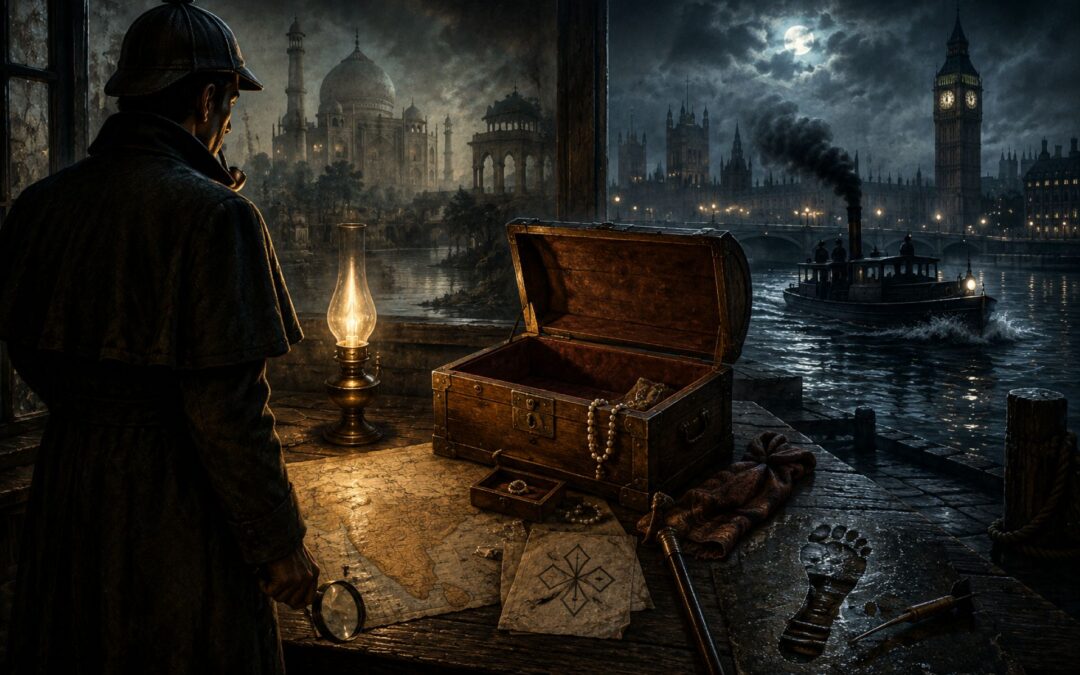
Arthur Conan Doyle’s The Sign of Four—also commonly published as The Sign of the Four—is the second major Sherlock Holmes narrative and one of the works that established the detective’s enduring personality. First published in 1890, the novel begins with Holmes bored enough to inject cocaine and ends with him reaching for the drug again after solving a case that has carried him from Baker Street to a murdered man in a locked room, through the streets and wharves of London, onto the Thames, and finally backward into the history of British India.
At first, the mystery appears intensely personal. Mary Morstan wants to know what happened to her father, why someone has been sending her valuable pearls every year, and why an anonymous correspondent now promises to correct a wrong done to her. The answers lead to the Sholto family, a hidden fortune known as the Agra treasure, the murder of Bartholomew Sholto, and a fugitive named Jonathan Small. Yet the London crime is only the latest consequence of a much older story involving murder, betrayal, imprisonment, imperial wealth, and the Indian Rebellion of 1857.
Spoiler warning: This article explains the entire novel, including Bartholomew Sholto’s murder, the fate of the Agra treasure, Jonathan Small’s confession, Watson and Mary Morstan’s relationship, and the final scene.
What makes The Sign of Four especially interesting is the way Doyle combines several different kinds of story without allowing any one of them to dominate completely. It is a detective puzzle built from footprints, handwriting, smells, poison, architecture, boats, and disguises; an adventure culminating in a high-speed river chase; a romance in which Watson falls in love with the client; and an imperial backstory in which the supposed treasure at the center of the mystery proves inseparable from violence and disputed ownership. The novel’s strengths lie in this momentum and layering, but so do some of its most serious limitations, particularly its portrayal of Tonga and its reliance on Victorian racial classification.

The Case Begins: Mary Morstan, the Pearls and the Missing Captain
The novel does not begin with Mary Morstan or with a crime. It begins with Sherlock Holmes administering himself a seven-percent solution of cocaine while Dr. John Watson watches with increasing alarm. Watson objects as a physician and a friend, warning Holmes that repeated drug use cannot be harmless. Holmes does not deny the danger so much as explain the reason he accepts it: ordinary existence leaves his mind unstimulated. When there is no sufficiently difficult problem to occupy him, he seeks another form of excitement.
This opening establishes a central tension in Holmes’s personality. He does not simply enjoy solving crimes; he appears to need intellectual difficulty as a form of mental activation. His brilliance is therefore linked from the beginning to restlessness. The same mind that can notice and organize details others ignore becomes deeply dissatisfied when there are no details worth organizing.
The conversation turns to Watson’s account of their previous adventure, A Study in Scarlet. Holmes criticizes Watson for presenting detection as literature rather than pure reasoning. In Holmes’s view, emotional embellishment contaminates what ought to be treated as an exact intellectual discipline. Watson, by contrast, believes human beings and their stories matter precisely because they cannot be reduced to a chain of deductions.
Holmes demonstrates his method by asking Watson to think about the distinction between seeing and observing. He correctly reconstructs Watson’s recent visit to the post office from apparently trivial physical traces and habits. He then performs a more personal and unsettling deduction using Watson’s inherited watch. From scratches, pawnbroker marks, and signs of careless treatment, Holmes infers that the watch belonged to Watson’s elder brother, that the man had inherited money, had suffered periods of financial difficulty, had repeatedly pawned the watch, had drunk heavily, and had eventually died.
The result shocks Watson because Holmes’s reasoning reaches into painful family history. For Holmes, the episode is evidence that disciplined observation produces knowledge. For Watson, it is also evidence that deduction can intrude into areas charged with emotion. That difference between the two men will matter throughout the novel.
Their discussion is interrupted when Mrs. Hudson announces a visitor. Mary Morstan enters Baker Street and presents the mystery that will occupy Holmes for the rest of the story.
Mary explains that her father, Captain Arthur Morstan, served for many years in India. As a child, she was sent to England while he remained abroad. Years later he returned and wrote to her from London, telling her to meet him at the Langham Hotel. Mary went there expecting a reunion, only to discover that her father had disappeared. His luggage remained at the hotel, but no convincing explanation for his absence could be found.
One possible connection seemed particularly important. Captain Morstan had served with Major John Sholto, who was living in England and should have known something about his old colleague’s movements. Yet when Mary approached him, Sholto denied knowing that Morstan had returned to London.
The disappearance would have remained an unresolved family tragedy had another strange sequence not begun several years later. An advertisement appeared seeking Mary Morstan’s address. After she responded, she received a small parcel containing an extremely valuable pearl. No explanation accompanied it. Each year thereafter, on the same date, another pearl arrived. By the time she visits Holmes, she has received six.
That morning, however, the pattern changed. Instead of another anonymous jewel, Mary received a letter instructing her to meet someone outside the Lyceum Theatre that evening. The writer describes her as a wronged woman and promises that justice can be done. She may bring two friends, but she must not involve the police.
Holmes is immediately engaged by the problem. He examines the handwriting and the earlier communications, finding enough similarity to connect them. Watson’s attention, meanwhile, is increasingly drawn to Mary herself. He finds her composed, intelligent, and attractive, and his interest quickly becomes more than professional.
Holmes reacts to Watson’s admiration with characteristic coldness. Emotional qualities, he insists, are opposed to clear reasoning. To Holmes, a client is a problem to be solved; to Watson, Mary is already becoming a person whose fate matters independently of the intellectual challenge.
Before they leave, Mary produces another clue from her father’s papers: a strange plan or map connected with India. On it are four names—Jonathan Small, Mahomet Singh, Abdullah Khan, and Dost Akbar—associated with a symbol or inscription identifying them collectively as the Sign of Four. At this stage, neither Mary nor Watson knows what the document means, but it establishes that Captain Morstan’s disappearance is connected to events far beyond London.
Holmes discovers another useful fact. Major Sholto died shortly before the first anonymous pearl was sent to Mary. The timing suggests that the pearls are not random gifts but an attempt by someone connected to Sholto to correct an old injustice.
That evening, Mary, Watson, and Holmes go to the Lyceum Theatre as instructed. An intermediary makes sure that Holmes and Watson are not police officers and then takes the trio by carriage through London. Although the route is deliberately confusing, Holmes tracks their movement by recognizing streets and geographical clues. Even while being transported blindly, he mentally maps the city.
They are eventually brought to a house occupied by Thaddeus Sholto, one of Major Sholto’s twin sons. The missing captain, the anonymous pearls, the strange map, and the dead major are about to converge.
The Sholto Secret and the Murder at Pondicherry Lodge
Thaddeus Sholto is one of Doyle’s more eccentric secondary characters. Nervous, highly strung, physically distinctive, and surrounded by ornate objects associated with an imagined “Eastern” luxury, he initially seems almost as mysterious as the case itself. Yet he has brought Mary to him because he wants to reveal a family secret and correct what he sees as an injustice committed by his father.
According to Thaddeus, Captain Morstan did indeed visit Major Sholto after returning from India. The two men had been associated with an enormous quantity of jewels known as the Agra treasure. Morstan believed he had a claim to part of it and came to Sholto’s home demanding his share.
The confrontation became heated. Morstan suffered from a weak heart and collapsed during the quarrel. As he fell, he struck his head against the treasure chest. Major Sholto did not kill him deliberately, but the circumstances looked terrible: the two men had been arguing over a hidden fortune, Morstan was dead, and the injury to his head could easily suggest violence.
Terrified that he would be accused of murder and unwilling to expose the treasure, Sholto concealed what had happened. With the assistance of his servant Lal Chowdar, he hid Morstan’s body instead of reporting the death. Mary therefore spent years believing her father had mysteriously vanished when the truth was that he had died in Sholto’s presence and his death had been concealed for self-protective reasons.
Sholto also retained the treasure. Whatever moral claim Morstan or Mary possessed mattered less to him than his desire to keep the jewels. The fortune became the center of his life, but possession did not bring peace. He grew fearful, secretive, and increasingly obsessed with the possibility that someone else might be searching for it.
Years later, when he was dying, Sholto called his sons Thaddeus and Bartholomew to him. Tormented by what he had done, he finally told them about Captain Morstan’s death and admitted that Mary had been wronged. He also acknowledged that he had intended to give her a significant portion of the treasure but had repeatedly allowed greed to prevent him from doing so.
Before he could tell his sons where the treasure was hidden, something terrifying happened. Sholto looked toward the window and saw a face staring in at him. The sight filled him with such fear that he died without revealing the hiding place. Afterward, a message associated with the Sign of Four was found, showing that whatever had happened in India had followed Sholto to England.
The sons were left with a house, a secret, and no treasure. They searched for years. Thaddeus, who felt genuine sympathy for Mary, believed that even without the full treasure she should receive something. A chaplet of pearls had been separated from the larger hoard, so he began anonymously sending her one pearl every year. The strange gifts that had puzzled Mary were therefore an imperfect form of restitution.
Bartholomew eventually solved the problem of the treasure’s location through architecture and measurement. He calculated that the dimensions of Pondicherry Lodge did not match its usable internal space. There was a concealed area in the building. The brothers searched it and discovered the Agra treasure hidden in a secret attic chamber.
This discovery is why Thaddeus has summoned Mary. He wants her to go with him to Pondicherry Lodge and demand a fair division from Bartholomew. What began as a missing-person investigation has apparently become a matter of inheritance and restitution.
The party travels to Pondicherry Lodge, a large and heavily protected property surrounded by walls. The nighttime setting immediately changes the tone. The domestic eccentricity of Thaddeus’s rooms gives way to Gothic isolation. Even entering the grounds is difficult. McMurdo, the gatekeeper, refuses to admit them until he recognizes Holmes from an earlier boxing encounter.
Inside the house, the mood becomes more ominous. Mrs. Bernstone, the housekeeper, is frightened because Bartholomew has shut himself in his room and has not responded normally. When the group looks through the keyhole, they see an unnatural grin fixed on his face.
Holmes and Watson force their way into the room. Bartholomew is dead. His body is rigid and distorted into a grotesque expression. Near the body is a small thorn or dart that has punctured him. The Agra treasure is gone, and another Sign of Four message has been left behind.
The narrative has now changed again. The old mystery of Captain Morstan has largely been explained, but a fresh murder has occurred at the exact moment the treasure is rediscovered. The hidden fortune has moved once more, and the Sign of Four has become not merely a relic from Mary’s father’s papers but the signature of people actively pursuing the treasure.
Holmes immediately treats the apparently sealed room as a physical puzzle rather than a supernatural one. The locked door does not prove that no one entered. He examines windows, ceiling, roof access, dust, footprints, scratches, marks, and the body itself. Instead of asking who behaved suspiciously in a psychological sense, he first asks what movements were materially possible.
The evidence points toward two intruders. One left the unmistakable impression of a wooden leg. The other left much smaller bare footprints and seems to have possessed extraordinary agility, making it possible for the pair to use a route through the roof rather than the locked door.
Bartholomew’s death gives Holmes another clue. The tiny puncture and the body’s violent muscular reaction suggest a powerful poison delivered through the thorn. The weapon is unusual enough to narrow the kind of accomplice Holmes imagines.
The room also contains a strong smell of creosote. That odor becomes important because the intruders appear to have stepped in or brushed against it during their escape. Unlike a footprint, which may disappear on another surface, a smell can be followed by an animal.
Athelney Jones of the police arrives and provides a contrast to Holmes. Jones is confident, energetic, and eager to produce a conventional theory quickly. He begins arresting people around the house, including Thaddeus Sholto, because the circumstances seem superficially suspicious. His method begins with plausible human motives and nearby suspects; Holmes’s begins with the physical impossibility that must be explained.
Holmes is already moving toward Jonathan Small. The wooden-legged man connects directly with one of the four names on Mary’s document, and the Sign of Four message confirms that the old compact and the new crime belong to the same history.
This is also the context for one of Holmes’s most famous principles: once the impossible alternatives have been eliminated, the remaining explanation must be considered even if it first seems improbable. The maxim is often remembered as an abstract slogan, but here Doyle shows how it works. A locked door appears to eliminate entry, so Holmes searches for another physical route; unusual footprints appear impossible under an ordinary-burglar theory, so he revises the theory rather than discarding the evidence.
To follow the creosote trail, Holmes needs a dog. He sends Watson to escort Mary to safety and then obtain Toby, a mixed-breed tracking dog with an exceptionally sensitive nose. The investigation is about to leave Pondicherry Lodge and spread across London.
Following the Trail Through London
Watson’s errand briefly slows the detective plot and gives the romantic subplot room to develop. He takes Mary away from the murder scene and becomes increasingly conscious of his feelings for her. Yet the treasure complicates those feelings. If Mary is about to become an extremely wealthy woman, Watson assumes that the social distance between them will become almost impossible to cross.
He then retrieves Toby from Sherman, an eccentric keeper of animals, and returns to Holmes. With Toby following the creosote, the detective and Watson begin reconstructing the burglars’ escape in practical terms.
Holmes has already concluded that Jonathan Small, the wooden-legged man named on the old document, was almost certainly one of the intruders. The second intruder was smaller, barefoot, physically agile, and equipped with the poisoned thorn. Their escape route through the roof and over the grounds becomes a trail that Toby can follow.
The tracking sequence shows Doyle’s interest in London not merely as a backdrop but as an investigative system. Streets, yards, walls, roads, bridges, smells, businesses, docks, vehicles, and people all carry information. Holmes does not possess omniscience; he connects traces left by ordinary movement.
For a time, Toby appears to validate the method perfectly. The dog races through London, pulling Holmes and Watson after him. Then the pursuit ends absurdly at a barrel of creosote.
The mistake is important because it shows that evidence is not self-interpreting. Toby has done exactly what he was asked to do: follow the smell. The problem is that there was more than one source of the same smell. Holmes and Watson can laugh because the failure does not destroy the method; it simply means they have followed the wrong branch of an otherwise valid trail.
They recover the scent and continue. Eventually Toby leads them toward the Thames, where they discover that the fugitives have used a steam launch named the Aurora. Mrs. Mordecai Smith explains that her husband left unexpectedly aboard the launch with another man matching the description of Jonathan Small.
The investigation now has a vehicle and a likely escape route, but London’s river network makes finding one launch difficult. Holmes responds by using a different kind of resource: the Baker Street Irregulars, a group of street boys led by Wiggins. Because the boys can move through areas where respectable adults would attract attention, they become a decentralized information network.
Doyle contrasts this practical intelligence gathering with official reporting. Newspapers confidently circulate Athelney Jones’s theory about the Pondicherry Lodge murder even though it is wrong. Public certainty therefore runs ahead of actual knowledge. Holmes, who has a better theory, remains aware that an essential piece of the chain—the location of the Aurora—is still missing.
During this phase, Holmes also tries to identify Small’s accomplice using a contemporary geographical or ethnographic reference work. From the footprints, physical traces, weapon, and poison, he concludes that the second man comes from the Andaman Islands. The passage is one of the places where the novel’s confidence in classification becomes ethically and intellectually unstable.
The descriptions Holmes consults present Andamanese people through nineteenth-century racial stereotypes, including sweeping claims about physical appearance, temperament, and violence. Those claims should not be read as accurate anthropology. As literary scholar John McBratney shows in his work on Victorian systems of racial classification, the novel participates in a culture that often treated racial taxonomy as scientific knowledge.
That creates an important tension in Holmes’s method. His deductions from footprints, architecture, scent, handwriting, and boat movements are materially testable. His racial deductions, by contrast, rely partly on biased classifications inherited from Victorian imperial knowledge. The narrative tends to present both through the same language of expertise, even though they do not deserve equal epistemic authority.
Meanwhile, Holmes suffers a genuine investigative setback. Despite sending the Irregulars across the river districts, he cannot locate the Aurora. His frustration grows because the chain of reasoning feels nearly complete but lacks its final physical link.
Watson spends more time with Mary during this delay. Her conduct strengthens his affection. She is less preoccupied with becoming wealthy than he expected and remains concerned about Thaddeus, who has been unjustly suspected. Watson, however, continues to imagine the treasure as a barrier because he assumes that a wealthy Mary would belong to a different social world.
Athelney Jones’s case begins collapsing. The people he arrested cannot be held on the basis of his original theory. Official confidence is forced to retreat.
Holmes eventually changes tactics. Rather than continue directing others, he disguises himself as an old sailor and personally investigates river yards and boat-repair facilities. When an apparently elderly seaman later arrives, the disguise is convincing enough to fool those present until Holmes reveals himself.
His reasoning is practical. Small cannot simply abandon the Aurora without losing the fast vessel he may need for escape. At the same time, openly using it would expose him. Holmes therefore considers the possibility that the boat has been temporarily concealed or altered rather than removed entirely from London.
That hypothesis proves correct. Holmes finds the Aurora and prepares the final pursuit.
He also makes an arrangement with Jones. The inspector can receive public credit for the capture if he provides police resources and follows Holmes’s plan. The bargain reveals that Holmes’s relationship with official policing is more complicated than simple contempt. He considers Jones intellectually inferior, but he is willing to use institutional authority when it becomes useful.
The Thames Chase and the Empty Treasure Chest
Once the Aurora is located, the novel abruptly shifts from deduction into action. Holmes, Watson, Jones, and police officers take a fast launch onto the Thames and prepare to intercept the fugitives. Holmes explains how he recovered the lost trail, but the intellectual phase of the story is now merging with physical pursuit.
The Thames chase is one of Doyle’s most energetic set pieces. The Aurora is fast, and Small understands that capture means the end of his attempt to recover and escape with the treasure. The police launch strains after it through the river traffic while Holmes and Watson try to close the distance.
Jonathan Small is easy to distinguish because of his wooden leg. With him is his smaller companion, Tonga, whom Holmes has already inferred to be the second participant at Pondicherry Lodge. During the chase, Tonga raises a blowpipe and prepares to fire one of his poisoned darts.
Holmes and Watson shoot. Tonga falls from the launch into the Thames and disappears. Afterward, a poisoned dart found dangerously close to Holmes and Watson shows that the threat was immediate; the shooting is not merely an act of distant pursuit but a response to a weapon capable of killing them quickly.
Small tries to escape when the Aurora reaches the riverbank, but the terrain works against him. His wooden leg sinks into the mud and traps him. The man who has evaded the Sholtos, crossed continents, escaped imprisonment, and outmaneuvered conventional police is finally immobilized by the physical limitation that has marked him since India.
The Agra treasure chest is found aboard the boat. At first, this appears to provide the obvious resolution. The killers have been caught or killed, the chest has been recovered, and Mary can finally receive the fortune that has shadowed her family for years.
Small immediately complicates the moral and criminal picture. He insists that he did not kill Bartholomew Sholto. According to him, Tonga fired the fatal dart. Small admits participating in the burglary and taking the treasure, but he distinguishes his intended crime from the killing carried out by his companion.
His complete explanation has not yet been given, so Holmes and the others postpone judgment. Before Jones takes formal possession of the treasure, Watson is permitted to carry the chest to Mary.
For Watson, this journey is emotionally difficult. He wants Mary to receive what she has been denied, yet he also believes that possession of an immense fortune will make marriage between them socially unrealistic. He finds himself wishing for her good fortune and fearing what it will mean for him at the same time.
Mary receives the chest with far less excitement than Watson expects. Her relative lack of greed is significant because almost every major man connected to the Agra treasure has treated it as an object capable of transforming his life. Mary has the strongest moral claim among the English characters, yet she is one of the least psychologically possessed by it.
There is a practical problem: the key is gone. Watson forces the chest open.
It is empty.
The reversal is almost comic in its simplicity after so much violence. The fortune that generated decades of murder, secrecy, betrayal, imprisonment, fear, and pursuit has disappeared before any supposed beneficiary can enjoy it.
Mary does not collapse in despair. Watson, meanwhile, feels an enormous private relief because the social barrier he imagined between them has vanished. He tells Mary that he loves her, and she reciprocates.
The scene gives the word “treasure” a deliberately altered meaning. The physical treasure is gone, but Watson sees Mary’s love as something more valuable. At the same time, the romance is not entirely free from complication. Watson’s confidence arrives only after Mary loses the wealth that might have made her socially superior to him, revealing how strongly Victorian assumptions about money and marriage shape even a sincere love story.
The novel could end here in the manner of a conventional romantic adventure: criminals captured, treasure lost, lovers united. Doyle does not end it here because the deepest mystery has not yet been explained. The reader knows what happened in London but does not yet know why Jonathan Small has spent years pursuing the treasure, why the Sign of Four exists, why Major Sholto feared a face at his window, or how the Agra jewels reached Britain at all.
That history belongs to Small.
Jonathan Small’s Story: Agra, the Andamans and the Sign of Four
Jonathan Small begins by explaining the treasure’s disappearance. He did not accidentally lose the jewels during the pursuit, nor did Tonga hide them elsewhere. Small deliberately threw them piece by piece into the Thames.
His reasoning exposes the unresolved question of ownership that has run through the novel. Small believes the treasure belongs to himself and the three men with whom he originally entered the compact. If he cannot possess it, he refuses to allow the Sholtos, Mary Morstan, or the British authorities to benefit from it. By scattering the jewels into the river, he transforms defeat into a final act of control.
Holmes asks for the whole story, and Small’s confession expands the geographical and historical scale of the novel dramatically.
Small was born near Pershore in Worcestershire. As a young man, he joined the British Army and was sent to India with the Third Buffs. His future changed when he went swimming in the Ganges and was attacked by a crocodile, which took his right leg. He survived but lost the limb, ending the military career he had expected to pursue.
After recovering, Small was invalided out of active service. He obtained work with an indigo planter named Abel White and began building another life. That stability collapsed during the uprising of 1857.
Small’s account is told from the perspective of a British participant in colonial India, and its assumptions should not be mistaken for neutral history. The event now commonly discussed as the Indian Rebellion of 1857 arose from a complex set of military, political, economic, religious, and social grievances against British rule and East India Company power. Small experiences the rebellion primarily as a threat to Europeans, which is historically understandable as his personal perspective but incomplete as an explanation of the conflict.
He eventually reaches Agra, where he serves during the instability surrounding the uprising. There he encounters Mahomet Singh and Abdullah Khan while stationed at an isolated gate. The two men introduce him to a plan involving a third conspirator, Dost Akbar.
A wealthy rajah has attempted to protect part of his fortune amid political uncertainty by sending valuable jewels toward Agra with a trusted servant named Achmet. Dost Akbar knows that Achmet is carrying the treasure and can help arrange an ambush.
Small is invited to join the conspiracy. At first he hesitates, but the prospect of wealth and the pressure of the situation overcome his resistance. He agrees to participate on the condition that he receives an equal share. The four men swear themselves together.
Dost Akbar brings Achmet toward the gate. The conspirators attack him, and Achmet is murdered. Small may later present himself as a victim of Sholto’s betrayal, but his own account makes clear that his claim to the treasure originates in participation in a lethal criminal conspiracy.
After the killing, the four men inspect the jewels. The fortune is astonishing enough to become almost unreal in Small’s memory. They hide the treasure rather than attempt to use it immediately, create plans identifying its location, and formalize their association through the compact remembered as the Sign of Four.
The murder does not remain secret. Authorities investigate Achmet’s disappearance, and the conspirators are discovered. Small, Mahomet Singh, Abdullah Khan, and Dost Akbar are convicted and eventually sent to imprisonment in the Andaman Islands.
The treasure, however, remains hidden. That fact gives the prisoners leverage. They are incarcerated, but they possess knowledge of a fortune no one else can find.
Years pass. Small acquires enough trust within the prison system to perform duties that bring him into contact with British officers, including Major John Sholto and Captain Arthur Morstan. He becomes aware of their financial pressures and sees an opportunity to exchange information for freedom.
Small proposes a bargain. He and the three other prisoners will reveal the location of the Agra treasure if Sholto and Morstan help all four escape. Once the treasure is recovered, it can be divided according to an agreed arrangement.
The scheme transforms the treasure yet again. It was first the rajah’s property, then carried by Achmet, then seized through murder by the four conspirators, and now offered as payment for illegal assistance from British officers. Each transfer creates a new claim, but none produces an uncontested moral owner.
Major Sholto obtains enough information to recover the treasure. Instead of honoring the bargain, he takes it and leaves for England without freeing the four men.
For Small, this betrayal becomes the central wrong of his later life. His obsession with the treasure increasingly becomes an obsession with revenge. The fact that Sholto cheated him is genuine; what Small tends to minimize is that the treasure he claims as his own was itself acquired through Achmet’s murder.
Captain Morstan later learns what Sholto has done but is unable to restore the agreement. This explains the bitter confrontation that eventually occurs between Morstan and Sholto in London. The quarrel that kills Morstan is one more delayed consequence of the Andaman bargain.
During his imprisonment, Small develops an important relationship with Tonga, an Andaman Islander whom he nurses through illness. Tonga becomes intensely loyal to him. That loyalty eventually makes Small’s escape possible.
The novel gives Small psychological depth here that it never grants Tonga. Small is permitted to explain how he feels, why he acts, what he believes he deserves, and how betrayal shapes his identity. Tonga is almost entirely seen from outside, primarily through Small’s affection and Watson’s racialized descriptions.
Small escapes from the penal settlement with Tonga’s help. The escape includes further violence, including the killing of a guard. Whatever sympathy Sholto’s betrayal may generate, Small continues to make choices that implicate him in serious harm.
The two men spend years traveling before reaching England. By this stage, Small’s purpose is not simply to become rich. He wants the Agra treasure specifically because he sees it as stolen from him, and he wants revenge on Sholto.
When Major Sholto is dying, Small watches the house and tries to reach him, but he is too late to confront the man directly. The face Sholto sees at the window shortly before his death is connected to Small’s return. Afterward, Small leaves the Sign of Four as a message.
For a period in England, Small and Tonga support themselves partly by presenting Tonga to paying audiences as an exotic spectacle. The episode is brief but revealing. Tonga is not only described through dehumanizing racial categories within Watson’s narration; he is literally turned into a commercial object for British spectators.
Small continues watching the Sholto family because the treasure itself remains hidden. When Bartholomew finally discovers it in the concealed attic space at Pondicherry Lodge, Small is ready to act.
He and Tonga enter the property through the roof. Small claims that his plan is to steal the jewels, not commit murder. Tonga, however, shoots Bartholomew with the poisoned dart before Small can stop him.
Small says he is furious with Tonga for killing the man unnecessarily. Nevertheless, he takes the treasure and escapes rather than surrendering or seeking help. Before leaving, he places the Sign of Four at the scene. The symbol that began as a compact among four conspirators has become a mark of grievance and revenge.
Small obtains the Aurora because he expects its speed to help him evade capture. He is preparing eventually to escape England when Holmes reconstructs the route from Pondicherry Lodge, follows the creosote, finds the river connection, and forces him into the Thames chase.
By the time Small finishes, nearly every mystery has been explained. Captain Morstan did not deliberately disappear; he died during his quarrel with Sholto. Major Sholto possessed the treasure because he betrayed the prisoners who told him where to find it. The Sign of Four belongs to Small and the other three conspirators. Tonga killed Bartholomew. Small took the treasure. The jewels disappeared because he deliberately threw them into the river.
Yet explanation does not produce a neat moral resolution. Small is guilty of serious crimes but also genuinely betrayed. Sholto wronged both the prisoners and Mary. Mary has a moral claim through her father but no connection to the treasure’s original owners. Achmet, the man murdered so that the conspiracy could seize the jewels, is long dead. No act at the end of the novel can restore the world to a state before the treasure began moving through violence.
The story returns to Baker Street. Watson tells Holmes that Mary has agreed to marry him. Holmes receives the news without enthusiasm and again suggests that emotion is incompatible with pure reason.
Watson points out the strange distribution of rewards. He gets Mary. Athelney Jones will receive official credit for the arrest even though Holmes did the real intellectual work. Small is captured, and the treasure is gone.
What, Watson effectively asks, does Holmes get?
Holmes’s answer is not romantic, social, financial, or institutional. With the intellectual excitement exhausted, he reaches again for the cocaine bottle.
The novel has come full circle.
Character Analysis and Relationships
The mystery works because Doyle gives different characters different relationships to knowledge, money, loyalty, and desire. Holmes wants intellectual stimulation, Watson wants emotional connection, Mary wants truth more than wealth, Small wants restitution and revenge, the Sholtos struggle with possession and guilt, and Jones wants a conventional police success. These conflicting motives ensure that the Agra treasure means something different to nearly everyone who encounters it.
The relationships are equally important. Holmes and Watson’s friendship provides the stable emotional center that Holmes himself refuses to name as such, while Watson and Mary’s romance introduces the possibility of a life organized around attachment rather than pure intellectual work. Small’s relationships, by contrast, are structured through oaths, betrayal, and intense loyalty, making him an imperfect dark counterpart to the more durable partnership at Baker Street.
Sherlock Holmes
The Sign of Four gives one of the clearest early portraits of Holmes as a man whose gift is inseparable from a psychological cost. His intelligence is not presented as general wisdom or serenity. It is specialized, restless, competitive, and dependent on challenge.
The opening cocaine scene reveals that detection is more than a profession for him. Holmes requires problems. When no sufficiently complex case exists, ordinary life becomes intolerably dull. Cocaine temporarily substitutes for intellectual stimulation, suggesting that the real dependency may be broader than the drug itself: Holmes is dependent on states of heightened mental intensity.
That pattern explains his reaction to Mary’s case. He becomes energized not because a vulnerable young woman needs help in the way Watson is moved by her, but because the facts contain contradictions worth solving. Missing father, unexplained pearls, dead associate, strange handwriting, and a mysterious document are mental fuel.
His method is strongest when Doyle makes it concrete. Holmes does not merely announce answers. He measures rooms, studies footprints, notices smells, reconstructs movement through roofs, distinguishes the mark of a wooden leg, uses a dog, maps the streets, employs informants, disguises himself, and revises his theory when evidence fails.
This ability to revise is important because The Sign of Four does not portray him as completely infallible. Toby follows the wrong creosote trail, and Holmes temporarily fails to locate the Aurora. Rather than collapse, he changes strategy. He rests his mind, reconsideres Small’s practical needs, disguises himself, and investigates the river yards personally.
Holmes’s relationship with Athelney Jones also complicates the idea that he simply despises the police. He mocks Jones’s premature certainty and sees the official theory as intellectually weak, but he is willing to cooperate when police authority becomes useful. He even allows Jones to receive public credit, partly because recognition appears less important to him than solving the puzzle itself.
The limits of Holmes’s supposed objectivity are clearest in his treatment of race. His physical deductions at Pondicherry Lodge depend on evidence that can be tested against the scene. His conclusions about Tonga rely partly on Victorian ethnographic classifications that present racial stereotypes as scientific knowledge. The novel gives both kinds of reasoning the prestige of expertise, which makes Holmes’s “science” more historically situated than he himself believes.
His relationship with Watson exposes another limitation. Holmes claims emotion interferes with reason, yet his life depends upon a loyal friend who provides companionship, medical care, practical help, physical courage, and narrative recognition. Watson supplies forms of human connection Holmes repeatedly dismisses in theory.
The ending therefore matters enormously. Holmes solves one of his most elaborate cases but gains no lasting satisfaction from the solution. Watson moves toward marriage; Jones acquires professional credit. Holmes returns to cocaine because the stimulating problem has vanished.
He wins the case without solving himself.
Dr. John Watson and Mary Morstan
Watson performs several roles simultaneously. He is narrator, physician, assistant, moral observer, occasional man of action, and emotional counterweight to Holmes. Because readers experience the case largely through his perceptions, Holmes’s deductions retain their surprise: Watson can see the same facts without immediately understanding their significance.
Watson also humanizes events that Holmes might reduce to evidence. Captain Morstan’s disappearance is not merely a problem in chronology because Watson sees what it has done to Mary. Bartholomew is not merely a poisoned body because Watson responds to the grotesque scene as a doctor and ordinary human being. Holmes’s brilliance gains dramatic power partly because Watson continually reminds us what the case feels like to people who are not solving it as an intellectual exercise.
His romance with Mary develops quickly, as many Victorian fictional romances do, but Doyle gives it structural importance. Watson is attracted to her from their first meeting and admires her composure, modesty, fairness, and lack of greed. His concern becomes increasingly personal as the investigation unfolds.
Mary herself is important because her attitude toward the treasure differs from nearly every other major character’s. She wants truth about her father and accepts the possibility of restitution, but she is not consumed by the fortune. When the chest turns out to be empty, her reaction is far calmer than the reaction of the men who have spent decades killing, lying, hiding, searching, and bargaining over it.
At the same time, the novel gives Mary less interior depth than her importance might warrant. Once she introduces the mystery and becomes Watson’s romantic focus, she spends much of the investigative middle at a distance from the action. We understand her largely through Watson’s admiration rather than through sustained access to her own thought.
Watson’s attitude toward her possible wealth also deserves scrutiny. He assumes that if Mary becomes extremely rich, marriage between them will become socially difficult. His love is sincere, but his confidence in declaring it emerges only when the treasure disappears.
The empty chest therefore resolves more than a mystery. It removes a financial hierarchy that Watson fears he could not overcome. The romance is emotionally satisfying on one level, but it also reveals the class assumptions built into Watson’s idea of a suitable marriage.
The relationship between Watson and Mary ultimately represents a path Holmes refuses. Watson accepts uncertainty, emotion, vulnerability, and attachment. Holmes treats those qualities as threats to reasoning, yet the novel allows Watson rather than Holmes to end with the possibility of a fuller personal life.
Jonathan Small
Jonathan Small is the novel’s most complicated criminal figure. He is not innocent, but neither is he merely a conventional villain whose capture restores moral order.
His first major crime is serious and deliberate. He agrees to join Mahomet Singh, Abdullah Khan, and Dost Akbar in a conspiracy that ends with Achmet’s murder. Small benefits from the killing and accepts a quarter-share in the stolen jewels. His later insistence that the treasure “belongs” to the four conspirators therefore rests on a deeply compromised foundation.
Yet Small is also genuinely wronged. He and his companions are imprisoned while Sholto and Morstan are free. When Small offers information about the hidden treasure in exchange for escape, Major Sholto accepts enough of the arrangement to recover the fortune and then betrays the men who trusted him.
That betrayal reshapes Small’s motivation. Money remains important, but revenge becomes increasingly central. He wants the treasure not merely because it is valuable but because he sees recovering it as proof that Sholto’s treachery cannot stand.
Small also distinguishes between crimes in ways that reveal his moral self-image. He admits theft, conspiracy, escape, and participation in violence, but he insists that Bartholomew’s murder was not part of his plan. He is angry that Tonga killed unnecessarily.
Readers should be careful not to accept every part of his self-defense automatically. Chapter 12 is a confession, but it is also a narrative constructed by a prisoner explaining himself to the men who captured him. Small has every reason to present his actions as loyalty and retaliation rather than greed and criminality.
Even so, Doyle gives him enough history to make his motives intelligible. The crocodile injury alters his life, the rebellion destroys his second livelihood, imprisonment narrows his possibilities, Sholto’s betrayal gives his resentment an identifiable object, and years of obsession turn the treasure into a symbol of everything he believes has been taken from him.
His decision to throw the jewels into the Thames is the culmination of that psychology. If he cannot possess the treasure, he would rather destroy its economic value than allow his enemies or the authorities to enjoy it. It is an act of revenge against everyone’s claim.
Small is therefore both victim and perpetrator, betrayed man and betrayer, loyal companion and violent criminal. That ambiguity gives the final confession much of its power.
The Sholtos, Captain Morstan and Athelney Jones
Major John Sholto is one of the novel’s central causes even though he dies before the main action begins. His fear after Morstan’s accidental death is understandable, but his decision to conceal the body is morally disastrous. More importantly, his betrayal in the Andamans and his refusal to share the treasure reveal a pattern of greed that drives nearly every later event.
His sons inherit the consequences without inheriting identical personalities. Thaddeus feels guilty about Mary’s treatment and sends her pearls as a partial attempt at restitution. His concern for fairness makes him more sympathetic, although he still lives within the wealth and secrecy created by his father.
Bartholomew is more possessive and solitary. His architectural calculation leads to the treasure, but his discovery also makes him the immediate target of Small and Tonga. His death is not a punishment in any simple moral sense, yet structurally he becomes the point where the Sholto family’s hidden past erupts into violence.
Captain Morstan is less developed as a personality because he exists mainly through others’ accounts. He is nevertheless essential to the causal chain. His partnership with Sholto, inability to prevent Sholto’s betrayal, later confrontation over the treasure, and concealed death create the mystery Mary brings to Baker Street.
Athelney Jones functions as Holmes’s institutional foil. He is not useless, but he is dangerously quick to convert suspicion into certainty. His early arrests show how official authority can harden an incomplete theory into action.
Jones improves somewhat by the end because he is willing to accept Holmes’s help and provide the resources needed for the arrest. Doyle still gives Holmes the intellectual victory while allowing Jones the public one, reinforcing the distinction between solving a crime and receiving institutional credit for it.
Tonga and the Limits of the Novel’s Characterisation
Tonga is the most serious weakness in the novel’s characterization. He is essential to the plot, yet he is given almost no independent subjectivity.
Small tells us that he cared for Tonga during illness and that Tonga became fiercely loyal to him. That relationship matters because it complicates the idea that Tonga is simply a random hired killer. He helps Small escape, follows him across great distances, participates in the pursuit of the treasure, and is willing to defend him during the Thames chase.
However, nearly everything readers learn about Tonga is filtered through other men. He never receives a sustained voice comparable to Small’s. Watson describes him in heavily animalizing and racialized terms, while Holmes relies on contemporary classificatory literature to explain him.
This is where the novel’s Victorian context matters without excusing the writing. McBratney’s analysis of racial and criminal types in the novel helps show that Tonga is shaped by a wider nineteenth-century habit of treating colonized peoples as objects to be categorized.
The episode in which Small and Tonga earn money by presenting Tonga to British audiences as an exotic spectacle makes this dehumanization even more explicit. Tonga is literally made into an object of consumption for metropolitan spectators.
His violence is real within the story. He kills Bartholomew and attempts to shoot Holmes and Watson with a poisoned dart. The problem is not that the novel depicts him as dangerous; it is that it offers almost no interiority beyond danger and loyalty while surrounding him with racial imagery that turns an individual criminal into a type.
That imbalance becomes sharper when compared with Small. Small also commits serious crimes, but Doyle explains his childhood, military service, injury, work, fear, resentment, imprisonment, betrayal, loyalty, revenge, and self-justification. Tonga never receives comparable humanity.
London, India and the Imperial Geography of the Novel
Place is not decorative in The Sign of Four. Doyle makes geography part of causation. The mystery can exist in London only because earlier events occurred in India and the Andamans, while Holmes can solve the London crime only by reading the city as a network of physical traces, transport routes, occupations, neighborhoods, and waterways.
The novel therefore contains two connected geographies. London is the space where concealed history becomes evidence. India and the Andamans are the spaces where that concealed history began.
London as a City of Traces
Holmes’s London is extraordinarily material. He recognizes streets while traveling through the city, follows footprints and odors, uses street children as information gatherers, studies river traffic, investigates boatyards, and moves between domestic interiors and industrial infrastructure.
Pondicherry Lodge is especially important because it initially appears sealed. High walls, guarded access, locked rooms, and hidden spaces create an atmosphere of isolation. Holmes’s method breaks that isolation by showing that every building has physical connections to the world outside it.
The same principle operates on a larger scale. The fugitives cannot simply disappear because they require transport. The Aurora must be docked, repaired, concealed, fueled, or moved somewhere. Even escape produces logistics.
The Baker Street Irregulars expand Holmes’s reach because they inhabit parts of the city he cannot monitor personally. Their value comes from social invisibility. Children whom respectable London might overlook become ideal observers because they can enter spaces and ask questions without generating the suspicion an adult detective would.
The Thames is the ultimate version of this network. It is an escape route, commercial artery, pursuit space, and finally a place of disappearance. The jewels brought from India into London are ultimately scattered into the river running through the capital of the empire.
Agra, 1857 and the Andamans
Small’s confession changes the meaning of the London mystery because it reveals that the case began decades earlier. The Agra treasure does not originate with the Sholtos, the Morstans, or even Small. It already belongs to a political and economic world destabilized by imperial conflict.
The Indian Rebellion of 1857 provides the historical crisis within which Small’s conspiracy becomes possible. The novel presents these events through a British soldier’s memories, so readers should distinguish Small’s fear and loyalties from a complete historical account.
Agra is important because it brings military instability, wealth, colonial authority, and criminal opportunity together. The conspirators exploit uncertainty to intercept Achmet and seize the jewels. The treasure therefore enters the central plot through murder committed within a colonial setting already marked by violence.
The Andaman Islands become the second crucial imperial location. They are not merely an exotic place where Small happens to be imprisoned. The penal settlement allows British officers, Indian prisoners, and an Andaman Islander to enter the same narrative system.
It is there that Small meets Sholto and Morstan, proposes the treasure-for-freedom bargain, and forms his relationship with Tonga. Without the penal colony, there is no Sholto betrayal in the form the novel requires and no partnership between Small and Tonga.
The movement from Agra to the Andamans and then to England gives the treasure a long imperial route. Wealth extracted through violence does not remain in the colony; it travels into metropolitan Britain and reshapes English households, relationships, and crimes.
Empire, Race and Colonial Classification
A modern reading of The Sign of Four has to confront the fact that empire is not simply background scenery. The entire plot depends on movement through imperial institutions: British military service, colonial rebellion, imprisonment, officer privilege, transportation, and the transfer of treasure to England.
At the same time, it would be too simple to claim that Doyle wrote a straightforward critique of empire. The novel exposes greed, betrayal, and violence among British characters, but it also reproduces imperial assumptions about colonized peoples.
The portrayal of Tonga is the clearest example. Holmes treats contemporary racial classification as though it were another tool of detection, alongside measurements and chemical traces. The narrative rarely pauses to challenge the assumptions built into those classifications.
That is especially significant because Holmes’s authority depends on the idea that he separates observation from prejudice. His method asks him to notice what others fail to see. Yet his conclusions about Tonga show that a brilliant observer can still inherit categories from the culture around him.
McBratney’s scholarship on Indian ethnography and racial classification in The Sign of Four is useful precisely because it places Holmes’s procedure within nineteenth-century intellectual systems rather than treating the racial material as accidental decoration.
The treasure itself also makes empire difficult to ignore. It is a concentrated object of wealth that travels from India to Britain, attracting claims from colonial subjects, British officers, prisoners, heirs, detectives, and police. Nearly every claim to possession is morally compromised.
The novel’s most interesting imperial implication is therefore not that it offers a clear political judgment, but that the crime in London cannot be understood without recovering a suppressed colonial history. The metropolitan present contains consequences produced elsewhere.
Yet the novel is less successful at imagining the colonized people within that history as full subjects. Achmet is largely important because he carries treasure and is murdered. The three Indian conspirators matter principally as members of Small’s compact. Tonga receives the most attention but also the most dehumanizing treatment.
The book is therefore both revealing and limited. It exposes the return of imperial violence to Britain while remaining deeply shaped by the worldview of the empire it depicts.
Major Themes
The themes of The Sign of Four grow directly from its plot rather than sitting outside it as abstract lessons. Holmes’s cocaine use matters because it is connected to reason and stimulation; the treasure matters because ownership repeatedly becomes moral corruption; Watson’s love matters because money threatens to reorganize his relationship with Mary. Even the imperial dimension emerges through the material movement of the jewels and the people pursuing them.
Four clusters of ideas are especially important: the tension between reason and emotion, the corrupting force of possession, the relationship between love and class, and the way violence from the colonial past re-enters the metropolitan present.
Reason, Emotion and the Need for Stimulation
Holmes repeatedly presents reason and emotion as opposites. He believes the ideal detective should be a calculating machine whose conclusions are unaffected by love, sympathy, pride, or sentiment.
Watson constantly complicates that claim. His emotions do not prevent him from being useful. His sympathy for Mary helps him understand what is personally at stake, his loyalty to Holmes makes dangerous collaboration possible, and his willingness to act during the Thames chase is not a product of detached calculation.
Holmes himself is less emotionless than he claims. His irritation when the Aurora cannot be found, pleasure in intellectual success, vanity about his methods, friendship with Watson, and hunger for mental excitement all reveal powerful feelings.
The cocaine motif sharpens the contradiction. Holmes imagines reason as pure and disciplined, yet his dependence on stimulation drives him toward a substance that Watson sees as physically destructive.
The case temporarily solves that problem. Once Mary arrives, Holmes no longer needs cocaine because the mystery itself provides the intensity he craves. He becomes energized, focused, inventive, and tireless.
The ending exposes the temporary nature of that solution. When the mystery is solved, Watson turns toward marriage and social connection. Holmes returns to chemical stimulation.
The novel therefore does not prove Holmes wrong about every danger of emotional bias, but it does undermine the fantasy that a human life can be sustained by reason alone.
Treasure, Greed, Justice and Betrayal
The Agra treasure is the most obvious unifying object in the novel, but its importance lies in what it does to people rather than in its monetary value.
Its history is a sequence of disputed possession. A rajah attempts to protect it. Achmet transports it. The four conspirators murder him and seize it. They hide it, are imprisoned, and later use its location as bargaining power. Sholto recovers it through betrayal. His sons inherit the consequences. Mary becomes a potential claimant through her father. Small steals it again. Finally he destroys it.
At no point does possession produce stable happiness.
Major Sholto is consumed by fear and greed. Small is consumed by grievance and revenge. Watson worries that Mary’s possible wealth will destroy his romantic prospects. Bartholomew dedicates himself to locating the treasure only to die when he succeeds.
Even Thaddeus’s better behavior is defined by the treasure’s moral pressure. He sends Mary pearls because he believes his family owes her something.
Justice becomes complicated because the law cannot simply identify the morally correct owner. Small was cheated, but he originally joined a murder conspiracy. Mary was wronged by Sholto’s concealment and greed, but the treasure was never cleanly her father’s to give. The British authorities can seize stolen property, but their possession would not undo Achmet’s murder or Sholto’s betrayal.
The Sign of Four itself begins as a symbol of loyalty among the conspirators. Later it becomes a mark of unfinished revenge. Loyalty and betrayal are therefore inseparable from ownership: the four men define fairness as fidelity to their compact, while Sholto’s great sin in Small’s eyes is not merely taking money but breaking an agreement.
The empty chest is the most decisive comment on the treasure’s power. Once the jewels are gone, the characters must confront what remains after wealth disappears. For Watson and Mary, that opens a future. For Small, it ensures that no rival claimant wins.
The treasure can be destroyed, but the history it created cannot.
Love, Class and the Cost of Wealth
Watson’s romance with Mary provides the novel’s most direct alternative to possessiveness. He values Mary herself, while the men around the treasure repeatedly value what wealth can give them.
Yet even this romance is shaped by money. Watson becomes anxious when he realizes Mary may inherit a fortune because he believes the resulting difference in wealth would make marriage inappropriate or impossible.
That fear tells us more about Victorian class assumptions than about Mary. Mary herself never tells Watson that wealth would make him unacceptable. The “barrier” exists largely in his imagination.
When the chest turns out to be empty, Watson experiences relief strong enough to make a declaration of love possible. The scene is romantic, but it is also socially revealing. He feels freer to love Mary once she is no longer on the verge of becoming vastly richer than he is.
Mary’s response to the loss contrasts sharply with the rest of the treasure narrative. She does not treat the empty chest as personal ruin. Her lack of fixation makes her one of the few characters whose identity is not reorganized by the jewels.
The novel ultimately prefers emotional connection over possession, but it does so within the assumptions of its period. Watson’s love is genuine, and Mary’s relative indifference to wealth is admirable, yet their happy ending depends partly on the disappearance of the fortune that might have altered their social balance.
Empire, Violence and the Return of the Colonial Past
The London mystery repeatedly gives the impression that something alien and inexplicable has entered a domestic English space: poison darts, hidden treasure, strange signs, a wooden-legged fugitive, and a mysterious accomplice. Small’s confession reverses that perspective.
These elements have not appeared from nowhere. They are consequences of British imperial movement.
Small goes to India because he is a British soldier. Sholto and Morstan are colonial officers. The treasure becomes accessible amid the upheaval of 1857. Small is imprisoned in the Andamans through an imperial penal system. Sholto transports the jewels to England. Small and Tonga follow.
The colonial past therefore “returns” to London only because Britain was already deeply involved in the places from which the story’s violence emerges.
This gives the treasure a symbolic force larger than greed alone. It is wealth whose history cannot be separated from political instability, murder, imprisonment, and unequal power. Once brought into England, it contaminates the lives of those who possess it.
A postcolonial reading can therefore see the Pondicherry Lodge murder and Thames chase as the return of suppressed imperial history to the metropolis. That interpretation is strongly supported by the plot’s geography, but it should not be converted into a claim that Doyle consciously constructed the novel as an anti-imperial critique.
The text remains contradictory. British greed and betrayal are condemned, yet colonial racial hierarchies remain embedded in the narration. Empire generates the conditions the mystery needs while also shaping the novel’s blind spots.
Symbols and Motifs: Treasure, Pearls, the Sign and the Language of Traces
The Agra treasure is the novel’s largest symbol because virtually every major plot movement passes through it. It represents wealth, but more importantly it represents the fantasy that possession can settle a life. Sholto believes keeping it will enrich him, Small believes recovering it will repair betrayal, Watson fears it will transform Mary, and the authorities treat it as property to be recovered. Instead it produces instability wherever it goes.
The pearls offer a smaller and morally different version of wealth. Thaddeus voluntarily sends them to Mary because he believes she has been wronged. They are not seized through force within the London plot; they function as incomplete restitution.
That distinction matters. The great treasure is hidden, hoarded, stolen, pursued, and destroyed. The pearls are deliberately given away.
The Sign of Four itself changes meaning across the story. Originally it marks an oath among Small, Mahomet Singh, Abdullah Khan, and Dost Akbar. They are bound by a criminal act but also by a promise of equal ownership.
After Sholto betrays them, the sign becomes a mark of grievance. Small leaves it near Sholto’s death and at Pondicherry Lodge as though reminding the Sholtos that the original compact still exists in his moral universe.
Maps and plans function similarly. The treasure can be physically hidden because knowledge of its location can be separated from possession. A small piece of paper can therefore become as valuable as the jewels themselves.
Holmes’s entire method depends on another class of signs: material traces. A footprint is evidence of a body; creosote is evidence of movement; handwriting is evidence of authorship; architectural discrepancy is evidence of hidden space; a boat description is evidence of escape.
Doyle repeatedly turns ordinary objects into records of invisible action. Holmes succeeds because he treats the world as something people unintentionally write upon.
The poisoned thorn and Holmes’s hypodermic needle create a darker possible parallel. The novel begins with Holmes using a needle to inject a drug into his own body and later introduces a killer who delivers poison through tiny punctures. A scholarly reading connecting addiction, empire, and narrative has explored these relationships more extensively.
The parallel should not be overstated as though Doyle explicitly equates Holmes with Tonga. Their intentions, substances, and narrative roles are entirely different. Yet the repeated imagery of puncture, chemical effect, and altered bodily states creates a suggestive formal echo.
The Thames is the final symbolic container. It enables pursuit but also destruction. Small uses it to remove the treasure from everyone’s reach, scattering the jewels through the river.
That ending transforms the empire’s capital into the treasure’s grave. Wealth transported from India to Britain disappears into the physical circulation system of London itself.
The empty chest then becomes the most powerful image of all. Everyone has pursued a container whose value depends entirely on what they imagine is inside it. When Watson opens it, the physical object remains but the fantasy attached to it collapses.
Style and Narrative Structure
Doyle’s achievement in The Sign of Four is not merely inventing a puzzle. The novel continually changes modes while retaining narrative momentum. It begins as a character study, becomes a client mystery, shifts into Gothic murder, develops into procedural tracking, turns into a river adventure, and ends with a long criminal confession.
That hybrid structure can feel uneven, particularly because the largest explanation arrives after the action climax. Yet it is also what gives the novel its distinctive scale. A case that begins with a young woman in Baker Street gradually opens into a decades-long history connecting England, India, and the Andamans.
Watson’s Voice and Holmes’s Performance of Detection
Watson’s first-person narration is essential to the Sherlock Holmes formula because he knows enough to observe Holmes closely but not enough to anticipate every conclusion. Readers therefore occupy a position between ignorance and expertise.
If Holmes narrated his own investigations, many mysteries would disappear because his observations would reveal too much too soon. Watson allows Doyle to show the clues without always revealing their significance.
Watson also controls tone. His emotional reactions give scenes atmosphere that Holmes himself would probably resist. Pondicherry Lodge becomes frightening because Watson experiences its darkness, silence, grotesque corpse, and apparent impossibility as a human observer rather than merely as data.
Holmes frequently turns deduction into performance. He withholds explanations, makes apparently impossible statements, and then reconstructs the reasoning for Watson. The pleasure comes not only from the answer but from the gap between what both men saw and what only Holmes understood.
That structure occasionally risks making Holmes look magical. Doyle handles it best when the chain of evidence is visible enough to reconstruct after the explanation. The wooden-leg imprint, roof access, creosote, and river connection work because readers can see the physical clues.
Other deductions depend more heavily on specialist information that Watson and most readers could not reasonably possess. The racial classification of the accomplice is the most problematic example both intellectually and ethically.
Humor prevents the method from becoming too solemn. Toby’s triumphant arrival at the wrong creosote barrel is funny precisely because Holmes has been treating the scent trail with such confidence. Disguise scenes and Jones’s certainty also create comic contrasts.
Watson’s narration further softens Holmes’s arrogance. Watson admires him enough that the reader can enjoy the intellectual display without needing to accept every claim Holmes makes about his own objectivity.
Gothic Mystery, Adventure and the Long Retrospective Confession
Pondicherry Lodge uses Gothic conventions effectively. The isolated house, locked chamber, grotesquely grinning corpse, strange poisoned weapon, hidden architectural space, and cryptic sign initially make the murder feel almost supernatural.
Holmes converts Gothic horror into material explanation. The supposedly impossible room has a roof route. The strange corpse has been poisoned. The unusual footprints belong to real intruders.
This is a classic detective-fiction pleasure: reason does not remove strangeness from the world so much as show how strangeness was produced.
The middle of the novel then becomes procedural. Toby follows scent, Holmes uses street informants, boat movements are traced, newspapers spread wrong theories, and disguise replaces laboratory-style observation.
The Thames chase transforms the narrative again. Holmes and Watson stop interpreting signs and begin physically pursuing their source. The chase gives the story a kinetic climax that contrasts with the more static deduction scenes.
Then Doyle makes a structurally unusual decision. The criminals are caught before the case is fully understood.
Chapter 12 therefore arrives after the apparent climax and takes up an exceptionally large portion of the novel. In pure pacing terms, this is risky. The high-speed chase has already supplied action, and the confession asks the reader to settle into a long retrospective narrative.
Yet the chapter is too important to describe simply as an exposition dump. It changes Jonathan Small from a name attached to a footprint into a character with a history. It explains how the treasure moved from India into Sholto’s possession. It reveals why Small hates him, how Tonga entered the story, and why the Sign of Four matters.
Most importantly, it changes the moral structure. Before the confession, Small is primarily the fugitive burglar associated with a murder. Afterward, he is still guilty, but the reader knows that Major Sholto betrayed him and that the treasure’s history is more corrupt than the London investigation alone suggested.
The structural weakness and strength are therefore the same feature. Chapter 12 delays closure after the action climax, but without it the novel would be much thinner.
Ending Explained: What Is Lost, What Is Gained, What Remains
The ending resolves the case but refuses to restore everything the characters have lost. That distinction is crucial.
Jonathan Small is captured. The immediate criminal threat ends. Tonga is dead. Bartholomew’s murder has been explained. Captain Morstan’s disappearance has been explained. The Sign of Four has been explained. Holmes knows how the treasure moved through the Sholto family.
Yet the jewels themselves are gone.
Small’s decision to throw them into the Thames prevents the story from ending with a simple transfer of wealth from a “bad” owner to a “good” one. Mary does not inherit the fortune. Thaddeus does not regain it. Jones cannot recover it for the authorities. Small cannot restore it to his three imprisoned partners.
The treasure’s destruction therefore reveals how impossible clean restitution has become. Too many claims have accumulated around property originally entangled with murder. No final distribution could erase that history.
For Mary and Watson, the loss produces an immediate personal gain. Watson no longer imagines her wealth as a social obstacle, and he proposes. Mary accepts.
This gives the romance a conventional happy ending, but it also reveals the limits of Watson’s thinking. Mary’s supposed financial superiority was never shown to trouble her. The obstacle existed mainly because Watson believed it should matter.
Athelney Jones gets another kind of reward. He will receive public credit for a case Holmes largely solved. Holmes seems relatively indifferent to this outcome because formal recognition is not the stimulus he seeks.
Jonathan Small receives no moral vindication. His confession explains him but does not acquit him. Sholto betrayed him, but he originally joined the conspiracy that murdered Achmet. Tonga’s killing of Bartholomew was not part of Small’s stated plan, but Small still participated in burglary, escape, and the theft.
Tonga receives the bleakest ending. He dies during the river chase and never gains the opportunity to explain himself. The novel’s least fully humanized major participant is also the one whose perspective disappears most completely.
The three other original conspirators remain outside the final London drama. Whatever happened to them beyond Small’s knowledge is not resolved. Their supposed quarter-shares disappear along with the jewels.
The most important final image belongs to Holmes. Watson announces that he has gained Mary, and Jones has gained credit. Holmes has gained the satisfaction of intellectual success, but that satisfaction is already fading.
He reaches for cocaine.
The gesture returns the novel to its first chapter and reveals that the case has not transformed him. Holmes can solve extraordinary external mysteries, but when the stimulation ends he still confronts the same internal emptiness.
That circular structure is one of the novel’s strongest character insights. The detective restores intelligibility to the world while remaining unable—or unwilling—to build the kind of ordinary emotional life Watson is entering.
Critical Review: How Well Does The Sign of Four Hold Up?
The Sign of Four remains an entertaining and important early Holmes novel, but it is also a work whose strengths and flaws are unusually intertwined. Doyle’s speed, atmosphere, deductive set pieces, and character contrasts still work. So does the gradual revelation that a London mystery is the final stage of a much older story.
The novel is less successful when it converts imperial stereotypes into apparent knowledge, particularly in its representation of Tonga. A modern evaluation therefore has to hold two conclusions at once: The Sign of Four is a highly effective detective-adventure novel, and some of the assumptions through which it creates that adventure have aged badly.
What Doyle Does Exceptionally Well
The strongest element is the Holmes-Watson partnership. Holmes’s brilliance becomes entertaining because Watson admires it without becoming identical to it. Their disagreement about cocaine, emotion, storytelling, and deduction gives the detective formula a human tension beyond the mechanics of the case.
Holmes’s method is also handled vividly. Doyle understands that a detective should not merely announce a solution but make the physical world interesting. Footprints, smells, roofs, boatyards, handwriting, hidden architectural spaces, newspaper reports, maps, and street networks all become meaningful.
The Pondicherry Lodge sequence is especially effective because it combines horror with rational reconstruction. Bartholomew’s grotesque death initially creates a sense of impossibility, yet Holmes gradually turns the scene into a sequence of movements that can be tested.
The middle tracking sequence is equally strong in a different way. Toby’s false creosote trail is a small but valuable reminder that evidence can be correct while interpretation goes wrong. Holmes appears more convincing because Doyle occasionally allows the process to fail.
The Thames chase gives the novel genuine action rather than leaving everything to retrospective explanation. It also produces a memorable physical end to Small’s flight when his wooden leg traps him in the mud.
Jonathan Small is another major success. He could easily have been a generic revenge-driven criminal, but Chapter 12 gives him enough history to complicate the reader’s moral response. He is guilty of grave wrongdoing, yet Sholto’s betrayal is real.
That ambiguity improves the treasure plot. If Small were simply evil and Mary simply the rightful owner, the story would end as a straightforward recovery narrative. Instead, the jewels accumulate incompatible claims and corrupted histories.
Doyle also makes excellent use of the treasure symbolically without needing to turn the novel into an explicit philosophical allegory. Everyone projects a future onto the jewels, but the treasure itself never delivers the promised transformation.
The empty chest is therefore both a plot twist and a thematic resolution. It converts years of obsession into literal absence.
The novel’s mixture of genres remains part of its appeal. It contains mystery, Gothic horror, romance, procedural detection, urban exploration, adventure, confession, and imperial backstory within a relatively compact narrative.
Where the Novel Falls Short
The portrayal of Tonga is the clearest and most important limitation. The problem extends beyond offensive vocabulary. Tonga is constructed through a racial framework that repeatedly treats him as a type rather than a psychologically developed person.
This matters especially because the novel prides itself on Holmes’s ability to see individuals accurately. A method supposedly committed to observation becomes entangled with a cultural system that turns racial prejudice into classification.
McBratney’s analysis of racial classification in The Sign of Four helps explain why this is not just an isolated piece of bad language. It reflects wider Victorian intellectual habits in which colonial peoples were categorized through supposed scientific hierarchies.
The novel cannot simply be excused by saying those ideas were common in its period. Historical context explains why the writing looks this way; it does not make the characterization artistically complete or ethically neutral.
The imbalance between Small and Tonga makes the problem particularly obvious. Small commits serious crimes, but readers are invited into his memories and motives. Tonga commits serious crimes too, yet remains almost entirely external.
Mary suffers a milder version of this limitation. She begins the case, carries its emotional stakes, and becomes central to Watson’s future, but the novel gives her far less interior complexity than Holmes, Watson, or Small.
Her composure and lack of greed make her sympathetic, yet much of what readers know about her comes through Watson’s idealizing perspective. Once the investigation becomes dangerous, she largely disappears from the active plot.
The detective mechanics also have occasional weaknesses. Some deductions are satisfying because the evidence is visible and the reasoning can be reconstructed. Others depend on specialist knowledge that most readers could never reasonably possess.
This means The Sign of Four is not always a “fair-play” puzzle in the later sense that a sufficiently attentive reader could solve everything independently. The primary pleasure lies in watching Holmes think rather than competing with him on equal informational terms.
Athelney Jones can also feel too convenient as a foil. His eagerness to arrest the wrong people makes Holmes look brilliant, but official policing becomes broader and less interesting when represented mainly through misplaced confidence.
The long final confession remains the largest structural trade-off. Chapter 12 is necessary and arguably contains some of the book’s richest material, but it arrives after the Thames chase has already produced an emotional and physical climax.
For some readers, the shift from pursuit to retrospective history will feel like a substantial slowing of pace. Yet removing or radically shortening the confession would damage the novel more than the delay does. The deeper problem is not that Doyle includes it, but that the overall structure gives the explanation so much work to do after the action has ended.
The imperial material is similarly double-edged. The colonial history makes the mystery larger and more morally complex, but the novel does not consistently interrogate the assumptions through which that history is narrated.
It is possible to read the treasure’s journey as exposing the consequences of imperial greed. It would be misleading, however, to turn that reading into a simple claim that Doyle wrote an anti-imperialist novel. The text criticizes individual greed more confidently than it criticizes empire itself.
Lasting Value and Who Should Read It
For readers interested in Sherlock Holmes as a character, The Sign of Four remains especially valuable because it establishes several qualities that later become central to his legend. His cocaine use, intellectual boredom, consulting-detective identity, theatrical deductions, reliance on specialist networks, use of disguise, and complicated dependence on Watson are all prominent.
The mystery itself remains highly readable. Pondicherry Lodge offers one of the stronger early Holmes crime scenes, the creosote pursuit gives the middle of the novel movement, and the Thames chase prevents the story from becoming purely cerebral.
Readers who value villains with complicated motives may find Jonathan Small more interesting than the straightforward criminal figure suggested by the early clues. His confession does not excuse him, but it makes the case morally less tidy.
The book is also worth reading for anyone interested in Victorian literature and empire because the imperial setting is not incidental. India and the Andamans are structurally necessary to the plot, while the treatment of Tonga demonstrates how deeply racial assumptions could become embedded within supposedly rational forms of knowledge.
Those same qualities may make the book difficult for modern readers. The racial language and characterization are not minor enough to ignore, particularly because Tonga is central to the murder and pursuit.
Readers seeking a fully developed female lead may also find Mary underwritten after her strong introduction. Her moral presence matters more than her narrative agency.
As detective fiction, however, The Sign of Four still works. It is fast, atmospheric, inventive, and full of memorable physical clues. It also deepens Holmes beyond the image of a flawless reasoning machine by revealing the restless appetite that drives his brilliance.
The novel is therefore worth reading, especially after A Study in Scarlet, but it benefits from being read with historical awareness rather than nostalgic exemption. Its detective craft remains impressive; its racial imagination does not.
The Sign of Four ultimately succeeds because solving the crime does not make the story morally simple. Holmes can reconstruct how Bartholomew died, where Small went, how the treasure moved, and why the Sign of Four appeared, but deduction cannot identify a perfectly innocent owner or restore everything broken by the jewels.
The Agra treasure passes through murder, concealment, betrayal, inheritance, theft, pursuit, and finally destruction. Once it disappears into the Thames, the novel leaves its characters with the things money could never reliably provide: love for Watson, professional credit for Jones, imprisonment for Small, and another period of emptiness for Holmes.
That final contrast explains why the cocaine bottle matters as much as the empty treasure chest. Watson has moved toward a life beyond the case, while Holmes still needs another case to feel fully alive. The Sign of Four is therefore more than an ingenious treasure mystery: it is an early portrait of a detective whose extraordinary ability to solve other people’s problems depends on a restlessness he cannot solve for himself.
Last Updated on August 20, 2026 by Aseem Gupta