
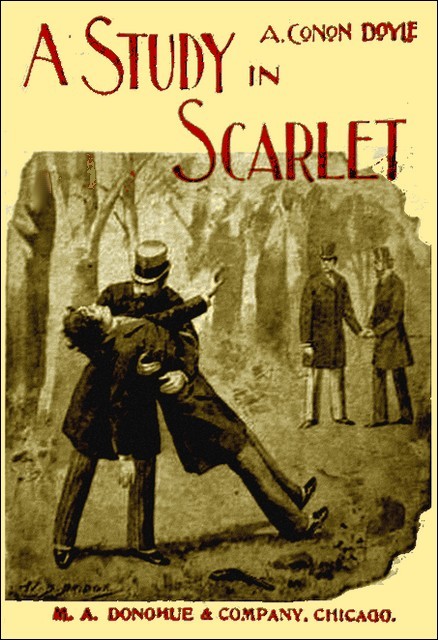
Arthur Conan Doyle’s A Study in Scarlet is remembered above all as the book that introduced Sherlock Holmes and Dr. John Watson, but its importance is larger than the arrival of two famous characters. First published in 1887, when the original text appeared in Beeton’s Christmas Annual, the novel establishes Holmes’s distinctive approach to detection, creates the Watson-as-chronicler narrative framework, and builds a murder mystery around the principle that visible effects can be traced backward to hidden causes. The result is not simply an early detective story but an experiment in making observation, specialised knowledge, and inference into dramatic action.
It is also a stranger and less seamless novel than later popular images of Sherlock Holmes might suggest. Halfway through the book, Doyle abandons London, Watson, and Holmes for an extended story set decades earlier in the American West, transforming a murder mystery into a tale of migration, forced marriage, escape, bereavement, and revenge. That structural rupture is both one of the book’s boldest features and one of its clearest weaknesses. Full spoilers follow: the discussion below covers both murders, Jefferson Hope’s identity and motive, Lucy Ferrier’s fate, Hope’s death, and Holmes’s complete explanation of the case.
A Study in Scarlet was the first Sherlock Holmes story, and many of the ingredients that would define Holmes are already present: forensic curiosity, theatrical confidence, contempt for conventional reasoning, competition with Scotland Yard, the Baker Street Irregulars, and Watson’s mixture of bewilderment and admiration. Yet the novel is most interesting when read not as a perfected Holmes story but as the moment Doyle discovers what the Holmes form can do. Its London chapters invent a compelling method of detection; its Utah backstory gives the killer a human history and complicates the morality of the case; and its ending establishes why Watson will become the person who turns Holmes’s investigations into stories.
A Study in Scarlet: Complete Plot Summary
The novel is divided into two parts of seven chapters each. Part I follows Watson’s meeting with Holmes and the investigation of two deaths in London, while Part II moves backward in time to explain the history that produced them before returning to Watson, Jefferson Hope, and Holmes. Doyle therefore solves the identity of the murderer before revealing his motive, making the second half less a conventional whodunit than a reconstruction of why the crime became inevitable.
Watson Meets Sherlock Holmes at 221B Baker Street
Dr. John H. Watson begins his account by explaining how he came to London alone, weakened, and in need of inexpensive accommodation. After receiving his medical degree, he enters the British Army as an assistant surgeon and is sent to Afghanistan. At the Battle of Maiwand he is wounded, survives the retreat with assistance, and later contracts enteric fever. His health deteriorates so severely that he is sent back to England with a modest allowance and no immediate professional occupation.
London initially offers Watson freedom, but his money is disappearing too quickly for him to continue living in a hotel. A chance meeting with an old acquaintance, Stamford, gives him a solution. Watson explains that he wants someone with whom he can share rooms, and Stamford says he knows another man in exactly the same position. His only hesitation is that the prospective roommate, Sherlock Holmes, is unusual enough that Watson should meet him before making any commitment.
Stamford describes Holmes as scientifically serious but eccentric. He knows a great deal about certain subjects and almost nothing about others, pursues experiments with unusual intensity, and is willing to conduct disturbing tests when they serve his curiosity. Stamford mentions, for example, Holmes’s experiments on corpses to understand how bruising changes after death. The description makes Watson more intrigued than alarmed.
They find Holmes in a hospital laboratory in a state of exhilaration. He has developed a chemical test that can identify blood even when the stain is old or difficult to distinguish from other substances. Holmes immediately understands the forensic importance of the discovery: many crimes, he argues, could be solved if investigators had a reliable way to prove that an ambiguous stain was blood.
His next demonstration is personal. Before Watson has explained where he has been, Holmes announces that he has recently returned from Afghanistan. Watson is startled, but Holmes refuses to explain the deduction immediately. The mystery of Holmes himself becomes one of the first puzzles Watson wants to solve.
Holmes and Watson inspect rooms at 221B Baker Street and find them suitable. Each discloses habits that might irritate a roommate. Holmes admits to chemical experiments, irregular hours, violin playing, and periods of silence; Watson says he dislikes noise because of his nerves and keeps a bull pup, though the animal plays no significant later role. They agree to share the rooms, beginning the partnership on which the rest of the Sherlock Holmes stories will depend.
Living with Holmes only deepens Watson’s curiosity. Holmes seems capable of intense bursts of physical and intellectual energy, followed by spells of inactivity. He receives visitors who do not seem to belong to any single profession or social class. He plays the violin, conducts chemical tests, practises boxing and swordsmanship, and possesses knowledge that is extraordinarily deep in some areas and almost nonexistent in others.
Watson tries to classify Holmes’s education. He decides that Holmes knows little about literature, philosophy, politics, or astronomy, but has exceptional expertise in chemistry, anatomy, poisons, sensational crime, British law as it relates to criminal investigation, and practical details such as different kinds of soil. When Watson is astonished that Holmes does not care whether the Earth moves around the Sun, Holmes introduces the theory of the mind as an attic. A person, he says, should not fill that attic indiscriminately; useful knowledge needs space, and irrelevant information may crowd it out.
The theory is psychologically questionable, but it reveals Holmes’s philosophy of professional expertise. His mind is not meant to be universally learned. It has been deliberately trained for a particular purpose.
Watson soon discovers what that purpose is. He reads an article titled “The Book of Life,” which argues that trained observation can allow a person to infer occupation, habits, history, and character from tiny details. Watson dismisses the claims as impractical exaggeration. Holmes then casually reveals that he wrote the article.
Holmes finally explains that he is a consulting detective. When private detectives or police investigators encounter a case they cannot understand, they sometimes bring him the evidence. He does not necessarily conduct every investigation himself; often he can identify the essential explanation from information others provide.
He also reconstructs the Afghanistan deduction. Watson’s appearance suggested that he was a medical man with the bearing of a military man; his darkened face contrasted with lighter skin at the wrists, showing that he had recently been in a strong sun; his weakened condition and stiff arm indicated injury and illness. Afghanistan, at that moment, provided the most plausible combination of military service, heat, wounds, and disease. What looked like intuition was actually a chain of compressed inferences.
Holmes’s confidence extends to literature. He criticises Edgar Allan Poe’s C. Auguste Dupin and Émile Gaboriau’s Monsieur Lecoq, famous fictional detectives whom Watson admires. Holmes considers them inferior because their deductions seem more theatrical or cumbersome than his own. The boastfulness is comic, but it also announces Doyle’s ambition: this detective is supposed to improve upon the fictional traditions that preceded him.
The first real opportunity arrives in the form of a message from Tobias Gregson of Scotland Yard. A man has been found dead in an empty house at Lauriston Gardens near Brixton Road. There is no obvious wound, no clear motive, and no satisfactory explanation. Gregson asks Holmes to come.
The Lauriston Gardens Murder and Holmes’s First Deductions
Holmes and Watson travel toward Lauriston Gardens, but Holmes deliberately stops their cab before it reaches the house. Instead of walking straight into the room where the corpse lies, he examines the road, the garden path, the ground, the exterior of the building, and the marks left by wheels and feet. The behaviour initially seems eccentric to Watson, but it demonstrates an important feature of Holmes’s method: the investigation begins before the most dramatic object appears.
Inside the abandoned house, Gregson and Inspector Lestrade are already at work. The dead man is middle-aged and well dressed. His body shows no obvious wound, although his face is twisted into a terrible expression that suggests fear, hatred, or extreme emotion at the moment of death. Blood is present in the room, but it does not appear to have come from the corpse.
The dead man is identified from his possessions as Enoch J. Drebber of Cleveland, Ohio. Letters indicate that Drebber had been travelling with Joseph Stangerson and intended to return to the United States. His money and valuable possessions are still with him, making ordinary robbery unlikely.
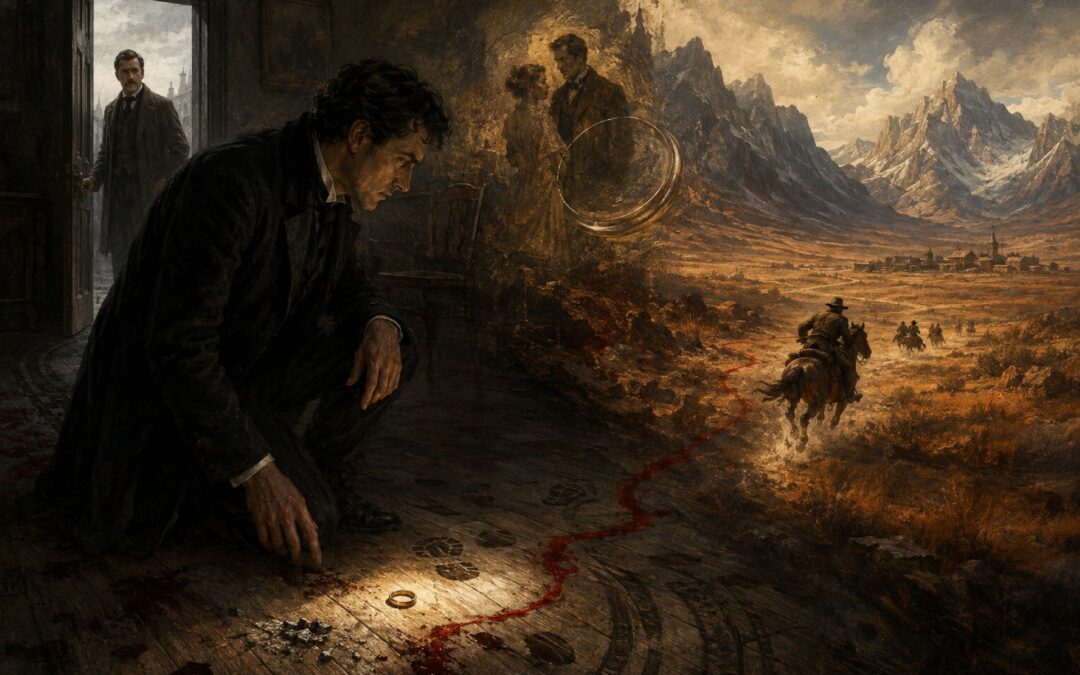
As the body is moved, a woman’s wedding ring falls to the floor. The ring seems out of place because no woman is present and no immediate explanation connects it to Drebber. It will become the emotional and evidentiary object linking the London murders to the tragedy in Utah.
Lestrade discovers another striking clue. Written on the wall in blood is the word RACHE. Lestrade assumes that the murderer was trying to write “Rachel” and failed to finish the name. Holmes points out that Rache is German for “revenge,” although he is sceptical that the word should be interpreted at face value. A clue designed to appear meaningful can be a deliberate attempt to make investigators pursue the wrong explanation.
Holmes studies the corpse, the room, the marks outside, and the wall. By the time he leaves, he is prepared to give Gregson and Lestrade an extraordinarily precise description of the killer: a tall man, relatively young, with small feet for his height, wearing coarse square-toed boots and smoking a Trichinopoly cigar. Holmes also believes the murderer has long fingernails on one hand, arrived with Drebber in a four-wheeled cab, and killed him with poison.
Watson is astonished because the official detectives have not yet established even the basic mechanism of death. Holmes, however, sees the scene as a combination of independent physical facts. Wheel marks indicate a cab. The shape and spacing of footprints suggest height and gait. The position of the writing helps estimate the murderer’s stature. Scratches in the plaster indicate fingernails. Ash identifies a cigar. The absence of wounds combined with the body’s condition suggests poison.
Holmes’s next step is to investigate Constable John Rance, the policeman who discovered the body. Rance explains that while walking his beat he noticed a light inside the supposedly empty house. He entered and found Drebber. The circumstances frightened him, particularly because of the corpse’s expression and the strange writing.
Rance also mentions meeting a drunken man near the house. The stranger was tall, red-faced, and unsteady. Rance assumed he was merely intoxicated and allowed him to go.
To Holmes, this forgotten encounter is more valuable than almost anything else Rance says. The “drunk” man matches the physical description Holmes has already inferred. Holmes believes the murderer returned to Lauriston Gardens after discovering that he had accidentally lost the wedding ring. When he saw the police, he protected himself by pretending to be too drunk to attract suspicion.
Holmes is frustrated that Rance failed to recognise the importance of the encounter, but the episode demonstrates one of the novel’s central ideas: evidence does not speak for itself. Rance saw the killer. What he lacked was the interpretive framework that would tell him whom he was seeing.
During this stage of the investigation, Holmes gives the case its title. He describes murder as a scarlet thread running through the colourless skein of ordinary life, a thread that the investigator must isolate and expose. The metaphor turns detection into an act of separating the meaningful from the surrounding noise.
Holmes then tries to exploit the wedding ring. He places an advertisement stating that the ring has been found and directs the supposed owner to Watson at Baker Street. If the murderer values it enough to return to the crime scene, Holmes expects him or an accomplice to attempt to recover it.
Watson prepares for danger by keeping a revolver nearby. The visitor who eventually arrives, however, appears to be an elderly woman. She claims that the ring belongs to her daughter and supplies a plausible domestic story explaining how it was lost.
Holmes notices inconsistencies but allows the woman to leave because he wants to follow her. The pursuit ends in embarrassment. Holmes tracks her into a cab, only to discover later that she has vanished from it. The address she provided is false.
The apparent old woman must therefore have been a disguise, probably worn by a younger and more agile person. For once, Holmes’s trap has failed because the other side has anticipated the possibility of surveillance. The episode is useful not only because it establishes that the murderer has help, but because it makes Holmes fallible. His intelligence gives him a major advantage, not magical invulnerability.
Gregson, Lestrade, and the Capture of Jefferson Hope
While Holmes continues working, the newspapers begin constructing their own explanations. Because of the German word on the wall, some reports speculate about revolutionary societies, political conspiracies, foreigners, and other sensational possibilities. Doyle uses the press coverage to show how quickly an unexplained crime attracts narratives that are more dramatic than the available evidence justifies.
Holmes, meanwhile, has enlisted the Baker Street Irregulars, a group of street boys led by Wiggins. Their importance lies in social invisibility. They can move through London, ask questions, watch streets, approach cabmen, and gather information without attracting the attention that an official detective might. Holmes’s supposedly scientific method therefore depends not only on laboratory reasoning but also on an informal human intelligence network.
Gregson then arrives at Baker Street feeling triumphant. He believes he has solved Drebber’s murder by tracing the dead man’s hat to the shop where it was purchased and then following the trail to the boarding house where Drebber and Stangerson had stayed.
There he interviewed Madame Charpentier and learned that Drebber had been an unpleasant guest. He drank heavily, behaved crudely, and became interested in Madame Charpentier’s daughter Alice. After being told to leave the house, Drebber returned and tried to persuade Alice to run away with him. When she resisted, he seized her.
Alice’s brother, Arthur Charpentier, intervened furiously. Armed with a heavy walking stick, he drove Drebber away and followed him into the street. Because Arthur had motive, anger, opportunity, and a weapon, Gregson arrests him and concludes that he killed Drebber.
The theory is plausible enough to demonstrate why ordinary police work cannot simply be dismissed as foolish. Gregson has found real facts and constructed a coherent narrative from them. The problem is that his narrative does not explain all the evidence: Drebber appears to have been poisoned, the blood in the room is not his, the wedding ring remains unexplained, and the physical traces at Lauriston Gardens do not fit Arthur neatly.
Before Gregson can enjoy his apparent success, Lestrade arrives with devastating news. Joseph Stangerson has been found murdered.
Lestrade had reasoned that if Stangerson was not Drebber’s murderer, he might be the next victim, so he had searched London hotels. He eventually found Stangerson dead in an upper room at Halliday’s Private Hotel. Unlike Drebber, Stangerson has been stabbed through the heart. The word RACHE again appears in blood.
A witness saw a tall, red-faced man leaving the building by ladder. The description corresponds closely to the man Holmes has been seeking.
More importantly, Lestrade produces a small box found among Stangerson’s belongings. It contains two pills. Holmes immediately suspects that the pills are connected to Drebber’s death.
To test them, Holmes uses a dog that is already dying. Part of one pill appears to have no effect. A portion of the other rapidly kills the animal. Holmes now understands the murder mechanism: the pills are a matched pair, one harmless and one poisonous.
The experiment clarifies Drebber’s death without explaining why Stangerson was stabbed. Holmes concludes that the same murderer was responsible for both deaths but had to change methods when circumstances changed.
Gregson and Lestrade press Holmes to name the killer. Holmes is reluctant to explain too early because he believes premature disclosure could endanger the arrest. He does, however, say that he knows the murderer’s identity.
Soon Wiggins arrives to report that the cab Holmes requested is waiting. Holmes asks the driver to come upstairs on the pretext of helping with luggage. When the man bends down, Holmes suddenly clamps handcuffs on his wrists.
The cab driver is Jefferson Hope.
Holmes announces that Hope murdered Enoch Drebber and Joseph Stangerson. Part I ends with the murderer captured but his motive still completely obscure. Doyle has answered the question of who committed the crimes while withholding the larger question that makes those crimes intelligible.
John Ferrier, Lucy Ferrier, and Jefferson Hope in Utah
Part II abruptly leaves London and travels backward several decades to the American West. Watson disappears as narrator, Holmes vanishes from the story, and the detective plot gives way to frontier adventure.
John Ferrier and a five-year-old girl are stranded on the Great Alkali Plain in 1847. They are the last survivors of a larger party destroyed by thirst, hunger, and exhaustion. Ferrier is not the girl’s biological father, but in their desperate isolation he becomes her protector and eventually adopts her as his daughter. She is Lucy Ferrier.
Their deaths appear imminent until they encounter a vast group of Mormon migrants moving westward. The travellers are presented as an organised community under Brigham Young’s leadership, bound by religion and collective discipline. They agree to save Ferrier and Lucy on the condition that Ferrier joins their faith and accepts the authority of the community.
Ferrier agrees because the alternative is death. He and Lucy travel with the migrants until they settle in Utah.
Years pass. Ferrier becomes prosperous, with productive land, livestock, and social standing. Lucy grows into a young woman admired throughout the settlement. Ferrier participates in the community but resists one practice in particular: he refuses to enter plural marriage.
One day Lucy finds herself endangered by a moving herd of cattle. A young hunter and prospector named Jefferson Hope comes to her aid. Hope has connections to Ferrier through an earlier acquaintance, and the rescue gives him a reason to visit the Ferrier household.
Lucy and Hope fall in love. Ferrier approves of him, and there is every expectation that they will marry. Hope leaves temporarily to pursue work at the silver mines, promising to return.
At this point Jefferson Hope is far removed from the murderer arrested by Sherlock Holmes. Doyle first gives the reader a young man associated with courage, physical competence, romantic devotion, and rescue. That earlier identity is necessary if his later violence is to be understood as a transformation rather than an innate trait.
Coercion, Escape, and the Destruction of the Ferriers
The tone of the Utah narrative darkens as Ferrier’s refusal to accept every demand of the community becomes dangerous. Doyle portrays the settlement as governed not merely by religious authority but by surveillance, intimidation, and the possibility of secret violence. This representation is a major part of the novel’s plot, but it must be understood as Doyle’s fictional and sensationalised version of nineteenth-century Mormon Utah rather than treated as neutral historical description.
Brigham Young comes to Ferrier’s home and reminds him that the community saved his life and Lucy’s. The rescue is now transformed into a debt of obedience. Young says that Lucy must marry within the faith and gives Ferrier a choice between two men: the sons of Drebber and Stangerson.
Ferrier is horrified. Neither man is someone he would willingly choose for Lucy, and Lucy herself loves Jefferson Hope. Young gives Ferrier one month to comply.
After Young leaves, Ferrier tells Lucy that he will never force her into such a marriage. Their only realistic hope is to contact Jefferson and flee. The danger is no longer merely that Lucy may marry the wrong man; it is that their household has ceased to be private. The community claims authority over Lucy’s future and treats Ferrier’s resistance as rebellion.
Drebber and Stangerson soon arrive to present their claims. Their conversation is deliberately degrading. They debate which of them has the stronger right to Lucy on the basis of wealth, family position, and practical advantage, treating her less as a person with preferences than as a prize to be allocated.
Ferrier drives them from his house, increasing the danger.
Then the intimidation becomes psychological. Mysterious numbers begin appearing, counting down the days remaining before the deadline. Ferrier guards the property, secures doors and windows, and watches for intruders, yet the messages continue to appear. The effect is to convince him that the people threatening him can enter his private space whenever they choose.
Jefferson Hope finally reaches the house in secret. He has learned of the danger and travelled with extraordinary speed and endurance to help Lucy and Ferrier escape.
The three leave covertly. Hope knows enough about the routes and the organisation of the guards to guide them through the surrounding country. At one checkpoint he is able to repeat information he has overheard, allowing them to pass without immediate discovery.
For a time, escape appears possible. Hope leads them into rough country where pursuit should be difficult. But supplies become scarce, and he eventually leaves Ferrier and Lucy alone while he hunts for food.
When he returns, the camp is deserted.
Hope follows tracks and discovers what happened. A grave has been dug for John Ferrier, who has been killed. Lucy has been carried away.
Hope learns that Stangerson was responsible for Ferrier’s death and that Lucy was forced into marriage with Drebber. The rescue has failed at the precise moment when Hope believed he had led them to safety.
Lucy does not survive for long after the forced marriage. When Hope manages to enter the place where her body lies, he sees the wedding ring on her finger. To him, the ring represents the marriage imposed on her after Ferrier’s murder and after her separation from the man she loved. He removes it so that she will not be buried wearing the symbol of Drebber’s claim over her.
That ring is the same object later found in Lauriston Gardens.
Hope now dedicates himself to revenge. He hunts Drebber and Stangerson, makes attempts on their lives, and forces them to live under the threat of a pursuer who may strike without warning. His physical health deteriorates, however, and he eventually has to leave the region temporarily.
When Hope returns years later, Drebber and Stangerson are gone. The pursuit expands across the United States and then Europe. Hope works when necessary, saves money, finds his targets, loses them, and finds them again.
His life narrows around one purpose. The young man who once crossed dangerous country to rescue Lucy becomes a man willing to spend years following the two people he holds responsible for destroying her family and future.
Eventually the pursuit reaches London.
Jefferson Hope Explains the Murders
After Hope’s arrest, the narrative returns to Watson. Hope is clearly ill, and a medical examination reveals that he suffers from a serious aortic aneurysm. He knows that he may die before reaching trial.
Because he does not want his actions reduced to the label of ordinary murder, Hope agrees to explain the killings. His account supplies the causal history missing from Part I.
In London, Hope found employment as a cab driver. The job was ideal for surveillance because a cabman could circulate constantly without attracting attention. He could wait near hotels, follow travellers, learn routes, and remain part of the city’s background.
He watched Drebber and Stangerson carefully. An opportunity finally appeared after the confrontation at Madame Charpentier’s boarding house. Drebber had been drinking and became separated from Stangerson.
Hope picked him up in his cab. Drebber was drunk enough that he did not recognise the danger and allowed Hope to drive him away from the places where he expected to be.
Hope took Drebber to the empty house at Lauriston Gardens. There he finally revealed his identity and confronted him with the past.
The murder was constructed as a ritual judgment. Hope had prepared two identical-looking pills, one harmless and one poisonous. Drebber was forced to choose one, while Hope swallowed the other. In Hope’s mind, this gave Providence the opportunity to decide between them.
Drebber chose the poison and died.
The blood in the room did not come from Drebber. Hope, excited and physically strained, suffered a nosebleed related to his illness. He used the blood to write RACHE on the wall, deliberately attempting to create the impression of a political or German connection.
Hope then discovered that Lucy’s wedding ring was missing. He realised he must have dropped it at Lauriston Gardens and returned to retrieve it.
That return explains Constable Rance’s encounter with the apparently drunken man. Hope was not drunk. When he saw the police near the house, he adopted the performance as a way to seem harmless and escape.
The advertisement for the ring later told Hope that someone involved in the investigation understood its importance. He therefore sent an accomplice in disguise to retrieve it. Hope refuses to identify the accomplice, preserving one small unresolved element even after he confesses.
Stangerson’s death occurred differently because Hope could not recreate the same ritual. He tracked Stangerson to his hotel, climbed to his room, and offered him the same choice between the pills. Stangerson resisted and attacked him. Hope killed him with a knife.
The difference between the deaths explains one of the mystery’s apparent inconsistencies. Drebber died by poison because Hope controlled the situation. Stangerson was stabbed because the confrontation became a struggle.
Hope does not describe himself as a criminal motivated by money or sadism. He believes he has executed the men who destroyed Ferrier and Lucy. His confession explains his reasoning, but it does not automatically make that reasoning morally correct. That unresolved distinction becomes central to the novel’s meaning.
Holmes Explains the Case—and Watson Becomes His Chronicler
Jefferson Hope never receives a trial. His aneurysm ruptures, and he is found dead in his cell. Watson notes the peaceful expression on his face, suggesting that Hope dies believing his long task is complete.
The absence of a trial prevents the legal system from issuing the novel’s final moral judgment. Readers know what Hope did and why he did it, but there is no courtroom verdict capable of translating his history into a formal assessment of guilt, mitigation, or punishment.
Holmes instead provides the intellectual resolution. He explains to Watson that the central skill of detection is the ability to reason backward. In ordinary life, a person often knows a cause and predicts its effects. The detective encounters the effects first and must reconstruct the cause.
Holmes revisits the evidence at Lauriston Gardens. The cab tracks showed how the victim and murderer arrived. Footprints indicated the murderer’s physical characteristics. The absence of robbery reduced the likely motives. The ring suggested a connection involving a woman. Drebber’s expression and the absence of a wound suggested poison. The blood came from someone else. The writing on the wall was a deliberate distraction.
Once Holmes learned that Drebber had previously sought police protection from a man named Jefferson Hope, the name became decisive. Holmes then reasoned that a stranger who needed to follow Drebber around London would benefit from a profession that allowed constant movement. The Baker Street Irregulars were therefore instructed to search among cab drivers.
The mystery looks miraculous only until Holmes exposes the chain connecting each clue.
The newspapers, however, do not reward him. Gregson and Lestrade receive much of the public credit for solving the sensational case. Holmes seems amused rather than outraged, but Watson feels that the injustice should be corrected.
Watson decides that he will record the real history himself.
The ending therefore establishes more than Holmes’s method. It creates Watson’s literary role. He does not merely witness Holmes’s cases; he becomes the person who ensures that the detective’s hidden intellectual labour receives the recognition the newspapers fail to give it.
London, Utah, and the Novel’s Two Worlds
The most striking structural fact about A Study in Scarlet is that its two principal settings initially seem to belong to different kinds of fiction. London is an urban detective environment defined by streets, lodging houses, cabs, newspapers, laboratories, official police, crowds, and anonymity. Utah is presented as a frontier landscape of migration, settlement, mountains, horses, pursuit, patriarchal authority, and dangerous isolation.
The contrast is not accidental. London allows people to disappear inside modern systems. Jefferson Hope can work as a cab driver and become almost invisible precisely because the city contains so many strangers performing specialised roles. Drebber and Stangerson believe that crossing continents and entering a huge metropolis may finally separate them from their past, but London’s anonymity protects their pursuer just as effectively as it protects them.
Holmes reads the city through material traces. Roads retain wheel marks, floors retain footprints, walls retain scratches, ash reveals the kind of cigar that was smoked, and a lost ring carries a hidden biography. London appears chaotic to ordinary observers, but Holmes treats it as an environment saturated with recoverable information.
Doyle’s Utah operates differently. Instead of anonymity, the novel emphasises visibility and social control. Ferrier cannot simply withdraw from the community because the authority surrounding him reaches into his household. Messages appear despite his precautions, his movements are watched, and Lucy’s marriage is treated as something the community may regulate.
This makes private space an important link between the two halves. Scholarly readings of the novel have explored its concern with threats to the private sphere: Ferrier wants his home and daughter to remain outside institutional possession, while the Utah plot repeatedly shows that boundary collapsing. In London, the apparently private crime scene also becomes a space that Holmes can reconstruct through traces left by people who believed their actions were hidden.
The novel’s geographical movement is also broader than a simple contrast between England and America. The murders have causes extending across migration routes, religious settlement, mining regions, American cities, continental Europe, and finally London. Caroline Reitz’s discussion of the imperial and transnational dimensions of the early Holmes novels helps explain why the backstory matters structurally: Holmes’s apparently local London puzzle is actually the endpoint of a history extending far beyond Britain.
Yet these two worlds are not equally convincing. Doyle knew how to make London serve the logic of detection because every street and object can become evidence. Utah is written more melodramatically, with threats, secret watchers, countdown messages, and pursuit through the mountains. Its primary function is emotional and moral rather than forensic.
That difference is precisely why the mid-book interruption can feel so drastic. Part I teaches readers to expect a detective story in which every detail may become a clue. Part II asks them to suspend that pleasure for a long explanatory narrative in another genre. The move ultimately gives the murders more human significance, but it temporarily removes the very characters and method that made the book distinctive.
Character Analysis
Although Sherlock Holmes dominates the novel’s reputation, A Study in Scarlet distributes its emotional weight more widely than many later Holmes stories. Watson provides the narrative consciousness, Jefferson Hope becomes the central figure of the second half, and the Ferriers supply the tragedy that turns a mystery into a revenge story. Even the less developed characters help define Holmes by giving him different forms of opposition, contrast, or evidence.
Sherlock Holmes
The Holmes of A Study in Scarlet is already recognisably Sherlock Holmes, but he is not yet the almost mythic figure created by decades of later stories and adaptations. Doyle presents him first as a professional specialist. He has constructed a life around detection and deliberately organised his knowledge, habits, physical training, social contacts, and scientific interests to support that profession.
His greatest strength is not merely observation. Many people in the novel observe the same facts. Rance sees Jefferson Hope outside Lauriston Gardens, Lestrade sees the writing on the wall, Gregson discovers the Charpentier conflict, and Watson witnesses much of the investigation. Holmes differs because he knows how to assign relative importance to details and combine them into causal explanations.
His thinking is also aggressively selective. The brain-attic theory expresses an almost ascetic commitment to usefulness. Holmes does not want to be a generally cultivated Victorian gentleman; he wants to become the best possible instrument for solving crimes. Even his unconventional gaps in knowledge become evidence of professional self-design.
At the same time, Holmes is vain. He enjoys astonishing Watson, dismisses Dupin and Lecoq, mocks the mistakes of Gregson and Lestrade, and delays explanations partly because dramatic revelation pleases him. His intelligence is inseparable from performance.
Doyle prevents that confidence from becoming unbearable by allowing Holmes to fail in smaller ways. The disguised visitor who retrieves the wedding ring escapes him. Holmes can recognise that he has been outmanoeuvred without losing command of the larger case.
His attitude toward official recognition is also complicated. He resents incompetence but is less desperate for newspaper praise than Watson expects. What Holmes seems to value most is being right. That emphasis on private intellectual mastery will become one of the defining tensions of the character.
Dr. John Watson
Watson enters the novel as a damaged man. His military service has left him wounded, physically weakened, financially constrained, and detached from ordinary social life. Sharing rooms with Holmes initially solves a practical problem, but it also gives Watson a new intellectual and social centre.
His most important quality is curiosity. He does not merely accept Holmes as eccentric; he studies him. The early chapters are structured almost like a detective investigation in which Watson attempts to solve the mystery of his roommate before either man investigates a murder.
Watson is intelligent enough to understand the significance of Holmes’s explanations but ordinary enough that the reader can share his surprise. This balance is crucial. A narrator who understood Holmes too quickly would destroy the dramatic effect of deduction, while an entirely foolish narrator could not communicate the method clearly.
He also supplies moral feeling where Holmes often supplies intellectual analysis. Watson is disturbed by murder scenes, sympathetic to Jefferson Hope’s suffering, annoyed when Gregson and Lestrade receive credit, and concerned with how the case appears to other people. Holmes cares primarily about the architecture of the puzzle; Watson keeps the narrative connected to ordinary human reactions.
By the ending, Watson’s role has changed. He begins as a lonely invalid seeking affordable rooms and ends as the self-appointed recorder of Holmes’s achievements. His decision to write is not an incidental flourish. It explains the narrative framework of the entire Holmes canon: the cases exist for readers because Watson believes the truth about Holmes deserves preservation.
Jefferson Hope
Jefferson Hope is the novel’s most complicated figure because he occupies several moral identities. He is introduced chronologically as a rescuer, lover, outdoorsman, and prospective husband. When the reader first encounters his name in London, however, Holmes is identifying him as a double murderer.
Part II forces these identities together.
Hope’s love for Lucy is initially associated with vitality and possibility. He rescues her from danger, gains Ferrier’s approval, and imagines a future with her. His return to help Lucy and Ferrier escape is physically heroic. He risks his life and crosses dangerous terrain because he believes he can save them.
Their destruction reorganises his personality around vengeance. Ferrier is murdered, Lucy is forcibly married to Drebber, and Lucy dies. Hope does not process these events by rebuilding a life elsewhere. Instead, he treats his survival as an obligation to punish those responsible.
The duration of his pursuit matters. Revenge is not an impulsive act committed in the first shock of grief. It becomes the organising principle of his adult existence. He sacrifices time, health, stability, and ordinary ambition to follow Drebber and Stangerson across continents.
That persistence makes Hope both impressive and frightening. The same qualities that made him capable of rescue—endurance, patience, physical courage, ingenuity, loyalty—become the qualities that make him an effective killer.
His method of killing Drebber reveals the moral story he tells himself. By offering two pills and taking one himself, Hope tries to distinguish execution from assassination. He imagines that chance or Providence will confirm the righteousness of his cause.
Yet the ritual does not remove his agency. Hope prepared the poison, abducted Drebber, forced the choice, and intended that one of them die. The religious or providential framing changes how Hope understands the act, not the basic fact that he engineered it.
His killing of Stangerson makes that distinction even clearer. When the ritual cannot proceed, Hope kills him with a knife. Revenge, not metaphysical fairness, is the underlying constant.
Hope therefore deserves sympathy without being reduced to a righteous avenger. Doyle gives him enough suffering to destabilise the conventional murderer-victim relationship, but the novel is strongest when his pain and his violence are allowed to remain morally entangled.
John Ferrier
John Ferrier is defined first by survival and then by paternal commitment. On the Alkali Plain, he accepts the migrants’ conditions because doing so saves both himself and Lucy. Once settled, he becomes successful, materially secure, and socially established.
His central conflict arises when the terms of belonging expand. Ferrier can accept residence within the community, but he will not accept unlimited control over his household. His resistance to Lucy’s compulsory marriage is therefore both personal and political.
Ferrier’s most important relationship is with Lucy. Although she is not biologically his child, he treats her future as a responsibility that overrides his security and property. When forced to choose between submission and flight, he abandons everything he has built.
His limitations are mainly literary rather than moral. Doyle gives him courage and affection but relatively little psychological complexity beyond those traits. Ferrier works effectively because the plot needs a father whose resistance makes the later revenge morally intelligible.
Lucy Ferrier
Lucy is the emotional centre of the Utah backstory but not its most fully developed consciousness. Her importance is enormous: Hope loves her, Ferrier risks everything for her, Drebber seeks possession of her, and her death motivates years of pursuit. Yet Doyle gives far more narrative agency to the men acting around her than to Lucy herself.
She does have recognisable preferences. She loves Hope, trusts her father, fears the imposed marriage, and wants escape. The problem is that once the coercion intensifies, her role becomes increasingly passive.
That imbalance is especially visible after the failed escape. Ferrier is killed; Hope becomes an avenger; Drebber becomes the forced husband; Lucy dies and becomes the remembered object around which the surviving men define justice. Her wedding ring gains more narrative life after her death than Lucy herself is permitted to have.
This does not make her unimportant. It reveals a limitation in Doyle’s construction. The novel asks readers to care intensely about what is done to Lucy without allowing her an equivalent interior presence.
Drebber, Stangerson, Gregson, Lestrade, and the Supporting Cast
Enoch Drebber is designed to make Jefferson Hope’s revenge emotionally understandable. In Utah he becomes one of the men competing for Lucy as though she were property, and in London his treatment of Alice Charpentier shows that coercive sexual entitlement remains part of his character. The disadvantage of this construction is that Doyle makes Drebber so thoroughly repellent that the ethical challenge of his murder becomes easier to evade.
Joseph Stangerson is less vividly characterised. He functions as Drebber’s associate, one of Lucy’s proposed husbands, the killer of Ferrier within Hope’s account, and eventually Hope’s second victim. His narrative importance exceeds his psychological depth.
Gregson and Lestrade are not incompetent in every sense. Both gather useful evidence and pursue rational leads. Their weakness is that they tend to form explanations too early and then fit subsequent facts into them. They exist partly to clarify Holmes by contrast: the police investigate crimes; Holmes investigates the logic connecting evidence.
The Charpentier family briefly gives the London case a convincing alternative explanation. Alice reveals Drebber’s character, Madame Charpentier protects her children imperfectly under questioning, and Arthur’s anger makes him a plausible suspect. Their episode shows how a genuine motive can still belong to the wrong causal story.
Wiggins and the Baker Street Irregulars demonstrate another side of Holmes’s intelligence. He recognises that information depends on social position and uses people whom respectable society overlooks. Stamford, meanwhile, performs the deceptively important function of bringing Holmes and Watson together.
John Rance embodies the distinction between seeing and understanding. He encounters the murderer almost directly but cannot recognise the importance of what he sees. His mistake becomes one of the clearest early demonstrations of Holmes’s belief that observation without interpretation is insufficient.
The Science of Deduction: How Holmes’s Method Works
The intellectual fascination of A Study in Scarlet lies in Doyle’s attempt to turn detection into a visible method rather than a mysterious gift. Holmes certainly enjoys creating the impression of magic, but the novel repeatedly demystifies his conclusions after the fact. The reader is asked to experience astonishment first and explanation second.
This approach was deliberate. Conan Doyle later explained, in his reflections on the origins of Holmes, how medical diagnosis, trained observation, and reasoning helped inspire the detective’s method. The doctor infers an invisible disease from outward symptoms; Holmes infers an invisible sequence of actions from physical and behavioural traces.
Observation, Specialist Knowledge, and Material Traces
Holmes’s method depends on disciplined attention to physical evidence. At Lauriston Gardens he does not rush toward the corpse because the road and path may contain information that will be destroyed by additional traffic. The order in which evidence is examined matters.
He also distinguishes observing something from knowing what it means. Cigar ash is useful only if the observer can identify varieties of tobacco. Footprints matter only if their size, spacing, depth, and relation to other prints can be interpreted. A chemical stain matters only if there is a reliable test.
This is why Holmes’s strange education is important. His knowledge appears eccentric because it has been selected around probable investigative problems. Chemistry, anatomy, poisons, criminal history, soil, law, and tobacco ash form a practical toolkit.
The Lauriston Gardens investigation demonstrates the cumulative nature of this toolkit. No single clue identifies Jefferson Hope. The cab marks, footprints, writing, blood, ring, corpse, and cigar ash gradually narrow the possibilities.
Holmes also gives physical evidence priority over testimony when the two conflict. Gregson’s Charpentier theory contains believable human motives, but it cannot explain the material structure of the crime scene. Holmes refuses to adopt an attractive narrative until it accounts for the facts.
Reasoning Backward from Effects to Causes
Holmes’s most explicit theory appears at the end, when he explains reasoning backward. Most people are comfortable moving from causes to consequences: given a set of circumstances, they can imagine what might follow. Detection reverses the direction.
The detective begins with consequences whose causes are hidden.
At Lauriston Gardens the visible effects include a dead man without wounds, blood belonging to someone else, wheel tracks, footprints, a ring, a German word, cigar ash, and an expression of terror. Holmes’s task is to construct an earlier sequence of events capable of producing all those effects together.
This makes the case easier in a paradoxical way when unusual evidence appears. A completely ordinary crime might fit many explanations. A bizarre combination of details can eliminate alternatives more quickly because fewer possible histories could produce it.
The method also explains why Holmes is suspicious of obvious clues. RACHE looks highly meaningful, which is exactly why he considers the possibility that it was planted to create a false narrative. Evidence must be interpreted not only for what it indicates but for what the person who left it may have wanted others to think.
Jefferson Hope’s own confession eventually confirms most of Holmes’s reconstruction. He arrived with Drebber in a cab, poisoned him, bled from the nose, wrote on the wall, lost the ring, returned for it, and escaped Rance by pretending to be drunk. Holmes has effectively reconstructed a hidden story from its material residue before the killer narrates the story himself.
The Limits of Holmes’s “Scientific” Method
The novel calls Holmes’s approach scientific, and important elements of it are recognisably systematic: careful observation, specialised knowledge, hypothesis testing, attention to physical evidence, and willingness to revise when new facts appear. Yet Holmes’s certainty sometimes exceeds what the evidence alone could reasonably support.
His ability to infer exact or near-exact personal characteristics from footprints, handwriting position, facial appearance, and other small details is part of the story’s theatrical appeal. Doyle wants deductions to feel both astonishing and retrospectively intelligible, which encourages conclusions presented with more precision than real forensic reasoning would usually justify.
The poisoned-pill experiment also reflects the assumptions of the period rather than modern forensic or ethical standards. Holmes uses a dying animal as a test subject because the story needs rapid confirmation of the poison mechanism. The procedure works narratively, but it is not a model of contemporary laboratory practice.
His brain-attic theory should be treated similarly. It expresses Holmes’s belief in disciplined professional specialisation, not an accurate account of modern memory science.
The most convincing part of Holmes’s method is therefore not every specific deduction. It is the larger habit of refusing to let appearances settle a case before all the available evidence has been integrated. Doyle’s enduring innovation was to make disciplined inference itself entertaining.
Justice, Revenge, and the Choice of the Poisoned Pills
Jefferson Hope turns A Study in Scarlet from a puzzle about murder into a story about competing definitions of justice. Holmes solves the factual question of responsibility, but the novel never provides an equally clean moral solution.
Hope believes Drebber and Stangerson destroyed the people he loved. Ferrier is killed during the escape, Lucy is forced into marriage with Drebber, and Lucy soon dies. Hope sees ordinary legal systems as irrelevant because the acts occurred in circumstances where he expects no institution to punish the responsible men.
His revenge therefore becomes a private substitute for law. He investigates, pursues, judges, sentences, and executes.
The paired pills give this private justice a ritual structure. Hope could simply murder Drebber without warning, but he instead offers two pills and takes one himself. The arrangement allows him to imagine that Providence will select the guilty man.
That ritual matters psychologically because Hope wants more than Drebber’s death. He wants the death to confirm a moral order in which Lucy’s suffering is recognised and answered.
Yet the ritual cannot transform private vengeance into neutral justice. Hope controls every condition except which pill Drebber chooses. He kidnaps the victim, designs the test, determines that death must occur, and refuses any possibility of acquittal other than his own accidental death.
The confrontation with Stangerson reveals the underlying logic more plainly. When Stangerson resists and the ritual becomes impossible, Hope kills him with a knife. The essential goal is punishment, not submission to chance.
Doyle deliberately makes Hope sympathetic enough that readers may feel emotionally satisfied by his revenge. Drebber is selfish, sexually predatory, and associated with Lucy’s forced marriage. Stangerson is connected to Ferrier’s death. Neither man is given much redeeming complexity.
That imbalance makes the novel morally effective but somewhat easier than it might have been. Hope’s victims are constructed to make his anger understandable, reducing the pressure on readers to confront the full implications of private execution.
Hope’s death before trial preserves the ambiguity. The state never judges him. No jury hears his history, and no sentence forces the novel to decide how much his motive should mitigate his guilt.
Instead, Hope dies believing that he completed the purpose around which he organised his life. His peaceful expression suggests subjective release, not necessarily objective vindication.
The distinction matters. A Study in Scarlet explains why a man became a murderer without requiring readers to believe murder was the only morally defensible outcome. Its most interesting ethical achievement is precisely that sympathy and judgment do not have to be identical.
Power, Marriage, and the Mormon Utah Backstory
The Utah chapters contain some of the novel’s strongest emotional stakes and some of its most serious historical problems. Doyle constructs a society in which communal authority can determine marriage, punish resistance, penetrate domestic privacy, and pursue fugitives. That machinery creates the circumstances that make Jefferson Hope’s revenge possible.
Ferrier’s original rescue establishes the central tension. He and Lucy survive because a religious community takes them in, but the novel later presents that rescue as a debt that the community believes entitles it to obedience. Gratitude becomes obligation, and obligation becomes a claim over Lucy’s future.
Marriage is therefore not treated simply as romance. It becomes a question of possession and authority. Lucy wants to marry Jefferson Hope; Ferrier supports her choice; Drebber and Stangerson discuss which of them should obtain her; Young’s ultimatum makes individual consent subordinate to institutional requirements.
The countdown messages intensify this conflict because they transform the Ferrier home into a space that cannot be defended. Ferrier can lock doors and watch windows, but anonymous authority still reaches him. The fear comes from knowing that resistance is visible even when the watchers are not.
That pattern has led scholars to examine the relationship between Mormonism, frontier space, colonisation, and Sherlockian logic in A Study in Scarlet. The Utah narrative does more than supply motive; it creates a world in which coercive authority is imagined as pervasive enough that private justice later appears emotionally plausible.
The historical representation, however, should not be accepted uncritically. Doyle’s secret enforcers and atmosphere of organised terror draw upon nineteenth-century anti-Mormon sensational traditions. Scholarship on the literary perpetuation of the “Danite” myth places such portrayals within a broader body of Western fiction that repeatedly transformed disputed or exaggerated stories about Mormon violence into dramatic convention.
That does not mean every conflict associated with nineteenth-century Mormon settlement was invented, nor does it require readers to ignore coercion, plural marriage, or institutional power as historical subjects. It means Doyle’s particular narrative cannot serve as an objective documentary account.
This qualification changes how the section should be evaluated. As fiction, the Utah chapters create effective dread. The anonymous warnings, forced choice of suitors, mountain escape, Ferrier’s death, and Lucy’s forced marriage give Hope a powerful tragic motive.
As historical representation, however, the section is shaped by sensational assumptions that simplify an entire religious community into an ominous system of surveillance and violence. The novel’s criticism of coercion may remain meaningful even when its chosen representation of Mormon society is historically unreliable.
Lucy’s treatment also reveals a second problem. The book condemns the idea that an institution or husband may possess her, yet its own plot repeatedly reduces her to the object over which men struggle. Ferrier protects her, Hope loves her, Drebber claims her, and her death motivates Hope. Her preferences matter, but her interior life is never developed with comparable force.
The section therefore contains a real contradiction. It passionately defends individual choice against imposed marriage while narratively giving its central woman limited control over the story built around that choice.
That tension does not erase the emotional power of the Utah chapters, but it prevents them from functioning as simple moral proof. Their strongest material lies in the private household resisting coercive authority; their weakest lies in the historical stereotypes and gender limitations through which that conflict is dramatised.
Symbols and Motifs
Doyle’s mystery works because ordinary objects acquire hidden histories. A ring, a bloodstain, cigar ash, wheel marks, scratches, and two pills all seem small compared with the murders themselves, yet they contain the information needed to reconstruct what happened. The repeated movement from object to meaning reinforces Holmes’s belief that the physical world can be read if the observer knows what questions to ask.
The Wedding Ring
Lucy’s wedding ring is the most emotionally important object in the novel. In the Utah story, Hope removes it from Lucy’s body because he refuses to let her be buried wearing the symbol of a marriage imposed on her. The act transforms the ring from an emblem of marriage into an emblem of coercion, grief, and unfinished revenge.
Years later, Hope carries it during his pursuit. When he drops it after Drebber’s death, an intensely private object becomes public evidence.
Its appearance at Lauriston Gardens links the murder to a woman long before Holmes knows who that woman is. The ring therefore performs two functions simultaneously: it is a forensic clue in Part I and a condensed emotional history in Part II.
Hope’s decision to return for it is equally revealing. Recovering the ring is dangerous and strategically unnecessary, yet its symbolic importance outweighs caution. The clue exists because the murderer is not acting with emotional detachment.
Blood, the “Scarlet Thread,” and RACHE
Blood is present from Holmes’s first laboratory appearance, where he celebrates a chemical test capable of identifying it. The motif therefore begins as scientific evidence before becoming the novel’s central metaphor.
At Lauriston Gardens, the blood is initially confusing because Drebber has no visible wound. Holmes eventually realises it came from the murderer, making the killer’s own body part of the evidence against him.
The “scarlet thread” metaphor expands the meaning. Holmes imagines murder as a line of violence running through ordinary existence, something hidden within the larger weave of everyday life. Detection is the process of isolating that line.
RACHE complicates the pattern because it is evidence designed to be misread. Hope writes the German word for revenge not to reveal his motive but to create false political meaning. The clue is simultaneously true—revenge really is the motive—and deceptive because its intended interpretation is false.
That paradox captures much of Holmes’s work. Facts may be genuine while the obvious story constructed around them is wrong.
Footprints, Cigar Ash, and the Language of Traces
Footprints, cab marks, scratches, ash, and similar details are the vocabulary of Holmes’s investigative world. They are remnants left by actions after the people who produced them have departed.
These traces differ from testimony because they do not intentionally tell stories. A witness may lie, forget, misunderstand, or impose assumptions. A footprint simply exists, although the investigator may still interpret it incorrectly.
Holmes’s expertise consists partly in learning this language. What appears to Watson as mud or ash appears to Holmes as information about movement, height, footwear, timing, or habit.
The motif supports the novel’s broader epistemology: consequences preserve aspects of their causes. The past is not completely gone because it leaves material residue.
The Pills: Chance, Providence, and Judgment
The two pills are the novel’s most morally charged objects. One kills; the other does nothing. They allow Hope to turn Drebber’s murder into what he imagines as a trial administered by chance or Providence.
The symmetry is important. Hope takes one pill himself, placing his life formally at risk. From his perspective, that makes the confrontation fair.
Yet the apparent fairness is constructed inside a situation Hope controls. Drebber never agreed to participate, and Hope has already decided that death is the appropriate judgment.
The pills therefore symbolise both Hope’s desire for moral legitimacy and the instability of that desire. He wants an external power to endorse his vengeance, but he has already built the mechanism that makes violence inevitable.
Holmes later uses the pills in a very different way. For Hope they are instruments of judgment; for Holmes they are objects of empirical testing. The same object therefore connects two contrasting systems of meaning: providential revenge and forensic reasoning.
Structure, Narration, and Style
A Study in Scarlet is formally unusual because the mystery’s explanation is not delivered through a short confession or final speech. Doyle interrupts the detective story for a substantial narrative in another setting, another time period, another point of view, and almost another genre.
Part I is largely Watson’s first-person memoir. Because Watson does not understand Holmes’s reasoning in real time, the narration creates controlled ignorance. Readers see clues when Watson sees them but do not know which clues matter or what Holmes has inferred.
This narrative limitation is essential to Holmes’s dramatic effect. If the story entered Holmes’s mind directly, most of the surprise would disappear. Watson allows Doyle to present Holmes externally as a spectacle of unexplained competence.
The first-person voice also gives the partnership warmth. Watson notices domestic habits, moods, music, conversation, irritations, and humour. Holmes would be a much colder literary creation if the reader encountered him only through solved cases.
Part II abruptly abandons this structure. Watson cannot narrate events that occurred before he knew Holmes or Jefferson Hope, so Doyle switches to a third-person account of the Ferriers and Utah.
The immediate cost is momentum. Part I ends with the murderer arrested, creating an expectation that the next chapter will explain the solution. Instead, readers begin again in an unfamiliar landscape with characters who initially appear unrelated to the case.
For readers primarily interested in Holmes, this can feel like an interruption at exactly the wrong moment. The novel has reached maximum investigative tension and then removes the detective.
The advantage is that Jefferson Hope’s motive receives far more space than a conventional confession would allow. Rather than hearing a murderer claim that he loved a woman and sought revenge, readers watch the relationship form, the coercion intensify, the escape fail, Ferrier die, Lucy be taken, and Hope begin his pursuit.
Doyle therefore trades mystery momentum for emotional reconstruction.
The change of genre reinforces this effect. The London chapters draw on detective fiction, urban sensationalism, and forensic curiosity. The Utah chapters use conventions of frontier adventure, pursuit narrative, romance, captivity, and revenge tragedy.
This hybrid structure is part of the novel’s ambition. It asks detective fiction to account not only for the mechanics of a crime but for the history that made the crime meaningful.
It is also part of the novel’s unevenness. The two halves do not always feel stylistically integrated. London’s clues reward precision; Utah’s threats and villains are drawn in broader melodramatic strokes.
The murderer’s confession provides the next narrative layer. Once the third-person backstory reaches the London pursuit, Watson’s memoir resumes and Hope speaks for himself. The person Holmes has treated as the hidden cause of physical evidence becomes a narrator capable of explaining intention.
Holmes then adds a final narrative after Hope’s death by reconstructing the investigation from his own perspective. The complete novel therefore gives readers several versions of the same events: Watson’s observations, the Utah backstory, Hope’s confession, and Holmes’s analytic explanation.
Each answers a different question. Watson tells us what the mystery looked like. The Utah narrative tells us where the motive came from. Hope tells us what he intended. Holmes tells us how the evidence allowed the hidden sequence to be reconstructed.
Doyle’s references to Dupin and Lecoq make the novel self-conscious about its place in detective fiction. Holmes does not simply solve a case; he argues, through his behaviour and comments, for a different ideal of the detective.
Conan Doyle later recalled that he wanted deductions to emerge from observable details rather than appear as unexplained authorial magic. His account of the medical influences on Holmes helps explain why diagnosis is such a useful analogy. Holmes observes symptoms in the world and infers the hidden condition that produced them.
Stylistically, Doyle is at his best when concrete action and intellectual discovery coincide. The inspection of Lauriston Gardens, the interview with Rance, the pill experiment, Hope’s arrest, and Holmes’s final explanation all move quickly because plot and reasoning are inseparable.
The Utah chapters are more openly melodramatic. Their countdown warnings, forced marriage, mountain pursuit, secret threats, and relentless avenger belong to a different emotional register.
That difference is not necessarily a flaw in itself. The problem is proportional. The backstory is long enough to make some readers feel that the novel has temporarily become a different book.
Yet without that backstory, Jefferson Hope would be much less memorable. The structural decision that weakens pacing is also the decision that gives the killer tragic depth.
Ending Explained: What the Final Chapter Changes
The final chapter resolves the case factually while leaving its most important moral questions unsettled. Jefferson Hope dies before trial, Holmes explains how he solved the murders, Gregson and Lestrade receive public praise, and Watson decides to correct the record.
Hope’s death matters because it removes the ordinary legal ending. The plot has spent considerable time asking whether Hope sees himself as murderer or avenger, but no court decides how the law would judge that distinction.
That absence preserves the emotional ambiguity created by Part II. Hope has unquestionably killed two men. He has also spent years pursuing people whom he believes destroyed the woman he loved and murdered her father.
His death with a peaceful expression indicates that he feels reconciled to his own actions. It does not compel the reader to share his verdict.
Holmes’s explanation provides a different kind of closure. He does not settle the morality of revenge; he settles the logic of the mystery.
His description of reasoning backward gives conceptual form to everything readers have watched him do. The murderer began with an intention and produced a sequence of effects. Holmes began with the effects and reconstructed the intention.
This explanation also makes the bizarre details appear less mysterious. The wedding ring came from Lucy. The blood came from Hope’s nosebleed. RACHE was deliberate misdirection. The drunken man was Hope acting. The cab belonged to Hope’s temporary profession. The pills explain Drebber. The knife explains why Stangerson’s death differs.
Holmes’s most important point is that unusual features can simplify a case because they narrow the possible histories capable of producing them. Mystery and solvability are not opposites. The strange detail that confuses an untrained observer may be the detail that makes the trained inference possible.
The newspaper reports then introduce a final irony. Gregson and Lestrade receive the glory.
This outcome returns to a theme present throughout the book: actual knowledge and public reputation are not the same. Holmes possesses the explanation, while institutions possess visibility.
Watson refuses to let the discrepancy stand. His decision to write the true account turns the ending into the origin of the narrative form readers have just experienced.
That choice changes the meaning of Watson’s presence throughout the novel. He is not merely a convenient roommate or audience surrogate. His admiration becomes literary action.
The Holmes-Watson partnership therefore has two complementary professions. Holmes discovers hidden truth; Watson makes that truth narratively visible.
Critical Review: How Well Does A Study in Scarlet Hold Up?
A Study in Scarlet is easier to admire as an invention than as a perfectly unified novel. Its greatest achievements are immediately recognisable: Holmes and Watson are compelling from their first meeting, the crime-scene investigation makes reasoning dramatically interesting, and the solution turns apparently disconnected details into a coherent causal sequence. Its weaknesses are equally real, particularly the severe mid-book interruption, sensationalised Mormon material, thin treatment of Lucy, and occasional tendency to present speculative inference with theatrical certainty.
Those flaws matter, but they do not erase the novel’s importance. The fairest judgment is that A Study in Scarlet is a highly readable, historically foundational, structurally uneven work whose best ideas proved far more durable than the particular plot constructed to introduce them.
The Achievement: Inventing Holmes and Watson
The novel’s greatest success is the speed with which Doyle establishes Sherlock Holmes. Within a small number of chapters, readers understand his intellectual pride, scientific curiosity, selective education, physical competence, professional identity, impatience with conventional reasoning, love of performance, and need for difficult problems.
The concept of a consulting detective is especially effective because it immediately separates Holmes from both the police and the gentleman-amateur model. He occupies an unusual professional niche in which institutions bring him cases precisely when ordinary methods fail.
Watson is equally important to the invention. Holmes alone could easily become exhausting. His unexplained deductions, arrogance, and technical knowledge need an intermediary who can challenge, admire, misunderstand, and humanise him.
Their domestic partnership gives the novel pleasures unrelated to murder. Watson studying Holmes’s habits, Holmes playing violin, the debate over useful knowledge, the jokes at Gregson and Lestrade’s expense, and Watson’s growing fascination create a relationship readers can imagine continuing beyond the immediate case.
The Lauriston Gardens investigation is the book’s strongest stretch because it demonstrates rather than merely describes the new detective ideal. Holmes examines the road before the room, interprets footprints, questions Rance, uses the ring as bait, tests the pills, and employs street children to search the city.
Not every deduction is equally convincing, but the cumulative effect is powerful. Detection becomes a craft with procedures.
The solution also satisfies because many strange details receive specific explanations. The ring is not decorative. The blood is not random. The German word is not an unfinished name. The drunken stranger is not incidental. The cab is not merely transportation.
The book rewards the expectation that anomalies matter.
Doyle’s use of Gregson and Lestrade strengthens this effect, even when their characterisation is broad. They collect genuine evidence but tend to commit too quickly to provisional explanations. Holmes wins because he delays narrative certainty until more of the facts can be made to fit together.
The result is a model that would become enormously influential: the exceptional detective, the admiring companion, the baffled officials, the apparently impossible clues, and the final reconstruction that reveals order beneath confusion.
The Cost of the Utah Backstory
The Utah section is the book’s most controversial structural choice because it solves one problem by creating another. It solves the emotional problem of motive. Without it, Jefferson Hope would be a mechanically interesting murderer with only a compressed tragic explanation.
Instead, readers watch his history unfold. They see Lucy and Ferrier before the disaster, Hope’s love before obsession, the failed escape before revenge, and the forced marriage before the killings. The motive therefore has dramatic weight.
The cost is that Holmes disappears for a substantial portion of his own first novel.
Part I ends at exactly the point when readers most want Holmes to explain what happened. Doyle then asks them to care about entirely new people in an entirely new narrative mode.
For some readers the shift works as suspense through postponement. For others it feels as though the novel has been interrupted by a related but separate adventure story.
The problem is intensified by the difference in style. London is built through observation and specific clues. Utah often depends on melodramatic intimidation, villainous authority, hidden watchers, desperate escape, and tragic romance.
These modes can complement each other, but Doyle had not yet learned to integrate them seamlessly.
The historical portrayal also weakens the section. The fictional Utah depends heavily on sensational anti-Mormon images, particularly secret coercion and murderous enforcement. Modern readers should recognise those elements as part of a literary tradition rather than accept them as transparent historical description.
That qualification is important because the section’s emotional force can otherwise disguise its historical simplification. Doyle makes institutional oppression so narratively overwhelming that Hope’s revenge begins to feel inevitable.
Lucy’s characterisation presents another limitation. The novel’s entire tragedy depends on her autonomy being violated, yet she receives less psychological development than the men fighting over what happens to her.
This asymmetry reduces some of the emotional complexity the section might otherwise achieve. Readers understand what Lucy represents to Hope and Ferrier more clearly than they understand Lucy as an independent consciousness.
Drebber and Stangerson are also constructed too conveniently for a fully difficult revenge tragedy. Their ugliness makes Hope’s anger persuasive, but the more completely the victims are stripped of sympathetic qualities, the easier it becomes for the reader to experience their deaths as deserved punishment rather than morally dangerous vengeance.
The section therefore works better as an explanation of Hope than as an impartial moral universe. Its task is to make the murderer comprehensible, and it succeeds. Its weakness is that Doyle sometimes manipulates the moral field so heavily that comprehension approaches exoneration.
Why the Novel Still Matters
A Study in Scarlet remains worth reading because its central imaginative breakthrough still works. Holmes’s ability to convert tiny physical details into narratives of unseen action remains pleasurable even for readers who already know the conventions he helped popularise.
The Holmes-Watson relationship is even more durable than the mystery. The two men complement each other immediately: Holmes brings extraordinary specialised intelligence, Watson brings emotional normality and narrative accessibility. Their friendship gives the detective method a human frame.
The novel is also valuable because it allows readers to see the Holmes formula before it became polished. Later stories would often handle pacing, structure, and character more efficiently. Here Doyle is experimenting visibly with what a detective story might contain.
That experimentation explains both the best and worst parts of the book. The London chapters show Doyle discovering the dramatic potential of forensic reasoning. The Utah chapters show him trying to give a detective puzzle the scale and emotional history of an adventure romance.
The result does not always cohere, but it is rarely dull.
The historical limitations should be confronted rather than excused by age. The sensationalised portrayal of Mormon Utah can be discussed responsibly without pretending the novel has no literary value. Lucy’s limited agency can be acknowledged without denying that the forced-marriage plot gives the book genuine emotional stakes.
Similarly, Holmes’s “science” can be appreciated without treating every deduction as realistic modern forensic practice. What matters most is not whether each inference would survive contemporary evidentiary scrutiny, but how effectively Doyle dramatises the idea that disciplined attention can uncover hidden causal structure.
Readers seeking the most perfectly constructed Sherlock Holmes mystery may find better examples later in the canon. Readers interested in the origins of Holmes, Watson, the consulting-detective idea, the narrative mechanics of deduction, and the early development of detective fiction should read A Study in Scarlet precisely because its roughness is revealing.
It contains the prototype before the formula hardened.
The book’s strongest contribution is therefore not Jefferson Hope’s particular murder case, memorable though it is. It is the creation of an investigative imagination in which ordinary reality becomes legible through traces, and the creation of a narrator whose astonishment teaches readers how to enjoy watching that imagination work.
That achievement survives the novel’s uneven structure.
A Study in Scarlet is not the flawless beginning that later Sherlock Holmes mythology might encourage readers to expect. It is something more historically interesting: an ambitious first attempt in which Doyle discovers two characters and a narrative mechanism powerful enough to outlive the weaknesses of the story designed to introduce them.
The murder mystery gives Holmes a stage, the Utah tragedy gives the murderer a history, and the final explanation reveals the principle that joins them. Effects can be traced back to causes, but understanding a cause is not the same as morally absolving it.
That distinction is what makes Jefferson Hope more than a puzzle solution and Holmes more than a clever machine.
For readers new to Sherlock Holmes, A Study in Scarlet remains the natural place to begin because it shows the partnership at the moment of creation. For readers returning after knowing Holmes through later stories, adaptations, or cultural shorthand, the novel is valuable for a different reason: it reveals how experimental, uneven, and surprisingly hybrid the beginning really was.
Last Updated on August 19, 2026 by Aseem Gupta