
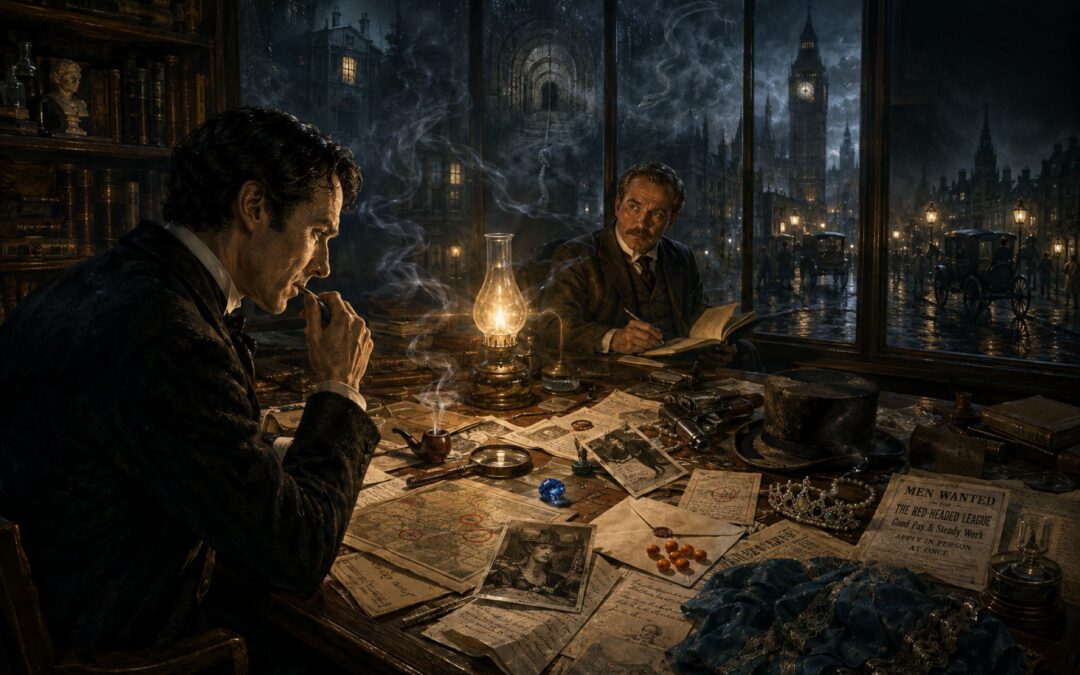
Arthur Conan Doyle’s The Adventures of Sherlock Holmes is one of those books whose cultural afterlife can obscure what is actually on the page. Sherlock Holmes has become shorthand for impossible intelligence, Dr John Watson for the loyal but slower companion, and Irene Adler for the woman who somehow pierces the detective’s emotional armor. The original stories are more complicated. Holmes is astonishingly perceptive but not infallible, Watson is far more useful than the stereotype suggests, Adler defeats Holmes without becoming his lover, and several cases end with murderers escaping the courts, innocent people suffering despite Holmes’s efforts, or Holmes deliberately deciding that formal justice would be worse than mercy.
The collection consists of twelve independent cases rather than one continuous novel. Together, however, they establish the distinctive Holmes formula: an apparently inexplicable situation enters the rooms at Baker Street; Holmes notices what everyone else overlooks; an investigation turns ordinary objects, habits, documents, spaces, and inconsistencies into evidence; and the fantastic surface of the mystery eventually gives way to a recognizably human motive. Money, inheritance, reputation, marriage, fear, desire, resentment, and control lie behind most of Doyle’s strangest plots.
Full spoiler warning: this article explains every case, culprit, solution, and ending in the collection.

What The Adventures of Sherlock Holmes Is—and Which Edition This Article Follows
The Adventures of Sherlock Holmes was first collected in book form in 1892, after the stories had appeared individually in The Strand Magazine. Holmes was not a new character: Doyle had already introduced him and Watson in A Study in Scarlet and The Sign of the Four. The major change was formal. Instead of requiring readers to follow a novel-length investigation, the magazine stories offered a complete mystery in each installment, allowing Holmes to encounter a new social environment, criminal method, and intellectual puzzle every time.
That short-story form proved ideally suited to the character. Holmes can remain mysterious because Watson does not need to explain every part of his life, while each case can begin with a fresh disturbance at Baker Street and proceed rapidly toward a revelation. The collection consequently develops character through recurrence rather than through a conventional continuous arc. Holmes becomes familiar because readers repeatedly watch him work, not because the book tells a single story about his personal transformation.
This article follows the 2009 Penguin ebook edition, which contains the same twelve stories as the original collection but places “A Case of Identity” second and “The Red-Headed League” third. The original collection order preserved by Project Gutenberg reverses those two, putting “The Red-Headed League” second and “A Case of Identity” third. Nothing substantial depends on the difference, but it matters when describing the book’s sequence accurately, so the summaries below follow the Penguin order.
The collection is also worth approaching as a cumulative casebook rather than a disguised novel. There is no single criminal mastermind connecting the stories, no overarching mystery, and no final confrontation resolving a season-long plot. What accumulates instead is an understanding of Holmes’s method, Watson’s narrative function, Victorian social structures, and the kinds of secrets Doyle finds beneath respectable appearances. By the time “The Copper Beeches” closes the volume, the reader has seen Holmes confront royal scandal, financial deception, organized theft, murder, blackmail, political terror, disguise, jewel robbery, domestic imprisonment, industrial crime, and marital confusion.
The Complete Story-by-Story Summary
The twelve stories vary considerably in tone. Some are almost comic, some resemble Gothic horror, some center on murder, and others involve no prosecutable crime at all. What unifies them is the movement from a strange surface to an underlying explanation, with Watson normally giving the reader enough information to feel the mystery before Holmes reveals the pattern he has already begun to see.
A Scandal in Bohemia
The collection opens with Watson returning to visit Holmes after his marriage has reduced the frequency of their adventures together. Holmes quickly demonstrates that domestic life has not dulled Watson’s interest in detective work, and an extraordinary client soon arrives: the hereditary King of Bohemia, Wilhelm Gottsreich Sigismond von Ormstein.
The King initially comes disguised, but Holmes immediately recognizes who he is. His problem concerns Irene Adler, an American opera singer with whom he once had a relationship. The King is about to marry Clotilde Lothman von Saxe-Meningen, a princess whose family would consider his former affair unacceptable. Adler possesses a photograph showing herself and the King together, and the King fears that she will send it to his fiancée’s family and destroy the marriage.
He has already tried bribery, burglary, robbery, and other forms of coercion without success. Holmes therefore focuses not on overpowering Adler but on discovering where she hides the photograph. Disguised as a groom, he observes her house and learns that lawyer Godfrey Norton visits her frequently. Holmes follows Norton and Adler to a church, where an unexpected comedy unfolds: Norton urgently needs a witness for their wedding, and the disguised Holmes is pressed into service. Irene Adler has just married another man.
That development changes the emotional circumstances but not the King’s problem. Holmes devises a test based on instinct. The following evening, disguised as a clergyman, he arranges for accomplices to create a disturbance outside Adler’s home. During the commotion Holmes appears to be injured, and Adler allows him inside. Watson, acting according to Holmes’s instructions, throws a smoke device through an open window and raises the alarm of fire.
Holmes’s reasoning is that a person who believes a house is burning will instinctively try to save what matters most. Adler immediately moves toward the hiding place of the photograph, revealing it behind a sliding panel. Holmes has what he needs. He plans to return the next morning with the King and take the photograph before Adler can interfere.
Yet Adler has understood the trap. She notices Holmes’s disguise beginning to fail, recognizes him, changes into male clothing, and follows Holmes and Watson to Baker Street. By the time Holmes and the King reach her house the next morning, she and Norton have left England. The compromising photograph is gone.
Adler has left a letter explaining what happened. She had been warned that the King might employ Sherlock Holmes, and once she recognized Holmes she understood his purpose. She promises that she will not use the photograph against the King because she now loves a better man, but she keeps it as protection in case the King threatens her again. In its place she leaves a photograph of herself alone.
The King is astonished and admires Adler’s intelligence while regretting that she was not of sufficiently elevated social rank to become his wife. Holmes reacts differently. When the King offers him an emerald ring as a reward, Holmes asks instead for Adler’s photograph. Watson explains at the beginning of the story that Holmes is not romantically in love with her. What matters is that she has overturned his assumptions and defeated him at his own game of observation, disguise, and anticipation.
The first story therefore establishes Holmes’s greatness by refusing to make him invincible. Irene Adler wins because she possesses qualities Holmes respects: intelligence, courage, theatrical skill, and the ability to observe the observer. She becomes memorable not because she transforms Holmes into a romantic hero but because she forces him to revise his judgment.
A Case of Identity
“A Case of Identity” moves from royalty to an apparently ordinary domestic problem. Mary Sutherland arrives at Baker Street because her fiancé, Hosmer Angel, disappeared on the day they were supposed to marry.
Mary is financially unusual for a young woman living at home because she has her own income, inherited through an uncle. Her mother has remarried James Windibank, a man only a few years older than Mary. Windibank repeatedly discourages Mary from socializing, claiming that a woman should be content with her family. His motives become increasingly suspicious when Holmes learns that Mary’s income contributes to the household while she remains unmarried.
Hosmer Angel appeared when Windibank was supposedly away on business in France. He seemed unusually anxious to avoid attention. He met Mary mainly in the evening, wore tinted glasses, had prominent facial hair, spoke in a weak whisper, provided no easily verifiable business address, and typed his letters rather than writing them by hand. He even typed his name rather than signing it normally.
Mary nevertheless fell deeply in love with him. Hosmer insisted that she promise fidelity no matter what happened and repeatedly hinted that some unexplained event might separate them. On their wedding day, he entered a cab to travel to the church but never emerged when it arrived. Mary interprets his disappearance as a mysterious tragedy. Holmes increasingly sees it as a performance.
The central clue is not simply that Hosmer is evasive but that every aspect of his identity has been designed to prevent recognition. Tinted glasses obscure the eyes, facial hair alters the face, a whisper disguises the voice, and typewritten correspondence prevents handwriting comparison. Even the timing of his courtship corresponds perfectly with Windibank’s supposed absences.
Holmes also notices distinctive imperfections in the typewriter used for Hosmer’s letters. When Windibank later writes to Holmes, his letter displays the same mechanical peculiarities. Holmes summons him and lays out the solution: Windibank himself created Hosmer Angel.
Windibank and Mary’s mother feared that Mary would marry and take her money with her. Simply forbidding marriage might have provoked resistance, so Windibank adopted the more elaborate strategy of making Mary fall in love with an imaginary man. By abandoning her at the wedding after securing promises of lifelong devotion, he hoped to leave her emotionally attached to Hosmer for years and therefore unavailable to genuine suitors.
What makes the case especially disturbing is that the deception falls between categories of law. Holmes regards Windibank as a contemptible scoundrel, but there is no straightforward criminal charge that captures what he has done. Holmes threatens to whip him, and Windibank escapes from the room.
Holmes then makes his own paternalistic decision. He does not tell Mary the truth because he believes she would reject it and continue idealizing Hosmer. The solution therefore restores intellectual order without restoring Mary’s autonomy. Windibank’s scheme is exposed to Holmes and Watson, but the person most affected remains ignorant because Holmes decides she cannot handle reality.
The story enlarges the collection’s understanding of crime. No corpse or stolen treasure is required. Economic exploitation, emotional manipulation, and control inside a respectable household can produce a mystery just as cruel as conventional criminal violence.
The Red-Headed League
Jabez Wilson, a London pawnbroker with unusually vivid red hair, brings Holmes one of the collection’s most absurd-looking cases. His assistant, Vincent Spaulding, recently showed him an advertisement announcing a vacancy in an organization called the Red-Headed League, supposedly established by a wealthy American benefactor to provide easy employment for red-haired men.
Wilson applied and found crowds of red-haired candidates. He was eventually selected and given a remarkable job: he would receive four pounds a week merely for sitting in an office from ten in the morning until two in the afternoon and copying the Encyclopaedia Britannica by hand. The only crucial condition was that he could not leave the office during those hours.
The arrangement continued for weeks. Then one morning Wilson arrived to find the office closed and a notice announcing that the Red-Headed League had been dissolved. His attempt to locate the organization led nowhere, so he came to Holmes.
Holmes pays particular attention to Spaulding. Wilson considers him an excellent assistant because he works enthusiastically for only half the normal wage. He also has a passion for photography and spends long periods in the cellar. Holmes later visits Wilson’s shop and deliberately knocks at the door so he can inspect Spaulding. More important than the man’s face are the knees of his trousers, which show evidence consistent with prolonged kneeling.
Holmes then examines the surrounding streets. The pawnshop is located behind a major bank. The entire absurdity suddenly has a practical shape.
Spaulding is actually John Clay, an educated and dangerous criminal. The Red-Headed League exists for one purpose: to remove Wilson from his shop for four predictable hours each weekday. While Wilson copies the encyclopedia, Clay and an accomplice work in the cellar, tunneling from the pawnshop toward the vault of the City and Suburban Bank.
Holmes learns that the bank is temporarily holding a large quantity of French gold and predicts that the criminals will strike on Saturday night, when they will have the longest possible time before business resumes. He coordinates with Inspector Jones and bank director Mr Merryweather. They hide inside the vault and wait in darkness.
Eventually Clay emerges through the tunnel and is arrested. His accomplice escapes back through the passage but is expected to be caught at the other end. What appeared to be an eccentric philanthropic organization was simply logistical camouflage for a bank robbery.
The story is one of Doyle’s purest examples of transforming ridiculous details into a rational plan. Wilson’s red hair, the excessive salary, the encyclopedia, the rigid working hours, Spaulding’s cheap labor, his photography hobby, the cellar, and the neighborhood geography all belong to one mechanism. Holmes succeeds because he does not ask whether the League itself makes sense. He asks who benefits from Wilson being somewhere else.
The Boscombe Valley Mystery
“The Boscombe Valley Mystery” begins with apparently overwhelming evidence against a murder suspect. Holmes asks Watson to accompany him to western England after the death of Charles McCarthy, whose body has been found near Boscombe Pool. Charles’s son, James McCarthy, has been arrested.
Witnesses saw father and son near the scene and heard them quarrel. James admits that he went to meet his father and that they argued violently. After leaving, he heard his father cry out, returned, and found him dying. The circumstantial case looks devastating.
James’s refusal to explain the quarrel makes matters worse. Charles had been pressuring him to marry Alice Turner, the daughter of wealthy landowner John Turner. James loves Alice, so his refusal seems irrational until Holmes learns the hidden reason: James had foolishly gone through a marriage ceremony with a barmaid in Bristol and believes himself already married. He has kept this secret because he fears hurting Alice. Later he discovers that the woman already had a husband, meaning the marriage was invalid, but that information arrives only after his arrest.
Holmes distrusts the obvious conclusion. At the crime scene he examines tracks, the position of the body, and the nature of the fatal wound. He concludes that another man was present. Charles McCarthy’s dying words also matter. James remembers his father uttering something that sounded like “a rat.” Holmes interprets this not as a reference to an animal but as a fragment of “Ballarat,” an Australian place name.
That connection points toward John Turner. Turner eventually confesses.
Years earlier in Australia, Turner had been a robber known as Black Jack of Ballarat. Charles McCarthy had been connected to one of Turner’s crimes and knew his secret. After both men returned to Britain, McCarthy used that knowledge to blackmail Turner. Turner became wealthy and allowed McCarthy to live on his estate, but McCarthy continually exploited his fear of exposure.
The immediate trigger involved the younger generation. McCarthy wanted James to marry Alice, effectively trying to bind the families permanently. Turner, who was already gravely ill, could not tolerate the thought that McCarthy would control his daughter’s future as he had controlled Turner’s life. During the confrontation by Boscombe Pool, Turner killed him.
The confession complicates the idea of justice. Turner is unquestionably a murderer. He also spent years under blackmail, expects to die soon, and acted partly from desperation to protect Alice. Holmes refuses to hand him over immediately. Instead, he keeps Turner’s written confession and promises to reveal it only if James cannot be acquitted by other means.
James is eventually cleared through objections Holmes helps the defense formulate. Turner dies seven months later. James and Alice appear likely to marry without ever learning the full truth connecting their fathers.
Holmes’s behavior here is not simply an exercise in detecting the correct culprit. He privately decides how much punishment is enough and who deserves to know the past. His sympathy for Turner does not erase the murder, but it leads him to separate legal justice from what he considers moral justice.
The Five Orange Pips
“The Five Orange Pips” is darker because Holmes understands the case but fails to save the man who asks for his protection.
John Openshaw arrives during a storm carrying a frightening family history. His uncle Elias had spent years in the United States, becoming a planter in Florida and serving in the Confederate forces during the American Civil War. After returning to England, Elias lived as a wealthy but troubled recluse.
One day Elias received an envelope containing five dried orange pips. Inside were the letters “K.K.K.” and an instruction involving papers and a sundial. The message terrified him. He removed documents from a locked box, burned most of them, and behaved as though men from his past had found him. Not long afterward he died in circumstances officially treated as accidental.
The property passed to John’s father, Joseph. Eventually Joseph received another envelope containing five orange pips and a similar warning. He dismissed it as nonsense. Soon afterward he died after falling into a chalk pit.
Now John has received the same warning.
Holmes immediately takes the matter seriously. He asks what remained of Elias’s papers and learns that one page survived. From the sequence of threatening letters and their postmarks, Holmes infers that the senders travel by ship. Each warning is mailed from a port, and the interval between the warning and the subsequent death depends on how long it would take the killers themselves to reach England by sea.
The initials also lead Holmes to the Ku Klux Klan. The story draws on a real organization associated with white-supremacist terror after the American Civil War, although Doyle’s fictional secret-society mechanism should not be mistaken for precise institutional history. The National Park Service’s account of the Reconstruction-era Ku Klux Klan provides the historical baseline: the Klan emerged as a white-supremacist vigilante movement that used intimidation and violence against Black freedpeople and their allies.
Holmes believes Elias possessed records identifying men involved in the organization and that those men are systematically recovering or destroying the evidence. He instructs John to place the surviving paper in the brass box and leave it on the sundial, making it appear that the demanded documents have been returned.
The plan comes too late. John Openshaw is found dead near Waterloo Bridge before he can reach safety.
Holmes is furious with himself. The case has become personal because a client who came specifically for his protection has died after leaving Baker Street. He spends the next day searching shipping records, old newspapers, and port information. By comparing ships present at the locations from which earlier warnings were mailed, he identifies an American vessel called the Lone Star. Its captain, James Calhoun, and two American mates appear to be the killers.
Holmes sends Calhoun an envelope containing five orange pips, turning the gang’s own symbol against them, and arranges for American authorities to arrest the men when they reach Savannah. Yet there is no conventional triumph. The Lone Star disappears during violent Atlantic storms, and later wreckage bearing its initials is reported at sea.
The killers apparently die, but Holmes has not delivered justice through investigation and prosecution. More importantly, John Openshaw remains dead. The story punctures the fantasy that recognizing the truth always gives Holmes enough time to control events. Intellectual victory can arrive after human failure.
The Man with the Twisted Lip
“The Man with the Twisted Lip” begins not at Baker Street but with Watson responding to a domestic appeal. A woman asks him to retrieve her husband, Isa Whitney, from an opium den in the East End. Watson finds Whitney but also encounters an apparently decrepit old addict who reveals himself to be Holmes in disguise.
Holmes is investigating the disappearance of Neville St Clair, a respectable man with a wife, children, and comfortable home. Mrs St Clair had unexpectedly been in London when she saw her husband at an upper window of the opium-den building. He seemed frightened and vanished almost immediately.
She tried to enter but was initially prevented from going upstairs. Police eventually searched the room and found evidence suggesting violence. St Clair’s clothes were present, while his coat later appeared near the river, its pockets heavily weighted with coins. Suspicion centered on Hugh Boone, a professional beggar with a scarred and twisted face who occupied the room.
Boone is well known in London. He sits in a regular location pretending to sell matches while earning considerable money from charity. Because of his grotesque appearance, passersby notice him and give freely. He denies killing St Clair, but the evidence appears disastrous.
One detail complicates the murder theory. Mrs St Clair receives a short note in her husband’s handwriting together with his ring. It suggests he is alive but caught in some unexplained trouble.
Holmes spends a long night in intense thought. By morning he believes he understands the case and takes Watson to the police station where Boone is being held. Holmes arrives carrying a large sponge. While Boone sleeps, Holmes scrubs his face.
The scar, twisted lip, dirt, and red hair disappear.
Hugh Boone is Neville St Clair.
St Clair finally explains how the double life began. Earlier in his career he had worked as a journalist and once disguised himself as a beggar while investigating urban poverty. His theatrical abilities made the disguise highly convincing, and he discovered that begging produced an astonishing income. The financial temptation overwhelmed his initial journalistic purpose.
He therefore created Hugh Boone as a continuing secret occupation. By day he could earn money in disguise; by evening he returned home as a respectable husband and father. His family had no idea.
When Mrs St Clair unexpectedly saw him at the window, he panicked. He removed his respectable clothes, transformed himself back into Boone, and threw or concealed evidence in ways that accidentally created the appearance of murder. The large number of coins in his coat resulted from his begging income, not robbery.
The police agree to suppress the matter if St Clair promises that Hugh Boone will disappear permanently. The case therefore ends without a criminal prosecution.
The deeper mystery is not where Neville St Clair went but how unstable social identity can be. The gentleman and the beggar are not merely confused for one another; they are literally performed by the same man. Clothes, posture, makeup, voice, dirt, location, and public expectation create two social beings from one body. Respectability itself appears as a costume sustained because everyone expects a gentleman to look like a gentleman and a beggar to look like a beggar.
The Blue Carbuncle
“The Blue Carbuncle” begins during the Christmas season with an object so ordinary that Watson initially assumes it cannot matter: a battered felt hat. Peterson, a commissionaire, acquired it after witnessing a street scuffle in which a man carrying a goose fled and abandoned both bird and hat.
Holmes turns the hat into an exercise in observation. From its size, condition, dust, hair, and other details, he constructs a provisional portrait of its owner. Some of these deductions are more persuasive than others, but the scene establishes an important principle: objects retain traces of the lives around them.
The goose produces a much less trivial surprise. When Peterson’s wife prepares it for cooking, she discovers a precious blue gemstone inside the bird. Holmes recognizes it as the stolen blue carbuncle belonging to the Countess of Morcar.
The jewel had vanished from the Hotel Cosmopolitan. A plumber named John Horner was arrested because he had recently been working in the Countess’s room and had a previous criminal conviction. James Ryder, a hotel employee, gave evidence connecting Horner to the scene. The case against the plumber seems strong.
Holmes begins not with the hotel but with the goose. He advertises for the owner of the lost hat and bird. Henry Baker responds. His reaction makes it clear that he knows nothing about the jewel and cares mainly about recovering the Christmas dinner he lost.
Holmes therefore traces the goose backward through London’s commercial network. Baker obtained it through a goose club connected with an inn. The innkeeper directs Holmes to a poultry dealer at Covent Garden, who eventually reveals that the relevant geese came from Mrs Oakshott of Brixton.
At the market Holmes encounters another man desperately asking questions about the same batch of birds. The man is James Ryder.
Under pressure from Holmes, Ryder confesses. He and Catherine Cusack, the Countess’s maid, stole the carbuncle and framed Horner. Ryder needed a way to hide the jewel before disposing of it, so he went to his sister Mrs Oakshott, who raised geese, and pushed the stone down the throat of a particular bird he intended to take away.
Then chance intervened. Ryder lost track of which goose contained the jewel and accidentally left with an identical-looking bird. The real carrier entered Mrs Oakshott’s normal commercial stock, moved through London’s food supply, reached Henry Baker, and finally landed in Peterson’s hands.
The solution is ingenious partly because no participant besides Ryder understands the whole chain. A priceless jewel travels invisibly inside an ordinary Christmas goose while innocent people treat the bird as food.
Ryder collapses and begs Holmes not to destroy him. Holmes lets him go.
This decision is more than seasonal sentimentality. Holmes believes Ryder is terrified enough that he is unlikely to offend again, while sending him to prison might harden him into a more committed criminal. Horner, meanwhile, should be freed because the prosecution’s key witness will disappear.
Once again Holmes claims an authority exceeding detection. He identifies the culprit, predicts future behavior, weighs punishment against rehabilitation, and quietly substitutes his own judgment for the formal legal process.
The Speckled Band
“The Speckled Band” begins with Helen Stoner arriving at Baker Street in extreme fear. She lives at Stoke Moran, the decaying ancestral home of her stepfather Dr Grimesby Roylott. Roylott comes from a once-wealthy family and spent years practicing medicine in India before returning to England. He is physically powerful, violent, and increasingly isolated.
Helen and her twin sister Julia inherited financial expectations through their late mother. Under the terms of the estate, Roylott benefits from controlling much of the money while the daughters remain unmarried, but each marriage would reduce the income available to him.
Two years earlier Julia became engaged. Shortly before her wedding, strange events began occurring at night. She heard a low whistle at around the same time on several evenings. Then one night she screamed and staggered into the corridor, dying in terror. Her final words referred to a “speckled band.”
No obvious murderer could be identified. The bedroom door had been locked from inside, the windows were secured, and there seemed to be no way for an attacker to enter. Roylott’s association with exotic animals and travelling Roma people encourages speculation, but nothing is proven.
Now Helen is engaged to be married, and the pattern is repeating. Renovations have supposedly made her own room unusable, forcing her to sleep in Julia’s former bedroom. She has begun hearing the same whistle.
Holmes immediately sees the financial motive. If both stepdaughters marry, Roylott’s income will be significantly reduced. He and Watson travel to Stoke Moran while Roylott is away and inspect the rooms.
The bedroom contains several peculiarities. The bed is fixed to the floor and cannot be moved. A bell-rope hangs beside it but is not connected to an actual bell. A small ventilator has been installed between the bedroom and Roylott’s adjoining room—an odd arrangement because ventilation normally connects to outside air.
Roylott’s room adds further clues. Holmes sees a safe, a saucer of milk, and a looped dog lash. The objects initially seem disconnected.
Holmes instructs Helen to sleep elsewhere that night and signal them when Roylott believes she has returned to her room. Holmes and Watson then sit silently in the dark beside the fixed bed.
After hours of waiting they notice a light through the ventilator and hear a faint sound. Something moves down the false bell-rope. Holmes suddenly strikes at it with his cane. Moments later a terrible scream comes from Roylott’s room.
They find him dead, sitting beside the safe with a snake wrapped around his head. The “speckled band” is not a group of people but the creature itself.
Holmes reconstructs the method. Roylott kept the snake in the safe, sent it through the ventilator, and allowed it to crawl down the bell-rope toward the fixed bed. He recalled it by whistling. Julia’s death had been the successful result; Helen was intended to be the second victim. When Holmes attacked the snake, it retreated through the ventilator and bit Roylott instead.
As detective fiction, the mechanism is memorable. As zoology, it is fantasy. Laurence Klauber’s specialist discussion preserved by the San Diego Natural History Museum examines the herpetological problems with the story’s snake: there is no real Indian “swamp adder” corresponding to Doyle’s creature, and several behaviors required by the murder scheme are biologically implausible.
That scientific weakness does not erase the narrative power of the case. Doyle constructs a superb piece of domestic Gothic horror in which every bizarre architectural detail acquires a deadly purpose. The crucial terror is not really the exotic snake. It is a stepfather willing to redesign his daughters’ bedroom so that he can murder them for money while making their deaths appear inexplicable.
The Engineer’s Thumb
“The Engineer’s Thumb” is unusual because Watson, rather than a client arriving directly at Baker Street, introduces the case. Victor Hatherley, a young hydraulic engineer, comes to Watson for medical treatment after suffering a horrific injury: his thumb has been severed.
Hatherley explains that a man calling himself Colonel Lysander Stark approached him with a highly lucrative but secretive engineering job. Stark claimed to own land containing valuable deposits of fuller’s-earth and said that a hydraulic press was used in the extraction process. Because the business supposedly depended on keeping the discovery secret from neighboring landowners, Hatherley had to agree to unusual secrecy and travel at night.
The payment is suspiciously high, but Hatherley is young and struggling professionally, so he accepts.
He is taken by carriage to an isolated house whose precise location he cannot determine. Once inside, he meets a frightened woman who urgently tells him to escape. Hatherley ignores the warning because he is determined to complete the work he was hired to perform.
When he inspects the hydraulic press, he quickly realizes that Stark’s explanation is false. The machinery is not being used for fuller’s-earth. Before he can leave safely, Stark locks him inside the press and activates it.
Hatherley faces a particularly brutal death: he will be crushed by industrial machinery. The woman who warned him opens a hidden panel, allowing him to escape just before the press closes.
He flees through the house and reaches a window, but Stark catches him. As Hatherley hangs from the sill trying to escape, Stark attacks with a cleaver and cuts off his thumb. Hatherley falls outside, loses consciousness, and later finds himself near a railway station.
Holmes identifies the hidden operation as counterfeiting. The hydraulic press is used as part of a coin-manufacturing scheme, explaining both the secrecy and the criminals’ willingness to murder engineers who learn too much.
Holmes, Watson, Hatherley, and the police return to the area and locate the house, but it is already burning. Hatherley’s lamp was crushed inside the hydraulic press during his escape and apparently started the fire. The criminals have fled with their equipment, and Holmes never captures them.
The case therefore resembles “The Five Orange Pips” in denying Holmes complete victory. He explains the mystery but cannot reverse what happened or bring the culprits to justice. Doyle’s emphasis is as much on Hatherley’s terrifying adventure as on Holmes’s reasoning, making the story feel closer to sensational Gothic fiction powered by industrial technology.
The Noble Bachelor
“The Noble Bachelor” begins with aristocratic scandal. Lord Robert St Simon has married Hatty Doran, the daughter of a wealthy American businessman, only for the bride to disappear almost immediately after the ceremony.
St Simon’s social position encourages everyone around him to interpret the event as a public humiliation. There is also an obvious suspect: Flora Millar, a dancer with whom St Simon had previously been involved. Flora interrupts the wedding celebrations and behaves angrily, making jealousy appear relevant.
Holmes is more interested in Hatty’s behavior during the ceremony. A shabby-looking man was present in the church. Hatty dropped her bouquet near him; he returned it and secretly passed her a message. Afterward her manner changed dramatically. She spoke privately with her maid and soon disappeared.
Inspector Lestrade searches for evidence of violence or suicide and discovers Hatty’s wedding clothes near the Serpentine. Holmes considers this line of inquiry misguided because the emotional and behavioral clues point elsewhere.
The mystery reaches back to America. Before meeting St Simon, Hatty had married Francis Hay Moulton. Moulton later disappeared under dangerous circumstances and was reported dead. Hatty eventually believed she was a widow and moved on with her life.
Moulton was not dead. He had been trying to find her and arrived in London just as she was marrying St Simon.
Once Hatty recognized him at the church, the social meaning of the wedding collapsed. From her perspective, her first husband had returned and therefore had a prior claim both emotionally and legally. She left St Simon and reunited with Moulton.
Holmes traces the couple through evidence that Lestrade had overlooked, including hotel information, and persuades them to come to Baker Street to explain themselves. Hatty apologizes for causing humiliation but insists that she could not simply remain married to St Simon once she discovered Francis was alive.
St Simon does not respond generously. He has lost both a wife and the fortune attached to the marriage, and his wounded aristocratic pride remains obvious.
Holmes does not ridicule him entirely. He recognizes that the situation would be painful for anyone. Yet the case exposes how differently the same marriage is experienced by those involved. For St Simon it carries social rank, public reputation, and considerable money. For Hatty, the return of the man she already loved invalidates the second marriage almost immediately.
The Beryl Coronet
Alexander Holder, a prominent banker, arrives at Baker Street in despair after a national treasure entrusted to him has been damaged and partly stolen.
A wealthy and highly placed client needed an enormous short-term loan and left a valuable beryl coronet as security. Holder, terrified of leaving such an important object at the bank overnight, brought it home and locked it away.
His household includes his son Arthur and his niece Mary, whom Holder has raised. Arthur has worried his father through gambling and expensive habits. He also associates with Sir George Burnwell, a charming man whom Holder distrusts. Mary, by contrast, appears virtuous, affectionate, and reliable.
During the night Holder hears a noise and discovers Arthur holding the coronet. Part of it has been bent and three beryls are missing. Arthur refuses to explain himself. To Holder, the case appears obvious: his irresponsible son has stolen the stones, perhaps to pay debts.
Holmes doubts that conclusion.
He examines the house and the snow outside. The tracks indicate movement between a window and the grounds. He also considers the physical strength necessary to bend the coronet. Arthur’s silence looks less like the behavior of a guilty thief once Holmes asks what else he might be protecting.
The truth reverses Holder’s moral map. Mary, not Arthur, has betrayed the household. She has fallen under the influence of Sir George Burnwell and gives him the coronet through a window.
Arthur witnesses the theft and pursues Burnwell outside without taking time to put on shoes. He catches him, and the two struggle. Arthur manages to recover most of the coronet, but a section containing three beryls breaks away. Burnwell escapes with those stones.
Arthur then faces a cruel dilemma. Explaining the truth would save him but expose Mary. He chooses silence.
Holmes reconstructs the confrontation from the tracks and verifies Burnwell’s involvement by obtaining a pair of his shoes and comparing them with the impressions in the snow. He then confronts Burnwell directly. Because public prosecution would create a scandal, Holmes bargains for information about the missing stones and eventually buys them back from the receiver who acquired them.
Holder is overwhelmed by the realization that he accused the wrong person. He rushes to apologize to Arthur. Mary has fled with Burnwell, and Holmes predicts grimly that the relationship itself will probably punish her more severely than the law could.
The story again makes observation a corrective to reputation. Arthur, already labeled irresponsible, looks guilty because everyone expects guilt from him. Mary looks innocent because Holder has already decided what kind of person she is. Holmes succeeds because the evidence matters more to him than the household’s existing moral categories.
The Copper Beeches
The final story begins when Violet Hunter consults Holmes about an employment offer. Violet is a governess, intelligent and financially vulnerable, and has been offered a position with the Rucastle family at their country estate, the Copper Beeches.
The salary is unusually high. So are the demands.
Jephro Rucastle initially wants Violet to cut her hair. He also hints that she may be required to wear particular clothes or obey eccentric household instructions. Violet refuses at first, but Rucastle increases the salary substantially. Financial necessity makes the position difficult to reject.
Holmes is uneasy. He tells Violet that excessive payment often signals excessive expectations and asks her to contact him if anything troubling occurs.
At the Copper Beeches, Violet discovers a deeply unsettling household. Rucastle can be jovial and charming, but something coercive lies underneath. His young son is unnervingly cruel to animals. The servants, Mr and Mrs Toller, are strange and secretive. A large mastiff is kept deliberately hungry and released at night, making escape from the grounds dangerous.
The family’s requests become stranger. Violet is told to wear an electric-blue dress that does not belong to her. She must sit in a particular chair with her back toward a window while Rucastle tells amusing stories. On another occasion she is ordered to wave her hand in a particular manner.
Violet uses a small mirror hidden in a handkerchief to see what lies behind her. A man is standing outside watching the house.
Other details intensify the mystery. Violet finds a lock of hair in a drawer that looks exactly like her own hair, except she knows her cut hair remains securely packed among her possessions. She also notices that one wing of the house is kept locked. Rucastle reacts with frightening anger when she approaches it.
Violet eventually enters the forbidden area and realizes that someone has been confined there. She sends for Holmes.
Holmes understands why Violet was hired. Rucastle has a daughter, Alice, from a previous marriage. Alice resembles Violet, especially after losing much of her hair during a serious illness. The blue dress belongs to Alice.
Alice has a financial inheritance of her own, and Rucastle wants control over it. When she planned to marry a man named Fowler, her father tried to force her to sign away rights over her money. After she refused and became seriously ill, Rucastle escalated from coercion to imprisonment.
Fowler continued watching the estate, hoping to communicate with Alice. Violet’s job was therefore not genuinely to educate the Rucastle child. She was being used as a decoy. Wearing Alice’s dress and sitting where Fowler could see her was supposed to persuade him that Alice remained in the household voluntarily and wanted nothing to do with him.
Holmes and Watson accompany Violet into the forbidden wing when they believe Rucastle is absent. They discover that Alice is already gone. Fowler has managed to help her escape through the skylight.
Rucastle returns, assumes Holmes and Watson have freed his daughter, and rushes toward the starving mastiff. The plan turns against him. The dog attacks its master savagely, and Watson shoots the animal to prevent it from killing him.
Mrs Toller then explains the remaining history. Rucastle’s determination to control Alice’s money had driven the entire scheme. Fowler had won the servants’ cooperation, and the apparent mystery of Violet’s employment was simply one component of an abusive father’s attempt to prevent his adult daughter from escaping his authority.
Alice and Fowler marry immediately after their flight. Rucastle survives the mastiff attack but remains physically broken and dependent on his wife. Violet Hunter later becomes the head of a private school and succeeds professionally.
Watson admits a final disappointment. He had imagined that Holmes might develop a personal interest in Violet because of her intelligence and courage. Instead, once the case ceases to be an intellectual problem, Holmes ceases to show any unusual interest in her.
That ending is quietly appropriate. The collection began with Watson explaining that Irene Adler mattered to Holmes without inspiring ordinary romantic love, and it ends with another capable woman whose intelligence attracts Holmes’s attention only in relation to a case. Holmes can admire formidable people intensely, but intellectual fascination is not the same thing as emotional attachment.
Sherlock Holmes and Dr Watson: The Partnership Behind the Cases
The collection is built around two people rather than one. Holmes provides extraordinary investigative ability, but Watson determines how readers encounter that ability. Without Holmes, Watson would have no cases to narrate; without Watson, Holmes would lose the perspective that turns private reasoning into suspenseful storytelling and gives the detective a human scale.
Sherlock Holmes
Holmes’s defining characteristic is not simply intelligence but directed attention. Other people see the same hat, footprints, letter, window, bell-rope, trousers, typewriting, or street layout and either overlook it or assign it no significance. Holmes has trained himself to ask what physical traces reveal about the processes that created them.
That is why his reasoning often seems miraculous to Watson. Holmes does not merely see more detail. He has accumulated specialized categories that make details meaningful. Worn knees suggest particular activity; typewriter defects identify a machine; soil can indicate location; a neighborhood’s geography can reveal criminal purpose. Observation becomes useful because it connects to a store of prior knowledge.
The popular label “deduction” therefore conceals a mixture of methods. Sometimes Holmes deduces consequences from known premises. Sometimes he infers the most likely cause from physical traces. Sometimes he recognizes a pattern because he has studied similar crimes. Sometimes he runs an experiment. Sometimes he simply obtains information through records, disguise, surveillance, or interrogation.
“A Scandal in Bohemia” shows him staging a psychological experiment: the false fire forces Irene Adler to reveal what she values. “The Red-Headed League” depends on spatial reasoning and criminal motive. “The Five Orange Pips” requires documentary research and shipping records. “The Blue Carbuncle” follows a commercial supply chain. “The Beryl Coronet” relies heavily on footprints and physical reconstruction. Holmes’s genius lies partly in moving between these modes without treating one technique as sufficient for every problem.
He is also a performer. Holmes repeatedly disguises himself, changes his voice, alters his posture, infiltrates unfamiliar social environments, and manipulates how others perceive him. This makes the contrast with criminals such as Windibank and Neville St Clair particularly interesting. Holmes fights deception with deception because he understands identity as something that can be constructed.
Conan Doyle’s emphasis on trained observation has roots in his medical education. The British Library’s account of Conan Doyle and Sherlock Holmes connects the detective to Dr Joseph Bell, Doyle’s Edinburgh medical professor, whose diagnostic demonstrations emphasized extracting information from apparently minor physical details. Holmes turns the physician’s attempt to infer an unseen condition from visible symptoms into a theory of criminal investigation.
Yet the stories repeatedly complicate the myth of the flawless reasoning machine. Irene Adler sees through him. John Openshaw dies after asking for his protection. The counterfeiters in “The Engineer’s Thumb” escape. Some mysteries are solved only after their most serious damage has already occurred.
Holmes’s ethics are equally complex. He is not a neutral information-processing machine. He routinely makes judgments about what people deserve. He spares John Turner from prosecution, releases James Ryder, allows Neville St Clair’s deception to remain private, threatens Windibank physically, and helps conceal facts from people he believes would be harmed by them.
That independence can look humane when institutions are rigid or ineffective. It can also look disturbingly arrogant. Holmes assumes that solving a case gives him enough moral understanding to decide whether the police, the victim, or even the client should receive the whole truth.
Emotionally, Holmes is reserved but not empty. He is delighted by difficult problems, contemptuous of boring ones, enraged by Openshaw’s death, amused by human absurdity, and capable of genuine admiration. Irene Adler matters precisely because she corrects his overconfidence. His apparent coldness is better understood as selective investment: intellectual difficulty activates him more reliably than ordinary social attachment.
This helps explain why money rarely functions as his primary motive. He enjoys cases as artistic and intellectual challenges. Wealthy clients may pay well, but an unusual puzzle can interest him regardless of social status. The same trait gives him independence from conventional professional structures while also feeding his vanity. He wants not merely to solve problems but to encounter problems worthy of him.
Dr John Watson
Watson is less brilliant than Holmes, but calling him stupid misses his purpose. He is a doctor, a military veteran, a capable observer by ordinary standards, and repeatedly brave under dangerous conditions. Holmes takes him into situations involving armed criminals, murderous stepfathers, poisonous animals, and isolated houses because Watson can be trusted.
His apparent slowness serves a narrative function. If Holmes narrated the stories directly and revealed his reasoning as it occurred, many mysteries would end before suspense developed. Watson sees enough to report clues accurately but not enough to assemble them as quickly as Holmes. Readers therefore occupy a position close to his: informed but uncertain.
Watson also humanizes the cases. Holmes often experiences an investigation primarily as a problem, whereas Watson reacts to frightened clients, grieving relatives, moral injustice, physical danger, and dramatic atmosphere. His sympathy gives emotional weight to stories that could otherwise become demonstrations of cleverness.
His storytelling is not neutral. Watson chooses which cases to record, heightens suspense, withholds information Holmes has not shared, and often frames his friend as extraordinary before the investigation even begins. The myth of Holmes is therefore partly created inside the fiction by Watson himself.
Holmes sometimes complains that Watson emphasizes dramatic elements rather than treating cases as scientific demonstrations. The criticism is revealing because Watson’s supposed weakness is one reason the stories work. Readers do not merely want a ledger of observations and conclusions. They want the eerie whistle in a dark bedroom, the client rushing through the door, the criminal emerging from the bank tunnel, and the moment a sponge transforms a beggar’s face.
Watson’s marriage also gives the friendship an unusual flexibility. He no longer necessarily shares Holmes’s daily life, yet he repeatedly returns when adventure calls. Their bond is not sentimentalized through elaborate declarations. It is demonstrated through trust, habit, intellectual fascination, danger, and Watson’s continuing desire to record Holmes’s work.
The partnership succeeds because each man supplies what the other lacks. Holmes gives Watson extraordinary material; Watson gives Holmes an audience, a companion, and ultimately literary immortality within the world of the stories.
Victorian London, Rural England, and the Social World of the Cases
The popular image of Sherlock Holmes is inseparable from foggy London, but The Adventures of Sherlock Holmes uses a much wider social geography. Baker Street is the intellectual center, yet the investigations move constantly through banks, hotels, railway stations, markets, suburbs, opium dens, country houses, churches, commercial streets, and isolated estates. The collection presents late-Victorian Britain as a network in which people, documents, money, information, and commodities are continually moving.
London is particularly suited to Holmes because anonymity and connectivity coexist there. Neville St Clair can maintain two social identities because millions of people encounter only fragments of one another. James Ryder can hide a jewel in a goose that passes through several unrelated hands. John Clay can disguise a bank robbery behind an invented organization because newspapers, advertisements, rented offices, small businesses, and urban geography create opportunities for deception.
Holmes thrives in that environment because he understands networks. He follows advertisements, hotel records, professional addresses, market chains, shipping registers, and the relationships between streets. His London is not merely atmospheric scenery. It is an information system.
The city also magnifies class differences while allowing them to overlap. Aristocrats, pawnbrokers, servants, bankers, beggars, governesses, policemen, professionals, criminals, performers, and laborers all enter Holmes’s orbit. Social rank shapes expectations, but Doyle repeatedly shows how misleading those expectations can be. A King can be less capable than an opera singer; a beggar can be a prosperous suburban gentleman; an irresponsible son can be innocent while a trusted niece betrays the family.
The rural stories alter the atmosphere but not the underlying concern with hidden structures. Country estates such as Stoke Moran and the Copper Beeches provide greater privacy than London, which makes them ideal locations for domestic coercion. Roylott can manipulate the physical architecture of a bedroom because few outsiders enter his household. Rucastle can imprison his daughter because his estate is isolated, guarded by a mastiff, and controlled by his authority.
The contrast is important. London generates mystery through density, movement, and disguise. Rural England generates mystery through isolation, hierarchy, and private power.
Class and property run through both environments. The cases often begin because money moves through families in ways that create incentives for control. Mary Sutherland’s income motivates Windibank. Helen Stoner’s marriage threatens Roylott financially. Alice Rucastle’s inheritance drives her father’s imprisonment scheme. Lord St Simon’s marriage carries obvious financial meaning alongside personal attachment.
The stories therefore depict a society in which respectability is constantly intersecting with economics. Doyle rarely writes abstractly about class, marriage law, or property. Instead, those structures become motives. A detective story allows him to ask the practical question Holmes always asks: who benefits if this person marries, disappears, remains dependent, appears guilty, or stays away from home for four hours every day?
Women, Marriage, Money, and Domestic Power
Women occupy far more varied positions in the collection than the simplified cultural memory of “Irene Adler, the woman” suggests. Some are clients, some victims, some deceivers, some accomplices, some romantic partners, and some unusually effective observers. Their circumstances differ, but marriage and economic dependence repeatedly determine the kinds of danger they face.
Irene Adler is the clearest case of female autonomy. The King assumes that his wealth, rank, and ability to hire specialists should let him control the evidence of their past relationship. Adler resists him successfully. She safeguards the photograph, recognizes Holmes, disguises herself, marries the man she chooses, leaves the country on her own terms, and neutralizes the King’s leverage without needing Holmes to rescue her.
Her victory matters because Holmes initially underestimates her. He is not misogynistic in a simple sense, but Watson explicitly suggests that Holmes’s previous attitude toward women contained a degree of dismissiveness. Adler forces a correction. She becomes memorable because she demonstrates that Holmes’s categories can fail when confidence hardens into assumption.
Mary Sutherland occupies the opposite economic position. She technically has income, yet family structures prevent that money from becoming real independence. Windibank understands that her marriage would remove resources from his household, so he manipulates her romantic life instead. The deception is ridiculous in design but serious in consequence: Mary’s financial value to her family makes her emotionally exploitable.
Holmes sees the abuse clearly, but his response reproduces another kind of paternalism. He decides not to tell Mary what happened because he believes she cannot accept it. The man who exposes one form of control then quietly assumes another form of authority over her knowledge.
Helen Stoner faces more direct violence. Roylott’s financial interest depends on preventing his stepdaughters from marrying, and the house itself becomes an instrument of control. Julia’s bedroom is converted into a murder apparatus; Helen is moved into the same room when her engagement threatens Roylott’s income. Domestic guardianship becomes predatory ownership.
“The Copper Beeches” intensifies that pattern. Alice Rucastle’s father attempts to control money legally, then emotionally, then physically. When she refuses to sign away her rights, he confines her. Violet Hunter is hired because economic need makes her vulnerable to his strange conditions, but she differs from many clients in how quickly she begins investigating for herself.
Violet observes, tests, uses a mirror, explores the forbidden wing, and recognizes that the household’s explanations do not fit the facts. Holmes ultimately solves the larger design, but Violet has already gathered much of the evidence. She is not merely a frightened client delivering a puzzle to a male expert.
Hatty Doran also resists becoming passive material in someone else’s marriage arrangement. Once she discovers Francis Moulton is alive, she leaves Lord St Simon. Her decision causes genuine harm and embarrassment, but the story does not treat aristocratic prestige as sufficient reason for her to remain in a marriage that has become impossible.
Mary in “The Beryl Coronet” complicates any claim that women are consistently portrayed as morally superior. She betrays her household under Burnwell’s influence and helps transfer the coronet to him. Doyle allows women to be intelligent, courageous, naive, loyal, selfish, manipulated, manipulative, or mistaken just as men are.
The recurring issue is therefore less “women are victims” than the relationship between female agency and systems of male authority. Fathers, stepfathers, husbands, suitors, and employers often possess greater control over money and movement. Some women evade that control through intelligence or courage; others suffer because their social or economic position leaves them dependent.
The collection’s gender politics remain distinctly Victorian. Holmes frequently adopts protective and paternalistic attitudes, and some female characters receive less psychological development than the men controlling their circumstances. Yet the stories repeatedly recognize that respectable domestic authority can conceal exploitation. Several of the most sinister villains are not street criminals but men using the privileges of family position to control women’s money, marriages, or bodies.
That tension is more interesting than labeling Doyle simply progressive or reactionary. The stories can reproduce Victorian assumptions while also exposing the dangers those assumptions make possible.
What Holmes’s “Deduction” Actually Involves
Holmes’s reputation rests on “deduction,” but the word has become so closely associated with him that it can obscure how varied his method actually is. Across The Adventures of Sherlock Holmes, he does not solve every case by staring at a person for ten seconds and logically deriving an entire biography. His success comes from combining observation with accumulated knowledge, investigative work, experiments, records, disguises, and a relentless search for causal coherence.
Close observation is the most famous component. Holmes notices mud, worn clothing, handwriting, physical injuries, footprints, dust, typewriter defects, hats, architectural oddities, and the placement of ordinary household objects. The principle is simple: events leave traces.
But traces do not interpret themselves. Watson often sees what Holmes sees without knowing why it matters. The difference is partly knowledge. Holmes has deliberately studied topics useful to detection and can connect a mark on an object with habits, occupations, environments, or previous criminal methods.
“A Case of Identity” demonstrates this through the typewriter. Holmes recognizes that mechanical imperfections can individualize a machine much as handwriting can identify a writer. Once Windibank’s typed letter displays the same defects as Hosmer Angel’s correspondence, the physical evidence joins the already powerful behavioral case.
“The Red-Headed League” shows a different process. Holmes does not discover one magical clue. He asks why someone would pay Wilson large amounts of money merely to sit elsewhere. Spaulding’s cheap labor, his time in the cellar, his worn knees, and the nearby bank gradually point toward tunneling. The solution comes from making motive, geography, timing, and physical evidence agree.
Holmes also runs experiments. The fake fire in “A Scandal in Bohemia” is a behavioral test designed to make Irene Adler reveal the photograph. The overnight vigil in “The Speckled Band” is another test: Holmes has developed a hypothesis from the ventilator, bell-rope, fixed bed, milk, safe, and whistle, but he waits in the room to see whether the predicted mechanism actually appears.
Documentary research is equally important. In “The Five Orange Pips,” Holmes spends hours with shipping records and old newspapers. The glamour of instantaneous deduction disappears; the detective succeeds through painstaking comparison of dates and vessel movements.
He also uses deception freely. Disguise allows him to enter places where Sherlock Holmes would attract attention. He becomes a groom, clergyman, loafer, addict, or other social type because information is partly controlled by how people respond to perceived identity.
Holmes’s method therefore resembles diagnosis more than magic. The connection fits Doyle’s medical background. As the British Library notes in its discussion of Joseph Bell’s influence on Conan Doyle, Bell trained students to infer unseen conditions from visible details. Holmes extends the same logic to crime: the visible world is a symptom, and the hidden event must be reconstructed from it.
Even so, not all of Holmes’s reasoning is equally fair to the reader. Doyle sometimes gives Holmes specialized knowledge that Watson and the audience could not realistically possess. Certain deductions function less as solvable clues than as demonstrations of expertise. The stories are therefore not always “fair-play” puzzles in the later sense of giving readers every tool needed to beat the detective.
Holmes also benefits from intuition disguised as certainty. He often forms hypotheses early and then tests them successfully, but the narrative naturally emphasizes cases in which those hypotheses prove fruitful. Readers rarely watch weeks of irrelevant inquiries.
Most importantly, method does not guarantee control. Holmes solves “The Five Orange Pips” too late to protect his client, and he never captures the criminals in “The Engineer’s Thumb.” “A Scandal in Bohemia” demonstrates that another skilled observer can anticipate his own anticipation.
The collection therefore gives Holmes an extraordinarily powerful but recognizably fallible method. His greatness comes not from supernatural intelligence but from disciplined attention combined with the willingness to investigate until scattered facts form a mechanism.
Justice Beyond the Law
Holmes repeatedly discovers that solving a mystery and deciding what should happen afterward are separate problems. Formal law matters, but he does not accept that police procedure automatically produces justice. Once he knows the truth, he often becomes judge as well as detective.
“The Blue Carbuncle” offers the clearest example. James Ryder committed a serious theft and helped frame an innocent man. Holmes nevertheless releases him because he believes terror has already changed him and that imprisonment might transform a weak first offender into a hardened criminal. The decision is compassionate, but it depends entirely on Holmes’s confidence that he can predict Ryder’s future.
“The Boscombe Valley Mystery” presents a more difficult case. John Turner deliberately killed Charles McCarthy. Holmes understands the years of blackmail and Turner’s terminal illness and decides not to expose him unless James McCarthy cannot otherwise be saved. He therefore protects a murderer because he regards the circumstances as sufficient mitigation.
In “The Man with the Twisted Lip,” Holmes accepts a private resolution once Neville St Clair promises to abandon his begging identity. No major prosecution serves an obvious social purpose. The mystery is solved, the supposedly murdered man is alive, and Holmes prefers restoration of the family to public scandal.
“A Case of Identity” demonstrates the opposite problem. Windibank’s conduct is morally vicious but difficult to prosecute. Law fails not by being too harsh but by lacking a clear category for the harm. Holmes responds with personal threat rather than institutional remedy.
These decisions reveal the difference between Holmes and an ordinary police investigator. He is a consulting detective, not simply an employee of the state. His primary allegiance is to truth as he understands it, followed by an individualized conception of justice.
That independence is one reason clients seek him. Institutions rely on categories and procedures; Holmes can respond to unusual circumstances. An innocent man like James McCarthy benefits enormously from a detective willing to question the official case.
Yet Holmes’s flexibility creates its own danger. Who appointed him to decide that Ryder deserves mercy, Turner deserves secrecy, Mary Sutherland should remain ignorant, or the full truth should be withheld from Alice and James? His judgments may be compassionate, but they are still unilateral.
The collection rarely treats this as a systemic political question. Doyle usually presents Holmes’s discretion as evidence of practical wisdom. Modern readers can appreciate that humane flexibility while also noticing how much power the stories grant one exceptionally confident man.
Holmes therefore embodies a recurring fantasy of personalized justice: the hope that a sufficiently intelligent individual can see circumstances more clearly than bureaucracy can. The cases also contain the seeds of a critique of that fantasy, because Holmes is demonstrably capable of error.
Empire, Foreignness, and the Returning Past
Although Holmes is usually imagined as a quintessentially English detective, several cases demonstrate how international the social world around him actually is. Britain’s wealth, families, crimes, and anxieties are connected to America, Australia, continental Europe, and India. The past repeatedly travels back to England with people who believe they have left it behind.
“The Boscombe Valley Mystery” depends almost entirely on Australian history. John Turner’s wealth and Charles McCarthy’s power over him originate in their shared past at Ballarat. The murder in rural England is therefore the delayed consequence of violence committed abroad.
“The Five Orange Pips” reaches across the Atlantic even more directly. Elias Openshaw’s years in the American South and the records he brings home create danger for multiple generations. Doyle imports the Ku Klux Klan into a secret-society thriller, turning post-Civil-War racial terror into the hidden background of an English mystery.
That use of history requires qualification. The real Reconstruction-era Klan was a white-supremacist terrorist movement, not merely an exotic fraternity of mysterious assassins. The story recognizes its violence but uses the organization primarily as machinery for suspense, compressing a vast political history into a family curse narrative.
“The Speckled Band” draws on India differently. Roylott returns from a medical career there with exotic animals and knowledge that the story associates with unusual forms of danger. The murder method depends on a fictional Indian snake, and the narrative participates in a broader Victorian habit of using the colonial world as a reservoir of strange threats.
The irony is that the actual evil in the story is not foreign. Roylott is an English stepfather murdering English women for money. Exotic imagery supplies the mechanism, but domestic greed supplies the motive.
“The Noble Bachelor” uses America less ominously. Hatty Doran’s background emphasizes social mobility and contrasts with Lord St Simon’s aristocratic assumptions. American wealth can enter British high society, but money does not erase cultural differences. Hatty behaves according to loyalties that St Simon’s world cannot fully absorb.
These stories repeatedly suggest that England is not sealed off from the world. Money, people, violence, memories, and objects move across borders. Holmes’s supposedly domestic cases often require understanding histories that began elsewhere.
At the same time, Doyle’s representation of foreign places reflects the limitations of his period. Racial terminology, stereotypes, compressed political history, and exoticized danger can feel crude to modern readers. The most responsible reading neither erases those features nor allows them to consume stories whose main concerns may lie elsewhere.
The broader pattern is one of returning consequences. A crime committed in Australia, secrets carried from America, or habits acquired in India do not remain safely distant. The detective’s task is frequently to reconstruct the hidden journey by which the past has entered the present.
Symbols and Motifs: Disguises, Documents, Hidden Spaces, and Ordinary Objects
Doyle’s stories repeatedly return to physical surfaces because Holmes’s central belief is that surfaces can be read. Clothing, hair, letters, rooms, windows, animals, and household objects may mislead casual observers, but they also preserve evidence for someone who knows where to look.
Disguise is the most obvious recurring motif. Holmes alters his appearance to collect information. Irene Adler disguises herself and turns his own technique against him. Windibank constructs Hosmer Angel through glasses, facial hair, a whisper, and typed letters. Neville St Clair transforms himself so completely into Hugh Boone that even the police fail to imagine they are the same person.
Disguise therefore works in two directions. It proves that appearance is unreliable, but it also demonstrates that successful deception requires detailed knowledge of social expectation. Boone works because people already possess a mental category for “beggar.” Holmes’s disguises work because servants, grooms, clergy, addicts, and laborers are treated differently in Victorian society.
Hair and clothing repeatedly become tools of identity. Violet Hunter must cut her hair because she needs to resemble Alice Rucastle. The blue dress turns her into a visual substitute. Irene Adler changes into male clothing to follow Holmes. A person’s appearance is therefore not merely decorative; it can become evidence, camouflage, or coercion.
Documents form another network of clues. Advertisements launch the Red-Headed League and allow Holmes to locate Henry Baker. Typewritten letters betray Windibank. Shipping records expose the Lone Star. Hotel bills lead Holmes toward Francis Moulton. Newspapers continually circulate information that Holmes can retrieve and reinterpret.
Doyle’s detective world is consequently modern in a specific sense: mysteries leave paper trails. Holmes investigates not only bodies and rooms but systems of information.
Architecture is equally important. Tunnels lead toward bank vaults. Ventilators and bell-ropes transform a bedroom into a murder device. Locked wings conceal imprisoned women. Windows permit surveillance and deception. Cellars provide criminal workspaces. Hidden panels conceal both photographs and escape routes.
These spaces often dramatize the difference between visible respectability and concealed purpose. A normal bedroom contains a murder mechanism; a family home contains a prisoner; a pawnshop cellar contains a tunnel toward a bank.
Ordinary objects undergo the same transformation. A hat becomes a biography. A goose becomes a jewel container. A coronet records physical struggle. A bell-rope that cannot ring a bell becomes suspicious precisely because it fails at its apparent purpose.
Animals are especially memorable because Doyle makes them cross the boundary between domestic familiarity and danger. The goose innocently transports stolen property, the snake becomes a weapon, and the Copper Beeches mastiff becomes an instrument of control that eventually turns on its master.
The collection does not require every repeated object to function as a deep symbol. Its more consistent pattern is practical: Doyle trains readers to distrust the apparently trivial. In Holmes’s world, ordinary things become meaningful because human actions have passed through them.
Style, Structure, and the Short-Story Formula
The enormous success of Holmes is inseparable from Doyle’s mastery of repetition with variation. Most stories share recognizable components: Watson encounters Holmes; a client or unusual event introduces a puzzle; the case initially seems bizarre; Holmes gathers evidence while withholding much of his thinking; danger or revelation follows; and the detective reconstructs what actually happened.
That formula could become monotonous, but Doyle varies the emotional genre inside it. “The Red-Headed League” begins as comedy. “The Speckled Band” is Gothic horror. “The Five Orange Pips” approaches tragedy. “The Blue Carbuncle” becomes a Christmas morality tale. “The Engineer’s Thumb” is a sensational escape story. “A Scandal in Bohemia” is almost a duel between two performers.
Watson’s narration is essential to this flexibility. Because he writes retrospectively, he can foreshadow importance without revealing solutions. He frequently tells readers that a case was among Holmes’s strangest or most memorable, creating anticipation before the mystery begins.
The first-person perspective also controls information. Holmes may notice the solution-forming detail, but readers see only that he noticed something. His questions sometimes appear irrelevant until the final explanation reconnects them. This produces the characteristic pleasure of retrospective clarity: details that looked random suddenly become necessary.
Client testimony supplies another structural advantage. Many stories contain a substantial embedded narrative in which the visitor tells Holmes what happened before coming to Baker Street. This allows Doyle to begin with a mystery already in motion. Readers do not need to watch weeks of ordinary life before the strange event occurs; they receive the compressed sequence through a frightened or confused witness.
The danger of the device is that long explanations can become mechanically similar. Yet Doyle usually keeps them vivid by giving each case a strong central image: five orange pips, a vanished bridegroom, an impossible beggar, a red-haired organization, a blue gem inside a goose, a whistle in a locked bedroom.
The stories also understand the power of delayed explanation. Holmes frequently knows more than he tells Watson, sometimes to an irritating degree. This can make him seem theatrically secretive, but it gives the final reconstruction dramatic force.
At their best, the solutions do more than identify a culprit. They transform the meaning of the entire narrative. Hosmer Angel becomes Windibank. Hugh Boone becomes Neville St Clair. The “speckled band” becomes a snake. The charitable Red-Headed League becomes cover for tunneling. Arthur Holder changes from thief to protector.
That structure is one reason the stories remain readable even when modern audiences already know the general Holmes formula. Each story asks readers to undergo a controlled change of interpretation.
Doyle’s prose is generally functional rather than ornamental. Watson gives enough atmospheric description to make places memorable, but the writing rarely stalls for extended lyricism. Dialogue carries much of the characterization, and scenes move rapidly once an investigation begins.
The format also explains the relatively limited psychological development of many secondary characters. They exist for one case and must become memorable quickly. Doyle therefore often builds them from forceful traits: Roylott’s violence, Wilson’s comic self-importance, Ryder’s panic, Violet’s intelligence, St Simon’s wounded pride, Windibank’s smug selfishness.
That compression can create caricature, but it also produces extraordinary narrative efficiency. Within a few pages, Doyle establishes a client, a problem, a social world, and a set of stakes.
The repetition becomes more noticeable when the collection is read continuously rather than encountered periodically. Several stories use similar rhythms of consultation, journey, investigation, and retrospective explanation. Some solutions rely on Holmes possessing knowledge unavailable to readers, and the pattern of Watson being amazed can become predictable.
Yet the formula’s durability is itself an achievement. Doyle discovered a structure capable of absorbing comedy, horror, adventure, domestic drama, social observation, and crime without losing its identity. The reader returns to Baker Street not because every case is radically different but because the familiar framework promises a new variation on the pleasure of explanation.
How “The Copper Beeches” Ends the Collection—and What the Ending Means
“The Copper Beeches” does not function as a conventional finale with a grand confrontation involving all previous stories. Its importance comes from how many recurring elements it gathers into one final case.
The mystery begins with economic vulnerability. Violet Hunter considers a suspicious job because the salary matters to her. It develops through disguise and performance: she is required to cut her hair, wear Alice’s dress, sit by a window, and impersonate another woman without understanding the role.
It also turns architecture into evidence. A forbidden wing, locked rooms, windows, and a skylight all become parts of the mystery. Like “The Speckled Band,” the rural household hides violence that outsiders cannot easily see.
The motive returns to money and marriage. Rucastle wants control over his daughter’s finances and imprisons her because she refuses to surrender that control and intends to marry Fowler. Domestic authority again becomes criminal coercion.
Yet the story gives both Alice and Violet meaningful agency. Alice escapes with Fowler before Holmes can rescue her, while Violet recognizes that the household’s behavior requires investigation and actively gathers information.
Rucastle’s fate also has the quality of poetic reversal. The mastiff he keeps hungry as an instrument of intimidation turns on him. Holmes and Watson do not deliberately impose the punishment, but the mechanism of control rebounds on the controller.
The final disposition of the women matters more. Alice marries Fowler and escapes her father’s financial control. Violet builds a professional future of her own as the successful head of a private school.
Watson’s closing observation about Holmes provides the collection’s final character note. Watson had hoped Holmes might become personally attached to Violet because he admired her ability. Holmes shows no such interest once the problem has been solved.
That ending echoes “A Scandal in Bohemia.” Both Irene Adler and Violet Hunter engage Holmes because they are unusually capable women, but neither produces a conventional romantic transformation. Holmes’s attention is intense while intelligence, danger, and mystery are active. Once the case becomes ordinary life, his attention returns to the next problem.
The collection therefore ends without changing Holmes into a different man. Instead, it completes the portrait of the man the previous eleven stories have established: curious, brilliant, morally independent, attracted to unusual minds and unusual problems, and fundamentally organized around the intellectual vocation of detection.
Critical Review: What the Collection Achieves—and Where It Falls Short
The Adventures of Sherlock Holmes remains compelling because Doyle understood that a great detective story requires more than a clever answer. The reader must first experience a world in which the wrong explanation feels possible. The collection repeatedly produces that effect through memorable situations, economical characterization, strong narrative perspective, and a detective whose mind is fascinating even when his conclusions are not fully available to the audience.
The collection’s strongest achievements
The greatest achievement is Sherlock Holmes himself, but Holmes works because Watson exists beside him. The contrast between them creates a natural storytelling engine. Watson understands enough to report events intelligently while remaining sufficiently uncertain to preserve mystery. Holmes can therefore appear extraordinary without narrating his own brilliance.
Their partnership also prevents the stories from becoming emotionally sterile. Watson cares about terrified clients and physical danger in ways Holmes sometimes does not. His admiration creates warmth, while Holmes’s teasing and trust reveal affection without requiring sentimental exposition.
Doyle’s second major achievement is conceptual economy. The best stories can be remembered through one image or premise: a society for red-haired men, five orange pips, a jewel inside a goose, a woman hearing a whistle in a locked bedroom, a beggar who is not what he seems. These hooks are not incidental marketing devices; they generate the whole investigation.
“The Red-Headed League” is exemplary. Its comic absurdity is perfectly functional because every ridiculous feature helps remove Wilson from his shop while criminals tunnel underneath it. The solution does not merely answer the mystery; it makes the strange premise retrospectively practical.
“A Scandal in Bohemia” is equally successful for a different reason. Holmes loses. Opening the collection with that defeat immediately gives his intelligence dramatic stakes. If he could never be surprised, subsequent cases would become demonstrations rather than contests.
“The Speckled Band” remains one of the most effective stories in atmospheric terms even though its biological mechanism is nonsense. The locked bedroom, whistle, false bell-rope, ventilator, violent stepfather, and nocturnal vigil generate sustained dread. Doyle’s narrative instincts are stronger than his zoology.
“The Blue Carbuncle” demonstrates another skill: causal chains through ordinary social systems. The jewel moves from hotel theft to goose to dealer to club to consumer, and Holmes reconstructs the route backward. The case makes London itself part of the puzzle.
Doyle also achieves unusual tonal range without breaking the collection’s identity. “The Five Orange Pips” ends with a dead client and a grim sense of failure. “The Blue Carbuncle” ends with mercy. “The Noble Bachelor” is social embarrassment rather than violent crime. “The Engineer’s Thumb” approaches horror. “A Case of Identity” exposes emotional abuse that law cannot adequately punish.
The collection’s social observation is often sharper than its reputation suggests. Many crimes emerge from family economics rather than criminal subcultures. Windibank, Roylott, Rucastle, and McCarthy all exploit intimate relationships in pursuit of money or control. Respectable households repeatedly contain behavior more disturbing than street crime.
Holmes’s moral independence also gives the cases ethical texture. He does not automatically equate legal punishment with the best outcome. His decisions can be questioned, but they make the stories more than mechanical exercises in identification.
Finally, the prose remains highly accessible. Doyle wastes little time. Clients arrive quickly, mysteries are stated clearly, scenes have strong visual identity, and solutions arrive before momentum dissipates. That economy explains why the collection remains approachable for readers who find much late-Victorian prose comparatively slow.
Its most important limitations and what has aged poorly
The collection’s weaknesses fall into several different categories, and they should not be treated as equally damaging.
The first is structural repetition. Reading all twelve stories in rapid succession makes the formula much more visible than it would have been for original magazine readers. A visitor arrives, Watson is baffled, Holmes notices peculiar details, some information is withheld, and a final explanation reorganizes the case. Doyle varies the ingredients skillfully, but the machinery is recognizable.
Some stories also provide an uneven contest between detective and reader. Holmes occasionally relies on specialized knowledge, off-page research, or observations whose significance could not realistically be inferred without his private expertise. Modern readers accustomed to tightly fair-play puzzle mysteries may therefore find certain solutions less satisfying as participatory problems.
Scientific plausibility creates a more specific weakness. “The Speckled Band” depends on a fictional snake whose behavior does not correspond to real herpetology. Doyle’s solution sounds scientific because Holmes explains it methodically, but disciplined narration is not the same as biological possibility.
That distinction matters because the Holmes stories helped create an aura of scientific detection. The collection is strongest when physical evidence and causal reasoning genuinely illuminate a plausible mechanism. It is weaker when authoritative explanation asks the reader to accept impossible natural behavior.
Coincidence also plays a larger role than Holmes’s rationalist image might suggest. Ryder’s entire scheme in “The Blue Carbuncle” unravels because he confuses nearly identical geese. Such accidents are not necessarily bad storytelling—crime fiction often depends on plans being disrupted—but they remind readers that the world of Holmes is not governed by deduction alone.
Characterization is another uneven area. Holmes, Watson, Irene Adler, Violet Hunter, Roylott, and several others emerge vividly, but many one-story figures are built for immediate narrative function rather than depth. Villains may be sharply drawn but psychologically simple. Victims sometimes exist primarily to transmit the puzzle.
Doyle’s treatment of women is similarly mixed. The collection contains strikingly capable women and repeatedly exposes abusive forms of male authority. Irene Adler outwits Holmes; Violet Hunter investigates intelligently; Hatty Doran acts according to her own loyalty rather than aristocratic convenience.
At the same time, male paternalism frequently goes unchallenged. Holmes withholds truth from Mary Sutherland because he decides she cannot accept it. Female financial vulnerability often exists as a plot condition without sustained examination of the institutions creating it. The stories can recognize injustice while remaining embedded in the assumptions of their period.
Race and empire have aged more visibly. “The Five Orange Pips” turns the Ku Klux Klan into sensational mystery material without exploring the Black victims who were the central targets of the real organization. “The Speckled Band” associates India with exotic animals and strange methods of killing. Other passages use ethnic and racial terminology that modern readers may find offensive.
These features should be acknowledged directly rather than excused as meaningless because the book is old. Historical context explains why assumptions appear; it does not require modern readers to endorse them.
The stories also sometimes rely on physical descriptions as shortcuts to moral judgment. Victorian popular fiction frequently connected appearance, class, nationality, or bodily difference with character in ways that now feel crude. Holmes’s observational method can intensify that tendency because the narrative often treats visible details as reliable indicators of hidden identity.
More philosophically, Holmes’s extralegal authority deserves scrutiny. His mercy toward Ryder is attractive, but he is still deciding another person’s fate without accountability. His protection of Turner may seem humane, yet it involves concealing a murder. His silence toward Mary Sutherland deprives her of information about her own life.
The stories usually trust Holmes because he is Holmes. A modern reader may be less comfortable granting any individual that degree of confidence.
None of these problems destroys the collection’s central achievement. The impossible snake damages the realism of “The Speckled Band” but not its suspense. Dated attitudes complicate the social world without making every story unreadable. Formulaic repetition is balanced by strong variation.
The most serious limitations arise when the authority of Holmes’s reasoning encourages readers to accept claims that the story has not actually earned—scientifically, ethically, or socially. Holmes is at his best when his confidence emerges from evidence. He is less convincing when confidence itself is treated as evidence.
Who should read it today?
Readers interested in mystery fiction have an obvious reason to read The Adventures of Sherlock Holmes: this is Holmes at the source, before a century of film, television, parody, pastiche, and cultural shorthand altered the character. The canonical Holmes is simultaneously more humorous, more fallible, more theatrical, and more morally unpredictable than many simplified versions.
The book is particularly rewarding for readers who enjoy short fiction. Each case can be read independently, and the variety prevents the collection from requiring the sustained commitment of a long novel. Readers interested in narrative construction can also learn a great deal from Doyle’s ability to establish a striking premise and move toward revelation with extraordinary efficiency.
Students of detective fiction will find the collection important not merely because it became influential but because the mechanics remain visible. Watson’s limited perspective, the delayed reveal, the eccentric client, the apparently impossible premise, and the reinterpretation of ordinary clues became foundational elements of later mystery storytelling.
Readers looking for deep psychological realism may find the collection less satisfying. The stories are primarily engines of situation, investigation, and revelation. Secondary characters often receive only enough depth to make the case work.
Modern readers should also be prepared for Victorian racial terminology, colonial assumptions, paternalism, and scientific claims that do not withstand scrutiny. These elements are not present at the same intensity in every story, but ignoring them would give a misleading picture of the collection.
Even with those qualifications, the book remains remarkably readable. Its best mysteries still create genuine curiosity, Holmes and Watson remain an exceptionally effective fictional partnership, and Doyle’s gift for making a small physical detail suddenly reorganize an entire story has lost little of its appeal.
The Adventures of Sherlock Holmes ultimately endures because its central pleasure is more durable than the mythology surrounding it. Holmes does not inhabit a world where reason automatically defeats evil. He inhabits a world where people hide motives behind performances, where respectable homes conceal exploitation, where extraordinary crimes often have ordinary causes, and where even the most intelligent observer can arrive too late or be outwitted.
What Doyle gives readers is therefore not simply a celebration of perfect logic. It is a collection about the possibility of making hidden structures visible. Holmes looks at a world everyone else has already seen and asks what their assumptions have prevented them from noticing.
That process remains satisfying even when particular mechanisms have aged badly. The snake may be impossible, some social attitudes are plainly dated, and Holmes’s moral authority deserves more skepticism than the stories usually give it. Yet the narrative machinery—the arrival of the impossible problem, the accumulation of apparently trivial details, and the moment when those details suddenly become a coherent explanation—still works.
For readers of mystery fiction, classic short stories, or Sherlock Holmes specifically, the collection remains worth reading rather than merely respecting from a historical distance. Its strongest cases are not museum pieces. They are still clever, strange, atmospheric, funny, unsettling, and exceptionally efficient demonstrations of why a detective who notices what everyone else dismisses became one of the most durable characters in fiction.
Last Updated on August 20, 2026 by Aseem Gupta