
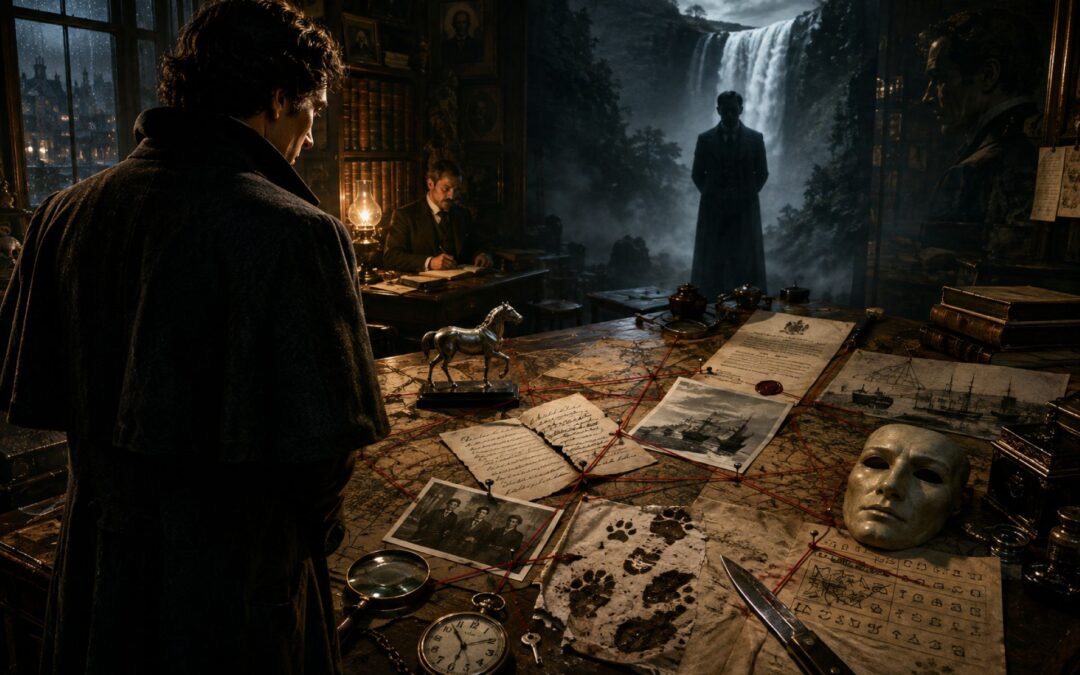
Arthur Conan Doyle’s The Memoirs of Sherlock Holmes is often remembered through a handful of spectacular moments: the racehorse mystery of “Silver Blaze,” Holmes’s humiliation at Norbury, the revelation that he has an even more intellectually gifted brother, the arrival of Professor Moriarty, and the struggle at the Reichenbach Falls.
Read as a complete collection, however, the book does considerably more than supply another sequence of ingenious puzzles. Its eleven stories widen Sherlock Holmes’s world, reach backward into his early career, expose the limitations of his celebrated method, and gradually turn Watson’s case reports into something closer to the biography of a friend whose life appears to be approaching its end.
This article contains full spoilers for all eleven stories, including every solution and the ending of “The Final Problem.” The book rewards close attention because Doyle rarely relies on deduction alone. Crimes arise from marriage, debt, inheritance, professional ambition, colonial history, blackmail, government secrecy, revenge, family loyalty, and concealed identities, while Holmes solves them through a mixture of observation, inference, experiment, psychological pressure, disguise, manipulation, and occasionally luck.
What makes The Memoirs of Sherlock Holmes especially important is the way it complicates the popular image of Holmes as an infallible reasoning machine. He can identify what others overlook, but he can also build a persuasive theory that turns out to be wrong. He can reconstruct another person’s past from tiny physical traces, yet some of his final conclusions remain hypotheses rather than facts. By the time Moriarty appears, Holmes’s intelligence has been placed beside three revealing contrasts: Watson’s humanity and loyalty, Mycroft’s superior but inactive intellect, and Moriarty’s equally formidable intelligence directed toward organized crime.

The Book, the Edition, and What This Collection Is Doing
The Memoirs of Sherlock Holmes is the second major collection of Holmes short stories after The Adventures of Sherlock Holmes. The eleven stories in the British-form collection were first published serially in The Strand Magazine before being gathered by George Newnes. A modern scholarly edition of The Memoirs of Sherlock Holmes notes an important bibliographical wrinkle: the volume was first published on 13 December 1893 even though the original book was dated 1894.
The selected edition contains “Silver Blaze,” “The Yellow Face,” “The Stock-Broker’s Clerk,” “The ‘Gloria Scott,’” “The Musgrave Ritual,” “The Reigate Puzzle,” “The Crooked Man,” “The Resident Patient,” “The Greek Interpreter,” “The Naval Treaty,” and “The Final Problem.” Readers using other editions may encounter a different arrangement because “The Cardboard Box” has a particularly complicated textual history. Andrew Glazzard’s account of the complicated publication history of “The Cardboard Box” explains that it appeared in the first American Memoirs but was omitted from the first English collection, while some of its opening Baker Street material was later transferred to “The Resident Patient.”
That difference matters because a complete guide should be clear about which book it is actually describing. The present article follows the eleven-story British-form collection rather than silently importing “The Cardboard Box” as a twelfth story. Its absence from the plot summary is therefore deliberate, not an omission.
The title Memoirs is also more meaningful than it first appears. Watson is not simply recording whatever case happens to occur next; he repeatedly presents himself as the selector, arranger, and interpreter of Holmes’s career. Two stories reach back to Holmes’s life before Watson, others take place after Watson’s marriage has created greater distance between them, and “The Final Problem” is narrated in the belief that Holmes is dead. The collection consequently moves from casebook toward biography, even though its individual mysteries remain largely independent.
The Eleven Stories: Complete Plot Summary
The eleven stories do not form a continuous plot, but their order gradually reveals more about Holmes than a simple anthology of mysteries would. The early stories display his mature powers, the middle of the collection reaches backward into his professional origins and explores buried crimes from the past, and the later stories disclose his family and finally confront him with an adversary who seems capable of ending his career altogether.
Silver Blaze
“Silver Blaze” begins with two linked mysteries: the disappearance of a celebrated racehorse and the violent death of its trainer. Silver Blaze, owned by Colonel Ross and heavily favoured to win the Wessex Cup, vanishes from the King’s Pyland training stable on Dartmoor. The horse’s trainer, John Straker, is discovered dead on the moor, while the stable boy Ned Hunter has been rendered unconscious with opium.
Suspicion naturally falls on Fitzroy Simpson, a betting man who had visited the stable shortly before the crime. Simpson had tried to obtain information about the horse, questioned the maid Edith Baxter, and carried a heavy walking stick that could conceivably have killed Straker. He also had a financial motive to prevent Silver Blaze from racing.
Holmes is less impressed by the apparent accumulation of evidence against Simpson than by details that do not fit. Hunter had eaten curried mutton before becoming unconscious, and Holmes recognizes that a strongly flavoured dish would be an effective way of concealing powdered opium. The key question is not merely who possessed the drug, but who could ensure that the stable boy received the doctored portion while everyone else remained unaffected.
Another clue is even more famous because it concerns something that did not happen. The watchdog at the stable made no disturbance during the night. If a stranger had entered, the dog should have reacted; its silence suggests that whoever removed Silver Blaze was familiar to it.
Straker’s own possessions further complicate the case. Among them is an unusually delicate surgical knife, unsuitable as an ordinary weapon but capable of making a subtle incision. Holmes also discovers an expensive dressmaker’s bill issued under another name, indicating that Straker maintained a concealed financial life and may have been under pressure because of a relationship outside his marriage.
The sheep near the stable supply the final confirmation. Several have inexplicably gone lame, which Holmes interprets as evidence that Straker had been practicing a precise tendon-cutting technique on them. His plan was not to kill Silver Blaze but to injure the horse just enough to prevent it from winning while making the damage appear natural.
Straker therefore led the horse from the stable himself. On the moor, he struck a match and prepared to make the incision. The sudden light and threatening movement frightened Silver Blaze, which lashed out and struck Straker in the head. Straker’s own delicate knife wounded him as he fell, creating the second injury found on his body.
The horse then wandered across the moor and was eventually discovered by Silas Brown, trainer of a rival horse. Brown recognized Silver Blaze and, having a strong financial interest in its disappearance, concealed it instead of returning it. Holmes identifies what has happened, confronts Brown, and forces him to preserve the horse safely until the race.
Colonel Ross remains irritated by Holmes’s refusal to explain everything immediately. At the Wessex Cup, however, a horse enters that Ross initially fails to recognize because its distinctive facial and leg markings have been altered. It is Silver Blaze, which wins the race.
The case ends with two solutions rather than one. Silver Blaze’s disappearance was concealed by Silas Brown, while Straker’s death resulted from Straker’s own attempt to sabotage the horse. The “murderer,” in the literal sense of the force that killed him, is Silver Blaze itself, but the death is the unintended consequence of Straker’s criminal scheme.
The Yellow Face
“The Yellow Face” is unusual because Watson introduces it as an example of Holmes being wrong. That framing changes the reader’s expectations immediately: the story is not designed merely to prove Holmes’s brilliance, but to show how brilliance can fail when inference outruns evidence.
Grant Munro comes to Baker Street because his wife Effie has begun behaving secretly. Before marrying Grant, Effie had lived in America and had been married to a man named John Hebron. She told Grant that both Hebron and their child had died, and the Munros’ subsequent marriage had been happy.
The trouble begins when a nearby cottage becomes occupied. Grant glimpses a strange yellowish face at an upstairs window, apparently staring at him. Effie starts visiting the cottage secretly and repeatedly asks her husband not to investigate.
Grant suspects some hidden relationship, but Effie insists that she has not betrayed him. She begs for trust without offering the explanation that would make trust easy, and that contradiction creates the emotional force of the mystery. Grant is not simply trying to identify a stranger; he is deciding whether the marriage he believes he understands rests upon a fundamental deception.
Holmes constructs a dark explanation from the available evidence. He suspects that Effie’s first husband may still be alive, that the supposed death in America was false, and that Effie may now be subject to blackmail or coercion. The theory is plausible, coherent, and completely wrong.
Grant eventually refuses to tolerate further secrecy. Accompanied by Holmes and Watson, he enters the cottage against Effie’s wishes. The mysterious figure is revealed to be a child wearing a pale mask and gloves.
When the mask is removed, Grant discovers that the child is Black. Effie then explains the truth she had been afraid to tell him.
John Hebron, her first husband, was a Black American whom she loved deeply. Their daughter Lucy survived him. When Effie returned to Britain and later married Grant, she left Lucy in America because she feared that English racial prejudice—and perhaps Grant’s own prejudice—would destroy her new marriage.
Eventually Effie could no longer endure separation from her daughter. She arranged for Lucy and her nurse to come to England and placed them in the nearby cottage. The mask was used in an attempt to conceal Lucy’s race from neighbours while Effie tried to decide what to do.
The mystery therefore contains no criminal conspiracy. Effie’s secrecy comes from fear rather than infidelity, and Holmes’s elaborate reconstruction collapses because he assumed that concealed behaviour implied a hidden crime.
Grant’s response provides the story’s moral resolution. Instead of rejecting Effie or Lucy, he takes the child into his arms and tells Effie, in effect, that she had underestimated him. The marriage survives not because the secrecy was harmless, but because Grant responds to the truth with greater generosity than Effie believed possible.
Afterward Holmes gives Watson a permanent corrective to professional pride. Whenever Watson notices Holmes becoming too confident, he is to remind him of “Norbury.” The word becomes shorthand for the case in which Holmes’s method produced a persuasive but fundamentally mistaken story.
The Stock-Broker’s Clerk
“The Stock-Broker’s Clerk” begins with the precarious world of commercial employment. Hall Pycroft is a capable clerk whose position disappears when his firm fails. He then secures what appears to be excellent employment at Mawson & Williams, a major stockbroking business.
Before he begins, however, Pycroft receives an extraordinary alternative proposal from a man calling himself Arthur Pinner. Pinner claims to represent the Franco-Midland Hardware Company and offers Pycroft a salary far beyond what his experience would normally command. He also pays him an unusually large advance.
The opportunity is flattering enough to overwhelm suspicion. Pinner persuades Pycroft to write out a statement accepting the position and tells him not to resign formally from Mawson & Williams. Pycroft is then sent to Birmingham, where he finds the supposed company operating from offices that appear almost empty.
There he meets a second man presented as Harry Pinner, Arthur’s brother. Pycroft is assigned repetitive work compiling lists that seems disconnected from any genuine commercial purpose. His unease increases when he notices that Arthur and Harry share the same distinctive gold-filled tooth and similar mannerisms.
Holmes immediately understands the implication: the two “brothers” are the same man in disguise. That discovery turns the apparently generous job offer into part of a larger impersonation scheme.
Pycroft’s handwritten acceptance had supplied the criminals with a sample of his handwriting. Keeping him away from Mawson & Williams without requiring a formal resignation ensured that the real firm continued expecting him. Another man could therefore present himself there as Hall Pycroft.
The reason for the entire Birmingham operation was to isolate the genuine clerk long enough for the impersonation to work. The false hardware company did not need to conduct meaningful business because its true purpose was simply to occupy Pycroft.
When Holmes, Watson, and Pycroft confront Pinner, he reads a newspaper report and becomes so distraught that he attempts suicide. The report reveals what has happened in London.
The impostor at Mawson & Williams was Beddington, a recently released criminal. Using Pycroft’s identity, he gained legitimate access to the firm, murdered a watchman, and stole a large quantity of securities. He was then captured.
The man posing as the Pinner brothers is Beddington’s real brother. His collapse comes from learning that the London operation has failed and, more seriously, that his brother’s theft has become a murder case.
The story turns professional identity into a security vulnerability. Pycroft’s handwriting, references, expected arrival date, and reputation are all treated as transferable credentials. Doyle’s mystery therefore depends on a distinctly modern anxiety: a person can be impersonated not by imitating his face perfectly, but by acquiring enough of the documentary evidence through which institutions recognize him.
The “Gloria Scott”
“The ‘Gloria Scott’” reaches backward to Holmes’s university days and explains one of the first investigations that suggested he might turn observation and deduction into a profession. The case also reveals how easily an apparently respectable English household can be destabilized by a concealed criminal past.
As a student, Holmes becomes friends with Victor Trevor and visits his family home in Norfolk. Victor’s father appears to be a prosperous country gentleman, but Holmes’s deductions about his past produce an unexpectedly violent emotional reaction.
Most disturbing is Holmes’s observation that the older Trevor once had a close association represented by the initials “J.A.” and had later tried to erase that evidence. The deduction touches a secret so serious that Trevor’s father nearly collapses.
The crisis deepens when a rough sailor named Hudson arrives. Trevor’s father is visibly terrified of him and allows Hudson liberties that make no sense within the social hierarchy of the household. Hudson becomes insolent, abusive, and increasingly confident that he cannot be dismissed.
Eventually Hudson announces that he will visit another man named Beddoes. Soon afterward Trevor’s father receives a bizarre message apparently concerning game birds and supplies. The wording appears meaningless until Holmes discovers that reading every third word reveals the real message: the game is up, Hudson has told everything, and the recipient must flee.
The warning overwhelms Trevor’s father. Before he dies, however, he leaves behind a written account explaining the hidden history.
His real name was James Armitage. As a young man he had committed embezzlement and been sentenced to transportation to Australia aboard the convict ship Gloria Scott. On that ship he encountered Jack Prendergast, a criminal of exceptional wealth, confidence, and organizational ability.
Prendergast had arranged a mutiny before the voyage was complete. Through bribery and outside assistance, weapons had been smuggled aboard, and an accomplice posing as a chaplain helped coordinate the plot. When the prisoners seized control, the violence quickly exceeded what Armitage and another prisoner, Evans, were willing to accept.
Prendergast intended to eliminate surviving witnesses, including officers and guards. Armitage, Evans, and several others refused to participate in the slaughter and left the ship in a small boat.
Not long afterward the Gloria Scott exploded. The men in the boat returned to the wreckage and rescued a single survivor: Hudson.
Armitage and Evans eventually reached Australia and built new lives. They prospered, changed their identities, returned to Britain, and became respectable gentlemen. Evans took the name Beddoes, while Armitage became Trevor.
Their success depended on the assumption that the past had been permanently buried. Hudson’s survival made that impossible.
Years later he located them and began exploiting their fear of exposure. Trevor tolerated humiliations that would otherwise have been inexplicable because Hudson possessed the power to reveal that the distinguished country gentleman was really a transported convict living under another name.
The coded warning shows that Beddoes believed Hudson had finally exposed them. Trevor’s health fails under the pressure, and Victor discovers that the identity of the father he thought he knew had been constructed over a concealed history of crime, transportation, mutiny, and reinvention.
Hudson and Beddoes subsequently disappear. Officially, suspicion can fall in more than one direction, but Holmes believes that Beddoes probably killed Hudson and then fled. The story never proves that final reconstruction, leaving its last violence unresolved.
For Holmes, the case has lasting consequences. Victor Trevor’s father had previously suggested that Holmes might make a profession from his unusual abilities, and “The ‘Gloria Scott’” becomes one of the episodes through which those abilities begin changing from private eccentricity into vocation.
The Musgrave Ritual
“The Musgrave Ritual” is another early Holmes case, but it begins with a domestic detail that humanizes the detective. Watson complains about Holmes’s extraordinary personal untidiness, prompting Holmes to produce old records from the period before Baker Street and recount one of his formative investigations.
Reginald Musgrave comes from an ancient landed family. His household possesses a hereditary ritual consisting of seemingly archaic questions and answers about who has gone, who will come, the position of an oak and elm, the measurement of a shadow, directional movements, and an object preserved “for the sake of the trust.”
For generations the Musgraves have recited the ritual without understanding it. Its meaning appears ceremonial rather than practical.
The household’s exceptionally intelligent butler, Richard Brunton, suspects otherwise. Musgrave catches him secretly studying the text late at night. Because Brunton has violated the family’s trust, Musgrave dismisses him.
Before Brunton can leave, however, he disappears. Rachel Howells, a maid who had once loved Brunton before he abandoned her for another woman, becomes emotionally unstable and then disappears as well.
A bag recovered from the lake contains old metal fragments and other objects that appear worthless. The mystery seems to involve Brunton’s personal life, but Holmes becomes more interested in the ritual itself.
He concludes that the document is not symbolic language but a set of encoded geographical instructions. Brunton had evidently reached the same conclusion.
The largest difficulty is that one of the trees mentioned in the ritual no longer exists. Holmes reconstructs its former position by using old measurements and the geometry of shadows. From there he follows the prescribed sequence of directions through the estate.
The route leads to a concealed underground chamber beneath the house. There, behind a massive stone slab, Brunton’s body is discovered.
Holmes reconstructs the likely events. Brunton needed another person’s assistance to move the stone and descend into the chamber, and Rachel was almost certainly his accomplice. Once he had entered, he began passing objects up to her.
At some point the support holding the stone failed, sealing Brunton inside. What remains uncertain is whether Rachel deliberately allowed the slab to fall as revenge for his betrayal or whether the death was accidental and her subsequent behaviour came from shock and guilt.
The seemingly worthless objects from the lake turn out to include the damaged remains of an ancient English crown. The Musgrave Ritual had preserved instructions for recovering royal regalia hidden during the political upheaval surrounding Charles I, with the expectation that the treasure could eventually be restored to Charles II.
The story therefore solves two mysteries simultaneously. Brunton discovers the practical meaning of a ritual whose words have outlived their remembered purpose, while Holmes reconstructs both Brunton’s recent actions and a much older act of political concealment.
Its deeper irony is that generations of Musgraves faithfully preserved information they no longer knew how to read. Their ancestral tradition looked empty only because the interpretive key had disappeared.
The Reigate Puzzle
“The Reigate Puzzle” begins with Holmes exhausted rather than triumphant. After overworking himself on a demanding international investigation, he is taken by Watson to Colonel Hayter’s country home in Surrey in the hope that rest will restore him.
The countryside immediately presents another mystery. Mr Acton, a local landowner, has recently experienced a strange burglary in which apparently trivial objects were taken despite the presence of more valuable property. Acton is also involved in an important legal dispute with the neighbouring Cunningham family.
Soon afterward the Cunninghams’ coachman, William Kirwan, is shot dead. The elder Cunningham and his son Alec claim that William struggled with an intruder who escaped.
A torn scrap of paper found in William’s possession appears to summon him to a meeting at a particular time. Holmes recognizes that the note is more important than the eyewitness account because its handwriting contains a hidden structure.
Two people wrote it alternately. Differences in letter formation, pressure, and sequence suggest that the writers are closely related, with one older than the other.
That evidence immediately threatens the Cunninghams, but Holmes does not reveal everything. Instead, he begins manipulating the investigation.
At one point he stages a physical collapse, exploiting everyone’s awareness of his recent illness. He also deliberately writes the wrong time on a reward notice and allows the elder Cunningham to correct it in his own handwriting.
The correction provides another specimen for comparison. Holmes now has stronger evidence connecting the Cunninghams to the mysterious note.
Inside their house, he creates a further distraction and searches Alec’s room. There he finds the missing portion of the note hidden in Alec’s clothing.
The Cunninghams react violently when they realize what Holmes has recovered. Their attack on him makes their guilt impossible to sustain behind social respectability.
The earlier burglary at Acton’s house was not ordinary theft. The Cunninghams had entered in search of legal documents connected with the property dispute between the two families. They stole random objects to make the incident appear like a conventional burglary.
William learned enough about their actions to blackmail them. The father and son therefore wrote the note together to lure him to a meeting, where Alec shot him.
The case displays Holmes’s method at its most theatrical. He does not simply notice handwriting differences and announce a solution; he uses feigned weakness, deliberate error, and controlled provocation to obtain the evidence he needs.
The Crooked Man
“The Crooked Man” begins with an apparent domestic murder inside a respectable military household. Colonel James Barclay, stationed at Aldershot, has risen from the ranks and built a distinguished career. His wife Nancy is the daughter of a colour-sergeant, and their marriage is generally believed to be stable.
There are, however, hints of unease. Barclay sometimes falls into dark moods and has a strong dislike of being left alone.
One evening Nancy returns from a charitable meeting with her friend Miss Morrison and abruptly begins quarrelling with her husband. Servants overhear her repeatedly using the name “David” and accusing Barclay of cowardice.
A crash follows. When the room is opened, Barclay is found dead with a severe head injury and a terrible expression on his face, while Nancy lies unconscious.
The physical evidence makes the scene stranger rather than clearer. The door is locked and the key has disappeared. An unfamiliar club lies in the room. Marks show that another man entered through the window, accompanied by some small animal whose tracks do not resemble those of an ordinary domestic pet.
Holmes focuses on what happened before Nancy came home. Miss Morrison eventually admits that Nancy encountered an unusual man during their walk and clearly recognized him.
Holmes traces the man and discovers Henry Wood, a travelling performer whose body has been severely deformed. Wood possesses a mongoose, explaining the animal tracks found at the Barclays’ house.
His story sends the mystery backward to British India during the uprising of 1857.
As a young soldier, Henry Wood had loved Nancy. James Barclay was his rival.
During a military crisis at Bhurtee, Wood volunteered to carry a message through dangerous territory in order to obtain help. Barclay knew the route he would take.
Jealous of Wood and wanting Nancy for himself, Barclay secretly betrayed Wood’s route to the enemy. Wood was captured, tortured, and permanently disabled.
Everyone in the British community assumed he had died. Barclay subsequently married Nancy and built a respectable career without revealing what he had done.
Wood survived and spent years moving through Asia before eventually returning to Britain. His physical appearance had changed so dramatically that he could live near his old world without being recognized.
His chance meeting with Nancy therefore destroys a decades-old lie. She had believed that Henry died through ordinary wartime misfortune; he tells her that her husband betrayed him.
Nancy returns home and confronts Barclay. Wood follows, entering through the open window.
Barclay sees the man whose death he engineered decades earlier and is overwhelmed. He does not die because Wood strikes him. Instead he suffers a fatal seizure or apoplectic attack, falls, and hits his head.
Wood panics because the scene makes him appear responsible. He flees, accidentally leaving behind his club and the animal evidence while carrying away the key.
The inquest ultimately accepts that Barclay was not murdered. Legally, Wood is not guilty of killing him.
Morally, the story is far less simple. Barclay dies at the moment when the respectable identity built over his betrayal collapses.
The repeated name “David” receives a final explanation from Holmes. Nancy was comparing Barclay to the biblical King David, who arranged for Uriah to be placed in mortal danger so that David could possess the woman connected to him. The allusion transforms what initially sounds like a mysterious proper name into Nancy’s accusation that Barclay once sacrificed a rival for love.
The Resident Patient
“The Resident Patient” begins with Watson reflecting on his role as the recorder of Holmes’s career. He distinguishes between cases that are important because Holmes’s reasoning is extraordinary and cases that are dramatic because the underlying events are unusual, reminding readers that the “memoirs” are already shaped by editorial selection.
Dr Percy Trevelyan is a talented physician whose lack of money prevents him from establishing the kind of medical practice his abilities could support. His circumstances change when a man calling himself Blessington offers an unusual financial arrangement.
Blessington provides the capital for a prestigious practice and lives in the building as Trevelyan’s resident patient. In return, he receives most of the income.
The arrangement is financially successful, but Blessington becomes increasingly fearful. After hearing of a nearby burglary, he takes elaborate security precautions and behaves as though he expects a specific threat.
The threat appears to arrive in the form of two foreign visitors. A young man brings an older gentleman described as a Russian nobleman suffering from cataleptic attacks.
While Trevelyan attends to the supposed patient, the younger man gains an opportunity to move through the house. The consultation ends strangely, and the pair later return with another explanation for their conduct.
Blessington is terrified when he realizes that someone has entered his room. Yet when Holmes questions him, he refuses to disclose why the intrusion should frighten him so intensely.
Holmes recognizes the central problem: Blessington knows what the danger is but is withholding the information necessary to understand it.
The next morning Blessington is found hanging in his room. The immediate appearance suggests suicide, but the physical evidence points elsewhere.
Holmes reconstructs the presence of multiple visitors from footprints, cigars, the state of the lock, and the arrangement of the room. The supposed patients were not seeking medical treatment. Their earlier visits were reconnaissance.
Blessington’s real name is Sutton. Years earlier he belonged to the Worthingdon bank gang alongside Biddle, Hayward, Moffat, and Cartwright.
After a robbery that included murder, Sutton turned informer. His testimony helped convict the others; Cartwright was executed, while the surviving gang members received lengthy prison sentences.
Blessington’s prosperous later life was therefore built on betrayal. He financed Trevelyan’s medical practice and lived anxiously inside it because he knew his former associates might eventually find him.
When the others were released, they did exactly that. Their false medical visits allowed them to identify the building and test access to Blessington’s room.
On the final visit they effectively conducted a private trial. Having judged Sutton for informing against them, they hanged him.
The law never produces a satisfying resolution. The killers escape and are later believed to have died at sea.
Unlike many Holmes stories, the case therefore ends without formal justice. Holmes discovers what happened, but solving the intellectual problem does not necessarily restore legal order.
The Greek Interpreter
“The Greek Interpreter” begins with a revelation that surprises Watson almost as much as the case itself. Despite years of friendship, he realizes that he knows virtually nothing about Holmes’s family.
Holmes tells him that he has an older brother, Mycroft. Even more surprisingly, he suggests that Mycroft’s powers of observation and deduction may exceed his own.
The brothers meet at the Diogenes Club, an institution designed for men who prefer silence and minimal social contact. There Holmes and Mycroft casually demonstrate their abilities by jointly reconstructing aspects of a stranger’s history from his appearance.
The similarities between them are obvious, but so are the differences. Mycroft possesses enormous intellectual power without Sherlock’s appetite for physical investigation, danger, or verification.
Mycroft introduces the case of Mr Melas, a professional Greek interpreter. Melas had been abducted by a man named Harold Latimer and transported in a covered carriage to an unknown house.
There he was ordered to interpret between Latimer’s associates and a Greek prisoner. The prisoner’s mouth had partly been sealed, making Melas necessary for communication.
The criminals want the prisoner to sign documents involving property. He refuses.
Melas realizes that because his captors do not understand Greek, he can secretly insert his own questions while appearing to translate faithfully. Through this improvised interrogation, he learns that the prisoner is named Paul Kratides, has recently arrived from Athens, and has been held for weeks.
The situation becomes even clearer when a young Greek woman unexpectedly enters the room. She and Paul recognize one another immediately.
She is Sophia Kratides, Paul’s sister.
Melas is eventually released under threat. Mycroft places an advertisement seeking information about the people involved and receives a response identifying a house called The Myrtles in Beckenham.
Before Holmes and the others can act effectively, Melas is abducted a second time.
At The Myrtles they find that the criminals have fled. A room has been filled with charcoal fumes.
Melas can be revived, but Paul dies from the poisoning.
The background is reconstructed afterward. Sophia had become involved with Harold Latimer in England. Paul travelled from Greece to intervene, apparently to protect his sister and the family’s property.
Latimer and his accomplice Wilson Kemp captured Paul and tried to force him to surrender control over property by signing legal documents. Sophia was kept sufficiently ignorant that she did not initially know her brother was being imprisoned nearby.
Latimer and Kemp escape with Sophia. Months later news arrives from Budapest that two Englishmen travelling with a woman have been stabbed to death.
Authorities believe the men killed each other. Holmes suspects a different explanation: Sophia may have avenged Paul herself.
The story never establishes that conclusion as fact. Its uncertainty is important because Holmes is once again reconstructing a plausible final chapter from incomplete information rather than demonstrating it conclusively.
The Naval Treaty
“The Naval Treaty” is one of the longest and most elaborate stories in the collection because the crime initially appears to threaten international stability. Watson receives a request for help from Percy Phelps, an old school acquaintance who has built a promising career at the Foreign Office.
Percy owes some of his advancement to his uncle, Lord Holdhurst, an important political figure. Holdhurst entrusts him with a highly confidential naval treaty and instructs him to make a copy.
The document is extremely sensitive. If its contents become known to rival governments, Britain could face a serious diplomatic crisis.
Percy works late at the Foreign Office. When coffee he has requested fails to arrive, he leaves his room briefly to investigate.
While he is away, a bell connected to the supposedly empty office rings. Percy rushes back and discovers that the treaty has vanished.
The circumstances seem almost impossible. The theft occurred within a narrow window, yet there is no obvious suspect.
Attention falls on several people who might have had access, including the commissionnaire and his wife, as well as Percy’s colleague Charles Gorot. None of the early investigations produces the missing treaty.
The emotional consequences for Percy are catastrophic. He believes his career is destroyed and that he has endangered national security.
He collapses into a prolonged brain fever and is taken to Briarbrae in Woking. There his fiancée Annie Harrison nurses him through a long recovery.
Percy occupies a bedroom that normally belongs to Annie’s brother, Joseph Harrison. Because Percy remains seriously ill and is continuously attended, the room becomes the centre of the household.
Once Percy begins recovering, someone attempts to enter the bedroom at night. The event appears to connect the mysterious Foreign Office theft to Briarbrae, though the relationship is not yet clear.
Holmes gives Annie precise instructions. She is to remain in Percy’s room throughout the day, lock it when she leaves, and keep the key.
He then appears to return to London with Watson and Percy. In reality, Holmes secretly remains near the house and watches.
During the night Joseph Harrison enters through the window. He lifts a floorboard and retrieves the missing naval treaty from its hiding place.
Holmes confronts him and recovers the document.
The solution transforms what looked like international espionage into a crime of opportunity inside a family. Joseph had gone to the Foreign Office intending to see Percy and entered the room during Percy’s brief absence.
By accident, he rang the bell. He then noticed the treaty, understood that it might be valuable, and stole it impulsively.
Back at Briarbrae, Joseph hid the document beneath the floorboards of his own room while deciding how to profit from it. Then an extraordinary complication trapped the thief.
Percy returned home gravely ill and was placed in Joseph’s bedroom. Because Percy required constant care, Joseph could not enter the room and retrieve the treaty without drawing attention.
For weeks the most important missing diplomatic document in Britain remained hidden beneath the floor of a sick man’s bedroom. The apparent international conspiracy survived because the ordinary domestic arrangement made the truth difficult to imagine.
Joseph’s later attempt to enter the room was not an unrelated burglary. He was trying to recover the document he had hidden there.
Holmes resolves the case with deliberate theatricality. At breakfast he allows Percy to believe briefly that nothing has changed, then reveals the recovered treaty concealed beneath a serving dish.
The gesture is comic after a long period of fear, but the crime itself rests on chance, opportunism, and betrayal. Percy’s professional disaster was not engineered by a foreign spy network; it was caused by someone inside the household who recognized an unexpected opportunity and then became trapped by the consequences of Percy’s illness.
The Final Problem
“The Final Problem” changes the tone of the collection immediately. Watson is no longer simply presenting another unusual case. He writes as a grieving friend who believes Sherlock Holmes is dead.
He explains that he had intended to remain silent about the events surrounding Holmes’s disappearance, but public discussion of Professor Moriarty has made silence impossible. Colonel James Moriarty has defended his brother’s reputation, and Watson therefore feels compelled to tell Holmes’s version of what happened.
Holmes arrives unexpectedly at Watson’s home in a state of unusual tension. He asks about precautions against air-guns and explains that he has spent months confronting an adversary unlike any he has previously encountered.
Professor Moriarty is a mathematical genius who has become the organizing intelligence behind a vast criminal network. Holmes describes him as someone who rarely commits crimes directly.
Instead Moriarty operates from the centre of a web. Agents carry out offences, intermediaries separate him from immediate evidence, and the organization protects its leader by making responsibility difficult to trace.
Holmes has gradually reconstructed the network and assembled enough evidence to destroy it. Arrests are imminent.
Moriarty recognizes the danger and visits Holmes personally. Their conversation is not a conventional confrontation between detective and thug; it is a negotiation between two people who understand each other’s intellectual capabilities.
Moriarty warns Holmes to abandon the investigation. Holmes refuses.
Attempts on Holmes’s life follow. A speeding vehicle nearly strikes him, a heavy object falls from a roof, and a hired attacker assaults him.
Holmes interprets these incidents as parts of Moriarty’s response rather than unrelated accidents. He also understands that the professor may evade the coming police operation even if the rest of the organization is captured.
Holmes persuades Watson to leave England with him. Their escape involves disguises, altered routes, and deliberate attempts to confuse pursuit.
Moriarty follows them across Europe.
The journey eventually brings Holmes and Watson to Switzerland and the Reichenbach Falls near Meiringen. The landscape is spectacular but dangerous, and Doyle turns the natural setting into a fitting stage for a final confrontation.
A messenger arrives with an urgent request from the hotel. An Englishwoman is supposedly dying and refuses treatment from anyone except an English doctor.
Watson’s professional duty overrides his reluctance to leave Holmes. He turns back to help.
The message is false.
When Watson discovers the deception, he rushes back toward the falls. Holmes is gone.
The physical evidence appears stark. Tracks show that two men walked toward the edge of the falls. There are no corresponding tracks leading away.
Watson also finds a written farewell from Holmes. Holmes explains that he recognized the medical summons as a trap and allowed Watson to leave anyway.
He had concluded that the decisive confrontation with Moriarty was unavoidable. He also believed that destroying Moriarty and his organization would justify the possible loss of his own life.
Holmes assures Watson that the evidence necessary to convict Moriarty’s associates has already been secured. He has also made arrangements concerning his personal affairs through Mycroft.
The official conclusion is that Holmes and Moriarty struggled at the edge and fell together into the Reichenbach Falls. Moriarty’s wider organization is subsequently broken.
For Watson, however, the legal victory offers little consolation. The collection ends not with Holmes explaining another puzzle but with Watson mourning the man whose cases he has been recording.
At the time of the story’s original publication, the implication was not that Holmes had cleverly escaped and would soon return. The intended ending was that the detective had sacrificed himself while eliminating the one criminal intelligence presented as his equal.
Sherlock Holmes Across the Collection: Method, Error, Origins, and Limits
The stories become more revealing when Holmes is treated not as a fixed icon but as a character whose method and identity are repeatedly tested. The Memoirs of Sherlock Holmes shows the mature detective at work, reaches backward to the cases that helped create his career, exposes one spectacular failure, and finally places him beside two intellectual counterparts who clarify what is distinctive about him.
How Holmes Reads What Others Miss
Holmes’s greatest talent is not simply “observation” in the everyday sense. He is unusually skilled at deciding which facts deserve attention and at constructing causal relationships between traces that other people either overlook or dismiss.
“Silver Blaze” provides the clearest example. Many investigators can notice a dead trainer, a missing horse, a suspicious gambler, and a drugged stable boy. Holmes instead asks why the dog did not bark, why curry was served, why sheep became lame, why Straker carried an inappropriate knife, and why an expensive bill existed under another name.
His method therefore includes negative evidence. An expected reaction that fails to occur can be as meaningful as an object that is physically present.
“The Reigate Puzzle” converts handwriting into another kind of physical trace. Holmes treats differences in pressure and formation not merely as aesthetic variation but as evidence of two writers, their relationship, and their relative ages.
In “The Stock-Broker’s Clerk,” writing becomes institutional identity. A specimen of Pycroft’s hand allows criminals to impersonate him inside a commercial system that relies on documents and expectations more than personal familiarity.
“The Musgrave Ritual” demonstrates a different form of reading. Holmes interprets language as spatial instruction, then reconstructs a vanished landscape feature through geometry. The words become a map only after he identifies the practical assumptions buried beneath generations of ceremonial repetition.
Holmes also experiments. He does not always sit in Baker Street and deduce the truth mentally.
He confronts Silas Brown, lays traps for the Cunninghams, stages weakness, creates false information, uses disguises, watches houses, and deliberately withholds conclusions from clients. His detective work therefore combines reasoning with performance.
This theatrical element can be manipulative, but it is also central to his effectiveness. Holmes often knows that suspects will reveal more through reaction than through voluntary confession.
Holmes Is Brilliant, Not Infallible
The popular caricature of Holmes as someone who never makes mistakes is difficult to sustain after “The Yellow Face.” There his reasoning is sophisticated, internally coherent, and fundamentally false.
Holmes assumes that Effie’s secrecy must conceal something criminal or sexually compromising. Once that assumption enters the theory, the available evidence can be arranged around it convincingly.
The reveal demonstrates a limitation inherent in deduction from incomplete data. A theory can explain known facts while still being wrong because the investigator has selected the wrong underlying premise.
Holmes’s reaction matters as much as the mistake itself. He does not defend the failed theory or pretend he was almost correct.
Instead “Norbury” becomes a private warning against overconfidence. The moment adds humility to a character whose extraordinary abilities could otherwise make him dramatically static.
Other stories contain smaller forms of uncertainty. Holmes suspects what happened to Hudson and Beddoes after “The ‘Gloria Scott,’” but the outcome is not demonstrated. He suspects Sophia may have killed Latimer and Kemp after “The Greek Interpreter,” but the evidence remains circumstantial.
“The Musgrave Ritual” likewise never proves whether Rachel intentionally allowed Brunton to die. Holmes can reconstruct probabilities, but the collection does not always grant him omniscience.
That distinction is important because some of Holmes’s deductions are more persuasive as fiction than they would be as scientific inference. Doyle’s stories often assume that habits, handwriting, appearance, clothing, posture, or behavioural detail can yield remarkably specific conclusions. The pleasure lies in seeing those conclusions form a coherent explanatory pattern, but the narrative sometimes gives Holmes a confidence that real-world evidence would not justify.
The Making of the Detective: “Gloria Scott” and “The Musgrave Ritual”
“The ‘Gloria Scott’” and “The Musgrave Ritual” are essential because they place Holmes before Watson and before the fully developed Baker Street mythology. He already possesses unusual powers of observation, but he has not yet settled into the role by which readers know him.
Victor Trevor’s father helps transform talent into possibility. When Holmes’s deductions produce both astonishment and fear, the older man suggests that such abilities might become more than an eccentric hobby.
The case then teaches Holmes something crucial about detection. The visible present may be unintelligible until an invisible past is reconstructed.
Hudson’s insolence cannot be explained by ordinary class relations because the real power in the household comes from secret knowledge. Trevor appears socially superior, but Hudson controls him because he knows that “Trevor” is a manufactured identity built over James Armitage’s criminal conviction and transportation.
“The Musgrave Ritual” develops a different aspect of Holmes’s emerging method. Here the investigator must assume that nonsense is not necessarily meaningless.
A hereditary ritual that everyone treats as obsolete tradition turns out to encode practical information. Holmes succeeds because he refuses to accept the family’s inherited interpretation of its own document.
Both stories therefore dramatize the making of a detective who distrusts surface explanations. Social respectability can conceal a transported convict, ceremony can conceal a map, and ordinary objects can preserve forgotten history.
Mycroft and Moriarty: Two Mirrors of Holmes
Mycroft Holmes and Professor Moriarty appear relatively late in the collection, but each clarifies Sherlock through contrast. Mycroft possesses enormous deductive ability and may even surpass his younger brother in pure intellectual inference.
What Mycroft lacks is the impulse to test his ideas physically. Sherlock does not merely think; he pursues, experiments, risks himself, disguises himself, questions witnesses, and enters dangerous spaces.
The contrast suggests that Sherlock’s identity cannot be reduced to intelligence. Energy, curiosity, competitiveness, physical courage, and appetite for practical resolution are equally important.
Moriarty provides the darker mirror. He possesses intelligence on a scale Holmes respects, but directs it toward crime.
Like Holmes, Moriarty sees patterns that others cannot. Unlike Holmes, he uses those abilities to create and coordinate networks of wrongdoing.
Their conflict therefore becomes more than policeman versus criminal. It is a confrontation between two organizing minds, each capable of perceiving structures invisible to ordinary people.
Yet Moriarty’s dramatic power also depends on how little readers actually see of him. Most of his greatness is communicated through Holmes’s description.
He arrives near the end of the collection already established as a criminal mastermind, without the accumulated narrative development Holmes has received. That imbalance makes him mythically effective but psychologically thinner.
Watson, Friendship, and the Meaning of the “Memoirs”
Watson’s importance becomes clearer in The Memoirs of Sherlock Holmes because his life has begun moving away from permanent residence at Baker Street. He has married, established a medical practice, and no longer shares Holmes’s daily routine. The physical separation changes the stories: Holmes now has to seek Watson out, summon him, or involve him in cases after periods of reduced contact.
Watson nevertheless remains more than a convenient audience for explanations. He performs practical functions as doctor, companion, witness, decoy, and assistant, but his greatest contribution is narrative. Through him, Holmes’s extraordinary reasoning becomes a human relationship rather than a sequence of abstract demonstrations.
That role is self-conscious. “The Resident Patient” opens with Watson reflecting on which cases deserve inclusion in his published record, emphasizing that the reader never receives an unfiltered archive. Watson selects stories because of their dramatic interest, Holmes’s reasoning, or some combination of the two.
His admiration also shapes characterization. Holmes is frequently impatient, secretive, or theatrical, yet Watson’s affection prevents those traits from reducing him to a cold machine.
At the same time, Watson is not merely a worshipper. He becomes irritated, questions Holmes’s choices, fails to understand him, and occasionally recognizes the vanity behind an elaborate reveal.
This mixture of admiration and resistance helps create one of the series’ most durable relationships. Watson allows Holmes to remain exceptional without becoming emotionally inaccessible.
The collection’s ending depends completely on that friendship. If “The Final Problem” were narrated by an impersonal observer, Reichenbach would be a clever duel between two extraordinary intellects.
Because Watson narrates it, the event becomes bereavement. His false medical summons is painful precisely because Holmes knowingly allows Watson to leave rather than placing him in the final danger.
Holmes’s farewell also exposes how much he values the companionship he rarely articulates directly. His tone remains controlled, but the decision to leave an explanation for Watson reveals a relationship that his usual manner tends to conceal.
The word “memoirs” therefore becomes especially appropriate by the final pages. Watson is not just preserving cases; he believes he is preserving the life of a dead friend.
That belief changes the emotional meaning of everything that came before. Stories that initially looked like demonstrations of deductive skill become episodes in a life Watson now imagines as complete.
Victorian Society Behind the Mysteries
The mysteries in The Memoirs of Sherlock Holmes move through a surprisingly wide range of social institutions. Doyle’s England includes racecourses, country estates, medical practices, commercial offices, military households, diplomatic departments, private clubs, railway networks, servants’ quarters, and criminal organizations. Those settings are not merely scenery because the crimes often depend on the rules governing class, reputation, employment, family, and institutional trust.
Class, Respectability, and Double Lives
Respectability is one of the collection’s most unstable ideas. Several characters occupy socially secure positions only because crucial information about their past has been hidden.
James Armitage becomes Mr Trevor, prosperous country gentleman. Sutton becomes Blessington, wealthy investor and resident patient.
Colonel Barclay becomes a distinguished military figure while concealing the betrayal that helped remove Henry Wood from his path. The Cunninghams enjoy status and property while committing burglary and murder to protect themselves in a legal dispute.
These cases do not suggest that respectable people are secretly criminal by definition. They show instead that social status depends heavily on what others know.
A changed name, forgotten history, successful career, or inherited property can transform public identity. Holmes repeatedly destabilizes that public identity by recovering information that society has lost.
Servants also occupy an important position because they move through spaces that employers consider private. Brunton’s intelligence allows him to penetrate the Musgrave family’s most carefully preserved secret, while stable workers, maids, coachmen, and commissionnaires become crucial witnesses or participants in other cases.
The collection therefore understands class hierarchy as porous in practice. Servants may lack formal authority, but their access to information can give them unexpected power.
Empire, Race, and the Colonial Past
Several stories reveal that apparently self-contained English mysteries cannot be understood without histories extending beyond Britain. Australia, India, continental Europe, and America repeatedly return through people, wealth, violence, and memory.
“The ‘Gloria Scott’” depends on convict transportation and the possibility of remaking identity in Australia. James Armitage’s English respectability is inseparable from the colonial system that removed him from Britain and later allowed him to return wealthy under another name.
“The Crooked Man” is even more direct. Colonel Barclay’s successful domestic life in England rests on an act of betrayal committed during the violence of British India.
Henry Wood’s return forces a colonial past into the centre of an English marriage. His injured body becomes visible evidence of a history Barclay had managed to suppress socially.
A disability-studies reading of “The Crooked Man” emphasizes the story’s reversal of initial expectations. Wood’s bodily difference first encourages suspicion, while the conventionally respectable Barclay ultimately emerges as the person whose moral conduct is most disturbing.
The story does not escape Victorian assumptions about disability. Wood’s appearance is repeatedly marked as grotesque or frightening.
Yet Doyle uses that initial coding against the reader to some extent. The “crooked” man is not the murderer, while the upright colonel built his career over betrayal.
“The Yellow Face” addresses race through an interracial marriage and a mixed-race child. Effie’s secrecy is driven by her belief that Grant may reject Lucy because of her Black ancestry.
Grant’s eventual acceptance of the child gives the story a humane moral direction. He proves more generous than Effie feared, and Holmes’s darker interpretation is defeated by an explanation rooted in prejudice rather than crime.
The story should not, however, be converted into a modern statement on race. Its language and assumptions remain those of late-Victorian Britain, and racial difference is still constructed as a socially shocking revelation.
Its significance lies in the fact that Doyle makes the anticipated prejudice the source of tragedy and secrecy while allowing Grant to reject that prejudice in practice. Its limitations lie in the cultural framework through which that drama is imagined.
Police, Finance, Law, and Government
Holmes’s cases repeatedly expose institutions that function only because people trust documents, reputation, procedure, and hierarchy. “The Stock-Broker’s Clerk” turns the modern office into a vulnerability: a forged professional identity gains access to securities because employers assume the arriving clerk is the person described by his paperwork.
“The Naval Treaty” does something similar with government bureaucracy. Percy Phelps occupies a position of trust, and a single opportunistic theft threatens to become an international crisis because secret information carries value far beyond the physical paper on which it is written.
Holmes operates beside these institutions without fully belonging to them. Police officers appear throughout the stories, and Holmes frequently relies on them for arrests, legal powers, or information.
At the same time, he enjoys the freedom of an unofficial investigator. He can conceal evidence temporarily, manipulate suspects, arrange private confrontations, and pursue explanations the formal system may overlook.
That independence creates ethical ambiguity. “The Resident Patient” demonstrates that solving a crime does not guarantee justice, while other stories distinguish sharply between legal guilt and moral responsibility.
Henry Wood is not legally responsible for Barclay’s death, but Barclay is morally implicated in Wood’s ruined life. Sutton is unquestionably murdered, yet his killers understand themselves as punishing a traitor.
Doyle does not resolve every conflict between law, revenge, and morality into a simple principle. That uncertainty gives several stories more complexity than their puzzle structures initially suggest.
Themes, Symbols, and Recurring Motifs
Because The Memoirs of Sherlock Holmes is a collection rather than a novel, its larger meanings emerge through repetition. Different cases repeatedly return to hidden histories, secret documents, disguised identities, physical traces, and conflicts between what society sees and what actually occurred. These patterns create coherence without requiring the eleven stories to form a single narrative.
The Past Returns
One of the strongest recurring structures is the return of old wrongdoing. Characters believe time has buried a crime, betrayal, identity, or relationship, only to discover that the past has remained active.
James Armitage builds decades of respectability before Hudson appears. Colonel Barclay builds a marriage and military reputation before Henry Wood returns.
Blessington lives in prosperity after informing on the Worthingdon gang, but his former associates eventually emerge from prison and find him. In all three stories, the present mystery is incomprehensible until an older event is reconstructed.
“The Musgrave Ritual” turns this pattern into literal historical archaeology. The family preserves instructions created for a political purpose long after anyone remembers what those instructions mean.
The past therefore survives in people, documents, rituals, bodies, and objects. Holmes’s work often consists of making that survival legible.
Secrecy, Masks, Ciphers, and Hidden Identity
The collection is filled with acts of concealment. Lucy wears a mask. Pinner changes appearance and manufactures a corporate identity.
James Armitage changes his name. Brunton secretly studies the Musgrave document.
Melas smuggles questions through the act of translation. Joseph hides the naval treaty beneath a floorboard.
Moriarty creates the most sophisticated form of concealment by distancing himself from individual crimes through layers of agents. His criminality becomes difficult to see precisely because he rarely needs to act directly.
These devices work because Doyle understands identity as something mediated through social recognition. A person is whoever employers, neighbours, relatives, officials, or clients believe that person to be until contradictory evidence appears.
Holmes’s task is often to separate the visible performance from the concealed structure underneath it.
Law, Justice, Revenge, and Mercy
Many mysteries end with the exposure of a culprit, but the collection does not treat legal resolution as identical to justice. Several stories complicate the relationship between what is punishable, what is understandable, and what is morally deserved.
“The Resident Patient” presents revenge in its harshest form. Sutton’s former accomplices do not seek the law because the law previously punished them through Sutton’s testimony; they create their own tribunal and execution.
“The Crooked Man” moves in the opposite direction. Henry Wood appears to have every motive for violent revenge, but Barclay’s death occurs without Wood intentionally killing him.
Grant Munro provides an example of mercy rather than punishment. Faced with the truth Effie feared would destroy their marriage, he chooses acceptance.
Holmes himself sometimes occupies a space between formal law and personal judgment. His concern is frequently truth first, legal procedure second.
That flexibility helps him solve cases, but it also makes his moral authority dependent on readers trusting his judgment. The stories generally invite that trust, though they occasionally remind us through “Norbury” that Holmes can be wrong.
Reading Traces: Dogs, Footprints, Handwriting, and Objects
Doyle’s mysteries repeatedly turn the smallest remainder of an event into a narrative. A dog’s silence becomes evidence because Holmes understands what should have happened. Handwriting reveals multiple authors because writing preserves physical habits.
Footprints establish routes of movement. Animal tracks in “The Crooked Man” show that an apparently impossible visitor did not arrive alone.
Objects acquire meaning through context. Straker’s knife looks strange until Holmes understands the planned injury. The battered metal in “The Musgrave Ritual” appears worthless until its history is recovered.
The naval treaty is merely paper physically, yet politically it is dangerous enough to threaten careers and international relations. Pycroft’s handwriting is ordinary writing until criminals use it as a key to professional identity.
The repeated pattern is not simply that “everything is a clue.” Doyle’s stronger idea is that significance is relational.
An object means little in isolation. It becomes evidence when Holmes places it inside a causal sequence.
Style, Structure, and Conan Doyle’s Detective Craft
Doyle’s achievement is easy to underestimate because the Holmes formula became so influential that many of its techniques now feel familiar. The stories are generally compact, fast-moving, and built around an initial disturbance that rapidly creates curiosity. Watson supplies enough information to let readers form theories while usually withholding the decisive interpretive connection until Holmes is ready to explain it.
That structure does not mean every story is a fair-play puzzle in the later, highly formalized sense. Some solutions depend on background information that readers could not reasonably infer in advance. The identity of a hidden criminal past, the specific circumstances of transportation, or the personal history behind a marriage may arrive through confession or testimony rather than through clues available from page one.
Doyle compensates through narrative variety. “Silver Blaze” is strongly clue-driven, while “The ‘Gloria Scott’” becomes a long embedded confession. “The Crooked Man” begins like a locked-room murder but transforms into a colonial history of betrayal.
“The Naval Treaty” resembles espionage before collapsing inward into domestic opportunism. “The Final Problem” abandons much of the conventional puzzle structure for pursuit, suspense, and tragic confrontation.
Watson’s narration makes these variations feel coherent. His voice provides continuity even when the kinds of mysteries change.
He also manages information strategically. Because Watson rarely understands Holmes’s reasoning immediately, readers can share his confusion without needing Doyle to artificially hide every clue.
Holmes’s explanations often arrive retrospectively, producing the characteristic pleasure of reinterpretation. Details that seemed trivial suddenly become necessary, while details that appeared central are exposed as distractions.
The stories also benefit from humour. Holmes can be arrogant, Watson exasperated, clients bewildered, and official investigators occasionally embarrassed.
That lightness matters because the underlying material can be dark. The collection contains murder, betrayal, transportation, blackmail, attempted suicide, torture, family coercion, and apparent death.
Doyle also uses atmosphere efficiently. Dartmoor, the underground Musgrave chamber, the military setting of Aldershot, the claustrophobic house in “The Greek Interpreter,” and the Reichenbach Falls each create distinct emotional environments without extensive descriptive delay.
The wider history of British detective fiction helps explain the collection’s significance. A scholarly overview of British detective fiction in the nineteenth and early twentieth centuries places Holmes within the period in which the detective story was becoming a durable modern form.
What Doyle perfected was not simply a clever investigator but a repeatable narrative system. A recognizable pair of protagonists could move through different social worlds, allowing each story to offer a new puzzle while gradually building a larger mythology.
The weakness of that system is also visible. Secondary characters sometimes exist primarily to generate the mystery, and emotional consequences can disappear quickly once a case is solved.
Coincidence occasionally performs too much work, particularly when chance meetings or perfectly timed events create the conditions Holmes later explains. Moriarty presents the clearest structural shortcut: an antagonist of enormous importance is introduced almost entirely through exposition because the collection needs a final adversary larger than an ordinary criminal.
Yet Doyle’s economy remains remarkably effective. Even when characterization is thin, he usually gives a figure one memorable contradiction, fear, gesture, or social position strong enough to carry the story.
That ability helps explain why individual cases remain vivid long after many more elaborate mysteries have been forgotten.
The Final Problem: Ending Explained
“The Final Problem” works differently depending on whether it is read in its original historical context or through knowledge of later Holmes stories. Modern readers generally approach Reichenbach already knowing that Sherlock Holmes eventually returns. That knowledge can make the apparent death feel like a temporary cliffhanger, but it was not originally designed that way.
Within the story itself, Holmes believes his conflict with Moriarty has reached a point where survival may be incompatible with victory. Moriarty is not simply one criminal among many; he is presented as the central intelligence sustaining an entire system of crime.
Holmes therefore measures the value of his own life against the possibility of destroying that system. His farewell to Watson makes clear that he regards the exchange as acceptable.
The false summons for Watson is crucial. Holmes recognizes that the request for a dying Englishwoman is a trap, yet he allows Watson to respond.
That choice can initially look like deception, but it is also protection. Holmes expects the final confrontation to be personal and dangerous, and he removes Watson from it rather than asking his friend to share the risk.
The physical evidence at Reichenbach is deliberately simple. Two sets of tracks approach the dangerous edge, none returns, and signs of struggle suggest that Holmes and Moriarty went over together.
Watson has no body to examine, but he has enough evidence to believe the conclusion is unavoidable. More importantly, he has Holmes’s written farewell.
The note transforms the apparent death from accidental failure into conscious sacrifice. Holmes has already arranged the evidence needed to dismantle Moriarty’s organization and made provisions concerning his affairs.
He does not expect rescue. He believes his work is ending.
Moriarty’s function is therefore partly symbolic. Mycroft represents intelligence without practical action; Moriarty represents intelligence divorced from moral purpose.
Holmes defeats the second only by being willing to risk what the first would never risk: his physical life in active confrontation.
Watson supplies the emotional meaning. His final assessment of Holmes is not primarily about deduction.
He remembers the quality of the man he believes he has lost. The narrator who spent years translating Holmes’s intellect for readers finally reveals the attachment underlying the memoirs.
Historically, this apparent death was intended to be real. Scholarship on Holmes’s death and later canonical resurrection shows how “The Final Problem” originally functioned as a genuine ending before Doyle returned to the character.
That distinction matters because the later continuity alters canonical fact but cannot erase the story’s original design. Readers in 1893 were not being asked to search for the trick by which Holmes escaped.
They were being asked to accept that the detective’s career had ended.
When “The Empty House” appeared a decade later, Doyle retroactively explained that Holmes had survived the confrontation and deliberately remained hidden. From the perspective of the complete canon, Watson’s conclusion at Reichenbach is therefore mistaken.
From the perspective of The Memoirs of Sherlock Holmes as originally written, however, the ending remains an act of finality. Doyle structures the entire story around farewell, sacrifice, and grief.
That later resurrection creates an unusual double reading. We can know that Holmes survives while still recognizing that “The Final Problem” was designed to make his apparent death emotionally definitive.
The result is one of the most durable endings in popular fiction precisely because both readings now coexist. Reichenbach is simultaneously the place where Holmes dies, the place where he does not die, and the place where Doyle first proved that the detective had become larger than an indefinitely repeatable series of cases.
Critical Review: How Well Does The Memoirs of Sherlock Holmes Hold Up?
The Memoirs of Sherlock Holmes remains one of the strongest demonstrations of why Doyle’s detective fiction became foundational. Its best stories combine clarity, speed, atmosphere, and memorable clues with an almost effortless ability to move between social settings. “Silver Blaze,” “The Musgrave Ritual,” “The Crooked Man,” “The Naval Treaty,” and “The Final Problem” all succeed for different reasons, which prevents the collection from feeling like eleven repetitions of the same mechanism.
“Silver Blaze” is probably the purest display of Holmesian clue selection. Its solution is satisfying because the famous silent dog is not an obscure technical fact but a simple behavioural expectation whose absence becomes decisive only when Holmes asks the right question.
“The Musgrave Ritual” is equally effective but differently shaped. It turns detection into historical interpretation and makes an apparently meaningless family custom carry centuries of forgotten purpose.
“The Crooked Man” has greater moral and historical density. The apparent murder mystery becomes a story about a marriage built over wartime betrayal, and Henry Wood’s return forces a respectable English present to confront colonial violence it had successfully excluded.
“The Naval Treaty” is one of Doyle’s most enjoyable large-scale reversals. The theft seems to demand international conspiracy, but its solution depends on coincidence, impulsive greed, and an almost absurd practical problem: the thief cannot retrieve the document because a sick man has been placed in the room where it is hidden.
“The Yellow Face” deserves special recognition because Doyle allows Holmes to fail completely. That decision strengthens the character more than another effortless triumph would have done.
The story’s racial framework is dated, and modern readers should not confuse Grant’s humane response with a fully modern representation of race. Yet the narrative still performs an important reversal by locating the real danger in anticipated prejudice rather than in Lucy herself.
The middle-tier stories are less extraordinary but rarely disposable. “The Stock-Broker’s Clerk” has an ingenious identity-theft mechanism and captures insecurity in modern commercial employment.
“The Reigate Puzzle” is memorable for its handwriting analysis and Holmes’s deliberate manipulation of the suspects. “The Resident Patient” is darker and less satisfying as a conventional justice narrative, but its private execution of an informer fits the collection’s larger concern with old crimes returning.
“The Greek Interpreter” matters at least as much for Mycroft as for the kidnapping plot. Mycroft’s introduction expands Holmes’s biography while preventing his abilities from seeming supernatural or uniquely inexplicable.
If Sherlock’s brother can equal or surpass him intellectually, then what distinguishes Sherlock is not pure intelligence alone. His identity depends on action.
“The ‘Gloria Scott’” is structurally uneven because much of its interest comes through an extended confession rather than Holmes’s active detection. Yet it is indispensable to the collection because it explains the origins of his vocation and introduces one of Doyle’s most persistent ideas: a respectable English identity may be a successful reconstruction laid over a dangerous past.
“The collection’s largest dramatic weakness is Moriarty. As a concept, he is brilliant: the criminal organizer so distant from individual offences that ordinary detection cannot touch him.
As a character within The Memoirs, however, he is scarcely developed. Readers are asked to accept almost immediately that Holmes has finally encountered his intellectual equal and greatest enemy.
The story succeeds because Doyle understands the power of suggestion, but Moriarty’s reputation is much larger than his direct presence on the page.
The collection also contains several limitations characteristic of its period and form. Holmes’s deductions sometimes grant too much certainty to handwriting, bodily appearance, behaviour, or inherited tendency.
Victorian assumptions about race, empire, class, disability, and social hierarchy appear throughout the stories. Some are questioned by the narrative, as in the reversal surrounding Henry Wood or Grant Munro’s acceptance of Lucy, while others remain largely unexamined.
Women receive uneven treatment. Effie Munro, Nancy Barclay, Rachel Howells, Sophia Kratides, and Annie Harrison all have significant roles, yet their narratives are often structured through marriage, family, secrecy, victimization, or male interpretation.
Several remain powerful presences despite limited narrative space, but the stories rarely grant them the sustained interiority given even indirectly to Holmes and Watson.
Doyle’s clue construction is similarly inconsistent. The strongest stories allow readers to recognize the importance of previously presented information after Holmes explains it.
Others rely heavily on testimony or hidden background revealed near the end. That approach can make a story compelling as narrative while weakening it as a puzzle the reader could plausibly solve.
The secondary characters are often drawn economically rather than deeply. Their fears and motives are usually clear enough for the mystery, but Doyle rarely pauses long enough to explore the aftermath once Holmes has reconstructed the truth.
Victor Trevor’s shattered view of his father, Percy Phelps’s humiliation, Effie Munro’s years of fear, and Sophia Kratides’s trauma could each sustain far more psychological exploration than the short-story form provides.
Yet that economy is also one reason the collection remains so readable. Doyle rarely allows explanation to become cumbersome.
Cases move quickly, premises are established efficiently, and major revelations arrive with strong narrative timing. Even relatively minor stories usually contain one device memorable enough to justify the journey.
Watson is central to that durability. His prose keeps Holmes close enough to admire and distant enough to remain mysterious.
A narrator inside Holmes’s mind would destroy much of the suspense, while an impersonal narrator would weaken the friendship that gives the series emotional continuity. Watson provides exactly the right mixture of knowledge and ignorance.
What has aged best, therefore, is not only the deductive ingenuity. The collection’s strongest achievement is the fusion of puzzle and character mythology.
Holmes becomes more interesting because he fails at Norbury, because his earlier cases reveal that his profession had to be invented, because Mycroft shows that intelligence alone is insufficient, and because Moriarty forces him to imagine a duty worth dying for.
What has aged least well are the assumptions that sometimes accompany Holmes’s certainty and the social vocabulary through which some characters are described. Modern readers should approach those elements historically without pretending they are harmless or attempting to rewrite the book into values it does not consistently hold.
Those limitations do not destroy the central project because the stories remain dramatically intelligible even when their period assumptions require criticism. In several cases, the narrative itself is more complicated than a superficial reading suggests.
“The Crooked Man” redirects suspicion away from the visibly disabled outsider and toward the respectable officer. “The Yellow Face” punishes Holmes’s suspicious imagination rather than Effie’s interracial family.
As a collection, The Memoirs of Sherlock Holmes is less uniformly elegant than the popular memory of its greatest cases might suggest. Some stories are clearly stronger than others, and Moriarty’s late arrival creates a degree of structural artificiality.
Even so, the variation works in the book’s favour. Doyle can move from horse-racing puzzle to domestic secret, commercial fraud, prison-ship confession, historical treasure hunt, country-house murder, colonial betrayal, revenge killing, kidnapping, diplomatic theft, and continental pursuit without losing the recognizable Holmes-Watson centre.
That range helps explain the enormous influence of the series. Doyle demonstrated that the detective story could be indefinitely portable across social worlds while still developing recurring characters whose relationship mattered independently of the puzzle.
For modern readers, The Memoirs of Sherlock Holmes is therefore worth reading not simply because it contains famous moments that later detective fiction imitated. It remains entertaining on its own terms, often surprisingly dark, and more self-critical about Holmes than the stereotype of the flawless detective suggests.
Its best mysteries still produce the pleasure they were built to produce: a confusing set of facts becomes suddenly coherent because one overlooked relationship changes the meaning of everything around it. But the collection’s greater accomplishment is cumulative. By the time Watson reaches Reichenbach, Sherlock Holmes has ceased to be merely the man who solves the case and has become a figure whose origins, limits, loyalties, rivals, and possible death matter to the reader.
That is the real importance of The Memoirs of Sherlock Holmes. The book expands Holmes while simultaneously trying to end him, and the tension between those two achievements is part of why it remains so compelling. Readers interested in detective fiction should encounter it as more than a source of famous clues, while readers who know Holmes mainly through adaptations may find that Doyle’s original character is stranger, less infallible, more theatrical, and more dependent on Watson than the cultural icon he eventually became.
Last Updated on August 20, 2026 by Aseem Gupta