
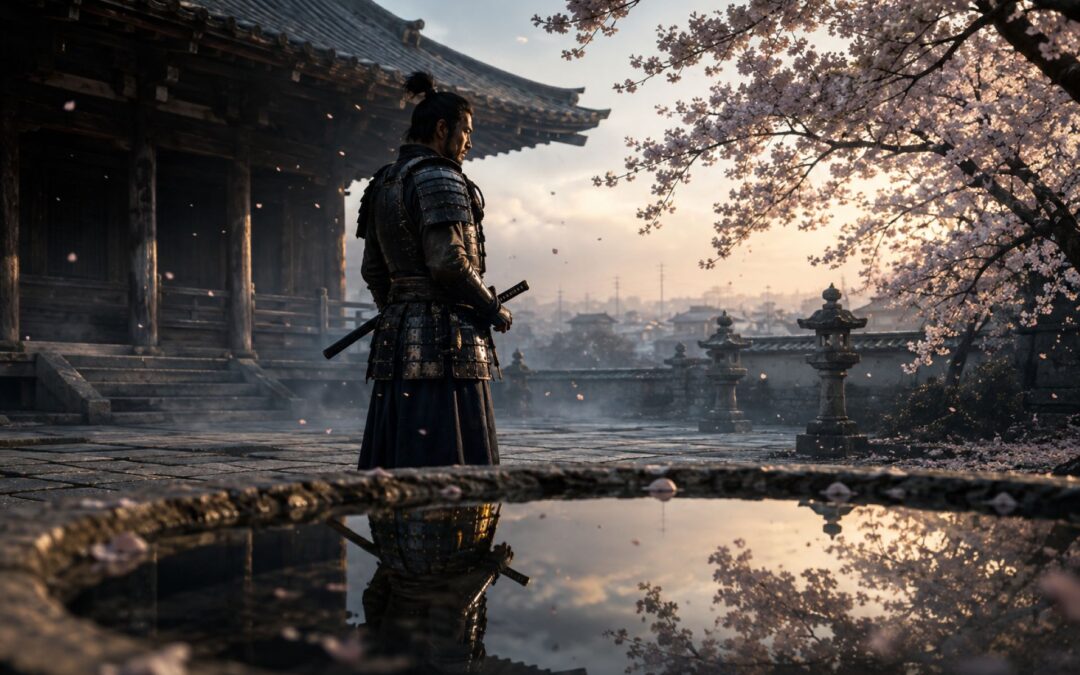
Inazo Nitobe’s Bushido: The Soul of Japan is one of the most influential attempts ever made to explain the moral ideals associated with Japan’s samurai to an English-speaking audience. First published in Philadelphia in 1900—the early edition carries an 1899 copyright notice, a distinction confirmed by the National Diet Library’s bibliographic record—the book was written at a moment when Japan was rapidly modernizing and Western readers were trying to understand a country that seemed simultaneously ancient and startlingly new. Nitobe’s response was not to write a military history of the samurai. He tried instead to identify the moral system that, in his view, had educated the Japanese conscience.
That distinction matters. Bushido is often reduced today to a list of samurai virtues such as courage, honor, loyalty, and self-control, but Nitobe’s argument is much larger. He traces an unwritten warrior ethic to Buddhism, Shinto, Confucianism, and customary feudal practice; explains how its virtues supposedly fit together; describes the education, emotional discipline, rituals, gender roles, and social institutions that sustained it; and finally argues that samurai morality spread beyond the warrior class until it helped shape Japanese national character. He then makes a surprisingly modern conclusion: Bushido as a distinct feudal system is destined to disappear, but some of its moral influence may survive after the institutions that created it are gone.
The edition followed here is Nitobe’s revised and enlarged authorial text, represented by the 1908 thirteenth edition recorded by CiNii Books as the “Author’s edition, revised and enlarged”. That matters because Nitobe expanded the work with additional illustrations while retaining its seventeen-chapter structure and fundamental argument. He also acknowledged that the organization was not exhaustive, regretting in a later preface that filial piety—one of the moral supports he regarded as nearly equal to loyalty—had never received a chapter of its own.
The most responsible way to read Bushido is therefore on two levels at once. It is an important primary document of late-Meiji Japan and an extraordinarily successful work of moral and cultural translation, but it is not a neutral transcription of a single timeless code followed uniformly by every samurai. Nitobe’s virtues have genuine connections to older warrior traditions, yet his polished synthesis makes those traditions appear more coherent, continuous, and nationally representative than modern scholarship can comfortably accept. Understanding the book means first understanding the complete system Nitobe constructs, and only then asking how closely that system corresponds to historical reality.

Why Nitobe Wrote Bushido and What He Means by the “Way of the Warrior”
Nitobe begins not with a battlefield but with a question about education. If Japanese schools did not ground morality in formal religious instruction, a European acquaintance asked him, how did Japanese people learn right from wrong? Nitobe initially had no satisfying answer. Only after reflecting on the lessons of his childhood did he decide that the moral atmosphere he had absorbed came substantially from Bushido, the ethical inheritance of Japan’s warrior class.
This personal starting point explains both the strengths and the limitations of the book. Nitobe is describing something he believes he experienced as a moral inheritance, but he is also reconstructing it retrospectively for outsiders. His audience therefore shapes everything from his vocabulary to his comparisons.
An Unwritten Code Born from the Warrior Class
In the original preface, Nitobe recalls being asked by the Belgian jurist Émile de Laveleye how morality could be taught in Japan when religion was not formally taught in schools. The question unsettled him because the moral precepts he remembered from childhood had not been presented as a systematic school subject. When he later tried to identify their source, he concluded that Bushido had supplied many of the assumptions through which he judged honorable and dishonorable conduct.
Questions from Nitobe’s American wife about Japanese customs gave the project a second impulse. Explaining particular practices repeatedly forced him back toward feudalism and the warrior ethic, until he came to believe that contemporary Japanese morality could not be understood without them. Bushido was consequently written as a bridge between societies: Nitobe would explain Japanese customs in English, drawing whenever possible on analogies Western readers already understood.
That comparative method is apparent in his translation of Bushido as something like the “Military-Knight-Ways.” European chivalry supplies the nearest conceptual parallel. Just as medieval European knights supposedly developed expectations governing courage, loyalty, courtesy, and honorable behavior, Nitobe argues that Japan’s military aristocracy developed its own customary principles.
Bushido, however, was not a written constitution. Nitobe explicitly denies that one lawgiver produced an authoritative samurai code or that a single text contained its commandments. He describes it instead as an unwritten body of moral conventions that accumulated over centuries. Particular teachers and schools could formulate parts of it, but its authority supposedly arose from custom, precedent, social expectation, and the shared moral consciousness of the warrior estate.
Its emergence is tied in Nitobe’s account to the samurai becoming a recognizable social class. Warriors had access to organized violence and possessed privileges unavailable to ordinary people. Because their occupation placed lethal power in their hands, Nitobe argues, they needed standards regulating when strength could legitimately be used. The profession of arms therefore developed an ethical dimension: a warrior was not supposed merely to be capable of violence but to know when violence was right, when restraint was honorable, and when duty justified sacrifice.
The revised-edition preface adds an important qualification to the architecture of the book. Nitobe acknowledges that he should have devoted a separate chapter to filial piety. In his moral picture, devotion to parents and family stands beside loyalty to one’s lord as a central support of Japanese ethics. Its absence from the chapter list therefore reflects the limitations of the book’s organization rather than its unimportance to Nitobe’s thought.
From this starting point, the rest of Bushido asks three linked questions. Where did this moral tradition come from? What kind of person did it try to produce? And what happened to those ideals when the feudal order disappeared? Nitobe answers the first by turning to Japan’s religious and philosophical traditions.
Buddhism, Shinto, Confucianism and the Moral Sources of Bushido
Nitobe does not claim that Bushido is itself a religion. He presents it as a practical ethical synthesis that drew selectively from several traditions and translated their teachings into the habits of the warrior class. Buddhism, Shinto, Confucianism, and later Neo-Confucian thought each supply different parts of the moral structure.
From Buddhism, and especially from the contemplative discipline he associates with Zen, Nitobe derives serenity in the face of fate. The warrior needs calmness before danger, indifference to unnecessary fear, and the ability to accept death when death cannot honorably be avoided. Zen is useful to him because it emphasizes direct inward realization rather than dependence on elaborate verbal explanation. A warrior confronted by death cannot survive psychologically if every crisis requires philosophical deliberation; his convictions must already have become character.
Shinto contributes a different cluster of values. Nitobe links it to reverence for ancestors, filial piety, loyalty to the sovereign, ritual purity, and an unusually intimate attachment to the Japanese land and imperial tradition. Within his interpretation, the individual is never entirely detached from inherited relationships. Family, ancestry, ruler, country, and sacred history overlap, making loyalty more than a contractual political obligation.
Confucianism supplies the most systematic social ethics. Nitobe appeals especially to Confucius’s teachings about properly ordered relationships—between ruler and subject, parent and child, husband and wife, elder and younger, friend and friend—and to the moral vocabulary of Mencius. These traditions allow him to portray ethical life not primarily as the assertion of individual preference but as right conduct within relationships that carry reciprocal duties.
Mencius is especially important to Nitobe’s treatment of benevolence and righteousness. Moral character requires both the ability to recognize what is right and the capacity to feel distress at the suffering of others. In that sense, the ideal warrior cannot be reduced to obedience or courage. Martial power must be domesticated by moral sentiment.
Nitobe also invokes Wang Yangming, whose thought he connects to the unity of knowledge and action. Merely knowing moral principles is worthless if they remain abstractions. True knowledge must become conduct, and moral understanding must be embodied so deeply that right action becomes almost spontaneous.
This emphasis establishes a principle that governs the rest of the book: Bushido is less interested in theoretical sophistication than in character formation. Nitobe repeatedly treats abstract knowledge as secondary to the ability to act rightly under pressure. The following chapters therefore examine not doctrines in isolation but qualities that must become habits.
The Seven Virtues at the Heart of Nitobe’s Bushido
Nitobe’s virtue chapters are often extracted from the book and converted into a neat modern checklist. That presentation is convenient but misleading. The virtues are not independent slogans. Nitobe repeatedly makes one virtue depend upon another: courage requires justice, politeness requires sincerity, honor requires restraint, and loyalty must remain answerable to conscience.
The sequence therefore describes an integrated moral personality. A warrior who possesses only courage becomes reckless; one who possesses only honor becomes touchy and violent; one who practices only courtesy becomes artificial. Bushido works, in Nitobe’s account, when its virtues correct one another.
Rectitude and Giri
Rectitude, or justice, is the foundation of Nitobe’s moral system because it determines whether every other virtue is properly directed. Courage is admirable only if the courageous act is right. Loyalty is honorable only if duty points toward a morally defensible end. Sacrifice has no intrinsic value merely because it is painful.
Nitobe defines rectitude as the power to decide upon the correct course and follow it without wavering. His ideal warrior must be able to act decisively when circumstances demand action: to strike when striking is right and, just as importantly, to accept death when dying is right. The emphasis falls on moral resolution rather than intellectual speculation.
Within this discussion appears the important concept of giri, which Nitobe translates roughly as “Right Reason” or duty. He explains it as an obligation that becomes necessary when natural affection is insufficient. A child may normally care for a parent because affection makes service natural, but giri supplies the binding reason when emotion fails. Duty ensures that morally required relationships cannot be abandoned whenever inclination changes.
Nitobe nevertheless recognizes that giri can deteriorate. What begins as rational moral obligation can harden into conventional pressure: one acts because society expects it, because shame threatens, or because disobedience will produce criticism. At that point duty can become an excuse for cruelty or casuistry. Nitobe’s willingness to acknowledge this corruption is important because later chapters repeatedly dramatize situations in which obligation demands terrible sacrifice.
Rectitude therefore supplies more than obedience. It is supposed to provide the moral criterion by which obligation itself is judged. Whether Nitobe consistently succeeds in maintaining that distinction becomes one of the book’s central problems.
Courage and Composure
Once rectitude has established what ought to be done, courage supplies the ability to do it. Nitobe is explicit that boldness without justice is not genuine courage. Recklessness, pointless risk, and theatrical self-destruction may look brave, but they lack moral value if the action itself is wrong.
He describes samurai education as deliberately cultivating familiarity with hardship. Children might be exposed to cold, hunger, difficult journeys, frightening places, stories of heroic endurance, or scenes associated with punishment and death. The purpose, in Nitobe’s account, was not cruelty for its own sake but the destruction of panic. Danger had to become something the future warrior could confront without losing control of judgment.
The highest courage therefore appears as composure. Nitobe admires the warrior who remains capable of wit, poetry, aesthetic appreciation, or clear thought when death is near. He recounts martial encounters in which opponents exchange verses or display intellectual presence of mind even in the middle of violence. Physical courage becomes inseparable from mastery of the self.
One story concerns a defeated warrior named Sadato, pursued by Yoshiie. When Yoshiie taunts him through an improvised poetic line, Sadato immediately completes the verse despite the danger. Yoshiie is so impressed by his enemy’s composure that he allows him to escape. Nitobe’s point is that courage is measured not only by attacking an enemy but by preserving mental dignity under extreme pressure.
The same moral elevation appears in the story of Uesugi Kenshin and his rival Takeda Shingen. When another power tries to weaken Shingen by cutting off his access to salt, Kenshin refuses to exploit the deprivation and supplies his enemy instead. Warfare, he insists, should be fought with the sword rather than by manipulating basic necessities. Whether every detail of such exempla can be treated as straightforward history is less important to Nitobe than the ethical type they construct: the worthy warrior wants a worthy enemy and refuses victories he regards as base.
At this point courage begins to merge into benevolence. Strength at its highest, Nitobe suggests, does not delight in another person’s helplessness.
Benevolence and Mercy
Benevolence is one of the most important correctives to the stereotype of Bushido as an ethic of hardness. Nitobe presents mercy, sympathy, love, and the ability to feel another person’s suffering as among the noblest qualities available to a powerful person. The stronger one’s authority, the more necessary compassion becomes.
Confucius and Mencius provide much of the philosophical language for this chapter. Nitobe treats benevolence as a princely virtue because rulers require something more than coercion if power is to become morally legitimate. Authority without humane feeling degenerates into domination.
The chapter’s most memorable illustration comes from the story of Kumagai Naozane and a young enemy warrior. Kumagai defeats the youth and prepares to kill him, but the sight of his face reminds him of his own son. He considers sparing him. Yet the surrounding battlefield makes escape almost impossible, and other warriors will kill the young man if Kumagai releases him.
Kumagai ultimately kills him himself, but the act devastates him. Nitobe uses the story to show the awakening of compassion inside the warrior’s profession and connects that awakening to Kumagai’s later renunciation of warfare and religious life. The episode matters because it does not make violence painless simply by calling it duty. The moral cost survives the act.
Nitobe consequently values music, poetry, beauty, and cultivated feeling as restraints upon brutality. A warrior who can appreciate tenderness is less likely, in his idealized picture, to become merely a technician of violence. Refinement does not weaken courage; it prevents courage from becoming cruelty.
There is a political idealization embedded here as well. Nitobe sometimes treats paternal benevolence as evidence that feudal authority could differ fundamentally from despotism. That inference is much harder to defend historically than the ethical principle beneath it. His moral claim—that power should be restrained by concern for the vulnerable—is stronger than his tendency to generalize from that ideal to the character of feudal government.
Politeness and the Discipline of Form
Politeness follows naturally from benevolence because genuine courtesy should express consideration for another person’s feelings. Nitobe has little interest in etiquette that exists merely to display refinement. If external form has no moral intention behind it, politeness becomes artificial.
At its best, etiquette trains people to inhabit social situations without imposing unnecessary discomfort on others. Posture, gestures, ways of sitting, bowing, receiving guests, exchanging gifts, and regulating one’s physical movements all become small disciplines of self-command. Nitobe sees this not as superficial ornament but as a means by which moral consideration becomes habitual.
The tea ceremony offers his richest example. Its carefully controlled movements cultivate concentration, harmony, economy, and composure. The participant learns to perform ordinary actions without waste or agitation. Physical grace and ethical discipline become mutually reinforcing.
Nitobe also interprets seemingly strange gift conventions through this logic. A person may belittle a gift not because the object is worthless but because elevating it too highly could imply that the recipient is being repaid or placed under obligation. What appears linguistically self-deprecating can therefore be intended as a form of consideration.
Yet Nitobe repeatedly warns that form can survive after spirit disappears. When etiquette becomes an end in itself, it produces pedantry rather than virtue. That warning prepares the transition to truthfulness: outward grace is morally worthless if it conceals insincerity.
Veracity and Sincerity
The warrior’s word, in Nitobe’s idealized account, derives authority from character rather than legal enforcement. A promise should not require elaborate documentation if the person making it is known to value honor. To demand excessive guarantees may even suggest distrust.
Nitobe distinguishes this ideal of sincerity from literalism about every social expression. Polite conventions can involve forms of speech that are not meant as empirical propositions. What matters ethically is whether a person is deliberately deceiving another for selfish advantage.
The chapter then makes an important and sometimes forgotten turn toward commerce. Nitobe describes the low status traditionally assigned to merchants within the old social hierarchy and suggests that contempt for commercial calculation contributed to difficulties when former samurai entered business after the feudal order collapsed. Men educated to despise money-making could possess courage and honor yet lack the habits required for successful trade.
The argument becomes broader when Nitobe contrasts intrinsic and utilitarian honesty. He dislikes the idea that honesty should be recommended merely because “honesty pays.” If truthfulness is practiced only because it produces profit, it ceases to be a moral virtue and becomes a technique.
This position captures both Nitobe’s strength and his tendency toward sweeping social generalization. His insistence that honesty should not depend solely on economic reward is philosophically clear, but his comments about merchants and class morality often move too quickly from normative ideals to historical claims about whole groups of people.
Honor and Shame
Honor gives Bushido much of its emotional force. Nitobe describes it as consciousness of personal dignity and the value attached to one’s name. To disgrace oneself is not merely to lose social approval; it is to become unworthy of the moral identity one claims.
Shame therefore becomes an instrument of education. Children learn that cowardice, disloyalty, dishonesty, and uncontrolled conduct dishonor both the individual and the family name. Reputation motivates endurance when immediate comfort points in the opposite direction.
Nitobe knows, however, that honor culture can become pathological. Excessive sensitivity to insult produces quarrels, vanity, and violence. A person who interprets every slight as an attack on dignity may be controlled by pride rather than honor.
The true corrective is patience. The person of genuine honor can endure provocation when retaliation would be foolish or unjust. Self-command becomes evidence of greater dignity than impulsive aggression.
This tension becomes crucial because Nitobe also portrays honor as more valuable than material gain and, under some circumstances, life itself. A culture capable of teaching that disgrace is worse than death can generate extraordinary courage, but it can also produce destructive social pressure. The next chapter intensifies that dilemma by adding loyalty.
Loyalty, Duty and Conscience
Loyalty is the point at which Nitobe believes Japanese feudal morality diverges most sharply from modern Western individualism. The individual does not stand alone as the fundamental moral unit. Family, lord, community, and polity place obligations upon a person that can outweigh private preference.
Nitobe dramatizes the severity of this idea through stories in which family members are sacrificed for duty. One of the most disturbing concerns Michizane, a disgraced statesman whose enemies seek his young son. The boy is hidden in a school run by Genzo, a former retainer. When authorities demand the child’s head, another family knowingly allows its own son to become the substitute.
The episode is meant to represent loyalty so deep that a family’s private attachment is subordinated to inherited obligation. Nitobe anticipates the horror such a story will provoke and compares the sacrifice to religious narratives in which obedience to a higher command overcomes ordinary affection. His explanation makes the ethical logic comprehensible without making the act morally comfortable.
He also uses the conflict of Shigemori, torn between loyalty to his father and duty to the sovereign, to show that loyalties can collide. Bushido is not therefore a system in which every obligation points in the same direction. Moral life can become tragic precisely because honorable duties compete.
Nitobe’s political assumptions are unmistakably hierarchical. He regards the family and the political community as prior to the isolated individual, and feudal loyalty receives a dignity difficult to reconcile with modern democratic ideas of personal autonomy. Yet he explicitly rejects the reduction of loyalty to servility.
A worthy retainer should not flatter an unjust lord. He should remonstrate, reason, and try to turn his superior back toward the right course. In the most extreme cases, the loyal subject may demonstrate sincerity through personal sacrifice rather than participate in wrongdoing.
That qualification is vital. Nitobe wants loyalty to remain subordinate to rectitude and conscience, just as courage is subordinate to justice. Whether a social order built on inherited hierarchy can reliably preserve that freedom of conscience is another question, but his own ethical ideal does not simply equate obedience with virtue.
How a Samurai Is Made: Education and Self-Control
After describing the virtues themselves, Nitobe turns to formation. How does a child become the kind of adult capable of acting with rectitude, courage, benevolence, honor, and loyalty when those ideals become painful? His answer is that moral character must be trained long before crisis arrives.
This section of the book is important because it reveals that Bushido, as Nitobe conceives it, is not primarily a set of beliefs. It is a program for creating habits of body, judgment, and emotion.
Education for Character and Action
The central aim of samurai education is character. Nitobe does not deny the usefulness of intellectual knowledge, but he repeatedly subordinates learning to practical moral formation. Knowing what courage means is less important than becoming capable of courage when fear arrives.
He condenses the warrior’s most important intellectual-moral equipment into wisdom, benevolence, and courage. Training traditionally includes fencing, archery, horsemanship, use of the spear, martial tactics, jiujutsu or related disciplines, calligraphy, ethical teaching, literature, and history. Physical, aesthetic, and moral education are interwoven because the ideal warrior is not merely a fighter.
Nitobe’s account gives less prestige to abstract calculation and certain forms of theoretical study. Mathematics and purely speculative learning do not occupy the central place they would in a modern academic curriculum. He is especially suspicious of knowledge that never becomes conduct.
Money receives similar suspicion. The honorable warrior should not organize life entirely around profit, and Nitobe admires a kind of disciplined poverty in which material desire remains subordinate to character. Such values help explain why he later thinks samurai entering commerce could find themselves maladapted to business.
The teacher, meanwhile, is more than a seller of information. Because education concerns the formation of the whole person, Nitobe treats teaching as a moral vocation. The authority of the teacher depends on character worthy of imitation, not merely expertise.
This conception of education helps explain the coherence of the preceding chapters. Bushido cannot function if virtues remain theories remembered during leisure. They must be trained through repeated conduct until action under pressure becomes an expression of character.
Self-Control and the Discipline of Emotion
Self-control is the emotional technology that makes this character possible. Nitobe portrays the samurai as learning to restrain visible displays of grief, fear, anger, affection, and excitement. The ideal is not necessarily to cease feeling but to prevent feeling from taking command.
Farewells can therefore be understated even when separation is painful. Grief may be concealed to avoid burdening others or compromising dignity. Anger may be hidden behind calmness, and laughter can sometimes function as a mask for distress.
Silence has particular importance in Nitobe’s moral vocabulary. Sincerity does not always require verbal expression. Deep feeling can be rendered less authentic by excessive display, while restraint can signify that emotion is too serious to theatricalize.
Poetry offers a culturally acceptable release. Feelings that cannot be proclaimed directly can be transformed into verse, allowing emotional expression without surrendering composure. This is one reason Nitobe repeatedly links martial culture to aesthetic cultivation rather than treating the warrior as emotionally primitive.
He is not completely blind to the dangers of this discipline. Excessive repression can create artificiality, hypocrisy, or psychological distortion. A person who has learned never to display pain may become incapable of healthy expression. Nitobe’s preferred outcome is therefore equanimity rather than numbness: emotion remains present, but judgment governs its outward form.
That distinction becomes essential in the following chapters, where warriors confront situations involving death, vengeance, and lethal weapons. Without self-control, the institutions Nitobe describes would look like uncontrolled violence. Within his system, they are supposed to represent the opposite: ritualized conduct governed by moral discipline.
Death, Revenge and the Sword
The darkest and most famous parts of Bushido concern death. Nitobe knows that practices such as seppuku and blood revenge fascinate Western readers, and he tries to explain them from within the moral universe that made them intelligible. His purpose is not merely to describe procedures but to connect them to honor, loyalty, courage, sincerity, and self-command.
Yet these chapters also expose the risks built into an ethic that places enormous value on reputation and sacrificial duty. Nitobe sometimes admires the composure with which death is faced while simultaneously acknowledging that death can be sought too easily.
Seppuku, Redress and the Limits of Honor
Nitobe begins his discussion of seppuku with the symbolism of the abdomen. In the cultural explanations available to him, the belly could be imagined as the seat of emotion, courage, or inner sincerity. Opening the abdomen therefore acquired symbolic meaning: the person dying exposed the interior self as proof that nothing dishonorable was being concealed.
Seppuku, as Nitobe presents it, was not one single kind of act. It might be imposed as punishment, chosen to preserve honor, performed as an apology, used to expiate failure, offered as protest, or embraced as proof of loyalty. Because the samurai was allowed to die by his own hand under formal circumstances, the ritual could also mark social distinction from ordinary execution.
Nitobe’s most detailed example is the ceremonial death of Taki Zenzaburo, described through an eyewitness account by A. B. Mitford. Taki had been ordered to die after assuming responsibility for an attack on foreigners at Kobe. The account emphasizes preparation, witnesses, ritual form, the presentation of the blade, the role of the second, and above all the condemned man’s composure.
The horror of the physical act is inseparable from Nitobe’s admiration for the emotional discipline surrounding it. The ritual is meaningful to him because the warrior supposedly approaches death deliberately rather than collapsing into panic. Courage, honor, and self-control converge.
Other examples make the social dimensions even more disturbing. Nitobe recounts cases in which younger participants absorb the expectation of honorable death from their elders. The practice is therefore not merely an individual philosophical decision. It can be reproduced by education, family pressure, and collective ideas about shame.
Nitobe nevertheless insists that Bushido does not make every suicide honorable. He criticizes the tendency to treat death itself as impressive and argues that living can require more courage than dying. A warrior should not escape difficulty through dramatic self-destruction when duty requires endurance.
That caveat prevents the chapter from becoming a simple celebration of suicide, but it does not eliminate the moral danger. Once honor can justify self-killing, the line between principled sacrifice and socially coerced death becomes extremely unstable. Nitobe recognizes the possibility without fully resolving it.
The chapter then turns from suicide to revenge, or redress. In a society where state institutions did not exercise an exclusive and reliable monopoly over justice, private vengeance could appear as a means of restoring a violated moral order. An injury to one’s lord or family could create an obligation that law alone did not satisfy.
The Forty-Seven Rōnin embody this logic. Their revenge for their lord became a celebrated demonstration of loyalty even though established authority ultimately required punishment. The episode reveals a recurring conflict in Bushido: public law, personal loyalty, and moral sentiment do not always coincide.
Nitobe views such practices as historically conditioned rather than eternally necessary. Once modern legal institutions provide mechanisms for punishment and redress, private vengeance loses its legitimate function. In that sense, Bushido is not simply nostalgic. It repeatedly suggests that institutions appropriate to feudal society can become obsolete even when some of the virtues associated with them survive.
The same applies to seppuku. Nitobe can admire courage and sincerity without insisting that the physical institution should continue. This distinction between enduring virtue and disappearing practice becomes increasingly important as the book approaches its conclusion.
The Sword as Symbol, Temptation and Restraint
The sword seems at first to represent the most obvious essence of the samurai. Nitobe describes its place in childhood initiation, social status, household display, artistic craftsmanship, and warrior identity. The paired swords signify that their wearer belongs to a class entrusted with violence.
Swordsmithing itself acquires an almost sacred quality in his description. The smith purifies himself, approaches the forge with seriousness, and produces an object whose value is simultaneously practical, artistic, and symbolic. The blade embodies history, skill, beauty, danger, and responsibility.
Yet Nitobe turns the symbol against the crude interpretation it might invite. Because the sword grants power, the warrior must become less eager to use it. Drawing a weapon over trivial insults reveals weakness of character rather than strength.
Katsu Kaishū serves as one of Nitobe’s preferred examples. Living through periods of intense political violence, Katsu becomes admirable not because he kills more effectively than others but because he avoids killing whenever possible. Mastery of violence reaches its highest form when violent capacity can remain unused.
The chapter therefore completes a paradox already visible in courage and benevolence. The warrior’s ethical development does not culminate in maximum aggression. It culminates in disciplined restraint. The sword is the “soul” of the samurai only if the person carrying it has learned that possessing force does not grant moral permission to use it casually.
Women Under the Bushido Ideal
Nitobe’s chapter on women is indispensable because it reveals that his Bushido is not merely a code for male fighters. It is a vision of an entire social order in which men and women are trained differently but both are expected to practice discipline, loyalty, sacrifice, and control of the self. The chapter also contains some of the book’s clearest limitations when judged against modern ideas of equality and personal autonomy.
Women of samurai families, in Nitobe’s account, could receive martial instruction. Weapons such as the naginata were associated with household defense, and women might learn enough martial skill to protect themselves, their families, or the home when male warriors were absent. This training complicates any simplistic picture of samurai women as entirely passive.
At the same time, martial education remains bounded by an ethic of chastity and family honor. Nitobe discusses the dagger not only as a defensive weapon but as a means by which a woman might take her own life if she believed sexual violation or dishonor had become unavoidable. The same honor culture that makes death preferable to disgrace for male warriors is therefore extended into female life through a specifically gendered concern with sexual purity.
Girls also receive education in music, literature, dance, etiquette, household management, and aesthetic accomplishment. Nitobe does not portray women as intellectually irrelevant. Their training is intended to prepare them for a morally serious role within the family.
The problem lies in the direction of that seriousness. The ideal woman is expected to subordinate herself to a network of obligations centered on father, husband, children, and household. Her virtue is repeatedly demonstrated through the capacity to sacrifice personal desire for the family just as the male retainer sacrifices himself for his lord.
Nitobe tries to defend this arrangement through an idea resembling complementary roles. Men and women contribute differently to the same social organism, and the woman’s “inner” domestic position is not, in his view, reducible to worthlessness. Household influence, maternal education, and moral support can carry great responsibility.
Yet difference in role is not equivalent to equality of power. Nitobe’s argument leaves women structurally subordinate in public and marital life, and the stories he admires sometimes make self-erasure itself a virtue. The possibility that a moral system can ask too much sacrifice from those with less power is never confronted as fully as it should be.
The chapter is therefore valuable precisely because it should not be removed from modern summaries. Leaving it out produces a more attractive but less truthful version of Nitobe’s Bushido. His moral system contains genuine respect for women’s courage and intelligence alongside patriarchal assumptions that sharply limit female autonomy.
It also shows how deeply the virtues of Bushido depend on hierarchy. Loyalty, honor, self-control, and sacrifice are not simply personal virtues chosen in isolation. They arise within social structures that tell people whom they owe, what they must protect, and which parts of themselves may be surrendered for others.
From Samurai Ethics to the “Soul of Japan”
The final three chapters make the book’s boldest move. Nitobe has spent most of Bushido describing the ideals of a warrior class, but his title promises something larger: the “Soul of Japan.” He therefore has to explain how a minority estate’s ethics became, in his interpretation, characteristics of an entire people.
His answer is cultural diffusion. Samurai ideals spread through stories, heroes, education, manners, popular performance, politics, and inherited habits until people who were not warriors could nonetheless admire or reproduce warrior virtues. This claim allows Nitobe to transform a class ethic into a theory of national character, but it is also where his generalizations become most historically vulnerable.
Bushido’s Influence on the Nation
Nitobe argues that the samurai functioned as models long after their numerical minority should have limited their direct influence. Heroic stories carried their values outward. Figures such as Yoshitsune and Benkei, the Soga brothers, Nobunaga, and Hideyoshi became familiar through legend, drama, storytelling, and popular memory.
Even children’s culture participates in this transmission. Momotarō, the heroic Peach Boy of folklore, embodies courage, loyalty, adventurousness, and disciplined action in a form available to ordinary families. Ethical ideals therefore spread not through formal philosophical instruction alone but through stories that make certain kinds of behavior admirable.
Nitobe also points to figures outside the formal samurai estate who imitate warrior ideals. Popular champions and otoko-date, men celebrated as defenders of ordinary people, suggest that martial values can migrate across social boundaries. Bushido becomes less the property of a legal class and more a repertoire of recognizable virtues.
This process culminates in Nitobe’s use of Yamato-damashii, the “spirit of Japan.” The language marks an enormous conceptual expansion. Qualities associated with the samurai are no longer merely occupational ethics; they become part of how Nitobe explains Japanese national character.
The cherry blossom becomes the book’s defining symbol for this transformation. Nitobe sees in it beauty, delicacy, impermanence, naturalness, and a willingness to fall at the height of life. Those qualities become an aesthetic metaphor for the warrior who does not cling fearfully to existence.
The symbol is powerful because it fuses ethics and beauty. Death is not presented solely as grim obligation but through an image of transience that is already culturally resonant. Yet the same symbol can romanticize sacrifice if detached from Nitobe’s repeated insistence that death must have a legitimate moral purpose.
More importantly, the chapter’s national claim is much broader than its evidence. Showing that warrior stories influenced popular culture does not demonstrate that one samurai ethic became the psychological essence of all Japanese people. Nitobe’s explanation is meaningful as an account of cultural influence, but much less secure as a theory of national uniformity.
Is Bushido Still Alive?
By Nitobe’s time, the political order that produced the samurai has disappeared. The formal status system has been dismantled, Japan has built modern institutions, and Western technologies and ideas have entered everyday life. Nitobe therefore asks whether Bushido has died with feudalism.
His answer is that it remains alive precisely because much of its influence has become unconscious. People may no longer identify an action as “Bushido” while still responding to older ideas of loyalty, honor, endurance, courage, and shame. The ethical vocabulary survives beneath modern institutions.
Nitobe attributes aspects of Meiji modernization and public conduct to this inheritance. Japan’s desire to gain international respect, its rapid adoption of foreign knowledge, patriotic energy, physical endurance, military courage, and sensitivity to national honor are all connected in his interpretation to Bushido.
The argument is revealing because modernization does not appear as the simple replacement of Japan by the West. Nitobe wants to show that Japanese people could adopt Western technology and institutions for indigenous reasons. National honor itself could motivate modernization: mastering foreign methods becomes a way of refusing humiliation and proving equality.
He also admits that Bushido’s legacy includes defects. An exaggerated concern for honor can become hypersensitivity. Pride can become conceit. The old educational system’s indifference to metaphysical speculation, he suggests, may have limited Japanese achievement in certain forms of abstract philosophy.
The shosei, or student, appears as a surviving fragment of the warrior type: poor, ambitious, intellectually restless, disdainful of material comfort, full of national feeling, and sometimes self-important. Nitobe sees both virtue and absurdity in the figure, which makes the example more psychologically interesting than simple praise.
His discussion of Christian missionaries reveals another purpose of the whole book. Nitobe is himself Christian, but he criticizes missionaries who approach Japan as though the country possessed no moral inheritance before Christianity arrived. Religious teaching, he argues, will fail if it contemptuously ignores the ethical vocabulary through which Japanese people already understand duty and loyalty.
A Christian appeal framed in familiar moral concepts may be powerful where imported terminology is not. Nitobe’s aim is therefore partly conciliatory: Christianity and Japanese inherited morality need not begin as enemies. Yet Christianity should not imagine that moral seriousness entered Japan from outside.
The Future of Bushido
The final chapter is more ambivalent than the book’s reputation might suggest. Nitobe does not predict the triumphant restoration of feudal warrior ethics. He predicts their decline.
The social institutions that produced Bushido are disappearing. Hereditary status has been dismantled, modern law has replaced private vengeance, industry changes the organization of life, democratic tendencies weaken inherited hierarchy, and modern warfare transforms the practical meaning of individual martial skill. A code built for a feudal warrior class cannot remain unchanged when that class no longer exists.
Nitobe’s chronology is sometimes loose, and modern readers should not rely on him for exact dating. One consequential example concerns sword-wearing: the formal Haitōrei restricting the ordinary public wearing of swords was issued in 1876, as recorded in the National Diet Library’s legal documentation of the March 28 proclamation, rather than following the simplified sequence Nitobe sometimes implies.
The deeper argument, however, is not dependent on those details. Nitobe believes the age of a primarily martial ethic is ending. The fighting instinct that once had social value must increasingly be subordinated to broader humanity, compassion, and love.
Christianity appears as one possible source of future moral development, while materialism and utilitarian modernity represent another powerful force. Yet Nitobe does not think Japan can simply discard inherited moral habits and import a complete new ethical system. New forms must grow through continuity with what people already recognize.
This leads to the book’s final distinction between an institution and its legacy. Bushido may disappear as a named code, just as Stoicism disappeared as an organized ancient school while Stoic ideas continued to shape people who did not call themselves Stoics. The structure dies before all of its values do.
Nitobe returns to the cherry blossom for his concluding image. The flower falls, but its fragrance remains in the air. Bushido’s feudal form may vanish, yet courage, loyalty, integrity, endurance, courtesy, and self-command may continue after the warrior estate itself has become history.
That ending prevents Bushido from being merely nostalgic. Nitobe is trying to preserve moral inheritance without claiming that the society that created it can or should be restored intact. The question left for the modern reader is whether the inheritance he describes was ever as unified as he assumes.
What Kind of Bushido Has Nitobe Actually Described?
Once Nitobe’s complete argument is visible, the historical problem becomes unavoidable. He writes as though an unwritten but recognizable Bushido gradually developed among warriors, became culturally authoritative, and eventually permeated the nation. Modern historians have challenged the coherence and antiquity of that picture.
The most useful interpretation avoids two easy conclusions. Nitobe did not simply discover and transcribe one ancient samurai constitution, but neither did he invent every value in the book without precedent. His Bushido is better understood as a late-Meiji synthesis: older warrior ideals are selected, harmonized, compared with Western moral traditions, and reorganized into a system suited to the questions of his own age.
Ethical Synthesis or Historical Code?
The central historical difficulty is diversity. Japan’s warrior class existed over many centuries, under changing political systems, military conditions, religious influences, economic arrangements, and local traditions. It would be surprising if warriors separated by hundreds of years all followed one stable ethical system in precisely Nitobe’s sense.
Oleg Benesch’s influential history of modern bushidō places much greater emphasis on the late nineteenth century. Rather than treating modern Bushido discourse as the straightforward survival of a single medieval code, Benesch shows how ideas of warrior morality were reorganized during Japan’s modernization, nationalism, and encounter with international models of chivalry and gentlemanly conduct.
This does not mean that premodern warriors lacked ethical traditions. Loyalty, martial courage, honor, discipline, preparedness for death, filial obligation, sincerity, and various forms of self-control appear in texts and practices long before Nitobe. The stronger criticism is that those ideas did not necessarily form one universally named and universally accepted system equivalent to the Bushido Nitobe presents.
Christian Etzrodt’s comparative study of twenty-nine premodern warrior texts makes the corrective especially useful. Etzrodt finds substantial precedents for many of the values Nitobe selects, undermining the crudest claim that Nitobe simply fabricated samurai ethics from Western chivalry. At the same time, the comparison makes the diversity and unevenness of earlier warrior ideals difficult to ignore.
The question therefore changes. Instead of asking whether Bushido was “real” or “invented,” it is more productive to ask what level of reality is being discussed. Individual virtues and moral expectations can be historically real without forming one continuous, internally consistent code. Later thinkers can also assemble genuine older elements into a new synthesis that acquires influence precisely because it appears ancient and coherent.
Nitobe’s own language encourages the problem because he moves easily between normative and descriptive claims. Sometimes he explains what a samurai ought to have been. At other moments he speaks as though the ideal describes what the warrior class generally was. A moral exemplum then begins doing the work of social history.
His evidence reinforces the effect. Stories of heroic warriors, literary episodes, maxims, personal memories, religious ideas, and famous anecdotes demonstrate what people admired, but admiration is not identical to ordinary behavior. A culture can praise absolute loyalty precisely because actual loyalty is difficult and frequently violated.
The same distinction applies to seppuku, benevolent government, restraint with the sword, treatment of enemies, and female sacrifice. Nitobe’s examples reveal a moral imagination and a repertoire of ideals. They cannot by themselves establish the frequency, uniformity, or social representativeness of those ideals.
The fairest description is therefore that Nitobe writes a philosophically organized portrait of exemplary warrior morality. It contains authentic historical materials but arranges them into a unity that belongs partly to his own interpretive project. Read in that way, the book becomes more interesting rather than less: it tells us both about inherited samurai ideals and about the kind of moral identity educated Japanese thinkers wanted to articulate during the Meiji era.
Chivalry, Christianity and Cross-Cultural Translation
Nitobe’s comparative method is impossible to separate from his biography. Born into a former samurai family, educated extensively in both Japan and the West, and converted to Quaker Christianity, he occupied an unusual intellectual position between cultural traditions. The National Diet Library’s biographical profile of Nitobe captures the combination of Japanese elite background, Western education, Christian affiliation, educational work, and later international activity that made such mediation central to his life.
His Western comparisons are therefore not decorative references added to impress readers. They are the mechanism through which the book communicates. “Bushido” becomes understandable through “chivalry.” Mencius can be introduced beside European philosophers. Japanese loyalty can be compared with biblical sacrifice. Samurai self-control can be illuminated through classical and literary parallels familiar to English-speaking readers.
The technique makes the book remarkably accessible. A Western reader who knows almost nothing about Japanese intellectual history is repeatedly given a conceptual bridge. Nitobe effectively says: you already possess categories through which courage, knighthood, sacrifice, honor, and moral formation make sense; Japanese civilization possesses analogous moral languages of its own.
That rhetorical strategy also has a political dimension. A recent study in Global Studies Quarterly interprets Nitobe’s comparative writing within a broader effort to establish Japan’s cultural and moral commensurability with Western powers in an international order structured by racial hierarchy. Read from that perspective, Nitobe is not merely explaining etiquette. He is participating in a larger argument that Japan belongs among civilizations capable of producing sophisticated ethical traditions.
The claim fits the emotional logic of Bushido. Nitobe repeatedly resists the assumption that Christianity gave the West morality while Japan merely possessed customs. By setting Confucius beside classical philosophers and samurai beside knights, he denies Western civilization a monopoly on ethical seriousness.
Yet analogy can clarify and distort at the same time. Calling Bushido Japanese chivalry may help readers imagine an aristocratic martial ethos, but it also encourages them to assume historical equivalences that do not necessarily exist. European knighthood itself was diverse, and neither tradition can be reduced to the romantic ideal later associated with it.
Christianity creates a similar tension. Nitobe is unusually open about his faith, and Christian language supplies some of his strongest comparisons. This does not make the book a disguised missionary tract; he frequently criticizes missionaries for misunderstanding Japan. But his theological background does influence which Japanese ideas appear morally important and how easily he organizes them into a universal language of virtue.
The result is one of the book’s greatest achievements and one of its greatest sources of distortion. Nitobe makes Japanese ethical ideas legible across cultures precisely by translating them into categories shaped by his own hybrid intellectual world.
National Character and Meiji Japan
The move from warrior ethics to national character is even more consequential. A samurai tradition can be historically complex without requiring a theory of the Japanese soul. Nitobe, however, wants to explain the morality of modern Japan, so he must show how the values of one class came to influence people far beyond it.
His mechanism—cultural prestige—is plausible in principle. Elite values often spread through education, literature, ceremony, political institutions, theater, folklore, and imitation. Samurai dominated Japanese political life for centuries, so it would be surprising if warrior culture had no influence outside the warrior estate.
Nitobe’s examples of heroic stories, children’s tales, social manners, and popular models make this argument vivid. The difficulty appears when influence becomes essence. “Warrior values affected Japanese culture” is a much narrower historical proposition than “Bushido explains the Japanese national character.”
The Meiji context helps explain why the broader formulation was attractive. Japan had undergone extraordinary political and institutional transformation while confronting a world order dominated by Western imperial powers. Intellectuals faced a double problem: how could Japan modernize without appearing culturally derivative, and how could it describe a distinctive national identity without rejecting modernity?
Bushido offered Nitobe an elegant answer. Modern Japan could adopt foreign science, technology, law, and institutions while retaining an indigenous moral foundation. The country could become modern without becoming culturally empty because its ethical energy came from inherited character.
That argument also explains the book’s international appeal. A Western audience curious about Japan receives a moral key that appears to make everything from courtesy to patriotism intelligible. A heterogeneous modern society becomes narratively coherent.
The cost of that coherence is essentialism. Japan contained peasants, merchants, artisans, religious communities, regional cultures, women living under very different conditions, and many people with little direct connection to samurai life. Their moral worlds cannot simply be absorbed into warrior identity.
Nitobe’s “Soul of Japan” should therefore be read as a powerful late-Meiji interpretation rather than an anthropological fact. It reveals an effort to construct continuity between feudal past and modern nation. That effort itself is historically significant even when its claims are too sweeping.
The Book’s Moral Tensions: Hierarchy, Violence and Gender
Nitobe’s Bushido is compelling partly because its virtues seem to restrain one another. Rectitude restrains courage, benevolence restrains power, sincerity gives substance to politeness, patience restrains honor, and conscience supposedly restrains loyalty. The system is therefore more morally sophisticated than a simple celebration of martial obedience.
Its hardest problems arise where those restraints are weakest. Three tensions recur across the book: whether conscience can remain independent inside hierarchical loyalty, whether an honor culture can praise death without coercing people toward it, and whether a social system built on sacrifice can distribute that burden justly between men and women.
Loyalty and Conscience
Nitobe’s insistence that loyalty is not servility deserves to be taken seriously. He does not admire the retainer who agrees with everything his lord says. Genuine loyalty may require opposition, remonstrance, and personal risk.
This preserves a space for rectitude above authority. If the lord commands something wrong, the subordinate should try to correct him rather than redefine wrong as right. The ethical hierarchy therefore places conscience above mere obedience even when the social hierarchy places lord above retainer.
The problem is practical rather than purely logical. In a system where social identity, livelihood, family status, honor, and political authority all reinforce loyalty, how independent can conscience remain? The retainer may possess the theoretical right to resist while facing enormous pressure not to exercise it.
Nitobe’s favorite solution is self-sacrificial remonstrance. The subject demonstrates loyalty by risking or surrendering himself in an attempt to reform the superior. This preserves moral independence but does so through an ethic that once again places the burden on the subordinate.
Modern political morality offers alternatives that Nitobe’s framework cannot fully imagine: institutional checks, legal accountability, rights independent of status, and the legitimacy of simply refusing wrongful authority without proving sincerity through suffering. His treatment remains morally serious, but the available mechanisms are constrained by feudal assumptions.
The same tension appears in family loyalty. Nitobe’s stories sometimes demand that affection submit to inherited duty. Such examples can illustrate extraordinary commitment, but they also reveal how easily hierarchy can convert virtue into coercion.
His greatest success is recognizing the problem at all. A less sophisticated defense of Bushido could simply call obedience noble. Nitobe instead spends considerable effort distinguishing loyalty from flattery, which shows that the danger of servility was visible from inside the moral tradition he admired.
Honor, Seppuku and the Ethics of Death
The treatment of death contains a similar contradiction. Nitobe wants the warrior to overcome the fear that makes a person betray conscience merely to survive. That ideal can be admirable. Many ethical traditions recognize that some things matter more than physical safety.
But a culture that repeatedly teaches that death is preferable to dishonor also creates powerful mechanisms of shame. The individual may no longer be choosing between life and principle freely. He may be choosing between death and social annihilation.
Nitobe’s insistence that unnecessary suicide is foolish helps but does not solve the problem. The question simply moves to who decides when death is “necessary” or honorable. A person immersed from childhood in an honor culture may experience social expectation as conscience.
Seppuku illustrates both the attraction and danger of ritualization. Formal procedure can transform panic into composure and give a condemned or disgraced person some control over the manner of death. Yet ceremony can also dignify an act so strongly that the social pressure behind it disappears from view.
The same ambiguity applies to revenge. Vengeance can appear morally intelligible in a weak legal order where no institution will answer serious wrongdoing. Once reliable public justice exists, however, private retaliation becomes harder to defend. Nitobe himself recognizes this historical transition.
His chapter on the sword offers perhaps the strongest internal correction. The person truly worthy of carrying lethal power is the one least eager to use it. Violence becomes evidence of virtue only under strict moral necessity, and restraint becomes a higher achievement than aggression.
That makes Bushido more complex than later caricatures in which the samurai longs perpetually for death. Nitobe admires the capacity to face death, not indiscriminate death-seeking. Even so, his aesthetic language around sacrifice and composure sometimes makes lethal practices appear nobler than a modern ethical account should permit without stronger scrutiny.
Women, Domesticity and Self-Sacrifice
The gender chapter reveals how differently a moral system can appear depending on who bears its costs. Nitobe’s women are not weak figures. They can be trained with weapons, educated in literature and the arts, entrusted with household responsibility, and praised for courage equal to that of men.
Yet their courage is frequently defined through service to others. The wife exists within obligations to husband and household; the daughter within filial duty; the mother within the education and preservation of the family. Her moral greatness often appears through willingness to subordinate herself.
Nitobe views this as parallel to male sacrifice. The retainer gives himself to the lord, so the wife giving herself to the household is not, within his framework, uniquely degrading. Everyone in a hierarchical society belongs to obligations larger than the individual.
The difficulty is that the hierarchy does not distribute authority equally. Men can occupy public and political roles that women cannot, while female sacrifice is frequently tied to chastity, obedience, and domestic service. Calling the roles complementary does not erase the imbalance.
The possibility of suicide to preserve chastity exposes the harshest edge of this ethic. A woman’s social worth can become so bound to sexual honor that death appears preferable to violation, including violation inflicted upon her without consent. Modern readers should recognize the courage praised in such stories without accepting the system that made self-destruction an imaginable moral demand.
Nitobe’s treatment should therefore not be dismissed as merely a product of its time, nor should it be excused by that fact. It is historically revealing precisely because an intelligent and humane writer could see profound moral dignity inside arrangements that modern readers will recognize as structurally unequal.
The chapter also complicates the broader ideal of self-sacrifice. Sacrifice can be noble when freely chosen for a genuinely valuable end. It becomes morally dangerous when social structures consistently teach some people that virtue consists in disappearing for the benefit of others.
Style, Structure and Method
One reason Bushido became so influential is that Nitobe is an unusually effective literary mediator. The book is written in polished English rich with biblical language, European literature, classical history, philosophical comparison, and rhetorical analogy. It rarely reads like a dry treatise on Japanese institutions.
Its architecture is equally deliberate. Nitobe begins with origins, moves into virtues, then asks how those virtues are trained, how they function in extreme institutions, how they shape gender and society, and whether they can survive modernization. The sequence gives the book a feeling of cumulative moral logic.
Transitions between the virtue chapters reinforce that impression. Courage properly understood rises toward benevolence; benevolence becomes outward consideration through politeness; politeness requires truthfulness; truthfulness becomes part of personal honor; honor culminates in loyalty. Nitobe does not merely catalogue virtues but makes one seem to generate the need for the next.
His use of anecdote is central to the effect. Abstract claims about mercy or loyalty are quickly embodied in dramatic stories. Kumagai looking upon a youthful enemy, Taki Zenzaburo facing ritual death, Katsu Kaishū avoiding bloodshed, and rival warriors refusing dishonorable advantage are far more memorable than definitions.
The technique also produces the book’s evidentiary weakness. A moral story can demonstrate what a culture admired without showing how frequently people acted that way. Nitobe rarely pauses to distinguish literary exemplar, historical event, social norm, and typical behavior with the precision expected in modern historiography.
Western references amplify both the accessibility and the problem. Shakespeare, classical authors, Christianity, European chivalry, modern philosophers, and Western political concepts continually reassure the reader that Japanese moral experience belongs to a recognizable human world. The foreign does not remain exotic because Nitobe translates it into parallels.
At the same time, comparison can create artificial symmetry. European chivalry was no more a single uniform historical code than Bushido, yet pairing the two encourages readers to imagine both as coherent moral institutions. A loose analogy can gradually harden into a historical category.
Nitobe’s prose also shifts easily between “the samurai ought to” and “the Japanese are.” Normative ethics becomes social description, and social description becomes national psychology. Those transitions are rhetorically smooth enough that readers can miss how large the claim has become.
Even so, reducing the book to historical error would misunderstand why it worked. Nitobe succeeded at something difficult: he gave readers a moral grammar through which unfamiliar Japanese institutions could become intelligible without being reduced to barbarism or picturesque exotica. His comparisons insist on ethical parity between civilizations.
The literary quality is therefore part of the argument. Bushido persuades by making Japanese moral traditions feel simultaneously distinctive and universal. Its limitations arise from the same operation: the cleaner the synthesis becomes, the more historical complexity disappears.
Critical Review: What Bushido Achieves and Where It Falls Short
Bushido: The Soul of Japan deserves neither unquestioning reverence nor casual dismissal. It is too historically important, intellectually ambitious, and morally nuanced to be reduced to a motivational handbook, but it is also too selective and idealized to function as a definitive history of samurai ethics. Its fairest evaluation begins by judging the project Nitobe actually attempted.
He wanted to explain how a society outside the Christian West could possess a serious ethical tradition, show how inherited warrior values shaped Japanese character, and make that tradition intelligible to outsiders. On those terms, the book accomplishes something remarkable. Its weaknesses become most serious when its moral synthesis is mistaken for comprehensive social history.
What the Book Does Exceptionally Well
The book’s greatest strength is conceptual integration. Nitobe does not treat courage, benevolence, politeness, truthfulness, honor, loyalty, education, and self-control as unrelated virtues. Each corrects or completes another. The result is a recognizable moral psychology rather than a collection of slogans.
His account of courage is especially durable because he refuses to equate bravery with aggression. Courage depends on rectitude and reaches maturity in composure. The ability to strike is less important than the ability to remain morally deliberate while afraid.
The same is true of his treatment of power. Benevolence is not weakness but the discipline that prevents strength from becoming cruelty. The sword chapter completes the point: the person entrusted with violence proves mastery partly through the capacity not to use it.
These ideas remain attractive because they address permanent ethical problems. What makes strength legitimate? When does courage become recklessness? Can honor survive without vanity? How should a person balance loyalty with conscience? What is the difference between emotional discipline and emotional repression? Nitobe’s historical answers may be contestable, but the questions are not antiquated.
His treatment of uncomfortable institutions is also more nuanced than simplified summaries suggest. Seppuku is explained sympathetically from inside its historical moral logic, but Nitobe does not argue that every suicide is admirable. Revenge becomes understandable where law is inadequate, yet he accepts that modern justice makes private vengeance obsolete.
The final chapter deserves similar credit. A writer merely romanticizing feudal Japan would call for Bushido’s restoration. Nitobe instead recognizes that the social foundations of warrior ethics are disappearing and that martial virtues alone are insufficient for modern humanity. His ideal is moral continuity through transformation, not institutional resurrection.
The book’s second great achievement is cross-cultural communication. Nitobe refuses the premise that morality belongs to one civilization. His use of Christian, classical, philosophical, and chivalric parallels asserts that Japanese ethical traditions can be discussed in the same serious vocabulary Western readers apply to themselves.
That achievement was especially significant in the international environment in which he wrote. Japan was frequently judged through racial and civilizational hierarchies, and Nitobe’s cultivated English itself challenged assumptions about cultural inferiority. The book presents Japan not as an exotic curiosity but as a society capable of reflective moral tradition.
Its prose remains another source of durability. Nitobe can be ornate, occasionally over-literary, and sometimes too fond of quotation, but he knows how to make ethical ideas memorable. The cherry blossom, the sword, the disciplined warrior, the merciful enemy, and the dying retainer give conceptual arguments emotional shape.
Finally, the book contains more internal self-criticism than its reputation suggests. Nitobe recognizes the degeneration of giri, the dangers of hypersensitive honor, the artificiality created by excessive self-control, the potential abuse of suicide, defects supposedly inherited from Bushido, and the inevitable disappearance of the old system. He is an advocate, but not an entirely uncritical one.
Its Most Important Limitations
The book’s largest weakness is historical over-unification. Nitobe presents “Bushido” with the coherence of an unwritten constitution, yet the samurai existed across too much time and social diversity for that picture to be accepted without major qualification. Earlier warrior ideals existed, but their presence does not automatically prove one stable system stretching continuously across centuries.
His evidentiary method compounds the problem. Heroic anecdotes, famous retainers, literary narratives, moral sayings, personal recollections, and culturally admired stories are excellent material for reconstructing ideals. They are much weaker evidence for typical conduct.
Nitobe frequently moves from “this virtue was praised” to “this is what the samurai was,” and from there to “this shaped the Japanese people.” Each move may contain some truth, but each requires additional historical evidence that the book rarely supplies.
National essentialism is therefore another major limitation. The diffusion of samurai prestige into Japanese culture is plausible and important, yet Yamato-damashii cannot bear the explanatory weight Nitobe places upon it. No population of millions can be adequately described through one inherited warrior psychology.
The chapter on women reveals a related tendency to moralize hierarchy. Nitobe can recognize women’s courage, education, and responsibility while still regarding self-subordination as natural or honorable. His respect is real, but it operates inside a social framework that grants men wider authority and defines female virtue disproportionately through service and chastity.
His class generalizations about merchants are similarly uncomfortable. The opposition between honorable warrior and calculating merchant helps his philosophical argument about morality versus profit, but it risks turning inherited status prejudice into moral sociology. Commercial communities were neither ethically uniform nor reducible to the rank assigned them by feudal ideology.
The treatment of loyalty is morally richer but structurally vulnerable. Nitobe insists that conscience outranks blind obedience, yet his preferred social order gives enormous authority to superiors and enormous honor to sacrifice. The conceptual safeguard exists, but the surrounding institutions can make it difficult to use.
Seppuku presents the same problem in sharper form. Nitobe’s admiration for courage and control is understandable, and he explicitly warns against unnecessary death. Nevertheless, his aesthetic treatment can romanticize a practice that was also embedded in coercive systems of reputation, punishment, authority, and shame.
Historical chronology occasionally slips as well, as the sword prohibition demonstrates. Such errors do not destroy the book’s ethical argument, but they reinforce why Bushido should not be treated as a modern historical survey.
The Christian and chivalric framework introduces a subtler limitation. Nitobe makes Japan understandable to Western readers by emphasizing moral similarities, but the act of translation inevitably selects some elements and minimizes others. The Bushido that emerges is therefore not simply “Japan explained.” It is Japan explained through categories that a cosmopolitan Christian intellectual expected Western readers to respect.
None of these flaws makes the book worthless. They define its proper genre. Bushido is strongest as an influential moral interpretation, a Meiji-era work of cultural diplomacy, and a primary source for understanding how samurai ideals could be reconstructed in modern Japan. It is weakest when used as a transparent window onto the everyday ethical life of all historical samurai.
Is Bushido: The Soul of Japan Still Worth Reading?
Yes—but the reason matters.
Readers should not approach Bushido expecting an authoritative handbook that reveals the one authentic code every samurai followed. Modern scholarship makes that interpretation impossible to sustain. The book compresses diverse traditions, idealizes exemplary conduct, generalizes from warrior culture to national character, and carries hierarchical assumptions about class and gender that require critical distance.
Read instead as Nitobe’s moral synthesis, and the book becomes considerably richer. It shows how an educated Japanese intellectual at the turn of the twentieth century could gather older warrior ideals into a coherent ethical vocabulary and use that vocabulary to answer a global civilizational question: can Japan modernize, enter an international order dominated by Western powers, and still claim a serious moral identity of its own?
Nitobe’s answer is emphatically yes. Rectitude gives action direction; courage makes right action possible under fear; benevolence prevents strength from becoming brutality; politeness gives moral consideration social form; sincerity prevents form from becoming deception; honor creates personal accountability; loyalty binds individuals to relationships larger than themselves; education turns principles into character; and self-control protects judgment from emotional collapse.
The darker institutions reveal the cost of that structure. Loyalty can demand too much. Honor can become shame. Self-control can become repression. Sacrifice can become coercion. Gendered duty can turn inequality into virtue, and willingness to die can be romanticized beyond ethical necessity.
Nitobe is at his best when he recognizes those dangers from within the system he admires. His ideal warrior is not the man who kills most eagerly but the one who can possess strength without being possessed by it. The highest use of the sword may be restraint, and the deepest loyalty may require opposing an unjust superior.
The ending gives the book its most persuasive form. Nitobe does not ask modern Japan to restore feudal institutions. He accepts that Bushido will eventually disappear as a recognizable system because the social world that produced it is vanishing. His question is whether virtues can outlive structures.
That is also the best way for a modern reader to approach the book. Courage, integrity, mercy, disciplined emotion, sincerity, responsibility, and principled loyalty remain serious ethical subjects even when feudal hierarchy, ritual suicide, hereditary status, patriarchal duty, and private vengeance do not. The moral task is not to resurrect Bushido whole but to distinguish virtues worth preserving from institutions that gave those virtues forms modern societies should reject.
Readers interested in samurai ideals, Japanese intellectual history, Meiji modernization, comparative ethics, cultural diplomacy, nationalism, or the Western imagination of Japan will therefore find Bushido indispensable. Anyone seeking the social history of the samurai or the historical development of bushidō should read it alongside later scholarship rather than allowing Nitobe to stand alone.
Its strongest contribution remains the same one that made it famous: Nitobe gives a dispersed moral inheritance memorable coherence and communicates it across cultural boundaries with unusual confidence and elegance. Its most important limitation is inseparable from that success: the coherence is partly his construction, and it often appears more ancient, uniform, and nationally universal than the historical record permits.
The cherry blossom with which Nitobe ends the book is therefore an unexpectedly appropriate symbol for Bushido itself. The feudal world he described had already begun to fall when he wrote, and modern historical scholarship has stripped away much of the illusion that one unchanged warrior code governed Japan for centuries. Yet the questions he attached to that vanished world—how power should be restrained, what courage means, when loyalty becomes servility, how character is formed, and which values deserve to survive their institutions—continue to carry a recognizable fragrance.
Last Updated on August 25, 2026 by Aseem Gupta