
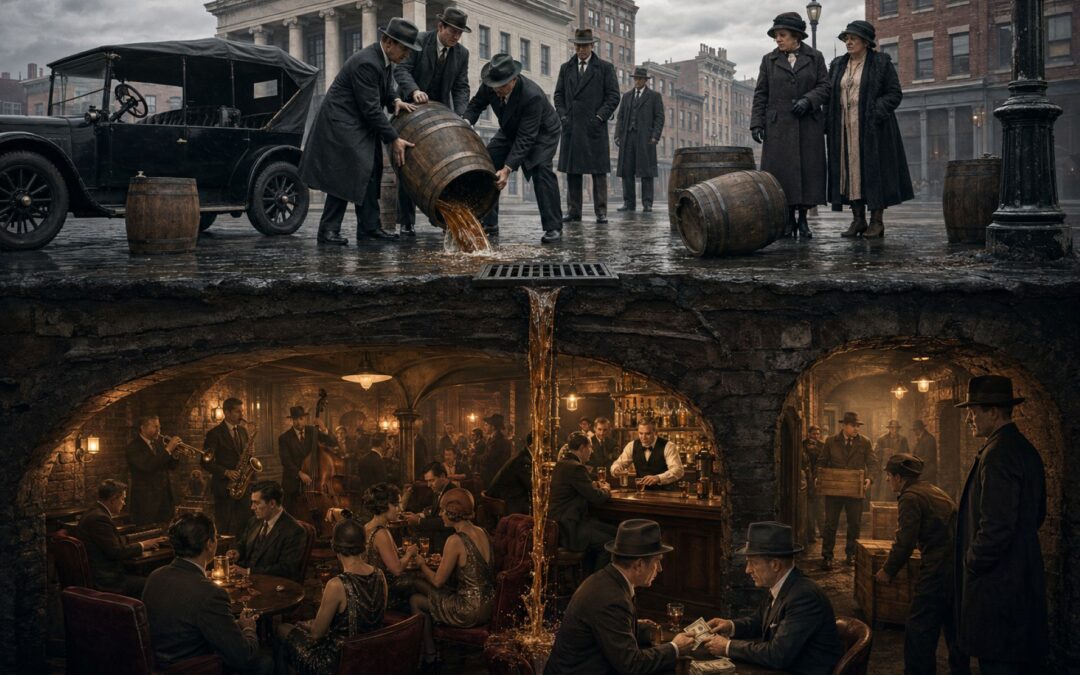
On January 17, 1920, the United States began enforcing one of the most extraordinary laws in its history. After generations of treating alcohol as an ordinary part of social, political, and economic life, the country had effectively outlawed the commercial production and distribution of alcoholic beverages. The Eighteenth Amendment had made Prohibition part of the Constitution, and its supporters believed they were witnessing the beginning of a healthier, safer, and more prosperous America.
Their expectations were not entirely unreasonable. Americans had once consumed astonishing quantities of alcohol, and excessive drinking had contributed to poverty, domestic violence, workplace accidents, and public disorder. The temperance movement promised to address these problems by dismantling an industry that many reformers considered a threat to family life and social progress.
What followed, however, was a remarkable contradiction. Alcohol consumption initially declined, and some alcohol-related health problems became less common. Yet the same law also encouraged bootlegging, enriched criminal organizations, corrupted public officials, overwhelmed courts, and exposed consumers to dangerous, sometimes poisonous liquor. Millions of Americans continued drinking, often with the knowledge or cooperation of the authorities responsible for stopping them.
By December 1933, the United States had repealed the Eighteenth Amendment, ending nearly fourteen years of national Prohibition. The experiment had achieved some of its stated objectives, but the political and social costs of enforcing it had become impossible to ignore. Understanding how that happened requires examining not only the gangsters and speakeasies of the 1920s, but also the genuine social problems, extraordinary political organizing, and changing public attitudes that made Prohibition possible in the first place.
Before Prohibition, America Had a Drinking Problem
Alcohol was woven into American society long before the United States became an independent country. European settlers brought their drinking traditions with them, and beer, cider, rum, whiskey, brandy, and wine became familiar features of colonial life. Taverns functioned as gathering places where travelers found accommodation, merchants conducted business, residents exchanged news, and political arguments unfolded over drinks.
Alcohol also served practical purposes in a society without modern refrigeration, sanitation, or medicine. Fermented beverages could be stored and transported, while distilled spirits were relatively compact and valuable commercial products. Physicians prescribed alcohol for conditions ranging from pain and fatigue to digestive complaints and nervous disorders, although many of these treatments lacked the scientific basis that modern medicine would require. Its use as a medicinal substance helped reinforce the belief that drinking could be beneficial rather than dangerous.
The custom extended into military and working life. George Washington’s soldiers received liquor rations, agricultural workers shared drinks during harvests, and alcohol was commonly present at construction projects, community gatherings, and celebrations. The National Park Service’s account of alcohol during the Lewis and Clark expedition illustrates how spirits accompanied major undertakings in the early republic, serving purposes ranging from personal consumption to medical treatment and diplomatic exchange.
Drinking was not necessarily reserved for evenings or special occasions. Some Americans consumed alcohol with breakfast, continued drinking throughout the working day, and finished their evenings with another glass. Political candidates sometimes distributed liquor to voters, while public festivities could become spectacularly disorderly. Andrew Jackson’s inauguration in 1829 became famous for a crowded White House reception during which refreshments reportedly had to be moved outside to draw visitors away from the building.
The scale of consumption was extraordinary. Historical estimates suggest that by 1830, Americans of drinking age consumed approximately 7.1 gallons of pure alcohol per person annually, a figure roughly three times the level recorded in many modern comparisons. Because this measurement converts different beverages into their equivalent pure-alcohol content, it represents a much greater volume of actual beer, cider, wine, and spirits.
The national average also concealed considerable differences. Men generally drank much more than women, while religion, occupation, class, region, and ethnicity influenced consumption. Some communities practiced abstinence, and many individuals drank moderately. Nevertheless, the overall quantities were substantial enough to alarm reformers who witnessed the consequences of chronic intoxication.
Those consequences were particularly serious in a society with limited social protections. Workers operating dangerous machinery or agricultural equipment could injure themselves and others while intoxicated. Families whose principal wage earner spent much of his income in a saloon might struggle to afford rent, food, clothing, or medical care. Heavy drinking could contribute to illness, neglect, public violence, and instability inside the home.
Women and children frequently bore the consequences without having much power to change their circumstances. Married women’s property rights and economic independence were restricted in many jurisdictions, divorce could be difficult, and effective protection against abusive husbands was limited. A woman whose husband drank away the household income or returned home violent might have few realistic alternatives.
These conditions gave temperance reformers a powerful argument. They were not simply inventing a moral panic about an ordinary pleasure; they were responding to genuine social and health problems. The disagreement that would eventually reshape American law concerned whether those problems required moderation, voluntary abstinence, local restrictions, or the complete suppression of the legal alcohol trade.
How Women Turned Temperance into a Mass Movement
The American temperance movement developed gradually during the nineteenth century. Its earliest organizations often promoted moderation rather than complete abstinence, and some distinguished between distilled spirits and beverages such as beer or wine. Over time, however, many activists concluded that encouraging responsible drinking was insufficient and began demanding that Americans abandon alcohol altogether.
Religious revivalism helped transform drinking into a national moral question. Protestant reformers increasingly argued that individuals could overcome destructive habits and that communities could be improved through organized campaigns against vice. Temperance became connected to other movements concerned with education, public health, child welfare, slavery, labor conditions, and women’s rights.
The saloon became a particularly important target because it represented more than alcohol itself. Reformers associated saloons with drunkenness, gambling, prostitution, domestic neglect, and corrupt political organizations. Closing them appeared to offer a practical way of eliminating several social problems at once.
Yet saloons also performed valuable functions, especially in working-class and immigrant neighborhoods. They provided companionship, employment contacts, entertainment, political meeting spaces, and sometimes informal financial assistance. Irish, German, Italian, and other immigrant communities developed distinctive social traditions around drinking establishments, making the saloon an important institution in urban life.
This created a tension within the reform movement. Some temperance advocates sincerely wanted to protect families and reduce harmful drinking, while others regarded immigrant customs, Catholic communities, and urban working-class culture as threats to Protestant American values. The campaign could simultaneously promote public welfare and reinforce religious, ethnic, or class prejudice.
Women became some of its most determined organizers because they had direct experience of alcohol-related household problems but limited formal political influence. During much of the nineteenth century, women could not vote in national elections and were expected to exercise their influence primarily within the domestic sphere. Public demonstrations therefore represented an unusually assertive way of challenging both drinking practices and prevailing expectations about women’s behavior.
During the Woman’s Crusade of 1873–1874, women began gathering outside saloons in Ohio, singing hymns, offering prayers, and asking proprietors to stop selling alcohol. According to Ohio State University’s history of the Woman’s Crusade, participants urged saloonkeepers to destroy their liquor, close their establishments, and pursue other occupations. The demonstrations spread across numerous communities, occasionally persuading proprietors to close voluntarily.
The protests were not always welcomed. Saloon owners, customers, and local officials sometimes mocked, threatened, or physically confronted demonstrators. In certain communities, the unexpected sight of women praying outside businesses attracted enormous attention and disrupted ordinary activities. Their persistence nevertheless demonstrated that organized moral pressure could challenge an established commercial industry.
The crusade helped inspire the formation of the Woman’s Christian Temperance Union in 1874. Under leaders such as Frances Willard, the WCTU developed into one of the country’s most influential women’s organizations. Its membership and activities extended far beyond simply persuading individuals to stop drinking.
Willard’s philosophy of broad reform connected temperance to women’s suffrage, labor protections, education, child welfare, and public health. The organization promoted public drinking fountains, supported services for women struggling with alcohol, distributed literature, and encouraged schools to teach children about the dangers of drinking. These activities helped turn temperance from a series of local demonstrations into a durable national movement.
Not everything the organization taught was reliable. Some educational campaigns relied on exaggerated or pseudoscientific claims, portraying even small quantities of alcohol as inevitably producing insanity, criminality, or catastrophic illness. Such propaganda reflected a growing willingness to use fear as an instrument of moral persuasion, even when its scientific foundations were weak.
The movement’s most dramatic personality was Carry Nation, who became famous for attacking saloons with bricks and a hatchet. Kansas had adopted statewide Prohibition in 1881, but illegal establishments continued operating, often with little interference from local authorities. Frustrated by what she considered official indifference, Nation began entering saloons and destroying bottles, mirrors, furniture, and bar fixtures.
She initially used objects she called smashers, including stones or bricks, before becoming nationally associated with her hatchet. Her confrontations produced arrests, publicity, and heated arguments within the temperance movement itself. Some supporters admired her refusal to tolerate illegal establishments, while others feared that her destructive methods made temperance activists appear fanatical.
Nation understood the publicity value of her actions. She supported her campaigns through speeches and merchandise, transformed arrests into opportunities for public attention, and became one of the country’s most recognizable reformers. But the destruction of individual saloons could not, by itself, create national legislation.
Women had helped make excessive drinking a major public issue. Transforming that moral campaign into a constitutional amendment would require a different kind of organization, one that could influence elections and make politicians fear the consequences of opposing Prohibition.
Wayne Wheeler and the Anti-Saloon League’s Political Machine
The Anti-Saloon League was founded in Ohio in 1893 and developed into an exceptionally effective political pressure organization. Unlike reform groups that addressed a broad collection of social problems, the League concentrated its resources on restricting and eventually eliminating the legal alcohol trade. That narrow objective allowed it to form alliances with groups that disagreed about nearly everything else.
Its most influential strategist was Wayne Wheeler, who understood that politicians did not necessarily have to be convinced that Prohibition was desirable. They only needed to believe that opposing it could cost them an election. By organizing voters and directing pressure toward vulnerable candidates, Wheeler transformed temperance into a form of political power that extended far beyond the League’s direct membership.
The League generally avoided relying on a separate political party. Instead, it supported candidates within both the Republican and Democratic parties who would advance its objectives, regardless of their positions on unrelated issues. This approach made alcohol policy a decisive electoral test and discouraged politicians from opposing Prohibition merely because it conflicted with their broader political philosophy.
The organization monitored legislative voting records, distributed campaign material, mobilized sympathetic churches, endorsed candidates, and coordinated opposition to politicians who resisted it. Wheeler demonstrated the effectiveness of these methods in Ohio, where the League helped defeat prominent officials considered insufficiently committed to temperance. The tactic subsequently expanded to national politics, earning him a reputation for ruthless electoral discipline.
Wheeler’s influence became so distinctive that the term Wheelerism was sometimes used to describe his style of single-issue pressure politics. The Westerville historical account of Wayne Wheeler describes the political machinery that enabled the Anti-Saloon League to influence legislation, mobilize voters, and exercise considerable power over public officials.
The League’s success depended partly on its ability to present alcohol as a different problem to different audiences. Religious conservatives were warned that saloons encouraged sin and weakened Christian families. Progressives heard that excessive drinking caused poverty, disease, and corruption. Employers were told that alcohol undermined workplace discipline, while workers encountered arguments that liquor interests benefited from keeping working people poor and dependent.
The same issue could even bring together groups with openly contradictory racial and social beliefs. Some Black temperance advocates regarded abstinence as a means of community advancement and as protection against racist stereotypes about drinking. White supremacists, meanwhile, exploited fears about Black men and alcohol to reinforce demands for racial control. The groups’ apparent agreement on temperance concealed fundamentally different objectives.
Immigration provided another source of political leverage. Nativists associated brewing with German immigrants and drinking establishments with Irish Catholics, portraying foreign customs as threats to American society. The movement’s hostility toward the saloon therefore appealed not only to people concerned about public health, but also to those who wanted to reshape the country’s religious and ethnic character.
Women’s suffrage created further political connections. Many temperance activists supported voting rights for women because they believed female voters would strengthen alcohol restrictions. Some suffrage advocates likewise saw cooperation with temperance organizations as a way to build support for women’s greater political participation, although the movements were never identical.
The League reinforced these alliances through newspapers, pamphlets, posters, sermons, statistics, and other propaganda. Its publications blended legitimate criticism of harmful drinking with selective evidence, exaggerated warnings, and prejudiced depictions of immigrants and minority groups. The organization became particularly effective at turning complex social questions into a straightforward electoral choice between candidates considered wet or dry.
By the 1910s, the Anti-Saloon League had developed the resources, organization, and political connections necessary to influence national legislation. Wheeler’s involvement eventually extended to the formulation of the constitutional amendment and the federal statute intended to enforce it.
The movement had spent decades changing attitudes toward alcohol, but national Prohibition still faced formidable obstacles. The liquor industry remained economically significant, public opinion was divided, and the federal government depended on taxes connected to alcoholic beverages. A combination of constitutional change and international war would eventually weaken those obstacles.
World War I and the Road to the Eighteenth Amendment
One of the most practical arguments against national Prohibition concerned government revenue. For much of American history, the federal government had depended heavily on customs duties and excise taxes, including taxes on distilled spirits and other alcoholic beverages. Eliminating a major taxable industry threatened an important source of public income.
The financial significance of liquor taxes was substantial, although the familiar claim that alcohol alone supplied approximately 40% of federal revenue needs qualification. Historical figures often combine alcohol-related receipts with broader excise-tax categories or refer to particular periods with very different revenue systems. What mattered politically was that Prohibition threatened established federal revenue at a time when the government lacked the modern income-tax base it would later possess.
The Sixteenth Amendment, ratified in 1913, helped change that calculation. It established Congress’s authority to levy federal income taxes without apportioning them among the states, giving the government a means of raising revenue that did not depend on liquor production and sales. The amendment was not enacted solely to facilitate Prohibition, but it weakened one of the strongest financial objections to an alcohol ban.
Temperance organizations had already secured restrictions in numerous states and local communities. A proposed national amendment had entered congressional consideration, and supporters increasingly believed that their accumulated political victories could be transformed into constitutional change. Nevertheless, the brewing and distilling industries retained enough influence to make national passage uncertain.
The First World War provided the decisive political opportunity. When the United States entered the conflict against Germany in April 1917, the government began mobilizing resources on an unprecedented scale. Wartime demands created new arguments for restricting alcohol: grain used in brewing and distilling could instead supply food, while sober workers and soldiers were presented as essential to national efficiency.
The broader history of American entry into World War I helps explain why these arguments became so powerful. The war intensified demands for patriotic sacrifice and expanded public acceptance of government intervention in production, consumption, and economic life. Prohibitionists could now present alcohol restrictions as contributions to military victory rather than merely attempts to impose religious morality.
Anti-German sentiment further strengthened their position. Some of America’s most prominent breweries, including Anheuser-Busch, Pabst, and Schlitz, had strong German-American associations. Companies that had previously represented industrial success and established drinking traditions suddenly faced suspicion because of the national origins of their founders and owners.
Temperance campaigners exploited those associations, portraying the brewing industry as foreign, disloyal, or sympathetic to America’s enemies. Drinking beer could be framed as a failure of patriotism rather than simply a personal habit. Such claims often relied on prejudice, but they weakened the political standing of an industry that had long opposed national restrictions.
The movement’s success was not simply a spontaneous reaction to wartime hysteria. Temperance advocates had spent generations developing organizations, creating dry jurisdictions, influencing elections, and changing public opinion. War accelerated a campaign whose political foundations were already well established.
Congress proposed the Eighteenth Amendment in December 1917. The amendment prohibited the manufacture, sale, transportation, importation, and exportation of intoxicating liquors for beverage purposes, subject to the constitutional provisions governing implementation. The necessary thirty-sixth state ratified it on January 16, 1919, and the amendment took effect the following January.
The Library of Congress’s collection of primary documents concerning the Eighteenth Amendment records the constitutional campaign and the legal measures surrounding national Prohibition. Passage required not only congressional approval by the necessary supermajorities, but also ratification by three-fourths of the states.
Congress still needed legislation establishing how the amendment would operate. The resulting National Prohibition Act, usually called the Volstead Act, supplied definitions, restrictions, exemptions, and enforcement provisions. President Woodrow Wilson vetoed the legislation, but Congress overrode him in October 1919, completing the statutory framework for the approaching ban.
A movement that had begun with voluntary reform, local demonstrations, and religious persuasion had achieved a remarkable constitutional victory. What remained uncertain was whether the government could make that victory work in a country where millions of people still wanted to drink.
What the Volstead Act Banned—and What It Left Legal
National Prohibition is often remembered as a law that made drinking alcohol illegal. That description is misleading because the Eighteenth Amendment primarily targeted the commercial activities that produced and supplied alcoholic beverages. It did not itself establish a general criminal prohibition on drinking, nor did it automatically forbid the private consumption of alcohol legally acquired before the restrictions took effect.
This distinction shaped the entire period. A person who already possessed a private collection of legally purchased liquor could continue consuming it under permitted conditions, while someone without the resources to stockpile beverages faced much greater difficulty obtaining alcohol. The law therefore affected social classes unequally from the beginning.
The Volstead Act also defined what counted as an intoxicating beverage. Its threshold covered products containing more than 0.5% alcohol, an exceptionally strict definition that applied to ordinary beer and wine as well as distilled spirits. Some Americans who favored eliminating whiskey and other hard liquor had expected less sweeping restrictions on familiar lower-strength beverages.
The amendment’s language and the statute’s actual operation consequently surprised part of the public. Prohibition was not simply removing the strongest drinks from the market; it was attempting to suppress the ordinary commercial supply of nearly every conventional alcoholic beverage.
Yet the legislation contained important exemptions. Alcohol remained legal for specified medicinal, religious, scientific, and industrial purposes. Manufacturers could continue producing alcohol used in fuels, solvents, chemicals, cosmetics, medicines, and other non-beverage products, while physicians and authorized religious institutions retained limited access for legitimate purposes.
The medical exception created a particularly awkward situation. Doctors could prescribe whiskey for certain conditions, and pharmacies could dispense it according to applicable regulations. The distinction between a medically necessary prescription and an opportunistic request from someone seeking a drink was not always easy to maintain, especially where physicians and patients had little sympathy for Prohibition.
Religious exceptions produced similar difficulties. Churches and synagogues needed access to sacramental wine, which could be obtained through approved channels. Although the exemption served legitimate religious purposes, it also created opportunities for illicit diversion and suspicious increases in demand.
Private stocks created another inequality. Wealthy households and clubs could purchase substantial quantities before Prohibition began, preserving access to alcohol that less affluent Americans could not easily replicate. In principle, citizens who followed the law were not being punished for possessing legitimate pre-Prohibition supplies; in practice, their ability to take advantage of that protection depended heavily on wealth and preparation.
The statute also relied on cooperation between federal and state authorities. While national legislation provided an overarching framework, states retained considerable responsibility for policing their own jurisdictions. Some governments approached enforcement enthusiastically, while others were reluctant to devote money or personnel to restrictions their citizens disliked.
These provisions created a system that was both exceptionally ambitious and legally complicated. It prohibited the ordinary commercial market while preserving narrow, legitimate channels through which alcohol could continue circulating. The government’s challenge was not merely preventing illegal production, but also distinguishing permitted uses from an expanding network of people determined to exploit the exceptions.
The Law Nobody Could Enforce Consistently
The difficulties of enforcement became evident almost immediately. Prohibition applied across a vast country containing major international ports, thousands of miles of coastline, extensive land borders, railways, farms, factories, cities, and countless private homes. Monitoring every route by which alcohol could be produced, transported, distributed, or consumed would have required an enormous administrative apparatus.
The federal government did not initially provide anything approaching such a force. The number of agents responsible for enforcing Prohibition was small relative to the population and territory they were expected to cover. Personnel were often poorly paid, unevenly trained, and vulnerable to political influence, while state and municipal authorities were expected to shoulder much of the responsibility.
This arrangement produced striking geographical differences. Some rural communities strongly supported Prohibition and expected local officials to enforce it. In major cities with established drinking cultures, immigrant neighborhoods, and powerful political organizations, the same law might be treated as an irritating formality.
New York illustrated the problem particularly clearly. The state repealed its own enforcement statute in 1923, reducing the legal and administrative support available for pursuing violations under state authority. Federal restrictions remained in force, but federal agents could not replace every state or local official unwilling to cooperate.
The gap between federal law and local attitudes encouraged people to search for convenient alternatives to openly buying alcohol. Physicians received requests for medicinal whiskey, pharmacists dispensed authorized liquor, and private clubs relied on supplies acquired before Prohibition. These arrangements were not necessarily unlawful, but their existence complicated efforts to suppress ordinary recreational drinking.
The religious exemption likewise created opportunities for diversion. Authorized sacramental wine remained available, and growing demand made it possible for unscrupulous intermediaries to conceal illegal distribution within legitimate transactions. Investigating abuses without interfering with lawful religious practice required distinctions that were difficult to administer consistently.
Home production offered another route. Companies marketed grape concentrates and other products that were legal to purchase but capable of fermentation. Some packages included suspiciously detailed warnings explaining the conditions under which their contents would turn into wine, effectively providing customers with instructions while maintaining an appearance of compliance.
For many Americans, obtaining alcohol therefore became less a matter of encountering dangerous professional criminals than of knowing the right doctor, pharmacist, club, neighbor, or local supplier. Ordinary social relationships could provide access to illicit beverages, making effective policing harder than legislators had anticipated.
The problem extended beyond enforcement personnel. Police officers often belonged to the same communities whose drinking habits they were expected to suppress, and some regarded arresting otherwise respectable neighbors for possessing liquor as unreasonable. Judges and prosecutors confronted large numbers of cases involving conduct that many citizens did not consider seriously criminal.
The Federal Judicial Center’s history of Prohibition in federal courts documents how alcohol prosecutions strained the judicial system. Courts increasingly relied on rapid processing, negotiated pleas, and monetary penalties as officials struggled to handle enormous numbers of violations. Resources devoted to liquor offenses competed with those needed for other criminal matters.
Enforcement was also unevenly distributed. Wealthy individuals could protect their privacy through private homes, established connections, or expensive suppliers. Poorer Americans and socially marginalized communities were often more exposed to raids, arrests, and harsh penalties, even when their conduct was similar to that of wealthier drinkers.
Some authorities genuinely attempted to enforce the law despite these obstacles. Investigators seized liquor, destroyed illegal stills, arrested distributors, and prosecuted offenders, occasionally imposing severe sentences. But harsh punishment in one jurisdiction could coexist with open disregard for the same restrictions elsewhere, producing a perception that enforcement depended more on circumstances and connections than on consistent legal principles.
The resulting hypocrisy damaged public confidence. Politicians who publicly defended Prohibition could privately consume alcohol, while police officers and other officials sometimes protected businesses they were legally required to close. Citizens watched a constitutional amendment become a rule that could be negotiated, purchased around, or ignored.
The difficulty was not that the law had no effect. The legal alcohol industry had been severely disrupted, access had become more expensive and complicated, and many people did drink less. The deeper problem was that national enforcement required levels of public cooperation, administrative capacity, and political commitment that the government could not consistently secure.
The Black Market: Bootleggers, Rum Runners, and Poisoned Liquor
Prohibition transformed alcohol from an ordinary commercial commodity into an extremely valuable illicit product. Demand had declined, but it had not disappeared, and millions of Americans remained willing to purchase beverages that legitimate businesses could no longer sell. Anyone capable of supplying that demand could earn substantial profits.
Some suppliers operated relatively small businesses. Illegal stills appeared in remote hills, wooded areas, rural buildings, urban basements, and private homes. Moonshiners produced liquor outside government supervision, sometimes using traditional distilling knowledge and sometimes relying on improvised equipment that yielded dangerous or inconsistent results.
Other bootleggers built sophisticated smuggling operations. Canadian distilleries became important sources of liquor, while routes across the Great Lakes and the Detroit River supplied American markets. Along the Atlantic coast, ships carrying alcoholic beverages gathered beyond American territorial waters in floating supply zones commonly known as Rum Row.
Smaller vessels traveled out to collect shipments and carry them toward shore, where distributors arranged onward transportation. Smugglers concealed bottles in vehicles, altered cargo documentation, bribed customs officials, and adjusted their routes in response to patrols. The enormous size of America’s coastline and borders made comprehensive interception extraordinarily difficult.
The success of some bootleggers demonstrated how much money could be made from this market. Roy Olmstead, a former Seattle police officer, developed a major liquor-smuggling operation in the Pacific Northwest, drawing heavily on Canadian supplies. His prosecution eventually led to Olmstead v. United States, a significant 1928 Supreme Court case involving warrantless wiretapping and constitutional privacy protections.
George Remus built an equally remarkable enterprise through a different legal opportunity. Originally a lawyer and trained pharmacist, he studied the restrictions governing liquor produced before Prohibition and realized that existing stocks could still be withdrawn for legitimate medicinal purposes. He acquired distilleries, pharmacies, and transportation businesses, creating a network through which he could obtain large quantities of whiskey using apparently lawful transactions.
Remus then arranged for shipments to be intercepted or supposedly stolen before the liquor reached its authorized destination. The alcohol could be resold illegally for enormous profits, allowing him to exploit both the legitimate exemption system and the criminal market. His success made him famous as the King of the Bootleggers.
The enterprise eventually collapsed under federal prosecution, and Remus went to prison for violating Prohibition laws. While he was incarcerated, his marriage and fortune disintegrated amid an affair involving his wife, Imogene, and a federal Prohibition agent. After his release, Remus killed Imogene during their bitter divorce proceedings.
His subsequent murder trial became a national sensation. Remus admitted the killing but defended himself on grounds of temporary insanity, and a jury acquitted him. The episode revealed how the fortunes created by bootlegging could produce consequences extending far beyond the illegal sale of alcohol.
Such extraordinary criminals were only part of the story. Many ordinary drinkers purchased liquor through familiar local distributors, while others consumed homemade beer, wine, or spirits. The quality of these products varied considerably, and the risks depended heavily on how they had been produced or obtained.
One particularly dangerous source was industrial alcohol. Factories legally used alcohol in manufacturing chemicals, solvents, cleaning products, cosmetics, fuel, and other goods. Because industrial alcohol was not intended for consumption, it was commonly denatured with substances designed to make it unsuitable for drinking.
Denaturing predated national Prohibition, but the illegal liquor market created powerful incentives to steal or divert industrial supplies. Criminal organizations discovered ways of attempting to remove additives and redistill the alcohol into beverages. These methods were unreliable, and poisonous substances could remain in the finished product.
The federal government responded partly by strengthening the denaturing requirements. During the 1920s, increasingly dangerous chemical formulas included methanol and other substances capable of causing severe injury or death. Officials knew that criminal suppliers were attempting to convert industrial alcohol into drinks, but greater toxicity was expected to discourage that activity.
The results were frequently tragic. Consumers who unknowingly drank contaminated products could suffer blindness, organ damage, or fatal poisoning. Lower-income drinkers were particularly vulnerable because cheaper illicit liquor was more likely to come from questionable sources than carefully manufactured or smuggled beverages.
New York City’s chief medical examiner, Charles Norris, became an outspoken critic of these policies. As documented in PBS’s The Poisoner’s Handbook, Norris and other medical investigators confronted the consequences of industrial-alcohol poisoning and questioned the government’s decision to make diverted alcohol increasingly dangerous.
The ethical responsibility was complicated but serious. Federal officials were not themselves serving poisoned drinks to consumers, and criminal suppliers were responsible for diverting hazardous industrial products and selling them as beverages. Nevertheless, the government understood that these products would continue entering the illegal drinking market despite stronger chemical deterrents.
Thousands of Americans died from poisoned or contaminated alcohol during the Prohibition era, although precise totals and the proportion attributable to particular government formulas remain disputed. These deaths illustrated a danger that went beyond ordinary lawbreaking: suppressing legitimate supply could expose consumers to products they had little ability to inspect, regulate, or challenge through lawful channels.
The black market therefore represented far more than a collection of clever methods for evading an unpopular law. It was an alternative commercial system with its own supply chains, financial incentives, risks, and methods of protecting transactions. Its profitability encouraged corruption and violence, while its lack of normal regulation made consumers vulnerable in ways that had not existed to the same degree in the legal market.
Speakeasies, Social Change, and the Price of Corruption
The most visible expression of Prohibition’s underground drinking culture was the speakeasy. These establishments operated behind ordinary-looking storefronts, inside private residences, in back rooms, or beneath apparently respectable businesses. Some required passwords or personal introductions, while others became so well known that their supposed secrecy was little more than a formality.
Speakeasies ranged from modest neighborhood drinking rooms to elaborate nightclubs featuring music, dancing, cocktails, and wealthy patrons. Their popularity was closely connected to the cultural transformations of the Roaring Twenties, an era associated with jazz, new fashions, changing gender expectations, and expanding urban entertainment.
The contrast with the pre-Prohibition saloon was significant. Traditional saloons were commonly male-dominated environments, while many speakeasies welcomed women as customers and participants in public nightlife. The growing visibility of flappers, social dancing, and mixed-gender drinking became part of the decade’s image of modernity.
These changes were not caused entirely by Prohibition. Women’s public roles had been changing for decades, and industrialization, urbanization, employment, mass entertainment, and the women’s suffrage movement all contributed to new patterns of social life. Prohibition nevertheless altered the spaces in which many Americans gathered to drink, sometimes weakening older conventions surrounding respectable public behavior.
The cultural effects also varied across racial and class boundaries. Jazz musicians, including Black performers, became central to the entertainment offered by many urban nightclubs. Some venues encouraged interactions across established social divisions, but segregation and discrimination persisted, and Black musicians could be celebrated onstage while denied equal treatment elsewhere in the same establishment.
Cocktails became strongly associated with the era, partly because mixing spirits with other ingredients could soften the harsh taste of inferior liquor. Yet cocktail culture was not invented during Prohibition, nor was every drink produced by illicit suppliers unsafe. The period popularized and reshaped drinking practices that had deeper historical roots.
The illegal nature of speakeasies created administrative problems that ordinary licensed establishments did not face in the same way. Businesses operating outside the law had little incentive to obey normal restrictions on opening hours, alcohol quality, or sales to underage customers. Consumers who received dangerous products could not rely on ordinary regulatory protections, while operators could not enforce business agreements through legitimate courts without exposing their own crimes.
Corruption became an essential part of the system. Owners paid police officers to overlook their premises, warn them about raids, or ensure that rival establishments received less favorable treatment. Bootleggers bribed officials to protect shipments, avoid prosecution, or recover confiscated goods.
The distribution of illegal liquor therefore depended on political connections as well as commercial skill. Police officers, mayors, judges, federal agents, and other public officials could become involved in protecting businesses that the law required them to suppress. Even honest officers faced organizations capable of paying large bribes, retaining lawyers, intimidating witnesses, and quickly replacing seized supplies.
This widespread corruption damaged the legitimacy of Prohibition as much as the continued existence of speakeasies themselves. The law’s authority depended on public officials behaving consistently, yet Americans repeatedly witnessed those same officials benefiting from its violation. When citizens believed that money and influence determined who would be punished, confidence in the legal system deteriorated.
The underground alcohol trade also created an opportunity for criminals who were willing to use more than bribery. As supply networks became increasingly profitable, control over transportation routes, warehouses, neighborhoods, and customers became worth fighting for. The struggle for those profits helped transform existing criminal organizations into far more powerful enterprises.
Al Capone and the Rise of Prohibition-Era Gangsters
Organized crime existed in American cities long before national Prohibition. Gambling operations, protection rackets, brothels, theft networks, political corruption, and violent gangs had already developed substantial influence. The Eighteenth Amendment did not create these activities or introduce criminals to bribery and intimidation.
What Prohibition provided was a huge illegal market for a product that millions of otherwise ordinary customers still wanted to buy. Criminal organizations that could acquire, transport, protect, and distribute alcohol gained access to profits far beyond those available through many smaller rackets. The resulting money allowed them to expand their operations and purchase greater political protection.
Bootlegging organizations employed drivers, warehouse workers, guards, distributors, accountants, and lawyers. They acquired vehicles, weapons, boats, storage facilities, and networks of cooperating officials. Territorial disputes became economically important because controlling a particular route or neighborhood could mean exclusive access to thousands of customers.
Chicago became the most famous example of this transformation. Multiple criminal factions competed for the city’s illegal alcohol market, sometimes dividing territory through informal agreements based on neighborhoods, ethnicity, or existing business relationships. Those arrangements frequently collapsed when rivals attempted to seize more profitable routes and establishments.
Al Capone emerged from this environment as one of the most recognizable criminals in American history. After Johnny Torrio withdrew from active leadership, Capone became the dominant figure in the Chicago Outfit. He combined ruthless methods of enforcing control with a remarkably public personality, speaking to reporters and cultivating the image of a successful businessman supplying a product that the public wanted.
Unlike criminals who sought to remain invisible, Capone appeared comfortable with celebrity. He attended public events, interacted with journalists, and presented himself as a generous figure who brought entertainment and employment to Chicago. That image obscured the intimidation, violence, and corruption underpinning his organization.
Bootlegging profits supported attacks on competitors, bribery of public officials, and efforts to control distribution networks. Gang warfare brought shootings, bombings, assassinations, and retaliatory killings into city streets. These crimes were closely associated with the struggle for alcohol profits, although urban violence also reflected other criminal businesses and political conflicts.
One of the most notorious incidents occurred on February 14, 1929, during the St. Valentine’s Day Massacre. Seven members and associates of a rival gang were murdered in a Chicago garage by attackers who included men dressed as police officers. The killings were widely linked to Capone’s organization, but he was never convicted of ordering them.
The massacre intensified public outrage and strengthened demands for action against powerful gang leaders. It also exposed the difficulty of prosecuting criminals who operated through layers of subordinates, intimidated witnesses, and protected themselves with political connections.
Federal jurisdiction posed an additional obstacle. The Bureau of Investigation, later known as the FBI, did not possess general authority over local murders or ordinary Volstead Act violations. As the FBI’s history of the Al Capone case explains, responsibility for investigating Prohibition offenses largely belonged to other federal agencies, while many suspected crimes associated with Capone fell under state or local jurisdiction.
Federal authorities ultimately pursued Capone through his finances. Investigators developed evidence that he had received substantial illegal income without paying the taxes owed on it. At his 1931 trial, the judge replaced a potentially compromised jury pool, and Capone was convicted of tax evasion.
He received an eleven-year federal prison sentence, a major victory for investigators who had struggled to connect him directly to numerous violent crimes. The conviction demonstrated that financial investigations could reach powerful criminals even when conventional prosecutions proved difficult.
But imprisoning Capone did not dismantle the networks strengthened by Prohibition. Criminal organizations had accumulated wealth, personnel, political connections, transportation systems, and experience operating large underground enterprises. When legal alcohol returned, many of those resources could be redirected toward gambling, extortion, labor racketeering, narcotics, and other activities.
Capone became the era’s most famous criminal symbol, but reducing Prohibition to his personal story would conceal the broader institutional problem. A lucrative illegal market had rewarded organizations capable of corrupting officials, intimidating competitors, and protecting large distribution networks. Removing one celebrated gangster could not eliminate the economic system that had enabled him to rise.
Did Prohibition Reduce Drinking or Just Drive It Underground?
Prohibition is commonly described as a complete failure because Americans continued drinking, organized crime became powerful, and the Eighteenth Amendment was eventually repealed. That judgment captures important consequences but overlooks a central fact: Prohibition substantially reduced alcohol consumption, at least during its early years.
The distinction matters because the law had been designed to address genuine problems associated with excessive drinking. If alcohol consumption declined, some of its supporters’ public-health objectives may have been achieved even while other aspects of the policy performed disastrously.
Historical consumption is difficult to measure when much of the market operates illegally. Researchers must reconstruct drinking patterns from indirect evidence such as production estimates, seizures, prices, medical outcomes, and other records. These methods produce useful approximations, but they cannot offer the same precision as a complete set of legal sales statistics.
Economists Jeffrey Miron and Jeffrey Zwiebel, in their National Bureau of Economic Research study of alcohol consumption during Prohibition, estimated that consumption initially fell to approximately 30% of its pre-Prohibition level. As illegal supply networks expanded and consumers adapted, they estimated that drinking recovered to roughly 60–70% of the earlier level.
Those figures do not mean that consumption was identical across regions, social classes, or years. They indicate an initial substantial decline followed by partial recovery, while leaving considerable uncertainty about the exact quantities consumed through illegal channels.
Prohibition also coincided with improvements in some alcohol-related health measures. Liver cirrhosis mortality and certain indicators of serious alcohol-related illness declined during the broader period surrounding national restrictions. Not all of those changes can be attributed exclusively to the Eighteenth Amendment, because drinking had already been affected by earlier temperance efforts and wartime restrictions.
The policy’s reduction of legal availability also changed drinking opportunities. Alcohol became more expensive, more difficult to obtain, and riskier to purchase, particularly for people without money or connections to illegal suppliers. The disappearance of the traditional saloon system altered the environments in which many Americans had previously consumed alcohol.
Historian Jack Blocker challenged the conventional portrayal of Prohibition as an unqualified disaster in his article Did Prohibition Really Work?. He argued that the policy’s effect on consumption and public health, along with the persistence of political support for restrictions, complicates the popular narrative of universal opposition and immediate failure.
This interpretation does not mean Prohibition was successful in every meaningful sense. Lower consumption must be weighed against the resources required to enforce the law and the unintended consequences of suppressing a large commercial market.
The black market transferred substantial economic opportunities to criminal suppliers. Profits supported bribery, intimidation, and violent competition, while enforcement agencies struggled to distinguish legitimate industrial, medical, or religious uses from illicit distribution. Courts devoted enormous time to violations that many citizens regarded as minor or morally acceptable.
Consumers also faced new risks. Industrial-alcohol poisoning was a particularly serious example, but the broader problem involved the absence of reliable quality controls and legitimate consumer protections. The law could reduce the amount of alcohol consumed while simultaneously making some of the alcohol that remained available more dangerous.
The social burdens were not distributed equally. Wealthy Americans could rely on private stocks, discreet suppliers, and influential connections, while poorer drinkers were more exposed to unsafe products and police intervention. Immigrant communities, working-class neighborhoods, and racial minorities could also experience enforcement more aggressively than affluent citizens engaged in comparable private behavior.
The relationship between Prohibition and violent crime must likewise be evaluated carefully. Gang warfare and the competition for bootlegging profits were real consequences of the illegal alcohol market, but national crime data from the period are incomplete. It would be misleading to attribute every murder, increase in criminal activity, or form of urban violence directly to Prohibition.
Institutional damage was more difficult to measure but equally important. Public officials who openly defended the law sometimes privately violated it, while corruption allowed criminal enterprises to operate with political protection. Such hypocrisy encouraged citizens to treat the law as negotiable and weakened confidence in the fairness of government.
The long-term effects also included changes to policing and federal authority. National alcohol enforcement expanded the government’s experience with surveillance, interstate investigations, raids, informants, prosecutions, and cooperation among enforcement agencies. Historian Lisa McGirr has emphasized how these developments contributed to the growth of the American penal state, with particular consequences for marginalized communities.
A reasonable assessment therefore depends on what counts as success. Judged narrowly by whether alcohol consumption declined, Prohibition achieved a substantial result. Judged by whether it created a sustainable, equitable, enforceable system that reduced social harm without intolerable collateral costs, its performance was much weaker.
The two conclusions are compatible. Governments can influence behavior through restrictions, and those restrictions can also produce consequences serious enough to outweigh their advantages. The eventual repeal of Prohibition reflected precisely that tension between a policy’s measurable effects and its broader political and institutional viability.
Pauline Sabin, the Great Depression, and the Repeal Coalition
By the late 1920s, organized opposition to Prohibition was becoming increasingly influential. The movement did not consist entirely of brewers, saloonkeepers, or people who wanted unrestricted access to alcohol. Many critics argued that the law had undermined public respect for government, empowered criminals, and failed to protect the families it was supposed to help.
One of the most important voices came from a group historically central to the temperance movement: women. Pauline Sabin was a wealthy, politically connected Republican who had supported Prohibition when she believed it would strengthen family life. Her experience of the law’s practical consequences gradually convinced her that the policy was doing more harm than good.
Sabin objected particularly to the Woman’s Christian Temperance Union’s suggestion that it represented women’s views generally. She believed that illegal drinking, public corruption, and the normalization of lawbreaking were exposing families and children to new dangers. Her criticism challenged the assumption that protecting the home necessarily required maintaining the Eighteenth Amendment.
In 1929, she founded the Women’s Organization for National Prohibition Reform. Through speeches, meetings, pamphlets, fundraising, and political organizing, the organization attracted substantial support, eventually claiming approximately 1.5 million members. Sabin’s wealth and connections gave the repeal movement credibility among influential Americans who might otherwise have regarded opposition to Prohibition as socially irresponsible.
The Museum of the City of New York’s history of the women who dismantled Prohibition describes how these campaigners challenged the moral authority of the dry movement. Instead of rejecting concerns about family welfare, they argued that regulation and lawful commerce would protect families more effectively than a poorly enforced national ban.
The rising backlash also reached the federal government. President Herbert Hoover established the National Commission on Law Observance and Enforcement, commonly known as the Wickersham Commission, to investigate Prohibition and wider problems within the criminal justice system.
The commission documented serious weaknesses in enforcement, including corruption, inadequate resources, inconsistent cooperation, and public resistance. Nevertheless, its findings did not amount to a straightforward recommendation for immediate repeal. The commission’s divided and complicated conclusions reflected the difficulty of reconciling concern about the law’s failures with continued belief in the objectives behind it.
Hoover remained unwilling to abandon national Prohibition. His position became increasingly difficult to defend as public frustration grew over corruption, gang violence, and the apparent inability of authorities to enforce the law consistently. Yet the decisive change in the political atmosphere came from an economic catastrophe rather than another sensational criminal episode.
The onset of the Great Depression transformed American priorities. Following the economic downturn and financial turmoil beginning in 1929, banks failed, businesses closed, investment collapsed, and millions of people lost their jobs or savings. By the early 1930s, unemployment had reached devastating levels, and many families were struggling to meet basic needs.
Under those circumstances, the economic costs of Prohibition became more prominent. Federal and local governments were spending scarce resources on enforcement while an enormous market continued operating illegally. Repeal promised to restore legitimate employment in brewing, distilling, transportation, distribution, and hospitality, while allowing governments to collect taxes from alcohol sales.
The Depression did not create dissatisfaction with Prohibition. Opposition had developed throughout the preceding decade as citizens encountered corruption, uneven enforcement, criminal violence, and legal hypocrisy. Economic collapse made those arguments more urgent by placing government revenue and employment at the center of political debate.
Franklin D. Roosevelt embraced the opportunity during the 1932 presidential campaign. The Democratic Party supported repeal, and Roosevelt appealed to voters frustrated with Hoover’s leadership during the economic crisis. Pauline Sabin, despite her longstanding Republican connections, supported Roosevelt and encouraged other opponents of Prohibition to do the same.
Roosevelt’s landslide victory reflected much more than the country’s attitude toward alcohol, but it gave repeal advocates the political opening they needed. The coalition that had secured Prohibition had fractured, and the argument that national restrictions were necessary for social improvement no longer commanded the same authority.
A constitutional amendment originally intended to protect families and promote public welfare was now widely associated with criminal profits, governmental hypocrisy, and lost economic opportunities. Its supporters had once regarded constitutional permanence as a guarantee that reform would survive ordinary political disagreements. By 1933, that permanence had become an obstacle to changing a policy that a growing coalition wanted to abandon.
How America Repealed Prohibition—and What Survived
The repeal process moved rapidly after the 1932 election. On February 20, 1933, Congress proposed the Twenty-First Amendment, which would repeal the Eighteenth Amendment and end national constitutional Prohibition. The proposal came before Roosevelt’s inauguration, illustrating how decisively the political atmosphere had changed.
Congress chose an unusual ratification procedure. Rather than submit the new amendment to state legislatures, lawmakers directed states to organize special ratifying conventions. Supporters of repeal feared that established dry interests remained disproportionately powerful in many legislatures and wanted a process more directly responsive to public opinion.
Roosevelt took office on March 4, 1933, amid the banking emergency and the wider economic crisis. One of his administration’s early legislative achievements concerned the return of legal beer, which could help demonstrate economic activity and provide new tax revenue before full constitutional repeal was completed.
On March 22, Roosevelt signed the Cullen–Harrison Act, authorizing the production and sale of specified lower-alcohol beer and wine. The law permitted beverages containing no more than 3.2% alcohol by weight under its relevant provisions, allowing legal beer sales to resume in April 1933.
As the United States Senate’s historical account of beer legalization explains, this preliminary reform came before the repeal amendment had been ratified. It marked an important practical reversal of national policy while the states continued considering the constitutional change.
Breweries reopened or expanded operations, workers returned to parts of the industry, and governments began collecting revenue from newly lawful sales. These immediate consequences reinforced the political appeal of ending Prohibition during a period of severe unemployment and fiscal pressure.
The state ratification process continued through 1933. On December 5, Utah became the thirty-sixth state to ratify the Twenty-First Amendment, supplying the required three-fourths majority. National Prohibition officially ended after nearly fourteen years.
The first section of the Twenty-First Amendment repealed the Eighteenth Amendment. Its second section preserved significant authority for states to regulate the transportation, importation, and distribution of alcohol within their jurisdictions.
Repeal therefore did not establish an unrestricted national right to sell or purchase liquor under identical conditions everywhere. States developed different systems of licensing, distribution, taxation, government-controlled alcohol sales, and local restrictions. Some communities continued prohibiting alcohol entirely despite the end of the federal constitutional ban.
Several states retained statewide restrictions long after 1933. Oklahoma did not repeal its statewide Prohibition until 1959, while Mississippi remained officially dry until 1966. Local dry counties and municipalities have continued to exist in parts of the United States under varying state laws.
The repeal also did not restore the drinking culture of nineteenth-century America. The old saloon had lost much of its institutional dominance, and licensed bars, restaurants, cocktail lounges, nightclubs, and private homes increasingly shaped where people consumed alcohol. Men and women became more accustomed to sharing public drinking spaces, although those changes reflected broader social transformations as well as the Prohibition era itself.
The commercial alcohol industry had also been permanently altered. Some major breweries survived Prohibition by producing soft drinks, food products, industrial materials, or other legal alternatives. Many smaller operations lacked the resources to adapt and disappeared, while the surviving companies entered a newly regulated market rather than simply returning to their old business conditions.
Organized crime did not vanish when legal alcohol returned. Prohibition had allowed criminal organizations to accumulate money, distribution networks, political connections, and experience operating complex underground enterprises. Once legitimate businesses could compete in alcohol production and sales, gangs lost much of their exclusive access to that market, but many redirected their activities toward other profitable forms of crime.
The effects on law enforcement also endured. Prohibition had expanded federal experience in investigating illicit commercial networks, coordinating agencies, using surveillance, and prosecuting violations that crossed state boundaries. Some techniques and institutions developed or strengthened during the war on alcohol influenced later approaches to organized crime and narcotics enforcement.
Those methods had not affected every community equally. Aggressive policing often imposed greater burdens on poorer Americans, immigrant communities, and racial minorities, while influential citizens enjoyed greater opportunities to avoid punishment. The era contributed to continuing debates about how federal power should be used, whose conduct should be criminalized, and how enforcement policies distribute their consequences.
Prohibition also demonstrated the political strength of highly organized single-issue movements. Wayne Wheeler and the Anti-Saloon League showed that an organization could influence both major political parties by mobilizing committed voters, concentrating attention on one policy, and punishing candidates who resisted it. Their methods did not disappear when the law they had helped create was repealed.
The constitutional legacy was equally distinctive. The Eighteenth Amendment remains the only amendment to the United States Constitution that has been repealed by another amendment. Its history illustrates both the power of constitutional reform and the difficulty of using a deliberately enduring legal instrument to impose detailed social policy.
Supporters had believed that constitutional permanence would protect Prohibition from temporary political opposition. When the policy’s difficulties became undeniable, that permanence complicated efforts to change it. Repeal required another constitutional amendment and another extraordinary political coalition.
Prohibition has since been compared with modern debates about drugs, gambling, and other restrictions on contested behavior. Such comparisons can illuminate questions about illegal markets, public health, regulation, and enforcement, but they require caution. Different activities create different harms, incentives, and risks, so the consequences of alcohol Prohibition cannot automatically predict the effects of every other restriction.
The enduring significance of Prohibition lies in the relationship between social objectives and the means used to achieve them. Its supporters identified real problems associated with excessive drinking, organized themselves effectively, and achieved a remarkable constitutional victory. Yet their solution demanded more agreement, administrative capacity, and consistent enforcement than American society and its institutions could provide.
National Prohibition did not collapse because everyone ignored it or because alcohol consumption remained completely unchanged. Drinking declined, some public-health indicators improved, and the old saloon culture lost much of its former influence. Those achievements were real, but so were the criminal markets, unsafe products, corruption, selective punishment, and erosion of legal legitimacy that accompanied them.
The central lesson is that recognizing a genuine social problem does not guarantee that a particular government intervention will solve it at an acceptable cost. Laws depend not only on the authority of the institutions that enact them, but also on realistic enforcement, public cooperation, and the ability to adapt when consequences differ from expectations.
The United States had successfully written Prohibition into its Constitution and mobilized considerable resources to enforce it. What it could not do was eliminate demand simply by suppressing legal supply. The experiment changed American drinking habits, organized crime, federal policing, political organizing, and the regulation of alcohol, but the accumulated costs ultimately overwhelmed the case for maintaining a nationwide ban.
Prohibition’s history is therefore neither a simple celebration of individual freedom nor proof that restricting harmful behavior never works. It is the story of a policy that partly achieved its immediate purpose while creating a set of consequences that made its continuation politically unsustainable. That distinction explains both why Americans adopted Prohibition and why, less than fourteen years later, they decided to repeal it.
Last Updated on October 22, 2026 by Aseem Gupta