
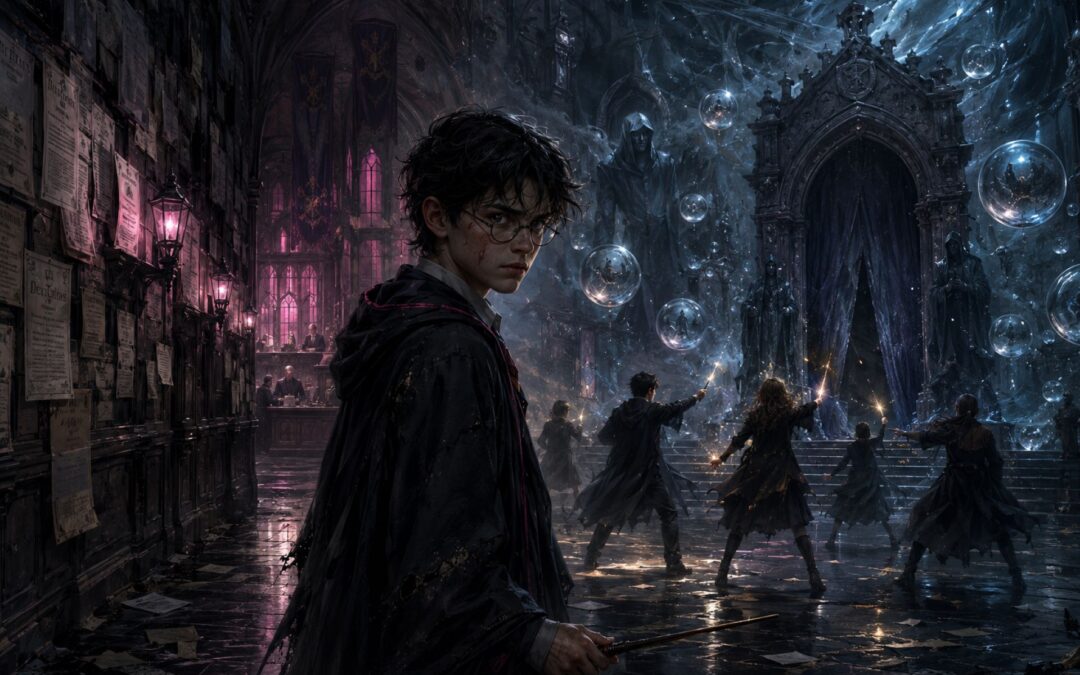
Harry Potter and the Order of the Phoenix is the fifth Harry Potter novel and the point at which the series changes its scale. The aftermath of Harry Potter and the Goblet of Fire has destroyed the possibility that Harry can return to an ordinary school year: Cedric Diggory is dead, Lord Voldemort has regained a body, and Harry has witnessed the event himself. Yet the new danger is not immediately an open war. Instead, the Ministry of Magic refuses to believe what happened, the wizarding press helps discredit those saying otherwise, and Hogwarts gradually becomes an institution in which admitting the truth can itself be punished.
That political conflict sits alongside a much more personal one. Harry begins the novel angry, traumatised, isolated and desperate to be treated as someone capable of understanding the danger around him. The adults protecting him repeatedly decide that withholding information is safer than trusting him with it. Voldemort eventually turns that isolation into a weapon, manipulating Harry through the very attachment that matters most to him. The result is a novel about more than resistance to evil: it is about what happens when truth is suppressed, authority loses legitimacy, grief is denied a language, and protection becomes indistinguishable from exclusion.
Spoiler warning: This article discusses the entire novel, including Sirius Black’s death, the prophecy concerning Harry and Voldemort, and the ending.

Detailed Plot Summary: From Denial to Open War
The novel covers Harry’s fifth year at Hogwarts, but its central conflict begins before he reaches school and never fits neatly inside the usual boundaries of classes, Quidditch and holidays. Voldemort remains mostly out of sight for much of the story. In his place, Harry faces a government determined to deny Voldemort’s return, Dolores Umbridge’s expanding control of Hogwarts, recurring visions that connect his mind to Voldemort’s, and increasingly serious failures of communication between himself and the adults trying to protect him.
The story therefore develops on several fronts at once. Harry moves from enforced isolation to leadership of a student resistance group, but his growing confidence is accompanied by worsening anger and recklessness. At the same time, seemingly secondary elements—Kreacher’s resentment, Sirius’s imprisonment at Grimmauld Place, the Room of Requirement, Thestrals, Occlumency lessons, Harry’s dreams of a corridor and a closed door—gradually become parts of the mechanism that drives the final catastrophe.
Harry’s Isolation, the Dementor Attack, and the Ministry Hearing
Harry spends the summer after Cedric Diggory’s murder at Number Four, Privet Drive, cut off from meaningful information. Ron, Hermione and Sirius write to him, but their letters are deliberately vague. Harry suspects that Voldemort must be doing something, so he watches Muggle television news and searches discarded newspapers for anything that might indicate unexplained deaths or disasters. Nothing appears. His frustration grows because he is the person who witnessed Voldemort’s return, yet everyone else seems to know more about its consequences than he does.
His emotional condition is equally important. Harry repeatedly dreams about the graveyard where Cedric died, and Dudley eventually reveals that he has heard Harry crying out about Cedric in his sleep. Harry is furious at being treated like a child when he believes his experiences have already forced him beyond childhood. That anger erupts during an argument with Dudley, but before Harry can do anything reckless, the neighbourhood is plunged into unnatural darkness and cold.
Two Dementors attack Harry and Dudley. Harry struggles at first to produce a Patronus because fear overwhelms the happy thoughts the spell requires, but the thought of never seeing Ron and Hermione again gives him enough emotional strength to conjure his stag Patronus. He drives away both Dementors and saves Dudley from the Dementor’s Kiss.
The attack is shocking not merely because Dementors have appeared in a Muggle suburb. Mrs Figg, Harry’s apparently eccentric neighbour, rushes to the scene and reveals that she is a Squib who has been watching Harry for Dumbledore. Mundungus Fletcher, an Order member who was supposed to be guarding him, abandoned his post to pursue a dubious business opportunity. Harry therefore discovers that Dumbledore has been concerned enough to place him under surveillance but not concerned enough, in Harry’s view, to tell him.
His use of the Patronus Charm triggers an immediate Ministry response. Harry receives a letter announcing his expulsion from Hogwarts and informing him that his wand will be destroyed. The decision is subsequently softened: he is suspended pending a disciplinary hearing. Arthur Weasley and Sirius both urge him not to leave the Dursleys’ house or perform more magic.
The confrontation that follows at Privet Drive reveals another hidden piece of Harry’s past. When Dudley describes the Dementor attack, Aunt Petunia unexpectedly knows that Dementors guard Azkaban. She remembers hearing about them through her sister Lily’s connection with the magical world. When Uncle Vernon understands that Voldemort may now be targeting Harry, he orders Harry out of the house. A Howler then arrives for Petunia containing a brief warning from Dumbledore to remember a previous communication. Petunia immediately insists that Harry must remain.
Several days later, members of the Order of the Phoenix arrive to remove Harry from Privet Drive. Among them are Remus Lupin, Alastor Moody, Kingsley Shacklebolt and Nymphadora Tonks, a young Auror and Metamorphmagus. They transport Harry by broom to Number Twelve, Grimmauld Place, a concealed London townhouse that serves as the Order’s headquarters.
Harry is delighted to see Ron and Hermione but almost immediately explodes at them. For weeks they have been together while he has been isolated, and they admit that Dumbledore ordered them not to send him significant information. His anger is not simply jealousy. He cannot reconcile being considered important enough for Voldemort to want him dead with being considered too young to know what people are doing about it.
Ron and Hermione explain that the Order of the Phoenix is the organisation Dumbledore founded to fight Voldemort during the first war. Its members are now monitoring suspected Death Eaters, attempting to recruit allies and guarding something mysterious. Harry also learns that the Ministry and the Daily Prophet have been undermining his credibility. Rather than directly accuse him of lying every day, the paper has gradually constructed an image of him as unstable, arrogant and addicted to attention.
Political denial has also divided the Weasley family. Percy Weasley has received a prestigious position in Minister Cornelius Fudge’s office and has sided with the Ministry against his father. Arthur believes Percy’s promotion may have been partly intended to give Fudge access to a family known to be close to Dumbledore. Percy responds by condemning Arthur’s lack of ambition, leaving home and distancing himself from the rest of the family.
Grimmauld Place introduces another history that will eventually matter enormously. The house belonged to Sirius’s family, the Blacks, an old pure-blood dynasty whose beliefs Sirius rejected. Their family tapestry celebrates supposedly respectable bloodlines while excluding relatives considered traitors. Sirius’s mother remains present through a magically fixed portrait that screams abuse at people she considers impure.
The house-elf Kreacher is an even more important remnant of that world. He remains devoted to the values of Sirius’s mother, despises many of the people now occupying the house and bitterly resents Sirius. Sirius, in turn, treats Kreacher with contempt because the elf reminds him of the family and ideology he hates. What initially looks like an unpleasant domestic relationship eventually becomes one of the novel’s most consequential failures of understanding.
Sirius himself is trapped. Because the Ministry still considers him an escaped murderer and Voldemort’s side knows his Animagus form, he cannot safely leave the house. He contributes Grimmauld Place to the Order but feels that others are fighting while he remains useless. His frustration parallels Harry’s: both resent being protected through confinement, and both hunger for action.
The Order’s members explain that Voldemort is moving carefully. He does not want the Ministry to accept immediately that he has returned, because official denial gives him time to gather followers and pursue his plans. Among those plans is an attempt to obtain something he did not possess during his first rise to power. The adults refuse to tell Harry exactly what this object is.
Molly Weasley and Sirius disagree sharply over how much Harry should know. Molly sees him as a fifteen-year-old who has already been exposed to too much danger. Sirius argues that Voldemort has made Harry part of the conflict whether the adults approve or not. Their dispute establishes one of the book’s central questions: when danger cannot be removed, does withholding knowledge protect someone or merely make that person less prepared?
Harry’s Ministry hearing turns that question into a political one. Arthur escorts him into the Ministry, but the hearing has been moved to an earlier time and a different courtroom without proper notice. Harry is brought before an unusually large body of officials led by Fudge. The proceeding increasingly resembles an attempt to convict an inconvenient witness rather than a neutral inquiry into underage magic.
Dumbledore appears in Harry’s defence. Mrs Figg testifies that Dementors were present, while Dumbledore points out that wizarding law allows underage magic in circumstances of immediate danger. Harry is acquitted. Yet the victory leaves him unsettled because Dumbledore barely acknowledges him and avoids making eye contact.
Back at Grimmauld Place, Ron and Hermione receive prefect badges. Harry momentarily feels that he deserved to become a prefect more than Ron, then becomes ashamed of his jealousy. The episode is small compared with the political conflicts around him, but it reveals how badly Harry wants some recognition that his experiences count for something.
Molly Weasley’s encounter with a Boggart makes the stakes of the coming conflict unmistakable. Instead of a single fear, she sees the dead bodies of the people she loves. Moody later shows Harry a photograph of the original Order of the Phoenix and casually identifies members who were murdered, tortured or driven into madness during the first war. What Harry has known intellectually becomes personal: the people around him are preparing to repeat a struggle in which many of their predecessors died.
Umbridge’s Hogwarts and the Birth of Dumbledore’s Army
Harry’s return to Hogwarts provides little relief. On the train he spends more time with Ginny, Neville and Luna Lovegood, an eccentric Ravenclaw whose unusual beliefs make her the object of mockery. Luna does not respond to Harry with the nervous fascination he receives from many other students, which eventually makes her one of the people around whom he feels least pressured to perform.
When the students reach Hogwarts, Harry sees skeletal, winged horses pulling the carriages. Ron and Hermione cannot see them. Harry worries that he is experiencing something no one else can perceive, but Luna assures him that she sees the creatures too. They are Thestrals, visible only to people who have witnessed death and psychologically processed what they have seen. Cedric’s death has therefore changed Harry’s perception of the magical world in a literal way.
The Sorting Hat’s new song warns that Hogwarts must overcome internal divisions if it is to survive outside danger. The warning is immediately followed by the arrival of Dolores Umbridge, a Ministry official installed as the new Defence Against the Dark Arts professor. Her speech at the opening feast is deliberately tedious, but Hermione recognises its significance: the Ministry intends to interfere directly in Hogwarts.
Umbridge’s Defence lessons reveal what that interference means. She refuses to teach practical defensive magic and insists that students follow a Ministry-approved textbook. When Harry points out that students may need to defend themselves against actual danger, she denies that they face such danger. When he insists that Voldemort has returned and that Cedric was murdered, she gives him detention.
The detention introduces the most memorable symbol of Umbridge’s rule. Instead of using ink, Harry must write lines with an enchanted quill that cuts the words into the back of his hand and uses his blood to form the writing. He is repeatedly forced to write that he “must not tell lies” while being punished precisely because he refuses to endorse the Ministry’s lie. Harry initially conceals what Umbridge is doing, partly from pride and partly because he does not want to give her the satisfaction of driving him to seek help.
Umbridge soon becomes Hogwarts High Inquisitor, gaining authority to inspect teachers and evaluate their competence. Her inspections transform classrooms into political performances. Professors such as McGonagall understand exactly what she represents, while teachers already regarded as vulnerable—particularly Trelawney and Hagrid—become obvious targets.
Sirius remains one of Harry’s strongest emotional supports, but their relationship grows more complicated. When Sirius proposes a risky meeting in Hogsmeade, Harry refuses because he fears Sirius will be discovered. Sirius responds by suggesting that Harry is less adventurous than James Potter would have been. The comparison hurts because it implies that Sirius sometimes relates to Harry not only as his godson but also as the son of the friend whose companionship he desperately misses.
The Ministry’s campaign enters the Weasley family again when Percy writes to Ron. He congratulates Ron on becoming prefect but advises him to distance himself from Harry and to treat Umbridge as a valuable source of Ministry guidance. The letter shows how official narratives work socially: they do not need to convince everyone at once. They only need enough people to repeat them inside workplaces, schools and families.
Hermione eventually concludes that official Defence lessons are useless. She proposes that Harry teach a group of students the practical magic he has used against real threats. Harry initially rejects the idea. He remembers how often luck, help from others or unusual circumstances contributed to his survival, and he dislikes the assumption that surviving danger has made him an expert.
Ron and Hermione persuade him that those experiences still give him knowledge the others lack. Hermione organises a meeting at the Hog’s Head, where students question Harry about his encounters with Voldemort, Dementors and other dangerous magic. Their scepticism irritates Harry because it resembles the public doubt surrounding him, but the meeting also forces him to recognise that he can teach things Umbridge refuses even to acknowledge.
The students sign a parchment agreeing to participate. Soon afterward, Umbridge issues an Educational Decree banning unapproved student organisations. The group is now illegal before it has properly begun, which turns practical education into an act of resistance.
They still need somewhere to meet. Harry asks Dobby whether Hogwarts contains a place where twenty-eight people could practise Defence without being discovered. Dobby tells him about the Room of Requirement, a magical room that appears when someone has a genuine need and provides what is necessary. The students begin training there.
The group eventually adopts the name “Dumbledore’s Army,” partly because the Ministry is absurdly afraid that Dumbledore is secretly building a force against it. What begins as a joke becomes an accurate description of the students’ position. They are learning defensive magic because official authority has forbidden them from preparing for the danger that authority refuses to admit exists.
Harry proves surprisingly good at teaching. He breaks spells into manageable steps, demonstrates techniques and encourages students who struggle. Neville makes particularly significant progress. Harry’s leadership in the DA contrasts with his powerlessness elsewhere: for the first time that year, his experiences become useful knowledge rather than evidence against him.
The school’s ordinary conflicts continue, but Umbridge increasingly uses them as opportunities for control. During a Quidditch match, Draco Malfoy provokes Harry and George by insulting their families. They attack him physically after the match, allowing Umbridge to ban them from Quidditch. Fred is banned as well despite not participating in the fight, demonstrating how little Umbridge cares about proportional punishment.
Hagrid eventually returns from a secret mission. He and Madame Maxime had travelled to the giants in an attempt to prevent Voldemort from recruiting them. They initially make progress with a giant leader named Karkus, but the violent Golgomath replaces him and Death Eaters begin influencing the group. Hagrid’s account expands the conflict beyond British wizarding institutions: both Dumbledore and Voldemort understand that the treatment of marginalised magical beings may determine wartime alliances.
The episode also exposes the consequences of long-standing prejudice. Giants are feared and excluded by wizard society, giving Voldemort opportunities to offer them rewards and status. The same pattern will appear with other groups. The war is not merely a contest between two collections of wizards; it is also a struggle over communities that mainstream wizard society has often treated with suspicion or contempt.
Visions, Occlumency, and the Collapse of Trust
Harry’s connection with Voldemort becomes more dangerous during the winter. After another DA meeting, Harry experiences a vision in which he seems to inhabit the body of a snake attacking Arthur Weasley. Unlike Harry’s earlier nightmares, this vision contains real information. Dumbledore acts on it immediately, and Arthur is rescued before the attack kills him.
The accuracy of the vision creates a frightening problem. Harry did not merely watch the attack; he experienced it through the snake. At St Mungo’s Hospital, he overhears adults discussing the possibility that Voldemort may be able to use or possess him. Harry becomes terrified that he is a danger to the Weasleys and withdraws from the people around him.
Ginny cuts through this fear with unusual force. She reminds Harry that she has actually experienced possession by Tom Riddle and asks why he did not consult her before deciding what possession must feel like. Her authority comes directly from the events of Harry Potter and the Chamber of Secrets, and her intervention reveals one of Harry’s recurring weaknesses: when frightened, he can become so absorbed in his own interpretation that he forgets other people may possess knowledge he needs.
The visit to St Mungo’s produces another important revelation. Harry and his friends encounter Neville visiting his parents, Frank and Alice Longbottom, who were tortured into permanent mental incapacity by Death Eaters after the first war. Neville has rarely explained his family history to his classmates. Seeing his parents transforms what could have remained background tragedy into one of the novel’s clearest demonstrations of the human damage caused by Voldemort’s earlier rise.
Dumbledore decides that Harry must learn Occlumency, the magical discipline used to protect the mind against external penetration. He assigns Snape to teach him. In principle the decision makes sense: Snape knows Legilimency and understands the need to conceal thoughts from Voldemort. In practice, the relationship between teacher and student is almost perfectly designed to fail.
Snape attacks Harry’s mind during lessons, forcing him to resist while exposing private and often humiliating memories. Harry resents Snape’s contempt, while Snape interprets Harry’s curiosity and resistance through his hatred of James Potter. Harry also has a hidden reason not to improve: his dreams are leading him repeatedly toward a mysterious corridor and closed door, and he increasingly wants to know what lies beyond it.
The return of several escaped Death Eaters, including Bellatrix Lestrange, confirms that Voldemort’s forces are strengthening while the Ministry continues denying the larger truth. Bellatrix matters personally to Neville because she participated in the torture of his parents, and she matters to Sirius because she is his cousin and represents the pure-blood ideology he rejected.
Harry’s relationship with Cho Chang also deteriorates. Both are carrying grief over Cedric, but they respond to it differently and communicate badly. Harry is uncomfortable when Cho wants to talk about Cedric, while Cho is hurt by Harry’s emotional awkwardness and jealous of his closeness with Hermione. Their Valentine’s Day date collapses because neither is equipped to turn mutual attraction and shared grief into a functional relationship.
Hermione, meanwhile, creates a more effective strategy for communicating the truth. She arranges for Rita Skeeter to interview Harry about Voldemort’s return and Cedric’s murder. The story appears in The Quibbler, Luna’s father’s eccentric publication. Umbridge immediately bans the magazine at Hogwarts.
The ban backfires. Students become more eager to read the forbidden interview, and Harry begins receiving indications that people outside Hogwarts believe him. Control of information becomes one of the novel’s recurring contests: official media helped isolate Harry, but an alternative publication gives his testimony a route around that system.
Umbridge’s authority keeps expanding. She attempts to dismiss Professor Trelawney and publicly humiliates her, but Dumbledore intervenes to prevent Trelawney from being thrown out of the castle. He then appoints the centaur Firenze as the new Divination teacher. Firenze’s decision to work for humans results in his rejection by the other centaurs, whose pride and political independence will matter later.
The DA continues practising, and Harry begins teaching Patronuses. Their progress proves exactly what Umbridge’s curriculum was preventing: students can learn meaningful defensive magic when trusted with practical instruction. That success also increases the danger of discovery.
The betrayal finally comes through Marietta Edgecombe, Cho’s friend, who informs Umbridge about the group. Hermione had enchanted the sign-up parchment so that betrayal would become visibly marked on the informer’s face. Dobby manages to warn Harry before the meeting can be fully trapped, but Umbridge and Ministry officials still obtain enough evidence to confront Dumbledore.
Dumbledore protects the students by claiming that the organisation was his own idea. Faced with arrest, he escapes spectacularly from the school. His departure removes the most powerful institutional barrier to Umbridge, who becomes Headmistress and takes effective control of Hogwarts.
Harry’s Occlumency training soon collapses as well. During a lesson, Snape leaves the room, and Harry looks into the Pensieve containing memories Snape had removed before teaching him. Harry expects to find evidence confirming the heroic image of his father that he has always carried. Instead, he sees teenage James Potter and Sirius bullying and humiliating Snape.
Lily Evans intervenes on Snape’s behalf until Snape, humiliated and furious, insults her with a blood-status slur. Harry is appalled. James’s behaviour resembles the arrogant cruelty Harry associates with people such as Draco Malfoy, and Sirius participates enthusiastically. Harry’s understanding of his parents and their generation becomes less comfortable and more human.
Snape discovers Harry in the memory and ends the Occlumency lessons. The consequence is larger than the personal violation between them: Harry now loses the only systematic attempt to prevent Voldemort from manipulating the mental connection.
Harry later contacts Sirius and Lupin to ask about James. They do not deny what he saw. James was arrogant and cruel in that period of his life, they admit, although they insist that he matured. The answer restores some of Harry’s faith without allowing him to retreat entirely into idealisation.
At Hogwarts, resistance becomes increasingly open. During Harry’s careers consultation, Umbridge mocks his ambition to become an Auror, while McGonagall responds by promising to help him achieve the required qualifications if it is the last thing she does. Their argument transforms educational guidance into another confrontation over who gets to determine Harry’s future.
Fred and George carry rebellion further. After months of undermining Umbridge with magical jokes and disruptions, they leave Hogwarts in a dramatic display of defiance. Their departure gives other students and even some staff permission to stop treating Umbridge’s authority as legitimate merely because it is official.
Hagrid’s own storyline becomes stranger when he introduces Harry and Hermione to Grawp, his giant half-brother. Hagrid has brought Grawp back from the giants despite Grawp’s limited command of English and unpredictable violence. He asks Harry and Hermione to care for him if Umbridge succeeds in removing Hagrid from the school.
Grawp initially seems detached from the central plot, but his presence places Harry and Hermione within the complicated politics of the Forbidden Forest. Hagrid’s relationship with Firenze has already angered the centaurs, and those tensions later become crucial to the students’ escape from Umbridge.
The ordinary school year now moves toward OWLs. Harry performs particularly well in practical Defence, confirming how much expertise he has actually developed. The examinations also produce one of the starkest juxtapositions in the novel: students try to complete normal academic milestones while authoritarian violence erupts outside their windows.
During the Astronomy exam, Ministry officials attempt to seize Hagrid. McGonagall intervenes and is struck by multiple Stunning Spells. Hagrid fights his way free and escapes. The school’s transformation is now complete: people charged with maintaining order are openly using force against teachers in front of students.
Then Harry has the vision that drives the final act. During his History of Magic examination, he sees Sirius apparently being tortured by Voldemort in the Department of Mysteries. Because the vision of Arthur’s attack was real, Harry has powerful reason to believe this one is real too.
The Department of Mysteries, Sirius’s Death, and the Prophecy
Harry wants to leave immediately for the Ministry, but Hermione insists that they verify Sirius’s situation before rushing into danger. They decide to use the Floo connection in Umbridge’s office to contact Grimmauld Place. The plan is sensible, but the information they receive is disastrously misleading.
Kreacher answers the fireplace. Harry asks whether Sirius is present, and Kreacher tells him that Sirius has gone and will not return. Harry interprets the answer as confirmation that Voldemort has captured him. In reality, Sirius is elsewhere in the house tending to Buckbeak, and Kreacher is exploiting Harry’s question rather than answering it honestly.
Umbridge catches Harry and his friends in her office. During the confrontation she reveals one of the novel’s major hidden facts: she sent the Dementors to Little Whinging. Her motive was not service to Voldemort but political hostility toward Harry and frustration that the Ministry could not silence him through ordinary means. The revelation distinguishes her from Voldemort while making her morally worse than a merely petty bureaucrat. She was willing to expose a teenager to a fate worse than death because his testimony threatened the Ministry’s preferred story.
When Umbridge prepares to use the Cruciatus Curse to force information from Harry, Hermione improvises. She claims that Dumbledore has hidden a powerful weapon in the Forbidden Forest. Umbridge follows Harry and Hermione into the forest, convinced she is about to seize something that will strengthen her authority.
Instead, they encounter the centaurs. Umbridge immediately insults them, asserts Ministry ownership over the forest and treats them as intellectually inferior beings. The centaurs attack and carry her away. The episode is not simply convenient rescue: Umbridge is undone by precisely the hierarchy and prejudice that have characterised her approach to magical beings throughout the novel.
Grawp then crashes into the confrontation, creating further chaos and allowing Harry and Hermione to get away. Back at Hogwarts, Ron, Ginny, Neville and Luna have escaped the Inquisitorial Squad. Harry initially wants to leave them behind, but they refuse. The six students decide to go to London together.
They need transportation that can reach the Ministry quickly. The Thestrals Harry and Luna can see provide the answer. The same creatures introduced as signs of Harry’s altered relationship with death now carry the group toward the place where he will experience another devastating loss.
The Ministry appears deserted when they arrive. Harry leads the group into the Department of Mysteries, following the route that has appeared repeatedly in his dreams. The place contains rooms devoted to forces and ideas that wizarding society studies without fully mastering: time, thought, prophecy, death and other fundamental mysteries.
In the Hall of Prophecy, Harry finds a glass sphere labelled with his name and Voldemort’s. When he removes it from its shelf, Death Eaters emerge from hiding. There is no captive Sirius. Voldemort constructed the entire vision to bring Harry to the prophecy.
Lucius Malfoy explains enough for Harry to understand the trap. Voldemort wants the prophecy but cannot simply send any follower to retrieve it, because magical restrictions prevent someone unrelated to a prophecy from taking it safely from its shelf. Harry, as one of its subjects, can retrieve it. Voldemort has therefore used Harry’s connection with him, Harry’s love for Sirius and Harry’s growing distrust of adult control to solve a practical problem.
The six students fight back. Their months of DA training now have real consequences: they are still outmatched by experienced Death Eaters, but they can defend themselves far more effectively than Umbridge’s curriculum would have allowed. The battle moves through the strange rooms of the Department, and several students are injured.
Neville remains with Harry despite suffering serious injuries. His presence is particularly meaningful because Bellatrix Lestrange, one of the people responsible for destroying his parents’ lives, is among their attackers. Neville’s development from a nervous boy into someone willing to stand against the people who shattered his family becomes one of the novel’s strongest secondary character arcs.
During the struggle, the prophecy sphere is destroyed. Voldemort’s elaborate scheme therefore fails in its immediate objective. He still does not obtain the complete prophecy.
Members of the Order arrive to rescue the students, including Sirius. For a brief time Harry’s worst fear appears to have been completely reversed: Sirius was never captured, is alive, and is now fighting beside him. That relief makes what follows more brutal.
Sirius duels Bellatrix near a stone archway hung with a mysterious veil. Bellatrix strikes him, and Sirius falls backward through the veil. Harry waits for him to reappear because the physical movement does not resemble the kind of death he expects. Lupin restrains him and tells him that Sirius is gone.
Harry cannot immediately accept it. Sirius represented more than a beloved adult. He was the closest surviving connection Harry had to his parents and the person with whom Harry imagined eventually building a life outside the Dursleys. The future Harry associated with Sirius disappears almost as suddenly as Sirius himself.
Harry chases Bellatrix through the Ministry and attempts the Cruciatus Curse. The spell causes pain but does not work with the sustained force Bellatrix expects. She tells Harry that righteous anger is insufficient; the caster must genuinely want to cause suffering. The moment shows Harry at his closest to using the methods of his enemies, but grief does not automatically turn him into them.
Voldemort then appears personally. Dumbledore arrives almost immediately, and the two most powerful wizards in the conflict duel in the Ministry Atrium. Dumbledore protects Harry while matching Voldemort’s attacks, refusing to react with the fear Voldemort expects from others.
Unable to defeat Dumbledore directly, Voldemort possesses Harry. His strategy appears devastating because Harry is already overwhelmed by grief and wants the pain to stop. Yet possession exposes Voldemort to precisely what he cannot tolerate. Harry thinks of Sirius and experiences love and loss so intensely that remaining inside Harry becomes unbearable for Voldemort.
Ministry officials, including Fudge, arrive in time to see Voldemort before he escapes. The political conflict that has governed the entire novel ends abruptly. Harry and Dumbledore were telling the truth, and the government can no longer plausibly deny it.
Harry is taken back to Dumbledore’s office, where the explanation withheld from him throughout the book finally arrives. Harry is initially too furious and grief-stricken to listen. He destroys objects in Dumbledore’s office and demands to know why Sirius had to die.
Dumbledore accepts much of the blame. He explains that he deliberately distanced himself from Harry because he feared Voldemort might detect their relationship and exploit Harry as a route to Dumbledore. He also withheld information about the prophecy because he cared about Harry and wanted to postpone burdening him with knowledge he believed no child should have to carry.
The intention was protective, but Dumbledore admits that his strategy contributed to the disaster. Harry did not understand why the visions mattered, did not understand the significance of the Department of Mysteries and had no reason to understand that Voldemort might deliberately feed him false information. Dumbledore’s secrecy did not cause every decision Harry made, but it left him less prepared to interpret the danger.
Dumbledore finally tells Harry the prophecy. Before Harry’s birth, Sybill Trelawney predicted the arrival of a child with the power to defeat Voldemort. The child would be born as July ended to parents who had defied Voldemort three times. Both Harry and Neville Longbottom initially fitted that description.
Voldemort never heard the entire prophecy. He chose Harry as the child he believed posed the greater danger and attempted to kill him. In doing so, he marked Harry as his equal and helped create the conditions described by the prophecy. The revelation therefore does not reduce Harry’s life to a mechanical destiny. Voldemort’s own interpretation and choices are part of the mechanism that brings the prophecy closer to fulfilment.
The prophecy ultimately says that Harry and Voldemort cannot indefinitely coexist: each will remain committed to the destruction of the other until one kills the other. Dumbledore also explains that Harry possesses a power Voldemort has repeatedly underestimated—his capacity for love. The idea is not simply sentimental. Love explains Lily’s protection, Harry’s attachment to others, his susceptibility to Voldemort’s trap and, paradoxically, Voldemort’s inability to remain inside Harry.
The final chapter begins after the Ministry publicly admits Voldemort’s return. Dumbledore is restored to the positions from which the government removed him, and the Daily Prophet reverses its narrative. Harry has been vindicated, but the novel refuses to pretend that public vindication repairs private loss.
Harry asks Nearly Headless Nick whether Sirius might return as a ghost. Nick explains that most people who die do not choose that form of existence. Harry then discovers the two-way mirror Sirius had given him so that they could communicate privately. He remembers it only after Sirius is dead. The object could potentially have allowed Harry to check on Sirius without using Umbridge’s fireplace, making it one of the cruelest embodiments of the novel’s theme of failed communication.
Luna eventually offers Harry consolation of a different kind. She speaks calmly about death and about hearing the voices beyond the veil, without trying to solve Harry’s grief or demand that he feel differently. Harry cannot recover what he has lost, but he ends the year slightly less isolated inside the loss.
At King’s Cross, Moody, Lupin, Tonks and the Weasleys confront the Dursleys and warn them to treat Harry properly. The gesture does not erase the fact that Harry must return to Privet Drive, but he no longer returns as someone completely abandoned there. The secret conflict is over. Voldemort is publicly known to be back, the Dementors are no longer reliably under Ministry control, and the second wizarding war has begun.
Setting and World-Building: A Wizarding Society Entering War
Earlier Harry Potter novels establish a magical society hidden alongside the Muggle world, but Order of the Phoenix is the book that most thoroughly exposes its institutions under pressure. Hogwarts remains central, yet the novel repeatedly leaves the classroom to show government, media, healthcare, aristocratic family history, resistance organisations and marginalised magical communities. The wizarding world becomes less charming because Harry is old enough to see not only its wonders but also the structures through which power operates.
The expansion matters because Voldemort’s return tests more than individual courage. It reveals which institutions are capable of responding to danger, which are primarily interested in preserving themselves, and which groups have been alienated badly enough that Voldemort can exploit their grievances.
The Ministry, the Daily Prophet, and the Politics of Denial
The Ministry of Magic is not portrayed as secretly controlled by Voldemort. That distinction is essential. Cornelius Fudge resists Dumbledore because accepting Voldemort’s return would threaten his sense of stability, expose his government to criticism and force him to confront a crisis he would rather believe does not exist.
Institutional self-preservation then produces a series of increasingly harmful choices. Harry’s disciplinary hearing is treated like a political trial. Dumbledore loses official positions. Ministry employees are pressured to distance themselves from him. Umbridge is inserted into Hogwarts and eventually given powers that allow the government to regulate teachers, student organisations and educational content.
The Daily Prophet reinforces the Ministry’s position by weakening the credibility of Harry and Dumbledore before many readers have seriously considered their claims. The strategy is effective because it does not require disproving Harry’s testimony. Turning him into a joke is enough to make people less willing to listen.
Umbridge translates that information strategy into education. Students are told they do not need practical defence because the threat requiring defence supposedly does not exist. Harry is therefore punished not merely for disobedience but for insisting that personal experience contradicts the officially approved account.
This connection between curriculum and political power has attracted academic attention. Robert J. Helfenbein and Sydney K. Brown’s analysis of curriculum, control and resistance in Order of the Phoenix reads the novel’s schooling conflict in relation to questions about who controls legitimate knowledge and how education can become a mechanism of standardisation rather than inquiry. That interpretation fits the book because Umbridge’s most important demand is not simply obedience. It is obedience to a prescribed version of reality.
The Ministry’s eventual reversal is correspondingly hollow. Once Fudge personally sees Voldemort, the official story changes quickly. Harry’s truth has not become truer; the people controlling public legitimacy have finally lost the ability to deny it.
Grimmauld Place, St Mungo’s, and the Department of Mysteries
Number Twelve, Grimmauld Place initially appears to be merely a gloomy headquarters, but it functions as a material history of the Black family. The screaming portrait, serpent decorations, family tapestry, Dark objects and mounted house-elf heads turn pure-blood ideology into domestic architecture. Sirius has rejected that inheritance intellectually, but living inside the house traps him within the environment he escaped as a young man.
The house also demonstrates that rejecting an ideology does not automatically free someone from its habits. Sirius despises his family’s beliefs, yet his treatment of Kreacher is often dismissive and contemptuous. The old hierarchy remains active even among people who oppose the political values associated with it.
St Mungo’s performs a different function. Hogwarts often contains recoverable magical injuries, but the hospital shows damage that magic cannot simply reverse. Arthur can eventually recover from Nagini’s attack, yet Neville’s parents cannot be restored to their former selves. Their presence prevents the first war from becoming romantic history.
The Department of Mysteries expands the world in another direction. Unlike Hogwarts, where magic is taught, or the Ministry above it, where magic is governed, the Department contains phenomena that remain only partly understood. Time, thought, prophecy and death are treated as subjects of organised magical investigation.
That uncertainty is especially important in the room containing the veil. The novel clearly establishes Sirius’s death after he passes through it, but it does not provide a complete metaphysical explanation of the archway. The ambiguity is part of its power: even in a world full of ghosts and magical portraits, death retains mysteries that characters cannot master.
Giants, Centaurs, House-Elves, and the Fault Lines Voldemort Exploits
Voldemort’s recruitment strategy exposes divisions that wizard society helped create long before his return. Giants have been feared, persecuted and pushed to the margins, which makes them susceptible to someone offering power and material rewards. Hagrid and Madame Maxime attempt diplomacy, but the overthrow of Karkus and the rise of Golgomath show how unstable that community has become.
The centaurs are not potential servants waiting to be recruited by either side. They insist on their own sovereignty and resent wizard intrusion into the Forbidden Forest. Firenze’s willingness to teach at Hogwarts makes him a traitor in the eyes of his own herd, while Umbridge’s assumption that centaurs are lesser beings immediately provokes the confrontation that ends her control of the school.
House-elves expose an even more uncomfortable hierarchy. Dobby actively chooses to help Harry, while Kreacher remains shaped by generations of service to the Black family. Their contrasting loyalties show why Hermione’s moral objection to house-elf servitude cannot be reduced to whether individual elves claim to enjoy serving particular households.
Kreacher’s role is especially important because the story does not make his betrayal a random act. He is miserable, despised by Sirius, devoted to the memory of Sirius’s mother and receptive to other members of the Black family who treat his loyalties as useful. His deception of Harry has catastrophic consequences, but the social relationship that made that deception possible was created over years.
Character Analysis: Harry and the People Who Shape His Fifth Year
Book Five contains a larger cast than any previous Harry Potter novel, yet its character work remains tightly connected to Harry’s changing perception. People he once idealised become more complicated, people he once overlooked become central allies, and respectable authority figures become more frightening than obviously sinister villains. Harry’s maturation therefore involves not simply becoming stronger but learning that moral categories are less tidy than they appeared when he was younger.
The strongest characters are those who represent different responses to fear and power. Dumbledore withholds information, Sirius rebels against confinement, Snape weaponises emotional distance, Umbridge converts insecurity into control, Hermione organises, Luna refuses social pressure, and Harry alternates between leadership and impulsiveness.
Harry Potter: Anger, Trauma, Leadership, and Recklessness
Harry’s anger dominates much of the novel, and treating it as mere teenage irritability misses both its causes and its function. He has watched Cedric die, witnessed Voldemort’s return, narrowly escaped murder and then been sent back to a household where he receives little emotional support. Instead of helping him process what happened, the magical community largely leaves him without information while newspapers suggest that he is unstable.
His emotional volatility is therefore understandable even when his behaviour is unfair. He lashes out at Ron and Hermione because they represent the community from which he feels excluded. He resents Ron’s prefect badge. He repeatedly argues with authority figures. His willingness to confront Umbridge is courageous, but his inability to regulate his reactions also gives her opportunities to punish him.
The blood-quill detentions intensify this dynamic. Harry refuses to stop telling the truth even when doing so would make his life easier, demonstrating extraordinary moral stubbornness. At the same time, he initially refuses to seek help, turning endurance itself into a matter of pride.
Dumbledore’s Army reveals the more constructive side of the same refusal to submit. Harry becomes an excellent teacher because he takes danger seriously and understands that practical competence matters. He encourages students rather than humiliating them and discovers that surviving difficult experiences has given him knowledge worth sharing even if survival did not make him invincible.
His leadership does not eliminate his weaknesses. Harry remains prone to treating urgent feelings as evidence that urgent action is necessary. Hermione repeatedly supplies the scepticism he lacks. She makes him check Grimmauld Place before leaving for the Ministry, but once Kreacher gives him the answer he fears, Harry becomes nearly impossible to stop.
The climax therefore grows directly from Harry’s best and worst qualities. He goes to the Ministry because he loves Sirius and cannot tolerate abandoning someone in danger. Those motives are admirable. The problem is that Voldemort understands them well enough to manufacture a situation in which Harry’s loyalty can be manipulated.
His final grief strips away the heroic framework through which many characters view him. Harry does not respond to Sirius’s death with wisdom or immediate acceptance. He is furious, destructive and desperate to reverse what happened. The emotional honesty of that response is one of the novel’s greatest strengths.
Dumbledore, Sirius, Snape, and Umbridge
Dumbledore spends much of the novel at a distance, which changes his role dramatically. In earlier books he often appears as a source of reassurance and retrospective explanation. Here, his avoidance becomes one of Harry’s deepest wounds.
His final explanation reveals that the distance was deliberate. Dumbledore believed that Voldemort might use Harry’s mental connection to discover or exploit Dumbledore’s plans, so he tried to reduce Harry’s knowledge and emotional contact with him. The strategy contains reasonable logic, but Dumbledore eventually acknowledges that affection distorted his judgment in another direction: because he cared about Harry, he postponed telling him the truth about the prophecy.
Dumbledore’s failure is therefore not indifference. It is paternalism. He attempts to decide on Harry’s behalf when Harry should be allowed to understand his own situation, and by doing so he helps create the ignorance Voldemort exploits.
Sirius represents almost the opposite response. The foundations of Harry’s relationship with Sirius were established when Harry discovered that Sirius was his godfather rather than his parents’ betrayer. By Book Five, Sirius has become Harry’s closest possibility of a real parent outside the Weasley family.
Yet Sirius is not emotionally stable simply because Harry loves him. His imprisonment at Grimmauld Place is psychologically destructive. He is trapped in the house associated with the childhood he rejected, unable to fight openly and dependent on younger people for much of his companionship.
His relationship with Harry is loving but imperfect. At times he encourages Harry to take risks because he misses the rebellious companionship he had with James. When Harry behaves more cautiously than Sirius wishes, Sirius’s comparison with James places an unfair burden on him.
That imperfection makes Sirius’s death more painful rather than less. Harry does not lose an ideal father who had solved his life. He loses a damaged adult with whom he might have built something better if both had been given more time.
Snape is even harder to simplify. He is genuinely working against Voldemort and possesses skills the Order urgently needs, but none of that makes him a good teacher for Harry. The Occlumency lessons require trust, emotional control and a willingness to expose vulnerability—the exact conditions their relationship cannot provide.
“Snape’s Worst Memory” then complicates Harry’s moral understanding further. James and Sirius behave cruelly toward Snape, while Lily defends him. Snape responds to humiliation by using a vicious blood-status slur against Lily. No one emerges as a simple moral category.
The memory does not excuse Snape’s later mistreatment of Harry, nor does Snape’s later role erase what James did. Its achievement is to break the assumption that good people must always have behaved well and damaged people must always be innocent.
Umbridge is different because the novel gives her very little redeeming complexity, yet she remains an effective antagonist precisely because she is not a Death Eater. Her cruelty arrives wrapped in institutional legitimacy, pink clothing, bureaucratic language and concern for proper procedure.
She does not need Voldemort’s ideology to become dangerous. Fear of disorder, prejudice, career power and devotion to an official narrative are enough. Her willingness to use a blood quill, send Dementors after Harry and contemplate the Cruciatus Curse shows how easily bureaucratic respectability can coexist with extreme abuse.
Hermione, Ron, Ginny, Neville, Luna, Kreacher, and the Wider Cast
Hermione is arguably the strategic engine of the student resistance. Harry becomes its most visible leader, but Hermione recognises the need for alternative Defence training, organises the Hog’s Head meeting, creates the membership parchment, identifies the Room’s security needs and engineers Harry’s interview with Rita Skeeter. Her response to authoritarian control is rarely passive outrage; she looks for mechanisms through which the balance of power can be changed.
That does not make all her methods comfortable. The curse placed on the DA sign-up sheet punishes betrayal without informing participants of the specific consequence in advance. Her deception of Umbridge in the Forbidden Forest is brilliant and necessary in the moment, but it is also ruthless. Hermione’s effectiveness partly comes from her willingness to act decisively when she believes the moral stakes justify it.
Ron’s arc is quieter. Becoming prefect exposes his insecurities, while Quidditch subjects him to public ridicule. His eventual improvement matters because it gives him a sphere of achievement that does not depend on being Harry Potter’s best friend or one of many accomplished Weasley siblings. Throughout Harry’s worst moods, Ron also remains loyal even when he does not always know how to respond.
Ginny becomes substantially more independent than the shy girl Harry remembers. Her importance is especially clear when she challenges his fear that he has been possessed. Because she survived Tom Riddle’s control herself, she can identify the difference between her experience and Harry’s more accurately than Harry can. She also refuses to accept Harry’s assumption that he can decide which friends are allowed to risk themselves for him.
Neville undergoes one of the novel’s most satisfying developments. Learning the truth about his parents reframes his diffidence: behind the clumsiness is a child carrying one of the first war’s most devastating family histories. DA practice gives him a setting where persistence matters more than reputation, and by the Department of Mysteries he continues fighting even after serious injury.
Luna operates differently from nearly everyone else. She is frequently wrong about factual matters, but she is unusually resistant to social coercion. Mockery does not determine what she is willing to say, and Harry gradually values the emotional freedom this creates. At the end, Luna can talk to him about death because she does not demand that he perform grief in a socially acceptable way.
Kreacher is one of the book’s most consequential secondary characters. His deception helps send Harry to the Ministry, but reducing him to a malicious servant misses the novel’s broader treatment of social hierarchy. Kreacher is the product of the Black household and has been taught whom to respect, whom to hate and what kind of family deserves his loyalty. Sirius understands the ideology but fails to understand the extent to which Kreacher himself has been shaped by it.
Hagrid continues to embody both compassion and poor judgment. His attempt to reach the giants serves the Order’s larger strategy, but bringing Grawp to the Forbidden Forest and expecting teenagers to look after him is reckless. Cho is similarly allowed to remain imperfect: her relationship with Harry is not a failed romance because either is a bad person, but because grief, jealousy and adolescent awkwardness leave them unable to give each other what they need.
Fred and George represent rebellion as performance. Molly and Arthur represent more conventional forms of protective family life. Fudge represents political denial, Percy the temptation of institutional approval, Lucius Malfoy elite collaboration with Voldemort, and Bellatrix the fanatical commitment that Voldemort’s more cautious followers lack. Together, the supporting cast gives the conflict social breadth rather than reducing it to Harry and Voldemort alone.
Relationships, Trust, and Failed Protection
The final disaster in Order of the Phoenix cannot be explained simply by saying that Voldemort tricked Harry. The deception succeeds because several relationships around Harry have already failed to communicate crucial information. Adults protect secrets, Harry hides pain, Snape and Harry distrust each other, Sirius and Kreacher despise each other, and even a useful gift such as the two-way mirror becomes meaningless because its purpose is never adequately established.
The novel therefore treats trust as a practical form of protection. Magical power matters, but so does whether people know whom to ask, whether they believe the answer, and whether relationships are strong enough to survive fear and disagreement.
Harry and Dumbledore
Harry enters the novel desperate for Dumbledore’s attention and spends most of the year receiving less of it than ever. Dumbledore rarely looks directly at him after Harry’s return to Hogwarts. To Harry, the avoidance feels like rejection at the moment he most needs confirmation that what happened to him was real.
Dumbledore sees the situation differently. He understands the increasing connection between Harry and Voldemort and fears that visible closeness could make Harry useful as a route into Dumbledore’s mind or plans. His strategy is therefore to reduce contact.
The problem is that Dumbledore explains none of this until after Sirius dies. Harry experiences only the consequence: the person he trusts most appears unwilling to speak to him. That makes every other restriction feel like evidence that adults do not respect him enough to tell him the truth.
Dumbledore’s final admission is unusually important because the novel does not present his good intentions as a complete defence. He effectively acknowledges that he made a serious mistake. Protecting Harry from painful knowledge was emotionally understandable, but Harry was already inside the conflict whether Dumbledore wanted him there or not.
Harry and Sirius
Harry and Sirius are drawn together partly because both are lonely. Harry wants a parent who belongs specifically to him, while Sirius wants family and meaningful participation in a struggle from which he has been physically excluded. Their affection is genuine, but those needs can distort the relationship.
Sirius treats Harry more like an equal than Molly Weasley does, which Harry appreciates. Yet that equality sometimes becomes an expectation that Harry should behave like James. Sirius’s disappointment when Harry discourages reckless behaviour reveals how strongly his past shapes his present relationships.
Harry, meanwhile, becomes protective of Sirius. Because Sirius cannot move freely without risking capture, Harry feels responsible for keeping him safe. Voldemort’s false vision succeeds precisely because the possibility of Sirius being tortured bypasses Harry’s caution.
The tragedy is intensified by missed possibilities. Sirius is in Grimmauld Place when Harry leaves for the Ministry, and the two-way mirror could have provided a safer method of contacting him. The relationship fails not because love is absent but because love exists inside a network of poor communication, secrecy and impulsive decisions.
The Trio, the DA, and Harry’s Failed Romance with Cho
Harry’s friendship with Ron and Hermione survives his anger because both are willing to let him be angry without abandoning him. They disagree with him frequently, particularly Hermione, but the disagreement occurs inside an established relationship in which each expects the others to remain.
That dynamic matters at the climax. Hermione is almost the only person able to slow Harry down when he believes Sirius is in danger. She cannot stop him completely, but she does persuade him to verify the vision. Friendship does not eliminate Harry’s impulsiveness; it creates friction against it.
The DA expands this kind of solidarity. Students from different social groups and houses voluntarily cooperate because the institution responsible for teaching them has failed. The group becomes more than a training club because mutual vulnerability creates trust: everyone risks punishment simply by attending.
Harry’s relationship with Cho provides the opposite example. Their attraction is real, but they do not have the communication necessary to handle Cedric’s death. Cho wants to talk about the person she lost; Harry wants to escape the memories surrounding him. Hermione’s presence becomes a source of jealousy because Cho does not understand Harry’s friendship with her, while Harry fails to recognise what reassurance Cho is seeking.
The romance is deliberately awkward rather than grandly tragic. That awkwardness is appropriate. Harry can face Death Eaters and teach defensive magic while remaining completely unprepared for another grieving teenager’s emotional needs.
Themes: Truth, Authority, Trauma, and Resistance
The novel’s political and psychological themes reinforce one another. Harry is traumatised partly because he witnessed horrifying events, but his isolation becomes worse because institutions tell the surrounding society that those events did not happen as he describes them. Resistance becomes necessary not simply because authority is strict but because authority demands submission to falsehood.
The book is consequently less interested in whether rules are inherently good or bad than in the relationship between rules and legitimate purpose. Dumbledore’s Army breaks school regulations but teaches students what they genuinely need. Umbridge invokes legal authority while repeatedly violating the ethical responsibilities that should justify that authority.
Denial, Propaganda, and the Control of Truth
Harry knows Voldemort has returned because he saw it happen. Dumbledore believes him because other evidence fits what he already understands. Yet individual knowledge does not automatically become public truth.
Fudge has institutional power to determine which claims receive legitimacy. The Daily Prophet amplifies that power. By portraying Harry as unstable and Dumbledore as politically ambitious, the Ministry does not need to rebut every detail of their account.
Umbridge completes the process by regulating speech. When Harry says Voldemort returned, she punishes him. The blood quill turns suppression into a grotesque paradox: Harry must injure himself by repeatedly writing a statement about lying because he refuses to tell the lie authority wants.
Hermione’s Rita Skeeter strategy recognises that truth therefore needs a distribution system. Publishing Harry’s testimony in The Quibbler does not magically prove it, but it gives readers access to the account the dominant newspaper is suppressing. Umbridge’s attempt to ban the interview makes it more desirable.
The ending exposes the fragility of the official narrative. Once Fudge sees Voldemort himself, public policy changes quickly. The Ministry does not discover a new philosophical commitment to evidence; denial has simply become impossible to sustain.
Education, Resistance, and Civil Disobedience
Umbridge’s Defence curriculum is political because it defines knowledge through administrative convenience. Students are not merely denied exciting practical lessons. They are denied the ability to prepare for a threat the government wants citizens to ignore.
Dumbledore’s Army answers this failure by creating an alternative educational institution. Hermione organises it, Harry teaches it, and the Room of Requirement provides a protected space. Authority comes from competence and shared purpose rather than formal appointment.
That makes the DA an obvious subject for interpretations involving civil disobedience. A law-and-literature analysis by Arthur Emanuel Leal Abreu and Alexandre de Castro Coura treats the organisation as a form of civil disobedience because students knowingly violate imposed rules in response to what they see as an illegitimate restriction on necessary defensive education.
The analogy should not be pushed beyond what the novel supports. The students are not presenting a systematic theory of political resistance. Their immediate goal is to learn magic that may keep them alive.
Even so, the narrative clearly distinguishes legality from legitimacy. Umbridge can issue decrees, but every new decree makes the school less governable because it gives students additional reasons to reject her authority. Fred and George’s departure is powerful partly because by that stage her office still exists but its moral credibility has largely collapsed.
Grief, Anger, Isolation, and the Psychology of Being Disbelieved
Harry’s emotional state is not a subplot attached to the political story. It is where the political story does some of its deepest damage. He has traumatic memories of Cedric’s death, yet much of the world around him implies that his account is exaggerated or dishonest.
That combination produces a particular kind of isolation. Harry cannot simply grieve Cedric because he is repeatedly forced to defend the reality of the circumstances in which Cedric died. Every denial becomes another reminder of the graveyard.
The same pattern reappears after Sirius’s death in a different form. This time no government denies that Sirius died, but Harry desperately searches for exceptions to death itself. He asks Nick about ghosts and later obsesses over the mirror. Grief makes him look for a version of events in which some missed mechanism can still reverse the loss.
Neville and Luna provide alternative experiences of bereavement and damage. Neville lives with parents who are physically alive but psychologically inaccessible. Luna has lost her mother and speaks about death with an openness Harry initially finds strange. Neither solves Harry’s grief, but each makes his suffering part of a broader human landscape rather than something uniquely attached to being the Chosen One.
Love, Choice, Prophecy, and the Limits of Fate
The prophecy creates an apparent problem for a series that has repeatedly emphasised choices. If Harry was foretold as Voldemort’s opponent before he could make meaningful decisions, does that turn the conflict into fate?
Dumbledore’s explanation prevents such a simple reading. Both Harry and Neville initially satisfied part of the prophecy. Voldemort chose Harry. By attacking him, he marked Harry and created the extraordinary connection between them.
The prophecy therefore matters because characters act in response to it. Voldemort hears part of a prediction, interprets it as a threat and chooses to attack a baby. That act kills Harry’s parents, gives Harry his scar, triggers the protection created by Lily’s sacrifice and establishes the relationship Voldemort was trying to prevent.
Love is similarly more complicated than a simple moral slogan. Harry’s love for Sirius makes him vulnerable to manipulation. His attachment to Ron and Hermione helps him produce the Patronus that saves Dudley. His grief over Sirius helps drive Voldemort from his mind.
Voldemort understands attachments primarily as weaknesses because they create hostages. Dumbledore understands that they can also generate forms of courage and resistance Voldemort cannot reproduce. The novel’s point is not that love protects people from pain. Harry’s capacity to love is exactly why Sirius’s death hurts so much.
Symbols and Motifs: Doors, Scars, Blood, and Broken Communication
Many of the novel’s most important symbols begin as practical pieces of plot machinery. Harry dreams of a corridor because Voldemort is trying to reach the prophecy; the blood quill is a punishment device; the mirror is a means of communication. Their symbolic force emerges because each becomes connected to a recurring problem Harry does not yet fully understand.
The novel repeatedly turns knowledge into something physical. Truth is carved into skin, prophecy is stored in glass, memories can be removed into a Pensieve, minds can be invaded, and death stands behind a veil. Abstract conflicts over truth and understanding therefore become objects and spaces Harry can touch but not always interpret correctly.
The Locked Door, the Corridor, and the Department of Mysteries
Harry repeatedly dreams about walking through a long corridor toward a closed door. At first he associates the imagery with feeling trapped at Privet Drive. The interpretation is psychologically plausible even though it is incomplete.
The corridor eventually proves to correspond to a real route inside the Department of Mysteries. Harry’s dreams are connected to Voldemort’s desire to reach the prophecy. The motif therefore works in two directions at once: Harry’s sense of confinement gives the dream personal meaning, while Voldemort’s intrusion gives it external reality.
The closed door also represents the central structure of Harry’s year. Adults know things they refuse to explain, the Ministry hides realities it does not want acknowledged, and Harry constantly senses important knowledge on the other side of boundaries he cannot cross. When he finally enters the Department, access to hidden knowledge does not automatically make him safer.
The Blood Quill, Harry’s Scar, and Writing as Control or Testimony
The blood quill is Umbridge’s most concentrated symbol because it turns political denial into self-inflicted bodily punishment. Harry must use his own blood to inscribe the demand that he stop “lying.” Authority literally attempts to write its preferred reality into his skin.
Harry’s scar also makes external conflict bodily. It hurts in connection with Voldemort and becomes part of the pathway through which Harry experiences emotions, visions and eventually deliberate manipulation. What the wider public debates as an abstract claim about Voldemort’s return is occurring inside Harry’s own body.
Writing later becomes a tool of resistance. Harry’s interview in The Quibbler transforms memory into public testimony. Umbridge attempts to control the circulation of that testimony, but the act of censorship increases interest in it.
The contrast is striking. Umbridge uses writing to force submission, while Hermione uses publication to create an audience for suppressed experience. In both cases, control over words is part of control over what communities are permitted to believe.
The Veil, the Prophecy Orb, the Two-Way Mirror, and the Fountain of Magical Brethren
The veil is the novel’s most mysterious symbol. Harry hears voices beyond it and feels strangely drawn toward it before Sirius falls through. The text supports an association with the boundary between life and death, but it deliberately refuses to provide a complete explanation of what the veil is or what lies beyond it.
The prophecy orb embodies a different human desire: the wish to contain the future as knowable information. Voldemort spends much of the novel trying to possess the prophecy because he assumes knowledge of it will give him greater control. His obsession is ironic because his earlier attempt to prevent the prophecy from coming true helped create the enemy he fears.
The two-way mirror represents communication missed rather than communication forbidden. Sirius gives Harry a potentially direct method of contacting him, but Harry avoids using the package because he assumes Sirius intends to help him take risks. After Sirius’s death, Harry realises what it contained. The tragedy lies not in the absence of a communication channel but in the failure to understand one that already existed.
The Fountain of Magical Brethren in the Ministry Atrium presents an idealised image of harmonious magical society. Its figures suggest cooperative relations among wizards and other beings. The surrounding novel repeatedly demonstrates how false that harmony is: house-elves remain subordinate, centaurs resent wizard interference, giants have been marginalised and the Ministry itself contains deep prejudice. When the fountain is damaged during Dumbledore and Voldemort’s duel, the destruction resonates beyond simple action spectacle.
Style and Narrative Structure: Why the Novel Feels So Oppressive
Order of the Phoenix is structurally different from the earlier Harry Potter novels. Those books often build around a school-year mystery: something unexplained happens, clues accumulate and a final sequence reveals what has been hidden. Book Five retains mysteries—the prophecy, Harry’s visions, Dumbledore’s behaviour—but its dominant effect comes from accumulation rather than investigation.
Harry repeatedly encounters systems he cannot control. He receives incomplete letters, attends a threatening hearing, returns to a school where the newspaper has already damaged his reputation, endures Umbridge’s classes, receives detention, watches new decrees appear, struggles through Quidditch restrictions, suffers dreams and undergoes hostile Occlumency lessons. None of these events alone defines the book. Together they create pressure.
The tight third-person perspective intensifies that effect because the narrative remains closely aligned with Harry’s knowledge and emotional reactions. Readers know that Dumbledore must have reasons for avoiding him, but they do not receive those reasons independently. When Harry interprets silence as abandonment, the structure makes the reader inhabit enough of his frustration to understand why he becomes receptive to desperate conclusions.
That perspective also allows the book to misdirect without simply cheating. Arthur’s attack proves that Harry’s visions can reveal genuine events. Once that precedent exists, the vision of Sirius being tortured becomes credible to Harry and to the reader. The eventual deception depends on established truth rather than on arbitrary reversal.
The novel’s length is both a strength and a weakness. The repeated detentions, decrees, inspections, Quidditch problems, romantic frustrations, dreams, family conflicts and resistance episodes make Harry’s year feel exhaustingly lived rather than efficiently plotted. The reader experiences something of the duration of oppression because Umbridge is not defeated after a few dramatic confrontations.
There is also a legitimate editorial criticism. Rowling later acknowledged in an interview profile in The New Yorker that she did not perform the final pre-submission edit she normally carried out on Order of the Phoenix and felt that the result showed. That retrospective comment does not prove that every long subplot should have been removed, but it gives unusually direct support to the impression that the novel could have benefited from further tightening.
Grawp is the most obvious example. His presence eventually helps Harry and Hermione escape the centaurs, and the subplot extends the giant material introduced through Hagrid’s diplomatic mission. Yet the amount of narrative space devoted to bringing him into the story can feel disproportionate to his contribution.
Some Quidditch material creates a similar problem. Ron’s performance matters to his confidence, while Umbridge’s bans reveal her arbitrary power, but the sports narrative sometimes slows a novel already carrying numerous political and psychological plots. The middle portion can feel less like a single accelerating line than a large collection of pressures sharing the same school year.
Yet aggressive compression would damage what the book does uniquely well. Umbridge is memorable partly because readers spend so much time living under her. Fred and George’s rebellion becomes satisfying because frustration has accumulated. Harry’s final explosion in Dumbledore’s office carries weight because the novel has spent hundreds of pages denying him explanations.
Humour also prevents the oppressive structure from becoming monotonous. Fred and George, Luna, McGonagall’s hostility toward Umbridge, magical accidents at Grimmauld Place and the absurdity of Ministry bureaucracy continually interrupt the darkness without erasing it. Rowling’s comic timing remains one of the series’ most reliable strengths.
A contemporary Observer review recognised both sides of the experience at publication: the book’s extraordinary size and its continuing ability to pull readers through the story. That tension remains a fair description of Order of the Phoenix. It is overextended in places, but rarely empty.
Ending Explained: Sirius, the Prophecy, and the Beginning of the Second War
The ending turns on a chain of mistakes and manipulations rather than a single fatal error. Voldemort discovers that Harry can receive impressions from his mind. The accurate vision of Arthur’s attack teaches Harry that such visions may reveal genuine emergencies. Dumbledore knows the connection is dangerous and orders Occlumency lessons, but the lessons fail because Snape and Harry cannot establish a workable relationship and Harry himself is ambivalent about closing the connection.
Voldemort then manufactures the image most likely to compel Harry to act: Sirius being tortured. Harry does attempt verification after Hermione challenges him. The crucial failure is that Kreacher gives him a misleading answer.
Kreacher is able to do this because Sirius has treated him with contempt while other members of the Black family have exploited his loyalties. The point is not that Sirius is morally responsible for being murdered. Voldemort and the Death Eaters are responsible for the trap and its violence. The novel nevertheless insists that casual cruelty toward someone socially powerless can create consequences powerful people fail to anticipate.
Voldemort needs Harry at the Department because Harry is one of the people to whom the prophecy refers and can therefore remove it. The prophecy orb itself breaks during the battle, preventing Voldemort from obtaining the information he wanted. Dumbledore can still tell Harry its contents because he personally heard the prophecy when Trelawney originally delivered it.
The revelation that Neville might also have fitted the prophecy at first is essential. It shows that Harry was not simply born with a label identifying him as Voldemort’s destined opponent. Voldemort selected Harry as the greater threat.
That choice matters enormously. Voldemort’s attack kills Lily and James, activates the sacrificial protection created by Lily’s refusal to stand aside, leaves Harry marked by the scar and produces the connection Voldemort later fears. He tries to eliminate the danger predicted by the prophecy and instead helps construct it.
The phrase saying that neither can live while the other survives does not mean Harry and Voldemort are magically incapable of breathing at the same time. They have already lived simultaneously for years. It expresses the logic of the conflict: once Voldemort has chosen Harry and Harry understands what Voldemort has done, neither is likely to abandon the struggle while the other remains capable of destroying what he values.
Dumbledore’s explanation of love also needs careful interpretation. Love in this series sometimes has literal magical consequences, as Lily’s sacrifice demonstrates. In Book Five it also operates psychologically and morally.
Voldemort possesses Harry because he believes entering Harry’s mind will give him leverage against Dumbledore. Instead, Harry’s grief for Sirius fills him with an attachment Voldemort finds unbearable. The same emotional capacity that allowed Voldemort to manipulate Harry through Sirius becomes the reason possession fails.
This does not make love a magical shield against every danger. Sirius is still dead. Cedric remains dead. Harry’s love repeatedly exposes him to fear and grief.
The distinction is that Voldemort treats human attachments only as vulnerabilities. He can understand that someone will risk themselves to save another person, so he can exploit the impulse. What he cannot understand is why people continue choosing those attachments when detachment would make them harder to hurt.
Sirius’s death is literally clear even though the veil remains mysterious. He is struck by Bellatrix, falls through the archway and does not return. Lupin immediately understands what has happened. The novel offers no basis for treating Sirius as secretly alive behind the veil.
Harry’s difficulty accepting this fact explains his conversation with Nearly Headless Nick. The existence of ghosts makes denial temporarily plausible: if some people continue as visible personalities after death, perhaps Sirius can too. Nick’s explanation closes that possibility.
The two-way mirror then makes Harry’s grief more painful because it creates a counterfactual scenario. Had Harry remembered the mirror and understood how to use it, he could have contacted Sirius directly. The story does not insist that one forgotten object alone “caused” Sirius’s death; too many other factors contributed. Its purpose is emotional. Grief often attaches itself to the thought that a different decision might have prevented the loss.
Dumbledore’s confession adds another counterfactual. If he had told Harry more, perhaps Harry would have understood Voldemort’s interest in the Department of Mysteries. If he had maintained a more trusting relationship with Harry, perhaps Harry would have sought him out. Dumbledore does not know exactly what would have happened, but he accepts that secrecy carried a cost.
The Ministry’s recognition of Voldemort finally resolves the public argument that dominated the year. Fudge can no longer claim Dumbledore is manufacturing a crisis to seize power. Harry can no longer be dismissed as an attention-seeking liar.
Yet the timing makes vindication bitter. Harry has spent the year wanting people to believe him, and by the time they do, belief cannot give him what he most wants. Political truth arrives only after private catastrophe.
That is why the final chapter is called “The Second War Begins.” Voldemort returned physically at the end of Goblet of Fire, but the wider wizarding world did not yet reorganise itself around that reality. Book Five is the year of denial. Its ending is the moment denial collapses and the conflict becomes publicly acknowledged war.
Critical Review: The Series’ Most Frustrating and Politically Ambitious Novel
Harry Potter and the Order of the Phoenix is easier to criticise than many of the earlier books because its excesses are visible. It is extraordinarily long, contains subplots that could be tightened and spends prolonged stretches keeping both Harry and the reader frustrated. Yet those same qualities are entangled with its greatest achievements. The novel wants adolescence, grief and institutional oppression to feel exhausting rather than elegantly contained.
Its fairest evaluation therefore cannot be reduced to whether it needed fewer pages. The real question is whether the additional scale produces enough character development, social depth and emotional force to justify the loss of tightness. Much of the time, it does.
What the Novel Does Best
Dolores Umbridge is one of the series’ strongest antagonists. Voldemort represents spectacular evil, but Umbridge represents cruelty that can function inside respectable institutions. She uses rules, titles, educational policy and bureaucratic language while behaving with extraordinary brutality.
The result gives the novel a kind of threat the earlier books rarely sustain. Voldemort is mostly absent, yet danger feels pervasive because Umbridge controls Harry’s daily environment. Students cannot simply avoid her; she influences classes, punishments, teachers, clubs and eventually the administration of the school itself.
Dumbledore’s Army provides the perfect counterweight. Rather than discovering another hidden magical artefact capable of defeating the villain, Harry and his friends create a community that teaches itself what authority refuses to teach. The solution is collective competence.
The DA also allows secondary characters to develop organically. Neville’s improvement has emotional weight because readers watch him practise. Ginny becomes increasingly independent. Luna becomes integrated into Harry’s circle without losing the oddness that defines her. The climax then rewards this development when the students survive against Death Eaters partly because they have genuinely trained.
Harry’s characterisation is another major strength. He is often unpleasant company, but the book rarely asks the reader to believe every reaction is admirable. His anger is grounded in experiences serious enough to justify it while still producing consequences serious enough to criticise.
This balance is difficult. A simpler version of the story would turn Harry’s rebellion into uncomplicated heroism and every adult disagreement into proof that Harry was right. Instead, Hermione frequently identifies risks he misses, Dumbledore eventually admits mistakes without surrendering all authority, and Harry himself ends the book knowing that heroic intentions did not prevent him from being manipulated.
Sirius’s death is effective for the same reason. Sirius is not perfected before dying. He remains bitter, reckless and wounded. His relationship with Harry is incomplete.
That incompleteness makes the loss resemble actual bereavement more than narrative closure. Harry does not lose Sirius after resolving every tension and saying everything that needed to be said. He loses him while imagining a future they never get to build.
The final conversation with Dumbledore is arguably the novel’s emotional centre. For most of the series, Dumbledore’s explanations restore order after chaos. Here, explanation includes an admission that Dumbledore helped create the conditions he is explaining.
The prophecy also expands the long-term story without entirely surrendering the series’ emphasis on choice. Voldemort’s attempt to act on incomplete information becomes part of the reason the prophecy matters. Rather than simply revealing that Harry was destined from birth to be special, the book makes Voldemort complicit in defining Harry as his opponent.
The wizarding world itself becomes substantially richer. Grimmauld Place, St Mungo’s, the Ministry hearing, the Department of Mysteries, the giant mission, centaur politics and the Daily Prophet turn scattered background institutions into a society capable of making systemic mistakes. The conflict becomes larger without losing its connection to school life.
Where Its Length and Subplots Strain the Story
The novel’s greatest weakness is not that nothing happens during its long middle. Too much happens, and not all of it contributes equally. The book must manage Umbridge, the DA, Quidditch, Cho, Percy, Hagrid’s giants, Grawp, Occlumency, visions, the Prophet, exams, Snape’s memory, St Mungo’s and the Order’s activity before reaching the Department of Mysteries.
Some of this accumulation creates the desired sense of an oppressive year. Some simply delays more compelling material. Grawp is the clearest example because his storyline requires significant space for a payoff that, while useful, does not feel proportionate to the setup.
The Quidditch material is more defensible because Ron’s confidence and Umbridge’s punishments matter, yet it occasionally feels as though the novel is preserving the full apparatus of a traditional Hogwarts year while simultaneously trying to become a political war novel. The two forms do not always fit cleanly.
Rowling’s retrospective admission that the book missed her normal final editing pass is relevant here because it confirms that the unusually loose scale was not entirely invisible to the author herself. It would be simplistic to turn that acknowledgement into an instruction for exactly which chapters should disappear, but a more severe edit could probably have preserved the claustrophobic effect while improving forward momentum.
The climax also depends on an unusually dense chain of communication failures. Dumbledore withholds information from Harry. Sirius does not ensure Harry understands the mirror. Harry and Snape cannot make Occlumency work. Snape ends the lessons after Harry violates his privacy. Kreacher misleads Harry. Harry does not consult other Order members before leaving Hogwarts.
None of these events is implausible in isolation, and most are carefully established. Together, however, they make the tragedy feel almost overengineered. The reader can see many opportunities at which one clearer conversation might have broken the chain.
That is partly the point: communication failure is one of the novel’s central themes. Yet thematic purpose does not entirely remove the sense of contrivance. Dumbledore’s decision to make Snape responsible for Harry’s mental defence is especially questionable given how obviously hostile their relationship is.
Harry and Cho’s romance can also frustrate readers, although here the awkwardness is more successful. Their interactions are uncomfortable because neither has the emotional skills necessary for the relationship they are attempting. Making the romance smoother would probably make it less believable.
The Department of Mysteries itself is both fascinating and slightly underused. The sequence introduces extraordinary rooms associated with time, thought, prophecy and death, but the plot moves through most of them too quickly to explore their implications. That is understandable during an action climax, yet the setting creates questions the novel deliberately leaves unresolved.
Who It Is For and Why It Still Matters
Readers who primarily love the compact mystery structures of Philosopher’s Stone or Prisoner of Azkaban may find Order of the Phoenix unwieldy. It has less of the satisfying mechanical neatness with which an apparently ordinary school detail later reveals itself as the missing piece of a central puzzle.
Readers most interested in character psychology, wizarding institutions and the moral complications of the larger war may find it one of the richest books in the series. Harry feels older not because the prose suddenly abandons children’s fantasy but because the problems surrounding him can no longer be solved by identifying the hidden villain at the end of the school year.
The novel also occupies a crucial position in the seven-book arc. Voldemort returned at the end of Book Four, but Book Five shows why his return does not immediately unite everyone against him. Fear produces denial, institutions protect their reputations, newspapers shape credibility, families divide and people who know the truth disagree about how much others should be told.
That makes the eventual transition to war more convincing. Evil does not arrive in a society waiting calmly to recognise it. The society wastes time arguing about whether the crisis is real.
The book remains worth reading precisely because its most memorable antagonist is not the dark wizard whose name frightens everyone. It is an official who insists that everything is under control. Its most important resistance is not a legendary duel but a group of students meeting secretly to teach one another. Its most consequential failure is not lack of courage but lack of communication.
For all its length, Harry Potter and the Order of the Phoenix earns its place as one of the series’ most ambitious novels. It is structurally looser than the best-plotted Harry Potter books and sometimes more exhausting than it needs to be, but the exhaustion also serves a purpose: Harry spends the year trapped between a danger he can see and a society determined not to see it.
By the time the Ministry finally admits that Voldemort has returned, Harry has already lost the person whose future with him seemed to promise an escape from his old life. That contrast gives the ending its force. Harry wins the argument about reality and loses something reality cannot return.
The novel’s deeper achievement is to show why knowledge alone is insufficient. Harry knows Voldemort is back, but truth must be communicated, believed and acted upon. Dumbledore knows Harry needs protection, but protection without trust creates vulnerabilities of its own. Sirius and Harry love one another, but love cannot compensate for communication that never happens.
The second war begins only after those lessons have become irreversible. Harry enters it with greater skill, stronger friendships and a clearer understanding of his connection to Voldemort, but also with the knowledge that courage does not guarantee good judgment and that even the wisest people can fail through fear. That painful enlargement of Harry’s understanding is what makes Order of the Phoenix more than a bridge between Voldemort’s return and the final stages of the series: it is the book in which the magical world, and Harry himself, are forced to grow up.
Last Updated on August 15, 2026 by Aseem Gupta