
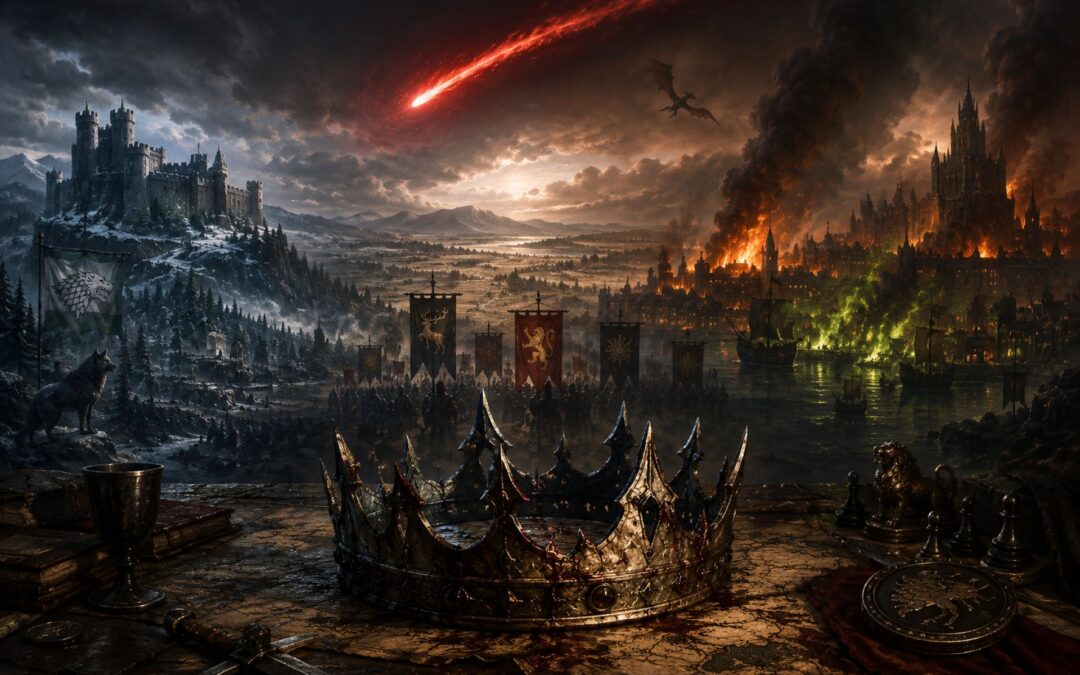
George R. R. Martin’s A Clash of Kings is the second novel in A Song of Ice and Fire, following the political collapse and personal catastrophes of A Game of Thrones. The official Penguin Random House listing identifies it as the second volume in the series, but structurally it is much more than a continuation. The first novel destroys the political equilibrium of the Seven Kingdoms; the second explores what happens once everyone begins trying to build a new order from the wreckage.
The result is a novel of expansion. The number of active political fronts grows, the map becomes more important, magic moves from rumor toward undeniable force, and characters who once seemed protected by family name or social role find themselves stripped of those identities. Five royal claims compete in or around Westeros, the Ironborn launch their own invasion, the Night’s Watch ventures deeper into the unknown north, and Daenerys Targaryen discovers that possessing dragons does not automatically give her the army, ships, or political support required to reclaim a kingdom.
What holds these disparate stories together is Martin’s insistence that power is never one thing. Blood matters, but so do armies. Law matters, but only if enough people recognize it. Wealth matters, but only if it can be converted into food, weapons, loyalty, or marriage alliances. Reputation matters because rulers depend on stories told about them. Information matters because characters repeatedly act on rumors, letters, prophecies, false reports, and deliberately manufactured beliefs. Increasingly, magic matters too.
Spoiler warning: this article covers the complete novel, including major deaths, betrayals, the Battle of the Blackwater, the fall of Winterfell, the House of the Undying, and the ending.

A Clash of Kings: Complete Plot Summary
A Clash of Kings is told through a rotating series of close third-person viewpoints. No single character sees the whole war, and several of the most important political actors—Robb Stark, Stannis Baratheon, Renly Baratheon, Joffrey Baratheon, and Balon Greyjoy—are never recurring viewpoint characters at all. Martin instead lets readers assemble the conflict from the perspectives of advisers, captives, children, soldiers, exiles, hostages, and people caught between loyalties.
This matters because the story constantly separates reality from perception. A character may make a rational decision based on false information, believe someone dead who is alive, mistake a staged spectacle for supernatural proof, or understand only one piece of a larger political maneuver. The novel’s plot is therefore not simply a sequence of battles and betrayals. It is also a sequence of people trying to act intelligently inside a world they only partially understand.
The Red Comet and a Realm of Rival Kings
The novel opens on Dragonstone with Maester Cressen, an elderly counselor who has served House Baratheon for decades. Robert Baratheon is dead, Joffrey sits the Iron Throne, and Robert’s younger brother Stannis now claims that Joffrey and his siblings are illegitimate children born from Cersei Lannister’s incestuous relationship with Jaime. Stannis therefore considers himself Robert’s lawful heir.
Yet Stannis’s court has changed. His wife Selyse and many followers have embraced R’hllor, the Lord of Light, through the red priestess Melisandre. Under her influence, the traditional images of the Seven are burned, and Stannis is proclaimed the prophesied warrior associated with the legendary hero Azor Ahai. A sword presented as Lightbringer becomes part of this new sacred image.
Cressen distrusts Melisandre and fears that she is transforming Stannis into something dangerous. He attempts to kill her using the strangler, a poison concealed inside one of the false purple jewels of his maester’s collar. During a feast, Cressen drinks from the poisoned cup and offers it to Melisandre. She drinks without apparent harm while he dies, establishing immediately that the supernatural in this book cannot be dismissed as mere superstition.
Above the world hangs a red comet. Nearly every faction interprets it differently. Some see blood, some war, some divine approval, and Daenerys later views it as a herald of dragons. Martin begins the novel with a symbol visible to everyone but understood by no one in the same way, establishing a central pattern: people do not merely respond to events; they assign meanings to them based on their needs.
Far to the south of Winterfell, Arya Stark travels north under the protection of Yoren of the Night’s Watch. Her hair has been cut, she has taken the identity of an orphan boy called Arry, and she is traveling among recruits for the Wall. Her disguise is essential because the Lannisters would treat Ned Stark’s missing daughter as a valuable hostage.
Arya’s journey quickly strips away what remains of aristocratic protection. She clashes with rough boys such as Hot Pie and Lommy, hides the sword Needle, and tries to behave like someone with no important name. Gendry, the apprentice armorer who is secretly one of Robert Baratheon’s bastards, eventually recognizes that Arya is a girl. Gold cloaks sent from King’s Landing come looking for Gendry, making it clear that the Lannister regime is systematically eliminating potential challenges connected to Robert’s bloodline.
Sansa, meanwhile, remains a prisoner in King’s Landing. At Joffrey’s name-day tourney, the drunken knight Ser Dontos Hollard appears and is in danger of being executed for embarrassing himself. Sansa persuades Joffrey to spare Dontos by making him the king’s fool. It is a small act, but it shows how much she has changed. She no longer believes noble behavior will automatically be rewarded. She uses the language of court to redirect Joffrey’s cruelty.
Tyrion Lannister returns to the capital carrying Tywin Lannister’s authority to serve as acting Hand of the King. He immediately discovers that King’s Landing is badly governed, economically strained, politically divided, and militarily vulnerable. Cersei resents his arrival, while Tyrion views Joffrey’s impulsive brutality as a threat not only to their enemies but to House Lannister itself.
Tyrion’s private life complicates his public role. Against Tywin’s orders, he brings Shae to King’s Landing and arranges to keep her near him. He wants political authority, but he also wants intimacy, admiration, and emotional security. Those needs will later become vulnerabilities.
At Winterfell, Bran Stark is learning to live with his paralysis while serving as the young prince of a castle whose lord and king are absent. His connection with his direwolf Summer grows increasingly strange. Bran dreams through the wolf’s senses and experiences moments that suggest he is not merely dreaming about Summer but entering the animal’s consciousness.
The war is also changing Robb Stark’s position. At Riverrun, Robb is now King in the North, crowned by his followers after Ned Stark’s execution. His battlefield success has given him legitimacy among his own lords, but kingship creates new problems. He must define what northern independence means, negotiate with rival powers, and maintain alliances while his enemies retain greater resources.
Catelyn Stark distrusts Robb’s decision to send Theon Greyjoy to negotiate with Balon Greyjoy. She knows that Theon has been raised among the Starks as a hostage as much as a ward and fears that returning him to his family may awaken loyalties Robb does not understand. Robb nevertheless trusts Theon’s friendship and hopes Balon will join the war against the Lannisters.
Tyrion begins reshaping King’s Landing’s government. He targets Janos Slynt, commander of the City Watch, whose corruption and role in Ned Stark’s downfall make him both useful and dangerous. Tyrion removes him, sends him to the Wall, and replaces him with Jacelyn Bywater. The act reveals Tyrion at his most effective: he understands that government depends on institutions, appointments, information, and disciplined force rather than only royal command.
Yet Tyrion also recognizes his own compromise. He may despise Slynt, but he still needs armed men willing to enforce his decisions. His politics are never purely moral. He seeks better government while participating fully in a regime sustained by violence.
Arya’s party, meanwhile, moves through a countryside increasingly damaged by war. Refugees crowd the roads, villages have been abandoned, food is scarce, and travelers are unsure which armed groups can be trusted. Yoren has made the journey to the Wall many times, but the familiar world in which the Night’s Watch could pass relatively safely through the realm is disappearing.
On Dragonstone, Davos Seaworth offers a different view of Stannis. Davos is a former smuggler knighted by Stannis after saving Storm’s End during Robert’s Rebellion. He is fiercely loyal but not blindly obedient. Watching the images of the Seven burn, he worries that Melisandre’s influence is changing the nature of Stannis’s cause.
Stannis himself is more complicated than a simple religious convert. He recalls a weak hunting bird named Proudwing that he abandoned for a stronger hawk because sentiment did not make the weaker animal useful. He approaches kingship in similarly severe terms. He believes he is the rightful king, but he is also willing to use whatever power works, including Melisandre’s.
Theon Greyjoy returns to Pyke expecting the homecoming to restore his identity. Instead, it exposes how divided that identity has become. Among the Starks, he has always known himself as a Greyjoy. Among the Greyjoys, however, he discovers that he has become too much like the mainland nobles who raised him.
Balon Greyjoy has not forgiven the rebellion in which his sons were killed and Theon was taken hostage. He rejects Robb’s proposal for alliance and plans instead to exploit the northern armies’ absence by invading the North. Theon had imagined himself returning as an important son and political bridge. Instead, he finds that his father regards him with disappointment.
Across the Narrow Sea, Daenerys Targaryen leads the exhausted survivors of Drogo’s khalasar into the red waste. She has three newborn dragons but little else. Hunger, thirst, and exposure reduce her already small following, demonstrating immediately that dragons are not yet an army and a royal name is not yet a kingdom.
Eventually Daenerys reaches the abandoned city she calls Vaes Tolorro. From there, her bloodriders seek help. Visitors from Qarth arrive, including the warlock Pyat Pree, the merchant prince Xaro Xhoan Daxos, and the masked woman Quaithe. They are interested in Daenerys because living dragons have returned to the world.
North of the Wall, Jon Snow travels with the Night’s Watch on the Great Ranging. The expedition passes settlements that should be inhabited but are empty. The absence of people, animals, and ordinary life creates a growing sense that something large has changed among the free folk.
Jon also continues to wrestle with what his vows require. Robb is a king while Jon is a sworn brother expected to renounce inheritance, family, marriage, and personal advancement. Lord Commander Jeor Mormont forces Jon to acknowledge the cost honestly. Jon admits that Robb’s glory and freedom trouble him, but he still chooses the Watch.
By the end of the opening movement, nearly every major front has been established. The Seven Kingdoms are politically fragmented, the North is vulnerable, Stannis has embraced an ominous source of power, Daenerys has become important because of her dragons, and the Night’s Watch has entered territory from which ordinary people seem to have vanished.
War Reaches the Roads, Castles, and Courts
Arya’s fragile protection collapses when Lannister forces attack the abandoned holdfast where Yoren’s group has taken shelter. The fighting is brutal and chaotic. Yoren dies defending the group, the compound burns, and many of the recruits are killed or scattered.
Before escaping, Arya frees three dangerous prisoners who had been confined in a wagon: Jaqen H’ghar, Rorge, and Biter. She does so because leaving them trapped in the fire would mean certain death. At this point, the rescue seems like one instinctive act amid disaster, but it later becomes one of the most consequential decisions in her story.
The survivors flee without Yoren. Arya, Gendry, Hot Pie, Lommy, and others are now children moving through a war zone with no institutional protection. Eventually Lannister men capture them. Lommy, unable to walk because of an injury, is simply killed when he becomes inconvenient.
In King’s Landing, Stannis’s accusation of incest begins circulating. He sends letters throughout the realm declaring that Joffrey, Myrcella, and Tommen are Jaime Lannister’s children rather than Robert Baratheon’s. Cersei wants the claim suppressed, but Tyrion understands the difficulty of fighting rumor. Excessive effort to silence an accusation can make it look more credible.
Tyrion also begins testing the loyalties of the Small Council. He tells Grand Maester Pycelle, Littlefinger, and Varys three different plans for Myrcella’s marriage, each to a different political faction. When Cersei reacts specifically to the proposal involving Dorne, Tyrion knows Pycelle has carried that version to her.
The Dornish proposal is more than bait. Tyrion genuinely sees value in sending Myrcella to Prince Doran Martell’s family and binding Dorne to the Iron Throne. The episode shows his preference for politics through information and leverage. He does not merely ask who is loyal; he creates circumstances that reveal loyalty.
At Winterfell, Bran is increasingly forced to act as a lord. During the harvest feast and in disputes such as the question of the Hornwood lands, he learns that ruling involves listening to grievances, weighing claims, and representing authority even when he feels like a child.
The arrival of Jojen and Meera Reed alters Bran’s understanding of himself. Jojen speaks with unsettling confidence about dreams and future events. He recognizes that Bran’s wolf experiences are not ordinary dreams and begins introducing him to the idea that his consciousness can enter Summer.
Maester Luwin remains skeptical. He knows that old stories speak of magic, greenseers, and powers associated with the children of the forest, but he assumes such things have faded. The disagreement between Luwin and Jojen is important because Luwin is not presented as foolish. He represents reasonable knowledge built from a world that may now be changing faster than its institutions can accept.
Catelyn reaches Renly Baratheon’s enormous host. Renly’s claim to the throne rests on something very different from Stannis’s. Stannis emphasizes lawful succession; Renly relies on charisma, political alliance, and overwhelming military support.
At Renly’s camp, Brienne of Tarth defeats celebrated male knights in a melee and wins a place in Renly’s Rainbow Guard. Her presence challenges the social assumptions surrounding chivalry because she possesses many of the virtues associated with ideal knighthood while being mocked precisely because she is a woman performing that role.
Sansa’s education in the hollowness of courtly romance continues. Ser Dontos secretly meets her in the godswood and promises to help her escape, presenting himself in the language of the romantic tale of Florian and Jonquil. Sansa wants to believe in rescue, but she has already learned that stories and reality rarely match.
Sandor Clegane offers the opposite lesson. He despises knights because his brother Gregor, one of the most feared and brutal men in the realm, is nevertheless a knight. Sandor tells Sansa about the childhood burning that scarred his face and rejects the idea that ceremony can transform violent men into moral ones.
Arya’s captors take prisoners toward Harrenhal. Along the way, Martin shows organized terror in the Riverlands. Villagers are tortured for information, suspected loyalties, or merely because armed men possess the power to inflict pain without consequence. Arya learns that elite wars become a different reality when experienced from the bottom.
At Harrenhal, Arya becomes a servant. The immense castle, built by Harren the Black and famously burned by Aegon the Conqueror’s dragon Balerion, is both a symbol of ruined power and a practical engine of occupation. Arya serves under Weese, a cruel overseer, while Gregor Clegane’s men and other Lannister soldiers dominate the castle.
Theon’s return to Pyke becomes increasingly humiliating. During his journey across the island, he meets a young woman calling herself Esgred and tries to impress and seduce her. She ultimately reveals herself as Asha Greyjoy, Theon’s sister.
Asha has remained among the Ironborn and earned Balon’s confidence as a capable leader. Theon, despite being Balon’s surviving son, discovers that his expectations of easy authority are meaningless. He is culturally half-outsider, arrogant about a status he has not earned, and desperate to prove he belongs.
At King’s Landing, Tyrion arrests Pycelle after exposing him as Cersei’s informer. He strips the Grand Maester of much of his dignity and confines him. Yet Tyrion is less secure against Varys and Littlefinger, precisely because their actual loyalties are harder to identify.
Tyrion also draws Lancel Lannister into his intelligence network. When Lancel approaches him on Cersei’s behalf, Tyrion reveals that he knows about Lancel’s sexual relationship with the queen and his part in supplying Robert with unusually strong wine before the hunting accident that killed him. The blackmail turns Lancel into another source of information.
The maneuvering exhilarates Tyrion. For perhaps the first time in his life, his wit, suspicion, memory, and instinct for contradiction have become sources of formal power. Yet this confidence will later prove unstable because much of his control depends on secrets that can disappear as soon as his office does.
In the far north, the Watch reaches Craster’s Keep. Craster is a brutal man who marries his own daughters and provides the Watch with information and shelter. Gilly, one of his pregnant daughter-wives, asks Jon to help her escape because she fears what Craster will do if her baby is male.
Jon gradually understands that Craster does not raise sons. He gives them away to the mysterious beings associated with the cold darkness beyond his settlement. The Night’s Watch tolerates Craster because he is useful, forcing Jon to confront the ugly compromises an institution may make in the name of survival.
In Qarth, Daenerys is welcomed as a wonder. Her dragons bring prestige, fascination, and fear. Xaro Xhoan Daxos gives her luxurious hospitality, but the generosity is not the same as political commitment.
Daenerys also receives news from Westeros. Robert is dead, the realm is divided, and several rulers are fighting over the Iron Throne. For the first time, the chaos across the sea seems to offer a practical opening for her claim. Yet she has no army capable of crossing the Narrow Sea, and the people of Qarth who admire her dragons are reluctant to finance her war.
The gap between spectacle and usable power becomes central to her story. Daenerys possesses something the world thought extinct, but she does not yet know how to convert that wonder into ships, soldiers, or durable alliance.
Renly’s Death, Harrenhal, and the Fall of Winterfell
At Harrenhal, Arya encounters Jaqen H’ghar again. Because she saved him, Rorge, and Biter from the burning wagon, Jaqen tells her that the Red God is owed three lives in exchange for the three she took from death. Arya may name three people, and Jaqen will kill them.
At first, Arya uses this extraordinary power emotionally rather than strategically. After hearing Chiswyck boast about horrifying crimes committed by Gregor Clegane’s men, she names Chiswyck. He dies. Later, after Weese mistreats her again, she names Weese, who dies through an attack by his own dog.
Only afterward does Arya recognize the scale of what she might have done. She could have named figures such as Tywin Lannister and potentially altered the war. The realization marks an important change: she is beginning to understand the difference between killing someone who hurts her and using violence politically.
Catelyn, meanwhile, is present for one of the book’s most consequential political confrontations. Stannis and Renly meet before battle. Stannis insists that Robert’s legal heir is himself because Joffrey is illegitimate. Renly’s position is essentially that Robert took a crown by force, so claims of strict inheritance are already compromised.
Their dispute dramatizes two theories of kingship. Stannis treats the crown as an obligation assigned by law and blood. Renly treats it as something made real by recognition and sufficient power. Neither persuades the other.
The conflict is resolved by something neither army expects. Before battle, a shadowy supernatural figure enters Renly’s tent and kills him in front of Catelyn and Brienne. The murder is so impossible by ordinary standards that Brienne is immediately vulnerable to accusation.
Catelyn helps Brienne escape. Renly’s enormous political coalition begins disintegrating almost instantly. Many of his followers move toward Stannis, but the Tyrells withdraw, leaving their future allegiance open.
Renly’s death changes the political map more dramatically than a battle might have done. Martin makes the supernatural directly consequential to strategy: thousands of soldiers become irrelevant because a magical assassination removes the person holding their coalition together.
Jon’s expedition also discovers evidence of forgotten supernatural knowledge. At the Fist of the First Men, Ghost leads Jon to a buried cache wrapped in a Night’s Watch cloak. Inside are obsidian weapons—dragonglass—and a horn.
The find suggests that earlier members of the Watch knew enough about dangers beyond the Wall to hide tools for future use. The current institution, however, has forgotten much of that knowledge.
At Winterfell, Jojen’s warnings become more explicit. His dreams suggest that the sea will come to Winterfell, an impossible image if interpreted literally because the castle lies far from the coast. The meaning becomes clear when the Ironborn arrive.
Theon, unhappy with the limited raid Balon has assigned him, designs a bolder plan. He attacks Torrhen’s Square to draw Winterfell’s remaining defenders away, then strikes the almost undefended castle.
Bran cannot hold Winterfell militarily. Theon takes the castle and forces Bran to yield to prevent further bloodshed. Mikken the smith resists and is killed. Hodor is beaten. Theon has achieved what appears to be a spectacular victory with a small force.
Yet the conquest contains the seeds of failure. Winterfell is deep inside hostile territory, the local population hates the Ironborn, and Theon’s position depends on maintaining the illusion of strength. He has captured the symbolic heart of the North without possessing the resources required to hold it.
Tyrion responds to Renly’s death more effectively. He realizes that the Tyrell alliance is now available. If the Tyrells can be detached from their former support for Renly and connected to Joffrey, the balance of power may change decisively.
He proposes replacing Sansa Stark as Joffrey’s intended bride with Margaery Tyrell. Littlefinger is sent to negotiate. This marriage alliance will later prove as important to the survival of King’s Landing as any military preparation.
Tyrion continues building those preparations. He works with the Alchemists’ Guild to increase wildfire production, organizes defensive works, and prepares the river approaches. The later Battle of the Blackwater is therefore carefully set up as a logistical achievement rather than an improvised trick.
King’s Landing itself is deteriorating. Hunger, fear, refugees, and resentment create explosive conditions. When Myrcella leaves for Dorne as part of Tyrion’s alliance strategy, a crowd gathers around the royal procession.
The situation becomes a riot. The High Septon is killed, Tyrek Lannister disappears, Lollys Stokeworth is sexually assaulted, and Sansa is nearly trapped in the violence before Sandor Clegane rescues her. The riot makes clear that the Lannister government faces danger not only from invading armies but from people within its own capital.
Davos witnesses another supernatural turning point. Stannis has moved against Storm’s End, but Ser Cortnay Penrose refuses to surrender the castle and Edric Storm. Davos then rows Melisandre beneath the fortress through an underground passage.
There, he sees Melisandre give birth to a shadow creature. The scene confirms beyond reasonable doubt that the force that killed Renly was not symbolic or imagined. Stannis’s cause has access to supernatural violence capable of bypassing ordinary walls, guards, and battle lines.
Jon’s Great Ranging moves into a more dangerous stage when Qhorin Halfhand joins the expedition. Qhorin believes the free folk are gathering under Mance Rayder in unprecedented numbers and sends smaller parties to learn what is happening.
Jon is chosen to travel with him. The assignment separates Jon from Jeor Mormont’s main force and places him under the guidance of a ranger who understands the wilderness far better than he does.
At Harrenhal, Arya decides to use Jaqen’s third death differently. She needs him to help free northern prisoners, but he refuses to do more than kill one person. Arya therefore names Jaqen himself.
Because Jaqen must either kill himself or make Arya withdraw the name, she gains leverage. She agrees to withdraw it only if he helps free the prisoners. The plan succeeds, northern men take control of Harrenhal from within, the Brave Companions change sides, and Roose Bolton becomes the castle’s new master.
Jaqen then parts from Arya. He gives her an iron coin and tells her the phrase “valar morghulis,” promising that if she ever needs to find him, she may use the coin with a man from Braavos. Before leaving, he changes his face, confirming that his unusual identity is connected to a form of magic or skill far beyond ordinary disguise.
Catelyn’s story at Riverrun becomes increasingly dominated by grief and uncertainty. Robb continues to win victories in the west, but the war’s strategic picture remains unstable. Edmure Tully prevents Tywin’s forces from crossing the Red Fork and celebrates what looks like a local success.
The result, however, is more ambiguous than it appears. Tywin is prevented from moving west, leaving him available to respond to the developing crisis around King’s Landing. The novel repeatedly shows how a tactical victory may have consequences no participant understands at the time.
In Qarth, Daenerys becomes frustrated. Xaro does not simply hand her the army or fleet she wants. The more she is admired as Mother of Dragons, the clearer it becomes that admiration is not equivalent to sacrifice on her behalf.
Quaithe warns Daenerys in riddling language and suggests that she must leave Qarth. Daenerys increasingly turns toward the House of the Undying, hoping that the warlocks can provide knowledge unavailable through ordinary politics.
Prophecy, False Deaths, and the Road to the Blackwater
Daenerys enters the House of the Undying after being given strict instructions about how to move through it. Inside, space and time seem unstable. She encounters rooms, figures, scenes, and visions that appear connected to past events, possible futures, Targaryen history, death, betrayal, and the larger destiny associated with dragons.
The visions resist simple interpretation. Some resemble memories or historical moments Daenerys could not personally have witnessed, while others appear prophetic. The phrase about the dragon having three heads recurs, along with sets of three—fires, mounts, and treasons—that the Undying tell her she will know.
The experience becomes physically dangerous. The Undying themselves attempt to hold or consume Daenerys, and their power is linked to a strange heart-like presence. Drogon attacks, burning the Undying and allowing Daenerys to escape.
The sequence expands the scale of Daenerys’s story. She is no longer simply a dispossessed girl trying to acquire ships. Her dragons and bloodline are now entangled with prophecy, ancient power, and a future no one can yet interpret clearly.
In King’s Landing, Tyrion finalizes defenses. Wildfire production increases, buildings near the river are cleared, mountain clans are positioned to harass Stannis’s movements, and the enormous chain Tyrion has ordered becomes part of a hidden plan for the Blackwater.
He is also forced to defend against threats within the city. Some people hope Stannis will take King’s Landing and are willing to help him. Tyrion’s task is therefore not simply to defeat an external enemy but to prevent the capital from collapsing internally.
At Winterfell, Bran, Rickon, Jojen, Meera, Hodor, and Osha escape Theon’s control. Theon reacts with panic. Capturing Winterfell had made him look bold; losing the Stark heirs would make him look incompetent.
He searches desperately but cannot find them. Reek, a prisoner associated with the disgraced Bolton bastard Ramsay Snow, offers a solution. Theon accepts it.
Two local miller’s boys are killed, mutilated, and presented as Bran and Rickon. Theon knows the children are not the Starks. His decision is made because he fears humiliation more than he fears becoming a murderer of innocent children.
This is the decisive moral collapse of his arc. Theon does not accidentally drift into atrocity. He consciously chooses a lie that can be sustained only through murder.
Asha later visits Winterfell and tells him the strategic truth he does not want to hear. Holding the castle is pointless. He has extended himself deep into hostile territory for prestige rather than military necessity.
She urges him to leave. He refuses because withdrawal would mean admitting failure. By this point, Theon’s fear of ridicule controls his choices more strongly than reason.
In the Frostfangs, Jon and Qhorin’s group encounters Ygritte, a young wildling woman. Jon is ordered to kill her after questioning her. She tells him stories about northern history, including the tale of Bael the Bard, which complicates rigid ideas about Stark ancestry and the division between wildlings and kneelers.
Jon cannot kill her. He lets Ygritte escape.
The act is both merciful and dangerous. Jon has been raised to treat wildlings as enemies, but meeting an individual makes the category less simple. His inability to execute Ygritte will later create the human connection that helps him enter the wildling camp.
Jon’s supernatural connection to Ghost also deepens. Through the wolf, he glimpses the enormous host gathered under Mance Rayder, including giants and mammoths. The force is far larger than a conventional raiding party.
The threat north of the Wall is therefore becoming clearer at the same time the southern kingdoms remain consumed by dynastic war.
Sansa’s situation grows more dangerous when she begins menstruating. Her body has now become politically significant because she is old enough, by the standards of her world, for marriage and childbirth. Her betrothal to Joffrey can become an immediate dynastic reality.
Cersei speaks to Sansa about marriage, sex, Robert, childbirth, and the vulnerability created by love. Some of what she says reflects genuine insight into the constraints placed on powerful women in Westeros. Yet her conclusions are filtered through bitterness and a worldview that treats intimacy largely as a weakness to be exploited.
Tyrion’s family conflict also becomes more personal. News reaches the capital that Bran and Rickon have supposedly been killed. Cersei then reveals that she has seized a prostitute she believes to be Tyrion’s beloved.
The prisoner is actually Alayaya, not Shae. Tyrion nevertheless reacts by threatening Tommen if Alayaya is harmed. The threat horrifies even him because he understands the logic it creates: once everyone uses innocent relatives and dependents as leverage, cruelty becomes reciprocal.
Catelyn receives the false report of Bran and Rickon’s deaths and breaks under the apparent loss. She speaks with Jaime Lannister, still imprisoned at Riverrun, in one of the novel’s most revealing confrontations.
Jaime admits to the incest with Cersei and speaks provocatively about honor, vows, and the contradictions built into knighthood. A knight may swear to defend the king, defend the innocent, obey his father, protect women, and serve his lord, yet those duties can conflict. Jaime’s killing of Aerys Targaryen is universally condemned as oathbreaking even though Aerys was monstrous.
Catelyn also becomes aware that parts of the story surrounding the dagger used in the attempt on Bran’s life do not fit cleanly. The novel does not resolve the matter here, but it undermines the certainty with which earlier conclusions were reached.
At the end of their encounter, Catelyn asks Brienne for her sword. The gesture prepares a desperate act motivated by a mother’s grief and a belief that formal political strategy has failed her family.
Meanwhile, the Blackwater approaches. Stannis has absorbed much of the military strength that once supported Renly and is moving against King’s Landing. The city’s defenders know he is coming.
Sansa enters the sept to pray while the capital prepares for siege. The fantasies of tournaments and handsome knights that shaped her early understanding of the world have been replaced by the knowledge that armies bring rape, fire, hunger, mutilation, and death.
The Battle of the Blackwater and the Broken Aftermath
The Battle of the Blackwater begins from Davos Seaworth’s perspective. Stannis’s fleet enters the river while Davos notices elements of the Lannister defense that make him uneasy. The river seems strangely prepared.
Tyrion’s trap is then sprung. Ships loaded with wildfire turn the Blackwater into an inferno. The substance burns with terrifying intensity and creates panic among Stannis’s ships.
The enormous chain Tyrion has arranged is raised across the river, trapping much of the fleet inside the killing zone. Ships collide, burn, and become improvised bridges of wreckage. The plan is tactically brilliant, but the experience from Davos’s side emphasizes horror rather than cleverness.
The wildfire does not end the battle. Stannis’s surviving men continue attacking, and enough ships and debris form crossings that troops can still reach the city.
Tyrion sees that the defenders remain in danger. Sandor Clegane, ordered back into the flames, refuses. His lifelong terror of fire, rooted in Gregor burning his face when he was a child, overwhelms him.
Sandor abandons the Kingsguard and Joffrey. The moment completes his rejection of an institution he has always despised. He has worn the white cloak without believing in the ideals supposedly represented by it.
As morale deteriorates, Tyrion takes command personally. His attempt to rally the defenders is striking because he does not invoke Joffrey’s greatness. He appeals to the immediate reality that these men are defending their own city, homes, and lives.
He leads a sortie outside the walls. The decision shows courage, but also exposes how far the battle has moved beyond the controlled political environment in which he usually excels.
Inside Maegor’s Holdfast, Sansa and the court’s women wait with Cersei. Cersei drinks heavily and talks about war, rape, kingship, and power. She has Ser Ilyn Payne present not merely as a guard but as a contingency: if Stannis wins, Cersei would rather have the royal women killed than captured and subjected to judgment or abuse.
Cersei’s behavior also harms the defense when she removes Joffrey from the walls. Joffrey is not an effective commander, but his visible presence matters to morale. Once the king disappears, some defenders interpret it as evidence that defeat is imminent.
Tyrion’s battle becomes increasingly chaotic. During the fighting, Ser Mandon Moore suddenly turns against him and cuts his face severely. The novel does not conclusively establish who ordered the attack.
Podrick Payne intervenes and saves Tyrion by sending Mandon into the river. Tyrion loses consciousness, ending his direct participation in the battle at the moment when he has done more than almost anyone else to preserve the city.
Sansa eventually returns to her chambers and encounters Sandor. He is drunk, terrified, enraged, and finished with Joffrey’s service. He offers to take Sansa away from King’s Landing.
Their encounter is frightening because Sandor is physically dangerous and emotionally unstable, but he does not force her to leave. He demands the song he has repeatedly asked from her, then departs.
The apparent defeat of King’s Landing is reversed by forces Tyrion helped set in motion but cannot personally command. The Tyrells have allied with the Lannisters through the proposed marriage between Joffrey and Margaery. Tywin and the Tyrell host arrive and strike Stannis’s forces.
Part of the relief army uses the visual memory of Renly to destabilize Stannis’s men. Many interpret the figure at the head of the attacking force as “Renly’s ghost.” It is not a literal resurrection, but in a war where symbols matter, the dead king’s image becomes a weapon.
Stannis is defeated and forced to retreat. The Lannisters retain King’s Landing.
Daenerys, far away in Qarth, reaches the end of her own local crisis. After the destruction of the House of the Undying, she remains without the great army she had hoped to obtain.
An assassination attempt involving a manticore is interrupted by two newcomers: the enormous fighter Strong Belwas and an elderly warrior called Arstan Whitebeard. They have been sent by Illyrio Mopatis and bring three ships.
Daenerys accepts the vessels and renames them for the dragons of Aegon the Conqueror: Balerion, Vhagar, and Meraxes. She leaves Qarth not with an army but with greater mobility, renewed purpose, and three growing dragons.
At Harrenhal, Arya decides she cannot rely on Roose Bolton merely because he fights on the Stark side. Her life as a servant has taught her that affiliation does not guarantee safety.
She escapes with Gendry and Hot Pie. During the escape, Arya personally kills a guard, an important development because her relationship to violence has moved beyond wishing for deaths or commanding Jaqen.
Sansa learns that the Tyrell alliance has changed her status. Joffrey is released from the betrothal to her so that he can marry Margaery Tyrell.
For a moment, Sansa believes she is free. Ser Dontos warns her that she is not. She remains a Stark hostage in the hands of the Lannisters and is still politically valuable.
At Winterfell, Theon’s situation collapses. Northern forces close on the castle. Reek returns with armed men who appear to be helping Theon.
The rescue is a trap. Reek reveals himself as Ramsay Snow, the bastard son of Roose Bolton. Ramsay’s men destroy the force outside Winterfell, then turn on the Ironborn as well.
Winterfell burns. Theon loses control of the castle he destroyed himself trying to hold.
Tyrion eventually awakens after the Blackwater. He has survived, but his face is badly scarred. More importantly, the political world has moved on without him.
Tywin Lannister has resumed the office of Hand. The Tyrells are celebrated as saviors. Tyrion’s work—the chain, wildfire, defensive planning, political maneuvering, and personal battlefield leadership—is overshadowed.
His greatest public achievement therefore ends in private bitterness. He saved a regime that does not love him and a city that largely does not know what he did.
Jon’s story ends in an apparently opposite direction. Qhorin’s group is captured by wildlings. Qhorin has already understood that their information must somehow reach the Watch and that Jon may have to survive by appearing to betray his vows.
Qhorin deliberately provokes Jon into combat in front of the wildlings. Jon kills him. Because Ygritte can testify that Jon previously spared her, the wildlings are more willing to accept the possibility that he has turned against the Watch.
Jon therefore enters their company as a spy. What looks like betrayal is obedience to Qhorin’s final command.
The novel’s final chapter returns to Bran. Through Summer, Bran experiences the burning of Winterfell before the story reveals the truth: Bran, Rickon, Jojen, Meera, Hodor, and Osha never fled far from the castle.
They hid in the crypts beneath Winterfell while Theon searched the countryside. The “dead” Stark boys have been alive beneath the castle associated with their ancestors.
When they emerge after the sack, Winterfell is ruined. They find Maester Luwin dying. Luwin advises them that Bran and Rickon should separate, because keeping both Stark heirs together makes them easier to capture or kill.
Osha takes Rickon in one direction. Bran leaves with Hodor, Jojen, and Meera, heading toward a future connected to the strange powers he is only beginning to understand.
Looking back at Winterfell, Bran does not see simple death. The castle is broken. So is he. Yet broken does not mean dead.
That distinction is the novel’s final answer to many of its apparent conclusions. Stannis is defeated but not destroyed. Sansa is released from one role but remains a prisoner. Tyrion survives but loses power. Jon appears to desert while fulfilling his duty. Winterfell burns but the Stark heirs live.
The War of the Five Kings and the World of A Clash of Kings
The title A Clash of Kings suggests a straightforward civil war, but Martin deliberately makes the conflict more complicated than a contest among five equivalent monarchs. Joffrey, Robb, Stannis, Renly, and Balon all bear or claim royal authority, but their political projects differ radically in legal basis, territorial aim, military strength, and public legitimacy.
Joffrey occupies the Iron Throne and therefore benefits from institutions that already exist: the capital, royal bureaucracy, the Kingsguard, the City Watch, and the political symbolism of ruling from King’s Landing. His weakness is that Stannis’s incest accusation directly attacks the hereditary basis of his claim, while Joffrey’s own cruelty repeatedly damages loyalty to the regime.
Robb Stark does not initially seek the Iron Throne. He becomes King in the North because his followers reject southern rule after Ned Stark’s execution. His kingship is therefore secessionist rather than universal. The North and Riverlands become the base of a new political order held together by military success and personal loyalty.
Stannis claims the entire realm through legal succession. If Joffrey is illegitimate, then Stannis, as Robert’s older surviving brother, has the strongest hereditary claim under the logic accepted by many of the realm’s nobles. His problem is that law does not automatically create followers.
Renly offers the opposite model. His claim is legally weaker than Stannis’s, but he has charisma, popularity, the support of House Tyrell, and the largest army. He implicitly understands kingship as something produced through sufficient recognition and force.
Balon Greyjoy represents another kind of sovereignty. He uses the mainland war to revive Ironborn independence and attacks the North. He is not trying to prove that he should inherit Robert’s throne; he rejects the political structure in which that inheritance matters.
The novel’s political world is therefore not a chessboard with five equal kings. It is a conflict among competing definitions of political reality. Heredity, conquest, local independence, possession of the capital, military coalition, and cultural memory all produce different kinds of legitimacy.
Geography makes those claims meaningful. King’s Landing is not merely a symbolic capital; it is a city that must be fed. As war interrupts trade and the surrounding countryside becomes unstable, food prices and hunger become political forces. The riot following Myrcella’s departure shows that urban government can fail long before an enemy army breaches the walls.
The Riverlands reveal war from another angle. Strategically, they are roads, rivers, castles, bridges, and crossing points. For Arya, they are villages where civilians are tortured, farms stripped of food, and children killed for being inconvenient. Martin repeatedly forces the reader to move between the map seen by commanders and the same land experienced by the people living on it.
Harrenhal concentrates that contrast. It is one of the largest fortresses in Westeros, famous as the castle Aegon the Conqueror destroyed with dragonfire. Yet in Arya’s chapters, its historical grandeur becomes secondary to kitchens, labor, beatings, interrogation, and arbitrary power. A legendary castle functions as an occupation system.
The Iron Islands have their own political culture. The Greyjoys remember independence, raiding, and what they consider the “old way.” Theon’s failure to understand how much he has changed away from that culture drives his desperate attempts to perform Ironborn masculinity.
Winterfell operates differently. It is both a strategic castle and a home saturated with Stark memory. Bran experiences its fall not only as a military event but as the destruction of the physical structure around which his identity has been built.
Beyond the Wall, Martin gradually reveals that southern politics may be dangerously parochial. The abandoned settlements, Craster’s sacrifices, hidden dragonglass, massing wildlings, giants, and evidence of the Others suggest a threat fundamentally different from the disputes consuming the Seven Kingdoms.
Qarth expands the world in another direction. It is wealthy, theatrical, mercantile, and politically fragmented. Daenerys discovers there that wealth does not mean generosity and admiration does not mean alliance. Her dragons make her valuable, but every faction that approaches her has interests of its own.
The great achievement of the world-building is therefore not scale for its own sake. Each region generates different forms of power. King’s Landing converts bureaucracy and alliance into authority. The Iron Islands convert culture into rebellion. The Riverlands expose the physical cost of military movement. Winterfell turns memory into political identity. Qarth converts spectacle into commerce. Beyond the Wall, forgotten knowledge begins becoming relevant again.
Character Analysis
The novel’s most powerful rulers are often denied direct viewpoint access. Martin rarely asks the reader to live inside the minds of the men calling themselves kings. Instead, he focuses on people whose relationship to power is unstable: Tyrion may govern but is not respected; Sansa lives at court but is captive; Arya is highborn but travels as a nobody; Theon claims princely status but belongs nowhere; Jon serves an institution while questioning where he fits; Bran is heir to a great house but cannot walk.
This structure prevents the political story from becoming a sequence of royal manifestos. Power is usually seen from the side, through the people who implement it, suffer under it, misunderstand it, or try to survive near it.
Tyrion Lannister
Tyrion has the novel’s most complete political arc. At the beginning, he enters King’s Landing with formal authority for the first time in his life. His father has made him acting Hand not because Tywin suddenly admires him, but because someone competent must control the capital while Tywin wages war elsewhere.
Tyrion proves exceptionally capable. He removes Janos Slynt, identifies Pycelle as an informer, turns Lancel into a spy, negotiates Myrcella’s Dornish marriage, initiates the Tyrell alliance through Joffrey’s proposed marriage to Margaery, strengthens the city’s defenses, commissions the chain, increases wildfire production, and ultimately leads soldiers personally during the Blackwater.
His intelligence is practical rather than merely verbal. Tyrion understands institutions. He knows that a ruler who cannot control the City Watch, food supply, council, river defenses, and alliances is not truly ruling.
Yet the novel does not turn him into an uncomplicated wise statesman. Tyrion enjoys manipulation. He humiliates Pycelle, blackmails Lancel, uses threats against children as part of his conflict with Cersei, and repeatedly treats political relationships as games of leverage.
His relationship with Shae reveals another weakness. Tyrion is aware that affection can be bought and that his status influences how people behave toward him, yet he wants to believe that Shae’s desire for him is emotionally secure. His intelligence in public matters does not protect him from self-deception in private ones.
His conflict with Cersei is equally complicated. Tyrion often understands governance better than she does, but their rivalry causes both of them to spend energy undermining each other while Stannis approaches. Their family functions almost like a second battlefield inside the government they are jointly trying to preserve.
The Blackwater gives Tyrion something close to conventional heroism. He has prepared the city intelligently and then risks his own life when planning is no longer enough. Yet his reward is not recognition.
After the battle, Tywin resumes power and the Tyrells receive much of the public glory. Tyrion’s wound becomes the physical sign of a deeper transformation. He has proved that he can govern effectively and discovered that competence does not guarantee love, gratitude, or status.
Arya Stark
Arya’s story is about the stripping away of social identity. She begins the novel disguised as Arry because being Arya Stark is dangerous. Her name, which once gave her rank, now makes her a target.
The war repeatedly forces her into new identities and roles. She is a boy among Night’s Watch recruits, a fugitive, a prisoner, a servant at Harrenhal, and eventually an escapee. The process teaches her that identity can be performed, concealed, and reconstructed.
Violence becomes central to that development. Arya has already experienced death in A Game of Thrones, but A Clash of Kings moves her into a world where killing is routine. Yoren dies, Lommy is murdered, civilians are tortured, and Harrenhal operates through fear.
Jaqen gives Arya a disturbing form of power. She can name people and have them die. Her first choices, Chiswyck and Weese, are understandable because both are cruel, but they also reveal how narrowly she initially thinks about revenge.
The third death shows growth in strategic thinking. By naming Jaqen himself, she converts his magical obligation into political leverage and frees northern prisoners. She begins to understand that power can be redirected toward larger ends.
That does not mean her development is simply positive. Arya is becoming more capable, but also more comfortable with death. Her personal killing during the escape from Harrenhal marks another threshold.
Martin does not romanticize her survival as simple empowerment. Arya is a child adapting to conditions that should never have existed around her. Her increasing competence is inseparable from the damage that made competence necessary.
Sansa Stark
Sansa’s development is almost the inverse of Arya’s. Arya survives by hiding her social identity; Sansa survives by performing the identity expected of her. She cannot escape King’s Landing physically, so she learns to create distance between what she says and what she thinks.
At the beginning of the series, Sansa believed in songs about handsome princes, noble knights, and courtly romance. In A Clash of Kings, those stories are dismantled one by one. Joffrey is a sadist. Knights obey him while he has her beaten. The Kingsguard protects royal authority rather than abstract virtue.
Her decision to save Dontos shows that she has become politically responsive. She understands how to influence Joffrey indirectly without openly challenging him. Later, her refusal to trust Tyrion simply because he behaves more kindly than other Lannisters shows similar caution.
Sandor Clegane becomes important because he is both a threat and a truth-teller. He rejects the moral glamour surrounding knighthood and forces Sansa to confront the violence hidden beneath courtly ritual.
Cersei provides another brutal education. Her discussions of marriage, sex, childbirth, and power reveal genuine structural constraints faced by noblewomen, but her worldview treats vulnerability as weakness and love as a liability.
Sansa does not fully adopt that worldview. Her survival depends on learning how power works without allowing power to determine everything she values.
Her release from the betrothal to Joffrey is therefore deliberately incomplete. She is no longer promised to him, but she remains a Stark hostage. The form of captivity changes while captivity itself remains.
Bran Stark
Bran’s storyline joins political education, disability, identity, and magic. His paralysis permanently separates him from the future he had imagined as a knight. Much of his development involves finding forms of agency that do not depend on the body he once expected to have.
At Winterfell, Bran is forced into the responsibilities of a prince. He receives guests, listens to disputes, and represents the Stark household. The experience teaches him that lordship is less about heroic action than sustained responsibility.
His relationship with Summer creates a different kind of agency. Through the direwolf, Bran can run, hunt, smell, and experience a powerful body. The danger is that the freedom offered by Summer may tempt him away from human identity.
Jojen and Meera help Bran understand that his wolf dreams have meaning. Jojen’s green dreams also force Bran to reconsider the limits of Maester Luwin’s rational account of the world.
The fall of Winterfell transforms Bran’s personal condition into a larger image. The castle is broken just as Bran is broken. Yet both survive.
The final chapter makes that parallel explicit without reducing Bran to symbolism. He remains a frightened child who has lost home, family proximity, and physical security. His departure north is not triumph; it is survival opening into a more mysterious destiny.
Jon Snow
Jon’s central conflict is between duty and belonging. He has chosen the Night’s Watch, but that choice does not erase his attachment to the Starks or his awareness of what he has renounced.
Robb’s kingship makes the contrast painful. Robb has a family name, a crown, armies, and the possibility of heirs. Jon has vows that require him to give up almost everything normally associated with adult status in Westeros.
Jeor Mormont forces him to acknowledge the resentment rather than hide behind noble rhetoric. Jon remains with the Watch because he chooses the duty even after admitting its cost.
Beyond the Wall, that duty becomes more complicated. Craster’s arrangement with the Others exposes the moral compromise required by survival. Ygritte challenges Jon’s assumptions about wildlings. Qhorin teaches him that loyalty may require actions that look like betrayal.
Jon’s inability to kill Ygritte is crucial. It reveals that direct human contact can destabilize inherited categories. He has been taught to think of free folk as enemies, but Ygritte is not an abstraction.
His final killing of Qhorin is therefore painful in a different way. Jon appears to betray the Watch by joining the wildlings, but he does so because Qhorin orders him to survive and infiltrate them.
The arc turns obedience inside out. True loyalty requires Jon to destroy the appearance of loyalty.
Theon Greyjoy
Theon is perhaps the novel’s most psychologically destructive character study. His tragedy begins with a real wound: he was taken from his family as a child after Balon’s failed rebellion and raised among the Starks under the implicit threat that his life depended on his father’s obedience.
Yet Martin refuses to let that wound excuse his choices. Theon’s desire for belonging becomes dangerous because he attempts to solve identity through performance.
Among the Starks, he insists internally that he is a Greyjoy. When he returns to the Greyjoys, he discovers that they view him as too Stark-like. Instead of accepting that he belongs imperfectly to both worlds, he becomes obsessed with proving he belongs completely to one.
Asha humiliates him because she exposes the difference between inherited status and earned competence. She understands Ironborn politics, commands respect, and knows the strategic limits of Balon’s war. Theon compensates by becoming more theatrical.
His conquest of Winterfell is tactically clever but strategically foolish. The castle’s symbolic value seduces him because capturing it allows him to imagine he has finally become a figure worthy of fear and admiration.
When Bran and Rickon escape, his constructed identity begins collapsing. Rather than accept embarrassment, he murders two innocent boys and presents their bodies as the Starks.
This is the defining choice of his arc. Theon prefers being feared as a successful conqueror to being exposed as a failed one, even when sustaining the illusion requires atrocity.
Asha gives him a final opportunity to retreat. He refuses because retreat would feel like humiliation. Ramsay then destroys him precisely by exploiting the same hunger for recognition.
Theon’s tragedy is therefore not that he has no identity. It is that he treats identity as something that can be made real through increasingly desperate public performances.
Catelyn Stark
Catelyn’s story combines political intelligence with maternal desperation. She often sees dangers others underestimate. Her warning about sending Theon to Balon is one of the most important correct judgments in the novel.
Her diplomatic mission to Renly also demonstrates political awareness. She understands the absurdity of the Baratheon brothers destroying each other while the Lannisters remain their common enemy, but she cannot overcome their incompatible claims.
Brienne becomes important to Catelyn because both women are constrained by a society that defines their permissible roles narrowly. After Renly’s murder, Catelyn protects Brienne and eventually gains one of the most devoted relationships in the novel.
Yet Catelyn’s political judgment deteriorates under grief. The apparent deaths of Bran and Rickon devastate her. Her family has already lost Ned, Arya is missing, Sansa is captive, and Robb remains at war.
Her conversation with Jaime occurs at the intersection of grief and uncertainty. Jaime’s provocations reveal uncomfortable truths about honor and the dagger mystery, but he remains the man who admits pushing Bran from the tower.
By the end of the novel, Catelyn is no longer willing to trust the normal structures of war to save her daughters. Her request for Brienne’s sword prepares a decision driven more by motherhood than by Robb’s military interests.
Daenerys Targaryen
Daenerys begins the novel with something extraordinary but not yet useful enough. Her dragons prove that magic has returned, but they are small, vulnerable, and incapable of conquering Westeros for her.
The red waste strips her political claim down to survival. She must keep a tiny khalasar alive before she can think seriously about ruling a continent.
Qarth then presents the opposite problem. Daenerys moves from deprivation to luxury, but luxury does not solve her strategic weakness. Xaro admires her, the city celebrates her dragons, and powerful people seek access to her, yet few are willing to risk armies or fortunes for her cause.
Daenerys therefore learns a crucial distinction between symbolic power and material power. Dragons make her important. They do not automatically give her ships.
The House of the Undying complicates her identity further. She is increasingly drawn into a Targaryen destiny larger than her own immediate ambitions, but the visions do not provide a simple instruction manual.
Her response is characteristic: she leaves with more questions than answers but retains her determination to move toward Westeros. By the end, she has not solved the problem of conquest. She has simply survived another stage and acquired the means to travel.
Stannis, Davos, and Melisandre
Stannis is one of the novel’s most important non-viewpoint characters because his claim forces the book’s political ideas into focus. He does not want the crown in the same way Renly wants it. He treats kingship as an obligation attached to lawful succession.
That severity makes him admirable in some contexts and frightening in others. Stannis despises flattery, recognizes competence, and possesses a strong sense of legal right. He is also rigid, resentful, and willing to embrace terrible means if he believes they serve a rightful end.
Davos provides the moral perspective Stannis lacks. His loyalty is deep because Stannis once rewarded him for saving Storm’s End, but Davos does not confuse gratitude with absolute agreement. He worries about Melisandre precisely because he wants Stannis to remain worthy of loyalty.
Melisandre introduces a different source of authority. Her supernatural power is real in ways skeptical characters cannot easily explain. Cressen dies while she survives the poisoned wine, the shadows kill, and her religious confidence appears connected to forces actually operating in the world.
Yet magical efficacy does not automatically prove theological interpretation. The novel gives readers strong reason to believe Melisandre possesses genuine power without requiring them to accept every claim she makes about Stannis, prophecy, or divine intention.
The Kings, Queens, Knights, and Other Major Secondary Characters
Robb Stark remains important despite lacking viewpoint chapters. He is a talented battlefield commander whose political position depends heavily on loyalty. His decision to trust Theon reveals that military brilliance does not eliminate errors in personal judgment.
Joffrey is the clearest example of inherited institutional power without competence. He possesses the throne but repeatedly weakens the regime through cruelty. Sansa’s abuse and the general fear surrounding him demonstrate how personal sadism can become a political liability when attached to monarchy.
Cersei is more perceptive than Joffrey but frequently undermines herself through paranoia and rivalry. Her insight into gendered power is real, yet she often converts that insight into a belief that domination is the only reliable form of security.
Renly possesses charm, popularity, and a vast coalition, but his death reveals how dependent that political structure is on his continued presence. The army does not automatically survive the man who gave it symbolic unity.
Balon Greyjoy is similarly shaped by memory. His renewed rebellion grows from unresolved humiliation after his earlier defeat. Rather than align with Robb against a shared enemy, he attacks the North because independence and revenge matter more to him than broader strategic logic.
Asha is one of the clearest contrasts to Theon. She is confident without needing constant public validation and understands both Ironborn culture and military reality better than he does.
Brienne embodies ideals that the official institution of knighthood repeatedly fails to uphold. Her loyalty, courage, and seriousness expose the distance between chivalric values and chivalric status.
Sandor Clegane presents the inverse problem. He rejects the language of knighthood because he has seen how easily brutality hides behind titles. His contempt is insightful, but his insight does not make him harmless.
Jaqen H’ghar introduces an entirely different relationship to identity and death. His language, face-changing, and debt to the “Red God” imply systems of belief and practice far outside Arya’s understanding.
Jojen and Meera provide Bran with access to a form of knowledge unavailable through conventional maester learning. Qhorin gives Jon a model of duty based on sacrifice rather than rigid appearances. Ygritte forces Jon to confront the humanity of people his institution classifies as enemies. Ramsay Snow, finally, reveals how easily Theon can be manipulated by someone who understands his desperation.
Loyalty, Family, and Betrayal
In A Clash of Kings, politics is rarely separable from personal attachment. Most major choices are made not by abstract institutions but by people who are siblings, children, parents, lovers, hostages, wards, and sworn companions. Loyalty is therefore powerful precisely because it is unstable.
Tyrion and Cersei provide the clearest example of family operating like civil war. They are both trying, in theory, to preserve Lannister rule, but neither trusts the other. Their mutual suspicion leads them to plant spies, threaten dependents, hide information, and undermine each other’s authority.
Tyrion’s relationship with Shae reveals another version of loyalty. He wants an emotional refuge from the politics surrounding him, but the relationship is inseparable from money, status, and secrecy. His need to believe in the relationship exceeds what he can confidently know about it.
Sansa and Joffrey show how dynastic relationships can become instruments of captivity. Their betrothal is supposed to symbolize alliance between great houses. After Ned’s execution, it becomes a mechanism for humiliating and controlling Sansa.
Sandor’s relationship with Sansa is more ambiguous. He frightens her, mocks her ideals, and inhabits the violent world she fears, yet he also repeatedly treats her with a form of brutal honesty absent from the court’s polished lies.
Catelyn and Robb reveal the tension between family and kingship. As a mother, Catelyn wants to protect her children. As the mother of a king, she must accept that Robb’s responsibilities extend beyond the family.
Her relationship with Brienne grows from shared experience and mutual respect. Brienne’s devotion after Renly’s death finds a new object in Catelyn, while Catelyn values Brienne because her loyalty seems unusually direct in a world built on bargaining.
Catelyn and Jaime form a darker relational axis. Jaime is both prisoner and source of information, enemy and key to possible exchange. Their conversation forces both to confront forms of honor that do not fit simple categories.
Theon’s tragedy is fundamentally relational. He cannot decide whether the Starks were captors, family, or both. He wants Balon’s approval but has been absent too long to understand what Balon values. He wants to compete with Asha because her competence exposes his insecurity.
Jon’s relationship with Qhorin shows loyalty in its most paradoxical form. Qhorin asks Jon to violate the outward appearance of allegiance in order to serve the Watch more deeply. Ygritte then becomes a test of whether Jon can understand free folk as individuals rather than a hostile category.
Davos and Stannis offer one of the novel’s most compelling models of loyalty because Davos does not believe obedience requires moral silence. He serves Stannis faithfully while remaining capable of fear, disagreement, and judgment.
Daenerys and Jorah likewise show how political dependence and personal attachment can overlap uneasily. Jorah advises her, protects her, and helps her survive, but his love for her complicates the relationship and sometimes shapes the way he interprets her other alliances.
Arya and Jaqen form a relationship based not on affection but obligation. Arya saves his life and gains three deaths. She then learns how rules, even strange and supernatural ones, can be turned into leverage.
Across all these relationships, betrayal is rarely simple. Theon betrays the Starks in the obvious political sense, but his betrayal emerges from years of divided belonging. Jon appears to betray the Watch while obeying it. Catelyn moves toward acting against Robb’s military interest because she believes family duty demands it.
The novel’s deeper point is not that loyalty is impossible. It is that loyalty becomes meaningful only when different obligations collide.
Power, Legitimacy, and What Makes a King
The central political question of A Clash of Kings is not simply which king will win. It is what makes any of them a king in the first place.
Stannis offers the strongest legal theory. If Joffrey is not Robert’s son, then Stannis is Robert’s lawful heir. His claim treats monarchy as an office governed by succession rules that should operate regardless of personal popularity.
Renly exposes the weakness in that theory. Robert himself did not become king through peaceful succession. He helped overthrow the Targaryen dynasty and established a new political order through war. If conquest created Robert’s legitimacy, Renly can argue that sufficient power and recognition may create his own.
Robb introduces another model. His followers do not claim he should rule all Westeros. They declare that the North no longer accepts southern kingship. His legitimacy is regional and emerges from collective political recognition following Ned Stark’s execution.
Balon’s kingship works similarly but with a different cultural memory. The Ironborn remember a past in which they ruled themselves and see the wider war as an opportunity to reassert that independence.
Joffrey’s position depends most heavily on possession. He sits the throne, controls the capital, has the backing of House Lannister, and commands institutions already recognized as royal. Even if Stannis’s biological claim is correct, Joffrey’s authority is politically real because armies and officials act in his name.
The novel therefore rejects the idea that legitimacy is a single objective substance. It is produced by overlapping forms of recognition.
Marriage becomes one of the most efficient ways to reorganize that recognition. Tyrion’s proposed marriage of Myrcella into House Martell seeks to prevent Dorne from joining the Lannisters’ enemies. The later decision to marry Joffrey to Margaery transforms the Tyrells from supporters of Renly into defenders of the Iron Throne.
The Blackwater demonstrates how political legitimacy and military survival interact. Tyrion’s defenses matter. Wildfire matters. The chain matters. The defenders’ courage matters. Yet the battle is ultimately reversed because the Tyrell alliance gives the Lannisters overwhelming reinforcements.
Administration also matters more than royal symbolism suggests. Joffrey may be king, but Tyrion is the person actually trying to make the capital functional. He manages offices, spies, marriages, supplies, and defenses.
This creates one of the novel’s sharpest ironies. A man without a royal claim exercises many of the functions of real government, while the crowned boy at the center of the system contributes mostly danger.
Information functions as another form of power. Stannis’s letters matter because belief in Joffrey’s illegitimacy can change allegiance. Tyrion’s false marriage plans expose Pycelle. The report of Bran and Rickon’s deaths changes Catelyn’s behavior. “Renly’s ghost” influences soldiers because perception can alter morale even when the perception is false.
The novel therefore presents power as a system rather than an object. Blood, law, wealth, armies, belief, information, marriage, administration, fear, culture, and supernatural force all matter because each can be converted into obedience.
Magic, Religion, and the Return of the Supernatural
Magic was present in A Game of Thrones, but A Clash of Kings makes it much harder for characters or readers to treat the supernatural as a distant legend. Several different kinds of impossible or near-impossible phenomena now affect the plot directly.
Melisandre represents the most overt connection between religion and supernatural power. Cressen’s death in the Prologue establishes that something about her exceeds ordinary explanation. Later, the shadow assassinations demonstrate a form of magic capable of killing powerful men without conventional access.
The key distinction is between supernatural fact and theological interpretation. The shadows are real within the narrative. That does not automatically prove every claim Melisandre makes about R’hllor, Azor Ahai, or Stannis.
Stannis’s relationship to Melisandre is similarly complicated. He uses religious language publicly, but his comments to Davos suggest a practical willingness to use a power that appears effective. His faith, political necessity, and personal resentment are difficult to separate cleanly.
Bran’s experiences reveal another kind of magic. His consciousness increasingly enters Summer, allowing him to perceive and act through the direwolf. The phenomenon is intimate rather than ceremonial.
Jojen’s green dreams introduce prophetic knowledge. Unlike ordinary prediction, his dreams repeatedly contain images that correspond to later events, such as the “sea” coming to Winterfell.
Yet prophecy remains difficult because symbolic information does not explain itself. Jojen may know that something is coming without knowing every detail of how it will occur.
The dragonglass cache at the Fist of the First Men suggests forgotten institutional knowledge. Someone in the Watch deliberately buried weapons associated with older supernatural threats, implying that the current order has lost understanding once possessed by predecessors.
Craster provides darker evidence about the Others. His male children disappear into a system he treats as a bargain for survival. Whatever the full mechanism, the Watch’s tolerated relationship with him exposes how the supernatural threat has already penetrated ordinary human arrangements.
Daenerys’s dragons are the most obvious proof that the world is changing. The creatures were believed extinct. Their birth has made Daenerys important in places she has never ruled.
The House of the Undying expands the supernatural from creaturely existence into visions and altered space. Daenerys sees images that seem to cross temporal boundaries and encounters beings sustained by a mysterious source of power.
Jaqen H’ghar adds yet another form. His change of face cannot be adequately explained as a simple costume trick within the scene as presented. Arya’s exposure to him hints that entire traditions of magical or quasi-magical practice exist beyond the religious systems she knows.
Varys’s account of being mutilated by a sorcerer contributes another important note. For Varys, magic is not glamorous. It is associated with childhood trauma and a voice responding from flames after part of his body was burned.
Taken together, these developments suggest not merely that magic exists, but that it is becoming more active. The world’s political institutions are still largely behaving as though the central crisis is who will sit the Iron Throne. The novel steadily prepares the reader to suspect that this may not be the largest crisis approaching.
Major Themes
The novel’s themes emerge through repeated situations across different viewpoints rather than through a single character explaining what the story means. The most important themes therefore become clearer when Tyrion’s court politics, Arya’s wartime suffering, Theon’s identity crisis, Sansa’s captivity, Jon’s duty, Bran’s supernatural development, and Daenerys’s ambitions are read together.
Identity and Belonging
Many characters in A Clash of Kings survive by becoming someone else. Arya calls herself Arry and later takes other servant identities. Sansa performs loyalty to Joffrey while privately hating him. Jaqen changes faces. Jon ends the novel pretending to betray the Watch.
Theon’s arc reveals the destructive side of the same problem. He cannot tolerate ambiguous belonging. He wants to be completely Greyjoy because admitting that the Starks shaped him would make his identity less pure.
Bran’s connection with Summer pushes identity into supernatural territory. The wolf offers a body Bran does not possess, but the deeper he enters Summer, the more important the distinction between human self and animal self becomes.
Daenerys is also constructing identity. She is simultaneously Drogo’s widow, Mother of Dragons, a Targaryen claimant, the leader of a tiny khalasar, and a young woman with almost no institutional base.
The novel repeatedly suggests that identity is partly inherited and partly performed. Names matter because societies act on them, but names can be hidden, changed, claimed, or betrayed.
War and Its Civilian Cost
The title centers kings, but some of the novel’s most important chapters are about people who have almost no influence over kingship.
Arya’s journey through the Riverlands provides the clearest example. Villages are emptied, food disappears, civilians are tortured, and children die because armed men can kill them without consequence.
The cruelty is not always strategically meaningful. Much of it occurs because war destroys normal restraints and gives violent people opportunities.
King’s Landing shows the civilian cost from an urban perspective. Shortages and resentment contribute to riot. The people inside the capital suffer for a regime whose dynastic disputes they did not create.
The Blackwater then makes civilian fear explicit. Sansa waits among women who know that the outcome of battle may determine whether they are raped, killed, or taken prisoner.
Martin does not deny the strategic fascination of war. Tyrion’s defenses are ingenious, and the battlefield is carefully constructed. Yet the novel repeatedly forces that fascination to coexist with suffering.
Gender, Chivalry, and the Violence Behind Social Roles
Sansa begins the series believing in the social story that knights protect the weak and kings embody noble authority. A Clash of Kings systematically tests that story against reality.
Joffrey orders sworn knights to beat her. Gregor Clegane is a knight despite monstrous cruelty. Sandor rejects knighthood precisely because the title has no necessary relationship to morality.
Brienne complicates the system from another direction. She embodies courage, loyalty, and martial discipline but is mocked because she does not fit expected femininity.
Asha also destabilizes gender expectations. Theon assumes that being Balon’s son should make him politically superior, only to discover that his sister has earned more trust and command.
Cersei understands that noblewomen’s bodies are political resources. Her conversation with Sansa about sex and marriage is cruel, but it contains real structural insight.
Arya rejects many feminine expectations, but her freedom is not simple liberation. Her ability to pass as a boy protects her precisely because the society around her treats boys and girls differently.
The novel’s critique of chivalry is therefore broader than “knights are hypocrites.” It asks what happens when social roles are treated as moral guarantees even though institutions can grant titles without virtue.
Love, Duty, and Family
The novel repeatedly forces characters to choose between attachments that would be compatible in a more stable world.
Jon loves the Starks but has sworn himself to the Night’s Watch. Catelyn loves Robb but increasingly makes decisions based on her other children. Tyrion loves Jaime and desires Shae while fighting Cersei within the same family.
Theon’s betrayal is made more painful because the Starks were not simply his captors. They were also the people among whom he grew up.
Davos’s loyalty to Stannis involves a related tension. He believes service requires honesty even when Stannis may not want to hear it.
The theme becomes most interesting when the novel refuses easy answers. Family loyalty can be noble, but it can also produce destructive favoritism. Duty can be honorable, but institutions may demand morally compromising obedience.
The recurring question is not whether love or duty should always win. It is what a person becomes when no choice preserves every loyalty at once.
Prophecy, Interpretation, and Uncertainty
The red comet establishes the novel’s approach to interpretation. It is one object, but nearly everyone who sees it assigns a different meaning.
Jojen’s dreams appear genuinely prophetic, yet the form of the prophecy remains symbolic. The “sea” comes to Winterfell, but not as literal seawater.
Melisandre possesses real supernatural power, but that does not settle whether her interpretation of Stannis’s destiny is correct.
Daenerys’s visions in the House of the Undying intensify the problem. The visions seem meaningful, but meaning is not the same as immediate comprehension.
The political plot mirrors this uncertainty. Characters act on reports that may be false. Bran and Rickon are believed dead. “Renly” appears at the Blackwater. The dagger story remains unresolved. Tyrion does not know who ordered Mandon Moore to kill him.
The novel therefore treats interpretation as an unavoidable human activity. People must act before they possess complete information.
The danger comes when uncertainty is converted too quickly into certainty.
Symbols and Motifs
Martin’s symbolism usually works through recurrence rather than isolated allegory. Objects and images change meaning depending on who encounters them, which makes them especially suitable for a novel concerned with competing interpretations.
The Red Comet
The comet is the novel’s most obvious shared symbol. It appears across different regions and social groups, but there is no agreed meaning.
Some characters see blood, war, divine judgment, or victory. Daenerys connects it to dragons. Others treat it as an omen whose meaning cannot yet be known.
The comet therefore symbolizes interpretation as much as destiny. Everyone sees the same physical phenomenon, but no one encounters it without a story.
Its narrative function is especially important because A Clash of Kings is built from separate viewpoints. The comet visually links characters who may be thousands of miles apart while emphasizing how differently they construct meaning from the same world.
Wolves, Dragons, and Animal Selves
The Stark direwolves increasingly function as extensions of identity rather than pets. Bran’s bond with Summer becomes explicitly supernatural, while Jon’s connection with Ghost also deepens.
For Bran, Summer offers physical freedom. Through the wolf, Bran can run and hunt despite paralysis. The temptation to remain within that animal strength reveals how identity can expand beyond the human body.
Dragons operate differently. They are linked to Daenerys personally, but also to Targaryen history and geopolitical transformation.
At the beginning of the novel, the dragons are small enough to require protection. Symbolically, however, they are enormous. People in Qarth care about Daenerys largely because the creatures exist.
Both wolves and dragons therefore connect personal identity to inherited history. They are living signs that old powers associated with great houses are becoming active again.
Fire, Shadow, and Water
Fire appears in several distinct forms. Melisandre’s religion treats it as sacred revelation. Wildfire turns the Blackwater into a weapon. Drogon’s flame destroys the Undying. Winterfell burns at the novel’s end.
Fire can therefore reveal, protect, destroy, purify, and terrorize. Its meaning depends on who controls it and who is being consumed.
Shadow is similarly connected to power without ordinary form. Melisandre’s assassins bypass physical defenses and kill in ways normal armies cannot prevent.
Water becomes most important at the Blackwater, where the river should provide access to the capital but is transformed into a trap. Davos enters by water expecting a conventional naval assault and finds the environment itself weaponized against him.
These elements are not arranged into a simple symbolic system. Their power comes from repetition across otherwise separate plots.
Broken Bodies, Broken Castles, Masks, and Hidden Names
Physical damage recurs throughout the novel. Bran’s paralysis, Tyrion’s facial wound, Sandor’s burns, and the mutilated bodies of the miller’s boys all make power visible on the body.
Castles are similarly marked. Harrenhal’s melted towers preserve the memory of conquest through dragonfire. Winterfell ends burned and broken.
The connection between bodies and structures becomes clearest in Bran’s final reflection. He is broken but alive, and Winterfell is broken but not simply dead.
Masks and hidden names create a parallel motif. Arya becomes Arry. Jaqen changes faces. Jon joins the wildlings under false allegiance. Sansa survives by concealing her real feelings. Theon attempts to create a convincing public self through theatrical cruelty.
These motifs reinforce the novel’s larger concern with the gap between surface identity and underlying reality.
POV Structure, Prose, and Narrative Construction
The defining structural feature of A Clash of Kings is its refusal to provide an omniscient political viewpoint. Readers rarely know everything at once because the characters do not.
That decision creates dramatic irony. Readers know Arya is alive while many characters do not. They know Bran and Rickon’s supposed deaths are reported as fact before the final revelation overturns the claim. They know Tyrion’s preparations for the Blackwater before Davos experiences their consequences from the attacking fleet.
The absence of kingly viewpoints is particularly effective. Stannis, Renly, Robb, Joffrey, and Balon must be interpreted from outside. Their claims to legitimacy therefore remain political performances rather than privileged truths delivered directly from their minds.
Tyrion comes closest to an insider’s view of government, but even he lacks complete information. His successes often depend on discovering what others know, and his failures frequently emerge from assuming he has mastered more of the political field than he actually has.
Geographic cross-cutting expands the scale. A chapter at Winterfell may be followed by Qarth, King’s Landing, Harrenhal, or beyond the Wall. The structure can create orientation burden, but it also allows Martin to show how events that appear unrelated gradually influence one another.
The Blackwater is the clearest example. Tyrion’s political and military preparations have been distributed across many earlier chapters. Davos then experiences the trap from the opposite side, while Sansa and Cersei experience the battle from inside the castle.
The climax therefore belongs to no single heroic viewpoint. It is simultaneously a tactical plan, a naval catastrophe, a crisis of morale, a civilian terror, a political alliance, and a personal turning point.
Martin’s prose is heavily material. Meals, clothing, heraldry, roads, ships, armor, smells, wounds, weather, and architecture constantly anchor abstract politics in physical life.
That detail is one reason the world feels inhabited rather than merely designed. A contemporary Publishers Weekly review praised the density of Martin’s world and the climactic battle in particular, and that judgment still captures an important strength: the fantasy depends less on explanation than on accumulation of convincing detail.
The same density can slow the novel. Martin often allows travel, meals, heraldic description, rumor, and secondary characters to accumulate before a major event.
Yet the accumulation usually serves the book’s political method. Important consequences emerge from details that seemed peripheral earlier: a marriage proposal, a chain, a dream, a hostage, a rumor, a missing child, a small act of mercy.
The structure therefore rewards attention. It also makes the novel less self-contained than a simpler adventure story. Much of the pleasure comes from recognizing connections across hundreds of pages and accepting that many consequences will extend into later volumes.
The Ending of A Clash of Kings Explained
The ending of A Clash of Kings can look deceptively victorious if viewed only from King’s Landing. Stannis has been defeated, the Lannister-Tyrell alliance controls the capital, Joffrey remains king, and Tywin has returned as Hand.
Yet nearly every major viewpoint ends in a condition of instability rather than resolution.
Stannis loses the Blackwater but survives. His claim has been damaged, not erased. The supernatural alliance with Melisandre also remains intact, meaning his defeat does not remove the larger questions introduced at Dragonstone.
Davos’s fate at the immediate end of the battle is uncertain from the perspective of this volume’s closing movement, reinforcing that the Blackwater does not resolve every individual story even when the military outcome is known.
Sansa receives what she once wanted in an altered form: she will not marry Joffrey. Yet the change does not give her freedom. She remains politically valuable because she is a Stark.
The distinction is central to her development. Formal status and actual power are not the same thing.
Tyrion survives the battle but loses the authority that allowed him to matter politically. Tywin resumes command, the Tyrells receive public recognition, and Tyrion awakens scarred and marginalized.
His ending is particularly bitter because it reveals that competence alone does not produce durable power. Tyrion could act effectively as Hand because Tywin temporarily delegated authority. Once that delegation ends, much of his control disappears.
Arya leaves Harrenhal but remains far from safety. She has gained independence and practical skill, yet she has also crossed further into violence.
Daenerys leaves Qarth with ships but still without the army required for conquest. Her arc advances geographically rather than resolving politically.
Theon’s apparent conquest ends in total collapse. Ramsay’s betrayal exposes how badly Theon has misread the people around him.
More importantly, Theon’s failure is moral before it is military. Even if he had held Winterfell, the murder of the miller’s boys would have transformed victory into corruption.
Jon’s ending deliberately reverses appearances. To an outside observer, he has killed a brother of the Night’s Watch and joined the wildlings.
In reality, Qhorin’s death is a sacrifice designed to create a spy. Jon must carry the guilt of killing him while maintaining a false identity among the free folk.
Bran’s ending gathers these patterns together. Winterfell has burned, Bran and Rickon are believed dead, and the Stark household has effectively collapsed.
Yet beneath the castle, the supposedly dead boys survived among the tombs of their ancestors. The image is not accidental. The Stark future remains alive inside the memory of the Stark past.
Maester Luwin’s death confirms that survival does not mean restoration. Bran cannot simply rebuild his old life. He and Rickon must separate, and Bran must move into a future shaped by powers he barely understands.
The final idea of being broken but not dead therefore applies far beyond Bran. Winterfell is broken. Tyrion is politically broken. Stannis’s campaign is broken. Sansa’s old dreams are broken. Theon’s self-image is broken.
Yet the story continues because destruction and ending are not the same thing.
That is why Bran’s chapter, rather than the Blackwater, closes the novel. A conventional war story might end with the battle determining who holds the capital. A Clash of Kings ends by showing that the deeper forces reshaping the world remain unresolved.
The southern rulers can celebrate victory while the North burns, wildlings mass beyond the Wall, old magic returns, and dragons grow across the sea.
Critical Review: How Well Does A Clash of Kings Work?
A Clash of Kings has to be judged in two ways at once. It is a novel with its own architecture, climaxes, character arcs, and ending, but it is also unmistakably the middle movement of a much larger story. Some of its greatest strengths depend on that scale, and several of its limitations arise from the same source.
Contemporary reviewers recognized both sides. The book was widely admired for the density of its world, intricate plotting, and increasingly confident handling of its enormous cast, while some criticism focused on accessibility and the burden created by so many characters and unresolved threads. A contemporary Kirkus review captures that tension well: the complexity is part of the achievement, but it also makes the novel strongly dependent on prior investment.
What It Does Exceptionally Well
The novel’s greatest achievement is political causality. Events do not happen because the plot needs a dramatic reversal; they usually emerge from earlier choices that seemed smaller at the time.
Robb sends Theon to Balon despite Catelyn’s warning. That decision contributes to the invasion of the North and eventually the fall of Winterfell. Tyrion sends Myrcella to Dorne partly as alliance-building and partly as a trap for informers. His later marriage strategy involving the Tyrells becomes crucial to the Blackwater.
Edmure’s successful defense of the Red Fork looks like a victory in isolation, yet it affects Tywin’s available movements. Renly’s death creates a sudden political market for the loyalty of his followers. Theon’s lie about Bran and Rickon changes Catelyn’s emotional state despite being false.
This is sophisticated plotting because consequences are rarely confined to the viewpoint in which the original decision occurs.
Character development is equally strong. Tyrion, Theon, Arya, and Sansa are particularly well served.
Tyrion’s arc demonstrates competence without idealization. He really is good at governing. He is also capable of cruelty, manipulation, and self-deception.
Theon is an even stronger example of psychological causality. His worst actions are not random villainy. They emerge from humiliation, divided identity, narcissism, and escalating attempts to avoid looking weak.
That explanation never becomes exoneration. The miller’s boys are murdered because Theon chooses reputation over innocent lives.
Arya’s chapters provide some of the novel’s most effective moral contrast. The political map may show Lannister advances and Stark counterattacks; Arya sees what those movements mean for villagers, prisoners, and children.
Sansa’s chapters achieve something different. Her battlefield is language. She survives by saying what powerful people want to hear while preserving an internal self they cannot fully control.
The world-building also remains exceptional. Martin rarely stops the novel to explain an institution abstractly. Readers learn how things work because characters need food, cross a river, bargain over a marriage, argue over inheritance, organize a fleet, or decide where an army can move.
The supernatural expansion is handled with notable restraint. Magic becomes undeniable but not fully explained. Melisandre’s shadows are terrifying precisely because the political world is otherwise so materially grounded.
The House of the Undying is effective for the opposite reason. It destabilizes the ordinary rules of space, sequence, and interpretation just when Daenerys wants clear guidance.
The Blackwater remains the novel’s great formal triumph. It is not one battle scene but several overlapping experiences.
Davos shows the terror of entering Tyrion’s trap. Tyrion shows command, morale, and close combat. Sansa shows how the battle looks to people waiting inside for men to decide whether they will live.
The result is both tactically understandable and emotionally fragmented. No single perspective is allowed to own the meaning of the battle.
Where Its Scale and Middle-Volume Structure Hurt It
The novel’s greatest limitation is inseparable from its strength: it is enormous because the story genuinely contains many moving parts.
Readers who are not already invested in A Game of Thrones are likely to struggle. Major houses, secondary knights, retainers, political histories, marriages, loyalties, and regional conflicts accumulate rapidly.
The appendix helps, but the novel still expects memory. A character mentioned briefly hundreds of pages earlier may later become important.
The middle sections can also feel accumulative rather than propulsive. Martin spends long stretches building pressure in multiple locations before allowing consequences to converge.
For readers who enjoy political texture, that accumulation is part of the pleasure. For readers looking for a continuous central quest, it can feel slow.
Daenerys’s Qarth storyline is probably the clearest structural example. It contains major thematic and supernatural material, especially the House of the Undying, but it remains geographically isolated from the Westerosi war.
Her chapters therefore sometimes feel less integrated with the volume’s dominant political momentum than Tyrion, Arya, Sansa, Theon, Bran, Catelyn, or Jon.
The novel also relies heavily on deferred meaning. Prophecies, mysteries, identities, and political questions are introduced without resolution.
That is appropriate for a series of this scale, but it means A Clash of Kings cannot offer the satisfaction of a self-contained novel in which every major mystery introduced is answered by the end.
Its brutality can also become numbing. The Riverlands material is important because Martin wants elite war to be seen from below, but repeated torture, sexual violence, and atrocity risk becoming part of the world’s background texture.
The strongest instances retain moral force because they are tied to character perspective and consequence. The weaker risk creating a generalized atmosphere of suffering rather than deepening a specific insight.
The treatment of women also requires similar qualification. The novel is often perceptive about the gendered structure of Westerosi power, especially through Sansa, Cersei, Brienne, Asha, Arya, and Catelyn.
At the same time, sexual threat appears with such frequency that the distinction between depicting misogynistic structures and repeatedly using sexual violence as atmosphere can become uncomfortable.
None of these limitations destroys the central achievement. They are better understood as costs of the form Martin has chosen.
What Has Lasted and Who the Novel Is For
A Clash of Kings remains compelling because its political complexity is not merely decorative. The novel understands power as something distributed across institutions, stories, bodies, money, armies, families, and beliefs.
Its characters also remain more morally difficult than conventional fantasy roles would suggest. Tyrion can be admirable and cruel. Stannis can be principled and terrifying. Catelyn can be perceptive and catastrophically driven by grief. Theon can be psychologically understandable and morally indefensible.
The book has aged especially well in its treatment of information. Rumor, propaganda, false reports, symbolic performances, and incomplete knowledge drive events constantly.
Characters rarely act with full information. The question is therefore not simply whether a decision was correct but whether it was reasonable given what the character believed at the time.
The fantasy elements have also retained their power because Martin refuses to reduce them to a transparent rule system. The shadows, green dreams, warging, dragons, and Undying feel connected to larger structures, but the reader is not given a neat explanatory manual.
For readers who want a single protagonist, clear moral alignment, a self-contained quest, and rapid closure, A Clash of Kings may be frustrating. It asks for memory, patience, and comfort with unresolved threads.
For readers who enjoy political fantasy, multi-POV storytelling, morally complicated characters, detailed world-building, and long-term narrative causality, it remains one of the strongest volumes in A Song of Ice and Fire.
Its most important contribution is not simply the Battle of the Blackwater or the expansion of the War of the Five Kings. It is the way the novel proves that the world of the series can sustain many kinds of story at once: court intrigue, wartime survival, identity tragedy, religious conflict, supernatural mystery, political theory, coming-of-age narrative, and military epic.
Its central limitation is the price of that achievement. The book expands faster than it resolves.
That makes it less elegant as an isolated novel than a tighter fantasy narrative might be. It also makes the world feel unusually large, unstable, and alive.
A Clash of Kings is worth reading not because it offers a satisfying answer to the question of who should rule Westeros, but because it makes the question itself increasingly inadequate. By the final pages, the battle for the Iron Throne is still important, yet the reader has seen enough to understand that no crown can stabilize a world in which families are fragmenting, ancient powers are returning, the North is opening toward something older and more dangerous, and dragons once thought extinct are growing again.
The title promises a clash among kings, and the novel delivers one. Its deeper achievement is showing how little even kings understand about the forces gathering around them.
The Blackwater gives the Lannisters a victory, but it does not give Westeros peace. Winterfell falls, but the Stark line survives. Jon appears to betray his brothers while serving them. Daenerys gains ships but not yet a kingdom. Tyrion saves the capital and wakes to discover that power has moved away from him.
The novel ends, appropriately, not with a crowned ruler but with Bran leaving the ruins of home. Winterfell is burned, Bran is disabled, and almost every certainty that defined his childhood has been destroyed. Yet neither Bran nor Winterfell can be understood simply as dead.
That final distinction captures why A Clash of Kings works so well as the second movement of a larger saga. It is a novel about structures breaking without the story ending, identities collapsing without people disappearing, and political victories that create new vulnerabilities almost as quickly as they resolve old ones.
Its scale can be exhausting, its brutality can be excessive, and its dependence on the larger series prevents full self-containment. Even so, the combination of political intelligence, character depth, structural ambition, and accumulating supernatural unease makes it one of the most consequential books in the series.
For readers willing to inhabit that complexity rather than rush through it, A Clash of Kings remains more than a bridge between A Game of Thrones and A Storm of Swords. It is the volume in which Westeros stops looking like a kingdom temporarily destabilized by one succession crisis and begins looking like a world whose political, social, personal, and supernatural foundations are all changing at once.
Last Updated on August 27, 2026 by Aseem Gupta