
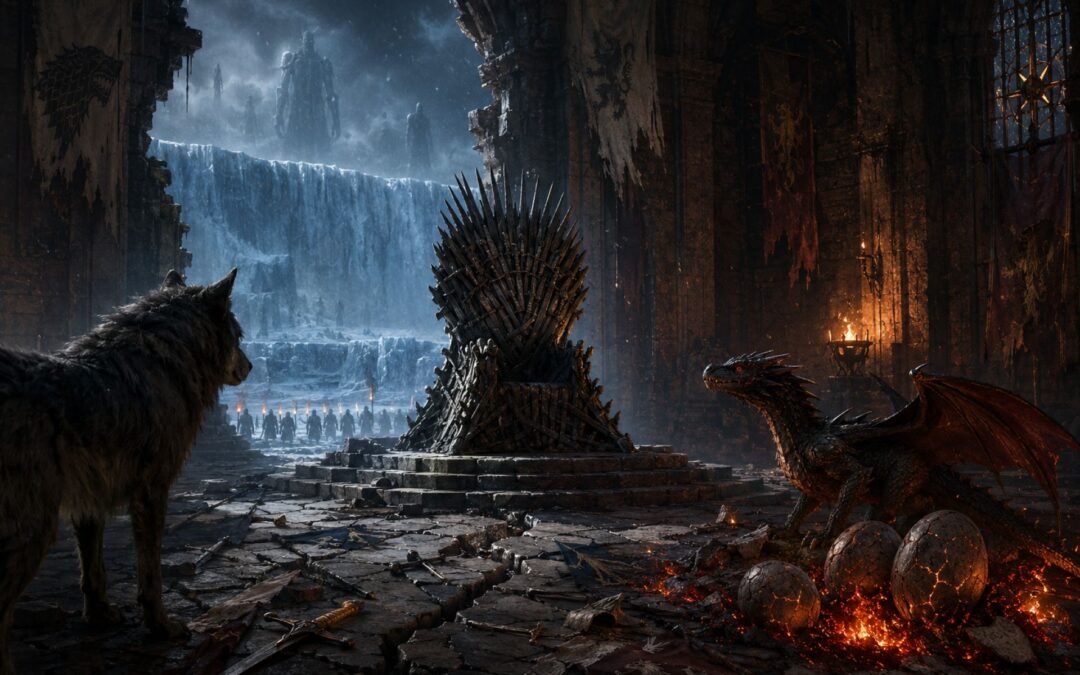
First published in 1996, A Game of Thrones is the opening novel of George R. R. Martin’s A Song of Ice and Fire, an epic fantasy series built around dynastic politics, fractured families, competing moral codes, and a supernatural danger most of its characters barely understand. The novel begins at the edge of the known political world, where three men of the Night’s Watch encounter something that should belong to legend, then spends most of its enormous middle following nobles, children, soldiers, exiles, and courtiers as they compete over a throne that may ultimately be less important than any of them imagine.
Its reputation for ruthlessness can obscure how carefully the book is constructed. Martin does not simply kill sympathetic characters or overturn fantasy conventions for shock value. He builds a world in which moral legitimacy, legal legitimacy, institutional power, military force, family loyalty, and personal survival often point in different directions. Eddard Stark can be right about Joffrey’s parentage and still lose. Robert Baratheon can be king and still fail to control his household. Catelyn can act out of love and worsen a war. Daenerys can begin as a frightened bargaining chip and end as the only person in the book to produce something genuinely new.
Spoiler warning: this article discusses the entire novel, including Ned Stark’s death and the final birth of Daenerys’s dragons.
The result is both a political tragedy and the opening movement of a much larger fantasy. The Stark family is scattered, the realm fragments into war, the Night’s Watch discovers that the dead can rise, and Daenerys emerges from a funeral pyre with three living dragons. What first appears to be a struggle over succession gradually becomes a story about the limits of political vision itself.
A Game of Thrones: Complete Plot Summary
Martin tells the novel through rotating third-person-limited viewpoints rather than through a single central hero. The main narrative follows Eddard Stark, Catelyn Stark, Daenerys Targaryen, Jon Snow, Tyrion Lannister, Bran Stark, Sansa Stark, and Arya Stark, with the Prologue seen through the ranger Will. These perspectives move between Winterfell, King’s Landing, the Wall, the riverlands, the Vale, and the Dothraki lands across the Narrow Sea, allowing the reader to understand connections that individual characters cannot.
The political plot, the northern supernatural plot, and Daenerys’s eastern story initially seem separate. Their importance becomes clearer as the novel progresses. The south descends into dynastic war, the Wall begins to confront evidence that old legends are returning, and Daenerys’s story transforms from an exile narrative into the first unmistakable rebirth of magic.
Winterfell, Exile, and the First Omens
The novel opens beyond the Wall, where three men of the Night’s Watch—Ser Waymar Royce, Will, and Gared—are tracking a group of wildlings. Will has seen the wildlings lying dead in their camp, yet when the rangers return, the bodies have disappeared. Royce presses deeper into the haunted forest despite Gared’s fear and the unnaturally cold conditions. There he encounters pale, inhuman figures whose appearance and weapons mark them as something outside ordinary human experience.
Royce fights one of the beings and is killed after its strange sword shatters his blade. The other creatures withdraw, and Will eventually climbs down from hiding. When he approaches Royce’s corpse, the dead knight rises with transformed blue eyes and kills him. Gared survives long enough to flee south, but he cannot explain what happened in any way that Westerosi authorities are willing to accept.
Some time later, Lord Eddard Stark brings his young son Bran to witness Gared’s execution for desertion. Ned personally beheads him with the ancestral Stark greatsword Ice. The scene establishes one of Ned’s governing principles: the person who passes a death sentence should accept responsibility for carrying it out. Justice, for Ned, must remain tied to personal accountability.
On the return journey, the Stark party discovers a dead direwolf with a stag’s antler embedded in its throat. The animal has given birth to five living pups, and Jon Snow soon finds a sixth albino pup apart from the others. The symbolism is obvious even within the world: the direwolf represents House Stark, the stag House Baratheon, and six pups correspond to Ned’s five legitimate children and Jon. At this early stage, however, the find is treated less as prophecy than as an unsettling coincidence.
At Winterfell, Catelyn Stark brings Ned more consequential news. Jon Arryn, the Hand of the King and a man who helped raise Ned and Robert Baratheon, has died suddenly in King’s Landing. King Robert is travelling north with his court. His arrival brings the political centre of the Seven Kingdoms directly into the relatively isolated Stark household.
Across the Narrow Sea, another displaced dynasty is preparing its own claim. Daenerys Targaryen lives in Pentos under the domination of her older brother Viserys, one of the surviving children of the deposed Targaryen royal family. Viserys has spent years telling Daenerys that Robert Baratheon stole their throne and that the people of Westeros secretly yearn for their return. In reality, Viserys possesses neither an army nor the temperament needed to win one.
Their wealthy patron Illyrio Mopatis has arranged a marriage between thirteen-year-old Daenerys and Khal Drogo, a powerful Dothraki warlord. Viserys expects Drogo to provide the mounted army that will restore him to the Iron Throne. Daenerys understands that her body and marriage are being traded for her brother’s ambitions, and her early chapters are dominated by fear—of Viserys, of Drogo, of an unfamiliar culture, and of a future she cannot control.
Back in Winterfell, Robert visits the Stark family crypts with Ned and mourns Lyanna Stark, Ned’s sister and Robert’s former betrothed. Her death during the rebellion against the Targaryens remains emotionally central to Robert, who has spent much of his reign idealising the woman he lost. The friendship between Ned and Robert was forged by war, but the two men have changed greatly since their youth.
Robert asks Ned to become Hand of the King in place of Jon Arryn. He also proposes a marriage between his eldest son, Prince Joffrey, and Ned’s daughter Sansa. The offer promises enormous prestige, but Ned is reluctant to leave Winterfell and dislikes court politics. His hesitation changes when Catelyn receives a secret message from her sister Lysa Arryn, Jon Arryn’s widow, accusing the Lannisters of murdering her husband.
The accusation converts Robert’s request into an investigative duty. Ned agrees to go south so that he can serve his king and determine whether Jon Arryn was killed. His decision begins the fragmentation of the Stark household that shapes nearly every subsequent plot.
Jon Snow, Ned’s acknowledged illegitimate son, already feels partly outside that household. At a royal feast he is seated below the salt with squires and lesser retainers rather than among the highborn family. He drinks heavily, watches his legitimate siblings from a distance, and speaks with Tyrion Lannister, the sharp-tongued dwarf brother of Queen Cersei and Jaime Lannister.
Tyrion immediately recognises Jon’s insecurity. He advises him not to hide from the word “bastard,” because an insult can be less useful to others once its target has accepted it openly. Their conversation begins an unlikely friendship between two men who occupy privileged families while remaining socially marginal within them.
Jon also tells his uncle Benjen Stark that he wants to join the Night’s Watch. He imagines the order as a place where birth matters less and where he can create an honourable identity separate from his bastardy. His idea of the Watch is still romantic, shaped by old stories rather than contemporary reality.
Arya Stark, meanwhile, struggles against the gender expectations governing noble girls. She is poor at conventional needlework, resents comparisons with her beautiful and accomplished sister Sansa, and would rather watch the boys train with swords. Jon understands her alienation better than most of the family does, making their relationship one of the warmest among the Stark siblings.
Sansa is almost her opposite. She has internalised the songs and stories of noble romance and imagines court life as a world of gallant princes, beautiful ladies, honourable knights, and elegant marriages. Joffrey appears to her as the embodiment of those stories. Much of her first-book development comes from discovering how completely the language of chivalry can coexist with cruelty.
The family’s political danger becomes personal when Bran climbs one of Winterfell’s abandoned towers and sees Queen Cersei having sex with her twin brother Jaime. Their incest is not merely a sexual secret. If Cersei’s children are Jaime’s rather than Robert’s, the legitimacy of the royal succession collapses.
Bran is too young to understand the full implications of what he sees, but Jaime does. After Cersei asks what should be done, Jaime pushes Bran from the tower window. Bran survives but falls into a coma and is permanently paralysed from the waist down.
The royal party prepares to depart. Jon visits Bran’s bedside and tries to say goodbye, but Catelyn’s grief turns into open hostility toward him. Her resentment of Jon has always been tied to what she believes is Ned’s infidelity and the humiliation of raising another woman’s child in her own home. At Bran’s bedside, that resentment becomes cruelty.
Jon later gives Arya a small sword he has secretly commissioned for her. She names it Needle, a joking inversion of the sewing she dislikes. The gift becomes both a physical weapon and a symbol of the identity Arya is trying to preserve.
Daenerys’s wedding to Drogo takes place in a completely different cultural world. The event is magnificent, violent, and unsettling. Dothraki celebration includes public sex and lethal fighting, while Daenerys receives gifts that will become crucial to her identity: a silver horse and three petrified dragon eggs, presented as rare relics of an extinct age.
Her wedding night is framed by a fundamental imbalance of age, culture, power, and political coercion, even though Drogo is gentler with her than she feared. In the weeks that follow, the physical demands of travelling with the khalasar leave her miserable and injured. Gradually, however, she adapts to Dothraki life and begins to experience moments of confidence rather than continuous terror.
Ned’s journey south with Robert reveals how far the king has changed. Robert is physically diminished, heavily indebted, bored with governing, and increasingly dependent on drinking, hunting, and women. He still despises the surviving Targaryens, especially when he learns that Daenerys has married Drogo and may produce heirs who could threaten his dynasty.
Tyrion travels north with Jon and begins stripping away Jon’s romantic expectations of the Night’s Watch. Castle Black is not filled with legendary heroes. It is undermanned, poorly supplied, socially marginal, and populated largely by criminals, political exiles, and unwanted men. The Wall remains physically magnificent, but the institution defending it has decayed.
At Winterfell, Bran’s situation becomes more dangerous. While most of the household is distracted by a fire in the library, an assassin enters Bran’s room with a dagger and tries to kill him. Catelyn fights the man with her bare hands, badly cutting herself, until Bran’s direwolf Summer tears out the attacker’s throat.
The attempt proves that Bran’s fall was not simply an accident. Someone is afraid of what he might remember. Catelyn becomes determined to investigate, even though Bran himself remains unconscious.
On the kingsroad, Sansa’s idealised vision of court life receives its first major blow. Joffrey encounters Arya practising swordplay with Mycah, a butcher’s boy. Joffrey humiliates and attacks Mycah, Arya strikes Joffrey, and her direwolf Nymeria bites the prince.
Arya drives Nymeria away so that the direwolf cannot be punished. When Robert hears the conflicting accounts, Sansa refuses to testify honestly against Joffrey. Cersei demands punishment anyway. Because Nymeria cannot be found, the queen insists that Sansa’s direwolf Lady be killed instead.
Ned personally kills Lady, an innocent animal sacrificed to preserve a fragile peace between royal families. At roughly the same time, Sandor Clegane hunts down and kills Mycah. The contrast is important: highborn conflict produces consequences that fall most severely on those without power, including an animal and a common boy.
Bran finally awakens after an extraordinary dream. He imagines falling and is told by a three-eyed crow that he must fly. His vision ranges far beyond Winterfell, giving him glimpses of distant lands and of something terrible stirring in the far north. When he wakes, he names his direwolf Summer.
By this point, the Stark family has already been scattered. Ned, Sansa, and Arya are travelling toward King’s Landing; Jon is going to the Wall; Catelyn is preparing to investigate; Bran has survived attempted murder but lost the use of his legs; and Robb remains at Winterfell. The family is physically divided before any formal war has begun.
King’s Landing, Castle Black, and Daenerys’s Awakening
Catelyn secretly travels to King’s Landing with Ser Rodrik Cassel to investigate the dagger used by Bran’s would-be assassin. She hopes to enter the city unnoticed, but Lord Varys and Petyr “Littlefinger” Baelish quickly learn that she is there. Their ease in discovering her arrival establishes the intelligence networks that make King’s Landing dangerous.
Littlefinger claims that the dagger once belonged to him but that he lost it to Tyrion Lannister in a wager. Catelyn has known Littlefinger since childhood and is inclined to trust him. His accusation appears to confirm Lysa’s warning that the Lannisters murdered Jon Arryn, even though the reader has no independent reason to believe that Tyrion would want Bran dead.
At Castle Black, Jon’s own illusions begin to collapse. Because he was trained at Winterfell by a professional master-at-arms, he easily defeats the poorer and less experienced recruits. He interprets their weakness as inferiority until the blacksmith Donal Noye points out that Jon has enjoyed privileges most of the boys never had.
The criticism changes him. Jon begins helping his fellow recruits rather than humiliating them, and his position in the group improves. His growth is not a rejection of pride so much as a broadening of perspective: he learns that ability cannot be understood without understanding opportunity.
Ned arrives in King’s Landing and joins Robert’s Small Council. He immediately discovers that royal government is financially reckless. The crown owes immense sums despite years of peace, with much of the debt owed to House Lannister and foreign lenders. Robert enjoys the privileges of kingship but has little patience for administration.
Littlefinger secretly reunites Ned and Catelyn. The dagger story convinces Ned that his investigation into Jon Arryn’s death may lead toward the Lannisters. Catelyn then leaves to return north while Ned begins tracing Jon Arryn’s final movements.
Jon’s experiences at the Wall continue to deepen his understanding of exclusion. When Samwell Tarly arrives, he proves overweight, terrified of violence, and almost helpless in combat. The other recruits torment him, but Jon intervenes.
Sam eventually tells Jon that his father, Randyll Tarly, considered him an unworthy heir and forced him to choose between joining the Night’s Watch and dying in a staged hunting accident. Jon recognises another young man whose family status has become a source of rejection. Their friendship helps turn Jon from a resentful outsider into someone capable of protecting others.
Arya reaches King’s Landing and finds herself equally out of place at court. Ned discovers Needle and initially worries about her desire to fight, but after hearing the full story of the confrontation with Joffrey, he accepts that Arya cannot simply be transformed into Sansa. He hires Syrio Forel, former First Sword of Braavos, to teach her.
Syrio’s “water dancing” is less about brute strength than balance, speed, awareness, and accurate perception. His recurring insistence that Arya truly see what is around her becomes one of the book’s most useful lessons about survival. In a political novel filled with deception, Arya’s sword instruction is also training in attention.
Daenerys undergoes her own education in power. As she becomes physically accustomed to riding and travelling with the khalasar, she stops experiencing herself solely as Viserys’s frightened sister. Her status as Drogo’s wife gives her authority that her brother does not possess.
When Viserys attacks her, Daenerys finally resists him openly. Dothraki riders who once would have regarded Viserys as the future king increasingly regard him as pathetic. Daenerys also learns that she is pregnant, giving her an independent dynastic significance beyond being Viserys’s bargaining tool.
At Winterfell, Bran wakes to a difficult reality. He has survived, but he cannot walk. Tyrion passes through on his return from the Wall and gives Bran a design for a special saddle that may allow him to ride again. Robb distrusts Tyrion because of the family’s suspicions, yet Tyrion’s act of kindness complicates any simple division between virtuous Starks and villainous Lannisters.
Ned’s investigation gradually begins to acquire shape. He questions Grand Maester Pycelle about Jon Arryn’s final illness and learns of Arryn’s cryptic last words: “the seed is strong.” He obtains a heavy genealogy describing noble family lineages and follows the dead Hand’s recent activities.
One trail leads him to an armourer’s shop where he meets Gendry, a dark-haired apprentice. Ned quickly recognises that the boy resembles Robert Baratheon. Gendry is one of Robert’s illegitimate children, and his appearance becomes an important piece of evidence.
Catelyn’s investigation, meanwhile, takes a disastrous turn. On the road north she happens to encounter Tyrion at the inn at the crossroads. She knows that if he recognises her, the Lannisters may realise what the Starks are investigating.
Rather than letting him leave, Catelyn calls upon men whose houses owe allegiance to her father and publicly arrests Tyrion for the attempted murder of Bran. Her action is bold and understandable within the information available to her, but it transforms private suspicion into an overt political act against House Lannister.
In King’s Landing, the Hand’s tourney demonstrates the gulf between chivalric spectacle and actual violence. Sansa is thrilled by the knights and ceremonies, but the competition quickly turns bloody. Ser Hugh of the Vale dies when Gregor Clegane’s lance strikes his throat.
Sandor Clegane later tells Sansa why his face is burned. As a child, he took one of Gregor’s toys; Gregor responded by pressing his face into a brazier. The story teaches Sansa that a knightly title guarantees neither honour nor kindness. Sandor, who is not a knight, may behave more protectively than men who proudly bear the title.
The tourney also gives Ned reasons to suspect that Ser Hugh’s death was not meaningless. Hugh had served Jon Arryn and might have known something about the former Hand’s activities. Varys eventually tells Ned directly that Jon Arryn was murdered because he was asking dangerous questions.
Catelyn takes Tyrion toward the Vale rather than Winterfell, hoping that the apparent change of destination will make rescue less likely. Their party is attacked by mountain clans, and Tyrion fights alongside his captors. Afterwards, he confronts Catelyn with the weakness of Littlefinger’s story: he would never have bet against Jaime Lannister in the contest Littlefinger described.
The observation should cause more doubt than it does. Catelyn has built her actions on a chain of testimony that originates with someone she believes she knows. Martin repeatedly shows how political disaster can begin not with irrationality but with misplaced confidence in personal relationships.
Arya accidentally becomes involved in another hidden political conversation. While chasing cats through the Red Keep as part of Syrio’s training, she wanders through tunnels and overhears Varys and Illyrio discussing the Hand, the realm’s instability, and the timing of a larger conflict. Arya understands that the conversation matters but lacks the political vocabulary necessary to explain it clearly to Ned.
Ned soon faces a direct moral test on Robert’s Small Council. News arrives that Daenerys is pregnant. Robert wants her killed before she can produce a son who might someday lead a Dothraki invasion.
Most of the council accepts assassination as political necessity. Ned refuses. He argues that Daenerys is a child and that murdering her for a future threat would be dishonourable. When Robert insists, Ned resigns as Hand.
Catelyn reaches the Vale and discovers that her sister is far less reliable than expected. Lysa Arryn is consumed by fear, intensely protective of her sickly son Robert Arryn, and determined to keep the Vale out of wider conflict. She nevertheless imprisons Tyrion in one of the Eyrie’s terrifying sky cells.
Back in King’s Landing, Ned visits a brothel and meets Barra, another of Robert’s illegitimate children. Like Gendry, she has recognisably Baratheon features. Ned is accumulating evidence without yet understanding its full significance.
Jaime Lannister then confronts Ned in the street over Tyrion’s abduction. Lannister men attack the Stark household guard. Jory Cassel is killed, other Stark men die, and Ned’s leg is crushed beneath his horse.
The confrontation marks a decisive escalation. The political struggle is no longer confined to secret messages and court manoeuvres. Great houses are openly spilling one another’s blood.
Daenerys arrives at Vaes Dothrak increasingly aware that Viserys no longer controls her future. He expected her marriage to produce an army for him, yet he understands neither Dothraki custom nor the limits of his status among them. His entitlement becomes more dangerous as his actual authority disappears.
Bran, meanwhile, begins riding using Tyrion’s saddle design. The ride gives him a sense of physical freedom he feared he had lost. It also exposes him to danger when wildlings and deserters attack.
Robb, Theon Greyjoy, and the direwolves help defeat the attackers. One surviving wildling woman, Osha, is taken captive. She warns that people north of the Wall are moving south because something terrible is awakening behind them, but her warning receives little attention from people preoccupied with southern politics.
The Eyrie, Ned’s Discovery, and Viserys’s Fall
Tyrion remains imprisoned in the Eyrie, where the open-sided sky cells are designed to break prisoners psychologically. He manipulates his jailer Mord by promising gold and eventually forces Lysa to grant him a public hearing. Instead of confessing to Bran’s attempted murder, Tyrion makes a theatrical confession of unrelated misdeeds and then demands trial by combat.
Lysa expects one of her knights to destroy him, but Bronn, an opportunistic sellsword, volunteers to fight as Tyrion’s champion. Bronn refuses to fight according to romantic chivalric expectations. He stays mobile, allows the heavily armoured Ser Vardis Egen to tire, then kills him.
Tyrion wins his freedom not by proving innocence in any rational judicial system, but by understanding how to exploit the rules. The episode reflects one of the novel’s recurrent political truths: institutions can preserve the appearance of legitimacy while rewarding whoever best manipulates their procedures.
Ned recovers from Jaime’s attack while dreaming of the Tower of Joy, an episode from the rebellion involving Lyanna Stark and three members of the Kingsguard. The dream is fragmentary and emotionally charged. It suggests that Ned’s past contains memories he has never fully processed, while also foreshadowing mysteries the first novel does not resolve.
Robert returns to Ned and effectively forces a reconciliation. The king is angered by Catelyn’s seizure of Tyrion, yet he still needs Ned to govern. Ned resumes his position as Hand, though the friendship between the two men is strained by their disagreement over Daenerys.
At Castle Black, Jon learns that several recruits are about to be elevated into the Watch while Sam is not. Rather than simply complain, Jon sees that Sam’s literacy, intelligence, and gentler abilities could make him useful to Maester Aemon. He successfully persuades the maester to take Sam as a steward.
Jon is gradually learning that leadership does not consist of making everyone resemble him. It requires placing people where their actual strengths matter.
Tyrion, travelling away from the Vale with Bronn, reveals a painful part of his past. As a young man he married a lowborn girl named Tysha after he and Jaime supposedly rescued her from attackers. Tywin later told Tyrion she was a prostitute whom Jaime had hired to give him his first sexual experience, then arranged a horrific punishment involving his guards.
The memory helps explain Tyrion’s mixture of sexual hunger, cynicism, vulnerability, and resentment toward his father. He often hides emotional injuries behind jokes because he assumes affection will eventually reveal itself as humiliation.
When mountain clans surround Tyrion and Bronn, Tyrion survives by bargaining rather than fighting. He promises them weapons and opportunities if they accompany him. Like Littlefinger and Varys, Tyrion’s strength lies partly in recognising what people want and converting desire into leverage.
Ned’s position as Hand forces him into another act of justice when refugees from the riverlands report systematic destruction by Gregor Clegane’s men. The raids are clearly intended to provoke the Tullys and Starks after Tyrion’s capture while allowing Tywin Lannister to maintain plausible distance.
Ned responds in legal terms. Sitting the Iron Throne in Robert’s absence, he strips Gregor of rank, sends Beric Dondarrion and other men to execute the king’s justice, and summons Tywin Lannister to answer for his bannerman. The decision is morally coherent but strategically risky because Ned is using royal law against a house whose influence penetrates the royal government itself.
Sansa inadvertently helps him solve Jon Arryn’s mystery. Angry that Ned intends to send her and Arya back to Winterfell, she protests that Joffrey is nothing like Robert. The remark makes Ned reconsider the genealogy he has been studying.
Every Baratheon-Lannister marriage in the family record produced dark-haired children. Robert’s known bastards, including Gendry and Barra, have dark hair. Yet Joffrey, Myrcella, and Tommen are blond like Cersei and Jaime.
The answer becomes unavoidable: Robert is not their biological father.
Ned confronts Cersei privately in the godswood. She does not deny the incest and confirms that Jaime fathered all three children. She also describes her marriage to Robert as emotionally empty and tells Ned that Robert has continued to love the dead Lyanna rather than the wife beside him.
At this moment, Ned possesses the information that can destroy Cersei politically. He nevertheless warns her that he intends to tell Robert and advises her to flee with the children. He remembers what happened to Targaryen children during the rebellion and cannot accept responsibility for exposing Cersei’s children to Robert’s rage.
The choice is central to understanding Ned. It is not merely political incompetence. It is a deliberate refusal to secure an advantage by risking the murder of children. His tragedy lies partly in the fact that an ethically intelligible choice gives a ruthless opponent time to prepare.
Daenerys reaches her own turning point in Vaes Dothrak. During a ritual before the dosh khaleen, she eats a raw stallion’s heart and is told that her unborn son will be a great conqueror, “the stallion who mounts the world.” The prophecy increases the symbolic importance of her pregnancy.
Viserys, meanwhile, has become increasingly enraged by his loss of status. Drunk and humiliated, he enters a sacred space carrying a sword and threatens Daenerys and her unborn child. Drogo finally gives him the “golden crown” he has demanded by pouring molten gold over his head.
Viserys dies believing royal identity is something the world owes him. Daenerys watches and recognises a truth she has been moving toward for much of the novel: her brother was never capable of becoming the dragon he imagined himself to be.
In Westeros, Robert returns from a hunt mortally wounded by a boar. While dying, he dictates a will naming Ned protector of the realm until Joffrey comes of age. Ned cannot bring himself to tell his friend that Joffrey is not his son, so he changes the wording from “my son Joffrey” to the more ambiguous “my heir.”
Robert’s approaching death creates a short window in which decisive action could determine the succession. Renly Baratheon urges Ned to seize Cersei’s children immediately and control the royal household before Cersei can act.
Ned refuses because he considers the plan dishonourable and because he believes Stannis Baratheon, Robert’s younger brother, is the lawful heir. Littlefinger offers another strategy: accept Joffrey temporarily, use his claim as political cover, and control the boy through the regency. Ned rejects that as well.
Ned therefore chooses legality over opportunism. The problem is that the institutions required to enforce legality are not neutral. The City Watch, the court, the treasury, and the royal household are all vulnerable to purchase, personal loyalty, or manipulation.
Robert’s Death and the Realm Breaks Apart
At the Wall, Jon and the other recruits are finally ready to swear their vows. Jon expects to become a ranger like his uncle Benjen but is instead made personal steward to Lord Commander Jeor Mormont. He initially sees the appointment as humiliation.
Sam offers a different interpretation. Serving directly under Mormont may be training for future command. Jon begins to understand that ambition can be fulfilled in forms different from those he imagined.
Jon and Sam speak their vows before a heart tree beyond the Wall. As they return, Ghost discovers a severed human hand. The discovery leads to two corpses recovered from the forest—men of the Watch who should not be where they are and whose condition will soon confirm the Prologue’s warning.
In King’s Landing, Robert dies. Ned moves to enforce the king’s will and the law of succession, but Cersei has already consolidated control. When Joffrey is presented as king, Ned declares that the boy has no lawful claim.
He expects the City Watch to support him because Littlefinger has promised their loyalty. Instead, the gold cloaks turn on Ned’s men. Littlefinger personally signals his betrayal.
The coup destroys the Stark presence in the capital almost immediately. Ned is arrested. His household men are killed. Sansa is taken into royal custody. Arya escapes only because Syrio Forel delays the Lannister guards who come for her.
Syrio refuses to abandon Arya and confronts armoured men with a wooden practice sword, allowing her to flee. Arya later kills a stableboy who tries to stop her, retrieves Needle from her possessions, and disappears into the hidden spaces of the Red Keep.
The killing is a major threshold in Arya’s development. Her earlier fascination with swords existed partly within the space of training and adventure. Now she discovers that violence is immediate, frightening, and irreversible.
Sansa’s captivity unfolds very differently. Cersei treats her with calculated gentleness and persuades her to write letters urging Robb and Catelyn to acknowledge Joffrey. Sansa remains desperate to believe that her engagement to Joffrey can somehow survive the conflict.
Her vulnerability comes from traits that are not inherently foolish: trust, courtesy, romantic imagination, and faith in institutions. King’s Landing weaponises those traits against her.
At Castle Black, the supernatural threat becomes undeniable. The dead bodies brought back from beyond the Wall rise during the night. One attacks Lord Commander Mormont.
Jon fights the corpse and finally burns it. The incident proves that the danger introduced in the Prologue was not an isolated hallucination or legend. Dead men can return, yet this reality remains almost entirely disconnected from the political priorities of the Seven Kingdoms.
At Winterfell, Robb begins assuming adult authority. Bannermen gather in response to Ned’s imprisonment and the Lannister attacks on the riverlands. Some northern lords challenge the young heir, but Robb learns to control a war council and command loyalty.
Osha continues warning that men are moving in the wrong direction. Everyone is marching south to fight over castles and crowns while people beyond the Wall are fleeing from something worse. Her warning encapsulates the novel’s largest irony.
Across the Narrow Sea, Robert’s attempted assassination of Daenerys produces the opposite of its intended effect. A merchant tries to poison her with wine, but Jorah Mormont intervenes.
When Drogo learns that the ruler of Westeros has attempted to kill his pregnant wife and unborn son, he finally commits himself to invasion. He vows to cross the Narrow Sea, tear down stone houses, kill armored men, and give his son the Iron Throne.
Robert’s preventive violence thus helps create the threat he feared. In political terms, the assassination attempt is self-defeating. In Daenerys’s arc, it also marks the moment when the distant throne begins to become part of her own future rather than merely Viserys’s obsession.
Catelyn joins Robb’s host on its march south. She finds that her son has changed from the boy she left at Winterfell into a commander responsible for thousands of men. Her presence becomes important because she combines maternal anxiety with political experience.
Tyrion reaches Tywin Lannister’s army and sees the consequences of the conflict from the other side. The riverlands are being devastated systematically. Tywin’s approach to power is far colder than Ned’s: fear, punishment, and strategic destruction are tools to be used whenever they produce advantage.
In King’s Landing, Joffrey’s new court begins reshaping royal power. Barristan Selmy, one of the most respected knights in the realm, is dismissed from the Kingsguard and publicly humiliated. The act demonstrates both Joffrey’s arrogance and the regime’s willingness to discard traditions that might restrain it.
Sansa appears before the court and begs for mercy for Ned. Joffrey promises that Ned may live if he publicly confesses treason and acknowledges Joffrey as the lawful king.
In the black cells, Varys visits Ned and explains the real stakes. Ned initially refuses to make a false confession, because doing so would publicly validate the regime he knows to be illegitimate. Varys then reminds him that Sansa’s life depends on his cooperation and that open resistance may bring more bloodshed.
Ned eventually agrees. His decision reverses the simplistic idea that he chooses honour over everything. At the end, he knowingly sacrifices his public honour because protecting his child matters more.
The northern army now faces a major strategic obstacle at the Twins, the fortified bridge controlled by the elderly and notoriously difficult Walder Frey. Catelyn negotiates passage. Frey demands long-term concessions, including marriage arrangements linking his family to the Starks.
Robb accepts because military necessity leaves little alternative. He then divides his army. Roose Bolton leads one force toward Tywin Lannister, while Robb secretly takes his mounted strength toward Jaime Lannister’s army near Riverrun.
At Castle Black, Jon receives Longclaw from Mormont as a reward for saving his life. News from the south leaves Jon increasingly tormented. Ned is imprisoned, Robb has gone to war, and Jon’s instinct is to abandon the Watch and help his family.
Maester Aemon explains that he has faced the same conflict on a far larger scale. Aemon is a Targaryen, a member of the former royal dynasty who watched relatives die and kingdoms change while remaining bound by his vows. His identity reveals that duty is painful precisely because genuine competing loyalties exist.
Daenerys’s situation deteriorates just as quickly. After Drogo’s khalasar defeats another group, Dothraki warriors rape and enslave the defeated. Daenerys intervenes and claims several women under her protection.
Her actions arise from compassion but also from the authority she has gained inside a violent social system. One of the women she protects is Mirri Maz Duur, a healer whose community has been destroyed by the Dothraki.
Drogo suffers a wound during the fighting. He initially treats it as minor, but it becomes infected. Mirri attempts to care for him, yet his condition worsens until he can no longer ride.
A khal who cannot ride cannot maintain a khalasar. Drogo’s political power therefore disappears together with his physical strength.
The Stark and Lannister armies then meet in two related battles. Tywin places Tyrion and the mountain clans in a dangerous forward position at the Green Fork, expecting them to absorb much of the initial assault. Tyrion survives the fighting.
Only afterward does the Lannister command realise that Robb himself was not present. Roose Bolton’s army was partly a diversion. Robb has taken his cavalry to attack Jaime.
At the Whispering Wood, Robb ambushes Jaime’s forces. Jaime attempts to cut his way directly toward Robb, killing several men before he is overwhelmed and captured.
The victory transforms Robb’s political position. He has not merely inherited his father’s cause; he has proven himself a capable battlefield commander. Yet Catelyn understands that a captured Jaime does not end the war, rescue Ned, or resolve the succession.
Ned’s Death, New Kings, and the Return of Dragons
Drogo’s deterioration pushes Daenerys into desperation. Most of his warriors abandon him as soon as his weakness becomes irreversible. The enormous social structure that surrounded Daenerys proves dependent on a single man’s ability to command.
Mirri Maz Duur tells Daenerys that blood magic may preserve Drogo’s life, but that life must pay for life. Daenerys agrees without fully understanding what the cost will be.
The ritual is terrifying. Mirri orders everyone away from the tent while strange sounds emerge from within. Daenerys goes into labour during the chaos, and Jorah eventually carries her into the forbidden space when no other help remains.
In King’s Landing, Arya survives by hiding among ordinary people. She tries to reach the ship Ned had arranged for his daughters, but crowds gather around the Great Sept of Baelor. There she sees Ned brought before the city.
Ned publicly confesses to treason and recognises Joffrey as the lawful king. He does exactly what was demanded because he believes the confession will save Sansa and perhaps allow him to take the black.
Cersei, Varys, and others appear to expect mercy. Joffrey ignores them. He orders Ned’s execution.
Arya watches as Ser Ilyn Payne beheads her father with Ice. Yoren of the Night’s Watch grabs Arya before she can reveal herself and prevents her from seeing the final moment.
The execution breaks the political compromise everyone around Joffrey had expected. It also destroys the possibility of restoring the old relationship between Stark and crown. Ned’s death turns a conflict over arrest and legitimacy into a blood feud and a wider war.
At Winterfell, Bran dreams of his father in the crypts before news of the execution arrives. His insistence on visiting the crypts reflects the increasingly uncertain boundary between dream, memory, and supernatural intuition in his story.
Osha speaks about forgotten things in the north and the persistence of older forces. When the raven finally arrives with confirmation of Ned’s death, Bran’s private vision and the political reality coincide.
Sansa’s world also collapses. Joffrey takes her onto the battlements and forces her to look at Ned’s severed head among those of other enemies of the crown. He humiliates her and orders a Kingsguard knight to strike her.
Sansa briefly considers pushing Joffrey to his death even though doing so would kill her as well. Sandor Clegane stops the moment from becoming action. Thereafter, Sansa begins using courtesy less as innocent belief and more as a defensive performance.
Daenerys awakens to discover that her attempt to save Drogo has destroyed almost everything she hoped to preserve. Her child Rhaego was stillborn and deformed. Drogo lives only in the most technical sense: breathing, unresponsive, empty of personality.
Mirri makes clear that she does not regard this outcome as a tragedy. Drogo’s khalasar destroyed her people, and Rhaego had been prophesied to become a world conqueror. From Mirri’s perspective, preventing his future conquests may have saved countless others from the violence Dany’s new family accepted as ordinary.
Daenerys initially searches for some remaining possibility of restoring Drogo, but finally recognises that the man she knew is gone. She smothers him herself. The act ends her last dependence on his authority.
In the Lannister camp, Ned’s death radically changes strategy. Jaime is a prisoner. Robb is winning victories. Stannis and Renly may both make claims to the throne. Joffrey is difficult to control.
Tywin decides that King’s Landing requires someone capable of restraining Cersei and her son. He sends Tyrion to act as Hand in his place, giving the family member he most despises one of the most important political offices in the realm.
At the Wall, Jon finally acts on his desire to join Robb. He deserts during the night and rides south. His friends pursue him.
They do not overpower him through force so much as remind him of what he chose when he said his vows. Jon returns voluntarily. His decision does not mean that he loves his family less; it means he has accepted that the Watch has become another family to whom he owes duties.
Mormont does not simply punish him. Instead, he reveals that the Watch itself can no longer remain passive. Rangers are disappearing, wildlings are moving, dead men are walking, and Benjen Stark has not returned.
The Night’s Watch will ride north in force. The supernatural plot that opened the novel is now ready to expand.
At Riverrun, the northern and river lords confront the succession crisis. Robert is dead, Joffrey is illegitimate in their eyes, and the Baratheon brothers have competing claims. Supporting either Stannis or Renly would place the North under another southern king.
Greatjon Umber proposes a different answer. He declares Robb the King in the North.
Other lords follow, restoring a title that existed before the Targaryen conquest. Robb’s war has therefore changed from a campaign to rescue his father into a struggle for political independence.
Daenerys’s final chapter completes the novel’s third transformation. She prepares a funeral pyre for Drogo and places the dragon eggs around his body. She also binds Mirri Maz Duur to the pyre.
As the flames rise, Daenerys walks into them.
At dawn, the fire has burned itself out. Daenerys is alive, her hair burned away but her body unharmed. Three dragons have hatched from the petrified eggs.
The surviving Dothraki kneel to her.
What Viserys could only claim through ancestry, and what Drogo possessed through military charisma, Daenerys now possesses in a new form. She has survived fire and restored an extinct species associated with Targaryen power.
The novel therefore closes on a profound shift. Westeros is fighting over a contested throne, the Night’s Watch is preparing to confront an ancient danger, and across the Narrow Sea a young exile has brought dragons back into the world.
Westeros, Essos, and the World Behind the War
Martin’s world-building works because politics, geography, memory, and material conditions are embedded inside character experience. Characters rarely stop to explain “the world” for the reader. They think about family obligations, roads, marriages, castles, food, debts, religious customs, banners, inherited grudges, and stories they assume everyone around them already knows.
Martin has described historical fiction as an important influence on the series, particularly its sense of social density, politics, and lived texture. He also emphasised that he wanted magic to remain relatively restrained rather than allowing it to solve ordinary political problems. That combination explains why A Game of Thrones initially feels closer to dynastic historical fiction than to a conventional quest fantasy even though its first and final chapters contain unmistakable supernatural events.
The Seven Kingdoms, Great Houses, and Feudal Power
The Seven Kingdoms are governed from the Iron Throne, but the monarchy does not possess anything like a modern central state. Real power is distributed through major noble houses that control territories, castles, armies, marriage alliances, and networks of lesser lords.
House Stark dominates the North from Winterfell. House Lannister controls the wealthy Westerlands from Casterly Rock. House Arryn rules the Vale, House Tully the riverlands, House Tyrell the Reach, House Martell Dorne, and House Greyjoy the Iron Islands. House Baratheon currently occupies the throne, while the deposed Targaryens remain living reminders that dynasties can fall.
Oaths are crucial because military power depends upon them. When Robb Stark calls the banners, he does not summon a standing national army. Lesser lords arrive because their houses owe military obligations to House Stark. When Catelyn arrests Tyrion at the crossroads inn, she invokes similar networks of loyalty.
The political order therefore depends on personal relationships more than impersonal institutions. Marriage can move armies because marriage connects houses. Fosterage can create lifelong political loyalties, as Ned and Robert’s youth under Jon Arryn demonstrates. A hostage can guarantee obedience because families rather than abstract citizenship structure political identity.
Robert’s monarchy appears stronger than it really is. He sits the Iron Throne because he won a rebellion and because enough major houses accepted the resulting settlement. Seventeen years later, however, the government is financially weak, factionalised, and dependent on personalities.
The Small Council resembles a governing institution, yet its members pursue individual interests. Littlefinger controls finances while cultivating his own network. Varys controls information. Cersei protects Lannister influence. Renly has his own ambitions. Ned enters the system assuming that lawful authority can be exercised through office, but the office itself cannot guarantee obedience.
The City Watch provides the clearest example. Ned believes he has secured its support through Littlefinger, only to discover that its loyalty can be redirected. Law does not enforce itself.
The Appendix at the end of the novel reinforces this political design by cataloguing family trees, retainers, bannermen, and rival houses. Its purpose is not simply genealogical ornament. The story’s conflicts are understandable only because inheritance and relationships are political infrastructure.
The setting is often described as medieval, but “medievalist” is a safer term. Westeros borrows broadly from European feudal history, dynastic conflict, chivalry, castles, heraldry, and social hierarchy without reproducing a specific historical society. Scholarly criticism of Martin’s medievalism has especially challenged the idea that the novel’s gendered brutality can simply be defended as “how the Middle Ages were,” since fantasy selectively constructs its historical resemblance.
The North, the Wall, and the Night’s Watch
The North is politically part of the Seven Kingdoms but culturally distinct. Its great distances, harsher climate, old religious traditions, and historical memory give the Stark domain a strong regional identity.
Winterfell represents continuity. The Starks have ruled the North for thousands of years in family memory, and the castle’s crypts connect living rulers to generations of dead ancestors. This sense of depth helps explain why Ned’s values feel older than Robert’s courtly politics.
The Wall is the most extraordinary piece of human infrastructure in the novel. It is an immense ice barrier stretching across the northern boundary of the realm. Once constructed to defend humanity from ancient threats, it is now widely treated by southern nobles as the edge of irrelevance.
The Night’s Watch preserves an heroic institutional mythology while living through decline. It receives criminals and unwanted sons because few noble families still send prestigious volunteers. Entire castles along the Wall have been abandoned.
Jon arrives expecting an order of legendary warriors and instead finds underfunded men performing difficult duty at the edge of society. That disillusionment makes his later loyalty more meaningful. He does not remain because the Watch fulfils his fantasy; he remains after discovering its deficiencies.
The wildlings, or free folk, are initially presented through southern assumptions as raiders beyond civilisation. Osha immediately complicates that picture. She is dangerous when first encountered, but her warnings indicate that people north of the Wall are themselves fleeing a greater danger.
The political geography therefore contains an inversion. The farther south characters travel toward the apparent centre of power, the more they become consumed by succession politics. The farther north the narrative goes, the closer it moves toward the threat established in the Prologue.
Daenerys, the Free Cities, and Dothraki Society
Daenerys’s chapters prevent Westeros from becoming the novel’s entire imaginative world. Pentos, the Dothraki Sea, and Vaes Dothrak reveal different forms of wealth, hierarchy, gender, slavery, commerce, and political organisation.
The Free Cities connect trade, exile, patronage, and political intrigue. Illyrio’s support for Viserys and Daenerys demonstrates how displaced claimants can survive through wealthy patrons whose motives are not fully explained.
The Dothraki khalasar operates very differently from a feudal Westerosi house. Drogo’s authority is personal and martial. He rules because warriors follow him, and they follow because he is strong enough to command them.
This produces spectacular mobility but institutional fragility. Once Drogo can no longer ride, his enormous khalasar fragments almost immediately. There is no bureaucracy capable of preserving authority independently of the khal’s body.
Daenerys’s relationship with Dothraki culture develops through immersion rather than abstract observation. She learns the language, adapts to riding, participates in ritual, earns affection from some followers, and begins exercising authority as khaleesi.
The novel simultaneously exposes the violence embedded in the system. The khalasar lives partly through raiding, slavery, and sexual violence. Daenerys eventually resists some of these practices, but her power initially exists because she is married to the man directing the conquest.
The Dothraki should not be reduced to a one-to-one representation of any historical nomadic culture. They belong to Martin’s constructed fantasy world, though their depiction can still be criticised for exoticism, simplification, and their frequent presentation through an outsider’s gaze.
Seasons, Religion, History, and Returning Magic
Westeros is shaped by seasons that can last for years. Summer is therefore more than pleasant weather, and winter more than an annual inconvenience. A long winter threatens food supplies, travel, military movement, and survival itself.
House Stark’s motto, “Winter is coming,” is unusually practical for a noble house. Most houses advertise pride or dominance. The Stark words function as warning, memory, and philosophy: prosperity is temporary, hardship will return, and preparation matters more than celebration.
Religion varies by region and history. Most of the Seven Kingdoms worship the Seven, a faith with institutional clergy and elaborate social rituals. The North retains worship of the old gods through sacred weirwood trees and godswoods.
The Night’s Watch contains men from multiple traditions, and Jon and Sam choose to swear their vows before a heart tree rather than in the sept. Religion therefore contributes to regional identity without dominating every political decision.
The Targaryen past hangs over the entire novel. Robert’s monarchy is young. Many living characters remember the previous dynasty, the rebellion, and the violence that ended it.
Dragons belong to that history. They are treated as extinct creatures whose skulls and petrified eggs remain as relics. The world remembers magic more readily than it experiences it.
That is why the ending matters so much. The Others, wights, Bran’s dreams, and Daenerys’s eggs gradually weaken the assumption that the magical past is dead. When the dragons hatch, history becomes present again.
Major Characters and Their Arcs
Martin’s characters are compelling because their virtues and flaws are rarely separable. The qualities that make Ned admirable also constrain him politically. Catelyn’s love produces courage and serious mistakes. Tyrion’s intelligence is sharpened by humiliation but also surrounded by bitterness. Sansa’s imagination makes her vulnerable before becoming one of the tools she uses to survive.
The rotating viewpoint structure intensifies this complexity because characters who look simple from outside become richer when the reader enters their minds. It also means that many important figures—Cersei, Jaime, Robert, Robb, Joffrey, Littlefinger, Varys, and Tywin among them—are known only through other people’s perspectives in this first volume.
Eddard Stark
Eddard Stark is the novel’s principal tragic figure. He is competent enough to govern the North, command respect, raise a family, investigate a murder, and identify the central secret of the royal succession. His downfall therefore cannot be adequately explained by calling him foolish.
Ned’s moral framework begins with responsibility. When he executes Gared, he does the killing himself because he believes judgment should carry personal weight. When he condemns Gregor Clegane, he does so through legal authority and sends named men to enforce the sentence rather than encouraging private vengeance.
His strongest instinct is to place limits on what power may legitimately do. He opposes assassinating Daenerys because she has not committed the future crime Robert fears. He warns Cersei because he does not want her children murdered. He refuses Renly’s plan to seize children during Robert’s final hours because he considers the act dishonourable.
These decisions are politically costly, but they are not irrational within Ned’s values. He believes the moral legitimacy of power matters.
His error is partly institutional. Ned assumes that once he possesses the truth and legal authority, respectable political actors will treat those things as meaningful constraints. King’s Landing operates differently. Gold, personal loyalty, blackmail, family interest, and pre-emptive force often determine what institutions actually do.
Ned is also shaped by trauma. His memories of Lyanna and the rebellion remain intensely private. His horror at the deaths of Targaryen children explains why he cannot casually expose Cersei’s children to Robert’s vengeance.
His final decision shows that honour is not absolute for him. He agrees to confess falsely because Sansa’s life matters more than his public reputation. Joffrey’s execution therefore destroys a compromise Ned had consciously chosen.
Ned’s tragedy lies not in possessing morality, but in entering a political system where morality without sufficient control of institutions cannot protect itself. His death also leaves a paradoxical legacy: he loses the capital, yet the loyalty he inspired in the North proves strong enough for his son to be proclaimed king.
Catelyn Stark and Robb Stark
Catelyn is one of the novel’s most consequential political actors. She is perceptive, courageous, deeply attached to her children, and capable of difficult negotiation. She is also responsible for decisions that help accelerate the conflict.
Her hostility toward Jon Snow is one of her clearest moral failures. Jon represents an injury she believes Ned inflicted on their marriage, but Jon himself is innocent. Catelyn nevertheless allows her resentment to shape his experience of the household.
Her response to Bran’s attempted murder reveals both strength and vulnerability. She fights the assassin herself and then pursues an investigation despite exhaustion and injury. Yet her desire to protect Bran makes her receptive to Littlefinger’s claim about the dagger.
Capturing Tyrion is understandable once she believes he tried to murder her child. Strategically, however, the arrest is disastrous. It gives the Lannisters an immediate grievance and helps move a hidden conflict into open violence.
Catelyn becomes more effective as the war develops. Her negotiation with Walder Frey demonstrates patience, social intelligence, and awareness of what military necessity requires. She secures Robb’s passage at considerable dynastic cost but avoids a battle he cannot afford.
Her relationship with Robb changes as he grows into command. She still sees her son, but the army increasingly sees a lord. Catelyn must learn to advise without undermining his authority.
Robb’s development takes place almost entirely from outside his own perspective. This makes his transformation especially interesting. He begins as the adolescent heir left behind at Winterfell and ends as a victorious war leader proclaimed King in the North.
His early difficulties with bannermen show that noble birth alone cannot command warriors. He must demonstrate decisiveness. By the Whispering Wood, he has learned to use deception, movement, and divided forces effectively.
Yet Robb’s kingship also creates new dangers. What began as a campaign to rescue Ned and defend the riverlands becomes a constitutional break with the Iron Throne. Victory increases rather than reduces the scale of his obligations.
Jon Snow and Bran Stark
Jon and Bran experience two different kinds of separation from the futures they expected. Jon begins life defined by bastardy; Bran begins expecting to become a knight before paralysis makes that future impossible.
Jon’s early resentment comes from being both included and excluded. Ned raises him alongside the legitimate Stark children, but social convention continually reminds him that he is different. Catelyn’s hostility makes the distinction painfully personal.
He initially imagines the Night’s Watch as an escape into equality. Instead, he discovers that he brings privilege with him. His weapons training makes him superior to recruits who never had a master-at-arms, and Donal Noye forces him to recognise that advantage.
Jon’s maturation lies in his growing ability to see other people accurately. He protects Sam, helps his fellow recruits, accepts an initially disappointing assignment, and learns to interpret stewardship under Mormont as responsibility rather than insult.
His central conflict appears when Ned dies. The family that made him feel partly excluded is still the family he loves. He deserts because blood loyalty overwhelms his vows, then returns because he understands that the Watch also depends on him.
Maester Aemon’s revelation gives the conflict historical depth. Aemon is a Targaryen who watched his own dynasty suffer while remaining bound to the Watch. Duty has meaning because it costs something.
Bran’s arc is quieter but equally important. His fall destroys his expected identity. Before the injury, climbing gives him freedom and mastery. Afterward, he must relearn physical independence through the special saddle.
His chapters also become one of the novel’s main supernatural channels. The three-eyed crow dream, his vision of distant places, and his sense of Ned in the crypts suggest that his disability has coincided with the opening of another form of perception.
Bran therefore moves in two directions at once. Physically, his possibilities narrow. Imaginatively and supernaturally, they expand.
Sansa Stark and Arya Stark
Sansa and Arya are often treated as simple opposites, but the novel gives each a more complicated relationship with gender and fantasy. Sansa embraces the stories society gives her; Arya resists them. Both eventually discover that survival requires learning how narratives shape behaviour.
Sansa begins with deep faith in chivalric culture. She wants to marry a prince because stories have taught her that noble rank, beauty, courtesy, and moral goodness naturally belong together.
Joffrey repeatedly disproves that assumption. He torments Mycah, lies about the incident, accepts Lady’s death, and later orders Ned’s execution despite promises of mercy. Yet Sansa takes time to abandon the worldview because it structures everything she has been taught to desire.
Her failure to support Arya after the Trident incident is morally significant. She chooses proximity to Joffrey over solidarity with her sister. That choice contributes to Lady’s death and foreshadows how her desire for court acceptance can be manipulated.
After Ned’s execution, however, Sansa changes. Courtesy stops being merely innocence and becomes camouflage. She learns that speaking the expected words may protect her even when she no longer believes them.
Arya begins from the opposite position. She dislikes the identities prepared for her, struggles with conventional feminine accomplishments, and finds greater freedom with Jon, Mycah, and Syrio than in courtly expectations.
Needle symbolises that resistance. Yet Arya’s story also shows that rejecting romantic convention does not make violence romantic in the opposite direction. When she kills the stableboy, the experience is immediate and frightening.
Syrio’s training gives her more than technique. His insistence on seeing clearly prepares her for a world in which appearances are dangerous. Arya survives King’s Landing partly because she can move through spaces Sansa barely notices and because she adapts quickly when formal protection collapses.
The sisters therefore represent different survival problems rather than one “correct” and one “incorrect” femininity. Sansa must learn scepticism without losing self-control; Arya must learn survival without allowing violence to consume identity.
Tyrion and the Lannister Family
Tyrion Lannister occupies one of the novel’s richest contradictions. He is among the most privileged people in the world by wealth and family name, yet his dwarfism makes him a target of humiliation even within House Lannister.
He responds by making intelligence into armour. Tyrion observes people closely, uses humour aggressively, and looks for the incentive behind behaviour. He survives the Eyrie because he understands how to manipulate procedure and because he recognises that Bronn values opportunity more than honour.
His friendship with Jon reveals a kinder side of this intelligence. He recognises another socially marginal young man and offers advice without demanding gratitude. His saddle design for Bran likewise demonstrates practical compassion even though Bran’s family suspects him of attempted murder.
The Tysha story exposes the injury beneath Tyrion’s wit. His father’s cruelty taught him that affection can become humiliation and that sexuality can be weaponised against him. This history contributes to his later attachments and resentments.
Tywin Lannister represents a harsher model of political intelligence. He values family power but often treats individual family members as instruments. His war in the riverlands demonstrates willingness to make civilian suffering part of strategy.
Jaime is more difficult to assess in the first book because the reader never enters his mind. He pushes Bran from a tower, attacks Ned’s men, and fights with extraordinary courage at the Whispering Wood. He is condemned throughout the realm as “Kingslayer” for murdering Aerys Targaryen, but the novel has not yet explained his motives.
Cersei is likewise seen externally, especially through Ned and Sansa. She is protective of her children, ruthless toward enemies, trapped in a disastrous marriage to Robert, and willing to seize power before Ned can act against her.
The incestuous relationship between Cersei and Jaime creates the central succession crisis. Yet the novel also shows that Cersei’s political position as queen has always depended upon marriage to a man who openly humiliates her through infidelity and nostalgia for Lyanna.
Joffrey represents inherited authority without discipline. His cruelty at the Trident can still be treated as the behaviour of a dangerous child. Once he becomes king, the same impulses acquire institutional force.
Ned’s execution is therefore not merely an act of personal sadism. It demonstrates what happens when a person unable to distinguish impulse from rule gains the machinery of sovereignty.
Tyrion’s appointment as acting Hand ends the first book by placing the most adaptable Lannister in direct opposition to the most destructive tendencies of his own family. Tywin does not suddenly respect Tyrion; he needs him.
Daenerys Targaryen
Daenerys undergoes the most dramatic transformation in the novel. She begins with almost no independent authority and ends with something no other living character possesses.
Her first identity is relational. She is Viserys’s sister, the last princess of a deposed dynasty, and the commodity through which her brother hopes to purchase an army.
Viserys has taught her a mythology of Targaryen entitlement. He insists that Westeros belongs to them and that ordinary people secretly await their return. Daenerys initially has no experience with which to challenge that story.
Marriage to Drogo relocates her into another system of power. The arrangement is fundamentally coercive: she is young, politically dependent, and unable freely to reject the match. Yet her subsequent emotional attachment to Drogo is also part of the text and should not be erased simply because the beginning of the relationship is unequal.
As Daenerys learns Dothraki language and custom, she discovers forms of authority unavailable under Viserys. The khalasar calls her khaleesi. Riders obey her commands. Her pregnancy gives her future political significance.
Viserys’s decline accelerates her transformation. His continued abuse reveals that the “dragon” he claims to embody is largely performance. His death ends the psychological structure in which Daenerys assumes he must be the centre of the Targaryen restoration.
Drogo then becomes the central source of her security. His promise to invade Westeros after the assassination attempt appears to give Daenerys everything Viserys wanted, but now on terms in which she matters directly.
That future collapses after Drogo’s wound. Daenerys tries to use her authority compassionately by stopping rape and protecting captives, but the social system around her has already destroyed Mirri Maz Duur’s world.
Mirri’s revenge exposes the moral blindness in Daenerys’s position. Dany sees herself as having saved Mirri. Mirri sees a conqueror’s wife who protected her only after the khalasar had murdered and enslaved her people.
The blood-magic bargain destroys Rhaego and leaves Drogo alive without consciousness. Daenerys therefore loses brother, child, husband, and khalasar in quick succession.
Her decision to kill Drogo is the beginning of genuine independence. She no longer waits for Viserys’s claim, Drogo’s army, or Rhaego’s prophesied future to give her identity.
The funeral pyre completes that movement. By walking into the fire, she takes an action no conventional political logic can explain. She emerges not merely alive, but with dragons.
The final image is powerful because Daenerys’s authority has changed categories. She began as someone transferred between powerful men. She ends as the centre around which new power gathers.
Family, Marriage, and Competing Loyalties
Family is not separate from politics in A Game of Thrones. It is the principal mechanism through which politics operates. Houses reproduce themselves through children, create alliances through marriage, maintain armies through inherited loyalty, and transmit both grievance and obligation across generations.
The Stark household initially appears unusually stable. Ned and Catelyn’s marriage began as a political arrangement after the death of Ned’s brother Brandon, but it developed into genuine partnership. Their separation therefore matters because the political crisis dismantles a functioning family rather than merely revealing one that was always broken.
Jon’s presence complicates that stability. Ned treats him as a son, the Stark children largely treat him as a brother, and Catelyn experiences him as a permanent reminder of betrayal. Family can therefore include love and exclusion simultaneously.
The contrast with Robert and Cersei is severe. Their marriage binds Baratheon and Lannister power but contains little trust or affection. Robert humiliates Cersei through repeated infidelity, while Cersei’s children are secretly Jaime’s.
The royal family’s political legitimacy is therefore built upon a marriage that has failed privately. The succession crisis demonstrates how intimate relationships can become constitutional facts.
Cersei and Jaime’s incest intensifies the pattern. Their private loyalty to one another directly threatens the public order. Bran is nearly killed because he witnesses the point where personal desire and dynastic legitimacy collide.
Sansa’s engagement to Joffrey shows how children are absorbed into this system before they understand it. She initially imagines marriage as romantic destiny. Her parents and Robert see it as an alliance between great houses.
Daenerys’s marriage makes the same mechanism more explicit. Viserys trades her to Drogo for expected military support. Dany’s personal experience of the marriage cannot be separated from the geopolitical purpose for which it was arranged.
The novel also offers alternative forms of family. Jon develops bonds with Sam and the Night’s Watch. The Watch explicitly requires men to surrender conventional inheritance and marriage so that their primary loyalty belongs to the order.
That requirement becomes meaningful only when Jon must choose between Robb and his vows. Blood is powerful, but A Game of Thrones repeatedly asks whether chosen obligations can become equally binding.
Honour, Power, Identity, and the Novel’s Major Themes
The novel’s themes emerge through conflicts rather than lectures. Martin rarely gives one character an argument that the story simply proves correct. Instead, different characters embody competing values and the plot subjects those values to pressure.
Honour matters, but so does survival. Legitimacy matters, but so does force. Family produces loyalty and cruelty. Identity can protect a person or trap them inside other people’s expectations.
Honour, Justice, and Political Survival
Ned is the obvious centre of the novel’s argument about honour, but the theme is broader than his downfall. His principles are contrasted with Robert’s avoidance, Littlefinger’s opportunism, Bronn’s pragmatism, Sandor’s contempt for chivalry, and Jaime’s damaged public reputation.
Ned’s justice is procedural and personal. He wants judgment tied to responsibility and legitimate authority. His problem is that other actors do not share the assumption that rules should constrain power.
Littlefinger views politics as a field of advantage rather than obligation. He does not need Ned to be wrong about Joffrey. He needs Ned to misjudge who controls the City Watch.
Bronn provides a smaller version of the same contrast. In the Eyrie’s trial by combat, Ser Vardis behaves like a conventional armoured knight. Bronn survives by refusing the expectations associated with honourable combat.
Sandor Clegane attacks chivalric hypocrisy from another angle. He has no knightly title and despises the institution because his brother, one of the realm’s most celebrated warriors, is also a sadistic murderer.
Yet the novel does not conclude that honour is useless. Ned’s values inspire deep loyalty. Jon’s growing commitment to the Watch depends on honour understood as responsibility. Robb’s men proclaim him king partly because they believe the Stark family has earned their allegiance.
The more precise distinction is between moral legitimacy and political effectiveness. Honour can guide action, but it does not substitute for control of institutions, information, and force.
Legitimacy, Inheritance, and the Meaning of Kingship
The succession crisis reveals how many different things the word “king” can mean. Robert is king because he won a rebellion that displaced a centuries-old dynasty. His own legitimacy therefore originated in successful resistance to an existing legal order.
Joffrey possesses the throne, royal symbols, the capital, and the machinery of government. If Cersei’s confession is accepted, however, he lacks the Baratheon descent upon which his formal claim depends.
Stannis has the strongest legal claim after Robert under Ned’s interpretation of succession, but he is absent when Robert dies. Legal entitlement without control produces little immediate power.
Renly appears to believe popularity and political coalition matter more than strict seniority. His later claim is only beginning to take shape in the first book, but his willingness to seize Cersei’s children reveals his more pragmatic approach.
Robb does not initially claim kingship at all. Northern lords create his kingship through acclamation after deciding they no longer accept southern authority.
Viserys represents yet another model. He believes descent itself makes him king even though he has no territory, army, or meaningful following. His title becomes psychologically important precisely because it lacks practical substance.
Daenerys begins by inheriting that dynastic story but ends somewhere different. Her dragons give Targaryen symbolism a form of material reality that Viserys never possessed.
The novel therefore refuses to define kingship by a single criterion. Blood, law, conquest, recognition, institutional control, military strength, and myth all contribute.
Childhood, Identity, and Belonging
Many of the book’s most important characters are children or adolescents forced into adult systems of violence. Bran witnesses incest and is nearly murdered. Sansa becomes a political hostage. Arya kills while escaping. Robb commands armies. Jon swears away ordinary family life. Daenerys is married to secure military support.
Their stories repeatedly show identity becoming unstable under pressure. The roles they were given at birth no longer fit the lives they must survive.
Jon is legally a bastard but emotionally a Stark. Tyrion is legally one of the richest heirs in the realm but treated by his father as a family embarrassment. Arya is unquestionably highborn but poorly suited to the gendered role expected of noble daughters.
Bran expected to become a knight and must imagine a future after losing the ability to walk. Sansa expected to become a beloved queen and discovers that the prince she idealised may be her greatest danger.
Daenerys’s transformation is the most dramatic example of identity being remade. “Princess,” “sister,” “wife,” “khaleesi,” and “mother” each define her at different stages. By the end, none is sufficient on its own.
Gender, Marriage, Chivalry, and Violence
Gender hierarchy shapes nearly every major family. Noble daughters are expected to marry strategically, queens derive formal status through marriage and motherhood, and sons inherit titles that daughters generally do not.
Sansa and Arya respond differently to those structures, but neither escapes them. Sansa initially finds meaning in the ideal of noble femininity. Arya experiences the same ideal as constraint.
Catelyn possesses significant informal authority through family, status, experience, and negotiation, yet her political position still depends heavily on relationships to father, husband, and son. Cersei is queen but cannot rule openly while Robert lives.
Daenerys’s early vulnerability is even clearer. Her brother can arrange her marriage because she has almost no independent resources. Her later authority develops inside the very institution originally used to control her.
The novel often presents brutality as part of its medievalist world, but historical resemblance should not be treated as automatic justification. Scholarly criticism of Martin’s “medieval realism” has pointed out that fantasy authors choose which features of the past to emphasise and which to omit.
Chivalry operates similarly. Knights are supposedly protectors of the weak, yet Gregor Clegane is a knight. Ser Hugh dies in a tourney that converts martial violence into spectacle.
Syrio is not a Westerosi knight and Bronn does not pretend to chivalric ideals, yet both can behave more honestly about violence than people who invoke noble codes. Sandor’s contempt for knighthood arises from knowing how easily titles can conceal monsters.
Secrets, Knowledge, and the Failure to See the Real Threat
Information is one of the book’s most important forms of power. Bran’s knowledge nearly kills him. Jon Arryn dies because he discovers the truth about Robert’s children. Ned’s investigation consists of reconstructing information other people already understand.
Littlefinger’s dagger lie demonstrates how one false fact can redirect an entire political conflict. Catelyn acts reasonably on bad information, and the consequences spread beyond anyone’s original intention.
Varys survives by knowing what people say in private. Littlefinger survives by making other people believe he is useful. Arya survives partly because Syrio teaches her to observe.
Ned’s weakness is not lack of intelligence. He successfully solves the central mystery. He fails because discovering truth and controlling what happens next are different capacities.
The largest failure of perception belongs to the realm as a whole. Everyone treats the Iron Throne as the centre of reality while the Others return beyond the Wall. Osha explicitly warns that armies are marching in the wrong direction.
This does not make the political struggle meaningless. Ned still dies, villages still burn, and dynastic decisions determine millions of lives. The point is that political actors often mistake immediate importance for ultimate importance.
Direwolves, Dragons, Winter, and Other Symbols
Martin uses symbolism most effectively when it remains part of the physical story. Direwolves are not merely abstract representations of Stark identity; they protect characters, die, hunt, bond with children, and shape decisions. Dragons are political mythology until they become living animals.
The symbols therefore work at several levels simultaneously. They belong to heraldry and legend, but they also acquire changing meaning through events.
Direwolves and House Animals
The dead direwolf found in the opening Stark chapter is one of the novel’s clearest pieces of foreshadowing. A stag’s antler has killed the wolf, linking the symbols of Houses Baratheon and Stark before Robert’s request draws Ned toward his destruction.
The six pups immediately connect the animals to the Stark children. Each child’s relationship with a direwolf gradually reflects temperament and circumstance.
Arya’s Nymeria is fiercely independent and ultimately driven away because staying would mean death. Sansa’s Lady is gentle and disciplined, then killed because of someone else’s wrongdoing.
Lady’s death is particularly significant. Sansa loses the animal associated with her Stark identity at the moment she chooses Joffrey’s version of events over Arya’s. The symbolism does not mean she ceases to be a Stark, but it marks the beginning of her separation from the security of Winterfell.
Bran’s Summer saves him from the assassin and remains tied to his supernatural development. Jon’s Ghost is physically distinct from the other pups just as Jon is socially distinct from the legitimate Stark children.
The lion and stag operate more through heraldry and politics. The stag represents Robert’s dynasty, yet his supposed heirs are biologically Lannister. The visible royal symbol therefore conceals a different bloodline.
Winter, Ice, Fire, and Dragons
Winter is both practical reality and existential warning. The Starks live in a culture that remembers scarcity and long hardship, making “Winter is coming” a philosophy of preparedness.
The south, by contrast, is consumed by court competition during summer. Much of the political order behaves as though present conditions will continue indefinitely.
Ice enters the novel not only through climate but through the Wall and Ned’s greatsword. The sword Ice represents inherited Stark authority and justice, while the Wall represents an older defence whose purpose has been largely forgotten.
Fire is initially associated most strongly with Daenerys, though not yet in a simple elemental opposition to the north. Her eggs are placed near heat, her dreams contain dragon imagery, and her final transformation occurs through a funeral pyre.
The dragons transform symbol into fact. Throughout the novel, Targaryen dragons belong to history, architecture, skulls, and stories. Their return means the world’s assumptions about what is possible are no longer reliable.
The title of the larger series, A Song of Ice and Fire, naturally encourages readers to connect the Others and dragons as opposing forces. Book One clearly establishes those poles, but it does not yet explain their ultimate relationship. Any more complete interpretation belongs to later volumes rather than this novel alone.
Dreams, Swords, Names, and Identity
Dreams create one of the book’s most important channels between psychology and supernatural possibility. Bran’s three-eyed crow dream follows physical trauma but includes knowledge far beyond ordinary experience.
Daenerys’s dreams similarly connect fear, ancestry, fire, and dragons before the eggs hatch. The dreams prepare the reader for events that would otherwise appear disconnected from the political realism dominating the middle of the novel.
Swords carry different forms of identity. Ice belongs to House Stark and Ned’s role as judge. Needle belongs to Arya’s alternative understanding of who she might become. Longclaw marks Jon’s growing place within the Night’s Watch.
Names and titles work in the same way. “Snow” marks bastardy. “Imp” reduces Tyrion to his body. “Kingslayer” defines Jaime through one act whose context remains unexplained.
“Khaleesi” gives Daenerys authority through marriage, while “King in the North” gives Robb authority through political recognition. Titles can therefore be imposed, inherited, claimed, mocked, or earned.
Point of View, Prose, and Narrative Construction
The novel’s size is made manageable by its strict viewpoint design. Martin does not give readers a neutral history of the realm. He gives them partial access to a sequence of people whose knowledge, prejudices, memories, and emotional priorities differ.
This structure turns information itself into narrative suspense. Readers may know Bran’s fall involved Jaime before Catelyn does, but they do not know who ordered the later assassination attempt. They may understand that Littlefinger is dangerous before Ned fully acts on that knowledge, but they still cannot see every political move being made against him.
A quantitative analysis of the series’ narrative structure found that Martin’s apparently enormous social world remains organised in ways that preserve cognitively manageable networks around viewpoint characters. That helps explain why the novel can contain hundreds of named figures without reading like an undifferentiated catalogue.
The Rotating Limited-POV Structure
Each chapter remains attached to one consciousness. Martin can therefore place two characters in the same scene while allowing readers to understand only one of them internally.
This is especially important for characters such as Cersei, Jaime, Joffrey, Littlefinger, Varys, and Robb. In the first book, none receives a viewpoint chapter. Readers judge them through observation, dialogue, reputation, and the biases of POV characters.
The method creates productive uncertainty. Jaime appears monstrous after pushing Bran, yet later information suggests his public identity may not tell the complete story. Cersei is clearly ruthless, but Ned’s conversation with her reveals dimensions of Robert’s marriage that his friendship with Robert did not.
Geographical rotation also prevents any single conflict from becoming the whole novel. A chapter about court intrigue may be followed by Castle Black, then Daenerys, then Winterfell.
The shifts can slow momentum when readers become heavily invested in one storyline, but they also create scale. The realm feels large because no viewpoint can see all of it.
The Prologue provides an especially effective structural frame. It reveals the Others immediately, then the book largely withdraws them from direct view.
Readers therefore know something most political characters do not. Every quarrel over the Iron Throne occurs beneath an unanswered warning.
Foreshadowing, Delayed Information, and Genre Expectations
Martin’s foreshadowing often appears as ordinary physical detail. The dead direwolf with the stag’s antler is simultaneously a believable discovery and a symbolic forecast.
The royal genealogy functions similarly. The book does not announce the succession secret; it gives Ned fragments—Jon Arryn’s last words, Robert’s bastards, family records, physical appearance—and allows the solution to emerge through investigation.
Sansa’s complaint about Joffrey’s resemblance becomes powerful because she does not know she is providing evidence. Martin frequently lets one character say something whose meaning is clearer to another person or to the reader.
The dragon eggs are another example. They initially seem like beautiful remnants of a dead age. Their repeated presence gradually makes them feel more active without forcing an early explanation.
Bran’s dreams, Osha’s warnings, and the wight attack perform comparable work in the northern plot. The novel places supernatural evidence inside a world whose political culture has largely stopped believing it matters.
This creates a distinctive relationship to genre. The Prologue tells the reader unequivocally that the world contains something supernatural. The next several hundred pages then encourage attention toward feudal politics, family conflict, and murder investigation.
When overt magic returns at the end, it feels both surprising and inevitable.
Prose, Dialogue, Pacing, and Violence
Martin’s prose is generally concrete rather than ornate. He emphasises weather, food, clothing, wounds, heraldry, smells, architectural space, and physical discomfort. The density gives the world a material quality that supports its political complexity.
Dialogue carries much of the characterisation. Tyrion’s wit, Sandor’s bitterness, Robert’s nostalgia, Littlefinger’s insinuations, Varys’s controlled ambiguity, and Ned’s restraint are often more revealing than exposition.
Martin also uses historical detail through memory and conversation rather than long chronological lectures. The rebellion, Lyanna’s death, Jaime’s killing of Aerys, and the fall of the Targaryens emerge gradually.
Violence is often sudden. Jory can be alive during a tense political confrontation and dead moments later. Ned’s execution overturns an expected compromise with almost no warning.
This willingness to let violence have irreversible consequences is one of the novel’s defining strengths, though it also contributes to its bleakness. Characters are not protected because the reader likes them or because genre convention appears to require them later.
Pacing is more uneven. The investigation in King’s Landing, travel sequences, genealogical discoveries, and military preparations can feel slow compared with the novel’s explosive turning points.
Yet much of that slowness has structural purpose. Ned’s downfall only works because readers understand how many chances he has to interpret evidence and how many political decisions accumulate around him.
The Ending of A Game of Thrones Explained
The ending does not resolve the novel’s conflicts so much as transform them. Each of the three principal arenas—Westerosi politics, the Wall, and Daenerys’s eastern storyline—ends with the destruction of an old assumption.
In the political story, Ned’s execution eliminates the possibility that the crisis can be settled through confession, hostage exchange, or restoration of Robert’s previous order. Joffrey’s decision turns political rivalry into vengeance.
Robb’s acclamation as King in the North then changes the constitutional stakes. The northern lords are no longer merely resisting an illegitimate king in order to replace him with the correct southern claimant. They are rejecting southern kingship over the North.
The realm is therefore fragmenting into competing sovereignties.
Jon’s ending works differently. His attempted desertion would have restored blood family as his primary identity. His voluntary return confirms that the Watch has become a chosen obligation.
Mormont’s announcement of the great ranging then moves the Night’s Watch from passive decay toward active confrontation. The dead have risen, rangers have disappeared, and the wildlings are behaving differently.
The northern storyline is finally beginning to take the threat from the Prologue seriously.
Daenerys experiences the most radical ending. Viserys is dead, Drogo is dead, Rhaego is dead, and the khalasar she expected to carry her to Westeros has disintegrated.
On conventional political terms, she should possess less power than at any earlier point in the novel. She has lost every male figure through whom her status was previously mediated.
The funeral pyre reverses that logic. Daenerys enters fire and emerges alive with three dragons.
The event can be understood literally before it is interpreted symbolically: extinct creatures have returned, Daenerys possesses them, and the surviving Dothraki recognise her changed status.
The dragons also alter the meaning of earlier material. The Prologue can no longer be dismissed as isolated horror. Bran’s visions are less easily treated as dreams generated purely by trauma. Old stories about supernatural forces gain new credibility.
The ending therefore expands the novel’s scale at exactly the moment its political world is narrowing into civil war. The Iron Throne has become more contested than ever, yet the reader now knows that forces outside the immediate succession struggle may eventually transform the conditions under which that throne matters.
That is the deeper structural achievement of the final chapters. Ned’s death tells readers that familiar narrative protection is gone. The King in the North tells them the political map can change. The great ranging tells them forgotten dangers are returning. The dragons tell them the world’s age of diminished magic may be ending.
How Good Is A Game of Thrones? A Critical Review
A Game of Thrones remains unusually effective because it succeeds at several difficult tasks simultaneously. It introduces a huge world without reducing the story to exposition, makes dynastic politics emotionally personal, sustains eight recurring viewpoint characters, and preserves supernatural mystery while offering a satisfying sequence of political revelations.
Its reputation was strong from the beginning. Publishers Weekly’s original review praised Martin’s character development, prose, and willingness to let apparently heroic figures suffer real consequences, while Kirkus’s contemporary review admired the richness of the setting and intricacy of the plot even while noting that the story’s larger resolution is necessarily deferred. Those judgments still identify many of the novel’s greatest strengths and one of its most obvious limitations.
What the Novel Does Exceptionally Well
The strongest achievement is causal complexity. Major developments rarely happen because a single villain executes a perfect plan. They emerge from several people acting according to different motives with incomplete information.
Bran’s fall creates fear. The assassination attempt creates suspicion. Littlefinger redirects that suspicion toward Tyrion. Catelyn arrests Tyrion. Jaime retaliates against Ned. Tywin attacks the riverlands. Robert dies before Ned can complete a lawful transition. Littlefinger changes sides. Joffrey executes Ned.
No single step contains the entire catastrophe. Together they create war.
This structure makes politics feel dynamic rather than mechanically plotted. Characters make choices that are understandable from inside their own perspective and disastrous from a wider one.
Characterisation is equally strong. Ned is neither a flawless hero nor a fool. Tyrion can be compassionate, defensive, funny, manipulative, and wounded. Catelyn can display exceptional courage and make devastating mistakes.
Sansa is especially well handled because Martin allows her early limitations to emerge from a coherent worldview rather than treating them as stupidity. She believes what her culture has trained her to believe.
Daenerys’s transformation is powerful for the opposite reason. Her circumstances repeatedly destroy the identities others construct for her until the final chapter gives her a new source of agency.
The world-building also benefits from restraint. Martin does not stop the narrative to explain every historical war or institution. Instead, political relationships reveal the structure as characters need it.
The Great Houses matter because armies respond to them. The Watch matters because Jon experiences its decline. Dothraki culture matters because Daenerys must live within it.
Martin’s treatment of fantasy is one of the book’s most distinctive choices. In his contemporary interviews, he emphasised both historical texture and a comparatively restrained use of magic. A Game of Thrones makes that approach work by keeping supernatural forces consequential but rare.
The opening tells readers the Others exist. The middle then lets politics dominate. The final dragon birth changes the balance.
The rotating viewpoint system supports nearly everything else. No character possesses the truth about the entire world, and the reader’s broader understanding is assembled from fragments.
This also creates unusual reread value. Once the succession secret is known, earlier references to hair, bastards, genealogy, and Jon Arryn take on clearer significance.
The novel’s emotional power comes partly from refusing to protect major characters from their choices. Ned’s death remains effective not simply because an important character dies, but because readers have watched him move toward a compromise that appears likely to save his life.
Joffrey’s intervention therefore destroys both Ned and the reader’s expectation of negotiated resolution.
Where the Novel Is Less Successful
The very scale that makes the novel impressive can also make it difficult. Hundreds of names, family relationships, banners, castles, and historical references appear before many readers understand which will matter.
The Appendix helps, but the first reading can still demand significant attention. Some minor nobles are memorable mainly because later books expand them, while in A Game of Thrones alone they contribute more texture than immediate narrative necessity.
Pacing is another reasonable criticism. The book repeatedly interrupts one storyline at a moment of high tension to move elsewhere. This is structurally necessary to the multi-POV design, but it can frustrate readers strongly invested in a particular plot.
Ned’s investigation also unfolds slowly by modern thriller standards. Genealogy, visits to bastards, court conversations, and gradual deductions occupy large amounts of space.
The political ending is deliberately incomplete. Ned’s death provides a powerful climax, but the war is only beginning. Robb has not defeated Tywin, Joffrey remains king, Stannis has not yet acted directly, Renly’s ambitions are unresolved, and Arya remains displaced.
This is not a flaw if the book is read as the first volume of a long epic. It is a genuine limitation for readers wanting a fully self-contained political narrative.
The handling of gender and sexual violence is more substantial as a critical issue. Martin uses a patriarchal world to create danger and constrain female characters, but the frequency and framing of coercion deserve scrutiny rather than automatic defence through historical analogy.
Daenerys’s marriage is the clearest example. Her later attachment to Drogo is psychologically important to the novel, yet it begins in an arrangement she has almost no power to refuse.
The Dothraki also receive much less internal complexity than Westerosi society. Daenerys’s perspective gives the culture more depth than an entirely external account would, but their depiction still leans heavily on raiding, sexuality, horse culture, warfare, and exotic spectacle.
This asymmetry becomes especially noticeable beside the enormous institutional and familial detail devoted to the Seven Kingdoms. It risks making Essos feel more like a dramatic other against which Daenerys develops than a society rendered with equal complexity.
The novel’s bleakness can occasionally appear to function as evidence of realism in itself. Political cruelty certainly makes sense within the setting, but brutality is not automatically more truthful than mercy, cooperation, or stable institutions.
Martin’s best scenes avoid that simplification. Ned inspires genuine loyalty. Jon learns solidarity. Tyrion helps Bran. Catelyn negotiates rather than fights.
The world is therefore strongest when cruelty exists alongside meaningful attachment, not when violence alone is treated as sophistication.
Why the Novel Still Matters
The book’s lasting importance comes partly from how thoroughly it changed expectations around modern epic fantasy. Political institutions, dynastic marriage, compromised heroes, contested legitimacy, and irreversible consequences were not invented by Martin, but A Game of Thrones combined them with enormous commercial storytelling power.
Its influence is visible in the widespread expectation that fantasy can treat politics, family systems, logistics, and moral ambiguity as central rather than secondary to quests and magic. Its cultural reach was later amplified enormously by television, but the novel’s strengths do not depend on adaptation.
The book also remains more carefully structured than its reputation for shock suggests. Ned’s death is not random. It is the culmination of a long sequence of moral, institutional, and strategic pressures.
The dragons do not appear merely to provide a spectacular final image. Their return has been prepared through Daenerys’s dreams, the eggs, Targaryen history, and the novel’s gradual destabilisation of what the world considers possible.
Its greatest limitation is inseparable from its ambition. A Game of Thrones is not designed to stand completely alone. It opens conflicts on a scale the first volume cannot resolve.
Yet as an opening novel, it accomplishes something more difficult than simple completeness. It provides a full tragic arc for Ned, meaningful transformations for Jon, Sansa, Arya, Bran, Tyrion, Catelyn, Robb, and Daenerys, a complete political mystery surrounding Joffrey’s parentage, and three endings that radically change the future direction of the story.
That is why the book remains worth reading even for people who already know its famous twists. The strongest pleasure does not come from discovering that Ned dies or that dragons hatch. It comes from understanding how meticulously Martin constructs the world in which those events become inevitable and transformative.
For readers who want a fast, tightly focused fantasy adventure, the huge cast, deliberate pacing, unfinished larger war, and dense family politics may be frustrating. For readers who enjoy character-driven political fantasy, dynastic conflict, morally difficult choices, and world-building that emerges through consequence rather than explanation, A Game of Thrones remains one of the most accomplished opening volumes in modern epic fantasy.
Its final irony is that nearly everyone in Westeros is fighting desperately over who should control the world they already know. By the last page, the reader understands that the world itself is changing beneath them.
Last Updated on August 26, 2026 by Aseem Gupta