
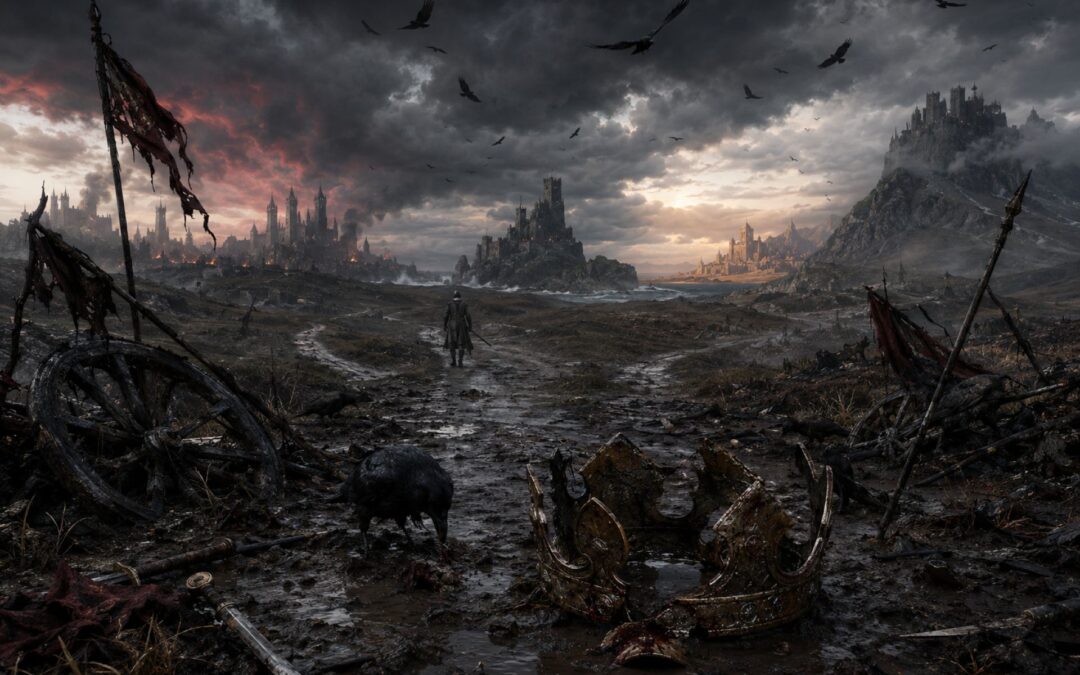
A Feast for Crows, the fourth novel in George R. R. Martin’s A Song of Ice and Fire, begins after the spectacular political and military shocks that transformed Westeros in A Storm of Swords. Robb Stark is dead, Joffrey Baratheon has been murdered at his wedding, Tywin Lannister has been killed by Tyrion, Balon Greyjoy is dead, the Riverlands have been devastated, and several of the great factions that began the War of the Five Kings either no longer exist or have been radically weakened. Yet Martin does not treat these events as the end of a conflict. He turns his attention to what victory leaves behind.
That change of focus makes A Feast for Crows the most unusual novel in the series to this point. Several central figures—including Tyrion Lannister, Daenerys Targaryen, and most of Jon Snow’s continuing story—are absent because Martin divided an oversized manuscript by characters and geography rather than simply cutting it at a chronological midpoint. Martin later explained that choice, and the resulting novel concentrates on King’s Landing, the Riverlands, the Iron Islands, Dorne, the Vale, Braavos, and Oldtown while A Dance with Dragons initially covers other characters during roughly the same period.
The result is a book about aftermath rather than conquest. Its major characters walk through broken institutions, ruined communities, religious resurgence, unresolved vengeance, and identities that no longer fit the people carrying them. Cersei Lannister tries to become the ruler she believes Tywin was and instead destroys the foundations of her own power. Jaime struggles to become more than the Kingslayer. Brienne tries to keep an oath in a world where formal knights repeatedly fail the people they are supposed to protect. Arya and Sansa live under new names. Dorne and the Iron Islands respond to political vacancies with their own competing visions of vengeance and rule.
Spoiler warning: This article covers the complete novel, including every major plot development, character outcome, and ending.
The novel was first published in the United States in November 2005; Penguin Random House lists it as the fourth book in A Song of Ice and Fire. What follows is a complete account of what happens, followed by an analysis of how Martin constructs this damaged postwar world and a critical assessment of why the book remains both one of the richest and one of the most divisive volumes in the series.

A Feast for Crows: Complete Plot Summary
Unlike the previous novels, A Feast for Crows does not build toward one great military convergence. Its story develops through several regional crises that initially seem separate but repeatedly echo one another: rulers lose control of institutions they believed they commanded, heirs and claimants struggle over succession, religious movements become political actors, and characters try to abandon or redefine old identities. The published chapter order matters because Martin constantly moves between these stories, allowing one region’s apparent solution to be answered by another region’s disaster.
Prologue to Chapter 10: A Realm After the Victors’ Triumph
The novel opens far from King’s Landing, at the Citadel in Oldtown. Pate is a novice who has failed to forge even one link of a maester’s chain and dreams of escaping with Rosey, a serving girl whose mother demands a gold dragon for her maidenhood. Pate’s companions discuss rumors that seem absurd in the learned world of the Citadel: dragons have supposedly returned, glass candles may be burning again, and Archmaester Marwyn takes magic more seriously than respectable maesters do.
Pate is already involved in something dangerous. A mysterious man calling himself an alchemist has promised him the gold dragon he needs in exchange for a master key belonging to the senile Archmaester Walgrave. The key can open doors throughout the Citadel. Pate eventually steals it and meets the stranger, who gives him a coin. After Pate bites the gold to test it, he collapses in the street and apparently dies. The chapter seems initially detached from the main political narrative, but its importance only becomes clear at the end of the novel.
On the Iron Islands, another succession crisis is beginning. Balon Greyjoy is dead after falling from a bridge at Pyke, and his brother Euron Crow’s Eye has returned from exile at almost exactly the right moment to benefit. Aeron Greyjoy, known as Damphair after a near-drowning and religious transformation, does not believe Euron should simply inherit. Aeron now understands virtually everything through the Drowned God, and he distrusts both Euron’s impiety and the possibility that Balon’s daughter Asha might claim the Seastone Chair. Rather than accept an ordinary succession, he calls for an ancient kingsmoot at Old Wyk, where captains and kings will choose Balon’s successor.
Dorne faces its own crisis after Oberyn Martell’s death in King’s Landing. Prince Doran Martell remains at the Water Gardens, physically weakened by gout but still trying to control events. His nieces, the Sand Snakes, demand vengeance against the Lannisters and present different versions of how that vengeance should be carried out. Obara wants war, Nymeria argues for political retaliation, and Tyene proposes a more subtle approach. Doran refuses to let Oberyn’s daughters dictate Dornish policy and orders them confined, apparently confirming the view among his enemies and even members of his family that he is too cautious to act.
In King’s Landing, Cersei Lannister wakes after dreaming of Tyrion and learns that her father has been murdered and Tyrion has escaped. Tywin’s death should force her to confront how much Lannister power depended on his political discipline, but Cersei initially experiences it as liberation. With Joffrey dead and young Tommen on the throne, she expects to rule through her son and imagines that she can finally exercise the authority men have denied her.
Her first instinct is to ask Jaime to become Hand of the King. Jaime refuses. The refusal matters because Cersei has always treated her twin as an extension of herself, someone whose loyalty is automatic and whose choices should coincide with her own. Jaime’s loss of his sword hand and his experiences during the previous book have already begun changing him, and his unwillingness to become her political instrument is one of the first signs that their formerly defining bond is breaking.
Brienne of Tarth leaves King’s Landing with a different kind of obligation. She has sworn to find Sansa Stark, partly to fulfill the oath she made to Catelyn Stark and partly because Jaime entrusted the task to her along with the Valyrian steel sword she has named Oathkeeper. Brienne begins with very little information. She knows Sansa vanished after Joffrey’s murder, but she does not know that Sansa is in the Vale under Littlefinger’s protection. Her search therefore sends her along roads filled with displaced people, defeated soldiers, hedge knights, scavengers, and survivors.
Near the Wall, Samwell Tarly receives orders from Jon Snow to leave Castle Black and travel to Oldtown. Maester Aemon is too old to remain safely at the Wall, particularly because Melisandre’s interest in royal blood makes his Targaryen ancestry dangerous. Sam is to accompany Aemon south, continue to the Citadel, train as a maester, and eventually return to serve the Night’s Watch.
Gilly travels with them, carrying an infant, but Jon has secretly forced a cruel substitution. The baby Gilly carries is Mance Rayder’s son, whose supposed royal blood might tempt Melisandre to use him in sacrifice. Gilly’s own son has been left at Castle Black. Sam slowly realizes the emotional price of Jon’s decision. From Jon’s perspective the swap may save a child with king’s blood, but for Gilly it means being separated from her own baby without knowing whether she will ever see him again.
Arya Stark reaches Braavos, using the iron coin and words given to her by Jaqen H’ghar to gain admission to the House of Black and White. The temple serves the Many-Faced God, understood by its priests as the single god of death worshipped under countless names throughout the world. Arya wants training, but the Faceless Men are not simply offering her new combat skills. They demand that she become “no one,” abandoning Arya Stark and the desires, loyalties, grudges, and memories attached to that identity.
Cersei, meanwhile, discovers that ruling is not the same as inheriting a title. Tywin’s funeral emphasizes both his enormous political weight and his humiliating physical mortality. His corpse decomposes visibly and smells so badly that the dignity of the ceremony begins collapsing around the body of the man who spent his life cultivating fear and control.
Kevan Lannister refuses to become Cersei’s obedient Hand. He is willing to serve the realm under conditions that would reduce her direct influence, but he believes she should leave actual government to more capable hands. Cersei interprets this not as a warning from one of the few experienced Lannisters left alive but as insubordination. It is an early example of the mistake that will dominate her regency: she equates independence with hostility and therefore drives away precisely the people capable of correcting her.
Jaime keeps vigil beside Tywin and reflects on the history of the Kingsguard. He remembers the white knights he admired as a boy and the grotesque contradiction of serving Aerys II, a king whose commands frequently violated the very moral ideals associated with knighthood. Jaime killed Aerys to save King’s Landing but has lived ever since under the name “Kingslayer.” His reflections begin separating public honor from ethical action, a distinction that will govern his entire story in the novel.
Brienne travels through Duskendale and the surrounding countryside, searching for reports of Sansa and Dontos Hollard. Her journey reveals the discrepancy between the language of rulers and the reality of the war they have supposedly finished. Towns can be rebuilt, but the roads remain dangerous, ordinary people remain poor, and armed men who learned violence during the war have not vanished because kings signed settlements.
In the Vale, Sansa is living as Alayne Stone, supposedly Petyr Baelish’s bastard daughter. Littlefinger has blamed Lysa Arryn’s death on the singer Marillion and presents himself as Robert Arryn’s necessary protector. Sansa knows the truth about Lysa’s fall, which makes her both dependent on Petyr and implicated in maintaining his lie. When the Lords Declarant challenge Littlefinger’s rule, Sansa begins watching political conflict from the inside rather than merely experiencing it as a victim.
By the tenth chapter, the shape of the novel is established. The old war has removed major figures, but instead of creating peace it has opened spaces that others are rushing to occupy. Euron may gain the Iron Islands, Cersei may dominate the regency, religious institutions may gain power, Littlefinger may reshape the Vale, and Dorne may finally move against the Lannisters. The battlefield has changed, not disappeared.
Chapters 11–19: New Claims, New Queens and the Kingsmoot
Asha Greyjoy returns to contest the succession on the Iron Islands. She has captained ships, commanded men, and fought for Balon’s cause, but many ironborn still treat her sex as disqualifying. Asha therefore faces a political problem that Cersei also faces in a completely different context: she has the ability and ambition to rule in a culture that assumes rulership belongs to men.
Her program, however, differs sharply from Euron’s. Asha understands that Balon’s war has cost the ironborn heavily while gaining them little that can be permanently held. Rodrik Harlaw, called the Reader, reinforces this more skeptical perspective. Where many captains romanticize the Old Way of reaving and conquest, Rodrik recognizes that nostalgia is not strategy. Asha proposes a more limited, pragmatic future rather than endless war against a mainland that vastly outnumbers them.
Back in King’s Landing, Tommen marries Margaery Tyrell. The marriage should strengthen the alliance between the Lannisters and Tyrells, but Cersei experiences Margaery’s increasing popularity as a threat to her own position. She is particularly disturbed by the affection Tommen develops for his new wife. Cersei wants him dependent on her, and Margaery’s ability to make the boy happy becomes politically suspicious in her mind.
Cersei orders the Tower of the Hand burned. The act is partly practical because the place is associated with Tyrion and Tywin, but it is also symbolically destructive. Rather than inherit and stabilize the machinery of government, she increasingly responds to the previous regime by purging, burning, or replacing what it left behind.
In Dorne, Ser Arys Oakheart becomes the central participant in Arianne Martell’s secret plan. Arys is one of Myrcella Baratheon’s Kingsguard protectors and has also become Arianne’s lover, placing desire and sworn duty in direct conflict. Arianne tells him that Dornish law gives women and men equal precedence according to birth order. If that principle applied to the Iron Throne, Myrcella, as Joffrey’s elder surviving sibling, would come before Tommen.
Arianne wants to crown Myrcella queen and force Dorne into open opposition to the Lannister government. She believes her father’s inaction dishonors Oberyn and Elia and fears that Doran intends to favor her younger brother Quentyn over her. Arys knows participation violates his vows, but Arianne’s political and emotional pressure succeeds.
Brienne reaches Maidenpool with Podrick Payne following her. Podrick served Tyrion and now attaches himself to Brienne because he has nowhere else to go. Brienne does not initially want responsibility for him, but his loyalty gradually turns him into part of her moral burden.
At Maidenpool, Randyll Tarly treats Brienne with contempt. His view is superficially protective—he insists that the road will eventually lead to rape or death—but it is built on the assumption that a woman has no legitimate place in the martial world. Brienne’s response is not a theoretical argument. She simply continues doing what the supposedly legitimate knights around her frequently refuse to do.
Nimble Dick Crabb approaches Brienne with a story about a fool and a young woman who may have traveled toward Crackclaw Point. Brienne suspects he may be cheating her but follows the lead because she has so few alternatives. The encounter becomes another test of her difficulty trusting people in a world where deception is common but universal suspicion can also become an injustice.
At sea, Sam’s journey deteriorates. He is badly seasick, Maester Aemon grows weaker, and Gilly remains devastated. Sam eventually realizes the truth about the baby swap. The discovery complicates his feelings about Jon. He understands the strategic reasoning but cannot avoid seeing Gilly’s grief, making the episode an early example of a recurring question in the novel: how much cruelty can be justified by a supposedly necessary political decision?
Jaime’s alienation from Cersei continues as he reflects on both family and Kingsguard history. He increasingly understands that the incestuous secret on which their relationship depended is not nearly as secret as they once imagined. Kevan knows. Tyrion knew. Rumors have shaped the war. The fantasy of Jaime and Cersei as two halves of one hidden, invulnerable self is becoming impossible to sustain.
Cersei builds a council around people she considers personally manageable. Qyburn, stripped of his maester’s chain for forbidden experimentation, becomes especially valuable because he flatters her and asks few moral questions. Aurane Waters receives responsibility for the royal fleet despite having little reason for personal loyalty to Cersei. Experienced men who might resist bad decisions are steadily replaced by courtiers whose chief qualification is that the queen believes she can control them.
Victarion Greyjoy arrives as another claimant to the Seastone Chair. He is a highly effective warrior and commander who believes his strength and status make him the natural successor. His hatred of Euron is also intensely personal. Euron slept with Victarion’s wife, after which Victarion beat her to death rather than challenge the underlying values that made her the object on which male honor was enforced.
Asha attempts to find common ground with Victarion, arguing that a divided family will make Euron’s victory easier. Victarion cannot accept her proposal. His conception of authority, masculinity, and inheritance leaves little room for compromise with a niece who wants the same crown.
The kingsmoot at Old Wyk then brings the entire Greyjoy succession dispute into the open. Candidates offer gifts and visions of rule. Asha argues that the ironborn should recognize the disastrous cost of Balon’s war and seek a more sustainable political settlement. Victarion offers martial strength and continuity.
Euron arrives last and understands the psychology of the gathering better than either rival. He brings exotic treasures from his voyages and presents himself not as the manager of Balon’s inheritance but as the architect of a far larger future. The centerpiece of his appeal is Dragonbinder, an enormous horn supposedly connected to dragons. Euron promises that he can give the ironborn not merely coastal plunder but conquest on a scale beyond anything Balon achieved.
The captains choose him.
The kingsmoot is one of the book’s most important reversals because it turns the Iron Islands from a defeated peripheral rebellion into the source of a new war. The ironborn do not respond to the failure of Balon’s strategy by abandoning conquest. They choose a man who promises something more spectacular.
Chapters 20–29: Failed Coups and Resurgent Powers
Brienne’s search leads her to the ruined Whispers with Nimble Dick, Podrick, and her traveling companions. The lead does not reveal Sansa. Instead they encounter surviving members of the Brave Companions, the brutal mercenary company whose presence in the Riverlands helped turn war into predation.
Nimble Dick is killed, forcing Brienne into direct combat with Shagwell, Pyg, and Timeon. She survives and kills her attackers, but victory leaves her ashamed of how thoroughly she distrusted Dick. He may have exaggerated and bargained aggressively, but in the end he took her where he said he would. Brienne buries him, a small act of respect that matters precisely because so many dead people in this world receive none.
In Dorne, Arianne’s queenmaker conspiracy moves from plotting to action. She takes Myrcella, Arys Oakheart, and a small group of conspirators into the desert, intending to proclaim Myrcella queen. The plan depends on surprise and on Arianne’s assumption that Dornish sentiment will support a bold challenge once it has begun.
Doran already knows.
Areo Hotah and Doran’s men intercept the party. Arys Oakheart, facing the collapse of everything he has compromised his vows to accomplish, charges Hotah and is killed. Darkstar attacks Myrcella during the confusion, nearly killing her and leaving her badly scarred before escaping. Arianne is arrested and isolated.
The failure destroys Arianne’s belief that decisive action is automatically superior to patience. She had seen Doran’s caution as weakness, but her own alternative has produced a dead Kingsguard knight, a maimed princess, and a political crisis.
Arya’s training at the House of Black and White becomes more demanding. She is expected to surrender not merely possessions but personal attachments. She disposes of many things associated with her former life, yet when the moment comes to throw Needle away, she cannot do it. Instead she hides the sword.
Needle has never been valuable because of its physical power. It was given to her by Jon Snow, and it carries Winterfell, family, memory, and the self she was before war scattered the Starks. Hiding it reveals the central contradiction in Arya’s training: she wants the skills of the Faceless Men without fully consenting to the disappearance of Arya Stark.
In the Vale, Littlefinger confronts the Lords Declarant, who want him removed from control of Robert Arryn. The meeting appears to go badly when Lyn Corbray suddenly draws steel. The apparent threat helps Petyr shift the mood and secure more time.
Sansa later learns that Corbray was secretly working for Littlefinger. What seemed like a spontaneous breakdown was part of the performance. It is a crucial lesson for Sansa, whose earlier political education consisted largely of discovering that adults lied to her. Littlefinger now teaches her that politics can involve constructing the event other people will mistakenly interpret as real.
Cersei continues using government to fight private enemies. She is increasingly threatened by Margaery, by the Tyrell presence at court, and by Tommen’s growing attachment to people outside his mother’s control. She also encourages an attempt to remove Bronn through Falyse Stokeworth and her husband Balman. The plan fails disastrously, and rather than take responsibility Cersei eventually gives Falyse to Qyburn for his experiments.
Qyburn’s growing access to prisoners exposes the moral environment Cersei is creating. She wants useful results without asking what methods produce them. That arrangement allows her to feel detached from brutality while benefiting from it.
Brienne’s journey through the Riverlands reaches its thematic center when she travels with Septon Meribald. He has spent years among ordinary people and explains how “broken men” are made. Peasants leave home because lords summon them to war. They march hungry, frightened, and poorly informed, often with little understanding of the political causes for which they are supposed to kill. Their friends die, armies disintegrate, commanders disappear, and eventually some men desert.
Desertion does not restore their old lives. Their villages may be burned, their families dead, and their farms ruined. Armed, traumatized, starving men then become outlaws, thieves, and killers. Society condemns them for becoming dangerous without acknowledging the machinery that produced them.
The speech changes the scale of the series. The War of the Five Kings has often been narrated through crowns, banners, betrayals, and military decisions. Meribald translates those same events into the lives of people who never had any meaningful choice about participating. It is the clearest statement of what A Feast for Crows is trying to examine.
Sam, Aemon, and Gilly become stranded in Braavos. Dareon, the Night’s Watch singer traveling with them, increasingly abandons his responsibilities. Aemon’s health continues deteriorating, but news from across the world suddenly gives him a final sense of purpose. Reports say that dragons have returned with Daenerys Targaryen.
Aemon has spent his life thinking about prophecy, the Targaryens, and the promised savior. The existence of living dragons makes those questions immediate rather than historical. Xhondo, a sailor from the Cinnamon Wind, helps provide passage toward Oldtown, and Aemon becomes determined that the Citadel must hear what Sam knows.
Jaime leaves King’s Landing for the Riverlands, where the crown still needs to convert military victories and treachery into actual political control. His journey also takes him back through Harrenhal and places associated with Brienne. He begins secretly training to fight left-handed with Ilyn Payne, whose lack of a tongue makes him a safe confidant. The practice is humiliating but necessary because Jaime can no longer build his identity around being one of the greatest swordsmen in Westeros.
At Harrenhal, Jaime encounters Ronnet Connington, Brienne’s former betrothed, and reacts violently when Ronnet mocks her. Jaime’s feelings toward Brienne remain difficult for him to name, but his instinctive defense of her shows how thoroughly his perspective has changed since he first treated her as an absurd curiosity.
Cersei makes the political decision that eventually destroys her. The religious movement of the sparrows has grown dramatically because war has displaced people, destroyed local security, and discredited established elites. The High Sparrow who now leads the Faith is nothing like the pliable court prelates Cersei expects.
Cersei nevertheless believes she can use him. The crown owes enormous sums, and she wants religious approval for Tommen. In exchange for financial concessions and cooperation, she allows the Faith to restore its armed orders: the Warrior’s Sons and Poor Fellows. From Cersei’s point of view, she has converted religious enthusiasm into another weapon.
In reality, she has given an increasingly independent institution the ability to enforce its own judgments with armed men.
On the western coast of the Reach, Euron launches his new reign through conquest. Victarion proves extremely effective in battle during the attacks on the Shield Islands. Yet Euron demonstrates that political intelligence matters as much as martial skill. He distributes captured territories and honors in ways that reshape loyalties and bind ambitious captains to his regime.
Euron then sends Victarion east with the Iron Fleet and Dragonbinder. The mission is to find Daenerys Targaryen and bring her—and more importantly her dragons—into Euron’s project. Victarion accepts, but he immediately begins imagining how he might take Daenerys for himself and frustrate Euron’s plan.
Thus the Greyjoy storyline, which began as a local inheritance dispute, expands into a potential connection with the dragon-centered struggle beyond Westeros.
Chapters 30–38: Oaths, Prophecies and the Human Cost of War
At Darry, Jaime encounters Lancel Lannister, whose physical and spiritual transformation shocks him. Lancel was once a young courtier trying to imitate Jaime. He is now thin, damaged, and consumed by religious guilt.
Lancel confirms what Tyrion had previously suggested: he slept with Cersei. He also admits helping arrange Robert Baratheon’s fatal drunkenness during the hunt. Cersei had instructed him to ensure Robert drank unusually strong wine, making the king more vulnerable to the accident that killed him.
For Jaime, the revelation is personal rather than simply political. His belief in the exceptional nature of his relationship with Cersei becomes harder to sustain. Cersei has repeatedly demanded absolute loyalty while treating loyalty as something she herself does not owe.
Brienne reaches the Quiet Isle, a religious refuge where violence and former identities are treated differently from the outside world. The Elder Brother tells her about Sandor Clegane’s final condition after Arya left him. He distinguishes the man from the identity of “the Hound,” suggesting that the Hound is dead even if Sandor’s story may be more complicated.
A silent gravedigger on the island strongly resembles what Sandor might have become, but A Feast for Crows never explicitly identifies him as Sandor. What matters within this novel is the possibility that a feared public identity can die even while the damaged human being who carried it continues.
Brienne is told that her quest may be hopeless. She continues anyway.
In King’s Landing, the ironborn attacks on the Reach create a serious strategic problem. Margaery and the Tyrells naturally want the crown to respond decisively because their own lands are under attack. Cersei again interprets a national emergency through her private conflict with the Tyrells.
Loras Tyrell eventually leads the assault on Dragonstone. Later reports claim that the castle has fallen but that Loras was horribly wounded in the attack. Cersei treats the news as convenient because one of Margaery’s strongest protectors may have removed himself from court. The novel does not independently verify the full accuracy of these reports, which matters because information in Martin’s world is often incomplete or politically useful.
Cersei’s private life also reveals how power has distorted her. Her sexual relationship with Taena Merryweather includes moments in which Cersei imitates forms of domination she remembers suffering from Robert. The scene does not simply invert gender roles. It shows Cersei reproducing abuse once she possesses enough power to occupy the position she previously hated.
At Riverrun, Jaime finds a siege that has become almost ceremonial. The Freys threaten Edmure Tully repeatedly but cannot make the castle surrender. Brynden “Blackfish” Tully continues resisting inside.
Jaime takes control. He does not want another assault if he can avoid one, partly because he has promised Catelyn Stark not to take up arms against the Tullys and Starks. Yet he is also commander of forces whose political objective requires Riverrun’s submission. His problem is not choosing between honor and dishonor. It is choosing between obligations that cannot all be satisfied simultaneously.
Arya is now living in Braavos as Cat of the Canals. Her new life teaches skills that matter as much as fighting: languages, observation, memory, deception, social movement, and collecting information while appearing harmless. She learns to see a city from the perspective of someone whose survival depends on noticing what others overlook.
Then she encounters Dareon.
Arya knows enough about the Night’s Watch to understand desertion as a capital offense. Ned Stark executed a deserter in the opening movement of the entire series, and Arya still carries a northern conception of justice despite living under a false name in a foreign city. She kills Dareon.
The Faceless Men did not order the killing. Arya acted because Arya Stark believed he deserved to die. When she admits what she has done, the temple takes her sight.
The punishment demonstrates that her instructors are not merely testing whether she can kill. They are testing whether she can stop deciding who deserves death according to Arya Stark’s loyalties. Her continued failure to become “no one” is precisely what keeps her psychologically recognizable.
At sea, Maester Aemon dies. Before his death, reports of Daenerys and the dragons force him to reinterpret prophetic traditions he has considered for decades. He comes to believe that interpreters may have misunderstood the promised prince partly because they assumed the savior must be male. In High Valyrian, gender does not operate in the prophecy exactly as Westerosi translators have assumed.
Aemon increasingly thinks Daenerys may be central to the prophecy. The novel does not confirm that he has solved it. His conclusion is significant because an extremely learned Targaryen maester, nearing death, recognizes that inherited assumptions can distort interpretation.
Sam is left carrying Aemon’s knowledge toward the Citadel. His relationship with Gilly also changes during the voyage. Their intimacy is complicated by grief, fear, religious vows, and the emotional damage created by the baby swap. Martin treats neither of them as clean symbols: they are young, frightened people making imperfect decisions under enormous strain.
Cersei’s memories then reveal one of the deepest sources of her paranoia. As a child she visited Maggy the Frog and demanded to know her future. The prophecy predicted her royal marriage, three children, their deaths, and her eventual displacement by a younger and more beautiful queen. It also foretold that the “valonqar,” a High Valyrian word associated with “little brother,” would eventually kill her.
Cersei has spent much of her life interpreting events through this prophecy. She assumes Margaery may be the younger queen and Tyrion the threatening little brother. The prediction therefore matters even if the reader refuses to treat prophecy as fixed destiny. Cersei’s belief changes her behavior, and her attempts to prevent the prophecy repeatedly help create the circumstances she fears.
Brienne’s journey reaches the crossroads inn, now occupied by children and people trying to preserve a small pocket of safety. Gendry is there, associated with the Brotherhood Without Banners. Violence soon returns.
Rorge has taken the Hound’s helm, demonstrating how an identity can continue terrorizing people after the original owner has vanished. He, Biter, and other killers attack the inn. Brienne could flee. Instead she stays to defend the children.
This is one of the clearest demonstrations of knighthood in the series. Brienne has never been properly knighted because she is a woman, yet she does what the romantic ideal of knighthood demands: she risks herself to protect vulnerable people without expectation of status or reward. She kills Rorge, but Biter overwhelms her and begins savaging her face before Gendry kills him.
The physical cost is severe. Martin refuses to preserve Brienne as an untouched emblem of virtue. Her ethics exist inside a world where doing the right thing can destroy the person who does it.
At Riverrun, Jaime tries negotiation before violence. His conversation with the Blackfish fails to produce surrender, so he turns to Edmure. Jaime threatens Edmure’s family in horrifying detail, making clear that resistance will bring consequences Edmure cannot accept.
Edmure yields. Riverrun falls without a battle, and the garrison is spared, but the Blackfish escapes.
The episode makes Jaime’s moral progress deliberately uncomfortable. He achieves a less bloody outcome than a direct assault would probably have produced, but he does it through terror. His reputation as a ruthless Lannister becomes the tool that allows him to prevent actual slaughter. Martin refuses to give him a simple redemption in which better intentions automatically produce clean actions.
Chapters 39–45: The Traps Close
Cersei now moves openly against Margaery. Grand Maester Pycelle reveals that Margaery has asked him for moon tea. The substance can have several uses, but Cersei interprets it as evidence that Margaery has been sexually active.
Rather than investigate fairly, she decides to manufacture a case.
Qyburn tortures the Blue Bard until he is willing to repeat accusations implicating Margaery and members of her circle. Cersei then manipulates Osney Kettleblack into claiming that he slept with Margaery. Her plan is to place the Tyrell queen under the judgment of the Faith, the same institution Cersei recently rearmed because she believed she could use it against her enemies.
In Dorne, Arianne remains imprisoned and becomes increasingly desperate to understand what her father intends. When she is finally brought before Doran, she explains the grievance underlying her rebellion. She believed he meant to pass Dorne to Quentyn despite Dornish inheritance customs favoring her as the elder child.
Doran reveals that she misunderstood the situation.
He had once intended Arianne for a far larger political marriage connected to Viserys Targaryen. His secret strategy has long been shaped by the murders of Elia Martell and her children during Robert’s Rebellion. After Viserys’s death, the plan changed. Quentyn has gone east seeking Daenerys Targaryen.
Doran has not forgotten vengeance. He has delayed it.
The revelation transforms Arianne’s understanding of her father but does not automatically prove that his strategy is wise. His secrecy helped produce the very rebellion he wanted to prevent. His preference for patience has preserved options, but it has also prevented his own heir from understanding the political world she is supposed to inherit.
In the Vale, Sansa’s development as Alayne continues. She helps manage Robert Arryn during the difficult descent from the Eyrie and becomes more comfortable operating within her false identity. Littlefinger then reveals the next stage of his plan.
Robert is sickly and may die. His likely heir is Harrold Hardyng, known as Harry the Heir. Petyr intends to arrange a marriage between Alayne and Harry. Once the marriage is secure, Sansa’s real identity can eventually be revealed, potentially allowing the Vale to rally behind a Stark restoration in the North.
For the first time since Ned’s death, Sansa is not merely being moved through someone else’s plan without understanding it. She is still profoundly dependent on Littlefinger and does not control the larger game, but she is beginning to learn how political identities can be constructed and deployed.
Brienne awakens in the hands of the Brotherhood Without Banners. The group she encounters is radically different from the brotherhood led by Beric Dondarrion earlier in the series. Its new leader is Lady Stoneheart: the resurrected corpse of Catelyn Stark.
Resurrection has not restored Catelyn to the woman Brienne served. Stoneheart is physically ruined, largely unable to speak, and consumed by revenge for the Red Wedding. She judges people according to their apparent connections with the Freys, Boltons, and Lannisters and orders executions with little interest in nuance.
Brienne’s possessions make her look guilty. She carries Oathkeeper, a Lannister sword given to her by Jaime, along with documents bearing Tommen’s authority. Stoneheart concludes that Brienne betrayed her promise.
Brienne cannot easily explain that Jaime gave her the sword so she could fulfill Catelyn’s own wish to recover Sansa and Arya. The very evidence of her oath has become evidence against her.
Stoneheart gives Brienne a choice: kill Jaime or be hanged with Podrick and Hyle Hunt.
Brienne refuses.
As the ropes tighten and Podrick begins dying, Brienne screams a word. A Feast for Crows does not reveal what that word is. The chapter ends at the moment when her ideals collide most violently: loyalty to Jaime, loyalty to Catelyn’s memory, protection of Podrick, and her commitment not to murder an innocent man cannot all be preserved at once.
Cersei believes her own plan against Margaery has succeeded. The younger queen has been arrested, and Cersei expects the Faith to destroy her politically.
Instead the trap reverses.
Under questioning, Osney Kettleblack has confessed that the accusations against Margaery were fabricated. He has also revealed his own sexual relationship with Cersei and his involvement in the murder of the previous High Septon. The High Sparrow is not Cersei’s servant. Once evidence implicates the queen regent, he applies religious law to her as well.
Cersei is arrested.
The consequences of her government now become visible all at once. Many of the people she elevated prove useless or disloyal. Aurane Waters disappears with the costly new royal fleet Cersei commissioned. Her ability to command the court collapses the moment she loses personal access to the machinery of power.
Imprisoned and desperate, she writes to Jaime asking him to return and rescue her.
Jaime receives the letter while continuing the work of pacifying the Riverlands. He has learned more about the betrayals that helped destroy Robb Stark’s cause and has seen what Lannister victory actually looks like on the ground. His relationship with Cersei has by this point been damaged by Lancel’s confession, Tyrion’s earlier revelations, and Cersei’s repeated attempts to use him.
Jaime reads her plea.
Then he has it burned.
The action is quieter than the great betrayals of the earlier books, but emotionally it is one of the novel’s decisive endings. Jaime does not ride back to King’s Landing. The relationship around which he once organized his identity no longer has automatic power over him.
The final chapter returns to Oldtown. Sam and the Cinnamon Wind approach a city increasingly threatened by Euron’s attacks in the Reach. The Greyjoy war has therefore expanded far beyond the Iron Islands and now threatens one of Westeros’s great intellectual and commercial centers.
Sam meets Alleras, a gifted novice associated with Archmaester Marwyn. He is taken to Marwyn, who treats the stories of dragons, prophecy, and magic with a seriousness that sharply contrasts with the Citadel’s usual skepticism.
Marwyn claims that the maesters are not simply neutral scholars observing the return of magic. In his view, the Citadel has historically opposed magical power and may even have contributed to the disappearance of dragons. The novel does not establish all of Marwyn’s accusations as objective fact, but his warning changes Sam’s assumptions about the institution he has just entered.
Marwyn decides that Daenerys cannot wait for a committee of cautious scholars. He prepares to leave for her immediately.
Then the novel closes a circle opened in its Prologue. A Citadel novice introduces himself as Pate.
The original Pate apparently died after giving the alchemist Walgrave’s master key. The appearance of another Pate strongly implies that the mysterious killer has assumed his identity, though this novel does not explicitly identify who the impostor is or explain the full purpose of the theft.
The book therefore ends not with restored order but with almost every regional story opening into another crisis. Cersei is a prisoner of the Faith she empowered. Jaime has rejected her summons. Brienne hangs before Lady Stoneheart. Sansa is being positioned for a Stark restoration through marriage. Arya has been blinded during Faceless Men training. Doran has revealed his Targaryen strategy. Victarion is sailing toward Daenerys. Euron’s war threatens Oldtown. Sam has entered a Citadel that may be deeply entangled in the struggle over magic, and someone who should be dead is walking its halls under a stolen name.
Setting and World-Building: Westeros After the War of the Five Kings
Earlier volumes build Westeros partly through political competition: readers learn the realm by following armies, royal courts, castles, noble houses, and competing claimants. A Feast for Crows adds a different layer. It explores what those struggles have done to institutions, roads, villages, religious communities, and regional cultures after the banners have moved elsewhere.
The novel also enlarges the political map. The Iron Islands and Dorne stop functioning mainly as distant sources of other characters and become complex societies with internal arguments about succession and legitimacy. Braavos becomes a lived city rather than a name associated with trade and assassins, while Oldtown and the Citadel emerge as a second intellectual center of the world just as magic is returning.
King’s Landing and the War-Scarred Riverlands
King’s Landing appears superficially secure because Tommen occupies the throne and the Lannister-Tyrell alliance defeated its major immediate rivals. In practice, the capital is unstable. Tywin is dead, Tyrion has escaped, Kevan withdraws from government, Cersei mistrusts the Tyrells, royal finances are deteriorating, and a new popular religious movement is becoming an independent political force.
The city therefore illustrates the difference between possessing a crown and possessing functioning authority. Cersei assumes the crown can command because it is the crown. The High Sparrow, the Iron Bank, the Tyrells, regional lords, and eventually even Aurane Waters demonstrate that power depends on cooperation, resources, legitimacy, information, and institutions that cannot always be ordered into obedience.
The Riverlands expose the deeper consequences of the same conflict. Here political theory disappears into mud, hunger, corpses, ruined inns, frightened peasants, abandoned villages, and roaming bands of armed men. The region has been fought over by Stark, Tully, Lannister, Frey, Bolton, and royal forces, yet the people paying the largest price rarely chose any of those causes.
Brienne’s route is deliberately repetitive because the devastation is repetitive. One burned settlement does not transform the war into tragedy; the accumulation does. She keeps encountering evidence that organized armies have passed through, consumed resources, killed people, moved on, and left social structures too weak to prevent further violence.
Jaime sees the same region from the perspective of the victorious faction. His job is to turn Lannister military success into political settlement. Riverrun can be forced to surrender, castles can receive new masters, and surviving nobles can swear new oaths, but none of that restores the world Brienne has walked through.
That contrast is one of Martin’s strongest world-building choices. Jaime operates on the official map where banners and titles change. Brienne moves across the human landscape where those changes often mean very little.
The Iron Islands, Dorne and the Vale
The Iron Islands are governed by a culture that remembers raiding and conquest as markers of identity. The Old Way is partly economic practice, partly religious memory, and partly political mythology. Balon’s failed rebellions did not destroy the idea because failure can be explained as insufficient commitment rather than evidence that the strategy itself is unsustainable.
Asha challenges that mythology more directly than her rivals. She has fought in her father’s war and therefore does not oppose the martial culture from outside it, but she understands that prestige cannot substitute for durable gains. Euron succeeds because he offers something psychologically more appealing: not retreat from Balon’s dream but a larger dream.
The kingsmoot also reveals a political system different from mainland hereditary monarchy. The captains choose a ruler through an ancient ritual that gives the appearance of collective legitimacy. Yet the process remains vulnerable to charisma, spectacle, wealth, and impossible promises. Euron wins partly because he understands that politics is not only about demonstrating competence. It is about defining the scale of what the audience believes is possible.
Dorne provides almost the reverse problem. Its inheritance customs allow women to inherit on equal terms according to birth order, giving Arianne a political position women in much of Westeros would not possess. Yet legal equality does not eliminate secrecy, patriarchy, family conflict, or strategic manipulation.
Arianne assumes Doran intends to deny her rights because he has failed to explain his plans. Her queenmaker conspiracy is therefore not simply youthful recklessness. It grows from a political environment in which the heir to Dorne has been denied enough information that she misreads her father’s entire strategy.
The Water Gardens add another dimension. Doran values the place partly because noble and common children mingle there with fewer visible distinctions than almost anywhere else in Westerosi aristocratic life. The image does not turn Dorne into a utopia, but it gives Doran’s politics a wider emotional background. His memory of Elia and her children is connected to the vulnerability of children in a political order where dynastic conflicts repeatedly destroy them.
The Vale appears peaceful compared with the Riverlands, but its stability is partly an illusion created by isolation. The Lords Declarant want to protect traditional aristocratic authority from Littlefinger, a man they regard as socially inferior and politically opportunistic. Petyr survives not by defeating them militarily but by manipulating rivalries and staging events.
Sansa’s education therefore takes place in a region where politics is unusually theatrical. Littlefinger teaches her that authority can depend on making other people interpret a scene incorrectly. That lesson is dangerous because it makes her more capable while binding her more closely to one of the series’ most manipulative characters.
Braavos, Oldtown and the Expanding World
Braavos represents a form of social and institutional complexity distinct from feudal Westeros. It is a commercial city connected to shipping, banking, foreign languages, religious pluralism, and networks that cross political borders. Arya’s training there requires adaptation to a world where noble birth carries much less immediate meaning.
The House of Black and White is especially important because it combines religion, intelligence gathering, performance, and assassination. The Faceless Men do not understand themselves as ordinary hired killers. Their theology treats death as a universal god wearing many cultural faces, and their discipline demands the destruction of personal identity so the individual can become an instrument of that larger principle.
Oldtown is another kind of international center. It is ancient, wealthy, intellectually prestigious, and tied to the Hightowers, the Faith, the Citadel, and global trade. Its appearance near the end of the novel matters because the story has spent hundreds of pages showing political institutions destabilized by war, and now the institution most associated with rational knowledge is confronted by reports that dragons and magic are returning.
Marwyn’s warning suggests that knowledge institutions may have interests of their own. The Citadel may not merely be a library waiting to update itself when new evidence arrives. If Marwyn is even partly correct, maesters have a historical relationship with magic that Sam does not yet understand.
The approach of Euron’s war toward Oldtown further collapses the distinction between political and intellectual worlds. The Citadel cannot remain safely outside history if fleets are attacking the Reach, dragons have returned, and mysterious agents are already operating inside its halls.
Character Analysis: Who Changes in A Feast for Crows
The most important transformations in A Feast for Crows are not battlefield victories. They involve characters discovering that identities which once seemed permanent no longer work. Some try to build new selves, some cling desperately to old ones, and some attempt to erase themselves entirely.
Cersei, Jaime, and Brienne form the strongest central triangle even though they rarely occupy the same physical space. Cersei moves toward the worst version of herself while believing she is becoming stronger. Jaime begins questioning the identity that defined him. Brienne, who has never been granted the title she wants, increasingly proves through action that she understands its ideals better than most titled knights.
Cersei and Jaime: Two Lannisters Moving in Opposite Directions
Cersei’s chapters are among the most revealing examples of unreliable close-third narration in the series. Readers inhabit her reasoning closely enough to understand why she acts, but the gap between what she believes and what the surrounding evidence shows grows steadily wider.
Her deepest political desire is to prove that men underestimated her because she is a woman. That grievance is legitimate. Westerosi society does restrict female authority, reduce women to marriage alliances, and allow men freedoms denied to them. Cersei correctly understands that much of the resistance she has experienced is gendered.
The tragedy is that she draws the wrong lesson from that experience. Instead of rejecting the brutal structure that limited her, she wants to occupy its highest position. She does not imagine a less abusive form of power; she imagines herself wielding the power men once wielded over her.
Tywin becomes the standard she believes she is imitating. She admires his decisiveness, fearsome reputation, and ability to crush opposition. What she repeatedly misses is that Tywin also understood logistics, alliances, institutional constraints, and the value of competent subordinates. Cersei imitates the theatrical surface of Tywin’s rule—intimidation, punishment, refusal to appear weak—without possessing his discipline.
Her relationship with prophecy amplifies the problem. Maggy the Frog’s prediction gives Cersei a template into which she can fit every threatening event. Margaery becomes the younger queen. Tyrion becomes the valonqar. Every independent political actor looks like another stage in an inevitable conspiracy.
Because Cersei believes she already knows the shape of danger, contrary evidence becomes difficult for her to process. Kevan’s criticism proves he is disloyal. Jaime’s refusal proves he is unreliable. Margaery’s popularity proves she is ambitious. The High Sparrow’s cooperation proves he can be manipulated. Once Cersei reaches a conclusion, the world is reorganized around confirming it.
Her fear of losing Tommen is similarly inseparable from her desire to possess him. She loves her children, but her love is controlling. Tommen’s attachment to Margaery, Loras, jousting, kittens, or any other independent source of happiness can feel to Cersei like a reduction of her own importance.
Cersei’s misogyny is therefore one of her most revealing contradictions. She hates the limitations placed on women but frequently judges other women through the same standards. Margaery’s sexuality becomes a weapon because Cersei understands how effectively a woman’s reputation can be destroyed by accusation. Falyse can be handed to Qyburn because her suffering does not matter once she is no longer useful. Taena becomes someone through whom Cersei can rehearse domination.
The restoration of the Faith Militant summarizes her entire political failure. She solves an immediate problem by empowering an institution she does not understand. She assumes authority is personal—if she makes an agreement with the High Sparrow, the High Sparrow is now part of her machinery. Instead he possesses his own source of legitimacy and his own definition of law.
Cersei’s arrest is therefore not random misfortune. It is the institutional form of her character flaw. She creates the weapon, points it at Margaery, and discovers that she has no control over where it turns next.
Jaime’s arc moves in the opposite direction, but it is not a clean redemption story. Losing his sword hand destroyed the skill around which he had built much of his identity. Brienne’s influence and his memories of the Kingsguard force him to reconsider what honor means when obedience and morality diverge.
His title “Kingslayer” contains the contradiction. Killing Aerys was technically the ultimate violation of his Kingsguard vows, yet allowing Aerys to burn King’s Landing would have been morally worse. Jaime therefore knows from personal experience that social definitions of honor can reward obedience to evil and punish disobedience that saves lives.
Brienne gives that abstract problem a living counterpart. She believes in knightly ideals with an earnestness Jaime once mocked, but the world refuses to recognize her as a knight. Jaime, who possesses the title and reputation she wants, spent much of his life violating its spirit.
Their relationship forces each character to see the other differently. Jaime begins by treating Brienne’s ideals as naivety and ends up respecting the fact that she actually lives by them. Brienne begins with the public story of Jaime as oathbreaker and learns that the moral history behind the Kingslayer name is more complicated.
His conduct at Riverrun demonstrates both progress and limitation. Jaime genuinely wants to prevent unnecessary bloodshed. He attempts negotiation. He allows many people to survive who might have died in an assault. Yet he ultimately succeeds by threatening Edmure’s family with horrific violence.
The outcome is better than a massacre, but the means are still coercive. Jaime remains a Lannister commander enforcing a settlement created through the Red Wedding and other betrayals. Martin does not ask the reader to forget that merely because Jaime is becoming more reflective.
His burning of Cersei’s letter is therefore best understood as separation, not completion. Jaime has stopped allowing Cersei to define his choices automatically. He has not yet solved the ethical contradictions of his political position.
Brienne and the Meaning of True Knighthood
Brienne’s storyline can initially look like a deliberately futile search. Readers know Sansa is in the Vale, so Brienne’s investigation of Duskendale, Maidenpool, Crackclaw Point, the Quiet Isle, and the Riverlands cannot produce the result she wants. The dramatic question is therefore not whether she will suddenly find Sansa.
The journey is about what her oath makes her encounter.
Brienne repeatedly enters situations where formal status has little relationship with moral worth. Randyll Tarly is a powerful, respected lord who understands the military world far better than Brienne does, yet his response to her aspiration is contempt. The Brave Companions possess martial skill but use it for predation. Former soldiers terrorize civilians. The Brotherhood Without Banners, once founded partly to defend ordinary people, becomes increasingly consumed by revenge under Stoneheart.
Brienne lacks the title of knight, but she consistently performs the duties associated with its idealized form. She keeps promises when breaking them would be easier. She protects Podrick despite never asking for responsibility over him. She buries Nimble Dick after realizing she treated him unfairly. Most importantly, she defends the children at the crossroads inn when retreat would be safer.
Her physical strength matters, but her defining trait is not strength. It is the willingness to accept danger for someone who cannot reward her.
That is why her encounter with Lady Stoneheart is so devastating. Catelyn’s oath originally gave Brienne’s journey its purpose. Stoneheart now interprets the evidence of Brienne’s attempt to keep that oath as proof of betrayal.
The ultimatum to kill Jaime creates an impossible moral structure. Obedience to Catelyn’s resurrected body would mean betraying the man who helped her fulfill Catelyn’s wish. Refusing means allowing Podrick and Hyle to die with her. No perfectly honorable choice remains available.
Brienne’s story therefore reaches the same conclusion as Jaime’s from the opposite direction. Honor is not difficult only because people are weak. Sometimes the world produces obligations that genuinely conflict.
Arya and Sansa: Losing a Name Without Losing the Self
Arya and Sansa spend most of the book under new names, but their transformations move in opposite directions.
The Faceless Men want Arya’s false identities to erase the original person. “Cat of the Canals” should eventually become one mask among many, with no Arya Stark beneath it. Her training rewards observation, control, deception, and emotional detachment.
Arya resists because her sense of self is bound to memory. Needle is the most obvious symbol, but the deeper attachment is moral. Killing Dareon shows that Arya still interprets the world through Stark loyalties and northern justice. The Faceless Men did not tell her he deserved death; Arya Stark decided that.
Her blindness is therefore not merely punishment for unauthorized killing. It is part of a training system trying to break the connection between personal identity and judgment.
Sansa’s transformation into Alayne works differently. Littlefinger does not want her to forget Sansa Stark forever. He wants her to hide Sansa until that identity becomes politically useful.
Alayne allows Sansa to survive. The disguise gives her distance from the role of hostage and suspected accomplice in Joffrey’s murder. It also places her in a new social position. As Littlefinger’s supposed bastard daughter, she has less status than Sansa Stark but more opportunity to observe how Petyr actually constructs power.
Sansa’s education is morally dangerous because Littlefinger is teaching her effective techniques without giving her a trustworthy ethical framework. She learns how people are manipulated, how apparent accidents can be engineered, and how identity itself can become political capital.
The Harry Hardyng plan demonstrates that Sansa’s name remains enormously powerful even while she does not use it. Arya is being asked to erase a name that she privately protects. Sansa is being asked to conceal a name that others plan eventually to deploy.
Both stories therefore ask whether identity is something a person possesses internally or something society assigns and uses.
Aeron, Asha, Victarion and Euron
The Greyjoy siblings and relatives embody competing responses to the failure of Balon’s rule.
Aeron turns political uncertainty into religious certainty. His earlier life included humiliation, fear, and near-death. Becoming Damphair gave him a new identity organized around the Drowned God. The kingsmoot is therefore both constitutional strategy and religious act. Aeron wants divine legitimacy to protect the islands from Euron.
Asha represents pragmatic adaptation. She accepts much of ironborn culture but rejects the assumption that repeating Balon’s mistakes more aggressively will produce better results. Her claim is politically serious because she offers an alternative future, not merely an alternative person.
Victarion represents the power and limitation of the Old Way in concentrated form. He is courageous, disciplined in battle, and capable of commanding men. He is also trapped inside an honor system so rigid that he responds to Euron’s sexual violation of his household by killing his own wife.
Euron understands all three of them. He defeats Aeron’s religious authority with spectacle, Victarion’s military credibility with larger promises, and Asha’s realism with fantasy. He tells the ironborn what they want to believe: that their historical weakness can be overcome not by changing strategy but by acquiring dragons and embracing an even greater conquest.
His victory is therefore not an accident. It is a political demonstration of how charismatic ambition can defeat sober analysis when a society prefers a mythic future to an honest account of recent failure.
Arianne, Doran and the Dornish Politics of Patience
Arianne’s conflict with Doran is built on secrecy. She knows he is cautious, knows Quentyn has been sent away, and believes she has discovered evidence that her father intends to deny her inheritance. From the information available to her, rebellion begins to look like self-defense.
Her queenmaker plot is also shaped by Dornish law. Arianne can plausibly argue that Myrcella should be queen according to principles Dorne applies to its own succession. The problem is that a legal argument cannot erase military reality. Crowning Myrcella would be an act of war whether or not Arianne can construct a legal justification.
The plan collapses because Doran’s intelligence network is better than Arianne realizes. Arys dies, Myrcella is scarred, and Arianne is imprisoned.
Doran’s revelation gives him a sudden appearance of greater strategic depth. He has not forgotten Elia. He has not accepted Lannister rule. His restraint concealed a long Targaryen restoration project.
Yet the revelation should not be treated as proof that Doran is secretly infallible. His obsession with secrecy contributes directly to his daughter’s rebellion. He has protected his plans by denying essential information to the person who will inherit Dorne.
The father and daughter therefore represent opposite political failures. Arianne acts too quickly because she lacks information. Doran withholds so much information that the people closest to him begin acting against plans they do not know exist.
Samwell, Aemon and Marwyn
Sam’s journey is quieter than the political stories but carries some of the novel’s most important connections to the larger series.
He begins under Jon’s command and is forced to participate in a decision he finds morally disturbing. The baby swap shows Sam that leadership can require choices he would rather avoid, but it also shows the danger of describing human beings as pieces in a strategy. Gilly experiences the cost that commanders can rationalize at a distance.
Aemon’s death gives the journey intellectual urgency. He has lived more than a century, rejected the throne, served the Night’s Watch, and spent decades thinking about Targaryen history and prophecy. The return of dragons occurs just as he is physically incapable of investigating it himself.
His final insight about Daenerys matters because it demonstrates interpretive humility. Even an extremely learned man can recognize that inherited assumptions—here, assumptions about gender—may have distorted a prophecy for generations.
Marwyn provides a sharper challenge to institutional certainty. He believes the Citadel’s respectable culture systematically excludes or opposes magic. Whether every element of his theory is true remains unresolved, but his willingness to act immediately contrasts with bureaucratic caution.
Sam therefore arrives at Oldtown expecting knowledge and discovers a struggle over what kinds of knowledge the institution is willing to recognize.
Power, Faith and Institutions
One of the most important differences between A Feast for Crows and the earlier books is its focus on institutions that cannot be reduced to individual rulers. Kings and queens still matter, but the novel repeatedly shows that crowns depend on religious legitimacy, financial systems, local aristocracies, military organizations, information networks, and intellectual authorities that possess their own interests.
Cersei’s central mistake is assuming that institutions function like servants. Doran makes the opposite error in miniature by relying so heavily on secrecy that even his heir cannot see what the governing system is doing. Across the novel, weakened central power allows older structures and peripheral actors to become more important.
Cersei, the Crown and the Faith Militant
The rise of the sparrows is a social consequence of war. The movement draws strength from displacement, religious fear, anger at elite corruption, and the collapse of ordinary security. The High Sparrow therefore possesses something Cersei does not understand how to manufacture: popular moral legitimacy independent of the royal court.
Cersei sees a bargaining opportunity. The crown needs cooperation, and the Faith wants its military orders restored. She grants the Faith the right to arm the Warrior’s Sons and Poor Fellows, expecting those forces to remain politically useful.
The decision changes the balance of power because it gives religious judgment physical enforcement. The crown no longer has a practical monopoly over legitimate armed authority in the capital.
When Cersei later fabricates accusations against Margaery, she assumes the Faith will behave like a royal court shaped by patronage. Instead the High Sparrow follows evidence wherever his institution understands that evidence to lead. Once Osney confesses, Cersei becomes subject to the same machinery she intended to use against someone else.
Her arrest therefore illustrates a basic principle of institutional politics: transferring power is easier than recovering it. A ruler who creates an independent enforcement mechanism cannot assume that its future decisions will remain personally convenient.
The irony is especially strong because Cersei believes she is consolidating monarchy. In practice she weakens the crown by driving away competent Lannisters, antagonizing the Tyrells, mishandling finances, empowering Qyburn, constructing a fleet under a questionable admiral, and restoring an armed church.
Kingsmoot, Dornish Succession and Regional Legitimacy
The kingsmoot and Arianne’s queenmaker plot both ask what makes a ruler legitimate.
On the Iron Islands, Euron wins through an ancient elective ritual. His claim is therefore not simply hereditary. He persuades the captains that he can embody a larger future for the islands, and the assembly grants him a form of collective legitimacy.
Yet the procedure does not guarantee wisdom. A political system can produce a legitimate decision in formal terms and still choose a disastrous leader. Asha’s stronger practical argument loses to Euron’s more intoxicating promise.
Dorne presents a different conflict. Its inheritance traditions provide Arianne with a legal framework according to which Myrcella’s seniority could challenge Tommen’s claim. Yet Westeros as a whole does not accept Dornish succession practice for the Iron Throne.
Arianne’s plot exposes the gap between regional law and continental power. Legitimacy is not a single universally agreed rule. Different societies can possess incompatible principles, and political actors can choose whichever principle serves their immediate cause.
Doran’s long-term strategy adds another layer. He believes revenge and restoration must be achieved through patient alliance rather than symbolic declarations. His approach values survivability over dramatic legitimacy, but the secrecy necessary to maintain it generates its own political costs.
The Iron Bank, the Citadel and Powers the Throne Cannot Command
The crown’s debt is another sign that monarchy does not exist outside systems it controls. Cersei can delay payments, but she cannot abolish the economic consequences of royal borrowing by refusing to think about them. Financial authority operates across borders and survives changes of kings.
Braavos represents this larger world of transnational power. Its banks, trade networks, religious institutions, and assassins are not subordinate to Westerosi feudal hierarchy. Arya and Sam both enter a city where the Iron Throne is only one political fact among many.
The Citadel similarly occupies a position that kings require but do not fully command. Maesters serve noble households throughout Westeros, giving the institution extraordinary access to information and influence while maintaining an appearance of scholarly neutrality.
Marwyn’s allegations complicate that neutrality. If he is correct that the Citadel has historically opposed magic, then knowledge itself has been shaped by institutional preference. The novel does not prove his larger conspiracy, but it deliberately leaves readers with the possibility that rational authority can become dogmatic just as religious authority can.
The wider pattern is consistent. A Feast for Crows takes a world that looked increasingly centralized around victorious Lannister power and reveals that power dispersing into churches, banks, regional customs, fleets, secret orders, and intellectual institutions.
Themes: What A Feast for Crows Is Really About
The novel’s major themes grow directly from its postwar setting. Instead of treating the Red Wedding, Blackwater, and other great events as dramatic endpoints, Martin asks what those events create after the narrative spotlight moves elsewhere. People inherit ruins, grudges, promises, debts, and identities shaped by violence.
The result is one of the most thematically coherent books in the series even though its plotlines are geographically fragmented. Nearly every major character is trying to live after some earlier order has collapsed.
What War Leaves Behind
Septon Meribald’s explanation of broken men is the clearest expression of the novel’s central subject, but the idea permeates the entire book.
The people who begin wars usually possess political narratives explaining why the wars matter. Robb fights for northern independence and vengeance. Stannis fights for lawful inheritance. Joffrey’s regime fights to preserve the throne. Balon fights to restore ironborn sovereignty. These causes differ morally, but ordinary conscripts often experience them in the same physical language: marching, hunger, fear, loss, mutilation, and death.
Once armies dissolve, those experiences remain. A starving deserter does not become peaceful because a king declares victory. A burned village does not immediately resume production. A child whose parents are dead does not benefit from the legal legitimacy of the new lord.
The title captures this condition. A feast attracts those who arrive after something has died. The “crows” of the novel include literal scavengers, opportunistic rulers, raiders, outlaws, ambitious priests, surviving houses, and institutions feeding on the political carcass left by the war.
Martin’s important move is refusing to identify only one faction as scavengers. Cersei sees the Tyrells feeding on Lannister power. Euron feeds on Balon’s death. The Faith grows from social collapse. Freys receive rewards created by betrayal. Outlaws prey on ruined communities. Even characters trying to do good move through opportunities and dangers created by catastrophe.
The war is therefore not over because its causes and consequences have been distributed through society.
Honor, Knighthood and Impossible Vows
Brienne and Jaime provide two complementary critiques of chivalry.
Brienne lacks formal recognition but consistently behaves according to the ideal. Jaime possesses formal legitimacy but has spent much of his life defined by a supposedly dishonorable act that was morally defensible.
The contrast exposes a problem in any ethical system based too heavily on reputation. If honor depends on what other people know, then Jaime cannot be honorable because almost nobody knows why he killed Aerys. If knighthood depends only on legal ceremony, Brienne cannot be a knight despite repeatedly doing what knights are supposed to do.
The book goes further by showing that vows can contradict each other. Jaime’s Kingsguard oath required obedience to a king who intended mass murder. His promises to Catelyn conflict with his obligations to House Lannister. Brienne’s oath to Catelyn eventually brings her before Stoneheart, who demands an act Brienne believes would itself be dishonorable.
Arys Oakheart faces a similar collapse. His oath to protect Myrcella becomes entangled with his love for Arianne and her claim that Myrcella herself is being denied a rightful crown.
The novel therefore rejects the idea that moral life can always be reduced to choosing the correct rule. Sometimes every available choice violates a meaningful obligation.
What matters then is character rather than perfect consistency. Brienne’s defense of the children at the inn matters because no external system commands her to stay. She acts because protection is what she believes a knight should provide.
Names, Masks and the Search for a New Self
Names in A Feast for Crows are unusually unstable.
Arya becomes Cat of the Canals. Sansa becomes Alayne Stone. Several Greyjoy and Dornish POV characters are introduced not by personal names but by titles such as the Prophet, the Kraken’s Daughter, the Soiled Knight, and the Queenmaker. Jaime is still imprisoned by the name Kingslayer. Sandor Clegane may survive while the identity of the Hound continues through a helmet worn by other killers.
The recurring question is whether identity is internal, social, or performative.
Arya’s instructors treat identity as something that can be dismantled. If memories, possessions, habits, facial expressions, loyalties, and names are systematically removed, a person can become an instrument capable of adopting another face.
Arya’s resistance suggests that selfhood is more deeply rooted. Needle matters because it carries relationships that cannot be discarded simply by changing clothing or vocabulary.
Sansa’s story shows the opposite political use of identity. Alayne is not meant to destroy Sansa. The disguise protects the valuable Stark identity until Littlefinger can profit from revealing it.
Jaime’s problem is reputational. He wants to become someone different, but other people continue seeing the Kingslayer. His transformation therefore requires acting according to a different standard even when his public name does not change.
The Hound’s helm offers the darkest version. Rorge can wear the object and become “the Hound” in the stories frightened people tell, proving that a social identity can detach from the individual and continue producing consequences.
Gender and the Exercise of Power
Cersei, Brienne, Asha, Arianne, and Margaery occupy radically different positions, but each storyline examines how gender shapes access to power.
Brienne’s exclusion is straightforward. She can fight, keep vows, endure hardship, and protect the weak, yet Westerosi culture treats those abilities as violations of femininity rather than evidence that she deserves knighthood.
Asha’s obstacle is succession. She has direct political and military experience but must persuade a martial society that a woman can sit the Seastone Chair. Her defeat does not show personal inadequacy; it reveals the deeper assumptions of the political audience.
Arianne lives under comparatively favorable inheritance law, yet that does not eliminate gendered politics. Her sexuality becomes part of the queenmaker conspiracy, and her relationship with Arys gives her leverage over a man whose oath should have made him difficult to recruit.
Margaery’s vulnerability demonstrates another form of gendered power. Cersei does not need to defeat her militarily or legislatively. She can attack her sexual reputation because female legitimacy at court is closely tied to chastity, marriage, and fertility.
Cersei is the most complicated case because she understands these structures while reproducing them. She correctly resents the fact that Jaime could inherit political and social freedoms denied to her simply because he was born male. Yet once she gains power, she directs misogynistic judgments toward other women and imitates forms of domination associated with the men who mistreated her.
Her failure cannot therefore be reduced to a crude lesson that women are unfit to rule. Martin surrounds her with women—Asha, Arianne, Margaery, Brienne—whose different abilities and constraints make such an interpretation impossible. Cersei fails because of her personality, decisions, trauma, entitlement, paranoia, and political incompetence inside a sexist society, not because that society’s sexism is correct.
Revenge, Justice and the Refusal to Let the War End
Several characters want justice for people who were murdered, betrayed, or humiliated. The novel repeatedly asks when that desire becomes indistinguishable from perpetuating violence.
Lady Stoneheart is the most extreme answer. Catelyn was murdered at the Red Wedding after seeing her son killed. Her resurrection does not heal the wound. It removes almost everything except the demand for revenge.
The Brotherhood under Stoneheart therefore becomes a distorted continuation of the war. People are judged by association. Nuance becomes betrayal. Brienne, who is trying to fulfill Catelyn’s wishes, nearly dies because she carries evidence connected to Jaime.
Dorne presents a more controlled form of the same impulse. Doran’s patience is often interpreted as the opposite of vengeance, but his final revelation shows that vengeance has been organizing his politics for years. He differs from the Sand Snakes not in whether he wants retaliation but in how slowly he is willing to pursue it.
Arya carries a personal list of enemies and still uses Stark justice to judge Dareon. Cersei sees vengeance against Tyrion and imagined rivals as self-defense. Euron turns family resentment into a struggle for empire.
The novel does not argue that all grievances are equivalent. The Red Wedding really was an atrocity. Elia and her children really were murdered. The important question is what response to injustice creates.
Stoneheart demonstrates the endpoint of vengeance detached from any larger vision of restoration. The victim becomes an agent producing new victims.
Religion, Prophecy and the Return of Magic
Religion in A Feast for Crows is not merely private belief. It provides identities, institutions, explanations, and political legitimacy.
Aeron interprets survival and political duty through the Drowned God. His religion transformed him psychologically, allowing a formerly frightened and humiliated man to become a prophet. That transformation gives him genuine authority among the ironborn even though it does not allow him to control the kingsmoot.
The Faith of the Seven becomes powerful because social conditions make its message politically relevant. Sparrows are not suddenly important because theology changed. They are important because war displaced populations and weakened trust in elites.
The House of Black and White turns religion into a disciplined system of death. Its priests understand the many gods of death across cultures as faces of one reality. Arya therefore enters an institution where assassination is framed not as ordinary murder but as sacred service.
Prophecy operates differently. Maggy’s prediction influences Cersei precisely because Cersei believes it. Whether every element is predetermined matters less than the psychological effect. Fear of the prophecy helps make her suspicious, controlling, and violent.
Aemon provides a more intellectually cautious model. Near death, he recognizes that prophecy can be mistranslated or misunderstood. The interpreter’s assumptions matter.
Marwyn then connects these questions to the return of magic. Dragons are no longer ancient history. Glass candles may work. The dead can return. People once dismissed as superstitious may possess information rational institutions failed to incorporate.
The novel does not ask readers to abandon reason. It asks what happens when institutions turn one model of reality into dogma and refuse to recognize evidence that does not fit.
Symbols and Motifs
Martin’s symbolism in A Feast for Crows is rarely isolated from physical reality. Corpses actually rot, bodies actually break, and objects change owners. The symbolic meaning grows because the material world repeatedly carries the same patterns the characters are experiencing psychologically and politically.
Several motifs therefore connect the book’s scattered plots. Decay links Tywin to the ruined countryside. Broken bodies connect Jaime, Brienne, Myrcella, Aemon, and the war’s anonymous victims. Renamed characters turn identity itself into a visible structural feature of the chapter list.
Crows, Corpses and Decay
The title’s carrion image provides the broadest symbol. A feast for crows begins after death. The great battles and assassinations of the earlier books create the meal over which survivors now compete.
Tywin’s corpse is the most concentrated example. During his life, Tywin cultivated control so successfully that his presence seemed almost synonymous with Lannister stability. In death, his body decomposes like any other body.
The humiliating physicality matters because Cersei is trying to inherit an image rather than the actual machinery behind it. She wants Tywin’s authority while standing beside evidence that even Tywin’s power was temporary.
The ruined Riverlands extend the corpse metaphor across geography. Burned farms, emptied villages, bodies hanging from trees, abandoned roads, and broken inns make the political order itself feel decomposed.
The crow therefore becomes more than a symbol of one villainous faction. Almost every ambitious survivor is living from the remains of something that died.
Broken Bodies, Oathkeeper and the Hound’s Helm
Physical damage repeatedly accompanies transformed identity.
Jaime’s missing hand destroys the version of himself built around swordsmanship. Brienne’s facial injuries mark the cost of acting according to knightly ideals. Myrcella’s mutilation turns Arianne’s political fantasy into visible consequence. Aemon’s failing body prevents him from participating directly in the return of the Targaryen magic he has spent a lifetime studying.
Oathkeeper has the opposite function. The sword was forged from Ned Stark’s Valyrian steel blade Ice after the Lannisters destroyed the Stark weapon and divided the material. Jaime gives one of the resulting swords to Brienne so she can rescue the Stark daughters.
The object therefore contains multiple contradictory histories: Lannister victory, Stark loss, Jaime’s changing honor, and Brienne’s oath. When Stoneheart sees it, the symbol becomes ambiguous enough to condemn the person using it for the purpose Catelyn originally wanted.
The Hound’s helm demonstrates how symbols can outlive their owners. Once Rorge wears it, frightened people report that the Hound has returned. The object carries reputation more effectively than truth.
The real Sandor Clegane, if he survives, may be attempting to leave that identity behind while the symbol continues committing violence in his name.
Water, Death, Rebirth and Renaming
Water repeatedly accompanies transitions between selves.
Aeron’s identity as Damphair emerges from drowning and religious rebirth. Braavos is a city of canals where Arya attempts to dissolve one identity into another. The Quiet Isle requires travelers to cross into a space organized around penance, work, and withdrawal from former violence.
Lady Stoneheart represents the darkest form of rebirth. Catelyn returns from death physically and psychologically transformed, preserving grievance more clearly than ordinary human warmth.
The Faceless Men make this logic explicit. Death and identity are connected because becoming someone else requires the symbolic death of the self.
Martin repeatedly complicates the fantasy convention that rebirth means improvement. Some people emerge from symbolic death with greater purpose. Others return damaged. Transformation itself is morally neutral.
Style and Narrative Structure: Why the Book Feels Different
The controversial quality of A Feast for Crows cannot be understood solely through plot. Martin changes the distribution of attention after three novels in which many major protagonists repeatedly intersected with the central war. Instead of continuing every storyline, he narrows this volume to a particular group of characters and regions.
That choice creates an unusually coherent book about aftermath, but it also produces a reading experience in which several of the series’ most popular unresolved stories simply disappear. The strength and weakness are inseparable because both come from the same structural decision.
The Geographic Split With A Dance with Dragons
Martin’s original manuscript continued growing until it could no longer function as one publishable volume. Rather than simply cut the story at an arbitrary chronological point, he divided the material by characters and geography. As Martin later explained when discussing the relationship between Feast and Dance, the books initially unfold in parallel rather than functioning as a simple before-and-after pair.
That explains the most immediately noticeable absence. Tyrion, Daenerys, and most of Jon’s continuing story do not vanish because their importance has declined. Their material belongs to the other side of the split.
The advantage is completeness within the selected arcs. Cersei’s regency can progress all the way from Tywin’s death to her arrest. Jaime can move through the Riverlands until he burns her letter. Brienne’s quest can reach Stoneheart. Arianne’s rebellion can fail and reveal Doran’s plan.
A strict chronological cut might have interrupted all of them halfway.
The disadvantage is equally real. Readers who finished A Storm of Swords wanting to know what happens to Tyrion after killing Tywin, Daenerys after conquering Meereen, or Jon after becoming Lord Commander receive no substantive continuation here.
That absence changes the emotional balance of the series. Instead of alternating familiar central figures with newer viewpoints, Feast asks readers to invest heavily in Aeron, Asha, Victarion, Arianne, Arys, Areo, and extended travel sequences.
The novel can therefore feel simultaneously complete within individual arcs and incomplete as the next volume of an ongoing saga.
POV Titles, Unreliable Perception and Identity
Martin’s close-third-person technique has always limited readers to what individual viewpoint characters understand, but A Feast for Crows makes the instability of viewpoint identity unusually visible.
Several new POV chapters use descriptive titles rather than names: the Prophet, the Captain of Guards, the Kraken’s Daughter, the Soiled Knight, the Iron Captain, the Drowned Man, the Queenmaker, the Reaver, and the Princess in the Tower. The titles emphasize roles or identities at particular moments rather than presenting the characters as fixed narrating units.
Sansa’s chapters eventually become “Alayne,” and Arya’s become “Cat of the Canals.” The chapter headings themselves therefore participate in the characters’ transformations.
Cersei’s chapters demonstrate another possibility. Her name remains stable while her interpretation of reality becomes increasingly unreliable. Because the narrative stays close to her perspective, readers experience her conclusions with the internal logic that makes them persuasive to her.
The effect produces strong dramatic irony. Cersei can congratulate herself on a clever decision while readers recognize that she has created another threat. Her chapters often become darkly comic because the distance between intention and consequence is so large.
Martin does not need an external narrator to announce that she is wrong. The surrounding world supplies the correction.
Slower Pacing, Travel and the Architecture of Aftermath
Brienne’s journey is the clearest example of the novel’s deliberate slowness. Readers know she is moving in the wrong direction if her immediate goal is Sansa. The quest therefore lacks the suspense of an ordinary search in which each clue might produce the missing person.
Its purpose is environmental and moral. Brienne has to travel slowly because Martin wants readers to remain in the damaged countryside rather than skip from political event to political event.
The same principle governs many court chapters. Cersei attends meetings, negotiates debts, rearranges offices, manages rival families, worries about rumors, and interprets incremental shifts in influence. Political collapse develops bureaucratically before it becomes dramatic.
This pacing produces some of Martin’s best observation. The world feels larger because not every page exists to advance a single central plot. Characters have time to encounter minor lords, innkeepers, priests, merchants, sailors, children, outlaws, and local customs.
The cost is momentum. A Storm of Swords conditioned readers to expect rapid reversals and major climaxes. A Feast for Crows often substitutes accumulation for acceleration.
Its architecture is therefore unusually dependent on retrospective value. A Brienne chapter that appears to move her no closer to Sansa may later feel essential to the book’s argument about war. That does not mean every reader who finds the journey slow has misunderstood it. The thematic purpose is real, and so is the pacing burden.
A Feast for Crows Ending Explained
The novel does not conclude by resolving its central conflicts. It concludes by transforming them. Almost every major character ends in a position that is dramatically different from where they began, but few receive conventional closure.
That distinction is crucial. A Feast for Crows has substantial character movement even though it withholds resolution. The ending is designed to open the next phase of each story, which is part of its power and part of the reason the book can feel structurally unfinished.
Cersei, Jaime and Brienne
Cersei begins the novel believing Tywin’s death has finally removed the last barrier between her and unrestricted authority. She ends imprisoned by the Faith.
The reversal is almost perfectly self-created. She alienates experienced family members, mistrusts the Tyrells, empowers opportunists, mishandles money, restores the Faith Militant, and then tries to use religious law to destroy Margaery. Once Osney’s confession exposes the conspiracy, the institution she strengthened turns on her.
Her imprisonment also strips away the difference between personal and institutional power. As queen regent she could command rooms because people recognized the office surrounding her. Once physically confined, she discovers how little independent loyalty she actually created.
Jaime’s ending is quieter but equally decisive. Cersei’s letter appeals to the relationship that once guaranteed his response. Earlier in the series, the possibility that Cersei needed him would have been enough to send him back.
He burns the letter.
The act does not mean he has become morally perfect, nor does it settle his future relationship with Cersei permanently. What it demonstrates is that she no longer possesses automatic authority over his identity.
Brienne ends inside the most brutal version of the book’s argument about vows. She promised Catelyn Stark she would protect her daughters. Jaime gave her the tools to pursue that promise. The resurrected Catelyn now sees those same tools as evidence that Brienne betrayed her.
Stoneheart orders Brienne to kill Jaime or die with Podrick and Hyle. Brienne refuses until the hanging begins, then screams an unidentified word.
The chapter deliberately withholds what she chooses. The important fact inside Feast is that no clean option exists. Saving Podrick may require betraying Jaime. Protecting Jaime may mean allowing a child who trusts her to die.
The conflict does not prove honor is meaningless. It proves that honor becomes hardest when moral obligations cease aligning.
Sansa, Arya, Dorne, the Ironborn and Oldtown
Sansa ends the book still hidden as Alayne, but her false identity is becoming part of an active political strategy. Littlefinger’s plan to marry her to Harry Hardyng could eventually combine Vale military power with the Stark claim to Winterfell.
The plan remains Petyr’s, not Sansa’s. She is learning, but she has not escaped manipulation. Her ending therefore represents potential rather than liberation.
Arya ends blinded by the Faceless Men. The punishment is part of her training, but it also follows an act that proves she remains Arya Stark. She killed Dareon according to her own sense of justice.
Her identity has not been erased. The deeper question is whether the House of Black and White will eventually succeed in changing the person who made that choice.
Dorne ends with revelation rather than action. Arianne learns that Doran’s restraint concealed a long strategy connected to House Targaryen. Quentyn has already been sent toward Daenerys.
The revelation reinterprets Doran’s apparent passivity but leaves his success completely uncertain. The plan has already suffered from Viserys’s death, secrecy, and family misunderstanding.
The Iron Islands end in expansion. Euron has converted the kingsmoot into an offensive war, while Victarion sails east intending to find Daenerys and possibly betray his brother. The Greyjoy story therefore points directly toward the dragon-centered conflict occurring outside this volume.
Oldtown brings several distant strands together. Sam arrives carrying Aemon’s conclusions. Marwyn believes dragons and magic are transforming the world and immediately decides to seek Daenerys. Euron’s forces threaten the Reach from the west.
Then Pate appears.
The Prologue established that Pate apparently died after surrendering a master key to a mysterious alchemist. The final appearance of someone using his name strongly implies an infiltrator has entered the Citadel under Pate’s identity.
The novel does not need to explain the entire scheme for the final image to matter. The institution that claims to guard knowledge is already penetrated by someone associated with deception, identity theft, and possibly the Faceless Men.
What “Meanwhile, Back on the Wall …” Means
Martin’s post-novel note is necessary to understand why the ending feels different from the endings of the previous volumes. The missing protagonists are not simply waiting offstage while all of A Feast for Crows occurs.
Much of A Dance with Dragons begins during the same period.
Martin chose to give readers the full continuation of one set of characters rather than half of every character’s continuation. That decision means the reader reaches the end of Feast without having advanced chronologically through the entire fictional world at the same rate.
The structure also explains why apparently large developments involving Daenerys are received as reports rather than direct narrative. Aemon hears about her dragons. Victarion is sent toward her. Marwyn leaves to find her. Doran reveals that Quentyn has been sent to her.
Daenerys is absent as a POV but increasingly present as a gravitational force.
The same is true of Jon and the Wall. Sam’s journey begins with Jon’s order, but the continuing consequences of Jon’s leadership largely belong elsewhere.
The final effect is unusual for a series novel. A Feast for Crows is both a substantial continuation and one side of a deliberately divided narrative field.
Critical Review: How Well Does A Feast for Crows Work?
A Feast for Crows is easier to admire once its structural intention becomes clear, but understanding the intention does not eliminate the book’s weaknesses. Martin made a deliberate trade: he sacrificed some series-wide momentum to explore consequences, secondary regions, institutions, and characters who would have received less space in a faster novel.
That trade produces extraordinary material. It also produces a book whose most common criticisms are grounded in real features of the reading experience rather than simple impatience. The fairest judgment has to hold both facts at once.
What the Novel Does Exceptionally Well
Its greatest achievement is the representation of aftermath.
Epic fantasy frequently excels at war but struggles with what happens after armies leave. Battles create climaxes; rebuilding is harder to dramatize. Martin makes the aftermath itself the subject.
Brienne’s Riverlands journey is indispensable to that achievement. Through her, the series finally spends sustained time among people for whom a change of banners does not restore safety. Septon Meribald’s explanation of broken men is powerful because it does not romanticize either soldiers or civilians. It traces a social mechanism by which ordinary people are transformed into future sources of violence.
Cersei’s chapters are another major strength. The choice to give her sustained POV access after three books largely seen from outside her mind produces one of the series’ richest psychological reversals.
From outside, Cersei can appear coldly calculating. From inside, she is far more chaotic. Her decisions emerge from fear, pride, resentment, prophecy, trauma, misogyny, class entitlement, and a desperate desire to prove herself superior to men who dismissed her.
The dramatic irony is exceptionally effective because readers often understand the consequences of her decisions before she does. Her empowerment of the Faith is the clearest example, but the same pattern appears in her treatment of Kevan, the Tyrells, Aurane Waters, Qyburn, and the royal finances.
Jaime’s material is equally strong because Martin refuses to simplify moral development. Jaime is more thoughtful, more self-critical, and less controlled by Cersei than he was earlier, yet he remains implicated in Lannister rule and capable of terrifying coercion.
His Riverrun settlement is exactly the kind of morally difficult episode the series handles best. He prevents a battle while threatening atrocities. The outcome can be better than the alternative without the method becoming noble.
Brienne provides the ethical counterweight. Her journey demonstrates that idealism does not need to be naïve merely because the world is brutal. Martin repeatedly puts her in situations where cynicism would be safer and then allows her to choose protection anyway.
The crossroads fight is especially effective because it transforms chivalric theory into action. Brienne does not defend the children because doing so advances her quest. She does it because they need defending.
The book’s expansion of Dorne and the Iron Islands also works remarkably well. Both regions could easily have been reduced to exotic cultural side plots. Instead Martin gives them internal political disagreements.
Asha is not “the ironborn position.” Neither is Aeron, Victarion, or Euron. Each interprets the islands differently. Doran and Arianne likewise represent different approaches to the same historical grievance rather than simple heroes and villains.
The Faith storyline strengthens the series’ politics by demonstrating that power is not confined to aristocratic houses. The religious movement grows because the war has altered social conditions. Cersei does not suddenly create its influence; she accidentally gives institutional form and military capacity to influence that already exists.
The novel’s identity motifs are similarly sophisticated. Arya and Sansa’s assumed names, Jaime’s struggle with “Kingslayer,” Sandor’s possible separation from “the Hound,” and the final appearance of Pate all explore different relationships between personhood and social identity without forcing them into one simple conclusion.
Finally, the book benefits from rereading because its apparent digressions form a stronger pattern once the reader knows where they lead. The first time through, a road journey can feel like delay. On rereading, the repeated encounters with ruins, broken men, false knights, religious communities, and children make the thematic design clearer.
A later Los Angeles Times reassessment described Feast as an underrated volume and emphasized its function as the aftermath following the extraordinary climax of A Storm of Swords. That interpretation captures an important part of why the novel’s reputation often improves for readers who return to it after knowing what kind of book it is.
Where the Structure and Pacing Falter
The strongest defense of A Feast for Crows cannot pretend that the manuscript split is painless.
Tyrion, Daenerys, and Jon are not minor characters. By the end of A Storm of Swords, each occupies one of the series’ most urgent unresolved positions. Removing them from the next published volume necessarily weakens continuity for readers invested in those stories.
The issue was visible immediately. A contemporary Publishers Weekly review criticized the absence of major characters, the buildup of unresolved threads, and the extent to which the novel functions as preparation for later developments. That criticism remains valid even if later readers value the themes more highly.
The proliferation of new POV identities also increases cognitive burden at exactly the moment readers are waiting for familiar ones. Aeron, Asha, Victarion, Areo, Arys, and Arianne eventually become meaningful, but the book demands patience before every strand establishes its importance.
Brienne’s quest poses the clearest pacing problem. The thematic purpose is excellent, and several individual chapters are among Martin’s best. Yet readers know early that Brienne is not actually close to Sansa.
That knowledge changes suspense into observation. For readers deeply interested in the Riverlands and Martin’s critique of war, the trade is worthwhile. For readers primarily following the central political and supernatural conflicts, the repetition can feel excessive.
Cersei’s chapters have a different form of repetition. Her paranoia is psychologically convincing, but because readers often understand that her plans are bad before she does, some later court maneuvers confirm an established pattern rather than reveal a new one.
The ending intensifies the structural problem. Cersei is arrested, but her trial is unresolved. Brienne faces Stoneheart, but her choice is withheld. Sansa is positioned for a future marriage, not restored. Arya is blinded but still training. Victarion has not reached Daenerys. Doran has revealed a plan rather than completed it. Sam reaches the Citadel just as a new mystery begins.
Individually, these are strong cliffhangers. Collectively, they make the book feel like a volume that has moved many pieces into fascinating positions without delivering enough final resolution.
That feeling is not merely a consequence of expecting A Storm of Swords again. It is built into the form Martin chose.
The geographic split therefore remains both defensible and costly. It allows individual arcs to progress farther than a chronological cut might have allowed, but it makes the published volume feel less representative of the overall saga.
The Book’s Lasting Value Within A Song of Ice and Fire
A Feast for Crows is unlikely to be the ideal volume for readers whose primary pleasure in A Song of Ice and Fire comes from rapid plot convergence, military shocks, Tyrion’s wit, Daenerys’s rise, or the supernatural conflict at the Wall. The book deliberately withholds several of those engines.
It is far more rewarding for readers interested in the political ecology of Martin’s world: how wars damage populations, how institutions gain power, how religious movements emerge from crisis, how reputations imprison people, and how apparent winners inherit problems their victories created.
The strongest sections are not peripheral to the series’ meaning. Cersei’s collapse is one of the sharpest studies of self-defeating rule Martin has written. Jaime’s Riverlands chapters complicate the possibility of redemption. Brienne’s journey gives the series its most sustained moral perspective on war’s victims. Dorne and the Iron Islands acquire enough internal complexity to become genuine political societies rather than background cultures.
Its flaws still matter. The narrative division interrupts major storylines, the pacing can become diffuse, and too many arcs end at moments that function primarily as invitations to another book. A reader should not have to deny those weaknesses in order to appreciate what the novel achieves.
What has aged particularly well is the book’s insistence that political catastrophe does not end when the victorious elite declares it over. Social damage persists through institutions, memory, poverty, revenge, religious radicalization, and people who learned violence because the old order required it of them.
That emphasis gives A Feast for Crows a distinctive place in the series. The earlier books frequently ask who will win the game of thrones. This one asks what kind of country remains for the winner.
That is why the novel is both frustrating and essential. Martin slows the saga at precisely the moment many readers expect acceleration, removes several beloved protagonists, and fills the resulting space with widows, priests, failed knights, damaged children, regional claimants, political opportunists, and the ordinary wreckage of dynastic ambition. The choice prevents A Feast for Crows from matching the relentless narrative force of A Storm of Swords, but it gives the series something the earlier books could not provide in the same depth: a sustained account of the bill coming due.
The best way to understand A Feast for Crows, then, is not as an intermission before the “real” story resumes and not as a misunderstood masterpiece whose structural problems should be ignored. It is a deliberately difficult aftermath novel whose greatest strengths arise from the same decision that created its most obvious weakness. Readers willing to exchange some momentum for political texture, moral ambiguity, and a closer look at the people and institutions left behind by war will find it one of the richest volumes in A Song of Ice and Fire. Readers most invested in forward propulsion may still find it the series’ hardest book to love, but even they cannot safely skip it, because almost every future struggle grows from the damaged world assembled here.
Last Updated on August 27, 2026 by Aseem Gupta