
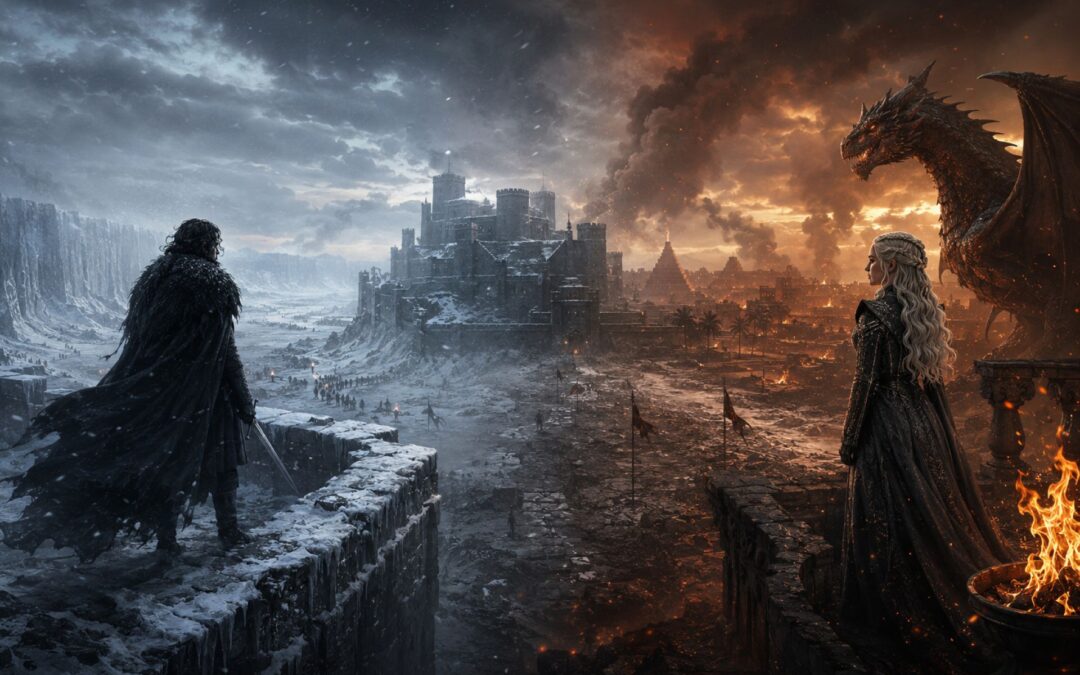
George R. R. Martin’s A Dance with Dragons is the fifth novel in A Song of Ice and Fire, but it is not simply the story that begins where A Feast for Crows ends. Its opening sections return to characters who disappeared after A Storm of Swords—Jon Snow, Daenerys Targaryen, Tyrion Lannister, Bran Stark, Davos Seaworth, and Theon Greyjoy—while events elsewhere are occurring alongside much of Feast. Only later does the chronology move beyond the fourth book and begin absorbing Jaime, Cersei, Arya, Asha, Victarion, Areo Hotah, and other characters whose stories had continued there.
That unusual architecture supports the novel’s central preoccupation. Earlier volumes repeatedly asked who could obtain power; A Dance with Dragons asks what happens after someone acquires enough power to become responsible for other people. Jon becomes Lord Commander of a dangerously depleted Night’s Watch. Daenerys rules the conquered slave city of Meereen. Stannis attempts to convert a legal claim into actual northern loyalty. The Boltons possess Winterfell without possessing the North’s affection. A supposed surviving Targaryen prince is educated specifically to rule, while several other men travel toward Daenerys hoping to use, marry, rescue, command, or possess her.
The result is one of Martin’s most politically ambitious novels. Jon and Daenerys discover that a ruler cannot make one humane decision and expect gratitude to follow. Every compromise protects one group while enraging another, every alliance creates new obligations, and every attempt to reform an institution threatens people whose status depends on the old system. Around them, Martin develops equally important stories about identity: Theon Greyjoy has been tortured into believing he is Reek, Arya Stark is being trained to become “no one,” Bran learns to inhabit other bodies and other times, a girl named Jeyne Poole must become Arya Stark for political purposes, and a young man raised as Young Griff is presented to the world as Aegon Targaryen.
Spoiler warning: This article covers the entire novel, including Quentyn Martell’s fate, Daenerys’s disappearance from Meereen, Jon Snow’s final chapter, the Pink Letter, and the Epilogue.

How A Dance with Dragons Fits Beside A Feast for Crows
The structure of A Dance with Dragons is the product of an unusual publishing decision. Martin’s manuscript had become too large for a single practical volume, but the problem was not merely length: the many geographically separated storylines had advanced at different speeds. As Martin explained when discussing the split, he ultimately divided the material by characters and geography rather than simply cutting the narrative at a chronological midpoint.
That is why A Feast for Crows concentrated heavily on King’s Landing, the Riverlands, Dorne, the Iron Islands, Braavos, and characters such as Cersei, Jaime, Brienne, Arya, Asha, Victarion, and Areo Hotah. Meanwhile, A Dance with Dragons initially follows the characters whose stories had been held back: Jon at the Wall, Daenerys in Meereen, Tyrion in exile, Bran beyond the Wall, Davos in the North, and Theon in Ramsay Bolton’s captivity. Events in these two novels are therefore taking place partly at the same time.
Martin places a short note, “A Cavil on Chronology,” before the novel precisely because this matters to the reader’s understanding. The opening of Dance is not occurring after everything in Feast. It is filling in the other side of the same period. Only once enough of those previously missing plotlines have caught up does Dance begin to move chronologically beyond Feast, at which point narrators such as Areo Hotah, Jaime, Arya, Asha, Victarion, and Cersei begin appearing.
This design produces both an advantage and a problem. The advantage is depth. Instead of alternating constantly among every region in the world, Dance can spend long stretches immersed in Jon’s institutional problems at the Wall, Daenerys’s political crisis in Meereen, Theon’s terror at Winterfell, and Tyrion’s wandering journey through Essos. Each environment accumulates its own social pressures, recurring characters, vocabulary, factions, and moral logic.
The problem appears when the timelines reunite. The final third of A Dance with Dragons becomes crowded because Martin is no longer merely continuing the withheld characters; he is also reinserting plotlines from Feast and introducing new POV perspectives. The novel begins to feel less like one expanding story and more like several enormous stories approaching collision. Aegon lands in Westeros. Victarion reaches Slaver’s Bay. Tyrion approaches Meereen. Barristan assumes political control there. Stannis marches through the North. Jaime disappears with Brienne. Cersei returns to the Red Keep. Jon’s command collapses. Yet several of the obvious battles or confrontations created by these developments do not actually occur before the novel ends.
That structural tension is fundamental to evaluating A Dance with Dragons. The book’s richness comes partly from refusing to reduce political processes to quick resolutions, but the same refusal leaves it unusually dependent on future volumes for dramatic completion.
A Dance with Dragons: Complete Plot Summary
The novel constantly cuts between distant regions, so its plot cannot be reduced to a single journey. What unifies the first half is the return of the characters omitted from A Feast for Crows; what increasingly unifies the second is convergence. Jon and Daenerys struggle to govern, Tyrion and several competing claimants move toward Daenerys, the North reorganizes around hidden loyalties, and the chronological divide between the fourth and fifth books gradually disappears.
Prologue–Chapter 16: Rule, Exile, and the Return of the Missing POVs
The Prologue begins beyond the Wall with Varamyr Sixskins, the powerful wildling skinchanger last seen among Mance Rayder’s people. Badly wounded and dying after the wildlings’ defeat, Varamyr remembers how he acquired and abused his ability to enter animals. His reflections establish important rules: a skinchanger can live through an animal, certain forms of possession are considered abominations, and entering another human being is among the gravest violations. When Varamyr tries to seize the body of the woman Thistle to escape death, she violently resists. His human body dies, his consciousness enters his wolf One Eye, and he later sees the dead Thistle moving again as a blue-eyed wight. The chapter establishes both supernatural possibilities that will matter to Bran and the terrifying fact that death beyond the Wall increasingly feeds the enemy.
Tyrion Lannister’s story resumes in Pentos. After murdering Shae and his father Tywin and escaping Westeros with Varys’s assistance, Tyrion has collapsed into drunkenness, bitterness, and obsessive thoughts about Tysha, the first wife whose history Jaime finally revealed to him. Illyrio Mopatis shelters him, but Tyrion is not simply being hidden. Illyrio has plans involving Daenerys Targaryen, and Tyrion is eventually set on a journey east, though he initially cares little whether he reaches any destination alive.
Daenerys, meanwhile, is learning the difference between conquering Meereen and ruling it. Her victory over the city’s slaveholding elite did not create a stable society. The Sons of the Harpy murder freedmen and supporters of her regime, the old Great Masters resent the new political order, and petitioners constantly force Daenerys to confront consequences she could ignore while she was an advancing liberator. One case is especially devastating: a man presents the charred bones of a small child, Hazzea, apparently killed by Drogon. Daenerys has called her dragons her children, but she is now confronted with what it means when her children prey on the people she claims to protect.
She cannot find Drogon, but she has Rhaegal and Viserion chained beneath the Great Pyramid. The decision is politically understandable and emotionally painful. Dragons gave Daenerys power, identity, and a sense of destiny, yet ruling requires her to restrain that power because ordinary people cannot live safely beside uncontrolled dragons. The conflict between queen and dragon will increasingly become a conflict inside Daenerys herself.
At the Wall, Jon Snow is now Lord Commander of the Night’s Watch. His election solved the problem of leadership but created a more difficult one: what is the Watch supposed to do when the wildlings it has spent centuries fighting are also human beings endangered by the Others? Stannis Baratheon remains at the Wall after defeating Mance’s host. He wants northern support, castles, manpower, and recognition of his kingship; Jon needs Stannis’s military strength but cannot openly turn the Night’s Watch into an army for one claimant to the Iron Throne.
Jon therefore spends much of the novel trying to maintain distinctions that reality constantly erodes. He advises Stannis because disastrous royal decisions could destroy the Wall. He negotiates with wildlings because leaving them north of the Wall creates more potential wights. He must find food for people the Watch never expected to feed, refill abandoned castles, manage officers who distrust him, and respond to the Others without possessing anything close to the resources the threat deserves.
Bran Stark is still traveling beyond the Wall with Meera Reed, Jojen Reed, Hodor, Summer, and the mysterious Coldhands. Bran increasingly inhabits Summer, and he also enters Hodor’s body despite understanding that Hodor is afraid of what is happening. The group is exhausted and starving, and the supernatural landscape around them has become deadly. Their destination is the three-eyed crow Bran has seen in dreams.
Quentyn Martell appears in Volantis under the alias of the Merchant’s Man. Doran Martell has secretly sent his son to Daenerys with the hope of creating a Targaryen-Martell marriage alliance, but the journey has already destroyed the shape of the mission. Companions have died, ordinary travel routes are failing, and Quentyn must improvise. His chapters gradually dismantle the romantic idea that a prince sent on a secret mission automatically becomes the hero of a quest.
Jon makes one of his first defining command decisions when he sends Samwell Tarly, Maester Aemon, Gilly, and an infant south. The infant with Gilly is not actually her own son. Jon secretly switches Gilly’s child with Mance Rayder’s baby because Melisandre’s interest in king’s blood makes Mance’s son vulnerable to sacrifice. Gilly is horrified, but Jon forces the arrangement because he believes it is necessary. The decision illustrates the moral pattern of his command: Jon often acts to protect people, but the scale of responsibility is turning him into someone willing to impose terrible choices on individuals.
Soon afterward, Janos Slynt openly refuses Jon’s order to take command of Greyguard. Jon gives him several chances to obey. When Slynt continues defying him, Jon sentences him to death and personally cuts off his head. The scene marks Jon’s transition from the boy who once watched Ned Stark dispense justice into a commander who must do it himself. Stannis, who has little respect for weakness disguised as authority, responds approvingly.
Tyrion joins a peculiar group aboard the riverboat Shy Maid. Its members include the older “Griff,” a boy called Young Griff, Haldon Halfmaester, Septa Lemore, and the knight Duck. Tyrion immediately realizes that the company is not what it appears to be. Young Griff has been educated in languages, history, religion, arms, and government in a manner that makes little sense for an ordinary exile.
Davos Seaworth, absent throughout A Feast for Crows, returns through a dangerous northern mission. Stannis has sent him to White Harbor to win Lord Wyman Manderly. Davos first reaches the Sisters after Salladhor Saan abandons Stannis’s increasingly impoverished cause. Lord Godric Borrell receives him and recalls how Eddard Stark once passed through the islands during Robert’s Rebellion. The memory matters because the North remains full of people whose loyalties cannot be inferred from their present behavior.
At the Wall, Stannis publicly burns the man everyone believes is Mance Rayder. The wildling king seems to die under Melisandre’s religious spectacle while another captive, apparently Rattleshirt, survives. The execution reinforces Melisandre’s power around Stannis’s court and apparently removes Mance from the political board. Much later, the reader discovers that the scene was a magical deception.
Daenerys continues confronting the Sons of the Harpy, her increasingly dangerous dragons, and emissaries from elsewhere in Essos. Quaithe appears to her in another mysterious warning, naming figures approaching from different directions and urging Daenerys to remember who she is. The warning is cryptic rather than explanatory, and one of the novel’s recurring lessons is that prophecy creates new problems when people become certain they know what symbols mean.
Theon Greyjoy’s first chapter is titled “Reek.” The name is not a disguise he has freely chosen. Ramsay Bolton has tortured Theon so thoroughly that Theon now polices his own thoughts, reminding himself that he is Reek and fearing punishment whenever his former identity surfaces. Fingers and toes have been removed, his teeth have been damaged, his body has been brutalized, and his sense of self has been deliberately dismantled.
Ramsay’s greatest victory over Theon is psychological. Theon does not merely obey because Ramsay is present; he has learned to imagine Ramsay’s punishment even when he is alone. His chapters are full of fractured memories of Winterfell, the Starks, his betrayal, and the boys he murdered in place of Bran and Rickon. Recovering from this condition will not mean becoming the arrogant Theon of A Clash of Kings again. Martin instead constructs an identity from guilt, memory, and the smallest restored capacity to choose.
Bran finally reaches the cave of the three-eyed crow after a wight attack nearly kills his party. Children of the forest rescue them, and Bran meets the ancient greenseer he has been seeking. The man is Brynden, embedded among weirwood roots in a place where the distinction between human life, tree, memory, and supernatural network has become blurred. Bran learns immediately that his legs will not be healed. What the greenseer offers is not restoration of his old body but access to a different kind of existence.
On the Rhoyne, Tyrion continues studying Young Griff. The ruined cities along the river remind the travelers of the ancient conflict between Valyria and the Rhoynar, making Tyrion’s journey through Essos also a journey through the ruins left by earlier empires. He plays cyvasse with Young Griff and tests his temperament, gradually confirming that the boy has been raised for far more than obscurity.
Davos finally reaches White Harbor, one of the North’s richest remaining cities. Superficially, Wyman Manderly appears to have accommodated the new political order. Freys are present, the Boltons control Winterfell, and the Lannister regime has taken Manderly hostages. Davos nevertheless intends to argue openly for Stannis.
In Meereen, Xaro Xhoan Daxos arrives from Qarth with ships and an offer. Daenerys can take the vessels and leave Slaver’s Bay. The proposal would remove her from a worsening political disaster and bring her closer to the Westerosi conquest she once imagined as her central purpose. She refuses because abandoning Meereen would mean accepting that the old slave order can simply return after she leaves. The refusal defines her problem for much of the book: she stays because she feels morally responsible for what follows liberation, even when staying postpones the destiny she once thought was hers.
Chapters 17–32: Hidden Heirs, False Identities, and Political Bargains
Jon’s involvement in northern politics grows even as he continues insisting on the Night’s Watch’s independence. Stannis initially considers strategies that would waste his limited strength against powerful enemies. Jon advises him to seek support from northern clans and to attack the ironborn at Deepwood Motte rather than throwing himself directly against the Boltons. The advice is politically consequential, but Jon sees it as necessary because Stannis’s survival affects the Wall’s survival.
Tyrion’s river journey becomes more dangerous in the Sorrows, the ruined territory associated with the Stone Men. The Shy Maid is attacked, and Tyrion ends up in the water before being rescued. He appears to escape greyscale, but Jon Connington—still traveling as Griff—has secretly been infected. Connington hides the disease because revealing it could end the mission to which he has devoted his remaining life.
Davos appears to fail catastrophically in White Harbor. Before a court where Frey and Lannister interests are watching, he argues Stannis’s case. Wyman Manderly denounces him and orders him executed. Reports of Davos’s death subsequently spread, making it appear that Stannis has lost his most trusted political envoy.
Theon, meanwhile, is sent to Moat Cailin. Ironborn hold the ruined fortress, and the Boltons want them removed. Because Theon is Balon Greyjoy’s son and former Prince of Winterfell, he can persuade the garrison to surrender under promises of mercy. They are starving, diseased, and desperate enough to believe him. Ramsay then has the surrendered men killed. The episode compounds Theon’s guilt: even in captivity he is used as an instrument through which other people are betrayed.
At the Wall, Jon’s wildling policy becomes steadily more important. He does not suddenly stop understanding why the Night’s Watch hates the free folk. Wildlings have raided, killed, and enslaved people south of the Wall for generations. What has changed is the strategic environment. Jon knows that corpses can rise, so every person left to die beyond the Wall may become an additional soldier for the Others. Tradition that refuses to account for this fact is no longer merely conservative; it may be suicidal.
Tyrion finally pushes the mystery of Young Griff into the open. The boy is presented as Aegon Targaryen, son of Rhaegar Targaryen and Elia Martell, supposedly saved from the Sack of King’s Landing when Varys exchanged him with another infant. Jon Connington, once Rhaegar’s close friend and one of Aerys II’s Hands, has been raising and protecting him in exile.
The revelation does not settle Aegon’s identity as objective fact. It establishes what Aegon’s supporters believe or want the world to believe. Martin leaves enough uncertainty around the rescue story, Illyrio’s motives, and the larger history for Aegon’s legitimacy to remain one of the novel’s unresolved questions.
Tyrion has already seen enough to identify a weakness in the plan. Aegon has been raised to join Daenerys, but if he simply arrives as another young man asking to share her dragons and claim, she has little reason to need him. Tyrion encourages Aegon to reverse the relationship: invade Westeros first, establish himself as a king in his own right, and make Daenerys come to him. During a cyvasse game he simultaneously exposes the young prince’s impatience and plants the strategic idea that will transform the plot.
Before Tyrion can travel with Aegon farther, Jorah Mormont captures him. Jorah remains obsessed with returning to Daenerys and regaining her favor after being exiled for spying on her. He intends to deliver Tyrion as a valuable captive or gift. Tyrion, although physically helpless, quickly recognizes Jorah’s shame and desperation and begins regaining the habit of manipulating the people around him.
Daenerys is also moving toward a drastic political compromise. The Green Grace, an influential religious figure in Meereen, repeatedly argues that Daenerys must reconcile with the city’s old elite. Hizdahr zo Loraq offers a measurable bargain: if Daenerys agrees to marry him after ninety days without a Harpy killing, he will prove that peace can be achieved. Daenerys accepts the condition.
The bargain exposes one of the novel’s central questions about political violence. If Hizdahr can stop the killings, that may imply influence over the people behind them, but influence is not identical to proven guilt. Daenerys also cannot simply destroy every old Meereenese family. She needs a political order in which former masters and former slaves can coexist without nightly assassinations. Marriage becomes a tool of counterinsurgency.
Jon Connington’s first POV chapter removes some of the disguise surrounding Aegon’s group. Connington has spent years living with the humiliation of exile and his failure during Robert’s Rebellion. He believes he failed Rhaegar, and his restoration of Rhaegar’s son has become the purpose that organizes his life.
The Golden Company’s original plan had been to join Daenerys in Essos, but Aegon embraces Tyrion’s alternative. Instead of waiting for Daenerys, he will take the Golden Company to Westeros. The decision turns Aegon from a secret inheritance into an active claimant and ensures that Westeros may face another invasion before Daenerys ever arrives.
Quentyn Martell’s journey has become similarly improvisational but far less triumphant. He and his remaining companions join the sellsword company called the Windblown under false names. Slaver’s Bay is full of shifting loyalties, and reaching Daenerys requires Quentyn to place himself inside the very military system fighting against her. Each step seems temporary, but every compromise makes returning home without accomplishing his mission more psychologically difficult.
Asha Greyjoy’s story rejoins the novel at Deepwood Motte. She lost the kingsmoot to Euron and remains politically vulnerable. Stannis, acting on the kind of northern strategy Jon encouraged, surprises the ironborn position with the aid of northern allies. Asha attempts to escape but is captured, placing her inside Stannis’s campaign.
Tyrion and Jorah eventually travel through Volantis and board the Selaesori Qhoran. Their companions include Penny, one of the dwarfs associated with the grotesque entertainments staged for the powerful, and Moqorro, a red priest. Penny has personal reason to resent Tyrion because the notoriety surrounding him has helped make dwarfs across the world targets. Tyrion initially treats her with impatience and cruelty, but she will become an important test of whether his suffering has destroyed his ability to care about anyone less powerful than himself.
Jon continues facing the emotional danger posed by news from Winterfell. The Boltons intend Ramsay to marry “Arya Stark,” but the girl is actually Jeyne Poole. Jon does not know that. To him, the report means his younger sister is being delivered to Ramsay. The situation pulls at the identity Jon has spent years trying to build: is he primarily a sworn brother of the Night’s Watch, or is he still Ned Stark’s son and Arya’s brother?
Davos’s supposed execution is eventually exposed as political theater. Wyman Manderly had been performing loyalty in front of enemies because his son remained a hostage. Once the immediate danger changes, Manderly reveals his real position. The North has not forgotten the Starks, and his submission to the Boltons and Freys is far less complete than it appears.
The most important revelation comes through Wex, Theon Greyjoy’s former squire. Bran and Rickon Stark survived the fall of Winterfell. Wex followed far enough to learn that the brothers separated and that Rickon was headed toward Skagos with Osha. Manderly offers Stannis his allegiance on a condition: Davos must retrieve Rickon, giving the North a living Stark around whom resistance can legitimately organize. Davos leaves on a mission whose outcome the novel does not reveal.
Meereen’s political crisis, meanwhile, becomes a public-health catastrophe. Refugees from the destroyed Astapor gather near the city, and the bloody flux spreads among them. The disease becomes known as the pale mare. Daenerys is not merely managing rival elites anymore; she is governing amid war, hunger, displacement, and epidemic disease.
Hizdahr’s promised peace appears to work. The Harpy killings stop for the agreed period, and Daenerys moves toward marriage despite her private longing for Daario Naharis. The compromise has an obvious logic. Peace may save thousands of lives. Yet Daenerys cannot know exactly why the murders stopped or whether she is creating stability, legitimizing enemies, or entering a trap.
Melisandre’s POV radically changes the reader’s understanding of her. From outside, she often appears intimidatingly certain. Inside her own chapter, it becomes clear that she genuinely receives supernatural visions but struggles to interpret them. She sees images, searches for meaning, and sometimes fits events into expectations that later prove wrong.
Her most dramatic revelation concerns Mance Rayder. The man burned by Stannis was not Mance at all but Rattleshirt disguised by a glamor. Mance is alive, and Melisandre has sent him south with several spearwives to help rescue the girl believed to be Arya Stark. Jon’s apparent tolerance of Rattleshirt therefore rests on another identity deception, while the earlier public execution is retroactively transformed into a magical performance.
Theon returns to the Bolton orbit as preparations shift toward Winterfell. Roose Bolton understands that the North is not secure merely because he holds a title. Ramsay is useful as an instrument of terror but dangerously uncontrolled. Northern houses outwardly submit while memories of the Starks, resentment of the Freys, and hatred of the Boltons remain active beneath the surface.
Chapters 33–52: Winterfell Closes, Meereen Compromises, and the Timelines Rejoin
Tyrion’s journey on the Selaesori Qhoran allows his relationship with Penny to deepen. Penny is less sophisticated, less cynical, and far more emotionally vulnerable than Tyrion. He can easily dominate conversations with her, which makes his treatment of her a measure of character rather than intelligence. Although he remains capable of cruelty, he begins protecting and instructing her as their circumstances worsen.
Moqorro adds another stream of prophecy to the novel. Unlike Melisandre, he is associated with a different part of the red faith and soon becomes connected to Victarion’s future. His visions involve dragons, krakens, and approaching conflict, but Martin again keeps symbolism open enough that neither characters nor readers can safely treat prophecy as a straightforward schedule of future events.
Bran’s arrival in the greenseer’s cave ends his physical quest but begins a much stranger transformation. Brynden teaches him to use weirwoods as more than sacred trees. Through them Bran begins perceiving scenes from Winterfell’s past, including people who lived long before him. History in this world is no longer merely recorded in books or songs; the old gods appear connected to a living network of memory.
The power is extraordinary, but Martin refuses to present Bran’s growth as uncomplicated spiritual elevation. Bran continues entering Hodor’s body, and Hodor’s fear makes clear that the act is a violation even if Bran finds it useful. The ethical warning established through Varamyr’s Prologue now applies to a sympathetic child. Bran is becoming powerful at exactly the age when he is least prepared to understand all the boundaries his power can cross.
At the Wall, Jon’s position looks strategically stronger than his internal politics suggest. Stannis’s success at Deepwood confirms that Jon’s advice was valuable. Jon continues filling castles and reorganizing the Watch’s relationship with the free folk. Yet officers such as Bowen Marsh increasingly see these choices as evidence that Jon has abandoned the identity and traditions of the institution he commands.
Daenerys’s world deteriorates despite the temporary peace. The plague outside Meereen worsens, enemy forces continue gathering, and Daario returns. Daenerys has committed herself politically to Hizdahr, but she resumes sleeping with Daario. Her private desires and public role have become almost perfectly opposed. Hizdahr may represent peace and political accommodation, but Daario represents appetite, danger, and the part of herself that resists becoming a domesticated monarch.
The Northern plot becomes far darker when the Boltons bring the false Arya to Winterfell. Jeyne Poole has been transformed by Littlefinger’s earlier manipulations into a political substitute for Arya Stark. Because the North values Stark legitimacy, Ramsay’s marriage to “Arya” helps the Boltons claim continuity with the dynasty they helped destroy.
Theon is required to participate because he knew Arya and can publicly attest to the girl’s identity. His presence lends credibility to the fraud. Ramsay then subjects Jeyne to horrific abuse and forces Theon into the situation, making him complicit again in someone else’s suffering. Yet Jeyne’s misery also begins drawing Theon outward from his own terror. Helping her will eventually become the choice through which he recovers part of himself.
Mance Rayder and the spearwives arrive at Winterfell disguised as Abel the bard and his women. The disguise places another hidden identity inside a castle whose entire political order depends on false identity. Jeyne is Arya, Reek was Theon, Abel is Mance, the Boltons are nominally loyal subjects turned rulers, and several northern houses are publicly compliant while privately hostile.
The chronology now begins catching up with A Feast for Crows. Areo Hotah returns in Dorne, where Balon Swann has arrived with what is said to be Gregor Clegane’s skull. Doran Martell continues navigating the consequences of Myrcella’s injury, the Sand Snakes, Darkstar, and the failed plots surrounding his family. The appearance of a Feast narrator is a structural signal that the two books’ separated timelines are rejoining.
At the Wall, arguments over Hardhome intensify. Large numbers of wildlings remain stranded there in appalling conditions. From the perspective of conservative Watch officers, sacrificing more ships, food, and men for wildlings is madness. From Jon’s perspective, abandoning thousands of people is both morally indefensible and militarily irrational because the Others can turn the dead into soldiers.
Tyrion’s voyage collapses when a violent storm cripples the Selaesori Qhoran. The travelers are eventually captured and sold into slavery. Tyrion, who grew up among the most privileged people in Westeros and has spent much of his journey watching systems of bondage from outside, now experiences enslavement directly.
Asha experiences a different form of captivity inside Stannis’s freezing northern campaign. Stannis’s army begins a brutal march toward Winterfell, but the weather becomes an enemy more effective than any Bolton army. Snow destroys speed, transport, supplies, morale, and physical survival. Men and horses die while the army becomes trapped near a crofter’s village.
Martin makes winter material rather than decorative. It is not simply a symbol that ominously arrives at the proper literary moment. Food stops moving. Roads disappear. Distances change. Armies that seem formidable on a map become collections of hungry bodies unable to advance. The political struggle for the North is increasingly governed by the North itself.
Quentyn finally reaches Daenerys and presents his credentials. He brings Doran Martell’s proposal and evidence of the old secret marriage agreement involving Viserys. Politically, an alliance with Dorne could connect Daenerys directly to Westeros. The timing, however, is disastrous. Daenerys has promised to marry Hizdahr because she believes the peace of Meereen depends on it.
She rejects Quentyn’s marriage proposal and proceeds with Hizdahr. The decision is important because it reverses what an outsider might expect from a would-be conqueror of Westeros. Daenerys gives up an attractive Westerosi alliance because she accepts an obligation to the people immediately under her rule. Whether the resulting Meereenese peace is sustainable is another matter.
Jon receives Queen Selyse, Shireen, and Tycho Nestoris of the Iron Bank. The Night’s Watch is facing an economic crisis, and Jon negotiates a loan to buy food. The episode demonstrates a less glamorous side of leadership: Jon’s survival problem is not only swords and Others but credit, grain, transport, staffing, and winter reserves.
Melisandre’s prophecy about a girl in grey fleeing toward the Wall also appears to come true, but the girl is not Arya. She is Alys Karstark, who has fled relatives trying to force her into a marriage designed to steal her inheritance. The mistake demonstrates why Melisandre’s visions are dangerous. The image may be genuine while the interpretation attached to it is wrong.
Arya’s story resumes in Braavos while she is blind. Her blindness is part of her Faceless Men training rather than permanent punishment. She learns to gather information through hearing, smell, physical awareness, and deception. At the same time, she continues dreaming through Nymeria and discovers she can perceive through a cat.
This is a crucial contradiction in her training. The Faceless Men want her to become no one, yet her Stark identity keeps expressing itself through supernatural abilities rooted in her family. Arya becomes technically better at abandoning identity while simultaneously demonstrating that some part of identity cannot simply be instructed out of her.
Inside Winterfell, unidentified killings increase distrust among the supposedly allied houses. Men disappear or are found dead, accusations circulate, and the Freys and Manderlys become increasingly hostile. The Boltons control the castle, but control is not the same as legitimacy. Winterfell becomes a pressure chamber in which old grievances, secret loyalties, hunger, snow, and fear slowly fracture the occupying coalition.
Tyrion, Jorah, and Penny are sold into slavery near Meereen. Tyrion’s dwarfism makes him useful as an entertainer, and he and Penny are forced into grotesque performances. They come within reach of the fighting pits, where the entertainment of the powerful threatens to turn them into disposable spectacle.
Jaime Lannister then re-enters the novel. His Riverlands arc has continued beyond the events covered in Feast, and he resolves the siege of Raventree Hall with negotiation rather than slaughter, further developing the new conception of knighthood he has been struggling to build. Then Brienne appears unexpectedly and tells him she has found Sansa Stark. To save Sansa, she says, Jaime must come alone.
The reader knows Brienne’s situation is far more complicated than Jaime does. Her own last appearance in Feast involved Lady Stoneheart, who demanded Jaime’s death. Dance does not reveal what happens after Jaime agrees to follow Brienne, leaving their shared plot suspended.
Jon solves Alys Karstark’s problem through an innovative marriage. He weds her to Sigorn, Magnar of Thenn, creating a new house that joins northern legitimacy with free-folk leadership. The arrangement protects Alys’s claim, blocks her grasping relatives, and gives an important wildling group a recognized place south of the Wall. It is one of Jon’s most successful political inventions.
Yet its success also illustrates why his officers fear his direction. Jon is not merely defending the Wall. He is reshaping the political order around it, integrating enemies, advising kings, arranging marriages, taking loans, and interfering with northern succession disputes. Each action can be defended individually, but together they make his claim to strict institutional neutrality increasingly difficult to sustain.
Daenerys’s peace requires compromises she hates. Yunkai and its allies remain powerful outside Meereen, slavery continues beyond the city’s walls, and the fighting pits reopen as part of the settlement. Daenerys is learning that peace does not automatically mean justice. Sometimes it means allowing parts of an unjust order to survive because the alternative is immediate war.
Theon’s transformation reaches its decisive stage in Winterfell. The titles of his chapters have shifted through labels such as Reek, the Prince of Winterfell, the Turncloak, and a Ghost in Winterfell. These names reflect identities imposed on him by Ramsay, history, accusation, and memory. When the chapter title finally becomes “Theon,” the psychological change has been prepared through many smaller acts.
Little Walder Frey’s murder accelerates conflict among the castle’s factions. With Mance’s spearwives, Theon helps Jeyne escape. They climb the walls, face the possibility of recapture, and leap into the snow. The action is reckless and potentially suicidal, but that is precisely what makes it meaningful. Reek exists to survive Ramsay’s next punishment. Theon is capable of risking his life to save someone else.
In Meereen, the reopened fighting pits become the setting for Daenerys’s own rupture. Tyrion and Penny are present among the entertainers, close enough to Daenerys for their storylines almost to meet but not yet close enough for a meaningful encounter. Strong Belwas eats poisoned locusts from the royal provisions and becomes gravely ill. The book never conclusively proves who arranged the poison or exactly who was intended to eat it.
Then Drogon arrives at Daznak’s Pit. The dragon transforms controlled entertainment into panic, death, and uncontrollable power. Daenerys approaches him, confronts him, climbs onto his back, and flies away from the city.
The moment is spectacular, but its significance is not merely that Daenerys finally rides a dragon. Meereen has been the place where she tried to chain both her dragons and the more violent parts of her identity in order to govern responsibly. Drogon tears her physically out of that political system. Whether this represents liberation, regression, or both becomes one of the novel’s central closing questions.
Chapters 53–71: Coups, Escapes, Dragonfire, and Broken Commands
Jon’s integration of the free folk reaches a new stage when Tormund Giantsbane brings thousands of wildlings through the Wall. Terms must be negotiated involving weapons, valuables, hostages, housing, and service, but Jon does not demand that the free folk cease being themselves. His policy assumes that the real war is no longer between Watch and wildling but between the living and the dead.
King’s Landing now re-enters the novel through Cersei. Imprisoned by the Faith, she strategically confesses some sexual offenses while refusing claims that would destroy her position more completely or threaten Tommen’s legitimacy. Her immediate objective is survival. Her experience in confinement has not turned her into a fundamentally different political thinker; it has made her temporarily more cautious.
Barristan Selmy becomes a POV character because Daenerys’s disappearance creates a vacuum. Hizdahr remains king, but Barristan distrusts what is happening around him. Skahaz mo Kandaq, leader of the Brazen Beasts, argues that Hizdahr is tied to the Sons of the Harpy and perhaps to the poisoning at the pits. Barristan must decide whether suspicion is enough to justify overthrowing his queen’s husband.
This is an uncomfortable problem precisely because Barristan’s moral identity has always rested on service, honor, and personal courage. Those virtues are clearer on a battlefield than in a government where nobody possesses complete information. He must now choose whether doing nothing is loyalty or cowardice and whether acting on uncertain evidence is prudence or treason.
Victarion Greyjoy approaches Meereen with the Iron Fleet. Euron sent him to bring Daenerys back, but Victarion intends to take her for himself. His mission is therefore already an act of betrayal hidden inside obedience.
Moqorro has entered Victarion’s story after being found at sea. Victarion’s wounded hand had become dangerously infected, but Moqorro treats it through fire magic, leaving the arm altered and strengthening his influence over the ironborn captain. Victarion, once defined almost entirely by the Drowned God and ironborn custom, now carries a red priest while approaching a queen whose dragons are associated with fire.
Tyrion’s status changes again when his slave master Yezzan becomes desperately ill with the bloody flux. Social order around the slave camp begins breaking down. Tyrion, Penny, and Jorah escape their situation and make contact with the Second Sons, the sellsword company now fighting against Daenerys under Brown Ben Plumm.
Tyrion cannot command through family power anymore, so he turns his name into a promise. He offers gold, Casterly Rock, political possibility, and written obligations whose practical enforceability is questionable. What matters is that he is thinking strategically again. The man who began the novel wondering whether life was worth continuing is once more calculating how to make other people’s interests intersect with his own.
At the Wall, the news from Hardhome becomes catastrophic. Cotter Pyke reports starvation, death, chaos, and desperate conditions among the wildlings gathered there. Jon decides that rescue cannot be postponed. His officers see an unacceptable expenditure of scarce resources; Jon sees thousands of living people who will otherwise die within reach of the Others.
Quentyn, meanwhile, cannot accept returning to Dorne after Daenerys’s rejection. Objectively, surviving the journey and bringing Doran reliable information would be a legitimate result. Psychologically, Quentyn experiences return without the marriage as failure. He has lost friends and endured extraordinary danger because he was told that the mission mattered. The more he has sacrificed, the harder it becomes to stop.
He therefore makes a bargain with the Tattered Prince and prepares to gain access to Daenerys’s dragons. If he cannot marry the queen, perhaps he can prove himself by mastering one of the creatures associated with her bloodline. The plan turns the logic of heroic romance into a trap: Quentyn believes perseverance must eventually be rewarded because otherwise all his earlier suffering was meaningless.
Jon Connington reaches Westeros with Aegon and the Golden Company. At Griffin’s Roost he revisits the history that defines him. During Robert’s Rebellion, Connington once had an opportunity to find Robert Baratheon during the Battle of the Bells but refused to destroy the town in order to guarantee the kill. He now believes that mercy or insufficient ruthlessness cost Rhaegar the war.
That conclusion matters because Connington is dying of greyscale. He has limited time to establish Aegon. Rather than making mortality gentler, the disease makes him determined not to repeat what he regards as the moral weakness of his younger self. Aegon’s campaign is therefore guided by a man who has learned the dangerous lesson that restraint is what ruined him.
Stannis’s army remains trapped in the North, but several storylines finally converge there. Tycho Nestoris reaches the king’s position, and refugees from Winterfell arrive. Among them are Theon and Jeyne. Asha initially sees only a physically ruined man, then realizes that the stranger is her brother.
The reunion gives Theon’s reclaimed identity an external witness. He can say that his name is Theon, but Asha’s recognition proves that he exists in someone else’s memory as well. His recovery is incomplete and his future is dangerous—Stannis has every reason to judge him for betraying the Starks—but he is no longer merely Ramsay’s creation.
Victarion reaches the waters around Slaver’s Bay as the Meereenese crisis approaches open battle. Moqorro explains more about the magical horn Dragonbinder, including the deadly conditions attached to its use. Victarion believes he can turn the horn, the fleet, and Daenerys’s dragons into instruments of personal power. He does not fully understand the magical forces he is trying to command.
Arya receives a sanctioned killing from the Faceless Men. Under a new face, she studies her target, learns his routines, and kills him through planning rather than rage. The assassination demonstrates real progress in the order’s craft. Yet the persistence of wolf dreams and Arya’s inner attachments continues to raise the question of whether she is becoming no one or simply becoming an exceptionally skilled Arya Stark who can wear other selves.
Cersei then undergoes her walk of atonement. Stripped and exposed to the people of King’s Landing, she experiences the destruction of one of the central fictions supporting royal authority: distance. A queen who once controlled access to her body and image is forced to become physically vulnerable before a hostile crowd.
The humiliation does not eliminate her access to violence. At the Red Keep, Qyburn presents the enormous silent knight Ser Robert Strong as her champion. The text heavily invites suspicion about his relationship to Gregor Clegane, but it does not formally settle the matter. Cersei emerges from religious punishment weakened yet equipped with a terrifying new instrument.
Tyrion consolidates his position with the Second Sons. He observes the changing balance around Meereen and works toward shifting the company away from the Yunkish side. His arc has not brought him to Daenerys yet, but he is no longer simply being carried across the world by other people’s plans.
Barristan finally acts against Hizdahr. Persuaded that waiting may lead to the destruction of Daenerys’s loyalists, he enters the king’s chambers to arrest him. Khrazz, Hizdahr’s formidable pit fighter, attacks Barristan. The aging knight kills him, demonstrating that his legendary martial ability remains real even when the political certainty surrounding the fight does not.
Barristan promises that Hizdahr will not be harmed if the accusations prove false, but the coup cannot be undone. The king has been removed, Skahaz’s faction has gained power, and Daenerys’s compromise government has effectively collapsed. News then arrives that Rhaegal and Viserion have escaped their confinement, adding loose dragons to an already unstable military situation.
Quentyn’s attempt to become a dragonrider ends disastrously. He and his companions enter the dragon enclosure. At first, Quentyn believes he may be succeeding with Viserion. Then he becomes aware of Rhaegal behind him and realizes he is burning.
The scene destroys the assumption that noble blood, courage, and determination guarantee heroic fulfillment. Quentyn is brave enough to enter the chamber, but bravery does not make the dragons safe. He survives the initial burning only long enough to linger in terrible agony.
Jon’s final chapter brings nearly every contradiction of his command together. He is still planning the Hardhome rescue when a letter arrives at Castle Black, apparently from Ramsay Bolton. The Pink Letter claims that Stannis has been defeated and killed, that Mance has been captured, and that Ramsay possesses or demands various people associated with Jon and Stannis. It also threatens Jon directly.
The contents cannot simply be accepted as a factual report. Some claims conflict with the reader’s last confirmed knowledge, and the novel does not reveal who actually wrote the letter. What matters immediately is Jon’s reaction.
Jon decides he cannot answer the challenge within the formal limits of the Night’s Watch. He announces his intention to march south against Ramsay and asks for volunteers. Many wildlings enthusiastically support him. From Jon’s perspective, the decision emerges from Ramsay’s threat, Arya’s presumed danger, Mance’s situation, and the unraveling northern war. From the perspective of Watch traditionalists, their Lord Commander has finally announced his intention to lead an army into a private conflict involving his family.
Disorder follows. Wun Wun becomes involved in violence with Ser Patrek of King’s Mountain. In the chaos, Bowen Marsh approaches Jon. He and other Watch brothers stab the Lord Commander while saying they act “for the Watch.” Jon is stabbed repeatedly, falls into the snow, and loses sensation.
The novel does not explicitly confirm Jon Snow’s death. It ends his POV at the moment of apparent mortal injury. Varamyr’s Prologue has also established supernatural possibilities relevant to a skinchanger whose direwolf is nearby, but the novel itself does not state that Jon enters Ghost or survives by any other mechanism.
Quentyn dies after several days from his burns. Barristan is left holding political and military authority in Meereen as peace fully disintegrates. Yunkish forces prepare for battle, plague remains rampant, and diseased corpses are thrown toward the city. The dragons are loose, Daenerys is absent, and Barristan must lead an army instead of merely serving a queen.
Daenerys’s final chapter occurs far from the city. She is with Drogon in the Dothraki Sea, hungry, physically weakened, and increasingly stripped of the structures that defined Queen Daenerys of Meereen. She struggles to control Drogon and eventually begins walking rather than simply waiting for rescue.
Her thoughts become a debate about what Meereen has made of her. She remembers the compromises, the peace, the marriage, and the decision to restrain the dragons. The Targaryen words “fire and blood” return with increasing force. Rather than definitively proving that all her attempts at peace were mistakes, the chapter shows Daenerys reaching a psychological point where she experiences those compromises as estrangement from herself.
She becomes ill and bleeds. The exact physical explanation is not established with certainty. Eventually Drogon kills a horse, and Daenerys encounters mounted Dothraki. The approaching khalasar belongs to Khal Jhaqo, one of the men who abandoned Drogo’s people after his fall. The queen who left the Dothraki world years earlier has been found again, but now she stands beside a full-grown dragon.
Epilogue: Winter Arrives and Varys Resets the Game
The Epilogue moves back to King’s Landing through Kevan Lannister. After Cersei’s fall, Kevan has begun doing something rare in the recent history of the capital: governing competently. He works with the Tyrell alliance, attempts to stabilize Tommen’s rule, and reduces some of the chaos Cersei created.
A white raven arrives from the Citadel, formally announcing winter. The declaration has enormous symbolic force because “winter is coming” has shaped the series from the beginning, but the political leadership of Westeros remains overwhelmingly occupied with dynastic struggles. The season that the Starks spent generations warning about has finally begun while the realm is fractured by war.
Kevan is summoned to Grand Maester Pycelle’s chambers and finds Pycelle dead. Varys appears and shoots Kevan with a crossbow. He does not kill Kevan because Kevan is governing badly. He kills him because Kevan is governing well.
Varys wants the realm unstable for Aegon’s arrival. A functioning Lannister-Tyrell government might repair enough of the kingdom to make invasion harder. He describes Aegon as a prince deliberately educated to understand hardship, duty, responsibility, and the lives of ordinary people rather than merely entitlement. Whether Aegon is truly Rhaegar’s son remains uncertain, but Varys’s political project is not uncertain: he is actively clearing the board for the boy’s restoration.
Children under Varys’s control finish Kevan with knives. The volume therefore ends with a grim reversal. Just as one center of political order begins repairing itself, Varys destroys that stability in service of another claimant. Winter arrives not to a realm finally ready for the greater threat but to a realm whose most intelligent political actors are still deliberately weakening one another.
The World After the War: The Wall, the North, Meereen, and a Fracturing Realm
The world-building of A Dance with Dragons is unusually inseparable from its politics. Martin does not merely move characters through different fantasy locations; he asks what institutions can survive famine, migration, civil war, inherited hatred, disease, religious change, and collapsing legitimacy. The Wall, Winterfell, and Meereen are therefore not backdrops. Each is a system under pressure, and the failures of those systems shape the choices available to the people inside them.
The Wall and the Free Folk: Who Counts as “the Realms of Men”?
The Night’s Watch was designed around a simple territorial distinction: the Seven Kingdoms lie south of the Wall, enemies live beyond it, and sworn brothers defend the boundary. The return of the Others makes that distinction obsolete. The wildlings may raid the Seven Kingdoms, but they are also living human beings threatened by an enemy that can conscript the dead.
Jon’s policy follows logically from that altered reality. If the Watch refuses the wildlings passage because of ancient hatred, it does not preserve the old border. It supplies the Others with corpses. His decision to bring Tormund’s people south, settle wildlings in abandoned castles, and risk resources on Hardhome therefore arises from an existential understanding that many of his officers never fully accept.
The conflict is partly moral but also institutional. The Night’s Watch has very little food, insufficient manpower, political traditions designed to prevent entanglement in southern wars, and members who have personally suffered wildling attacks. Jon sees the coming war clearly but underestimates how much leadership depends on making followers feel that the institution still belongs to them.
The supernatural North makes this political crisis more urgent. Wights turn mortality into enemy recruitment. Varamyr’s Prologue and Bran’s chapters establish skinchanging, while the cave of the greenseer connects the old gods to memory, trees, animals, and human consciousness. The threats beyond the Wall are not simply invading monsters. They destabilize basic assumptions about death, identity, history, and the border between bodies.
The North Under Bolton Rule: Occupation, Memory, and Winter
The Boltons possess Winterfell and official recognition, but Martin carefully distinguishes possession from legitimacy. Roose Bolton can sit in a captured castle, receive royal titles, and arrange his son to marry the supposed Arya Stark. None of those things erase the North’s memory of Ned Stark, Robb Stark, or the Red Wedding.
That is why Jeyne Poole’s false identity matters so much. Ramsay does not need the real Arya as a person; he needs “Arya Stark” as a political sign. Her name gives the Bolton regime a symbolic bridge to the dynasty it replaced. The abuse of Jeyne is therefore not only personal horror. It reveals how completely the political system can consume an individual beneath the identity assigned to her.
Wyman Manderly offers the clearest example of hidden resistance. Public behavior suggests accommodation with the Freys and Boltons, while private behavior preserves loyalty to the Starks. Davos discovers that the North contains layers of apparent submission designed to survive occupation until a credible alternative exists.
Stannis supplies that alternative without naturally belonging to the North. His legal claim to the Iron Throne matters less to northern houses than his actions and his relationship to Stark memory. His success grows when he stops treating the North as a generic battlefield and begins working with its clans, grievances, geography, and customs.
Winter then becomes the decisive world-building mechanism. An army cannot simply choose to fight because commanders desire battle. Horses starve, men freeze, food vanishes, movement slows, and intelligence becomes unreliable. Martin’s winter is political because it changes what power can physically accomplish.
Meereen and Slaver’s Bay: Governing a Broken Slave Society
Meereen is one of the most ambitious settings in the series because Martin refuses to let Daenerys’s abolition of slavery serve as the end of the story. She defeats the ruling class and frees the enslaved population, but centuries of social structure do not disappear when chains are broken. Former masters still possess wealth, networks, cultural authority, and memories of status. Freed people possess formal liberty but often lack security, resources, or institutions capable of protecting them.
The Sons of the Harpy turn elite resistance into insurgent violence. Daenerys answers with policing, hostages, and the Brazen Beasts, but every coercive response creates its own dangers. If she is too restrained, her supporters die. If she rules by indiscriminate terror, liberation starts resembling another form of tyranny.
External politics make reform even harder. Yunkai and other slave powers have a strong interest in demonstrating that Daenerys’s project will fail. Sellsword companies can change sides. Astapor’s destruction creates refugees. The pale mare turns crowded camps into zones of mass death. Slavery continues outside Meereen’s immediate jurisdiction even while Daenerys tries to create a different society inside the walls.
Hizdahr’s marriage proposal therefore cannot be judged simply as romantic betrayal or political weakness. He offers access to local legitimacy and, apparently, an end to Harpy killings. Daenerys accepts because ruling requires some method of incorporating people she cannot simply kill or expel.
Yet the peace also exposes its moral cost. Fighting pits reopen. Old customs return. Slave armies gather outside the city. Daario becomes a hostage. Daenerys finds herself protecting a peace that seems to preserve parts of the system she originally came to destroy.
Meereen’s density is intentional. There is no single villain whose death would fix the city. The difficulty comes from institutions, incentives, historical memory, class interests, foreign intervention, disease, and the limits of Daenerys’s own knowledge. That is why the plot can feel frustratingly slow while also representing one of Martin’s most serious attempts to imagine what happens after a revolutionary victory.
The Wider World Converging on Daenerys
Daenerys spends much of the novel trapped in Meereen, but the wider world is moving toward her. Quentyn comes from Dorne with a marriage proposal. Tyrion crosses Essos hoping eventually to reach her. Jorah wants redemption. Victarion approaches with the Iron Fleet and his own marital ambitions. Moqorro carries religious interpretation. Yunkai gathers armies and sellswords. The Golden Company originally intended to join her before Aegon changes course.
This convergence makes Daenerys paradoxically important even when absent from other characters’ chapters. People build plans around what they imagine she is: queen, conqueror, dragonrider, wife, savior, ally, enemy, or source of legitimacy. Many of them know less about the actual woman ruling Meereen than they know about the political meaning of her name.
Braavos and Volantis offer alternative models of power. Braavos is associated with anti-slavery history, finance, secrecy, and the Faceless Men; Volantis combines tremendous wealth with entrenched slavery and a powerful red priesthood. The Dothraki Sea represents yet another political world based on mobility, conquest, horses, and khalasar loyalty. By ending Daenerys’s story there, Martin pulls her out of one governing system and places her back in another that shaped her rise.
Major Characters and Character Arcs
The strongest characters in A Dance with Dragons are not defined merely by what happens to them. Each is being forced to answer a question about identity under pressure: what remains of a person when rank, body, family, certainty, or institutional support disappears? Jon and Daenerys gain authority and find themselves transformed by it; Tyrion and Theon begin stripped of the identities that once protected them; Bran and Arya acquire power through increasingly unstable relationships with selfhood.
Jon Snow: The Cost of Reformist Command
Jon’s arc is one of the clearest examples in the series of an intelligent leader making individually defensible decisions that collectively destroy his political support. He recognizes the threat of the Others more clearly than most of his officers. He understands that the free folk must be treated as potential allies rather than an inexhaustible enemy population. He sees that Stannis needs northern support, that abandoned castles must be staffed, that the Watch needs money and food, and that Hardhome cannot be ignored.
Many of Jon’s actual policies are remarkably competent. Advising Stannis to work with northern clans contributes to the king’s success at Deepwood Motte. The Alys Karstark marriage protects an endangered heir while integrating the Thenns. The Iron Bank loan addresses the unromantic problem of feeding the Watch. Jon’s dealings with Tormund create a framework through which large numbers of wildlings can cross the Wall without simply becoming an uncontrolled armed population.
The failure lies partly in political communication and coalition management. Jon becomes increasingly isolated from the officers whose cooperation he needs. He often explains why a decision is strategically necessary, but necessity is not the same as consent. Bowen Marsh and others watch the institution they know being transformed by a very young commander who socializes with former enemies, advises Stannis, protects Mance’s child through deception, and allocates scarce resources to wildlings.
Jon’s personal identity also makes strict neutrality impossible. He has always been both Jon Snow of Winterfell and a sworn brother of the Watch. The supposed marriage of Arya to Ramsay activates the part of him that cannot treat the Stark family as merely another political faction. Melisandre’s rescue plan, Mance’s mission, and finally the Pink Letter make that conflict unavoidable.
His decision to march against Ramsay is therefore not an inexplicable break from an otherwise apolitical career. It is the point at which many earlier compromises collapse together. Jon has already blurred the line between defending the Wall and shaping northern politics; Ramsay’s letter turns that ambiguity into open action.
The mutiny is tragic because both sides possess intelligible reasons. Jon’s officers are dangerously narrow about the wildlings and the Others, but they are not wrong that their Lord Commander is about to lead an army south in a personal conflict. Jon is strategically farsighted about the existential war while politically shortsighted about how much alienation his reforms have created inside the organization that must carry them out.
Daenerys Targaryen: Peace, Power, and the Return of the Dragon
Daenerys begins A Dance with Dragons with more formal power than she has ever possessed and less freedom than she has experienced since her early life with Viserys. As conqueror, she could move forward. As queen, she must remain where consequences accumulate.
Hazzea’s death represents the central moral problem in miniature. Daenerys’s dragons are not abstract symbols of rightful kingship to the father who brings her a child’s bones. Power that liberates one person can destroy another. Daenerys therefore chains Rhaegal and Viserion, converting her own greatest source of military superiority into something she must restrain for the sake of civilians.
Her attempts to rule Meereen are often caricatured as simple indecision, but the political alternatives are genuinely bad. She can massacre the old elite, which risks replacing emancipation with terror. She can reconcile with them, which risks restoring the people who benefited from slavery. She can leave, which risks abandoning freed people to revenge. She can stay, which postpones Westeros and makes her responsible for an increasingly international war.
Marriage to Hizdahr is the logical culmination of this governing strategy. Daenerys accepts a man she does not love because he can potentially connect her to the city she conquered. The end of the Harpy killings appears to validate the compromise. At the same time, the reopening of the pits and accommodation with Yunkish demands make the peace feel increasingly like a surrender of moral ground.
Daario represents the opposite pull. He is dangerous, selfish, charismatic, and emotionally associated with the part of Daenerys that wants rather than compromises. The choice between Hizdahr and Daario is therefore larger than a romantic triangle. Hizdahr represents the queen who governs an existing society; Daario represents appetite, conquest, and indifference to respectable political accommodation.
Drogon embodies this conflict even more powerfully. Daenerys calls the dragons her children, yet she chains two because responsible government demands restraint. Drogon, the one she cannot chain, remains associated with the self that cannot be domesticated by Meereen. His arrival at Daznak’s Pit destroys the controlled political spectacle around her and carries her into another life.
Her final chapter does not neatly prove that compromise was a mistake. That interpretation would be too simple. The peace did reduce killings, and Daenerys had real obligations to the people of Meereen. What changes is her own emotional conclusion. Alone, sick, hungry, and reunited with Drogon, she remembers the identity she has repeatedly suppressed in the name of peace.
The return to “fire and blood” is therefore both exhilarating and ominous. Daenerys may be recovering decisiveness after becoming trapped in compromise, but the phrase belongs to a dynasty historically capable of terrible violence. Martin ends her story at the threshold of a change rather than telling readers whether that change will make her a more effective liberator, a more dangerous conqueror, or both.
Tyrion Lannister: From Nihilism Back to Agency
Tyrion begins the novel psychologically wrecked. The murder of Tywin did not free him from his father; it made Tywin one of the voices Tyrion carries everywhere. Jaime’s revelation about Tysha has reopened the foundational trauma of Tyrion’s adult life, and he turns much of his anger inward.
His early behavior reflects that collapse. He drinks, fantasizes about violence, insults people who help him, and often seems to care less about survival than about maintaining enough consciousness to feel hatred. The wit remains, but wit is no longer evidence that he is functioning well. It can be a weapon used against everyone around him.
Young Griff gives Tyrion something he has been missing: a political problem interesting enough to engage his intelligence. He studies the boy, recognizes the hidden royal education, deduces the Aegon claim, and then changes the group’s strategy almost as an intellectual exercise. Tyrion is not yet loyal to Aegon. He is rediscovering the pleasure of affecting events.
His relationship with Jorah is similarly based on reading weakness. Tyrion knows Jorah wants Daenerys’s forgiveness so desperately that he can be manipulated. Yet Tyrion himself is also being used and transported by others, creating a dynamic in which his intelligence remains the one kind of power nobody can easily confiscate.
Penny complicates the arc by demanding something other than cleverness. Tyrion initially despises what he sees as her naivety, but she forces him to confront another dwarf whose life has been shaped by vulnerability without the protection of Lannister wealth. He becomes protective of her even while remaining impatient, sarcastic, and morally damaged.
Enslavement strips away another layer of status. Tyrion’s name does not prevent someone from putting a collar on him. What eventually changes his situation is his ability to turn information, promises, reputation, and potential wealth into bargaining power.
By the Second Sons chapters, Tyrion is operating again. He is not healed. His hatred, self-loathing, sexual bitterness, and capacity for cruelty remain. What has returned is agency. The novel moves him from a man passively descending through exile into someone once again trying to determine which way an army will move.
Theon Greyjoy: Reek, Memory, and Recovering a Name
Theon’s arc is arguably the novel’s greatest psychological achievement. Martin does not begin with repentance. He begins after Ramsay has systematically destroyed the mental habits that make ordinary repentance possible.
Reek is a survival identity. He agrees with Ramsay before Ramsay speaks, anticipates punishment, suppresses forbidden thoughts, and tries not to remember what it felt like to be Theon. Ramsay has made self-erasure adaptive. The person who once desperately wanted recognition now survives by refusing to recognize himself.
Winterfell gradually disrupts that conditioning because the castle is saturated with memory. Theon cannot move through it without remembering Bran, Rickon, Robb, Ned, the people he betrayed, and the life in which others knew his name. Those memories are painful, but pain is also evidence that Ramsay has not completely replaced him.
Jeyne Poole becomes crucial because her suffering gives Theon a reason to act that is not reducible to self-preservation. She too is trapped inside an imposed identity. The regime needs her to be Arya; Ramsay wants her to behave as his possession. Theon recognizes something in that condition because he has been made into Reek.
Helping Jeyne does not erase Theon’s crimes. Martin never asks the reader to forget the murder of the miller’s boys, his betrayal of Winterfell, or his ambition. The arc is powerful precisely because redemption is not presented as retroactive innocence. Theon becomes morally active again while remaining responsible for what he did before Ramsay captured him.
The changing chapter titles make the process visible at the level of form. “Reek,” “The Prince of Winterfell,” “The Turncloak,” and “A Ghost in Winterfell” are roles through which other people define him. When the title becomes “Theon,” reclaiming the name coincides with reclaiming the ability to choose.
His reunion with Asha deepens that recovery. Identity is not only private memory. Other people can remember the person one used to be. Asha’s recognition returns Theon to a network of human relationships from which Ramsay tried to sever him.
Bran and Arya Stark: Power Through Unstable Identity
Bran and Arya spend A Dance with Dragons far from one another, yet their stories form an important pair. Both acquire powers that depend on crossing boundaries of identity. Bran enters animals and Hodor; Arya learns to wear faces and inhabit socially constructed personas.
Bran’s power seems grander because it opens the past. Through the weirwoods he can witness earlier moments at Winterfell, suggesting that history remains accessible rather than lost. The greenseer’s cave therefore offers an answer to Bran’s physical confinement: his body cannot walk, but his consciousness can travel across bodies, distance, and perhaps time.
The moral cost is already visible. Hodor does not consent. Bran knows Hodor dislikes being possessed but continues because doing so is useful. Varamyr’s Prologue establishes that human possession is considered an abomination among experienced skinchangers, making Bran’s behavior ethically significant even though he is still a child.
Arya faces the opposite training. Rather than expanding a stable self into other beings, the Faceless Men ask her to dismantle the stable self altogether. She learns deception, observation, assassination, language, and control. Blindness becomes a training method that sharpens abilities she previously relied on less.
Yet the Stark self keeps returning. Nymeria remains psychically connected to her, and Arya can use other animals in ways the Faceless Men have not created. She hides Needle rather than surrendering it. Her identity is therefore not simply being erased; it is becoming layered beneath professional masks.
Both arcs raise an uncomfortable question about mastery. Becoming more powerful may also make it easier to violate other selves. Bran can seize a body. Arya can wear a face and kill with institutional sanction. Martin presents supernatural and professional competence without assuming that competence is moral maturity.
Davos, Asha, and Stannis: Loyalty in the Broken North
Davos remains one of the series’ clearest examples of loyalty without romantic blindness. He serves Stannis because he believes Stannis has a legitimate claim and because Stannis once rewarded and punished him according to the same law. Yet Davos’s service consistently requires political imagination rather than simple obedience.
His White Harbor mission reveals the North beneath Bolton rule. Manderly’s deception works because public loyalty and private loyalty have separated. Davos’s next task—retrieving Rickon—recognizes that law alone may not rally the North. People need a Stark.
Asha provides a more skeptical view of Stannis. She is his prisoner and has no reason to idealize him. Through her chapters, however, readers see both the extraordinary severity of his campaign and his capacity to endure conditions that destroy less disciplined men.
Stannis remains rigid about kingship but flexible enough to learn strategy. His willingness to work with northern clans after Jon’s advice contrasts with the caricature of him as incapable of adaptation. At the same time, religious zeal among parts of his army and the burning of men reveal the costs surrounding his cause.
These characters collectively show that legitimacy has several forms. Stannis possesses a legal argument, the Starks possess inherited regional loyalty, the Boltons possess official recognition and military control, while the Manderlys perform one allegiance and privately sustain another. The North cannot be understood by asking only who currently holds Winterfell.
Aegon, Connington, Quentyn, Barristan, and Victarion: The Claimants Converging Around Daenerys
Aegon is unusual because his importance depends partly on uncertainty. If he is truly Rhaegar’s surviving son, his existence dramatically changes the Targaryen succession. If he is not, he demonstrates that successful kingship may depend as much on convincing narrative and political organization as on biological truth.
He has been educated specifically for government. Varys later emphasizes that the boy has experienced hardship, learned practical skills, and been taught that kingship involves duty. Yet Tyrion also exposes impatience and pride beneath that education. Aegon may be better prepared than many princes without being immune to the weaknesses of a teenage claimant.
Jon Connington gives the project emotional intensity. He is not merely a professional exile. His loyalty is rooted in love for Rhaegar, shame about the past, and a desperate desire to correct history before greyscale kills him. That makes him both effective and dangerous.
Quentyn is almost Aegon’s inverse. He is not secretly raised for glory but assigned a mission by his father and gradually convinced that completing it is the measure of his worth. His death is tragic because he is neither foolish in every respect nor naturally heroic. He is an ordinary young prince trying to become the protagonist of a story that does not care about his expectations.
Barristan also discovers that inherited roles can fail. He knows how to be a knight and how to serve a monarch. When Daenerys disappears, neither role tells him clearly how to govern a revolutionary city, evaluate an uncertain conspiracy, or remove a king without becoming a kingbreaker himself.
Victarion approaches the same political center from another direction. He imagines Daenerys largely through possession and competition with Euron. Unlike Barristan, who is burdened by moral uncertainty, Victarion is often dangerously certain about a world he poorly understands. He carries a magical horn, a red priest, and an enormous fleet toward dragons while believing these forces can be fitted into familiar ironborn ideas of conquest.
Relationships That Drive the Novel’s Conflicts
Political decisions in A Dance with Dragons are repeatedly expressed through relationships because institutions function through trust. Jon’s relationship with Stannis is especially revealing. Each man values duty, blunt competence, and a willingness to make hard choices, but they belong to institutions with conflicting needs. Jon cannot become Stannis’s northern lord without abandoning the Watch, while Stannis cannot ignore a Lord Commander whose strategic understanding of the North is unusually valuable.
Jon and Melisandre operate through a different kind of uncertainty. Melisandre genuinely wants to help against the darkness, and her magic is real enough that dismissing her would be foolish. Yet her interpretations can be wrong. Jon therefore exists in the uncomfortable position of needing information from someone whose visions may be authentic while her explanations of them remain unreliable.
Jon’s alliance with Tormund is perhaps more consequential than either relationship. Tormund represents the possibility that former enemies can become political partners without ceasing to have different customs and interests. Bowen Marsh represents the opposite reaction: the belief that accommodating wildlings means betraying the institution built to resist them. Jon fails because he never builds a stable bridge between these constituencies.
Daenerys’s relationships similarly split her identities. Hizdahr is a political husband associated with local compromise. Daario is the lover she desires and a reminder of conquest, danger, and freedom from courtly restraint. Barristan offers loyal service but cannot provide intimate understanding of the Meereenese society she is trying to rule.
Theon and Ramsay form the novel’s most abusive relationship. Ramsay does not merely inflict pain; he reconstructs Theon’s behavior through fear. That makes Theon’s later relationship with Jeyne especially important. Helping her becomes the first sustained action in which he chooses solidarity with another victim over the habits Ramsay has trained into him.
Tyrion’s relationships reveal a different pattern. With Aegon, he becomes provocateur and political teacher. With Jorah, he manipulates a man whose emotional weakness he understands. With Penny, he faces someone he could easily dominate and gradually chooses, imperfectly, to protect. Tyrion’s recovery is therefore visible through the changing uses of his intelligence.
Aegon and Connington represent devotion between an older guardian and a young claimant, but Connington’s love for the project can also become a danger to the boy. Because he wants to give Aegon the victory he could not give Rhaegar, his judgment is increasingly shaped by regret. The more his greyscale shortens his future, the more urgently he may force Aegon’s.
Barristan and Skahaz provide a final important contrast. Barristan values honor and proof; Skahaz lives inside Meereen’s conspiracy politics and assumes hidden treachery. Barristan needs local knowledge, but accepting Skahaz’s interpretation pushes him into a coup whose factual basis remains uncertain. Their alliance shows what happens when a principled outsider must govern through insiders he does not entirely trust.
Power, Identity, Legitimacy, and the Novel’s Major Themes
A Dance with Dragons contains dragons, prophecies, assassins, battles, and hidden heirs, but its dominant concerns are political and psychological. The novel repeatedly dismantles the idea that possessing the right title, bloodline, weapon, principle, or intention is sufficient. Power becomes meaningful only when other people respond to it, and identity becomes meaningful only when it survives pressure from roles imposed by institutions, enemies, families, and history.
Ruling Is Harder Than Conquering
Jon and Daenerys are the novel’s central parallel because both inherit leadership after dramatic victories created by other circumstances. Neither spends the book trying to win the position they occupy. Their problem is what to do with it.
Daenerys can destroy slave armies with dragons, but she cannot burn her way to a stable post-slavery social order without destroying many of the people she wants to protect. Jon can defeat a rebellious subordinate such as Janos Slynt, but he cannot simply execute every brother who mistrusts the wildlings. Institutions survive through cooperation, not only command.
Both leaders therefore make compromises that anger their natural supporters. Daenerys marries Hizdahr and tolerates the reopening of the pits. Jon settles wildlings and prioritizes Hardhome. Each can give powerful reasons for these decisions, yet leadership is judged not only by the internal logic of a policy but by whether enough people continue accepting the leader’s authority.
The parallel becomes especially sharp near the end. Daenerys is removed from Meereen by Drogon at the moment her compromise government is collapsing. Jon is stabbed after announcing the decision that finally makes his personal and institutional obligations impossible to separate. Neither story proves that reform is futile. Both show that reform undertaken from above can destabilize the coalition on which authority depends.
Barristan becomes a late variation on the same theme. As a knight, he wants morally legible decisions. As acting ruler, he faces uncertainty, conspiracy, hostages, plague, armies, and incomplete evidence. Government forces him into actions no chivalric code can simplify.
Names, Masks, and the Fight to Remain a Self
Identity is one of the novel’s most pervasive structures. Theon is renamed Reek until he nearly loses the ability to think of himself otherwise. Arya changes names and faces as part of becoming no one. Young Griff may be Aegon Targaryen. Jon Connington is Griff. Mance becomes Rattleshirt through glamor. Jeyne Poole is forced to become Arya Stark. Bran enters Hodor. Robert Strong appears without a normal human identity.
These cases are not equivalent, but they demonstrate that names possess political force. Calling Jeyne “Arya” can support Bolton rule. Calling Aegon “Rhaegar’s son” can launch an invasion. Calling Theon “Reek” can become part of torture. Calling Arya “no one” can become a spiritual-professional discipline.
Theon’s chapters show identity as something damaged but recoverable. Arya’s show it as something that can be layered. Aegon’s show it as something whose political effects may operate even before its biological truth is settled.
Martin therefore treats identity as both internal and social. Theon needs to remember his own name, but Asha’s recognition matters. Jeyne knows she is not Arya, but the Boltons need other people to accept the name. Aegon’s claim will ultimately matter through what armies, lords, and populations believe.
Legitimacy Is a Story Backed by Power
Several competing forms of legitimacy operate simultaneously. Stannis claims the Iron Throne through law and succession. The Boltons possess royal authorization and Winterfell. Aegon claims blood. Daenerys has both Targaryen ancestry and dragons. Tommen possesses established institutions in King’s Landing. The Starks retain extraordinary emotional legitimacy in the North despite being politically shattered.
The false Arya plot makes the constructed nature of legitimacy especially visible. Ramsay cannot simply announce that military victory makes him rightful lord of the North. He needs a recognizable connection to the dynasty the North still remembers. Jeyne’s body becomes a political document.
Aegon raises the question at an even larger scale. Martin does not require readers to settle his parentage in order to understand the plot. Varys has built a candidate, assembled a narrative, prepared supporters, and destabilized rivals. If enough people accept the claim, its political force may become real regardless of whether readers ever receive biological certainty.
This does not mean truth is irrelevant. It means political systems often operate through truths that cannot be immediately verified. Characters act on letters, rumors, heraldry, names, marriages, testimony, memory, and prophecy because direct knowledge is rare.
Freedom, Slavery, and Political Captivity
Slavery is literal in Slaver’s Bay, where the ownership of human beings remains the central institution Daenerys is trying to break. Tyrion’s enslavement ensures that the theme does not remain something observed at a political distance. A man who once possessed wealth, servants, and aristocratic privilege is bought and treated as entertainment.
Theon represents captivity at a psychological extreme. Ramsay has so thoroughly conditioned him that chains are not required every moment. Fear has been internalized. Jeyne is trapped through sexual violence and false identity; Daenerys uses hostages as instruments of governance; political marriages bind individuals to collective interests; the Night’s Watch requires lifelong vows.
Even the dragons are chained. The image is deliberately uncomfortable because Daenerys imprisons creatures she loves in order to protect people from them. Freedom is therefore never treated as a single uncomplicated good detached from consequences. One person’s freedom can become another person’s terror when power is radically unequal.
The novel does not use that complexity to excuse slavery. The slave system is presented as brutal and exploitative. Instead, Martin distinguishes the moral clarity of rejecting ownership from the political complexity of dismantling a society built around it.
Duty Against Love, Desire, and Kinship
Jon’s deepest conflict is not simply Watch versus wildlings. It is the conflict between the vows he chose and the family identity he never stopped carrying. “Arya” is the pressure point because his bond with her reaches beneath political abstraction. When Ramsay threatens what Jon believes is his sister’s world, the Lord Commander and Ned Stark’s son can no longer be cleanly separated.
Daenerys faces duty through a different kind of sacrifice. She wants Daario but marries Hizdahr because she believes the city needs peace. She wants Westeros but remains in Meereen because she believes freed people will suffer if she leaves. The tragedy is that duty does not guarantee good outcomes.
Quentyn’s relationship to duty becomes self-destructive. Doran sends him on a mission, and Quentyn increasingly treats completing that mission as an obligation that justifies greater risk. He cannot distinguish perseverance from the sunk cost of everything already lost.
Davos offers a healthier form of loyalty. His devotion to Stannis does not eliminate his independent judgment. Barristan occupies a more difficult position because he has spent his life defining virtue through service. When his queen vanishes, he must decide what loyalty requires in her absence.
Prophecy, Memory, and the Danger of Interpretation
Martin’s prophecies are dangerous because they are often real enough to encourage confidence but ambiguous enough to punish it. Melisandre sees genuine images yet misidentifies the girl in grey. Her chapter reveals that certainty is partly performance: she must make choices even when the images do not explain themselves.
Quaithe’s warnings to Daenerys operate similarly. Figures really are approaching—krakens, lions, griffins, princes—but recognizing symbolic correspondences does not automatically tell Daenerys whom to trust or what to do. Prophecy creates a field of possible meaning rather than a reliable strategic briefing.
The Pink Letter brings the same epistemological problem into politics without requiring magic. Jon receives a document containing claims he cannot independently verify. He must act before knowing whether the author, facts, and threats are genuine. Information itself becomes a weapon.
Bran’s greenseeing offers something that seems closer to objective memory, yet even access to the past raises questions. Seeing a fragment is not the same as understanding all its context. The novel repeatedly suggests that human beings can possess true information and still draw dangerous conclusions from it.
Dragons, Faces, Chains, Weirwoods, and Winter: Symbols and Motifs
Dragons are the novel’s clearest symbol of power that cannot be made morally simple. To Daenerys they are children, ancestral inheritance, military advantage, and evidence of a destiny no other ruler can claim. To Hazzea’s father, a dragon is the creature that may have burned his child. To Quentyn, a dragon is a possible shortcut from rejected suitor to heroic prince. To Victarion, dragons are weapons that a magical horn may allow him to possess.
The chaining of Rhaegal and Viserion therefore carries several meanings at once. Daenerys restrains her own power in the name of responsibility, but she also separates herself from the creatures through which her Targaryen identity became real. Drogon cannot be contained. When he returns at Daznak’s Pit, the political order built around restraint literally loses control of the dragon.
Faces and names perform a similar function for identity. Arya changes faces voluntarily as part of training; Jeyne’s identity is stolen for political use; Mance’s face is magically replaced; Aegon’s supposed identity can reorganize the political future of Westeros. The motif repeatedly asks whether a name reveals a truth or creates one.
Chains and collars make coercion visible. Slaves wear them literally. Dragons are chained beneath Meereen. Theon does not always require chains because Ramsay has built psychological captivity inside him. Political hostages, arranged marriages, vows, and debts extend the motif beyond physical bondage.
The Wall is both shield and barrier. It protects the Seven Kingdoms from northern threats while institutionalizing a division between people whom Jon increasingly believes must fight together. In that sense, the Wall’s political meaning begins changing before its physical function does.
Weirwoods, roots, ravens, and eyes connect the story to memory. Bran’s body becomes physically surrounded by roots as his consciousness expands into a system that appears to preserve history. The image suggests knowledge purchased through loss of ordinary individuality: the more Bran becomes capable of seeing beyond himself, the less conventional his existence becomes.
The pale mare turns disease into an almost apocalyptic presence. Unlike an enemy general, plague cannot be negotiated with, defeated in single combat, or persuaded by legitimacy. It travels through the vulnerable social conditions created by war and displacement, converting political failure into bodily catastrophe.
Winter serves an even larger function. For most of the series, winter is expectation. In A Dance with Dragons, it becomes lived condition. Stannis’s march shows what the season does to military power, and the Epilogue’s white raven formally announces that the anticipated era has arrived.
Cyvasse offers a quieter recurring image of strategy. Tyrion uses the game to read Aegon and teach him about politics. Pieces have different powers, players sacrifice them, and knowledge of the board matters—but the game also encourages the illusion that politics is fully visible. The actual world contains hidden identities, false letters, prophecy, weather, disease, and loyalties no player can see.
Narrative Structure, Point of View, Prose, and Pacing
A Dance with Dragons depends on limited third-person narration. Readers know what a POV character perceives, remembers, suspects, or misunderstands, but they are rarely given an omniscient correction. This is crucial to the politics. Barristan does not know whether Hizdahr is guilty. Jon does not know who wrote the Pink Letter. Daenerys cannot know exactly who controls the Harpy. Connington believes Aegon is Rhaegar’s son, but belief within a POV is not authorial certification.
The large POV system also gives Martin a form of moral multiperspectivism. Characters can be hero, enemy, ruler, captive, traitor, and symbol depending on where the narrative stands. Stannis looks different through Jon and Asha. The Boltons’ occupation looks different through Theon than it would through a conventional military narrator. Daenerys’s reforms can be morally admirable and politically destabilizing at the same time because the consequences are seen from several angles.
The structural division from A Feast for Crows intensifies this effect. Martin’s own explanation of the geographic split makes clear that the strange chronology was a practical solution to an expanding manuscript, but the solution became an artistic feature. Dance initially creates deep immersion in a smaller subset of geographic systems, then becomes increasingly dense as the timelines reunite.
Alias chapter titles are especially effective in the Theon arc. Most established narrators are named directly, so titles such as “Reek,” “The Prince of Winterfell,” “The Turncloak,” and “A Ghost in Winterfell” become conspicuous. They externalize Theon’s fragmented identity without requiring abstract explanation. When “Theon” finally appears, the title itself becomes part of the character event.
Martin also uses bodily detail relentlessly. Hunger, dysentery, mutilation, cold, sexual violence, infection, scars, greyscale, burns, wounds, and exhaustion prevent political events from becoming abstract chess moves. Armies are bodies that must eat. Kings can freeze. Dragons burn flesh rather than merely symbolizing power. Cersei’s walk turns political humiliation into exposure of the body.
Food performs a similar grounding function. Feasts, scarcity, camp provisions, stored grain, refugee hunger, and the poisoned locusts remind readers that political power depends on material logistics. Jon’s Iron Bank loan may be less spectacular than a battle, but a Watch without food cannot defend anything.
The prose moves between grim physical realism and heightened fantasy imagery. The North becomes increasingly claustrophobic under snow, while Bran’s cave enters visionary myth. Meereen combines grotesque decadence, political bureaucracy, dragons, disease, and siege. Tyrion’s river journey passes through ruined civilizations that make present conflicts feel like another layer in a much older history.
A contemporary review by Jeff VanderMeer emphasized the novel’s exploration and quest structures as well as the restrictions placed on rulers such as Jon and Daenerys. That is useful because the book’s apparent slowness is not simply inactivity. Much of its action consists of journeys that change political possibilities, rulers managing consequences, and characters moving into position for collisions not yet completed.
That does not eliminate the pacing problem. Several storylines progress through long stretches of travel or administration. Tyrion spends a substantial portion of the book moving from one intermediary situation to another before reaching Meereen’s orbit. Quentyn’s mission deliberately feels difficult and anticlimactic until its terrible payoff. Daenerys’s negotiations involve many names, factions, envoys, hostages, and reversals that can overwhelm readers.
The deepest structural criticism is that the novel prepares climaxes it does not deliver. Stannis is poised for confrontation in the North. Barristan is preparing the Battle of Fire. Victarion has arrived. Tyrion is changing sides. Aegon has invaded Westeros. Jon has been stabbed. Jaime has vanished with Brienne. These are powerful stopping points for a serialized epic, but they make A Dance with Dragons less satisfying as a self-contained dramatic volume than the strongest earlier books.
The trade-off is real rather than accidental. Martin gains complexity because events take time and because different systems develop independently. The cost is that narrative expansion outpaces closure.
The Ending Explained: What Is Resolved and What Remains Open
The end of A Dance with Dragons is deliberately unstable, so separating confirmed events from reports and interpretations is essential. The novel finishes several character transformations while leaving many military and political outcomes suspended.
Jon Snow is stabbed repeatedly by members of the Night’s Watch, with Bowen Marsh among the mutineers. His final POV ends after he falls into the snow and loses sensation. The novel does not state that he is definitively dead, nor does it establish how or whether he survives. Varamyr’s Prologue makes skinchanger survival through an animal a relevant possibility, especially because Jon is bonded to Ghost, but applying that mechanism to Jon remains interpretation rather than an event completed in this book.
The Pink Letter is equally unresolved. It claims that Stannis has been defeated and killed and contains claims about Mance, hostages, and other people connected to the northern conflict. The reader’s last directly observed information does not confirm the letter’s entire account. Its authorship is not established. Ramsay may be the writer, but alternative possibilities remain open, and the article cannot responsibly convert any one theory into fact.
Stannis’s last confirmed position is therefore not the death reported by the letter. His army has endured the disastrous winter march and remains in a difficult position near Winterfell. Theon and Jeyne have escaped the castle and reached the sphere of Stannis’s army. Asha has recognized Theon, and Tycho Nestoris has arrived. The battle implied by this situation lies beyond the novel.
Theon’s psychological arc, however, reaches a genuine stage of resolution. He is no longer simply Reek. He chooses to help Jeyne escape, asserts his name, and is recognized by Asha. That does not resolve his guilt, his legal danger, or his future, but it completes the book’s central movement from erased identity toward recovered agency.
Daenerys is alive when her story ends. She has flown from Meereen on Drogon, survived in the Dothraki Sea, become ill, and encountered Khal Jhaqo’s khalasar. The exact meaning of her bleeding is not established. What is clear is the psychological shift toward remembering the Targaryen identity and “fire and blood” that she had tried to subordinate to Meereenese peace.
Meereen itself is moving into open war. Quentyn Martell dies from his dragonfire injuries. Rhaegal and Viserion are loose. Barristan has removed Hizdahr and assumed military-political responsibility. Yunkai’s forces remain outside, the pale mare continues spreading, and diseased corpses are being launched toward the city.
Barristan’s coup does not prove Hizdahr guilty. Skahaz’s suspicions may be correct, partly correct, or manipulative. The poisoned locusts likewise remain an unresolved conspiracy. Strong Belwas eats them and becomes ill, but the novel does not conclusively identify the poisoner or settle exactly who the intended victim was.
Tyrion has not yet met Daenerys in any meaningful political sense. He ends the novel with the Second Sons, working to move them away from the Yunkish coalition. His major resolution is internal and strategic: he has regained the capacity to act.
Victarion has reached the theater around Meereen with the Iron Fleet, Moqorro, and the dragon horn, but his hoped-for encounter with Daenerys has not happened. He is another major force arriving after the queen has disappeared.
Aegon and Jon Connington are in Westeros and actively beginning their invasion. Their campaign no longer depends on first finding Daenerys. Connington’s greyscale gives the plot urgency, while the Epilogue confirms that Varys is manipulating King’s Landing to help Aegon’s arrival.
Aegon’s biological identity remains unresolved. The novel presents the claim that he is Rhaegar and Elia’s surviving son, but it does not supply incontrovertible proof. Readers may reasonably suspect alternative origins, yet those suspicions remain theories rather than settled textual fact.
Cersei survives her walk of atonement and returns to the Red Keep. She has not been fully restored to her previous political position, and her legal-religious problems are not over. Qyburn has given her Ser Robert Strong as a champion. The circumstances strongly invite the reader to connect Strong with Gregor Clegane, but the identity is not formally confirmed.
Jaime leaves with Brienne after she tells him she has found Sansa and needs him to come alone. The novel does not reveal what follows. Readers aware of Brienne’s encounter with Lady Stoneheart have reason to fear a trap or coerced confrontation, but Dance stops before that storyline resumes.
Bran remains in the cave learning greensight and skinchanging. Arya remains with the Faceless Men, increasingly competent at wearing identities without clearly having surrendered her own. Davos’s mission to find Rickon on Skagos remains unresolved.
The final confirmed political act belongs to Varys. He kills Kevan Lannister and has Pycelle killed because competent government threatens the conditions needed for Aegon’s invasion. This matters enormously. Varys is not merely waiting for a better ruler to appear. He is actively making the existing regime worse so that his preferred candidate will look better by comparison.
Then there is winter. The white raven formally announces its arrival. That fact connects almost every unresolved thread. Stannis’s army is already being destroyed by weather. The Night’s Watch is internally fractured just as the supernatural threat grows. Westeros is preparing for another dynastic invasion. Meereen remains at war. Many of the most powerful actors are still treating political victory as the central problem even as the environmental and supernatural crisis promised since the beginning of the series becomes immediate.
The ending therefore does not offer conventional closure. It offers convergence under worsening conditions. The characters have spent the novel trying to control cities, armies, names, prophecies, marriages, borders, and dragons. By the final pages, nearly every system of control is breaking down.
Critical Review: A Brilliant, Frustrating Novel About the Price of Governing
A Dance with Dragons is one of the most intellectually and psychologically rewarding novels in A Song of Ice and Fire, but it is also one of the hardest to evaluate in isolation. Its best material depends on Martin’s willingness to slow down after conquest and ask what governing actually costs. Its greatest weakness comes from that same expansion: so many conflicts are developed with such detail that the book ends before several of them reach the climaxes it has spent hundreds of pages preparing.
The Jon and Daenerys parallel is the novel’s strongest large-scale construction. Both characters are young, idealistic in important ways, more pragmatic than their reputations suggest, and forced to govern communities divided by old hatred. Neither fails because they are simply foolish. They make serious decisions in situations where every available option injures someone.
Jon’s material is especially strong because Martin lets institutional opposition develop gradually. The mutiny is shocking but not arbitrary. By the time Bowen Marsh strikes, readers have seen many decisions that make sense from Jon’s perspective and feel threatening from the old guard’s perspective. The tragedy emerges from incompatible definitions of what saving the Watch requires.
Daenerys’s Meereen chapters are more controversial because they are denser and less conventionally propulsive. Yet their political ambition is substantial. Martin refuses the fantasy shortcut in which destroying evil rulers automatically creates a good society. Daenerys must deal with insurgency, elite accommodation, disease, foreign intervention, hostages, labor, marriage, public spectacle, and the moral consequences of her own dragons.
The weakness is that Meereen’s complexity sometimes exceeds the reader’s ability to care equally about every named faction and intermediary. A large number of Ghiscari nobles, sellswords, hostages, envoys, and shifting relationships accumulate before the central crisis moves decisively. The result may be realistic as political texture while still being cumbersome as narrative.
Theon’s storyline is less vulnerable to that criticism. It is compact in purpose even when embedded inside a complicated Northern conspiracy. Martin uses repetition, naming, memory, fear, and physical environment to portray a damaged consciousness without pretending recovery is quick. The moment Theon helps Jeyne escape works because the novel has spent so much time showing how difficult choosing anything has become for him.
Tyrion’s chapters are more uneven. His voice remains one of Martin’s most entertaining, and his descent from privileged fugitive to enslaved performer gives the character a new relationship to power. His encounters with Aegon also have enormous consequences. Yet the journey contains multiple transitional stages—Pentos, the Shy Maid, Jorah’s capture, Volantis, the ship, slavery, the Second Sons—that can feel like a very long route toward a meeting with Daenerys that still has not happened by the end.
Quentyn’s apparently minor quest is one of the book’s most interesting anti-fantasy structures. He is sent on the sort of mission that would make him a hero in a more conventional adventure: cross the world, find the dragon queen, marry her, restore an alliance, and return transformed. Instead, Daenerys has her own priorities. Quentyn cannot make the world recognize the genre of story he thinks he occupies, and his attempt to force the heroic ending kills him.
Bran and Arya receive less page space than the central rulers, but their chapters deepen the series’ supernatural and identity structures. Bran’s power is fascinating partly because Martin makes it ethically troubling. Arya’s Faceless Men training gains interest from the contradiction between professional self-erasure and the persistence of her Stark abilities.
The Northern world-building is among the novel’s finest. Winterfell under Bolton occupation becomes simultaneously castle, prison, memory palace, and political theater. Stannis’s march demonstrates how geography and climate can defeat abstractions of military power. The Manderly plot reveals a North in which memory of the Starks survives beneath outward submission.
Contemporary critics recognized both the accomplishment and the difficulty. Bill Sheehan’s Washington Post review praised the novel’s suspense, reversals, large set pieces, and extraordinarily detailed world. Those strengths are real: even after five enormous books, Martin can make the political map feel unstable enough that victories rarely look permanent.
Jeff VanderMeer’s assessment in the Los Angeles Times is particularly useful in emphasizing exploration, quests, atmosphere, and the restrictions imposed on rulers. A Dance with Dragons is full of characters traveling toward destinations they misunderstand and leaders discovering that authority narrows their options rather than expanding them.
The harsher view also deserves serious consideration. Kirkus criticized the novel’s ponderousness and heavy exposition, and the criticism points to a genuine structural problem. The volume does not merely end with open questions, as middle books in large series often do. It stops immediately before several enormous confrontations that feel like the natural climaxes of material contained here.
The Battle of Ice around Stannis and Winterfell does not occur. The Battle of Fire around Meereen is only beginning. Victarion has arrived but has not executed the central purpose of his voyage. Tyrion has reached the military theater but not Daenerys. Aegon has invaded but remains at the opening stage of his campaign. Jon’s story ends on a potentially mortal cliffhanger. Jaime’s ends after he walks into an unresolved situation with Brienne.
That accumulation of deferral weakens A Dance with Dragons as an individual dramatic unit. A Storm of Swords, for example, contains enormous developments while still delivering multiple major climaxes and transformations within its own covers. Dance often feels like a volume whose final acts have spilled into the next book.
It would nevertheless be misleading to dismiss the novel as mere setup. Jon’s command has a complete internal movement from election aftermath through reform to mutiny. Theon’s identity arc reaches a profound turning point. Daenerys’s experiment with Meereenese peace reaches the destruction of the political balance she created and her reunion with Drogon. Quentyn’s quest reaches its devastating conclusion. Varys decisively resets King’s Landing around Aegon’s invasion.
The book’s most important achievement is therefore not conventional plot efficiency. It is consequence. Earlier fantasies—including earlier stages of Martin’s own series—can create excitement from the question of whether a character will win. A Dance with Dragons repeatedly asks the harder question of what winning obligates the victor to do afterward.
Daenerys freed slaves; now she must govern former masters and former slaves together. Jon became Lord Commander; now he must decide whether an institution can survive if it refuses to change its definition of the enemy. The Boltons captured the North; now they must discover whether castles and royal decrees can manufacture loyalty. Aegon has a claim and an army; now the political system must decide whether his story will become accepted truth.
This focus also makes the novel’s moral world more sophisticated than a simple celebration of ruthlessness. Characters frequently conclude that mercy caused failure—Jon Connington most explicitly—but Martin does not straightforwardly endorse them. Ramsay’s cruelty produces terror without durable legitimacy. Daenerys’s compromises may fail, but indiscriminate destruction would create different horrors. Jon’s empathy toward wildlings is strategically rational even though his coalition management is flawed.
The series’ famous moral ambiguity is strongest when it means competing responsibilities rather than simply making every person corrupt. A Dance with Dragons often reaches that stronger form. Jon must choose between institutional tradition and living people. Daenerys must choose between uncompromising abolition and a peace that preserves injustice. Barristan must choose between obedience and intervention without knowing the full truth.
The prose remains highly effective at making an enormous invented world feel material. Martin’s attention to meals, wounds, cold, disease, ships, coin, horses, castles, clothing, bodily discomfort, and local customs can sometimes slow the book, but it also prevents power from becoming abstract. Winter matters because men cannot eat titles. Plague matters because political ideology does not stop infection. Dragons matter because people burn.
Where the prose is less effective is in the sheer volume of names and secondary political actors, particularly in Slaver’s Bay. Martin’s commitment to cultural density can make some passages difficult to parse without reference material. The problem is not that Meereen should be simplified into a familiar European court; it is that narrative significance becomes distributed among so many similarly introduced figures that readers may struggle to distinguish meaningful complexity from administrative noise.
The novel also benefits from its willingness to let characters misunderstand themselves. Theon believes survival requires being Reek until he acts otherwise. Quentyn believes completing his quest requires greater courage until courage becomes fatal. Connington believes ruthlessness is the lesson of his failure. Daenerys increasingly believes peace has taken her away from herself. Jon believes strategic necessity will be enough to sustain his authority.
These interpretations drive action, but the narrative does not automatically certify them as correct. That distinction is essential to Martin’s method. A character’s realization may be emotionally authentic without becoming the book’s final philosophy.
As a fifth volume, A Dance with Dragons is therefore brilliant and frustrating for closely related reasons. It wants dynastic fantasy to include governance, logistics, ideology, trauma, public health, institutional resistance, propaganda, historical memory, and competing forms of legitimacy. That ambition produces some of the series’ best writing, especially around Jon, Theon, Daenerys, and the North.
It also produces sprawl. Readers seeking the concentrated cascade of climaxes associated with A Storm of Swords may find long portions slow, and they are justified in objecting that several major payoffs have been transferred into a future book. The fact that the larger series continues does not eliminate the artistic responsibility of an individual volume to create satisfying shape.
Even with that limitation, A Dance with Dragons remains essential rather than supplementary. It changes how the entire political struggle of A Song of Ice and Fire should be understood. Conquest is no longer the end of a character’s problem. Bloodline is not enough for legitimacy. Good intentions are not enough for successful reform. Identity can be destroyed, performed, recovered, or politically manufactured. Information can be true, false, prophetic, manipulated, or simply impossible to verify in time.
Most importantly, the novel makes the struggle for power look increasingly provincial just as winter arrives. Varys is killing competent rulers so that Aegon can take the throne. Cersei is preparing another political recovery. Stannis is buried in snow near Winterfell. The Boltons are trying to preserve a regime built partly on a false Stark bride. Barristan is preparing for battle in a plague-ridden slave city. Victarion wants dragons. Daenerys has returned to the Dothraki Sea. Jon has been stabbed by his own brothers.
The larger danger has not waited for any of them to finish.
That is why A Dance with Dragons ultimately works best as a novel about the limits of control. Its characters try to control borders, governments, families, bodies, narratives, dragons, prophecies, and one another. Again and again, reality exceeds the system they have built to contain it. The strongest characters are not those who achieve perfect mastery, because almost nobody does, but those forced to discover what remains of their values when mastery becomes impossible.
For readers already committed to A Song of Ice and Fire, the novel is indispensable. Its unfinished battles and enormous cliffhangers can be maddening, and its middle stretches demand patience, but the political depth, psychological characterization, Northern atmosphere, and Theon-Jon-Daenerys material rank among Martin’s strongest work. Readers looking primarily for rapid resolution may find it one of the least satisfying volumes; readers interested in what fantasy looks like when victory creates responsibilities rather than endings may find it one of the series’ most rewarding.
Last Updated on August 27, 2026 by Aseem Gupta