
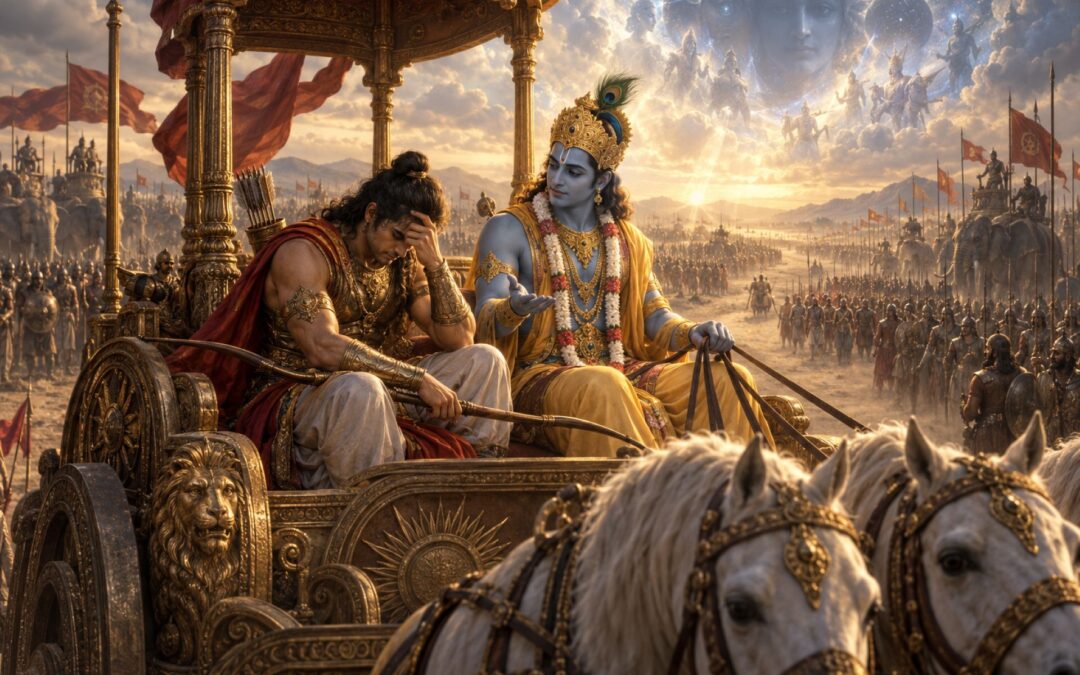
The Bhagavad Gita begins at the moment when action has become almost impossible. Two branches of the same royal family stand ready for battle at Kurukshetra. Arjuna, one of the greatest warriors on the Pandava side, asks his charioteer Krishna to place their chariot between the armies so that he can look at the people he is expected to fight. What he sees destroys his certainty. Teachers who educated him, elders he reveres, cousins he grew up with, friends, allies and relatives now stand among the enemy. The political cause may be just, but victory would require killing people whose deaths would make victory itself feel corrupt.
That crisis gives the Bhagavad Gita its enduring power. Although the work is now frequently encountered as an independent scripture, it is an episode within the Mahabharata, and Oxford’s scholarly overview of the Gita situates its eighteen chapters within the Bhishma Parva of the larger epic. The text is traditionally attributed with the Mahabharata to Vyasa, but its historical composition cannot be assigned to a single documented author or precise publication date in the modern sense. Scholarly dating varies, and the work belongs to a long process of oral, textual and interpretive transmission rather than to one recoverable moment of authorship.
The standard form followed here contains eighteen chapters and 700 verses. Some textual traditions include an additional opening question at the beginning of Chapter 13, producing a count of 701. Because the Gita exists in Sanskrit and has generated centuries of competing translations and commentaries, no English rendering can be treated as philosophically neutral. Words such as dharma, yoga, atman, karma, bhakti and Brahman carry ranges of meaning that shift according to context. IIT Kanpur’s complete Gita Supersite is especially valuable because it allows readers to compare the Sanskrit text with multiple translations and commentarial traditions rather than assuming that one English phrasing settles every question.
The central problem of the Gita is therefore larger than the popular slogan “do your duty without worrying about the result.” Krishna must persuade Arjuna to act, but he does so by gradually transforming what action, selfhood, duty, knowledge, renunciation and devotion mean. The argument moves from the immortality of the Self to disciplined action, from action to meditation and knowledge, from these to a progressively stronger theology of Krishna, and finally toward devotion, surrender and a transformed understanding of agency. The book’s achievement lies in this attempt to make spiritual liberation compatible with serious participation in the world. Its most difficult questions arise from exactly the same attempt, because the action Arjuna is finally prepared to perform is participation in a devastating war.

The Crisis at Kurukshetra and Krishna’s First Answer
The Gita opens one level removed from Arjuna and Krishna. The blind king Dhritarashtra asks Sanjaya what is happening at Kurukshetra, where his own sons and the sons of Pandu have assembled for war. Sanjaya, who possesses supernatural vision within the epic frame, becomes the narrator of the dialogue. This outer frame matters because the conversation is never merely a private exchange between two philosophers. It is taking place on an actual battlefield whose consequences will determine the future of a kingdom and destroy much of an extended family.
Before Arjuna’s crisis, the poem establishes the scale of the conflict. Duryodhana surveys the Pandava forces and approaches his teacher Drona, calling attention to formidable warriors on the opposing side while also naming major fighters supporting the Kauravas. Bhishma, the revered elder of the family, blows his conch, and the battlefield fills with answering sounds from both armies. Krishna and Arjuna then sound their own conches, along with the other Pandava leaders. The martial spectacle initially suggests that battle is inevitable, yet the first chapter suddenly turns away from military preparation and inward toward one man’s inability to participate in it.
Arjuna asks Krishna to drive the chariot between the two armies. He wants to see the men with whom he must fight. Krishna places him where he can observe elders and teachers, and Arjuna’s perception changes the meaning of the battle. An opposing army becomes a collection of individual human beings to whom he is bound by affection, gratitude and kinship. Bhishma is not merely a military obstacle; he is a grandfatherly figure. Drona is not simply an enemy commander; he is Arjuna’s teacher. The people before him include cousins, uncles, brothers-in-law, friends and younger generations whose deaths would extend suffering through entire families.
His body reacts before the philosophical argument is complete. He becomes weak, trembles, feels his mouth dry and loses his grip on his famous bow, Gandiva. Yet his refusal is not simply a panic attack. Arjuna gives reasons. He argues that no kingdom, pleasure or victory can compensate for killing the very people for whose sake such goods would ordinarily be valued. He fears wrongdoing in killing relatives and teachers, even if they are participants in the conflict. He also imagines the social effects of family destruction: traditional obligations will collapse, disorder will spread and future generations will inherit the consequences.
The reasoning is morally serious even when some of its social assumptions belong to the world of the epic rather than to modern ethics. Arjuna is asking whether a formally legitimate duty can become morally unbearable when seen in its full human consequences. He prefers, at the end of Chapter 1, the possibility of being killed without resistance to becoming the agent of such destruction. He sits down in the chariot and puts aside his bow and arrows.
Chapter 2 changes the relationship between Arjuna and Krishna. Arjuna initially continues to argue, but then admits that he cannot resolve the conflict by himself. He asks Krishna to instruct him and formally places himself in the position of a student. This shift is essential because Krishna’s subsequent teaching is not simply a command from a superior officer. It is offered as a transformation of the assumptions through which Arjuna understands himself, other people, action and death.
Krishna’s first response is deliberately unsettling. He argues that Arjuna grieves for those who, at the deepest level, should not be understood as annihilated by bodily death. Bodies pass through childhood, maturity and old age and eventually perish, but the atman, the deepest Self, is not born and does not die in the same manner. Weapons do not destroy it, fire does not burn it, water does not wet it and wind does not dry it. The doctrine does not deny that bodies die or that worldly loss is painful; it relocates personal identity beyond the perishable body.
Krishna then approaches the problem from another direction. Even if Arjuna does not accept the metaphysical account of an immortal Self, birth and death remain inevitable features of embodied existence. What is born will die, and what dies participates again in becoming. Grief cannot reverse that condition. The argument is meant to weaken Arjuna’s assumption that refusing to fight can somehow preserve everyone from mortality.
A third argument concerns Arjuna’s svadharma, his particular duty as a warrior. Krishna says that a righteous battle constitutes a situation in which a warrior must not retreat. Refusing would mean abandoning his role and reputation, and those who admire him would interpret his withdrawal as fear. This part of Krishna’s response is very different from the metaphysical teaching about the Self. One argument attempts to transcend ordinary social identity; the other appeals directly to Arjuna’s social identity as a Kshatriya. The coexistence of these levels becomes a recurring feature of the Gita.
Krishna then begins to reformulate action itself. Arjuna’s deeper problem is not merely whether he acts, but how he relates to action and its results. He should perform what must be done while relinquishing possessive attachment to success or failure. The famous teaching about having responsibility for action rather than control over its fruits belongs here. It is not a promise that results do not matter, nor an invitation to work carelessly. It is a discipline designed to prevent the agent from making personal reward, victory, fear or ego the controlling basis of action.
This produces the idea of equanimity. Success and failure, pleasure and pain, gain and loss ordinarily pull the mind in opposite directions. Krishna calls for a steadiness that makes right action possible without constant dependence on favourable outcomes. Such steadiness is part of yoga: disciplined integration rather than withdrawal from responsibility.
Arjuna asks what a person established in this kind of wisdom actually looks like. Krishna’s answer closes Chapter 2 by describing the sthitaprajna, the person of stable understanding. Such a person is not driven compulsively by desires, is not shattered by adversity or intoxicated by pleasure, and has gained control over the senses rather than allowing them to drag the mind toward objects. Desire generates attachment; frustrated attachment produces anger; anger clouds judgment; confused judgment damages memory and understanding. The psychological chain links the battlefield crisis to ordinary human conduct.
The first two chapters therefore establish almost the entire problem in miniature. Arjuna believes moral seriousness requires him not to act. Krishna begins by arguing that Arjuna misunderstands death, duty, agency and attachment. But the solution is not yet complete. Arjuna immediately notices that if knowledge and stable understanding are so important, Krishna still owes him an explanation of why he should remain engaged in violent action at all.
Action, Renunciation, and Meditation
Chapters 3 through 6 take up the contradiction Arjuna thinks he has discovered. If wisdom is superior to ordinary action, perhaps the obvious spiritual solution is to abandon action and pursue contemplation. Krishna rejects that inference repeatedly. Human beings cannot escape action merely by refusing particular tasks, because embodied life itself is active. The real distinction is therefore not simply between acting and not acting but between forms of action governed by different motives and forms of understanding.
Chapter 3 develops karma-yoga more explicitly. Krishna says that no one remains truly inactive even for a moment because the qualities of nature continually generate activity. A person who outwardly restrains the body while mentally dwelling on desired objects has not achieved genuine renunciation. External passivity can coexist with intense inner attachment, while outward activity can coexist with deep inward freedom.
The alternative is disciplined action performed without possessiveness toward its fruits. Krishna connects this to yajna, sacrifice. In its earlier Vedic setting, sacrifice has ritual meaning, but the Gita broadens the concept into a way of understanding reciprocal participation in a larger order. Human beings receive from a world they did not create, and action oriented only toward private consumption becomes spiritually binding. Action understood as offering does not erase practical consequences, but it changes the agent’s relationship to them.
This leads to lokasangraha, the maintenance or holding together of the world. Krishna invokes exemplary rulers such as Janaka to argue that liberation is compatible with action. People of influence also bear responsibility because others imitate them. A spiritually mature person therefore cannot assume that private enlightenment excuses indifference to the social consequences of behaviour. Krishna intensifies the argument by applying it to himself: although he lacks nothing and has no personal goal left to obtain, he continues to act because complete withdrawal would contribute to disorder.
Arjuna then asks what drives a person toward wrongdoing even when the person knows better. Krishna identifies desire, allied with anger, as a central enemy. Desire inhabits the senses, mind and intellect and distorts knowledge. The solution therefore cannot be reduced to rule-following. A person may know a rule intellectually while still being controlled by impulses that override judgment. The Gita’s ethics begins to look as much like a theory of character formation as a theory of duty.
Chapter 4 expands the scale of Krishna’s authority. He claims that the yoga he teaches is ancient and was transmitted in an earlier age. Arjuna notices an apparent impossibility: Krishna’s present birth is recent, so how could he have taught it long ago? Krishna replies by distinguishing his manifestation from ordinary birth. He knows his previous appearances, whereas Arjuna does not, and although he is unborn he manifests through his own power.
The doctrine develops into the famous teaching of divine incarnation. When dharma declines and disorder rises, Krishna says, he manifests to protect those aligned with the good, restrain destructive forces and restore dharma. This is a crucial theological transition. Krishna is no longer functioning merely as a wise human adviser. His authority begins to rest on claims about his divine relation to history and cosmic order.
Chapter 4 also deepens the paradox of action. A wise person must learn to discern action in apparent inaction and inaction within action. The language is deliberately difficult because Krishna wants to sever the assumption that the moral and spiritual quality of action can be read from outward movement alone. A person may be visibly active while inwardly free from possessive ego, while another may outwardly abstain yet remain inwardly consumed by desire.
The language of sacrifice is broadened further. Different practitioners offer material goods, sensory pleasures, disciplined breathing, austerity, study or knowledge. The variety allows Krishna to reinterpret spiritual practice as a set of transformations in which lower attachments are offered into a higher discipline. Among these forms, knowledge receives special emphasis because it changes the practitioner’s basic understanding of who acts and why.
Knowledge is compared to a fire that consumes the binding effects of previous action. This does not mean that simply learning philosophical propositions magically erases consequences. The point is that transformative knowledge undermines ignorance, especially the ego’s assumption that it is an isolated, absolutely independent doer. Right action and right understanding therefore become increasingly difficult to separate.
Chapter 5 returns to Arjuna’s persistent question about renunciation. He asks whether it is better to renounce actions or practice karma-yoga. Krishna again refuses the simple binary. Both can lead toward liberation, but disciplined action is presented as more accessible and appropriate for Arjuna. A true renouncer is not defined merely by leaving society, changing clothing or refusing work. The decisive renunciation concerns attachment, aversion and egoistic ownership.
The practitioner of karma-yoga can therefore act intensely without repeatedly thinking, in effect, “I alone am the absolute author of everything occurring here, and the result belongs to me.” Krishna describes the senses engaging with their objects while the disciplined person understands that the deeper Self is distinct from those processes. Actions can be offered to Brahman, like water that does not cling to a lotus leaf in the traditional image, so that the practitioner remains inwardly unbound.
This chapter also develops the Gita’s language of equality. A person established in knowledge sees beyond conventional status distinctions, perceiving the same underlying reality in a learned Brahmin, a cow, an elephant, a dog and a person placed outside orthodox caste society. The claim is spiritually radical, though it does not by itself abolish the social differentiations that the text later retains. That tension between metaphysical equality and differentiated social duty becomes important in evaluating the book.
The closing verses of Chapter 5 anticipate meditation. Freedom requires control of desire and anger, withdrawal from compulsive sensory fixation, regulation of breath and concentration of consciousness. Chapter 6 then provides the Gita’s most sustained account of meditative practice.
Krishna begins by once again refusing to separate the true yogi from the true renouncer. A person who performs necessary action without dependency on its fruit embodies renunciation more deeply than someone who merely abandons ritual fire or physical activity. The practitioner must become capable of raising the self through the self rather than allowing the mind to become an enemy. When mastered, the mind functions as an ally; when uncontrolled, it sabotages intention.
Meditation requires practical discipline rather than vague spirituality. Krishna describes a clean place, a stable seat, an upright body and concentrated attention. The practitioner restrains the wandering mind and moderates ordinary habits. Yoga is not for someone who eats excessively or starves, sleeps constantly or refuses necessary sleep. Regulation of food, recreation, effort and rest creates the bodily conditions in which concentration can stabilize.
The image of a lamp protected from wind conveys the desired quality of mind: steady rather than continually flickering in response to stimulation. As concentration deepens, the practitioner experiences satisfaction that does not depend on external objects. This is not presented merely as relaxation. Meditation is a means by which ordinary identification with restless mental processes loosens and deeper self-knowledge becomes possible.
Arjuna raises one of the most psychologically credible objections in the entire text. The mind is restless, forceful and difficult to control; disciplining it seems almost as difficult as controlling the wind. Krishna does not deny the diagnosis. He agrees that the mind is hard to restrain but insists that repeated practice and dispassion can gradually bring it under discipline. Yoga is therefore developmental rather than instantaneous.
Arjuna then asks what happens to a sincere practitioner who begins the path but fails to attain completion. His concern is that such a person might lose both ordinary worldly success and spiritual liberation, belonging fully to neither. Krishna rejects that fear. Genuine spiritual effort is not wasted. The unsuccessful yogi enters favourable conditions in a future life and eventually resumes the discipline, propelled by impressions from previous practice.
The chapter ends by ranking the yogi highly among ascetics, scholars and ritual performers, but Krishna adds an increasingly significant qualification: the most deeply united yogi is one who turns inwardly toward Krishna with faith and devotion. The statement anticipates the major shift of Chapters 7 through 12. Action, knowledge and meditation remain important, but the identity of the divine object toward which the entire discipline is directed is about to become much more explicit.
Knowing Krishna: Divinity, Devotion, and the Universal Form
Chapters 7 through 12 form the theological centre of the Gita. Earlier chapters have already hinted that Krishna is more than Arjuna’s talented friend and teacher, especially through the doctrine of divine manifestation in Chapter 4. Now Krishna increasingly identifies himself as the source, sustaining reality and ultimate destination of the cosmos. The change is not merely conceptual; it culminates in Chapter 11 when Arjuna is temporarily given the capacity to see what Krishna claims to be.
Chapter 7 begins by distinguishing two aspects of Krishna’s nature. The lower nature includes the traditional elements together with mind, intellect and ego. This is prakriti considered as the field of material and psychophysical existence. Krishna then speaks of a higher nature associated with life and consciousness. Through these natures the world arises, and Krishna presents himself as its ultimate source and dissolution.
The chapter gathers ordinary realities into theological language. Krishna is associated with the taste in water, light in the sun and moon, strength freed from selfish passion and the life in living beings. Such statements do not simply say that certain beautiful objects happen to remind people of God. They progressively present the world as dependent on and expressive of a divine foundation.
At the same time, beings are deluded by the three gunas of material nature: sattva, rajas and tamas. These qualities will later receive detailed analysis, but here their principal role is to explain why the divine source remains difficult to perceive. Krishna’s maya is difficult to cross, and liberation requires turning toward him rather than assuming that intellectual ability alone automatically reveals ultimate reality.
Krishna identifies different kinds of devotees. Some approach because they are suffering, some desire particular benefits, some seek understanding and some possess mature knowledge. The knowledgeable devotee receives special praise because devotion is no longer merely a transaction for worldly assistance. Yet Krishna does not simply dismiss worship directed toward other divine forms. He explains such worship within a larger theological hierarchy in which the faith enabling it and the limited fruits it yields ultimately depend on him.
Chapter 8 begins with a series of direct questions from Arjuna about terminology. What is Brahman? What is the individual self? What is action? What happens at death? Krishna answers by connecting metaphysical categories to the practical problem of consciousness at the end of life. A person’s final orientation matters because consciousness does not suddenly become something entirely new at the instant of death. What the mind remembers then reflects the habits cultivated throughout life.
The instruction to remember Krishna at death is therefore joined to the instruction to remember him while acting. Arjuna is not told to abandon the battlefield so that he can spend his remaining life rehearsing a death ritual. He is told to maintain divine remembrance while fulfilling his duty. Meditation, disciplined attention and action are again brought together.
The sacred syllable Om appears within instructions concerning concentration at death and the attainment of the imperishable. Krishna also expands the reader’s temporal horizon through descriptions of immense cosmic cycles. Worlds repeatedly manifest and dissolve; even cosmic longevity remains within impermanence. Liberation requires attaining what lies beyond repetitive creation and dissolution.
Traditional routes followed after death are also described, including luminous and dark paths associated with different destinies. These passages belong to the Gita’s inherited cosmology and are difficult to translate into modern categories without distortion. Their function within the argument is clearer than their literal cosmological status: the practitioner is encouraged to seek liberation beyond recurring conditioned existence rather than merely a superior position within it.
Chapter 9 presents its teaching as a supreme knowledge and profound secret. Krishna now describes his relation to the world in language that deliberately combines immanence and transcendence. Beings depend upon him, yet he is not exhausted by the totality of beings. He sustains the cosmos without becoming bound by the processes through which nature creates and dissolves forms.
The chapter also transforms worship. Ritual directed toward limited rewards can produce limited results, including heavenly enjoyments, but those results remain temporary. Devotion to Krishna aims beyond the cycle of acquisition and loss. The theological claim becomes increasingly comprehensive: Krishna identifies himself with sacrifice, ritual offering, sacred formula, fire, father, mother, sustainer, witness, refuge, origin and dissolution.
Yet the practical expression of devotion can be strikingly simple. A sincere offering of something as modest as a leaf, flower, fruit or water can be accepted when given with devotion. The importance lies not in the market value of the offering but in the orientation of the person making it. Krishna then extends the same principle to ordinary life: actions, food, gifts and austerities can be offered to him, turning spiritual practice from an isolated ritual activity into a general orientation of action.
Chapter 9 also contains a socially significant claim that people who occupy marginalized positions within the conventional religious hierarchy can reach the highest goal through devotion. The text includes women, Vaishyas and Shudras in a formulation whose ancient social categories cannot simply be mapped onto modern egalitarian language. The passage expands devotional accessibility, but it does so while taking hierarchical categories for granted. The Gita’s spiritual universalism and social differentiation therefore coexist rather than neatly cancelling one another.
Chapter 10, the Vibhuti Yoga, answers a new question created by Krishna’s increasingly expansive self-description. If the divine is present throughout reality, how should Arjuna recognize that presence? Krishna responds with examples of outstanding manifestations or vibhutis. Among different classes of beings, natural forces, scriptures, powers and qualities, the most striking manifestations of excellence, splendour, authority or vitality can be contemplated as expressions of the divine.
The catalogue ranges widely. The sun, moon, sacred knowledge, powerful gods, mountains, rivers, animals, sages, weapons, virtues and capacities all become possible sites of recognition. The principle is more important than memorizing the entire list: wherever unusual splendour, power or excellence appears, Arjuna is encouraged to see it as deriving from Krishna.
The catalogue also corrects itself. No list can adequately enumerate the divine manifestations because the whole universe depends upon a portion of Krishna’s power. This statement prompts the decisive request. Arjuna has heard the metaphysics and theology; now he wants direct vision. He asks Krishna to show him the cosmic form.
Chapter 11 changes the Gita from philosophical instruction into theophany. Krishna tells Arjuna that ordinary eyesight is insufficient and grants him a divine mode of seeing. Sanjaya’s narration then attempts to describe something that exceeds normal spatial categories: countless faces, eyes, forms, ornaments and weapons; dazzling radiance; gods and cosmic beings contained within one immeasurable body.
At first Arjuna responds with wonder. The distinctions between separate beings appear gathered into Krishna. He sees the divine form stretching without discernible beginning, middle or end. The revelation seems to confirm what earlier chapters have stated conceptually: Krishna is not one finite person located beside other finite beings but is somehow the encompassing ground within which the cosmos appears.
The emotional tone then darkens. Arjuna sees frightening mouths with terrible teeth. Warriors from both armies rush toward them, including figures he knows personally. Some appear crushed between the teeth of the cosmic form. Rivers flowing inevitably toward the sea and moths rushing into flame become images for armies moving toward destruction.
Arjuna asks what this terrifying form means. Krishna identifies himself with cosmic Time in its world-destroying aspect. The warriors whom Arjuna fears killing are already caught in a process of destruction larger than Arjuna’s individual will. Krishna therefore tells him to rise, fight and become an instrument.
This is one of the most philosophically and ethically difficult moments in the text. The vision can reduce Arjuna’s egoistic belief that he personally controls life and death, but it can also seem to shift responsibility away from human agency by placing destruction inside cosmic necessity. The summary need not resolve that problem, but the problem cannot be omitted without sanitizing the chapter.
Arjuna’s relationship with Krishna is permanently altered. He has previously joked, eaten, rested and spoken casually with Krishna as a friend. Now he recognizes that the companion beside him is also the terrifying totality he has just witnessed. He apologizes for previous familiarity, not because friendship itself was wrong but because he had not understood the full identity of the person he addressed.
The vision becomes unbearable. Arjuna asks to see Krishna again in a familiar and gentler form. Krishna grants the request, reassuring him after the shock. The scene matters because divine revelation here is not simply comforting illumination. To see the totality means seeing creation and destruction together, beauty and terror, personal divinity and impersonal cosmic process.
Chapter 12 begins after this overwhelming revelation with a more practical question. Arjuna asks whether it is better to worship Krishna in manifest personal form or contemplate the unmanifest absolute. Krishna does not deny the validity of the unmanifest route, but he presents it as especially difficult for embodied beings. Personal devotion provides a more accessible path because attention, emotion and action can be gathered around a relationship.
The chapter then gives a graduated series of practices rather than demanding immediate perfection. Ideally, the devotee fixes mind and understanding continuously on Krishna. If sustained absorption is impossible, repeated practice can cultivate it. If such practice remains difficult, one can perform actions for Krishna. If even that is beyond one’s capacity, one can at least relinquish attachment to the fruits of action. Earlier karma-yoga is therefore not discarded; it is incorporated into a devotional progression.
The second half of Chapter 12 describes the qualities of a devotee dear to Krishna. These qualities include non-hatred, compassion, absence of possessiveness, steadiness, forgiveness, self-control and freedom from agitation. Devotion is thus not defined by emotional intensity alone. It produces a recognizable moral character.
By the end of Chapter 12, the Gita has moved far beyond the battlefield argument with which it began. Yet the teaching has not abandoned Arjuna’s original problem. Action remains necessary, but it is now nested within a theology in which the agent, world, duty and result all depend upon a divine reality that can be known, contemplated and loved.
Field and Knower, the Three Gunas, and the Supreme Person
After the theological climax of Chapters 7 through 12, Chapters 13 through 15 return to concentrated metaphysical analysis. The transition can feel abrupt, but the subject is continuous with earlier teaching. If liberation requires acting without bondage and recognizing Krishna as ultimate reality, the reader still needs a clearer explanation of what belongs to material nature, what counts as the knower, how psychological tendencies arise and how the individual self relates to the supreme.
Chapter 13 begins with the distinction between kshetra, the field, and kshetrajna, the knower of the field. Some textual traditions place an explicit question from Arjuna before Krishna’s answer, which accounts for the familiar 700-versus-701-verse discrepancy. The philosophical point remains the same: the body and psychophysical complex can be treated as something known, and therefore they cannot exhaust the identity of the knowing principle.
The field includes not only the physical body but the components of embodied experience—elements, senses, mind, desire, aversion, pleasure, pain and the structures through which experience occurs. The “knower of the field” introduces a distinction between changing objects of experience and consciousness. Krishna then complicates the distinction by identifying himself as the knower present in all fields, linking individual self-awareness to the divine.
Remarkably, the chapter defines “knowledge” partly through qualities of character rather than through information. Humility, sincerity, nonviolence, patience, self-control, nonattachment, awareness of birth and death, and devotion to the search for truth count as conditions of genuine knowing. Knowledge is therefore existential. A person whose life is completely governed by vanity, craving and possessiveness cannot compensate merely by possessing sophisticated metaphysical vocabulary.
The object of knowledge is described as Brahman in paradoxical language. It cannot be confined to ordinary categories of location or finite embodiment. It is described through presence both within and beyond beings, near and far, undivided yet appearing through divisions. Such language resists a simple picture in which ultimate reality is merely another object somewhere inside the universe.
The chapter then uses the categories prakriti and purusha. Prakriti is the domain of nature and the source of qualities and change; purusha is associated with consciousness and experience. Bondage arises through identification with nature’s qualities. Liberation requires seeing processes of nature as processes of nature rather than continually appropriating them as an absolute egoic identity.
Chapter 14 develops the gunas, the three qualities or strands of prakriti. Sattva is associated with luminosity, clarity, harmony and knowledge. Rajas is associated with activity, craving, ambition and restlessness. Tamas is associated with darkness, inertia, confusion and negligence. These are not three permanent personality types into which every human being can be cleanly sorted. They are dynamic tendencies whose relative predominance changes.
The Gita makes the analysis more subtle by refusing to treat sattva as absolute liberation. Sattva is preferable to the agitation of rajas and obscurity of tamas because it supports clarity, but it can still bind a person through attachment to happiness or knowledge. Rajas binds through attachment to action and desired results, while tamas binds through carelessness, laziness and delusion. Spiritual freedom therefore requires eventually transcending even the most refined mode of nature.
The gunas also provide a theory of observable psychological change. When clarity and illumination predominate, sattva is active; when acquisitiveness, restless activity and desire dominate, rajas has become strong; when confusion, negligence and inertia take over, tamas predominates. The framework will later be applied not only to psychology but to knowledge, action, religious practice, diet, austerity and charity.
Arjuna asks how someone who has gone beyond the gunas can be recognized. Krishna describes a person who does not hate the appearance of clarity, activity or delusion and does not desperately crave their absence. Such a person can witness nature’s changing modes without identifying absolutely with them. The chapter again brings metaphysics into devotion by stating that steadfast devotion to Krishna enables one to transcend the gunas.
Chapter 15 condenses many of these ideas into a powerful image: the inverted ashvattha tree. Its roots are above and its branches below, while its extensions spread through conditioned existence. The image presents samsara as a living structure whose visible growth depends on a source beyond the visible world. Its branches are nourished by the gunas, and action contributes to the further entanglement of embodied existence.
The seeker is told to cut this deeply rooted tree with detachment. The point is not hatred of the physical world but liberation from compulsive identification with a structure of becoming that never produces permanent security. After cutting attachment, the seeker searches for the supreme state from which there is no return to ordinary bondage.
Krishna then describes the individual living self as connected to him while moving through embodiments and carrying mind and senses from one body to another. The imagery resembles wind carrying scents from their sources: something continues across changing embodiments even though the physical form changes.
The chapter again places divine reality inside ordinary processes. Krishna identifies the light of sun and moon with divine radiance, describes himself as sustaining the earth, nourishing plants, dwelling in living bodies as digestive fire and residing within the heart as the source associated with memory, knowledge and their loss. Transcendence does not require a picture of God located only outside material existence.
The final distinction is among the perishable, the imperishable and Purushottama, the Supreme Person. Perishable existence includes changing beings; the imperishable refers to a principle beyond such change; the Supreme Person surpasses both categories as the ultimate sustaining reality. By Chapter 15, the Gita has created a dense architecture in which individual selfhood, material nature, consciousness and Krishna cannot be discussed independently of one another.
Character, Faith, Renunciation, and Arjuna’s Final Decision
The last three chapters bring the Gita back toward conduct. After the metaphysical density of Chapters 13 through 15, Krishna examines character, religious practice, social duty and renunciation in increasingly concrete terms. Chapter 18 then acts as both summary and culmination, gathering earlier distinctions into a final response to the question Arjuna raised before the teaching began.
Chapter 16 contrasts daivi and asuri dispositions, often translated as divine and demonic qualities. The terminology can sound mythological, but much of the discussion is psychological and ethical. Divine qualities include fearlessness, purity, self-control, generosity, truthfulness, compassion and absence of destructive anger. Demonic qualities include hypocrisy, arrogance, harshness, uncontrolled desire and ignorance.
The demonic person is characterized by more than individual bad habits. Krishna describes a worldview in which existence is treated as lacking meaningful moral order and desire becomes its own justification. Such people continually pursue acquisition, status and gratification, imagining that each new possession will secure them while their desires multiply. Their sense of self becomes entangled with what they own, dominate or expect to obtain.
Desire, anger and greed are identified as three especially destructive gateways. This continues a psychological argument first made in Chapters 2 and 3. Human beings are not ruined only because they choose one isolated wrong action. Repeated desire alters perception, anger follows frustration, greed makes satisfaction recede, and eventually the person’s entire character becomes organized around compulsions.
Chapter 16 ends by appealing to scriptural teaching as an authority for distinguishing what should and should not be done. This can seem in tension with the Gita’s emphasis on transformed understanding, but it reflects the text’s assumption that moral discernment develops within an inherited normative tradition rather than through private preference alone.
Chapter 17 begins with Arjuna asking about people who possess faith but do not follow scriptural rules correctly. Krishna replies that shraddha, often translated as faith, corresponds to the underlying constitution of a person. Faith is not automatically virtuous merely because it is sincere. Like other aspects of human life, it can reflect sattva, rajas or tamas.
The threefold scheme is applied to worship. Sattvic worship is directed according to a disciplined understanding; rajasic worship is entangled with desire for power, reward or display; tamasic worship can become confused or destructive. Religious behaviour therefore receives the same moral scrutiny as ordinary action. Spiritual language does not protect an act from criticism.
Food is classified according to the gunas as well. Foods associated with vitality, steadiness and health are described as sattvic; excessively stimulating, harsh or intensely flavoured foods are associated with rajas; stale or degraded food with tamas. These categories have often been turned into modern lifestyle systems, but in the chapter they function as one part of a larger attempt to show how the qualities of nature shape apparently mundane choices.
Sacrifice, austerity and giving receive similar threefold treatment. A sacrifice performed because it should be done and without craving for reward is sattvic; one performed for prestige or personal gain is rajasic; one conducted carelessly and without proper orientation is tamasic. Giving is sattvic when offered appropriately without expectation of return, rajasic when done reluctantly or for recompense, and tamasic when given contemptuously or without regard for circumstance.
Austerity is especially important because the Gita rejects the assumption that severe self-denial is automatically spiritual. Discipline of body, speech and mind can be valuable, but austerity performed for recognition or one that harms oneself and others through delusion is corrupted. The chapter closes around the formula Om Tat Sat, associating properly oriented action with the ultimate reality it is meant to serve.
Chapter 18 begins by returning to a question Arjuna has been asking in different forms throughout the Gita: what exactly should be renounced? Krishna distinguishes sannyasa and tyaga in a discussion whose translation varies across traditions. The central practical claim is clearer than the terminology. Necessary action should not simply be abandoned; what must be relinquished is attachment to action and possessive demand for its fruits.
Krishna insists that sacrifice, giving and austerity should continue because they can purify the practitioner. Even these actions, however, must be performed without egoistic attachment. Renunciation is therefore not equivalent to passivity. The person who refuses every unpleasant duty merely because it produces discomfort has not necessarily achieved spiritual freedom.
Chapter 18 then challenges simplistic ideas about agency by identifying several factors involved in action. These include the embodied situation or basis of action, the agent, the instruments through which action occurs, the various activities involved and a fifth factor often translated in relation to the divine or providential element. The point is that the isolated ego cannot plausibly claim to be the sole cause of every event.
The three gunas are applied once more, now to knowledge, action and the agent. Sattvic knowledge sees underlying unity without erasing apparent diversity. Rajasic knowledge remains fixated on separateness. Tamasic knowledge mistakes a fragment for the whole and lacks adequate grounding. Similarly, action can be disciplined and nonattached, driven by desire, or undertaken in ignorance without regard for consequences.
The same framework extends to intellect, determination and happiness. Sattvic intellect discerns what ought and ought not be done, what creates bondage and what leads toward freedom. Rajasic intellect confuses these distinctions, while tamasic intellect can invert them. Determination can sustain disciplined practice, pursue reward or remain trapped in fear, grief and inertia.
Krishna then turns directly to social duty. He describes characteristic functions associated with the four varnas. The Brahmin is associated with qualities such as serenity, restraint, purity and knowledge; the Kshatriya with courage, vigour, firmness, generosity and unwillingness to flee justified conflict; the Vaishya with agriculture, cattle-rearing and trade; and the Shudra with service. These classifications belong to the text’s ancient social framework and cannot responsibly be presented as a timeless empirical hierarchy of human value.
The argument that follows is crucial for Arjuna. One’s own duty, even when imperfectly performed, is preferable to adopting another’s duty successfully. Because actions arising from one’s nature contain imperfections, one should not abandon appropriate work merely because it is morally or practically difficult. This principle provides a direct route back to the battlefield: Arjuna’s revulsion does not, in Krishna’s view, automatically nullify his responsibility as a warrior.
Yet Chapter 18 does not end with social duty. Krishna moves toward an increasingly comprehensive spiritual synthesis. By performing one’s work without selfish attachment, disciplining mind and senses, abandoning possessiveness and cultivating knowledge, a person becomes prepared for realization of Brahman. Devotion then reappears as the means by which the practitioner knows Krishna truly and enters into relationship with the supreme.
The final movement becomes intensely personal. Krishna asks Arjuna to direct mind and devotion toward him and assures him that such orientation leads to the divine. The culmination comes in the instruction conventionally associated with 18.66, where Krishna tells Arjuna to abandon other dharmas and take refuge in him alone, promising liberation from wrongdoing. The verse has generated enormous interpretive debate because the Gita has spent much of its length teaching dharma and now seems to place surrender beyond or above those differentiated obligations.
Importantly, Krishna does not conclude by erasing Arjuna’s capacity for judgment. After giving the teaching, he tells Arjuna that the matter has been explained and that Arjuna should reflect fully and then act as he sees fit. The relationship between divine authority and human agency is therefore more complicated than obedience to a command.
Arjuna’s answer completes the narrative that began in Chapter 1. His confusion has been dispelled, his understanding has returned and he is ready to act. He does not say that the war has become pleasant, that his relatives no longer matter or that death has become emotionally trivial. The transformation concerns his ability to act after his earlier moral and psychological paralysis.
The outer narrative frame then returns. Sanjaya tells Dhritarashtra of his amazement at hearing the dialogue and especially at recalling Krishna’s extraordinary form. The Gita ends not with Krishna alone but with Krishna and Arjuna together: divine guidance joined to a human warrior prepared for action. The final image therefore preserves the structure of the entire book. Insight has not replaced action; it has changed the consciousness from which action proceeds.
The Gita’s Core Synthesis: Dharma, Karma, Knowledge, Meditation, and Devotion
A summary of the eighteen chapters reveals why the Gita cannot be reduced to one slogan or even one philosophical technique. Its central terms overlap without becoming identical, and later teachings do not simply cancel earlier ones. Ithamar Theodor’s philosophical study of the Bhagavad Gita is useful precisely because it treats dharma, karma-yoga, knowledge, meditation and bhakti as interacting parts of a larger philosophical structure rather than as isolated “lessons.”
The synthesis begins with a concrete problem: Arjuna must determine whether acting in accordance with a socially defined obligation can be spiritually and morally justified when the consequences are terrible. Krishna’s response changes several variables at once. Duty remains important, but action must be purified of possessiveness. Knowledge remains important, but knowledge must transform the agent rather than remain theoretical. Meditation disciplines the mind that would otherwise sabotage understanding. Devotion then relocates action inside a relationship with Krishna, culminating in surrender.
Dharma, Svadharma, and Lokasangraha
Dharma is one of the least satisfactory words to translate with a single English equivalent. “Duty” captures an important part of its meaning in Arjuna’s case, but dharma can also imply sustaining order, normative responsibility, right conduct and the principles by which a life or social role is properly organized. The battlefield is explicitly a dharma-kshetra, a field of dharma, before Arjuna begins questioning what dharma actually requires.
Svadharma is one’s own particular dharma. For Arjuna, that includes his position as a warrior and member of a political order whose conflict has reached a point where battle is presented as unavoidable. Krishna repeatedly tells him that abandoning his proper function because another path seems spiritually cleaner would not solve the problem. A borrowed duty can become another form of avoidance.
The argument becomes broader through lokasangraha, the holding together of the world. Action is not evaluated only in terms of private liberation. Exemplary people shape the conduct of others, institutions depend on people fulfilling responsibilities and disorder can spread when those capable of acting withdraw for selfish reasons. This helps explain why Krishna praises figures such as Janaka, who are associated with spiritual attainment while still performing worldly responsibilities.
Yet dharma is not morally self-validating merely because a role is inherited. That is one of the Gita’s unresolved difficulties for modern readers. The text generally assumes that Arjuna’s warrior role provides real normative information. Contemporary readers are more likely to ask whether a social role itself is just before deciding whether fulfilling it counts as duty. The Gita powerfully analyzes fidelity to obligation, but it offers fewer resources for dismantling an unjust role structure from outside its own assumptions.
Karma-Yoga and Renouncing the Fruits
Karma means action and, by extension in the Gita’s religious framework, action understood through its consequences across the cycle of rebirth. Karma-yoga does not mean simply “working hard,” and it does not mean becoming indifferent to outcomes. It is a discipline that attempts to remove craving, ego and possessiveness from action without removing responsibility for action itself.
The distinction matters because attachment can corrupt even outwardly admirable behaviour. A person may perform a generous act mainly to gain admiration or obey a duty only because success enhances status. Conversely, a difficult action may be performed because it is judged necessary even when the agent expects no personal reward. The Gita continually relocates moral attention from external movement to the structure of motivation.
Renouncing the fruits therefore means relinquishing the demand that the world confirm the ego through a desired result. It does not mean refusing to plan, assess consequences or work competently. Arjuna is expected to fight effectively, not carelessly. What he is asked to surrender is the belief that his identity and moral worth depend on possessing victory.
This is psychologically sophisticated because much anxiety arises from confusing responsibility with control. People can choose preparation, effort and conduct while remaining unable to dictate every consequence. The Gita separates these domains. The danger, however, is that “nonattachment” can be misunderstood as moral insulation: if one tells oneself that outcomes are not “mine,” one may be tempted to ignore preventable harm. The text itself tries to prevent that through dharma, self-discipline and lokasangraha, but responsible application requires keeping those constraints visible.
Atman, Brahman, Rebirth, and Knowledge
Krishna’s earliest major philosophical move is the distinction between the body and the imperishable Self. The atman survives bodily change and death, which means that Arjuna’s fear of absolute annihilation rests on an incomplete account of personhood. Within the Gita’s metaphysics, the doctrine also explains rebirth: embodied identities change while a deeper continuity persists across lives.
Brahman functions as a term for ultimate reality, though the relationship between Brahman, individual selfhood and Krishna is interpreted differently across traditions. The Gita does not present these questions as a modern analytic system with every definition fixed once and for all. Instead, its metaphysical vocabulary develops through overlapping images and claims, which later commentators systematize differently.
Knowledge, jnana, therefore means more than learning the proposition that the Self is immortal. Genuine knowledge changes how one identifies oneself and how one acts. A person who intellectually recites doctrines while remaining completely ruled by vanity, fear and desire does not embody the knowledge Krishna describes.
This is why Chapter 13 includes humility, restraint and nonattachment among the conditions of knowledge. Epistemology and ethics merge. To know reality properly requires transforming the kind of person who is doing the knowing.
The metaphysical claims themselves remain claims of a religious-philosophical tradition. The Gita does not provide scientific evidence for reincarnation, an immortal atman or Brahman, nor should modern advocates pretend that neuroscience has independently demonstrated them. A reader may find the ethical psychology valuable while remaining unconvinced by the metaphysics, but some of Krishna’s arguments—especially the response to Arjuna’s fear of killing—depend heavily on those metaphysical commitments.
Meditation, Self-Mastery, and the Mind
Meditation in the Gita is part of a wider discipline of self-mastery. Chapter 6 is particularly concrete about posture, moderation and concentration, but the underlying problem appears much earlier. The uncontrolled senses pull the mind toward objects; repeated fixation becomes attachment; frustrated attachment creates anger; anger impairs judgment. Meditation interrupts this process by training attention.
Arjuna’s objection that the mind is difficult to control prevents the discussion from becoming naive. Krishna accepts that restlessness is real and proposes practice and dispassion rather than a miraculous shortcut. The practitioner repeatedly notices wandering and returns attention. Progress is cumulative.
Meditation also prepares the distinction between awareness and mental activity developed later through field and knower. If thoughts, desires and sensations can be observed, the practitioner begins to experience them as events within consciousness rather than as an absolute identity. The Gita’s metaphysical explanation of that observation is contestable, but the practical distinction between having a thought and being wholly governed by it remains psychologically intelligible.
Self-mastery does not require hatred of the body. The rejection of extremes in Chapter 6 is important. Excessive eating and starvation, excessive sleep and chronic deprivation are both incompatible with stable practice. Discipline requires regulation rather than theatrical severity.
Bhakti, Grace, and Surrender
Devotion, bhakti, becomes increasingly prominent as the dialogue progresses. At first Krishna speaks largely as teacher, but by Chapters 7 through 12 he presents himself as the divine source and proper object of devotion. The change transforms yoga from a purely self-directed discipline into relationship.
Bhakti does not erase karma-yoga. Chapter 12 explicitly integrates earlier disciplines into a graded devotional structure: concentrated awareness of Krishna is ideal, repeated practice can cultivate it, action can be performed for Krishna, and attachment to fruits can be surrendered when more developed concentration is not yet possible. Devotion gives earlier forms of discipline a theological centre.
Nor is bhakti simply emotional affection. The beloved devotee is compassionate, non-hating, steady and self-controlled. Devotional intensity without ethical transformation would fail the text’s own description. This helps explain why Bina Gupta’s ethical analysis of duty and virtue in the Gita argues that the work cannot be understood only as an ethics of obligation; the formation of character is also essential.
Grace becomes clearest near the end. A purely self-powered model would imply that liberation depends entirely on perfect control and knowledge. Krishna instead tells Arjuna to take refuge in him and promises release. Devotion therefore introduces an asymmetry: liberation is not only an achievement of disciplined self-fashioning but also a relation of trust and surrender.
The famous injunction in 18.66 intensifies this tension by apparently placing refuge in Krishna beyond the differentiated dharmas the book has spent many chapters explaining. Traditions disagree over whether this represents the final supremacy of bhakti, a deeper form of renunciation, the completion of karma-yoga or a theological synthesis in which all previous disciplines reach fulfillment. The text supports more than one emphasis because it has spent eighteen chapters refusing to isolate action, knowledge and devotion completely from one another.
Krishna and the Structure of Reality
Krishna’s identity is the decisive difference between the Gita and a purely philosophical dialogue about ethics. If he were only a clever adviser, several of his claims would remain unsupported assertions. As the work progresses, however, Krishna identifies himself with the divine source, reveals a cosmic form and asks for devotion. The validity of his guidance becomes inseparable from the text’s theology.
This development also creates one of the Gita’s greatest interpretive challenges. Krishna can be described as personal friend, avatar, supreme deity, indwelling presence, cosmic totality and the reality associated with Brahman. These descriptions overlap without reducing easily to one philosophical label.
Krishna as Teacher, Avatar, and Supreme
At the beginning, Krishna occupies a deliberately humble social position: he drives Arjuna’s chariot. Yet he is already the person to whom Arjuna turns when moral reasoning fails. Chapter 2 establishes him as teacher, but Chapter 4 changes the scale by having Krishna claim participation in an ancient transmission of yoga and explain his repeated manifestation when dharma declines.
The avatar doctrine creates a bridge between transcendent divinity and history. Krishna can be unborn at the deepest level while still appearing within particular periods. The divine does not remain indifferent to disorder; it enters the historical field when dharma deteriorates.
Chapters 7 through 10 broaden the claim. Krishna becomes the source of material and higher nature, the foundation of beings, the recipient underlying worship and the power manifest through extraordinary forms. Chapter 11 then converts these propositions into vision. Arjuna does not merely hear that Krishna contains the cosmos; he sees a form in which the categories of creator, creation and destruction collapse into a single overwhelming reality.
By Chapter 18, the theological relationship has become personal again. The cosmic form is not the final mode in which Arjuna must live. He receives guidance from the familiar Krishna and is invited to trust, remember and take refuge. The Gita therefore refuses to choose between personal intimacy and metaphysical immensity.
Prakriti, Purusha, Kshetra, Kshetrajna, and the Gunas
The Gita’s metaphysical vocabulary partly overlaps with the broader Sankhya tradition but should not be assumed to reproduce later classical Sankhya in a perfectly systematic way. Prakriti names material nature in a broad sense, including mental processes that modern readers might instinctively classify as “inner” rather than material. Purusha refers to the conscious principle distinct from nature.
The distinction between field and knower in Chapter 13 reformulates similar territory. The body, senses, mental states, desire and pleasure belong to the field of experience. The knower is that for whom these become objects of awareness. Krishna then claims to be the knower within all fields, preventing the chapter from settling into a simple dualism of many completely independent selves confronting material nature.
The gunas describe the modes through which prakriti operates. Sattva clarifies, rajas activates and tamas obscures. Because all three belong to nature, even refined states are not identical with ultimate freedom. Liberation requires seeing their movement without becoming completely identified with them.
This framework gives the Gita an unusually integrated account of psychology. Desire is not merely a moral failure; it is related to rajas. Inertia is not merely laziness; it belongs to a wider tamasic configuration of confusion and neglect. Clarity can be cultivated, but attachment even to clarity must eventually be transcended.
The model also explains why the text repeatedly asks the practitioner to change conditions rather than merely adopt correct beliefs. Food, social action, meditation, speech, giving and attention can reinforce different dispositions. Spiritual practice alters the configuration through which experience is interpreted.
Personal and Impersonal Divinity
The Gita repeatedly speaks in ways that resist a single Western theological category. Krishna can be addressed personally, loved and worshipped, yet he also identifies himself as the ground of cosmic processes and is associated with Brahman. The universal form includes all beings and events, including horrifying destruction. The divine is therefore neither simply one powerful individual among others nor easily reduced to an impersonal absolute.
The tension becomes explicit in Chapter 12 when Arjuna asks about devotion to Krishna versus contemplation of the unmanifest. Krishna accepts the unmanifest path but presents personal devotion as more practicable for embodied beings. The distinction is not framed as a choice between truth and falsehood; it concerns modes of spiritual relation and accessibility.
Recent philosophical scholarship on the Gita emphasizes precisely this plurality of divine conceptions. It is misleading to force the book into a single label such as monotheism, pantheism or impersonal monism and then treat everything else as inconsistency. Different passages present different relations between Krishna, Brahman, selves and the world, and major commentarial traditions organize those relations differently.
That interpretive openness is both a strength and a difficulty. It allows the Gita to speak meaningfully to several schools of Hindu philosophy, but it also means that readers frequently encounter a “Gita” already filtered through a theological system. The text itself is more layered than most confident summaries admit.
Arjuna’s Transformation and the Gita as Dialogue
Arjuna is sometimes reduced to an obedient pupil who asks questions so that Krishna can deliver doctrine. Read from beginning to end, however, his role is more substantial. He is the narrative embodiment of the Gita’s central problem: a morally serious person whose existing concepts are insufficient for a decision that cannot be postponed.
The dialogue form also shapes the philosophy. Krishna does not deliver eighteen chapters of uninterrupted lecture because Arjuna repeatedly notices problems, misunderstandings and apparent contradictions. Those objections force the teaching to expand.
From Collapse to Chosen Action
Arjuna begins with compassion, but compassion alone does not produce clarity. His refusal emerges from several motives at once: genuine concern for relatives, fear of wrongdoing, disgust at the meaninglessness of victory after mass death, anxiety about social collapse and perhaps also a natural horror of personally killing revered figures. Krishna never simply labels all of this cowardice.
The transformation begins when Arjuna admits uncertainty. Asking to be taught requires him to surrender the belief that he already possesses the framework needed to solve the problem. Yet he remains intellectually active. He questions why action is necessary if knowledge is superior, asks how Krishna could have taught an ancient yoga, worries about the uncontrollable mind, wonders what happens to an unsuccessful practitioner, asks about ultimate metaphysical categories and requests direct vision of Krishna’s divine form.
These questions show that Arjuna is not converted by one decisive argument. His understanding changes through repeated reframing. The Self changes the meaning of death; karma-yoga changes the meaning of action; meditation changes the relation to thought; bhakti changes the relation to divinity; the universal form changes the scale within which the war is perceived.
The universal form is the most dramatic turning point because it breaks the ordinary friendship between Arjuna and Krishna open. Arjuna sees that the person he has treated as an intimate companion represents something immeasurably larger. His fear and apology demonstrate that revelation produces disorientation before it produces stability.
Yet Arjuna does not remain dissolved in mystical awe. Krishna returns to a form with which relationship is possible, and the teaching continues. The final Arjuna is not a spectator of transcendence but a person prepared to re-enter action.
His last response therefore matters more than an obedient “yes.” Krishna tells him to reflect on what he has heard. Arjuna responds that his confusion has been removed and that he will act. The final agency is transformed rather than abolished.
Why Krishna Teaches in So Many Different Ways
Krishna’s variety of arguments can appear inconsistent if the Gita is expected to behave like a modern philosophical treatise. In Chapter 2 alone he appeals to metaphysics, inevitability of death, warrior duty, honour, equanimity and psychological discipline. Later he adds sacrifice, social responsibility, meditation, divine incarnation, devotion, cosmology and surrender.
One explanation is pedagogical. Arjuna’s problem exists on several levels simultaneously, so no single argument is sufficient. Intellectual confusion requires knowledge, emotional instability requires discipline, attachment requires karma-yoga, existential isolation requires a transformed view of selfhood and theological estrangement requires devotion.
The repetition also reflects development. Concepts introduced early acquire new meanings later. “Yoga” initially emphasizes equanimity in action, then meditation, then wider spiritual integration and finally devotion. “Renunciation” repeatedly changes from something that appears to mean leaving action into something increasingly understood as relinquishing attachment.
This recursive structure is one reason Jeaneane Fowler’s detailed commentary is more useful than a collection of isolated quotations. Later chapters often answer difficulties generated by earlier chapters. The reader must follow the movement rather than extract one verse and make it carry the entire philosophy.
The teaching methods also change because argument has limits. Krishna begins with reasoning, but Chapter 11 gives Arjuna something reasoning alone cannot supply: direct vision within the narrative world. Afterward, devotion and trust become more prominent. The Gita therefore moves through argument, practice, character formation, revelation and surrender rather than treating spiritual understanding as one uniform cognitive task.
Ethics of War, Duty, Social Order, and Moral Tension
The Gita’s setting cannot responsibly be treated as decorative scenery. Arjuna is not hesitating over an ordinary workplace decision. He is about to participate in a war in which respected teachers, beloved elders, cousins and friends will die. Any interpretation that converts this into a harmless metaphor before confronting the literal situation removes the very moral pressure that gives the dialogue its force.
At the same time, it would be equally simplistic to describe the Gita as a general celebration of violence. Krishna’s argument is situated inside the epic’s account of a particular conflict, and the text repeatedly links legitimate action to dharma, discipline, nonattachment and protection of order. The ethical difficulty arises because those principles are invoked to justify participation in lethal violence.
Does the Gita Endorse War?
At the literal level, Krishna persuades Arjuna to fight. That fact should not be obscured. He appeals to Arjuna’s warrior dharma, argues that bodily death does not annihilate the Self, warns against retreat from a righteous battle and eventually reveals a cosmic form in which the warriors are already moving toward destruction.
None of those arguments is identical to the modern claim that “war is good.” The Gita does not celebrate killing for pleasure, conquest, hatred or greed. Indeed, much of its psychology is directed against precisely those motives. Arjuna is asked to act without hatred and without personal desire for the fruits.
The harder question is whether absence of hatred is sufficient. Modern ethics usually treats foreseeable consequences and the justice of institutions as morally relevant even when the individual agent feels detached. A soldier who sincerely claims no personal animosity still participates in physical harm. Nonattachment may purify motive without automatically settling whether the action itself is just.
The immortality argument presents a second difficulty. If the deepest Self cannot be killed, Krishna can weaken Arjuna’s fear that he is annihilating another person absolutely. Yet the Gita still recognizes bodily suffering, social destruction and consequences of action. It would therefore be too easy to use the doctrine as though bodily killing did not matter. Arjuna’s initial concern about families and society would otherwise become inexplicable.
Chapter 11 introduces another problem through cosmic Time. Arjuna is told that the warriors are already destined for destruction and that he should become an instrument. The vision undermines egoistic claims to absolute authorship, but a fatalistic reading could also weaken personal responsibility. The larger Gita resists complete fatalism by repeatedly insisting on disciplined choice, moral discernment and action, yet the tension remains.
Mahatma Gandhi famously interpreted the battlefield in strongly allegorical and spiritual terms, treating the struggle as an inner moral conflict and making the Gita compatible with his commitment to nonviolence. That reading became enormously influential. However, Laurie Patton’s scholarly criticism of purely allegorical readings argues that spiritualizing the battlefield cannot simply make the text’s literal violence disappear. The war is not an accidental backdrop; Krishna’s teaching is framed as an answer to whether Arjuna should fight in it.
The fairest conclusion is therefore uncomfortable. The Gita does endorse Arjuna’s participation in this particular war as dharmically required within its narrative and theological framework. It does not follow that every war, every command or every inherited duty receives divine authorization. Translating Arjuna’s case into a universal rule for obedience would violate the discriminating moral discipline the book itself repeatedly demands.
Varna, Svadharma, and Social Hierarchy
The same problem appears in the Gita’s account of varna. Chapter 18 explicitly assigns characteristic functions to Brahmins, Kshatriyas, Vaishyas and Shudras, and Arjuna’s warrior identity is central throughout the dialogue. The text therefore assumes a differentiated social order rather than a modern ideal in which every individual freely constructs a vocation independent of inherited structures.
The principle of svadharma gives that order philosophical weight. One’s own duty is preferable even when imperfectly performed. The teaching can express an important insight: a person should not evade difficult responsibilities merely because another life appears cleaner or more prestigious. Duties arise from actual relationships, capabilities and commitments rather than fantasies about who one would prefer to be.
The danger appears when inherited social structures themselves are unjust. If svadharma is interpreted as unquestioning submission to a predetermined hierarchy, the principle can shield institutions from criticism. A modern reader cannot responsibly infer that every social role becomes morally legitimate merely because it exists.
The Gita partly complicates its own hierarchy. Chapter 5 speaks of the wise person perceiving underlying equality across socially different beings, and Chapter 9 extends the highest devotional possibility to people placed in socially subordinate categories. Krishna’s theology also repeatedly locates the divine in all beings.
Yet spiritual equality and social equality are not the same thing. The text can affirm the same ultimate reality within people while still assigning different worldly functions. Modern interpreters sometimes collapse the first claim into the second because they want the Gita to align neatly with egalitarian ideals, but the historical text does not complete that move for them.
A serious reading can therefore preserve both sides. The Gita contains powerful resources for seeing beyond superficial status and for assessing character by qualities deeper than prestige. It also retains a social framework whose hierarchical assumptions require criticism when the text is applied outside its ancient setting.
Spiritual Universality and Social Difference
The tension between universality and difference runs through the whole book. At the metaphysical level, the same deeper reality is associated with all beings. At the devotional level, access to Krishna is not restricted to an intellectual or ritual elite. At the ethical level, however, duties remain differentiated.
This prevents a simplistic classification of the Gita as either egalitarian or hierarchical. It is egalitarian in some spiritual registers and hierarchical in important social ones. The levels coexist.
The distinction matters especially when people translate the Gita into modern self-development language. “Follow your svadharma” is often reinterpreted as “discover your authentic personal passion.” That may be an interesting modern adaptation, but it is not an adequate description of what Arjuna is being told. His svadharma is not a privately chosen passion; it is bound to an inherited social, familial and political role.
Likewise, the Gita’s ethics cannot be reduced to obedience. Its ideal agent needs self-control, compassion, discernment, freedom from greed and a transformed relation to ego. Duty without those virtues would fall below the moral psychology of the text itself. This is one reason the Gita remains philosophically richer than either a defence of hierarchy or a collection of inspirational sayings.
Symbols and Recurring Images
The Gita contains fewer narrative events than a conventional epic episode of similar importance because most of its action is verbal and contemplative. Its images therefore carry unusual weight. Some are inherited from ritual and philosophical traditions, while others emerge directly from the battlefield setting.
These symbols should not all be forced into one hidden allegory. They work differently: sacrifice reorganizes action, the field reorganizes self-knowledge, the inverted tree maps conditioned existence and the universal form transforms Krishna’s theological identity.
Sacrifice and Fire
Sacrifice begins with a recognizable ritual background but becomes a general model for action. The crucial transformation occurs when the Gita treats disciplined practices themselves as offerings. Sensory restraint, study, breath control, material giving and knowledge can all be imagined sacrificially.
This allows ordinary action to be relocated from possession to offering. The person no longer acts only to accumulate private rewards. Action participates in a larger order.
Fire reinforces the transformation. Sacrifice traditionally involves fire, but knowledge is also imagined as a fire capable of consuming the binding effects of action. The symbol connects ritual externality with internal understanding: what was once placed into sacrificial flame can become ego, ignorance or attachment offered into discipline.
Field and Knower
The most obvious field in the Gita is Kurukshetra, the battlefield on which Arjuna must decide what to do. Chapter 13 then introduces kshetra, “field,” as a philosophical category for the body and domain of experience. The repetition naturally invites symbolic comparison, but the two meanings should not be collapsed.
Kurukshetra remains a literal battlefield. The philosophical field is the changing complex of embodied experience known by consciousness. The resonance between them nevertheless matters: the outer conflict takes place in a field, while the spiritual problem requires learning how to understand the inner field in which desire, fear, knowledge and identification operate.
Later traditions have often extended the metaphor further by interpreting the entire war as an inner battle. Such readings can be spiritually fruitful, but they are interpretations built upon the narrative, not evidence that the narrative was never about war.
The Inverted Tree
The upside-down ashvattha tree of Chapter 15 is among the Gita’s most concentrated symbols. Its roots above and branches below reverse ordinary perception. Visible existence appears to be the starting point, yet the image says that the manifest world depends upon a source beyond itself.
The branches spread through the gunas and the consequences of action. Samsara is therefore not simply a prison imposed from outside; it is continually nourished by attachment, action and identification. The tree grows because beings remain involved in the processes that bind them.
Cutting the tree with detachment does not mean destroying the physical universe. It means withdrawing the belief that conditioned existence can provide permanent identity and ultimate security. The seeker then turns toward the source represented by the upward root.
Universal Form and Time
The universal form converts theology into imagery powerful enough to destabilize Arjuna. Earlier Krishna has claimed to be the source and sustainer of the world. Now Arjuna sees divine reality containing gods, creatures, warriors, creation and destruction.
The crucial symbol is not simply vastness but simultaneity. Beauty and terror exist in the same form. The divine contains what human beings normally separate into benevolent and destructive processes.
Time intensifies the symbolism because time makes destruction unavoidable. Even without war, bodies age and civilizations disappear. Krishna’s cosmic form forces Arjuna to see the battle inside that larger condition of mortality. The philosophical danger is that cosmic inevitability may appear to excuse particular violence; the theological power is that the divine is not sentimentalized into only the pleasant side of existence.
Battlefield and Chariot
The battlefield functions first as literal setting. The Gita gains its urgency because Arjuna cannot delay indefinitely while composing a philosophical treatise. The armies are waiting. Understanding must eventually become decision.
The chariot intensifies the relationship between Krishna and Arjuna. Krishna, who later reveals himself as cosmic divinity, initially serves as driver while Arjuna carries the bow. Divine guidance and human agency are therefore staged visually from the beginning.
Later allegorical traditions have turned the chariot, horses, reins and rider into elaborate models of mind and self, often drawing on broader Indian imagery. Such symbolism can illuminate the text when clearly identified as interpretation. It becomes misleading only when later allegory is substituted for the literal dramatic relationship that makes the Gita possible.
Style, Structure, and the Problem of Translation
The Gita is often approached as though it were a modern philosophical handbook organized into eighteen neat lessons. Its actual form is stranger and more demanding. It is a Sanskrit philosophical poem embedded inside an epic, structured as dialogue, narrated through another dialogue and constantly revisiting its own terms.
That form explains both its extraordinary interpretive richness and some of its difficulty. Repetition is not always redundancy; concepts are reintroduced in different practical, metaphysical and devotional contexts. At the same time, the lack of one rigid modern system makes the text unusually vulnerable to selective quotation.
A Philosophical Poem, Not a Modern Treatise
The outermost speaking situation begins with Dhritarashtra and Sanjaya. Sanjaya then reports the conversation between Arjuna and Krishna. Within that reported conversation, Krishna describes realities that exceed the battlefield, and Chapter 11 temporarily expands the narrative into cosmic vision. The poem then contracts again until Sanjaya closes the account.
This nested form matters. Dhritarashtra’s first question reminds the reader that philosophy is taking place inside political conflict. Sanjaya’s final response reminds the reader that the dialogue has consequences beyond Arjuna’s private enlightenment.
The Gita also progresses recursively rather than linearly. A modern treatise might define renunciation once and then proceed. The Gita raises it repeatedly because Arjuna continues to understand it through the assumption that spiritual seriousness requires withdrawal. Each return modifies the concept.
The same is true of yoga. It can refer to equanimity, disciplined action, meditative concentration, integration, devotion and other connected forms of spiritual practice. The semantic flexibility is not simply careless inconsistency. “Yoga” names different techniques and states within a project of disciplined union or integration, depending on the argument at hand.
Poetic compression adds another difficulty. A Sanskrit verse can carry grammatical ambiguities and conceptual associations that English translation must resolve somehow. Translators often make interpretive decisions appear more definite than the original wording necessarily requires.
The universal form demonstrates what poetry can accomplish that abstract prose cannot. Krishna could simply repeat that everything exists within him, but the vision makes the claim emotionally overwhelming. Arjuna must confront dazzling multiplicity, terrifying mouths and inevitable destruction. The form performs the philosophy.
Why Key Sanskrit Words Resist One English Equivalent
Dharma is commonly translated as duty, righteousness, law or order, yet none of those captures every use. “Duty” works when discussing Arjuna’s role but can sound overly individual and legalistic. “Righteousness” may sound purely moral. “Order” can become too abstract. The range must be preserved.
Yoga is even more flexible. Modern English often associates yoga primarily with physical postures, but the Gita uses the word across disciplines of action, meditation, knowledge and devotion. Translating every occurrence with a different technical English phrase may clarify local meaning while hiding the conceptual unity.
Karma also creates confusion because popular usage often turns it into a cosmic reward-and-punishment slogan. In the Gita, karma fundamentally concerns action and the ways action binds the agent within causal and moral processes. Karma-yoga transforms how action is performed.
Atman is often rendered “self” or “soul.” “Self” risks confusion with personality or ego, which the text distinguishes from deeper identity. “Soul” imports associations from Western religious traditions that may not match the Gita’s metaphysics.
Brahman can be translated as absolute or ultimate reality, but such phrases remain approximations. Bhakti can mean devotion or loving participation, yet “devotion” may sound merely emotional unless its disciplinary and ethical dimensions are retained.
Sannyasa and tyaga become especially difficult in Chapter 18 because both can be translated using forms of “renunciation.” The chapter depends on distinguishing what is renounced—action itself, certain kinds of action, attachment or fruits. A translation that uses one English word too mechanically can make Krishna appear to contradict himself more sharply than necessary.
Translation is therefore not a preliminary problem solved before interpretation begins. It is part of interpretation. Readers who compare several competent translations quickly discover that apparently simple verses can imply significantly different philosophical relations depending on how key terms are rendered.
Commentary as Part of the Gita’s Afterlife
The Gita’s enormous influence is inseparable from its commentarial history. Major Vedanta traditions treat the same text as authoritative while disagreeing about the relation between individual self, ultimate reality and Krishna. Their differences reveal genuine ambiguities or polyvalence in the text rather than mere failures to read carefully.
Shankara’s Advaita tradition places strong emphasis on liberating knowledge and the ultimate nonduality of atman and Brahman. Ramanuja’s Vishishtadvaita develops a qualified nondualism in which individual selves and the world are real and depend upon the personal supreme, making devotion and surrender central. Madhva’s Dvaita insists on a real and enduring distinction between God and individual souls.
These commentaries do more than explain difficult Sanskrit. They systematize a text whose own structure combines several vocabularies. A reader encountering the Gita through one traditional commentary therefore encounters both the ancient poem and a sophisticated later argument about what the poem ultimately means.
This is not a flaw unique to scripture. Major philosophical works routinely generate interpretive traditions. The unusual feature of the Gita is the scale of the afterlife: the same compact poem can stand near the centre of several systems that disagree over some of its deepest metaphysical claims.
The Ending Explained: Surrender, Freedom, and “I Will Act”
The Gita’s ending is easy to oversimplify because two powerful ideas appear close together. Krishna asks Arjuna for radical surrender, yet he also tells him to reflect and choose. If one statement is isolated from the other, the text can look either like absolute religious submission or like a defence of autonomous individual judgment. The ending holds both together.
Chapter 18 first completes a long argument about renunciation. Arjuna has repeatedly imagined a choice between worldly action and spiritual freedom. Krishna’s final answer is that necessary action does not have to be abandoned if egoistic attachment to it is surrendered. This makes the ending continuous with karma-yoga rather than an unrelated devotional appendix.
The theological emphasis then becomes more intense. Krishna asks Arjuna to direct mind and devotion toward him, culminating in the command to relinquish other dharmas and take refuge in him. The verse can be read as superseding differentiated duties with ultimate devotion, but it can also be read as their completion: the agent no longer treats duty as self-sufficient or the ego as the final source of moral authority.
The apparent paradox becomes sharper because Krishna does not immediately demand mechanical obedience. After teaching, he instructs Arjuna to consider the matter fully and then act as he chooses. The divine teacher supplies a framework, but the human agent must still embody a decision.
Arjuna’s answer resolves the story rather than every philosophical dispute. His delusion has ended, his understanding has been restored and he is prepared to act. What disappears is not compassion but paralysis. He now sees the situation through a different understanding of Self, duty, action and Krishna.
The final return to Sanjaya is important because it prevents the poem from dissolving into private mysticism. Sanjaya remembers the dialogue and the universal form with wonder, while Dhritarashtra remains the recipient of a report about a political conflict already in motion. The Gita ends before the war itself is narrated because its concern has been the transformation required for Arjuna to re-enter it.
The last image joins Krishna and Arjuna: divine guidance and human action, wisdom and the bow. This is the architecture of the whole poem in miniature. Surrender does not result in Arjuna putting down Gandiva permanently. It results in his taking responsibility for action within a larger reality that he no longer interprets through personal attachment alone.
Interpretive Traditions and Modern Afterlives
Few philosophical works have been so repeatedly re-created by their interpreters. The Gita has been read as a text of knowledge, devotion, disciplined action, nondual realization, theistic surrender, nationalism, nonviolence, political responsibility, psychology and management. The range is not proof that the text means anything whatsoever, but it does show that its internal plurality creates several plausible centres of emphasis.
The history of interpretation is therefore part of understanding the book. It also offers a warning: when a reader encounters a confident statement about “the Gita’s one true message,” there is usually an interpretive tradition standing behind it, whether acknowledged or not.
Classical Vedanta
Shankara’s commentary became foundational for Advaita Vedanta. His larger philosophical system treats liberating knowledge of nonduality as decisive, which means passages on action are often understood as preparing the mind for knowledge rather than placing action at the final summit. Karma-yoga has profound importance, but its importance is related to purification and readiness for realization.
Ramanuja reads the text within Vishishtadvaita, where the personal supreme is not a lower provisional form that disappears into impersonal reality. Individual selves remain real as dependent modes of the divine, and devotion takes on greater ultimate importance. Surrender can therefore be understood relationally rather than as dissolution of individuality.
Madhva’s Dvaita Vedanta preserves a stronger ontological difference between God and individual souls. Bhakti occurs between genuinely distinct realities rather than ultimately revealing that worshipper and worshipped are identical. The same devotional verses therefore acquire significantly different metaphysical meanings.
These disagreements explain why phrases such as “the Gita teaches that the self is God” or “the Gita proves dualism” are too crude for a neutral summary. The text supplies resources later traditions organize differently.
Modern Readings
Modern Indian interpreters have often shifted the centre of the Gita toward public life. Bal Gangadhar Tilak emphasized action and opposed interpretations that made renunciation from worldly responsibility the dominant message. In a period of anti-colonial politics, karma-yoga could become a language of vigorous engagement rather than inward withdrawal.
Gandhi performed a different transformation. The battlefield became, in his reading, a representation of the moral struggle within human beings, while the Gita’s teaching on nonattachment became compatible with disciplined nonviolence. His interpretation gave the text enormous ethical and political influence, but it also depends on reading beyond the literal military situation.
Sri Aurobindo sought an integrative reading in which works, knowledge and devotion belong to a larger spiritual development rather than competing as mutually exclusive paths. His approach matches an obvious feature of the Gita: Krishna repeatedly incorporates previous disciplines instead of simply discarding them.
Modern devotional movements, especially Vaishnava traditions, frequently place Krishna’s personal divinity and bhakti at the centre. Their translations may therefore render ambiguous metaphysical language more explicitly in theistic terms than an Advaita translation would.
The Gita has also moved into psychology, popular spirituality, leadership literature and management discourse. Oxford’s survey of the Gita’s modern Indian afterlives documents how widely the poem has circulated across devotional, intellectual, political and managerial contexts. That versatility explains some of its popularity, but it can also produce drastic simplification when a text about death, liberation and divine reality is reduced to advice about workplace performance.
The most responsible modern use of the Gita therefore begins by distinguishing interpretation from substitution. Readers are free to apply karma-yoga to modern careers, read Kurukshetra psychologically or derive theories of leadership from Krishna. They should not confuse those adaptations with a complete description of the ancient work.
Critical Review: Achievement, Tensions, and Lasting Value
The Bhagavad Gita earns its stature first through the brilliance of its dramatic premise. A philosophical discussion about action and detachment could easily become abstract, but the Gita chooses a situation in which abstraction is impossible. Arjuna must decide whether to kill people he loves. Every doctrine is therefore tested against a decision whose consequences cannot be neutralized by elegant language.
The opening crisis is unusually strong because Arjuna is neither ignorant nor obviously selfish. He already understands the claims of honour and political responsibility, yet he can see the human cost of fulfilling them. His refusal exposes a real moral collision between loyalty, social order, compassion and duty. The text respects that crisis enough to spend seventeen further chapters answering it.
The second major achievement is the transformation of renunciation. Spiritual traditions can create an apparent opposition between worldly life and liberation: either participate in action and become entangled, or withdraw and become free. The Gita’s response is more demanding because it removes the easy geographical solution. The source of bondage lies not only in what one does but in ignorance, possessiveness, desire and identification with results.
Karma-yoga remains compelling because it names a genuine human problem. People need to act in conditions they cannot fully control. When identity becomes completely dependent on success, praise, victory or possession, action generates anxiety and distortion. Separating responsibility for effort from absolute control of outcome can produce steadiness without requiring passivity.
The insight is often trivialized, however. Nonattachment is not an excuse to ignore outcomes. The Gita itself connects disciplined action to dharma, sacrifice, character and sustaining the world. A modern manager who uses “focus on the process” to disregard the human consequences of decisions has taken one fragment of karma-yoga while discarding the moral framework that gives it meaning.
The Gita’s psychology is another strength. The chain from attention to attachment, desire, frustration, anger and confused judgment remains recognizable even without accepting the text’s metaphysics. Chapter 6’s treatment of the restless mind is similarly credible because Krishna does not pretend concentration is effortless. Practice, moderation and repeated return are more psychologically plausible than sudden mastery.
The gunas add a broader explanatory model. Sattva, rajas and tamas are not scientific personality categories, and they should not be presented as such. As philosophical psychology, however, they capture recognizable patterns of clarity, restless acquisition and inertia. Their value increases because the Gita applies them not only to moods but to action, knowledge, discipline and religion itself.
The treatment of devotion is especially sophisticated when read alongside these disciplines. Bhakti is not presented merely as feeling intense affection for a deity. The devotee becomes less hateful, less possessive, steadier and more compassionate. This protects devotion from becoming a purely emotional credential.
The theological imagination reaches its peak in the universal form. Few moments in philosophical literature so dramatically alter the scale of an argument. Krishna’s divine identity has been asserted repeatedly, but Chapter 11 makes Arjuna experience a reality in which creation and destruction coexist. The vision is memorable because it is not designed solely to reassure. It terrifies the person who requested it.
That terror gives the Gita greater religious seriousness than many simplified devotional retellings. A divine reality that contains time must also contain death. The text refuses to construct a universe in which divinity is visible only through pleasant experiences. For believers, this can represent an unusually comprehensive theology. For sceptical readers, it at least prevents the divine conception from becoming sentimental.
The same chapter exposes one of the book’s largest ethical difficulties. If opponents are already destroyed by cosmic Time, Arjuna’s role can appear morally secondary. Krishna intends the teaching to reduce egoistic authorship, but the idea can slide toward fatalism. If everything is already cosmically determined, why hold any human being responsible?
The wider Gita prevents a completely fatalistic reading because it repeatedly insists on discernment, self-control, disciplined choice and responsibility. Krishna finally tells Arjuna to reflect and decide. Nevertheless, the philosophical relationship among providence, nature, karma and individual agency never becomes perfectly transparent.
The problem of war is more serious still. It is tempting to rescue the text by saying that the battlefield is purely symbolic, but this weakens the very problem the poem has spent its opening chapter constructing. Arjuna is horrified because people are actually going to die. Krishna persuades him to fight.
A fair evaluation must therefore admit that the Gita’s ethic of duty can authorize violence under conditions the text regards as justified. The book places restraints around that authorization—proper dharma, absence of hatred, nonattachment, disciplined consciousness and cosmic order—but modern readers may reasonably question whether those restraints are sufficient. A philosophical work does not become less profound because its answer remains morally contestable.
The social hierarchy creates a similar problem. The Gita contains spiritually universalizing ideas of striking power: the wise see beyond status differences, the divine resides throughout beings, and devotion provides access to the highest goal beyond the narrowest ritual elite. Yet Chapter 18 still gives differentiated duties to varnas and presents Arjuna’s warrior identity as morally binding.
Modern egalitarian readers should resist two opposite distortions. One is to claim that the Gita secretly abolishes all social hierarchy; the text does not. The other is to assume that hierarchical passages exhaust everything it says about human worth. They do not. The tension is real and should remain visible.
Another limitation is structural. The Gita is magnificently compressed but not always easy to systematize. Terms recur in different senses, arguments overlap and later chapters return to issues that appeared to have been settled. Readers expecting a modern philosophical sequence of definitions, premises and formally separated conclusions may find it frustrating.
Yet the apparent disorder often reflects the work’s dramatic method. Krishna is teaching a person, not writing a textbook. Arjuna misunderstands, objects, asks for clarification and changes over time. The argument must therefore circle back.
The combination of philosophical systems also creates unresolved tensions. Atman and Brahman language can support nondual interpretation, while personal devotion to Krishna can support strongly theistic interpretation. Prakriti and purusha suggest dualistic categories, yet Krishna is also described as underlying and surpassing both. The work can be praised for synthesis, but “synthesis” should not become a polite word for pretending every conceptual difference has disappeared.
This very openness has helped produce the Gita’s enormous interpretive afterlife. Advaita, Vishishtadvaita and Dvaita traditions can all regard it as authoritative. Modern activists can emphasize action, contemplatives can emphasize meditation, devotional communities can emphasize Krishna and philosophers can emphasize selfhood or ethics. Very few ancient texts have remained productive across such different intellectual environments.
The cost of that adaptability is susceptibility to quotation culture. A verse can be detached from the battlefield, from reincarnation, from Krishna’s divinity and from its chapter context until it becomes an inspirational statement any reader could already have believed. The Gita often sounds simpler when quoted than when read.
Its metaphysics will also limit its persuasiveness for some readers. Krishna’s early attempt to answer grief depends substantially on belief in an imperishable Self. The later argument assumes rebirth, karmic continuity, divine manifestation and a supreme reality. Readers who reject those commitments can still learn from the psychological and ethical analysis, but they cannot pretend the entire argument survives unchanged.
Nor should metaphysical disagreement be described as proof that the Gita has been scientifically disproved. The book is doing religious philosophy, not experimental science. Its questions concern what a person ultimately is, how action binds, what liberation means and how divine reality relates to the world. Those claims require philosophical and theological evaluation on their own terms.
The book’s strongest contribution remains its refusal to make spiritual freedom dependent on escaping ordinary responsibility. Action can become a discipline. Work, social obligation, contemplation, knowledge and devotion need not belong to sealed compartments. What matters is whether the agent acts from craving and ego or from a transformed understanding of self, obligation and reality.
Its most important limitation is the mirror image of that strength. If inherited responsibility is granted too much authority, disciplined performance of duty can become a way of preserving roles and institutions that ought to be questioned. The Gita teaches people how not to flee responsibility, but modern readers must add an equally serious question: responsibility to what, and why is that obligation just?
This limitation does not destroy the work. It prevents the work from functioning responsibly as an unquestionable manual. The Gita becomes more valuable, not less, when its insights are allowed to confront its tensions rather than being protected from criticism.
Readers seeking simple motivation may therefore find the complete text stranger than expected. It contains metaphysics, cosmology, devotional theology, social hierarchy, meditation, psychology, ritual reinterpretation and a terrifying divine vision. Anyone interested only in a few productivity principles will be reading a very small part of it.
Readers of philosophy and religion, by contrast, have strong reason to engage with the whole work. Its treatment of agency and control remains intellectually fertile; its depiction of moral paralysis is psychologically acute; its combination of action and renunciation is philosophically distinctive; and its theology of a divine reality containing both creation and destruction possesses extraordinary imaginative force.
The best way to read the Gita is therefore not to search immediately for “the lesson.” Read the argument in sequence. Watch Arjuna’s objections change. Notice that Krishna repeatedly modifies earlier answers. Compare translations when an important Sanskrit term seems suspiciously simple in English. Treat later commentators as interpreters rather than transparent substitutes for the text.
The Gita remains worth reading because it refuses to solve the problem of living by recommending either total immersion in worldly desire or total escape from the world. It asks whether a human being can act fully while relinquishing the fantasy of absolute ownership—of outcomes, status, even the isolated ego that claims complete authorship. Its answer is bound to a religious metaphysics that not every reader will accept, but the question remains remarkably difficult to dismiss.
The poem finally returns us to Arjuna between the armies. Nothing external has become easier. Bhishma is still his elder, Drona is still his teacher, the opposing warriors are still relatives and friends, and the battle will still bring enormous suffering. Krishna has not made the consequences disappear.
What has changed is Arjuna’s understanding of the person who must choose. He no longer sees himself only as an isolated individual trying to secure a desirable future, nor does he assume that withdrawal automatically produces moral innocence. He understands action through duty, nonattachment, knowledge, discipline and devotion, and he accepts that choosing rightly cannot mean controlling everything that follows.
That is why the Gita ends with action rather than escape. Its final image joins Krishna, the source of guidance, with Arjuna, the human being who still has to lift the bow. Whether one accepts Krishna’s theology or challenges the ethics of Arjuna’s decision, the book’s deepest question survives: how should a person act when the world demands commitment but neither certainty nor control is available? The Bhagavad Gita has endured because it does not ask that question from a safe distance. It asks it at the moment when a decision can no longer be postponed.
Last Updated on September 9, 2026 by Aseem Gupta