
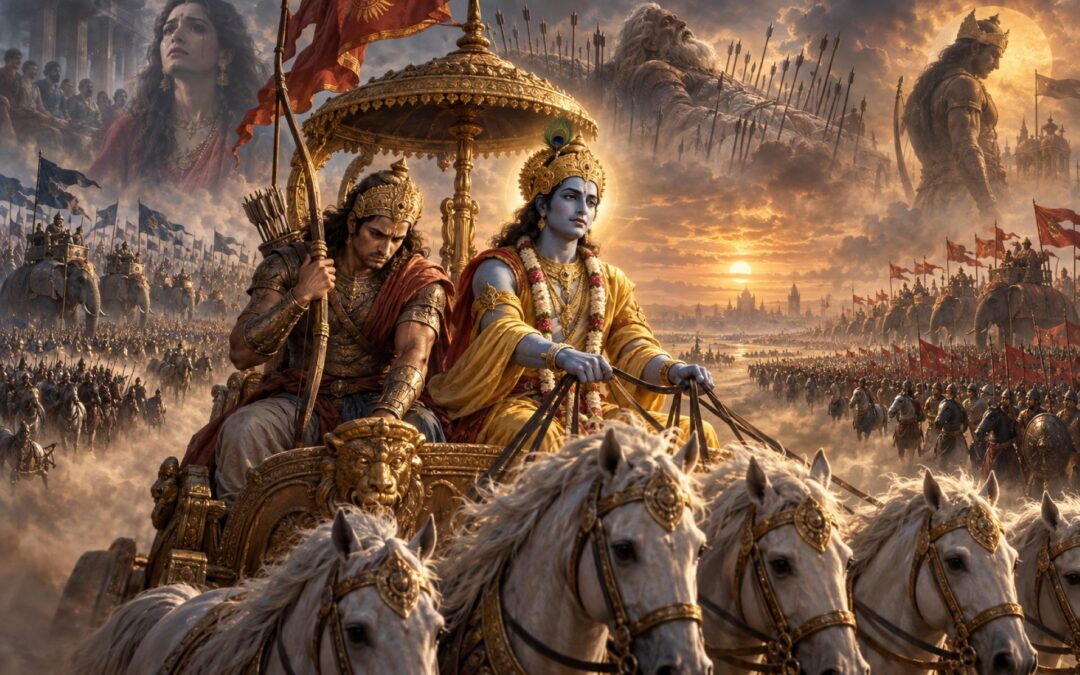
The Mahabharata is often introduced as the story of a war between two branches of an Indian royal family, but that description is roughly equivalent to calling Hamlet a story about a prince whose father dies. The dynastic struggle between the Pandavas and Kauravas provides the narrative spine, yet around it grows an extraordinary body of mythology, political thought, ethical argument, religious teaching, folklore, tragedy, genealogy, pilgrimage, law, philosophy, and speculation about how human beings should act when every available choice carries a cost. The result is not simply one of the world’s longest epics but one of its most sustained investigations of moral conflict.
The work is traditionally attributed to Krishna Dvaipayana Vyasa, who also appears within the story as an ancestor of the Kuru dynasty and as a sage capable of intervening in its affairs. Historically, however, the surviving Mahabharata is better understood as a layered composition that developed over centuries rather than the product of a single identifiable author working at one moment. This article follows the Sanskrit text established by the Bhandarkar Oriental Research Institute’s Critical Edition, while using Bibek Debroy’s complete ten-volume English translation as the principal modern English reading edition. That matters because some scenes familiar from later retellings, regional traditions, television adaptations, and popular mythology differ from the critically constituted Sanskrit text.
The epic’s moral structure is equally important to establish at the beginning. The Pandavas are usually the side with the stronger claim to sympathy, and Krishna repeatedly supports them, but the Mahabharata is not a clean story in which virtuous heroes defeat uncomplicated villains by virtuous means. Bhishma’s noble vow helps create the succession crisis. Yudhishthira’s commitment to dharma coexists with disastrous gambling and morally compromised wartime decisions. Arjuna receives a transcendent teaching about duty but later kills Karna under circumstances that trouble ordinary rules of combat. Bhima fulfills justifiable vows of vengeance through terrifying violence. Karna is humiliated and loyal but also participates in cruelty. Duryodhana is courageous and capable of friendship while remaining unwilling to relinquish a political ambition that drives his family toward destruction. The further the story proceeds, the less useful simple moral labeling becomes.
This article contains complete spoilers for the entire Mahabharata, including the Kurukshetra war, the deaths of its major characters, Krishna’s death, the Pandavas’ final journey, and the epic’s scenes of heaven and hell. The war is not the ending. Nearly a third of what makes the Mahabharata intellectually distinctive comes from what its survivors must confront after apparent victory has ceased to feel like victory at all.

What the Mahabharata Is—and Which Text This Article Follows
The Mahabharata is simultaneously a text and a tradition. The Sanskrit epic has circulated through manuscripts, recitation, performance, commentary, vernacular translation, regional adaptation, religious interpretation, literary retelling, theatre, television, film, and oral storytelling for centuries. As the Oxford Bibliographies overview of the Mahabharata tradition emphasizes, the work can be approached as heroic epic, scripture, philosophical literature, and a continuing narrative tradition rather than as a single modern-style book existing in one permanently fixed form.
That textual plurality explains the importance of identifying an edition. Beginning in 1919, scholars at the Bhandarkar Oriental Research Institute undertook a vast comparison of Mahabharata manuscripts from different regions. The resulting Critical Edition, completed in 1966 after consultation of 1,259 manuscripts, sought to reconstruct a text supported by the widest recoverable manuscript evidence while recording rejected and variant material in a critical apparatus. It contains the familiar eighteen parvas of the Mahabharata and treats the Harivamsha separately. A complete electronic text of the Critical Edition now makes the constituted Sanskrit text directly searchable and comparable.
A Critical Edition should not be mistaken for a recovered manuscript personally written by Vyasa or for proof that every excluded passage is “fake.” Its purpose is philological: to move behind later manuscript expansion toward a reconstructable common textual layer. The living Mahabharata tradition is broader. Material absent from the Critical Edition may still be ancient, regionally important, religiously meaningful, or culturally central, but it should not silently be treated as part of the selected text when summarizing that edition.
This distinction becomes visible almost immediately. The celebrated story in which Vyasa dictates the epic to Ganesha under a condition of uninterrupted composition is famous in later Mahabharata tradition, but it is not part of the critically constituted opening followed here. The same caution applies to Draupadi’s swayamvara, where the Critical Edition does not retain the familiar version in which she explicitly rejects Karna because of his birth status. Even the dice-hall disrobing exists in multiple textual forms: the Critical Edition retains the multiplication of Draupadi’s garments but not the later, more explicit sequence in which she prays to Krishna and Krishna personally supplies an endless sari. Modern scholarship on the textual history of Draupadi’s attempted disrobing helps explain why modern readers may know a version different from the one summarized here.
For readers who want to experience the complete Critical Edition in English, Debroy’s translation is the most practical modern choice. Readers seeking a freely available complete English translation can use Kisari Mohan Ganguli’s public-domain Mahabharata, though Ganguli translates a pre-Critical-Edition textual tradition and his Victorian English can be difficult. Neither should be confused with the many excellent abridgments, which are often more approachable but necessarily omit vast amounts of the epic’s embedded narrative, philosophy, ritual instruction, and postwar material.
From the Kuru Dynasty to the Dice Hall: Adi and Sabha Parvas
The first two books construct the catastrophe before it occurs. The war does not arise from one quarrel or one wicked decision but from generations of compromised succession, binding vows, concealed parentage, jealous rivalry, political calculation, and unresolved grievances. By the time Yudhishthira sits down to gamble, the Kuru family already carries enough accumulated tension that a game of dice can become the mechanism through which an entire political order collapses.
Origins, Vows, Births, and the Making of the Kuru Conflict
The Mahabharata is itself a story about storytelling. Its outer narrative involves the bard Ugrashravas Sauti speaking to sages gathered in the forest of Naimisha. Sauti recounts a version of the epic previously narrated by Vyasa’s disciple Vaishampayana during King Janamejaya’s snake sacrifice. Janamejaya is a descendant of the very Pandavas whose story he hears, which means the main narrative is framed from the beginning as remembered catastrophe: later generations are trying to understand what happened to their ancestors and what those events mean.
Janamejaya’s sacrifice emerges from another chain of inherited violence. His father Parikshit dies after being bitten by the serpent king Takshaka, and Janamejaya responds by attempting to annihilate the serpents through a great ritual. The young sage Astika eventually stops the sacrifice. Before the central Kuru conflict has even begun, the epic has therefore staged a miniature version of one of its governing problems: an injury produces vengeance, vengeance grows into collective destruction, and someone must discover whether inherited hatred can be interrupted before retaliation becomes extermination.
The dynastic story moves through the Bharata lineage toward the Kuru royal house. One of its decisive figures is King Shantanu, who first marries the river goddess Ganga. Their surviving son Devavrata becomes one of the epic’s greatest warriors. When Shantanu later falls in love with Satyavati, however, her father demands that Satyavati’s descendants inherit the throne. Devavrata solves his father’s problem by renouncing his own claim and taking an even more extreme vow of lifelong celibacy so that he can never produce rival heirs. The gods respond to the terrible force of the vow by giving him the name Bhishma, “the terrible” or “the one of the terrible vow.”
The vow is magnificent as an act of filial devotion and disastrous as dynastic policy. Bhishma becomes the Kuru family’s supreme guardian while removing himself from the normal mechanism of succession. Shantanu and Satyavati’s sons Chitrangada and Vichitravirya both die without establishing a secure line. Bhishma cannot simply take the throne or father heirs because the very promise that defines his moral greatness forbids him from doing so.
The problem is eventually addressed through Vyasa, Satyavati’s son from before her marriage to Shantanu. Following the practice of niyoga, Vyasa fathers children on Vichitravirya’s widows Ambika and Ambalika. Ambika closes her eyes when she sees the austere sage, and her son Dhritarashtra is born blind. Ambalika turns pale with fear, and her son Pandu is born pale. A maidservant who receives Vyasa without the same fear gives birth to Vidura, who will become one of the epic’s wisest political counselors but whose maternal status limits his claim to kingship.
Dhritarashtra is the elder brother, but his blindness complicates his succession. Pandu becomes king and proves militarily successful, yet his own future is destroyed by a curse. While hunting, Pandu shoots a deer engaged in mating, only to discover that the animal is a sage in animal form. The dying sage curses Pandu to die if he approaches either of his wives sexually. Pandu withdraws to the forest with Kunti and Madri, and the succession problem that Bhishma’s vow helped create returns in a new form.
Kunti already carries a secret that will become one of the epic’s cruelest delayed revelations. As a young woman, she received a mantra allowing her to summon gods and obtain children from them. Curious about its power, she invoked the sun god Surya before marriage and gave birth to a son born with divine armor and earrings. Terrified of scandal, she placed the infant in a basket and abandoned him. He was found and raised by the charioteer Adhiratha and his wife Radha. The boy becomes Karna, while Kunti goes on to marry Pandu and keeps his identity hidden.
When Pandu can no longer father children, Kunti uses her mantra with his approval. She invokes Dharma and gives birth to Yudhishthira, Vayu and gives birth to Bhima, and Indra and gives birth to Arjuna. She shares the mantra with Madri, who invokes the Ashvins and gives birth to the twins Nakula and Sahadeva. These five become known collectively as the Pandavas, although their biological parentage is divine rather than Pandu’s.
Dhritarashtra, meanwhile, marries Gandhari. Her pregnancy develops strangely and eventually produces the hundred sons conventionally called the Kauravas, together with a daughter. The eldest son is Duryodhana. Ominous signs attend his birth, and counselors warn Dhritarashtra that the child may destroy the dynasty. Dhritarashtra cannot bring himself to sacrifice his son for the larger political good, anticipating a pattern that will define his kingship: he can often see the right course intellectually, but paternal attachment repeatedly prevents him from enforcing it.
Pandu eventually succumbs to the curse when desire overcomes restraint and he approaches Madri. He dies, and Madri joins him on his funeral pyre, leaving Kunti to raise all five Pandavas. The boys return to Hastinapura, where they grow up alongside Dhritarashtra’s sons under the guardianship of Bhishma and the Kuru elders.
Their rivalry appears early and violently. Bhima’s physical strength makes him especially threatening to Duryodhana, who attempts to kill him. The cousins are trained first by Kripa and then by Drona, a brilliant but embittered master of arms. Arjuna becomes Drona’s favorite student and develops extraordinary skill with the bow.
The episode of Ekalavya complicates any simple celebration of Arjuna’s excellence. Ekalavya, a talented youth denied conventional instruction by Drona, trains himself before an image of the teacher and becomes a formidable archer. When Drona realizes that his skill threatens his promise that Arjuna will be unrivaled, he demands Ekalavya’s right thumb as the teacher’s fee. Ekalavya complies. The incident exposes the social exclusions and moral compromises embedded in institutions that also produce the epic’s celebrated heroes.
Drona carries a grievance of his own against King Drupada of Panchala. They had known one another when young, but Drupada later denied the equality Drona believed their earlier friendship promised. Once his pupils are trained, Drona sends them to capture Drupada. Arjuna succeeds, enabling Drona to humiliate his former friend and seize part of his kingdom. The feud does not end; Drupada will eventually perform a sacrifice to obtain children capable of destroying Drona and strengthening the enemies of the Kurus.
At a public martial exhibition, another central relationship begins. Karna appears and challenges Arjuna, displaying skill comparable to his. His social identity becomes an obstacle to the duel, and he is humiliated over his supposed low birth. Duryodhana immediately recognizes both Karna’s value and his resentment. He makes Karna king of Anga, giving him status and creating a bond of loyalty that will survive every later attempt to separate them. For Karna, Duryodhana is the man who treated him as an equal when the established elite would not. For Duryodhana, Karna is both friend and indispensable counterweight to Arjuna.
As the Pandavas’ popularity grows, Duryodhana becomes increasingly determined to eliminate them. A palace made from highly flammable materials is prepared for them at Varanavata. Vidura covertly warns them, and they escape through a tunnel after arranging circumstances that convince the world they have died. The escape itself is morally uncomfortable because others die in the burning structure, but the Pandavas’ presumed deaths free them temporarily from Kuru surveillance.
During their wandering, Bhima encounters the rakshasa Hidimba. He kills him and forms a relationship with Hidimba’s sister Hidimbi, with whom he has a son, Ghatotkacha. Ghatotkacha later becomes one of the Pandavas’ most powerful wartime allies. Bhima also kills the man-eating Baka, reinforcing his role as the brother whose enormous physical strength is repeatedly used against threats the others cannot confront directly.
The brothers eventually hear of Draupadi’s swayamvara in Panchala. Draupadi is the daughter of Drupada and sister of Dhrishtadyumna, who has been born from sacrifice with the destiny of confronting Drona. Arjuna, still living in disguise with his brothers, wins the archery contest that determines Draupadi’s husband. In the Critical Edition followed here, the later-famous scene in which Draupadi explicitly excludes Karna because of his supposed social status is not part of the constituted text.
When the brothers return home with Draupadi, Kunti, without first seeing what they have brought, tells them to share what they have obtained. The extraordinary result is Draupadi’s marriage to all five Pandavas. The epic supplies theological and narrative explanations for this polyandrous arrangement, but its political effect is equally important: Draupadi unites the brothers to Panchala, one of the most powerful kingdoms opposed to the Kuru establishment.
The return of the supposedly dead Pandavas forces Hastinapura to acknowledge them. To reduce conflict, the Kuru realm is divided, and the Pandavas are given territory from which they develop the magnificent capital of Indraprastha. Their rise is rapid. The once-endangered brothers now possess a kingdom, powerful alliances, extraordinary martial ability, and Krishna’s friendship.
Arjuna’s personal story also expands during this period. Under the brothers’ arrangement governing access to Draupadi, he accepts a period of exile after intruding where Yudhishthira and Draupadi are together, even though the intrusion was motivated by duty. During his travels he forms relationships with Ulupi and Chitrangada and later marries Krishna’s sister Subhadra. Subhadra gives birth to Abhimanyu, whose death will become one of the war’s defining tragedies. Chitrangada gives birth to Babhruvahana, who becomes crucial during the postwar horse sacrifice.
The Adi Parva closes its central political development with the burning of the Khandava forest. Agni, the fire god, seeks to consume the forest, and Krishna and Arjuna help him overcome resistance from Indra and others. The episode displays their extraordinary partnership and martial power, but it is also an act of mass destruction within the epic’s world. Among the survivors is the architect Maya, whose gratitude leads directly to one of the wonders of the next book.
Indraprastha, the Rajasuya, and the Dice Game
Maya builds Yudhishthira an astonishing assembly hall at Indraprastha. The hall becomes a symbol of the Pandavas’ transformed status: they are no longer endangered princes living under their cousins’ authority but rulers capable of competing for supremacy among kings. Yudhishthira begins considering the Rajasuya, a royal sacrifice that would establish a claim to imperial sovereignty.
One obstacle is Jarasandha, the powerful king of Magadha. Krishna argues that Jarasandha must be defeated before the Rajasuya can proceed. Krishna, Arjuna, and Bhima approach him, and Bhima ultimately kills Jarasandha in prolonged single combat. Kings held by Jarasandha are released, while the Pandavas undertake campaigns securing tribute and recognition from other rulers.
The Rajasuya gathers kings and dignitaries at Yudhishthira’s court. When Krishna is chosen for the highest ceremonial honor, Shishupala denounces him and unleashes a long history of hostility. Krishna finally kills Shishupala. The episode reinforces Krishna’s growing theological stature while also demonstrating that Yudhishthira’s imperial ritual is surrounded by violence even at its moment of greatest glory.
Duryodhana sees the prosperity of Indraprastha and returns to Hastinapura consumed by envy. Later retellings often elaborate his humiliation in Maya’s deceptive hall and sometimes have Draupadi mock him, but that familiar dramatic formulation should not be casually imported into the selected Critical Edition. What matters for the main narrative is that Duryodhana experiences the Pandavas’ rise not as a tolerable division of family power but as an intolerable challenge to his own status.
Shakuni, Duryodhana’s maternal uncle and a master of dice, proposes the means by which Yudhishthira can be destroyed without open battle. Yudhishthira knows gambling is dangerous and that Shakuni is exceptionally skilled, yet he feels constrained by aristocratic expectations and by his own weakness for the game. Dhritarashtra permits the invitation. A political contest disguised as entertainment begins.
Shakuni throws on Duryodhana’s behalf, and Yudhishthira loses repeatedly. The stakes escalate from wealth to possessions, servants, kingdom, brothers, and himself. Once Yudhishthira has lost his own freedom, he stakes Draupadi and loses her too.
What follows is the epic’s most important legal and moral crisis before the war. Draupadi is summoned to the assembly and asks a devastating question: if Yudhishthira had already lost himself, did he still possess the legal authority to stake her afterward? The question exposes how little moral clarity the court possesses beneath its appearance of institutional authority. Bhishma, embodiment of ancient wisdom and duty, cannot provide a decisive answer because the obligations involved appear to conflict. Other elders are similarly paralyzed.
Dushasana drags Draupadi into the hall. Karna joins in the verbal attack against her, and Duryodhana participates in her humiliation. Dushasana attempts to strip her. In the Critical Edition, additional garments continue to appear as her clothing is pulled away, but the explicit later devotional sequence in which Draupadi prays to Krishna and Krishna directly provides an endless sari is not part of the constituted passage. The distinction matters because the textual history of the disrobing episode shows how profoundly later reception has shaped modern memory of the scene.
Bhima responds with vows that will echo across the entire war. He promises terrible vengeance against Dushasana and Duryodhana. Draupadi does not become merely a passive victim waiting for men to avenge her; her questioning has already demonstrated that she understands the legal contradiction of the assembly more clearly than many of its supposed guardians.
Dhritarashtra finally becomes frightened by the consequences of what his sons have unleashed. He offers Draupadi boons, and she uses them to restore Yudhishthira and his brothers. For a moment the disaster appears reversible.
It is not. A second game is arranged. The decisive wager imposes twelve years of forest exile followed by a thirteenth year in which the Pandavas must remain unrecognized. If they are discovered during that final year, the exile must begin again. Yudhishthira loses, and the Pandavas leave their kingdom with Draupadi.
The dice hall transforms every earlier rivalry into an existential conflict. Bhima leaves with vows of blood. Draupadi leaves with a memory of public humiliation and institutional failure. Arjuna leaves knowing his weapons may one day be needed against his own teachers and relatives. Duryodhana has acquired the kingdom he wanted, but only by making future coexistence nearly impossible.
Exile, Disguise, and the Failure of Peace: Vana, Virata, and Udyoga Parvas
The exile books slow the central political action without pausing the epic’s development. The Pandavas acquire weapons, allies, knowledge, grievances, and stories that reshape how they understand their own suffering. When they finally emerge from concealment and attempt negotiation, war is no longer merely the threatened consequence of the dice game; it is the outcome toward which dozens of unresolved commitments have converged.
The Forest Exile and Its Embedded Teaching Stories
The Vana Parva is vast, episodic, and intentionally expansive. Draupadi and Bhima repeatedly challenge Yudhishthira’s policy of patience. To them, excessive restraint can look like weakness dressed in the language of virtue. Yudhishthira insists that anger does not automatically produce justice and that a promise made in the dice hall, however unjust its circumstances, cannot simply be discarded without consequence.
Their disagreement establishes one of the Mahabharata’s recurring internal debates. No single character owns the definition of dharma. Yudhishthira’s restraint prevents reckless retaliation, but his commitment to the game helped create the crisis in the first place. Bhima’s anger is morally intelligible because he witnessed Draupadi’s humiliation, yet his preferred solutions often depend on overwhelming violence. Draupadi’s demands expose the danger of asking victims to admire patience while perpetrators enjoy the rewards of wrongdoing.
The forest itself is dangerous. Bhima kills Kirmira and other threats, while the brothers meet sages who expand the scale of the epic beyond immediate Kuru politics. The Pandavas’ exile becomes a setting in which their own story is repeatedly placed beside older stories of kings, lovers, ascetics, heroes, gods, and people who face analogous catastrophes.
Arjuna leaves his brothers to seek celestial weapons. His quest eventually brings him into conflict with Shiva, who appears disguised as a hunter. Arjuna and the mysterious hunter compete over a slain animal and then fight. When Arjuna recognizes that his opponent is Shiva, his perseverance is rewarded with the formidable Pashupata weapon. He later travels to Indra’s realm and acquires further divine weapons and training. The quest is practical preparation for war, but it also marks how far the coming conflict will exceed ordinary human combat.
The embedded story of Nala and Damayanti speaks directly to Yudhishthira’s condition. Nala is a king whose weakness for gambling contributes to the loss of his kingdom and separation from his wife. Through suffering, transformation, skill, and eventual recovery, he regains what was lost. The story does not mechanically predict Yudhishthira’s future, but it provides an analogue through which gambling, dispossession, marriage, endurance, and restored kingship can be contemplated at a safe narrative distance.
Savitri’s story addresses a different form of loss. Knowing that her husband Satyavan is destined to die, Savitri follows the god of death and engages him with disciplined intelligence until she obtains boons that culminate in Satyavan’s restoration. The episode elevates fidelity and verbal skill while also giving Draupadi and the Pandavas another example of how determined human action operates inside a world structured by fate.
The Ramopakhyana, a telling of the Rama story embedded within the Mahabharata, places yet another exile narrative beside the Pandavas’ own. Its presence illustrates how the Mahabharata thinks through comparison. Embedded stories are not interruptions merely because they delay the central plot; they often function as interpretive mirrors through which characters and readers reconsider the main narrative.
Bhima’s meeting with Hanuman performs a similar widening of heroic context. Both are sons of the wind god Vayu. Bhima’s pride in his strength is tested when he encounters Hanuman in the form of an old monkey and cannot move the monkey’s tail. The episode humbles Bhima while connecting the Pandavas’ world to the heroic universe associated with Rama.
Meanwhile, old political dangers continue following the exiles. Jayadratha, king of Sindhu and husband of Duryodhana’s sister Duhshala, attempts to abduct Draupadi. The Pandavas pursue and defeat him. He survives, but the humiliation becomes another grievance. His later role in preventing Pandava warriors from reaching Abhimanyu during the war will make this forest incident part of a much larger causal chain.
Duryodhana himself tries to display his prosperity near the exiled Pandavas, an act designed to sharpen their humiliation. Instead, Gandharvas defeat and capture him. The Pandavas rescue him despite Bhima’s reluctance. Yudhishthira insists that conflict within the family does not justify allowing outsiders to dishonor a Kuru prince. The act demonstrates the very kinship ethic that Duryodhana repeatedly refuses to reciprocate.
Karna’s preparation for the future war also changes during the exile. Born with natural armor and earrings that make him extraordinarily difficult to kill, he is approached by Indra, Arjuna’s divine father, in disguise. Karna recognizes the danger but refuses to abandon his reputation for generosity. He gives away the armor and earrings and receives in return a divine weapon capable of killing one formidable enemy. He intends to reserve it for Arjuna.
The exile eventually approaches its conclusion through the celebrated Yaksha episode. One by one, Yudhishthira’s brothers drink from a lake despite a mysterious warning and fall unconscious. Yudhishthira obeys the unseen questioner and answers a long series of questions concerning morality, mortality, wisdom, human nature, duty, and the strange contradictions of life. When allowed to restore one brother, he chooses Nakula rather than the militarily indispensable Bhima or Arjuna, explaining that because he himself survives as Kunti’s son, fairness requires that one of Madri’s sons also survive. The questioner, revealed as Dharma, restores all four brothers.
The episode is not proof that Yudhishthira has solved dharma permanently. His later decisions will remain contestable. What it shows is the quality that repeatedly distinguishes him at his best: he can place principle above immediate advantage even when enormous practical stakes encourage a different answer.
The Year at Virata
For their thirteenth year, the Pandavas enter the kingdom of Matsya and adopt disguised identities. Yudhishthira becomes Kanka, a court companion skilled in dice; Bhima becomes a cook and wrestler; Arjuna lives as Brihannala, a dance and music teacher; Nakula tends horses; Sahadeva manages cattle; and Draupadi serves Queen Sudeshna as Sairandhri. The disguises are partly comic inversions of their heroic identities, but they also expose how dependent social power is on recognition. Famous warriors must survive while unable to openly exercise the status that once protected them.
The gravest danger comes from Kichaka, Sudeshna’s powerful brother. He becomes obsessed with Draupadi and abuses the institutional security his position gives him. Because the Pandavas cannot reveal themselves without risking another thirteen years of exile, Draupadi initially appears trapped by the same structural problem that defined the dice hall: a powerful man acts with confidence because those who should protect her are constrained or silent.
This time, however, Draupadi and Bhima act together. She arranges a meeting with Kichaka under deceptive circumstances, and Bhima waits in her place. He kills Kichaka with overwhelming violence. The episode reinforces the particular bond between Draupadi and Bhima: among her husbands, he is often the one most immediately responsive to her anger and demand for vengeance.
The final stage of the incognito year is dominated by cattle raids. Kuru forces attack Matsya, expecting to exploit the kingdom’s weakness. Arjuna accompanies the inexperienced prince Uttara, reveals his true identity, retrieves the weapons the Pandavas had concealed, and defeats the Kuru warriors. The concealment period has effectively ended.
King Virata, delighted by the revelation of who has been serving in his court, offers his daughter Uttara to Arjuna. Arjuna declines because his role as her dance teacher has made him more like a parent or mentor to her. Instead, Uttara marries Arjuna’s son Abhimanyu. The alliance links Matsya more closely to the Pandavas just as the political struggle moves toward open confrontation.
Diplomacy Fails and the Armies Gather
The Udyoga Parva is the epic’s long demonstration that war is not inevitable merely because everyone expects it. Both sides recruit kings and armies, but diplomacy continues almost until fighting begins. The repeated negotiations make responsibility for the conflict more, not less, complicated because each failed opportunity reveals who is willing to compromise and who is not.
Krishna’s choice becomes symbolically decisive. He offers one side his large military force and the other side himself, unarmed and promising not to fight. Duryodhana chooses the forces. Arjuna chooses Krishna. Krishna becomes Arjuna’s charioteer, a role that outwardly appears subordinate but gives him extraordinary influence over the war’s most important warrior.
Messages move between Hastinapura and the Pandava camp. Sanjaya carries diplomatic communication. Vidura again counsels Dhritarashtra, warning against policies driven by attachment, greed, and bad advisers. The material traditionally known as Vidura Niti develops political and ethical reflections on self-control, kingship, judgment, friendship, and conduct. The Sanatsujata discourse broadens the discussion further toward knowledge, ignorance, death, and liberation.
Krishna eventually travels to Hastinapura as a peace envoy. The Pandava demands have already been reduced from full restoration toward increasingly modest settlement. Duryodhana nevertheless refuses to concede a politically meaningful share. When some in the Kuru court consider restraining Krishna, Krishna reveals a supernatural form that demonstrates the impossibility of treating him as an ordinary diplomat who can simply be imprisoned.
Before the war, Krishna approaches Karna privately and reveals the secret Kunti has hidden since before Karna’s birth. Karna is not the low-born outsider he has always believed himself to be. He is Kunti’s first son and therefore, by birth, the eldest of the Pandava brothers.
Krishna offers Karna a radically different future. If he joins the Pandavas, he can be recognized as the eldest brother and receive the royal status his abilities have always seemed to deserve. Karna refuses. Whatever injustices he has suffered, Duryodhana was the man who stood beside him when others mocked his birth. To abandon him now, with war imminent, would make Karna’s social grievance the justification for betraying the person who answered that grievance with friendship.
Kunti then meets Karna herself. Their encounter is painful because the truth comes too late to undo the life her secrecy helped create. Karna refuses to switch sides but gives her a grim consolation: he will direct his decisive hostility toward Arjuna rather than seek the deaths of all five brothers. Whether Karna or Arjuna survives their confrontation, Kunti will still have five sons.
Bhishma accepts command of the Kaurava army despite loving the Pandavas and repeatedly warning against Duryodhana’s course. This contradiction captures his whole tragedy. His vows bind him to the Kuru throne, but loyalty to an institution has become loyalty to a war he knows may destroy the family he has spent his life protecting.
The Kurukshetra War: Bhishma through Shalya
The Kurukshetra war occupies only part of the Mahabharata, yet nearly every major relationship and unresolved vow converges upon its eighteen days. The fighting is reported to the blind Dhritarashtra by Sanjaya, who receives the capacity to perceive distant events. That narrative arrangement turns the king into a spectator of the destruction his failures helped enable: he can finally “see” the consequences through Sanjaya’s words while remaining physically absent from the battlefield.
Bhishma and the Bhagavad Gita: Days 1–10
When the armies assemble, Arjuna asks Krishna to place their chariot between them so he can see those with whom he must fight. What he sees destroys his confidence. The opposing army contains relatives, teachers, friends, elders, and people whose deaths would leave the supposed victory soaked in familial grief. Arjuna lowers his weapon and questions the value of a kingdom purchased through the destruction of those for whose sake a kingdom should matter.
Krishna’s answer becomes the Bhagavad Gita, one of the most influential religious and philosophical texts in world literature. The dialogue does not simply tell Arjuna that killing is acceptable because he is a warrior. Krishna attacks Arjuna’s assumption that refusing to act necessarily frees him from moral responsibility. He distinguishes the enduring self from the mortal body, argues that action is unavoidable, teaches action without attachment to its fruits, explores knowledge and disciplined meditation, develops devotion to the divine, and eventually reveals his overwhelming cosmic form.
The Gita’s argument is difficult precisely because Arjuna’s problem is genuine. He is not a coward looking for an excuse to avoid danger; he is horrified by what duty appears to require. Krishna’s response is that moral action cannot be grounded simply in desire for pleasant outcomes. Arjuna must understand his place within a larger order, act according to his responsibility, and relinquish possessive attachment to the results.
Arjuna eventually resumes his bow. The war begins under Bhishma’s command.
Bhishma’s battlefield performance is devastating. Although emotionally attached to the Pandavas, he fights with extraordinary effectiveness for Duryodhana’s side. His contradictions become visible every day: he can lament the conflict and still kill the soldiers before him because his understanding of duty binds him to the throne he serves.
The war begins with conventions meant to limit violence, but such restraints become progressively harder to maintain as loss accumulates. Krishna, who has vowed not to fight, is himself repeatedly driven toward intervention by the danger Bhishma poses. At one point his fury becomes so intense that he appears prepared to break his promise in order to protect Arjuna and destroy Bhishma. Arjuna restrains him and renews his own commitment to fight.
The Pandavas eventually learn that Bhishma’s refusal to fight Shikhandi offers the route to defeating him. Shikhandi is connected to Amba, whose life was destroyed through circumstances rooted in Bhishma’s earlier actions and vow. The old moral debt of the first generation therefore returns physically to the battlefield.
On the tenth day, Shikhandi is placed before Arjuna. Bhishma will not effectively oppose Shikhandi, allowing Arjuna to strike him with overwhelming numbers of arrows. Bhishma falls but does not die. Because he possesses the boon of choosing the time of his death, he remains suspended upon a bed of arrows, alive long after his role as commander has ended.
The first phase of the war therefore concludes with a paradox. The Kuru dynasty’s greatest defender has been defeated by the long-delayed consequences of his own past, but he remains alive to witness the ruin that follows. His final and perhaps greatest role will come only after the war, when the survivors ask the man who could not prevent catastrophe to teach them how a kingdom should be governed.
Drona: Abhimanyu, Jayadratha, Ghatotkacha, and the Fall of the Teacher
Drona assumes command and increases the pressure on the Pandavas. His strategy repeatedly involves separating Arjuna from Yudhishthira so that the Pandava king can be captured. The Samsaptakas, warriors sworn to challenge Arjuna, draw him away from the main battlefield, creating the conditions for one of the war’s defining disasters.
Drona arranges a complex military formation that must be penetrated quickly. Abhimanyu, Arjuna’s young son, can break into it, and the Pandavas expect to follow him. Jayadratha, however, helps prevent the supporting warriors from entering behind Abhimanyu. The young warrior becomes trapped among vastly more experienced opponents.
Abhimanyu fights with extraordinary skill and inflicts enormous losses, but the battle ceases to resemble honorable single combat. His weapons and mobility are progressively stripped away, and several warriors participate in overwhelming him. He is killed inside the formation while Arjuna remains elsewhere on the battlefield.
The death changes the emotional temperature of the war. Arjuna returns, learns what happened, and vows to kill Jayadratha before the following sunset or die himself. The next day’s fighting is organized around that deadline. Kaurava warriors devote themselves to protecting Jayadratha, while the Pandava side attempts to create a path for Arjuna.
Arjuna eventually reaches and kills Jayadratha before the vow can consume him. What began as a strategic battle has become increasingly driven by personal promises of vengeance, and those vows will continue dictating tactics regardless of broader consequences.
Combat extends into the night, where Ghatotkacha becomes especially dangerous. As a rakshasa, his supernatural abilities flourish in darkness, and he begins destroying Kaurava forces at a rate Duryodhana cannot tolerate. Karna is finally forced to use the divine weapon he obtained from Indra in exchange for his natural armor and earrings.
The weapon kills Ghatotkacha. Bhima loses his son, but Krishna reacts with relief because the weapon had been intended for Arjuna and could be used only once. Ghatotkacha’s death is therefore simultaneously devastating and strategically protective: by becoming the target of Karna’s surest weapon, he indirectly saves Arjuna.
Drona remains a nearly unstoppable commander. The Pandavas conclude that he can be neutralized only if he loses the will to fight. Bhima kills an elephant named Ashvatthama, sharing the name of Drona’s beloved son, and the warriors spread the claim that Ashvatthama has died.
Drona does not trust Bhima and turns to Yudhishthira, whose reputation for truth makes him uniquely credible. Under enormous pressure, Yudhishthira gives an answer that allows Drona to believe his son is dead while qualifying the statement in a way that blurs responsibility for the falsehood. The moral cost is important precisely because Yudhishthira is the character most associated with truth and dharma.
Broken by the news, Drona lays down his weapons and turns inward. Dhrishtadyumna, born through Drupada’s sacrifice for the purpose of killing him, takes the opportunity and kills the defenseless teacher. Another ancient cycle closes through an act that would appear dishonorable under ordinary rules of war.
Ashvatthama survives and responds with fury. He releases the Narayana weapon, whose destructive power increases against those who resist it. Krishna understands that the Pandava forces must lay down their weapons and cease opposition. Bhima initially resists the humiliation of submission, but the weapon is ultimately survived not through superior aggression but through recognition that aggression itself is feeding the danger.
The Drona phase demonstrates the war’s moral deterioration more clearly than any earlier section. Abhimanyu is destroyed unfairly; Arjuna answers with an extreme vow; Ghatotkacha becomes a strategic sacrifice; and Drona is defeated through deception. By now, no claim that one side will win while preserving the moral purity with which it entered the war can survive contact with events.
Karna and Shalya: The Last Three Days
Karna finally becomes commander after Drona’s death. The position brings him to the confrontation toward which his entire life has been moving. He has lost his natural armor, spent his most reliable divine weapon, learned the truth of his birth, refused Krishna’s offer, and promised Kunti that his decisive rivalry will be with Arjuna.
Shalya serves as Karna’s charioteer despite tensions between them. Their exchanges repeatedly unsettle Karna rather than offering the reassuring partnership Krishna provides Arjuna. The contrast between the two chariot teams becomes another way the epic stages the difference between isolated heroic pride and sustaining relationship.
Bhima, meanwhile, finally reaches Dushasana. The memory of Draupadi’s treatment in the dice hall has shaped his vows for years. He kills Dushasana with extraordinary brutality and fulfills the terrible promise he made after Draupadi’s humiliation, including his blood-soaked vengeance. The scene refuses to let righteous grievance remain aesthetically clean once translated into action.
Karna continues inflicting major damage. He defeats and humiliates Yudhishthira, contributing to a severe quarrel between Yudhishthira and Arjuna. Arjuna carries vows concerning anyone who insults or belittles his bow and martial identity, while his obligations toward his elder brother forbid a literal fulfillment of those vows. Krishna must guide him through a way of satisfying the logic of his promise without producing another fratricidal catastrophe.
The long-awaited duel between Karna and Arjuna finally begins. It is not simply a contest to determine which archer is stronger. Every important element of Karna’s life arrives with him: his abandoned birth, Duryodhana’s friendship, his hunger for recognition, his generosity, his involvement in Draupadi’s humiliation, his participation in Abhimanyu’s destruction, the loss of his divine protection, and the curses and consequences accumulated through previous actions.
At a critical moment Karna’s chariot wheel becomes trapped. He asks Arjuna to observe the rules of combat and allow him time to free it. Krishna answers the appeal by recalling moments when Karna and his allies refused comparable fairness to others, especially Draupadi and Abhimanyu. Arjuna kills Karna while he is vulnerable.
The death is strategically decisive and ethically uncomfortable. Karna cannot claim an unblemished right to fairness after participating in earlier violations, but earlier wrongdoing does not magically convert every retaliatory breach into an ideal act. The Mahabharata allows both truths to remain visible.
Shalya assumes command for the final day and is eventually killed by Yudhishthira. Sahadeva kills Shakuni, ending the life of the gambler whose skill enabled the dice-hall disaster. The Kaurava army collapses.
Duryodhana retreats and hides in a lake. When found, he eventually emerges for single combat with the mace, a weapon at which he is exceptionally skilled. Bhima faces him. The duel is dangerous enough that Krishna recognizes the possibility that Duryodhana could still win under the formal rules.
Bhima therefore does what those rules forbid. Guided toward the necessary tactic, he strikes Duryodhana on the thigh. The blow fulfills the vow rooted in the dice hall but violates the conventions governing mace combat. Balarama, who knows the art intimately, condemns the act.
Duryodhana lies mortally wounded. The Pandavas have effectively won the war, but the final decisive victory has been achieved through another broken rule. That is not an accidental blemish on an otherwise uncomplicated triumph. It is the logic toward which the entire war has been moving.
Victory Becomes Catastrophe: Sauptika and Stri Parvas
Kurukshetra ends militarily before it ends morally. The Kaurava army has been destroyed and Duryodhana is dying, but survivors remain whose grief has not accepted the battlefield’s verdict. The next two books deliberately shift the meaning of victory from possession of a kingdom to confrontation with the dead.
The Night Massacre
Ashvatthama, son of Drona, survives with Kripa and Kritavarma. Filled with rage over his father’s death and the destruction of Duryodhana’s cause, he sees an owl killing sleeping birds and takes the image as inspiration. If ordinary battle has already abandoned its rules, he sees no reason to respect them now.
At night he enters the sleeping Pandava-Panchala camp. The slaughter is not a continuation of equal combat but an extermination of exhausted survivors. Dhrishtadyumna, who killed Drona, is among Ashvatthama’s primary targets. Shikhandi and many other warriors are killed.
Most devastatingly for Draupadi, her five sons by the Pandava brothers die. The five brothers themselves are not sleeping in the camp and survive. What Duryodhana’s side could not achieve across eighteen days of battle is partly accomplished against the next generation in one night of revenge.
Ashvatthama returns to the dying Duryodhana and tells him what has happened. The news offers Duryodhana a final satisfaction before death, but it cannot change the strategic reality. The Kuru kingdom will not be restored to him. Revenge has produced additional bereavement without reversing defeat.
The Pandavas pursue Ashvatthama. The confrontation escalates beyond ordinary warfare when he releases a catastrophic celestial weapon and Arjuna responds. Sages intervene because the destructive potential extends far beyond the individuals fighting.
Arjuna possesses the discipline to withdraw his weapon. Ashvatthama cannot fully do the same and redirects its destructive force toward the womb of Uttara, Abhimanyu’s widow, where the last continuation of the Pandava line is developing. Krishna protects the future heir, Parikshit. The dynasty survives by the narrowest imaginable margin.
The Sauptika Parva completes the war’s central lesson about retaliatory escalation. Once every side begins justifying new violations through earlier violations, there is no natural point at which vengeance stops itself. Only intervention, exhaustion, or the survival instinct of those not yet born can interrupt the sequence.
The Women’s Grief and Karna’s Revelation
The Stri Parva shifts attention toward those who did not command armies but must live with what the commanders have done. Dhritarashtra has lost his sons and still carries rage toward Bhima, who killed Duryodhana and Dushasana. Krishna anticipates the danger when the blind king embraces the Pandavas and substitutes an iron figure for Bhima. Dhritarashtra crushes it, revealing how grief and paternal attachment continue to coexist with murderous anger even after the war is finished.
Gandhari’s position is more complicated. She knows Duryodhana’s faults and repeatedly failed to endorse his conduct, yet moral recognition does not make the deaths of her children less devastating. She walks among the consequences of the war as a mother who has lost nearly everything.
Her anger eventually turns toward Krishna. He possessed enormous influence and divine power, and from Gandhari’s perspective he allowed the destruction to unfold. She curses him so that his own Yadava clan will one day destroy itself. The curse is not left as an impotent outburst; the Mausala Parva will later fulfill it.
The battlefield lament of the women changes the epic’s scale of judgment. Warriors who were described through formations, weapons, vows, and heroic deaths are now husbands, sons, fathers, brothers, and lovers whose bodies must be found and mourned. Heroic glory and private devastation occupy the same ground.
Funeral rites follow. Then Kunti reveals the secret she has maintained for most of the epic: Karna was her firstborn son. The Pandavas learn that the enemy whose death was essential to their victory was their elder brother.
For Yudhishthira, the revelation is shattering. The war was already difficult to justify emotionally after the loss of teachers, cousins, children, allies, and countless soldiers. Now the family structure itself has been revealed to be more tragic than anyone fighting understood. A hidden act from Kunti’s youth has reached across decades to alter the meaning of victory after it can no longer alter the outcome.
The Stri Parva is therefore not simply an epilogue of mourning. It is a reinterpretation of the entire war. The winners receive the kingdom, but knowledge increases their suffering rather than confirming that the moral universe has rewarded them.
What Comes After Victory: Shanti, Anushasana, and Ashvamedhika Parvas
A modern adaptation might end with Yudhishthira’s coronation. The Mahabharata refuses. Its largest intellectual response to Kurukshetra comes after the armies have disappeared, when the surviving king discovers that possessing the throne does not answer the question of whether obtaining it was worth the cost.
Yudhishthira’s Crisis and Bhishma’s Teachings on Kingship
Yudhishthira is overwhelmed by guilt. He has obtained the kingdom that was denied to him, but nearly every person whose recognition might have made kingship satisfying is dead or bereaved. Karna’s newly revealed identity deepens that despair. Yudhishthira considers renunciation preferable to ruling over a kingdom acquired through slaughter.
His brothers, Krishna, Vyasa, and others resist this impulse. Renunciation cannot resurrect the dead, and abandoning responsibility after fighting for sovereignty would impose another cost on those who survived. The argument forces Yudhishthira to confront a different form of dharma: continuing to govern may be morally harder than walking away.
Attention turns to Bhishma, still lying on his bed of arrows and waiting for the proper time to die. The choice is deliberately striking. The survivors seek instruction in government from the elder whose lifetime of loyalty, vows, and compromises failed to prevent the dynasty’s collapse. Bhishma’s authority is not invalidated by that failure, but neither is his teaching detached from it.
The Rajadharma material addresses kingship in enormous detail. A ruler exists to protect subjects, maintain order, appoint capable ministers, gather information, administer punishment, conduct diplomacy, manage revenue, defend territory, and judge competing interests. Kingship is not treated merely as personal honor. It is an institution whose failures spread through society.
The material can be pragmatic to the point of discomfort. Political survival may require secrecy, intelligence gathering, punishment, strategic deception, and calculations that do not resemble private moral purity. The Mahabharata is therefore not content with saying that a good king should be virtuous. It asks what virtue means when the ruler is responsible for security, law, revenue, war, and people whose interests conflict.
This is especially important after Kurukshetra. Yudhishthira’s desire to be personally free from guilt cannot override the responsibilities created by his public position. The epic repeatedly refuses to let moral life become a search for one’s own innocence.
Emergency Ethics, Liberation, Conduct, and Bhishma’s Death
The Shanti Parva moves from ordinary royal duty into apaddharma, the problem of conduct during crisis. Emergency conditions can make normal rules impossible to follow. Actions ordinarily condemned may become defensible when survival or a greater obligation is at stake, while principles that appear absolute in peaceful circumstances may collide violently under pressure.
The danger of emergency ethics is obvious from the war the reader has just witnessed. Nearly every major violation at Kurukshetra can be rationalized through some appeal to necessity. The Mahabharata does not offer a simple formula that makes these conflicts disappear. Instead, it acknowledges that context matters while repeatedly showing how easily necessity can become self-serving justification.
The Mokshadharma material expands the horizon beyond kingship and emergency action toward the possibility of liberation from worldly bondage. It contains numerous dialogues and teachings on the self, knowledge, action, renunciation, yoga, nonviolence, asceticism, devotion, and the conditions under which freedom might be achieved. Rather than presenting one completely uniform philosophy, the parva preserves multiple voices and intellectual approaches.
Among its striking embedded discussions are encounters in which conventional hierarchy is unsettled. The dialogue involving the merchant Tuladhara and the ascetic Jajali questions whether visible austerity guarantees moral superiority. The conversation between Sulabha and King Janaka examines selfhood, liberation, speech, and identity while placing a philosophically sophisticated woman in debate with a celebrated king. Other passages move toward devotional theology, including material centered on Narayana.
The Anushasana Parva continues Bhishma’s instruction but shifts emphasis toward conduct, charity, gifts, vows, religious merit, social obligations, food, nonviolence, and prescriptive norms governing different kinds of people and relationships. The Vishnu Sahasranama, the famous litany of Vishnu’s thousand names, appears within this enormous didactic world rather than standing alone as an isolated devotional text.
Modern readers should not treat every prescription in Shanti and Anushasana as a timeless universal command. The texts contain hierarchical assumptions about social status, gender, ritual, and duty that belong to the historical and religious worlds through which the Mahabharata developed. Their importance lies partly in showing what traditions of normative thought the epic preserved, not in requiring contemporary readers to accept every rule.
Eventually the season changes and Bhishma chooses to die. His death closes an arc that began with the vow made for Shantanu and Satyavati generations earlier. Bhishma gave up kingship and descendants to protect his father’s happiness, then spent his life protecting a dynasty whose succession problems that very vow helped intensify. Only after the dynasty has destroyed itself does he finally complete his duty by instructing its surviving king.
The Horse Sacrifice, Anugita, Babhruvahana, and the Mongoose
Yudhishthira’s sovereignty must still be politically reconstructed. The Ashvamedhika Parva centers on the horse sacrifice, an imperial ritual in which a consecrated horse wanders through territories and rulers must either accept the sponsoring king’s authority or challenge it. Arjuna accompanies the horse, converting ritual sovereignty into a series of political and military encounters.
Before the campaign, Krishna and Arjuna revisit the philosophical relationship transformed by Kurukshetra. Arjuna admits that he has not retained the battlefield teaching in full. Krishna does not simply repeat the Bhagavad Gita word for word. The Anugita instead offers another body of teaching through dialogues, narratives, and reflections on knowledge, action, rebirth, discipline, and liberation. Its difference from the Gita matters: revelation given at a moment of existential crisis cannot necessarily be reproduced under calmer conditions in precisely the same form.
Arjuna’s campaign eventually takes him to Manipura, where his son Babhruvahana rules. Babhruvahana is the child of Arjuna and Chitrangada, conceived during Arjuna’s earlier travels. Their encounter becomes violent, and the son defeats his father.
Arjuna appears to die. Ulupi, another of Arjuna’s earlier partners, intervenes and participates in his restoration. The episode brings relationships established near the beginning of the epic back into the postwar world, demonstrating again how little in the Mahabharata exists as a completely isolated adventure.
The horse sacrifice itself restores Yudhishthira’s imperial position, but the parva ends by questioning the moral meaning of magnificent ritual expenditure. A half-golden mongoose recounts the sacrifice of a poor family whose willingness to give away the little food they possessed represented a form of generosity the royal ritual, for all its grandeur, could not surpass. Political restoration is therefore accompanied by another challenge to visible definitions of merit.
The End of the Age: Ashramavasika through Svargarohana
The final four books gradually dismantle the world the previous books spent constructing. The older generation leaves the court, the Yadavas destroy themselves, Krishna dies, Arjuna’s heroic powers fade, the Pandavas abandon their kingdom, and even the categories of enemy and ally are disturbed by the final visions of heaven and hell. Wendy Doniger’s study and translation of the final books is particularly useful because it treats this material not as a negligible appendix but as the Mahabharata’s extended argument about grief, justice, renunciation, and reconciliation after civil war.
The Elders Leave and the Dead Return
Years of Pandava rule do not erase the old grief. Dhritarashtra lives under the protection of the men who killed his sons, while Bhima’s anger toward Duryodhana’s memory can still wound him. Gandhari and Kunti carry their own losses. Eventually Dhritarashtra decides to leave royal life and enter the forest, accompanied by Gandhari and Kunti. Sanjaya goes with them.
The departure has enormous symbolic force. Kunti does not remain to enjoy the prosperity secured by her sons. She leaves with the parents of the men those sons killed. The older generation withdraws from the political world created by the war and moves toward renunciation.
Vidura is already living an ascetic existence when Yudhishthira encounters him. Their final meeting is represented in unusually metaphysical terms, with Vidura’s life or spiritual energy passing into Yudhishthira. The scene reflects the tradition connecting Vidura and Yudhishthira through Dharma and gives their lifelong ethical relationship a final supernatural expression.
Vyasa later enables one of the most extraordinary reconciliatory moments in the epic. The surviving relatives gather near the Ganges, and for a single night the dead warriors are allowed to return. The distinctions imposed by the battlefield temporarily dissolve as parents, spouses, siblings, and friends encounter those they lost.
The episode does not undo Kurukshetra. The dead do not return permanently, and history is not reversed. Instead, the epic imagines a brief realm in which grief can be answered through recognition and reunion rather than vengeance.
Dhritarashtra, Gandhari, and Kunti eventually die in a forest fire. They do not flee. The generation that presided over the rise and destruction of the Kuru conflict disappears in the forest, far from the palaces where succession once seemed important enough to justify everything that followed.
The Yadavas Destroy Themselves and Krishna Dies
Gandhari’s curse eventually reaches Krishna’s own people. The Yadavas, long protected by their strength and Krishna’s presence, fall into internal disorder. A notorious act in which young Yadavas mock sages leads to a curse involving an iron pestle that will become the instrument of their destruction.
Attempts to eliminate the cursed iron do not escape fate. The pestle is broken or ground down, but its material returns in new forms. At Prabhasa, intoxication, old resentments, and violence erupt among the Yadavas. Reeds become lethal instruments, and the clan destroys itself from within.
The parallel with the Kuru catastrophe is unmistakable. Krishna guided the Pandavas through a war in which their enemies were destroyed partly through their own accumulated hatreds and moral failures. His own clan now collapses through similarly self-destructive violence. The epic does not exempt the victorious side’s divine ally from the world of consequences.
Balarama withdraws from the world. Krishna later sits alone in the forest, where the hunter Jara mistakes part of his body for an animal and shoots him. Krishna accepts the event rather than retaliating. The strategist who shaped Kurukshetra and revealed his cosmic form to Arjuna leaves the world through an almost quiet human scene.
Dvaraka must be abandoned, and Arjuna tries to escort surviving women and dependents to safety. Then another kind of ending occurs. The warrior who once held off armies discovers that his powers no longer answer him as they did before. Bandits attack, and Arjuna cannot fully protect those in his care. Celestial weapons fail him; the heroic identity on which he relied has become obsolete.
The failure is not simply evidence that Arjuna has grown old. It signals that the age itself has changed. Krishna is gone. The conditions under which the Pandavas’ extraordinary power operated are ending. Their continued possession of a kingdom can no longer disguise the fact that their world has passed.
The Great Journey, the Dog, Heaven, Hell, and Final Reunion
The Pandavas place Parikshit, Abhimanyu’s surviving son, on the throne and renounce royal life. Yudhishthira, Bhima, Arjuna, Nakula, Sahadeva, and Draupadi begin a final journey northward, accompanied by a dog. They no longer travel as rulers seeking conquest. They are leaving behind the status around which most of the epic’s conflict revolved.
Draupadi falls first. Bhima asks why Yudhishthira does not stop, and Yudhishthira attributes her fall to partiality toward Arjuna despite being wife to all five brothers. Sahadeva falls next, associated in Yudhishthira’s explanation with pride in wisdom. Nakula falls through pride in his beauty. Arjuna falls after a life in which confidence in martial prowess became part of his identity. Bhima, last of the brothers to fall, is associated with appetite and pride in strength.
These explanations should not be accepted without qualification as exhaustive divine verdicts on complex lives. They are Yudhishthira’s interpretations within a moralized final journey. What matters narratively is that the epic strips away, one by one, the relationships and abilities that defined Yudhishthira’s worldly existence.
Only Yudhishthira and the dog continue to the threshold of heaven. Indra offers Yudhishthira admission but says the dog cannot enter. Yudhishthira refuses to abandon an animal that has remained faithful to him. He has spent the epic making compromises under the pressure of political necessity; now, when nothing remains to be gained except heaven itself, he chooses loyalty over reward.
The dog reveals himself as Dharma, Yudhishthira’s divine father, and the refusal becomes another test. Yet the final trial is even stranger. In heaven, Yudhishthira sees Duryodhana enjoying celestial glory while his own brothers and Draupadi are absent.
The sight outrages him. If this is heaven, he does not want it on those terms. He demands to go where his companions are and is taken toward a realm of horror where he hears their voices suffering.
Yudhishthira again refuses to abandon them. If those he loves must remain in such a place, he will remain too. The apparent hell is eventually revealed as part of a temporary karmic experience or final test, while the celestial order is disclosed more fully. The Pandavas and other figures reach their ultimate states, and earthly antagonisms no longer function in the same way.
The ending is deliberately disorienting. Duryodhana’s heavenly status reflects the heroic merit of dying as a warrior rather than proving that his political choices were secretly righteous. Yudhishthira’s temporary encounter with suffering prevents heaven from functioning as a childish scoreboard in which the reader simply sees villains punished and heroes rewarded.
The Mahabharata ends beyond the categories that drove most of its action. Kingdoms, weapons, revenge, royal precedence, and even earthly family identities cease to possess their former power. The epic that began with a descendant hearing how his ancestors destroyed one another closes by forcing those ancestors into a larger moral and cosmic order that no political victory ever fully comprehended.
How the Mahabharata’s World Works
The Mahabharata’s world is not realistic in a modern secular sense, but it is internally structured. Political institutions operate alongside divine parentage, ritual acts coexist with military strategy, curses can shape future events, and social status matters even when the epic simultaneously produces characters who expose the injustice or instability of those hierarchies. Understanding this world prevents the supernatural material from appearing as arbitrary interruption and the political material from being reduced to an ordinary family feud.
Kingship, Kinship, Succession, and Political Order
The central conflict begins with succession. Bhishma renounces the throne and descendants. Dhritarashtra is older than Pandu but blind. Pandu becomes king but loses the ability to father children. The Pandavas are legally his heirs even though divine beings are their biological fathers. Dhritarashtra rules after Pandu’s withdrawal, while Duryodhana grows up assuming that his father’s position should eventually translate into his own sovereignty.
This ambiguity gives the political struggle more substance than simple theft. Yudhishthira possesses a powerful claim rooted in Pandu’s kingship and his own status as the eldest Pandava. Duryodhana possesses power within the court, his father’s attachment, and his own conception of dynastic continuity. The tragedy comes from the unwillingness to create a durable political settlement that both branches will accept.
Kingship in the epic is also relational. Marriages create alliances, teachers create loyalties, gifts create obligations, and rulers rarely act as autonomous individuals. Draupadi brings Panchala into the Pandava orbit. Subhadra and Abhimanyu deepen the connection with Krishna’s family. Uttara’s marriage to Abhimanyu links Matsya to the Pandavas and eventually preserves the dynasty through Parikshit.
Imperial ambition further destabilizes the arrangement. The Rajasuya is not merely a religious event; it declares hierarchy among kings. The Ashvamedha after the war similarly combines ritual with political submission. Power in the Mahabharata is therefore never only military. It must be recognized, performed, legitimized, inherited, negotiated, and sacralized.
The epic is often skeptical of rulers who treat kingship as personal possession. Duryodhana is prepared to destroy the family rather than accept substantial Pandava sovereignty. Yet Yudhishthira is not free of the prestige structures that make competition possible. He performs the Rajasuya, gambles away his kingdom, fights to regain political authority, and later has to be taught that kingship is fundamentally a responsibility toward subjects rather than a prize that validates the ruler.
Dharma, Ritual, Social Rank, Gender, and Institutions
The Sanskrit term dharma can refer to duty, right conduct, law, moral order, social obligation, religious responsibility, or the sustaining principle of a situation. No single English word captures all its uses. One reason the Mahabharata feels morally complex is that different forms of dharma frequently collide.
Yudhishthira’s problem at the dice game illustrates this conflict. He may feel that a king should not refuse an invitation to play, especially when issued through family and courtly protocol. Yet accepting a destructive game enables injustice. Arjuna at Kurukshetra faces the obligations of a warrior, relative, student, and morally reflective human being at once. Bhishma’s duty to his vow and the Kuru throne conflicts with his knowledge that Duryodhana’s course is disastrous.
Ritual also functions at several levels. Sacrifice can legitimate kingship, create children, generate merit, destroy enemies, or become an instrument of vengeance, as in Janamejaya’s snake sacrifice. The epic repeatedly questions whether large visible rites are morally superior to less spectacular forms of generosity or restraint. The golden mongoose at Yudhishthira’s horse sacrifice makes that challenge explicit.
Social rank is likewise presented with both normative force and narrative instability. Karna’s supposed birth status shapes how others treat him, yet he is secretly of royal and divine ancestry. Ekalavya’s exclusion exposes the cost of preserving elite privilege. Vidura possesses exceptional wisdom but remains politically constrained by his maternal origin. These stories do not amount to a simple modern egalitarian manifesto, especially because other parts of the epic defend hierarchy, but they make status morally and narratively unstable.
Gender structures power with comparable tension. Draupadi can be publicly treated as property during the dice game while simultaneously defeating the court’s elders in moral and legal argument. Kunti’s sexual and reproductive choices are constrained by fear of social shame, and her concealment of Karna shapes the entire war. Gandhari’s position as wife and mother does not prevent her from judging Duryodhana or cursing Krishna. Savitri and Sulabha demonstrate other kinds of female agency through argument, ascetic force, and intellectual authority.
Gods, Astras, Vows, Curses, and Cosmic Time
Divine beings in the Mahabharata are not decorative additions to an otherwise human story. The Pandavas’ divine parentage shapes their abilities. Krishna gradually emerges as far more than a gifted prince or strategist. Gods intervene in births, weapons, boons, curses, and revelations, while sages move between political and cosmic registers.
Astras, supernatural weapons activated through knowledge and discipline, transform warfare into something capable of exceeding ordinary physical limits. Arjuna’s quest for weapons, Karna’s one-use missile, the Narayana weapon, and the final confrontation between Ashvatthama and Arjuna all demonstrate that possessing destructive power is not the same as possessing the wisdom to use or withdraw it.
Vows function almost like causal machinery. Bhishma’s vow reshapes the succession for generations. Bhima’s promises in the dice hall govern his later killings of Dushasana and Duryodhana. Arjuna’s vows create crises in which a promise made under one set of circumstances becomes dangerous under another. Karna’s commitment to generosity costs him his natural protection. The epic repeatedly shows that keeping a promise can be admirable while the promise itself creates terrible future constraints.
Curses operate similarly. Pandu’s curse ends his royal life. Gandhari’s curse anticipates the Yadavas’ destruction. Karna’s accumulated curses contribute to his vulnerability at the decisive moment. The supernatural form does not eliminate human responsibility; rather, curses often turn earlier actions into consequences that arrive later when characters have forgotten or outgrown the circumstances that produced them.
Behind all of this stands Time. Krishna repeatedly speaks as a figure aligned with cosmic process, and the final books emphasize the ending of an age. Human beings still make choices, but they do so within a reality larger than their intentions. The Mahabharata’s tragedy comes partly from holding both truths together: people are responsible for what they do, and no individual completely controls the world those actions enter.
The Major Characters and Their Moral Conflicts
The Mahabharata’s greatest characters resist reduction because their virtues and failures often arise from the same source. Bhishma’s loyalty becomes complicity, Karna’s gratitude becomes destructive allegiance, Yudhishthira’s commitment to dharma becomes indecision or self-deception, and Bhima’s devotion to Draupadi becomes terrifying vengeance. Character in the epic is therefore less about revealing one hidden essence than about watching a value become dangerous when pursued under changing circumstances.
Yudhishthira: Dharma, Gambling, Kingship, and Guilt
Yudhishthira is often called Dharmaraja, but the title should not be mistaken for a declaration that every choice he makes is right. His importance lies precisely in the fact that he thinks about moral responsibility more than most characters and still makes catastrophic errors. The Mahabharata uses him to show that moral seriousness does not guarantee moral infallibility.
His great failure is gambling. Whatever courtly obligation he feels, he continues staking possessions, political authority, his brothers, himself, and Draupadi. The disaster cannot be blamed solely on Shakuni’s skill. Yudhishthira participates in the mechanism that destroys his family.
During exile, however, his patience prevents Bhima and Draupadi’s understandable anger from producing premature war. The Yaksha episode shows his capacity for principled reasoning when immediate self-interest points elsewhere. His choice of Nakula preserves fairness between Kunti and Madri instead of simply restoring the brother most useful to him.
The war stains that moral identity. Yudhishthira participates in the deception that destroys Drona. He authorizes a conflict he knows will kill relatives and teachers. Afterward, he does not receive victory with heroic satisfaction because the moral questions that worried Arjuna before battle now return to the king who must live with the result.
His desire to renounce after Kurukshetra reveals both integrity and another possible evasion. He is genuinely horrified by what kingship has cost, but walking away would transfer responsibility to others rather than repair the kingdom. Bhishma’s long instruction forces him to understand dharma as sustained responsibility rather than personal freedom from guilt.
The final journey returns him to a form of moral clarity purified of political calculation. He refuses heaven rather than abandon the dog, then refuses celestial comfort without his companions. These acts do not retroactively make every previous decision righteous. They complete his character by showing the principle toward which his best moments always pointed: loyalty to what he considers right even when reward lies in the opposite direction.
Krishna: Guide, Strategist, and Divine Actor
Krishna occupies several roles that are difficult to separate. He is Arjuna’s friend and charioteer, the Pandavas’ political ally, a diplomatic envoy, a strategist willing to recommend morally controversial tactics, and the divine teacher who reveals the cosmic form in the Bhagavad Gita. Any analysis that selects only one of these identities distorts the character.
As diplomat, Krishna repeatedly attempts to prevent war without requiring the Pandavas to surrender all political legitimacy. His embassy to Hastinapura demonstrates that his later support for violence follows failed negotiation rather than preceding it. Duryodhana’s refusal narrows the available political choices.
As charioteer and teacher, Krishna understands Arjuna’s crisis as philosophical rather than merely emotional. He does not simply shame Arjuna into fighting. The Gita transforms the battlefield into an argument about action, selfhood, attachment, devotion, and the impossibility of escaping responsibility through withdrawal alone.
As strategist, however, Krishna repeatedly endorses tactics that bend or break martial rules. He helps make Bhishma vulnerable through Shikhandi, supports the deception against Drona, reminds Arjuna why Karna’s appeal to combat ethics should not stop his killing, and contributes to the tactic that allows Bhima to strike Duryodhana’s thigh. Krishna’s position is that the Pandavas cannot defeat opponents who have already violated norms by behaving as though ideal rules still operate symmetrically.
That argument is powerful but not morally costless. The epic does not erase the discomfort simply by placing strategy in Krishna’s mouth. Balarama condemns Bhima’s illegal blow. Yudhishthira remains burdened by the war. Gandhari holds Krishna morally accountable for not preventing the destruction and curses his clan.
Krishna’s divinity therefore does not make the story ethically simple. It makes the problem larger. If Krishna participates in history as divine guide while history still contains deception, grief, and mass death, the epic must confront the relationship between cosmic order and human suffering. The final destruction of the Yadavas ensures that Krishna’s own world is not insulated from the logic of consequence.
Arjuna and Bhima: Conscience, Prowess, Anger, and Duty
Arjuna and Bhima represent contrasting forms of Pandava strength. Arjuna is the supreme technical warrior whose self-understanding is destabilized by moral reflection. Bhima is physically direct, emotionally transparent, and usually more willing to identify an enemy without philosophical hesitation. Their differences help explain why the brothers collectively function more effectively than any one of them would alone.
Arjuna’s identity is built through excellence. Drona favors him, Ekalavya’s thumb is sacrificed partly to protect his supremacy, celestial weapons are given to him, Krishna chooses to guide him, and the war repeatedly depends on his ability. That identity creates its own vulnerability. When Arjuna looks across Kurukshetra and sees loved ones, martial excellence suddenly loses meaning because skill cannot answer whether the battle should be fought.
The Bhagavad Gita allows him to act again, but it does not eliminate emotional suffering. Abhimanyu’s death turns Arjuna’s grief into a dangerous vow. His rivalry with Karna becomes entangled with questions he does not fully understand until after Karna has died. In the Mausala Parva, the loss of his extraordinary powers dismantles the heroic identity that once seemed permanent.
Bhima begins from a different emotional structure. He rarely doubts that Duryodhana’s faction deserves punishment. His loyalty to Draupadi is especially intense, and she often turns to him when Yudhishthira’s patience becomes unbearable. He kills Kichaka, vows revenge in the dice hall, kills Dushasana brutally, and breaks Duryodhana’s thigh.
His greatest virtue and greatest danger are closely related. Bhima takes injury seriously and refuses to hide anger beneath abstractions. He also demonstrates what vengeance becomes when its emotional legitimacy is allowed to dictate the form of punishment.
Together, Arjuna and Bhima dramatize two inadequate extremes if taken alone. Arjuna can become paralyzed by the complexity of action; Bhima can become consumed by its immediate emotional justice. The Pandava story requires both conscience and force, while repeatedly warning that neither guarantees righteousness.
Draupadi: Humiliation, Agency, Justice, and Survival
Draupadi stands at the center of the Mahabharata’s most important questions about gender, authority, humiliation, marriage, and justice. She enters the main narrative through a politically significant marriage and becomes wife to all five Pandavas, but her importance cannot be reduced to the unusual structure of that marriage. She is one of the epic’s clearest voices demanding that moral language be tested against what institutions actually do.
The dice hall establishes her intellectual power. Before asking for miraculous rescue, vengeance, or sympathy, she asks a legal question. If Yudhishthira had already lost himself, what right remained by which he could stake her? The elders’ inability to answer exposes the weakness of an order that claims authority over women while failing to explain its own principles when those claims conflict.
Her humiliation becomes one of the war’s emotional causes, but Draupadi is not merely an injury for male warriors to avenge. During exile she argues with Yudhishthira about patience and justice. At Virata she helps devise the plan that destroys Kichaka. Her demands continually force the Pandavas to confront the gap between their self-image as righteous men and their ability to protect the person whose treatment helped define their grievance.
Her relationship with Bhima is especially important because he most consistently responds to her anger as morally actionable. Yudhishthira often asks her to endure within a larger theory of dharma. Bhima is more likely to ask whom he should kill. Neither response is sufficient by itself, but the contrast allows Draupadi’s own perspective to remain visible rather than disappearing into the collective identity of her husbands.
The death of her five sons during Ashvatthama’s night raid completes the terrible cost she pays for the conflict. She survives the humiliation that helped propel the Pandavas toward war only to lose the next generation after the war is supposedly over. Her final fall on the great journey should therefore not be read solely through Yudhishthira’s claim that she favored Arjuna. She is a character whose life demonstrates how much the epic’s political and masculine structures demand from women while rarely allowing them equivalent control over those structures.
Duryodhana and Karna: Grievance, Loyalty, Status, and Refusal
Duryodhana is the principal political antagonist, but reducing him to simple evil makes the story less intelligible. His resentment is destructive, yet it is rooted in a recognizable fear that the Pandavas’ popularity, prowess, alliances, and imperial success will permanently reduce his own place in the Kuru order. The problem is not that he has no intelligible perspective; it is that he increasingly treats his perspective as sufficient justification for denying others legitimate existence.
He repeatedly chooses escalation. He participates in attempts to eliminate the Pandavas, embraces the dice scheme, humiliates Draupadi, refuses meaningful political settlement, and continues the war after opportunities for compromise have narrowed but not disappeared. His courage in battle and his refusal to beg for mercy at the end cannot undo those choices.
Karna complicates Duryodhana because their friendship is one of the epic’s most emotionally compelling relationships. Duryodhana recognizes Karna when others use status to humiliate him. Karna’s lifelong gratitude is therefore not absurd. It is built on one of the most generous acts Duryodhana performs.
The tragedy is that gratitude becomes allegiance without adequate moral limit. Karna knows Duryodhana’s campaign contains injustice. He participates in Draupadi’s humiliation and in the war that follows. His own experiences of exclusion do not automatically make his behavior toward others compassionate.
Karna’s discovery that he is Kunti’s eldest son gives him a real opportunity to abandon Duryodhana. He refuses because switching sides on the eve of war would transform a lifetime of loyalty into opportunism. That decision is admirable under one moral vocabulary and disastrous under another.
His character therefore resists both major simplifications. Karna is not merely a flawless victim defeated by unfair fate, because he actively supports acts the epic presents as grievous wrongs. He is not merely a villain either, because his generosity, loyalty, courage, humiliation, abandoned childhood, and refusal to desert a benefactor are genuinely moving. His tragedy lies in the way legitimate grievances and admirable virtues become attached to a destructive cause.
Bhishma, Drona, Dhritarashtra, Gandhari, and Kunti: The Elders Who Cannot Stop the Catastrophe
The Mahabharata’s older generation possesses more knowledge than its younger warriors and often less effective moral agency. Bhishma understands the danger of Duryodhana, loves the Pandavas, and commands extraordinary respect, yet his vow binds him to the Kuru throne. The institution he sacrificed his personal life to protect becomes the institution whose collapse he cannot prevent.
Drona’s failures are different. He is a teacher of extraordinary skill but carries resentment over Drupada, protects Arjuna’s supremacy at Ekalavya’s expense, and eventually fights for the Kaurava side despite complicated loyalties to his pupils. His death through Dhrishtadyumna fulfills a vengeance cycle that Drona himself helped create when he used his students to humiliate Drupada.
Dhritarashtra embodies paralysis through attachment. He repeatedly receives sound advice from Vidura, Bhishma, Sanjaya, Gandhari, and others. He often understands that Duryodhana’s choices threaten the dynasty, yet he cannot consistently oppose his son. His blindness is therefore literal before it becomes symbolic; the epic does not need to pretend the physical condition is a moral defect, because his actual political failure lies in refusing to act on what he knows.
Gandhari has less formal political power but greater moral independence. She does not simply endorse Duryodhana because he is her son. Her grief after his death remains total even though she recognizes his wrongdoing. Her curse on Krishna expresses the survivor’s accusation that those with the capacity to restrain catastrophe bear responsibility when they allow it to occur.
Kunti’s hidden decision is more private but equally consequential. Her abandonment of Karna was produced by fear of social disgrace, not malice, yet secrecy deprives both Karna and the Pandavas of knowledge that could have transformed their relationships. When she finally tells Karna the truth, it comes at the moment least capable of repairing the past. When she tells her surviving sons after the war, knowledge becomes another source of grief.
Together, these elders embody one of the epic’s harshest judgments: catastrophe does not require everyone to be ignorant or wicked. It can occur in a world full of intelligent people who understand pieces of the danger but remain trapped by vows, affection, social order, pride, secrecy, and divided responsibility.
The Supporting Figures Who Change the Story
Nakula and Sahadeva receive less narrative attention than their brothers but remain important to the unity of the five Pandavas. Sahadeva fulfills a major war debt by killing Shakuni, while Yudhishthira’s choice of Nakula at the Yaksha’s lake demonstrates how the twins’ relationship to Madri matters morally even when their battlefield importance is smaller.
Vidura functions as the Kuru court’s most consistent voice of political prudence and ethical warning. His lack of sovereign authority contrasts sharply with his quality of judgment. Shakuni represents strategic cunning turned toward grievance, while Dushasana becomes the physical agent of the dice-hall humiliation that Bhima later avenges.
Ashvatthama is crucial because he extends violence beyond the war’s formal end. His destruction of the sleeping camp and attack on the unborn Pandava heir reveal what vengeance becomes after every institution capable of restraining it has collapsed. Kripa and Kritavarma survive with him into this final phase.
Abhimanyu and Ghatotkacha embody the cost paid by the next generation for the conflicts of their fathers. Abhimanyu’s death radicalizes Arjuna, while Ghatotkacha dies partly because Karna must spend the weapon intended for Arjuna. Both sons become strategically meaningful through their deaths.
Shikhandi and Dhrishtadyumna carry old Panchala grievances into Kurukshetra. Shikhandi connects Bhishma’s fall to Amba’s earlier tragedy, while Dhrishtadyumna fulfills the purpose of his sacrificial birth by killing Drona. Satyaki, Subhadra, Balarama, Uttara, and Parikshit link the central Pandava story to allied houses and to the world beyond the immediate five brothers. Parikshit ultimately matters because after almost everyone else has died, the entire Kuru-Pandava political future narrows to the survival of one child.
Dharma Without Easy Answers: The Epic’s Central Ideas
The Mahabharata repeatedly announces the importance of dharma while repeatedly placing characters in situations where its requirements are obscure. This is not inconsistency that needs to be corrected out of the text. The collision among duties is one of the epic’s deepest subjects.
Dharma as Conflict, Not a Simple Moral Code
If dharma were merely a list of rules, the central crises would be easy. Yudhishthira could identify the rule governing gambling and refuse. Bhishma could identify the rule governing loyalty and leave Duryodhana. Arjuna could identify the rule governing war and fight without hesitation. Draupadi could ask the elders a legal question and receive a clear answer.
Instead, roles produce incompatible claims. A king should honor obligations but also protect his kingdom. A warrior should fight but should also respect teachers and kin. A son should honor parents, but a ruler must resist destructive familial attachment. A vow should be kept, but a bad vow can become a mechanism of future injustice.
Draupadi’s dice-hall question is perhaps the purest demonstration. The men who claim authority over her cannot agree whether Yudhishthira’s loss of himself invalidated his later wager. The crisis reveals that legal form can become morally empty when the institution administering it refuses to confront contradictions.
Yudhishthira’s wartime deception concerning Ashvatthama creates the reverse problem. Strict truthfulness may protect Drona’s ability to continue devastating the army. The Pandavas choose a deceptive formulation to stop him. The outcome may be strategically necessary, but it damages the moral identity of the man used to make the lie credible.
The Mahabharata therefore treats dharma less as possession than as inquiry. Some actions are clearly condemned, but the most important dilemmas occur where values cannot all be preserved simultaneously. Moral maturity means recognizing the cost of one’s choice rather than pretending that correct action leaves no remainder.
Fate, Karma, Time, Divinity, and Human Agency
The epic is filled with prophecies, curses, divine births, cosmic identities, and statements suggesting that the great destruction belongs to a larger process. This can create the impression that human agency does not matter because Kurukshetra was destined to happen.
Yet the narrative spends enormous time on decisions that would be meaningless if destiny eliminated responsibility. Dhritarashtra can oppose Duryodhana and does not. Duryodhana can accept compromise and refuses. Karna can join the Pandavas and refuses. Krishna can seek peace and does. Yudhishthira can stop gambling earlier and does not.
Fate in the Mahabharata therefore often operates through character rather than replacing it. A curse creates conditions, but someone still chooses what to do within them. A divine plan may place warriors on a battlefield, but the ethics of their tactics remain available for judgment.
Krishna complicates this relationship because the Gita reveals him as a cosmic being associated with the destruction already unfolding. Yet he simultaneously urges Arjuna to choose action. The paradox is deliberate: human action can be part of a cosmic order without becoming morally irrelevant.
Time ultimately defeats everyone. Bhishma dies, Krishna’s clan destroys itself, Krishna leaves the world, Arjuna loses his powers, and the Pandavas abandon their kingdom. No victory over another human being becomes a victory over impermanence.
War, Broken Rules, and the Corruption of Victory
Kurukshetra begins with ideals of warrior conduct and ends with those ideals repeatedly violated. The sequence matters because each violation becomes the justification for another. The killing of Abhimanyu by multiple warriors helps rationalize later Pandava tactics. Drona’s continued devastation helps justify deception. Karna’s participation in previous wrongdoing becomes Krishna’s answer when Karna asks for fair treatment. Duryodhana’s actions become the background against which Bhima’s illegal thigh strike is defended.
This logic is emotionally persuasive and morally dangerous. Once fairness is owed only to people who have never violated fairness, war can eliminate the rule by mutual accusation. Each side can point backward to an earlier wrong.
The Mahabharata does not pretend that the Pandavas could necessarily have won by preserving every ideal convention. Their opponents are formidable, and some have themselves participated in grave violations. The epic’s darker point is that necessity does not erase contamination. A tactic can be strategically required and still leave moral injury behind.
That is why Yudhishthira’s postwar despair is not a failure to understand that he won. He understands too well what victory required. The Shanti Parva exists because the war cannot be evaluated solely by asking which army remained standing.
Vows, Loyalty, Kinship, and Political Legitimacy
Vows give the Mahabharata much of its tragic architecture. Bhishma’s vow solves Shantanu’s immediate problem and destabilizes generations of succession. Bhima’s vows give emotional coherence to his later violence. Karna’s commitment to generosity leaves him vulnerable. Arjuna’s promises can place him in conflict with other duties.
The epic repeatedly asks whether moral consistency means preserving a vow regardless of changing circumstances. Bhishma’s greatness is inseparable from his terrible inflexibility. He remains loyal to the Kuru throne even when the throne’s effective political direction is controlled by Duryodhana.
Karna’s loyalty to Duryodhana raises the same problem. Gratitude is a real virtue. Duryodhana did something for Karna that few others were willing to do, and abandoning him only when defeat became likely would indeed be morally unattractive. Yet loyalty becomes dangerous when it prevents judgment of the cause to which one is loyal.
Kinship further complicates legitimacy. The Pandavas and Kauravas are not rival nations with no shared bonds. They are cousins trained by the same teachers and guarded by the same elders. The war is therefore civil and familial before it is geopolitical.
The final revelation that Karna was Kunti’s son pushes that irony to its extreme. The man Duryodhana relied upon to defeat Arjuna was biologically Arjuna’s elder brother. A conflict obsessed with rightful inheritance was fought under conditions where one of the most important facts of inheritance was hidden.
Birth, Merit, Status, and Exclusion
Karna and Ekalavya are the epic’s most obvious challenges to easy equations between social status and individual ability. Karna repeatedly experiences humiliation because he is believed to be the son of a charioteer, even though his skill rivals the greatest royal warriors. His eventual revelation as Kunti’s son exposes the instability of judgments supposedly rooted in birth.
Yet that revelation does not automatically turn the epic into a rejection of social hierarchy. The irony can also be read as restoring Karna to elite ancestry rather than proving ancestry irrelevant. Modern readers should therefore resist making the text say more than it does.
Ekalavya presents an even sharper problem. He develops skill outside Drona’s institution and is then mutilated through a demand framed as teacher’s payment. The action protects Arjuna’s privileged position. Whatever later traditions say about Ekalavya, the narrative creates discomfort around educational gatekeeping and the use of authority to preserve hierarchy.
Vidura offers another variation. His wisdom is repeatedly superior to that of royal men with greater formal status, but his maternal origin limits his political position. Intelligence and legitimacy do not perfectly overlap.
The Mahabharata’s treatment of status is thus contradictory in a productive sense. Some passages defend structured hierarchy; major stories repeatedly show people whose worth exceeds the position assigned to them. The article of faith that social order and moral merit naturally coincide is difficult to sustain inside the epic’s own narrative.
Women, Power, Vulnerability, and Moral Witness
Women in the Mahabharata often have less formal political power than men while bearing enormous consequences for male political decisions. Draupadi’s humiliation becomes a cause of war, yet she did not choose the gamble. Gandhari loses her sons in a conflict she repeatedly warned against. Kunti’s fear of social shame forces a decision about Karna that later becomes politically catastrophic.
The epic nevertheless gives women significant moral and intellectual agency. Draupadi interrogates the assembly rather than accepting its judgment. Savitri argues with Death. Sulabha debates philosophical liberation with Janaka. Gandhari confronts Krishna. Kunti makes difficult decisions about dynastic continuity and eventually chooses forest renunciation rather than royal comfort.
Amba’s story, carried forward through Shikhandi, is especially important because it demonstrates how an injury produced by elite marriage politics returns generations later as a battlefield consequence. Bhishma cannot simply outlive what happened to her.
The Stri Parva then alters the perspective of the whole war. Heroic men may frame combat in terms of vows, honor, sovereignty, and martial duty; the women walking through corpses measure those abstractions against husbands and sons who will not return. Their grief does not automatically invalidate the reasons for fighting, but it destroys the fantasy that righteous war can be emotionally clean.
Renunciation Versus Responsibility
Arjuna’s first impulse at Kurukshetra is to withdraw. Yudhishthira’s first impulse after the war is also to withdraw. The parallel is crucial because both men interpret renunciation as a possible escape from actions that seem morally unbearable.
Krishna tells Arjuna that refusing to fight does not remove him from the moral structure in which he already stands. Bhishma and others tell Yudhishthira that abandoning kingship after winning it will not heal the dead and may betray the living. In both cases, the epic challenges withdrawal when it functions primarily as refusal of responsibility.
Yet the final books do not reject renunciation absolutely. Dhritarashtra, Gandhari, and Kunti eventually leave the court. The Pandavas eventually give up the kingdom. What changes is timing and obligation.
Renunciation becomes appropriate only after worldly responsibilities have been discharged. The question is therefore not whether action or withdrawal is universally superior. It is whether a person is abandoning attachment or merely abandoning duty.
The Mahabharata’s Great Teaching Texts
The Mahabharata contains philosophical teaching throughout its narrative, but several embedded discourses became major traditions in their own right. They do not all teach precisely the same doctrine. Their diversity is part of the epic’s intellectual character.
The Bhagavad Gita: Action Without Attachment
The Bhagavad Gita begins with a practical crisis that becomes metaphysical. Arjuna does not want to kill the people he loves, respects, and owes obligations to. Krishna first challenges his despair by distinguishing the immortal self from the mortal body, arguing that death does not annihilate the deepest reality of the person.
The teaching then moves toward action. Human beings cannot remain truly inactive simply by refusing visible work, because embodied life continually involves action. The moral problem is therefore not how to escape action completely but how to act without being enslaved by egoistic attachment to results.
This produces the Gita’s influential idea of disciplined action. Arjuna should perform the work appropriate to his role while surrendering possessive obsession with victory, reward, reputation, or personal enjoyment. The teaching is not indifference to consequences in the modern sense. It is an attempt to separate responsible action from the ego’s demand to control what action produces.
Knowledge provides another path. Krishna distinguishes the enduring self from changing bodies, emotions, and material conditions. To identify completely with temporary states is to remain trapped in ignorance and attachment.
Meditative discipline develops control over mind and desire. Devotion then becomes increasingly central as Krishna reveals himself not merely as Arjuna’s human companion but as the divine ground toward which knowledge, action, and love can be directed. The revelation of the cosmic form overwhelms Arjuna because he sees creation and destruction simultaneously contained within Krishna.
The Gita therefore refuses a simple opposition between worldly action and spiritual liberation. Action can become a path when performed with transformed understanding. Knowledge, disciplined practice, and devotion are not presented as mutually exclusive compartments but as interrelated modes through which attachment can be overcome.
The difficult concept of svadharma, one’s own duty or appropriate way of acting, becomes especially controversial because Krishna uses it in the context of Arjuna’s warrior role. The teaching should not be flattened into “always obey your social role.” The Gita’s argument operates within a larger metaphysics of action, selfhood, and liberation, and traditions of interpretation have disagreed profoundly about how its language of duty should be applied beyond Arjuna’s specific crisis.
The dialogue ends not with Krishna mechanically controlling Arjuna but with Arjuna choosing to act after receiving the teaching. That distinction matters. The Gita is persuasive discourse addressed to a person whose agency remains necessary.
Vidura Niti, Sanatsujata, and the Yaksha Prashna
Vidura’s counsel in the Udyoga Parva represents a more political and practical mode of wisdom. He urges Dhritarashtra toward self-control, sound advisers, justice, prudent friendship, resistance to greed, and the recognition that a ruler’s private attachments can destroy public order. The tragedy is that Dhritarashtra receives excellent counsel without developing the strength to act upon it.
The Sanatsujata material moves from political anxiety toward philosophical questions about death and knowledge. It reflects the Mahabharata’s habit of allowing a practical crisis to open into metaphysical reflection. Dhritarashtra’s fear over the coming war becomes an occasion to ask what ignorance, mortality, discipline, and true understanding mean.
The Yaksha Prashna works differently because philosophy appears as a test rather than a lecture. Yudhishthira answers questions about morality, human behavior, happiness, mortality, knowledge, and the strange fact that people witness death constantly while living as though they themselves were exempt. His eventual decision to restore Nakula provides the practical demonstration of the values his verbal answers express.
Together these texts show why the Mahabharata should never be reduced to the Bhagavad Gita. Krishna’s teaching is central, but the epic contains many competing and complementary models of wisdom: political prudence, philosophical speculation, narrative exemplum, ascetic dialogue, riddling examination, and postwar instruction.
Shanti Parva: Rajadharma, Apaddharma, and Mokshadharma
The Shanti Parva is in some respects more radical than the Gita because it asks what happens after action has been completed and its consequences cannot be undone. Yudhishthira has already fought. The enemies are already dead. No philosophical teaching can now prevent Kurukshetra.
Rajadharma responds by redefining kingship as responsibility. A ruler must protect subjects, maintain justice, organize advisers and officials, control crime, manage resources, handle enemies, and preserve order. Political ethics cannot be limited to the personal virtue of the king because state action affects people who have no control over royal introspection.
Apaddharma examines exceptional conditions. Ordinary rules may fail during famine, war, political collapse, or personal emergency. The material recognizes a reality familiar from the war: moral judgment changes when survival itself is threatened.
Yet the concept is inherently dangerous. If every ambitious person can declare an emergency, rules disappear. The Shanti Parva’s importance lies less in supplying an effortless formula than in acknowledging that ethics under catastrophe cannot always resemble ethics under stable conditions.
Mokshadharma then asks whether there is a good beyond political order altogether. Its discussions range across knowledge, selfhood, renunciation, yoga, nonviolence, asceticism, liberation, devotion, and metaphysical speculation. The huge diversity of this material resists being compressed into a single philosophical school.
The merchant Tuladhara’s discussion with Jajali challenges the assumption that external ascetic status guarantees superior virtue. Sulabha’s encounter with Janaka interrogates selfhood, liberation, social identity, and the meaning of freedom. The Narayaniya material develops devotional and theological ideas centered on Narayana.
The structure itself is meaningful. The epic moves from war to government, from government to emergency ethics, and from political responsibility toward liberation. It does not pretend that ruling well exhausts the possibilities of human life, but neither does it allow the king to invoke liberation as an excuse for abandoning subjects who depend on him.
Anushasana and Anugita: Prescription After Catastrophe
The Anushasana Parva continues Bhishma’s effort to rebuild normative order after a narrative in which norms repeatedly failed. It addresses charity, gifts, religious merit, food, vows, nonviolence, social duties, relations among classes and genders, devotional practice, and the consequences of conduct.
The tension is obvious. The epic that has shown dharma becoming nearly impossible in practice now produces long bodies of prescription. Rather than treating this as simple contradiction, it is useful to see the didactic material as a post-catastrophe effort to restore intelligibility. Human beings still need rules even after the story has demonstrated that rules can conflict.
Some prescriptions remain ethically difficult for modern readers because they assume forms of hierarchy contemporary audiences may reject. They should be historically contextualized rather than either silently endorsed or dismissed as irrelevant. The Mahabharata preserves traditions of normative thought along with stories that sometimes destabilize those very traditions.
The Anugita returns to philosophical questions after the war and after Arjuna admits that he has not retained Krishna’s earlier instruction perfectly. Its form is itself a comment on teaching. The Bhagavad Gita arose from an unprecedented crisis in which Arjuna’s entire identity collapsed. Krishna cannot simply recreate that psychological and cosmic moment on demand.
The later teaching therefore unfolds differently, through stories and dialogues that again address liberation, rebirth, knowledge, discipline, and action. The contrast reminds readers that the Mahabharata is not built around one definitive lecture after which all philosophical uncertainty disappears.
Symbols, Motifs, and Recurring Images
The Mahabharata’s scale encourages symbolic overinterpretation because almost any image can be made to stand for something. The stronger approach is to focus on motifs whose recurrence changes the way important events are understood. Dice, vows, blindness, fire, forests, serpents, weapons, clothing, chariots, sacrifice, and the final dog all acquire meaning through repeated narrative use rather than through an imposed one-to-one allegorical code.
Dice and Vows: The Traps People Build for Themselves
Dice represent more than Yudhishthira’s personal weakness. They turn political power into a game whose formal legitimacy disguises manipulation. Because Yudhishthira continues participating voluntarily, the dice hall becomes a model of how people can remain trapped inside systems they know are harming them because rules, status, pride, and obligation make refusal seem impossible.
Vows create a parallel structure. Bhishma’s promise is freely chosen and then becomes permanent. Bhima’s dice-hall vows transform humiliation into future violence. Arjuna repeatedly becomes endangered by promises whose literal fulfillment would conflict with other duties.
Together, dice and vows dramatize self-binding. Characters enter an arrangement at one moment and later discover that the arrangement has acquired more power over them than they have over it. The epic is fascinated by the moral difference between steadfastness and rigidity.
Blindness and Vision
Dhritarashtra’s blindness is the obvious center of this motif, but the epic uses vision in several ways. The blind king cannot physically see the war, yet Sanjaya is granted extraordinary sight so that the battle can be narrated to him. Physical limitation is therefore contrasted with informational access.
The deeper failure is not that Dhritarashtra lacks eyes. He receives warnings repeatedly and often understands them. His political blindness consists in allowing paternal attachment to override knowledge.
Gandhari voluntarily covers her eyes, traditionally linking her own embodied life to her blind husband’s. Sanjaya’s divine sight, Arjuna’s vision of Krishna’s cosmic form, and the recurring difficulty characters have in perceiving the moral consequences of their actions all broaden the motif.
Vision in the Mahabharata is therefore less about eyesight than about the difference between witnessing, knowing, and acting. Characters frequently know enough to recognize disaster but fail to respond before knowledge becomes retrospect.
Fire, Forests, and Serpents
The epic’s frame begins with a sacrifice designed to destroy serpents and is interrupted before extermination can be completed. That image of inherited vengeance already contains the pattern of Kurukshetra.
Fire appears as both sacred and destructive power. The Khandava forest burns with Krishna and Arjuna’s assistance, producing a spectacular display of heroic cooperation that is also environmental and biological destruction within the story’s world. The lac-house plot weaponizes fire for assassination. Dhritarashtra, Gandhari, and Kunti later die in a forest fire.
Forests themselves are spaces of danger, exile, instruction, and renunciation. The Pandavas lose the court and acquire a different kind of knowledge in the wilderness. Later, the elders leave the court for the forest voluntarily.
The movement between palace and forest tracks a movement between power and relinquishment. Characters are repeatedly driven from institutions into spaces where ordinary rank becomes less secure and where different forms of knowledge become possible.
Weapons, Chariots, Clothing, and the Final Dog
Weapons represent both power and responsibility. Arjuna spends years acquiring celestial weapons, while Ashvatthama’s final inability to withdraw catastrophic force demonstrates the danger of possessing power without complete mastery. Karna’s one-use weapon becomes strategically decisive because when it is used matters as much as what it can do.
Chariots function as extensions of heroic identity. Krishna’s role as Arjuna’s charioteer makes guidance physically inseparable from action. Karna’s failing chariot marks the moment when accumulated consequences become fatal. Later, Arjuna’s inability to summon his old power dismantles the identity symbolized by his weapons and vehicle.
Clothing becomes morally charged in the dice hall because Draupadi’s attempted stripping transforms domination into public exposure. The multiplication of garments prevents the humiliation from being physically completed, but the court’s willingness to permit the attempt remains the deeper violation.
At the very end, the most important companion is not a warrior, god, king, or sage but a dog. Yudhishthira’s refusal to abandon it converts an apparently insignificant creature into the vehicle of his final ethical test. After thousands of pages filled with dynastic status, divine weapons, royal ritual, and martial glory, the last test is whether heaven is worth entering if loyalty must be betrayed to obtain it.
How the Epic Is Told: Frames, Digressions, Repetition, and Genre
The Mahabharata’s form can frustrate readers who expect the narrative efficiency of a modern novel. Stories interrupt stories, philosophical discourses halt action, genealogies expand, episodes repeat motifs from earlier episodes, and the postwar books devote vast space to instruction after the central military conflict has ended. These features can be weaknesses in reading experience while also constituting the work’s distinctive method.
Story Within Story and the Janamejaya Frame
The principal story reaches readers through layers of narration. Sauti speaks to sages and recounts what Vaishampayana told Janamejaya at the snake sacrifice. Vaishampayana narrates a past in which Vyasa himself participates, while characters within that past frequently tell still older stories.
This framing prevents the war from appearing as immediate action without interpretation. Janamejaya belongs to a later generation and is himself engaged in an act of vengeance when he hears the epic. The story of his ancestors therefore becomes potentially corrective: a descendant trying to destroy serpents because of his father’s death listens to a narrative in which inherited retaliation nearly destroys another world.
The frame also raises questions about memory. The Mahabharata is not pretending to deliver an untouched camera recording of Kurukshetra. It presents catastrophe as something narrated, transmitted, interpreted, and retold.
That structure is appropriate to a work whose cultural life has followed the same pattern. The Mahabharata continued changing as communities repeated and interpreted it, just as characters inside the epic continually repeat and interpret earlier stories.
Why the Digressions Are Part of the Book’s Meaning
The Vana Parva provides the clearest example of useful digression. Nala’s gambling catastrophe resembles Yudhishthira’s. Savitri’s confrontation with death speaks to people living under the certainty of loss. The Ramopakhyana places one exile inside another. These stories allow the Pandavas to understand their own condition through comparison.
The philosophical digressions serve a related purpose. A political problem can open into a discussion of death. A king’s guilt can produce hundreds of chapters on government, emergency morality, and liberation. The Mahabharata constantly asks the reader to see an event as more than itself.
This expansiveness creates genuine difficulties. Narrative momentum can disappear for long stretches. Characters who seemed psychologically immediate can vanish while sages discuss cosmology or ritual. Readers approaching the epic primarily for the Pandava-Kaurava plot may find much of Shanti and Anushasana exhausting.
Yet removing all such material produces a fundamentally different work. The Mahabharata’s claim to comprehensiveness depends on its refusal to remain one genre. Its digressions are where the central story discovers that it belongs to larger questions about how human beings live.
From Heroic Epic to Scripture, Philosophy, Law, and Lament
The Mahabharata begins comfortably enough within heroic epic: royal ancestry, miraculous births, contests, marriages, rivalries, weapons, battles, and quests. It then repeatedly becomes something else.
The Bhagavad Gita turns a battlefield hesitation into a major theological and philosophical dialogue. The Stri Parva turns heroic aftermath into lament. The Shanti Parva becomes a treatise on kingship, emergency ethics, liberation, and metaphysics. The Anushasana Parva gathers prescriptive religious and social teaching. The final books move into renunciation, cosmic dissolution, heaven, hell, and reconciliation.
This hybridity is one reason scholarship treats the wider Mahabharata tradition as more than a conventional epic. For many communities, it has functioned not only as literature but as a repository of religious, ethical, political, and cultural reflection.
The result is uneven by modern literary standards because the Mahabharata is not trying to sustain one tonal register. It can be grotesque, comic, devotional, philosophical, brutal, legalistic, intimate, mythic, and mournful within the same enormous architecture.
Oral Texture, Translation, and the Critical Edition
Repetition is partly a product of the epic’s long compositional and performative history. Formulaic descriptions, recurring genealogical explanations, repeated moral claims, summaries within narration, and alternate tellings are easier to understand when the work is imagined not only as a silent book but as material transmitted through recitation and manuscript traditions.
The Critical Edition project attempted to navigate those traditions by comparing manuscript evidence rather than simply printing one late regional version. Its achievement is immense. Readers can now distinguish passages widely supported across manuscript families from episodes that entered particular recensions later.
The method also produces an inevitable limitation. A critically constituted text can tell us something about recoverable textual history, but it cannot replace the entire cultural life of the Mahabharata. A scene excluded from the Critical Edition may have shaped centuries of devotion, performance, painting, literature, and popular memory.
That is why Debroy’s translation and Ganguli’s translation can feel like translations of recognizably the same epic while differing in important episodes. The distinction is not a problem to be “fixed” by silently mixing them. It is part of what reading an ancient, many-layered tradition requires.
For the purposes of a complete modern guide, the Critical Edition offers the clearest governing base because it makes textual decisions explicit. It should be used with humility, however. The phrase “the Mahabharata says” is often less precise than “the Critical Edition contains,” “another recension preserves,” or “later tradition makes famous.”
The Ending Explained: Why Heaven Does Not Simplify the Moral
The Mahabharata’s ending is frequently compressed into the image of the Pandavas climbing toward heaven, but the final books are far stranger than a simple ascent. The destruction of Krishna’s clan, the disappearance of Arjuna’s power, the companions’ deaths, the dog, Duryodhana’s presence in heaven, and Yudhishthira’s encounter with apparent hell collectively dismantle the expectation that cosmic justice will merely confirm the moral judgments readers formed during the war.
What Literally Happens
After the Yadavas destroy themselves and Krishna dies, Arjuna discovers that the heroic age has ended. He cannot reliably summon the powers that once defined him. Dvaraka is lost, and the surviving Pandava world contracts around Parikshit.
The brothers place Parikshit on the throne and renounce kingship. Draupadi travels with them. Their final journey is not another conquest but an abandonment of worldly identity.
Draupadi falls, followed by Sahadeva, Nakula, Arjuna, and Bhima. Yudhishthira continues with the dog. His refusal to abandon those who fall can appear cold, but the journey operates under a renunciatory logic in which returning cannot reverse their deaths.
At heaven’s threshold, Yudhishthira refuses to abandon the dog. After the animal reveals itself as Dharma, Yudhishthira enters the final phase of testing. He then encounters Duryodhana in heaven while failing to find the people he loves.
His demand to join them leads him toward the apparent hell experience. When he hears the voices of his family suffering, he chooses to remain with them rather than accept a paradise purchased through separation.
The scene eventually changes, and the apparent suffering is placed within a larger karmic and celestial order. Earthly identities are transcended or restored to divine dimensions. The epic closes without simply reproducing the political divisions with which Kurukshetra began.
Yudhishthira’s Final Tests
The dog test appears simple compared with the dice hall or battlefield, but its simplicity is the point. Yudhishthira no longer has advisers, armies, subjects, brothers, a wife, or political crisis around him. There is no Shakuni manipulating rules and no Krishna explaining cosmic duty. The choice is stripped to its ethical minimum.
He can obtain heaven by abandoning a dependent creature, or he can reject the reward. He rejects it.
The second test intensifies the same principle. A heaven containing Duryodhana but excluding Yudhishthira’s loved ones violates Yudhishthira’s sense of moral relationship. He does not accept celestial prestige simply because an authority tells him he has earned it.
When he reaches the apparent hell and hears his companions, he again chooses solidarity over reward. The man who once gambled other people away now refuses ultimate personal gain if obtaining it requires leaving others behind.
This does not erase his earlier failures. It gives the arc shape. Yudhishthira’s life moves from compromised decisions under systems of status and obligation toward a final capacity to choose without attachment to status at all.
Duryodhana in Heaven, the Pandavas in Hell, and the Problem of Justice
Duryodhana’s presence in heaven shocks because readers naturally expect the epic’s cosmic ending to validate the side they have been encouraged to support. The text instead invokes a moral universe in which different actions can generate different consequences. Duryodhana’s courage and death as a warrior can possess one kind of merit without retroactively turning the dice hall, political refusal, or war into righteous actions.
The Pandavas’ apparent suffering creates the inverse challenge. Being the more sympathetic side does not mean every act they committed was pure. Yudhishthira participated in deception against Drona. Bhima broke the rule of his mace duel. Arjuna killed a vulnerable Karna under Krishna’s urging.
The final vision therefore resists binary accounting. Human beings can possess merit and guilt simultaneously. One aspect of a life does not erase every other aspect.
Wendy Doniger’s work on the Mahabharata’s final books is valuable partly because it takes this disturbing conclusion seriously. Heaven and hell do not function merely as rewards and punishments attached to reader favorites. They become part of the epic’s final debate over whether justice can be understood through the limited categories available within human conflict.
Yudhishthira’s refusal to accept heaven without his companions may be the most important answer the epic finally provides. Cosmic accounting remains complicated, but loyalty does not require complete metaphysical understanding. When confronted with a paradise that appears morally intolerable, Yudhishthira chooses the people he loves.
That decision changes the meaning of the whole war. The epic began with a struggle over who should possess a kingdom. It ends with the most successful claimant willingly abandoning kingdom, brothers, heroic identity, and finally even heaven as personal reward. The object over which the family destroyed itself is revealed as temporary long before the story closes.
Critical Review: What the Mahabharata Achieves—and Where It Resists the Modern Reader
The Mahabharata cannot fairly be judged only by the standards of a tightly plotted modern novel, because it is not trying to be one. At the same time, reverence should not protect it from criticism. Its scale produces extraordinary depth and genuine excess; its philosophical plurality produces richness and contradiction; its portrayal of gender and hierarchy can be both strikingly self-critical and deeply troubling.
Its Greatest Achievements
The Mahabharata’s greatest literary achievement is tragic causation on an enormous scale. The war feels both avoidable and inevitable because the epic carefully builds the conditions under which people repeatedly choose the path that makes the next escalation harder to prevent. Bhishma’s vow, Kunti’s secrecy, Drona’s grievance, Karna’s humiliation, Duryodhana’s envy, Yudhishthira’s gambling, Draupadi’s humiliation, the exile, failed diplomacy, Abhimanyu’s death, and the accumulation of wartime violations all become parts of one causal system.
Its major characters are correspondingly difficult to exhaust. Karna can support mutually incompatible interpretations because the contradictions are genuinely present. Yudhishthira can be wise and disastrous. Krishna can be divine guide and unsettling strategist. Bhishma can be morally magnificent and politically complicit. Draupadi can be victimized without being narratively passive.
The epic’s treatment of victory is perhaps even more impressive than its construction of war. Many heroic narratives devote enormous energy to conflict and little to aftermath. The Mahabharata gives the aftermath some of its longest and most intellectually demanding material.
The Stri Parva forces heroic glory through the experience of bereaved women. Shanti asks what a traumatized victor owes the people he now governs. Anushasana attempts to reconstruct normative life. Ashramavasika returns to grief. Mausala destroys the victors’ divine allies. Mahaprasthanika removes heroic identity itself. Svargarohana makes the moral universe stranger rather than clearer.
The philosophical plurality is another major achievement. The Bhagavad Gita alone would have secured the epic enormous influence, but the Mahabharata also contains political realism, ascetic thought, devotional theology, moral riddles, debates over social obligation, renunciatory traditions, stories challenging visible hierarchy, and reflections on emergency ethics. These materials do not collapse into one seamless system, which can frustrate readers seeking doctrinal unity but enriches the work as a record of sustained intellectual argument.
The epic’s emotional range is equally remarkable. Draupadi’s question in the hall, Arjuna’s collapse before battle, Abhimanyu’s death, Karna’s conversation with Kunti, Gandhari on the battlefield, Yudhishthira learning Karna’s identity, the reunion with the dead, Arjuna discovering his powers have left him, and Yudhishthira refusing heaven without his companions belong to very different literary registers yet remain connected by the same world.
Its continuing relevance comes from that refusal of moral simplicity. The Mahabharata understands that institutions fail through ordinary human attachments, that loyalty can become complicity, that legitimate grievances can produce illegitimate acts, and that winning a conflict does not prove the means were pure. Those insights survive changes in theology, politics, and social organization.
Its Structural and Ethical Difficulties
The scale that makes the Mahabharata extraordinary also makes it difficult. Repetition can be extensive. Genealogies, battle descriptions, ritual prescriptions, moral instructions, and embedded stories can overwhelm readers who are primarily invested in the central characters.
The postwar didactic books are particularly demanding. Shanti and Anushasana contain essential material, but narrative momentum slows dramatically. The philosophical richness is purchased through bulk and unevenness.
Layered composition also produces contradictions. Ideas stated confidently in one passage may sit uneasily beside other passages. Character emphasis can change between sections. Theological conceptions are not always uniform. Prescriptive social claims do not necessarily align with the social challenges dramatized elsewhere.
These tensions should not all be converted into hidden harmony. Sometimes a vast tradition preserves multiple views because multiple communities and intellectual layers contributed to it. The desire to make the Mahabharata teach one perfectly consistent doctrine can flatten the text more severely than acknowledging disagreement.
Ethically, the epic contains material modern readers may find deeply disturbing. Draupadi’s treatment in the dice hall exposes gendered vulnerability even as the narrative condemns the court’s failure. Ekalavya’s story raises troubling questions about status and educational exclusion. Karna’s humiliation reflects social hierarchy, while some didactic passages elsewhere defend hierarchical structures.
The war includes extreme brutality committed by protagonists as well as antagonists. Bhima’s treatment of Dushasana and Duryodhana, the deception against Drona, Arjuna’s killing of Karna, and Ashvatthama’s night massacre create different moral problems rather than one clean spectrum of good and evil.
Religious and social prescriptions in the didactic books also require historical judgment. Contemporary readers are not obligated to adopt every claim concerning gender, social category, ritual purity, food, or hierarchy simply because the text preserves it. Respect for the Mahabharata’s historical and religious importance should coexist with ethical evaluation.
The epic can also reward selective quotation in misleading ways. Because it contains so many voices, nearly any modern ideology can search for isolated lines that appear to authorize its position. Responsible reading requires context: who is speaking, under what circumstances, whether another section complicates the claim, and whether the passage belongs to the selected textual tradition.
What the Critical Edition Solves—and What It Cannot
The Critical Edition solves a major scholarly problem by making textual evidence visible. Instead of pretending that one late manuscript represents the ancient epic unchanged, the editors compared a vast body of manuscripts and reconstructed a critically supported text. For modern readers who want a stable base for complete analysis, that achievement is indispensable.
It also explains why some beloved episodes look different when readers encounter Debroy. The missing Ganesha scribe episode, variant details around Draupadi’s swayamvara, and differences in the disrobing narrative can be jarring because modern popular culture often treats later formulations as though every Sanskrit manuscript contained them identically.
Yet philological priority and cultural importance are not the same thing. A scene that developed later can become central to centuries of religious devotion or artistic representation. The Critical Edition cannot answer which version a community ought to value spiritually or aesthetically.
It also cannot reconstruct a single pristine manuscript written at the instant of composition, because such an artifact is not available. The Mahabharata grew through transmission. The Critical Edition reconstructs what the manuscript evidence allows scholars to reconstruct; it does not abolish textual history.
The fairest approach is therefore double. Use the Critical Edition when making claims about a defined Sanskrit textual base, and acknowledge the broader tradition when culturally famous variants matter. The electronic Critical Edition makes the first task increasingly accessible, while older translations and regional traditions remain essential for understanding the second.
Who Should Read It, and Which Edition to Choose
Readers drawn to epic fantasy, mythology, political tragedy, philosophy, religious studies, military narrative, moral psychology, or ancient literature can all find something substantial in the Mahabharata. Readers expecting a streamlined novel may find the complete work frustrating unless they accept digression and repetition as part of the experience.
Anyone who wants the full Critical Edition in readable modern English should begin with Bibek Debroy’s complete ten-volume translation. Its great advantage is completeness combined with a clearly identified textual base. The disadvantage is simply the scale: completeness means thousands of pages, including didactic material many abridgments omit.
Readers who need a free complete English text can use Kisari Mohan Ganguli’s translation. It remains enormously valuable and covers the full eighteen-book structure, but its older English can obscure material that is already philosophically and genealogically difficult. Because it predates the Critical Edition, its textual contents also differ in places from Debroy.
Abridgments can be excellent introductions, especially for readers primarily interested in the central Pandava-Kaurava narrative. They should simply be approached honestly as abridgments. A version that reaches Kurukshetra quickly by removing Nala, Savitri, the great postwar teachings, or the final books may be more immediately entertaining, but it does not provide the same Mahabharata.
The strongest reason to read the complete work is not that every passage is equally compelling. It is that the sections modern storytelling instincts are most tempted to cut are often the sections that transform the meaning of the parts everyone already knows.
The Mahabharata begins with people who inherit a damaged political order and convince themselves that possession, loyalty, honor, vows, and rightful rule can be secured through increasingly irreversible choices. It then spends thousands of verses showing what those choices cost. The Pandavas recover their kingdom, but the recovery does not restore Abhimanyu, Ghatotkacha, Draupadi’s sons, Bhishma, Drona, Karna, Gandhari’s sons, or the countless unnamed people destroyed around them.
That is why the epic’s most important question is not who wins Kurukshetra. The answer to that question is easy. The harder question is whether a victory can remain righteous when achieving it requires people to compromise the very values that made their cause worth defending.
The Mahabharata never resolves that problem with a slogan. It gives Arjuna the Bhagavad Gita and then shows the war becoming ethically uglier. It gives Yudhishthira the kingdom and then gives him guilt. It gives Bhishma time to teach after giving him a lifetime in which his loyalty could not save his family. It gives Duryodhana heaven without asking the reader to approve his politics, and it gives Yudhishthira apparent hell without asking the reader to conclude that his entire life was wicked.
Its final wisdom is therefore inseparable from its refusal to simplify. Dharma matters, but recognizing it can be difficult. Loyalty matters, but loyalty can serve injustice. Rules matter, but emergencies strain them. Renunciation can be noble, but it can also become an escape from responsibility. Power can defend order, but every form of worldly power eventually disappears.
For readers willing to accept its vastness, repetition, contradictions, and difficult ethical inheritance, the Mahabharata remains one of literature’s most extraordinary achievements. It contains thrilling heroic narrative, but its lasting power comes from what happens after heroism stops being enough. The war gives the epic its spectacle; the survivors give it its meaning.
Last Updated on September 9, 2026 by Aseem Gupta