
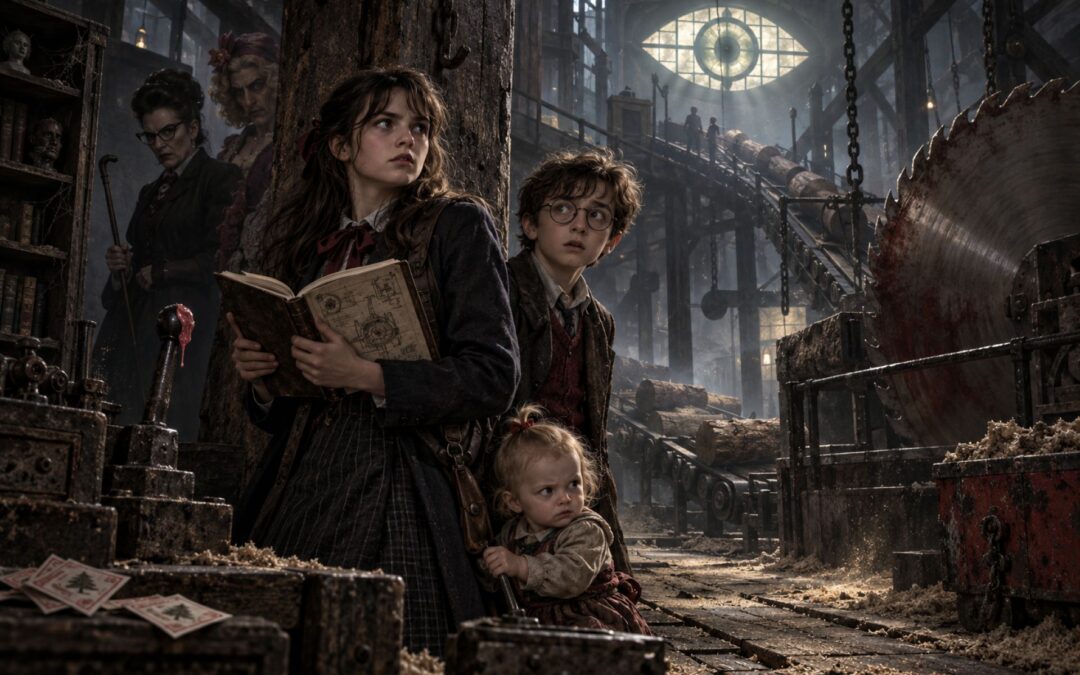
By the fourth volume of A Series of Unfortunate Events, the Baudelaire orphans have learned enough about Count Olaf to expect him almost everywhere. What they have not learned—because the adults responsible for them refuse to learn it—is how to find a place where intelligence, evidence, and obvious danger matter more than convenience. In The Miserable Mill, Lemony Snicket places Violet, Klaus, and Sunny in perhaps their bleakest home yet: an industrial compound where children are treated as workers, employees are paid in useless coupons, the library has only three books, and the man responsible for protecting the Baudelaires barely seems interested in seeing them.
Originally published by HarperCollins in 2000 as the fourth book in the series, The Miserable Mill initially appears to repeat a familiar pattern. The children receive another unsuitable guardian, Count Olaf returns in disguise, and adults again dismiss evidence that would be obvious to almost anyone willing to listen. Yet this volume develops the formula in an important way. Olaf does not simply infiltrate the children’s new home; he exploits a whole environment already built around obedience, ignorance, exhaustion, and unequal power.
The result is a story about more than escaping a villain. The Baudelaires must recover the very abilities that normally protect them after the mill’s conditions suppress Violet’s inventiveness, Klaus’s reading, and Sunny’s confidence. By the climax, each child survives partly by learning from the others: Violet researches like Klaus, Klaus invents like Violet, and Sunny faces danger with an independence that no adult around her possesses.
This article contains complete spoilers for The Miserable Mill, including Count Olaf’s disguise, the hypnosis plot, Dr. Orwell’s fate, and the ending.

From Finite Forest to Forced Labor at Lucky Smells
The novel opens with the Baudelaires traveling by train through the Finite Forest toward Paltryville. Even before they arrive, the landscape tells them that their circumstances have not improved. The forest is dark and branchless, the sky is gray, and the town awaiting them sounds unpromising enough that Violet, Klaus, and Sunny are already wondering whether their lives will ever become less miserable.
Their companion is Mr. Poe, the banker charged with managing the Baudelaire fortune and finding homes for the orphaned children. His record is already disastrous. Count Olaf has repeatedly infiltrated their lives, attempted to steal their inheritance, and escaped after the children themselves uncovered his schemes, yet Mr. Poe continues treating these events less as evidence of systemic failure than as inconvenient episodes requiring another placement.
Poe has now received a promotion at Mulctuary Money Management and announces that he will have even less time for the children. Their new caretaker is the owner of the Lucky Smells Lumbermill, although Poe cannot pronounce the man’s extremely long name. Rather than accompany the children to the mill and verify their living conditions, he plans to remain on the train because getting off would force him to spend the night in Paltryville and miss work.
The Baudelaires immediately raise the obvious concern: Count Olaf has promised to pursue them again. Poe insists that the mill owner has received descriptions of Olaf and his known associates, including Olaf’s distinctive eye tattoo, and behaves as though this administrative precaution solves the problem. The children know better because Olaf nearly always disguises himself, but their objections accomplish nothing.
After the train leaves, Violet, Klaus, and Sunny walk through Paltryville alone. The town is almost aggressively unpleasant. Shops lack windows, an old shoe hangs from the post office flagpole, stacks of newspapers stand where trees might normally grow, and a high wooden wall separates the Lucky Smells Lumbermill from the street.
At the mill’s gate, the children find its name spelled out in chewed gum. More troublingly, they notice a building at the far end of town constructed to resemble a gigantic eye. The shape reminds them immediately of Count Olaf’s tattoo. They try to convince themselves that the resemblance is coincidental, but all three understand that coincidences involving Olaf have rarely proved harmless.
Inside the mill gates, nobody welcomes them. Instead, an envelope lies in the dirt with their name typed on it. A memorandum instructs them to report for work the next morning and states that the mill’s owner expects them to be both “assiduous” and “diligent.” Klaus explains that both words essentially mean hardworking, and the children realize that Mr. Poe has not merely placed them at a lumbermill; he has placed them there as laborers.
The attached map directs them to a dormitory between the storage shed and the lumbermill itself. There they meet Phil, a sawdust-covered employee whose defining characteristic is relentless optimism. Even the fact that nobody has knocked on the dormitory door in fourteen years does not seem to strike him as particularly depressing.
Phil explains that working at Lucky Smells is extremely difficult. The employees live communally, sleep in bunk beds, and work long hours among dangerous machines. The dormitory itself reflects the mill’s warped priorities: even the windows are not real windows but pictures painted on the walls, offering the appearance of openness without any actual view outside.
The Baudelaires still try to be hopeful. Violet imagines that machinery might interest her, Klaus thinks there may be manuals to read, and Sunny hopes there will be wood suitable for biting. Their optimism does not survive the evening. After an inadequate meal, surrounded by exhausted workers and bleak surroundings, they begin to understand that their supposedly protective new home may be another trap.
Morning confirms their fears. Instead of breakfast, the workers are awakened by Foreman Flacutono violently banging metal pots together. Flacutono wears a surgical mask that obscures much of his face, a ridiculous white wig, and shoes whose unusual appearance later becomes important. His rough manner and deliberate mispronunciation of “Baudelaire” immediately establish that he regards the children not as vulnerable newcomers but as workers he can insult and command.
The children are sent into the lumbermill, an environment of enormous mechanical devices, deafening noise, and constant physical risk. They begin by removing bark from logs. The tools are designed for adults, making them difficult for Violet and Klaus to use, while Sunny eventually relies on her teeth as improvised debarkers.
Their hunger makes the work worse. They receive no breakfast, and when the lunch break finally arrives they discover that lunch consists only of chewing gum. The adult workers are hardly better treated. Phil explains that they receive one casserole in the evening and are paid not in money but in coupons: discounts and special offers that are nearly useless because the workers have no actual money with which to make the required purchases.
The arrangement is so obviously exploitative that even the children recognize its absurdity immediately. Yet the mill employees have largely accepted it as normal. Their resignation becomes one of the most unsettling features of Lucky Smells: the system persists not because its unfairness is hidden but because almost nobody with power is willing to challenge it.
After the first exhausting shift, the Baudelaires are summoned to meet the mill owner. Before they enter his office, a mirror shows them what a few hours of labor have already done. They are covered in bark and wood fragments, hungry, exhausted, and physically worn down.
Inside, they first meet Charles, the owner’s business partner. Charles is polite, sympathetic, and horrified when he realizes how young the children are. Unfortunately, sympathy is almost the limit of his usefulness. Whenever he begins to object to their treatment, he retreats as soon as his partner asserts himself.
The owner finally appears behind a thick cloud of cigar smoke that obscures his face so completely that the Baudelaires cannot properly see him. He tells them to call him Sir because his actual name is too complicated to pronounce. His chosen title immediately establishes the relationship he expects: not caretaker and children, but commander and dependents.
Sir explains his arrangement as though it were generous. The Baudelaires may sleep in the dormitory, eat a hot dinner, receive gum for lunch, and remain within the supposedly safe gates of Lucky Smells. In return, they will work at the mill for the next several years, until Violet becomes old enough for the children to leave his guardianship.
When Violet asks that at least Sunny, who is still an infant, be spared from working, Sir refuses. He describes labor as a valuable lesson in responsibility and treats the children’s objection as ingratitude. His own lunch, meanwhile, is pizza, a small detail that makes his praise of hard work and gum lunches even more grotesque.
Charles privately gives the children a peach after Sir leaves. He apologizes for his partner’s harshness and explains that Sir had a terrible childhood, as though an unhappy past excuses the deliberate exploitation of other children. Violet, thinking of her own loss and suffering, immediately sees the weakness in that justification: having experienced misery does not require a person to reproduce it.
Charles then offers the one thing most likely to comfort the Baudelaires—a library. Books have repeatedly represented safety and possibility for them, from their parents’ lost library to the collections they encountered in previous homes. Klaus in particular responds to difficulties by reading until he understands them.
The Lucky Smells library initially looks promising. It has elegant shelves, comfortable places to sit, windows that let in genuine light, and paintings on the walls. The problem is that nearly every shelf is empty because Sir refused to provide money for books.
Only three volumes are available: The History of Lucky Smells Lumbermill, The Paltryville Constitution, and Advanced Ocular Science by Dr. Georgina Orwell. The last book carries the image of an eye on its cover.
For the Baudelaires, the symbol confirms that their fear about the eye-shaped building cannot simply be dismissed. They do not yet know how Count Olaf is connected to Dr. Orwell or how dangerous the book will become, but the mill’s empty library has already established something crucial about their new environment. Information exists, but access to it is restricted, neglected, or controlled by people who do not value what knowledge can do.
Klaus’s Hypnosis and the Manufactured Accidents
The next stage of the novel turns the mill’s exhausting routine into a direct attack on the Baudelaires’ ability to resist Count Olaf. Days of physical labor leave them so tired that the interests normally defining them begin to disappear from their lives. Violet stops thinking about inventions, Klaus has virtually nothing to read, and Sunny becomes too exhausted to spend much time biting things for pleasure.
Count Olaf still does not appear, which makes the situation more disturbing rather than less. The Baudelaires inspect Sir, Flacutono, the workers, and almost everyone they meet for evidence of disguise. They know the eye-shaped clinic and Advanced Ocular Science cannot be meaningless, yet none of the obvious suspects seems to be Olaf.
Their inability to locate him matters because exhaustion is narrowing the range of things they can do. In previous books, the children survive by investigating actively. At Lucky Smells, the system keeps them busy enough merely enduring each day that investigation itself becomes difficult.
Foreman Flacutono eventually creates the opportunity the villains need. As Klaus walks through the mill, Flacutono deliberately sticks out his foot and trips him. Klaus falls, and his glasses skid across the floor before striking a bundle of boards.
The glasses become twisted and cracked beyond use. Klaus is severely nearsighted and can barely function without them, making the damage much more serious than a minor inconvenience. Charles correctly insists that a child who cannot see must not continue operating dangerous machinery and volunteers to take Klaus to the nearest eye doctor.
That doctor is Dr. Georgina Orwell, whose office is the eye-shaped building outside the mill.
Violet and Sunny immediately object. The building resembles Olaf’s tattoo, and Orwell wrote the suspicious book in the mill library. Charles nevertheless escorts Klaus there, and the sisters are forced to remain behind.
Hours pass before Klaus returns. When he does, he has new glasses but behaves unlike himself. His face is strangely blank, he remembers almost nothing about the appointment, and his responses have become automatic. Rather than questioning instructions, he repeatedly answers with obedient phrases such as “Yes, sir.”
Violet and Sunny can see that something has happened to him, but Klaus himself cannot explain it. He seems less like their brother than a version of Klaus from which curiosity, memory, and resistance have temporarily been removed. The effect is especially disturbing because those qualities are central to his identity.
The next morning, the altered Klaus remains confused enough to forget his shoes. Flacutono places him in charge of the stamping machine even though Klaus has never operated it before. Under ordinary circumstances he would question the instruction, seek information, or refuse to operate equipment he did not understand, but in his dazed condition he simply obeys.
The result is disastrous. Klaus mishandles the stamping machine, which crashes into the string machine and causes a serious accident. Phil’s leg is badly injured in the chaos.
Phil responds in characteristic fashion by insisting that matters could be worse. His left leg is broken, but he jokes that at least he is right-legged. The humor emphasizes how extreme his optimism has become: he cannot merely endure misfortune but seems compelled to redefine each disaster as somehow fortunate.
Flacutono is far less concerned about Phil than about the damaged machinery. While complaining about the cost of the string machine, he uses the word “inordinate.” The effect on Klaus is immediate.
Klaus suddenly begins explaining the word’s possible meanings and returns to his normal intellectual manner. His eyes lose their blankness, his personality seems restored, and he has no memory of what happened while he was operating the machine. Violet and Sunny realize that whatever controlled him has ended, though they still do not understand why.
The episode gives them their first major clue. Klaus’s strange behavior is not random, and his recovery is connected somehow to language. Unfortunately, before the children can investigate properly, Flacutono trips Klaus again and breaks his replacement glasses.
The pattern is now too obvious to ignore. The foreman has deliberately created a second reason for Klaus to visit Dr. Orwell. This time Violet and Sunny refuse to let their brother go alone.
On the way to the optometrist, the children consider simply running away from Lucky Smells. The idea is tempting because the mill is clearly unsafe, but leaving would place them outside even the inadequate protection of their official guardian, with no money and nowhere to live. More importantly, Klaus still needs glasses.
As he tries to make sense of his previous appointment, Klaus searches his memory of things he has read. His symptoms remind him of descriptions of hypnosis. He remembers enough from an encyclopedia to recognize that a hypnotized person can be made unusually obedient, but he had not read the relevant entry carefully enough to know exactly how the process works or how it can be reversed.
That gap in his knowledge is unusual for Klaus and therefore important. Reading has always seemed almost inexhaustibly useful to him, but here the novel makes a more precise point: knowing many things is not the same as knowing the particular thing needed at a particular moment. Klaus’s strength remains real, but it is not magical.
The children enter Dr. Orwell’s office, where the doctor’s cheerful manner contrasts sharply with their suspicions. She presents herself as friendly, even invoking the idea that sweetness persuades more effectively than hostility. Her approach is deliberately unlike Flacutono’s open cruelty, but the difference is tactical rather than moral.
Orwell separates Klaus from his sisters for the examination. Violet and Sunny are left in the waiting room with the doctor’s receptionist, a woman calling herself Shirley.
They recognize her almost immediately as Count Olaf.
The disguise is absurd: Olaf wears a blond wig, false eyelashes, lipstick, a dress, and sensible shoes while speaking in an exaggeratedly high voice. As usual, the comedy does not make the disguise less dangerous. The children know exactly who he is, but they also know from experience that identifying Olaf is not enough if adults refuse to believe them.
Violet and Sunny confront Shirley directly. Olaf continues pretending to be a receptionist, treating their accusations as though the children are confused rather than correct. The exchange exposes one of his most effective recurring strategies: he relies not only on physical disguise but on the assumption that adult social conventions will be trusted more readily than children’s testimony.
The larger plot gradually becomes clear. Dr. Orwell is hypnotizing Klaus, and Foreman Flacutono is engineering opportunities for that hypnosis to produce disasters inside the mill. The accidents are meant to convince Sir that the Baudelaires are destructive and troublesome.
Once Sir decides they can no longer remain at Lucky Smells, the apparently helpful Shirley can offer to take them in. Olaf will therefore gain legal custody without needing to kidnap the children directly. From there, he can resume his pursuit of the Baudelaire fortune under the protection of an official guardianship arrangement.
The plan is more sophisticated than several of Olaf’s earlier schemes because it turns the failures of other adults into part of his machinery. Dr. Orwell manipulates Klaus, Flacutono manufactures workplace disasters, Sir judges the children through productivity and property damage, and Mr. Poe’s guardianship system provides the mechanism through which Shirley can potentially acquire them.
When the children return to Lucky Smells, they find Phil recovering from his injury and receive a memorandum from Sir. The message effectively gives them one final chance: if another accident occurs, Sir will remove them from the mill and place them with Shirley.
The threat traps them inside Olaf’s plan. Klaus has been hypnotized again, the villains control the circumstances in which he works, and any disaster caused through that control will be blamed on the Baudelaires themselves.
Violet and Sunny seek help from Sir. Violet explains that Dr. Orwell has hypnotized Klaus and that Shirley is Count Olaf in disguise. The accusation is extraordinary, but the children can point to an extraordinary amount of evidence: Klaus’s altered behavior, the repeated glasses incidents, the eye symbols, and Olaf’s established history of disguises.
Sir refuses to take the danger seriously. He judges the situation according to labels and appearances rather than evidence. If the receptionist’s nameplate says Shirley, then he treats her as Shirley; if an accident occurred while Klaus was operating a machine, then Klaus caused the accident; if Sir has decided on a deal, then the children’s reality must somehow fit the deal.
Even making a telephone call to Mr. Poe is rejected because Sir does not want to pay for a long-distance conversation. The financial cost is trivial compared with the danger facing the children, but Sir’s priorities remain consistent: expense and inconvenience matter more to him than protection.
Charles understands that the Baudelaires may be telling the truth, yet once again he fails to challenge Sir effectively. His kindness produces small comforts rather than meaningful resistance. At this moment, the best help he can offer is essentially food and sympathy.
With the responsible adults unwilling to act, Violet and Sunny are left with the one resource that the mill has neglected but not completely eliminated: the library.
The Saw, the Command Words, and Count Olaf’s Escape
Violet and Sunny enter the Lucky Smells library carrying a problem that would normally belong to Klaus. They need to understand hypnosis quickly enough to save him, but Klaus—the sibling who would normally attack such a problem through research—is himself under hypnotic control. Violet therefore has to approach the book in a way that does not come naturally to her.
She begins Advanced Ocular Science and is immediately overwhelmed by its dense vocabulary. Reading has never been beyond her, but intensive research is Klaus’s specialty just as mechanical invention is hers. The distinction matters because Snicket has spent several books giving each Baudelaire a recognizable form of competence, and the children themselves have begun to think in those categories.
Instead of giving up, Violet asks how Klaus would approach the task. She examines the table of contents rather than beginning at page one and laboriously reading hundreds of irrelevant pages. That simple strategic change leads her directly to a chapter on hypnosis and mind control.
The chapter is still difficult, but Violet adjusts again. Rather than stopping every time she encounters an unfamiliar word, she begins using context and concentrating on the information that matters. By imitating her brother’s habits, she turns a skill she possesses only generally into one she can use effectively under pressure.
The book explains that Dr. Orwell’s form of hypnosis operates through special words. One word places or keeps the subject under hypnotic command, while another can release the subject from that state. Violet now understands the basic mechanism, but not the specific words being used on Klaus.
Before she can solve that problem, Violet and Sunny hear the lumbermill operating in the middle of the night. The sound is terrifying because there should be no ordinary shift underway. They leave the library and follow the noise.
Inside the mill they find the next “accident” already being prepared. Charles has been bound to a log and positioned on the machinery leading toward the enormous saw. Layers of string prevent him from calling for help, though his expression makes his terror obvious.
Foreman Flacutono stands nearby, instructing Klaus to operate the machine. Klaus is barefoot, blank-eyed, and obedient. The plan is to make him push the log into the saw and kill Charles, producing an accident so horrific that Sir will unquestionably expel the Baudelaires.
Violet and Sunny shout at their brother to stop, but he does not respond. Flacutono mocks their efforts and continues giving instructions. Violet now knows that ordinary persuasion is useless while Klaus remains hypnotized, so she concentrates on the foreman’s exact language.
Flacutono repeatedly calls Klaus “lucky.” The word stands out because of how unnaturally often he uses it. Violet realizes that “lucky” must be the command word.
She tests the idea by using the word herself while giving Klaus an order. It works. For a moment, Violet can redirect her brother simply by using the same linguistic key that Flacutono has been using.
The discovery gives her temporary leverage, but the villains arrive before she can end the danger. Dr. Orwell and Shirley enter the mill, and Orwell quickly recognizes what Violet has learned. She modifies Klaus’s instructions so that he will no longer obey his sisters.
Violet therefore needs the second word, the one capable of ending the hypnosis altogether. She has read that such a word exists, but the book cannot tell her the particular word Orwell chose. She must reconstruct it from Klaus’s earlier behavior.
The key memory is Phil’s accident. Klaus had been acting dazed and obedient until Flacutono complained that the string machine cost an “inordinate” amount of money. Immediately afterward, Klaus returned to himself and began defining “inordinate.”
Violet shouts the word. Klaus awakens.
Releasing him from hypnosis does not end the crisis because Charles is still moving toward the saw, the villains are physically present, and the children are outnumbered. Instead, the confrontation divides into several simultaneous struggles, each demanding a different kind of intelligence.
Flacutono trips Klaus yet again. Shirley and the foreman restrain Violet. Dr. Orwell reveals that her cane contains a sword and turns her attention toward Sunny, who has been attempting to free Charles.
Sunny responds with the only weapons she possesses: her four unusually sharp teeth. The resulting duel is intentionally ridiculous in form but serious in consequence. An infant is fighting an armed adult because every supposedly responsible adult has failed to prevent the situation.
Meanwhile Klaus has to save Charles without relying on his usual strength. There is no useful passage he can read in time, no reference book beside the saw, and no opportunity for extended research. He therefore asks himself the same kind of question Violet asked in the library: what would his sibling do?
Klaus begins thinking like an inventor. He notices the available materials, considers how they might be combined, and remembers a childhood fishing lesson with his mother. The memory gives him an idea involving casting a line.
Using a debarker and his chewing gum, Klaus creates an improvised device. The gum stretches when he casts it, but instead of reaching the saw as he initially intends, it lands on the string binding Charles to the log. The apparent failure becomes useful when Klaus realizes that pulling on the gum allows him to move the log itself.
He strains against the makeshift line and manages to shift Charles far enough that the saw blade slices empty air instead of his body. The rescue succeeds not because Klaus suddenly becomes Violet, but because he has absorbed enough of her way of thinking to improvise when his own usual method is unavailable.
Sunny’s fight with Dr. Orwell remains unresolved. Orwell eventually kicks the infant down and prepares to strike her with the sword. At that moment Sir enters the lumbermill and demands to know what is happening.
Orwell turns in surprise and steps backward.
She steps directly into the path of the operating saw.
Her death is one of the darkest moments in the early series. Snicket describes it with grotesque restraint, preserving the children’s-book narrative voice while making the outcome unmistakable. The “accident” the villains spent so much effort manufacturing finally occurs, but its victim is the person who helped engineer the entire scheme.
The aftermath brings Mr. Poe back to Paltryville. Sir, Charles, Poe, and the children review what happened, and the adults are finally prepared to accept that Orwell was a hypnotist and Flacutono tied Charles to the log. Astonishingly, they remain hesitant to accept the simplest remaining fact: Shirley is Count Olaf.
Sir insists that the receptionist does not look like Olaf. Mr. Poe falls back into his familiar habit of treating the children’s certainty as an unfortunate tendency to suspect their enemy everywhere. The Baudelaires point out that they suspect Olaf everywhere because Olaf repeatedly appears everywhere they are sent.
Shirley and Foreman Flacutono have been confined in the library while the adults discuss the situation. When the group enters, Olaf attempts another explanation: both he and the foreman supposedly behaved badly because Dr. Orwell hypnotized them as well.
The claim is absurd, but the adults briefly entertain it. The decisive evidence is finally physical. Mr. Poe asks to inspect Shirley’s left ankle, revealing Count Olaf’s eye tattoo.
Foreman Flacutono then removes his disguise. Beneath the wig and mask is the bald man with the long nose, one of Count Olaf’s known associates whom Poe himself had supposedly described to Sir before the children arrived.
Exposure still does not lead to capture. Olaf grabs Advanced Ocular Science and throws it through one of the library windows, breaking the glass. He and his associate escape through the opening.
The image is bitterly appropriate. A book that helped Orwell control Klaus later allowed Violet to understand and defeat that control, and it now becomes the object Olaf uses to smash an exit through the room devoted to knowledge. Lucky Smells has finally found several uses for its nearly empty library, but too late to make the institution itself wise.
Phil, meanwhile, has begun reading The Paltryville Constitution. He does not understand every word, but he has learned enough to discover that paying workers entirely in coupons appears to violate Paltryville law. The revelation confirms what the Baudelaires recognized almost immediately: the mill’s exploitation was not simply unpleasant but built on practices nobody had bothered to investigate.
Sir responds not by reforming the mill or apologizing to the children, but by blaming them for the disruption. His original bargain, he says, has failed. He therefore refuses to remain their guardian.
Mr. Poe falls back on the plan announced at the beginning of the novel. The Baudelaires will be sent to boarding school.
Before leaving, the children say goodbye to Charles and Phil. Phil searches, as always, for something positive in the disaster and finally points out the most basic fact: they are alive.
For once, the Baudelaires do not dismiss his optimism immediately. Violet managed to research even though she is not the family’s researcher. Klaus managed to invent even though he is not the family’s inventor. Sunny defended herself against a sword. Each child survived partly because the qualities associated with one sibling had begun to become shared resources.
The word “lucky,” previously the trigger that made Klaus vulnerable to control, acquires a different meaning. The Baudelaires are not lucky in the conventional sense; almost everything that could reasonably be called good fortune has been denied them. Yet they have survived circumstances in which each of them might easily have died, and their survival has revealed capabilities they did not know they possessed.
Paltryville and Lucky Smells Lumbermill as a System of Exploitation
Paltryville is one of the series’ clearest examples of setting functioning as an argument rather than mere scenery. Almost everything about the town removes comfort, beauty, variety, or openness. The Finite Forest is gloomy, stores lack windows, the post office flies an old shoe, stacks of newspapers replace trees, and the most visually striking building is an enormous eye associated with manipulation.
Lucky Smells intensifies that atmosphere by enclosing the Baudelaires behind a wooden wall. The mill has a dormitory, machinery, an office, and a library, but the physical arrangement reflects the hierarchy of the people living there. Workers sleep together in poor conditions, eat inadequate food, and spend their days surrounded by industrial danger, while Sir remains separated in an office and eats food unavailable to the people whose labor supports him.
The economic arrangement is openly absurd. Employees receive coupons instead of spendable wages, meaning that compensation often requires money they do not possess before it can be used at all. The system prevents workers from gaining the independence normally associated with wages while allowing Sir to describe them as paid employees.
Phil’s eventual reading of The Paltryville Constitution exposes another dimension of the arrangement. The information needed to question the payment system has existed within the mill all along, sitting unread in a nearly empty library. Exploitation therefore depends not only on Sir’s power but on a culture in which nobody has been encouraged to investigate the rules governing that power.
The Baudelaires experience the same system more intensely because they are children. Sir is supposed to be their guardian, yet he transforms dependency into an excuse for labor. Housing, food, and protection—things a caretaker should provide because the children are in his care—are reframed as generous benefits requiring repayment through years of work.
The setting also attacks the children’s identity through exhaustion. Violet, Klaus, and Sunny initially enter Lucky Smells with the same interests that have repeatedly saved them, but hunger, noise, repetitive labor, and fatigue gradually suppress those activities. The danger of the mill is therefore psychological as well as physical: it leaves them with less time and energy to think.
That broader relationship between vulnerable children and unreliable social structures has attracted scholarly attention across A Series of Unfortunate Events. Research examining childhood, fear, and institutions in the series helps explain why the books’ incompetent adults matter beyond simple comedy. The Baudelaires repeatedly discover that institutions theoretically designed to protect children can become dangerous when authority is trusted automatically and children’s knowledge is discounted.
Lucky Smells gives that recurring pattern an unusually concrete form. Sir is not Count Olaf, and he does not want the Baudelaire fortune. He is dangerous because his priorities make Olaf’s scheme easier: productivity matters more than safety, obedience matters more than evidence, money matters more than communication, and the maintenance of his own authority matters more than determining what is true.
Characters and Relationships
The characters in The Miserable Mill are organized around different relationships to knowledge, authority, and action. The Baudelaires adapt under pressure, while most adults represent distorted alternatives: Sir has power without responsibility, Charles has compassion without courage, Phil has hope without sufficient skepticism, and the villains possess intelligence without conscience.
The novel’s most important development occurs within the sibling relationship itself. Violet, Klaus, and Sunny remain distinct personalities, but the climax reveals that their strengths are no longer isolated specialties. They have watched, trusted, and learned from one another closely enough that each can act beyond the role the series initially assigned them.
Violet Baudelaire
Violet begins the novel as the fourteen-year-old inventor whose instinct is to solve mechanical problems. Even on the train through the Finite Forest, she studies the branchless trees and imagines a device that could climb them. That habit establishes how naturally invention belongs to her before Lucky Smells begins wearing it away.
Her responsibilities also extend beyond engineering. As the oldest Baudelaire, Violet frequently takes the lead in decisions affecting the siblings. At the mill she monitors possible disguises, argues with adults, tries to protect Klaus after his behavior changes, and eventually becomes the person who must identify the mechanism controlling him.
The library sequence provides her most important development. Faced with a research problem, Violet initially struggles because she approaches the book without Klaus’s habits. Her breakthrough comes when she stops defining ability as something fixed and asks how her brother would work.
By consulting the table of contents, identifying the relevant chapter, using context to move through unfamiliar vocabulary, and connecting written information to observed behavior, Violet effectively learns to research under pressure. Her success does not diminish Klaus’s importance; it demonstrates how deeply she understands him.
She also makes mistakes. She cannot immediately identify the release word, and knowledge of the hypnosis mechanism does not instantly solve the crisis. This keeps her competence believable within the exaggerated world of the novel. Violet succeeds because she combines observation, memory, adaptability, and trust in her siblings rather than because invention automatically makes her capable of everything.
Klaus Baudelaire
Klaus suffers the most direct attack on identity in The Miserable Mill. His defining habit is reading, and his glasses symbolize the physical condition that makes that activity possible. Flacutono’s repeated destruction of them therefore does more than inconvenience him; it makes Klaus dependent on the villains for restored sight.
Hypnosis then removes the intellectual resistance normally associated with him. The boy who habitually asks questions and defines complicated words becomes someone who obeys commands without reflection. His repetitive agreement with authority is disturbing precisely because it reverses the personality readers already know.
The first release from hypnosis shows how closely language and identity are connected. When “inordinate” is spoken, Klaus immediately begins defining it. Vocabulary is not merely a running Snicket joke in that moment; command of words becomes evidence that Klaus has returned to himself.
His imperfect memory of reading about hypnosis also complicates his role as the family researcher. Klaus has read an enormous amount, but he once skipped information that did not interest him enough to retain. The gap becomes important later, reminding readers that education is a process rather than an all-purpose storehouse from which exactly the right fact will always emerge.
Klaus’s climactic invention is his strongest development. Unable to solve the problem through research, he notices materials, remembers an old fishing lesson, combines a debarker with gum, and improvises a way to move Charles’s log. He succeeds by adopting Violet’s experimental mentality while remaining recognizably Klaus: the solution still depends on memory and knowledge being converted into action.
Sunny Baudelaire
Sunny occupies an unusual position in the early series because her age allows Snicket to combine absurd humor with genuine competence. She speaks in short utterances translated by the narrator, bites extraordinarily hard objects, and is routinely underestimated by adults. Yet the mill gives her meaningful physical and emotional agency.
Like her siblings, Sunny is forced to work despite being an infant. Sir’s refusal to excuse her from labor reveals how grotesque his interpretation of responsibility has become. Her teeth, normally treated as an eccentric talent, are used practically on the logs when adult-sized debarkers are too large for her.
During the climax, Sunny’s role becomes much more serious. She tries to free Charles and then faces Dr. Orwell, who attacks with a sword concealed inside her cane. Sunny answers with her teeth, transforming a comic character trait into an act of genuine courage.
The fight should not be mistaken for evidence that Sunny is simply a miniature adult. Its absurdity is part of the point. An infant should never need to duel an armed villain, and the fact that she does reflects the complete failure of every adult system around her.
Sir, Charles, and Phil
Sir, Charles, and Phil represent three very different ways of responding to an unjust environment. Sir creates and benefits from the system, Charles recognizes its cruelty but submits to it, and Phil endures it by insisting on seeing nearly everything positively. None is equivalent to Count Olaf, yet each helps explain why Lucky Smells remains dysfunctional even before Olaf interferes.
Sir is the most culpable. He treats guardianship as a transaction, believes providing minimal food and shelter entitles him to years of child labor, and judges moral questions through property and inconvenience. When Phil is injured, the institutional response revolves around machinery; when the Baudelaires report a conspiracy, Sir worries about credibility and telephone costs.
His hidden face reinforces his remoteness. The permanent cloud of cigar smoke makes him visually inaccessible even while he demands personal obedience from everyone else. He expects to be called “Sir” but offers almost none of the care or accountability that should accompany authority.
Charles is considerably kinder but also illustrates the limits of kindness without resistance. He feeds the hungry children, shows them the library, worries about their safety, and believes their claims more readily than Sir does. Yet he repeatedly retreats whenever standing up to Sir would require real conflict.
His explanation that Sir had a terrible childhood captures the weakness of his approach. Charles is so eager to excuse another person’s behavior that he loses sight of the people being harmed by it. His compassion matters emotionally, but it cannot protect the children until others act.
Phil is kinder still and often genuinely helpful, yet his optimism repeatedly borders on denial. After his leg is broken, he immediately searches for reasons the situation is fortunate. Such resilience can be admirable, but the novel also shows that relentless positivity can make exploitation easier to tolerate.
His most important development occurs when he finally reads the Constitution and discovers that the coupon system may be illegal. At that moment optimism is supplemented by information. Phil does not cease being hopeful, but he begins questioning a condition he previously accepted.
Count Olaf, Dr. Orwell, and Foreman Flacutono
Count Olaf’s Shirley persona is deliberately ridiculous, but the underlying strategy is one of his more intelligent early schemes. Instead of trying to become the Baudelaires’ guardian immediately, he creates circumstances in which another guardian will voluntarily hand them over to him. He uses bureaucratic legitimacy against children who already know bureaucracy rarely believes them.
Olaf’s greatest strength remains his understanding of adult complacency. He does not need a perfect disguise because he knows that a nameplate, an assumed professional role, and enough confidence will often outweigh the Baudelaires’ testimony. His disguises work socially even when they fail visually.
Dr. Georgina Orwell contributes a different form of control. Where Olaf manipulates appearances and institutions, Orwell manipulates Klaus’s mind directly. Her pleasant professional manner contrasts with her willingness to erase another person’s agency, making her politeness another disguise of sorts.
Her use of hypnosis also connects language with power. A simple word can turn Klaus into an obedient instrument, and another word can restore him. Orwell’s system literalizes a broader concern running through the mill: who gets to command, who is trained to obey, and what allows someone to recover independent judgment.
Foreman Flacutono operates at ground level. He controls the children’s working conditions, breaks Klaus’s glasses, places him near dangerous machinery, and eventually ties Charles to the log. His disguise as the bald man with the long nose matters less than the access his position gives him.
Together the three villains divide the plan efficiently. Olaf provides motive and the prospective guardianship, Orwell provides psychological control, and Flacutono converts that control into apparently accidental workplace disasters. Their cooperation contrasts sharply with the ineffective cooperation among the adults who are supposed to protect the Baudelaires.
Power, Knowledge, Free Will, and Luck
The central ideas of The Miserable Mill emerge from the same events that drive its plot. The book repeatedly asks what happens when people with authority refuse to examine evidence, when workers become accustomed to unfair conditions, when words can be used to command rather than communicate, and when children must acquire new skills because the adults around them will not act.
These ideas are not presented as a formal political or philosophical system. They remain embedded in an exaggerated children’s adventure, but the exaggeration makes certain relationships unusually visible: ignorance supports power, exhaustion weakens resistance, and cooperation restores forms of agency that isolation removes.
Exploitation and Adult Authority
Sir’s mill is based on a distorted understanding of obligation. He provides workers with minimal subsistence and unusable compensation while expecting difficult labor in dangerous conditions. When the Baudelaires arrive, their legal dependence makes it even easier for him to impose the arrangement because they have almost no ability to refuse.
He justifies the work by claiming that it teaches responsibility. The argument is revealing because responsibility is the quality most conspicuously absent from his own behavior. Sir has authority over workers and children but repeatedly shifts responsibility for consequences onto the people with the least power.
The same pattern appears when Klaus, under hypnosis, damages machinery. Sir does not ask why an inexperienced child was operating the equipment or why his glasses were repeatedly broken. He treats the event as Klaus’s failure because the organizational structure assumes workers are responsible upward while authority is barely responsible downward.
Mr. Poe reproduces the pattern outside the mill. He has institutional responsibility for the orphans but repeatedly interprets his role as placing them somewhere and responding after disaster occurs. His promotion becomes another reason to reduce his involvement rather than a reason to improve the safeguards surrounding children whose guardian has already tried repeatedly to steal their fortune.
Charles shows how authority can be sustained by people who dislike its consequences but will not oppose it. He often knows Sir is wrong. What he lacks is the willingness to transform that knowledge into confrontation.
The novel therefore distinguishes between being personally pleasant and being morally effective. Charles is far better company than Sir, but his submission means the children remain exposed to harm. Good intentions matter, yet they do not substitute for action when a person is in a position to prevent abuse.
Knowledge as Resistance
Books in The Miserable Mill are practical tools of survival. The Baudelaires do not read merely because reading is virtuous; they read because information changes what they are capable of doing. The tragedy of Lucky Smells is that this possibility exists inside a library almost nobody uses.
The three books represent different relationships between knowledge and authority. The History of Lucky Smells Lumbermill centers the institution itself. The Paltryville Constitution contains rules capable of challenging its economic practices. Advanced Ocular Science contains both the knowledge used to control Klaus and the knowledge Violet eventually uses to free him.
That last contradiction is important. Information is not automatically benevolent. Dr. Orwell possesses specialized knowledge and uses it to violate another person’s autonomy. Violet accesses the same body of information and uses it to restore autonomy.
The difference lies in purpose, interpretation, and access. Knowledge becomes resistance when people can examine it independently rather than receiving commands from someone who claims expertise. Orwell wants Klaus passive; Violet reads in order to understand what has been done to him.
Phil’s late discovery about coupons extends the same principle beyond the immediate villain plot. The workers have endured an obviously dysfunctional payment system for years, yet a book sitting inside their workplace may contain grounds for challenging it. The scene suggests that accepting a system as normal can be easier than investigating whether it is legitimate.
Violet’s research also broadens the meaning of literacy. She does not suddenly become as well read as Klaus. She learns how to find relevant information, tolerate uncertainty, infer meaning from context, and focus on the question she needs to answer.
That process is more valuable than simply memorizing facts. Knowledge protects the Baudelaires because they can use it adaptively, combining books with observation and memory. The library becomes useful only when someone reads critically enough to connect information with the world outside the page.
Hypnosis, Obedience, and Free Will
Dr. Orwell’s hypnosis is best understood as the novel’s fictional mechanism for dramatizing obedience rather than as a realistic account of clinical hypnosis. Its rules are deliberately simple: a command word subjects Klaus to control, instructions direct his behavior, and another word can release him. The mechanism works because Snicket is interested less in psychology as science than in autonomy as a narrative problem.
Hypnotized Klaus is frightening because he continues moving and speaking while the part of him that evaluates commands seems absent. He performs actions that the normal Klaus would reject immediately. Control therefore appears not as physical imprisonment but as the suspension of judgment.
That state echoes ordinary life at Lucky Smells. The workers are not hypnotized, yet many have become accustomed to following unreasonable rules. Charles is not hypnotized, yet he repeatedly obeys Sir despite recognizing that Sir is wrong. The novel does not claim these situations are identical, but the parallel makes the hypnosis plot thematically useful.
Language becomes the battleground. “Lucky” sounds harmless and positive, yet Orwell turns it into an instrument of submission. “Inordinate,” a comparatively obscure vocabulary word, becomes the key that restores Klaus’s independent self.
The reversal fits the series’ broader fascination with words. Vocabulary can confuse, disguise, educate, or liberate depending on how it is used. A familiar word can become dangerous when attached to unquestioned authority, while a difficult word can become lifesaving when someone understands its significance.
Violet defeats Orwell’s system not through superior force but through attention to patterns in speech. Her achievement depends on noticing that specific words correspond with changes in Klaus’s behavior. Free will is restored through interpretation.
Sibling Cooperation and Borrowed Skills
The three Baudelaire talents initially seem neatly divided. Violet invents, Klaus researches, and Sunny bites. The series repeatedly uses those specialties as plot devices, but The Miserable Mill begins breaking down the boundaries between them.
The mill first weakens each specialty separately. Violet becomes too exhausted to invent, Klaus has almost nothing to read, and Sunny’s normal energy is consumed by labor. The conditions therefore threaten not only their bodies but the identities around which the children have organized their confidence.
The climax answers that threat by making their talents transferable. Violet enters the library and consciously models Klaus’s research habits. Her success comes from knowing her brother well enough to reproduce his method even though research is not her strongest skill.
Klaus later does the reverse. When Charles is approaching the saw, he cannot read his way out of the emergency. He asks what Violet would do, looks at available materials, remembers a practical experience, and builds something.
Sunny does not borrow a specific sibling specialty in the same explicit way, but her independent role matters just as much. While Violet and Klaus solve intellectual and mechanical problems, Sunny confronts Orwell directly. The youngest Baudelaire is not merely protected by the older two; she participates in protecting the family.
This development makes the siblings’ relationship more important than any individual talent. Their real strength is not that a family happens to contain one inventor, one reader, and one unusually sharp-toothed infant. It is that they pay enough attention to one another to learn different ways of confronting problems.
The ending recognizes that growth directly. Violet acknowledges Klaus’s invention, Klaus acknowledges Violet’s research, and Sunny recognizes her own contribution. Their survival demonstrates that identity can expand without becoming meaningless: Violet remains an inventor, Klaus remains a reader, and Sunny remains Sunny, but none is confined to a single ability.
Optimism, Luck, and Survival
Phil’s optimism initially appears almost ridiculous. He can reinterpret inadequate food, exploitative wages, exhausting work, and even a broken leg as opportunities to notice something positive. His attitude is funny because the gap between reality and his interpretation is so enormous.
The novel does not simply conclude that optimism is foolish, however. Phil’s instinct to search for the bright side eventually helps the Baudelaires reconsider their own experience. The crucial difference is between denying suffering and recognizing survival.
During most of the book, calling the children lucky would be absurd. They are orphaned, exploited, hunted by a criminal, ignored by their guardian, and nearly killed by industrial machinery. The word becomes even more disturbing because Orwell uses “lucky” as the trigger that strips Klaus of independent control.
By the end, however, the Baudelaires can use the word differently. They do not pretend Lucky Smells was pleasant or that their suffering was secretly beneficial. They recognize that several things could have ended much worse and that they possessed more resources than they realized.
This is a more credible optimism than Phil’s automatic positivity. It begins with an accurate understanding of danger rather than denial of it. The children can acknowledge misery and still value survival.
The transformation of “lucky” therefore completes one of the novel’s strongest thematic movements. The villains use the word to command Klaus. The mill uses it ironically in its own name. Phil uses the idea almost indiscriminately. The Baudelaires finally reclaim it through experience, giving luck a meaning connected not to comfort but to surviving catastrophe together.
Eyes, Books, Gum, Coupons, and Machines
The eye is the book’s most obvious recurring symbol. It appears first in the architecture of Dr. Orwell’s office and on the cover of Advanced Ocular Science, immediately connecting Paltryville with Count Olaf. Yet the motif develops beyond identifying the villain because the entire plot concerns different kinds of seeing and failing to see.
Klaus’s glasses make vision literal. Once Flacutono breaks them, Klaus becomes dependent on Dr. Orwell, whose profession supposedly concerns improving sight. Instead of helping him see more clearly, she takes control of his mind. The eye doctor becomes an agent of intellectual blindness.
The adults suffer a different blindness. Sir and Mr. Poe can physically see Shirley but cannot interpret what is in front of them. The children recognize Olaf because they combine visual evidence with memory and context, while the adults treat appearances and labels as more trustworthy than patterns.
Books complicate the motif. The nearly empty library is one of Lucky Smells’ most revealing spaces because it contains the possibility of understanding inside an institution that does almost nothing to encourage understanding. Its three volumes eventually become more useful than Sir’s entire system of authority.
Advanced Ocular Science has the clearest double function. It is associated with Orwell’s expertise and her abuse of knowledge, but it also contains the information Violet needs to defeat her. At the end Olaf turns the book into a physical weapon against the library window, converting knowledge into the means of escape even after knowledge has helped expose him.
Windows carry a similar tension. The dormitory’s windows are merely painted illusions, while the library’s windows are real and admit light. The distinction fits a world in which some institutions provide only the appearance of what people need, while genuine access to the outside world remains rare.
When Olaf finally smashes the library window, the image joins several ideas at once. The room that allowed Violet to understand the conspiracy becomes the route through which the exposed villain escapes. Knowledge can reveal danger, but knowledge alone cannot guarantee that institutions will respond effectively.
Gum is transformed even more dramatically. At first it represents humiliation and deprivation: Sir considers a stick of gum adequate lunch for workers, including children. Chewed gum also forms the grotesque lettering on the mill gate.
During the climax, however, Klaus turns gum into part of an invention capable of saving Charles. A material associated with the mill’s contempt for its workers becomes a survival tool. The change mirrors the siblings’ wider ability to repurpose circumstances they did not choose.
Coupons operate less ambiguously. They represent compensation stripped of actual economic power. The workers technically receive something for their labor, but that something is often useless without money they do not possess.
The coupons expose how language can make exploitation sound legitimate. Sir can say his employees are paid just as he can say the Baudelaires receive lunch. Both claims are technically describable in words while concealing the reality that “payment” means coupons and “lunch” means gum.
Machines dominate the physical world of Lucky Smells. They make the workers’ labor productive for Sir while exposing the workers themselves to injury. Phil’s broken leg and Charles’s near death demonstrate that industrial equipment becomes especially dangerous when human beings are treated as replaceable parts of a system.
Yet the novel does not portray technology itself as evil. Violet is an inventor, and Klaus ultimately uses a tool creatively to save Charles. The distinction lies between machinery serving human purposes and humans being subordinated to machinery and production.
The two command words complete the symbolic pattern by turning language itself into technology. “Lucky” activates control; “inordinate” breaks it. One familiar word becomes a mechanism of obedience, while another—exactly the kind of vocabulary Snicket constantly pauses to explain—restores a reader’s identity.
Lemony Snicket’s Narrative Style and Structure
The Miserable Mill depends heavily on the narrative persona of Lemony Snicket. The plot could be described as a dark adventure about child labor, hypnosis, and attempted murder, but Snicket’s intrusive narration transforms that material into a distinctive mixture of comedy, dread, linguistic play, and self-conscious storytelling.
From the opening chapter, the narrator draws attention to the mechanics of fiction itself. He discusses what first sentences tell readers about books before providing the novel’s own miserable opening sentence. Later, Chapter Eleven returns explicitly to the subject of first sentences, creating a structural echo that reminds the reader that Snicket is not simply telling events but continually commenting on how stories are told and read.
The narrator also addresses the reader directly, often warning that the story will become worse and suggesting that a more pleasant book would be a better choice. These warnings are obviously paradoxical: by repeatedly telling readers to stop, Snicket creates curiosity about the misery still to come.
His vocabulary definitions perform several functions simultaneously. On the surface they help younger readers understand difficult words. They also become comic devices because the definitions are frequently tailored to bizarre situations, interrupted by personal anecdotes, or used to expose differences between literal and contextual meaning.
In The Miserable Mill, this habit becomes part of the plot. Klaus’s return from hypnosis is revealed when he begins defining “inordinate,” making the series’ familiar vocabulary joke a diagnostic sign of identity. A stylistic convention therefore crosses into narrative causation.
Scholars examining metafiction and double readership in A Series of Unfortunate Events have noted how Snicket’s narrator repeatedly disrupts the boundary between story, storyteller, and reader. The Miserable Mill offers several clear examples: Snicket claims to have investigated the Baudelaires’ experiences, inserts stories from his own mysterious life, comments on the book’s construction, and behaves as though the reader’s decision to continue is itself part of the narrative.
This metafiction creates two levels of humor. Younger readers can enjoy the absurd definitions, outrageous adult behavior, disguises, and escalating disasters, while older readers are more likely to notice parodies of bureaucratic language, sentimental storytelling, workplace rhetoric, and narrative convention. Neither level cancels the other.
The tone depends on collision. Terrible events are narrated with formal politeness, elaborate vocabulary, and comic digressions. Phil’s serious injury becomes an occasion for absurd optimism; Orwell’s monstrous scheme sits beside jokes about ocular terminology; a baby fighting a sword with her teeth is funny as an image and horrifying as a situation.
That balance is difficult to sustain, and Snicket deliberately refuses conventional emotional reassurance. The narrator rarely promises that suffering will produce justice. Instead, he frequently announces that matters will worsen, sometimes before the characters themselves understand the danger.
Foreshadowing therefore becomes part of the comedy. Readers already know Olaf will return because Snicket essentially tells them he will. Suspense comes not from whether misery is approaching but from what form it will take and whether the Baudelaires can understand it quickly enough.
Repetition works similarly. Mr. Poe coughs and misunderstands. Olaf disguises himself. Adults dismiss the children. Vocabulary is explained. The narrator insists the reader would be happier elsewhere. These repeated devices create the series’ identity, but The Miserable Mill is strongest when repetition produces a variation rather than merely another instance.
The hypnosis plot is one such variation. Instead of only hiding Olaf’s identity, the villains interfere with the Baudelaires’ own ability to recognize and resist danger. Klaus becomes part of the mechanism threatening the siblings, forcing Violet and Sunny to solve a problem while their usual researcher is unavailable.
The structure also plants objects and words early and pays them off later. Gum begins as disgusting signage and inadequate food before becoming an invention material. Advanced Ocular Science appears as an ominous object before becoming both the villains’ tool and Violet’s source of liberation. “Inordinate” seems like another vocabulary opportunity before becoming the release word.
These payoffs make the book feel more tightly constructed than a simple sequence of calamities. Snicket’s apparent digressiveness can disguise how carefully several narrative elements are positioned for reuse.
The Ending Explained
The ending resolves the immediate threat at Lucky Smells without giving the Baudelaires anything resembling a secure victory. Dr. Orwell dies, Klaus is freed from hypnosis, Charles survives, Count Olaf is exposed, and Flacutono’s identity is revealed. Yet Olaf escapes again, Sir rejects the children, and Mr. Poe sends them toward another institution rather than reconsidering why every previous placement has failed.
Dr. Orwell’s death is deliberately framed as the accident the villains had been trying to manufacture. Throughout the plot, Orwell and Flacutono attempt to make Klaus cause disasters that will appear unintentional. In the end, Orwell genuinely steps backward into the saw because Sir’s unexpected arrival startles her.
The irony is severe but not presented as a triumphant act of revenge by the Baudelaires. The children are shaken by what they witness. Snicket allows the death to end the physical struggle while preserving the moral discomfort of three children seeing an adult killed in front of them.
Charles’s rescue carries a different meaning. Klaus saves him by inventing rather than researching, completing the cross-development that Violet began in the library. The siblings’ earlier specialties have not disappeared, but the crisis demonstrates that they have learned from one another.
The library also receives a final transformation. Sir mocked it as useless, yet Violet’s reading there saves Charles and Klaus. Phil’s reading there reveals the probable illegality of the wage system. Olaf then uses Orwell’s book to break the window and escape.
The room therefore contains both the possibility and the limitation of knowledge. Books can reveal mechanisms of control and expose unjust rules, but they cannot force Sir to become responsible, Mr. Poe to become perceptive, or the authorities to prevent Olaf from escaping.
Sir’s rejection of the Baudelaires confirms that the book’s institutional problem remains unresolved. Even after learning that Klaus was hypnotized and Charles was deliberately placed in mortal danger, Sir insists that the children caused too much trouble. He treats the collapse of his own unsafe arrangement as evidence against the victims of that arrangement.
The decision also exposes the emptiness of his original “deal.” Sir promised to protect the children from Olaf in exchange for their labor, but Olaf infiltrated the situation through several people connected to the mill. When the bargain fails, Sir does not admit that he failed to protect them; he blames the children because doing so preserves his sense of authority.
Mr. Poe’s boarding-school solution extends the pattern into the next volume. His response to repeated guardian failures is not to believe the children more readily or remain involved in their protection. It is to transfer them into another institution.
The emotional resolution therefore belongs not to the adults but to Violet, Klaus, and Sunny. They look back on what almost happened: Klaus could have remained hypnotized, Sunny could have been killed, Charles could have been sawed apart, and any of the siblings could have died.
When Phil calls them lucky because they are alive, the word initially seems painfully inadequate. Yet the children reconsider it without adopting his habit of pretending bad conditions are good. Their version of luck includes a full recognition of misery.
Violet was fortunate that she could think like Klaus. Klaus was fortunate that he could think like Violet. Sunny was fortunate that the unusual ability adults constantly underestimate helped her survive an armed attack.
Their “luck” is therefore inseparable from relationship and adaptability. It is not random good fortune arriving from outside. Much of what saved them came from what they had learned by living closely with one another.
That is why reclaiming the word matters after Orwell used it as Klaus’s command trigger. Earlier, “lucky” meant loss of control. At the ending, the children can give the word a meaning of their own.
The reversal does not make Lucky Smells a secretly beneficial experience. Nothing about child labor, manipulation, or attempted murder becomes acceptable because the children learned something. Instead, the ending recognizes a smaller but more credible victory: the system failed them, the villains escaped, and the future remains uncertain, but the Baudelaires leave knowing that their capacities are greater and more shared than they believed.
Critical Review: How Well Does The Miserable Mill Work?
The Miserable Mill arrives at a potentially dangerous point in A Series of Unfortunate Events. By Book 4, readers understand the basic machinery of the series: the Baudelaires enter a new environment, Count Olaf appears in disguise, adults fail to recognize him, the children uncover a plot involving their fortune, and Olaf escapes. A fourth repetition without meaningful variation could easily have made the formula feel mechanical.
The novel largely avoids that problem by making machinery itself part of the story and altering Olaf’s method. He is no longer trying simply to convince adults that he is an appropriate guardian. Instead, his allies manipulate Klaus into creating the conditions under which Sir will voluntarily transfer the children to “Shirley.”
That scheme gives the novel stronger causal construction than its premise initially suggests. Flacutono’s disguise gives him access to the mill, breaking Klaus’s glasses sends Klaus to Orwell, Orwell’s hypnosis makes the accidents possible, the accidents threaten the children’s placement, and Shirley waits as the apparently convenient solution. Each villain occupies a specific position in the mechanism.
The hypnosis device is psychologically simplistic if judged as realistic science, but realism is not its primary function. Within the novel’s exaggerated logic, it creates an effective reversal by transforming Klaus from investigator into instrument. It also gives Snicket’s recurring fascination with words an unusually concrete role.
The command and release words are particularly satisfying because they are embedded in ordinary language before their significance becomes clear. “Inordinate” first appears naturally during Flacutono’s outrage about the damaged machine. Only later does Violet understand why Klaus changed immediately afterward.
The climax is probably the book’s strongest achievement. Earlier details converge without requiring the children to discover entirely new powers. Violet’s familiarity with Klaus leads to research, Klaus’s familiarity with Violet leads to invention, Sunny’s teeth become a defensive weapon, gum becomes useful, the debarker returns as a tool, and a childhood fishing memory contributes to Charles’s rescue.
That cross-use of skills also gives the Baudelaires genuine character development. Early installments necessarily establish them through clear signatures—Violet invents, Klaus reads, Sunny bites—but a long series would become restrictive if each sibling could only solve problems through one repeated gimmick. The Miserable Mill begins expanding those identities while keeping them recognizable.
Violet benefits most from this change because the library sequence forces her to confront being a novice. She is intelligent but initially intimidated by Advanced Ocular Science. Her success comes from method rather than effortless brilliance, making the scene one of the better portrayals in the early series of learning how to learn.
Klaus’s development is more emotionally unsettling. Hypnosis temporarily erases the qualities that normally distinguish him, and the other children have to interact with a brother who looks familiar but does not respond like himself. His return through “inordinate” is therefore satisfying on both plot and character levels.
Sunny remains the least psychologically developed because the series still uses infancy as part of its comic structure, but the swordfight gives her greater narrative agency than a purely dependent younger sibling would possess. The absurdity works because Snicket commits fully to it while maintaining actual stakes.
The industrial setting is another major strength. Paltryville feels distinct from the previous books’ environments not because Snicket creates extensive realistic world-building but because a handful of exaggerated details reinforce one another: fake windows, smokestacks, gum lunches, coupon wages, deafening equipment, an empty library, and an owner hidden behind cigar smoke.
Sir is effective precisely because he is not another Count Olaf. He does not need the Baudelaire fortune and is not secretly participating in the conspiracy. His selfishness creates danger independently, showing that Olaf does not have to manufacture every bad condition the children encounter.
Charles is a similarly useful secondary character because he complicates the series’ adult divide. He is neither villainous nor wholly incompetent. He understands much of what is wrong and genuinely cares about the children, but his fear of challenging Sir prevents his kindness from becoming reliable protection.
Phil’s optimism is more divisive. The joke is intentionally repetitive, and readers who find his refusal to acknowledge misery irritating are responding to something the novel itself recognizes. His worldview sometimes resembles emotional evasion more than resilience.
Yet the ending gives him greater purpose. Phil’s insistence on identifying survival as good fortune allows the Baudelaires to develop a more nuanced version of optimism. They do not adopt his habit of treating every disaster as secretly positive; they accept only the narrower insight that remaining alive and together has value even after a terrible experience.
The book’s treatment of labor is broad satire rather than sophisticated economic analysis, and it works best when kept at that scale. Coupon wages, child workers, starvation-level meals, dangerous machinery, and Sir’s pizza are deliberately exaggerated signals of exploitation. The simplicity makes the moral relationship accessible without requiring the novel to become a realistic account of industrial labor.
A more serious limitation lies in the continuing dependence on adult foolishness. The series requires grown-ups repeatedly to reject the Baudelaires’ evidence, and Sir’s refusal to believe that Shirley is Olaf pushes that device toward absurdity. Readers who accept the books’ satirical universe will likely find the exchange funny, while readers seeking realistic human behavior may find it frustrating.
Mr. Poe produces a similar tension. His failures are central to the series’ design, but by the fourth volume his inability to learn from previous cases can make him feel less like an ordinary incompetent adult and more like a mechanism required to reset the children for the next book. That artificiality becomes increasingly visible as the series progresses.
Snicket partly turns the limitation into a theme. Poe’s repeated disbelief is not simply incidental incompetence; it reflects the books’ continuing interest in adults who trust procedures, credentials, and conventional appearances more readily than children who possess direct evidence. Even so, thematic purpose does not entirely remove the repetitiveness.
The prose is much more successful at transforming repetition into identity. Vocabulary explanations, miserable warnings, autobiographical fragments about Beatrice, exaggerated definitions, and direct addresses to the reader could easily become gimmicks, yet Snicket continually adapts them to the immediate plot. The Miserable Mill goes further by making vocabulary itself part of the mechanism through which Klaus is controlled and released.
The metafiction also protects the book from becoming oppressively grim. Child labor, psychological manipulation, severe injury, attempted murder, and a gruesome death are extraordinary material for a middle-grade novel. Snicket’s formal distance gives readers a way to encounter those events without pretending they are harmless.
At its best, the humor does not undermine the darkness; it sharpens it. Sir’s description of gum as lunch is funny because the arrangement is transparently awful. Shirley’s disguise is funny because everyone except the relevant adults can see through it. Sunny fighting a sword with her teeth is funny because the situation has passed beyond ordinary plausibility, but the reason she has to fight remains genuinely disturbing.
The narrative does occasionally pause too long for one of Snicket’s digressions when the immediate plot has already generated sufficient momentum. Readers strongly invested in the crisis may sometimes want the narrator to stop explaining an expression and return to the children. That tension is inseparable from the series’ style, and preferences will vary according to how much pleasure a reader takes in Snicket’s voice.
As a fourth volume, however, The Miserable Mill makes an important contribution by expanding the Baudelaires’ competence beyond isolated talents. The first three books prove repeatedly that the children are cleverer and more observant than the adults around them. Book 4 begins showing that their intelligence is developing through shared experience.
That development gives the climax emotional force beyond simply preventing another Olaf victory. Violet and Klaus have internalized one another’s habits enough to act outside their usual specialties. Their bond is no longer only affectionate or protective; it has become educational.
The book also makes the institutional world surrounding Olaf feel increasingly important. Olaf remains the principal recurring villain, but he succeeds because he repeatedly enters systems already inclined not to listen to children. Lucky Smells may be an absurd lumbermill, yet its central failure is recognizable: authority assumes it deserves obedience before proving it deserves trust.
For younger readers, the novel offers danger, absurdity, mystery, wordplay, and one of the series’ more elaborate escape sequences. For adult readers, the same events support satire about labor, bureaucracy, expertise, institutional credibility, and the gap between being nice and being useful.
Its limitations are real. Hypnosis operates according to convenient fictional rules, several adults are exaggerated beyond realism, and the recurring Olaf structure is impossible to hide completely. Readers who dislike the series’ narrative voice are unlikely to be converted because this volume doubles down on its defining habits rather than moderating them.
Within those terms, The Miserable Mill works very well. Its setting is memorable, its plot elements connect tightly, and its climax pays off details established throughout the story. Most importantly, the Baudelaires leave Paltryville changed in a way that matters beyond the immediate adventure.
They do not defeat the system that exploited them. Phil has only begun questioning the coupon wages, Charles remains under Sir’s influence, Mr. Poe is still Mr. Poe, and Count Olaf remains free. The victory is narrower: the children understand more clearly that survival does not depend on each of them performing a predetermined role.
That makes The Miserable Mill worth reading even for someone who already understands the basic formula of A Series of Unfortunate Events. Beneath the hypnotists, disguises, saws, gum, and dreadful adults is a meaningful development in the series’ conception of intelligence. Violet, Klaus, and Sunny survive because they observe one another, learn from one another, and adapt when the abilities they usually depend on are not enough.
The final use of “lucky” captures that development without pretending the Baudelaires’ suffering was somehow good for them. They have experienced another terrible home, witnessed another death, and lost another chance at security. Calling them fortunate in any ordinary sense would be absurd.
Yet they remain alive, together, and increasingly capable of carrying one another’s strengths with them. In a series committed to denying its characters easy happy endings, that is not happiness, but it is meaningful progress—and for the Baudelaire orphans, an inordinate amount of luck may sometimes have to be enough.
Last Updated on September 9, 2026 by Aseem Gupta