
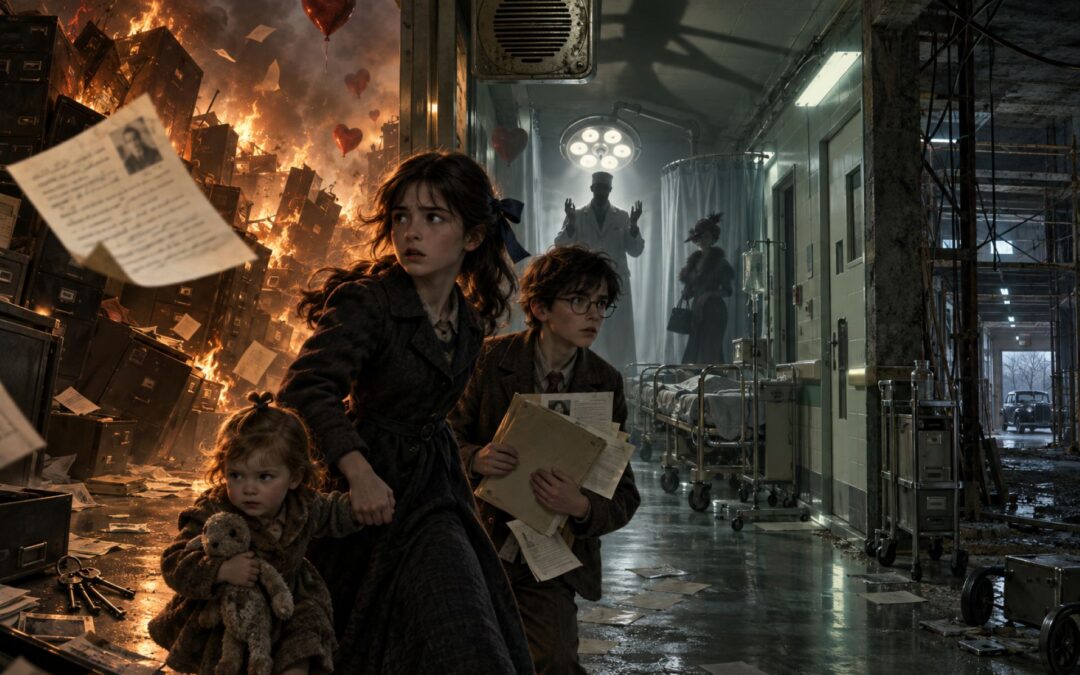
The Hostile Hospital is the eighth novel in Lemony Snicket’s A Series of Unfortunate Events, and it marks one of the clearest structural turning points in the thirteen-book series. The 2001 HarperCollins novel begins immediately after The Vile Village, with Violet, Klaus, and Sunny Baudelaire no longer merely fleeing Count Olaf but also running from authorities who believe they are murderers. Their old strategy—survive the latest guardian, expose Olaf, and hope a responsible adult finally listens—has effectively collapsed.
The hospital setting gives Snicket another institution to parody, but the deeper subject of the novel is information. Newspapers manufacture false realities, telegrams fail to produce help, files conceal lost histories, anagrams disguise identities, paperwork creates authority, intercom announcements direct crowds, and the destruction of records threatens to erase the truth altogether. The Baudelaires increasingly survive by learning how to interpret and manipulate these systems themselves, which creates a new and uncomfortable question: if they lie, steal, disguise themselves, and trick other people in order to survive, how different are their methods from Count Olaf’s?
This article contains full spoilers for The Hostile Hospital, including the Snicket file, Violet’s planned operation, the hospital fire, and the novel’s ending. It does not use revelations from later books to resolve mysteries that remain deliberately unanswered here.

From Fugitives to Volunteers Fighting Disease
The novel begins with the Baudelaires walking through an empty, unfamiliar landscape after escaping the Village of Fowl Devotees. They are exhausted and frightened, but physical discomfort is only part of the problem. Count Olaf has successfully manipulated events so that Jacques Snicket’s murder has been blamed on Violet, Klaus, and Sunny, while Olaf himself is presumed dead. The children who have spent seven books trying to convince adults that Olaf is a criminal are now officially regarded as criminals themselves.
They eventually reach the Last Chance General Store, a cluttered shop that appears to be the only inhabited place for miles. The store offers them something more valuable than food or shelter: a telegraph machine. The Baudelaires decide to contact Mr. Poe at Mulctuary Money Management, despite their long experience of his ineffectiveness, because he remains the closest thing they have to an adult responsible for their welfare. Violet understands the machinery, Klaus knows how to transmit the message in Morse code, and Sunny helps monitor the signal, so even the attempt to ask for adult assistance depends on the children’s own abilities.
Their telegram carefully explains the situation. Jacques Snicket, not Count Olaf, was the murdered man in the Village of Fowl Devotees; Olaf is still alive; Esmé Squalor remains his accomplice; the Quagmires have escaped; and the Baudelaires themselves are innocent. The message ends with an admission that becomes more significant than the children initially realize: they are in grave danger. Putting the facts into a formal communication briefly gives them hope that someone outside their immediate crisis may finally understand what has happened.
While they wait, the shopkeeper mentions a group called Volunteers Fighting Disease. The initials immediately catch the Baudelaires’ attention because V.F.D. has been haunting them as an unresolved mystery. Duncan and Isadora Quagmire discovered something important about those initials before their separation from the Baudelaires, and Jacques Snicket had also been connected to the same mysterious network. For a moment, Volunteers Fighting Disease appears to offer the children not only transportation and safety but perhaps the answer to a question that has followed them across several books.
Mr. Poe never replies. Instead, a deliveryman named Lou arrives with The Daily Punctilio. The newspaper reports the supposedly murderous Baudelaire children as fugitives and includes their photographs. The shopkeeper, who had previously regarded them as talented and polite children, is immediately ready to reconsider them according to what the newspaper says. Lou also reports that the police are closing in, while a nearby group of volunteers has been allowed to travel freely.
The contrast is important. The Baudelaires have just transmitted a detailed first-person account of what actually happened, but the message that changes their circumstances is the false newspaper story. They cannot wait for Mr. Poe any longer. When the Volunteers Fighting Disease prepare to leave, the siblings climb into their van, exchanging one danger for another because remaining at the store would almost certainly lead to arrest.
The volunteer group initially looks like the answer to the V.F.D. mystery, but it quickly proves otherwise. Its members travel around singing cheerfully to ill people and distributing heart-shaped balloons, convinced that relentless optimism is a useful response to suffering. Their songs mention grotesque illnesses and injuries while remaining insistently upbeat, creating exactly the sort of collision between horror and absurdity that defines Snicket’s comedy.
The Baudelaires also discover that the volunteers avoid unpleasant information. Their idea that ignorance can preserve happiness is almost the reverse of what happened at the general store. Milt is endangered by believing bad information too readily; the volunteers protect themselves from bad information by refusing to engage with it at all. Neither approach offers the skepticism and judgment that the Baudelaires increasingly need.
The van eventually arrives at Heimlich Hospital, a strangely unfinished institution with one completed section and another still under construction. There the children hear the scratchy voice of Babs, Head of Human Resources, speaking through an intercom. She asks for three volunteers to take a special assignment in the hospital’s Library of Records. The Baudelaires immediately recognize the opportunity: if the hospital maintains extensive records, perhaps somewhere inside them lies information about Jacques Snicket, V.F.D., or even the fires that destroyed both the Baudelaire and Quagmire homes.
Heimlich Hospital and the Library of Records
Heimlich Hospital presents itself as an institution devoted to health, but the Baudelaires quickly discover that its priorities are stranger than its name suggests. Babs refuses to meet them in person and conducts her work exclusively through the intercom. She even turns an old saying about children being “seen and not heard” into a justification for her own arrangement: adults, in her view, may be heard without being seen. Her disembodied authority becomes one of the novel’s central recurring images, because the people who control the intercom can command the institution without exposing themselves to scrutiny.
Babs also reveals what she considers the hospital’s most important activity. It is not diagnosing illness, relieving pain, or caring for patients. It is paperwork. This joke is exaggerated, but the exaggeration establishes the logic that will govern the entire hospital plot. Records, forms, labels, lists, and official procedures matter so much that anyone who appears to understand them can acquire enormous authority.
The Baudelaires are assigned to the Library of Records, an enormous archive managed by an elderly man named Hal. He is initially one of the most sympathetic adults the children have encountered for some time. He distrusts The Daily Punctilio, which immediately distinguishes him from the shopkeeper, and he treats the children with relative kindness. His failing eyesight also means that he does not recognize them from the newspaper.
The Library itself is less orderly than its name suggests. Information arrives through a chute and must be classified into a filing system whose logic often depends on odd associations rather than straightforward alphabetical categories. Hal possesses a huge ring of keys for the locked cabinets, while Sunny proves useful because her sharp teeth can help open cabinets whose proper keys have been lost. Violet and Klaus sort the incoming information, learning the patterns of the archive while discreetly searching for anything connected with their own lives.
Their work becomes dramatically more important when Hal mentions that he has previously encountered information about the Baudelaire children in material concerning the “Snicket fires.” The phrase is startling because the children have already learned that Jacques Snicket was connected with V.F.D., while the fires that destroyed their own home and the Quagmires’ home appear increasingly unlikely to be isolated tragedies. Hal does not give them a complete explanation, partly because he does not read everything he files and partly because the archive is too vast for a single clue to be easily recovered.
That night, the children sleep in the unfinished wing of the hospital. The setting emphasizes how far they have fallen from the idea of conventional protection: they are essentially hiding in a construction site, using whatever materials they can find to make themselves temporarily comfortable. More importantly, they finally have time to study the surviving fragments of Duncan and Isadora Quagmire’s notebooks.
The scraps contain several clues that have appeared separately across previous adventures. There are references to Jacques, V.F.D., fire, an apartment, 667 Dark Avenue, the mysterious name Al Funcoot, and the equally puzzling phrase “Ana Gram.” None of them yet forms a complete explanation. The children realize, however, that the Library of Records may contain something that connects these fragments.
The problem is Hal. He is kind, but he is also protective of the archive and unwilling to let the children rummage freely through confidential files. The Baudelaires cannot simply ask him for the Snicket material without risking questions about why they are interested in it. Even worse, Count Olaf has once again found them.
An announcement over the hospital intercom reveals that Babs is no longer in charge and that a man named Mattathias has become the new Head of Human Resources. The Baudelaires immediately recognize the voice as Count Olaf’s. Snicket carefully avoids establishing what exactly has happened to Babs, because anything the new administrator says about her is coming through a communication system now controlled by a known liar. What matters to the children is that Olaf can inspect the hospital, issue orders, and use its own institutional authority to find them.
The Baudelaires decide that they must enter the Library at night, locate the Snicket information, and learn as much as possible before Olaf discovers them. Yet Hal locks both the Library and its cabinets, and he keeps the keys with him. Violet can invent lockpicks, but there are too many locks and too little time. Sunny cannot bite through their way into an entire archive before morning.
Their solution marks an important ethical change. Hal’s eyesight is poor, and the children realize they can make a false ring of keys from paper clips and Violet’s ribbon, exchange it for his genuine keys, and rely on his inability to notice the substitution. The plan is clever, but unlike most of their earlier inventions, it requires deceiving someone who has treated them kindly.
The children know this. They repeatedly distinguish between something being necessary and something being nice. They plan to return the keys and apologize once they have obtained the information. Their guilt matters because the novel is beginning to remove the easy distinction between innocent children who obey rules and villains who break them. The Baudelaires are still trying to do the right thing, but circumstances increasingly force them to decide what “right” means when ordinary rules protect neither truth nor justice.
Page Thirteen, the Survivor Clue, and Violet’s Capture
The Baudelaires successfully substitute the false key ring for Hal’s real one and return to the Library after dark. Finding the right file is harder than simply unlocking a cabinet, because Heimlich Hospital’s classification system is enormous and inconsistent. The children search under possibilities connected with Snicket and with fires, but their time is running out. Someone is trying to force open the Library door.
The breakthrough comes when Sunny suggests looking under their own family name. The children rush to the B section and find a folder marked “Baudelaire.” At first the discovery appears useless. A note explains that all thirteen pages of the Snicket file have been removed from the Library of Records for an official investigation.
Klaus is devastated because the file seemed to offer the best chance they had encountered of understanding the network of mysteries around them. Then Violet notices that one sheet has accidentally remained behind. It is Page Thirteen.
The page contains very little material in physical terms, but what it contains is extraordinary. A photograph shows four people standing outside 667 Dark Avenue, the building where the Baudelaires previously lived with Jerome and Esmé Squalor. One is Jacques Snicket. Another is a man turned away from the camera, holding a notebook and pen. The other two are the Baudelaire parents.
For Violet, Klaus, and Sunny, merely seeing their parents again in a photograph is emotionally overwhelming. Their entire series of misfortunes began with Mr. Poe telling them that their parents had died in the Baudelaire mansion fire. Since then, almost every adult arrangement in their lives has been shaped by their status as orphans. The photograph itself does not overturn that history, because it was taken before the fire, but the sentence attached to it opens a possibility they had never seriously been allowed to entertain.
According to Page Thirteen, evidence discussed on the missing Page Nine caused investigators to suspect that one person might have survived the fire. The survivor’s location is unknown. The sentence is deliberately ambiguous, and that ambiguity must be preserved. It does not say that Bertrand Baudelaire survived, that Beatrice Baudelaire survived, or even that the unidentified survivor was necessarily one of the Baudelaire parents. The children do not possess Page Nine, so they cannot examine the evidence on which the suspicion is based.
Even with those limitations, the emotional effect is immense. Grief that had previously been presented as an irreversible condition is suddenly disturbed by hope. Violet remembers details associated with her father, Klaus remembers his mother’s habits, and Sunny is forced to imagine parents she lost when she was even younger than her siblings. Hope is not comforting in a simple way, because the children immediately understand that the missing pages may contain the difference between truth and fantasy.
Their discovery is interrupted by the intruder breaking into the Library. The person is Esmé Squalor, whose conspicuous fashion and exaggerated movements make her recognizable even amid disguise and darkness. She has been sent to destroy whatever Baudelaire-related evidence remains behind.
Esmé does not need to read or understand the archive. Her purpose is to eliminate it. She begins knocking over filing cabinets, producing a domino effect through the enormous room. The scene makes the novel’s information theme physically violent: years of accumulated records become heavy objects crashing into one another, and the attempt to destroy knowledge literally threatens to crush the people seeking it.
The children race toward the information chute as the cabinets fall. Klaus and Sunny are small enough to fit through, but Violet is not. A cabinet separates the siblings, and Violet orders the younger children to continue while she searches for another way out. It is a decision consistent with her role as the eldest Baudelaire: she protects Klaus and Sunny even when doing so leaves her alone.
Klaus and Sunny escape through the chute and wait desperately for Violet. She never joins them. By morning they understand that their sister has been captured.
The separation changes the balance of the story. Violet is usually the inventor who produces practical solutions when the siblings are trapped, but now Klaus and Sunny must find her without her help. Their rescue will require Klaus’s reading and pattern recognition, Sunny’s increasing independence, and a willingness to use the same tools of disguise and deception that Count Olaf has used against them.
The Cranioectomy Plot and the Operating Theater
Count Olaf, still speaking as Mattathias through the intercom, effectively confirms that the hospital inspection has achieved its purpose. Klaus and Sunny cannot see Violet, but they know Olaf has found something he wanted, and their sister’s disappearance leaves little room for doubt about what that is. They hide among the Volunteers Fighting Disease, using the volunteers’ identical cheerfulness and lack of close attention as cover.
Their movement through the hospital exposes the limits of the volunteer group’s philosophy. Patients receive songs and balloons regardless of their actual needs, while requests for useful assistance are treated as less important than maintaining cheerfulness. The joke is not that kindness has no value but that kindness becomes empty when it refuses to engage with reality. The Baudelaires need information, medicine, action, and judgment; songs cannot substitute for any of them.
The crisis becomes more specific when the hospital announces an extraordinary surgical procedure called a cranioectomy on a fourteen-year-old girl. The term is deliberately absurd in the context of the book: the supposedly revolutionary operation involves removing the patient’s head, and Olaf’s associates later dress murder in the language of medical experimentation. Klaus and Sunny immediately suspect that the patient is Violet.
They obtain a list of hospital patients, but Olaf has anticipated the obvious search. Violet Baudelaire does not appear anywhere. Then the intercom calls for Dr. Flacutono to report to the Surgical Ward.
Klaus recognizes the name from an earlier encounter with Olaf’s troupe in Paltryville. More importantly, the sound of “Flacutono,” together with the Quagmire notebook clue “Al Funcoot” and the phrase “Ana Gram,” triggers an important realization. “Al Funcoot,” a name already associated with Olaf’s theatrical schemes, can be rearranged into “Count Olaf.” The notebook clue is telling them to look for anagrams.
A nearby supply closet contains cans of alphabet soup, giving Klaus and Sunny physical letters with which to test the names on the patient list. The scene is absurd, but its logic is precise: Klaus transforms a linguistic insight into a practical search method. They eliminate names whose letters cannot possibly form “Violet Baudelaire” and eventually identify “Laura V. Bleediotie” as the disguised version of their sister’s name.
Language has now become a rescue tool. Olaf uses rearranged letters to hide identities inside official paperwork; Klaus reverses the deception by treating words as objects that can be dismantled and reconstructed. The same principle applies to the disguises that come next.
Klaus and Sunny find white medical coats, masks, and other hospital clothing and decide to impersonate medical personnel. This is another moment that troubles them because Count Olaf’s plots depend heavily on costume. They have spent much of the series furious that adults cannot see through his disguises, yet now their survival depends on the same weakness.
Following a supposed surgical assistant, they soon realize they are watching Esmé Squalor. Her costume conceals her enough to move through the hospital, but familiar details reveal her to the children. That contrast is important: the Baudelaires do not possess supernatural powers of recognition. They pay attention. Other characters often accept the role someone claims to occupy, while Violet, Klaus, and Sunny notice behaviour, objects, voices, names, and inconsistencies.
By maintaining their own disguises, Klaus and Sunny enter the Surgical Ward and discover Violet. She is unconscious from anesthesia and registered under her anagrammed identity. Olaf’s troupe has transformed the hospital into a stage on which murder can be presented as medicine.
The plan is grotesque even by the series’ standards. Count Olaf’s associates will perform—or pretend to perform—the first cranioectomy before an audience. Violet’s death can then be explained as an unfortunate complication of a dangerous new procedure rather than murder. Olaf does not merely intend to kill her; he intends to surround the killing with enough institutional language, costumes, spectators, and paperwork that people will willingly misinterpret what they are seeing.
Klaus and Sunny pose as Dr. Tocuna and Nurse Flo, supposedly associates of the false surgeons. In the operating theater they find doctors, nurses, Volunteers Fighting Disease, reporters, and curious spectators treating the procedure almost like live entertainment. The hook-handed man appears as Dr. O. Lucafont, while another associate presents himself as Dr. Flacutono. Their authority comes from costume and confidence rather than expertise.
To Klaus and Sunny’s horror, the villains order them to perform the operation while the supposed senior surgeons supervise. Klaus is handed a rusty knife and expected to begin cutting his unconscious sister. Sunny realizes that their only immediate option is to stall.
Klaus turns his reading into a defensive weapon. Drawing on what he remembers about the history of surgical tools, he begins giving elaborate explanations about knives, materials, medical technique, and procedure. His knowledge does not magically solve the problem, but it buys time. Sunny contributes by finding excuses to delay the operation and by trying to help Violet recover from the anesthesia.
The scene becomes a contest between performance and knowledge. Olaf’s associates possess no meaningful medical competence, but they understand how to perform expertise before a credulous audience. Klaus possesses genuine knowledge, yet he is using it while pretending to be someone else. The crowd cannot reliably distinguish between the two because it is responding to surface signals—white coats, professional vocabulary, confidence, and institutional setting.
Eventually Klaus reaches the point where delay seems impossible. Holding the knife over Violet, he refuses to proceed. Then the hospital’s own obsession with bureaucracy gives him another idea: paperwork.
Klaus insists that the patient’s documentation must be complete before surgery can occur. The audience immediately accepts this invented requirement because everyone already believes paperwork is the hospital’s highest priority. Doctors and nurses call for Hal, since he oversees the Library of Records and therefore seems like the logical authority to settle the matter.
The tactic works only temporarily. Esmé arrives with Olaf’s actual disguised associates and exposes Klaus and Sunny as impostors. Once their masks come off, the audience recognizes the children from The Daily Punctilio. Rather than questioning why two wanted children were apparently being forced to operate on their own sister, many people immediately accept the newspaper’s narrative.
Hal then arrives carrying the fake key ring. He is deeply hurt and furious. From his perspective, three children he trusted impersonated volunteers, deceived him, stole his keys, entered the Library without permission, and left the archive in chaos. The Baudelaires try to explain, but their actual wrongdoing now supports the much larger false accusation against them.
Then Hal reports something even worse: the Library of Records is on fire.
Fire, Escape, and the Decision to Follow Count Olaf
Count Olaf immediately turns the hospital fire into another piece of misinformation. Through the intercom, Mattathias announces that the Baudelaire murderers have committed arson and orders everyone to capture them. The announcement is horrifying not only because it is false but because Olaf places catching the children ahead of rescuing patients from a burning hospital. The institution has become so thoroughly captured by his voice that even catastrophe can be reorganized around his personal agenda.
The operating theater erupts into confusion. Esmé attacks, Olaf’s associates close in, and Klaus is still holding the rusty surgical knife. For a moment the object gives him a genuine opportunity to use potentially lethal force against people trying to kill him and his siblings.
Klaus refuses. His decision provides one of the clearest answers the novel gives to its growing moral question. He has already lied, disguised himself, stolen keys, and manipulated the hospital’s rules, but there are still actions he will not take. He does not regard necessity as a blank cheque that makes every form of violence acceptable.
Instead, the Baudelaires use Violet’s wheeled hospital bed to escape. Klaus climbs onto the gurney with his sisters and sends it rolling toward the exit. Hal grabs it, believing he is stopping dangerous criminals. Sunny knows that Hal is not evil and that his anger has understandable causes, but she also knows they cannot remain trapped. She bites him only enough to make him let go and apologizes as she does so.
That small moment is easy to overlook amid the chase, but it reinforces the ethical distinction the novel is constructing. Sunny harms Hal because she believes she must, yet she recognizes his humanity and limits the harm as much as possible. Olaf and Esmé treat other people as disposable objects; the Baudelaires continue worrying about the consequences of what they do, even when they cannot avoid causing pain.
The children race through the hospital while the fire spreads. The sight and smell of flames immediately connect the current disaster with the destruction of their home. Fire has followed them throughout the series as both personal trauma and growing mystery, and now it is consuming the very archive that might have explained those earlier fires.
The gurney cannot carry them safely through every corridor. One route is blocked by flames, another by Olaf’s large associate, and Violet remains weak from anesthesia. The children finally take refuge in a supply closet resembling the one where Klaus and Sunny solved the patient-list anagram.
This time the contents look different because Violet is with them. Rubber bands, medical coats, a sink, alphabet soup, and a small window are no longer simply hospital supplies. They are potential components of an invention. Violet is still groggy, however, and struggles to think clearly.
Sunny helps by improvising a replacement for Violet’s missing ribbon, knowing that tying back her hair is part of the inventor’s thinking ritual. The gesture combines practical assistance with intimate sibling knowledge. Klaus and Sunny are not simply waiting for Violet to resume leadership; they actively help restore the conditions in which she can use her talent.
The children first need to distract the crowd gathering outside the hospital. Violet constructs a makeshift system that lets them imitate an intercom announcement and send people away from the area beneath the window. The method works because everyone has been trained to obey disembodied institutional instructions without asking who is speaking.
Violet is disturbed by what they are doing. They are wearing disguises, lying about who they are, manipulating people, and using false announcements—precisely the techniques Count Olaf has repeatedly employed. Klaus and Sunny acknowledge the similarity but argue that motives and consequences matter. They are deceiving people to escape murder and uncover the truth, not to steal a fortune or kill innocent people.
The discussion does not completely erase Violet’s concern, nor should it. Snicket is not replacing a simplistic rule that “lying is always wrong” with an equally simplistic rule that “lying is fine when you are the hero.” Instead, the book is forcing the children to judge particular actions within increasingly compromised circumstances.
Violet then uses the available materials to create a system involving rubber bands that will help them descend from the hospital. Because she is still recovering, the escape is dangerous. At one point she suggests that they might have a better chance if they descend separately.
Klaus and Sunny refuse. Their collective survival matters more than maximizing one sibling’s individual odds. Throughout the book, separation has been one of Olaf’s greatest advantages, most obviously when Violet was captured. The children answer that threat by treating their sibling bond as non-negotiable.
They leap together and survive the descent. Outside, smoke and confusion fill the hospital grounds while people flee the building. The Baudelaires have escaped immediate capture, but they still have nowhere safe to go.
Then they overhear Count Olaf and his troupe preparing to leave. Olaf reveals that the complete Snicket file was not in the Library when it burned. He believes he knows where the thirteen pages can be found and intends to reach them before someone else does. Esmé explicitly distinguishes the “real” V.F.D. from the cheerful volunteers, confirming that the initials still point toward a larger mystery.
For the Baudelaires, the stakes change instantly. The Snicket file could contain evidence capable of clearing their names, exposing Olaf, explaining V.F.D., or identifying the possible survivor mentioned on Page Thirteen. If Olaf reaches it first and destroys it, the children may lose their best chance to learn what happened to their family.
Violet makes a decision that would have been almost unthinkable at the beginning of the series: they will follow Count Olaf deliberately.
The trunk of Olaf’s car is open because his troupe is loading costumes into it. The children crawl inside and hide beneath the clothing before the trunk closes. It is damp, dark, dangerous, and directly controlled by their greatest enemy, yet it offers both escape from the burning hospital and a route toward the information they need.
The novel ends with the siblings huddled together in darkness as Olaf drives away. They are still frightened, but they are no longer waiting for Mr. Poe, another guardian, or some benevolent institution to decide what happens next. They have chosen their direction themselves.
Setting and World-Building: A Hospital Built on Bad Systems
Heimlich Hospital is deliberately unrealistic, but it is carefully constructed as an absurd institution whose physical and administrative design reinforces the novel’s ideas. The building is literally unfinished: one section functions as a hospital while another remains an incomplete construction site. That division makes the setting feel unstable before Count Olaf even arrives.
The unfinished wing gives the Baudelaires somewhere to hide and sleep, but it also suggests a broader incompleteness. The institution possesses doctors, wards, an operating theater, administrators, records, volunteers, maps, intercoms, and policies, yet these pieces do not form a reliable system of care. The hospital looks organized enough to command obedience while remaining fragmented enough to be manipulated.
Babs embodies the problem. She is officially Head of Human Resources but refuses normal human contact, conducting her work through speakers. Her physical absence means authority is separated from accountability. Once Olaf gains access to the same communication system, the institution barely notices that the voice issuing orders now belongs to someone else.
The intercom therefore matters more than almost any individual office. Whoever speaks through it can declare administrative changes, announce surgical procedures, define who counts as a criminal, direct the crowd during a fire, and determine which crisis deserves attention. The hospital’s employees respond primarily to the authority of the channel rather than the credibility of the speaker.
The Library of Records offers a different version of institutional power. It contains potentially enormous quantities of truthful information, but that information is scattered across an eccentric classification system, locked inside cabinets, and vulnerable to removal or destruction. Possessing records is not the same thing as possessing usable knowledge.
Hal is devoted to the archive, yet even he does not know everything inside it. He files material without necessarily reading it, protects access through keys, and depends on rules that make sense only if the people controlling the records are trustworthy. Page Thirteen demonstrates both the value and fragility of the system: one accidentally abandoned sheet gives the Baudelaires their most important clue, while twelve missing sheets leave that clue dangerously incomplete.
The operating theater takes institutional absurdity further by turning medicine into spectacle. Doctors and nurses gather to watch a supposedly revolutionary procedure, while reporters and ordinary spectators behave as though they are attending entertainment. Olaf’s associates do not need sophisticated medical knowledge because the audience is already prepared to interpret confident performance as expertise.
Snicket pushes this almost beyond plausibility on purpose. Heimlich Hospital is not meant to function as a realistic depiction of medical practice. It is an exaggerated world in which the habits of bureaucracy—deference to titles, obsession with forms, faith in uniforms, compartmentalized responsibilities, and institutional self-importance—become visible enough to form comedy.
The satire works because the children repeatedly exploit exactly the mechanisms that endanger them. Klaus invents a paperwork requirement because everyone assumes paperwork must be authoritative. Violet impersonates Babs through a homemade intercom because everyone obeys announcements. White coats help both villains and Baudelaires move through the hospital because clothing creates an expectation of professional status.
The hospital is therefore hostile in more than the obvious sense that Count Olaf takes control of it. Its systems were vulnerable before he arrived. Olaf simply understands how to weaponize their weaknesses faster and more ruthlessly than anyone else.
Character Analysis: The Baudelaires, Their Enemies, and the Adults Around Them
Violet remains the eldest Baudelaire and the family’s inventor, but The Hostile Hospital complicates her usual role. She begins the book trying to solve the children’s situation rationally, first by using the telegraph and later by designing the false key ring. Her inventions increasingly operate inside morally ambiguous situations, which forces her to question not only whether something will work but whether doing it is acceptable.
Her capture is crucial because it temporarily removes the sibling who most often creates the physical means of escape. Violet spends much of the hospital’s central crisis unconscious or impaired by anesthesia, but this does not reduce her importance. Her absence forces Klaus and Sunny to prove that the Baudelaire partnership is not simply two younger children following their older sister.
When Violet regains consciousness, her first major problem is psychological as well as technical. She sees how closely the children’s methods resemble Olaf’s: disguises, false identities, stolen keys, and deceptive announcements. Her discomfort reflects a meaningful expansion of her character. She has always been resourceful, but resourcefulness now requires ethical judgment.
Klaus develops in a complementary direction. His reading has always been useful, but Book 8 turns knowledge into action with unusual consistency. He understands the telegraph and Morse code, works through the Library’s classification problems, recognizes the importance of “Ana Gram,” manipulates alphabet-soup letters to identify Violet, draws upon the history of surgical tools to delay the operation, and understands how bureaucratic language can be used to stall the procedure further.
The operating theater demonstrates that Klaus’s talent is not simply remembering facts. He applies information to changing circumstances. A fact about knives that would be useless in most situations becomes valuable because he recognizes that talking like an expert can buy time. His reading gives him a reservoir of possible tools rather than a collection of trivia.
His refusal to use the surgical knife as a weapon also gives him one of the novel’s clearest moral decisions. Klaus is surrounded by enemies, his sister has nearly been murdered, and escape seems impossible. He still refuses to cross a line he believes would make survival morally unbearable.
Sunny’s development is even more striking because the series continues moving her away from the role of passive infant. She contributes practical observations, helps with the archive, recognizes clues, participates in solving the anagram, wears a disguise, assists Klaus in the operating theater, and physically frees the gurney from Hal. Her speech remains comically idiosyncratic, but her siblings increasingly treat her contributions as equal parts of their decision-making.
Her interaction with Hal is particularly revealing. Sunny understands that he is wrong about the Baudelaires but also recognizes why he is angry. When she bites him, she apologizes and limits the attack to what is necessary for escape. Her growing physical competence is therefore paired with moral awareness.
Together, the three siblings function less like a hierarchy than a cooperative unit. Violet possesses mechanical ingenuity, Klaus possesses extraordinary reading and memory, and Sunny contributes observation, physical ability, improvisation, and increasingly sophisticated judgment. The hospital plot repeatedly separates or weakens one of these capacities so that the others must compensate.
Their refusal to abandon one another during the final escape makes this structure explicit. The practical question is whether splitting up might improve their chances. Their answer is that survival without one another is not the form of survival they want.
Count Olaf is less physically present through much of the novel than in some earlier volumes, but his influence is everywhere once he becomes Mattathias. His most important skill in The Hostile Hospital is not acting convincingly as an individual character. It is controlling systems.
As Mattathias, Olaf gains authority through the intercom without needing to maintain an elaborate visible disguise. He can announce inspections, order procedures, redefine the Baudelaires as dangerous fugitives, manipulate the response to the fire, and coordinate his associates. His performance works because the institution provides the machinery through which his lies become orders.
Olaf’s use of medicine also extends his theatrical instincts. The operating theater is literally a theater, and his associates present murder as a show. Titles, white coats, technical language, spectators, and applause turn a criminal scheme into institutional performance.
Esmé Squalor remains an energetic accomplice whose cruelty is less restrained by the need for elaborate justification. She enters the Library to destroy evidence, participates in disguises, helps manage the surgical plot, and attacks the children directly. Her interest in fashion continues to make her costumes simultaneously useful and recognizable, because she cannot completely suppress her own conspicuous tastes.
Esmé also reveals something about the difference between disguise and identity in the series. A disguise changes how the crowd categorizes her, but the Baudelaires recognize her through patterns they have learned: distinctive shoes, accessories, mannerisms, and behaviour. Recognition depends on memory and attention rather than simply seeing a face.
Hal is more complicated than the many adults who are merely foolish or cruel. He genuinely helps the Baudelaires, distrusts The Daily Punctilio, values information, and treats them kindly. When they deceive him, his anger is not absurd. They really do steal his keys and really do enter his Library without permission.
The tragedy is that Hal receives enough true evidence to support a false conclusion. He sees the fake key ring and knows the children lied to him. He also sees his beloved archive burning. Because he does not know about Esmé’s attack or Olaf’s larger scheme, the newspaper’s accusation suddenly seems consistent with his personal experience.
That makes Hal one of the book’s strongest examples of why truth is harder than simply distinguishing honest people from dishonest ones. He is not malicious, but incomplete information causes him to participate in injustice.
Babs, the Volunteers Fighting Disease, hospital staff, reporters, and much of Olaf’s troupe remain broader caricatures. Snicket uses them less as psychologically complex individuals than as embodiments of institutional habits, fashionable certainty, blind optimism, or theatrical villainy. That limits their depth, but it also gives the novel the exaggerated social world its satire requires.
The V.F.D. Mystery and the Meaning of the Snicket File
By Book 8, V.F.D. has stopped functioning as a single unexplained set of initials and become the central architecture of the series mystery. The Hostile Hospital does not solve it, but it changes the Baudelaires’ relationship to it. They begin the book chasing accidental clues and end it intentionally pursuing information that Count Olaf himself wants to destroy.
Volunteers Fighting Disease is the first major misdirection. The name fits the initials perfectly, and earlier hints about volunteers make the connection initially plausible. Yet the singing hospital visitors are clearly not sufficient to explain Jacques Snicket, the eye tattoo, the underground passage beneath 667 Dark Avenue, Olaf’s long history, the Quagmires’ discoveries, or the fires connecting several families.
The ending confirms the distinction when Esmé refers explicitly to the real V.F.D. while dismissing the hospital singers. That is an important revelation, but it remains limited. Book 8 still does not explain the organisation’s history, membership, purpose, internal conflicts, or full connection with the Baudelaire parents.
The Snicket file is therefore more significant than the false V.F.D. answer. Its existence proves that some formal body has collected information connecting the Baudelaires, Jacques Snicket, fires, 667 Dark Avenue, and other figures whose relationships the children do not yet understand. Olaf’s urgent desire to destroy the file proves that the records threaten him.
Yet the children never possess the whole thing. That limitation is central to the mystery rather than an inconvenience that should be smoothed over. Twelve pages have been removed, and the one remaining page explicitly depends on evidence from Page Nine. The Baudelaires encounter a conclusion without the evidence required to evaluate it.
Page Thirteen therefore gives them knowledge and ignorance simultaneously. The photograph establishes that their parents knew Jacques Snicket and were present with him at 667 Dark Avenue. The sentence establishes that investigators believed there might be a survivor of the relevant fire. Nothing on the page securely identifies that survivor.
The missing pages make absence itself meaningful. Someone has enough authority to remove them from the archive. Olaf wants them destroyed. Another party apparently wants them too. The children are no longer investigating only visible clues; they are learning to ask who controls what has disappeared.
The photograph also destabilizes their understanding of their parents. Until this point, Bertrand and Beatrice Baudelaire have largely existed in the series as beloved memories cut off by the opening catastrophe. Page Thirteen suggests that their lives may have included connections, organisations, and dangers that the children never knew about.
That possibility changes the emotional nature of the mystery. V.F.D. is no longer simply something the Baudelaires need to understand because Olaf is involved. It may be part of their own family history.
The final conversation outside the burning hospital confirms that the information war is still active. The complete Snicket file survived because it had already been removed from the Library. Olaf believes he can find it, and he fears that another party may reach it first.
The Baudelaires respond by entering his trunk. At that moment V.F.D. becomes more than a mystery imposed on them. It becomes an investigation they have chosen to pursue.
Major Themes: Truth, Knowledge, Morality, and Family
The most important theme in The Hostile Hospital is not simply truth but the difficulty of reaching truth when information travels through unreliable systems. Almost every major location contains a different problem of knowledge: the telegraph produces no answer, the newspaper publishes false accusations, the volunteers avoid unpleasant news, the archive contains inaccessible information, Page Thirteen lacks its supporting evidence, patient names are encoded, and the intercom lets a liar control what an entire institution hears.
The novel repeatedly distinguishes information from understanding. The shopkeeper possesses information because he reads the newspaper, but the information is false. The Volunteers Fighting Disease preserve cheerfulness by avoiding information altogether. Hal possesses enormous quantities of information without knowing all of its contents. The Baudelaires survive because they compare sources, recognize inconsistencies, remember previous evidence, and remain willing to revise what they think they know.
That pattern makes reading one of the novel’s most active virtues. A detailed rereading of The Hostile Hospital has similarly emphasized how unusually central communication, filing, decoding, and interpretation are to its plot. Klaus’s literacy is the clearest example, but the larger point applies to all three children: reading well means more than understanding written words. It means evaluating systems that claim to tell you what is true.
The Daily Punctilio represents the most obvious failure of that process. Its authority is powerful enough to transform the Baudelaires socially even though it does not transform them morally or factually. They are still innocent, but once the newspaper labels them murderers, strangers react to the label rather than to the people in front of them.
The hospital intensifies the same mechanism through professional authority. A white coat makes someone a doctor in the eyes of the crowd. A speaker makes someone the administrator. A patient list makes an invented identity administratively real. The novel’s absurdity depends on exaggeration, but the underlying observation is recognizable: people often use social markers as shortcuts for judgment.
Against this, the Baudelaires develop skepticism without collapsing into complete distrust. They do not conclude that every record is false or every institution is useless. Page Thirteen matters because records can preserve truth; Hal matters because adults can be decent; the telegraph would have been useful if someone trustworthy had answered. Their problem is not that knowledge systems are inherently corrupt but that systems require interpretation and can be manipulated.
The second major theme is moral ambiguity. Earlier books often establish a straightforward contrast between the resourceful children and the criminal Count Olaf. The Hostile Hospital complicates that division by making the Baudelaires use techniques strongly associated with him.
They steal Hal’s keys. They create false objects. They adopt disguises. They use false names. They manipulate professional expectations. Violet fabricates an intercom announcement. Sunny bites someone who is not evil. The children themselves notice the resemblance, especially Violet.
The novel does not treat all these acts as morally neutral. The Baudelaires feel guilty about deceiving Hal precisely because he has been kind to them. Their discomfort demonstrates that they have not simply decided rules no longer matter.
At the same time, Snicket refuses to define morality purely through the outward form of an action. Olaf lies in order to steal, murder, conceal evidence, and dominate others. The Baudelaires lie primarily to avoid wrongful arrest, rescue Violet, escape murder, and pursue evidence. Similar techniques can serve radically different purposes.
Consequences matter as well. Sunny uses force against Hal but limits it and apologizes. Klaus refuses lethal violence even when facing people who intend to kill him. Violet worries about manipulating the crowd even while the crowd is helping Olaf capture them.
This does not produce a neat ethical formula. It produces something more appropriate to the stage of the series: the children are discovering that goodness cannot always mean obedience. When rules, institutions, and authorities are controlled by criminals or misinformation, following them blindly may help injustice.
Family loyalty provides the emotional structure that keeps this ethical complexity from becoming abstract. Violet, Klaus, and Sunny repeatedly make decisions according to what will protect one another. Klaus and Sunny risk exposure to rescue Violet. Violet remains deeply troubled by any plan that might separate the siblings. Their final choice to jump together turns family solidarity into a deliberate principle.
The possible survivor gives family a second dimension. Until Page Thirteen, their parents are loved but definitively absent. The survivor clue changes grief into uncertainty, and uncertainty is almost harder to manage because it demands action. If there is even a possibility that someone from the fire survived, remaining passive becomes much more difficult.
The Volunteers Fighting Disease introduce another theme: the difference between optimism and compassion. Their songs, balloons, and cheerfulness are not evil, and some patients may even appreciate them. The problem is their belief that avoiding unpleasant realities is itself a moral virtue.
The Baudelaires have learned the opposite lesson. Painful information may be necessary. They need to know that Olaf is nearby, that Violet has been captured, that a surgical procedure is a murder plot, that the hospital is burning, and that Page Thirteen cannot prove what they desperately want it to prove.
Hope therefore has value only when it remains connected to truth. The possibility of a survivor motivates the children, but the novel does not allow them certainty they have not earned.
Finally, The Hostile Hospital develops the theme of self-reliance. At the general store, Violet still insists that they cannot be expected to solve everything by themselves. Klaus quietly observes that they have already been doing exactly that since the fire.
The rest of the novel proves his point. No adult rescues them. Mr. Poe does not arrive. Babs disappears from effective control. Hal helps before turning against them. Doctors and nurses are manipulated. The volunteers sing. The authorities believe the wrong story.
By the ending, the Baudelaires no longer organize their plans around finding a better adult to take charge. They decide what information matters and deliberately follow the person most likely to lead them toward it. Their independence is frightening rather than triumphant, but it is unmistakable.
Symbols and Motifs: Fire, Files, Intercoms, Balloons, and Disguises
Fire is the most emotionally powerful recurring image in the novel because it connects the immediate hospital crisis with the catastrophe that began the series. The Baudelaire mansion fire killed—or apparently killed—the children’s parents and destroyed the physical center of their former life. The Quagmires experienced a comparable loss, while the phrase “Snicket fires” suggests that these events may belong to a larger pattern.
The hospital fire therefore means more than escape danger. It destroys the Library of Records, threatening to erase information about earlier fires at the very moment the children finally begin uncovering it. Memory, evidence, and destruction converge in one event.
The fire also changes meaning because the Baudelaires are falsely accused of starting it. Something that has defined them as victims is transformed by public narrative into evidence that they are perpetrators. Olaf’s manipulation of that reversal shows how completely he can exploit appearances.
Files represent the opposite impulse: preservation. The Library attempts to keep information against time, forgetfulness, and disorder. Yet its cabinets, keys, classification rules, and official investigations also restrict access to what has been preserved.
Page Thirteen becomes a symbol of incomplete knowledge. It contains enough to transform the children’s understanding but not enough to settle the questions it raises. Its missing context matters as much as the surviving page.
The intercom symbolizes institutional authority detached from physical presence. Babs uses it because she prefers to be heard without being seen. Olaf then takes advantage of exactly that structure. Later, Violet appropriates the system herself, using imitation to redirect the crowd.
Its progression is significant. The intercom begins as an odd bureaucratic convenience, becomes Olaf’s weapon, and finally becomes a tool the Baudelaires can seize. The object itself is neither benevolent nor evil; power depends on who controls it and how unquestioningly others obey.
Heart-shaped balloons represent the Volunteers Fighting Disease’s philosophy of compulsory cheerfulness. The heart shape suggests care, but the balloons are light, temporary, and practically useless in the face of serious illness. Their inadequacy is part of the joke.
Disguises are more ethically complex. Olaf has used disguises throughout the series to exploit the inability of adults to look beyond surfaces. In this book the Baudelaires themselves begin wearing costumes because the same weakness can help them survive.
The motif therefore changes from something done to the children into something they consciously adopt. Their growing resemblance to their enemy becomes visible before it becomes part of their explicit moral debate.
Anagrams perform a related function with language. “Al Funcoot,” “Count Olaf,” and Violet’s hospital alias demonstrate that identity can be concealed while all the original components remain present. Nothing has technically disappeared; the pieces have merely been rearranged until most observers fail to recognize them.
Keys symbolize access and its moral price. Hal’s keys can open the archive containing the truth, but obtaining them requires betraying his trust. The Baudelaires’ counterfeit ring is therefore both a clever invention and evidence of their growing ethical compromise.
The unfinished hospital provides a broader visual motif for the novel itself. Its structures are incomplete, its information is incomplete, and the children’s understanding of their family history is incomplete. Even their status as orphans becomes uncertain by the final page.
The trunk at the ending gathers several of these patterns together. It is a disguise because the children conceal themselves beneath Olaf’s costumes, a form of imprisonment they enter voluntarily, and a shelter controlled by their enemy. It perfectly captures their new situation: knowledge can be pursued only by moving deeper into danger.
Narrative Style, Metafiction, and Literary Allusion
Lemony Snicket’s narrative voice is so distinctive that the series would be fundamentally different if its events were told by a conventional third-person narrator. Snicket does not simply report what happens. He interrupts, defines words, warns readers away, describes his own mysterious circumstances, recalls people he has lost, introduces absurd examples, and repeatedly reminds us that he is supposedly documenting real events from incomplete evidence.
That construction makes A Series of Unfortunate Events a useful example of metafiction, and scholarship on the series’ metafictional structure has examined how Snicket blurs the boundaries between narrator, researcher, character, authorial persona, and supposedly documented history. The Hostile Hospital is especially compatible with that method because the plot itself revolves around missing records and uncertain evidence.
Snicket’s narrator frequently knows more than the Baudelaires but refuses—or claims to be unable—to supply everything. When the children struggle with “Snicket fires,” the narrator implies that he possesses a wider history but continues following the Baudelaires’ limited perspective. That gap creates dramatic irony while also making the reader feel that the fictional archive extends beyond the pages of the novel.
His vocabulary explanations are another signature technique. Sometimes Snicket defines genuinely difficult words; sometimes he explains ordinary phrases in absurdly specific ways; sometimes the definition becomes a joke or miniature narrative. The effect is simultaneously educational and parodic.
In The Hostile Hospital, however, language becomes unusually central to the action itself. “Ana Gram” is not simply wordplay for the reader. Klaus must understand it correctly to find Violet. An invented patient name can determine where a person is physically hidden because bureaucracy treats the rearranged letters as a valid identity.
A linguistic study of the series has likewise examined how Snicket uses variation in dialogue and linguistic style to distinguish characters while making language itself part of the books’ relationship with reading. The Baudelaires’ abilities repeatedly depend on paying attention to exactly how something is said rather than accepting only its surface meaning.
The novel’s opening use of telegram language is a good example. Snicket builds an extended joke around the word “STOP,” treating the telegraphic convention as both punctuation and an instruction that readers should abandon the dreadful story. The joke establishes the chapter’s communication theme before the Baudelaires even reach the telegraph machine.
The same method shapes the hospital scenes. “Operating theater” becomes an excuse to compare surgery with dramatic and musical performance, but the comparison also predicts what Olaf’s associates are doing: turning an operation into a literal show. Snicket’s digressions often seem like comic detours until the main plot reveals that the joke and the structure are connected.
Literary allusions and unusual names contribute another layer. The series routinely rewards readers who recognize authors, historical figures, theatrical references, and other cultural material, but recognition is rarely required to understand the immediate plot. The allusions help create a world where reading broadly seems normal, even when the events themselves are absurd.
Black comedy remains the governing tone. Serious threats—wrongful imprisonment, murder, surgical mutilation, arson, parental death—are surrounded by jokes about paperwork, balloons, hospital names, songs, and professional language. The comedy does not remove the danger; it makes the danger easier to examine without turning the novel into straightforward horror.
Snicket also relies on repetition, but he often changes what repeated elements mean. Count Olaf appears under another identity, adults again fail to recognize the truth, and the children again need to escape, yet their response is no longer the same. The repeated formula becomes a measuring device for character development.
That is particularly important in Book 8. If the disguise pattern were merely repeated without alteration, it would feel increasingly mechanical. By giving the Baudelaires disguises of their own and making them question the ethics of using them, Snicket turns a familiar series mechanism into new material.
The narrator’s own shadowy biography also deepens here. References to Snicket’s losses, associates, research, and personal past resonate more strongly once Jacques Snicket and the Snicket file become central to the children’s investigation. The narrator is no longer simply the strange man telling their story; his name now exists inside the story’s mystery.
Yet the novel wisely refuses to explain all of this at once. Metafiction works here through controlled incompleteness. The reader receives enough evidence to realize that Snicket’s narration and the Baudelaire mystery are connected, but not enough to collapse the mystery into exposition.
The Ending Explained: Why the Baudelaires Enter Olaf’s Trunk
The literal ending is straightforward but strategically important. The Baudelaires escape Heimlich Hospital as it burns, hide near Count Olaf’s car, and overhear him discussing the complete Snicket file. Olaf says the file was not destroyed in the Library and indicates that he intends to find it before another party can reach it.
The children understand immediately that allowing Olaf to disappear again would mean losing their strongest lead. The file may contain evidence proving their innocence, information capable of bringing Olaf to justice, an explanation of V.F.D., or clarification of the possible fire survivor. They therefore climb into the open trunk of Olaf’s car and hide beneath his troupe’s costumes.
What makes this ending different from earlier cliffhangers is intention. Count Olaf has pursued the Baudelaires from guardian to guardian, forcing them to react to his schemes. Even when they investigate him, their primary objective has usually been exposure followed by escape.
Here the relationship reverses. They voluntarily place themselves in his path because he knows something they need to know. Olaf remains the hunter in many practical respects, but the Baudelaires have chosen to track the hunter.
The choice also completes the book’s movement away from conventional adult protection. The novel begins with Violet believing Mr. Poe may still help them if they can simply explain the truth. It ends with the children deliberately entering their enemy’s vehicle because following him seems more rational than waiting for another institution to understand their situation.
Their decision is not recklessness for its own sake. The hospital is burning, the authorities believe they are murderers and arsonists, and remaining nearby is itself dangerous. The trunk is simultaneously an escape route and an investigative strategy.
Their earlier refusal to separate during the hospital escape also matters. The three children enter the trunk together just as they choose to descend from the hospital together. Olaf repeatedly succeeds by isolating people, exploiting fractured institutions, and separating information from context. The Baudelaires answer by preserving the one structure they still trust completely: their sibling relationship.
Violet’s fear that they are becoming like Olaf remains unresolved. Entering the trunk does not magically settle the moral question raised by their lies and disguises. Future circumstances may force even harder choices.
What Book 8 does establish is that motive alone is not the only difference between them. The Baudelaires continue questioning themselves, limiting unnecessary harm, apologizing when they hurt decent people, and refusing certain forms of violence. Olaf shows no comparable moral friction.
The possible survivor remains equally unresolved. Page Thirteen gives the children a reason to hope, but the final suggestion that they may not actually be orphans is intentionally conditional. The novel does not reveal who survived, where that person is, or whether the evidence was interpreted correctly.
That uncertainty gives the final image its emotional force. The Baudelaires are hidden in darkness inside Count Olaf’s trunk, breathing through bullet holes while moving toward an unknown destination. They have never been less conventionally safe, yet they have rarely had a stronger reason to keep moving.
Critical Review: How Well Does The Hostile Hospital Work?
The Hostile Hospital is one of the more important transitional volumes in A Series of Unfortunate Events because it does more than advance the external V.F.D. mystery. It changes the Baudelaires themselves. By the end, they are no longer children who expect that exposing Count Olaf to the correct authority will restore order. They have begun operating in a world where authority may itself be compromised, ignorant, or unavailable.
The strongest element of the novel is the unusually tight relationship between theme and plot. Information is not merely discussed as an abstract value. The story is built out of communication systems: telegram, newspaper, archive, patient list, intercom, paperwork, names, files, and overheard conversation.
Klaus’s reading ability is therefore integrated especially well. In weaker versions of the “bookish character,” knowledge can function like magic: the character conveniently remembers exactly the fact the plot requires. Snicket partly uses that device, but he also shows the interpretive process around it. Klaus makes connections between old clues and new evidence, tests anagrams physically, adapts remembered information to stall a dangerous situation, and sometimes reaches only partial conclusions.
Violet’s inventiveness receives a comparable ethical complication. Her machines and devices still save lives, but her most significant creations in this volume include a fake key ring and a deceptive communication system. The question is no longer simply whether she can invent a solution. It is whether the solution is one she can live with.
Sunny benefits from the novel’s broader shift toward sibling equality. Her unusual speech and biting remain comic trademarks, but she increasingly contributes judgment rather than merely useful teeth. Her role in rescuing Violet and escaping Hal makes her a meaningful actor in the crisis.
The operating-theater sequence is probably the book’s most successful extended set piece. It combines suspense, comedy, institutional satire, language, character development, and the series’ disguise motif without allowing any single element to completely dominate. The basic situation—Klaus and Sunny must pretend to be medical professionals while being ordered to kill their own unconscious sister—is immediately horrifying, while the crowd’s enthusiasm makes it grotesquely funny.
The absurdity escalates in a controlled way. Technical language creates delay; then historical knowledge creates delay; then hospital paperwork creates delay. Each tactic arises from something previously established about the characters or institution, so the sequence feels more constructed than arbitrary despite its deliberate ridiculousness.
The Library of Records material is equally effective for different reasons. Page Thirteen finally gives readers a substantial payoff after several books of cryptic V.F.D. hints. The photograph, missing pages, survivor statement, and Olaf’s interest in destroying the file make the larger mystery feel materially connected rather than endlessly teased.
At the same time, the book risks frustration because almost every answer generates more questions. The surviving page depends on missing evidence. The photograph identifies relationships without explaining them. “Real V.F.D.” is confirmed without being defined. Olaf knows where the file may be, but the novel ends before the children follow him there.
For readers moving through the series consecutively, that withholding is part of the momentum. As a completely isolated novel, it makes The Hostile Hospital less self-contained than some earlier installments. The local hospital plot reaches a climax and escape, but the larger narrative ends by accelerating into Book 9 rather than settling.
The portrayal of adults also remains intentionally exaggerated. Doctors, nurses, reporters, volunteers, and spectators accept absurd claims with astonishing ease. The operating theater would collapse if too many people behaved like skeptical adults rather than caricatures.
That is both a limitation and a feature of Snicket’s world. The series has never aimed for strict social realism; it uses institutional absurdity to represent a child’s experience of living under rules created and enforced by adults who may be less competent than they appear. The exaggeration becomes most effective when it reveals a recognizable habit beneath the joke, such as trusting uniforms, titles, official announcements, or newspaper headlines too readily.
The Volunteers Fighting Disease illustrate the strengths and weaknesses of this caricatural method. They are memorable because their response to suffering is so comically inappropriate, but they do not develop into complex individuals. Their thematic role is more important than their characterization.
Hal works better precisely because he is more complicated. His initial kindness makes the theft of his keys genuinely uncomfortable, while his eventual anger gives the Baudelaires consequences they cannot dismiss as mere stupidity. His mistaken belief in their guilt is unfair, but it is built partly from their real deception.
Count Olaf himself is effective here largely because the book reduces the importance of his physical disguises. Mattathias works through the intercom, making institutional control more important than costume. That variation helps prevent the familiar Olaf formula from becoming completely repetitive.
Even so, the series pattern is still visible. Olaf adopts another identity, adults accept it, the Baudelaires recognize him, and almost no one listens until the situation has become catastrophic. Readers already tired of that mechanism by Book 8 may not find the hospital variation enough to eliminate the repetition.
The difference is that the novel now begins criticizing the mechanism from inside. Klaus and Sunny put on medical disguises and discover that people believe them for many of the same reasons they believe Olaf. Violet later uses the intercom in much the same way he does. The children are finally learning how the world’s absurd rules actually work instead of merely suffering because of them.
The novel’s moral development may therefore be more important than its V.F.D. revelations. The children are becoming capable of operating in compromised systems, but competence brings moral responsibility. They can no longer imagine goodness as simply telling the truth and following proper procedures, because those procedures are being used to capture and kill them.
Snicket does not resolve the resulting ethical problem too neatly. Klaus’s refusal to use lethal force establishes a limit, but the children still have to live with what they did to Hal. Violet still worries about deception after it saves them. Their conscience is not presented as proof that every action was correct; it is part of the burden of making decisions without reliable authority.
The prose remains one of the book’s most distinctive pleasures. Snicket’s definitions, digressions, literary jokes, direct addresses, and elaborate warnings can frustrate readers who prefer fast, transparent narration, but they are integral to the series’ identity. In this volume they are unusually well matched to the plot because language itself is one of the things being manipulated.
The darkest scenes also benefit from the black comedy. A story involving attempted decapitation, children falsely accused of murder, destroyed evidence, anesthesia, and a burning hospital could become oppressively grim. Snicket’s absurd tone lets the story remain accessible without pretending the events are harmless.
Emotionally, Page Thirteen provides the book’s strongest quieter moment. After volumes built on the certainty of parental loss, the possibility of a survivor changes what the Baudelaires think they are searching for. The novel wisely refuses to turn that possibility into immediate sentimental reassurance.
The ending is effective because it transforms a familiar image of captivity into voluntary action. Hiding in Count Olaf’s trunk is objectively terrible shelter, but the decision belongs to the children. They enter because they have chosen a goal larger than immediate escape.
That makes The Hostile Hospital especially rewarding for readers following the full series in order. It retains the grotesque humor, incompetent adults, elaborate disguises, cliffhangers, and linguistic games of the earlier books while pushing the larger narrative into a more investigative and morally ambiguous phase. Readers encountering it alone can still appreciate the hospital adventure, but much of its importance depends on understanding the accumulated mysteries and failures that brought the Baudelaires there.
Its greatest achievement is that it turns information into drama. A newspaper can chase the children across a landscape, a missing page can create hope, an anagram can locate a prisoner, paperwork can delay a murder, and an intercom can control an entire institution. These mechanisms make the novel more thematically unified than its deliberately chaotic surface initially suggests.
Its most important limitation is inseparable from the serial form: the book opens larger questions much faster than it answers them. Readers wanting a self-contained solution to V.F.D. will not receive one. What they receive instead is the moment when the Baudelaires stop treating mystery as something happening around them and decide to pursue it themselves.
That shift gives the novel lasting value within A Series of Unfortunate Events. The hostile hospital is eventually left behind, but the lesson the children carry out of it is much larger than the setting. Truth does not automatically reach the people who need it, institutions do not automatically protect the innocent, and intelligence does not remove the moral consequences of difficult choices.
By the final pages, Violet, Klaus, and Sunny still do not know who survived the fire, what the complete Snicket file contains, what the real V.F.D. is, or where Count Olaf is taking them. What has changed is their understanding of their own role. They are no longer waiting for someone else to solve those questions.
That is why The Hostile Hospital works best not simply as another unfortunate episode but as a threshold in the series. The Baudelaires leave the hospital without a guardian, without public credibility, and without conventional safety, yet they possess more agency than before. For readers of the full sequence, it remains worth reading because this is the volume in which surviving Count Olaf begins to turn into investigating the world that produced him—and the hidden history of the Baudelaire family itself.
Last Updated on September 10, 2026 by Aseem Gupta