

Cal Newport’s How to Become a Straight-A Student begins from an observation that many college students eventually discover for themselves: the number of hours spent studying is a poor measure of how much useful academic work actually gets done. A student can remain in the library for an entire evening, switching between reading, conversation, distraction, anxiety, and half-focused work, yet accomplish less than another student who works intensely for a much shorter period. Newport’s book is an attempt to turn that difference into a repeatable system.
The title makes the book sound narrowly obsessed with grades, but its deeper concern is control. Newport wants students to stop allowing coursework to expand until it consumes every available hour. His promise is that academic work can be organized into processes—planning, focused study, active review, research, argument construction, drafting, and editing—that make good performance more predictable while leaving more room for sleep, friendships, activities, and the rest of college life.
This article follows the complete original U.S. text of the book. Penguin Random House’s current listing records the book’s publication on December 26, 2006, while the first-edition text itself carries a 2007 copyright and publication statement. What matters more than the date is how much of Newport’s system has survived nearly two decades of changes in technology and higher education. Some details now look unmistakably mid-2000s, but the architecture underneath them remains surprisingly durable.
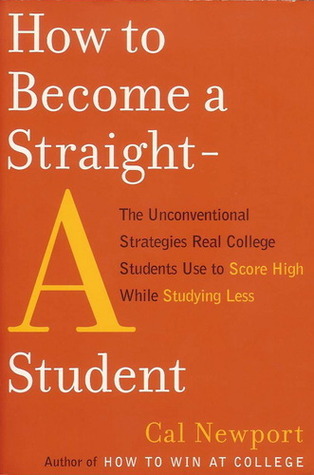
What Newport Is Trying to Solve: Better Grades Without the Grind
Newport frames the book around his own transition at Dartmouth. He arrived with study habits that had worked well enough in high school but did not scale smoothly to college. Assignments accumulated, deadlines competed for attention, and long hours did not always translate into reliable results. Instead of responding by working progressively longer, he began experimenting with how he organized his time, how he studied, and how he approached papers and exams.
He reports that the later version of his system produced 35 As and one A− across his final 36 courses while still allowing him a life outside academics. That personal result supplies the book’s initial credibility, but Newport does not want the method to rest solely on his own experience. He also interviewed high-performing students at demanding colleges and tried to identify practices shared by people who earned excellent grades without behaving like what he calls “grinds”—students whose academic success depends on giving nearly all their available time to schoolwork.
Newport later described the project as being based on interviews with 50 well-balanced straight-A undergraduates. That research design is important to understand correctly. He was not conducting a randomized experiment that could prove which habits caused high grades. He was observing how successful students actually worked, combining those observations with his own experimentation, and distilling them into procedures that other students might imitate.
The book’s central enemy is what Newport calls pseudo-work. Pseudo-work is the familiar state of being technically engaged in academic activity without maintaining enough concentration to make the activity efficient. A student may spend five hours “studying,” but if those hours contain socializing, wandering attention, frequent interruption, and tired rereading, the useful work accomplished may be modest.
Newport captures the idea with a simple heuristic: useful work depends on both the time invested and the intensity of concentration. The formula is not presented as a scientific law. Its purpose is practical. If two students complete similar academic tasks, the one who can work at higher intensity for a shorter period has gained something valuable that the other has not: time.
That principle governs the entire book. Part One tries to make focused work possible by controlling time and procrastination. Part Two applies the same philosophy to lectures, assignments, studying, and exams. Part Three applies it to writing, arguing that research, thinking, drafting, and editing become much easier when students stop attempting all of them at once.
The book therefore asks students to change more than individual habits. Newport wants them to stop treating academic success as a contest in endurance and begin treating it as a system-design problem.
Part One: Build a System That Makes Focus Possible
Part One is the foundation on which everything else rests. Newport cannot teach efficient exam preparation or paper writing to a student who has no idea where the week is going, postpones unpleasant tasks until deadlines become emergencies, and attempts difficult work only when already exhausted. His first three steps are therefore less about studying than about creating the conditions in which studying can happen efficiently.
Pseudo-work is the conceptual thread connecting them. Newport’s solution is not simply to demand stronger willpower. He tries to reduce the number of situations in which students must rely on willpower by making commitments visible, creating routines, protecting energy, and choosing environments that encourage concentration.
Manage Your Time in Five Minutes a Day
Newport’s time-management system is intentionally primitive. He does not ask students to build a complex productivity dashboard, maintain multiple planning horizons, or schedule every hour of the semester. The essential tools are a calendar and some method of capturing new obligations as they appear.
The capture step matters because college days are full of small commitments that arrive unpredictably: a professor announces an assignment, a classmate suggests a meeting, someone remembers an errand, or a deadline changes. Instead of trusting memory, the student records these items immediately. Once each day—usually in the morning—the captured material is transferred into the calendar and converted into a realistic plan.
The key word is realistic. Newport does not want a heroic list of everything the student would ideally complete. He wants tasks assigned to actual blocks of available time, with an honest estimate of what can fit. If the day cannot accommodate everything, some items must be consciously moved rather than left hovering as vague intentions.
The system remains flexible after the initial plan is made. New tasks may appear, a class may take longer than expected, or a meeting may disrupt the schedule. Newport expects the student to revise the plan rather than treating any deviation as failure. The calendar is a control panel, not a moral contract.
Stephen’s Monday is used to show how this works in practice. He begins with a day that already contains coursework and ordinary commitments, then has to absorb additional errands, exercise, newly discovered obligations, and a social event. The lesson is not that Stephen perfectly predicts every minute. It is that he repeatedly looks at what time remains and deliberately decides what can still be done.
This is a small but important shift in behavior. Without a trusted planning system, students often carry an undifferentiated sense that they “should be studying,” which makes leisure feel guilty and work feel endless. Newport’s method tries to replace that anxiety with explicit decisions: this task will happen here, this task must move, and this period is genuinely free.
The system also prevents a common form of self-deception. A student who writes down six hours of tasks when only three hours are actually available can no longer pretend that determination will somehow solve the arithmetic. Newport wants overload exposed early enough that priorities can change before a deadline creates panic.
Years later, Newport acknowledged that this original method was deliberately simple and does not solve every productivity problem. It says relatively little about large-project decomposition or sophisticated prioritization. That limitation is real, but simplicity is also part of why the method works inside this book: it is meant to be adopted immediately by a student who needs more control, not studied as a productivity philosophy.
Fight Procrastination Before It Becomes a Crisis
A schedule is useless if the student repeatedly ignores it. Newport therefore treats procrastination as a separate operational problem rather than assuming that a sufficiently detailed calendar will automatically produce action. His five “battle plans” are designed to attack different excuses that arise between intention and work.
The first is a work-progress journal. The student records what work was planned and what was actually accomplished, especially when procrastination wins. Newport’s purpose is not elaborate self-analysis. The journal creates accountability by making repeated failure visible. It is easier to rationalize another wasted afternoon when yesterday’s avoidance has disappeared from memory than when a record shows the same pattern happening repeatedly.
The second strategy is to protect energy. Hunger, exhaustion, and physical discomfort frequently become convenient reasons to postpone cognitively demanding work. Newport therefore recommends taking care of food and basic physical needs before entering a serious study period. The idea is straightforward: remove predictable excuses before asking yourself to concentrate.
The third tactic is to make an event out of especially unpleasant work. When a task has become psychologically toxic, Newport suggests changing context—going somewhere pleasant or distinctive, perhaps a café, and associating the session with something enjoyable. This recommendation can appear to conflict with his later insistence on isolated study locations, but the two serve different purposes. Isolation is the default for deep concentration; changing scenery is an emergency technique for a task that the student otherwise cannot get started.
The fourth strategy is to create routines. If recurring work always happens at a familiar time or in a familiar setting, the student avoids renegotiating the decision every week. The purpose is to make beginning automatic enough that less emotional energy is spent asking whether one feels like working.
The fifth is to accept occasional hard days deliberately. Newport rejects the fantasy that efficiency means every day must be easy. Some periods of the semester will contain too much work to remain comfortable. The difference is that a student using his system can identify these demanding days in advance and choose them strategically instead of allowing every neglected deadline to manufacture a crisis.
Together, the five tactics reveal an important feature of Newport’s thinking. He does not imagine procrastination as a single character flaw that can be defeated by wanting success more intensely. He treats it as a collection of predictable situations—low energy, aversive tasks, weak routines, invisible failure, and unavoidable overload—that can be managed with different countermeasures.
Choose the Right Time, Place, and Study Length
Newport’s third step concerns the physical and temporal environment of study. His preferred pattern is simple: work earlier rather than later, choose locations that make distraction difficult, and divide demanding study into energetic sessions rather than extending work indefinitely.
The advice to work earlier reflects his observation that concentration deteriorates as students become tired. Newport does not insist that every person has an identical biological clock, but the practical warning is clear. Students who postpone important work until late at night often reach the task with less mental energy precisely because procrastination has consumed the better part of the day.
Location matters because willpower is limited by environment. Newport prefers quiet, isolated places where chatting, browsing, and casual interruption are inconvenient. The more effort required to become distracted, the easier sustained concentration becomes. This is why his occasional café recommendation belongs to procrastination management rather than to his default model of focused academic work.
He also argues against marathon sessions. Roughly fifty minutes of concentrated work followed by a short break appears as a useful default, although the students he interviewed did not all use identical intervals. What matters is the principle: concentration has a usable duration, and students should stop pretending that sitting in the same place for four unfocused hours is automatically superior to several shorter periods of genuine effort.
By the end of Part One, Newport has built a basic control system. Capture obligations, convert them into a realistic daily plan, anticipate the situations in which procrastination is likely, and conduct difficult work when concentration is most available. None of these steps produces academic knowledge by itself, but without them the later methods would continually be undermined by disorganization.
Part Two: Prepare for Quizzes and Exams Without Cramming
Part Two applies Newport’s efficiency principle directly to learning. His central complaint is that students often confuse familiarity with mastery: material feels recognizable after repeated reading, so they assume they know it until an exam requires them to produce an explanation or solve a problem without the book open. Newport replaces passive exposure with preparation that increasingly resembles the demands of the test itself.
He also rejects the idea that every academic task deserves equal effort. A ten-minute quiz, a routine reading assignment, a midterm worth a large share of the grade, and a final examination are not equivalent. Efficient students allocate time according to importance and create study materials that make later review active rather than repetitive.
Take Smart Notes
Newport begins with the simplest possible instruction: go to class. Skipping lectures and attempting to reconstruct everything later creates unnecessary work because students lose the professor’s emphasis, explanation, examples, and clues about what matters. Attendance is therefore not a ceremonial requirement in his system. It is the first stage of exam preparation.
For nontechnical courses, he recommends capturing big ideas rather than transcribing every sentence. His preferred structure is question, evidence, and conclusion—often abbreviated as Q/E/C. A lecture segment can be organized around a question the professor is addressing, the evidence or examples used to develop the answer, and the conclusion that emerges.
The book illustrates this with a lecture about explanations for the decline of the Roman Empire. Instead of accumulating a stream of disconnected historical statements, the student identifies the organizing question, records the major explanations or evidence, and notes the conclusion associated with them. The resulting page is already close to a self-testing document because the question can later be covered while the student attempts to reproduce the evidence and conclusion.
Discussion courses require a looser version of the method. Newport does not expect students to record every comment made in seminar. They should capture useful interpretations, arguments, examples, and ideas that could plausibly matter later. The emphasis remains on intellectual structure rather than transcription.
Technical courses require a different note-taking strategy because the important unit is often not an argument but a method. Newport wants students to collect sample problems, procedural steps, explanations of why a method works, and questions that arise during the lecture. The goal is to leave class with usable models for later problem solving.
His enthusiasm for laptop note-taking reflects the era in which the book was written. Newport values speed, searchability, and the ability to organize material cleanly, but the deeper principle is independent of the device: notes should be selective, structured, and designed for future use.
Demote Your Assignments Without Losing the Important Material
“Demote your assignments” is one of Newport’s deliberately provocative formulations. He does not mean that students should ignore coursework. He means that routine assignments can consume far more time than their educational or grading value justifies if students approach every task with the same intensity.
His preferred alternative is to work constantly in small increments. Starting assignments early prevents ordinary problems from becoming emergencies and allows difficult material to remain in the mind between sessions. A problem set that begins several days before it is due can benefit from questions asked in class, conversations with classmates, and ideas that occur after the student has stopped actively working.
Reading-heavy courses require more aggressive triage. Newport divides readings according to their function. Some texts make central arguments that need to be understood carefully. Others mainly provide descriptive information, while still others supply context that can often be absorbed more selectively. Students should devote their deepest attention to the material that carries the intellectual structure of the course.
His history and policy examples show how this works. A reading that advances a major interpretation of the Vietnam War deserves more active engagement than material that merely supplies background chronology, while a health-policy course may contain some texts whose arguments need Q/E/C notes and others whose details can be skimmed for context. The purpose is not to avoid learning but to stop treating every assigned page as equally significant.
The strategy is controversial because it openly acknowledges a reality many students prefer not to say aloud: there is often more assigned material than can be processed at maximum depth. Newport’s answer is to allocate attention intelligently rather than distribute shallow attention everywhere.
For technical courses, he gives different advice. Problem sets should begin early, difficult problems should be discussed when collaboration is permitted, and students should allow themselves to step away and return rather than grinding on a single question for hours. Once the reasoning is clear, solutions should be written neatly, but Newport discourages needless recopying simply to make completed work look ceremonially perfect.
This approach connects directly with his anti-grind philosophy. The aim is not to do the minimum possible. It is to distinguish work that creates understanding from work that merely consumes time.
Marshal Your Resources Before You Review
Newport separates organizing exam material from studying exam material. Students often begin “studying” by opening the textbook and rereading from the beginning because they have not first identified what the exam actually covers. His third step forces that uncertainty to be resolved before intensive review begins.
The student first determines the scope and format of the assessment. Which chapters, lectures, readings, or problem types are included? Will the exam contain essays, short answers, calculations, definitions, multiple-choice questions, or some combination? Knowing the form of the test affects how the material should be prepared.
For nontechnical courses, notes are clustered into major topics and converted into a study guide. The Q/E/C structure makes this easier because lectures and readings already contain questions that can become prompts. The student is not creating a polished miniature textbook. The goal is a finite collection of questions and concepts that can be tested repeatedly.
Technical students create what Newport calls mega-problem sets. Instead of vaguely reviewing equations or rereading worked examples, they gather representative problems from assignments, lectures, practice materials, and previous exercises into a single set that covers the techniques expected on the exam.
Material requiring direct memorization can be placed on flashcards or an equivalent prompt-and-answer format. Again, the important feature is not the paper card. It is the conversion of information into something the student must actively retrieve.
This stage matters because it creates a visible boundary around the exam. The student now knows what must be mastered and has transformed scattered notes, readings, and assignments into material that can be rehearsed deliberately.
Use Quiz-and-Recall to Conquer the Material
The heart of Newport’s exam strategy is quiz-and-recall. Once study materials have been organized, the student should stop staring at them and begin trying to reproduce the material from memory.
In a nontechnical course, that may mean covering the answer and explaining a topic aloud from a study-guide question. If the response is incomplete, the student checks the notes, marks the weakness, and returns to the question later. Material already recalled correctly can receive less attention, while repeatedly missed material receives more.
Technical students use the same logic with problems. Rather than reviewing a solved example until the steps look familiar, they work the problem themselves without guidance. If they cannot complete it, the failure identifies exactly what needs clarification.
Newport’s method becomes progressively selective. The first pass may reveal many weak areas. Later passes focus increasingly on what was missed before. Study time therefore becomes more concentrated on remaining uncertainty instead of being wasted on concepts already mastered.
Memorization is also distributed across several days. Newport does not want a student trying to force a large body of facts into memory during one exhausted night. Shorter repeated encounters are preferable because each return requires the information to be retrieved again.
This is the point at which Newport’s broader philosophy becomes most visible. Efficient studying is not easier in the sense of requiring no mental effort. Quiz-and-recall is often more difficult than rereading precisely because it exposes ignorance that passive review can conceal. The efficiency comes from directing effort toward a cognitively productive activity.
Buy Academic Disaster Insurance
Even a well-organized study guide is dangerous if it contains ideas the student never truly understood. Newport therefore asks students to mark every concept, problem, or explanation that remains unclear with a question mark and remove those marks before the exam.
He calls this academic disaster insurance because known gaps are among the most preventable causes of bad exam experiences. A student who notices during preparation that a particular proof, historical argument, or problem type makes no sense should not simply hope it disappears from the test.
The remedy may be a professor, teaching assistant, classmate, textbook explanation, office hour, or another legitimate academic resource. The mechanism matters more than the source: identify uncertainty while there is still time to resolve it.
Newport is not promising perfect knowledge. Unexpected questions will always exist. His point is narrower and stronger: students should not walk knowingly into an important exam with major holes they already discovered and chose not to repair.
Provide A+ Answers on the Exam
Preparation is only part of exam performance. Newport treats test-taking itself as a skill because students can lose points through poor time allocation even when they understand the material.
His first instruction is to inspect the entire test before beginning. This gives the student a sense of length, difficulty, and point distribution. The next step is to create a time budget so that one stubborn problem or essay cannot consume a disproportionate share of the available period.
He recommends beginning with questions that can be answered relatively confidently. This accumulates secure points, reduces early panic, and prevents the student from becoming trapped. Difficult items can be marked and revisited after more of the test is complete.
Essay questions should be outlined before they are drafted. Even a short planning period can prevent an answer from becoming a stream of remembered facts without a controlling argument. Newport wants the student to know the claim and major supporting points before committing to full prose.
Any remaining time should be used to check answers rather than leaving immediately. In technical courses this may expose arithmetic or notation errors; in essays it may reveal missing evidence or unfinished arguments.
The larger principle is the same as in the rest of the book: structure the task before immersing yourself in it.
How Julie and Michael Apply the System
Julie’s history midterm shows how the entire nontechnical exam method fits together. She is preparing for an important test while also managing another significant academic commitment, so simply reserving the final weekend for “studying history” would be dangerous. More than a week before the exam, she begins turning her existing notes into organized material.
Her history content is grouped into six major topics. She creates questions that allow her to test the arguments and evidence within each topic, while chronology material that requires direct memorization is moved into flashcard form. The result is a finite body of examinable material instead of a stack of notes that must somehow be reread.
Julie then spreads quiz-and-recall across several days. Each session reveals what she can explain and what remains weak. Instead of spending equal time on every topic, she increasingly concentrates on the questions that she previously missed.
Unresolved points become question marks. She gets answers from classmates rather than allowing the uncertainty to survive until the exam. By the final weekend, the heavy intellectual work is largely complete, so she needs only comparatively light review instead of an all-night rescue mission.
On exam day she uses Newport’s execution method as well. She surveys the test, budgets her time, and outlines essay responses before writing them. Because she has practiced producing answers rather than merely recognizing notes, she enters the exam with material that is accessible under pressure and earns an A.
Michael’s calculus case is useful because the circumstances are much less ideal. He notices an upcoming exam with only four days remaining. Newport therefore shows that the system can be compressed when early preparation has already failed.
Michael first identifies the exam scope and assembles a mega-problem set representing the major techniques he will be expected to use. He repeatedly works the problems rather than staring at solutions. When a method is unclear, he marks it and seeks clarification.
The repetition becomes targeted. Problems already mastered require less attention, while difficult procedures are revisited and sometimes explained aloud so that Michael can confirm he understands why the steps work. The short time frame is not celebrated, but it is organized.
During the exam, one calculus problem resists him. Instead of allowing it to consume the test, Michael moves on, completes the remaining problems, and returns later. He cannot finish the difficult item perfectly but obtains partial credit, while many classmates also struggle with it. His overall performance is strong enough for an A.
Julie and Michael reveal why Newport considers studying a process rather than an event. Their courses require different materials and different time scales, but both students first determine what matters, transform it into active practice, expose weaknesses, repair those weaknesses, and manage the exam itself strategically.
Part Three: Write Essays and Research Papers Without the All-Nighter
Part Three extends the same efficiency logic to writing. Newport argues that papers become unnecessarily painful because students often attempt to discover a topic, research it, decide what they believe, locate evidence, compose sentences, and edit those sentences at nearly the same time. Each task competes with the others, so progress feels slow and mentally exhausting.
His solution is to separate the intellectual stages. A paper should move from topic to thesis, from thesis to research, from research to argument, and only then from argument to prose. Editing comes after drafting rather than interrupting every sentence as it is written.
Choose the Topic, Hunt the Thesis, and Seek a Second Opinion
Newport begins by distinguishing a topic from a thesis. A topic identifies the territory a paper will explore; a thesis makes a specific claim within that territory. Students often create trouble by confusing the two, either beginning with a subject so broad that research becomes endless or forcing a thesis before they know enough to make an interesting argument.
For open research assignments, Newport wants students to notice subjects that genuinely attract their attention. Curiosity helps because major papers require sustained engagement. The chosen area must still fit the professor’s instructions, but personal interest can make the later research process more tolerable.
Once a topic exists, Newport recommends a thesis-hunting expedition. The student begins with general sources that explain the field well enough to reveal major debates, interpretations, and unanswered questions. These sources are not necessarily the final evidence used in the paper; they are maps.
From there the student follows citations into more specialized scholarship. The objective is not to collect everything that can be found. It is to locate a claim specific enough to be argued and important enough to justify the paper.
Newport then inserts an early quality-control step: seek a second opinion. The student takes the tentative thesis to a professor or another knowledgeable person before investing heavily in research. A brief conversation can reveal that the idea is too broad, too obvious, already disproven, impossible to support with available sources, or more interesting in a slightly different form.
This is one of the book’s most efficient moves because it places feedback before sunk costs accumulate. Students often become emotionally attached to a weak argument after spending days researching it. Newport wants that argument tested while changing direction remains cheap.
Research Like a Machine
Once the thesis is viable, research becomes systematic. Newport’s workflow can be reduced to four recurring actions: find promising sources, obtain copies that can be worked with directly, annotate them, and decide whether the existing evidence is sufficient. If important gaps remain, the cycle begins again.
The first stage moves from general to specific. Broad sources identify vocabulary, important scholars, debates, and relevant subtopics. Bibliographies and citations then lead toward specialized material. Newport also encourages databases, librarians, and web searching as tools for discovering useful scholarship.
The technological details reveal the age of the original edition. Newport frequently imagines students photocopying articles or printing sources so that they can mark them physically. That implementation is no longer essential. A student using searchable PDFs, a tablet, or a reference manager can preserve the same underlying method as long as the research remains organized and annotatable.
Annotation is important because Newport does not want a student to finish “research” with a large pile of unread or poorly understood material. Each source should reveal what it contributes to the thesis, what evidence it contains, and where it might fit in the developing argument.
He also introduces a research termination determination, which is more sophisticated than the phrase sounds. Research can continue forever because every source points toward more sources. Newport therefore asks students to divide the developing argument into crucial and helpful subtopics, then evaluate whether enough evidence exists for the claims that must be made.
If a crucial part of the thesis remains unsupported, more research is necessary. If the essential claims are covered and only peripheral curiosity remains, continued searching may have diminishing value. Research therefore receives something students often lack: a stopping rule.
This is another application of Newport’s efficiency philosophy. The question is not whether more sources exist. They always do. The question is whether additional research still improves the argument enough to justify the time required.
Craft the Argument Before You Draft
After the research phase, Newport asks the student to build what he calls a story. He does not mean fiction. He means a logical sequence in which each section prepares the next and the evidence gradually establishes the thesis.
The student begins with a topic-level outline. At this stage the focus is not polished prose or even paragraph-level detail. The question is whether the intellectual progression makes sense. If one claim depends on something that has not yet been established, the structure needs revision.
Evidence is then inserted directly beneath the relevant portions of the outline, along with enough source information to identify where it came from. This transforms the outline from a list of headings into a map of the actual paper. Quotations, examples, data, or scholarly claims already have destinations before drafting begins.
The process also exposes research gaps. If an outline section makes an important claim but has no evidence beneath it, the problem becomes visible before the student is halfway through a draft. Additional research can then be targeted toward a specific need rather than reopened indiscriminately.
Newport again recommends external feedback before expensive work begins. For substantial assignments, the developing argument or outline should be shown to a professor, knowledgeable peer, or other appropriate reader. The larger the paper and the more important the grade, the more valuable this checkpoint becomes.
This second “expert panel” stage differs from the earlier thesis check. The thesis consultation asks whether the project is worth pursuing. The outline consultation asks whether the argument built from the research actually works.
By delaying prose until the intellectual structure is stable, Newport is trying to eliminate one of the most painful forms of student writing: producing several pages beautifully and then discovering that the argument requires an entirely different shape.
Write and Edit in Separate, Controlled Passes
Once the outline contains both argument and evidence, drafting becomes comparatively mechanical. Newport’s claim is not that writing suddenly requires no skill. It is that the writer no longer has to decide what the paper means while simultaneously inventing the sentences that express it.
He recommends writing in a controlled environment with distractions minimized, much as he does for exam preparation. The student works from the outline, converting each prepared unit into clear prose. Research is largely closed during this period because repeatedly leaving the draft to hunt for information destroys momentum and reopens decisions that were supposed to be settled earlier.
Newport also rejects the romantic ideal that every first draft should be deliberately chaotic because “real writing happens in revision.” His system tries to do the hardest conceptual revision before drafting begins. The first prose draft need not be perfect, but it should already reflect an argument that has survived research and feedback.
Editing then occurs through three passes. The Argument Adjustment Pass examines the reasoning and structure: does the paper actually establish its thesis, do sections appear in the right order, and are important connections missing?
The Out Loud Pass moves closer to the sentence level. Reading the paper aloud helps expose awkward phrasing, missing words, clumsy transitions, and sentences that look acceptable silently but sound wrong when spoken.
Finally, after some distance if possible, the student performs a Sanity Pass. This is a final check for obvious errors, inconsistencies, formatting problems, and mistakes that survived earlier editing.
The separation of passes protects the student from perfectionism. A writer who tries to solve argument, style, punctuation, citation, and word choice simultaneously can spend an hour polishing a paragraph that later disappears. Newport wants revision to move from the largest intellectual problems toward the smallest textual ones.
How Mindy and Chris Apply the Paper System
Mindy’s art-history paper shows Newport’s method operating at full scale. She faces a research project of roughly 30 to 50 pages worth a large portion of her grade, so a last-minute drafting strategy would be especially dangerous.
About a month before the deadline, Mindy notices similarities between the American painter Washington Allston and the German Romantic painter Caspar David Friedrich. At this stage she has a topic but not yet a strong thesis. Her initial research reveals that other scholars have already compared the two artists, which prevents her from simply rediscovering an existing observation and mistaking it for an original argument.
As she follows the scholarship more deeply, a more specific possibility emerges: Samuel Taylor Coleridge may provide an intellectual link between the two painters. The idea gives her research a direction rather than leaving her with the impossible task of “finding everything” about two major artists.
Professor feedback helps refine the project before Mindy commits to it. She then returns to research in a series of controlled library sessions, locating and annotating relevant sources instead of gathering them indiscriminately. Because research occurs early enough, one weak session does not threaten the entire paper.
Mindy later devotes a separate period to constructing the argument. She develops the sequence of claims, identifies where particular evidence belongs, and consults the professor again. By the time serious drafting begins, she is no longer asking what the paper is supposed to prove.
The prose is therefore produced from an existing intellectual skeleton. She can concentrate on clarity and development instead of simultaneously searching for sources and deciding what she thinks. Editing then follows the structured passes rather than turning into an indefinite process of rewriting from scratch.
Chris’s film-studies essay demonstrates the same architecture on a much smaller assignment. He writes short critical papers regularly, so using a month-long research process every week would be absurd. Newport’s point is that the stages can compress without disappearing.
Chris begins with two readings that offer contrasting perspectives on a film and takes structured notes on their arguments. He does not immediately force himself to produce a thesis. He allows the material to remain mentally active for several days while other obligations continue.
Eventually he identifies a promising idea involving the relationship between a favorable technical interpretation of the film and the dialogue itself. That insight becomes the basis of the argument. He constructs a topic skeleton, inserts relevant evidence, and only then begins drafting.
The actual writing takes place on Sunday from a prepared structure. Chris then moves through the argument, out-loud, and sanity passes rather than endlessly tinkering with the same sentences. The finished essay earns an A.
Mindy and Chris matter because they prevent the eight-step method from being mistaken for a bureaucratic ritual. The large research paper needs prolonged thesis development and extensive source work; the short critical essay can move through the same intellectual stages quickly. Newport is teaching a sequence of mental tasks rather than prescribing identical calendar durations.
How the Book Ends: Academic Efficiency as Personal Autonomy
Newport’s conclusion returns to the claim that inefficient academic work wastes far more than time. When students never know whether they have done enough, schoolwork expands into every corner of life. Even leisure becomes contaminated by guilt because some unfinished reading, paper, or exam is always present in the background.
The Straight-A system is supposed to produce a different relationship with college. A student who knows what must be done, has scheduled it realistically, and can trust an effective method for completing it can stop working with less anxiety. Free time becomes actually free because academic obligations have boundaries.
This matters because Newport does not treat college as valuable only for grades. The time recovered from pseudo-work can be spent sleeping, exercising, building friendships, joining organizations, exploring interests, working on ambitious projects, or simply experiencing life outside a library.
The conclusion therefore modifies the apparent message of the title. Becoming a straight-A student is not presented as the ultimate purpose of college. Academic competence is valuable because it prevents academics from monopolizing college.
That idea also explains why Newport is so hostile to the mythology of the heroic all-nighter. A student who repeatedly rescues coursework through exhaustion may still receive good grades, but Newport would consider the system a failure because those grades were purchased with unnecessary chaos.
The Core Framework: Why Newport’s Method Is a System, Not a Bag of Tips
The book contains memorable tactics, which makes it tempting to extract a few favorites—use active recall, start papers early, schedule the day—and ignore the rest. That misses Newport’s most important contribution. His methods are designed as linked stages in which earlier steps create the conditions required by later ones.
The system works best when understood as a chain. Time management protects opportunities for concentrated work; concentrated work produces better notes and assignments; those inputs can be converted into organized study material; organized material enables retrieval practice; retrieval reveals uncertainty; uncertainty can be repaired before the exam. The paper process has a parallel chain from topic selection to thesis formation, research, argument construction, drafting, and editing.
Efficiency Means Raising the Quality of Academic Work, Not Merely Going Faster
The word “efficiency” can easily be misunderstood as doing the minimum possible. Newport means something different. He wants students to increase the proportion of academic time spent on activities that directly improve understanding, recall, argument quality, or performance.
This is why he is willing to recommend difficult activities such as closed-book recall. Quiz-and-recall may feel less pleasant than rereading because it constantly exposes failure. It is nevertheless more efficient if the discomfort identifies exactly what the student does not yet know.
The same logic explains reading triage. Newport is not arguing that books and articles lack value. He is asking students to recognize that a central theoretical reading and a supplementary contextual reading may contribute differently to an upcoming assessment. Time should therefore reflect importance rather than page count alone.
His paper system makes the same distinction between intellectual and textual work. Spending four hours polishing sentences cannot rescue a thesis that is conceptually weak. Newport wants the higher-leverage problem solved first.
This view of efficiency also limits the usefulness of merely copying Newport’s surface habits. A student could follow a fifty-minute timer, sit in an isolated corner, and still engage in pseudo-work if the chosen task is intellectually unproductive. The principle underneath the technique is more important than the ritual.
Each Part Solves a Problem the Next Part Depends On
Part One exists because later strategies require dependable time. A student cannot distribute memorization across several days if every assignment is discovered the night before it is due. Nor can someone visit office hours to resolve a question mark if the confusion is discovered two hours before an exam.
Part Two depends on the quality of earlier academic inputs. Smart notes make study guides easier to create. Beginning technical assignments early generates practice and exposes difficult methods. Reading selectively but intelligently creates cleaner material for later retrieval.
The study sequence then becomes increasingly diagnostic. Organizing materials defines the examination territory. Quiz-and-recall exposes weak knowledge. Academic disaster insurance converts that weakness into questions. Exam budgeting protects the value of everything learned from being undermined by poor execution.
Part Three uses the same logic in another domain. An early topic creates time for thesis hunting. A viable thesis makes research more selective. Organized research makes an argument possible. A complete argument turns drafting into articulation rather than discovery. Structured editing then improves the existing paper instead of reconstructing it.
When isolated from that sequence, Newport’s famous techniques can look trivial. “Start early,” “study in a quiet place,” or “outline before writing” are hardly revolutionary statements. Their force comes from the way he links them into processes with explicit transitions and stopping rules.
That systems perspective is what allows the book to remain useful even when some individual tactics need updating.
What Later Learning Science Supports—and What Needs Qualification
Newport did not present How to Become a Straight-A Student as a scientific handbook, and later research should not be retroactively inserted into the book as though it were part of his original evidence. The fairest evaluation is narrower: several mechanisms he recommends can now be compared with a much larger body of research on learning, self-regulation, note-taking, attendance, and procrastination.
The result is mixed in a productive way. Some of his strongest techniques align closely with evidence that accumulated independently of his book. Others are reasonable heuristics whose exact form remains situational, while a few technological recommendations have aged more obviously than the principles they were meant to implement.
Retrieval Practice and Spacing: The Strongest Part of the Book
Newport’s quiz-and-recall method is one of the best-supported elements of the entire system. Instead of telling students to reread notes until the material looks familiar, he asks them to close the notes and attempt to produce the information themselves.
A major review of learning techniques by Dunlosky and colleagues rated practice testing and distributed practice among the most useful learning techniques. By contrast, familiar strategies such as simple rereading received much weaker evaluations. The correspondence with Newport’s method is striking even though his book was not based on that later review.
Quiz-and-recall functions as a form of retrieval practice. Each attempt forces the student to reconstruct an answer from memory, and each failure identifies material that needs another pass. The process is fundamentally different from looking at a completed answer and experiencing recognition.
Newport’s repeated passes also contain an efficient allocation principle. Once a question can be answered reliably, it receives less attention. Study time migrates toward what remains uncertain. This reduces the common tendency to spend disproportionate time on material that already feels comfortable.
His advice to spread memorization across several days similarly resembles distributed practice. A student who encounters material repeatedly with time between sessions has to retrieve it again after some forgetting has occurred. Newport does not provide a detailed theory of spacing intervals, but the underlying move away from one-session cramming is strong.
Mega-problem sets apply the same logic to technical subjects. Solving a problem is not identical to recalling a definition, but both require students to generate an answer without relying on the completed solution in front of them. Newport’s insistence that students actually work the problems rather than admire them is one of the book’s most durable recommendations.
What later research does not prove is that Newport’s entire exam method has been scientifically validated as a package. Practice testing can support quiz-and-recall without establishing that every surrounding rule—study location, note format, reading hierarchy, and exam order—is equally effective for every learner.
Time Management, Attendance, and Self-Regulation
Part One is harder to test because “time management” can refer to many different behaviors. Newport’s specific five-minute routine has not been established as the uniquely correct planning method, but the broader idea that self-regulated time use matters for academic outcomes has substantial support.
A 2026 systematic review and meta-analysis of time management and college learning outcomes covering more than 13,000 students reported a significant positive relationship between time-management behavior and learning outcomes, with notable effects among undergraduates. That does not prove that making Newport’s morning calendar plan will directly raise a student’s GPA, but it strengthens the general premise that planning and controlling academic time are meaningful components of successful study.
Newport’s method may be useful partly because it reduces ambiguity. Students do not merely know that a paper is due; they decide when work on it will happen. This resembles the difference between intention and implementation. The calendar becomes a bridge between “I need to do this” and “I will do this during this actual period.”
His instruction to attend class also holds up better than many simplistic study tips. A large meta-analysis of college attendance found strong relationships between attendance and academic performance. Attendance is not magic, and correlation does not mean physically occupying a seat automatically causes learning, but students who regularly miss class generally sacrifice information, explanation, and instructional cues that can be expensive to reconstruct later.
Newport is especially persuasive when attendance is understood as part of the complete system. Smart notes depend on exposure to the lecture. Study guides depend on those notes. Exam preparation depends on having captured the professor’s emphasis correctly. Skipping class therefore damages multiple later stages at once.
Where Newport needs qualification is in his preference for particular schedules and times of day. Students differ in chronotype, employment demands, commuting constraints, family responsibilities, disability-related needs, and course timetables. The durable recommendation is to protect periods of high-quality attention, not to convert one undergraduate pattern into a universal biological rule.
Notes, Laptops, and the Difference Between Method and Medium
Newport’s note-taking advice contains two separable claims. The first is that notes should capture intellectual structure rather than indiscriminate transcription. The second is that laptops are often a convenient way to do this efficiently. The first has aged better than the confidence of the second.
A 2022 systematic review and meta-analysis of note-taking methods found no simple overall academic-performance advantage for digital or longhand note-taking under controlled conditions. The debate is therefore more complicated than the popular claim that handwriting is always cognitively superior or the older assumption that faster typing is automatically better.
Distraction is one major complication. A laptop used only for structured notes is different from a laptop simultaneously offering messaging, social media, shopping, entertainment, and endless browser tabs. Newport wrote before today’s attentional environment had reached its current intensity.
His Q/E/C method survives this technological change because it is fundamentally a processing strategy. A student who has to identify the question being asked, distinguish evidence from conclusion, and organize the lecture accordingly is making decisions about meaning. The benefit does not depend on whether the final words appear in a notebook, tablet, or laptop.
The same principle applies to technical courses. Capturing representative problems, methods, and explanations is valuable because the student leaves class with material that can later be practiced. The medium matters mainly insofar as it supports or interferes with that intellectual work.
A modern adaptation of Newport should therefore avoid the false choice between “always type” and “always write by hand.” The better question is which medium allows a particular student, in a particular class, to remain attentive, selective, and organized enough to create useful study material.
Procrastination Is More Complicated Than Five Battle Plans
Newport’s anti-procrastination chapter is pragmatic because it treats avoidance as something that happens in recognizable situations. The work journal addresses accountability, energy management removes physical excuses, routines reduce repeated decision-making, a change of setting can lower resistance to an aversive task, and planned hard days acknowledge that some overload cannot be eliminated.
These are plausible tools, but contemporary research suggests that academic procrastination is more complicated than any five-tactic package. A systematic review of interventions designed to reduce academic procrastination reflects a field in which avoidance is connected with self-regulation, motivation, cognition, emotion, and task characteristics, while interventions vary substantially in approach and evidence.
That matters because two students can procrastinate on the same assignment for very different reasons. One may underestimate how long the task will take; another may be anxious about producing imperfect work. A third may have difficulty regulating attention, while a fourth may simply find the assignment meaningless and aversive.
Newport’s tactics work best when treated as situational tools rather than a complete psychological theory. A progress journal may help someone who repeatedly rationalizes delay, while another student may need the project broken into smaller actions. A student whose procrastination is tied to severe anxiety, depression, ADHD, or another significant difficulty may need support that lies well beyond the scope of the book.
The strongest element of Newport’s chapter is therefore its refusal to moralize. He does not simply say, “be disciplined.” He asks what specific conditions repeatedly precede avoidance and how those conditions might be redesigned.
Advice That Has Aged Into Context Rather Than Rule
Some of Newport’s advice is best understood today as a useful default rather than a universal instruction. The clearest example is reading triage. In an overloaded survey course, distinguishing central argumentative texts from background material may be rational. In a literature seminar, philosophy course, language program, or primary-source-heavy history class, however, the reading itself may be the central intellectual work.
The same caution applies to his recommendation against excessive pre-reading in some technical contexts. For one student, attempting a dense textbook chapter before the relevant lecture may produce confusion with little benefit. For another, previewing definitions and examples may make the lecture substantially easier to follow.
Study-session length should also remain flexible. Newport’s rough preference for focused intervals around fifty minutes is more useful as an antidote to four-hour pseudo-work sessions than as a precise cognitive law. Some tasks require shorter bursts; others benefit from longer uninterrupted periods once momentum develops.
The material technology of Part Three has aged more obviously. Photocopying journal articles, maintaining physical source piles, and conducting research primarily through library stacks make sense in the world in which the book was written. The modern equivalents may be PDFs, citation managers, digital annotation systems, online databases, and cloud documents.
The research principle nevertheless survives intact: sources should be gathered deliberately, annotated while their relevance is fresh, connected to specific claims, and limited by a stopping rule. A student who downloads fifty PDFs and never processes them has recreated Newport’s inefficient paper pile in digital form.
Modern assessment also requires adaptation. Open-book exams, online quizzes, collaborative projects, laboratory work, studio critique, software projects, simulations, clinical placements, and competency-based assessments do not fit neatly into Newport’s lecture–problem set–exam–paper model. The system is strongest in conventional academic courses and should be extended thoughtfully elsewhere.
Student circumstances matter as well. Newport’s model assumes significant control over unscheduled hours. Someone working a substantial paid job, commuting long distances, caring for family members, managing a disability, or dealing with unpredictable responsibilities may not be able to create the clean routines described by well-balanced residential-college students.
None of these limitations makes the book obsolete. They simply change the level at which it should be followed. The principles are stronger than the literal instructions.
Style, Structure, and the Book’s Anti-Grind Philosophy
How to Become a Straight-A Student is effective partly because Newport refuses to write like an educational researcher. The prose is direct, conversational, and deliberately practical. He gives techniques memorable names—“pseudo-work,” “academic disaster insurance,” “research like a machine”—that make abstract study principles easier to recall.
The three-part structure also mirrors the student experience unusually well. Newport begins with control of time because nothing else is possible without it. He then moves to exams, where students most obviously confuse time spent with learning achieved, and ends with papers, where inefficiency often comes from trying to perform several different cognitive tasks simultaneously.
The worked cases prevent the book from becoming a collection of slogans. Stephen shows planning under real-life pressure; Julie and Michael reveal how the exam system adapts to different kinds of courses and preparation windows; Mindy and Chris show how the paper method stretches or compresses depending on the assignment.
The cheat sheets perform another rhetorical function. After explaining a process in detail, Newport condenses it into an operational checklist. This reinforces his belief that studying is not mysterious talent. It is something students can execute.
That confidence is one of the book’s greatest attractions and one of its risks. Memorable rules are easier to use than hedged advice, but they can make situational strategies sound universal. “Study earlier,” “don’t read everything,” or “use a laptop” can be helpful prompts without being laws of cognition.
The peer testimony reinforces the same trade-off. Hearing how high-performing students work makes the system feel achievable because the examples come from ordinary undergraduates rather than abstract experts. Yet successful students can mistake personal preference for general principle just as easily as anyone else.
Newport’s own position is more flexible than the book’s sharpest slogans sometimes imply. He repeatedly encourages readers to adapt the system rather than worship the exact procedure. That matters because the book works best when its rules are interpreted through its larger design.
The most interesting design principle is also philosophical. Newport rejects the idea that academic suffering is evidence of seriousness. Long nights, endless rereading, and constant busyness may look industrious, but if the same learning can be achieved with less chaos, the extra suffering deserves no special respect.
This attitude anticipates themes Newport would later explore more broadly in his writing about deep concentration and deliberate work. In this early book, however, the stakes remain specifically collegiate. Focus is valuable because it lets a student complete academic obligations well and then stop.
The title emphasizes straight As because grades create a clear promise. The internal philosophy is less grade-obsessed than the marketing suggests. Newport repeatedly returns to the idea that students should build an interesting life rather than allow academic work to become their entire identity.
That is why the book’s anti-grind position is more than a productivity technique. It is an argument about what college time is for.
Critical Review: What the Book Gets Right, Where It Overreaches, and Who Should Use It
The fairest way to judge How to Become a Straight-A Student is not to ask whether every instruction is universally correct. No credible study-skills book could meet that standard. The better question is whether Newport gives students a coherent system that improves how they think about academic work, whether its mechanisms are plausible or supported, and whether readers can distinguish enduring principles from context-specific tactics.
By those standards, the book remains unusually strong. Its weaknesses are real, especially in the evidence behind some prescriptions and in the narrowness of the collegiate environment it assumes, but they do not undermine the central project.
The Strongest Contribution
Newport’s greatest achievement is turning academic success into a sequence of explicit processes. Students frequently experience schoolwork as a set of vague obligations: “study for biology,” “work on the paper,” “catch up on reading.” Those labels conceal the actual operations required.
The Straight-A system decomposes the work. “Study for biology” becomes determine scope, collect representative problems, solve them from memory, mark what cannot be done, resolve confusion, and test again. “Write the paper” becomes select a topic, hunt for a thesis, test the thesis, research deliberately, build the argument, seek feedback, draft, and edit in separate passes.
This decomposition reduces cognitive ambiguity. A student who knows the next action has fewer opportunities to replace work with anxious contemplation. The method also creates checkpoints at which errors can be discovered before they become expensive.
The exam system is particularly good at distinguishing recognition from production. Students often stop studying when the page looks familiar, but exams usually require recall, explanation, comparison, argument, or problem solving. Newport’s quiz-and-recall method brings preparation closer to the performance demanded later.
His separation of intellectual stages in paper writing is equally powerful. Many students research badly because they have no thesis, write badly because they are still researching, and edit badly because they are still deciding what the paper means. Newport’s sequence reduces those conflicts.
The book also understands that efficient work requires stopping rules. A student needs to know when research is sufficient, when a study question is mastered, when confusion needs outside help, and when editing has moved from useful improvement into unproductive fixation.
Finally, Newport refuses to equate academic virtue with visible suffering. That stance is more humane than it initially appears. If a student can produce stronger work in fewer hours through concentration and better organization, there is no educational reason to prefer exhaustion.
The Most Important Limitation
The book’s main weakness is the gap between observation and prescription. Newport interviewed successful students and looked for recurring habits, but a practice common among high achievers is not automatically the cause of their achievement.
The sample itself is selective. These students had already succeeded in demanding academic environments and were apparently able to maintain balanced lives while doing so. They may differ from struggling students in prior preparation, confidence, socioeconomic support, health, executive function, course selection, institutional resources, or many other ways that the method does not fully address.
Self-report introduces another limitation. People are imperfect observers of their own success. A student may sincerely believe that a particular ritual makes the difference while overlooking other factors, and an interviewer may naturally emphasize behaviors that fit an emerging system.
Newport’s confidence occasionally pushes beyond what the evidence warrants. Advice about optimal times of day, reading priorities, laptops, study locations, or specific routines can sound categorical even when it is better understood as a starting hypothesis.
The conventional college environment assumed by the book also limits generalization. Its ideal reader attends lectures, completes problem sets, writes papers, sits timed exams, has access to professors, and controls enough discretionary time to organize work proactively. Many modern students live in more complicated academic and personal systems.
There is also an unresolved tension between optimizing grades and maximizing education. Newport is often right that reading every assigned page with equal intensity is inefficient. Yet some of the richest learning occurs precisely when students follow an idea beyond what will appear on an exam.
The book sometimes encourages the reader to ask, “What deserves my attention given how this course is assessed?” That is a rational student question. It is not always identical to, “What would most deepen my understanding of this subject?”
Still, this tension should not be exaggerated. Much of Newport’s method improves real learning rather than merely gaming assessment. Retrieval, repeated problem solving, clarification of confusion, structured reading, argument construction, and serious editing are substantive intellectual activities.
His most important limitation is therefore not that the book teaches students to cheat education. It is that it occasionally presents local strategies with more universality than its evidence can support.
Who Will Benefit Most—and Who Should Adapt It Heavily
The ideal reader is a capable student whose main problem is inefficiency. Someone who spends enormous amounts of time rereading, begins papers without an argument, lets ordinary assignments consume entire evenings, or studies until material feels familiar without testing recall can gain immediately from Newport’s procedures.
Students in lecture-, exam-, and paper-heavy degree programs are especially well matched to the system. The architecture closely resembles the way their courses are organized, so most of the techniques can be applied with relatively little modification.
The book is also valuable for high-achieving students who are already receiving good grades but paying too high a price for them. Newport’s premise is not merely that weak students can improve. It is that excellent students can often eliminate unnecessary work.
Students with weak prerequisite knowledge require something additional. Efficient planning cannot substitute for mathematical foundations, language competence, reading ability, or subject knowledge that was never acquired. Newport’s system can organize the repair process, but it cannot eliminate it.
Students in laboratory, studio, clinical, design, project-based, or highly collaborative programs will need heavier adaptation. Their work may not decompose naturally into lectures, problem sets, examinations, and papers, and the most important learning may occur through practice that cannot simply be “studied” more efficiently.
Students whose lives contain substantial external constraints should also resist treating Newport’s ideal schedule as a moral standard. A commuter working twenty hours a week, a caregiver, and a residential student with large blocks of discretionary time are solving fundamentally different scheduling problems.
The same is true for students with ADHD, chronic illness, anxiety, disability-related fatigue, or other needs that affect concentration and routine. Newport provides useful process tools, but he does not offer a comprehensive framework for accessibility or neurodivergent learning.
The right response is not to discard the system. It is to separate the underlying question—“How can I make this academic process more deliberate and less wasteful?”—from the exact routine Newport happens to recommend.
Is How to Become a Straight-A Student Still Worth Reading?
Yes, but the best reason to read it today is not the promise in the title. The book remains valuable because it teaches students to see academic work as a collection of processes that can be designed, inspected, and improved.
Its strongest ideas have aged remarkably well. Realistic planning is better than carrying an anxious mental list. Retrieval is more diagnostic than rereading. Spaced preparation is safer than cramming. Known confusion should be resolved before the exam. Research should have a stopping rule. Arguments should be built before prose consumes attention. Feedback is cheapest before the writer becomes committed to a weak structure.
Those principles remain useful even when the surrounding tools change completely. A digital calendar can replace the paper system, searchable PDFs can replace photocopies, and electronic flashcards can replace index cards without altering the intellectual logic of the method.
The weaker parts of the book are usually not its central mechanisms but the moments when Newport’s personal or interview-derived preferences harden into rules. Reading strategies, ideal study locations, session length, laptop use, and assumptions about professor access all require more flexibility than the original prose sometimes suggests.
Readers should therefore treat How to Become a Straight-A Student as an adaptable architecture rather than a sacred checklist. Preserve the sequence, ask what each step is trying to accomplish, and modify the implementation when the course, student, technology, or life circumstances demand it.
The book’s final insight is also its most enduring one. Academic success is most useful when it creates freedom rather than consuming it. A genuinely efficient student does not prove seriousness by being permanently overwhelmed; the system has succeeded when important work gets done well and there is still a life left after it.
Last Updated on September 15, 2026 by Aseem Gupta