
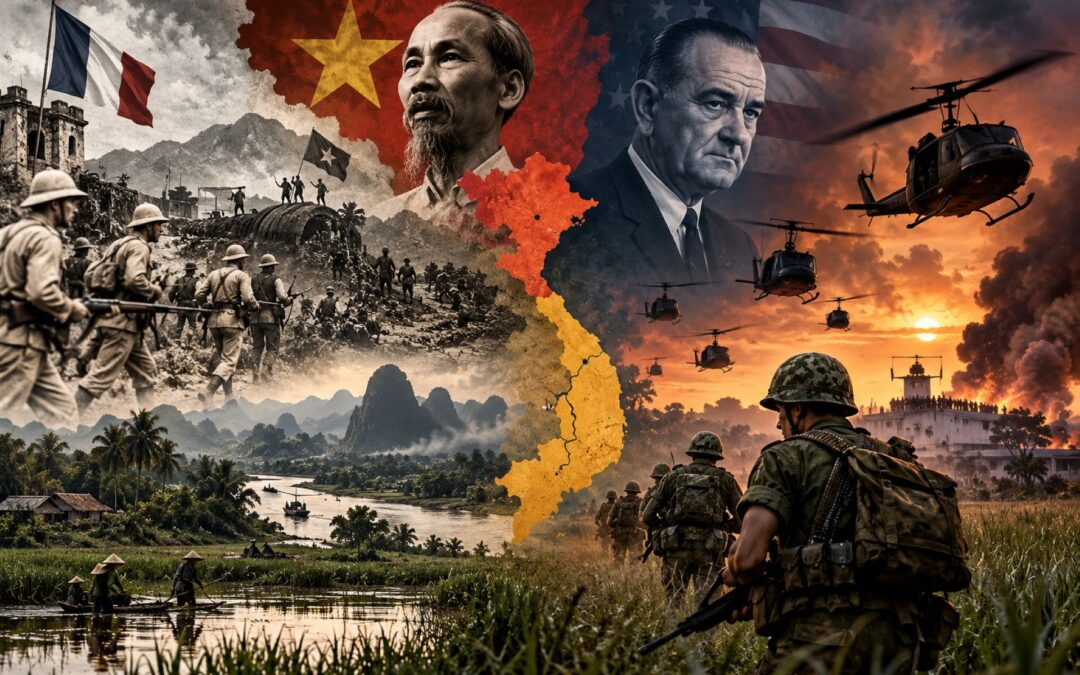
The United States entered the Vietnam War with advantages that seemed almost impossible to overcome. It possessed the world’s most powerful military, an enormous industrial economy, sophisticated aircraft, overwhelming firepower, and the financial resources to sustain operations thousands of miles from home. Its opponents were fighting in a country devastated by decades of colonial rule and warfare. Yet in April 1975, North Vietnamese forces entered Saigon, South Vietnam’s government collapsed, and the United States watched an ally it had spent years defending disappear.
How did a country with such extraordinary military resources fail to achieve its objectives against a much poorer opponent? Why did successive American presidents continue a war that became increasingly unpopular, and how did North Vietnam sustain its struggle despite suffering enormous losses?
The answers begin long before American combat troops arrived. Vietnam had already spent generations resisting foreign domination, first under French colonial rule and then during Japanese occupation. Its independence movement brought together nationalism, communism, competing political ambitions, and a determination to end foreign control. When the Cold War divided the international political landscape, Vietnam’s struggle became entangled in a much larger confrontation between the United States, the Soviet Union, and communist China.
The Vietnam War was therefore more than a conflict between capitalism and communism. It was simultaneously a struggle for independence, a contest between rival Vietnamese governments, a revolutionary war, and an international confrontation shaped by the fear of communist expansion. Understanding why North Vietnam ultimately prevailed requires examining how these different conflicts developed, how they influenced one another, and why military superiority could not guarantee political victory.
French Indochina and the Rise of Vietnamese Nationalism
The origins of the Vietnam War lie in the nineteenth century, when European imperial powers were competing to expand their influence across Asia and Africa. France established control over Vietnamese territories through a series of military campaigns and political agreements, beginning with its intervention in 1858. By the late nineteenth century, the French had consolidated their rule over Vietnam and incorporated it into French Indochina alongside Cambodia and, subsequently, Laos.
French Indochina was not a single unified nation. Vietnam itself was administered through three territories: Cochinchina in the south, Annam in the center, and Tonkin in the north. These divisions helped the colonial administration maintain control while allowing France to organize the region according to its economic and strategic interests.
Colonial rule transformed Vietnamese society. French authorities expanded plantations, mining operations, transportation networks, and commercial agriculture, but much of this development primarily served colonial interests. Land concentration, taxation, compulsory labor obligations, and political restrictions created resentment among different sections of the population. Economic opportunities were distributed unequally, while Vietnamese participation in the highest levels of government remained severely limited.
Resistance emerged almost immediately and took many forms. Some movements hoped to restore traditional Vietnamese political authority, while others advocated constitutional reform, republican nationalism, or revolutionary independence. Vietnamese intellectuals increasingly studied political ideas circulating through China, Japan, France, and other parts of the world. By the early twentieth century, the independence movement had become more diverse, organized, and internationally connected.
Among the figures who emerged from this political environment was Nguyen Sinh Cung, later known as Ho Chi Minh. Born in 1890, he left Vietnam in 1911 and spent many years abroad, working and participating in political movements. His experiences exposed him to European socialism, anti-colonial activism, and debates about the future of colonized peoples.
The end of World War I appeared to offer an opportunity for Vietnamese nationalists. American President Woodrow Wilson had promoted the principle of national self-determination, encouraging hopes that the postwar peace settlement might challenge European colonial empires. In 1919, Ho Chi Minh, then using the name Nguyen Ai Quoc, was associated with a petition presented at the Paris Peace Conference demanding civil and political rights for the Vietnamese under French rule.
The petition did not demand immediate independence in its final form, but it challenged colonial injustice and sought recognition of Vietnamese political aspirations. The major powers did not seriously address those demands. Wilson’s language of self-determination proved far more influential in discussions about European territories than in determining the future of Asian and African colonies.
For Ho Chi Minh, the failure reinforced a growing interest in revolutionary socialism. Lenin’s arguments about imperialism and colonial liberation offered a political framework that appeared more directly relevant to Vietnam’s circumstances. Ho became involved in the French communist movement and later worked within international communist organizations.
In 1930, Ho helped establish the organization that became the Indochinese Communist Party. The party combined communist revolutionary ideas with the objective of ending colonial domination. Although communism became central to its leadership and organizational structure, the broader Vietnamese independence movement continued to include people with different political beliefs.
This distinction is essential to understanding the later conflict. Vietnamese nationalism was not inherently communist, and not everyone who opposed French colonial rule supported Ho Chi Minh’s political program. Nevertheless, communist organizations increasingly developed the discipline, networks, and military capabilities needed to organize sustained resistance.
By the beginning of World War II, Vietnamese politics had become a struggle over both independence and the kind of state that would emerge afterward. The coming Japanese occupation would transform those questions into an immediate contest for power.
From Japanese Occupation to France’s Defeat at Dien Bien Phu
When Germany defeated France in 1940, French authority in Southeast Asia became vulnerable. Japan was expanding its military influence across East Asia and sought access to Indochina’s territory, transportation networks, and strategic facilities. Japanese forces entered northern Indochina in September 1940 and subsequently expanded their presence throughout the region.
For several years, Japanese military occupation coexisted with a French colonial administration operating under the authority of the Vichy government. Vietnam was therefore subject to overlapping foreign powers rather than a straightforward replacement of French rule by Japanese rule. Japanese forces controlled essential strategic decisions while much of the existing colonial bureaucracy continued functioning.
The occupation became part of the wider struggle against Japanese expansion during World War II. It also created opportunities for Vietnamese revolutionaries who recognized that France’s defeat in Europe had weakened the legitimacy and security of its colonial empire.
Ho Chi Minh returned to the region in 1941 after decades abroad and helped establish the Viet Minh, a nationalist independence coalition led by communists. The movement sought to mobilize Vietnamese opposition to foreign domination while building guerrilla networks, political organizations, and territorial bases.
The situation became particularly catastrophic during the famine of 1944–1945, when large numbers of Vietnamese died from starvation. Wartime requisitions, disrupted transportation, economic policies, natural disasters, and administrative failures contributed to the disaster. The famine severely damaged confidence in the existing authorities and strengthened the Viet Minh’s appeal in areas where it organized relief and resistance.
In March 1945, Japan removed the remaining French colonial administration and established more direct political control. Yet Japan’s own position was deteriorating as Allied forces advanced across Asia and the Pacific.
The United States had an unexpected connection to Ho Chi Minh’s movement during this period. American intelligence officers were searching for organizations capable of gathering information, rescuing downed pilots, and disrupting Japanese operations. The Office of Strategic Services, the predecessor of the CIA, developed contacts with the Viet Minh and provided limited training, equipment, and assistance.
As the National Archives’ account of early American involvement in Vietnam documents, cooperation against Japan did not establish a lasting political partnership. Nevertheless, it demonstrated how the wartime interests of American officials and Vietnamese communists could temporarily converge.
Japan’s surrender in August 1945 created a sudden political vacuum. The Viet Minh moved quickly to seize control in what became known as the August Revolution. On September 2, 1945, Ho Chi Minh proclaimed the independence of the Democratic Republic of Vietnam in Hanoi.
His declaration drew on the language of the American Declaration of Independence and broader principles of human equality. The symbolism was deliberate: Ho hoped international powers, particularly the United States, would recognize Vietnam’s right to determine its future.
But Vietnamese independence faced immediate obstacles. France intended to restore its colonial authority, while the Allied powers were primarily concerned with accepting the Japanese surrender and stabilizing the region. Chinese Nationalist troops entered northern Vietnam, and British-led forces arrived in the south, where they facilitated the restoration of French control.
The United States was also reconsidering its priorities. Franklin D. Roosevelt had expressed opposition to the restoration of traditional European colonialism, but American policy remained inconsistent and never amounted to a clear commitment to Vietnamese independence. Under Harry Truman, Washington increasingly prioritized European reconstruction, its relationship with France, and the growing confrontation with the Soviet Union.
Efforts to negotiate a political settlement between the French and Ho Chi Minh’s government ultimately failed. Fighting escalated in December 1946, beginning the First Indochina War.
The conflict initially pitted French forces, supported by local allies, against the Viet Minh’s guerrilla networks. France possessed superior conventional military resources, but the Viet Minh increasingly expanded its political organization, recruitment, and military capabilities. The war gradually changed from scattered insurgency into a conflict involving larger formations and more sophisticated operations.
International developments altered the balance. In 1949, Mao Zedong’s Communist Party won the Chinese Civil War and established the People’s Republic of China. The emergence of a communist government along Vietnam’s northern border provided the Viet Minh with an important source of military equipment, training, and logistical support.
The Soviet Union also recognized Ho Chi Minh’s government in 1950. Meanwhile, the United States increasingly supported France financially and materially, interpreting the Indochina conflict through the emerging Cold War rivalry. By the final years of the war, American assistance was paying a substantial proportion of French military expenditures.
France attempted to regain the initiative by establishing a fortified position at Dien Bien Phu in northwestern Vietnam. French commanders hoped to draw Viet Minh forces into a conventional battle where French artillery, air support, and defensive positions would provide an advantage.
Instead, General Vo Nguyen Giap’s forces surrounded the position and assembled artillery in the surrounding hills. Viet Minh troops constructed extensive supply routes, transported equipment through difficult terrain, and gradually tightened their siege.
The battle began in March 1954 and ended on May 7, when the French garrison surrendered. It represented not simply a tactical defeat but the collapse of France’s ability to continue the war on acceptable political terms.
As the U.S. State Department’s history of Dien Bien Phu and the Geneva negotiations explains, the defeat accelerated diplomatic efforts to settle the conflict. France ultimately agreed to withdraw, ending its attempt to restore colonial control over Vietnam.
For Vietnamese communists, Dien Bien Phu became a defining victory against European imperialism. Yet the defeat of France did not produce a unified and politically settled Vietnam. Instead, the arrangements negotiated in Geneva created the conditions for another conflict.
The Geneva Settlement, a Divided Vietnam, and the Failed Promise of Elections
The Geneva Conference of 1954 brought together major powers and representatives involved in the Indochina conflict. Its purpose was to establish arrangements that would end the fighting and address the political future of Vietnam, Laos, and Cambodia.
The agreement provided for a temporary military demarcation near the 17th parallel. Viet Minh forces would regroup to the north, while forces associated with the French-backed State of Vietnam would regroup to the south. A demilitarized zone separated the two areas.
The division was not originally intended to create a permanent international border. The conference’s final declaration envisaged nationwide elections in July 1956 as a means of achieving political reunification.
There were important complications, however. The United States did not sign the final declaration, and the southern State of Vietnam did not accept the proposed political arrangements. The military agreements and the conference’s political declaration therefore did not command uniform acceptance among all participants.
The division nevertheless acquired political permanence as rival governments consolidated their authority.
In the north, Ho Chi Minh’s Democratic Republic of Vietnam established a communist-led state centered in Hanoi. Its leadership pursued socialist transformation, land reform, and the consolidation of revolutionary authority. Land reform brought significant redistribution but also coercion, denunciations, and executions, followed by official acknowledgment of serious abuses.
In the south, Ngo Dinh Diem emerged as the principal anti-communist leader. Initially appointed prime minister under the State of Vietnam’s head of state, Bao Dai, Diem gradually concentrated power and developed a government supported by the United States.
The division also triggered an enormous movement of people. During the migration period following Geneva, hundreds of thousands of civilians moved south from communist-controlled northern areas. Many were Catholics, but others included people who feared communist repression, opposed the northern government, or believed better opportunities existed in the south.
A smaller movement occurred in the opposite direction, including communist cadres and supporters of the Viet Minh. The migrations reflected genuine political choices, religious concerns, family circumstances, economic calculations, and organized encouragement from competing authorities.
Washington viewed these developments through the broader framework of the Cold War. American policymakers feared that the loss of Vietnam to communism could strengthen revolutionary movements across Southeast Asia and undermine American influence.
This argument became associated with the domino theory. President Dwight Eisenhower warned that communist gains in one country might increase the likelihood of neighboring countries falling under similar influence. Laos, Cambodia, and Thailand were among the countries frequently considered vulnerable.
The analogy with Korea was particularly influential. Both countries had experienced Japanese domination, foreign intervention, communist and anti-communist political competition, and territorial division following World War II.
But the circumstances were not identical. Korea’s division developed through Soviet and American occupation zones and later hardened during a major interstate war. Vietnam’s division emerged from the negotiated military settlement of an anti-colonial conflict. The Korean experience, examined in greater detail in the history of North Korea, helps explain American anxieties without suggesting that the two conflicts followed the same political path.
Diem believed nationwide elections would threaten his government’s survival. Ho Chi Minh enjoyed considerable nationalist prestige, although the precise outcome of genuinely free elections cannot be established with certainty. Conditions under both competing governments also raised serious questions about how political competition could be conducted.
South Vietnam refused to participate in the proposed 1956 reunification elections, and the anticipated vote never occurred. North Vietnam regarded this as a denial of the settlement’s political expectations, while Diem’s supporters maintained that the southern government had not accepted those provisions.
The failure of elections was a crucial milestone, but it did not by itself instantly create the entire subsequent war. Political repression, armed resistance, competing state-building projects, renewed communist strategy, and escalating foreign involvement all contributed to the conflict’s development.
Vietnam had escaped French colonial domination, but it had not resolved the question of who possessed legitimate authority to govern the country.
Ngo Dinh Diem, the Viet Cong, and South Vietnam’s Political Crisis
Ngo Dinh Diem presented himself as an alternative to both French colonial rule and communist revolution. A Vietnamese nationalist and committed anti-communist, he sought to establish a centralized state that could resist Hanoi while receiving political, military, and economic assistance from Washington.
His government faced difficult circumstances. South Vietnam contained rival political organizations, religious communities, armed groups, former colonial officials, and people whose experiences of the independence struggle had produced sharply different loyalties.
Diem responded by concentrating authority around himself, his relatives, and trusted political associates. His brother Ngo Dinh Nhu became especially influential in developing the government’s security and political apparatus. Critics accused the regime of favoritism, repression, electoral manipulation, and intolerance of organized opposition.
In October 1955, Diem held a referendum to remove Bao Dai and establish a republic with himself as president. Official results awarded Diem approximately 98.2 percent of the vote, but the campaign was heavily manipulated and offered little meaningful opportunity for opposition.
Contemporary American diplomatic reporting on the referendum reflected awareness of the election’s political circumstances. The result strengthened Diem’s formal position without demonstrating that his government enjoyed the overwhelming popular support claimed by the official numbers.
Washington nevertheless continued backing him. American leaders considered a stable anti-communist South Vietnamese state essential to containment, and Diem initially appeared capable of resisting communist influence without bringing American combat forces directly into the conflict.
Opposition to Diem was not exclusively communist. His government alienated different social and political groups, including former nationalist allies, religious organizations, and rural communities affected by security policies.
Communist organizations also remained active in the south. Some members had stayed behind after the 1954 regroupment, while others developed networks among rural populations. Northern leaders initially approached renewed armed struggle cautiously, partly because they hoped to consolidate their government and avoid a larger confrontation.
By the late 1950s, however, armed resistance was intensifying. In 1959, Hanoi formally endorsed greater support for revolutionary struggle in the south. The National Liberation Front of South Vietnam was established in December 1960 and sought to unite opponents of Diem’s government.
The front included communist leadership and substantial communist influence, but its political appeal extended beyond people committed to a Marxist-Leninist state. Many supporters were motivated by local grievances, nationalism, opposition to repression, or resentment toward the southern government.
Its military forces became widely known as the Viet Cong, a term associated with Vietnamese communists. Although Hanoi increasingly supplied, directed, and coordinated the southern insurgency, the movement also developed through local organizations and social relationships within South Vietnam.
The distinction mattered because the conflict could not be reduced to an army infiltrating from the north. South Vietnam experienced an internal political and military struggle in which both rival governments sought to influence communities and secure their allegiance.
Diem’s attempts to strengthen rural security frequently produced additional resentment. Government programs sought to relocate and organize villagers into defensible settlements, restrict insurgent access to communities, and expand state authority. Some initiatives improved security locally, but others involved coercion, corruption, inadequate resources, and the disruption of established rural life.
The government’s relationship with Buddhist organizations became another major source of instability. Although Diem himself was Catholic and several important officials were associated with Catholic networks, South Vietnam’s population was predominantly Buddhist or influenced by Buddhist traditions.
In 1963, protests erupted over religious discrimination and government repression. Security forces confronted demonstrators, and attacks on Buddhist institutions escalated the crisis. In June, the monk Thich Quang Duc set himself on fire in Saigon to protest the government’s policies, producing one of the most widely recognized images of the war.
The crisis severely damaged Diem’s international standing. American officials increasingly doubted whether his government could defeat the insurgency or maintain political stability.
In November 1963, South Vietnamese military officers overthrew Diem in a coup conducted with American knowledge and encouragement. Diem and his brother were killed after being captured.
The coup removed an increasingly unpopular leader but failed to resolve South Vietnam’s deeper institutional weaknesses. Successive military governments struggled to establish stable authority, while insurgents continued expanding their operations.
When John F. Kennedy was assassinated later that month, Lyndon Johnson inherited a deteriorating conflict. The United States had already committed advisers, funding, weapons, and political credibility to South Vietnam, but its preferred partner remained unstable and its military prospects uncertain.
The Gulf of Tonkin and America’s Escalation into Full-Scale War
By 1964, American involvement in Vietnam had expanded far beyond the limited wartime cooperation with the Viet Minh two decades earlier. Thousands of American military personnel were serving as advisers and support specialists, while Washington continued providing equipment, financial assistance, intelligence, and training to South Vietnamese forces.
The central American objective was to prevent South Vietnam from falling under communist control. Yet policymakers faced a growing dilemma: increasing assistance had not produced the stable political authority or decisive military improvement they expected.
Lyndon Johnson feared the consequences of either withdrawing or becoming deeply involved. Withdrawal might be portrayed as abandoning an ally and weakening American commitments elsewhere. Escalation carried the risk of a prolonged war against an opponent supported by China and the Soviet Union.
Events in the Gulf of Tonkin gave Johnson an opportunity to seek broader congressional authority.
On August 2, 1964, the American destroyer USS Maddox engaged North Vietnamese patrol boats in the Gulf of Tonkin. The incident occurred amid American intelligence operations and South Vietnamese maritime raids supported by the United States, contributing to a tense environment.
North Vietnamese boats approached the destroyer, American warning shots were fired, and an armed engagement followed. The incident was real, although its context and interpretation became subjects of considerable controversy.
Two days later, American ships reported another attack. Subsequent analysis of intelligence, communications, radar information, and naval accounts established that the reported August 4 attack did not occur.
The Johnson administration nevertheless presented the incidents as evidence of North Vietnamese aggression. Congress passed the Gulf of Tonkin Resolution on August 7, granting the president broad authority to use military force in Southeast Asia without issuing a formal declaration of war.
The resolution did not immediately produce the full-scale American ground war. The decisive escalation developed during 1965, as political instability in South Vietnam and continued communist military advances intensified American concerns.
In March 1965, American combat troops landed at Da Nang. Their initial mission included protecting military installations, but their responsibilities expanded as the war developed. Washington also launched Operation Rolling Thunder, a sustained bombing campaign against North Vietnam intended to weaken its military capacity and increase pressure on Hanoi.
The number of American troops increased rapidly. Approximately 184,000 were stationed in Vietnam by the end of 1965, with deployments continuing to grow during the following years. By 1968, American military strength in South Vietnam exceeded half a million personnel.
The United States had moved from supporting one side of a Vietnamese conflict to conducting a massive war of its own. The assumption was that superior resources, technology, and sustained military pressure could eventually force Hanoi to abandon its objectives.
What American planners underestimated was the difficulty of translating those advantages into a durable political and military outcome.
How the Vietnam War Was Fought—and Why Superior Firepower Was Not Enough
The American military entered Vietnam with enormous advantages in aircraft, artillery, communications, transportation, firepower, and logistical support. It could move large formations, deliver supplies over great distances, and strike targets with a concentration of force that its opponents could rarely match.
Yet the conflict was not simply a contest over which army possessed the strongest weapons. The United States needed to preserve a noncommunist government in South Vietnam, protect populated areas, weaken communist military forces, and create conditions under which South Vietnam could survive without permanent American protection.
Those objectives were much harder to achieve than winning individual engagements.
American strategy increasingly emphasized attrition: killing or disabling enough enemy soldiers to make continued resistance unsustainable. General William Westmoreland, who commanded American forces during the main escalation period, relied heavily on large-scale operations designed to locate and destroy communist units.
Success was frequently measured through reported enemy casualties, captured weapons, destroyed bases, and estimates of enemy strength. The approach reflected an assumption that communist forces would eventually reach a point where they could no longer replace their losses.
But casualty figures were imperfect indicators of progress. Enemy body counts could be exaggerated or incorrectly classified, while killing large numbers of combatants did not necessarily create lasting security in contested villages. Civilian casualties and destruction could also undermine the political support that South Vietnam needed.
The Communist forces themselves were not a single uniform military organization. The Viet Cong included local guerrillas, political cadres, and larger armed formations operating inside South Vietnam. The People’s Army of Vietnam, commonly known to Americans as the North Vietnamese Army, supplied regular units capable of conducting increasingly sophisticated conventional operations.
This combination created a flexible military system. Local guerrillas could conduct ambushes, sabotage roads, attack isolated government positions, gather intelligence, and pressure villages. Larger formations could challenge South Vietnamese or American forces when conditions appeared favorable.
Communist political organizations also maintained networks for recruitment, intelligence, supplies, taxation, and propaganda. Their influence varied widely between regions and communities, and not every village supported them voluntarily. Coercion and assassination were among the methods used to intimidate opponents and weaken the southern government’s presence.
Northern forces also relied on an extensive supply system usually called the Ho Chi Minh Trail. Rather than a single road, it consisted of connected routes, depots, transport corridors, and logistical facilities running through eastern Laos and parts of Cambodia.
The network allowed Hanoi to move personnel, equipment, food, and ammunition toward the southern battlefields. American bombing repeatedly damaged routes and installations, but North Vietnamese engineers and transport units repaired sections, developed alternatives, and expanded the system.
The trail’s location outside South Vietnam complicated American operations. Attacking it risked widening the conflict into neighboring countries and created political and diplomatic consequences beyond Vietnam’s borders.
Terrain influenced military operations, but the idea that American forces simply could not fight in jungles is misleading. American soldiers conducted extensive jungle operations, won numerous engagements, and developed effective methods of using helicopters, artillery, reconnaissance, and air support.
The central difficulty was not an inability to enter difficult terrain. It was the challenge of finding dispersed opponents, identifying enemy networks, securing civilians, and maintaining control after combat units departed.
An American unit might capture a village or clear a surrounding area, only to discover that communist forces returned when the operation ended. Repeated deployments could produce casualties without changing the area’s long-term political allegiance.
The South Vietnamese army, known as the Army of the Republic of Vietnam or ARVN, played a much greater role than simplified accounts of the war often acknowledge. South Vietnamese troops conducted major operations, defended cities, suffered heavy casualties, and supplied much of the manpower required for the country’s defense.
Nevertheless, ARVN performance varied considerably. Leadership problems, political interference, corruption, uneven training, and dependence on American support affected some units. Other formations fought effectively, including during major communist offensives.
Scholarly research on the ARVN’s wartime experience demonstrates why the southern military should not be portrayed merely as an ineffective force waiting for American assistance. Its soldiers possessed their own motivations and experiences, even as their institution struggled with serious structural weaknesses.
For American policymakers, military operations were inseparable from the legitimacy of the South Vietnamese government. Villagers needed reasons to trust government officials, cooperate with security forces, and resist communist pressure. Yet military destruction, forced displacement, corruption, and arbitrary repression could undermine these relationships.
This produced one of the war’s central contradictions. Military action intended to strengthen South Vietnam could sometimes weaken the social and political foundations on which its survival depended.
American firepower also transformed the physical environment. Bombing campaigns targeted transportation systems, supply networks, military installations, and suspected enemy positions. Artillery and aerial attacks devastated extensive rural areas, while civilians frequently faced displacement and insecurity.
The United States employed herbicides as part of operations intended to remove vegetation that concealed enemy movement or provided agricultural support. Agent Orange became the most notorious of these chemicals. It contained a highly toxic dioxin contaminant associated with long-term health concerns.
The environmental consequences extended far beyond individual military operations. Forests, mangrove ecosystems, and agricultural lands suffered extensive damage, while exposure to contaminated herbicides created enduring medical and political disputes.
The war’s military consequences were also shaped by international assistance. China supplied North Vietnam with equipment, engineering support, antiaircraft personnel, logistical assistance, and other resources. The Soviet Union provided substantial military technology, including aircraft, missiles, radar systems, and specialist support.
Hanoi did not operate without vulnerability or industrial resources. American bombing damaged its transportation networks, factories, power facilities, and other infrastructure. Nevertheless, external assistance and extensive repair efforts allowed North Vietnam to continue fighting despite the destruction.
The involvement of China and the Soviet Union created an additional constraint for Washington. American leaders feared that an attempt to conquer North Vietnam or fundamentally destroy its government could provoke a wider international war. The experience of Chinese intervention in Korea reinforced this concern.
As a result, American military strategy operated within political limits. Washington sought to compel Hanoi to change its behavior without necessarily occupying North Vietnam or directly confronting its major communist supporters.
The human consequences were immense. American soldiers faced mines, ambushes, difficult patrols, an often-unseen opponent, and uncertainty about the relationship between civilians and combatants. North Vietnamese and Viet Cong soldiers endured heavy bombing, severe supply difficulties, disease, exhaustion, and enormous casualties.
Morale deteriorated in portions of the American military as the war continued. Drug use, racial tensions, declining discipline, refusal of orders, and attacks on unpopular officers became serious problems, particularly in the later years. These developments should not obscure the service and sacrifices of many soldiers, but they reflected the growing strain of a prolonged and increasingly unpopular war.
Both sides continued fighting because military results alone did not settle the political conflict. American forces could win engagements while the communist movement remained capable of recruitment and renewed operations. Hanoi could suffer disastrous casualties while maintaining its commitment to eventual victory.
The limitations of America’s attrition strategy would become unmistakable in 1968.
The Tet Offensive of 1968: Military Defeat, Political Turning Point
By late 1967, American officials were increasingly emphasizing progress in Vietnam. Despite continued casualties and fighting, Washington presented the communist forces as weakening and suggested that sustained military pressure was bringing victory closer.
North Vietnamese leaders were developing a different strategy. They hoped that a major coordinated offensive could disrupt South Vietnamese military operations, undermine the Saigon government, encourage a popular uprising, and weaken American willingness to continue the war.
The offensive was planned around Tet, the Vietnamese Lunar New Year and the country’s most important traditional holiday. Tet had previously been associated with temporary reductions in fighting, and attacks during the holiday offered an opportunity for surprise.
Preparations included operations intended to divert American attention and military resources. Fighting around Khe Sanh, a remote American Marine base near the Laotian border, became particularly intense. American commanders considered the possibility that North Vietnamese forces were preparing another major siege reminiscent of Dien Bien Phu.
On January 30 and 31, 1968, communist forces launched coordinated attacks against cities, towns, military installations, and government facilities across South Vietnam.
Saigon was attacked, including a dramatic assault on the American embassy compound. Fighting erupted in numerous provincial centers, while the city of Hue became the site of one of the offensive’s longest and most destructive battles.
The scale of the attacks shocked American and South Vietnamese authorities. Communist forces demonstrated an ability to organize widespread operations despite years of bombing, major ground offensives, and repeated claims that their capabilities were approaching exhaustion.
Yet the attacks did not produce the anticipated general uprising. Most South Vietnamese military units continued fighting, and American and South Vietnamese forces eventually repelled the offensive. Communist forces suffered extremely heavy losses, including serious damage to southern insurgent formations.
The battle for Hue illustrated the offensive’s brutality. Communist forces occupied much of the city before American and South Vietnamese troops retook it after weeks of combat. Extensive fighting devastated neighborhoods and historical structures, while communist forces also carried out killings of civilians and people associated with the South Vietnamese government.
The recapture of Hue was a military success for American and South Vietnamese forces, but the destruction inflicted on the city demonstrated the terrible costs of victory.
The U.S. Office of the Historian’s account of the Tet Offensive identifies its extraordinary political significance. The operation failed to achieve Hanoi’s immediate military and revolutionary objectives, yet it undermined American confidence in official assessments of the war.
This apparent contradiction explains why Tet became such a decisive historical turning point.
American commanders could correctly point to communist casualties and the successful defense of major cities. However, the public could also ask how an enemy supposedly approaching defeat had managed to attack so many important locations simultaneously.
Television reporting, newspaper coverage, photographs, and increasingly critical commentary brought the war into American homes with unprecedented immediacy. Vietnam was not literally the first war covered by television, but its extensive and sustained televised reporting fundamentally influenced public understanding.
The problem for Washington was not merely that Americans witnessed violent scenes. It was the widening gap between optimistic official statements and the apparent ability of communist forces to continue major operations.
The controversy intensified when reports emerged that General Westmoreland had sought substantial additional reinforcements. The possibility of sending more troops after years of escalation challenged assurances that American strategy was succeeding.
The Tet Offensive also occurred during a period of growing antiwar activism. Opposition had developed around casualties, military conscription, civilian suffering, the legitimacy of intervention, and doubts about whether American objectives were achievable.
In March 1968, Johnson announced a partial halt to bombing and expressed willingness to pursue negotiations. He also declared that he would not seek another presidential term.
Tet did not immediately end the war, destroy the American military, or guarantee Hanoi’s eventual victory. It demonstrated that battlefield losses and political consequences could move in opposite directions.
The offensive fundamentally weakened the argument that continued escalation would necessarily deliver a favorable outcome. Although fighting continued for seven more years, the political foundations of America’s intervention had been permanently shaken.
Nixon’s Vietnamization, Cambodia, Laos, and the War at Home
Richard Nixon won the 1968 presidential election amid intense public dissatisfaction with the Vietnam War. His administration inherited a conflict that had become enormously expensive, politically divisive, and difficult to reconcile with American strategic objectives.
Nixon sought to reduce American military involvement without appearing to abandon South Vietnam or accept defeat. His approach became known as Vietnamization, a policy intended to transfer increasing responsibility for combat operations to South Vietnamese forces while withdrawing American troops.
The program involved expanding and equipping ARVN, improving military training, and transferring responsibilities previously carried by American units. Washington hoped that a stronger southern military could eventually resist communist offensives without requiring hundreds of thousands of American combat soldiers.
Troop withdrawals began in 1969 and continued during the following years. The American military presence declined substantially, but withdrawal did not mean the United States had abandoned military pressure on Hanoi.
Nixon combined troop reductions with bombing campaigns, diplomatic negotiations, and operations against communist supply networks. His administration hoped that military pressure would strengthen Washington’s negotiating position and persuade North Vietnam to accept a settlement preserving South Vietnam.
This combination reflected a fundamental tension in the American strategy. Nixon wanted to reduce the domestic and military costs of the war while maintaining enough leverage to prevent the outcome his administration feared.
Cambodia became one of the most controversial parts of this approach.
The country was officially neutral, but North Vietnamese and Viet Cong forces used areas near the Vietnamese border for bases, transport networks, and logistical support. Cambodia’s internal political situation was also deteriorating as its government struggled to manage competing foreign and domestic pressures.
In 1969, the Nixon administration began a secret bombing campaign against communist positions inside Cambodia. The secrecy reflected concern about diplomatic consequences, congressional opposition, and public criticism.
In April 1970, Nixon publicly announced an American and South Vietnamese military incursion into Cambodia. The operation sought to attack communist bases and disrupt supply networks, but it widened the geographical scope of a war that Americans had repeatedly been told was moving toward withdrawal.
The Cambodian operations also interacted with the country’s deepening internal conflict. The rise of the Khmer Rouge cannot be explained by American intervention alone, but the wider regional war contributed to the conditions in which Cambodia experienced catastrophic political upheaval.
Laos was similarly affected. The Ho Chi Minh Trail ran through Laotian territory, and the country had already become a battleground involving the communist Pathet Lao, royalist forces, North Vietnamese troops, and American-backed operations.
The United States conducted extensive bombing in Laos. In 1971, South Vietnamese ground forces launched Operation Lam Son 719 into southern Laos with American air and logistical support, attempting to disrupt the communist supply network. The operation exposed significant weaknesses in planning and execution and failed to deliver a lasting interruption of the trail.
These campaigns demonstrated that the conflict had become a regional war, even though international attention remained focused primarily on Vietnam itself.
At home, public opposition intensified. The Vietnam War had already generated demonstrations, resistance to military conscription, and criticism from students, religious organizations, civil rights activists, veterans, and other groups.
The movement was never politically uniform. Some Americans opposed the war because they considered it immoral or strategically misguided. Others believed the United States should negotiate withdrawal while continuing to support South Vietnam. Many citizens defended the intervention and regarded antiwar demonstrations as damaging to American soldiers or national credibility.
Public anger increased as previously concealed aspects of the war became known.
In 1969, the massacre at My Lai attracted national attention. American soldiers had killed hundreds of unarmed Vietnamese civilians in March 1968, including women, children, and elderly people. The killings and the failures to investigate them promptly became among the most notorious American atrocities of the war.
The public exposure of My Lai was driven by individuals who challenged official accounts, including Ronald Ridenhour, who gathered testimony, and journalist Seymour Hersh, whose reporting brought the massacre to a wider audience.
In May 1970, protests against the Cambodian operation contributed to confrontations on American university campuses. Ohio National Guardsmen shot and killed four students at Kent State University. Later that month, police killed two students at Jackson State College in Mississippi.
The deaths intensified national divisions and raised broader questions about government power, civil liberties, and the legitimacy of suppressing protest.
Another major controversy emerged in 1971 with the publication of the Pentagon Papers. The classified study documented the history of American involvement in Vietnam and exposed the gap between official public statements and internal government assessments across successive administrations.
The revelations strengthened concerns that American leaders had repeatedly concealed the difficulties of the war and misrepresented its prospects.
Historical scrutiny also extended to the 1968 presidential election. Evidence concerning contacts between Nixon campaign associate Anna Chennault and South Vietnamese representatives raised serious questions about efforts to discourage Saigon from participating in peace negotiations under the Johnson administration.
The affair remains controversial because the precise effects of those communications on South Vietnamese decisions and the negotiations are difficult to establish. President Nguyen Van Thieu’s government had independent objections to the proposed talks, particularly concerning the political standing of the National Liberation Front. The episode therefore cannot responsibly be reduced to the claim that Nixon single-handedly prevented peace or caused every subsequent wartime death.
The National Archives’ documentation of the later Vietnam War illustrates how military escalation, secret decisions, political dissent, and declining public trust became increasingly interconnected.
Meanwhile, Hanoi continued fighting. In March 1972, North Vietnam launched a major conventional offensive, commonly known as the Easter Offensive. Unlike many earlier operations emphasizing guerrilla warfare, it involved large formations, armored vehicles, artillery, and coordinated attacks.
South Vietnamese forces suffered serious setbacks but mounted significant resistance, supported by American airpower. The United States responded with intensive bombing, including Operation Linebacker, helping prevent the offensive from achieving its largest objectives.
The fighting showed that South Vietnam remained militarily capable with substantial American assistance. It also revealed the limitations of Vietnamization, particularly the continuing importance of American aircraft, logistics, and other support.
By the end of 1972, the United States had withdrawn most of its ground combat forces. Yet the war had not produced the political settlement Washington sought, and negotiations remained difficult.
The contradiction that had shaped American policy for years remained unresolved: the United States wanted to leave Vietnam while preserving an ally whose survival was increasingly uncertain.
The Paris Peace Accords, American Withdrawal, and the Fall of Saigon
Negotiations to end American involvement in Vietnam had begun in Paris in 1968, but years of diplomatic discussions produced limited progress. The parties disagreed over the withdrawal of foreign forces, the future of South Vietnam’s government, political representation, and the continued presence of North Vietnamese military units in the south.
The principal participants included the United States, North Vietnam, South Vietnam, and representatives of the southern revolutionary movement. Their objectives were not identical, even when they appeared to belong to the same broad political coalition.
Washington sought the withdrawal of its forces, the return of prisoners of war, and a settlement that would not immediately destroy South Vietnam. Hanoi wanted American military withdrawal while maintaining the possibility of achieving national reunification under communist leadership.
South Vietnam’s government, led by Nguyen Van Thieu, feared that an agreement allowing North Vietnamese troops to remain in the south would leave it vulnerable after American forces departed.
In October 1972, negotiations between American representative Henry Kissinger and North Vietnamese negotiator Le Duc Tho produced a draft agreement. However, disagreements involving South Vietnam and subsequent disputes delayed the final settlement.
In December, Nixon ordered a major bombing campaign against targets around Hanoi and Haiphong. The operation, known as Linebacker II, involved intensive attacks by American aircraft, including B-52 bombers. It caused significant destruction, civilian casualties, and military losses.
The bombing remains controversial both because of its human cost and because historians disagree about how decisively it affected the timing and terms of the final agreement.
Negotiations resumed, and the Paris Peace Accords were signed on January 27, 1973.
The agreement called for a ceasefire, the withdrawal of American and allied foreign forces, the return of prisoners of war, and arrangements intended to address South Vietnam’s political future. It also left important military and political questions unresolved.
Crucially, North Vietnamese forces already operating in South Vietnam were not required to withdraw completely. The settlement therefore ended direct American combat involvement without eliminating the military conflict between the rival Vietnamese governments.
As the U.S. Office of the Historian’s account of the war’s conclusion explains, American withdrawal and the termination of the Vietnamese conflict were separate developments.
The last major American combat forces left Vietnam in March 1973, completing the withdrawal required by the agreement. Some American personnel remained in other capacities, while Washington continued providing substantial support to South Vietnam.
President Nixon portrayed the settlement as an honorable conclusion to American involvement. But the continued presence of rival armies, unresolved political claims, and ongoing territorial disputes made the ceasefire fragile.
Fighting resumed and intensified despite the agreement. Both North and South Vietnamese forces sought to consolidate or expand control over contested territory.
South Vietnam faced worsening economic and military difficulties. Inflation, dependence on American financial assistance, fuel shortages, corruption, and uncertainty about future support placed enormous pressure on the state.
The Watergate scandal further weakened Nixon’s presidency, culminating in his resignation in August 1974. Gerald Ford inherited the problem of supporting South Vietnam under increasingly unfavorable political circumstances.
Congress had become less willing to fund large-scale military commitments, and American assistance declined. South Vietnamese forces struggled to maintain equipment, transportation, ammunition supplies, and operational readiness.
However, South Vietnam’s defeat was not simply the result of reduced American aid. Problems of leadership, military planning, political legitimacy, economic weakness, territorial overextension, and Hanoi’s strategic decisions also contributed.
Scholarship examining the renewed war between North and South Vietnam from 1973 to 1975 emphasizes that these years formed a major conflict in their own right rather than merely an epilogue to American withdrawal.
North Vietnam increasingly believed that the international and military balance favored a decisive campaign. Its leaders prepared to exploit South Vietnam’s weaknesses and test whether Washington would intervene again.
In early 1975, communist forces began a major offensive. Initial successes in the Central Highlands triggered a wider South Vietnamese military crisis.
Decisions to withdraw from exposed positions contributed to confusion, panic, and the collapse of defensive lines. Military retreats became entangled with civilian flight as enormous numbers of people attempted to escape advancing northern forces.
The speed of the collapse exceeded Hanoi’s earlier expectations. Cities and military positions fell in rapid succession, and South Vietnam’s capacity to organize an effective national defense deteriorated dramatically.
By April, North Vietnamese forces were advancing toward Saigon. The United States began evacuating remaining Americans and vulnerable Vietnamese associated with its presence.
The final evacuation from Saigon became one of the most recognizable images of the war. Helicopters transported people from evacuation points as large crowds desperately sought to escape the approaching communist forces.
On April 30, 1975, North Vietnamese troops entered Saigon. South Vietnamese President Duong Van Minh announced his government’s surrender, bringing the Republic of Vietnam to an end.
The Vietnam War had reached its decisive military conclusion. The United States had withdrawn two years earlier, but South Vietnam’s collapse demonstrated that the political system Washington had sought to preserve could not survive the final offensive.
Why the United States Lost and North Vietnam Won
The result of the Vietnam War is frequently described as the defeat of the world’s most powerful military by a much poorer country. Although the contrast is striking, it can create a misleading impression that American forces were repeatedly defeated in conventional battles or that Vietnamese victory resulted from guerrilla tactics alone.
American forces won many engagements and inflicted enormous casualties on their opponents. The problem was that those battlefield results did not necessarily achieve the political objectives for which the United States was fighting.
Washington wanted a stable, noncommunist South Vietnam capable of surviving without continuous American military intervention. That required more than destroying communist units. It required a government with sufficient legitimacy, effective institutions, territorial control, military competence, and public support to resist a determined opponent.
American policymakers repeatedly underestimated how difficult those conditions would be to establish.
The northern leadership approached the conflict with a different conception of victory. Hanoi wanted to end the division of Vietnam and achieve reunification under its political authority. Its leaders were prepared to pursue this objective over many years, absorbing severe losses while adapting their military and political strategy.
This determination did not mean that communist forces possessed unlimited public support or that their victory was inevitable. Their movement used repression, coercion, political discipline, military force, and outside assistance alongside genuine nationalist commitment.
Nevertheless, Hanoi could continue the struggle as long as its military and political organizations remained capable of operating. The United States, by contrast, faced the challenge of sustaining public and congressional support for an overseas intervention whose endpoint remained uncertain.
The difference in political objectives shaped the war’s strategic logic.
American attrition strategy sought to make continued fighting prohibitively costly for communist forces. But Hanoi repeatedly demonstrated a willingness to accept tremendous losses in pursuit of reunification.
The communist movement also benefited from a combination of local organization, guerrilla operations, conventional military forces, and international assistance. China and the Soviet Union provided military equipment and other resources that helped North Vietnam withstand sustained American pressure.
American technological advantages were substantial, but they could not independently resolve the political contest within South Vietnam. Aircraft could destroy supply depots and strike enemy positions, while ground forces could clear territory. Neither achievement guaranteed that villages would remain secure, that civilians would support the government, or that South Vietnamese institutions would become self-sustaining.
The South Vietnamese state was not without supporters, competent leaders, or effective military formations. Millions of Vietnamese opposed communist rule or preferred a different political future. Its military also demonstrated considerable resilience during several major offensives.
Yet the government struggled to overcome political instability, divisions within its leadership, corruption, uneven military performance, and dependence on American assistance. These weaknesses mattered most when American troops and support were reduced.
The United States also faced limits on how far it could escalate. An invasion intended to conquer North Vietnam might have risked direct confrontation with China or the Soviet Union. American leaders therefore pursued military pressure within constraints that prevented them from treating the conflict as an unrestricted war of conquest.
Domestic politics added further complications. Military conscription, rising casualties, civilian suffering, and evidence of official deception weakened public confidence. The longer the conflict continued, the more difficult it became for Washington to justify additional sacrifices without demonstrating a credible path to success.
Tet illustrated this problem by showing that military success could coexist with political failure. The 1972 Easter Offensive demonstrated that South Vietnamese forces could resist major attacks with substantial American support. The 1975 campaign demonstrated the consequences when Hanoi achieved military superiority against a weakened opponent without a renewed American intervention.
It would therefore be misleading to argue that the United States lost simply because its soldiers could not fight guerrillas, because the terrain was too difficult, or because television coverage turned public opinion against the war. Each of these explanations captures part of the experience, but none adequately explains the entire result.
The central failure was the inability to convert enormous military resources into a durable political settlement. North Vietnam prevailed because its leadership maintained a coherent long-term objective, preserved the military capacity to pursue it, adapted its strategy, benefited from international support, and ultimately defeated a South Vietnamese state that could no longer withstand the final offensive.
The military outcome was decisive in 1975, but the reasons for that outcome developed over decades.
The Human Cost of the War and Vietnam’s Reunification
The Vietnam War left behind a level of destruction that cannot be measured solely through the outcome of the fighting. Millions of people experienced displacement, injury, bereavement, political persecution, environmental damage, and the collapse of communities.
The exact number of Vietnamese deaths remains uncertain because estimates differ in their definitions, periods covered, and treatment of civilians and combatants. Common historical estimates place the overall Vietnamese death toll in the millions when civilian and military losses across the extended conflict are considered, but there is no single universally accepted total.
American military records identify more than 58,000 U.S. service members who died as a result of the war. South Vietnamese, North Vietnamese, and Viet Cong military personnel also suffered enormous casualties, while civilian deaths occurred through combat, bombardment, massacres, forced displacement, and related wartime conditions.
The suffering extended beyond Vietnam. Laos and Cambodia endured prolonged conflict, bombing, displacement, and political upheaval associated with the wider Indochina wars.
Bombs and unexploded ordnance continued to threaten communities long after the fighting ended. Agricultural land, infrastructure, villages, forests, and other ecosystems required extensive recovery efforts, while unexploded devices remained dangerous for subsequent generations.
Chemical warfare produced another enduring legacy. American herbicide operations damaged vegetation across extensive areas, and exposure to contaminated chemicals generated serious health concerns.
The U.S. Department of Veterans Affairs recognizes associations between Agent Orange exposure and several medical conditions, as reflected in its information on diseases associated with Agent Orange exposure. Vietnamese communities have also experienced long-term health and environmental consequences, although the precise attribution of individual conditions and the total number of affected people remain subjects of medical and scientific investigation.
The consequences were not confined to physical injuries. Former soldiers, displaced families, political prisoners, and civilians carried psychological trauma, bereavement, and disrupted social relationships into the postwar period.
For Vietnam, military victory created the possibility of formal national reunification, but it did not immediately resolve these problems.
On July 2, 1976, North and South Vietnam were formally unified as the Socialist Republic of Vietnam, with Hanoi as the capital. Saigon was renamed Ho Chi Minh City, commemorating the revolutionary leader who had died in 1969, before the final victory.
Reunification fulfilled a central objective of the communist leadership, but it also brought major political and economic changes. The new government consolidated its authority across the former South Vietnam, introduced socialist economic policies, and subjected many former South Vietnamese officials and military personnel to reeducation and detention.
The transition was especially difficult for people associated with the defeated government. Property restrictions, political discrimination, detention, and uncertainty about the future contributed to widespread fear and migration.
Large numbers of Vietnamese subsequently fled the country, including refugees who became known internationally as the boat people. Their experiences highlighted the fact that reunification did not produce the same political meaning or sense of liberation for everyone who had lived through the war.
Vietnam also faced severe economic difficulties. Decades of conflict had damaged infrastructure and agricultural production, while centralized economic policies encountered serious problems. The country’s continuing regional conflicts, international isolation, and the consequences of war complicated reconstruction.
In 1986, the Vietnamese government introduced the Doi Moi reforms, beginning a transition toward a more market-oriented economy while retaining Communist Party political rule. These changes eventually contributed to significant economic growth and deeper integration into international trade.
Relations with the United States also evolved. For years, the war remained a major obstacle to diplomatic normalization, accompanied by disagreements concerning missing service members, wartime accountability, refugees, and economic relations.
The United States and Vietnam normalized diplomatic relations in 1995, twenty years after the fall of Saigon. Their subsequent relationship demonstrated how geopolitical interests could change even when the memory and consequences of war remained deeply significant.
For the United States, Vietnam transformed public attitudes toward military intervention and government credibility. The war intensified debates about presidential power, congressional oversight, the military draft, civilian protection, and the moral responsibilities of a state conducting operations abroad.
The Pentagon Papers, revelations of wartime atrocities, and the gap between official optimism and military reality contributed to a broader crisis of public trust. Watergate intensified that crisis, although the scandal involved its own distinct abuses of political authority.
Within the American military, Vietnam also encouraged reconsideration of military doctrine, force structure, training, leadership, and the relationship between military operations and political objectives.
For Vietnamese society, the legacy was more complicated than a straightforward narrative of national triumph. Reunification ended the division between rival states and achieved an objective pursued by generations of Vietnamese nationalists. Yet the process brought immense suffering, destroyed families, and imposed a political settlement that many South Vietnamese citizens had opposed.
Different Vietnamese communities therefore remember the war through different experiences. For some, it represents liberation from colonialism and foreign intervention. For others, it recalls the destruction of their political world, the loss of relatives, displacement, and the struggle to rebuild their lives in exile.
Both perspectives belong to the history of the conflict.
The Vietnam War ultimately demonstrated that military power and political success are not the same thing. The United States could deploy extraordinary resources, win major battles, and inflict devastating losses without establishing the political outcome it sought. North Vietnam could withstand that pressure and achieve reunification, but its victory emerged from a prolonged struggle involving immense sacrifice, external assistance, political coercion, and the defeat of a rival Vietnamese state.
Vietnam’s modern independence had been shaped by resistance to colonial domination, while the struggle over its political future continued long after the French departed. The war ended with a unified country, but that unity came at a human cost that extended far beyond the battlefield.
Understanding the Vietnam War therefore means recognizing both the achievement of reunification and the suffering through which it occurred. Its history is not simply the story of a superpower’s defeat or a smaller country’s victory. It is the story of how competing visions of sovereignty, ideology, national identity, and political authority became entangled in one of the most destructive conflicts of the twentieth century.
Last Updated on October 30, 2026 by Aseem Gupta