
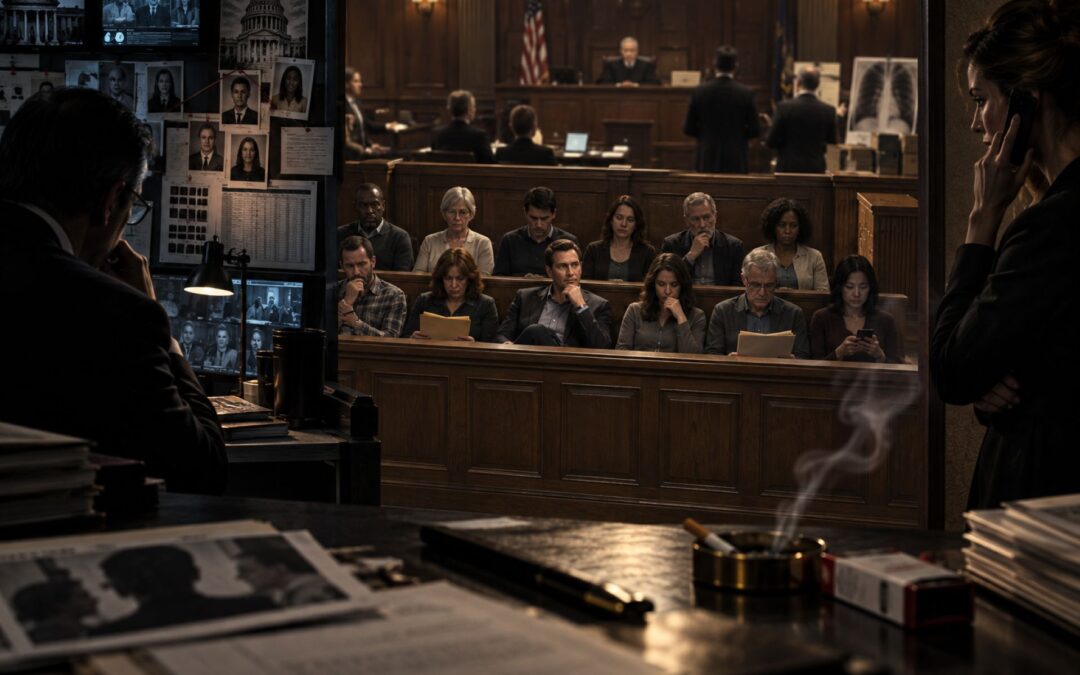
John Grisham’s The Runaway Jury begins as a familiar legal thriller: a widow sues a major tobacco company after her husband dies of lung cancer, and both sides prepare for a trial that could have consequences far beyond one family. The deeper conflict, however, is not simply between plaintiff and defendant. It is a struggle over twelve jurors whose decisions are supposed to remain independent even as lawyers, consultants, investigators, employers, family members, money, fear, personal loyalties, and hidden agendas all begin pressing against them. Published in 1996, the novel arrived when tobacco litigation was becoming a major public and legal issue, and Penguin Random House’s current edition of The Runaway Jury preserves what remains one of Grisham’s most elaborate studies of jury manipulation.
At the center of the story is Nicholas Easter, an apparently ordinary juror who proves unusually skilled at influencing the people around him. Outside the courthouse, a woman calling herself Marlee establishes contact with Rankin Fitch, the ruthless consultant secretly running the tobacco industry’s jury operation. She claims that Nicholas can control the jury and that she can control Nicholas. Fitch initially treats this as another threat to investigate, but as Marlee repeatedly demonstrates knowledge she should not possess, he begins to understand that someone has entered a game he believed belonged exclusively to him.
The novel’s central tension grows from that collision. Fitch represents organized corporate power attempting to penetrate the jury from outside, while Nicholas and Marlee construct a competing system of manipulation from within. The legal question—whether the tobacco company should be held responsible for Jacob Wood’s death—remains important throughout, but Grisham increasingly asks a more disturbing question: what does a jury verdict mean if nearly everyone with enough money, information, nerve, or skill is trying to engineer it?
Spoiler warning: this article covers the complete novel, including Nicholas and Marlee’s identities, the verdict, their manipulation of other jurors, and the final explanation of their motive.

Complete Plot Summary of The Runaway Jury
The forty-three chapters of The Runaway Jury develop several plots at once. The formal tobacco trial provides the visible structure, but the suspense comes from a second trial occurring around it: Rankin Fitch is trying to identify and control vulnerable jurors, Nicholas is gradually reshaping the jury from within, and Marlee is forcing Fitch to decide whether she is bluffing, bargaining, or genuinely capable of delivering a verdict.
Chapters 1–5: A Jury Is Built—and Nicholas Gets Inside
The novel opens before the jury has even been selected, with the defense treating prospective jurors as targets for intelligence gathering. Rankin Fitch’s organization has already accumulated extensive information about people who might sit on the case. Nicholas Easter draws particular attention because parts of his background look ordinary while others do not fit. He has a job, a residence, and enough conventional details to pass casual scrutiny, but his relatively recent arrival in the area and inconsistencies in his history make him difficult to classify.
Fitch’s operation does more than read questionnaires. Potential jurors are observed, tested, and approached in ways designed to reveal attitudes that formal voir dire might not uncover. Nicholas encounters a woman connected to one of these efforts and gives answers that appear plausible but later prove hard to verify. From the beginning, therefore, the defense knows something about him but cannot decide what that something means. The uncertainty is especially irritating to Fitch because his professional identity rests on reducing people to usable information.
The case itself concerns Celeste Wood, whose husband Jacob died after years of cigarette smoking. She is suing Pynex, one of the fictional tobacco companies involved in the defense coalition. The industry regards the case as dangerous not merely because of the damages that might be awarded but because a major plaintiff victory could weaken a long record of successful defense outcomes and encourage further litigation. Fitch operates behind the official lawyers as the man responsible for ensuring that the jury remains favorable to the industry.
Inside the courthouse, Judge Fred Harkin begins dealing with prospective jurors and hardship requests. One memorable prospective juror is Herman Grimes, who is blind but firmly rejects the idea that his disability should automatically prevent him from serving. Herman’s insistence establishes him as both stubborn and civic-minded, qualities that eventually make him an important presence within the jury.
Nicholas survives the screening process. His answers conceal enough of his real history to prevent the lawyers from understanding who he is, and he is ultimately seated. The jury includes people with very different temperaments and vulnerabilities, including Millie Dupree, Lonnie Shaver, Rikki Coleman, Frank Herrera, Jerry Fernandez, Sylvia Taylor-Tatum, Angel Weese, Loreen Duke, and others who will become increasingly important once the outside pressure begins.
Herman becomes foreman, and Nicholas quickly supports him rather than competing for authority. This is one of Nicholas’s most effective habits throughout the book: he rarely begins by demanding power. He studies the group, identifies existing sources of legitimacy, and makes himself useful to them. His influence grows because the other jurors experience him first as competent, reasonable, and attentive.
Nicholas also knows far more about the tobacco litigation world than he admits. He recognizes Fitch from earlier trials where he himself had appeared around jury pools under different identities. That recognition confirms that his presence in the Wood trial is intentional rather than accidental, even though Grisham withholds the reason.
The formal trial opens with Wendall Rohr representing Celeste Wood and Durwood Cable representing Pynex. Rohr’s case is built around addiction, corporate knowledge, product responsibility, and the suffering caused by Jacob’s death. Cable’s defense emphasizes personal choice, uncertainty, causation, and the idea that smokers knowingly decide to use a legal product despite widely understood risks. These competing frameworks remain important throughout the trial, but before either side can fully develop its evidence, the novel has already established that the supposedly neutral people deciding between them are being studied as aggressively as the evidence itself.
Chapters 6–10: Nicholas Takes the Room and Marlee Reaches Fitch
Nicholas’s first significant assertion of authority inside the jury arises from something mundane rather than ideological: lunch. When the jurors are left waiting and treated carelessly, he becomes the person willing to confront the inconvenience and demand better treatment. The episode seems trivial beside a multimillion-dollar tobacco trial, but it demonstrates how Nicholas builds influence. He notices practical frustrations, speaks when others hesitate, and converts group irritation into collective action.
This ability matters because juries are social groups before they are decision-making bodies. Nicholas does not initially tell anyone how to think about cigarettes or liability. He first teaches them that he will defend their interests. That reservoir of trust will later give his substantive arguments more weight.
Outside court, Marlee begins contacting Rankin Fitch. She does not immediately state her full purpose. Instead, she proves that she possesses privileged access to Nicholas by predicting details of his behavior, including what he will wear. Fitch is accustomed to being the person who knows more than everyone else, so Marlee’s knowledge unsettles him in a way an ordinary threat would not.
Fitch responds by investigating Nicholas more aggressively. His people enter Nicholas’s apartment without permission, searching for evidence that might explain who he really is. They do not realize that Nicholas has anticipated intrusion closely enough to document what occurs. The break-in therefore gives Nicholas information about Fitch’s willingness to cross legal boundaries while confirming that the defense is actively targeting him.
The plaintiff meanwhile begins presenting the human and scientific case against Pynex. Jacob Wood appears through recorded testimony, allowing the jurors to encounter him not as an abstract dead smoker but as a person whose illness and dependence affected his life and family. Medical evidence follows concerning lung disease, carcinogens, nicotine, and addiction.
The courtroom material is important, but Grisham repeatedly contrasts expert evidence with the psychology of the people hearing it. Technical testimony can become tiring. Jurors have different educational backgrounds, emotional reactions, and prior attitudes. A scientifically sophisticated argument is not necessarily persuasive simply because it is accurate or complex.
Fitch’s team understands this, which is why its operation extends beyond legal argument. Lonnie Shaver begins experiencing professional attention that can improve his career. The opportunity is presented indirectly enough to look legitimate, yet it is connected to interests aligned with the tobacco defense. The purpose is not necessarily to hand him an envelope of cash. It is to make his economic future feel more secure if his sympathies move in the desired direction.
Nicholas becomes increasingly aware that the jurors are being watched. He speaks with Jerry Fernandez and others, gradually strengthening social ties while encouraging the group to recognize the presence of professional consultants. The jurors begin confronting or resisting the idea that strangers can observe them without consequence. Surveillance, which Fitch treats as an invisible instrument of control, becomes visible enough to produce resentment.
Frank Herrera becomes another figure Nicholas studies carefully. His attitudes toward smoking, personal responsibility, and the lawsuit suggest that he may be strongly inclined toward the defense. Nicholas does not challenge him directly yet. Instead, he collects information about how the room works.
The apartment break-in becomes increasingly useful to Nicholas. He recognizes one of the operatives connected to the intrusion and takes the matter to Judge Harkin without revealing everything he knows or why he had expected trouble. This is characteristic of Nicholas’s strategy. He does not expose his whole position because partial disclosure gives him leverage while allowing him to preserve the larger operation.
By the end of this phase, the apparent structure of the novel has already changed. The Wood family still has to prove its case against Pynex, but the larger suspense turns on whether Fitch can discover Nicholas’s purpose before Nicholas and Marlee understand enough about Fitch’s system to defeat it.
Chapters 11–16: Surveillance, Sequestration, and the First Major Reversals
Marlee continues demonstrating that her connection to Nicholas is real. Her predictions become difficult for Fitch to dismiss as coincidence, yet she still refuses to explain how far her influence extends. She even establishes contact with the plaintiff side, making it unclear whether she intends to sell information, manipulate both camps, or pursue some third objective.
Nicholas simultaneously builds his standing among the jurors. He pays attention to individual personalities and grievances, and he learns which people are resistant to pressure, which are anxious, and which can be moved through trust rather than argument. The courtroom continues presenting evidence, but the jury itself increasingly resembles a second case study in persuasion.
Stella Hulic becomes the target of one of Marlee’s outside operations. Marlee follows Stella and her husband and creates the impression that tobacco interests are watching them. The tactic generates fear precisely because real surveillance is already occurring elsewhere. Marlee is able to weaponize Fitch’s reputation for covert intrusion even when Fitch is not responsible for the specific incident.
At the same time, Lonnie Shaver’s professional situation becomes more attractive. He is courted through business opportunities and exposed to people whose interests align with the defense. Grisham presents this type of pressure as more sophisticated than an obvious bribe. Lonnie can tell himself he is making rational career decisions even as those decisions create psychological indebtedness.
The pressure on Stella eventually becomes too much. Improper outside contact comes to light, and she is removed from the jury. Phillip Savelle takes her place. Judge Harkin, increasingly concerned about interference, orders sequestration.
Sequestration is meant to protect the jurors, but it gives Nicholas a new environment to dominate. The jurors are now removed from ordinary life, placed together in controlled lodging, and subjected to restrictions they quickly find burdensome. Nicholas becomes the effective negotiator between the group and the court, arguing over food, searches, visitation, privacy, entertainment, and the general conditions under which they are expected to perform their civic duty.
These disputes again build his authority without requiring him to discuss the merits of the case. People trust leaders who solve immediate problems. By the time deliberations arrive, Nicholas will not need to invent influence from nothing because he has been accumulating it for weeks.
Fitch’s organization becomes even more invasive. Rikki Coleman’s private medical information is obtained and treated as potential leverage. Her life is no longer relevant merely insofar as it affects impartiality; deeply personal details become strategic assets in a corporate intelligence system.
The plaintiff’s courtroom strategy also encounters problems. Some expert evidence, including material involving animal testing, is scientifically relevant but emotionally complicated. Grisham shows that jurors can react negatively even to evidence intended to strengthen a side’s case. The trial is never a simple transmission of facts from experts to rational listeners.
Marlee eventually agrees to meet Fitch in person. The meeting is another contest over control. Fitch would prefer to identify her weakness, price, or location, but she understands his methods and refuses to make herself easily containable. More importantly, she still does not simply offer him the verdict.
Nicholas secretly leaves the normal juror environment and meets Marlee, confirming beyond doubt that the two are working together intimately. Their relationship is personal, but it is also operational. Each handles a different part of the scheme: Nicholas controls information and relationships inside the jury, while Marlee conducts negotiations and counter-surveillance outside it.
The plaintiff then receives one of its strongest pieces of testimony from Lawrence Krigler, a former tobacco insider. Krigler describes knowledge within the industry about nicotine addiction and research relating to cigarettes with reduced nicotine. His account supports the plaintiff’s argument that tobacco companies understood the addictive nature of their product while publicly resisting responsibility.
Cable attacks Krigler’s credibility, as a defense lawyer must. The trial therefore continues to preserve two levels of uncertainty. The jurors have to decide what witnesses deserve belief, while Fitch has to decide whether Marlee genuinely controls the people whose belief matters.
Chapters 17–24: The Trial Becomes a War Outside the Courtroom
The campaign against individual jurors intensifies through Hoppy Dupree, the husband of juror Millie Dupree. Hoppy works in real estate and becomes involved in what appears to be a lucrative development opportunity. The deal is deliberately constructed around his financial ambitions and vulnerabilities.
What Hoppy does not understand is that the opportunity is part of a trap. He is drawn into behavior that can later be presented as corruption. Men posing as federal agents confront him with supposed evidence of bribery and threaten him with criminal prosecution. They imply that the danger can disappear if Millie becomes helpful to the tobacco defense.
The scheme is especially sinister because Millie herself has not agreed to anything. The pressure is applied through her husband, allowing the manipulators to convert marital loyalty and fear into a possible jury vote. Hoppy becomes terrified not only of prison but of destroying his family.
While this operation develops outside the courthouse, the plaintiff continues building its public-health case. Former Surgeon General Roger Bunch testifies about smoking, addiction, disease, and industry conduct. His testimony reinforces the plaintiff’s broader argument that the risk was not simply an isolated matter of Jacob Wood making a bad private decision.
Fitch’s investigators also uncover a major clue about Nicholas. They connect him to earlier tobacco cases in which he appeared near jury selection under different names. What had looked like a strange but potentially innocent background now becomes evidence of a deliberate campaign. Nicholas has not wandered into this lawsuit. He has been trying to reach a tobacco jury for years.
Fitch still does not know why.
Nicholas’s apartment is then attacked more aggressively. Operatives enter, steal material, and set a fire. The escalation shows how far Fitch’s system is willing to go once conventional investigation fails. Nicholas recognizes that the burglary was not random and understands that the missing information may allow Fitch to reconstruct more of his identity.
The book then reveals part of the truth to the reader. Nicholas Easter is really Jeff Kerr, while Marlee has used the name Claire Clement. They are highly educated, closely connected, and have spent years studying tobacco litigation, jury behavior, and Rankin Fitch. Their presence in Biloxi is the culmination of preparation rather than opportunism.
Yet Grisham still withholds the deepest explanation. Knowing their identities does not tell the reader why they care so much about tobacco cases or why Marlee appears willing to risk criminal exposure to control a verdict.
The plaintiff meanwhile presents Leon Robilio, another former industry figure who testifies about addiction, marketing, lobbying, and tobacco-company conduct. As with Krigler, the defense attacks his motives and credibility. The legal case therefore becomes cumulative rather than dependent on one perfect witness. Rohr is trying to build a pattern suggesting that Pynex and the broader industry understood the dangers and addictive character of cigarettes while continuing to protect profits and resist accountability.
Economic testimony addresses the measurable losses caused by Jacob’s death. Celeste Wood then provides the emotional center of the plaintiff’s case. She describes her husband, his smoking, his dependence, his illness, and the consequences for their family. Her testimony transforms technical debates about nicotine and epidemiology back into the story of a particular person.
The plaintiff eventually rests.
By this point, however, the novel has made clear that the formal case is only one determinant of the verdict. Hoppy is being blackmailed, Lonnie has been professionally cultivated, private medical information has been collected on Rikki, Nicholas is deliberately organizing the jury, and Marlee has created an information network capable of challenging Fitch’s own. The jury may be sequestered, but the people who compose it remain connected to lives that can be frightened, bought, flattered, compromised, or protected.
Chapters 25–32: Bought Jurors, Removed Jurors, and the $10 Million Offer
Marlee’s relationship with Fitch now moves from demonstrations of power to explicit negotiation. She tells him that she can deliver the verdict. Her proposition is extraordinary because Fitch’s entire career has been built on influencing juries without ever believing another private actor could simply seize one.
Nicholas, meanwhile, uses a jury fishing outing to assess the group more closely. Social activity gives him information that formal discussions cannot. He watches alliances, prejudices, levels of certainty, and the ease with which individual jurors can be persuaded. He is effectively conducting his own jury consulting from inside the jury.
The plaintiff side also crosses an ethical boundary. An operative attempts to reach Angel Weese through her boyfriend Derrick. Money is offered in the hope that Angel can be influenced. Derrick, recognizing that a jury vote might be worth considerably more than the amount initially offered, begins thinking less like a messenger than an entrepreneur.
This subplot matters because it prevents the novel’s moral geography from becoming perfectly clean. Fitch’s operation is more extensive, more organized, and more dangerous, but the plaintiff camp is not untouched by corruption. The desire to win can erode procedural boundaries on either side.
The defense then calls Martin Jankle, the head of Pynex. Jankle presents the industry’s preferred moral framework: cigarettes are legal, warnings are widely known, and adults choose whether to smoke. If Jacob continued smoking despite understanding the risk, the company should not become legally responsible for every consequence of that decision.
Rohr’s cross-examination is devastating. He challenges Jankle’s presentation of corporate responsibility and introduces material resembling the widely remembered public spectacle of tobacco executives denying that nicotine was addictive. The effect on the jury is more immediate than some of the denser scientific testimony. Jankle embodies the company in a way charts and experts cannot.
Millie Dupree is meanwhile being pressured through Hoppy, but she does not simply surrender her judgment. Hoppy attempts to convey information and influence her, yet she resists. Her reaction demonstrates that vulnerability does not automatically produce compliance.
Nicholas, however, is willing to manipulate the jury composition much more directly when he believes someone threatens his desired outcome. Frank Herrera is strongly disposed toward the defense and difficult for Nicholas to move. Instead of persuading him, Nicholas engineers his removal.
He plants prohibited material so that it appears Frank has violated the judge’s instructions. The violation is discovered, Frank is dismissed, and alternate Henry Vu enters. It is one of the clearest moments when Nicholas crosses from influencing fellow jurors into actively corrupting the integrity of the proceeding.
The distinction matters. Nicholas is not merely a charismatic juror with strong opinions. He is altering who is allowed to deliberate.
Defense testimony continues with experts attempting to weaken the causal and moral claims of the plaintiff. Some arguments emphasize scientific uncertainty; others focus on advertising, personal responsibility, or the difficulty of assigning a single cause to smoking behavior. The defense occasionally succeeds in presenting a more persuasive case than the plaintiff expects, especially when expert testimony is framed in psychologically accessible terms.
Nicholas begins integrating Henry Vu into the group, while sequestration fatigue deepens. The longer jurors are confined together, the more important interpersonal management becomes. Nicholas has spent the entire trial making himself the person who can ease conflict, explain confusion, and organize action.
Marlee finally states her price to Fitch: ten million dollars.
Her demand transforms the covert contest into an explicit market transaction. Fitch must decide whether purchasing the verdict is more rational than trusting his existing influence network. Because the financial stakes of a catastrophic plaintiff verdict are potentially enormous, ten million dollars can be treated as a business expense.
Marlee also proves that she knows highly confidential details about the tobacco industry’s joint defense funding. That knowledge makes it harder for Fitch to dismiss her. She understands not just Nicholas and the jurors but the internal machinery behind Fitch’s authority.
In one of the novel’s most revealing exchanges, Marlee and Fitch compare their understanding of individual jurors. Fitch believes some can be counted on because of pressure or incentives. Marlee demonstrates that she knows about those vulnerabilities too. The conversation makes the jury sound less like a civic body than a portfolio of votes whose loyalties can be priced and managed.
Fitch agrees to continue toward the transaction. He believes he is buying certainty.
Marlee intends him to believe exactly that.
Chapters 33–38: The Last Manipulations Before Deliberation
The Hoppy Dupree operation begins to unravel once Millie confides in Nicholas. Hoppy has finally explained enough about the supposed federal case for Millie to understand that something extraordinary is happening. She brings the problem to Nicholas because, by this point, he has become the juror people trust with problems that feel too complicated for ordinary discussion.
Nicholas immediately suspects that the “federal agents” are not genuine. The threats have been designed to look official, but they also fit the pattern of outside manipulation he has been observing throughout the trial. He and Marlee begin checking the identities involved.
The result is a counter-operation. Hoppy is reassured that the supposed prosecution may be fraudulent, and the men who have been threatening him are maneuvered into a situation where a genuine federal presence can expose their deception. Fitch’s effort to control Millie through her husband collapses.
This reversal is important for more than plot. Fitch has built his operation on informational asymmetry: he succeeds because the targets do not know who is behind the pressure or what information is real. Nicholas and Marlee defeat the scheme by restoring information to Hoppy and Millie.
The formal defense approaches its conclusion. Additional expert testimony continues emphasizing uncertainty, personal responsibility, and weaknesses in the plaintiff’s interpretation of smoking behavior and disease. The courtroom increasingly feels secondary, however, because all major players are preparing for deliberations.
Fitch’s investigators finally get closer to the woman they have known as Claire Clement. They discover another identity: Gabrielle Brant. The discovery leads them toward Missouri and toward the family history that will eventually explain everything.
Derrick’s effort to profit from Angel’s jury position also collapses. He takes money, makes reckless choices, gambles, and becomes entangled with the police before he can deliver the influence he promised. His failure contrasts with the sophistication of Nicholas, Marlee, and Fitch. Corrupt intent alone does not produce effective manipulation; organization and knowledge matter.
The most ethically disturbing move by Nicholas comes shortly before deliberations. Herman Grimes remains foreman and possesses substantial independence. Nicholas secretly induces symptoms that make Herman appear medically unable to continue. Herman is removed from the jury, and another alternate, Shine Royce, joins.
Whatever sympathy readers may feel for Nicholas’s broader goal, the act is difficult to reconcile with the ideal of jury independence. Herman is not removed because he broke the rules, accepted money, or was legally disqualified. He is removed because Nicholas wants a different deliberating body.
Rohr and Cable deliver their closing arguments. Each attempts to convert weeks of testimony into a coherent moral account. Rohr asks the jurors to see Jacob Wood as the victim of a company and industry that understood addiction, protected their product, and externalized the consequences. Cable asks them to preserve the boundary between corporate responsibility and adult choice.
Outside the courtroom, Marlee insists that Fitch complete the ten-million-dollar transfer before the jury begins deliberating. She has spent the trial teaching him that hesitation carries risk. He finally authorizes the offshore payment.
Fitch believes he has purchased a defense verdict at the moment when he has actually financed the final phase of an operation against himself.
Chapters 39–43: Deliberation, the $402 Million Verdict, and the Final Reveal
With Herman gone, the jury needs a new foreman. Nicholas is the obvious candidate because he has spent the entire trial becoming the person the group looks to when something needs to be organized. His ascent therefore feels natural to the jurors even though readers understand how carefully it has been engineered.
Marlee begins taking financial positions based on what she expects the verdict to do to tobacco-company stocks. The scheme expands beyond revenge inside a courtroom. A major plaintiff verdict could damage investor confidence, meaning advance knowledge of the verdict creates an opportunity to profit from falling prices.
Fitch’s investigators, meanwhile, finally discover what happened to Gabrielle Brant’s family. Both of her parents died after suffering from smoking-related disease. The revelation supplies the motive that has been withheld since the opening chapters. Nicholas and Marlee did not choose tobacco litigation randomly. Their long preparation is rooted in grief and a desire to retaliate against an industry they believe caused devastating harm while repeatedly escaping legal accountability.
The deliberations begin without immediate chaos. On some factual questions, the jurors are closer to agreement than they are on the final legal conclusion. Many accept that smoking causes cancer and that nicotine can be addictive. The more difficult question is responsibility: whether Pynex should be held legally and financially responsible for Jacob’s death when Jacob himself chose to continue smoking.
The jurors discuss warnings, addiction, marketing, personal choice, children, corporate conduct, and analogies to other dangerous products. These arguments matter because Grisham does not simply have Nicholas announce the verdict he wants and watch everyone obey. Nicholas manages the pace of discussion, allows positions to become visible, and waits until he can intervene effectively.
Initial voting shows that the jury remains divided. Some jurors favor the plaintiff, some the defense, and others are uncertain. Nicholas eventually stops behaving like a neutral facilitator and argues openly for liability. The trust he accumulated through weeks of practical leadership now becomes substantive political capital inside the jury room.
His argument emphasizes the power imbalance between smokers and tobacco companies, the addictive nature of nicotine, the evidence that industry insiders understood the problem, and the need for a verdict large enough to matter. The discussion then moves from liability to damages.
The final result is a 9–3 verdict for Celeste Wood. The jury awards two million dollars in compensatory damages and four hundred million dollars in punitive damages, for a total of $402 million.
The verdict is catastrophic for the tobacco defense and humiliating for Fitch, who believed he had paid to guarantee the opposite result. Nicholas leaves quickly and avoids the surveillance that would otherwise follow him. Marlee’s market positions benefit from the decline in tobacco stocks caused by the verdict.
Yet the ending does not present a completely clean victory. Post-trial irregularities begin surfacing. Herman’s medical condition does not appear to have been what everyone assumed, while Frank Herrera insists that evidence was planted against him. These problems threaten the legitimacy of the verdict because they point directly toward manipulation of jury composition.
Six weeks later, Marlee confronts Fitch.
She returns the ten million dollars he transferred to her. The gesture distinguishes her scheme from simple theft. She did not ultimately want Fitch’s money as the source of her reward; she wanted him to commit himself to an illegal purchase of the verdict, giving her leverage over him.
Her profits instead came from the market operation surrounding the tobacco-stock decline. Those profits were possible because she knew what the jury would do before the market did.
Marlee then explains the history behind her campaign. She is Gabrielle Brant. Her parents died after years of smoking and smoking-related illness, and she came to see the tobacco industry as responsible not only for their deaths but for a system in which companies could continue profiting while avoiding meaningful liability.
That history explains why she and Nicholas spent years studying tobacco litigation and trying to position themselves inside a decisive case. It explains the persistence, the aliases, and the willingness to take enormous personal risks.
It does not, however, erase what they did.
Nicholas entered the jury under false pretenses. He manipulated fellow jurors, engineered Frank’s dismissal, caused Herman’s removal, and used the trust of the group to help produce an outcome he had desired before hearing the evidence. Marlee created fear, negotiated the sale of a verdict she had no legitimate right to sell, and profited from advance knowledge of an event she and Nicholas were secretly controlling.
Fitch is defeated, but the mechanism of his defeat mirrors his own worldview more closely than Nicholas and Marlee might wish to admit. He believes juries are systems to be engineered. They prove him right by engineering one better.
The Jury as the Real Battleground
The courtroom gives The Runaway Jury its legal framework, but the jury gives the novel its distinctive identity. Rohr and Cable present arguments according to recognizable rules, while nearly everyone outside those rules tries to discover how much juror independence can actually withstand. Grisham therefore treats the jury not as a single institution but as a collection of individuals whose private circumstances can be translated into pressure.
That design also makes character analysis inseparable from power. Nicholas, Marlee, and Fitch matter because each understands people instrumentally, while the jurors matter because their ordinary needs and weaknesses become strategic variables.
Nicholas Easter / Jeff Kerr: The Juror Who Engineers the Jury
Nicholas enters the novel as an information problem. Fitch’s people can find fragments of his history but cannot form a stable picture. That uncertainty is deliberate because “Nicholas Easter” is itself a constructed identity.
His greatest skill is not courtroom knowledge but social intelligence. He recognizes that authority in a jury does not begin when deliberations start. It begins with lunches, hotel conditions, interpersonal disputes, entertainment, small acts of solidarity, and the ability to make people feel understood.
Nicholas rarely uses obvious domination. When Herman is foreman, he supports Herman. When jurors are frustrated with their treatment, Nicholas speaks for them. When individuals need help, he becomes the person they trust. His later control of deliberations works because he has already built a reputation for competence that appears unrelated to the verdict.
This makes him a more plausible manipulator than someone who simply delivers irresistible speeches. Most of his influence is cumulative. He studies which jurors respond to logic, which respond to confidence, and which respond to personal loyalty.
His willingness to interfere becomes progressively harder to defend. At first, he mostly exposes or counters Fitch’s manipulation. He identifies surveillance, documents the apartment intrusion, helps free Hoppy from a fraudulent scheme, and gives vulnerable jurors information they otherwise would not have.
But Nicholas does not stop at defense. Frank Herrera is removed because Nicholas plants material designed to make him appear disobedient. Herman is removed because Nicholas creates a medical problem. These acts are not protection of the jury from outside corruption; they are corruption by Nicholas himself.
His moral logic appears consequentialist. He believes the tobacco industry has caused immense harm and has repeatedly escaped accountability, while Fitch is already willing to corrupt the trial. From that perspective, manipulating the jury can be rationalized as defeating a corrupt system on its own terms.
The novel never fully endorses that rationalization. The suspense depends on Nicholas succeeding, but the ethical force of the story depends on readers noticing what success requires.
Nicholas’s near-total competence is also one of the book’s plausibility strains. He anticipates intrusion, manages group dynamics, investigates covert agents, plants evidence without exposure, manipulates a foreman’s health, escapes surveillance, and maintains the larger operation while serving on a sequestered jury. His effectiveness is thrilling because it creates momentum, but it can also make him feel less like a psychologically ordinary person than a mechanism built to defeat Fitch.
Marlee / Claire Clement / Gabrielle Brant: Strategist, Avenger, and Moral Wild Card
Marlee is the character who turns Nicholas’s influence into a system capable of challenging Fitch. She manages information, negotiations, aliases, surveillance, timing, and money while maintaining enough uncertainty that Fitch never knows how much of what she says is bluff.
Her most effective weapon is not secrecy alone but controlled proof. She repeatedly tells Fitch something about Nicholas that he can verify. Each successful prediction increases the credibility of her next claim, allowing her to build bargaining power before she ever names a price.
She understands Fitch psychologically as well as he understands jurors. His professional identity depends on knowing more than the people around him, so she does not merely hide from him; she makes him experience uncertainty. She lets him investigate, discover fragments, and still remain behind.
Marlee is therefore not secondary to Nicholas. If Nicholas controls the internal jury environment, she controls the external strategic environment. She creates diversions, tracks Fitch’s moves, negotiates the payment, researches threats, helps dismantle the Hoppy operation, and arranges the financial side of the scheme.
Her multiple identities also matter thematically. “Marlee,” “Claire Clement,” and “Gabrielle Brant” are not merely names used to surprise the reader. They represent different layers of the person Fitch is trying to reduce to a file. Every time his investigators believe they have discovered her, another identity appears beneath the previous one.
The final revelation of Gabrielle’s parents gives emotional coherence to her campaign. What looked like an elaborate fraud becomes revenge rooted in grief. She has built her adult life around an injury she believes the legal system repeatedly failed to recognize.
Returning Fitch’s ten million dollars complicates the revenge. She does not want the ending to reduce her to someone who sold a verdict and kept the purchase price. By returning the money, she converts Fitch’s transfer into evidence of his willingness to buy a jury while depriving him of the simple explanation that she was motivated only by greed.
That gesture does not make her innocent. She still participates in manipulating a trial, frightening people, and profiting from information available only because she and Nicholas secretly control the outcome. Her moral ambiguity is precisely what makes her more interesting than a conventional avenging heroine.
Rankin Fitch: Corporate Power Made Personal
Rankin Fitch is the antagonist, but he works best as more than an individual villain. He represents a system in which immense private resources can be directed at supposedly independent public institutions.
Fitch believes in information. Every juror has a biography, every biography contains pressure points, and every pressure point can potentially be translated into behavior. His organization collects employment history, financial details, family relationships, medical information, habits, opinions, and vulnerabilities.
The frightening aspect of his method is how rarely it requires an obvious bribe. Lonnie can be influenced through career opportunity. Hoppy can be coerced through fear of prosecution. Rikki’s private information can become potential leverage. Stella can be destabilized through fear of surveillance.
Fitch’s worldview is cynical but internally consistent. He assumes that juries are never truly neutral because people always bring needs and weaknesses into the room. His job is simply to identify those variables before the opposing side does.
Marlee’s great strategic achievement is forcing him to confront an opponent who has adopted the same premise. When she claims she can deliver the jury, Fitch is appalled less by the immorality of the proposition than by the possibility that someone else controls an asset he has been trying to control.
His defeat is therefore deeply ironic. He loses not because the jury system proves impossible to manipulate, but because another team manipulates it more effectively. The book punishes Fitch personally while leaving his central theory disturbingly intact.
Wendall Rohr, Durwood Cable, and Judge Harkin: The Law Around the Manipulators
Wendall Rohr and Durwood Cable represent the legitimate adversarial structure of the case. Rohr argues for Celeste Wood and tries to establish that the tobacco company should bear responsibility for Jacob’s death. Cable defends Pynex by emphasizing choice, uncertainty, credibility, and the danger of holding manufacturers responsible for voluntary behavior.
Neither lawyer is neutral, but both operate primarily through evidence, witnesses, cross-examination, and argument. That distinction becomes increasingly important as the covert plots escalate. The official advocates may aggressively shape what the jurors hear, yet they remain constrained by a process that Fitch, Nicholas, and Marlee repeatedly bypass.
Judge Harkin represents another form of legitimate authority. He controls jury selection, sequestration, juror discipline, alternates, and the practical conditions of the trial. He responds when misconduct becomes visible, but his power depends on information reaching him.
That limitation is central. Harkin cannot prevent a manipulation he cannot see. A juror can be pressured through a spouse, an employer, stolen medical information, a fake investigation, or another juror’s secret agenda while the courtroom continues to appear orderly.
The novel therefore does not portray formal institutions as meaningless. Rather, it shows how rules become vulnerable when covert actors possess better information than the people responsible for enforcing them.
The Jurors Who Can Be Bought, Pressured, Protected, or Removed
Herman Grimes initially gives the jury a legitimate source of authority outside Nicholas. His insistence on serving despite blindness establishes independence and dignity. As foreman, he provides structure, which is precisely why his eventual removal matters so much.
Nicholas does not defeat Herman through argument. He removes him from the system. That distinction exposes one of the novel’s most troubling ideas: if the composition of a jury can be engineered, persuasion inside the jury room may become secondary.
Millie Dupree is threatened indirectly through Hoppy. Her importance lies partly in resisting the idea that family pressure automatically determines a juror’s vote. She listens to her husband but ultimately seeks help rather than simply obeying him.
Hoppy is more vulnerable because he is frightened, financially exposed, and convinced that government agents possess evidence that could destroy his life. The fake sting works by exploiting his belief in institutional authority. Once Nicholas gives him reason to question that authority, the pressure begins to collapse.
Lonnie Shaver represents a subtler vulnerability. His professional future is improved in ways that can be rationalized as ordinary business opportunity. He does not need to think of himself as corrupt for the strategy to work; the pressure depends on making self-interest feel respectable.
Rikki Coleman’s stolen medical information demonstrates another form of power. Her vulnerability exists because private facts can be transformed into strategic assets without her knowledge. She illustrates why surveillance becomes one of the novel’s central themes rather than merely a plot device.
Frank Herrera is important because Nicholas cannot easily persuade him. Frank’s removal exposes the difference between influence and engineering. Nicholas decides that the solution to a resistant juror is not stronger argument but exclusion.
Stella Hulic is removed after outside pressure and fear destabilize her participation. Her story shows that a juror can be compromised even without accepting money or intentionally breaking rules. Fear alone can damage the conditions under which independent judgment is supposed to occur.
Angel Weese becomes the target of plaintiff-side bribery through Derrick. The scheme fails, but its existence complicates any simple claim that only the defense is willing to corrupt the jury. The difference is one of scale, organization, and effectiveness rather than perfect moral purity.
Jerry Fernandez, Sylvia Taylor-Tatum, Loreen Duke, Henry Vu, Phillip Savelle, Shine Royce, Gladys Card, and the remaining jurors help create the social ecology Nicholas learns to manage. Not all need independent plots for the jury to feel consequential. Their value lies partly in making deliberation a group process rather than a duel between two predetermined votes.
Biloxi, Sequestration, and the Machinery of a High-Stakes Trial
Biloxi is more than a geographic label in The Runaway Jury. The Gulf Coast setting gives Grisham a compact environment in which courthouse, hotels, casinos, restaurants, offices, airports, homes, and private meeting places can remain connected while different characters operate in secrecy. The city feels large enough to contain sophisticated legal and corporate operations but small enough for surveillance to create claustrophobia.
The courthouse represents formal legal order. Inside it, evidence is admitted, witnesses are examined, lawyers object, and Judge Harkin controls procedure. Yet the book’s central irony is that many of the most consequential actions occur elsewhere. Employment negotiations, apartment searches, financial transfers, fake investigations, surveillance, and secret meetings determine what kind of jury eventually returns to the courtroom.
Sequestration is designed to protect the jury from precisely this type of interference. By removing jurors from normal routines and restricting outside contact, the court attempts to create an insulated decision-making body. Grisham shows how imperfect that insulation can be because jurors do not stop having spouses, jobs, fears, habits, or private histories simply because they are placed in a hotel.
The Siesta Inn therefore becomes a second institutional setting. The jurors eat together, complain together, negotiate rules, seek entertainment, and develop loyalties. Isolation reduces some forms of outside influence while increasing the importance of internal social dynamics.
That tradeoff benefits Nicholas. A juror who controls group morale inside a sequestered jury possesses unusual influence. Nicholas uses disputes over food, searches, visitation, and comfort not because these issues decide the lawsuit but because they help establish who can make life easier for everyone else.
The surrounding casino culture adds another layer. Gambling, money, risk, and calculation echo the larger trial even when Grisham does not force the comparison into explicit symbolism. The tobacco companies are gambling on a defense verdict, Fitch is gambling that jurors can be priced correctly, Marlee is gambling in financial markets, and Derrick literally turns corrupt opportunity into reckless speculation.
Professional jury consulting completes the machinery. Both sides study jurors, but Fitch transforms consultation into covert intelligence work. The novel exaggerates some capabilities for thriller effect, yet its institutional insight remains clear: a jury trial does not occur only through law and evidence. It also occurs through research, money, logistics, psychology, and unequal access to information.
What The Runaway Jury Is Really Testing
The plot of The Runaway Jury works because several moral questions overlap without perfectly resolving one another. Tobacco can be harmful, Pynex can deserve accountability, Fitch can be corrupt, and Nicholas can still violate the integrity of the trial. Grisham’s strongest thematic material emerges precisely where one true proposition fails to cancel another.
The novel is therefore more interesting when treated as a conflict among competing forms of power than as a simple story about good people defeating a bad corporation.
Manipulation, Free Will, and Jury Independence
Jury independence is the institution’s central ideal, but nearly every major character behaves as though independence is provisional. Lawyers persuade through evidence. Consultants profile personalities. Fitch pressures jurors through work, family, fear, and private information. Nicholas builds loyalty and manages discussion. Marlee shapes the environment outside the courthouse.
The book does not claim all these forms of influence are equivalent. Persuasion based on evidence is part of the legitimate trial process, while covert coercion or bribery violates it. The tension comes from the wide territory between those poles.
Nicholas illustrates that ambiguity especially well. Helping jurors articulate frustration or understand evidence can be legitimate leadership. Secretly arranging the removal of unfavorable jurors is not. His arc shows how easily influence justified as protection can turn into control.
Fitch begins with a simpler assumption: people are predictable if enough data is collected. He believes independence is largely a comforting fiction concealing economic interest, fear, prejudice, and social pressure.
Nicholas defeats him partly by proving that humans are more complicated than Fitch’s profiles. Yet Nicholas also confirms Fitch’s premise by treating fellow jurors as people whose behavior can be engineered.
The novel therefore leaves jury independence both defended and undermined. The institution matters precisely because its independence is valuable, but the story demonstrates how many actors benefit from pretending they are merely observing that independence while actually trying to shape it.
Corporate Power, Money, and the Market for Influence
Money in The Runaway Jury rarely appears simply as wealth. It buys research, investigators, travel, surveillance, access, legal expertise, employment opportunities, offshore accounts, and the time required to study people intensively.
Fitch’s real power comes from turning financial resources into information and information into influence. A corporation does not need to hand every juror cash if it can shape the conditions around them.
Lonnie’s career illustrates this mechanism. A better professional future can influence him without requiring him to admit that he has been bought. Hoppy’s case reverses the logic: instead of offering wealth, the conspirators threaten financial and personal destruction.
The ten-million-dollar negotiation makes this logic explicit. Fitch treats a verdict as something that may rationally be purchased if the price is lower than the expected cost of losing. His outrage is not primarily moral; he is calculating whether Marlee can deliver.
Marlee understands that calculation and uses it against him. By forcing Fitch to participate in the transaction, she makes him expose the same corruption he has spent the trial practicing indirectly.
The financial-market subplot broadens the theme. A verdict is not simply a moral statement about Jacob Wood. It changes the perceived value of tobacco companies, meaning legal outcomes can immediately move enormous amounts of capital. Marlee turns that connection into profit.
The novel’s money theme therefore operates at several levels: personal vulnerability, corporate power, litigation strategy, bribery, punitive damages, and market speculation. Each demonstrates a different way economic power can enter the supposedly non-economic act of deciding what is just.
Addiction, Choice, and Responsibility
The formal case against Pynex turns on a conflict that cannot be resolved merely by stating that cigarettes are dangerous. The harder question is how responsibility should be divided between a company that sells an addictive product and an adult who repeatedly chooses to consume it.
The defense emphasizes choice. Jacob Wood smoked for years while public warnings about cigarettes became increasingly familiar. If adults remain legally responsible for dangerous habits they voluntarily continue, then Pynex should not become the insurer of every smoker’s health.
The plaintiff attacks the simplicity of that position. Nicotine addiction complicates the meaning of voluntary choice, especially if tobacco companies understood addictive mechanisms while publicly minimizing them. Marketing, product design, corporate knowledge, and the difficulty of quitting all become relevant to whether “he chose to smoke” is a sufficient moral explanation.
Grisham clearly weights the narrative toward the plaintiff. The insider testimony, Jankle cross-examination, Celeste’s account, and final verdict position the tobacco companies as institutions that have escaped responsibility for too long.
Yet the novel preserves enough of the defense argument to make deliberations necessary. The jurors debate whether people can blame manufacturers for choices they knowingly continue, and analogies to other dangerous products complicate an easy conclusion.
The strongest thematic reading therefore does not require deciding that choice or addiction eliminates the other. The novel is interested in what happens when meaningful personal agency operates inside conditions deliberately designed to sustain dependence.
Justice Versus Legality: Can a Corrupt Verdict Serve a Just Cause?
This is the novel’s most difficult question because the plot strongly encourages readers to want Nicholas and Marlee to defeat Fitch. Their target is a corrupt consultant working for a powerful industry, and their personal motive emerges from devastating loss.
But a desirable opponent does not automatically make every method legitimate.
Nicholas enters the jury under false pretenses. He has already sought access to other tobacco juries under different identities. He therefore approaches the case with a settled agenda rather than the openness expected of a juror.
He later plants prohibited material to cause Frank Herrera’s removal. Frank may hold views Nicholas dislikes, but juries are supposed to contain people with different views. Removing a juror because he appears unlikely to support the desired verdict is exactly the logic of manipulation Nicholas claims to resist.
Herman’s removal is more serious still. Nicholas secretly causes a medical crisis that makes Herman appear unable to continue. Herman is deprived of his role not because of misconduct but because Nicholas decides that a different jury composition will better serve the outcome he wants.
Marlee’s behavior raises similar issues. She offers to sell a verdict for ten million dollars even though she intends to deceive the purchaser. The fact that she eventually returns the money changes the financial meaning of the transaction but not the underlying interference with the judicial process.
Readers may conclude that the tobacco industry deserved a punitive judgment and still recognize that the verdict was produced through illegitimate means. That contradiction is not a flaw to be solved away. It is the ethical core of the ending.
The book thereby distinguishes outcome from process. A result can feel morally satisfying while the method used to obtain it damages the institution that gives the result legitimacy.
That is also why Fitch’s defeat is not a restoration of an uncorrupted system. Nicholas and Marlee do not cleanse the jury of manipulation. They become the most successful manipulators in the story.
Their victory therefore carries an uncomfortable implication. If justice requires secretly deciding which jurors deserve to remain, engineering medical removals, manipulating deliberations, and profiting from advance knowledge, then the system has not been rescued. One private power has defeated another.
Privacy, Surveillance, and Information as Weapons
Fitch’s system depends on destroying the practical boundary between public eligibility and private life. Jurors answer questionnaires for legitimate trial purposes, but his operation seeks much more: financial circumstances, medical information, employment pressures, relationships, habits, and anything else that can predict behavior.
Rikki Coleman’s private information makes the danger obvious. A fact does not need to be relevant to the lawsuit to become useful if it can create embarrassment, fear, or leverage.
Nicholas’s apartment is another battleground. The break-in and later destruction show what happens when the search for information ceases to recognize legal boundaries. Fitch does not merely want to know whether Nicholas can be impartial; he wants every fact that might explain or control him.
Marlee fights surveillance partly by manufacturing false information and layered identities. Her aliases make data unreliable. Instead of attempting to remain completely invisible, she creates enough competing versions of herself to waste Fitch’s confidence.
This theme has aged particularly well because the technology has changed more than the logic. The novel relies on telephones, faxes, physical surveillance, private investigators, and comparatively limited digital records, but the central proposition—that detailed personal data can be converted into behavioral power—has become more familiar rather than less.
Persuasion, Fatigue, and the Psychology of Group Judgment
One of the novel’s most convincing insights is that jurors do not receive evidence as disembodied rational processors. They become bored, irritated, hungry, tired, defensive, loyal, suspicious, and socially attached.
Some technically impressive expert testimony fails to land because it is too dense. More emotionally or narratively coherent testimony can have greater force. Jankle’s appearance becomes powerful because he embodies the company and can be confronted directly.
Sequestration intensifies these psychological conditions. Jurors spend weeks together under restrictions, meaning annoyance over meals or hotel rules can influence group cohesion even though those matters have no legal relevance.
Nicholas excels because he understands this human dimension. He does not wait until deliberations to become persuasive. He accumulates credibility through dozens of small interactions, then converts that credibility into influence when the legal discussion becomes decisive.
Grisham does not present the jury room as irrational. The jurors debate real questions about addiction, responsibility, causation, and damages. But rational argument occurs inside a social group, and the person who manages that group can shape which arguments receive attention.
Symbols and Recurring Motifs
The Runaway Jury is primarily a plot-driven thriller, so its motifs should not be treated as if every object carries elaborate symbolic meaning. Several recurring patterns nevertheless reinforce the novel’s larger concerns.
Cigarettes are simultaneously evidence, product, habit, source of disease, commodity, and social behavior. A cigarette can support the defense’s language of adult choice while also illustrating the plaintiff’s claim that addiction makes repeated consumption more complicated than ordinary preference.
Smoke breaks similarly reveal how addiction operates in everyday routines. The product being litigated is not an abstract chemical formula. It has been integrated into patterns of work, stress, socialization, and habit.
Phones, cameras, faxes, computers, and surveillance equipment repeatedly promise informational control. Fitch’s people use technology to reduce uncertainty, yet the devices never produce omniscience. Better interpretation, deliberate deception, and human unpredictability continue defeating the apparent certainty of data.
Aliases serve a related function. Nicholas, Jeff Kerr, Marlee, Claire Clement, and Gabrielle Brant demonstrate that identity can itself become tactical information. A name is useful to an investigator only if it leads to the correct life.
Food and juror privileges appear minor but become part of Nicholas’s rise. By fighting over meals, accommodation, searches, and visitation, he turns ordinary discomfort into solidarity. The motif reinforces the idea that institutional power often becomes real through control over mundane conditions rather than grand declarations.
The jury room is the most important enclosed space in the novel. Fitch can surveil almost everything around it, yet he cannot simply enter and dictate the vote. Nicholas’s great strategic advantage is that he occupies the protected space from within.
Money and market prices recur wherever the legal case touches economic power. Damages translate suffering into dollars. Fitch translates the verdict into a purchasable risk. Marlee translates the expected verdict into a stock-market opportunity. Grisham repeatedly asks what happens when institutions designed to express justice operate inside systems where almost everything else already has a price.
How Grisham Builds the Thriller
The Runaway Jury generates suspense less through physical danger than through controlled information. Readers repeatedly know more than the courtroom participants but less than Nicholas and Marlee, while Fitch spends much of the novel trying to close precisely that gap. The structure succeeds because Grisham can reveal one layer of the scheme without exposing the next.
Shifting Point of View and Parallel Plotting
The narration moves among the courthouse, jurors, Fitch’s command operation, Marlee, Nicholas, lawyers, investigators, and people being pressured outside the trial. These shifts allow several forms of suspense to develop simultaneously.
A witness may be testifying while Fitch’s team pressures a juror’s family. Nicholas may be solving a problem inside sequestration while Marlee negotiates outside it. An investigator may uncover part of Nicholas’s history while Nicholas himself is quietly studying jury alliances.
The technique prevents the courtroom scenes from becoming static. Trial testimony acquires tension because readers know the jurors hearing it are already embedded in hidden relationships.
The shifting focus also creates dramatic irony. Judge Harkin may believe a problem has been handled while readers know a deeper manipulation remains invisible. Fitch may believe he controls a juror whom Nicholas understands differently. Marlee may promise a defense verdict while readers increasingly suspect that her promise cannot be trusted.
Nicholas and Marlee remain partially withheld even when the point of view moves close to them. Grisham gives enough information to demonstrate competence without immediately revealing motive. This selective access keeps them mysterious without requiring a completely unreliable narrator.
Pacing, Procedure, and the 43-Chapter Structure
The forty-three numbered chapters are generally short enough to encourage forward movement while long enough to carry discrete tactical developments. Rather than organizing the novel into large formal parts, Grisham lets the reader experience the case as a sequence of moves and countermoves.
Courtroom procedure provides a natural clock. Jury selection leads to openings, plaintiff evidence, defense evidence, closings, deliberations, and verdict. That sequence gives the narrative a fixed destination even when the covert plots become complicated.
Grisham then inserts escalating deadlines inside that larger structure. Fitch needs information before jury selection closes. Marlee needs to prove access before asking for money. Hoppy’s problem must be solved before Millie deliberates. The ten-million-dollar transfer must occur before the verdict becomes uncontrollable.
This architecture creates momentum even in scenes dominated by conversation. The reader rarely wonders whether something is happening because almost every discussion changes the information available to one side.
The procedural detail also gives the thriller credibility. Voir dire, sequestration, expert testimony, alternate jurors, closing arguments, and deliberation provide recognizable legal structures around increasingly implausible covert behavior.
That contrast is useful. The more extraordinary Nicholas and Marlee’s scheme becomes, the more Grisham grounds it in ordinary courthouse routines.
Withheld Information, Reversals, and the Late Motive Reveal
The novel withholds information in stages rather than relying on one final twist. First Nicholas is mysterious. Then Marlee reveals access to him. Later Fitch discovers Nicholas has appeared around other tobacco cases. The reader subsequently learns the Jeff Kerr and Claire Clement identities. Only near the end does Gabrielle Brant emerge.
Each revelation answers one question while creating another. Discovering that Nicholas deliberately infiltrates tobacco trials explains his presence but not his motive. Learning that Marlee is Claire proves a larger operation but not why she is willing to risk everything.
The final family history therefore works because it resolves a question the book has preserved for hundreds of pages. Gabrielle’s parents do not suddenly invent motivation at the end; they explain the intensity already visible throughout the story.
Grisham also builds reversals around apparent control. Fitch repeatedly thinks he has solved the problem shortly before discovering that the problem has moved. Nicholas seems like one juror until he becomes the social center of the group. The ten-million-dollar payment seems to give Fitch certainty but actually confirms how completely Marlee has controlled the negotiation.
The technique is effective because the reversals usually arise from information already present rather than arbitrary new threats. The reader may not know the full plan, but the plan increasingly feels like something Nicholas and Marlee have been executing all along.
Prose, Dialogue, and Characterization
Grisham’s prose is functional, fast, and designed to make complex legal and tactical information easy to follow. He rarely pauses for elaborate description when a conversation, procedural decision, or investigative discovery can advance the plot.
Dialogue carries a large share of the novel. Lawyers examine witnesses, jurors debate, Fitch interrogates subordinates, Marlee bargains, and investigators report findings. Characters often reveal themselves through strategic conversation rather than extended introspection.
That economy helps the thriller move quickly, but it also creates one of the book’s main limitations. The inner lives of many characters are less fully developed than the systems of pressure surrounding them.
A contemporary Publishers Weekly review recognized much the same balance, praising Grisham’s command of the legal-thriller machinery while treating the prose and characterization as less distinguished than the plotting. The criticism remains fair: The Runaway Jury is much more interested in what characters can do to a system than in rendering every character with deep psychological complexity.
Nicholas and Marlee are compelling because they are mysterious, intelligent, and effective, but their inner emotional lives remain relatively controlled even after Gabrielle’s family history appears. Fitch is vivid as a professional predator but not unusually subtle as a person.
This does not prevent the novel from succeeding on its own terms. It simply identifies where Grisham invests his greatest energy. The systems are richer than the souls moving through them.
Why the Tobacco Setting Mattered in 1996
The tobacco lawsuit in The Runaway Jury was fictional, but Grisham placed it inside a rapidly changing real-world legal environment. The timing matters because the novel appeared when long-established assumptions about the tobacco industry’s litigation strength were beginning to face serious institutional challenges.
Mississippi was especially significant. A CDC historical account of tobacco litigation notes that Mississippi became the first state to sue tobacco companies to recover Medicaid costs in 1994. Other states followed, transforming tobacco litigation from isolated individual suits into a broader governmental challenge to the industry.
That setting helps explain the novel’s extraordinary stakes. A plaintiff victory against Pynex is presented not merely as compensation for Celeste Wood but as a potential breach in an industry defense strategy that depends partly on preventing successful precedents and encouraging plaintiffs to believe major victories are unlikely.
Grisham also incorporates a fictional analogue to one of the defining public moments in the tobacco controversy. In April 1994, seven tobacco-company executives appeared before Congress and publicly rejected the proposition that nicotine was addictive, an episode preserved in the Congressional Record’s discussion of the 1994 testimony. Rohr’s confrontation with Martin Jankle draws power from a cultural context in which corporate statements about nicotine were already subjects of intense public scrutiny.
The legal landscape continued shifting after the novel appeared. In 1998, the major tobacco companies entered the Master Settlement Agreement described by the National Association of Attorneys General, resolving claims brought by participating states and imposing major financial and marketing-related obligations. The Runaway Jury therefore belongs to a narrow historical window just before that settlement substantially changed the public legal environment surrounding tobacco.
That chronology should not be confused with the plot. Pynex is fictional, Celeste Wood’s lawsuit is fictional, and the $402 million verdict belongs to Grisham’s narrative rather than real litigation history.
The historical context instead explains why the premise felt urgent in 1996. Tobacco was a product with enormous economic power, increasingly contested scientific and legal narratives, and a growing possibility that institutions which had long resisted liability might finally become vulnerable.
The 2003 film adaptation demonstrates how portable Grisham’s deeper jury-manipulation premise proved to be. The American Film Institute catalog entry for Runaway Jury confirms the adaptation directed by Gary Fleder and starring actors including John Cusack, Gene Hackman, Dustin Hoffman, and Rachel Weisz. The film significantly changes the underlying lawsuit, so it should be understood as a reinterpretation of the novel’s jury-control mechanism rather than a faithful substitute for the tobacco story.
The Ending of The Runaway Jury Explained
The ending works on two levels. Literally, Nicholas and Marlee achieve the result they have spent years engineering: a major plaintiff verdict against a tobacco company. Morally, however, the final chapters complicate the apparent triumph by revealing how much manipulation was required to obtain it.
The result becomes more understandable once the jury’s composition, the 9–3 voting rule available in the case, the removal of resistant jurors, the financial scheme, and Gabrielle Brant’s history are considered together.
What the Verdict Actually Is—and Why It Is 9–3
The jury finds for Celeste Wood by a 9–3 vote. It awards two million dollars in compensatory damages and four hundred million dollars in punitive damages, producing the headline figure of $402 million.
The compensatory amount addresses the losses associated with Jacob Wood’s death. The vastly larger punitive award expresses condemnation of Pynex’s conduct and is designed to punish rather than merely reimburse.
The verdict does not emerge from unanimous moral conversion. Three jurors remain opposed, which matters because it shows that Nicholas has not literally hypnotized the room. He succeeds by creating the level of support required for a plaintiff verdict.
His earlier manipulation of jury composition nevertheless shapes what becomes possible. Frank Herrera is gone. Herman is gone. Alternates have entered. Nicholas is foreman.
The deliberating jury is therefore not merely the random endpoint of lawful selection and ordinary attrition. It is partly the jury Nicholas has manufactured.
His influence during deliberations then converts that engineered composition into an actual decision. He manages the discussion long enough to establish common ground on cancer and addiction before pushing harder on responsibility and damages.
The 9–3 result is thus both a genuine group vote and the product of extensive prior manipulation. Those descriptions are not mutually exclusive, which is precisely why the ending remains ethically complicated.
Why Marlee Shorts Tobacco Stocks and Returns Fitch’s $10 Million
Marlee understands that a verdict of this size will affect more than Pynex. Investors may interpret it as evidence that tobacco companies face a newly serious litigation threat, causing share prices to fall.
She positions herself to profit from that decline. In practical terms, she is betting against tobacco stocks while possessing advance knowledge of an event she and Nicholas are secretly helping to create.
The financial scheme matters because it answers a question the ten-million-dollar bargain deliberately raises. If Marlee’s entire goal were simply to extort Fitch, she could keep his payment after betraying him.
Instead, she returns the principal.
That action does not erase the illegal or unethical elements of the scheme, but it clarifies her purpose. Fitch’s ten million dollars was useful primarily because transferring it forced him to participate explicitly in the purchase of a verdict.
The transfer becomes leverage. Fitch cannot easily expose Nicholas and Marlee without inviting scrutiny of why the tobacco defense secretly moved millions of dollars to a woman negotiating over a jury.
Marlee’s own profit comes from the market rather than directly from Fitch’s purchase price. She therefore distinguishes, in her own mind, between taking money from a corrupt bargain and profiting from the economic consequences of revenge.
Legally and ethically, that distinction is not as clean as she would like. She possesses nonpublic knowledge because she and Nicholas have manipulated the outcome. Returning Fitch’s money makes the ending more morally interesting, but it does not convert the stock-market operation into an innocent transaction.
Gabrielle Brant’s Parents and the Meaning of the Revenge Plot
The final identity revelation explains why tobacco litigation has consumed so many years of Nicholas and Marlee’s lives. Marlee is Gabrielle Brant, and both of her parents suffered and died after long-term smoking.
For Gabrielle, those deaths are not merely private tragedies. They represent a broader structure in which tobacco companies profited from addiction while resisting responsibility for the consequences.
Her campaign is therefore revenge, but revenge transformed into an institutional project. She and Nicholas do not attack a particular executive physically or expose one hidden document. They try to force the legal system to produce the kind of verdict they believe should already have occurred.
This helps explain why they repeatedly attempted to reach tobacco juries before Biloxi. They were waiting for a case in which the stakes, jury composition, and surrounding conditions gave them enough room to act.
The revelation also changes how earlier scenes appear. Marlee’s hostility toward Fitch was never merely professional competition. Her knowledge of the industry, willingness to risk exposure, and determination to prevent another defense victory came from personal history.
Yet motive is explanation rather than exoneration. Losing parents to smoking-related disease can explain why Gabrielle becomes obsessed with tobacco accountability without establishing that she has the right to decide a lawsuit secretly before hearing all the evidence.
The revenge plot is strongest when both truths remain visible. Gabrielle’s anger is understandable, and her method is corrupt.
What the Ending Resolves—and What It Leaves Morally Unresolved
The ending resolves the central mysteries. Nicholas and Marlee are not ordinary opportunists. Their multiple identities were part of a long campaign directed specifically at the tobacco industry. The ten-million-dollar bargain was a trap. The final verdict was the outcome they had wanted from the beginning.
Fitch is defeated in several ways at once. He loses the case, loses control of the jury, loses the credibility of his intelligence system, and discovers that his attempted purchase of the verdict has given Marlee leverage over him.
Marlee’s final warning suggests that Fitch’s future tobacco-jury operations will now carry greater risk. If he resumes the same kind of illegal manipulation, she possesses information capable of exposing what happened in Biloxi.
What remains unresolved is the legitimacy of the Wood verdict. Frank’s claims about planted evidence and the questions surrounding Herman’s medical removal create possible avenues for challenge. More importantly, readers know the jury process was manipulated even if a court never proves every detail.
The book therefore ends with victory rather than purification. The tobacco company has been punished, but the jury system has not emerged untouched.
That distinction prevents the conclusion from becoming a simple fantasy in which clever outsiders repair institutional corruption. Nicholas and Marlee win because they understand the same vulnerabilities Fitch exploits and are willing to use them more effectively.
The ending’s deepest irony is that Rankin Fitch’s cynical theory of human institutions survives his personal defeat. The jury can indeed be manipulated. He simply misidentified who was doing the best job.
Critical Review: How Well Does The Runaway Jury Hold Up?
A legal thriller should first be judged by its ability to make procedure, evidence, strategy, and institutional conflict produce suspense. By that standard, The Runaway Jury remains one of Grisham’s more conceptually ambitious novels. Its central mechanism is unusually strong because the reader is not merely waiting to learn what verdict the jury will reach; the reader is watching competing actors attempt to manufacture the conditions from which that verdict will emerge.
Its limitations arise mostly where the machinery becomes stronger than the people operating it. The plot is intricate, energetic, and memorable, while the psychological interiority is often comparatively thin.
What the Novel Does Exceptionally Well
The greatest achievement is the transformation of jury management into a thriller premise. Most courtroom fiction treats the jury as an audience whose reactions lawyers try to read. Grisham makes the jury the contested territory itself.
That shift allows almost every ordinary feature of a trial to become suspenseful. A questionnaire can expose vulnerability. A lunch dispute can create leadership. A hotel rule can affect loyalty. An alternate juror can transform the likely vote.
Fitch is especially effective as an antagonist because he rarely needs melodramatic violence. His most disturbing actions involve data, employment, private information, and institutional impersonation. He understands how to manipulate people while allowing them to believe they remain autonomous.
Nicholas and Marlee provide a strong counterforce because they do not merely resist Fitch. They understand his model and reverse it. Their operation gradually becomes visible without being fully explained, sustaining mystery across a long novel.
The parallel plotting is another major strength. Courtroom testimony, jury-room psychology, investigative work, financial pressure, and Marlee’s negotiations continually interact. The novel can move away from the courthouse without making the trial feel abandoned because every subplot ultimately returns to the verdict.
The Hoppy Dupree storyline is particularly effective. It dramatizes jury tampering through a family relationship rather than through an obvious payoff. Hoppy believes he faces criminal ruin, Millie faces pressure through someone she loves, and the entire scheme depends on victims misunderstanding who has real authority.
The formal tobacco case also gives the novel more substance than an abstract corporate lawsuit might have provided. Addiction, personal choice, corporate knowledge, public-health evidence, and punitive damages are understandable questions even for readers without legal training.
The deliberations succeed because Grisham lets the jurors debate those questions instead of treating the verdict as predetermined exposition. Nicholas exercises immense influence, but he still has to operate through arguments that the others can accept.
The novel’s ethical ambiguity is another strength. It would have been easier to make Nicholas and Marlee purely heroic crusaders. Instead, their methods become increasingly difficult to separate from the corruption they oppose.
That ambiguity connects The Runaway Jury to broader concerns visible elsewhere in Grisham’s fiction. Readers interested in his use of surveillance and private institutional power can see a related but differently structured conflict in The Firm, where information and control are concentrated inside a corrupt employer rather than around a jury.
Where the Novel Is Less Convincing
The largest weakness is characterization. Nicholas, Marlee, and Fitch are memorable because of what they can do, but they are not explored with the psychological depth their extraordinary choices might warrant.
Gabrielle’s family history explains her motive late in the novel, yet readers receive relatively little sustained access to the emotional life connecting grief to years of deception and jury infiltration. Nicholas is even more controlled. His loyalty to Gabrielle and commitment to the plan are clear, but the novel spends more time demonstrating his competence than exploring what the project has cost him.
Many jurors function primarily through a dominant trait or vulnerability. That is partly appropriate because Fitch himself thinks in profiles, but the narrative sometimes reproduces his simplification rather than fully challenging it.
The plot also requires considerable tolerance for contrivance. Nicholas and Marlee repeatedly anticipate threats, evade surveillance, understand complex systems, control timing, and exploit opponents with remarkable precision.
Any one of their accomplishments can be plausible within a thriller. The cumulative effect makes them unusually close to omnipotent.
Nicholas’s manipulation of Frank and Herman is especially important because the plot depends on him executing serious interference without exposure at the moment it matters most. These scenes are dramatically effective but also among the points where readers seeking strict realism may become skeptical.
Fitch’s organization creates a similar problem from the opposite direction. It can access remarkable amounts of information, infiltrate lives, stage fake federal pressure, manipulate employment, and conduct illegal searches while maintaining enough operational secrecy to continue functioning.
The exaggeration serves the genre, but it occasionally turns institutional power into near-superpower. The novel works best when Fitch’s methods feel like intensified versions of recognizable private influence; it becomes less convincing when almost any barrier appears penetrable.
The moral balance can also feel weighted. The tobacco defense is given arguments worth discussing, but the narrative architecture strongly encourages a plaintiff verdict. That is understandable given the subject and historical moment, yet it means Nicholas’s preexisting certainty receives less challenge than it might in a more morally symmetrical novel.
The plaintiff-side bribery attempt involving Derrick helps complicate the picture, but the episode is comparatively smaller and more inept than Fitch’s systematic corruption. It prevents total moral purity without seriously redistributing the novel’s sympathies.
These weaknesses do not destroy the central project because The Runaway Jury is fundamentally a systems thriller. Readers are being asked to follow a battle over information and institutional vulnerability more than an intimate psychological novel.
What Has Aged Well—and What Feels Historical Now
The technology dates the novel immediately. Faxes, landline communications, physical surveillance teams, comparatively limited digital records, and labor-intensive investigation belong recognizably to the mid-1990s.
That dated surface can actually increase the book’s fascination. Fitch’s organization requires people to gather information that later technological environments can aggregate much more quickly.
The deeper surveillance theme has aged extraordinarily well. The assumption that detailed personal information can predict preferences, identify vulnerabilities, and influence behavior feels more contemporary than the devices used to collect it.
The same is true of the novel’s skepticism toward the boundary between persuasion and manipulation. Modern readers are accustomed to debates about behavioral targeting, data profiling, algorithmic prediction, employer power, political microtargeting, and the use of personal information to shape decisions.
The Runaway Jury explores an earlier version of the same anxiety: how independent is a choice when another actor knows enough about the decision-maker to construct the environment around it?
The tobacco context, however, now feels historically specific because the legal landscape changed dramatically after 1996. The later national settlements and decades of additional public-health developments mean modern readers encounter the fictional Pynex trial with historical hindsight unavailable to the original audience.
That does not make the case obsolete. It makes the novel a snapshot of a period when large-scale tobacco liability still felt unusually uncertain and potentially transformative.
The jury question remains more timeless. Grisham’s earlier A Time to Kill also examines the gap between formal legal procedure and the moral judgments individual jurors bring into a courtroom, though the two novels approach that gap very differently. The Runaway Jury is less interested in whether jurors can separate law from conscience than in whether they can remain independent when powerful outsiders deliberately target their private lives.
Who Should Read It Today?
The Runaway Jury remains especially rewarding for readers who enjoy legal thrillers built around strategy rather than constant physical action. Much of the suspense comes from conversations, surveillance, witness preparation, jury psychology, financial maneuvering, and the gradual discovery of hidden information.
Readers fascinated by institutions may find it particularly satisfying. The novel asks how a system intended to produce impartial judgment actually operates once lawyers, consultants, employers, corporations, spouses, investigators, and jurors themselves begin interacting around it.
It is also a strong choice for readers interested in moral ambiguity. Nicholas and Marlee are easy to root for at the level of thriller momentum, yet increasingly difficult to defend if procedural legitimacy matters.
Readers looking primarily for rich interior characterization may find the book less satisfying. Grisham’s priorities are structure, pace, tactics, and institutional pressure rather than prolonged psychological exploration.
Those willing to accept some high-level contrivance will probably find the central mechanism more memorable than the implausibilities required to sustain it. The book remains entertaining because its fundamental question is so productive: if everyone believes a jury can be influenced, who ultimately controls the people who are supposed to control the verdict?
Final Assessment: A Courtroom Thriller About Who Owns the Jury
The Runaway Jury succeeds because it takes an institution most legal thrillers treat as an endpoint and turns it into the entire battlefield. The verdict matters, but the more compelling question is how twelve supposedly independent people can remain independent once everyone around them starts treating their lives as information.
Rankin Fitch believes he understands the answer. With enough research, money, surveillance, leverage, and patience, jurors can be managed. The frightening part of his worldview is not simply that he is corrupt; it is that many of his methods work.
Nicholas and Marlee defeat him because they understand the same truth from the opposite direction. Nicholas becomes indispensable inside the jury before he attempts to direct its decision. Marlee makes herself indispensable to Fitch before she names her price. Both recognize that control is most effective when the target still believes the choice is voluntary.
Their victory gives the novel its strongest satisfaction and its deepest problem. Pynex receives a devastating verdict, Fitch is humiliated, and Gabrielle obtains the retaliation she has pursued for years. Yet the jury has not been protected from manipulation. It has been captured by a more successful manipulator.
That distinction gives the ending more weight than a conventional corporate comeuppance. Grisham allows readers to enjoy the tactical defeat of Fitch while leaving enough evidence of Nicholas and Marlee’s misconduct to make the triumph uncomfortable.
The novel’s strongest contribution is therefore not simply its tobacco plot or even its famous jury scheme. It is the idea that procedural justice depends on conditions ordinary participants may never see: privacy, independence, accurate information, freedom from coercion, and the confidence that people have not been quietly selected or removed because someone dislikes the way they might vote.
Its chief limitation is that the machinery often overwhelms the characterization. Nicholas and Marlee are extraordinary operators before they are fully realized people, while several jurors exist mainly through the vulnerabilities the plot requires. The scheme also asks readers to accept a remarkable accumulation of successful deception.
Those weaknesses do not undo the novel because the machinery is unusually good. The escalating duel between Fitch and Marlee, Nicholas’s patient capture of jury authority, the parallel trial and surveillance plots, the Hoppy operation, the removal of jurors, the ten-million-dollar bargain, and the deliberation sequence all serve one coherent design.
For readers who value psychological depth above plotting, The Runaway Jury is unlikely to be Grisham’s most satisfying novel. For readers who want an intricate legal thriller about surveillance, corporate power, jury psychology, and the unstable line between justice and manipulation, it remains an exceptionally effective one.
The final irony is what gives the book its lasting force. Rankin Fitch spends the entire story treating the jury as something that can be owned. Nicholas and Marlee prove that he is wrong about who owns it, but they never prove that a jury should belong to anyone at all.
Last Updated on September 18, 2026 by Aseem Gupta