
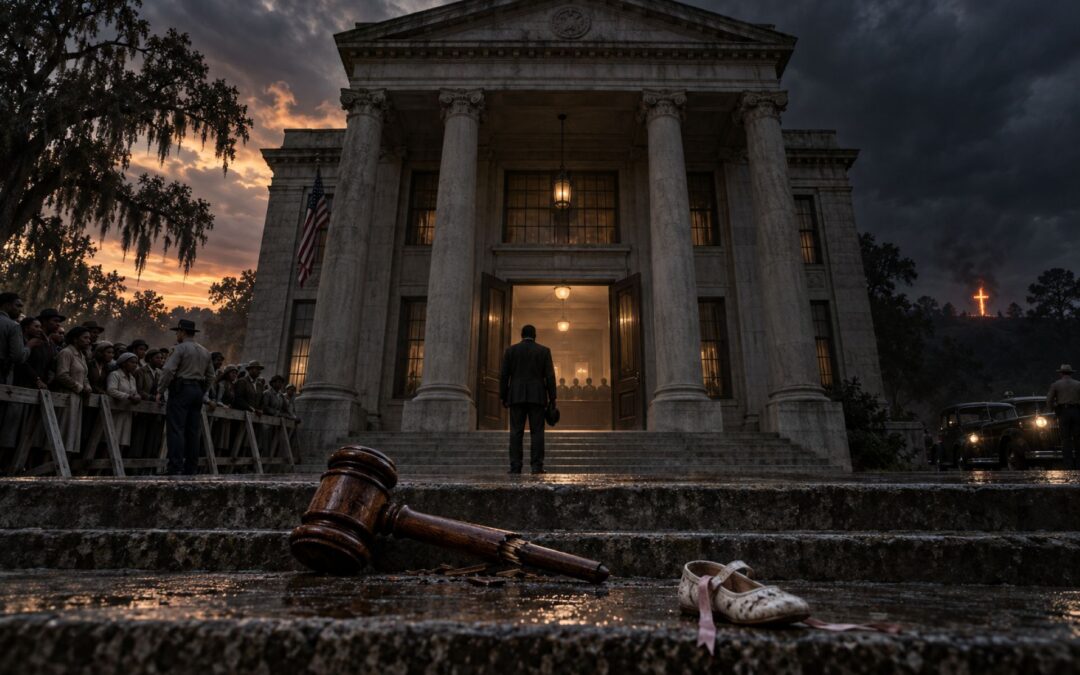
John Grisham’s A Time to Kill begins with a crime so brutal that the reader’s instinctive sense of justice is engaged before the legal system has a chance to speak. When ten-year-old Tonya Hailey is kidnapped, raped, beaten, and left for dead by two white men in rural Mississippi, her father, Carl Lee Hailey, becomes convinced that the courts cannot give him the justice he wants. He takes matters into his own hands, kills both attackers inside the courthouse, and turns what appeared to be a straightforward prosecution of two rapists into a capital murder trial that divides an entire community.
The resulting novel is not simply about whether Carl Lee deserves sympathy. It is about what happens when nearly everyone involved in a criminal case—defendant, defense attorney, prosecutor, judge, activists, terrorists, journalists, witnesses, and jurors—tries to bend the machinery of law toward a result they consider morally right. The courtroom offers rules and procedures, but Grisham repeatedly demonstrates how those rules operate through human beings whose judgments are shaped by race, fear, ambition, family, money, loyalty, prejudice, and empathy.
A Time to Kill was Grisham’s first published novel. In his later recollection of the book’s difficult publication in 1989, he described the modest beginning of a novel that would eventually become central to his career. Jake Brigance would later return in other Ford County novels, and Penguin Random House’s current edition places A Time to Kill at the beginning of the Jake Brigance sequence. Yet the novel remains unusually expansive even within Grisham’s legal fiction: it is simultaneously a murder story, courtroom thriller, portrait of a Southern community, study of professional ambition, and morally unstable argument about race and justice.
Spoiler warning: This article discusses the entire novel in detail, including the trial, verdict, major acts of violence, jury deliberations, and ending.

The Crime That Divides Clanton
The novel opens not with Jake Brigance or Carl Lee Hailey but with Billy Ray Cobb and Pete Willard, two white men whose cruelty establishes the moral pressure under which everything else will occur. They abduct Tonya Hailey, a ten-year-old Black girl, sexually assault and beat her, and leave her for dead after trying to conceal what they have done. Tonya survives, but her injuries are catastrophic. She has not merely been frightened or temporarily hurt; the assault inflicts physical damage and psychological trauma that will continue long after the initial crime disappears from the courthouse docket.
Sheriff Ozzie Walls begins the investigation. Ozzie occupies an unusually difficult position in Ford County: he is a Black sheriff exercising official authority in a community where racial divisions remain embedded in everyday social life. Through informants and police work, he quickly develops the evidence needed to identify Cobb and Willard. Willard ultimately confesses, and the case against the two men appears strong enough that, under ordinary circumstances, the central legal question would have been how severely they would be punished.
Grisham introduces Jake Brigance within this atmosphere. Jake is a young white lawyer with a struggling Clanton practice, a wife named Carla, a daughter named Hanna, an old office inherited through professional circumstance, and ambitions far larger than his current caseload. His mentor is Lucien Wilbanks, a brilliant but disbarred lawyer whose cynical knowledge of Ford County’s legal system will become indispensable. Jake is not initially connected to the prosecution of Tonya’s attackers, but because he knows the Hailey family and moves within the same courthouse culture, he is drawn quickly toward the developing crisis.
Carl Lee soon tells Jake that the ordinary case against Cobb and Willard is not enough for him. In one of the novel’s most important early conversations, he asks Jake what he would do if the raped child had been his own daughter. The question strips the case of professional abstraction. Jake can explain the courts, trials, evidence, and punishment, but Carl Lee is asking whether a father should trust those institutions when faced with the deliberate destruction of his child.
Carl Lee then announces that he intends to kill Cobb and Willard. Jake tells him not to do it, yet the warning leaves Jake in an ethically dangerous position. He now possesses information suggesting a future crime, and Carla recognizes the seriousness of the situation. Jake nevertheless fails to take decisive action. Part of his hesitation comes from his understanding of Carl Lee’s grief, but the novel also allows a darker possibility to enter: Jake can imagine what defending Carl Lee in a sensational murder trial might do for his career.
Carl Lee does not act spontaneously. With help from his brother Lester, he studies the courthouse and the routes by which prisoners are moved. He identifies the point at which Cobb and Willard will be vulnerable. Through K.T. “Cat” Bruster, a wealthy and criminally connected friend from Carl Lee’s Vietnam years, he obtains an M-16. The preparation matters enormously because it will later sit uneasily beside the defense theory that Carl Lee was legally insane when he fired the shots.
Jake gives Ozzie a warning, but it is vague rather than sufficient to expose Carl Lee’s actual plan. The distinction becomes morally important later. Jake does not help Carl Lee commit the crime, yet he cannot honestly claim that the killings arrive as a total surprise. Ozzie, too, operates close enough to the danger that the novel raises uncomfortable questions about how much prevention was possible and how aggressively the people around Carl Lee really wanted to prevent his revenge.
At the courthouse, Carl Lee carries out his plan. He hides until Cobb and Willard are being transported, emerges with the weapon, and shoots both men to death. Deputy DeWayne Looney is also struck in the attack. Looney survives, but his injuries eventually require the loss of a leg, giving Carl Lee’s act a consequence beyond the deaths of the two rapists. What Carl Lee considers targeted vengeance has injured an innocent friend.
Jake reacts immediately as a lawyer, protecting Carl Lee from interrogation and helping establish the attorney-client relationship that will dominate the rest of the book. Carl Lee does not flee permanently or deny what he has done. Ozzie later arrests him peacefully at his home, where the emotional consequences become visible through Gwen Hailey and their children. The father who acted because he could not tolerate what happened to one child must now leave his entire family behind to face a murder prosecution.
The legal roles have therefore reversed with startling speed. Cobb and Willard, whose prosecution once seemed to promise a community reckoning with Tonya’s assault, are dead. Carl Lee, the father of their victim, is now the accused. The crime that emotionally makes him understandable also gives the state overwhelming evidence against him.
Carl Lee Hailey Becomes the Defendant
Carl Lee privately acknowledges to Jake that he killed Cobb and Willard. The factual question of who committed the murders is therefore almost irrelevant to the defense. Jake’s problem is finding a lawful path between an obviously premeditated shooting and a capital conviction that could end in Carl Lee’s execution.
For Jake, accepting the case brings together motives that never settle into simple heroism. He likes Carl Lee and understands why he acted. He also knows that defending a Black man who killed two white men in Ford County can make him a target. At the same time, Jake is ambitious enough to recognize that a nationally visible murder trial could transform a small-town law practice. Grisham keeps these motives entangled throughout the novel, preventing Jake’s courage from erasing his vanity and preventing his vanity from making his courage meaningless.
The wider consequences of the shooting begin to accumulate. Looney loses his leg, yet he does not become the furious victim the prosecution might expect. He remains sympathetic to Carl Lee, understanding that he was not the intended target. Cobb and Willard, meanwhile, become usable symbols for people who want to frame their deaths not as the destruction of two rapists but as racial violence committed by a Black man against white men.
District Attorney Rufus Buckley takes control of the prosecution. Buckley is a capable courtroom opponent, but political ambition accompanies his legal purpose. A death-penalty murder case of enormous public interest can advance his career, just as victory could advance Jake’s. The two lawyers are therefore adversaries in law while also functioning as rival entrepreneurs of the same public spectacle.
The central defense idea comes through Lucien Wilbanks. Since Carl Lee cannot plausibly deny the shooting, Lucien suggests insanity as the possible legal escape route. The strategy is not based on the discovery of an obvious psychotic break. Rather, it begins as a legal mechanism through which sympathetic jurors might acquit a defendant whom they do not want to condemn. From the beginning, then, there is tension between the formal doctrine Jake will argue and the moral judgment he hopes the jury will actually make.
Carl Lee’s relationship with Looney complicates the prosecution’s moral narrative. Carl Lee apologizes to the deputy for shooting him, and Looney accepts the apology. The exchange does not erase the damage, but it establishes that Looney himself distinguishes between Carl Lee’s intended targets and the innocent man accidentally caught in the attack. His later testimony will become one of the trial’s most important departures from the prosecution’s expected script.
The grand-jury stage reveals how divided Ford County already is. When the evidence against Carl Lee is presented, Mack Loyd Crowell asks fellow jurors to imagine how they would feel if Tonya were their own daughter. Carl Lee is indicted, but the decision is far from the automatic response that the factual evidence might suggest. Grisham is already establishing the mechanism that will eventually determine the trial: legal judgment changes when people are forced to imagine an unbearable crime as personally theirs.
While Jake develops the defense, the Ku Klux Klan sees an opportunity. Stump Sisson, an Imperial Wizard seeking renewed relevance, recruits Freddie Cobb and begins organizing around the case. Carl Lee’s prosecution becomes useful to people whose real purpose extends far beyond the deaths of Cobb and Willard. What begins as a criminal proceeding is increasingly transformed into a racial contest over who controls Ford County’s public space and public meaning.
Judge Omar Noose schedules the trial, while Jake publicly embraces the insanity defense. He understands that he is litigating not only before the eventual jury but before newspapers, television cameras, churches, activists, and frightened local citizens. The Hailey family participates in carefully managed public appearances designed to humanize Carl Lee and remind observers of Tonya. Jake’s evolution into a media strategist is another sign that the actual courtroom rules will never contain the entire case.
Money, however, threatens the defense almost as seriously as the evidence. Carl Lee and Gwen do not possess the resources needed for expensive psychiatric experts and an enormous capital trial. Jake himself is barely financially stable. The case may become famous, but fame does not pay investigators, experts, staff, or household expenses while ordinary clients stay away.
That vulnerability creates an opening for Cat Bruster and Bo Marsharfsky, a more prominent Memphis lawyer. Carl Lee accepts new representation and fires Jake. The loss wounds Jake professionally and personally. He has come to think of the case as his, but Carl Lee reminds him that the defendant—not the lawyer—has the formal power to decide who will speak for him.
The dismissal also reveals something essential about Carl Lee. He is not merely a passive Black defendant waiting for a benevolent white attorney to rescue him. He makes strategic decisions, distrusts institutions, calculates money, changes lawyers, and sometimes infuriates Jake by refusing to behave as Jake thinks a client should. His power is constrained by poverty, incarceration, and racial inequality, but Grisham repeatedly gives him enough agency to make the attorney-client relationship contentious rather than paternalistically smooth.
The Fight Over Who Will Defend Carl Lee
Jake’s removal from the case does not end his involvement. Instead, the defense becomes another contested arena in which local loyalties, national organizations, money, prestige, and political representation compete for control. Carl Lee’s case is increasingly treated as something larger than Carl Lee himself, which makes the question of who speaks for him almost as important as what legal argument will be made.
Local Black ministers begin raising money, while national civil-rights organizations become interested in the case. Reverend Ollie Agee emerges as an aggressive organizer, and the possibility of substantial outside funding brings both opportunity and conflict. The trial has become a symbolic racial cause, but symbolism creates its own danger: Carl Lee’s individual needs can be subordinated to the institutional ambitions of people who see the case as a national platform.
The Klan responds from the opposite direction. A cross is burned near Jake’s home, transforming political hostility into direct personal intimidation. Jake now has to consider the cost of the case to Carla and Hanna, not simply the cost to himself. His professional ambition is becoming physically dangerous to the family whose importance he repeatedly invokes when asking jurors to understand Carl Lee.
Although Marsharfsky now represents Carl Lee, Jake does not gracefully disappear. He uses his access to people around Carl Lee, including cellmate Leroy and Lester Hailey, to weaken confidence in the new lawyers. The tactics are manipulative and ethically questionable, but they demonstrate the intensity with which Jake has come to identify his own destiny with Carl Lee’s case.
The decisive counterattack comes through people Carl Lee trusts. Reverend Isaiah Street argues that a famous outside lawyer can be a liability before a local white jury, particularly if the lawyer appears to have been imposed by national interests. Lester reinforces the point. Carl Lee eventually dismisses Marsharfsky and asks Jake to return.
Jake does return, but by now the case cannot be understood purely as a professional assignment. His need to win includes loyalty, ego, fear, financial survival, racial politics, and the desire to prove that the client was right to choose him over more famous alternatives. Carl Lee, meanwhile, has demonstrated that he wants Jake on his own terms rather than because he accepts every strategic judgment Jake makes.
The novel also returns attention to Tonya, whose suffering has never ended simply because the legal case has changed defendants. Gwen describes nightmares and lasting physical damage, including injuries that may affect Tonya’s ability to have children in the future. These details prevent the original crime from becoming a mere prologue, though the novel still gives Tonya far less interior attention than it gives the men whose careers and political movements form around her pain.
The insanity defense takes more definite shape when Lucien introduces Dr. W.T. Bass, a retired psychiatrist whose willingness to support Jake comes with a serious credibility problem. Bass is intelligent enough to understand the necessary psychiatric theory, but he is also an alcoholic whose instability could destroy the defense under cross-examination. Jake needs an expert who can give jurors legal permission to acquit; instead, he receives a witness whose own history may become evidence against his reliability.
Carl Lee is also evaluated at Whitfield State Hospital. This matters because the state’s psychiatric system will not simply confirm the defense team’s preferred conclusion. The contrast between institutional evaluation and Bass’s private opinion later becomes central to Buckley’s attack on the insanity claim.
Jake tries to move the trial out of Ford County. The publicity is overwhelming, local racial divisions are obvious, and the case has already inspired threats and demonstrations. Yet Noose refuses to grant the change of venue. The decision leaves Jake convinced that he must somehow find an impartial—or at least persuadable—jury among people who have been surrounded by the case for weeks.
The financial strain intensifies at the same time. Jake borrows money as his practice deteriorates. Carl Lee’s case promises professional fame but produces almost no dependable income, turning the romantic idea of the crusading defense lawyer into something materially precarious. The more important the case becomes, the closer Jake comes to financial collapse.
National NAACP attorney Norman Reinfeld eventually arrives with the resources and expertise associated with serious capital litigation. His presence creates a legitimate question: should Carl Lee trust Jake’s local knowledge and personal commitment, or should he accept specialized lawyers with greater institutional support? Jake attacks the national organization’s role in fundraising and control, while Carl Lee ultimately rejects Reinfeld and reaffirms his choice of Jake.
The episode exposes several forms of power operating simultaneously. National organizations can bring expertise that an underfunded local lawyer lacks, but they can also treat a defendant as a cause. Jake may know Ford County better than outsiders do, but he has his own ego and financial interest. Carl Lee’s insistence on choosing his lawyer therefore becomes one of the few places where he can decisively assert control over a case that everyone else wants to claim.
Clanton Under Siege Before the Trial
By the time Jake is securely back on the case, Clanton is no longer merely hosting a controversial murder trial. The case has begun to destabilize ordinary civic life. Intimidation escalates from words and symbols into attempted murder, organized terror, riots, espionage, attacks on families, and interference with the jury pool.
The first major escalation near Jake’s home comes through a bomb plot. Ozzie catches the man involved before the device can be used and forces him to confront the danger he has created. The incident makes it impossible for Jake to maintain the illusion that threats are merely part of a lawyer’s occupational risk. Carla and Hanna are now potential targets.
Jake nevertheless refuses to leave the case. Carla and Hanna leave Clanton instead, creating a painful separation that reveals the hidden cost of Jake’s professional obsession. He can present himself publicly as the lawyer standing firm against intimidation, but privately his decision means sending his wife and child away for their own safety.
Into the increasingly chaotic defense operation comes Ellen Roark, an Ole Miss law student whose competence quickly makes her important to Jake. Ellen is intelligent, skeptical of the death penalty, legally sophisticated, and willing to challenge Jake rather than flatter him. Her privileged background and strong education contrast with Jake’s improvised small-town practice, but she does not treat Ford County as beneath her.
Ellen becomes especially important in preparing the psychiatric defense and researching the prosecution’s likely arguments. Her arrival also complicates Jake personally. The novel allows attraction to enter their relationship, sometimes in ways that sexualize Ellen more heavily than her legal contribution warrants, but she remains substantially more than a romantic temptation. Her work becomes indispensable as the trial approaches.
Jake and his allies obtain access to the confidential jury list and begin researching prospective jurors. The defense’s willingness to investigate the panel demonstrates how little either side believes in the fiction that jurors enter court as unknown neutral citizens. Every scrap of personal history, family connection, racial attitude, religious belief, and social relationship may matter.
The Klan applies a far more brutal version of the same logic. Jake’s secretary Ethel is drawn into the violence when her husband, Bud Twitty, is savagely beaten. Bud later dies, turning intimidation around Jake’s office into another death caused by the political struggle surrounding Carl Lee.
Money again produces conflict within the movement supporting Carl Lee. Jake challenges Reverend Agee over defense donations and tries to ensure that funds actually reach the Hailey family. The dispute complicates any simple division between a virtuous civil-rights side and an evil racist side. Grisham depicts activism as necessary but also vulnerable to ego, institutional self-interest, and opportunism.
Ozzie, meanwhile, has an informant inside the Klan known as “Mickey Mouse.” The informant gives law enforcement rare access to the group’s plans, but the role carries mortal danger. The Klan is not portrayed merely as a collection of loud demonstrators; it is increasingly a clandestine terrorist network willing to punish betrayal with torture and death.
The prosecution side is not untouched by improper tactics. Buckley’s investigator approaches a prospective juror, reinforcing Jake’s belief that everyone is attempting to shape the panel before the trial begins. The legal contest thus mirrors the political one outside: both depend on finding and influencing the people who will eventually decide Carl Lee’s fate.
Large numbers of Black supporters begin arriving in Clanton. Churches organize buses, vigils, prayers, rallies, and public demonstrations. Their presence creates communal protection and shows that Carl Lee’s case resonates far beyond his family, but it also increases pressure on a town already preparing for confrontation.
Lucien’s conversations with Jake introduce an even darker possibility. He has previously manipulated juries and is not morally opposed to doing so again. For Lucien, law is less an ideal structure than a game played by people who know how power actually works. His cynicism is useful because he understands the system, but it will later force Jake to decide whether winning Carl Lee’s freedom is worth corrupting the verdict outright.
The confrontation in the courthouse square eventually explodes. A Klan march collides with Black demonstrators, and Stump Sisson is set on fire during the resulting violence. The square that is supposed to symbolize civic order becomes a physical battlefield between competing racial forces.
The Klan then targets prospective jurors directly. Crosses are burned near their homes, ensuring that jury service is no longer simply a civic obligation but a threat to personal safety. Jake reports the intimidation, and affected jurors are removed, yet Noose still refuses to move the trial away from Ford County.
Ellen’s research focuses on Mississippi’s M’Naghten insanity rule and the state’s psychiatric expert. The doctrine requires far more than rage, trauma, or temporary emotional collapse; the defense must present Carl Lee as legally incapable of understanding the nature or wrongfulness of what he did. Against the enormous evidence of planning, that is a difficult argument.
Bud Twitty dies from his injuries, adding another victim to the widening circle of violence. Carl Lee is briefly allowed home, while Jake’s world becomes increasingly militarized. The National Guard arrives in force, and Clanton begins to resemble a town preparing for civil disorder rather than a community preparing for jury service.
By the night before trial, Jake’s team is exhausted. Alcohol, fear, legal preparation, sexual tension, political pressure, and constant danger have accumulated around them. The trial has been presented as the place where law will finally take control, but everything leading to it suggests that law is already surrounded by forces it cannot fully contain.
The Trial of Carl Lee Hailey
The trial begins in a courthouse transformed by everything that has happened outside it. Black supporters, Klansmen, journalists, police officers, and National Guard personnel crowd the town. Jake continues to challenge the fairness of trying Carl Lee in Ford County, but Noose keeps the case where it is, forcing the defense to work within the community whose prejudices and passions have created the need for a venue change in the first place.
The central factual issue is never whether Carl Lee shot Cobb and Willard. The prosecution can establish that easily. The real contest concerns how jurors will morally and legally classify an act everyone knows was planned: as deliberate capital murder, or as an act for which Carl Lee should escape criminal responsibility because of insanity.
Jury Selection and the All-White Jury
Buckley approaches voir dire methodically, knowing that the jury’s attitudes toward race, punishment, and insanity may matter more than disputes about the physical evidence. Jake needs jurors capable of accepting an insanity defense even after learning that Carl Lee obtained a weapon, chose his position, waited for the prisoners, and then opened fire.
The death penalty further shapes the panel. Prospective jurors whose opposition to capital punishment prevents them from imposing a death sentence can be removed through the death-qualification process. The result is not a random cross-section of the community but a jury filtered through the requirements of a capital trial.
Jake directly probes whether prospective jurors can imagine ever accepting legal insanity. He is not asking them to decide Carl Lee’s mental condition yet; he needs to know whether they are willing to recognize the defense as legitimate at all. If a juror begins from the belief that anyone who deliberately kills another person must be legally sane, Bass’s testimony cannot help.
The final jury consists entirely of white jurors—ten women and two men. In a trial defined by a Black father killing the white men who raped his daughter, the racial composition of the panel becomes impossible to treat as incidental. Jake must persuade people whose experience of race may be very different from Carl Lee’s to see his act through more than the prosecution’s legal categories.
At the same time, Stump Sisson dies from the injuries he sustained during the riot. His death increases the desire for vengeance within the Klan, making the supposedly isolated jury trial even more vulnerable to forces operating beyond the evidence.
The Prosecution’s Case
Buckley’s opening argument contains the prosecution’s strongest moral idea. Cobb and Willard committed a monstrous crime, but Carl Lee denied them the due process that he now demands for himself. If personal certainty that someone deserves death is enough to justify killing, then the rule of law becomes dependent on whichever armed person feels most morally entitled to act.
Jake cannot answer that argument by denying the planning. Instead, he repeatedly directs jurors back to Tonya. His task is to make the legal case inseparable from the event that produced it. He wants jurors to feel that evaluating Carl Lee’s act without fully confronting what happened to his daughter would itself create a distorted form of justice.
The prosecution presents the mothers of Cobb and Willard, physical evidence, forensic evidence, fingerprints, ballistics, and testimony establishing the mechanics of the courthouse shooting. None of this is surprising. Carl Lee’s factual responsibility is so obvious that each additional proof mainly increases the difficulty of portraying his behavior as the product of a mind incapable of legal responsibility.
Jake struggles to introduce the full horror of Tonya’s injuries whenever the rules of evidence allow it. The state would prefer the jury to decide whether Carl Lee murdered two men, while Jake wants the jury constantly reminded of why those two men became his targets. The trial therefore contains a conflict over narrative as much as law: which story is the jury actually deciding?
Ozzie’s testimony further establishes the events around the shootings and arrest. Yet Ozzie is difficult to use as a simple prosecution figure because his relationship with Carl Lee and his position in Ford County carry moral complexity. He is an officer of law who must enforce rules even when he understands the emotions of people who distrust those rules.
DeWayne Looney produces an even more dramatic reversal. The prosecution has an innocent man permanently maimed by Carl Lee’s attack, yet Looney refuses to become the moral weapon Buckley might want. He describes his shooting as accidental and expresses sympathy for Carl Lee, even treating him as heroic for avenging Tonya.
Looney’s position does not legally erase the shooting. Carl Lee still fired the weapon that destroyed his leg. But the testimony deprives the prosecution of an emotionally powerful victim and reinforces Jake’s effort to separate Carl Lee’s intention from the unintended damage around it.
While the trial proceeds, the Klan’s violence escalates again. A sniper attempts to kill Jake but instead shoots National Guardsman Woody Mackenvale, who is gravely wounded. The attack demonstrates that the people claiming to defend white justice are willing to murder a public servant simply because he stands between them and a defense lawyer.
Ellen is then abducted by men connected to the same campaign of terror. She is taken to a burning cross, brutalized, humiliated, and subjected to physical mutilation. The assault shifts Klan violence from threats surrounding the case to intimate bodily terrorism against a member of Jake’s team.
Mickey Mouse’s intervention helps prevent an even worse outcome, and law enforcement is alerted. Yet Ellen’s survival does not reduce the meaning of the attack. Like Tonya, she becomes a victim of men using violence to enforce a racial and political order, though the circumstances and motivations of the two crimes are different.
Carl Lee’s Insanity Defense
Dr. W.T. Bass takes the stand for the defense and gives Jake the psychiatric opinion on which the legal theory depends. Bass argues that Carl Lee experienced a temporary state of legal insanity after Tonya’s assault and connects his mental condition partly to trauma associated with his Vietnam service. The testimony offers the jury a formal doctrine through which sympathy could become acquittal.
The problem is that Carl Lee’s behavior looks highly organized. He talked in advance about killing Cobb and Willard, studied courthouse procedures, obtained a military-style weapon, chose an ambush point, waited for the men, and understood afterward that he would be arrested. Even without the prosecution’s expert, those facts make Bass’s conclusion difficult to reconcile with ordinary ideas of not understanding one’s actions or their wrongfulness.
Buckley therefore attacks Bass rather than merely arguing against him. The cross-examination exposes Bass’s alcoholism, his limited recent professional standing, and a concealed criminal episode in his past. Jake watches the credibility of his indispensable expert collapse.
The failure is especially damaging because Jake has always understood that insanity is the legal escape route rather than an intuitively obvious description of Carl Lee. Once Bass appears personally unreliable, jurors are free to see his diagnosis as something a desperate defense lawyer purchased rather than a neutral clinical judgment.
During the same phase of the case, Lucien recognizes juror Clyde Sisco as someone connected to his own history of corrupt jury practice. The discovery creates an alternative path to victory that has nothing to do with persuading anyone. It also establishes the temptation that will later test Jake’s moral boundary.
Jake’s relationship with Carl Lee deteriorates under the pressure. Carl Lee does not suddenly become apologetic simply because Bass performed poorly. His certainty that killing Cobb and Willard was justified remains much stronger than Jake’s need to make his mental state fit a legal doctrine.
Then Jake’s historic home on Adams Street is burned. The destruction is both material and symbolic. The case that Jake hoped might build his future has now consumed part of his past, cost him money, separated him from his family, endangered his colleagues, and turned his professional ambition into a life-threatening commitment.
The state answers Bass with Dr. Wilbert Rodeheaver. Rodeheaver presents Carl Lee as sane and emphasizes the planning surrounding the murders. The state’s argument is straightforward: a man who plans an ambush this carefully demonstrates awareness, purpose, and rational calculation.
Jake attacks Rodeheaver’s own reliability by portraying him as an expert so resistant to insanity findings that his objectivity can also be questioned. The defense cannot rehabilitate Bass completely, but Jake can try to show jurors that psychiatric testimony on both sides is shaped by professional assumptions and adversarial positioning.
By the end of the expert evidence, the insanity question has become less scientifically decisive than either side would prefer. The jury has heard competing professionals, but neither expert can remove the basic moral facts. Carl Lee planned the killing, and the reason he planned it was the rape and near murder of his daughter.
Closing Arguments and Deliberations
Jake’s closing does not pretend that Bass was an ideal witness. Instead, he returns to the emotional foundation of the defense: Tonya, Hanna, family, parental love, and Looney’s refusal to demand vengeance for his own injury. He wants the jurors to confront Carl Lee’s act through identification rather than through detached classification.
The defense argument is therefore doing two things at once. Formally, Jake asks the jury to accept insanity. Emotionally, he asks whether they can condemn a father to death for responding to a crime that they themselves might find unbearable if committed against someone they loved.
The jury does not immediately accept the invitation. Initial voting shows a divided panel containing guilty votes, undecided jurors, and only limited support for acquittal. The evidence has not produced a clean consensus, which is consistent with the ambiguity Grisham has built into the defense.
Outside the jury room, Lucien introduces the most direct form of corruption yet. Clyde Sisco can allegedly be bought: one price to guarantee a hung jury, a higher price to secure an acquittal. Lucien is willing to supply the money and rationalize the transaction as necessary to save Carl Lee.
Jake refuses. The decision is crucial because Jake has already tolerated questionable behavior, used leaks, manipulated public perception, worked indirectly to regain the case, and benefited from information obtained through ethically dubious channels. Yet bribing a juror would make the verdict itself fraudulent in a way he cannot accept.
The refusal does not mean the jury remains untouched by illegal pressure. Barry Acker, the foreman, is attacked and threatened. Men who know details about his wife and children tell him that his family will suffer if Carl Lee goes free. The Klan therefore attempts to dictate a guilty verdict through terror while Jake is refusing to purchase the opposite result.
The contrast is important. Carl Lee’s fate is being decided inside a formal institution supposedly protected from outside pressure, yet both acquittal and conviction have attracted people willing to corrupt the process. The integrity of the verdict depends on twelve frightened citizens somehow making a decision after weeks of manipulation.
The jury remains deadlocked as enormous crowds continue gathering around Clanton. Some jurors believe Carl Lee must be convicted; others cannot bring themselves to condemn him. Legal doctrine alone has not resolved the conflict because the disagreement concerns moral perception as much as psychiatry.
Meanwhile, the Klan discovers Mickey Mouse’s real identity as Tim Nunley. He is tortured, whipped, doused with fuel, and murdered. His death is the ultimate demonstration of how far the organization has moved from public racist theater into lethal enforcement of internal obedience.
The Verdict and Immediate Aftermath
The decisive movement occurs inside the jury room through Wanda Womack. She does not suddenly produce new psychiatric evidence. Instead, she changes the imaginative frame through which the jurors are seeing the case.
The jurors eventually return with a verdict of not guilty by reason of insanity. Legally, this means they have accepted the defense position that Carl Lee cannot be held criminally responsible under the applicable insanity standard. Emotionally, the verdict releases the enormous pressure that has accumulated throughout Clanton.
Outside the courthouse, Carl Lee’s supporters celebrate. The result appears to vindicate Jake’s gamble, Carl Lee’s choice of lawyer, the defense’s endurance under terrorism, and the belief among many observers that executing Carl Lee would itself have been an injustice.
Yet Chapter 44 complicates any simple claim that Jake’s legal argument produced the victory. Jake asks Lucien directly whether he secretly paid Sisco. Lucien denies it, and Jake accepts the answer. The acquittal, at least as the novel presents it, was not purchased.
Mack Loyd Crowell then explains what happened inside the jury room. Wanda asked the jurors to reconstruct Tonya’s ordeal in their minds and then alter one fact: imagine the child was white and the men who raped her were Black. The exercise exposes a difference in moral response that the jurors had not fully confronted.
That revelation is the real climax of the novel. The jury’s formal answer is insanity, but its transformation arises from race and empathy. The jurors do not discover a new fact about Carl Lee’s mind; they discover something about their own.
Jake’s final movements also matter. Instead of treating victory only as a launchpad for fame, he goes to see Carl Lee and Tonya and reaches out to Carla. His marriage and family, pushed aside by the case, return to the center of his private priorities.
The novel nevertheless ends with characteristic legal-thriller humor rather than solemn moral transcendence. Jake calculates that he has earned only about nine hundred dollars from the trial and jokes about sharing it with Lucien and Harry Rex before finally going to face the waiting reporters. He has won the case that may make him famous, but the immediate financial reward is absurdly small.
Clanton and Ford County: Race, Class, and the Local Legal Order
Clanton is fictional, but Grisham builds it from recognizable features of small-town Mississippi legal and political life. The courthouse sits at the center of civic identity, lawyers know judges socially, professional reputations travel through gossip, churches mobilize communities, local elections matter deeply, and supposedly private legal decisions rapidly become public knowledge. The trial does not enter an anonymous justice system; it enters a dense web of relationships in which almost everyone knows who everyone else is.
Race determines how that network functions. Ozzie’s position as a Black sheriff carries authority but does not eliminate racial hierarchy. Carl Lee can formally hire and fire lawyers, yet his lack of money restricts those choices. White jurors formally receive the same legal instructions regardless of the defendant’s race, yet the ending demonstrates that identical facts do not necessarily produce identical emotional reactions.
The book is set after the legal destruction of formal Jim Crow, but social separation and racial memory remain powerful. The Black churches can mobilize thousands of supporters, while the Klan can still recruit people who believe white authority is threatened. The novel’s racial order is therefore not a simple historical relic. It survives through habits, institutions, private networks, fear, and assumptions about whose suffering feels immediately recognizable.
Class complicates race without replacing it. Jake is white, but he is not economically secure. Carl Lee’s poverty puts enormous pressure on the defense, while Cat Bruster’s wealth gives him influence unavailable to many respectable characters. Harry Rex moves through Clanton through social knowledge rather than prestige, and Buckley’s political ambition shows how professional status can be converted into electoral power.
The courthouse square concentrates all of these forces. It begins as the physical location of legal proceedings but becomes a camp for reporters, soldiers, activists, Klansmen, preachers, police, and spectators. Formal justice occurs inside the building while rival forms of power occupy the ground outside.
The refusal to change venue therefore has significance beyond procedural strategy. Jake is asking whether twelve people selected from a saturated community can separate courtroom evidence from everything they have heard, seen, feared, and experienced. Noose’s decision keeps the trial in the place where the crime has the greatest emotional meaning but also where impartiality is most doubtful.
Grisham’s most convincing form of world-building is precisely this institutional density. Ford County feels real not because of elaborate physical description but because every office has a political history, every lawyer has a reputation, every family has connections, and every public act produces consequences somewhere else. The law is inseparable from the town because the people administering the law are also the town’s neighbors, rivals, voters, customers, parishioners, and enemies.
Characters and Relationships
A Time to Kill contains a much larger ensemble than its basic courtroom premise requires. That breadth allows Grisham to show justice as something produced by overlapping relationships rather than by one heroic lawyer alone. It also creates an imbalance: some characters receive genuine psychological complexity, while others remain powerful mainly because of the roles they play in Jake’s story.
The most important relationships are rarely simple alliances. Jake can admire Carl Lee while resenting him, love Carla while endangering their family through professional obsession, depend on Lucien while rejecting Lucien’s willingness to corrupt a jury, and respect Ellen’s intelligence while responding to her through a sexualized lens. Those contradictions give the novel much of its energy.
Jake Brigance
Jake is the novel’s most fully developed character because the narrative repeatedly returns to his ambitions, fears, finances, marriage, friendships, professional calculations, and private reactions. He wants Carl Lee to survive the prosecution, but he also wants to become the kind of lawyer who wins a case people remember. Those goals often reinforce each other, which makes it difficult even for Jake to know where principle ends and ambition begins.
His identification with Carl Lee begins through fatherhood. When Carl Lee asks what Jake would do if Hanna suffered what Tonya suffered, Jake cannot answer as a detached lawyer. That emotional identification becomes the foundation of his trial strategy: if white jurors can experience Tonya’s rape through their own children, they may stop evaluating Carl Lee only as a Black man who killed two white men.
Jake is courageous, but Grisham does not make his courage pure. He knows before the courthouse shooting that Carl Lee has talked about murder and gives Ozzie only a partial warning. He later manipulates people around Carl Lee to regain the case, exploits media attention, obtains confidential information, and accepts the assistance of allies whose tactics sometimes cross ethical boundaries.
Yet Jake does have boundaries. His refusal to bribe Clyde Sisco is therefore meaningful because it occurs after the reader has seen how flexible his ethics can be. Winning matters enormously to him, but he ultimately refuses a method that would make the jury’s verdict an outright purchase.
His finances keep him grounded in material reality. Jake is not a wealthy celebrity attorney who heroically sacrifices comfort from a secure position. The case destabilizes his already vulnerable practice, forces him to borrow money, destroys property, and yields almost no immediate fee.
His relationship with Carla gives the case a private cost. Jake wants to protect his family but repeatedly chooses the trial even after threats become credible. Sending Carla and Hanna away protects them physically, yet it also reveals how completely the case has taken possession of his life.
Ellen creates another challenge to that marriage. Jake recognizes her intelligence and relies heavily on her legal ability, but attraction complicates the relationship. The novel sometimes allows Jake’s gaze to reduce a talented legal assistant to her sexuality, a weakness in both his character and the narrative’s treatment of Ellen.
Lucien functions as Jake’s possible future if legal brilliance becomes detached from restraint. He teaches Jake how Ford County really works and pushes him toward aggressive strategy, yet his willingness to bribe jurors shows why Jake cannot simply imitate him. Harry Rex, by contrast, provides practical loyalty, irreverence, local knowledge, and friendship without Lucien’s grander appetite for manipulation.
Grisham has since acknowledged in a 2026 reader Q&A that Jake is highly autobiographical: when writing A Time to Kill, Grisham himself was a struggling small-town Mississippi lawyer dreaming of a major trial. That connection helps explain why the novel understands Jake’s office, money worries, local reputation, and professional fantasies with such specificity.
Jake’s final development is modest rather than transformative. He does not stop caring about publicity, and he is pleased by victory. What changes is his sense of priority. Before surrendering entirely to the reporters who can turn him into a public figure, he goes to Carl Lee, sees Tonya, and calls Carla.
Carl Lee, Tonya, Gwen, and the Hailey Family
Carl Lee is the moral catalyst of the novel, but he is deliberately difficult to turn into a conventional sympathetic defendant. He does not accidentally kill Cobb and Willard. He plans the attack, acquires the gun, studies the courthouse, waits for his opportunity, and remains convinced that what he did was justified.
His motive is inseparable from his love for Tonya and his distrust that the legal system can deliver justice equal to the crime. The reader does not have to accept that belief legally to understand it emotionally. Grisham’s entire plot depends on keeping those two judgments in tension.
Carl Lee’s Vietnam background adds another layer. His relationship with Cat Bruster comes from wartime loyalty, and Bass later uses war trauma as part of the insanity explanation. Yet the novel never makes Vietnam a complete causal explanation for the murder. Carl Lee’s own explanation remains far simpler: men destroyed his daughter, and he believed they deserved death.
He also possesses more agency than a purely passive-client interpretation allows. Carl Lee chooses Jake, replaces him, rejects other lawyers, brings him back, refuses to perform remorse on demand, and argues with him about strategy. He is constrained by incarceration and poverty, but he is not obediently molded into whatever form the defense requires.
At the same time, Carl Lee receives far less interior space than Jake. Readers know what he believes about the killings, his family, his lawyers, and his circumstances, but the novel spends much less time inside his psychological complexity. That imbalance becomes important when evaluating the book’s treatment of race.
Tonya’s narrative position is even more limited. She is the victim whose suffering creates the entire story, yet much of what readers know about her comes through what adults report, remember, or imagine. Her physical injuries, nightmares, fear, and possible reproductive damage are devastating, but she is not given an interior narrative comparable to Jake’s.
That choice has a real literary consequence. Tonya becomes both a child and a symbol: Carl Lee’s daughter, Jake’s imagined substitute for Hanna, the jury’s moral test, and the emotional center of closing arguments. The more effectively the novel uses her suffering to transform adults, the more noticeable it becomes that her own subjective experience receives comparatively little space.
Gwen Hailey carries the ordinary burden produced by Carl Lee’s extraordinary act. She must care for Tonya, manage the family, confront financial strain, and endure Carl Lee’s imprisonment. Her presence reminds the reader that revenge does not restore the Hailey household to what it was before the rape.
Lester serves as both family ally and strategic intermediary. His role in the planning of Carl Lee’s attack and later in the struggle over legal representation shows how family loyalty can move between private emotion and public consequence. Cat Bruster extends that network beyond Ford County, using wealth, criminal influence, and wartime loyalty to support Carl Lee in ways respectable institutions cannot.
The Hailey family therefore embodies a contradiction central to the novel. Carl Lee’s act is committed in the name of protecting family, but it exposes that family to new forms of economic hardship, political attention, danger, and possible permanent separation.
Ozzie, Lucien, Harry Rex, and Ellen
Ozzie Walls represents institutional duty under conditions that make neutrality almost impossible. As a Black sheriff, he has to investigate crimes fairly while serving a community whose racial divisions repeatedly challenge the legitimacy of law enforcement. He understands Carl Lee personally, understands the horror of Tonya’s assault, and still has to arrest Carl Lee after the courthouse shootings.
His role becomes especially complicated because Jake gives him some warning before the murders. The novel does not portray Ozzie as secretly consenting to Carl Lee’s plan, but it does place him close enough to the danger to raise questions about whether institutional actors sometimes fail to act decisively when private revenge feels emotionally understandable.
Lucien Wilbanks is the novel’s most sophisticated cynic. He understands juries, judges, local prejudices, courtroom tactics, and human weakness with extraordinary clarity. His advice about insanity is strategically brilliant because he recognizes that legal doctrine can provide jurors with a formal vocabulary for a moral decision they already want to make.
His willingness to corrupt the system is the darker side of the same intelligence. Lucien has manipulated jurors before and does not consider bribing Sisco morally disqualifying when Carl Lee’s life is at stake. To him, an unjust system may justify dirty methods.
Jake’s refusal reveals the distance between them. Jake is willing to bend rules, manage impressions, and exploit connections, but he still wants the verdict to contain some genuine act of judgment. Lucien cares more about producing what he considers the right result.
Harry Rex operates differently. He is less idealistic than Jake and less grandly corrupt than Lucien. His strength lies in practical loyalty and knowledge of people. He understands Clanton through informal relationships and supports Jake without needing the case to prove a philosophical theory about justice.
Ellen Roark brings formal legal intelligence and ideological skepticism into the group. She opposes the death penalty, takes research seriously, and refuses to behave as though Jake’s instincts are automatically correct. Her work on the insanity standard and prosecution experts materially strengthens the defense.
Her abduction also demonstrates that the Klan’s violence is not limited to racial targets in a narrow sense. Anyone helping Carl Lee can be designated an enemy. Yet the violence against Ellen should not reduce her to another victim; before and after the attack, she contributes intellectually to the case.
The novel is less successful when it repeatedly filters Ellen through Jake’s attraction. Sexual tension can deepen characterization, but Grisham sometimes gives her body more narrative attention than her professional role requires. Her intelligence ultimately survives that treatment, though it has to compete with it.
Buckley, Noose, the Activists, the Klan, and the Jury
Rufus Buckley is easy to dislike because of his ambition, but the novel gives him a legal argument that deserves to be taken seriously. Carl Lee deliberately executed two prisoners before they could be tried. A legal system cannot survive if every person who believes a defendant deserves death is permitted to impose that punishment privately.
Buckley’s problem is that his public ambition makes his principled argument appear partly opportunistic. He wants justice, but he also wants victory. In that sense, he mirrors Jake more than either man would admit.
Judge Noose is harder to categorize. His repeated refusal to move the trial seems increasingly questionable as violence consumes Ford County, yet he is not simply a cartoon villain controlling the verdict. He represents the enormous discretion judges possess in determining the circumstances under which supposedly neutral procedure operates.
The Black activists are intentionally varied. Reverend Agee uses the case for mobilization and fundraising, while Isaiah Street and Reinfeld represent different approaches to advocacy and legal control. The disagreements among them prevent the Black community from appearing completely monolithic, although some of these figures receive satirical or suspicious treatment that contributes to later criticism of the novel’s racial perspective.
The Klan, by contrast, steadily loses any ambiguity. Its members begin with racist symbolism and political mobilization but progress into bombing, beatings, sniper attacks, kidnapping, jury intimidation, arson, torture, and murder. Their actions reveal how claims about defending lawful order collapse into terrorism when the law does not guarantee the racial outcome they want.
The jury is perhaps the most important collective character. Its members are neither perfect embodiments of justice nor uniformly hateful racists. They are ordinary people subjected to extraordinary pressure, and their imperfections are exactly why the ending matters.
Wanda Womack ultimately becomes decisive because she changes the terms of deliberation. Barry Acker reveals how terror can reach even the jury foreman. Clyde Sisco embodies the possibility of corruption. Mack Loyd Crowell functions as the interpreter who later explains to Jake what actually shifted the panel.
Through them, Grisham makes the jury simultaneously the novel’s hope and its indictment. Justice depends on ordinary people, but ordinary people bring into the jury room all the fears, prejudices, loyalties, and imaginative limitations that the law pretends instructions can temporarily suspend.
Justice, Revenge, Race, and the Limits of Law
The central conflict in A Time to Kill is not between people who respect law and people who reject it. Almost everyone claims to respect justice, but many characters are willing to manipulate legal procedure when they fear that procedure will produce the wrong result. Carl Lee’s murders are the most obvious violation, yet the novel surrounds them with less spectacular forms of pressure, coercion, deception, and corruption.
This is why the story remains morally unsettled even after the acquittal. Grisham gives readers powerful reasons to understand Carl Lee without fully demonstrating that his method can be reconciled with a stable rule of law. The verdict resolves his prosecution; it does not settle the philosophical argument his actions create.
Vigilante Justice and Due Process
Carl Lee’s reasoning is emotionally direct. Two men raped, tortured, and nearly killed his daughter. He believes they deserve death, and he does not trust the state to punish them in a way equal to what they did.
The reader encounters Tonya’s suffering before Carl Lee commits murder, which matters enormously. Grisham structures sympathy before legal judgment. By the time Carl Lee fires the M-16, the reader already knows exactly why revenge feels imaginable.
That structural choice does not make Buckley wrong. His due-process argument attacks the principle behind vigilantism rather than the character of its targets. Cobb and Willard may deserve the harshest lawful punishment available, but allowing Carl Lee to execute them means allowing private certainty to replace public adjudication.
The uncomfortable question is what principle would distinguish Carl Lee from someone whose certainty is less morally persuasive. If the answer is simply that readers know Cobb and Willard were guilty, then justice depends on the audience possessing perfect knowledge that legal systems normally exist because human beings do not.
The novel intensifies the contradiction by giving Carl Lee little remorse. He regrets injuring Looney but does not meaningfully regret killing Cobb and Willard. This makes the insanity defense psychologically awkward, because Carl Lee’s own moral position is closer to justification than to incapacity.
Looney’s response strengthens the emotional case for mercy. As the innocent person most directly injured by Carl Lee, he might have become the prosecution’s strongest moral witness. Instead, he forgives Carl Lee and identifies with the motive behind the attack.
Yet forgiveness cannot answer the institutional question. Looney may forgive the shooting of his own body, but neither he nor Carl Lee possesses the authority to determine whether killing prisoners should be legally excused. Grisham therefore keeps personal morality and public law in productive conflict.
The acquittal ultimately chooses mercy without establishing a general rule that could safely justify vigilantism. That is part of the ending’s emotional power and part of its legal weakness.
Race, Empathy, and Moral Imagination
Race is not merely background to Carl Lee’s trial. It determines how violence is interpreted, whose fear seems natural, whose anger seems threatening, and whose suffering jurors can imagine as belonging to people like themselves. The novel’s climactic insight is that ostensibly neutral judgment can remain racially distorted even when no juror openly announces racist principles.
The all-white jury makes this problem explicit. Jake spends much of the trial asking jurors to identify with Tonya through family. Wanda Womack eventually forces the issue further by changing Tonya’s race in their imagination.
The thought experiment works because it exposes unequal empathy. The facts remain identical, yet the jurors’ moral reactions change when the victim becomes white and the rapists become Black. Their supposed neutrality had therefore depended on a racial distance they had not acknowledged.
The device is powerful precisely because it is uncomfortable. The jury does not overcome racism by seeing Tonya fully as a Black child whose suffering deserves equal moral weight. Instead, Wanda initially has to make her white in their imagination so that some jurors can experience the crime with maximum emotional immediacy.
That can be read optimistically: the exercise reveals prejudice, and recognizing prejudice allows the jurors to correct it. It can also be read more critically: justice becomes available only after Black suffering is translated into white experience.
This tension connects to a broader criticism of the novel. In Anjali Enjeti’s critique of canonical white-authored Southern literature, she argues that A Time to Kill centers Jake’s heroism and white moral awakening while giving Carl Lee, and especially Tonya, much less narrative dimensionality. The criticism is forceful because it identifies something structurally observable in the novel: readers know far more about Jake’s money, marriage, fear, ambition, property, friendships, and career than they know about Tonya’s internal life.
That does not make Carl Lee passive. He plans the central act himself, selects and rejects lawyers, resists outside organizations, argues with Jake, and refuses to become the compliant defendant others might prefer. But the narrative still gives Jake the broadest interior territory.
The novel can therefore critique racial prejudice while reproducing a representational hierarchy in which a white lawyer becomes the reader’s primary vehicle for understanding Black suffering. Those two facts can coexist. A book can make a serious argument against racism and still possess limitations in how it distributes narrative attention.
Fatherhood, Family, and Protection
Fatherhood is one of the mechanisms by which the novel converts political questions into immediate emotional ones. Carl Lee acts because Tonya is his daughter. Jake understands the impulse because he imagines Hanna in Tonya’s place. The jury is repeatedly invited to make the same substitution.
This strategy gives the novel enormous emotional force, but it also narrows the moral logic of empathy. Tonya should matter because she is a child whose humanity has been violated, not only because adults can imagine her as their daughter. Yet Grisham repeatedly relies on family identification because it is the fastest route between abstract suffering and personal outrage.
Carl Lee’s revenge also complicates the idea of protection. He acts to answer what was done to Tonya, but the killings cannot undo her trauma. Instead, they expose Gwen and the other children to poverty, publicity, possible execution of their father, and prolonged family instability.
Jake faces a parallel contradiction. His identification with Carl Lee begins because he is a father, but remaining on the case brings danger directly to Carla and Hanna. He must send them away partly because his professional commitment makes their home unsafe.
The novel therefore refuses to equate protective love with harmless action. Love can motivate courage, but it can also become possessive, violent, reckless, or self-justifying. Carl Lee and Jake both make decisions in the name of family that impose significant costs on the families they are trying to defend.
Institutions, Media, Activism, and Manipulation
Almost no institution in the novel remains neutral. The prosecutor sees political opportunity, the defense manipulates publicity, the judge exercises controversial discretion, churches organize mass support, national organizations compete for influence, reporters turn the trial into spectacle, and the Klan uses terror to force a racial result.
The media expands both accountability and distortion. National attention makes it harder for local actors to operate unnoticed, but it also rewards dramatic performance. Jake learns how to use cameras. Buckley understands the value of a public victory. Activists recognize that the case can mobilize supporters far beyond Ford County.
Civil-rights involvement is necessary because Carl Lee lacks money and faces a racially charged capital prosecution. Yet Grisham also depicts institutional activism as a source of rivalry and self-interest. The conflict among Agee, Street, Reinfeld, Jake, and Carl Lee prevents the supportive side from becoming morally seamless.
The Klan represents manipulation stripped of any legitimate purpose. It burns crosses near jurors, attacks people connected to Jake, attempts assassination, abducts Ellen, burns property, threatens Barry Acker’s family, and murders Tim Nunley. Its members claim to defend white people from lawlessness while repeatedly committing crimes intended to destroy lawful adjudication.
Lucien’s proposed bribery shows that corruption is not monopolized by Carl Lee’s enemies. He is prepared to buy a juror because he believes the desired outcome is morally correct. Jake’s refusal matters because it rejects the argument that righteous ends automatically sanctify corrupt means.
Even so, the final jury has already been subjected to social forces no court instruction can erase. By the time Wanda changes the deliberations, the jurors have lived through demonstrations, racial conflict, media saturation, cross burnings, violence, and fear. The novel’s verdict is therefore produced by human beings inside institutions, not by an abstract legal machine.
The Jury, the Insanity Defense, and Legal Realism
The insanity defense in A Time to Kill is legally important but psychologically unstable. Grisham uses a genuine feature of Mississippi criminal law while constructing a defendant whose detailed planning makes the defense difficult to accept literally. Understanding that distinction clarifies why the verdict works better as a moral resolution than as a straightforward psychiatric conclusion.
Mississippi courts of the period continued to use the M’Naghten rule. In Hunter v. State, the Mississippi Supreme Court described the test in terms of whether a disease of the mind prevented the accused from knowing the nature and quality of the act or, if he understood the act, from knowing it was wrong. That is a far narrower standard than simply being enraged, traumatized, grief-stricken, or psychologically disturbed.
A contemporaneous example appears in White v. State, decided in 1989. There, competing experts disagreed over the defendant’s sanity, and the Mississippi Supreme Court emphasized both the M’Naghten framework and the jury’s authority to assess conflicting expert testimony rather than mechanically accepting a psychiatrist’s conclusion.
Grisham therefore does not invent the legal framework surrounding Bass and Rodeheaver. The state hospital evaluation, battle of experts, narrow right-wrong standard, and ultimate power of the jury all fit a recognizable legal structure.
Carl Lee himself is the problem. His conduct before the killings demonstrates planning over time. He discusses what he wants to do, studies courthouse movement, obtains a weapon, prepares an ambush, and appears to understand that the shootings will have legal consequences.
Those facts do not make insanity logically impossible, because legal insanity concerns mental state at the time of the act rather than whether the defendant performed any planning at all. But they give Buckley an unusually strong basis for arguing that Carl Lee knew exactly what he was doing.
Bass attempts to bridge that gap through temporary insanity and trauma. Yet his personal credibility collapses under cross-examination, leaving the defense without a highly persuasive scientific explanation. Rodeheaver’s contrary certainty has its own weaknesses, especially when Jake portrays him as predisposed against insanity findings, but attacking the state expert does not automatically prove Bass right.
The verdict therefore depends on the jury’s freedom to interpret expert testimony in combination with the total circumstances. Legally, a jury can choose between competing experts and reach a result that another jury might reject. Narratively, however, Grisham makes clear that Wanda’s racial exercise changes the outcome in a way the psychiatric testimony could not.
That distinction is essential. Carl Lee is not acquitted because the novel establishes beyond meaningful doubt that he suffered a psychiatric condition rendering him unaware of his actions. He is acquitted because insanity gives the jury a legally available category into which it can place an act that some jurors come to believe should not be punished as ordinary murder.
The result is plausible as a fictional jury verdict precisely because juries are human. It is much less convincing if interpreted as the novel proving that Carl Lee’s revenge satisfies M’Naghten as a matter of objective legal analysis.
Grisham’s legal realism therefore works on two levels. The procedure and doctrine are recognizable, while the verdict dramatizes the gap between doctrine as written and justice as experienced. The law supplies the vocabulary; the jury supplies the moral meaning.
Symbols and Motifs: Courthouse, Fire, Daughters, and the Jury Box
The courthouse is the novel’s most important recurring place. It represents formal law, but it is also the site where Carl Lee commits his killings, where lawyers perform for juries, where crowds gather, and where competing groups attempt to control the meaning of justice. Instead of remaining a sanctuary from social conflict, it becomes the point at which every conflict converges.
The courthouse square extends that symbolism into public life. Demonstrators, Klansmen, journalists, soldiers, and spectators surround the building until the distinction between trial and political theater nearly disappears. Law occurs inside, but the community is constantly pressing against its walls.
Fire is the Klan’s recurring language of terror. Cross burnings begin as symbolic intimidation but expand into attempted bombing, riot, assault, arson, torture, and murder. The repetition matters because it shows hatred moving from spectacle to bodily destruction.
Jake’s burned home gives fire a different resonance. The case literally consumes part of the life he built before it. What began as a possible career-making trial leaves him with loss that cannot be measured only in professional prestige.
Daughters form the novel’s most consequential emotional motif. Tonya is Carl Lee’s daughter, Hanna is Jake’s, and the defense repeatedly asks people to understand one child through another. The final jury-room breakthrough depends on a related imaginative substitution, though Wanda changes race rather than family.
This technique is effective because it demonstrates how empathy often works through analogy. It is also ethically limited because the humanity of the actual victim should not require substitution. The novel’s own climactic method therefore contains the tension it seeks to expose.
The jury box symbolizes another contradiction. American criminal procedure treats jurors as neutral fact-finders, but Grisham fills the box with ordinary human vulnerability. Jurors can be prejudiced, terrified, uncertain, compassionate, stubborn, corruptible, or courageous.
By the end, the jury box is not a symbol of perfect impartiality. It is a place where flawed people attempt to recognize their flaws before exercising enormous power over another person’s life.
Style and Narrative Construction
A Time to Kill already contains many features that would define Grisham’s career: procedural detail, fast legal dialogue, strategic meetings, courtroom confrontation, professional rivalry, and protagonists who understand that law is partly performance. Yet it is broader, rougher, and more sprawling than the streamlined legal thrillers that later made him internationally famous.
The narration is third person and mobile, moving among lawyers, criminals, law-enforcement officers, activists, Klansmen, jurors, and families. The story nevertheless remains overwhelmingly Jake-centered. His finances, marriage, ambitions, fears, friendships, and professional calculations receive the most sustained interior attention.
That narrative hierarchy is both an advantage and a limitation. Jake gives the reader a coherent path through a large cast and complicated case. At the same time, centering him so strongly means that Carl Lee and Tonya can sometimes feel like the source of Jake’s transformation rather than equally developed centers of consciousness.
Grisham’s procedural detail is one of the novel’s greatest strengths. He understands that trials are not only dramatic speeches. They involve scheduling, venue motions, expert witnesses, jury research, money problems, evidentiary fights, local relationships, preparation, media strategy, and the exhausting logistics of keeping a case alive.
The dialogue is usually more effective than descriptive prose. Lawyers insult one another, negotiate, gossip, manipulate, joke, and strategize with a speed that creates momentum even during long stretches without courtroom action. Harry Rex and Lucien are especially useful in preventing legal explanation from becoming sterile.
Humor also matters. The novel contains grotesque characters and comic exchanges that can feel startling beside rape, murder, racism, and terrorism. Sometimes the tonal mixture makes Ford County feel human rather than relentlessly symbolic; at other times it contributes to the novel’s unevenness.
The plot keeps expanding. What begins as a rape-and-revenge story becomes a capital murder case, then a struggle over counsel, then a Klan revival, then a media spectacle, then a civic siege involving bombing, sniper fire, abduction, arson, riots, jury intimidation, and murder.
This accumulation produces tremendous narrative momentum, but it can also feel melodramatic. Almost every possible pressure on the trial eventually appears. A more restrained novel might have gained psychological concentration by removing some of the secondary violence.
The trial itself is deliberately delayed. Grisham spends more than thirty chapters constructing the community before the jury hears opening statements. That patience is crucial because the eventual verdict cannot be understood only by reading the expert testimony. The reader needs to know what Ford County has become and what the jurors have been exposed to.
The delayed revelation in Chapter 44 is another effective structural choice. The jury announces an insanity acquittal before Jake—and therefore the reader—fully understands how consensus formed. Mack Loyd Crowell’s later explanation reframes the verdict after the emotional celebration has begun.
That sequence forces the reader to distinguish the visible courtroom victory from the invisible psychological event that made it possible. Jake appears to have won through advocacy, but the deeper explanation lies in what happened among the jurors when he was not present.
The autobiographical dimension helps explain the vividness of Jake’s professional life. Grisham’s later acknowledgment that Jake reflected his own experience as a struggling Mississippi lawyer dreaming of a major case makes the novel’s attention to office rent, clients, local gossip, courtroom reputation, and ambition feel less like generic thriller decoration than observed professional reality.
As a first novel, A Time to Kill is therefore both impressively ambitious and visibly undisciplined. Its excess is part of its identity. The book wants to contain the entire town around the case, and sometimes the town threatens to overwhelm the case itself.
Ending Explained: Why Carl Lee Is Acquitted
Carl Lee is formally acquitted because the jury finds him not guilty by reason of insanity. That is the legal answer, but it is not the complete narrative answer. Grisham deliberately reveals that the expert battle did not produce the decisive shift.
The jury enters deliberations divided. Bass has given them a defense theory, but Buckley has badly damaged him. Rodeheaver has defended Carl Lee’s sanity, though Jake has undermined his objectivity. The evidence of premeditation remains impossible to ignore.
Wanda Womack changes the discussion by moving it away from competing psychiatrists. She asks the jurors to imagine Tonya’s ordeal in detail and then imagine that the child is white and the rapists are Black. The exercise causes jurors to confront the possibility that race has altered their judgment even when they believed themselves to be reasoning fairly.
This does not scientifically establish Carl Lee’s insanity. Nothing about the thought experiment changes what happened inside Carl Lee’s mind when he obtained the M-16 or waited inside the courthouse. What changes is the jury’s willingness to punish him.
The verdict therefore functions as a legal vessel for a moral conclusion. The jurors use insanity because the law requires a recognized category, but the narrative suggests that their deeper conclusion is that they cannot treat Carl Lee’s act as ordinary murder once they fully identify with the horror that produced it.
One interpretation sees this as the triumph of moral imagination. The jurors recognize racial bias, correct for it, and refuse to impose a punishment that their own prejudice had made easier to contemplate.
A more critical interpretation asks what kind of triumph has actually occurred. The jury reaches equal empathy only after imagining Tonya as white. Rather than immediately recognizing a Black child’s suffering as fully equivalent, some jurors need racial translation.
A third interpretation focuses on vigilantism. If the jury’s real conclusion is that Carl Lee’s revenge was understandable or even justified, then insanity becomes a convenient fiction that allows them to avoid saying openly that some premeditated killings deserve acquittal. The verdict saves Carl Lee without establishing a principle the justice system could apply consistently.
The ending is therefore satisfying as drama because it resolves the threat of execution and defeats the Klan’s desired outcome. It is deliberately less tidy as legal philosophy. Grisham gives the reader emotional release while leaving behind a difficult question about what the jury actually believed.
The final chapter also recalibrates Jake’s victory. He first confirms that Lucien did not secretly buy Sisco, preserving the legitimacy he cares about. Then he goes to Carl Lee and sees the Hailey family rather than immediately turning himself over to the cameras.
His call to Carla completes the quieter personal arc beneath the courtroom plot. Jake has spent much of the novel believing that one great case can make him the lawyer he wants to become. Victory teaches him something less grand but more durable: professional triumph is not sufficient compensation for losing the people whose safety and love gave the case its emotional meaning in the first place.
The joke about Jake earning roughly nine hundred dollars completes the novel’s resistance to a purely heroic ending. The case may transform his reputation, but financially it has been disastrous. The discrepancy between fame and payment returns the story to the practical world of small-town law even after an extraordinary verdict.
The ending is often culturally associated with the later film adaptation, but the distinction matters. In the novel, Jake does not win by delivering the famous cinematic racial-reversal flourish to the jury. Wanda Womack introduces the decisive imaginative exercise during deliberations, outside Jake’s control.
That difference actually makes the novel’s ending more interesting. Jake is important, but he is not the sole creator of justice. The jury’s moral breakthrough belongs to a juror.
Critical Review: What A Time to Kill Achieves and Where It Falls Short
A Time to Kill deserves to be judged on several levels at once. It is a legal thriller designed to create suspense, a first novel displaying a new writer’s strengths and excesses, a moral drama about vigilantism, and a Southern novel making explicit claims about race and unequal empathy. Its considerable power comes from the fact that these levels reinforce one another; many of its weaknesses arise when one level simplifies what another has made complicated.
The fairest assessment recognizes both sides. Grisham created a remarkably compelling courtroom world and a moral dilemma that remains difficult long after the verdict. He also built that dilemma around representational choices, legal conveniences, stereotypes, and escalating melodrama that deserve more scrutiny than the book’s entertainment value sometimes invites.
As a Legal Thriller
As a legal thriller, A Time to Kill is extraordinarily effective because the verdict is never suspenseful in the ordinary whodunit sense. Everyone knows Carl Lee killed Cobb and Willard. Suspense comes from whether Jake can find a legal and emotional path through facts that appear disastrous.
That structure lets Grisham concentrate on strategy. Jake cannot discover a hidden killer or expose a conventional frame-up. He must work with an openly guilty client, a damaged expert, an unfavorable venue, an all-white jury, financial desperation, political enemies, terrorism, and a legal doctrine that does not comfortably fit the evidence.
The courtroom scenes are strongest when the expected role of a witness collapses. Looney should strengthen the prosecution but emotionally helps Carl Lee. Bass should save the defense but nearly destroys it. Rodeheaver should provide scientific authority but becomes vulnerable when Jake questions whether he ever meaningfully recognizes insanity.
The expert battle works because neither side possesses unquestionable authority. Grisham understands that courtroom expertise is adversarial. Lawyers do not merely ask what a psychiatrist believes; they ask why the jury should trust that psychiatrist over another.
The pretrial material also adds credibility. Legal cases require money, investigators, research, scheduling, jury work, client management, and relationships. Jake’s financial problems are particularly valuable because they remind readers that high-stakes representation can be economically devastating even when publicity makes the lawyer appear successful.
Grisham is also excellent at professional dialogue. Lucien, Harry Rex, Jake, Buckley, and Noose have distinct relationships to the law, and their conversations make procedure feel social rather than mechanical. The legal system emerges as a professional culture with grudges, favors, reputations, ambitions, and unofficial rules.
The novel’s greatest thriller weakness is excess. Bombing, cross burnings, riots, sniper fire, kidnapping, torture, arson, assaults, jury intimidation, and murder all surround a case that was already dramatic enough to sustain attention. Each incident raises stakes, but together they can make Ford County seem designed to exhaust every possible thriller mechanism.
Some secondary figures also approach caricature. Grisham often chooses vividness over subtlety, especially with extremists, political operators, and colorful lawyers. This is entertaining, but it occasionally reduces the social complexity the novel otherwise tries to explore.
The pacing reflects the same tension. The long pretrial buildup gives the final jury trial depth, but not every subplot deserves equal weight. Readers who expect the compact efficiency of Grisham’s later commercial thrillers may be surprised by how sprawling his debut is.
Yet the sprawl has a purpose. By surrounding the courtroom with competing institutions and violence, Grisham demonstrates that a trial does not occur in a vacuum. The jury is expected to decide only from admitted evidence, while the entire town is trying to make such isolation impossible.
As a thriller, then, the book is imperfect but memorable. Its excess sometimes weakens plausibility, yet the same abundance creates the sense that Carl Lee’s case has become an event too large for any one participant to control.
As a Novel About Race and Justice
The novel’s strongest intellectual achievement is its refusal to assume that legality automatically equals justice. Cobb and Willard’s crime is so horrific that Carl Lee’s revenge becomes emotionally intelligible, but Grisham does not erase the institutional danger of allowing individuals to execute people they believe deserve death.
Buckley’s due-process argument preserves that danger. He may be ambitious, but his core point remains difficult to refute. Carl Lee demands the protection of legal procedure after denying the same protection to his victims.
The racial dimension makes that argument harder. Carl Lee does not make his decision in a society where every defendant and victim can confidently expect identical treatment. The history and present social structure of Ford County give his distrust of the system a context beyond personal anger.
The jury-room reversal is the book’s sharpest expression of this problem. It demonstrates that bias may operate before explicit legal reasoning begins. People can believe themselves neutral while imagining identical suffering differently depending on race.
The device remains powerful because it is simple enough to be instantly understood. Its limitation is equally clear: it requires jurors to imagine a Black child as white before their empathy fully activates. The novel exposes that failure but also relies on it as the mechanism of justice.
Jake’s role creates another ambiguity. He is a compelling protagonist precisely because he is not morally spotless. He seeks publicity, benefits professionally from Carl Lee’s catastrophe, makes ethically questionable choices, neglects warnings, risks his family, and sometimes behaves possessively toward the case.
That complexity helps prevent him from becoming merely a saintly white lawyer. Nevertheless, the narrative still makes his journey the dominant one. Readers spend enormous time with Jake’s house, wife, child, office, debts, mentors, temptations, fears, and aspirations.
Carl Lee receives substantially less psychological space, and Tonya receives less still. Enjeti’s white-savior criticism therefore cannot be dismissed simply by pointing out that Jake has flaws. A flawed white savior can still occupy the narrative center of a story built from Black suffering.
At the same time, describing Carl Lee as entirely passive would also oversimplify the book. He initiates the central action without Jake, makes decisions about counsel, resists institutional control, chooses whom he trusts, and refuses to adopt the emotional posture others want from him. Jake can defend Carl Lee, but he cannot manufacture Carl Lee.
Tonya is the harder case. The entire moral architecture depends on what happened to her, yet she rarely becomes the center of her own narrative. Her trauma is reported through injuries, nightmares, family reactions, courtroom strategy, and imaginative substitutions.
This creates an ethical imbalance. The novel is deeply concerned with what Tonya’s rape means to fathers, lawyers, jurors, racists, activists, and the justice system, but less concerned with giving sustained form to what the aftermath means from Tonya’s own consciousness.
The portrayal of Black political institutions is similarly uneven. Grisham distinguishes among local ministers, national organizations, wealthy supporters, law enforcement, and the Hailey family, which prevents a completely monolithic portrayal. Yet opportunism among Black activists sometimes receives sharper satirical attention than the structural reasons national legal support is necessary in the first place.
The Klan’s portrayal is far less ambiguous, appropriately so. Its members move from racism to terrorism, and the novel never romanticizes their violence. Their attacks expose the hypocrisy of demanding lawful punishment for Carl Lee while using murder and intimidation to control the result.
The book’s frequent racial slurs and stereotypes will also affect modern readers differently. Some language reflects the characters and setting Grisham is depicting, while some characterization feels more dependent on broad racial or regional typecasting than a contemporary novelist might choose. Representing racist language is not identical to endorsing it, but representation can still be judged for its literary effects.
What has aged particularly well is the novel’s insistence that prejudice need not appear as explicit ideological hatred. The jurors’ problem is partly imaginative. They must discover that neutrality is not achieved merely by believing oneself neutral.
What has aged less well is the assumption that a white protagonist can carry so much of the interpretive burden for a story whose originating trauma belongs to a Black child. That does not erase the novel’s critique of racism, but it limits the range from which that critique is delivered.
Lasting Value and Who Should Read It
As Grisham’s debut, A Time to Kill has obvious historical importance within his career. Jake Brigance already contains the qualities that would recur in later Grisham lawyers: professional skill, personal vulnerability, suspicion of institutions, willingness to bend rules, and a belief that legal ethics do not always provide simple answers to moral problems.
Readers interested in how those concerns evolved can compare Jake with figures from Grisham’s later Rogue Lawyer, where rule-bending and the morally ambiguous work of criminal defense become even more explicit. The comparison also shows how much more expansive and community-focused A Time to Kill is than some of Grisham’s later high-concept legal thrillers.
The novel remains worth reading for people who enjoy courtroom fiction in which legal procedure matters. Grisham does not merely use a trial as scenery. Jury selection, venue, psychiatric testimony, client control, media strategy, professional ethics, money, and witness credibility all shape the outcome.
It is also valuable for readers interested in morally difficult stories rather than simple justice fantasies. Carl Lee is sympathetic without being legally easy to defend. Jake is courageous without being pure. The jury produces a result many readers will welcome through reasoning that remains open to serious criticism.
Readers sensitive to graphic violence should approach the book cautiously. Tonya’s assault is brutal, and the later Klan violence includes torture, mutilation, attempted murder, kidnapping, arson, and killing. The novel also contains pervasive racist language and some dated racial and gender characterization.
Those elements are not incidental to the experience of reading the book. Some readers will see the harshness as necessary to Grisham’s depiction of the stakes; others will find that the repeated violence becomes exploitative or melodramatic.
The strongest reason to read A Time to Kill today is not that it offers a perfect account of race, law, or insanity. It does not. Its value lies in how effectively it creates a case in which every available answer carries a moral cost.
Convict Carl Lee, and the law appears capable of executing a father whose rage many people understand more easily than they understand the neutrality demanded of him. Acquit him, and the law appears to excuse deliberate private execution through a psychiatric doctrine that does not comfortably fit the facts. Let race influence the judgment, and justice is corrupted; pretend race has no influence, and the jury may never recognize how deeply it has already shaped their response.
Grisham’s achievement is to make that contradiction entertaining without making it disappear. His limitation is that the story’s deepest racial wound is still filtered disproportionately through Jake Brigance’s awakening, career, family, and heroism.
That makes A Time to Kill a flawed but unusually forceful debut. Its courtroom machinery is compelling, its moral premise remains provocative, and its ending is more complicated than the apparent triumph of acquittal suggests.
The novel’s most enduring insight is that law cannot manufacture impartial people simply by seating them in a jury box. Rules can constrain judgment, evidence can discipline it, and procedure can protect against some forms of abuse, but justice still depends on what human beings are capable of seeing in one another.
Carl Lee’s acquittal therefore resolves the legal case without resolving the book’s central argument. The jury reaches mercy by confronting racial bias, yet the insanity verdict also disguises the difference between legal incapacity and moral sympathy. Jake wins without proving that every part of his defense is intellectually convincing, and Carl Lee goes free without proving that vigilantism can become a defensible rule.
That unresolved tension is why the novel remains worth reading. A Time to Kill works best not as a declaration that Carl Lee was right or that the jury finally discovered perfect justice, but as a disturbing examination of what happens when the law’s formal categories cannot contain the moral emotions of the people asked to apply them. Its flaws—narrative imbalance, melodrama, stereotypes, and a legally strained defense—matter, but they do not erase the force of the dilemma Grisham created.
For readers who want a tightly controlled literary novel, its sprawling thriller mechanics may frustrate. For readers looking for a courtroom story with genuine moral conflict, complicated characters, procedural texture, and an ending that becomes less simple the more closely it is examined, A Time to Kill remains one of Grisham’s most consequential books.
Last Updated on September 9, 2026 by Aseem Gupta