
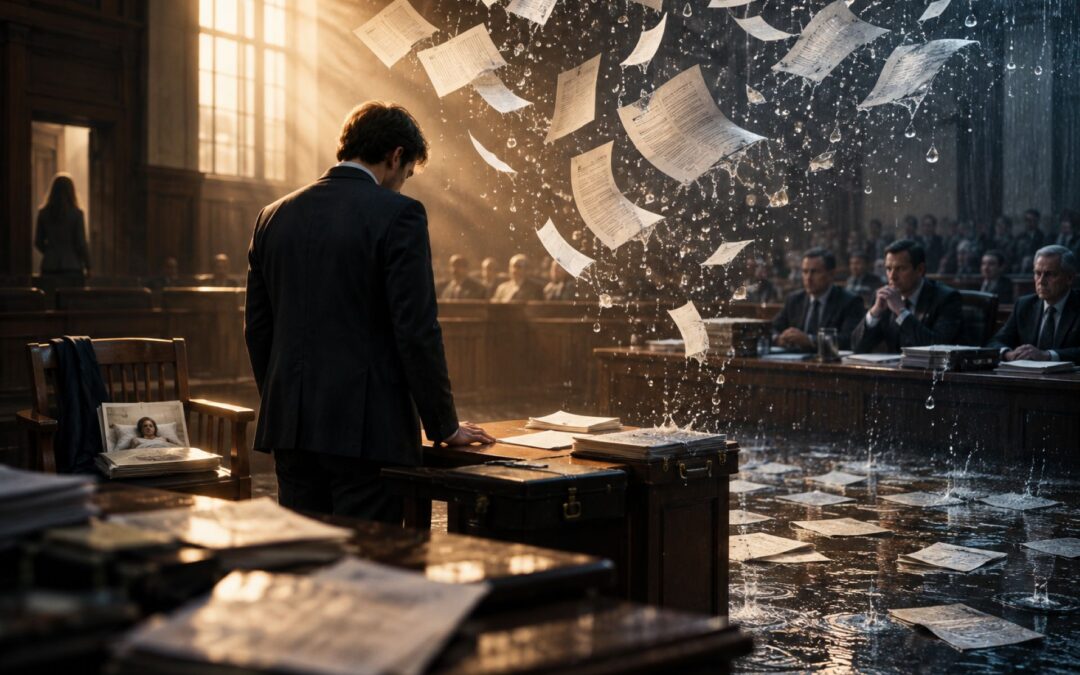
John Grisham’s The Rainmaker begins with the kind of professional dream that drives many legal thrillers: a young lawyer wants the case that will make his reputation and his fortune. Rudy Baylor is still a law student when he begins imagining himself as a “rainmaker,” the sort of attorney who brings lucrative clients and enormous fees into a firm. By the end of the novel, he has done something even more spectacular than he imagined. He has taken on a powerful insurance company, exposed systematic misconduct, persuaded a jury to award $50 million in punitive damages, and become famous almost overnight.
Yet virtually everything about that victory is poisoned. Rudy’s client Donny Ray Black is already dead. The company he defeated becomes insolvent before the judgment can produce the expected fortune. Rudy’s personal life has become entangled with domestic violence and a killing. His education in legal practice has shown him corruption not only among corporations and disreputable lawyers but within himself. The young man who finally possesses the reputation capable of making him a genuine rainmaker ends the novel determined never to practice law again.
Originally published by Doubleday in 1995, as confirmed by the WorldCat record for the first edition, The Rainmaker is a legal thriller, courtroom drama, professional coming-of-age story, and populist critique of institutional power at the same time. The edition considered here is the 2010 ebook represented in Penguin Random House’s catalog record. Its 53 numbered chapters follow Rudy from his final weeks of law school through a trial that should launch his career and instead convinces him to abandon it.
Spoiler warning: This article covers the complete novel, including Donny Ray Black’s death, the Great Benefit trial and verdict, Cliff Riker’s death, Great Benefit’s bankruptcy, and Rudy’s final departure from Memphis.

Complete Plot Summary of The Rainmaker
The novel’s 53 chapters form one continuous first-person narrative rather than a sequence of formally named parts. Grisham nevertheless builds the story in distinct phases: Rudy first loses the respectable future he expected, then acquires the Black case, enters the less respectable world of plaintiff practice, becomes an independent lawyer, uncovers increasingly damaging evidence against Great Benefit, takes the case to trial, and finally watches his apparent triumph lose almost all of its practical meaning.
The Great Benefit lawsuit supplies the central legal plot, but the novel continually interweaves it with three other strands. Miss Birdie’s supposed fortune teaches Rudy how money can distort relationships; Bruiser Stone and Deck Shifflet expose him to the ethically compromised mechanics of obtaining and handling clients; and Kelly Riker’s abusive marriage draws him into a crisis that law has repeatedly failed to resolve. Those strands become increasingly important because Rudy’s final decision cannot be explained by the insurance case alone.
Chapters 1–10: Rudy Loses His Future and Finds the Black Case
Rudy Baylor is approaching the end of law school in Memphis with mixed feelings about the profession he has chosen. His decision to become a lawyer was partly an act of rebellion against his father, an industrial engineer who came to hate lawyers after repeated litigation against his employer. His father’s decline, alcoholism, unemployment, and eventual death have left Rudy without much family support, and his mother’s remarriage has further weakened his connection to home. By the time Rudy reaches his final semester, he is less an idealistic future attorney than a tired student hoping to graduate, pass the bar, and begin earning enough money to escape years of financial strain.
One of Rudy’s easiest final-semester courses takes him to the Cypress Gardens Senior Citizens Building, where law students provide basic help to elderly people with legal problems. There he encounters Miss Birdie Birdsong, an energetic elderly woman who produces a will suggesting that she possesses a fortune of at least $20 million. She wants substantial changes made to the distribution of that money, particularly because she feels neglected by members of her family. Rudy immediately begins imagining what it would mean to bring a multimillionaire client into the small law firm where he expects to start work after graduation.
His more important encounter is with Dot and Buddy Black. Their son Donny Ray has acute leukemia, and Great Benefit Life Insurance Company has repeatedly refused to pay for the bone-marrow transplant his doctors believe offers him a meaningful chance of survival. Donny Ray has an identical twin, Ron, who can serve as a donor, but the treatment is far beyond the family’s financial means. Dot shows Rudy a series of rejection letters offering shifting reasons for denial, including arguments about preexisting illness, household status, and the transplant itself.
One document is so contemptuous that Rudy initially struggles to believe a corporation actually sent it. After repeated requests for payment, Great Benefit issues what later becomes known throughout the case as the Stupid Letter, ending one rejection by calling Dot “stupid, stupid, stupid.” Rudy has little practical legal knowledge, but even he senses that the letter is extraordinary. For the first time, the legal-help visit gives him something that looks like more than a classroom exercise.
At the same time, Rudy’s apparently secure professional future collapses. He has accepted a job with Brodnax and Speer, a small firm representing insurance companies, but the firm is absorbed into the much larger Tinley Britt operation and his promised position disappears. The timing is devastating. Rudy has almost no money, debts are accumulating, his apartment is precarious, and Memphis already has more new lawyers than comfortable jobs.
His reaction to losing the job is not especially dignified. Angry and humiliated, he lashes out at the old firm and then worries that his behavior may produce criminal or professional consequences. The incident establishes something important about Rudy before the Great Benefit case begins in earnest: he is sympathetic and frequently decent, but he is also impulsive, resentful, and capable of rationalizing conduct he would condemn in someone else.
With conventional employment disappearing, Rudy begins making humiliating rounds of local law offices. He discovers that academic credentials matter far less once every firm already has more applicants than it needs. The experience pushes him toward the world of contingency-fee litigation, where a young lawyer can theoretically make money without salary or wealthy clients if he acquires valuable cases. Stories about lawyers who bring large fees into their firms give the term “rainmaker” its first real significance for him.
Rudy’s financial condition deteriorates enough that he prepares to file for bankruptcy. He also turns to Professor Max Leuberg, whose insurance-law expertise helps him evaluate Dot Black’s documents. Leuberg is fiercely hostile to insurance companies, but his reading of the file gives Rudy a legal basis for what had previously been instinct: the Black claim may support a serious bad-faith lawsuit. Great Benefit’s shifting explanations and contemptuous correspondence no longer look merely rude; they may demonstrate an insurer refusing a valid claim without a defensible basis.
Rudy returns to the Blacks and becomes increasingly interested in representing them himself. The attraction is partly moral, because Donny Ray is visibly dying while the family is helpless, but it is also economic. Rudy is broke, unemployed, and beginning to realize that a large contingency-fee case could transform his life. Grisham does not require the reader to choose between those motives because Rudy himself carries both.
Miss Birdie becomes part of Rudy’s survival strategy as well. He rents the small apartment above or near her garage in exchange for modest rent and a considerable amount of yard work. The arrangement is often comic, particularly because Miss Birdie treats Rudy as an available labor force, but it gives him a stable home at a moment when almost every other part of his life is deteriorating.
Rudy’s other source of income is bartending at Yogi’s, where he knows Prince Thomas, a colorful local operator with connections to lawyer J. Lyman “Bruiser” Stone. Bruiser has a notorious reputation, the kind of attorney respectable law students are expected to avoid. As respectable firms continue rejecting Rudy, however, the distance between what he wants and what he is willing to consider becomes steadily smaller.
By the end of this first movement, Rudy has lost the career route he expected, entered bankruptcy, and discovered that the most valuable piece of property he possesses may be a dying young man’s legal claim. The circumstances place moral pressure on everything that follows. He wants to help the Blacks, but he also needs their case.
Chapters 11–20: Bad-Faith Insurance, Bad-Faith Lawyering, and Kelly Riker
Rudy skips his law-school graduation ceremony and keeps hunting for work. One promising stop is Jonathan Lake’s successful plaintiff firm, where Barry Lancaster expresses interest in Rudy only after learning about the Great Benefit claim. Rudy initially persuades himself that he has finally found a professional home, but the arrangement quickly reveals how personal-injury firms can view clients as assets. Lancaster wants the Black case more than he wants Rudy.
Before that betrayal becomes clear, Rudy deepens his relationship with the Black family. He meets Donny Ray more closely and sees how severely leukemia has weakened him. Donny Ray’s condition destroys any comforting abstraction around the lawsuit. This is no theoretical dispute about contract language: a young man is dying while his parents believe a company they faithfully paid has denied the treatment that might have saved him.
Donny Ray also asks Rudy to look after his parents. The request changes Rudy’s emotional position in the case because it creates a personal obligation extending beyond legal representation and prospective fees. Rudy will continue thinking about money, sometimes eagerly, but Donny Ray increasingly becomes the person against whom every professional calculation must be measured.
Miss Birdie’s life provides a comic counterpoint. Rudy works brutally hard on her property, attends church with her, listens to her family grievances, and continues wondering about the fortune suggested by her will. He is not purely predatory toward her; genuine affection develops between them. Yet he also fantasizes about what proximity to a wealthy elderly client might mean, which makes him less different from Miss Birdie’s supposedly money-hungry relatives than he would like to believe.
The Lake firm’s intentions become undeniable when Barry Lancaster goes directly to Dot and exposes Rudy’s insecure status. Instead of employing Rudy and allowing him to develop the case, the firm attempts to separate him from the client he brought in. Rudy is furious, but the experience teaches him a lesson he will repeatedly encounter: in contingency practice, possession of a promising client can matter more than hierarchy, credentials, or loyalty.
At roughly the same time, Rudy’s earlier outburst following the destruction of his promised job creates fear of police trouble. Prince Thomas uses his connections to bring Rudy to Bruiser Stone. Bruiser’s office is almost a parody of the profession’s predatory image, complete with gaudy surroundings, questionable associates, and a live-shark joke built into the decor. Yet Bruiser can solve problems and offer Rudy something the respectable firms will not: work.
Rudy accepts employment because his alternatives have disappeared. Bruiser’s arrangement is not the conventional salaried apprenticeship he once imagined, but it gives him an office, access to legal work, and a place from which to pursue Great Benefit. Under Bruiser, Rudy files the Black lawsuit and secures the family’s representation before the Lake firm can take it permanently away.
The most important person Rudy meets in Bruiser’s practice is Deck Shifflet. Deck is not a licensed lawyer despite repeatedly taking the bar examination, but he has years of practical experience. He knows claims, courts, police reports, settlements, client solicitation, office survival, and the informal networks through which small legal practices actually function. He represents almost the opposite of Rudy’s law-school education: weak credentials combined with extensive operational knowledge.
Deck’s usefulness comes with a moral price. He happily engages in conduct Rudy finds repellent, particularly aggressive client solicitation. When Bruiser’s operation targets Dan Van Landel, an injured hospital patient, Rudy sees how quickly human suffering can become inventory for lawyers hunting contingent fees. The lesson becomes even uglier because Rudy cannot simply dismiss the people doing it as incompetent. Deck understands practical law far better than Rudy does.
The hospital environment also brings Kelly Riker into Rudy’s life. Kelly is young, badly injured, and initially presented as another accident victim. Rudy is immediately attracted to her. Deck’s informal investigations soon establish that Kelly’s injuries came from her husband, Cliff Riker, who attacked her with a baseball bat and has abused her before.
Rudy becomes emotionally attached with unusual speed. Kelly is vulnerable, isolated, and frightened, while Rudy begins imagining that he can help her escape. His concern is genuine, but it is inseparable from romantic attraction and a strong desire to become her rescuer. That mixture will grow more troubling as the novel proceeds because Kelly repeatedly asks for distance while Rudy remains preoccupied with her.
Cliff is violent, jealous, and physically intimidating. The domestic-abuse plot introduces a second institutional failure alongside Great Benefit. Donny Ray cannot obtain medical care despite having insurance, while Kelly cannot obtain lasting safety despite police involvement, criminal charges, shelters, divorce filings, and warnings from judges. In both cases, the existence of formal systems does not mean that vulnerable people receive effective protection.
Meanwhile, Rudy is studying for the Tennessee bar examination and trying to prepare the Black case while facing Leo F. Drummond, one of Memphis’s most formidable defense attorneys. Great Benefit hires Drummond and Tinley Britt, giving the corporation vastly greater resources than Rudy has. The inequality becomes worse when the case is assigned to Judge Harvey Hale, who once roomed with Drummond at Yale and previously worked in insurance defense.
Kelly eventually leaves the hospital and asks Rudy not to pursue her. He tries to respect the instruction in form more than in spirit, continuing to think about her and watch for her. His fixation is already becoming one of the places where the sympathetic first-person narration requires critical distance from the reader.
Rudy takes the bar exam alongside Booker Kane, his closest law-school friend. Afterwards, he spends time with Donny Ray away from the suffocating atmosphere of illness, including an outing that briefly allows the dying young man to experience ordinary life. These scenes matter because Grisham keeps Donny Ray from becoming merely the unseen victim whose suffering generates damages. Rudy knows him as a person before the trial turns him into evidence.
By this point, Rudy has effectively entered legal practice before he is fully entitled to act as a lawyer. He has a serious client, a lawsuit against a major corporation, a disreputable employer, an experienced unlicensed mentor, a powerful opponent, and a dangerously personal interest in an abused woman. The life he imagined as a law student has almost completely disappeared.
Chapters 21–30: Rudy Passes the Bar and Builds a Practice
Kelly’s attempt to use the criminal justice system against Cliff demonstrates how difficult it is to convert acknowledged abuse into durable protection. When she refuses or is unable to testify against him, the case collapses. A judge warns Cliff about his behavior, but the warning cannot neutralize the danger. Rudy sees the failure and becomes even more convinced that Kelly needs rescuing, although he still lacks a clear role in her life.
His disgust with plaintiff-law practice also reaches a new level when Bruiser’s people respond to a river disaster as an opportunity to acquire clients. Lawyers race toward grieving families and potential claims, transforming catastrophe into a competition for signatures. Rudy participates long enough to understand the mechanism and then recoils from it, physically removing himself from the frenzy.
The scene is important because Rudy is not discovering corruption from a safe moral distance. He needs money, works for Bruiser, and has already begun benefiting from the same contingency system. Each encounter forces him to decide how much of the machinery he can use while still believing he is different from the people who use it without shame.
His bar-exam results finally arrive, and Rudy passes. The moment should mark the beginning of his professional life, yet it occurs just as Bruiser’s operation is disintegrating. Deck warns Rudy that federal authorities appear increasingly interested in Bruiser’s activities and encourages him to remove his files before everything is seized.
Bruiser then fails to appear for an important hearing in the Black matter, leaving Rudy to face Judge Hale and Drummond essentially alone. Although Rudy has passed the bar, the administrative process of licensing has not completely caught up with him. Hale treats him with open hostility while Drummond controls the room with experience and institutional confidence.
The hearing confirms the enormous imbalance between the parties. Great Benefit has a sophisticated defense team and a friendly judge; Rudy is a rookie whose own employer has vanished. Yet Drummond also floats a settlement of $75,000. To Rudy, the offer signals that Great Benefit does not consider the case worthless, no matter how contemptuously it behaves.
Bruiser and Prince disappear altogether as federal agents move against Bruiser’s operation. His office is raided, indictments follow, and Rudy never receives a satisfying conventional conclusion to Bruiser’s story. For Rudy and Deck, however, the collapse creates an opportunity. They take the files they have removed, locate inexpensive office space, and form their own precarious practice.
The arrangement is improbable on paper. Rudy is barely licensed, Deck is not licensed at all, and neither has financial security. In practice, their skills fit together remarkably well. Rudy can appear in court and perform legal work; Deck knows how to locate information, cultivate contacts, negotiate small matters, organize files, and find clients.
Then the case changes through sheer chance. Judge Harvey Hale dies suddenly of a heart attack. The development removes the judge Rudy regarded as hostile and potentially biased before the Black case has gone far enough for that hostility to become decisive.
Booker tells Rudy that Tyrone Kipler may be appointed to the vacancy. Kipler comes from the civil-rights and plaintiff side of the Memphis legal world and has little affection for insurance companies or Tinley Britt. Booker knows him through Marvin Shankle’s firm and makes no secret of his willingness to discuss the Black case with him.
Kipler receives the appointment, producing a reversal almost too perfect for Rudy. A case that was trapped before Drummond’s former roommate is now before a judge predisposed to distrust Great Benefit and its lawyers. Kipler is energetic, intelligent, and prepared to force the case forward, exactly where Hale appeared inclined to obstruct it.
The change benefits Rudy immediately. He survives motion practice against Drummond’s much larger team, and Kipler refuses to allow Great Benefit to delay the case indefinitely. Rudy experiences one of his first genuine courtroom successes, but the circumstances contain an uncomfortable symmetry that becomes more important later. Rudy had good reason to object to Hale’s relationship with Drummond, yet he is perfectly willing to benefit from a judge who openly favors his side of the broader legal struggle.
Donny Ray’s deteriorating health makes speed essential. Rudy asks the court to preserve his testimony through an evidentiary deposition because there is a serious possibility he will not live until trial. The resulting proceeding takes place at the Black home because Donny Ray is too ill for conventional courtroom conditions.
Judges, lawyers, court personnel, and equipment enter the family’s intimate space so that Donny Ray’s words can survive him. The scene is both procedural and painful. Rudy is learning how litigation converts human experience into admissible evidence, while everyone present understands that the preservation of testimony is necessary precisely because the witness may soon be dead.
Rudy and Deck’s new practice, meanwhile, is financially miserable. Their small fees barely cover office costs, and many matters come through Deck’s questionable hustling. Rudy’s first genuinely ordinary legal earnings are modest enough to make the possible Great Benefit contingency fee seem almost fantastical.
Miss Birdie’s subplot also becomes more complicated. Her estranged sons and other relatives suddenly become attentive after learning of a will that appears to distribute millions. Their renewed concern confirms her suspicion that money, rather than affection, explains their interest. Rudy sees their behavior critically even though he himself has entertained fantasies about her fortune from the moment he read the original will.
Rudy strengthens the Black case through Dr. Walter Kord, Donny Ray’s oncologist. Kord can explain the illness, the proposed transplant, and why the denied treatment mattered medically. The evidence is vital because Rudy must prove more than corporate rudeness; he must connect Great Benefit’s conduct to the loss suffered by Donny Ray and his family.
The novel has now moved Rudy from law student to practicing attorney, but none of the transition resembles the career ladder he expected. His professional education consists of bankruptcy, client poaching, ambulance chasing, federal raids, improvised office management, judicial politics, a dying witness, and litigation against one of the city’s strongest firms. Grisham makes Rudy increasingly capable without making his path increasingly respectable.
Chapters 31–40: The Case Becomes an Indictment of Great Benefit
Dot Black’s deposition becomes a turning point because Great Benefit’s own written communications begin taking center stage. The company has offered multiple explanations for denying Donny Ray’s treatment, and Rudy forces those contradictions into the record. The Stupid Letter becomes especially damaging because its contempt cannot be explained as technical disagreement about policy language.
The letter matters not simply because it is cruel. It suggests a company so confident in the helplessness of its customers that an employee could express contempt in writing. Great Benefit’s later attempts to distance itself from the document only make it more important once Rudy discovers that the company’s file does not contain the same material Dot preserved.
Booker, meanwhile, successfully resolves his own bar-exam problem after initially failing and challenging the result. His path remains a useful contrast to Rudy’s. Booker moves toward a stable professional environment and a respected civil-rights practice, whereas Rudy’s every success seems to pull him deeper into improvisation and risk.
Donny Ray continues deteriorating. Rudy visits him as the lawsuit advances, but the legal timetable cannot outrun the disease. The closer the case moves toward trial, the less likely it becomes that the litigation can achieve its original purpose of helping the person whose treatment was denied.
Discovery turns into a battle. Great Benefit’s important witnesses and documents are concentrated in Cleveland, and Rudy travels there with almost none of the resources available to Drummond’s team. The trip dramatizes corporate power through logistics as much as doctrine: Great Benefit can make information expensive to obtain, surround its executives with lawyers, and force a nearly broke opponent to spend time and money simply reaching the place where the evidence exists.
Once Rudy arrives, key employees are said to have resigned, disappeared, been reassigned, or otherwise become difficult to examine. The claim file supplied to him appears incomplete. Rather than treating these problems as routine inconvenience, Rudy contacts Kipler, who reacts aggressively and begins imposing stronger control over discovery.
The conflict gradually reveals that the Black claim may not be an isolated mistake. Rudy begins seeing a corporate structure in which responsibility can be divided among departments, policies, supervisors, claims examiners, and executives until no individual appears fully responsible for a dying policyholder. Great Benefit’s size, which initially intimidates Rudy, starts becoming evidence of the scale on which misconduct might operate.
Bobby Ott, the agent connected to the policy, proves unreliable and eventually disappears from Rudy’s immediate reach. The episode reinforces a recurring feature of the case: many of the witnesses Rudy needs are unstable, compromised, frightened, or difficult to locate. His successful case is never a clean accumulation of perfectly cooperative evidence.
The most important personal loss arrives when Donny Ray dies. The death permanently changes what the lawsuit can accomplish. Before, Rudy could imagine that forcing Great Benefit to pay might somehow be part of saving him; afterwards, the case can only compensate his family, punish misconduct, and expose what happened.
Dot’s motivation hardens accordingly. Money becomes less important than forcing Great Benefit into the open. A settlement that might once have financed treatment cannot restore her son, and the moral center of the lawsuit moves from obtaining benefits to establishing accountability.
Rudy and Deck devote themselves to an enormous collection of documents. Their office fills with files that have to be sorted, cross-referenced, indexed, and compared. The work contrasts with the theatrical image of trial law. Rudy’s later courtroom success depends heavily on months of documentary labor that is tedious, exhausting, and mostly invisible.
Rudy also begins believing that Great Benefit or people connected to the defense are monitoring his communications. Rather than merely complaining about the suspected surveillance, he starts thinking about how it can be exploited. The suspicion becomes part of his tactical worldview, in which unethical conduct by the opponent increasingly gives him permission to respond with manipulation of his own.
A separate case finally generates meaningful ordinary income for Rudy and Deck when they obtain a settlement for Derrick Dogan. The money keeps the practice alive and briefly proves that the partnership can function without a once-in-a-career jackpot. Still, the Black case dominates everything because its potential fee and public importance dwarf the rest of their work.
Rudy contacts attorney Cooper Jackson and taps into a loose network of plaintiff lawyers who have encountered Great Benefit elsewhere. Through these conversations, he learns that other attorneys have seen patterns suggesting systematic claim denials. The information does not automatically prove his case, but it changes his theory of the company from one outrageously mishandled policy to a business culture in which refusing legitimate claims may be part of the operating model.
The most damaging discovery concerns Great Benefit’s internal manuals. Copies obtained outside the company allow Rudy to compare what Great Benefit has produced with fuller versions. Missing material raises the possibility that the corporation has withheld exactly the portions most likely to explain or incriminate its claims practices.
By the pretrial conference, Rudy no longer possesses merely a sympathetic story about a sick young man. He has Donny Ray’s preserved testimony, Dot’s letters, medical evidence, internal corporate material, suspicious gaps in discovery, potentially useful former employees, and a judge prepared to force compliance. Drummond still has far greater money, staff, expertise, and trial experience, but the factual balance has shifted dramatically.
The difference will be the jury. Drummond has professional consultants and sophisticated research; Rudy has Deck, local contacts, intuition, and increasingly aggressive tactics. As trial approaches, the novel begins turning Rudy from an underdog struggling to survive into an opponent capable of frightening people who once dismissed him.
Chapters 41–49: Jury Selection, Trial, and the $50 Million Verdict
Rudy’s interest in Kelly has never disappeared. He repeatedly goes to places where he might see her, particularly the mall where she works, and continues imagining a future relationship despite the boundaries she has tried to establish. The behavior is presented through Rudy’s affectionate self-justifications, but it also illustrates the limitations of first-person narration: readers are always inside the mind of the man doing the pursuing.
At the same time, Rudy and Deck devise their most ethically complicated courtroom tactic. Convinced that Great Benefit is illegally listening to conversations in their office, they deliberately discuss certain prospective jurors in misleading ways. The goal is to feed false intelligence to the defense and manipulate Drummond into using his challenges against people Rudy actually wants removed.
The scheme reveals how far Rudy has traveled from the uncertain law student of the opening chapters. He is no longer simply reacting to more powerful lawyers; he is shaping what they believe. His defense is that Great Benefit should not be illegally obtaining the information in the first place, but the tactic still depends upon calculated deception directed at the jury-selection process.
When potential jurors arrive, Rudy intentionally emphasizes the physical imbalance in the courtroom. Great Benefit has a polished team of lawyers, staff, resources, and consultants; Rudy appears as the young attorney with little institutional support. His rookie status, once a crippling disadvantage, becomes part of his appeal.
The false wiretap information produces an extraordinary result when Drummond challenges prospective juror Billy Porter over supposed contact with Rudy. Porter denies the accusation and reacts angrily enough that the situation turns physical. Instead of destroying Rudy’s position, the confrontation damages Drummond and reinforces the impression that the defense is trying to manipulate ordinary citizens.
Kipler refuses to discard the entire panel, and the final jury is highly favorable to Rudy. The selection process gives him a substantial advantage before opening statements begin. It is also one of the clearest places where the novel asks readers to enjoy tactical ingenuity without examining too closely how many procedural coincidences and questionable maneuvers have combined to produce it.
Shortly before trial, Rudy receives an important call from Cleveland lawyer Peter Corsa concerning Jackie Lemancyzk, a former Great Benefit employee. Lemancyzk becomes the witness who can connect Rudy’s documentary suspicions to the company’s internal behavior. Her emergence arrives almost at the last possible moment, another example of Grisham using thriller timing to transform a difficult case into a devastating one.
Trial begins with Rudy needing to do several things simultaneously. He must establish the policy, Donny Ray’s medical condition, the requested treatment, the denials, the damages, and the possibility that those denials were not innocent mistakes. He also must survive procedural attacks from lawyers with far more courtroom experience.
Dot’s testimony gives the case its human foundation. Rudy walks through her efforts to obtain coverage and the succession of Great Benefit explanations. When the Stupid Letter is read before the jury, the company’s abstract bureaucracy suddenly acquires a voice, and that voice is openly contemptuous of the family asking for help.
Dr. Walter Kord supplies the medical component. He explains Donny Ray’s leukemia and the significance of the proposed transplant in language accessible to the jury. The point is not that survival was guaranteed but that the denied treatment represented a serious medical opportunity that Donny Ray never received.
Great Benefit’s witnesses attempt to explain the claim through procedure, departmental responsibility, underwriting rules, and industry practice. Rudy repeatedly turns those defenses back toward the company’s own documents. The more executives insist that everything was handled normally, the more damaging the internal inconsistencies become.
Jackie Lemancyzk changes the scale of the accusation. Her knowledge of Great Benefit’s internal operation supports Rudy’s theory that aggressive denial was not simply the result of one incompetent employee. She describes a system structured to reject claims in the expectation that many policyholders would accept the refusal rather than fight a large insurance company.
The missing portions of Great Benefit’s manuals become particularly powerful. Rudy has obtained fuller versions elsewhere, allowing him to confront executives with material the company has failed to provide during discovery. What began as suspicion of a bad claim decision becomes an allegation that the corporation has both mistreated policyholders and attempted to conceal how it did so.
Kipler responds to discovery violations with sanctions and threats of increasingly severe consequences. Great Benefit’s executives find themselves losing control of a case they had once treated as insignificant. CEO Wilfred Keeley is forced to answer questions not only about the Black claim but about the company’s finances and capacity to absorb punitive damages.
Rudy then plays Donny Ray’s videotaped deposition. The testimony gives the jury something the defense cannot counter with accounting language: the dying insured speaking before his death. Rudy has spent much of the trial converting documents into a story, and Donny Ray’s recorded presence connects that story back to the human being who never reached the courtroom.
Drummond’s defense is not literally nonexistent. He calls witnesses intended to establish that Great Benefit’s conduct can be understood within insurance-industry norms and that an inexpensive policy should not automatically be treated as a guarantee of extraordinarily costly treatment. The argument tries to move the jury away from emotional outrage and back toward ordinary claims administration.
Insurance expert Payton Reisky becomes one of Rudy’s principal targets. Rudy forces him to confront the Stupid Letter and attacks the supposed neutrality of testimony favorable to the insurance industry. What might have sounded persuasive in the abstract becomes difficult to defend against Great Benefit’s own correspondence and documents.
Rudy’s courtroom tactics are not always clean. When questioning in-house lawyer Jack Underhall and other company witnesses, he uses strategic uncertainty and bluffing to make them fear that he possesses additional damaging material. The technique works because Great Benefit itself no longer knows exactly what Rudy has obtained.
By the time the defense rests, Rudy has survived a trial that should have been beyond him. More experienced plaintiff lawyers tell him how strong the case has become, yet Rudy is perceptive enough to recognize how much luck has contributed. Hale died. Kipler replaced him. Crucial documents surfaced. Jackie Lemancyzk appeared. The defense repeatedly made tactical and ethical mistakes.
Then Kelly’s life violently reenters the foreground. Cliff beats her again, leaving her severely injured, and she takes refuge in a shelter. Rudy helps her begin another attempt to escape the marriage and spends crucial pre-closing hours dealing with emergency legal matters connected to her safety rather than concentrating exclusively on the largest case of his life.
The interruption reinforces the contrast between legal performance and lived danger. Rudy is about to ask a jury to punish a corporation for failing one vulnerable person while another vulnerable person he knows is still struggling to survive despite previous encounters with police, prosecutors, judges, and lawyers.
In closing argument, Rudy turns his inexperience into an advantage. He does not pretend to match Drummond’s polished authority. Instead, his status as a young lawyer standing beside Dot against a large corporation strengthens the emotional structure that has been building throughout the case.
Drummond asks the jury to distinguish negligence and mistakes from intentional cruelty. Great Benefit, he argues in effect, should not be financially destroyed because employees handled a claim badly. Rudy’s reply is that the apologies and explanations arrived only after exposure, after litigation, and after Donny Ray was dead.
The jury returns $200,000 in actual damages and $50 million in punitive damages. The compensatory amount recognizes the concrete loss associated with the claim, while the punitive award is designed to punish Great Benefit’s conduct on a scale proportionate to the company’s wealth. Rudy has achieved a result so large that it instantly transforms his professional reputation.
Dot’s reaction keeps the verdict from functioning as a conventional triumph. She did not spend months in litigation because she wanted an abstract number announced in a courtroom. What she wanted was her son alive, and no jury has the power to provide that remedy.
Chapters 50–53: The Victory Collapses and Rudy Leaves the Law
For a short period after the verdict, Rudy can believe that every fantasy attached to becoming a rainmaker has come true. The judgment makes news, other lawyers congratulate him, and he and Deck begin mentally calculating what a contingency fee on an enormous recovery might mean. Rudy has gone from bankruptcy to apparent wealth in a matter of months.
He knows intellectually that a verdict is not the same thing as money in the bank, but the distinction initially feels technical. Great Benefit had presented itself as an enormously valuable company. Rudy and Deck therefore behave like paper millionaires waiting for the practical machinery of judgment and appeal to catch up with them.
Rudy’s personal life, however, is moving toward another crisis. Kelly is still at the shelter after Cliff’s latest attack. Rudy helps her with divorce arrangements and becomes more directly involved in her attempt to separate from her husband.
When Rudy accompanies Kelly back to her apartment so she can retrieve possessions, Cliff appears and attacks him. The confrontation becomes violent almost immediately. Rudy fights back, gains control of the baseball bat, and strikes Cliff while defending himself.
Kelly then becomes directly involved in the final violence. By the end of the confrontation, Cliff has suffered fatal blows to the head. What follows is confused by fear, Rudy’s own participation in the fight, Kelly’s vulnerability, and their uncertainty about how police will interpret the scene.
Rudy leaves rather than immediately giving a complete account to authorities, then begins obsessively reconstructing what happened. He understands enough criminal law to see the danger created by every inconsistency and every attempt to manage appearances. The man who has just won a famous civil trial suddenly finds himself thinking like both lawyer and potential suspect.
Kelly is arrested on a manslaughter charge. Rudy becomes her lawyer as well as her romantic attachment, another collapse of boundaries that the novel treats more sympathetically than a professional-ethics manual would. He works with Morgan Wilson and others to present the extensive history of Cliff’s abuse and demonstrate why the killing should be understood through self-defense rather than as an unprovoked homicide.
The danger does not end with Cliff’s death because his family is hostile and threatening. Kelly is terrified not only of prosecution but of the Rikers themselves. Rudy increasingly wants to remove both of them from Memphis rather than remain within the professional and personal world he has just entered.
Then the financial foundation of the Great Benefit victory disappears. Rudy learns that the insurer has filed for bankruptcy protection. Great Benefit’s parent organization, PinnConn, has suffered financial problems and appears to have been moving or stripping assets while its subsidiaries collapse.
The revelation makes the recent trial almost surreal. Only days earlier, Great Benefit had presented financial statements suggesting it could absorb a large punitive award, and Rudy had used its apparent wealth in asking the jury for meaningful punishment. Now the company that supposedly possessed hundreds of millions of dollars cannot simply pay the judgment.
The scandal spreads beyond the Black case. Investigators and grand juries become interested in PinnConn’s financial conduct, litigation multiplies, and Wilfred Keeley is detained while apparently trying to leave the country. Rudy realizes that even the lawyers who fought the case may receive little or nothing from the bankrupt company.
Drummond becomes an ironic fellow casualty. He and Rudy spent enormous energy attacking each other, yet both can now lose financially because their former client has collapsed. The adversarial system produced a spectacular verdict, but the economic system surrounding the defendant makes collection a different battle entirely.
Miss Birdie’s supposedly enormous fortune dissolves in another direction. Her sons Delbert and Randolph eventually push hard enough for disclosure to discover that their mother’s multimillion-dollar image has largely been a performance. Their sudden devotion, inspired by expected inheritance, loses much of its motivation when the money fails to materialize.
The parallel with Rudy is unmistakable without being exact. Miss Birdie’s relatives reorganize their behavior around money that is not really there, while Rudy and Deck briefly reorganize their futures around a $50 million judgment they may never collect. Both plots punish people for treating anticipated wealth as though it already belongs to them.
Kelly’s criminal case ends more favorably. Prosecutors reviewing Cliff’s record, the evidence of repeated abuse, and the circumstances of his death conclude that obtaining a conviction is unrealistic and unjustified. The charges are dismissed.
Even that legal victory does not restore safety. A bullet is fired through the window of Rudy and Deck’s office, apparently reinforcing the danger associated with Cliff’s family. Rudy no longer sees Memphis as a place where professional success compensates for the accumulated risks and losses surrounding him.
His partnership with Deck comes to an end. Their relationship remains one of the more affectionate and successful parts of Rudy’s legal experience, but the Great Benefit case will not produce the fortune they imagined and Rudy has lost his desire to continue building a practice. Deck, who understands survival better than ideals, can continue in the legal world without Rudy.
Rudy leaves Memphis with Kelly almost immediately after the charges against her are dropped. They do not have a carefully developed plan. Kelly wants to go somewhere with mountains and snow and hopes to attend school; Rudy imagines finding a small college town and perhaps teaching history.
His decision about law is much clearer. He intends to let his license expire, avoid courtrooms, and remove himself from the profession entirely. Memphis recedes behind them as they drive west, and Rudy vows not to return.
The ending is deliberately excessive in its reversals. Rudy has passed the bar, learned litigation, defeated one of the city’s strongest defense lawyers, won a record-setting verdict, gained public recognition, and demonstrated that he can practice law at a remarkably high level. Each development should confirm his career choice.
Instead, they convince him that he wants another life.
Memphis and the Legal World Grisham Builds
The Rainmaker depends on more than courtroom procedure because Rudy’s education occurs across an entire legal ecosystem. Grisham moves him through law school, corporate firms, plaintiff offices, hospitals, police stations, courtrooms, modest homes, corporate headquarters, shelters, and his own struggling practice, showing how differently law looks depending on who possesses money, information, institutional access, and a lawyer willing to fight.
Memphis functions less as a richly descriptive cityscape than as a network of social and professional territories. Rudy learns that the profession taught in classrooms is only one layer of a system where personal contacts, judges, money, client acquisition, race, reputation, procedural leverage, and sheer endurance frequently matter as much as doctrinal knowledge.
Elite Firms, Street Lawyers, Courts, Hospitals, and Poor Clients
At the top of Rudy’s professional imagination are firms such as Tinley Britt. They have established partners, large clients, experienced trial teams, research support, offices, money, and reputations capable of influencing a case before anyone addresses its merits. Leo Drummond embodies that world: he is prepared, confident, respected, and backed by resources Rudy cannot approach.
Brodnax and Speer represents a more modest version of respectable practice, but even it proves unstable when economic incentives change. Rudy’s promised position disappears because the firm’s partners make a business decision that benefits themselves. His first lesson after law school is therefore that professional loyalty can evaporate as quickly in respectable offices as it can in shady ones.
Jonathan Lake’s plaintiff firm exposes another form of commercial logic. Lancaster is interested in Rudy while Rudy possesses a promising case; once the Black claim can be separated from the young lawyer who found it, Rudy becomes expendable. Grisham uses the episode to show that exploitation does not require criminality or gaudy offices.
Bruiser Stone occupies the openly disreputable end of the spectrum. He has questionable clients, suspect business practices, aggressive solicitation methods, and connections that eventually attract federal investigators. Yet his office also contains working knowledge that Rudy’s formal education has not supplied.
Deck Shifflet makes that contradiction even sharper. He is technically less qualified than Rudy because he lacks a law license, but practically he knows far more about everyday legal work. He understands how to open files, track witnesses, find defendants, deal with small cases, negotiate claims, gather information, and keep a struggling office functioning.
Hospitals become especially revealing spaces because they contain suffering people and lawyers who see potential clients. Rudy’s discomfort with aggressive solicitation shows that he retains a moral line, yet the novel refuses to let him remain entirely outside the practice. His livelihood depends on the same contingency system that creates incentives to hunt for profitable injuries.
The courtroom offers a more dignified appearance without eliminating personal power. Hale and Kipler demonstrate that the identity of the judge can alter the practical trajectory of a case dramatically. Procedure exists, but the people administering it still have histories, preferences, relationships, and ideological commitments.
The Blacks’ home represents the opposite end of institutional scale from Great Benefit’s offices. Dot and Buddy do not have specialized knowledge or a legal department; they have policy papers, letters, anger, and a dying son. When Donny Ray’s deposition occurs there, the legal system physically enters their private world because they lack the ability to move easily through the formal one.
Rudy and Deck’s office sits somewhere between these extremes. It is underfunded, improvised, and sometimes dependent on questionable methods, yet it gradually becomes capable of challenging a corporation with vastly greater resources. Grisham’s populist appeal comes partly from making professional competence look obtainable outside elite institutions, even if the circumstances enabling Rudy’s success are dramatically exceptional.
How Class and Race Shape Access to Justice
Money determines far more than comfort in The Rainmaker. It influences whether a person can withstand a denied insurance claim, hire a lawyer, finance discovery, travel for depositions, wait through litigation, employ jury consultants, or simply survive long enough for the legal system to respond. The Blacks’ vulnerability begins with this asymmetry: Great Benefit can deny; they cannot independently finance Donny Ray’s treatment while they challenge that denial.
Rudy himself experiences class insecurity constantly. He enters bankruptcy, struggles with rent, searches desperately for employment, worries about office expenses, and cannot travel or litigate with Drummond’s ease. His financial position helps him understand the Blacks, but it also creates incentives that complicate his moral purity because the Great Benefit case may solve his own economic problems.
Contingency fees are therefore neither simply noble nor simply predatory. They allow people without substantial money to hire lawyers because payment can come from a later recovery. At the same time, the model turns claims into financial opportunities and encourages lawyers to calculate the monetary value of injuries, deaths, and grief.
Race also shapes the Memphis legal world, particularly through Booker Kane, Marvin Shankle’s firm, Tyrone Kipler, jury strategy, and Rudy’s observations about local institutions. Booker moves within a professional tradition connected to civil-rights work, while Kipler’s experience influences his hostility toward institutions he believes routinely exploit people with less power.
Rudy’s narration and jury planning also contain racial and social assumptions characteristic of his perspective and of the novel’s 1990s setting. Characters sometimes generalize about how Black jurors, white jurors, poor jurors, religious jurors, or working-class jurors will react. The novel presents these judgments as part of trial strategy, but they should not be mistaken for neutral sociological truths.
That tension is actually useful to understanding the book. Jury selection turns democratic participation into a process in which lawyers classify citizens according to perceived prejudice, class position, occupation, race, religion, personality, and personal history. The courtroom may promise equal justice, but both sides enter it trying to predict which ordinary people will be most favorable to their interests.
Grisham’s legal world is therefore populist without being idealized. Ordinary people can use a jury to punish a corporation, yet getting to that jury requires money, strategy, procedural opportunity, competent representation, and extraordinary persistence. The Blacks eventually receive a public declaration that Great Benefit wronged them, but only after circumstances align in ways most similarly situated families could never count on.
Character Analysis and Relationships
Rudy’s development becomes clearest through his relationships because nearly every significant person teaches him something different about law, money, loyalty, care, or power. Some characters provide alternatives to what he might become, while others reveal qualities he already possesses but would prefer not to recognize.
The novel’s first-person perspective makes Rudy psychologically dominant, but several supporting characters are essential rather than decorative. Deck, Dot, Donny Ray, Miss Birdie, Kelly, Booker, Kipler, Drummond, Bruiser, and Cliff collectively turn Rudy’s legal education into a moral one.
Rudy Baylor
Rudy begins the novel with more resentment than idealism. He resents his father, his poverty, the job market, wealthier classmates, established lawyers, creditors, and institutions that appear designed for people with more money or better connections. His humor makes much of that resentment entertaining, but the anger is genuine.
He is also observant and self-aware enough to recognize some of his flaws. He admits when greed affects his thinking, notices his fantasies about Miss Birdie’s money, acknowledges how badly he wants the Black case to become valuable, and understands that he sometimes enjoys winning more than principle alone would justify. This partial honesty is one reason his narration remains likable even when his conduct becomes questionable.
Rudy’s central strength is his capacity to care about individual clients. Donny Ray stops being a file almost immediately. Dot’s anger matters to him. Miss Birdie becomes more than a possible wealthy client. Kelly’s suffering affects him so deeply that it repeatedly disrupts his professional priorities.
The same instinct has a dangerous counterpart: Rudy often assumes that caring gives him the right to intervene. His fixation on Kelly is the clearest example. Because readers see Kelly through Rudy’s perspective, his persistence can initially seem romantic, but she repeatedly attempts to manage her own boundaries while he continues watching for opportunities to enter her life.
Professionally, Rudy learns at extraordinary speed. He begins terrified of real clients and unsure how to evaluate an insurance policy. Within months, he is taking depositions, handling motion practice, managing discovery, examining experts, cross-examining executives, selecting jurors, and delivering a closing argument in a major punitive-damages trial.
The transformation is not purely a fantasy of hidden genius. Rudy studies relentlessly, organizes evidence, asks for help, listens to Deck, seeks expertise from Max Leuberg and others, and benefits from mentors and allies. Grisham gives him competence through work even while compressing into months an evolution that would normally require years.
Luck is equally important. Rudy gets the right case before he has a career, Hale dies, Kipler replaces him, Great Benefit behaves disastrously, important documents surface, useful witnesses appear, and Drummond’s team repeatedly gives him opportunities. Rudy himself knows that the verdict is not simply proof of superior skill.
His ethical development is deliberately mixed. He becomes more committed to clients but also more comfortable with deception. He condemns unethical behavior when Great Benefit or Bruiser engages in it, yet he rationalizes feeding false information through the suspected wiretap and uses bluffs to destabilize witnesses.
That contradiction prevents Rudy from functioning as a spotless moral hero. His education teaches him how to use power, and the more power he gains, the easier it becomes to excuse methods that would once have troubled him. The novel’s most interesting question is not whether Rudy becomes corrupt in the same way as Bruiser or Great Benefit—he does not—but whether he can continue practicing inside a system that rewards forms of conduct he increasingly knows how to perform.
His final decision answers that question through withdrawal rather than reform. Rudy does not end by resolving to become an ethical lawyer who changes the profession from within. He abandons it.
That ending can be read as disillusionment, exhaustion, trauma, or avoidance. It is certainly not evidence that Rudy lacked talent. He leaves precisely after proving that he has an exceptional capacity for legal work.
Deck Shifflet and Bruiser Stone
Deck is one of the novel’s strongest supporting characters because he embodies a contradiction Grisham repeatedly explores: formal legitimacy and practical competence are not the same thing. Deck has repeatedly failed to become a licensed attorney, yet he knows the daily machinery of small legal practice better than Rudy and often better than people with much stronger credentials.
His methods are ethically elastic. Deck solicits clients aggressively, cultivates questionable contacts, follows accident reports, understands hospital hustling, and treats the legal market with few illusions. He rarely pretends that the profession is nobler than the way people actually make money within it.
For Rudy, Deck becomes a mentor without becoming a moral model. Rudy learns from him constantly while also trying to restrain his worst instincts. The partnership works because each possesses what the other lacks: Rudy supplies the license and rapidly developing courtroom ability, while Deck supplies experience, organization, contacts, survival skills, and an understanding of how clients actually arrive.
Their friendship is also unusually free of status anxiety. Deck does not resent Rudy for passing the bar, and Rudy does not treat Deck as merely clerical help. Even when money becomes important, the partnership has genuine affection beneath its hustling.
Bruiser Stone is a darker version of the same educational paradox. Rudy initially sees him as the type of lawyer one should avoid, and federal investigations eventually validate much of that suspicion. Yet Bruiser gives Rudy employment when reputable firms will not and provides the institutional shelter within which the Black lawsuit can be filed.
Bruiser’s world teaches Rudy the economics of legal practice stripped of polite language. Clients are acquired, fees are divided, contacts matter, and legal talent exists alongside conduct that may be criminal. His disappearance prevents the novel from turning him into a fully resolved character, but his function in Rudy’s development is clear.
Rudy leaves Bruiser’s office believing he can take practical knowledge from the place without becoming the kind of lawyer Bruiser represents. The rest of the novel keeps testing whether that separation is as easy as he hopes.
Booker Kane and Tyrone Kipler
Booker Kane provides Rudy with the closest thing the novel offers to a stable professional alternative. He is intelligent, disciplined, connected to Marvin Shankle’s respected civil-rights practice, and far less erratic than Rudy. Their friendship predates the crisis around Great Benefit, which means Booker can function as both emotional support and professional bridge.
Booker’s own difficulty with the bar examination briefly disrupts that contrast, but he challenges the result and eventually succeeds. His response to adversity is procedural and patient in a way Rudy’s often is not. Where Rudy repeatedly falls into improvisation, Booker remains connected to a professional community with institutional memory and support.
Tyrone Kipler emerges from that same network. His appointment to replace Hale saves Rudy from what appeared to be a deeply unfavorable forum. Kipler understands plaintiff practice, dislikes insurance-company behavior, and is prepared to use judicial authority aggressively when Great Benefit obstructs discovery.
He is enormously useful to Rudy, but the novel becomes more interesting when his role is viewed critically. Rudy’s objection to Hale is based partly on Hale’s friendship and shared history with Drummond. Once Kipler arrives, Rudy welcomes a judge whose sympathies run strongly in the opposite direction.
Kipler often has legitimate reasons for ruling against Great Benefit because the company repeatedly creates serious discovery problems. That does not erase the appearance of favoritism. Grisham effectively replaces an imbalance hostile to Rudy with one favorable to him, and the story expects readers to feel the second is more justified because Rudy’s underlying case is morally stronger.
The symmetry complicates any simple claim that The Rainmaker is about restoring neutral justice. Rudy succeeds partly because the personnel controlling the system change. His victory depends not merely on law but on finally having a judge willing to interpret and enforce procedure in his favor.
Dot and Donny Ray Black
Dot Black is the client who refuses to disappear into legal terminology. She is abrasive, angry, suspicious, persistent, and often difficult, but those qualities make sense in a woman who has spent months begging an insurer for treatment while watching her son deteriorate. Her anger is not polished enough for corporate communication, which is exactly why Great Benefit’s contempt toward her feels so cruel.
At the beginning, Dot wants the policy honored. The family’s objective is practical: secure the transplant. Once Donny Ray dies, that objective becomes impossible and her motivation shifts toward punishment and exposure.
Her response to the verdict is therefore one of the novel’s most important emotional corrections. A jury can assign a monetary value to damages and punish misconduct, but Dot cannot experience $50 million as equivalent to her son. The number means something institutionally while meaning almost nothing in the emotional economy of grief.
Donny Ray is comparatively quiet because illness limits his presence, but the novel makes him more than a symbol. Rudy talks with him, spends time with him, takes him away from the sickroom temporarily, and witnesses his physical decline. Those scenes explain why Rudy’s relationship to the case changes.
Donny Ray’s preserved deposition becomes crucial because he dies before trial. The courtroom sees him only through recorded testimony, making the legal system dependent on a representation of someone who is no longer alive. The recording is evidence, but for Rudy and Dot it is also a reminder that the process arrived too late.
His death gives the entire trial a retrospective quality. Every argument about what Great Benefit should have done concerns a decision whose consequences cannot now be repaired. That is why punishment, rather than restitution, becomes the dominant logic of the verdict.
Miss Birdie
Miss Birdie initially appears to be one of the novel’s comic eccentrics. She dominates the Cypress Gardens gathering, produces a will suggesting immense wealth, orders Rudy around her property, changes her inheritance plans, and treats family drama as an ongoing performance. Rudy oscillates between affection, irritation, and fascination with her supposed fortune.
Her relationship with Rudy becomes unexpectedly important because she gives him something close to a home. The garage apartment provides physical stability when he is bankrupt and professionally lost. Their arguments about yard work and church attendance create a domestic rhythm unlike anything else in Rudy’s life.
Money nevertheless contaminates the relationship from the beginning. Rudy knows he should not become personally interested in a client’s estate, yet the idea of Miss Birdie’s millions excites him. His fantasies allow Grisham to make him participate in the same temptation he condemns when her sons suddenly rediscover filial devotion.
Miss Birdie understands that temptation and partly manipulates it. Her supposed fortune becomes a way of testing, punishing, or attracting people who have neglected her. When the truth finally emerges, the joke is not simply that she was never as rich as everyone assumed; it is that so many relationships changed before anyone verified whether the money existed.
She is also one of the few characters who gives Rudy affection without requiring legal rescue. He performs legal work for her, but their bond ultimately rests on companionship. That makes her a quiet counterexample to the transactional relationships dominating much of the novel.
Kelly and Cliff Riker
Kelly Riker’s story is the most difficult part of the novel to evaluate because it combines a serious depiction of repeated domestic abuse with a romantic rescue plot filtered entirely through Rudy’s perspective. Kelly is extremely young, isolated from support, repeatedly injured by Cliff, and caught in the familiar cycle of leaving, returning, fearing retaliation, and struggling to use institutions capable of offering only partial protection.
Cliff is presented with little ambiguity. He is violent, controlling, jealous, and dangerous. His repeated assaults continue despite arrests and warnings, making him another example of an actor who can exploit the gap between formal legal rules and practical enforcement.
Rudy’s concern for Kelly is compassionate, but his perspective makes the relationship ethically complicated. He is attracted to her while she is injured and vulnerable, continues looking for her after she asks for distance, and increasingly defines himself as the person who can remove her from danger. Because Rudy narrates the novel, the reader is encouraged to share his romantic interpretation before being invited to question it.
Kelly does make important decisions of her own. She seeks shelter, considers divorce, returns for her belongings, participates in the fatal confrontation with Cliff, and ultimately chooses to leave Memphis. Yet the story gives Rudy so much narrative authority that Kelly can sometimes feel like a catalyst for his moral journey rather than a fully independent center of consciousness.
The killing of Cliff resolves the immediate physical threat in a manner the legal system had repeatedly failed to achieve. That does not make the violence triumphant. Kelly is arrested, Rudy becomes implicated, and both are terrified of Cliff’s family.
The dismissal of charges gives Kelly legal freedom but not psychological closure. The novel ends before either she or Rudy has processed what happened. Their drive west is therefore not proof that Rudy has successfully “saved” her; it is an escape undertaken by two traumatized young people with very little idea what their new life will require.
Leo Drummond and Great Benefit
Leo Drummond is most effective when distinguished from Great Benefit itself. He is the corporation’s lawyer, not the architect of its claim-denial system. His job is to defend a client facing potentially catastrophic liability, and Grisham gives him enough skill and discipline to remain a credible adversary.
Drummond is aggressive, resourceful, and accustomed to having institutional advantages. He uses investigators, consultants, procedural motions, discovery resistance, and every available pressure point. Rudy often experiences that conduct as bullying because he occupies the weaker position.
The suspected wiretapping and the Hale relationship push the defense side beyond ordinary adversarial zeal, although the novel leaves parts of the surveillance plot in a deliberately murky zone. Drummond’s greater significance is that he represents the professional polish Rudy originally imagined wanting.
Great Benefit is more broadly villainous. Its employees offer contradictory explanations for the Black denial, documents disappear or are withheld, internal procedures appear designed to discourage legitimate claims, and executives show little capacity for moral self-examination until a jury is preparing to punish them.
Jackie Lemancyzk matters because she supplies an insider’s account of those practices. The Stupid Letter matters because it gives institutional contempt a tangible form. The manuals matter because they suggest policy rather than accident.
The weakness of Great Benefit’s characterization is also obvious. A corporation can function as an institutional antagonist without needing a single psychologically complex villain, but many of its executives are written chiefly to become targets for Rudy’s cross-examination. The company is powerful as a system and comparatively thin as a collection of individuals.
Major Themes and Social Meaning
The novel’s major themes develop across multiple plotlines rather than existing only inside the Great Benefit lawsuit. The insurance case, Miss Birdie’s inheritance drama, Rudy and Deck’s practice, and Kelly’s abusive marriage repeatedly ask variations of the same question: what happens when people with unequal power enter systems that supposedly operate according to neutral rules?
Grisham’s answers are populist but not entirely simple. Institutions can be corrupt, yet individuals fighting them can also become compromised. Money can provide access to justice while simultaneously distorting professional motives. Legal victory can matter enormously without becoming the same thing as justice.
Justice Versus Legal Victory
The difference between winning and obtaining justice is the novel’s central thematic distinction. Rudy wins almost everything a trial lawyer can ask a jury to award, but the verdict cannot perform the one act that originally mattered: keeping Donny Ray alive.
Dot understands that instantly. The money is not the point because no amount can recreate the future her son lost. Punitive damages may condemn Great Benefit, yet condemnation arrives after the irreversible harm has occurred.
The bankruptcy makes the distinction even sharper. A legal judgment establishes liability and damages; collecting that judgment depends on the defendant’s actual financial condition. Great Benefit’s collapse therefore does not erase Rudy’s courtroom victory, but it strips away much of the practical recovery that made the verdict appear transformative.
Kelly’s case provides a parallel. Criminal charges against Cliff, judicial warnings, divorce papers, shelter rules, and police involvement all have legal significance, yet none reliably prevents another assault. Formal recognition of rights does not automatically produce physical safety.
Rudy’s own ending follows the same pattern. Becoming an excellent trial lawyer does not make legal practice a satisfying life. The achievement is real, but its meaning differs from what he expected when he dreamed of professional success.
Money, Class, and Access to Representation
Money controls the novel from its opening pages. Rudy chooses his future partly because he wants economic security, loses his first job because of firm economics, files bankruptcy, hunts cases because he needs fees, and fantasizes about Miss Birdie’s inheritance long before the Great Benefit verdict exists.
The Blacks’ case demonstrates the most serious consequence of economic inequality. Great Benefit can withstand correspondence, delay, and litigation; the Black family cannot independently produce the money required for a major medical procedure. The insurer’s ability to say no becomes powerful because the policyholder lacks an immediate alternative.
Contingency-fee representation partially corrects that imbalance. Rudy can take the case without asking the Blacks to finance a major lawsuit in advance. His eventual fee depends on recovering money for them, aligning lawyer and client against a wealthier opponent.
The same mechanism creates uncomfortable incentives. A dying person becomes a potentially lucrative claim, and lawyers compete to secure signatures. Bruiser and Deck expose the ugliest version of this reality, but Rudy never becomes completely free of it because he too recognizes the financial value of the Black case.
Miss Birdie’s inheritance plot turns the same logic toward family. Her sons become attentive when they think she controls millions. Their behavior is exaggerated for comedy, yet Rudy’s own early thoughts about her money make it harder for him to stand completely outside the joke.
The $50 million verdict is the largest expression of this pattern. Before a dollar is collected, Rudy and Deck begin imagining wealth as if the future has already become property. Great Benefit’s bankruptcy punishes that psychological leap.
Money in The Rainmaker is therefore neither merely corrupting nor merely empowering. It determines whether people can obtain treatment, hire professionals, endure litigation, escape debt, influence institutions, and imagine futures. The problem is that people repeatedly mistake financial value for moral value, even though the novel keeps demonstrating that the two cannot be made equivalent.
Corruption and Moral Compromise
Great Benefit supplies the clearest example of corruption because the Black claim appears to reveal an organization willing to deny legitimate benefits, produce inconsistent explanations, hide damaging material, and rely on customers’ inability to fight back. The company combines financial power with bureaucratic distance, allowing cruelty to appear as administration.
Bruiser Stone represents corruption at the level of legal practice. He inhabits a world of solicitation, questionable deals, criminal associates, and federal investigation. Rudy knows almost immediately that Bruiser is not the professional model he wants to follow.
Harvey Hale represents a subtler institutional problem. His friendship and history with Drummond make Rudy reasonably fear that the case will not receive neutral treatment. The court may formally be impartial while the people involved possess relationships capable of shaping outcomes.
The complication arrives with Tyrone Kipler. Rudy enthusiastically accepts the advantages created by a judge predisposed to distrust insurance companies and Tinley Britt. Kipler often responds to genuine misconduct, particularly discovery abuse, but Rudy’s comfort with favorable bias weakens any claim that he seeks nothing except perfectly neutral procedure.
Rudy’s own conduct becomes progressively harder to classify as purely defensive. His deliberate use of the suspected wiretap to spread false information is ingenious precisely because he expects Great Benefit to obtain information improperly. The wrongdoing of the opponent becomes the premise for his own deception.
His courtroom bluffing raises a similar question. Trial advocacy allows strategic presentation, but Rudy sometimes depends on witnesses believing he possesses information that may not exist. He has learned that uncertainty can be used as a weapon.
The novel does not suggest that Rudy becomes morally equivalent to Great Benefit. Scale, intention, and consequences matter. Great Benefit is accused of systematically profiting from denying vulnerable policyholders, while Rudy’s questionable tactics occur during an attempt to expose that wrongdoing.
What matters is that moral compromise is shown as incremental. Rudy rarely decides to become unethical. He makes one decision that seems justified by circumstances, then another, while becoming increasingly skilled at explaining why his behavior is different from the conduct he condemns.
That pattern gives The Rainmaker more depth than a simple corporate-villain story. Rudy wins not because he remains untouched by the world around him but because he learns how to function inside it. His final rejection of legal practice can partly be understood as recognition of what continued success might require him to become.
Education, Experience, and Professional Disillusionment
Rudy enters the novel after almost completing three years of legal education, yet he knows remarkably little about being a lawyer. He understands cases, classes, exams, and doctrine but is terrified by real clients and uncertain about basic professional survival.
The novel treats this gap largely through comedy. Deck, who cannot pass the bar, repeatedly knows things Rudy does not. Secretaries, court clerks, street contacts, trial lawyers, and clients teach Rudy lessons no classroom provided.
Some of the education is technical. Rudy learns how to take depositions, conduct discovery, manage files, negotiate settlements, choose jurors, handle witnesses, and build evidence into a trial narrative. He becomes more professional in the literal sense of acquiring competence.
The more important education concerns incentives. Rudy learns why firms want valuable clients, how contingency fees shape behavior, why corporations resist discovery, how judges matter, how lawyers use personal relationships, how clients can disappear, and why a verdict does not guarantee payment.
His development therefore produces a paradox. The less naive Rudy becomes, the more capable he becomes; the more capable he becomes, the less attractive the profession looks. Experience validates his talent while destroying the fantasy that talent alone defines a legal career.
The title ultimately depends on this reversal. Rudy spends much of the book becoming exactly the lawyer he once wanted to be. His disillusionment is powerful because it occurs after success rather than failure.
Care, Exploitation, and the Desire to Rescue
Many characters in The Rainmaker encounter vulnerable people, but they respond differently to vulnerability. Great Benefit sees policyholders partly through claim costs and probabilities. Ambulance-chasing lawyers see injured patients as potential fees. Miss Birdie’s relatives see an elderly mother whose presumed wealth suddenly makes her company desirable.
Rudy usually responds with more genuine care. He visits Donny Ray, worries about Dot, helps Miss Birdie, and becomes deeply concerned for Kelly. His capacity for personal attachment separates him from the most predatory characters.
Yet care can become possessive when the helper assumes superior knowledge of what another person needs. Rudy’s relationship with Kelly repeatedly approaches this problem. His desire to protect her can blur into a desire to decide for her, particularly because he is emotionally and romantically invested in the outcome.
The same tension appears more mildly with Miss Birdie. Rudy wants to help her but also enjoys being needed and fantasizes about the wealth surrounding her. Human motives rarely remain pure simply because affection is real.
Donny Ray offers the clearest version of care without rescue fantasy. Rudy cannot save him. Once that becomes unavoidable, the relationship forces Rudy to remain present without pretending that legal skill can repair everything.
The novel’s larger social argument emerges from these contrasts. Vulnerable people need others to care about what happens to them, yet institutions built around profit, professional ambition, or bureaucratic distance often convert vulnerability into opportunity. Rudy’s challenge is to help people without becoming another person who benefits from their misfortune.
Symbols and Motifs
The Rainmaker is not a symbol-heavy novel in the manner of densely allusive literary fiction. Grisham’s recurring images and objects tend to be concrete, functional, and closely tied to the legal plot. The strongest motifs gain meaning because their practical significance changes as Rudy changes.
Three deserve particular attention: the professional idea of the rainmaker, the written documents through which Great Benefit incriminates itself, and Miss Birdie’s phantom fortune. Together they connect aspiration, evidence, and imagined wealth.
The “Rainmaker” and the Meaning of Success
In legal-business language, a rainmaker is someone capable of bringing valuable clients or business into a firm, a meaning also explained in a 1995 Los Angeles Times report about the novel’s publication. Rudy understands the concept early and measures professional success against it.
Miss Birdie initially triggers the fantasy. If she truly possesses $20 million and becomes Rudy’s client, he imagines arriving at Brodnax and Speer with an impressive piece of business before his career has even begun. Later, the Black case replaces that fantasy with something far larger.
The term becomes increasingly ironic because Rudy’s greatest case does not arise from sophisticated business development. He meets the Blacks while reluctantly completing an easy law-school course. His potential fortune comes from being available when desperate people seek help.
By the time the jury awards $50 million in punitive damages, Rudy has surpassed the conventional image of a rainmaker. He has not merely brought in a profitable client; he has created the kind of verdict capable of defining a career.
Then the money disappears. Great Benefit’s bankruptcy means the celebrated judgment may produce little practical recovery, turning Rudy’s status into something close to a joke. He has made it rain on paper.
The deeper reversal is psychological. Even if the money had been collectible, Rudy no longer wants the life that the verdict could purchase for him professionally. The title therefore moves from aspiration to achievement to repudiation.
The Stupid Letter and the Paper Trail
Documents are everywhere in The Rainmaker: policies, letters, wills, claims manuals, medical records, depositions, financial statements, pleadings, settlement papers, divorce files, and corporate records. The legal system constantly converts human conflict into paper because events become actionable only when they can be proven.
The Stupid Letter is the most memorable example because Great Benefit’s contempt survives in its own handwriting, metaphorically speaking. The company can later apologize, contextualize, or blame an employee, but Dot possesses a document showing how the claim was treated before litigation created an incentive for politeness.
The manuals operate similarly. Missing material becomes meaningful precisely because other copies exist. Rudy’s ability to compare what Great Benefit produces with what it should possess transforms absence into evidence.
Donny Ray’s deposition is the human version of the same process. Because he may die before trial, his testimony must be recorded so that the legal system can preserve a version of his presence. The recording is both proof and a reminder of law’s lateness.
Paper therefore has an ambivalent role. Bureaucracies can hide behind documents, but documents can also defeat bureaucratic denials. Great Benefit is dangerous because it controls information; Rudy becomes dangerous when he learns how to recover, organize, compare, and present that information.
Miss Birdie’s Fortune and the Fantasy of Easy Money
Miss Birdie’s apparent fortune is one of the novel’s longest-running jokes, but it also mirrors Rudy’s changing relationship with wealth. Her will seems to reveal millions, and everyone who believes the money exists begins behaving differently.
Her estranged sons become attentive. Rudy imagines opportunities he knows he should not be imagining. Lawyers become involved. Family relationships reorganize themselves around an expected inheritance.
The fortune’s eventual collapse exposes how little evidence was required for desire to become certainty. People do not wait to possess the money before emotionally spending it.
Rudy and Deck repeat the same mistake after the Great Benefit verdict. Their claim to a future fee is much more legitimate than Miss Birdie’s relatives’ fantasies, but they still begin planning around money that has not been collected.
The parallel helps prevent the bankruptcy twist from being merely arbitrary. Grisham has been rehearsing the difference between apparent wealth and actual wealth throughout the novel. The final chapters simply apply the lesson to Rudy on a much larger scale.
First-Person Voice, Humor, and Courtroom Structure
Rudy’s first-person narration is the mechanism that makes The Rainmaker feel intimate despite its crowded plot. Readers experience every institution at his level of knowledge: he does not understand Great Benefit before investigating it, does not know what Bruiser is doing before federal agents arrive, does not know whether the office is truly being monitored, and does not know whether his trial tactics will work until they do.
That limitation creates suspense naturally. Grisham does not need an omniscient narrator hiding information because Rudy himself lacks it. Each document, witness, judicial ruling, and phone call changes what both protagonist and reader know.
Rudy’s voice also carries much of the novel’s comedy. He is sarcastic about law school, judges, wealthy lawyers, elderly clients, his own poverty, Deck’s habits, Miss Birdie’s demands, and nearly every institution he encounters. The humor prevents a story involving terminal illness, domestic abuse, financial desperation, and corporate misconduct from becoming relentlessly grim.
His self-mockery is especially important. Rudy often recognizes the absurdity of being an inexperienced lawyer in situations far beyond his professional standing. That awareness makes his rapid rise easier to accept because he rarely behaves as though success proves he was secretly superior to everyone from the beginning.
At the same time, first-person narration requires readers to maintain distance from Rudy’s judgments. His resentment can distort people, particularly when class, race, sex, or professional status enters his thinking. His treatment of Kelly is the clearest case in which emotional sincerity does not guarantee reliable interpretation.
Structurally, the novel spends far more time preparing the Great Benefit trial than conducting it. Rudy must lose his job, acquire the case, join Bruiser, pass the bar, establish a practice, survive motions, preserve Donny Ray’s testimony, experience Donny Ray’s death, fight discovery, locate documents, and prepare a jury strategy before the courtroom climax can occur.
That long accumulation is one of the book’s major strengths. A contemporary Los Angeles Times review by Garry Abrams particularly noted Grisham’s ability to manage the novel’s unusually complicated plotting without losing readability. The Great Benefit trial works because readers have watched dozens of apparently separate details gradually become usable evidence.
The subplots also regulate pacing. Miss Birdie provides comedy and domestic stability, Kelly introduces danger and intimacy, Bruiser expands the professional world, and Deck keeps the daily economics of practice visible. The novel can leave the insurance case for stretches without abandoning its central concerns because the secondary plots continue examining money, vulnerability, and legal power from different angles.
The trial itself accelerates sharply. Documents and characters accumulated over hundreds of pages are suddenly converted into witnesses, exhibits, cross-examinations, and arguments. Grisham’s plain prose is especially effective here because legal procedure is explained through action instead of delivered as detached exposition.
Then the novel deliberately breaks the expected shape of a courtroom thriller. A conventional structure might end soon after the verdict, perhaps after a short celebration. The Rainmaker spends several crucial chapters dismantling the meaning of victory instead.
Cliff’s death, Kelly’s arrest, Great Benefit’s bankruptcy, PinnConn’s scandal, the office shooting, and Rudy’s departure all occur after the jury has supposedly resolved the central conflict. That structural decision is the book’s boldest move. The trial provides a climax, but the ending asks whether the climax actually solved anything.
The Ending Explained: Why the $50 Million Victory Is Not a Triumph
Literally, Rudy wins the Great Benefit case. The jury awards the Black family $200,000 in compensatory damages and $50 million in punitive damages after accepting the argument that Great Benefit’s conduct went far beyond an ordinary mistake. Nothing in the final chapters retroactively erases that verdict.
What changes is the possibility of collecting it. Great Benefit files for bankruptcy while its parent organization, PinnConn, is engulfed in a financial scandal involving disappearing assets and failed investments. The corporation Rudy demonstrated was wealthy enough to punish suddenly lacks the accessible financial resources the verdict assumed.
The distinction matters legally and thematically. A judgment is a court’s declaration that one side owes another money; it is not a magical transfer of cash. Rudy and Deck briefly confuse the two because Great Benefit’s reported wealth makes collection seem inevitable.
The bankruptcy makes the victory materially hollow, but Donny Ray’s death had already made it emotionally incomplete. Even if Dot received every dollar awarded, the money would remain compensation for a loss that could not be reversed. The novel therefore destroys the fantasy of perfect legal repair twice: first through death and then through insolvency.
Great Benefit’s collapse also makes punitive damages paradoxical. The jury wants to punish a wealthy company severely enough that the punishment matters. By the time the judgment exists, the company’s own financial misconduct may have done more to destroy it than the jury ever could.
Kelly’s ending operates differently. Cliff’s death removes the immediate abuser but creates the possibility that Kelly herself will be punished. The prosecution eventually decides not to proceed because the history of violence and circumstances of the confrontation make conviction unrealistic.
That resolution gives Kelly legal freedom, but it is not a clean liberation narrative. She has endured repeated severe abuse, killed her husband during a violent encounter, been arrested, feared retaliation from his family, and is leaving the city almost immediately. The future may be better, but nothing suggests that the past has been psychologically resolved.
Miss Birdie’s money plot provides a lighter version of the same collapse. Her sons discover that the fortune around which they have reorganized their relationship with her is largely illusory. Their greed has exposed itself in pursuit of wealth that was never securely there.
Rudy’s position joins all three endings. He has been bankrupt, then apparently rich, and finally close to broke again. He has watched law fail to save Donny Ray, fail repeatedly to protect Kelly from Cliff, succeed spectacularly in court, fail economically to deliver the judgment, and become entangled with conduct that leaves him worried about his own moral and physical safety.
His decision to leave the profession is therefore more than disappointment about money. If the Great Benefit fee alone were the issue, he could exploit his new reputation and attract other major clients. A lawyer who had just won such a verdict would possess precisely the public stature required to become a conventional rainmaker.
Rudy refuses that opportunity because the experience has changed what success means to him. Professional status once represented security, independence, wealth, and revenge against people who had dismissed him. Now it represents a system of conflict he no longer wants organizing his life.
There is nevertheless an element of avoidance in the decision. Rudy is exhausted and traumatized. Leaving Memphis allows him to avoid questions about Cliff’s death, Great Benefit, Bruiser, his partnership with Deck, Miss Birdie’s demands, and the ethical ambiguities of his own behavior.
The westward drive should therefore not be read as uncomplicated transcendence. Rudy and Kelly are two very young people carrying serious unresolved experiences toward a future they have barely planned. Their escape may be necessary, but it is still escape.
The ending works because Rudy’s external achievement and internal judgment move in opposite directions. The world can call him a successful lawyer at precisely the moment he decides that being a successful lawyer is not the life he wants.
Critical Review: How Well The Rainmaker Holds Up
As a legal thriller, The Rainmaker should be judged primarily by its ability to make a complicated lawsuit understandable, create suspense from procedure and evidence, develop memorable characters around that legal machinery, and produce a satisfying relationship between courtroom victory and the novel’s larger moral concerns. By those standards, it remains one of Grisham’s more ambitious courtroom novels.
Its limitations are equally connected to that ambition. Rudy’s rise depends on extraordinary coincidence, several characters are broadly drawn, the Kelly subplot sometimes shifts from serious domestic-abuse material into melodrama, and the legal environment becomes increasingly favorable to a protagonist who is supposed to be confronting overwhelming power.
What the Novel Does Exceptionally Well
The book’s greatest achievement is its accumulation of narrative detail. The Black case begins with a bundle of papers presented to a frightened law student at a senior center. Grisham then builds the lawsuit layer by layer until letters, medical records, depositions, missing manuals, corporate witnesses, financial statements, former employees, and jury strategy all become part of one coherent courtroom attack.
That progression makes the trial feel earned. Rudy does not suddenly discover one magical document that proves everything. Even Jackie Lemancyzk’s late appearance becomes powerful because she confirms patterns Rudy has already begun identifying through discovery.
The legal material is also unusually accessible. Readers do not need prior knowledge of bad-faith insurance law, discovery, depositions, contingency fees, compensatory damages, or punitive damages. Rudy learns these things in real time, allowing the explanation to emerge through his problems.
Rudy’s voice carries an enormous amount of exposition without making the novel read like a legal manual. His sarcasm and self-consciousness provide momentum through procedural stretches that could otherwise become dry. Even when he is sorting documents or worrying about office expenses, his running commentary gives the scene personality.
Deck is a major reason the professional story works. He could easily have been written as a comic sidekick, but his practical knowledge makes him essential. The contrast between Rudy’s license and Deck’s experience also gives the novel one of its sharpest critiques of legal education.
Miss Birdie is similarly effective because her subplot initially appears almost detachable from the insurance case. By the end, her phantom fortune has become a miniature version of Rudy’s own relationship with anticipated wealth. The comedy therefore contributes to the novel’s central argument rather than merely providing relief.
Dot and Donny Ray give the case emotional weight without requiring sentimental idealization. Dot can be abrasive and Donny Ray can be withdrawn or exhausted. Their suffering is persuasive precisely because Grisham allows them to remain ordinary people rather than turning them into flawless symbols.
The courtroom sequence is tightly constructed despite the novel’s length. Rudy’s strategic disadvantages have been established for so long that every successful cross-examination feels like a reversal of an existing power relationship. Drummond remains sufficiently capable that Rudy’s victory does not feel like defeating an incompetent opponent.
The decision to continue after the verdict is particularly strong. A less interesting novel would allow $50 million to function as moral arithmetic: corporate wrongdoing produces enormous punishment, the underdog becomes rich, and the story ends. Grisham instead asks what such a number actually repairs.
The answer is very little. Donny Ray remains dead. Dot remains bereaved. Rudy’s expected fee evaporates. Kelly remains traumatized. The profession Rudy has mastered no longer attracts him.
That refusal of easy triumph gives the novel more emotional seriousness than its populist structure initially promises. The contemporary Los Angeles Times assessment of the book’s complex but controlled plotting remains persuasive because Grisham manages several substantial narrative strands without losing the reader’s sense of the central case.
Where Plotting and Legal Realism Strain Credibility
The same plotting skill that makes The Rainmaker entertaining also creates its largest weakness: an extraordinary number of developments break Rudy’s way. The most obvious is Harvey Hale’s death. Rudy appears trapped before a judge personally connected to Drummond, and almost immediately that judge dies.
Hale’s replacement is not merely neutral. Tyrone Kipler is almost perfectly suited to Rudy’s needs: energetic, skeptical of insurance companies, hostile toward the defense establishment, and willing to impose aggressive discovery control. The change is so favorable that it functions less like ordinary institutional chance than like narrative rescue.
Great Benefit repeatedly makes matters worse for itself. The company sends an indefensibly insulting letter, produces inconsistent denial reasons, loses or removes employees, mishandles discovery, withholds damaging manual sections, produces witnesses who perform poorly, and underestimates Rudy until the cumulative evidence becomes devastating.
Jackie Lemancyzk arrives at an extraordinarily useful moment. The suspected wiretap gives Rudy an opportunity to manipulate jury selection. Drummond’s response leads to the Billy Porter incident. The jury itself becomes exceptionally receptive to the plaintiff’s case.
None of these events is individually impossible, but the concentration matters. Rudy’s victory is produced by preparation interacting with a remarkable sequence of favorable circumstances.
Legal plausibility requires the same distinction. A New York State Bar Association discussion of trials in fiction has observed that much of the underlying law in The Rainmaker is reasonably grounded while the larger premise of a brand-new lawyer personally taking such an enormous case through trial is highly improbable. That is the fairest way to judge the book.
Rudy’s individual tasks often resemble recognizable litigation activities: depositions, discovery disputes, expert testimony, evidentiary preparation, jury selection, opening and closing arguments, examination of corporate witnesses, compensatory damages, and punitive damages. The stretch comes from having one inexperienced lawyer perform all of them at this level, this quickly, against elite opposition.
Kipler’s role also complicates the novel’s moral framework. Readers are encouraged to condemn Hale because his connection with Drummond threatens fairness, then to celebrate Kipler because his sympathies benefit Rudy. If judicial favoritism is dangerous, it remains dangerous when the favored party possesses the stronger moral case.
Rudy’s jury strategy presents another credibility and ethics problem. Feeding false information through a suspected illegal wiretap is clever thriller plotting, but it brings the protagonist into ethically dubious territory and contributes to an unusually dramatic voir dire incident. The scene is entertaining precisely because it pushes beyond ordinary professional behavior.
The Kelly subplot sometimes strains more heavily. Domestic abuse itself is treated seriously, particularly the difficulty Kelly faces in obtaining safety. Yet the later progression—Rudy’s romantic pursuit, Cliff’s violent confrontation, the fatal beating, Kelly’s arrest, threats from the Riker family, and a bullet fired into the office—compresses multiple thriller escalations into the final pages.
The result is emotionally intense but risks overshadowing Kelly’s own experience. Her abuse becomes entangled with Rudy’s transformation at exactly the moment the Great Benefit case is also collapsing. The convergence is narratively efficient but psychologically crowded.
Great Benefit is also almost too perfectly villainous. A systemic antagonist does not require nuanced executives, but the company’s misconduct accumulates to a degree that makes the jury’s moral decision relatively easy. Greater ambiguity about whether the denial arose from institutional incentives, incompetence, defensible policy interpretation, or deliberate strategy might have made the legal conflict more intellectually difficult.
Those weaknesses do not destroy the novel because The Rainmaker is first a legal thriller, not documentary realism. The problem arises only if its procedural detail encourages readers to treat the whole scenario as typical. Grisham’s law often feels convincing at close range while his plot operates according to the heightened probabilities of popular fiction.
What Has Aged Well, What Has Aged Poorly, and Who Should Read It
The novel’s most durable concern is the imbalance between individuals and large institutions. The Blacks buy insurance precisely because they cannot independently absorb catastrophic medical costs, yet the usefulness of the policy depends on the insurer honoring it when the expensive event actually occurs. That basic conflict remains immediately understandable even without accepting every detail of Great Benefit’s fictional business practices as representative of real insurers.
The book’s treatment of access to justice also remains strong. Rights mean less when people lack information, money, time, representation, or the ability to persist against an institution designed to outlast them. Rudy’s contingency arrangement demonstrates why plaintiff lawyers can be essential to people who could never finance complex litigation hourly.
At the same time, Grisham refuses to romanticize that profession completely. Ambulance chasing, case poaching, client commodification, fee obsession, and informal influence all exist alongside genuine advocacy. That ambivalence has aged better than a simpler portrait of noble plaintiffs’ lawyers battling evil corporations would have.
The portrayal of professional precarity also remains effective. Rudy completes an expensive education believing that a respectable career awaits him and instead encounters an oversupplied job market, disappearing promises, debt, and employers interested in what he can immediately produce. His desperation gives the legal thriller an economic foundation that makes his later ethical compromises more understandable.
Some aspects of the social writing have aged less comfortably. Rudy’s narration includes broad assumptions about race, gender, class, age, physical appearance, and jury behavior that frequently reflect 1990s attitudes or his own immaturity. The first-person form means not every statement should be treated as Grisham’s universal judgment, but readers are still required to navigate language and stereotypes that can feel dated.
Kelly’s storyline also invites more scrutiny now. Rudy’s determination to find and protect her is framed romantically, yet some of his persistence ignores boundaries that Kelly attempts to establish. The novel recognizes her vulnerability but does not consistently give her enough narrative independence from the man who wants to rescue her.
Its domestic-abuse material is strongest when it shows the structural difficulty of leaving a violent partner. Kelly’s fear, repeated returns, isolation, financial vulnerability, and uncertainty are treated as realities rather than as proof that she secretly wants the abuse. The weaker moments are those in which the plot makes her suffering primarily a test of Rudy’s courage or compassion.
The prose itself has aged well for readers who value speed and clarity. Grisham is not attempting stylistic experimentation or dense psychological interiority. His sentences are functional, his scenes move, his legal explanations are clean, and his dialogue usually advances either plot or characterization.
Readers seeking highly subtle literary prose may find the novel broad. Great Benefit executives are not Dostoevskian studies of moral self-deception, Cliff is not given complex psychology, and several supporting figures exist largely because the plot needs particular functions. The pleasures lie elsewhere: momentum, procedural detail, character voice, indignation, suspense, and the satisfaction of watching a seemingly powerless litigant force a powerful organization to answer questions.
For readers of legal thrillers, The Rainmaker remains highly recommendable. It provides considerably more than a courtroom finale because it shows the economic and professional machinery required to reach that courtroom. Readers interested in law as a profession may find Rudy’s education more compelling than the verdict itself.
It is also worthwhile for readers who enjoy coming-of-age stories in which maturity does not mean finding one’s destined career. Rudy becomes an adult partly by discovering that being capable of a profession does not obligate him to build his identity around it.
The novel is less suitable for readers who demand strict procedural realism or who dislike plots dependent on coincidence. Its final quarter especially asks the reader to accept a remarkable concentration of corporate scandal, domestic violence, legal reversal, and personal danger.
Still, the excess serves a coherent purpose. Grisham keeps stripping away every conventional measure by which Rudy might declare himself successful until only Rudy’s own judgment remains.
That is why The Rainmaker ultimately works better as a story about becoming a lawyer than as a fantasy about winning a case. Rudy begins with a superficial definition of success: the right firm, money, status, clients, and eventually the ability to make rain. His disastrous first months in practice teach him what those ambitions look like when translated into actual lives.
The Great Benefit case gives him everything he thought he wanted. It proves that he can understand difficult facts, confront stronger opponents, persuade a jury, attract public attention, and generate a verdict large enough to transform his career. The irony is that the proof arrives only after he has learned to distrust the value system that made those achievements desirable.
Donny Ray is dead regardless of the verdict. Dot has vindication without restoration. Great Benefit is condemned without becoming capable of paying the punishment. Kelly escapes prosecution but carries the consequences of years of abuse and a violent death. Rudy wins professionally while becoming increasingly uncomfortable with the methods, institutions, and conflicts through which professional victory is produced.
His decision to drive west is therefore neither a declaration that law is useless nor proof that the trial accomplished nothing. The lawsuit exposes misconduct, gives Dot public recognition of the wrong done to her family, and demonstrates that a powerful company can be challenged. Those achievements matter.
They are simply not enough to make Rudy want the life of the person who achieved them.
That distinction gives the title its final meaning. A rainmaker is supposed to be the lawyer who brings prosperity into a practice. Rudy Baylor finally becomes one in spectacular fashion, only to discover that the ability to generate money, cases, and victories is a poor measure of whether the work itself is worth doing.
For all its coincidences, broad villains, heightened courtroom drama, and dated assumptions, The Rainmaker remains an absorbing and unusually complete legal thriller because it allows the fantasy of the giant verdict to collapse under the weight of everything a verdict cannot repair. Rudy’s greatest victory does not launch his career. It gives him enough knowledge of the profession to walk away from it.
Last Updated on September 11, 2026 by Aseem Gupta