

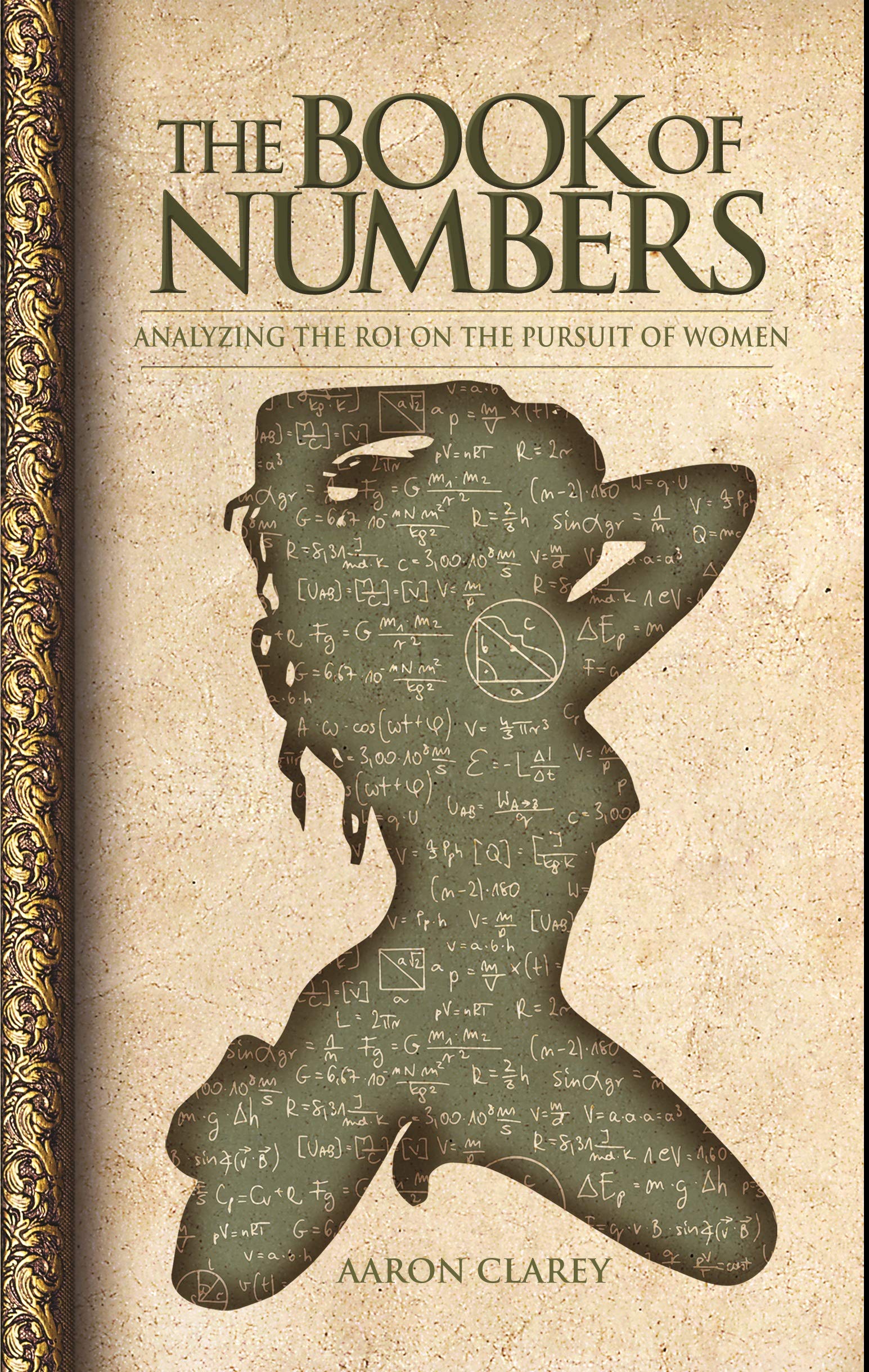
Aaron Clarey’s The Book of Numbers: Analyzing the ROI on the Pursuit of Women begins with a deliberately unusual premise: what would happen if a man treated his romantic life as an economist might treat an investment? Instead of assuming that dating, marriage, and family are simply things a man is supposed to pursue, Clarey asks what he spends in money, time, effort, emotional energy, and forgone opportunities, what probability he has of obtaining the outcome he actually wants, and whether the resulting exchange is worth the price.
The original 2020 edition turns that question into a ten-chapter progression from economic argument to probability model, from probability model to cost calculation, and finally from pessimistic diagnosis to a philosophy of how men should live. Its headline numbers are intentionally dramatic: Clarey estimates that only 2.72% of young women satisfy his definition of “marriageable,” that only 0.197% are statistically likely to marry his hypothetical “Average Joe 5,” and that the probability attached to a single random encounter ultimately producing a happy marriage falls to 0.00076283%. He then estimates hundreds of thousands of dollars in direct costs and millions in hypothetical opportunity costs before concluding that a man should stop organizing his existence around the pursuit of women.
Those numbers, however, require much more scrutiny than their precision suggests. The Book of Numbers is best understood not as a validated actuarial model of marriage but as a provocative cost-benefit argument built from Clarey’s preferences, demographic statistics, convenience samples, informal polls, online-dating observations, and a series of strong assumptions about gender and relationships. Its most durable ideas concern opportunity cost, realistic expectations, search strategy, self-development, and the wisdom of building a life that remains meaningful whether or not marriage occurs. The numerical machinery through which Clarey tries to prove those ideas is far less secure.
What Clarey Is Trying to Calculate
Clarey opens with an autobiographical story from his twenties in Minneapolis. As a libertarian attending house parties in a predominantly left-leaning social environment, he found that political arguments frequently interrupted what he regarded as the more important task of meeting women. Because he had an economics background, his attempted solution was characteristically quantitative: he began carrying economic charts and statistics so that he could settle arguments quickly and return to socializing.
The paper charts eventually became digital files, and then a blog called Captain Capitalism. Clarey noticed that conventional economics attracted a modest readership, while material connecting economics to relationships, sex, marriage, and gender attracted much more attention. That observation leads to the book’s first major thesis: he argues that a great deal of male economic production is ultimately motivated by sexual and reproductive competition. Men seek income, competence, status, property, and achievement partly because these things historically improved their chances of attracting women, reproducing, and supporting families.
Clarey pushes that idea much further than ordinary economic analysis would justify. In his telling, sex and progeny are close to the underlying engine of civilization itself: men build, work, invent, accumulate resources, and compete because female sexual selection rewards men who succeed. Modern capitalism and technology, however, have reduced the importance of physical strength, allowed women greater economic independence, and changed the traditional provider-dependent relationship between the sexes. Government welfare systems, female labor-force participation, changing gender norms, and feminism also enter Clarey’s account of why women are less economically dependent on individual men than they once were.
From that historical interpretation comes his central question. If men remain strongly motivated to pursue women but women no longer require men economically in the same way, and if dating and marriage now expose men to greater costs and risks than Clarey believes existed in the past, is the traditional pursuit still a rational use of a man’s life?
Before attempting an answer, Chapter 2 establishes a series of methodological assumptions. Clarey repeatedly calls the project a first attempt rather than a definitive scientific study. His “Flight of the Phoenix” principle is that he will work with whatever data exist, even when the ideal dataset does not. That means extrapolating from imperfectly matched age groups, combining different sources, using anecdotal material, conducting informal polls, and accepting rough approximations when nothing better is available.
He explicitly describes his results as ballpark figures and acknowledges that they will not meet professional actuarial or statistical standards. He also recognizes generational problems: a study of lifelong marriage must inevitably rely partly on marriages that began under different social conditions from those confronting young adults in 2020. Cohabitation further complicates the simple married-versus-single distinction.
The analysis is intentionally male-centered. Clarey constructs an imaginary subject called “Average Joe 5,” a man who is average in looks, height, income, education, and status, because he wants the model to describe something closer to an ordinary man than either an exceptionally attractive winner or an unusually disadvantaged outlier. Most of the female population considered in the model is aged 18 to 35, while the advice is aimed primarily at relatively young men who have not yet married.
Most importantly, Clarey defines success narrowly. The desired outcome is not sex, obtaining a telephone number, getting dates, or even merely getting married. Success means a traditional committed relationship that remains happy over the long term. Clarey acknowledges that love, chemistry, personality, and interpersonal compatibility cannot realistically be quantified, so those factors remain outside the model even though they could either improve or worsen an individual couple’s prospects.
Chapter 3 then converts the problem into two broad categories: “what you’re going to get” and “what you’re going to pay.” On the return side, Clarey wants to estimate the probability that a man encounters a woman he regards as suitable for marriage, that she is willing to select him in return, and that the resulting marriage both survives and remains happy. On the cost side, he divides the price into explicit monetary expenditure, opportunity cost, and intangible psychological or emotional cost.
The resulting framework is less a conventional financial ROI calculation than a cost-benefit comparison. Clarey nevertheless uses investment language throughout because that language forces a question he believes men rarely ask: given that time and resources are finite, what does the pursuit of romantic success prevent a man from doing with the rest of his life?
The Probability of Finding a “Marriageable” Woman
The model’s first major calculation asks what percentage of women should count as potential candidates for the kind of marriage Clarey wants. This is where the book moves from general economic argument into its most controversial territory, because “marriageable” is not an established demographic category. Clarey creates the category himself and attempts to measure it through three separate approaches, which he later averages.
The first approach begins with eight characteristics he regards as major disqualifiers. The second is a personal examination of 900 Match.com profiles. The third uses an informal estimate of how many women men date before eventually marrying.
The Eight-Deal-Breaker Method
Clarey’s first method begins with what he calls eight “deal breakers.” These are not intended as minor imperfections or individual annoyances. In his framework they are traits serious enough that their presence should remove a woman from the pool of candidates for a happy marriage.
The first is being overweight or obese. Clarey considers physical attraction indispensable to a happy marriage and therefore treats excess body weight as an automatic disqualification. He uses a figure of 59.6% for the proportion of young women falling into overweight or obese categories. The important distinction is that a population’s weight distribution can be measured, while the claim that everyone in those categories is necessarily incapable of being an attractive or satisfactory spouse is Clarey’s judgment rather than something contained in the health statistic itself. Current National Center for Health Statistics data on overweight and obesity likewise classify weight through measured body-mass index; they do not classify marital suitability.
His second deal breaker is what he calls a “worthless degree.” Clarey works from federal data on bachelor’s degrees but creates his own classification of fields that, in his view, lack a sufficiently direct or lucrative employment path. He treats such degrees as proxies for several other things: impracticality, poor financial judgment, student-debt exposure, political indoctrination, and an excessive focus on career or ideology. The resulting claim that more than 80% of relevant degrees are “worthless” is therefore not an official educational statistic. It is the output of Clarey applying his own criteria to an official distribution of degrees.
Financial delinquency is the third filter. Clarey uses Federal Reserve material on credit behavior and treats having ever fallen behind on debt as evidence of insufficient financial responsibility for marriage. He arrives at a figure of 31.6% for women in the approximate age range he wants to study. The underlying financial behavior may be measurable, but the threshold again belongs to Clarey: a history of delinquency becomes a marital disqualifier because he believes financial disorder is likely to create conflict and force a future husband to absorb liabilities.
The fourth deal breaker is left-wing, socialist, or feminist politics. Here the normative character of the method becomes especially obvious. Clarey does not merely argue that large ideological differences can strain a relationship; he portrays modern left-wing politics and feminism as identities that can displace family, compromise, and romantic loyalty in a woman’s hierarchy of values. He acknowledges that a politically compatible left-leaning man might not regard such views as a problem, but still includes political identity in a supposedly general measure of female marriageability.
Single motherhood is the fifth filter. Clarey assumes that a younger man seeking his first marriage generally does not want to raise another man’s child and argues that becoming a single mother may also indicate earlier poor decisions. He uses an estimate that roughly 40% of single women in his target age band are mothers. Once again, the empirical and normative questions are separate: the prevalence of motherhood can in principle be counted, while the proposition that single motherhood automatically makes a woman unfit for a successful marriage is a value judgment built into his definition.
For sexually transmitted infections, Clarey chooses herpes as a proxy for what he calls a marriage-disqualifying STD. He uses a figure of 25% for women and argues that incurability and stigma make herpes a reasonable screening threshold. Yet national CDC data are more specific than the number used in the model: among people aged 14–49 in 2015–2016, the age-adjusted prevalence of HSV-2 was 15.9% among females. That age group is not identical to Clarey’s 18–35 population, so it cannot simply replace his number, but it illustrates the danger of turning a loosely matched disease statistic into a precise probability input.
The seventh variable is mental illness, for which Clarey uses antidepressant use as a proxy. He assumes that 25% of young women take antidepressants and treats that figure as a conservative approximation of the proportion suffering mental-health problems serious enough to disqualify them from marriage. This is one of the model’s clearest measurement problems. Nationally representative NCHS data for 2015–2018 found antidepressant use among women aged 18–39 at 10.3%, but the deeper problem is conceptual: taking an antidepressant is not equivalent to having a psychiatric condition that makes a healthy marriage impossible.
The eighth filter is what Clarey calls “body mutilation,” operationalized primarily as having four or more tattoos. He uses an estimated prevalence of 15.3%. His reasoning is that extensive tattoos may signal impulsiveness, conformity, psychological problems, poor financial judgment, or simply reduced attractiveness to the kind of man he has in mind. Even if tattoo prevalence were measured perfectly, however, the movement from “has four tattoos” to “unmarriageable” remains an assumption created by the author.
If all eight filters were independent and simply multiplied, Clarey says the surviving pool would fall to roughly 0.54%. He recognizes that this is inappropriate because the characteristics can overlap in the same person: someone with financial problems may also be overweight, politically aligned in a certain way, taking psychiatric medication, or heavily tattooed. An actuary, Clarey says, helped him adjust for this correlation, producing two estimates of approximately 1.1% and 1.4%. He averages them and adopts 1.25% as the first method’s answer.
That adjustment improves on naïvely multiplying eight prevalence estimates as if none were related. It does not, however, solve the more fundamental problem that the variables themselves were chosen by Clarey and that several are proxies for qualities they do not directly measure.
The 900-Profile Match.com Survey
Clarey’s second attempt is more direct. Rather than beginning with population statistics, he borrows access to a friend’s Match.com account and manually inspects 900 women’s profiles. The profiles are drawn from Texas, Minnesota, and Colorado, with each state represented through city, suburban, and rural locations.
He looks for evidence of the same kinds of deal breakers used in the first method. This is labor-intensive because dating profiles do not reveal credit histories, medication use, sexually transmitted infections, or many other personal facts. Clarey therefore relies heavily on photographs, profile language, disclosed family status, political clues, education, and other visible signals.
He is aware that this method can miss hidden information and may therefore overestimate marriageability. He also makes subjective inferences from photographs, including treating certain ways of obscuring one’s body as evidence that a woman is hiding excess weight. Those judgments make the survey impossible to regard as a neutral sample even before considering whether Match.com users represent women in general.
After reviewing the 900 profiles, Clarey identifies 50 women who show no obvious deal breaker and appear, by his criteria, to be potential marriage material. That produces 5.4%, substantially higher than the 1.25% generated by the first method.
The exercise matters because it reveals what Clarey is actually trying to measure. He is not estimating some universally accepted probability that a woman can sustain a marriage. He is asking how frequently a man with Clarey’s own priorities might encounter a profile that survives an unusually restrictive screening process.
Dates Before Marriage
The third approach asks how many women men date before they eventually marry. Clarey uses an informal poll and divides the reported number of wives by the reported number of women dated, reasoning that the ratio may approximate how often men conclude that a woman is marriage material.
He finds an average of about 67 women dated per marriage, which becomes approximately 1.5%. Clarey openly acknowledges major weaknesses: the poll is unscientific, people who date very large numbers of women raise the mean substantially, the men have already screened women before asking them out, and the median would likely produce a different result.
Despite those differences, Clarey takes the three results—1.25%, 5.4%, and 1.5%—and calculates a simple arithmetic average. His final answer is 2.72%, or roughly one woman in 37, without one of the disqualifiers he considers major.
This 2.72% becomes the first essential input in the larger model. Everything that follows inherits not only that number but all the judgments, sampling decisions, proxies, and uncertainties that produced it.
The Probability an “Average Joe 5” Gets Chosen
Finding a woman Clarey considers suitable is only half of mutual selection. Chapter 5 asks whether that woman would be interested in the hypothetical Average Joe 5. The model first reduces the pool according to whether women marry by a certain age, then attempts to estimate how many would accept an average man on the basis of looks, income, and status, and finally asks how frequently women marry the men they date.
Clarey begins with what he calls the “Spinster at 35 Ratio.” He reasons that although most women may say they want marriage, only about 70% marry by age 35, so he removes the other 30% from his effective marriage market. This already embeds a strong assumption: not being married at 35 becomes equivalent, for the model’s purposes, to being unavailable to the younger man Clarey has in mind. Women who marry later therefore largely disappear from the calculation.
The next stage is attraction. Clarey draws on the famous 2009 OkCupid analysis in which women using the website rated a large majority of male profiles below the midpoint of the attractiveness scale. The original OkCupid analysis, however, is more complicated than the slogan that women consider “80% of men unattractive.” It described how users of one dating platform rated photographs and also examined actual messaging behavior, which did not map perfectly onto those attractiveness ratings.
Clarey nevertheless converts the pattern into a simple rule: only about 20% of women will consider Average Joe physically attractive enough to date. That is a large inferential leap. A distribution of ratings on a dating site is not the same thing as the proportion of all women who would reject a statistically average man in every real-world context, especially when attraction can depend on familiarity, personality, social environment, age, and other traits that photographs do not capture.
Income provides the second criterion. Clarey invokes research sometimes popularized under the label “economically unattractive men,” particularly a study by Daniel Lichter, Joseph Price, and Jeffrey Swigert. The actual peer-reviewed paper on mismatches in the marriage market constructed hypothetical or “synthetic” husbands whose characteristics resembled those of recently married men and found that their average income was about 58% higher than the income of unmarried men currently available to unmarried women.
Clarey interprets that 58% gap as an income requirement imposed by women on potential husbands. He converts it into an annual income of roughly $64,231 and estimates that only about 15% of single men aged 18–45 reach that level. But the original study did not survey each woman and discover a personal rule that she would reject any man earning less than 58% above the bachelor average. It examined a structural mismatch between the characteristics of the available unmarried male population and the characteristics associated with men who had recently married.
For status, Clarey chooses education as a measurable proxy. He assumes women generally prefer men who are at least as educated as they are and estimates that, if people paired at equal educational levels, 75.2% of women could obtain an equally educated partner. The remaining 24.8% therefore become, in effect, inaccessible to an average man who does not meet their educational status.
Multiplying the attractiveness, income, and education components initially gives Clarey 2.26%. Because income and educational status correlate, he adjusts the figure upward and settles on 2.93% as the estimated proportion of women willing to date Average Joe 5.
He then compares that result with three informal online-dating case studies in which men recorded large numbers of swipes, matches, conversations, and dates. Normalizing their reported results, Clarey notes that 32,600 swipes produced only 11 dates. Counting all swipes yields a vanishingly small conversion rate, while counting 571 matches against 11 dates produces approximately 1.93%. He retains 2.93% for the model but treats 1.93% as a plausible lower bound.
The final stage asks how many men a woman dates before marrying. Another informal poll produces an average of 10.4 men per marriage, which Clarey converts into a 9.6% chance that a man who has made it to the dating stage ultimately becomes the woman’s husband. Combining the 70% marriage-by-35 assumption, the 2.93% willingness-to-date estimate, and the 9.6% dates-to-marriage estimate gives Clarey 0.197%.
The number sounds extraordinarily precise, but it should be read as the endpoint of Clarey’s assumptions rather than a measured probability attached to real women. By this stage, the calculation has moved through marriage timing, an online attractiveness distribution, a reinterpretation of marriage-market income research, educational matching, a correlation adjustment, and an informal dating poll. Each transformation introduces uncertainty that the final three decimal places do not display.
From Dating Odds to a “Happy Marriage”
Chapter 6 combines the first two pieces of the return model. Clarey multiplies the 2.72% “marriageable” estimate by the 0.197% estimate of women likely to marry Average Joe 5 and obtains 0.00536%. He immediately warns readers not to confuse this with an individual man’s lifetime probability of marriage.
The distinction is important and is one of the stronger conceptual points in the book. The figure represents something closer to the probability attached to selecting a random woman from the target population and having all the model’s conditions eventually align. Real men do not choose partners randomly from the entire female population. They filter by age, appearance, location, social environment, interests, mutual attraction, and numerous other visible and invisible characteristics.
Clarey translates his percentage into population terms. Starting with roughly 44 million women in his target age range, 2.72% produces about 1.2 million “marriageable” women. Applying the 2.93% dating-interest figure yields about 35,160 women who, in his model, are both acceptable to and willing to date Average Joe 5.
He then compares those women with millions of roughly average men, producing his image of many “Average Joes” competing for each “unicorn.” Yet this very exercise leads to an important corrective to the book’s fatalism: men have agency. Someone can ask out more women, improve his appearance, earn more, develop social skills, move geographically, or otherwise change the conditions under which he searches.
That insight interrupts the apparent determinism of the earlier statistics. Clarey argues that a man who makes 100 approaches a year has a radically different lifetime exposure to potential partners from one who asks out two or three. Likewise, a man who becomes more attractive or economically successful should not be expected to retain the same probabilities assigned to Average Joe 5.
The final component of the return model is the marriage itself. Clarey adopts the familiar shorthand that roughly half of marriages end in divorce and also emphasizes research suggesting women are more likely than men to want divorce. Michael Rosenfeld’s work does support the narrower proposition that in his data about two-thirds of divorces were wanted by the wife, while also stressing that the same gender pattern did not characterize breakups among unmarried heterosexual couples.
Clarey wants more than marital survival, however. His success condition is a happy marriage. Finding no single measure he regards as adequate, he takes two estimates of the proportion of marriages that are happy—17% and 40%—and averages them to 28.5%. He then halves this to account for his 50% divorce assumption, producing 14.25% as the chance that a marriage both survives and qualifies as happy.
The use of a universal 50% divorce probability is much rougher than actual marriage-survival data. A National Center for Health Statistics study of first marriages found that the probability of first marriages remaining intact for twenty years was about 52% for women and 56% for men in the 2006–2010 data, with substantial variation across demographic groups. Twenty-year survival is not the same thing as lifelong survival, but neither is every newly married person exposed to one identical 50% risk.
Clarey nevertheless multiplies 2.72%, 0.197%, and 14.25%. The result is the book’s most memorable statistic: 0.00076283%.
He again emphasizes that this is a per-event number, not a lifetime destiny. If Average Joe 5 encounters one randomly selected Average Jane 5, the model assigns that encounter this extremely small probability of eventually producing a happy marriage. A man has thousands or millions of potential encounters available to him, so behavior and repeated attempts remain capable of moving lifetime outcomes dramatically.
Chapter 7 tries to model that effect. Clarey imagines two men dating from roughly age 16 to 36. The ordinary man asks out around three women each year, or about 60 over two decades; the serial dater asks out around 100 each year, or about 2,000. Clarey now assumes that 20% of approaches become dates because real men preselect women they think are likely to accept them.
That new assumption gives the ordinary man around 12 dates and the serial dater around 400. Clarey’s model then predicts that the serial dater encounters roughly 11 “unicorns” and, through sheer volume, has enough chances to expect approximately one marriage to such a woman. After applying the 14.25% happy-marriage factor, he arrives at approximately 148.8 happily married men per 1,000, or roughly 15%, among this highly active dating scenario.
For the ordinary dater, the result is only about 4.5 per 1,000. Clarey treats this as confirmation of what he believes people observe around them: genuinely happy marriages are rare, while a man can improve his odds only by investing much more effort in dating.
The chapter also acknowledges that online dating alters the meaning of an “attempt.” A swipe is not equivalent to approaching someone face-to-face, and platform behavior may allow enormous numbers of low-cost approaches without comparable numbers of dates. That distinction has become even more important as online dating has spread, although digital platforms still do not represent the entire relationship market. Pew Research Center found that three in ten U.S. adults had ever used a dating site or app in its 2022 survey, while one in ten partnered adults reported meeting their current partner through one.
By the end of Chapter 7, the model’s return side is complete. Clarey believes an ordinary man faces extremely poor odds under ordinary effort, while persistent searching and self-improvement can move those odds significantly. The obvious next question is how much the required effort costs.
The Costs of Pursuing Women
Chapter 8 divides that cost into explicit, opportunity, and intangible forms. The underlying thought experiment compares an ordinary man who pursues women with an imaginary confirmed bachelor who has no interest in doing so. Clarey then tries to identify expenditures the first man makes that the second could theoretically avoid.
Explicit costs begin with obvious dating expenses such as dinners, drinks, entertainment, cover charges, clothing, and transportation. Clarey extends the category much further, arguing that romantic competition also influences men to buy more expensive cars, maintain more impressive homes, acquire education partly to increase earnings and status, spend on weddings and rings, and otherwise maintain a lifestyle designed partly to attract and keep women.
He classifies the early phase as pursuit or acquisition cost. His model includes average annual dating expenditure, part of higher-education expense and student-loan interest, additional vehicle expenditure, and portions of wedding, ring, and honeymoon costs. After adjusting expenditure by age, he estimates that a man spends approximately $67,900 in pursuit costs between age 18 and the age at which Clarey assumes the typical man marries.
Marriage does not end the spending. Clarey’s “maintenance” category includes continued dating, household subsidies he attributes disproportionately to husbands, consumption associated with married life, and various expenses intended to preserve domestic satisfaction. His estimate for lifetime maintenance is approximately $80,000.
Divorce creates the third explicit category, which Clarey provocatively calls “disposal costs.” He assumes a 50% chance of divorce, roughly $20,000 in legal expense, loss of half of an estimated $125,000 net worth at age 40, and approximately five years of alimony at $6,000 annually. From these assumptions he arrives at an expected disposal cost of around $113,000.
Combining pursuit, maintenance, and divorce produces his headline explicit-cost estimate of approximately $260,785 over a man’s adult life. A man who never divorces, he says, incurs a much lower total of roughly $148,000.
The larger number comes from opportunity cost. Clarey asks what would happen if the money spent on women were instead invested over decades in an S&P 500 index. Assuming an inflation-adjusted annual return of 8.64% and investment beginning early in adulthood, his model produces a terminal value of $9,685,096, which he interprets as approximately $9.4 million more than the original $260,000 in expenditure.
That calculation is central to his economic case because the true cost of money is not merely that it disappears when spent. Money spent at 22 cannot compound for another fifty years. Clarey extends the logic beyond finance: perhaps a man who spends less time dating could work more, start a business, pursue hobbies, travel, build friendships, or simply enjoy greater peace and financial security.
The third category is intangible. Rejection, being stood up, betrayal, conflict, anxiety, sexual frustration, heartbreak, divorce, separation from children, confusion, and the emotional labor of difficult relationships all enter Clarey’s account. These cannot be placed on the same financial spreadsheet as restaurant bills or investment returns, but he insists that excluding them would dramatically understate the real burden men sometimes bear in romantic life.
At its most extreme, the chapter describes the total cost as a man’s entire life. Human biology drives men toward sex, reproduction, love, and attachment, so Clarey argues that some level of investment is unavoidable. He names the resulting conflict the “Male Black Widow Paradox”: what happens when a man’s reproductive and romantic instincts tell him to pursue women while his calculation of risk and reward tells him that doing so threatens his economic security, emotional stability, or freedom?
That formulation deliberately turns the relationship question into a conflict between biology and rational calculation. By the end of Chapter 8, Clarey has prepared the book’s final comparison: an apparently small probability of success on one side and an enormous lifetime expenditure on the other.
Clarey’s ROI Verdict and Forecast for Modern Dating
Chapter 9 brings the two halves together. For an ordinary dater, Clarey’s model offers roughly a 4.5-in-1,000 probability of eventual marital happiness; with dating effort elevated almost to the level of a part-time job, he believes that figure can rise toward 15%. Against this he places approximately $260,000 in direct expenditure, potentially millions in forgone compounding, and an intangible cost that can encompass decades of time and psychological stress.
Clarey concedes that because the outcome is not itself financial, he cannot calculate a standard percentage return in the normal sense. A conventional return on investment compares gains from an investment with its cost; Clarey instead compares the probability of one kind of life outcome with multiple monetary and nonmonetary costs. His “ROI” is therefore as much rhetorical framework as financial metric.
Within his own framework, the verdict is emphatically negative. He portrays the ordinary pursuit of women as a near-zero expected return purchased at potentially total cost. At its most polemical, the chapter reduces that idea symbolically to zero divided by infinity.
Yet Clarey immediately introduces an important exception. Good women exist, some men really do have fulfilling marriages, and the subjective value of a deeply compatible spouse cannot be captured by a simple market price. For a man who finds such a partner, Clarey says, she is effectively “priceless.”
That changes the analogy. The pursuit of women becomes less like buying a bond and more like buying a lottery ticket whose expected financial value may be poor but whose jackpot would transform the winner’s life. Clarey’s recommendation is not therefore complete withdrawal. He argues that the intelligent strategy is to spend only an amount of time, money, and energy one can afford to lose while remaining exposed to the small possibility of an extraordinarily valuable outcome.
The second half of Chapter 9 asks whether the future will improve those odds. Clarey thinks it will not. He identifies three broad changes that he believes have reduced male-female interdependence and made conventional relationships harder to form: economic and technological independence, modern feminism, and the internet.
His discussion of capitalism, technology, and government is more ambivalent than the book’s general tone might suggest. Technological progress reduced the importance of male physical strength in economic production, allowing women to participate in a much wider range of paid work. Economic prosperity and government programs also made it easier for women to support themselves without a husband.
Clarey does not regard all of this as undesirable. He explicitly recognizes that voluntary relationships are preferable to relationships maintained because one partner would otherwise be economically destitute. Greater independence therefore removes coercive dependence and creates the possibility that men and women remain together because they genuinely choose each other.
His discussion of feminism is much more hostile and should be understood as Clarey’s ideological interpretation rather than an empirical conclusion produced by his model. He argues that modern feminism moved beyond equal legal treatment and encouraged women to replace husbands, children, and family with careers, education, political activism, and self-realization. He also believes victimhood-oriented politics trains women to view men as an opposing class, making trust and cooperation harder.
Whether one accepts that explanation or not, it performs a clear function within the book. Clarey needs an explanation for why the relationship market he describes allegedly became worse, and feminism becomes one of the cultural mechanisms through which he explains the change. The model itself does not establish that feminism caused the trends he attributes to it.
The internet receives an even larger role because Clarey sees it changing the economics of attention. A person once selected potential partners from a geographically restricted community; online, the apparent choice set can include thousands or millions of people. He argues that this abundance encourages people to keep searching for somebody marginally better rather than invest deeply in the imperfect person already available.
Online interaction also reduces the cost of rejection. A man can swipe with little emotional commitment instead of approaching someone face-to-face, while a woman can ignore a message instead of explicitly rejecting the sender. Clarey believes this lower investment causes people to value individual interactions less.
He then extends the theory into what he calls digital substitutes. Men can use pornography, subscription services, online entertainment, or virtual interaction to meet some needs without building a real relationship. Women, in his account, can obtain attention, dates, sex, financial support, or validation from different men rather than relying on one partner for all of them.
From this comes his metaphor of the “synthetic superman.” No individual man needs to be the richest, funniest, most attractive, most sexually desirable, and most attentive person available if the internet allows a woman to draw those things from different men. Clarey believes this creates an impossible competitive standard for any one partner and will continue lowering what he calls the ROI of dating.
The argument is speculative and often overstated, but it connects the book’s economics to its cultural diagnosis. Abundance lowers perceived scarcity, lower scarcity reduces investment, weaker investment reduces commitment, and digital substitutes make it easier to remain outside conventional relationships. Chapter 10 therefore asks what an individual man should do when he cannot control most of those forces.
The Strategy: Stop Chasing and Pursue Excellence
The final chapter begins from a partly stoic premise: an individual man does not control the preferences of millions of women, the economy, culture, technology, or most demographic trends. He controls only his own expectations, behavior, effort, standards, and life choices. Clarey therefore turns from trying to calculate the world to trying to decide how a man should respond to it.
His first recommendation, “No, You Are Not Insane,” tells frustrated men to stop assuming that every difficulty they experience in dating is a unique personal failure. Clarey argues that the internet allowed men to compare experiences on a scale unavailable to previous generations and thereby discover common patterns. He points interested readers toward the broader “manosphere,” particularly Rollo Tomassi’s The Rational Male, as an interpretive framework for those patterns.
This is also one of the chapter’s most ideologically aggressive passages. Clarey repeats his earlier statistics about single motherhood, obesity, sexual infections, dating behavior, and career priorities and treats them as evidence that modern relationship norms themselves have become dysfunctional. His confidence here exceeds the caution of Chapter 2: ballpark estimates increasingly become sweeping claims about women and society.
The next recommendation is to align expectations with what Clarey believes the numbers show. A man who assumes that a suitable spouse must eventually appear may spend decades treating each failure as temporary rather than considering the possibility that marriage will not happen. Clarey wants readers to make psychological room for that outcome.
He does not, however, recommend absolute withdrawal from women. His phrase is “leave a line in the water.” A man can remain open to love without making the search for it his main occupation, just as someone can buy an occasional lottery ticket without staking his financial future on winning.
The principal example is a female friend whom Clarey calls “Black Calamity Jane.” She has unusually specific political, religious, lifestyle, and cultural preferences in a husband, so instead of limiting herself to local dating she searches across the United States. She identifies six promising men and travels in an RV to meet potential partners at gun shows, barbecue events, and other places compatible with her interests.
Within six months, she finds a partner and marries him. The marriage ultimately ends in divorce, a fact Clarey openly includes, but he still regards the search method as successful evidence that geography should not be treated as a rigid limit. If someone wants an uncommon combination of traits, a national search may be more rational than repeatedly dating incompatible people simply because they live twenty minutes away.
The internet, which Chapter 9 portrays as corrosive, thus becomes a tool in Chapter 10. Clarey recommends using online dating less as an endless attention-and-swiping machine and more as a filtering mechanism. A person can state serious intentions clearly, screen broadly but selectively, and be willing to travel when a genuinely promising match appears.
The chapter then reaches the constructive idea on which the whole book ultimately rests: pursue excellence. If a man cannot assume that wife and children will provide the central structure of his adult life, he still has decades to live. Clarey contrasts what he calls “debauchery”—passivity, video games, pornography, poor health, cheap consumption, and aimlessness—with a life organized around achievement and self-command.
He divides excellence into seven broad domains. Physique means maintaining health, discipline, and physical competence rather than surrendering to inactivity. Profession means becoming genuinely good at useful work, whether one is a programmer, plumber, accountant, entrepreneur, or anything else. Adventure means using free time for experiences that test and enlarge a person rather than allowing life to dissolve into passive entertainment.
Camaraderie gives friendship an unusually high place in Clarey’s framework. Good friends freely give one another something more precious than money: time. If marriage never occurs, friendship becomes an even more important source of belonging and evidence that a person has built a character other people genuinely value.
Passion means developing a serious craft or pursuit outside ordinary employment and, ideally, producing something tangible from it. Intellectual pursuit means continuing to learn, think, study, or engage philosophy, economics, religion, history, or other demanding subjects rather than allowing the mind to stagnate. Morality means living in a way that minimizes the burden of guilt and regret that accumulates when short-term advantage is repeatedly purchased at other people’s expense.
Clarey connects these activities to the idea of legacy, although not necessarily fame. The point is to make one’s finite life materially different from a passive existence in which nothing difficult is attempted and nothing meaningful is made. A man may not get the family he expected, but he can still produce work, friendships, experiences, competence, knowledge, and character.
The chapter closes with what Clarey calls “The Irony.” Almost everything he has recommended for reasons independent of dating—getting fit, developing a career, earning more, becoming socially competent, building interests, and pursuing difficult goals—also makes a man more attractive. The strategy of refusing to center women may therefore improve the romantic prospects the man has stopped treating as his principal purpose.
Clarey attempts to quantify this again. He claims that becoming physically attractive enough to rate an “8” can multiply a man’s prospects by 500%, reaching roughly $65,000 in income can improve them by 514%, and asking out 1,000 women over a lifetime can improve the chances of a happy marriage by 3,300%. He then combines these effects into claimed improvements of 850 times, or even 1,400 times under another scenario.
Those multipliers are products of the same model and should not be mistaken for experimentally measured causal effects. The philosophical point does not depend on them. Clarey’s real conclusion is that a man should construct a worthwhile life first, remain receptive to a good relationship, and refuse to make romantic success the condition on which the value of his existence depends.
How the Model Is Built—and Why the Numbers Do Not Support Its Precision
The strongest way to evaluate The Book of Numbers is not simply to ask whether individual statistics are correct. A model can contain several real statistics and still produce an unreliable answer if the variables do not measure the intended concepts, the populations do not match, conditional relationships are ignored, or uncertain estimates are multiplied as though they were exact.
Clarey deserves some credit for repeatedly acknowledging imperfect data. The difficulty is that the precision and rhetoric of his later conclusions frequently outrun those disclaimers. A calculation can be useful as a thought experiment without being accurate enough to tell an individual man that his probability of a happy marriage is 0.00076283%.
Construct Validity
The first problem is whether the model’s variables actually represent the concepts named by the model. Clarey wants to measure “marriageability,” but no direct measure of marriageability exists. He therefore constructs it from weight, education, credit history, politics, motherhood, herpes, antidepressant use, and tattoos.
Some of those traits could reasonably matter to an individual choosing a spouse. A person may care greatly about physical attraction, debt, existing children, politics, health, or lifestyle. But combining them into a universal category called “marriageable” transforms one man’s preferences into a population-level psychological construct.
The same difficulty appears with Average Joe 5. Average looks, average income, average education, average status, and average height do not necessarily coexist in one typical person, nor do people evaluate potential partners by simply multiplying independent scores for those traits. A man who is ordinary on paper can be unusually funny, confident, socially connected, kind, athletic, charismatic, culturally compatible, or compelling to a particular woman.
“Happy marriage” is even harder. Happiness is not a binary condition that exists identically across decades. Some marriages include periods of severe dissatisfaction followed by recovery; others appear stable but are emotionally empty; some couples separate despite having enjoyed many good years; and others remain together despite being unhappy. Clarey acknowledges these ambiguities but nevertheless requires one percentage because the model cannot proceed without it.
The result is a central tension: the book asks inherently multidimensional human questions but requires every one of them to become a binary filter before multiplication is possible. The apparent clarity of the arithmetic is purchased by simplifying the underlying concepts.
Samples, Proxies, and Denominators
Several variables come from samples that do not match the population to which Clarey later applies them. His target is primarily American women aged 18–35, but the data sources frequently cover wider age ranges, married and unmarried people together, dating-site users, different generations, or other imperfectly aligned groups. Clarey acknowledges this problem in Chapter 2, but acknowledging mismatch does not eliminate it.
The Match.com survey is a convenience sample selected and coded by Clarey himself. It represents women who used one particular dating service in selected areas of three states, not a random sample of American women. More importantly, he personally decides what photographs and profile statements imply, so observer judgment becomes part of the measurement.
Informal polls about how many partners men and women date before marriage have even fewer safeguards. Respondents are self-selected, dating histories can be interpreted differently, extreme daters can distort the mean, and it is not clear that the sampled people represent the target population. Clarey admits much of this, yet their outputs become numerical building blocks treated alongside national surveys.
Proxy variables create another difficulty. Antidepressant consumption stands in for marriage-disqualifying mental illness. Education stands in for social status. Degree subject stands in for financial realism, ideology, personality, and career quality. Tattoos stand in for psychological stability and decision-making.
A proxy can be useful when it correlates strongly with something difficult to observe, but that relationship itself must be established. Without such validation, the model risks counting the convenience of available data as though it were evidence about the actual concept.
The 58% income figure offers the clearest example of denominator drift. The underlying marriage-market research found that synthetic husbands modeled on recently married men had average incomes about 58% higher than those of unmarried men available in the current pool. Clarey turns that population comparison into a personal female threshold and then asks what fraction of men meet it.
Those are different statements. “Men who recently married have characteristic X more often than currently unmarried men” does not automatically mean “women reject all men who lack X.”
Averaging and Multiplying Probabilities
The calculation of 2.72% demonstrates another problem. Clarey obtains three numbers—1.25%, 5.4%, and 1.5%—through three entirely different methods and then takes their arithmetic mean. That procedure would be meaningful only if all three were reasonably unbiased attempts to estimate the same underlying quantity and deserved approximately equal weight.
They are not obviously equivalent. The first estimates how many women survive eight author-defined statistical filters. The second estimates how many profiles reveal no obvious disqualifier to Clarey. The third estimates the ratio of dates to marriages in an informal male sample. They measure related ideas, but they do not operationalize the same event.
Multiplication creates further problems. To calculate the final 0.00076283%, Clarey multiplies 2.72%, 0.197%, and 14.25%. Yet some components already contain overlapping selection processes. A woman’s likelihood of marrying an average man may be correlated with characteristics that helped determine whether she entered the “marriageable” group, while marital happiness may also correlate with age, income, health, education, debt, previous children, and ideology.
The model occasionally adjusts for correlations it recognizes, particularly among the deal breakers and between income and education. But it does not establish a complete conditional-probability structure connecting all stages. Multiplying point estimates therefore produces a number more precise in appearance than in meaning.
Uncertainty also compounds. Suppose each input were only modestly uncertain. Multiplying them would create a wide range of plausible outputs, yet the final result is presented to eight decimal places as 0.00076283%. Those extra digits do not reflect additional information; they merely reflect what a calculator produces when uncertain inputs are multiplied.
Sensitivity to Assumptions
Chapter 7 inadvertently provides the clearest demonstration that the model is assumption-sensitive. Chapter 5 arrives at approximately 2.93% for the proportion of women willing to date Average Joe 5. Chapter 7 then assumes 20% of women approached will say yes because men preselect women who appear more receptive.
That change is understandable. Real dating is not random, so a man asking someone out after conversation and mutual interest should indeed have different odds from a hypothetical random pairing. But 20% is almost seven times 2.93%. Changing one input by that amount radically alters every downstream result.
The self-improvement scenarios make the same point more dramatically. If attractiveness, income, and approach volume can multiply success by hundreds or thousands of percent, then the baseline prediction is not a stable property of “the dating market.” It describes only one tightly defined scenario under a particular collection of assumptions.
This is not necessarily a weakness in the idea of modeling. Sensitivity analysis is precisely how useful models reveal which variables matter most. The missed opportunity is that The Book of Numbers usually presents sensitivity as proof that men should take action rather than as evidence that the headline probability is itself highly uncertain.
The Eight Deal Breakers Under Scrutiny
The deal breakers deserve separate examination because the 2.72% result becomes the foundation on which nearly every later calculation rests. The question is not whether a man is allowed to reject a potential partner for any of these reasons. People are free to have strict standards. The question is whether those preferences can be converted into a general estimate of how many women are capable of happy marriage.
Weight illustrates the distinction immediately. Population-level BMI can be measured, and current NCHS statistics provide standardized definitions and prevalence estimates. Clarey adds the judgment that every woman who crosses the overweight threshold is incapable of satisfying the physical-attraction requirement for happy marriage. That conclusion does not follow from the prevalence statistic.
His degree filter combines several separate ideas even more aggressively. A field of study may have weak labor-market returns, yet that does not establish that its graduates are irresponsible, politically incompatible, unable to contribute to household finances, or unsuited to family life. Clarey may personally prefer a spouse with a direct vocational degree, but his classification cannot legitimately be described as though an educational agency had measured “worthless degrees.”
Financial delinquency has more obvious relationship relevance because debt and financial conflict can place stress on couples. Yet “has ever been late on a debt” is an extremely broad criterion. A temporary delinquency at 22, persistent inability to manage money, bankruptcy after medical catastrophe, and chronic overspending are not interchangeable indicators of character or future marital behavior.
Politics can certainly matter in intimate relationships, particularly when political beliefs reflect conflicting moral values or lifestyles. Clarey, however, builds his own political preference directly into the supposedly general population filter. A politically progressive woman may be wholly incompatible with Clarey or a conservative man while being highly compatible with a progressive husband.
Single motherhood likewise describes a real circumstance rather than a universal measure of character. A man who does not want to become a stepfather has every reason to screen for childlessness. That tells us something about compatibility between that man and that woman, not whether the woman is objectively incapable of sustaining a good marriage with someone else.
The herpes variable combines a health condition with a preference. Clarey is entitled to regard the infection as a personal deal breaker, but his use of a blanket 25% figure is not well matched to the target group. CDC data reported HSV-2 prevalence of 15.9% among females aged 14–49 in 2015–2016, and the infection’s presence still does not by itself determine relationship quality.
Antidepressant use is even more problematic because the proxy changes what is being measured. The book moves from “takes antidepressant medication” to “mentally ill to a degree that makes someone unqualified to be a wife.” Apart from the fact that the NCHS estimate for women aged 18–39 was 10.3% during 2015–2018 rather than Clarey’s 25%, antidepressants can be prescribed for conditions of varying severity and do not establish incapacity for a healthy relationship.
Tattoo count has the weakest direct connection to the stated outcome. Clarey interprets four or more tattoos as a signal of impulsivity, instability, conformity, poor judgment, or damaged attractiveness. Even if some research finds correlations between tattooing and particular psychological or behavioral variables in selected samples, a tattoo threshold cannot simply be treated as a validated predictor of marital failure.
The larger lesson is methodological. Most of the eight variables make more sense as personal screening preferences than as components of an actuarial marriageability index. If Clarey had framed the result as “the share of women likely to satisfy this particular set of unusually strict preferences,” the number would be much easier to interpret.
Instead, “marriageable” makes the category sound objective. That linguistic shift allows a highly personalized compatibility screen to become the first multiplier in a supposedly general model of male romantic prospects.
The Evidence on Divorce, Marital Happiness, and Online Dating
Clarey’s later calculations depend on three broad propositions: many marriages fail, many intact marriages are unhappy, and modern dating platforms make partner selection especially difficult for average men. All three contain something worth investigating, but the book tends to convert complicated distributions into uniform probabilities.
Divorce is the clearest example. The familiar statement that half of marriages end in divorce compresses differences between first marriages and remarriages, marriage cohorts, education levels, ages at marriage, and other factors. The NCHS study of first marriages estimated twenty-year intact-marriage probabilities of 52% for women and 56% for men in its 2006–2010 data and found meaningful differences among demographic groups.
That still indicates substantial marital disruption. It does not support applying precisely the same 50% chance to every couple. A model designed for individual decision-making should ideally incorporate characteristics that alter risk, especially when the book simultaneously argues that careful partner selection and self-improvement matter.
The question of who wants divorce is similarly narrower than the rhetoric surrounding it. Rosenfeld’s research on relationship dissolution found that wives wanted approximately two-thirds of divorces in his data. He also found that the gender pattern did not apply in the same way to breakups among unmarried heterosexual couples.
That finding cannot by itself establish why a divorce occurred, who was morally responsible, whether one spouse had valid reasons to leave, or what proportion of marriages would have remained happy had the wife not wanted dissolution. Initiation, desire, causation, and blame are distinct concepts.
Marital happiness is harder still. Clarey’s decision to average estimates of 17% and 40% and then multiply the result by marital survival has the virtue of transparency but little established statistical foundation. Happiness is measured through survey responses with different questions, samples, and thresholds, and the population of currently married respondents already excludes some dissolved marriages.
Even Rosenfeld’s discussion provides an instructive counterweight to the book’s bleak rhetoric: majorities of husbands and wives in the General Social Survey material he discusses described their marriages as very happy, although women reported somewhat lower marital happiness than men. That does not mean all marriages are excellent, but it illustrates how strongly results depend on the measure chosen.
Online dating poses a different generalization problem. Clarey draws on OkCupid ratings and small self-tracking experiments to portray a world in which average men receive almost no interest. Some men genuinely do encounter very low match rates, and online platforms undeniably produce highly unequal distributions of attention.
But users of dating apps are a selected population operating within particular algorithms and interface designs. Swiping on a photograph also strips away many sources of attraction available offline: voice, humor, familiarity, reputation, social context, smell, body language, shared activity, and gradual attachment.
Nor does online dating encompass everyone. Pew’s 2023 findings on online dating reported that three in ten U.S. adults had ever used a dating site or app, with use concentrated more heavily among younger adults. Among partnered adults, one in ten said they met their current partner through such a service.
Online data are therefore relevant evidence about one increasingly important environment, but they should not be treated as a complete census of human mate choice. Clarey is strongest when he treats apps as environments that change search costs and behavior; he is weakest when he treats selected platform outcomes as though they directly reveal universal female preferences.
The Economics of Dating: ROI, Opportunity Cost, and Counterfactuals
Clarey’s most useful conceptual contribution is also the one that needs the most careful economic interpretation. Romantic life really does consume scarce resources. Money spent on one activity cannot be spent elsewhere, and a weekend devoted to dates cannot simultaneously be spent working, studying, traveling, building friendships, or doing nothing at all.
Opportunity cost is therefore an entirely legitimate lens. People routinely evaluate education, careers, housing, family formation, and retirement through trade-offs, even when they do not use formal equations. Applying the same reasoning to dating can expose assumptions people rarely examine.
The difficulty begins when Clarey tries to turn every difference between an ordinary man and a hypothetical woman-indifferent bachelor into a cost of pursuing women. The counterfactual bachelor lives more cheaply, drives a cheaper vehicle, spends less on clothing and social life, needs less impressive housing, avoids much educational expenditure, never pays for a wedding, never supports a wife, and never divorces.
Some men would indeed spend less without dating or family aspirations. But many of these expenditures produce independent benefits. A university education can increase lifetime earnings and intellectual opportunities regardless of whether it attracts a spouse. A comfortable home provides comfort. A reliable or enjoyable car provides transportation. Restaurants, travel, nightlife, clothing, and social experiences can be consumed for their own sake.
Counting the entire incremental expenditure as a cost of women therefore depends on an extreme counterfactual: without romantic incentives, the man would not have wanted any of those things. Clarey occasionally acknowledges that he is constructing a theoretical comparison, but his later rhetoric treats the output as if it were an ordinary expense statement.
The S&P 500 calculation adds another layer. Money spent at age 20 genuinely has a large potential future value because early investment compounds for decades. If a person consistently saved thousands that would otherwise have been spent, investing could indeed produce substantial wealth.
But the relevant counterfactual is not simply “money spent versus money invested.” It is “what would this particular man actually have done with the money?” He might have invested it, but he might instead have traveled, purchased other consumer goods, worked fewer hours, started a risky business, or spent more heavily on hobbies. The approximately $9.7 million terminal value represents one disciplined hypothetical strategy, not the amount that romantic relationships ordinarily subtract from a man’s net worth.
There is also an accounting asymmetry. Clarey counts dinners, homes, travel, education, marriage, and emotional pain as costs but does not place corresponding positive values on companionship, sex, affection, emotional support, shared household labor, shared income, children, family memories, caregiving, social networks, or the consumption value of the activities themselves. Yet the whole reason people voluntarily spend on relationships is that they believe these experiences produce benefits.
Clarey partly recognizes the issue when he calls a good spouse “priceless.” Once that is admitted, however, the attempt to calculate a conventional ROI largely collapses. One side contains dollars and forgone investment returns while the other contains probabilities of subjective human fulfillment.
The ordinary financial concept of ROI works because costs and returns can be expressed in comparable units. Clarey’s framework cannot do that. What it offers instead is a structured question: how much of your life are you prepared to spend pursuing one uncertain source of fulfillment when other sources are available?
That question remains valuable even when the $260,785 and $9.7 million figures are rejected as universal estimates. Romantic obsession can crowd out savings, career development, friendship, health, hobbies, and peace. The economic insight survives better than the spreadsheet.
Gender, Ideology, and the “Average Joe 5”
The Book of Numbers is explicitly written from a heterosexual male perspective, and Clarey warns readers about that from the beginning. The decision is defensible as a matter of scope: a book cannot model every possible partner market simultaneously. The more significant issue is that the male perspective does not merely determine the audience; it shapes what counts as evidence, cost, success, and failure.
Women are primarily evaluated as potential sources of either marital value or marital risk. Their weight, education, debt, politics, children, infections, medication, tattoos, attractiveness, and willingness to choose Average Joe all become filters. The man’s flaws are initially compressed into the abstract category of being “average,” while the female population receives far more detailed scrutiny.
Chapter 10 partly corrects this asymmetry by describing Average Joe 5 harshly. Clarey portrays the ordinary man as overweight, economically mediocre, passive, socially timid, overly dependent on entertainment, and unwilling to improve himself. The final strategy therefore demands considerable male responsibility rather than telling readers simply to blame women.
Still, the model’s architecture matters. A female political identity becomes a potential deal breaker, while the man’s political identity is treated mainly as a disadvantage because it may reduce his appeal. A woman’s debt is a risk to the man, while a man’s higher income is an attraction multiplier. Female motherhood reduces value in the model, while the male desire for biological children is treated as an evolutionary baseline.
This does not make every observation false, but it makes the framework asymmetrical by design. The book asks, essentially, “What does an average man receive from this market, and what does he risk?” It does not ask an equivalent question about what women spend, sacrifice, fear, or obtain.
Clarey’s interpretation of feminism is part of that architecture. He believes modern feminist culture encourages women to prioritize autonomy, career, education, politics, and self-realization over husbands and children, and he presents this as a major cause of declining relationship quality. That claim is ideological interpretation, not an empirical conclusion generated by the equations.
More interesting is a tension within Clarey’s own worldview. As a libertarian, he approves of individual freedom and acknowledges that women should not need husbands for financial survival. Yet the same independence reduces the bargaining power that traditional male provider roles once created. The book therefore confronts a genuine dilemma without fully resolving it: voluntary relationships are morally preferable to dependency, but voluntary choice also means more people can walk away from relationships that do not satisfy them.
“Average Joe 5” similarly simplifies a real problem while creating new ones. A model needs some representative subject, but romantic matching is unusually resistant to averages because people do not marry populations. They marry individual people whose traits interact in highly specific ways.
A man who is average across five demographic dimensions can still be a perfect fit for one woman and intolerable to another. Compatibility is not simply the sum of percentile rankings.
The “unicorn” label illustrates the book’s rhetorical tendency to turn statistical rarity into categorical scarcity. In Clarey’s usage, a unicorn is not merely a woman with unusual measurable traits but a woman who satisfies the author’s values and is willing to choose his hypothetical man. That makes the concept useful for understanding his worldview, but much less useful as a demographic class.
Style and Structure: Polemic, Spreadsheet, and Self-Help
The book’s style is inseparable from its impact. Clarey writes in a deliberately blunt, profane, comic, and confrontational voice aimed at male readers who are tired of conventional relationship advice. His language frequently moves beyond criticism into insult, especially when discussing women he considers overweight, politically progressive, indebted, tattooed, promiscuous, mentally unstable, or otherwise unsuitable.
That rhetoric makes the book unusually readable for something built around percentages. Chapters that might otherwise resemble a spreadsheet are filled with anecdotes, exaggerated scenarios, jokes, cultural references, and provocations. “Average Joe 5,” “unicorns,” “Male Black Widow Paradox,” and “synthetic superman” are memorable labels because they compress complicated arguments into images.
The cost is that rhetoric often outruns analysis. A cautious paragraph may admit that a dataset is weak, only for the next pages to treat its output as proof of sweeping claims about American women. The book oscillates between “this is only a ballpark model” and “these numbers reveal reality,” depending on whether Clarey is defending the methodology or pressing the conclusion.
The numerical precision strengthens that rhetorical effect. An output such as 0.00076283% looks scientific even though its inputs include informal polls, subjective filters, proxies, and unmatched datasets. Readers unfamiliar with statistical modeling can easily mistake calculator precision for evidentiary precision.
Structurally, however, the book is well designed. Chapter 1 establishes the question; Chapters 2 and 3 define assumptions and model architecture; Chapters 4 through 7 build the probability side; Chapter 8 constructs the cost side; Chapter 9 delivers the verdict; and Chapter 10 answers the practical question created by that verdict.
Chapter 10 is particularly important because it changes the meaning of the whole work. Without it, The Book of Numbers would be little more than a numerical case for male romantic pessimism. With it, the argument becomes a broader self-help philosophy: even if a man believes his romantic odds are poor, he still has a responsibility to create a physically, professionally, socially, intellectually, and morally substantial life.
That philosophical turn is both the book’s most constructive movement and a tacit admission that the exact probability was never truly the most important thing. Clarey ultimately wants the reader to stop outsourcing the value of his life to the possibility that another person will someday validate it.
What The Book of Numbers Does Well
The book’s first strength is simply that it asks readers to make implicit trade-offs explicit. Romantic pursuit is usually discussed through emotion, destiny, attraction, loneliness, morality, or social expectation. Clarey asks what else a person could do with the years, money, and mental attention devoted to it.
That is a worthwhile question. People can overinvest in any uncertain objective, whether it is a career, business, social status, gambling, a relationship, or the pursuit of someone who repeatedly rejects them. Thinking in opportunity-cost terms can reveal when persistence has become self-destruction.
Clarey also distinguishes usefully between per-event probability and lifetime outcome. The 0.00076283% number is not convincing, but his insistence that a single interaction probability is different from what happens after hundreds of attempts is sound. Repeated exposure, selective search, self-improvement, and geographic flexibility obviously change opportunities.
His emphasis on agency also prevents the book from becoming completely deterministic. If the argument were simply that modern women are unsuitable and average men are doomed, the obvious response would be resignation. Instead, Clarey repeatedly says that men can become fitter, more competent, wealthier, more social, more selective, and more proactive.
The geographic-search insight in the Black Calamity Jane story is similarly practical. Someone seeking a rare combination of religion, culture, lifestyle, politics, and family goals may genuinely benefit from expanding the search beyond a local dating pool. Modern communication makes that much easier than it would have been for previous generations.
The final philosophy of excellence has value far beyond Clarey’s model. Physical health, useful work, adventure, friendship, craft, intellectual development, and moral integrity are substantial goods whether a person marries or remains single. Building them because they make life intrinsically richer is more psychologically resilient than developing them solely as techniques for attracting a partner.
Clarey also deserves credit for declaring many of his assumptions instead of hiding them. He tells readers that the model is approximate, data are missing, informal polling is weak, age groups do not always align, personality and chemistry are absent, and more research would improve the estimates. Those acknowledgements give a critic far more to work with than a book that disguises value judgments as undisputed science.
Finally, the book is memorable. Its conclusions may be disputable, but its organizing question is easy to retain: what are you paying, what are you getting, and what else could you be doing with your finite life? That question can remain useful even for a reader who rejects nearly every numerical answer Clarey supplies.
Where the Argument Fails
The central failure is not that every statistic in the book is false. Several inputs come from legitimate government data, academic research, or real online behavior. The larger problem is what happens between obtaining those numbers and assigning them roles in the model.
The 2.72% “marriageable” estimate is the clearest example. Clarey first invents a definition of marriageability, fills it with eight criteria, assigns prevalence figures to those criteria, adjusts them, adds a personal Match.com survey, adds an informal dating-history poll, and averages three fundamentally different estimates. The resulting number cannot reasonably be interpreted as a measured proportion of women objectively capable of happy marriage.
The second major problem is inferential conversion. OkCupid ratings become the fraction of women willing to date an average man. A marriage-market income gap becomes a female income threshold. Education becomes status. Antidepressant consumption becomes disqualifying mental illness. Tattoo count becomes psychological instability. The fact that a variable is correlated with some phenomenon does not automatically mean it directly measures the phenomenon Clarey assigns to it.
Sampling problems accumulate as well. A 900-profile survey personally coded by the author, Reddit-style self-tracking studies, informal polls, national surveys, dating-platform data, and academic demographic papers all enter the same model. They have radically different levels of representativeness and measurement quality.
The final numbers do not reflect those differences. A weak convenience sample is eventually treated as one numerical input alongside a national statistic. The calculator assigns both the same certainty unless the model explicitly includes uncertainty, which Clarey’s does not.
The probability chain is also underdeveloped. Real relationship outcomes are conditional: age, education, religion, income, health, personality, politics, previous marriage, children, social environment, and selection behavior interact. Clarey adjusts for a few correlations but otherwise multiplies point estimates whose relationships are not established.
That weakness becomes impossible to ignore when Chapter 7 changes the acceptance assumption from around 2.93% to 20% because men preselect women before approaching them. The change is sensible as a real-world adjustment, but it demonstrates that the earlier “random woman” number has limited practical meaning. The output is extraordinarily sensitive to the modeler’s assumptions.
False precision compounds the problem. There is no plausible basis for believing the uncertainty surrounding Clarey’s inputs is small enough to justify reporting 0.00076283% as though the eighth decimal place contains information. A range would have been more appropriate than a point estimate, and a sensitivity analysis would have been more informative than a single headline probability.
The cost side is similarly asymmetric. Clarey asks what a hypothetical bachelor could avoid spending but largely ignores the consumption value and positive returns that relationships can produce. If a couple enjoys a vacation, the entire expense cannot automatically be classified as a loss merely because the vacation would not have occurred without the relationship.
The investment counterfactual exaggerates this asymmetry. Compounding every avoided romantic expense at a high long-run return produces a spectacular number, but it assumes extraordinary financial discipline from the counterfactual bachelor. The model compares actual human behavior with an optimized investing machine.
Intangible costs receive similar one-sided treatment. Rejection, heartbreak, conflict, divorce, stress, and lost freedom are real, sometimes devastating costs. Love, intimacy, companionship, care during illness, shared experience, sexual fulfillment, children, extended family, and mutual support are equally real intangible benefits, yet the model provides no symmetrical framework for them.
The ideological argument creates another weakness because Clarey often treats his preferred family structure as the objective benchmark against which everyone else should be measured. A woman who places substantial value on work, does not want children, has political commitments, or chooses an unconventional life may be incompatible with the marriage Clarey desires without being defective as a human being or incapable of a good relationship.
His rhetoric frequently erases that distinction. Women outside his preferred template become evidence of social decline rather than simply people who want different things. That may resonate with readers who already share his worldview, but it weakens the book as a general analysis of contemporary relationships.
The treatment of men can be reductive too. Clarey repeatedly assumes that male productivity, education, wealth accumulation, and achievement are fundamentally powered by access to women and reproduction. Sexual competition is certainly one human motive, but men also work for curiosity, creativity, status among other men, duty, survival, craftsmanship, community, fascination, power, altruism, security, or enjoyment.
Finally, the book sometimes undermines its own strongest defense. Chapter 2 says the model is exploratory and approximate. Later chapters repeatedly transform those approximations into categorical declarations about what women are like, how rare good marriages are, and how rational men should interpret society.
A model presented consistently as a provocative scenario could survive many methodological weaknesses. A model presented as evidence that almost no women are suitable and almost no average men can succeed carries a much heavier burden of proof.
Final Assessment: A Provocative Cost-Benefit Essay, Not a Validated Actuarial Model
The Book of Numbers succeeds best when it is read as a challenge to an unexamined life script. Clarey asks men to question the assumption that romantic pursuit deserves unlimited time, money, emotional energy, or priority simply because biology and culture make it feel important. He forces the reader to consider opportunity cost, selection, geography, repeated effort, personal improvement, and the possibility that a meaningful life must remain possible even if marriage never arrives.
Its numerical project is far less successful. The famous 2.72%, 0.197%, 0.00076283%, 4.5-per-1,000, and 15% results depend on subjective definitions, imperfectly matched populations, convenience samples, informal polls, unvalidated proxies, questionable transformations of legitimate studies, uncertain conditional relationships, and assumptions whose alteration can change the answer by orders of magnitude. They are outputs of Clarey’s model, not trustworthy actuarial estimates of a particular man’s probability of finding a happy marriage.
That flaw damages the central claim that the book has mathematically established a poor romantic ROI. It does not establish that dating is cheap, divorce is painless, modern relationship markets are easy, or opportunity costs are imaginary. It means only that Clarey has not demonstrated their universal magnitude with the precision his calculations imply.
The distinction matters because some of the book’s best advice does not require those calculations at all. A person should not tolerate obviously incompatible partners simply from fear of being alone. Someone seeking an uncommon partner may need to search beyond a small geographic area. Repeated rejection can become a destructive drain when romantic success is treated as the measure of personal worth. Money and time spent on relationships really do have alternatives. Most importantly, health, competence, friendship, meaningful work, intellectual development, adventure, creativity, and moral character remain worth pursuing whether they increase one’s attractiveness or not.
What has aged poorly is the book’s confidence in selected online-dating statistics, some of its health and demographic inputs, and its tendency to generalize from a particularly combative interpretation of American dating culture. The deliberately insulting language will also make it harder for many readers to separate potentially useful questions from Clarey’s contempt for people who fall outside his preferred model of femininity.
What remains valuable is the structure of the challenge. “What am I paying, what am I hoping to receive, what probability do I realistically assign to that outcome, and what else could I do with these resources?” is a powerful set of questions whenever someone is pouring a disproportionate share of life into an uncertain objective.
Readers seeking rigorous relationship science should not use The Book of Numbers as a statistical guide to their actual marriage prospects. Readers interested in Clarey’s worldview, male-oriented dating pessimism, unconventional applications of economic reasoning, or a provocative argument for decentering romantic validation will find much more to engage with, particularly if they treat the equations as rhetoric to interrogate rather than forecasts to obey.
The fairest final judgment is therefore almost the reverse of the book’s own hierarchy. Clarey treats the numbers as the proof and “pursue excellence” as the strategy that follows from them. The numbers are the least reliable part of the project, while the final strategy is the part that needs them least.
A worthwhile life should not require statistical proof that love is unlikely. It should be worthwhile before the probability of love is calculated at all.
Last Updated on September 24, 2026 by Aseem Gupta